
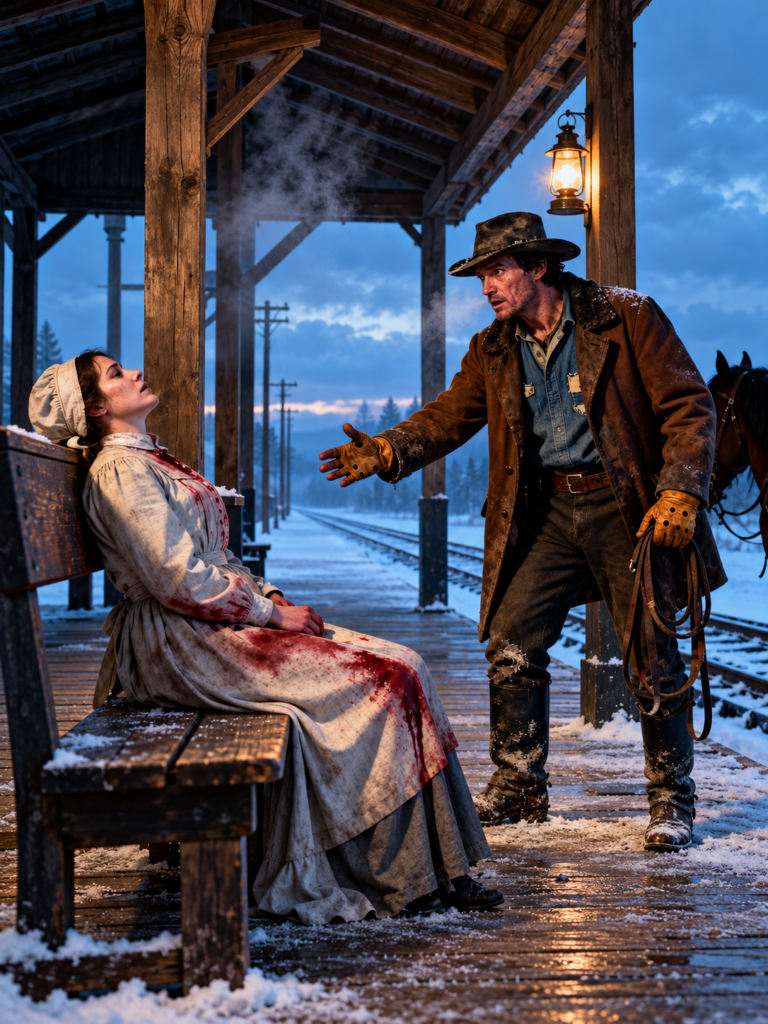
Clay Bennett’s breath clouded the frozen air as the last passenger disappeared into the blizzard. The Redemption Bluff train station stood empty, a lonely oil lamp flickering against the December darkness.
He’d come for supplies that never arrived, another broken promise in a long line of them.
He turned toward his horse when he saw her.
A woman slumped against the wooden bench. Her nurse’s uniform stained with blood. Her lips were blue. One hand clutched a leather medical bag like it was the only thing tethering her to life.
Clay approached slowly, boots crunching on frozen snow. Her breathing came shallow and weak. Frostbite darkened her fingertips.
She mumbled something.
“The child… and I tried.”
He crouched beside her, touched her shoulder. Ice crystals clung to her hair.
His mind ran the calculations every poor man knows. His cabin sat two hours away through deadly cold. He had firewood for maybe a week if he stretched it, food for two weeks if he didn’t eat much.
Taking her in might cost him everything.
But leaving her meant certain death.
Out here, a man’s measured by what he does when nobody’s watching, his father used to say.
Clay pulled off his only coat and wrapped it around her thin frame. He lifted her, lighter than she should be, and placed her across his horse’s saddle.
Her medical bag he tied carefully beside her.
“Don’t know who you are, stranger,” he said to her unhearing ears. “But dying alone ain’t right for nobody. You hold on. You hear?”
He climbed up behind her, keeping her steady against his chest.
The station lamp grew smaller as they rode into darkness.
Snow began to fall harder, erasing their tracks.
Clay muttered into the wind, “God help us both.”
The frozen woman didn’t answer, but her heart still beat against his arm.
For now.
That was enough.
Clay kicked the cabin door open and carried her to his only bed.
The one-room structure felt colder than outside.
He started a fire with numb, trembling hands, coaxing reluctant flames from damp kindling.
Steam rose as snow melted from her uniform. He worked quickly, clinically, stripping away her frozen outer clothes.
His wife’s old blanket and his only quilt went around her.
The fire caught and held.
Three days blurred together.
Fever ravaged her. She thrashed and called out names he didn’t recognize.
He forced thin broth between her cracked lips. Kept the fire burning. Slept sitting up in his chair, jerking awake every hour to check her breathing.
On the fourth morning, her eyes opened.
Terror flashed across her face. She tried to sit up, scanning the unfamiliar room, the rough furniture, the leaking roof, the photos on the mantel.
“Where am I? Who are you?”
Clay backed away, hands raised peacefully.
“You’re safe, ma’am. Found you froze near dead at the station. I’m Clay Bennett. This is my land.”
She stared at him, breathing hard, deciding whether to trust.
Her gaze fell on the medical bag sitting carefully beside the bed.
“My bag? You didn’t…”
“Didn’t touch nothing inside,” Clay said. “Figured it was important to you.”
Some of the fear left her face. She slumped back against the thin pillow.
“Thank you,” she whispered. “I’m Norah Brennan.”
Clay nodded.
“Miss Brennan.”
“Just Norah.”
He moved to the fireplace, added another log.
“You were bad off. Frostbite on your fingers, fever for three days. You’re lucky to be breathing.”
When Norah looked down at her bandaged hands, torn cloth carefully wrapped, she saw the photos on the mantel.
A young woman holding an infant, both smiling, the frame covered in dust.
“Your family?” she asked quietly.
“Was.”
The single word carried three years of grief.
Norah understood without asking.
Loss recognized loss.
“I’m sorry,” she said.
Clay turned from the fire.
“No need. But I got to be straight with you. I got food for maybe two weeks if we’re careful. Winter don’t care about our plans. You bend or you break.”
Norah sat up slowly, ignoring the protest of her aching body.
She looked at this man who’d saved her life. Worn clothes, calloused hands, eyes that had seen too much sorrow.
“Then I won’t be a burden long,” she said. “I’m a nurse, a real one. I can earn my keep.”
Something in Clay’s expression shifted.
Not quite hope, but close to it.
“We’ll figure it out,” he said. “For now, you rest.”
But Norah was already looking out the window, seeing the simple wooden cross in the near distance.
Snow covered the grave, but love had placed it there.
She knew that much.
She whispered again, softer, “I’m sorry for the trouble.”
Clay replied, “No trouble. Just two people trying to get through winter.”
Outside, the wind howled.
Inside, the fire crackled, and for the first time in months, neither of them was completely alone.
Morning light turned the snow-covered hills silver.
Norah stood at the window, staring at the grave marker.
Clay entered with an armload of firewood, followed her gaze, and said nothing.
Over breakfast, thin porridge stretched with water, the truth came out in careful pieces.
“I’m from Boston,” Norah said, hands wrapped around a chipped cup for warmth. “I worked for a wealthy family. The Harrisons.”
Clay listened, spooning his porridge slowly.
“Last fall, the patriarch, old Mr. Harrison, was dying. Cancer, had maybe weeks left. But their housemaid’s child came down with pneumonia. Seven years old. Treatable, if caught early.”
Her voice steadied, rehearsing a story she’d told herself a thousand times.
“They called me for Mr. Harrison. I went to the child first. Mr. Harrison was already gone. Nothing I could do would change that. But the boy, he could live.”
“What happened?” Clay asked.
“I saved the boy. Mr. Harrison died while I was treating him. The family said I chose wrong. Said I murdered their father by choosing a nobody over a somebody. They destroyed my career, made sure no hospital in Boston would hire me, so I left.”
She looked directly at Clay.
“I came west because there was nowhere else to go. That’s who you saved. A disgraced nurse running from her past.”
Clay set down his spoon.
He rolled his left shoulder, a movement Norah noticed immediately with a trained eye.
“Three winters passed,” he said slowly. “I lost my wife Sarah and our baby girl. I was away buying horses, trying to build up the ranch. Make something for us. Sarah went into labor early. By the time I got back…”
He didn’t finish.
Didn’t need to.
“Couldn’t afford a doctor,” he continued. “Couldn’t afford lots of things. Lost most of the ranch paying debts. This cabin and ten acres is all that’s left.”
Norah watched him carefully.
“Your shoulder. That’s an old break, isn’t it? Healed wrong?”
Clay looked surprised.
“Last summer, horse threw me. Never set right.”
“I can fix that,” Norah said. “And I can earn my keep if you’ll let me stay through winter. Treat your neighbors. Anyone who needs help. Split whatever I earn.”
Clay studied her.
“Town will talk. A poor widower and an unmarried woman under one roof. They’ll have opinions.”
“Let them talk.”
“Might not be that simple. But Martha Doyle, my nearest neighbor, she’s good people. Sharp-tongued but fair. If she approves, others might follow.”
Norah extended her bandaged hand across the rough table.
“I won’t be charity, Mr. Bennett.”
“Clay,” he corrected. “And it ain’t charity if you’re working.”
He shook her hand carefully.
“A horse knows a hard man from a kind one. So do I.”
That afternoon, Martha Doyle arrived, a sturdy woman in her sixties with intelligent eyes and a no-nonsense manner.
She looked Norah up and down like she was evaluating livestock.
“So you’re the frozen nurse?” Martha said. “Clay says you’re staying.”
“If he’ll have me,” Norah replied evenly.
Martha turned to Clay.
“Town won’t like this. Warren Kent especially. He’s been looking for reasons to get your land.”
“I know.”
“But I like her.”
Martha set down a basket of preserves.
“Girl’s got purpose in her eyes. That’s more than most folks got.”
After Martha left, Norah found Sarah’s sewing kit in a drawer.
Without asking permission, she began mending Clay’s torn shirt, careful, precise stitches.
Clay watched from the doorway.
The sight of someone caring for his things, his home, his life had cracked something in his chest that had been frozen solid for three years.
“Thank you,” he said quietly.
Norah looked up, smiled slightly.
“Just earning my keep.”
But they both knew it was more than that.
Something was beginning here.
Something neither quite understood yet.
Outside, the first evening star appeared.
Inside, two broken people sat in comfortable silence, mending what could be mended.
January brought routine and rhythm.
Norah worked on Clay’s shoulder each morning, kneading, manipulating carefully, coaxing the joint back to proper alignment.
Clay gritted his teeth through the pain, but within two weeks his range of motion improved noticeably.
Word spread cautiously through the valley.
Martha Doyle mentioned the nurse at Bennett’s place to a desperate mother whose son struggled to breathe.
Through croup, the child gasped.
The woman arrived at dawn, terrified, carrying her gasping child.
Norah worked quickly. Steam tent, herbal poultices, keeping the boy upright through the worst hours.
By evening, his breathing eased.
By morning, the crisis passed.
The mother paid with a basket of eggs and tearful gratitude.
More came after that.
Farmers too proud to see the town doctor.
Ranchers too poor to afford his fees.
A pregnant woman worried about bleeding.
An old man with an infected wound that wouldn’t heal.
Norah treated them all.
She accepted what they could offer. Flour, preserved vegetables, a repaired harness, fresh milk.
Clay built her a small examination area in the corner of the cabin.
Clean, organized, respectful of her profession.
They developed rhythms.
Clay taught Norah to split wood properly. Angle the axe, let gravity do the work.
She showed him how to clean wounds without whiskey. Boiled water and clean cloth worked better and hurt less.
They worked side by side repairing the leaking roof.
Clay on the ladder, Norah handing up shingles.
Both of them laughing when she made a joke about his carpentry skills.
“I can fix bones,” she said. “You fix roofs. We each got our talents.”
“Neighbors might talk, but they remember who helps when the chips are down,” Clay replied, hammering a nail home.
Christmas Eve arrived quiet and cold.
They shared simple stew by firelight.
Clay disappeared into the barn.
Returned with a small wrapped bundle.
“These were Sarah’s,” he said, handing Norah a pair of winter gloves, fine leather, lovingly maintained. “She’d want them used, not locked away.”
Norah’s eyes filled with tears.
The first she’d allowed since Boston.
“Clay, I can’t.”
“You can. You should.”
She tried them on.
Perfect fit.
She looked at him across the firelight.
This good man who’d saved her life and asked nothing in return.
“You’ve done more good in two months than I’ve done in two years,” Clay said quietly.
“You saved my life, Clay. I’m just returning the favor.”
“Feels like more than that.”
The words hung in the warm air between them.
Neither quite brave enough to name what was growing, but both feeling it.
Steady.
Undeniable.
Real.
That night, Clay slept in the barn to maintain propriety, but he lay awake in the hay, watching lamplight glow from the cabin window.
Norah stood at that window, looking toward the barn, one hand pressed against the cold glass.
Sometimes the hardest thing and the right thing are the same.
Both of them were learning that truth together.
The blizzard hit on the third night of January.
Sudden, vicious, screaming wind that turned day to night.
For four days, they were trapped inside.
Snow piled against the door waist-high.
The world disappeared into white chaos.
Only the cabin existed.
Firelight and forced proximity and nowhere to hide.
The first day passed in practical tasks. Rationing food, keeping the fire fed, melting snow for water.
They worked together efficiently, speaking only what was necessary.
The second day brought conversation.
Norah read aloud from Clay’s only book, the Bible.
Clay whittled a small horse figurine, letting the wood shavings fall into the fire.
The silence between words grew comfortable instead of awkward.
The third morning, Norah spoke the full truth.
“The patriarch, Mr. Harrison, he was dying anyway,” she said, staring into the flames. “Cancer had spread everywhere. He had weeks at most, and those weeks would have been agony. The boy had pneumonia, but it was early, completely treatable.”
Clay’s hands stilled on the wood.
“I knew what they’d say. I knew what it would cost me. But that child was seven years old with his whole life ahead. Mr. Harrison was eighty-three and ready to go. He told me so himself the week before.”
Her voice cracked.
“I chose, and they called me a murderer anyway. Said I let a somebody die to save a nobody.”
Clay set down his whittling, moved to sit beside her on the floor by the fire.
“I chose wrong, too,” he said quietly. “I was buying breeding horses. A business decision. Trying to build something for us. Sarah went into labor early. If I’d been there…”
“You couldn’t have known,” Norah interrupted.
“Neither could you.”
They looked at each other.
The firelight caught gold in Norah’s hair, shadowed the grief lines around Clay’s eyes.
“We’re both carrying guilt that ain’t ours to carry,” Norah whispered.
Clay nodded slowly.
“Reckon we are.”
The fourth afternoon, the wind finally died.
Weak sunlight filtered through.
Clay taught Norah to dance.
No music, just his humming an old tune his mother once sang.
They moved clumsily in the small space, laughing when they bumped into furniture.
The laughter faded.
They stood close, swaying gently, his hand on her waist, hers on his shoulder.
The moment stretched, fragile and precious.
Clay leaned in slowly, giving her time to pull away.
She didn’t.
The kiss was tentative, gentle, full of question and answer both.
Norah pulled back, breathing unsteadily.
“Clay, I can’t. If I ruin you…”
“You ain’t ruining nothing,” he said firmly. “You’re fixing what’s been broke.”
She kissed him again, less tentative this time.
The fire crackled.
The storm outside had passed.
The storm inside was just beginning.
The good kind.
The kind that washes things clean.
When they separated, Clay smiled.
Actually smiled.
The first genuine one Norah had seen on his face.
“Reckon we’re in trouble now?” he said.
“Reckon we are,” she agreed.
The next morning dawned clear and cold.
They opened the door to find three families waiting.
They’d camped nearby during the storm, needing Norah’s help.
They brought supplies. Smoked meat, fabric, seed corn for spring.
As Norah treated a child’s fever, Clay stood on the porch, watching his community forming, his life rebuilding, his heart learning to beat again.
But at the edge of his property line, barely visible against the snow, sat a man on horseback.
Warren Kent, the town banker.
Watching.
Not approaching.
Just watching.
Then he turned his horse and rode away.
Clay’s stomach tightened.
Storm’s over outside, he thought. But another one’s coming.
The first Sunday in February dawned cold and clear.
Clay and Norah stayed home from church, a deliberate choice to avoid gossip.
But Martha Doyle went and returned at noon with a face like thunder.
“It started, Clay,” she said without preamble. “Kent made his move.”
They sat at the table while Martha explained.
Warren Kent had stood up during service.
He’d called Clay and Norah’s arrangement immoral and a stain on Redemption Bluff’s Christian character.
He demanded Clay send her away within seven days or face consequences.
Credit denial, social ostracism, potential legal action for harboring an unwed woman improperly.
Several families who’d come to Norah for treatment, afraid of Kent’s financial power, had publicly sided with him.
Only the Doyles and the poorest ranchers had spoken in their defense, but they lacked Kent’s influence.
“I’m sorry,” Martha said, her voice tight with anger. “Some folks got more fear than sense.”
That afternoon, Kent himself arrived.
Clay met him outside, wouldn’t let him near the cabin.
“Send her away, Bennett,” Kent said from his fine horse. “One week. After that, I foreclose on this property.”
“I don’t owe you enough for foreclosure.”
Kent smiled coldly.
“You will. I own your credit. One word from me and you can’t buy seed, supplies, nothing. You’ll be bankrupt by spring.”
He leaned forward in the saddle.
“But I’ll make you a deal. Send the woman away. Sign over this land and I’ll forgive your debts. Keep it and I’ll bury you.”
“Why?” Clay asked. “Why do you want this land so bad?”
“Railroad’s coming through. This valley is the best route. Your land sits right in the path. I’d rather buy it cheap than pay fair value.”
Kent straightened.
“It’s just business, Bennett. Nothing personal.”
“A man who won’t stand for something will fall for anything,” Clay said quietly.
Kent’s face hardened.
“One week.”
He rode away, leaving Clay standing in the cold, fists clenched, heart pounding with helpless rage.
Inside, Norah had heard everything through the thin walls.
That night, she packed her medical bag, wrote a letter in careful script.
You gave me back my life. I won’t take yours in return. Thank you for everything. You are the best man I’ve ever known.
At dawn, she walked toward town, bag in hand, letter left on the table.
She made it maybe a mile before Clay caught up on horseback.
He dismounted, blocked her path physically.
“Don’t you dare decide for me.”
“I won’t let you lose everything for me.”
“I lost one woman because I wasn’t there.”
Clay’s voice cracked.
“I ain’t losing another by letting her walk away. If standing with you costs me this land, so be it. Land can be bought again. But you, there ain’t another you.”
Norah’s face crumpled.
“Clay…”
“Whatever happens, we face it together. That’s what… that’s what people do when they…”
He couldn’t quite say the word.
Not yet.
“When they love each other,” Norah finished softly.
Clay nodded, throat tight.
They stood in the frozen road, breath clouding between them.
Finally, exhausted, they sat in the snow.
Clay took her hand.
“I choose you,” he said simply. “Whatever comes.”
Norah leaned against his shoulder.
“Then we face it together.”
They returned to the cabin as the sun rose higher.
Seven days until Kent’s deadline.
Seven days to find a miracle or lose everything.
That night, a wolf howled in the distance, circling, waiting, patient as death.
But inside the cabin, two people sat together by firelight, hands clasped, refusing to let fear win.
Day seven arrived too quickly.
Clay rode into Redemption Bluff alone.
Norah wanted to come.
He’d refused.
“I won’t have you shamed in public.”
But she followed anyway, staying back in the gathering crowd that filled the town square.
Word had spread.
A confrontation was coming.
At the bank, Warren Kent had foreclosure papers ready.
But before Clay could enter, Martha Doyle appeared with twenty families behind her.
Ranchers, farmers, laborers, people Norah had treated through the winter.
“We got a counteroffer, Kent,” Martha announced loudly. “We pooled our money. Enough to clear Clay’s debt three times over.”
Kent’s face darkened.
“This doesn’t concern you, Martha.”
“The hell it doesn’t. That nurse saved my nephew’s life. Tom Parker’s baby girl. The Wilson boy’s leg. While you’ve been counting coins, she’s been saving lives.”
Kent took the fight public.
He strode into the town square where the crowd had gathered.
Church folks, merchants, curious onlookers.
“This is about decency,” Kent shouted. “Bennett harbors an unmarried woman. He flouts Christian values. Are we going to allow this corruption?”
Murmurs rippled through the crowd.
Some approving, some uncertain.
Then Dr. Samuel Hayes stepped forward.
The elderly town physician, respected and quiet, rarely spoke in public.
When he did, people listened.
“That nurse has done more good in three months than I’ve managed in three years,” he said clearly. “She treats those I turn away because they can’t pay. She sits with the dying when nobody else will. If that’s immoral, then judge me too, because I sure as hell haven’t shown that kind of charity.”
The crowd shifted, uncertain now.
Clay pushed through to the center.
Faced them all.
“You want to judge her? Then judge me. Judge every man here who’s let pride keep him from asking help. Judge every mother who brought her sick child to Norah in the dark of night because she couldn’t afford daylight prices.”
His voice grew stronger.
“This woman’s got more Christian charity in her little finger than this whole town’s got in its church building.”
A small voice spoke up.
Tommy, the orphan boy whose infected leg she’d saved from amputation, limped forward.
“She gave me my leg back when Doc Hayes said cut it off,” Tommy said, looking at Kent. “That’s all I know.”
One by one, others stepped forward.
A mother holding a healthy baby.
“Mine would have died without her.”
A rancher.
“She treated my wife for free when I had nothing.”
A widow.
“She sat with my husband when he was dying. Held his hand so he wasn’t alone.”
The tide turned visibly.
Kent felt it.
Made a desperate play.
“You’re all fools,” he snarled, “letting sentiment cloud judgment.”
Martha Doyle stepped directly in front of him.
“You calling me a fool, Warren?”
“You’re a meddling old woman who should mind her own business.”
Martha’s husband, Henry, silent until that moment, rose to his full height.
He was the valley’s largest landowner after Kent.
A quiet man who rarely spoke but carried immense weight when he did.
“My wife ain’t foolish,” Henry said calmly. “And my money don’t go to bullies. I’m pulling my accounts, Kent. All of them. And I’ll build that railroad spur myself before I let you profit from cruelty.”
The crowd erupted in approval.
Other families announced they’d move their money, too.
Kent stood alone, face flushed with humiliation.
He’d miscalculated badly.
In trying to crush Clay, he’d revealed his own greed and lost the town’s respect.
He retreated to the bank, defeated.
Clay stood in the square, breathing hard, hardly believing what just happened.
Then he saw her.
Norah, pushing through the crowd.
He held out his hand.
She took it.
Applause started tentative.
Then strong.
Martha embraced them both.
Tommy hugged Norah’s waist.
Dr. Hayes shook Clay’s hand.
“Judge not by where a person comes from,” the old doctor said, “but by where they’re willing to go.”
They walked home together through melting snow.
Spring was coming.
The worst was over.
But the best was just beginning.
March brought the thaw.
Clay’s apple tree, the one by Sarah’s grave, showed first buds.
Norah touched the rough bark, gently whispered, “Thank you for sharing him. For the gloves. For everything.”
Henry Doyle arrived with a proposal and a wagonload of lumber.
“If you two make it official, get married, establish a proper clinic, I’ll donate materials and organize labor. Twenty families already volunteered.”
Henry grinned.
“Figured it’s time Redemption Bluff had a real medical facility, one that don’t turn folks away.”
Clay looked at Norah.
She looked back.
Hope and question in her eyes.
That evening, Clay said, “I ain’t got much. Probably never will. But what I got, I’d share with you every day till I die, if you’ll have me.”
No fancy speech.
No flourishes.
Just truth.
Norah smiled through tears.
“Yes, on one condition.”
“Name it.”
“We build that clinic together so no one else loses someone they love because they can’t afford help.”
Clay kissed her.
“Deal.”
The wedding happened three days later.
Outdoor ceremony at the cabin.
Simple and honest.
Dr. Hayes officiated, his voice steady with emotion.
The whole community attended.
Families crowding the small yard, children running between adults’ legs, even some folks who’d initially sided with Kent, now ashamed and seeking peace.
Martha cried.
Tommy stood beside Clay as his unofficial best man, chest puffed with pride.
During the vows, Clay and Norah planted an apple tree together, a young sapling from Henry Doyle’s orchard.
“This is for what was,” Clay said, patting soil around the roots.
“And what’s coming,” Norah added.
“For all of us,” Dr. Hayes smiled. “Marriage ain’t just two people. It’s a promise to build something that outlasts you. These two already started. We’re just catching up.”
“Amen,” the community responded.
After the ceremony, construction began immediately.
No point wasting daylight.
Men raised the clinic frame in an addition to the cabin’s east side.
Women organized the first meal in the expanded kitchen.
Saws sang.
Hammers rang.
Children played.
Tommy approached Clay shyly.
“Can I… can I stay? Help you build?”
Clay looked at Norah.
She nodded, smiling through happy tears.
“Son,” Clay said, voice thick, “you already are part of this family.”
Tommy beamed.
By sunset, the clinic frame stood rough but sturdy.
Two more children arrived that evening.
Siblings, seven and five, orphaned by winter’s cruelty.
Their aunt couldn’t keep them.
Norah welcomed them in without hesitation.
“We got room. We’ll make more if we need to.”
That night, Clay and Norah stood on the porch, watching their expanded family through the window.
Tommy helping the younger children settle in.
The clinic frame silhouetted against the darkening sky.
“Love ain’t just a feeling,” Clay said quietly. “It’s choosing to build every single day.”
Norah leaned against him.
“Then let’s keep building.”
Stars appeared overhead.
The apple tree’s shadow stretched across Sarah’s grave, not erasing the past, but growing from it.
Something good was taking root here.
Something that would last.
Spring 1884.
One year later, a traveling journalist from Harper’s Weekly sketched the bustling scene.
Norah teaching three women midwifery techniques in the clinic’s bright examination room.
Clay working with ranchers in the new corral, evaluating breeding stock.
Tommy, now fourteen and tall, helping two younger children feed chickens.
The hand-carved clinic sign read:
Bennett Family Clinic. All Welcome.
The journalist, a sharp-eyed woman named Elizabeth Worth, interviewed patients throughout the day.
An elderly woman clutching a healthy baby.
“My granddaughter would have died in childbirth without Nurse Norah. She delivered her when Doc Hayes was too sick to come.”
A weathered farmer.
“Clay gave me seed on credit when the bank wouldn’t. Paid him back double. That’s the kind of man he is.”
A widow.
“She sat with my husband through his last night. Held his hand. Sang to him. He didn’t die alone.”
Dr. Samuel Hayes, now semi-retired, spent his afternoons apprenticing under Norah before leaving medicine entirely.
That evening, he gifted her his medical library.
Thirty precious books.
A lifetime of accumulated knowledge.
“You taught this town that healing ain’t just medicine,” he said, voice rough with emotion. “It’s dignity. It’s seeing people as worthy of care regardless of their means.”
He patted the stack of books.
“These will serve you better than they served me.”
Norah embraced him, unable to speak.
Evening settled gently.
The journalist shared her draft article.
Clay and Norah read it together by lamplight while the children played quietly nearby.
Elizabeth’s prose was clean and powerful.
The Nurse of Redemption Bluff: How One Woman and a Poor Rancher Changed the Frontier.
It told their story honestly.
The frozen train station, the scandal in Boston, the community’s initial judgment, the public stand, the transformation.
In a land where harshness often hardens hearts, Elizabeth had written:
Clay and Norah Bennett chose differently. They proved that broken people, given kindness and purpose, don’t just survive. They build. They build something that outlasts them.
This clinic, serving the forgotten and the poor, stands as testament. Redemption isn’t granted. It’s built log by log, life by life.
Norah’s eyes filled with tears.
“She got it right. She wrote about all of them. Every family.”
“That’s because it’s the truth,” Clay said. “You don’t need to fancy up the truth.”
Tommy appeared in the doorway, followed by the three younger children, the orphans now fully part of the family.
“Mama Norah, are we famous?” Tommy asked, having overheard.
Clay laughed, pulled the boy close.
“No, son. We just lived right. Sometimes that’s enough to change things.”
The youngest child, a girl of six named Hope, tugged Norah’s skirt.
“Can we have a story?”
“Always,” Norah said, settling into the rocking chair Clay had built for her.
They gathered around.
Four children.
One good man.
One woman who’d found her purpose.
Outside, the original apple tree bore its first fruit.
Norah had picked one that afternoon, given it to Hope like a blessing.
As she began the story, Clay stood at the window.
The clinic glowed with lamplight.
Smoke rose from two chimneys now.
Horses moved peacefully in the expanded corral.
Wildflowers bloomed where there had been only snow.
He thought of Sarah sometimes still, but the grief no longer crushed him.
She was part of this.
Her gloves that saved Norah’s hands.
Her grave that taught him loss could transform into growth.
Her memory that made him brave enough to love again.
Some things, when built right, last forever.
Martha Doyle had said that at the wedding.
Clay believed it now.
Later, after the children slept, Clay and Norah sat on the porch.
The journalist’s article lay between them.
“They’ll remember us,” Norah said softly.
“Maybe. But that ain’t why we did it.”
“No,” Norah agreed. “We did it because it needed doing. Because someone helped us when we needed it most.”
Clay took her hand, squeezed gently.
“And because we learned something important.”
“What’s that?”
“That redemption ain’t about forgetting what broke you. It’s about using those broken pieces to build something new. Something stronger.”
Norah kissed him, gentle, grateful, full of the quiet joy that comes from lives lived with purpose.
Stars wheeled overhead.
The apple blossoms fell like snow, white and pure, carrying the promise of fruit to come.
Inside, four children dreamed safe dreams.
Outside, a community slept soundly, knowing help was near if needed.
And in a small cabin that had become a clinic, that had become a home, that had become a legacy, two people who’d been lost had found each other, found purpose, found a way to turn their pain into something that healed others.
The journalist’s final paragraph captured it perfectly.
That clinic still stands today, over a century later, now a museum. But the town remembers history isn’t always made by the powerful. Sometimes it’s made by the broken who chose to heal, the judged who chose to forgive, the poor who chose to give.
Anyway, Clay and Norah Bennett didn’t just survive that winter.
They showed us what love looks like when it’s built on purpose, not just passion.
When it’s built to last.
And their story, our story, reminds us that kindness given freely creates ripples that reach far beyond what we can see.
That’s the history worth remembering.
That’s the legacy worth building.
The end.


