
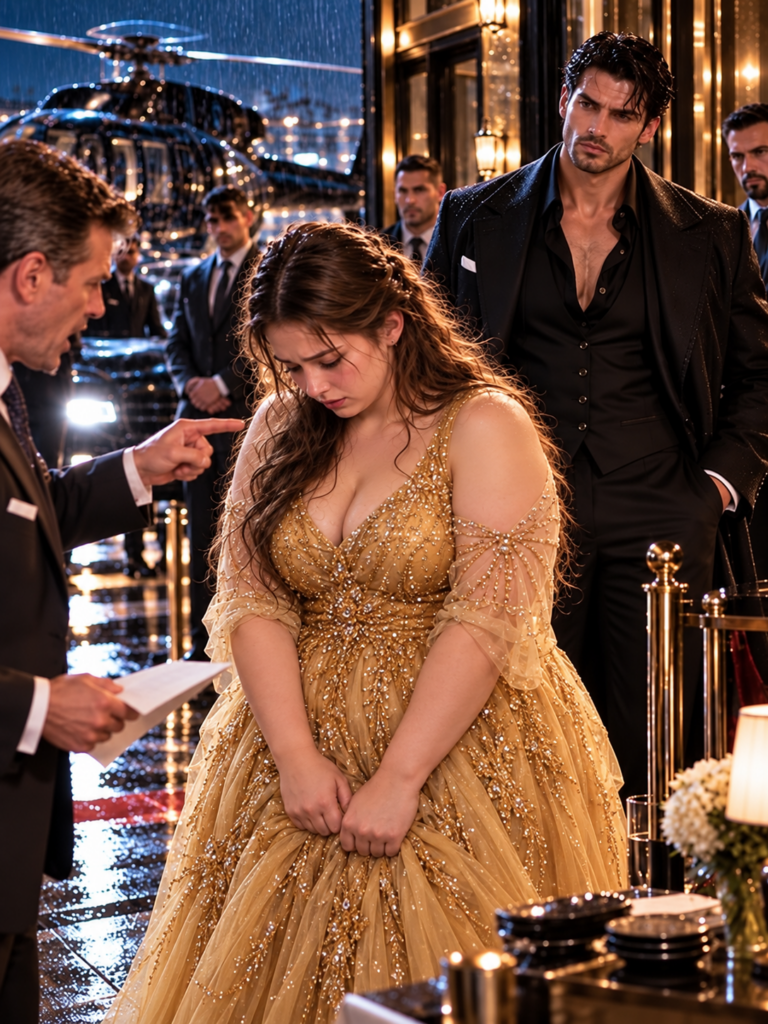
PART 2
“Who fired her?”
Roman’s voice was quiet.
That made the kitchen seem even more silent.
David Kesler stood beside the stainless-steel preparation counter with one hand still hovering near the office door. Around us, cooks, servers, and dishwashers had stopped moving. Even the printer beside the pass had gone still between orders.
I looked from Roman to the three men behind him.
He looked nothing like the man I had left bleeding beneath the fire escape.
His hair was dry now. His face still seemed paler than it should have, but he stood straight, dressed in a clean charcoal suit with a dark shirt buttoned neatly beneath it. Only the stiffness in his posture hinted that less than two hours earlier I had been pressing a torn apron against his side.
David swallowed.
“I did.”
Roman’s eyes moved to the envelope on the floor.
Then to my stained blouse.
Then back to David.
“Why?”
David seemed confused by the question.
“She arrived forty-five minutes late. She came into the restaurant covered in blood. We have important guests tonight.”
“She was covered in my blood.”
A murmur moved through the kitchen.
My face grew hot.
Roman glanced at me.
“She stopped because I was injured. She stayed because I needed help. If she had walked past me, she would have been on time.”
David’s expression shifted from disbelief to something closer to panic.
“I didn’t know that.”
“No,” Roman said. “You didn’t.”
There was no threat in his voice.
That somehow made it worse for David.
He looked at me as if seeing me for the first time.
“Megan, you should have explained.”
“I did.”
“I mean—you should have told me who he was.”
“I didn’t know who he was.”
Roman’s mouth tightened slightly.
Neither a smile nor anger.
Just recognition.
One of the men behind him stepped forward and murmured, “Mr. Vale, the car is waiting.”
Vale.
The name struck me.
Roman Vale.
Even I knew that name.
Vale Properties owned half a dozen restored buildings in the neighborhood, including the narrow brick block that housed Laura. I had seen the company name on maintenance notices and rent paperwork taped in the manager’s office.
David knew it too.
That explained the color draining from his face.
Roman did not look at him again immediately.
Instead, he bent slowly, favoring his left side, and picked up the envelope.
He held it out to me.
I stared at it.
“You dropped this,” he said.
“I didn’t.”
His eyes flicked toward David.
“No,” he said. “You didn’t.”
I took the envelope.
The edges were damp from the floor.
“I should go,” I whispered.
David stepped forward.
“Megan—”
Roman raised one hand, not sharply, simply enough to stop the moment from becoming uglier than it already was.
Then he surprised all of us.
He turned to me and said, “Do you want your job back?”
I opened my mouth.
Nothing came out.
I had spent the last ten minutes wanting exactly that.
Begging for it in my head.
Thinking of Leo’s prescription waiting behind the pharmacy counter.
Thinking about rent due in six days.
Thinking about the groceries in my kitchen that had to last until Friday.
Yet standing there with the entire kitchen listening, the answer did not come as quickly as I expected.
I looked at David.
He was terrified.
Not of me.
Of what Roman might do because of me.
And suddenly, if I accepted my job back that way, I knew exactly what the next weeks would feel like.
Every schedule David gave me would carry Roman’s shadow.
Every mistake I made would become dangerous for someone else.
Every coworker would wonder whether I was still there because I deserved to be or because the building owner had walked through the kitchen and spoken my name.
“I don’t know,” I said.
David blinked.
Roman studied me.
“You don’t have to decide now.”
“I need the money now.”
“I understand.”
“No,” I said, perhaps more sharply than I intended. “I don’t think you do.”
One of his men shifted.
Roman did not.
He merely nodded.
“That’s fair.”
The answer disarmed me.
He reached inside his coat.
For one wild second, I remembered the armed men in the alley.
But he only removed a plain white business card.
He wrote something on the back.
“This is my office number. Not my assistant’s. Mine.”
I did not take it.
“I don’t want money.”
“I didn’t offer money.”
“What are you offering?”
“A conversation tomorrow.”
“About what?”
His gaze settled briefly on David, then returned to me.
“About why this restaurant is going to need a new operating structure regardless of what happened tonight.”
David went completely still.
Roman handed me the card.
This time I took it.
Then he said, “Go home to your son, Megan.”
I stared at him.
“How do you know I have a son?”
The silence returned.
Roman’s expression changed.
Barely.
But I saw it.
He had made a mistake.
David had heard me say my son was sick.
Roman had not.
At least, I did not remember him hearing it.
His answer came a second too late.
“You mentioned him in the alley.”
“No, I didn’t.”
One of the men behind him looked away.
Roman held my gaze.
Then he said softly, “Tomorrow.”
And walked out.
I spent the bus ride home staring at his business card.
ROMAN VALE
VALE URBAN HOLDINGS
A phone number had been written in black ink beneath his name.
Nothing else.
I turned the card over and over between my fingers while rain slid across the bus windows in crooked streams.
How did he know about Leo?
Maybe I had mentioned him.
People said strange things under stress.
Maybe while I was talking to keep Roman conscious, I had rambled about my life without remembering.
I tried to reconstruct every second.
I had asked his name.
Told him mine.
I had said he needed to stay awake.
I had told him that if he passed out I would keep talking anyway because I had once spent three straight hours explaining dinosaurs to a five-year-old—
I stopped.
Had I said that?
Maybe.
It was possible.
By the time I reached our building, I had almost convinced myself.
Our apartment was on the third floor of a narrow brownstone in Albany Park. The hallway always smelled faintly of someone’s dinner and the lemon cleaner our landlord used twice a week.
Mrs. Alvarez from across the hall opened her door before I could find my keys.
“There she is.”
She was sixty-three, wore slippers decorated with strawberries, and had been looking after Leo during my evening shifts since my sister moved to Milwaukee.
“Is he okay?”
“He ate soup. Complained about the peas. Watched the same cartoon twice. No fever.”
Relief loosened something inside my chest.
Mrs. Alvarez looked down at my clothes.
Her eyebrows rose.
“That is not tomato sauce.”
“It’s a long story.”
“Good long or bad long?”
“I don’t know yet.”
She studied me for another moment and then squeezed my arm.
“Leo is asleep on the couch. I didn’t move him.”
I found him curled beneath his blue dinosaur blanket, one cheek pressed into the cushion, his dark curls damp against his forehead.
I touched his skin.
Warm, but not feverish.
His eyes opened.
“Mom?”
“Hey, bug.”
“You’re home early.”
“I am.”
He pushed himself up and immediately winced, one hand going to his ear.
“Still hurts?”
“A little.”
“I’m getting your medicine.”
“Tonight?”
I looked at the paycheck in my hand.
“Yes.”
Mrs. Alvarez refused payment for the night.
“You can catch me next week,” she said.
I almost told her there might not be a next week.
Instead, I changed clothes, woke Leo enough to put on his raincoat, and we walked the four blocks to the twenty-four-hour pharmacy.
The antibiotics cost more than I hoped and less than I feared.
The first dose was given at our kitchen table with chocolate milk.
Leo made a face.
“It tastes like pink.”
I laughed despite everything.
“What does pink taste like?”
“That.”
He pointed accusingly at the medicine.
It was the first moment all night that felt normal.
After he went to bed, I sat at the kitchen table with a calculator, my final paycheck, and three unopened bills.
The numbers did not work.
No matter how many times I rearranged them, they did not work.
Rent.
Medicine.
Electricity.
Groceries.
Bus card.
Then nothing.
My phone buzzed.
A text from Sophie, another server at Laura.
ARE YOU OKAY???
A second came immediately.
DAVID CLOSED HIS OFFICE AND HASN’T COME OUT. WHO WAS THAT MAN?
I typed:
Building owner.
Three dots appeared.
Then:
OH MY GOD.
I almost smiled.
Instead, I set the phone down.
At 11:18, another message arrived.
Unknown number.
This is Roman Vale. I apologize for contacting you late. You were right earlier. You did not mention your son in the alley.
I stared at the screen.
Another message followed.
I would like to explain tomorrow. Nothing is required of you. 10:00 a.m. My office address is below. If you prefer not to come, I will understand.
My hands went cold.
He admitted it.
He had known about Leo before tonight.
I typed three different responses and erased them.
Finally:
How did you know?
The reply came almost immediately.
That is the conversation I owe you.
I slept badly.
The next morning, after walking Leo to kindergarten and explaining to his teacher that he might be tired because of the ear infection, I nearly went home.
Instead, I took the train downtown.
Vale Urban Holdings occupied four floors of a renovated warehouse near the river.
The lobby had polished concrete, old brick walls, and the kind of quiet that made you feel as if everyone inside had already finished something important before breakfast.
A receptionist stood when I gave my name.
“Mr. Vale is expecting you.”
Of course he was.
I followed her to an office that surprised me.
No marble desk.
No dramatic skyline.
Roman’s office had bookshelves, architectural models, framed black-and-white photographs of old Chicago neighborhoods, and a battered wooden desk that looked older than either of us.
He stood when I entered.
Slowly.
“You should be in a hospital,” I said.
“I was treated.”
“That wasn’t what I said.”
For the first time, he smiled.
Briefly.
“No. It wasn’t.”
He gestured toward a chair.
I remained standing.
“How did you know about my son?”
Roman lowered himself back into his chair.
“Three months ago, Vale purchased the controlling interest in Laura.”
“I thought you only owned the building.”
“We did until July.”
My confusion deepened.
He continued.
“The restaurant has been losing money for eighteen months.”
That surprised me.
Laura was always full.
“Full dining rooms do not always mean profitable restaurants.”
“What does that have to do with me?”
“I began reviewing the operation.”
He opened a folder.
Inside were schedules.
Payroll sheets.
Customer comments.
Employee evaluations.
My stomach tightened.
“You investigated me?”
“I reviewed every department.”
“That’s a nice way to say it.”
“Yes.”
At least he did not pretend otherwise.
Roman folded his hands.
“Your name kept appearing.”
I almost laughed.
“Because I was late yesterday?”
“Before yesterday.”
He slid one page across the desk.
It was a comment card.
I recognized the handwriting.
A woman named Mrs. Bellamy had written it after I helped arrange a special dinner for her husband’s seventy-fifth birthday.
Another page.
A note from a kitchen porter named Ellis saying I had stayed thirty minutes after my shift to help him when his bus route changed.
Another.
A schedule request.
A customer email.
A training sheet.
“What is this?”
“Evidence.”
“Of what?”
“That Laura has an unusual problem.”
I looked at him.
Roman said, “The employees holding it together are the ones management notices least.”
I sat down.
He opened another folder.
This one contained employee emergency contact information.
My name.
My address.
And beside dependent information:
LEO CARTER — SON — AGE 5.
I stared at it.
“That’s how you knew?”
“Partly.”
“Partly?”
Roman exhaled.
“I remembered your name before you told me.”
My heart began to beat harder.
“From the payroll review?”
“No.”
His eyes remained on mine.
“From an application.”
“What application?”
“A community management program Vale funded last year.”
I frowned.
“I never applied for anything.”
“No. But someone applied on your behalf.”
He turned the final page toward me.
There was my name at the top.
Beneath it was a recommendation letter.
The signature at the bottom stopped me.
David Kesler.
For several seconds I could not speak.
“That doesn’t make sense.”
“It didn’t make sense to me either.”
“David fired me.”
“Yes.”
“But he recommended me?”
“Yes.”
“For management?”
“Assistant operations training.”
I read the letter.
It described me as calm under pressure.
Reliable with guests.
Trusted by staff.
Able to solve problems without making other people feel small.
The words made my throat tighten because they did not sound like the David I knew.
Except maybe once they had.
When I first started at Laura two years earlier, he had been patient. He had taught me how to describe wine pairings without pretending to know more than I did. He had covered two of my shifts when Leo had the flu.
Somewhere during the last year, that version of him had disappeared.
“Why didn’t anyone tell me?”
Roman’s expression became thoughtful.
“That’s one of the questions I wanted to ask David.”
“Did you?”
“Not yet.”
I looked at the application again.
“Why were you in that alley?”
He was silent long enough for me to notice.
The question mattered.
Finally he said, “I had a meeting nearby.”
“With people who carry guns?”
His gaze sharpened.
“They are licensed security. Yesterday was unusual.”
“That still isn’t an answer.”
“No.”
I waited.
Roman looked toward the windows.
“The meeting concerned Laura.”
I felt the room grow smaller.
“What about Laura?”
“There has been money disappearing from the business.”
“David?”
“I don’t know.”
“You think he’s stealing?”
“I didn’t say that.”
“Then what are you saying?”
“That someone has been hiding losses and moving money between vendor accounts. I came downtown because I believed I was finally going to learn why.”
The alley.
The blood.
The men.
I shook my head.
“This is exactly the kind of thing I do not need in my life.”
“I agree.”
That answer surprised me.
Roman closed the folder.
“I don’t want you involved in that investigation.”
“Then why tell me?”
“Because it affects the offer I’m about to make.”
I almost laughed.
“I told you I don’t want charity.”
“This is not charity.”
He pushed a single sheet of paper across the desk.
At the top:
INTERIM GUEST SERVICES COORDINATOR — LAURA RESTAURANT
I stared at the salary.
It was more than I made serving.
Not dramatically more.
Enough to matter.
“I’m a waitress.”
“You understand the staff.”
“I carry plates.”
“You solve scheduling problems before management notices them. You remember regular customers. You know which suppliers are late, which tables wobble, which cooks communicate well under pressure, and which new servers need help before they ask.”
“You learned all that from paperwork?”
“Some.”
“And the rest?”
Roman leaned back carefully.
“I ate at Laura four times in the last two months.”
I stared.
“I served you?”
“No.”
“Then—”
“You were always busy.”
Something about that made me uncomfortable.
He noticed.
“I was reviewing the restaurant, Megan. Not you.”
I nodded.
“Good.”
“The position lasts ninety days. After that, the permanent role is determined by performance. You would report to a temporary operations director, not to me.”
“What happens to David?”
“That depends on what we learn.”
I thought of the paycheck on the floor.
Then of the recommendation letter.
“Does he know he recommended me?”
“Yes.”
“Can I ask him why?”
“Yes.”
“Can I refuse this job and still get an answer?”
Roman looked almost offended by the question.
“Of course.”
I picked up the offer sheet.
“What happens if I fail?”
“Then you fail at a job you were given a fair opportunity to try.”
“And if people think I got it because I saved your life?”
“They probably will.”
At least he was honest.
Roman continued, “Your work will have to answer them.”
I looked down at the salary again.
Leo needed stability.
But I needed something else too.
I had spent five years making decisions based entirely on what might disappear next.
Money.
Childcare.
Hours.
Rent.
Security.
Taking this job felt frightening because for once the risk was not losing something.
It was wanting something better.
“I need until tonight.”
“You have it.”
I stood.
At the door, Roman said, “Megan.”
I turned.
“David’s recommendation letter was written eight months ago.”
I looked at him.
“He never submitted it.”
My fingers tightened around the offer.
“Then how did you get it?”
Roman’s expression became serious.
“It was found last week in a file he had marked for deletion.”
I returned to Laura just after two in the afternoon.
The dining room was empty between lunch and dinner service.
David was seated at table twelve with a cup of coffee growing cold in front of him.
He looked exhausted.
When he saw me, he stood.
“Roman called.”
“Of course he did.”
“No. He didn’t tell me what to say.”
I remained near the entrance.
“Why did you write the letter?”
David glanced at the chair opposite him.
I sat.
For a while he said nothing.
Then he rubbed both hands over his face.
“Because you deserved it.”
“Then why didn’t you send it?”
His eyes dropped.
“Because I needed you on the floor.”
The answer hurt more than I expected.
“You kept me from a better job because you needed a server?”
“When two senior servers left, you were the only person I trusted to keep evenings from becoming chaos.”
“So you punished me for being useful.”
“Yes.”
The word was barely audible.
David stared at his coffee.
“I told myself I would submit your name during the next round. Then the restaurant started losing money. Corporate started demanding labor cuts. Every month became another emergency.”
“You could have told me.”
“I could have.”
“You could have asked me to stay.”
“I was afraid you wouldn’t.”
I shook my head.
For once, David looked smaller than his position.
Not defeated.
Simply human.
“I’m sorry about last night,” he said.
“You were cruel.”
“I was.”
“My son’s medicine was waiting at the pharmacy.”
His face changed.
“I know.”
“You knew when you threw that check.”
“Yes.”
Silence settled between us.
I wanted a better apology.
Something that would somehow undo the humiliation.
But real apologies were rarely that clean.
David finally said, “I’ve been angry for months.”
“At me?”
“No.”
He looked around the empty restaurant.
“At myself. At the numbers. At the owners before Vale. At everyone who kept telling me to make this place look successful while cutting everything that actually made it work.”
“Did you take money?”
His eyes snapped to mine.
“No.”
“Roman says money is missing.”
David’s expression became guarded.
“He told you that?”
“Enough of it.”
He looked toward the kitchen.
Then back at me.
“There’s something you should see.”
He stood and led me into his office.
From the bottom drawer of the filing cabinet, he removed a thick envelope.
Inside were photocopies of invoices.
Dozens of them.
“What am I looking at?”
“Food supplier charges.”
I scanned the pages.
The amounts meant little to me.
David pointed to a name.
MARCHAND HOSPITALITY SERVICES.
“I’ve never heard of them.”
“Neither had I.”
“But we paid them?”
“Every month.”
“For what?”
“That’s the problem.”
He slid another paper toward me.
The mailing address belonged to a vacant storefront two neighborhoods away.
I looked at David.
“You found this?”
“Three weeks ago.”
“Did you tell Roman?”
“I was going to.”
“When?”
David gave a tired laugh without humor.
“Yesterday.”
I froze.
“The meeting Roman had?”
David nodded.
“He called me Thursday. Said someone had contacted him claiming to know who was behind the payments.”
“Who?”
“I don’t know.”
“Then why didn’t you go?”
“Because whoever contacted him told him not to bring restaurant staff.”
I thought of the alley.
A cold feeling moved through me.
“David…”
“I know.”
“You should give these to Roman.”
“I will.”
I gathered the invoices.
One page shifted loose from the pile.
Underneath it was another document.
A bank authorization form.
At the bottom, approving vendor payments, were two signatures.
One belonged to David.
The second belonged to someone named Eleanor Vale.
I looked up.
“Who is Eleanor?”
David’s expression changed.
“You really don’t know?”
“No.”
He stared at the signature.
Then at me.
“Eleanor Vale is Roman’s mother.”
And for the first time since the alley, I wondered whether Roman Vale had come to Laura looking for a thief—
or looking for the truth about his own family.
PART 3
The following morning, I accepted the ninety-day position.
Not because I trusted Roman.
Not yet.
And not because I had forgiven David.
I accepted because Leo needed stability, I needed work, and somewhere beneath all the fear I felt a small, stubborn curiosity about what I might become if I stopped assuming survival was the most I was allowed to want.
My first day as interim guest services coordinator began with Sophie placing a mug of coffee on my new desk.
The desk was hardly glamorous.
It sat in a narrow office near the coatroom where old menus and broken reservation tablets had once been stored.
Sophie leaned against the doorframe.
“So.”
“So?”
“You have an office.”
“I have a closet with a lamp.”
“You have a door.”
“It sticks.”
“You have risen above us.”
I laughed.
It felt good.
Then Sophie’s expression softened.
“People are talking.”
“I assumed they would.”
“Some think Roman gave you the job because of what happened.”
“He did give me the job because of what happened.”
“No. What happened made him notice the timing. Your work got you the offer.”
I looked at her.
“You sound very certain.”
“I read the recommendation letter.”
My mouth fell open.
“What?”
“David showed it to me last year.”
I stood.
“You knew?”
“Not that he never sent it.”
That stopped me.
Sophie crossed her arms.
“He asked me whether I thought you’d take a management training role.”
“What did you say?”
“I said yes.”
“And?”
“I told him you would probably be terrified and then do it anyway.”
Despite myself, I smiled.
“That sounds accurate.”
“He looked worried after that.”
“Because he needed me on the floor.”
“Probably.”
Sophie paused.
“But I think there was more.”
“What?”
“I don’t know.”
That became the theme of my first week.
I don’t know.
Roman’s mother’s signature appeared on vendor authorizations.
David had known about the suspicious invoices but had not understood who created the vendor.
Accounting said the payments had begun sixteen months earlier.
The old ownership group had approved them.
Vale had inherited the arrangement when it purchased control.
And somehow, no one had asked the simplest question.
What service was Marchand Hospitality actually providing?
Roman’s finance team began reviewing records.
I stayed out of it.
Mostly.
My job was the restaurant itself.
And almost immediately, I understood why David had been unraveling.
Laura looked elegant from the dining room.
Behind the walls, it was held together by tired people performing invisible miracles.
The dishwasher had been leaking for months.
Two cooks were working six days a week because David had postponed hiring.
The reservation system double-booked corner tables.
Servers traded shifts through text messages because the official scheduling program had not been updated in years.
A pastry chef named Nia was buying vanilla beans with her own money because the approved supplier kept sending low-quality substitutes.
“You’re reimbursing yourself, right?” I asked.
Nia gave me a look.
That was my answer.
By Thursday, I had filled an entire notebook.
At home, Leo colored beside me while I organized my notes.
He had finished most of his antibiotics and returned to his usual cheerful energy.
“What’s that?” he asked.
“Work.”
He peered at the pages.
“You write a lot.”
“I’m trying to fix things.”
“Like Grandpa fixes sinks?”
“My dad was terrible at sinks.”
Leo considered this.
“Like Mrs. Alvarez fixes everything?”
“That is more accurate.”
He went back to coloring.
Then he asked, “Do you like your new job?”
The question caught me.
“I think so.”
“Then why do you make the worried face?”
“What worried face?”
He demonstrated by squeezing his eyebrows together.
I laughed.
Then I realized he had seen that expression often enough to imitate it.
“I’m learning.”
He nodded as if that made perfect sense.
“Learning is hard.”
“Yes.”
“Then it gets easy.”
“Sometimes.”
He added another blue cloud to his picture.
Simple truths sounded different coming from a five-year-old.
Roman did not visit Laura until the following Monday.
When he arrived, there was no entourage.
No black SUV waiting outside.
Just Roman in a navy coat, moving with more ease than the week before.
I was standing near the host station explaining a new reservation policy to two servers.
He waited until I finished.
“How’s the revolution?”
“There is no revolution.”
“David says you replaced his scheduling system.”
“David’s scheduling system involved three dry-erase markers and prayer.”
Roman smiled.
“I noticed.”
“Why are you here?”
“To eat.”
“You own the restaurant.”
“I still need lunch.”
I hesitated.
“You could have it somewhere else.”
“I could.”
He seemed amused, but not offended.
Then his expression turned more serious.
“And I wanted to see how you were doing.”
“I’m doing my job.”
“I can see that.”
He took a table near the window.
I returned to work.
For the next hour, I deliberately ignored him.
Not rudely.
Professionally.
He ordered onion soup and trout.
He spoke quietly with Nia when she delivered dessert.
He thanked Ellis when he cleared the table.
Then he paid his bill.
That surprised me.
“You’re charging yourself?” I asked when I saw the receipt.
“Accounting prefers it.”
“You tip yourself too?”
“I tip the staff.”
I glanced at the amount.
Generously, but not absurdly.
“Can I ask you something?”
“You usually do.”
“Why didn’t you tell me Eleanor Vale was your mother?”
Roman’s expression changed.
He glanced toward the dining room.
“Not here.”
“Your office?”
“No.”
That surprised me more.
“Walk with me.”
We stepped outside.
The rain had finally stopped after nearly a week of gray skies.
The sidewalks shone beneath a pale afternoon sun.
Roman kept one hand inside his coat pocket as we walked slowly toward the river.
“My mother founded Vale Urban Holdings with my father,” he said.
“Is she still involved?”
“Technically, no.”
“But her signature is on restaurant payments.”
“Yes.”
“Did she authorize them?”
“I don’t know.”
“You really don’t?”
“No.”
I studied him.
He looked tired.
Not physically.
Something deeper.
“My mother has early-stage memory problems.”
My questions stopped.
Roman continued.
“She manages most of her daily life. She knows me. She knows where she lives. She reads the paper every morning and argues with me about interest rates.”
A faint smile appeared.
“But complex financial decisions became difficult before any of us understood what was happening.”
“And someone might have used her signature?”
“That is one possibility.”
I regretted the suspicion I had carried.
“I’m sorry.”
“Thank you.”
“Does she know you’re investigating?”
“Yes.”
“How did she take it?”
Roman looked toward the river.
“She thinks she made the payments herself.”
“But you don’t?”
“I don’t know.”
Again.
That phrase.
“So what happened in the alley?”
Roman stopped walking.
For several seconds, he watched bicycles move along the path below us.
“The person who asked to meet me was named Thomas Bell.”
“Who is he?”
“A former financial controller for one of my family’s companies.”
“Former?”
“He left two years ago.”
“Why?”
“I thought he retired.”
“And now?”
“Now I think he was trying to tell me something.”
“What?”
“I never got the chance to ask.”
A chill moved across my shoulders.
“Was he there that night?”
Roman nodded.
“But he left before your men arrived?”
“Yes.”
“Did he hurt you?”
“No.”
The certainty in Roman’s answer was immediate.
“Then what happened?”
“I followed him into the alley because he believed someone had been watching him. We argued. He told me I was asking the wrong questions. Then a delivery truck turned into the street and there was confusion near the entrance.”
He paused.
“I was injured during it.”
He did not elaborate.
I appreciated that.
“What did Thomas say before he left?”
Roman looked at me.
“Ask Eleanor why she kept the blue ledger.”
“The blue ledger?”
“I have no idea.”
Two days later, Eleanor Vale came to Laura.
I recognized her only because Roman had once appeared in a magazine article with his family.
She was seventy-one, elegantly dressed in a green wool coat, with silver hair cut to her jaw.
Roman walked beside her.
She did not seem frail.
She seemed irritated.
“I can walk perfectly well,” she told him as they entered.
“I’m aware.”
“You keep hovering.”
“I’m six feet away.”
“That is hovering for you.”
I liked her immediately.
Roman introduced us.
Eleanor studied me.
“You’re Megan.”
“I am.”
“The alley woman.”
Roman closed his eyes.
“Mother.”
“What? That’s how you described her.”
I tried not to laugh.
Eleanor took my hands.
“They tell me you kept my son from doing something inconvenient like dying.”
“Mother.”
“I’m expressing gratitude.”
“You’re embarrassing everyone.”
“Excellent.”
Her eyes returned to me.
“Thank you.”
“You’re welcome.”
Then she looked around the restaurant.
“I haven’t been here in years.”
Roman stiffened slightly.
I noticed.
“You have,” he said gently.
Eleanor frowned.
“When?”
“Last spring.”
She looked at him.
Then at the dining room.
“Oh.”
The uncertainty lasted only a few seconds, but the entire atmosphere changed.
Roman did not correct her again.
He simply offered his arm.
“Would you like table six?”
“That was your father’s table.”
“I know.”
They sat.
I turned away, suddenly feeling as though I had witnessed something private.
Later, while Roman took a phone call outside, Eleanor wandered toward my office.
She looked at the notebook on my desk.
“You write things by hand.”
“It helps me remember.”
“Smart.”
Then she said, “Computers remember everything until they don’t.”
I smiled.
Her gaze fell on the stack of supplier invoices beside my keyboard.
Marchand Hospitality.
She froze.
“Where did you get that?”
I stood.
“Mrs. Vale?”
She touched the paper.
“Marchand.”
“You recognize it?”
“Of course.”
My pulse quickened.
“What was it?”
She looked at me as if the answer should have been obvious.
“A scholarship fund.”
I stared.
“Scholarship?”
“For employees.”
“You mean restaurant employees?”
“Hotel staff. Restaurant staff. Maintenance people. Anyone who wanted training.”
I remembered the application Roman had shown me.
My application.
Eleanor continued.
“Arthur hated seeing good workers trapped because they couldn’t afford certificates or childcare.”
Arthur.
Roman’s father.
“You paid Marchand for training?”
She nodded.
“I think so.”
“Why was it listed as vendor consulting?”
Eleanor’s expression clouded.
“I don’t remember.”
Roman returned just then.
He saw the invoice in his mother’s hand.
“What happened?”
Eleanor gave it to him.
“Marchand was ours.”
Roman stared at her.
“What?”
“Not ours exactly. Arthur set it up.”
“Dad?”
“For training.”
Roman’s face went still.
“Mother, we have no record of a training foundation called Marchand.”
“Well, you should.”
“Do you remember who managed it?”
She frowned.
“I…”
Roman stepped closer.
“It’s all right.”
“No, I knew.”
“You don’t have to force it.”
“I knew.”
Her frustration sharpened.
Then her eyes suddenly lifted.
“David.”
I felt my stomach drop.
“David managed it?” Roman asked.
Eleanor shook her head.
“No. Not David.”
She pointed toward the restaurant.
“The other one.”
“What other one?”
“The man who worked with David.”
I exchanged a glance with Roman.
Laura had gone through several assistant managers before I was hired.
“Do you remember his name?” Roman asked.
Eleanor closed her eyes.
“M…”
She pressed her fingers to her forehead.
“Mason?”
Roman went pale.
“What?”
Eleanor opened her eyes.
“Mason Vale.”
For a moment, I assumed I had misheard.
Then I saw Roman’s face.
“Mason is your—”
“My brother,” he said.
That evening, Roman came to my office carrying an old cardboard storage box.
“My mother was right.”
Inside were records dating back nearly ten years.
Marchand had not begun as fraud.
It had been a legitimate employee development fund created by Roman’s father, Arthur Vale.
The name came from Arthur’s mother’s maiden name.
For years, it had paid for culinary courses, building certifications, English-language classes, bookkeeping training, and childcare during evening programs.
Then, after Arthur died four years earlier, the program had quietly disappeared.
Except the payments had not.
I turned pages slowly.
“Where did the money go?”
“That’s what we’re finding out.”
“And Mason?”
Roman sat opposite me.
“My younger brother left the company three years ago.”
“Why?”
“Family.”
“That means nothing.”
“It means everything and nothing.”
He rubbed his thumb across the edge of one document.
“Mason wanted to turn Marchand into a permanent nonprofit. I wanted to close side projects until the company stabilized after my father died.”
“You shut it down.”
“I thought I did.”
“Did your mother agree?”
“At the time, yes.”
“But payments continued.”
“Yes.”
I looked through the old program records.
Names.
Classes.
Amounts.
Then I found something familiar.
DAVID KESLER — RESTAURANT LEADERSHIP CERTIFICATE.
David had once received help from Marchand.
That explained something.
Maybe several things.
Beneath his name was another.
SOPHIE NGUYEN — SOMMELIER EXAM PREPARATION.
I smiled.
She had never told me.
Then another page.
MEGAN CARTER.
I stopped breathing.
The date was from eight months earlier.
My name.
A training placement had been approved.
Childcare included.
I looked at Roman.
“You said David never submitted my application.”
“He didn’t.”
“Then how is this here?”
Roman took the page.
Confusion crossed his face.
“I’ve never seen this.”
The approval signature at the bottom belonged to Eleanor Vale.
Beside it, in different handwriting, was a note:
Candidate declined before notification.
“I never declined.”
“I believe you.”
“Then who wrote this?”
Roman stared at the note.
I thought of David.
But the handwriting did not look like his.
At least, not from the schedules I had seen.
Roman said, “There’s another problem.”
“What?”
“The Marchand account was emptied three weeks ago.”
My stomach tightened.
“How much?”
“Nearly two hundred thousand dollars.”
I sat back.
“Where did it go?”
“A new account.”
“Whose?”
“We don’t know yet.”
I looked again at the page carrying my name.
Someone had approved a future for me.
Someone else had quietly erased it.
And suddenly the missing money felt less important than the pattern.
People had been offered chances.
Training.
Childcare.
Certifications.
Better jobs.
Yet somehow, some of those chances had never reached the people they were meant for.
“Roman.”
“Yes?”
“What if Marchand wasn’t being used to steal money?”
He frowned.
“What else would you call two hundred thousand dollars disappearing?”
“What if somebody moved it because they realized you were shutting the program down?”
“That would still be unauthorized.”
“I know.”
“But?”
I looked toward the dining room, where Sophie was laughing with a couple near the bar.
“Maybe we keep assuming the person behind this was trying to get rich.”
Roman followed my gaze.
“What if they were trying to keep something alive?”
The answer came from the last person I expected.
David knocked on my office door the next morning.
He looked as if he had not slept.
“I need to tell you something.”
I set down my pen.
“Okay.”
He closed the door.
“Roman thinks Mason might have moved the money.”
“Did he?”
“I don’t know.”
“Then what do you know?”
David sat.
“Marchand didn’t stop when Arthur died.”
“I know.”
David stared at his hands.
“We kept it running.”
“Who is we?”
“Me. Eleanor. Sometimes Mason.”
I felt a sharp rise of frustration.
“You lied.”
“I was trying to protect her.”
“Eleanor?”
“Yes.”
“From what?”
“From Roman.”
I stared.
David quickly added, “Not because Roman would hurt her. Because he would shut it down.”
“He did shut it down.”
“Exactly.”
David leaned forward.
“Megan, when Arthur died, Vale was carrying debt from three major renovations. Roman came in and cut everything that wasn’t essential.”
“Including Marchand.”
“Yes.”
“Why hide it?”
“Because Eleanor begged us to.”
I thought of her silver hair, her sharp humor, the moment of uncertainty when she could not remember visiting the restaurant.
“Did she understand what she was doing?”
“At first, yes.”
“And later?”
David looked away.
“That became harder.”
“So you kept taking her signatures?”
“No.”
“Then whose?”
David swallowed.
“Mason’s.”
I went still.
“He came back?”
“Quietly.”
“When?”
“Eight months ago.”
The same time as my application.
“Where is he now?”
“I don’t know.”
“Why didn’t you tell Roman?”
“Because Mason made me promise.”
“You protected his brother from him?”
“No.”
David’s voice softened.
“I protected the program.”
“That makes no sense.”
“It will.”
He reached inside his jacket and placed a blue notebook on my desk.
Worn cloth cover.
Frayed edges.
Roman’s mother had not meant an accounting ledger.
She had meant this.
“The blue ledger,” I whispered.
David nodded.
“I found it yesterday.”
“Where?”
“In the old wine inventory cabinet.”
I opened it.
Inside were handwritten names.
Hundreds of them.
Employees.
Courses.
Childcare expenses.
Promotions.
New positions.
Beside some names were small check marks.
Beside others:
NOT CONTACTED.
DEFERRED.
DECLINED BY MANAGER.
Then I found my name.
MEGAN CARTER.
Beside it, someone had written:
Approved. Strong candidate. Single parent. Needs evening childcare support.
Below that:
Hold notification pending staffing review — D.K.
My eyes lifted to David.
“You.”
He nodded.
“I held it.”
Anger rose hot in my chest.
“You took this from me.”
“Yes.”
“And then someone wrote that I declined.”
“I didn’t do that.”
“Who did?”
David opened his mouth.
Then stopped.
A voice came from the doorway.
“I did.”
Roman stood there.
For several seconds, no one moved.
My fingers remained on the page.
“You?”
Roman stepped inside.
His face was pale.
“I didn’t know your name then.”
“That doesn’t make it better.”
“No.”
“Why?”
He looked at the ledger.
“Because eight months ago I ordered every pending Marchand placement canceled.”
The room seemed suddenly too small.
“You erased people?”
“I erased a program.”
“There are names in here.”
“I know that now.”
“You knew employees were involved.”
“I knew numbers were involved.”
His voice was quiet.
“And I treated them like numbers.”
David looked at Roman.
“You never saw the applications?”
“No.”
“Then who marked Megan as declined?”
Roman shook his head.
“I signed the closure order. Someone below me processed the records.”
I stared at him.
The man I had saved in the alley was not the villain I had imagined.
He was something more difficult.
A person who had made a decision from a distant office and never seen the faces attached to it.
Roman looked at me.
“I am sorry.”
I closed the ledger.
“I need you both to leave.”
“Megan—”
“Please.”
David stood first.
Roman followed.
At the door, he paused.
“I won’t ask you to forgive a decision simply because I regret it.”
Then he left.
I sat alone for nearly twenty minutes.
Finally, I opened the ledger again.
There were 143 names.
Some had received training.
Some had not.
Some had moved on.
Others still worked in Vale buildings.
Near the back, tucked between two pages, I found a sealed envelope.
On the front was written:
ROMAN — WHEN YOU ARE READY TO UNDERSTAND WHY MASON LEFT.
The handwriting belonged to Eleanor Vale.
And the envelope had never been opened.
Part 4 (The end)
I did not open Eleanor’s letter.
It was addressed to Roman.
For a few minutes, that seemed like an inconveniently moral distinction considering everything that had happened.
Then I remembered how furious I had been when decisions about my own life were made by people who never asked me.
So I walked upstairs to the small private dining room where Roman was meeting with accountants.
I knocked once.
He came out.
I handed him the envelope.
“I found this in the ledger.”
He recognized his mother’s handwriting immediately.
“Did you read it?”
“No.”
Something softened in his face.
“Thank you.”
I crossed my arms.
“I’m still angry with you.”
“You should be.”
“I don’t need permission.”
“No.”
“And stop agreeing with everything I say.”
That startled a laugh out of him.
“Fine.”
“Good.”
He looked at the envelope.
“Will you stay?”
“For what?”
“When I read it.”
“That seems private.”
“It concerns Marchand.”
I hesitated.
Then nodded.
We sat across from each other at the long dining table.
Roman opened the envelope carefully.
Inside were four pages.
He read the first silently.
Then the second.
Halfway down the third, his expression changed.
He slid the pages toward me.
“You should read it.”
Eleanor had written the letter almost two years earlier.
Her handwriting was neat at first, shakier near the end.
She wrote that Mason had not left the family business because of money.
He had left because he and Roman had disagreed about what their father’s company was supposed to become.
Roman believed survival required discipline.
Mason believed survival without purpose was merely preservation.
After Arthur’s death, Roman had been responsible for thousands of employees, several unfinished developments, and debt large enough to threaten the company.
He cut programs.
Sold properties.
Closed projects.
And saved the business.
Eleanor understood why.
But she also understood why Mason could not accept it.
One line stayed with me.
A company can survive the loss of money more easily than the loss of memory.
Arthur had created Marchand because, before he owned buildings, he had been a maintenance worker taking night accounting classes while raising two children.
The fund was not charity.
It was repayment.
One generation helping the next generation move one step farther.
Mason had tried to protect that.
Roman had tried to protect the company.
Both believed they were honoring their father.
Neither had understood the other.
At the end, Eleanor wrote:
If you ever find this, I hope you and your brother have grown old enough to realize that being right is sometimes a very lonely form of winning.
Roman read that line twice.
Then folded the letter.
“Do you know where Mason is?” I asked.
“No.”
“David said he came back eight months ago.”
Roman nodded.
“My mother must have contacted him.”
“Then find him.”
Roman looked up.
“Not as the owner of Vale.”
“No.”
“As his brother.”
It took three days.
Mason Vale had not disappeared dramatically.
He had not fled the country.
He was living in Evanston, teaching part-time in a community college business program while consulting for nonprofit organizations.
When Roman told me, I almost laughed.
“All this mystery and he was half an hour away?”
“Apparently.”
“Families are strange.”
“That may be the first thing we’ve agreed on without argument.”
“I wouldn’t get comfortable.”
Roman went to see Mason alone.
He did not tell me what they said.
I did not ask.
The next afternoon, however, Mason walked into Laura.
I knew him immediately.
He resembled Roman around the eyes but almost nowhere else.
He wore an old brown jacket and carried a canvas messenger bag.
Where Roman moved carefully, Mason seemed perpetually on the verge of bumping into furniture.
He stopped at the host stand.
“You must be Megan.”
I stared.
“Does everyone in your family know who I am?”
“At the moment? Unfortunately, yes.”
I laughed before I could stop myself.
He held out his hand.
“Mason.”
“I gathered.”
“Roman says you found Mom’s letter.”
“I found the envelope.”
“You didn’t read it first?”
“No.”
He looked impressed.
“I would have.”
“I believe that.”
He asked for coffee.
We sat at table six.
Arthur’s table.
Mason noticed.
His smile faded.
“Roman told you?”
“A little.”
“He never tells a little. He either says nothing or gives you a quarterly report.”
“That sounds accurate.”
Mason stirred sugar into his coffee.
“I moved the Marchand money.”
“You did.”
“Yes.”
“Why?”
“Because Roman’s finance department finally noticed the account.”
“And you thought stealing it would help?”
“I didn’t steal it.”
He slid a folder across the table.
The money had been moved into an escrow account controlled by an outside law firm.
Every dollar remained there.
“Why not just tell Roman?”
“Because he would have frozen it.”
“He did close the program.”
“I know.”
“You also let everyone think there was fraud.”
Mason looked uncomfortable.
“I expected to resolve it faster.”
“That seems to be a family trait.”
He laughed.
Then he grew serious.
“I was trying to protect Mom too.”
“Everyone keeps saying that.”
“Because she was still approving payments after she should have stopped managing them.”
“Did you use her condition?”
“No.”
“Did anyone?”
Mason’s answer was immediate.
“No.”
I believed him.
He explained that Eleanor had continued financing Marchand personally after Roman closed the official program. David helped identify employees who might benefit. Mason managed applications unofficially.
It was disorganized.
Sometimes irresponsible.
But not criminal.
Then Eleanor’s memory problems became worse.
Mason stepped in.
The signatures stopped.
He paid approved expenses from a trust authorized years earlier.
“So why hide all of this?” I asked.
“Pride.”
“At least that answer is simple.”
He nodded.
“Roman and I had not spoken in almost three years.”
“Three years?”
“Family can turn one terrible conversation into a long tradition.”
I thought about my own sister in Milwaukee.
We spoke every Sunday.
We also avoided discussing why she had moved so suddenly after our mother died.
Maybe Mason was right.
Sometimes silence became a habit before anyone realized they were practicing it.
“What happens now?” I asked.
“That depends on Roman.”
“No.”
Mason looked at me.
“It depends on all of you.”
The following week, Roman called a meeting.
Not in the boardroom.
At Laura.
He invited David, Sophie, Nia, Ellis, several Vale property managers, two hotel supervisors, Mason, Eleanor, and me.
Eleanor sat between her sons.
Neither hovered.
Though Roman came close.
On the table was the blue ledger.
Roman stood.
“I closed Marchand four years ago because I believed Vale could not afford it.”
No speechwriter language.
No corporate phrases.
Just words.
“I was wrong about one part of that decision.”
Mason raised an eyebrow.
“One part?”
Roman glanced at him.
“I am still speaking.”
Eleanor smiled into her coffee.
Roman continued.
“The company did need cuts. We were at risk. But I treated an employee program as an expense without understanding why it existed.”
He looked around the room.
“I also failed to understand that people had built plans around opportunities we had offered.”
My chest tightened.
“I cannot recreate every opportunity that was lost.”
His eyes met mine briefly.
“But we can decide what happens next.”
He announced that the missing Marchand funds would be returned to a newly created independent foundation.
Vale would match them.
Not control them.
Match them.
A board would include employees from the restaurants, hotels, maintenance teams, and office staff.
Mason would help design the structure but would not run it alone.
Eleanor would hold an honorary founding seat.
Then Roman looked at me.
“Megan Carter will serve as the first employee representative.”
I stared at him.
“No.”
The entire room turned.
Roman blinked.
“No?”
“I already have a full-time job.”
Sophie covered a smile.
Roman tried again.
“It is a quarterly board meeting.”
“I have a five-year-old.”
“We provide childcare.”
“That sentence sounds suspiciously familiar.”
Mason laughed aloud.
Even David smiled.
Roman exhaled.
“Would you consider it?”
“That’s better.”
“Will you?”
“Yes.”
Eleanor leaned toward Roman.
“See what happens when you ask people?”
“I am learning.”
Laura changed slowly.
Which meant the changes lasted.
David remained manager.
That surprised some people.
Including David.
Roman offered him the choice to resign or remain under a six-month performance plan.
David chose to stay.
For the first month, things between us were awkward.
I still remembered the paycheck hitting the floor.
He remembered it too.
Forgiveness did not arrive as one dramatic decision.
It came in small pieces.
The morning David covered for me when Leo had a school event.
The afternoon I admitted his new kitchen staffing plan was better than mine.
The evening he stopped me before service.
“I owe you something.”
“What?”
He placed an envelope on my desk.
Inside was a reimbursement check.
The exact cost of Leo’s antibiotics.
I looked up.
“I don’t need this.”
“I know.”
“Then why?”
“Because that night I knew why you needed the job, and I chose not to care.”
His voice was steady.
“I cannot undo it. But I can acknowledge what it cost.”
I handed the check back.
“No.”
His face fell.
Then I said, “Put it into Marchand.”
He stared at me.
“For childcare.”
A small smile appeared.
“All right.”
That was enough.
Three months passed.
My ninety-day position became permanent.
Guest services coordinator became operations manager after David insisted the title better reflected what I actually did.
The raise meant I no longer had to count grocery items in my head while standing at the register.
I opened a small savings account.
The first deposit was fifty dollars.
I stared at the receipt for a long time.
Fifty dollars was not security.
But it was the beginning of believing security might someday be possible.
Leo liked my new schedule because I was home most evenings.
Mrs. Alvarez complained that I was ruining her social life.
“You used to need me four nights a week.”
“I’m sorry.”
“No, you aren’t.”
“No.”
“Good. Leo and I will still have Thursdays.”
“Apparently I have no vote.”
“You do not.”
Leo’s ear infection disappeared.
His kindergarten class began practicing letters.
He wrote my name on a piece of yellow paper:
MOM
Then underneath it:
BOS
“You forgot an S,” I told him.
He shook his head.
“I ran out of room.”
I framed it anyway.
Roman and I became something like friends.
Carefully.
He never offered me money.
I never let him forget when he behaved like a man accustomed to being obeyed.
Once, during a staffing discussion, he said, “Just move the schedule.”
I replied, “People are not furniture.”
He stared at me for three seconds.
Then said, “Point taken.”
Mason heard about it and sent me a box of cookies with a note:
PLEASE CONTINUE.
Roman’s relationship with his brother improved more slowly.
There were no dramatic embraces.
No magical restoration of lost years.
They met for breakfast.
Argued.
Stopped speaking for four days.
Met again.
Eleanor complained equally about both of them, which seemed to help.
One Sunday afternoon, I happened to see the three of them at Laura.
Eleanor sat at table six.
Roman on one side.
Mason on the other.
They were arguing about whether Arthur had cheated at cards.
“He absolutely did,” Mason said.
“He counted cards,” Roman replied.
“That is cheating.”
“That is mathematics.”
Eleanor noticed me watching.
“Your vote?”
“I’m staying out of this.”
“Coward.”
I smiled.
She looked happy.
Not perfectly well.
Not magically restored.
Happy.
There was a difference.
Six months after the alley, Marchand reopened officially.
The first new group included twelve employees.
Nia enrolled in an advanced pastry certification.
Ellis began facilities-management coursework.
A hotel housekeeper named Camille entered an accounting program.
Sophie finally completed the sommelier exam she had postponed twice.
And David applied for a leadership course.
When I saw his application, I carried it personally to him.
“You know I could reject this.”
“I know.”
“For staffing reasons.”
“I deserve that.”
“Probably.”
I signed it.
APPROVED.
He stared at the page.
“Thank you.”
“Don’t make me regret it.”
“Bossy.”
“I learned from management.”
That night, after closing, I walked out through the service door.
The air smelled like spring rain.
Roman was standing under the awning.
“No security team?” I asked.
“They’re nearby.”
“Good.”
He looked toward the alley at the end of the block.
I followed his gaze.
For months, I had avoided walking that direction.
Not from fear exactly.
More because it belonged to another version of my life.
The woman running late.
The woman with twenty-seven dollars in her account.
The woman who believed every decision was between one bad possibility and another.
Roman said, “Do you ever think about that night?”
“Sometimes.”
“I do.”
“You were stabbed. I would imagine so.”
He smiled.
Then grew quiet.
“I never properly answered one thing.”
“What?”
“Why I told you to walk away.”
I remembered his hand around my throat.
His pale face.
The words.
Don’t. Walk away.
“Why?”
“Because I thought helping me would only make your life worse.”
For a moment neither of us spoke.
“In the short term,” I said, “you were correct.”
He laughed.
“Fair.”
“But I’m glad I stopped.”
Roman looked at me.
“Why?”
I thought about the obvious answer.
Because he survived.
Because I got a better job.
Because Marchand returned.
Because David changed.
Because brothers spoke again.
But none of those answers felt complete.
“I spent years thinking the safest choice was always the smallest one.”
Roman waited.
“Keep the job. Don’t complain. Don’t ask for more. Don’t risk losing what you have.”
I looked through the restaurant windows.
Sophie was finishing paperwork at the bar.
David was helping Ellis move a table.
Nia had left a box of pastries near my office for Leo.
“My life was getting smaller because I was so afraid of it falling apart.”
Roman nodded.
“And now?”
“Now I’m still afraid sometimes.”
“That’s disappointing.”
I smiled.
“Very.”
He put his hands into his coat pockets.
“But?”
“But I know being afraid doesn’t mean I’m making the wrong choice.”
We stood there listening to traffic hiss over wet pavement.
Then Roman said, “Would you like dinner?”
I raised an eyebrow.
“This is my workplace.”
“Somewhere else.”
“With you?”
“That is generally how invitations work.”
I looked at him.
Over six months, we had built trust cautiously.
Not romance.
Not yet.
Something gentler.
Respect.
Interest.
The awareness that neither of us had to rescue the other.
“I have to pick up Leo.”
“Another night?”
“Maybe.”
Roman smiled.
“I’ll take maybe.”
The next Thursday, I said yes.
Mrs. Alvarez nearly pushed me out of my own apartment.
“You own shoes without rubber soles,” she said.
“I wear heels at work.”
“Work heels are not dinner heels.”
“I didn’t realize footwear had careers.”
She sighed dramatically and took over.
Leo looked up from his dinosaurs.
“Are you going to dinner with Mr. Roman?”
I froze.
“How do you know about Mr. Roman?”
“You say his name.”
Mrs. Alvarez suddenly became very interested in adjusting the television volume.
I narrowed my eyes at her.
She smiled innocently.
Leo asked, “Is he your boyfriend?”
“No.”
“Oh.”
He thought about that.
“Can he be?”
“Leo.”
“What?”
“Watch your dinosaurs.”
“Okay.”
Then, as I reached the door, he called, “Tell him I like pizza!”
Mrs. Alvarez laughed so loudly I heard her from the hallway.
Dinner was simple.
An Italian place where no one knew Roman owned anything.
He told me stories about his father.
I told him about my mother.
We disagreed about dessert.
He ordered two.
Nothing extraordinary happened.
That was what I liked most.
A year after the rain-soaked night in the alley, I found my old apron.
Or what remained of it.
Roman had kept the torn half after the paramedics treated him.
He had it cleaned.
Not repaired.
Just folded carefully inside a plain box.
He gave it to me on the anniversary of Marchand reopening.
“This belongs to you.”
I ran my fingers over the torn fabric.
“I thought this was thrown away.”
“I asked them not to.”
“Why?”
He considered.
“Because I wanted proof.”
“Of what?”
“That once, when someone had every reason to keep walking, she didn’t.”
I closed the box.
“You know what I remember?”
“What?”
“I was furious about ruining this apron. They deducted twenty-two dollars from my paycheck when they issued it.”
Roman laughed.
The sound filled my little office.
On my desk was Leo’s framed picture:
MOM
BOS
Beside it sat a new Marchand application.
A dishwasher at another Vale restaurant wanted to study electrical maintenance.
He had two children.
Evening childcare required.
I picked up my pen.
APPROVED.
Then I looked around at the life I had almost missed because I was so busy trying not to lose the one I already had.
The strange thing about turning points is that they rarely look important when you reach them.
Sometimes they look like rain.
Sometimes like a ruined apron.
Sometimes like a stranger asking you to walk away.
And sometimes the most important choice is simply deciding not to.
I had thought I stopped in that alley to save Roman Vale.
It took me a long time to understand that the night had changed both of us.
Not because he owned the building.
Not because I needed a job.
Not because anyone owed anyone a life.
But because afterward, all of us were forced to look more closely at the choices we had been making.
David learned that fear could turn responsibility into control.
Roman learned that numbers were never only numbers.
Mason learned that protecting something in secret could damage the very people he hoped to help.
Two brothers learned how to speak again.
A mother saw part of her husband’s legacy restored while she could still understand what it meant.
And I learned that survival was not the same thing as living.
That evening, I locked my office and found Roman waiting near the host stand.
“Ready?” he asked.
“For what?”
“Dinner.”
I smiled.
A year earlier, I would have checked my bank account first.
Checked the schedule.
Checked the weather.
Found five reasons to say no.
Now I picked up my coat.
“Where?”
“It’s a surprise.”
“I hate surprises.”
“You tolerate some.”
“Barely.”
Outside, the rain had started.
Light this time.
Almost warm.
Roman opened an umbrella.
I stepped beneath it.
Then my phone buzzed.
A message from Mrs. Alvarez.
LEO SAYS REMEMBER HE LIKES PIZZA.
I laughed.
Roman looked at the screen.
“Should I be worried?”
“Apparently your long-term prospects depend heavily on pizza.”
“That seems reasonable.”
We started down the sidewalk together.
Behind us, Laura glowed through tall windows, warm and bright against the rainy Chicago evening.
A restaurant.
A workplace.
A second chance.
Not perfect.
Never perfect.
But real.
And for the first time in a very long time, real was more than enough.

