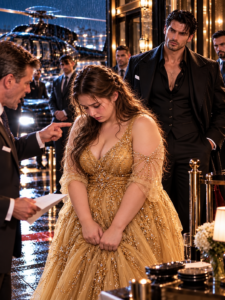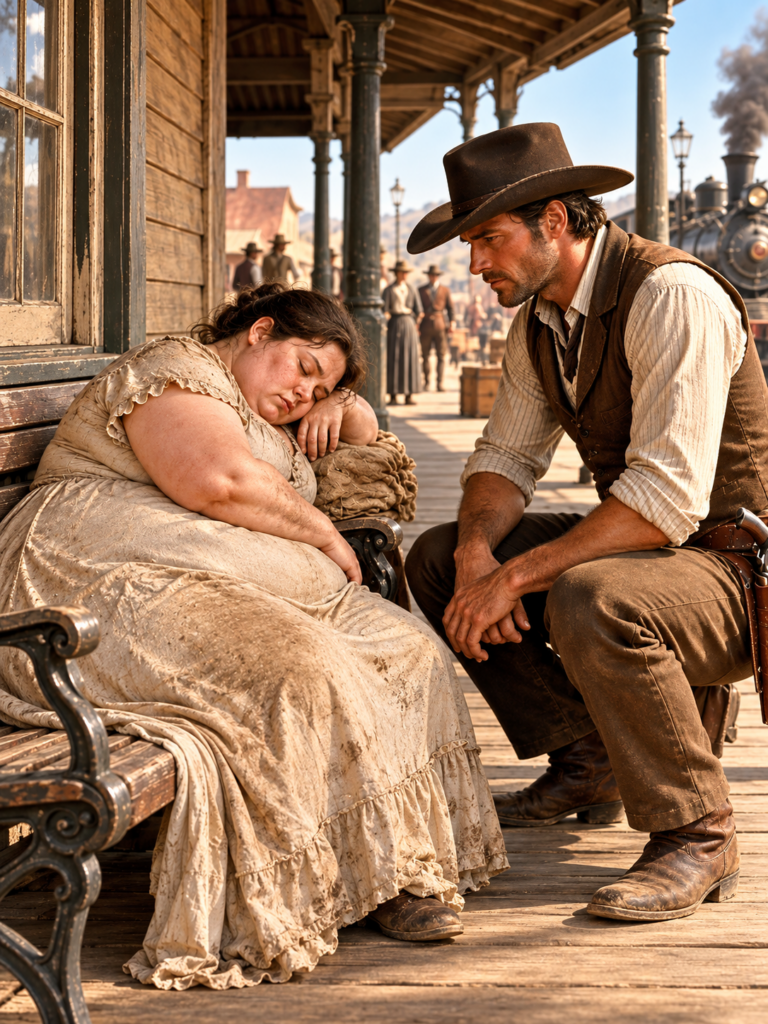
On the third morning, Eleanor Whitmore stopped waiting. She rose from the bench that had been her bed, folded the letter that had ruined her, and pressed it flat against her chest as if she could still make it true. A man had promised her a home out west. He never came. For three days, the town had watched her starve on that bench and called her the fat bride nobody wanted.
She had sold everything she owned to reach this place. Now she had nothing left but her own two hands and the terrible decision to walk into the desert alone.
Eleanor Whitmore had counted the boards of that bench until she knew them like the fingers of her own hand. Eleven planks, one split down the middle where the wood had dried and cracked in the Wyoming heat. She had slept on all eleven, and on the third morning she decided she would not sleep on them a fourth time.
She folded the letter along its old creases and slid it into the pocket sewn inside her dress. The paper was soft as cloth now, worn from three days of reading and folding and reading again. She did not need to look at the words anymore. She had them memorized.
Come west, Eleanor. I have a home waiting for you, and a heart that has waited longer.
The heart had not waited. The home did not exist. And Eleanor was done pretending either one ever had.
She stood. It took effort, the way standing always took her effort, and she felt the eyes on her before she was even upright. There were always eyes. The town of Ashfork, Wyoming Territory, had made a sport of watching her these three days, and she had learned the sound of their whispering the way a person learns the sound of a rattlesnake. Low, dry, and warning.
“There she goes again,” a woman said from the boardwalk across the street. “Reckon she’s finally leaving.”
“Where’s she going to go? Ain’t a wagon in the territory built to carry that.”
Laughter. Two women and a man leaning in a doorway.
Eleanor did not turn her head. She had learned that, too.
“My cousin says she come all the way from Ohio,” the first woman went on, loud enough to carry, meant to carry. “Sold her mama’s things. Sold her own wedding ring. All for a man who took one look and rode off. Can you imagine paying good money to be humiliated?”
“I’d have run, too,” the man said, and spat.
Eleanor bent slowly, carefully, and lifted her carpet bag from beneath the bench.
Everything she owned in the world fit inside it now. A change of clothes, a sewing kit, a small ledger book with columns she had kept since she was fifteen, her mother’s thimble. That was all. That was the sum of Eleanor Whitmore, twenty-eight years old, standing in a strange town at the edge of the world.
“Miss.”
The voice came from the station door. Eleanor turned.
It was the stationmaster, an old man named Peavey with a mustache the color of dirty snow. He had been the only soul in Ashfork to speak to her without cruelty. And even his kindness had been the tired, careful kind, the kind that wished she would leave so it could stop feeling responsible for her.
“Mr. Peavey.”
“You can’t sleep out here again.”
He said it gently, but he said it.
“Sheriff come by this morning. Said if you’re still on that bench tonight, he’s obliged to move you along. Vagrancy.”
He winced at the word.
“His word, not mine.”
“I understand.”
Eleanor lifted her chin.
“You needn’t trouble the sheriff. I won’t be here tonight.”
“Where will you go?”
She had no answer. That was not a lie. So she gave him the lie.
“I have arrangements.”
“Miss Whitmore.”
Peavey stepped down off the platform, lowering his voice.
“Ain’t my business, but that man who wrote you them letters, James Caldwell, he ain’t coming. I’ve worked this station eleven years. I know how it goes. Fella writes pretty words, gets a woman to travel out, and then…”
He stopped himself.
“I’ve seen it before. You’re not the first he done it to, if that’s any comfort.”
It was not any comfort. It was, if anything, the cruelest thing anyone had said to her in three days, because it meant she had been a fool in a common and predictable way.
“Thank you, Mr. Peavey.”
Her voice did not shake. She had promised herself it would not shake.
“You’ve been very kind.”
She turned and began to walk. Not toward the town. She would sooner die than walk toward the town, but toward the open road that led west out of Ashfork, into the yellow grass and the low hills and the enormous, indifferent summer sky.
She did not know what was out there. She only knew it could not be crueler than what was behind her.
“You’ll die out there,” one of the women called after her, delighted. “Ain’t nothing west of here but Indians and coyotes.”
Eleanor walked.
She had gone perhaps a quarter mile, the town falling away behind her, the carpet bag already dragging at her arm, when she heard the horse.
It came at a walk, unhurried, the hooves soft on the road dust behind her. She did not turn. She had learned that men on horses in this country were rarely bringers of good news, and she had already received all the bad news a body could hold.
The horse drew even with her and stopped.
“Ma’am.”
She kept walking.
“Ma’am.”
The voice again. Low, not unkind, but not gentle either. Plain the way a fence post is plain.
“You’re walking toward eighty miles of nothing.”
“Then I’ll walk eighty miles of nothing.”
Eleanor did not slow.
“It’ll be a rest compared to where I’ve been.”
There was a silence. Then, to her surprise, the horse kept pace with her, its rider saying nothing at all. Just letting the animal amble beside her as she trudged.
She stole a glance.
A big man, forty perhaps, in a leather coat gone soft with age. A hat pulled low. A dark beard three days grown. His face was not kind and not cruel. His face was closed like a door that had been shut so long the hinges had rusted.
“You going to follow me the whole way?” she said.
“Thinking about it.”
“Why?”
He was quiet a moment.
“Cuz I watched you sit on that bench for three days,” he said. “And I couldn’t figure why nobody in that town would lift a hand, and I got tired of not figuring it.”
Eleanor stopped walking.
She turned to face him fully now, and she felt the old armor come up, the armor she had worn her whole life. The armor a large woman learns to wear against a world that will not let her forget her size.
“I don’t need your pity, mister.”
“Didn’t offer any.”
“You looked at me the same as they did, sitting on your horse, watching. Three days, you said. Three days you watched me starve and did nothing, same as all of them. So don’t ride up now and play the—”
“You’re right.”
He said it flat, and it stopped her cold.
“I watched. Didn’t do nothing. That’s the truth, and I won’t pretty it up.”
He shifted in the saddle.
“I ain’t good with people, ma’am. Haven’t been for a long while. I saw a woman in trouble and I told myself it wasn’t my business, and I rode home three nights running telling myself the same lie.”
He looked down at her, and something moved behind the closed door of his face.
“Then last night I couldn’t sleep for it. So here I am, too late to be a good man about it. But here.”
Eleanor stared at him.
In three days, no one had told her the truth. Everyone had lied. Caldwell with his letters, the town with its false pity, even old Peavey with his gentle uselessness. This stranger was the first person to look at her and admit he had failed her.
It undid something in her.
She hated that it undid something in her.
“What do you want?” she said, and it was not quite a question.
“Name’s Thomas Walker.”
He touched the brim of his hat, a small automatic courtesy.
“Got a ranch about ten miles north. Cattle mostly. It’s just me out there. Has been for a spell.”
He paused.
“You need somewhere safe. I got a spare room nobody’s used in years. You can have it a night, a week, till you sort out where you’re headed. No cost. No…”
He seemed to search for the word.
“No expectations. You’ll have a door with a latch on the inside. You can lock me out. Reckon you’d want to.”
“And why,” Eleanor said slowly, “would a woman who’s just been abandoned by one strange man who made promises trust a second strange man who makes them?”
For the first time, something almost like respect flickered across his face.
“That’s a fair question,” he said. “Smartest thing anybody said to me all summer.”
He leaned forward on the saddle horn.
“I can’t give you a reason to trust me, ma’am. Trust ain’t a thing you hand a body like a train ticket. All I can tell you is I ain’t Caldwell. I didn’t write you no letters. I’m not asking you to marry me or thank me or owe me. I’m offering you a roof for the night cuz it’s about to be a hundred and five degrees out here, and you’ve got no water and no shade and eighty miles of open range between you and the next well.”
He straightened.
“You can say no. I’ll ride off and leave you be if that’s what you want. But I’d have to live with knowing I left a body to die on a road twice.”
Eleanor looked west at the shimmering, empty distance.
She looked back the way she’d come, at the town that had spat on her. She looked at the carpet bag in her hand, so heavy already, and at her own two feet and shoes worn through at the heel.
“You know how they laughed at me,” she said quietly. “You heard it.”
“I heard it.”
“They called me things to my face.”
“I heard that, too.”
“And you still…”
Her voice caught, and she pressed it down hard the way she pressed everything down.
“You still think I’m worth ten miles of your afternoon?”
Thomas Walker was quiet for a long moment.
When he spoke, he did not look at her body the way everyone always looked at her body. He looked at her face.
“I think,” he said, “that a woman who sat up straight on a bench for three days while a whole town threw stones at her is about the toughest person I’ve laid eyes on in years. And I don’t say that to flatter you, ma’am. I don’t flatter. I’m just telling you what I saw.”
Eleanor Whitmore had been called many things in twenty-eight years. Big, too much, greedy, a burden, a shame to her family, a joke, a charity case.
No one, not once, not ever, had called her tough.
No one had ever looked at her and seen strength.
She did not cry. She had learned not to cry in front of people who might use it. But she felt the thing behind her ribs shift the way a stone shifts when the water beneath it finally wears away.
“One night,” she said. “And I’ll cook and clean for it. I don’t take charity.”
“Wasn’t offering charity. Was offering a room.”
“And I don’t take rooms from men I don’t know without earning them.”
She lifted her chin again.
“Those are my terms, Mr. Walker. I’ll not be beholden. I cook, I clean, I mend, I keep books. I do it for the room. When I leave, we’re square. Nobody owes anybody.”
Something that might have been the ghost of a smile touched the corner of his mouth, though it did not quite arrive.
“Those are hard terms,” he said.
“They’re the only kind I’ve got left.”
“All right.”
He nodded slowly.
“Then we’re square before we even start.”
He swung down off the horse, a big man moving easy, and reached for her carpet bag.
She held it away from him.
“I can carry my own bag.”
“Never said you couldn’t.”
He didn’t reach again.
“Just figured you’d rather ride than walk ten miles in this heat, and the horse will go easier if the bag’s slung on the saddle instead of in your lap. That’s all.”
He waited.
“Your call.”
Eleanor considered him.
Then slowly she held out the bag.
He took it, tied it behind the saddle with quick, practiced hands, and stepped back.
“Now,” he said, “the tricky part.”
He looked at the horse, then at her, and there was no cruelty in it. No calculation, just a plain man solving a plain problem.
“She’s a tall mare. You want a hand up, I’ll give you one, and neither of us will say another word about it. You want to do it your own way, I’ll hold her steady and look at that hill yonder till you’re set. Which is it?”
And that small thing, that offering of dignity where every other soul in three days had offered only humiliation, was the moment Eleanor Whitmore first understood that Thomas Walker was not like other men.
“Hold her steady,” she said. “And look at the hill.”
“Yes, ma’am.”
He turned and looked at the hill.
It took her some doing. It always took her some doing. But he did not turn and he did not laugh, and he did not sigh the way her own brother used to sigh.
And when at last she was seated, breathless, flushed, but seated, he simply took up the reins and began to lead the mare north on foot, walking beside her, saying nothing about it at all.
They went a mile in silence. Then two.
The town of Ashfork sank away behind them into its own dust, and Eleanor felt the strangest thing come over her.
Not relief. Not yet. She did not trust it enough for relief, but the loosening of a fist she had not known she’d been clenching for three days.
“You always this quiet?” she said at last.
“Mostly.”
“My mother used to say a quiet man is either wise or hiding something.”
“Reckon your mother was half right.”
He didn’t look back at her.
“I ain’t wise.”
Eleanor almost smiled. Almost.
“You said it’s just you out at the ranch,” she said. “No wife?”
His shoulders changed just slightly. Just enough that a woman who had spent her life reading the small movements of people who did not want her there could see it.
“No,” he said. “No wife.”
“I’m sorry. I shouldn’t have—”
“There was one.”
He kept walking.
“Sarah. She’s been gone six years come October.”
He said it the way a man says a thing he has said to himself ten thousand times and to another person almost never.
“Fever took her one winter. Took our boy the same week. He was four.”
A pause.
“So it’s just me. That’s the long and short of it. And I’d take it kindly if we didn’t dig at it further.”
Eleanor was quiet.
She knew that kind of quiet. She had her own version of it, a room in herself she kept locked.
“I’m sorry, Mr. Walker,” she said. “That’s a grief I wouldn’t wish on a soul.”
“Thomas is fine.”
He said it gruffly.
“Mr. Walker was my father, and he wasn’t worth the name.”
They walked on.
The sun climbed, and after a while, because the silence had gone soft instead of sharp, Eleanor found herself talking.
She did not know why. She had not talked to anyone in three days, and perhaps that was why. Or perhaps it was because he asked her nothing. And a person will sometimes give freely what they’d never surrender under questioning.
“His name was James Caldwell,” she said. “The man who wrote me. We had a correspondence near a year. His letters were…”
She stopped.
“They were beautiful, Thomas. He wrote like a poet. He said he’d seen my likeness, a photograph my aunt had made, a small one, just the face. And he said he’d never seen a kinder face, and that a kind face was worth more than any fortune in the West.”
Her voice went flat.
“I believed him. God help me, I believed every word, because I was twenty-eight and no man had ever written me a beautiful thing. And I wanted it to be true so badly, I never once asked myself why a man who’d never met me was so certain.”
“He knew what you looked like,” Thomas said.
Not a question.
“He knew my face from the photograph.”
Eleanor’s hands tightened on the saddle horn.
“He did not know the rest of me. And when I stepped down off that train three days ago, when he saw the whole of me standing on that platform in my good dress, the dress I’d saved a year to buy…”
Her breath came short.
“He looked at me the way you’d look at a horse that came up lame. Just once, head to foot, and then he tipped his hat and he said, ‘I believe there’s been a misunderstanding, miss.’ And he walked away. Didn’t say another word. Left me standing there with my trunk and my hope and half the town watching.”
Thomas had stopped walking.
She realized it a moment after he did.
He was standing still in the road, the reins slack in his hand, and his jaw had gone tight beneath the dark beard.
“He said that?”
Thomas’s voice had dropped low.
“A misunderstanding. Those were his words. And then he left you on the platform for three days?”
Eleanor made herself say the rest because she was tired of carrying it alone.
“I couldn’t afford the fare home. I’d spent it all coming out. My trunk’s still at the station. The sheriff took it for what he called storage, which I expect means I’ll never see it again. So it’s been me and this bag and that bench. And a town that decided the first hour exactly what kind of woman ends up abandoned like that.”
She swallowed.
“They decided I must have lied about myself, tricked him, trapped him somehow.”
Her laugh was a small, bitter thing.
“As if a woman my size could trap anybody.”
Thomas said a word under his breath that no gentleman would say in front of a lady.
Then he said, “Beg your pardon.”
“I’ve heard worse.”
“I’ll bet you have.”
He started walking again, but harder now, his boots striking the road.
“This Caldwell, he’s still in Ashfork?”
“I don’t know. I don’t want to know.”
Eleanor shook her head.
“Thomas, don’t. Whatever you’re thinking, don’t. I’ve had three days of men deciding what to do about me. I’d like to decide a thing or two for myself.”
He looked back at her. Then really looked, the way he had on the road, at her face and not her body.
And after a moment, he nodded once.
“Fair,” he said. “It’s your business. I’ll keep to mine.”
But she noticed he did not say he’d forget it.
They came to the ranch as the afternoon burned toward evening.
Eleanor would not have called it grand. It was not grand, but it was standing, and it was solid. A low house of squared logs with a porch across the front, and outbuildings scattered behind, and a corral where three horses lifted their heads to watch them come.
There was no woman’s touch anywhere on it. She could see that at a glance.
It was a place a man had let go quiet the way a man lets a thing go quiet when the reason to keep it bright has died.
“It ain’t much,” Thomas said, and she heard underneath the words that it had once been much, and he could not bear to say so.
“It’s a home,” Eleanor said. “That’s more than I had this morning.”
He helped her down, held the mare, offered his arm without making a show of it, let her use as much of his strength as she needed and not a scrap more, and led her up onto the porch and through the door into a house that smelled of dust and coffee and long solitude.
“Room’s back there.”
He nodded down a short hall.
“Bed’s made up. Sheets are clean, more or less. I aired them this morning. Figured you’d say yes or I’d have made a fool of myself.”
A pause.
“There’s a bolt on the inside of the door. I put it there myself before I rode out. So you’d know it was there. So you’d know it worked.”
Eleanor turned to look at him.
“You put a bolt on the door,” she said. “Before you’d even asked me.”
“Seemed like the kind of thing a woman would want to know about,” he said, “before she’d trust a strange man’s roof. Reckon I’d want it in your shoes.”
And Eleanor Whitmore, who had not wept in front of a living soul in three days, who had held herself upright on eleven wooden planks while a town threw its cruelty at her like stones, turned her face away so this quiet, closed-up, grieving man would not see what a single bolt on a single door had done to her.
“Thank you,” she managed.
“Ain’t nothing to thank me for. It’s a bolt.”
He cleared his throat, gruff again, retreating back into himself.
“I’ll see to the horses. There’s cold ham in the larder and bread if it ain’t gone hard, and the well’s out back. Good water. Eat something. You look like you ain’t had a proper meal in three days.”
She said, “I haven’t.”
His jaw tightened again.
“Eat,” he said. “Please. Then rest. We’ll sort the rest of it tomorrow.”
He put his hat back on and went to the door.
And there he paused, his hand on the frame, not turning around.
“Miss Whitmore.”
“Eleanor.”
“Eleanor.”
He tried the name like a boot he wasn’t sure would fit.
“That town back there, Ashfork…”
He was quiet a moment.
“They were wrong about you. Every one of them. I don’t know you, but I know that much already. And I ain’t a man who says things he don’t mean.”
Then he went out, and the door closed behind him.
And Eleanor stood alone in a stranger’s house for the first time in her life, feeling something she had not expected to feel again.
She felt seen.
She ate the ham. She ate the bread, which had not gone hard. She drank the good cold water from the well until her three days of thirst was a memory.
And then she went into the little room with the bolt on the door, and she sat down on the edge of the clean, aired bed, and she took James Caldwell’s letter out of the pocket sewn inside her dress.
She read it one last time. Every beautiful, lying word.
Then she rose and she went to the small stove in the corner, and she fed the letter into the cold ashes, and she struck a match, and she watched the paper that had brought her eight hundred miles to be humiliated curl and blacken and turn to nothing at all.
“You don’t get to keep me,” she told the ashes. “Not one more night.”
She bolted the door.
Then, after a moment, she thought of the man out in the barn with his dead wife and his dead boy and his rusted-shut heart, and she unbolted it again.
Not for him, she told herself, but for her own pride, because a woman who trusts no one is only a smaller kind of prisoner.
She left it shut, but unlatched.
She lay down.
The bed held her without complaint.
And Eleanor Whitmore, twenty-eight years old, abandoned at a desert station by a man who wrote like a poet and left like a coward, slept for the first time in three nights without one eye open, in the house of a stranger who had looked at her and, alone in all the world, had seen someone worth ten miles of his afternoon.
Out in the barn, Thomas Walker brushed down the mare in the dark, long after she needed brushing.
He was thinking about a photograph he had never seen, and a man who had looked at a good woman head to foot and called her a misunderstanding, and a town that had watched her starve and laughed.
He was thinking about his Sarah, too, and how she used to say that the measure of a place was how it treated the people it could get away with mistreating.
He thought about the ledger book he’d glimpsed in Eleanor’s carpet bag when he tied it to the saddle, and the careful way she’d said, “I keep books,” like it was a thing worth keeping.
And Thomas Walker, who had not planned a single day past this one in six long years, found himself, against all his own hard rules, against the rusted-shut door of himself, beginning to plan tomorrow.
He didn’t know yet what Caldwell was. He didn’t know about the papers Caldwell had already filed at the land office, or the men Caldwell answered to, or the reason a smooth-tongued stranger had really wanted a lonely woman to travel eight hundred miles into Wyoming Territory in the summer of 1886.
He only knew there was a light on in the back room of his house for the first time in six years, and that the woman who’d lit it had asked for nothing but a room and the right to earn it.
He finished with the mare. He stood a while in the dark, and then he went in to sleep in his own house, quiet as always, with the barest, strangest feeling that the long winter of the place might finally, against all odds, be breaking.
Morning came to the ranch before Eleanor did, and when she stepped out onto the porch, she found Thomas Walker already at the corral.
And she stopped dead because the man had a look on his face like he’d been up half the night arguing with himself and lost.
“You didn’t sleep,” she said.
“Slept fine.”
“You’re a poor liar for a quiet man.”
Eleanor came down the steps, and her voice was steadier than it had been the day before, the way a voice gets steadier when the body behind it has finally eaten and finally slept.
“I heard you out in the barn past midnight, brushing that mare like she owed you money.”
He didn’t answer that.
He set down the coffee tin he’d been holding and looked at her, and there was something working behind his face he clearly didn’t have the words for.
“You leaving today?”
“Do you want me to?”
“No.”
He said it too fast, then looked annoyed at himself for it.
“I mean, it ain’t my place to want anything. You said a night, it’s morning, bargain’s kept. I’ll drive you wherever you need.”
“And where would that be, Thomas?”
Eleanor spread her hands.
“I’ve got no home east and no money west. I’ve got a carpet bag and a sewing kit and eleven dollars sewn into my hem that I’ve been saving to bury myself with if it came to that. So you tell me. Where does a woman like me go?”
He was quiet a long moment.
“You could stay,” he said, “and keep to the bargain you made. Cook, clean, keep books till you sort a way forward.”
He rubbed the back of his neck.
“House could use it. I ain’t much of a hand at any of it.”
“That’s charity dressed up as work.”
“No, ma’am, it ain’t.”
Now he looked at her straight.
“You seen my ledgers?”
“I haven’t.”
“Come here, then.”
He led her inside to a roll-top desk in the corner. She hadn’t noticed it the night before, and he pulled it open, and Eleanor’s whole face changed.
There were papers stuffed in every slot. Bills of sale, tally sheets, letters from a cattle buyer in Cheyenne, receipts crumpled and shoved and forgotten.
It was the desk of a man who had once kept order and then simply stopped the day the reason for order died.
“I can’t make heads nor tails of it no more,” Thomas admitted, and the admission cost him something. “Sarah kept the books. She had a head for figures I never did. After she passed, I just let it go. Told myself I’d catch it up. Six years I’ve told myself that.”
He picked up a letter, dropped it.
“There’s a man been at me to sell. Says I owe more than I can see. I can’t argue him cuz I can’t read my own accounts. So if you can do what you say you can do…”
He stopped.
“That ain’t charity, Eleanor. That’s you saving my hide if you’re half as good as you claim.”
Eleanor was already reaching for the papers.
Her hands knew this. Her hands had always known this since she was fifteen, and her father, drunk and failing, had shoved a shoebox of debts at her and said, “You’re no use for anything else, girl. See if you’re useful for this.”
She had been useful for it. She had saved the family farm three winters running before her father drank the rest of it away and blamed her for the drinking.
“Who’s the man wants you to sell?” she said, pulling a chair to the desk.
“Fella named Randolph Vance. Owns half of Ashfork one way or another. Bank, freight line, mercantile.”
Thomas watched her sort papers into piles with a speed that plainly startled him.
“Why?”
“Because a man who owns the bank and wants your land and tells you that you owe more than you can see is either a fool or a thief,” Eleanor said without looking up. “And rich men are rarely fools.”
She pulled a tally sheet close, ran her finger down a column, and her mouth tightened.
“Thomas, when did you last actually count your cattle yourself? Head by head?”
He frowned.
“Vance’s man does the count. Comes twice a year. Fellow named Ridge.”
“Vance’s man does the count,” Eleanor repeated slowly. “The man who wants your land counts your cattle and then tells you how much you owe against them.”
She set the sheet down very carefully, the way you set down something you’ve realized is hot.
“How much does he say you owe?”
“Near four hundred head short over three years. Says I’m losing them to rustlers and bad management. Says the debt against them—”
“Stop.”
Eleanor’s voice cracked like a whip, and Thomas actually stopped.
“Don’t tell me the number he gave you. Tell me, do you have four hundred fewer cattle than you did three years ago?”
Thomas opened his mouth, closed it.
She watched the thought land on him, watched it land the way a slow thing lands on a slow man, and then watched it change his whole face.
“No,” he said very quietly. “I don’t. I got about the same as always. Grass is good, herd’s healthy.”
“Then where,” Eleanor said, “are the four hundred cattle you’re paying a debt on?”
The kitchen went silent.
“Well, I’ll be damned,” Thomas said.
“You’ve been robbed, Thomas Walker.”
Eleanor stood, and there was color in her face now, the old fire she thought the bench had burned out of her.
“Not by rustlers. By arithmetic. Somebody’s been counting cattle you never lost so they could load you with a debt you never owed, so a rich man could take your land when you couldn’t pay it.”
She slapped the tally sheet.
“And you handed him the pen to do it because you couldn’t bear to open this desk.”
Thomas sat down hard on the edge of the table.
He was a big man, and he sat like a felled thing.
“Sarah always said I’d sign my own name off a cliff if somebody handed me the paper polite enough.”
He put his face in his hands a moment.
Then he looked up at her, and there was something new in his eyes. Not just gratitude, but a kind of dawning astonishment. The look of a man who’s been drowning so long he forgot there was such a thing as a hand reaching down.
“You did that in ten minutes. Ten minutes at my desk, and you saw what I couldn’t see in three years.”
“I’ve had practice being underestimated,” Eleanor said. “You learn to count when nobody thinks you can do anything else.”
“Stay.”
He said it plain. No dressing on it now.
“Not for the bargain, not for the room. Stay cuz I need somebody who can see. And you’re the first person in six years walked through that door and looked.”
He caught himself, and the old weariness pulled at him.
“For the wages, I mean. I’ll pay you proper. Whatever’s fair. This ain’t—”
“I know it isn’t,” Eleanor said gently, and she surprised them both by smiling the first real smile she’d smiled in longer than she could name.
“I’ll stay, Thomas. Not for wages. For the puzzle. I’ve been made to feel useless my whole life. You just handed me the most useful thing I’ve held in years.”
She turned back to the desk and rolled up her sleeves.
“Now get out of my way and go count your cattle. All of them. I want a real number by supper.”
He went.
And that was how it started.
Not with a declaration, not with a proposal, but with a roll-top desk and a stolen herd and a woman who could count.
The days after did not go soft all at once. Nothing with either of them went soft all at once. But they went, and they built one small true thing stacked on the last.
By the end of the first week, Eleanor had the ledgers straightened into something a court could read. By the end of the second, she’d found three more places where Vance’s man had padded the debt, and one where he’d charged Thomas twice for the same lot of winter feed.
She kept it all in a fresh book, her own hand small and precise, every figure sourced to a paper she could produce.
“You’re building a case,” Thomas said one evening, watching her work by lamplight.
“I’m building the truth,” Eleanor said. “A case is what you do with the truth when a man forces you to.”
She didn’t look up.
“Have you told anyone in town I’m out here?”
“No.”
“Good. Keep it that way.”
She set down her pen.
“The moment Vance learns his numbers are being audited by a woman who knows how, he’ll move faster. Right now, he thinks you’re a grieving fool who can’t read his own accounts. Let him keep thinking it. It’s the only advantage we’ve got.”
“We,” Thomas said.
Eleanor looked up.
“What?”
“You said we’ve got.”
He wasn’t smiling, but the door in his face had come open another inch.
“Ain’t been a we out here in a long while.”
Eleanor felt her cheeks warm and hated it.
“Figure of speech.”
“Sure,” Thomas said. “Figure of speech.”
And he went out to the porch so she wouldn’t see him almost smile, and she bent back over the book so he wouldn’t see her do the same.
The ranch changed the way a person heals, so slow you don’t see it happening, and then all at once you realize it’s not the same wound.
Eleanor did the thing she’d told him she could do.
She brought life back to an abandoned place.
She scrubbed six years of grief out of the kitchen. She found Sarah’s abandoned kitchen garden gone to weeds behind the house and did not ask permission before she started clearing it, because she’d learned that some men can’t say yes to a kindness. They can only fail to stop it.
She cooked. Lord, she cooked.
The first proper meal she set in front of Thomas Walker, a beef stew rich enough to stand a spoon in, biscuits, a pie from the last of the winter apples, the man ate three helpings and then sat back and looked at his empty plate like it had betrayed him.
“Something wrong?” Eleanor said.
“No.”
Thomas cleared his throat.
“That’s the problem.”
“I don’t follow.”
“I forgot,” he said. “I forgot food could taste like that. Forgot a house could smell like that.”
He looked at her across the table, and his voice had gone rough.
“I got used to it being quiet. Got so I liked the quiet cuz the quiet couldn’t leave me. And now you’re in it, making it loud and warm, and I don’t know what to do with it, Eleanor. That’s the plain truth. I don’t know what to do with a full plate and a lit lamp and a person across the table.”
He stood up abruptly, scraping his chair.
“Thank you for the supper. It was fine. It was more than fine.”
And he walked out into the dark, and Eleanor sat alone with the dishes, understanding him better than he’d have liked.
She knew what it was to be so used to the cold that warmth felt like a threat.
She’d been cold her whole life, too.
The next morning, she found a spray of wildflowers on the kitchen windowsill. Prairie flowers, the plain kind, roots and dirt still on them, like he’d yanked them from the ground on his way in.
No note.
Thomas said nothing about them at breakfast, and neither did she.
And both of them knew exactly what they were.
It was the ranch hands who first tested it, for Thomas was not in truth entirely alone.
He kept two men through the working season. Old Bud Hollis, who’d been on the place since before Sarah, and a young, hard-eyed fellow named Court, who’d hired on that spring.
They came in from the north range on a Friday and found the house transformed and a large woman in the kitchen, and Court’s mouth got ahead of his sense.
“Well,” Court said, leaning in the doorway, looking Eleanor over the way the town had looked her over. “So this is where you’ve been getting to, boss. Reckon I see why you ain’t been riding out with us.”
He grinned.
“Didn’t figure you for—”
He didn’t finish it.
He didn’t finish it because Thomas Walker crossed that kitchen in three strides and had a fistful of the young man’s shirt before Eleanor had drawn a breath.
“Finish that sentence,” Thomas said very low, “and you’ll finish it on the road with your gear in the dirt behind you.”
“Boss—”
“That’s Miss Whitmore.”
Thomas didn’t raise his voice. He didn’t need to.
“She keeps my books, and she saved my ranch, and she is a guest in my house, and you’ll tip your hat to her or you’ll draw your pay. Which is it?”
The kitchen held its breath.
Court’s grin was long gone.
“Beg your pardon, ma’am,” he muttered. “Meant no harm.”
“Yes, you did,” Eleanor said calmly.
And she surprised all three men by not looking hurt at all, only tired. She’d heard it a thousand times. She’d heard it worse.
“But Mr. Walker’s made his point, and I’ve no use for a grudge. Sit down, all of you. There’s enough stew for an army, and you all look like you’ve been eating trail dust for a week.”
Old Bud Hollis took his hat clean off and held it against his chest.
“Ma’am,” he said with a courtliness that had gone out of fashion twenty years before, “if that stew tastes half as good as it smells, I’ll marry you myself, and the boss can fight me for it.”
And even Eleanor laughed at that.
A real laugh surprised out of her, and the kitchen came unstuck, and Court sat down chastened and ate two bowls, and by the end of the meal was calling her ma’am like he meant it.
That was the thing about Eleanor that the town of Ashfork had never given itself a chance to learn.
She disarmed people not by being soft, but by refusing to be as small as they expected her to be.
But Thomas didn’t forget the grab. And neither did Eleanor.
That night, she found him on the porch and stood beside him a while before she said it.
“You didn’t have to do that with Court.”
“Yeah, I did.”
“I’ve been managing men like Court my whole life, Thomas. I don’t need defending.”
“I know you don’t.”
He looked out at the dark range.
“Wasn’t defending you cuz you’re weak. Was defending you cuz it was right. And cuz…”
He stopped, and she watched him fight the words up out of whatever locked room he kept them in.
“Cuz I couldn’t stand it, hearing it in my own house. The same voice as that town. I’ve stood in a lot of rooms, Eleanor, and let a lot of things pass that I shouldn’t have. I’m done doing that. Starting with my own kitchen.”
Eleanor was quiet.
Then softly, “My father used to say a man’s true self shows in what he lets slide.”
“Then I’ve been a poor self a long time,” Thomas said. “But I’m working on it.”
“You’re not poor,” she said before she could stop herself. “You’re the least poor man I’ve ever met, Thomas Walker. You just don’t know it yet.”
He looked at her then in the porch dark, and for a moment neither of them moved, and something crossed the space between them that had no name and needed none.
Then Eleanor, frightened of it, of how much she wanted it, of how surely she believed it would be taken away, stepped back.
“Good night, Thomas.”
“Good night, Eleanor.”
She went in. He stayed out.
And both of them lay awake a long while in the same quiet house, closer than they’d ever admit and further than they’d ever choose.
The trouble came the way trouble always comes, on an ordinary afternoon, wearing a friendly face.
Eleanor was hanging wash when the rider came up the ranch road, and she knew before he’d reached the yard that he was town, because he sat his horse like a man who’d never had to work from it.
He was well-dressed, well-fed, a soft, smiling man of fifty in a good coat. And when he touched his hat to her, it was with a courtesy that made her skin crawl, because it was the courtesy of a man appraising a thing he means to buy.
“Afternoon, miss.”
He looked her over, quick and complete, and filed her away.
“I’m looking for Thomas Walker. This his place?”
“It is. And you are?”
“Randolph Vance.”
He smiled wider.
“And you’d be the new help.”
“Housekeeper,” Eleanor said, and did not smile back. “Mr. Walker’s at the north range. I’ll tell him you called.”
“No need to trouble him. I’ll wait.”
Vance swung down uninvited and looped his reins over the rail like a man who owned it.
“In fact, miss, I’m glad to catch you first. Woman like yourself keeps a man’s house. Keeps his books, too, I’d imagine.”
His eyes stayed on her face now, sharp behind the soft.
“You’d know if a man was in trouble. Financial trouble.”
Eleanor did not answer.
Every instinct she had, the ones the bench had honed to a razor, went still and alert.
“I’ll be frank, miss.”
Vance produced a folded paper from his coat, held it lightly. A man showing a card without playing it.
“Thomas Walker owes my bank considerable money. More than this land’s clear. I’ve been patient. Lord knows I’ve been patient, out of respect for what the man’s lost. But patience has an end. I’m prepared to make him a generous offer for the place. Take the debt off his shoulders. Leave him money enough to start fresh somewhere. It’d do him good to breathe.”
He tapped the paper against his glove.
“A man in his position, he needs someone to talk sense to him. Someone he trusts. Someone he’d listen to.”
The smile turned just slightly into something with teeth.
“There’d be a consideration in it for the someone.”
He was offering to buy her, to pay her to talk Thomas off his own land.
Eleanor understood it fully in one cold instant, and understood something worse alongside it.
Randolph Vance had just told her without meaning to exactly how frightened he was.
A man who owns the bank and the count and the debt doesn’t come out to a ranch to bribe the housekeeper unless he’s learned the housekeeper can count.
He knew. Somehow he already knew.
“That’s a kind offer, Mr. Vance,” Eleanor said, and her voice gave nothing. “I’ll be sure to tell Mr. Walker every word of it.”
The smile flickered.
“That’s not— Miss, I don’t think you—”
“I understood you perfectly.”
Eleanor picked up her wash basket and set it on her hip, and she looked at the rich man the way she’d looked at the town of Ashfork, straight and unafraid and entirely unbought.
“You want me to help you take an honest man’s land by convincing him a debt is real when I can prove on paper it isn’t? And you’re offering me money to do it?”
She smiled at last, thin and bright.
“I’ve been offered a great many insults in my life, Mr. Vance. Yours is at least the most expensive. Good afternoon.”
Vance’s face lost its softness all at once, and what was underneath was not friendly at all.
“You want to be careful, miss,” he said quietly, “about what fights you pick out here. It’s a hard country for a woman on her own. Harder still for one that don’t fit where she’s put.”
His eyes went over her once more, cruel now, deliberate.
“You had a rough welcome in Ashfork, I hear. Sat on a bench three days. Be a shame if your next welcome was rougher.”
The threat hung there in the summer air.
And that was the moment, that exact moment, with Vance’s threat still cooling between them, that Thomas Walker rode into the yard.
He took it in fast. The town horse at his rail, the soft rich man standing too close to Eleanor, Eleanor’s face gone hard and pale.
He was down off his horse before it fully stopped.
“Vance.”
His voice was flat as a struck anvil.
“You’re on my land.”
“Thomas.”
Vance’s smile snapped back into place.
“I was just having a pleasant word with your—”
“You were threatening her.”
Thomas didn’t ask it. He’d seen Eleanor’s face. He’d learned to read it same as she’d learned to read his.
“I could hear it in her from the road. Get on your horse.”
“Now, Thomas, let’s be reasonable men.”
“Get on your horse, Randolph, or I’ll put you on it.”
Thomas stepped forward, and the size of him, the stillness of him, made Vance take a step back.
“You want to talk business? You send a letter, and I’ll have my— I’ll have Miss Whitmore answer it in writing. Every word on paper. That how you like your business done? On paper?”
Something in Vance’s face said no, it was not.
And Thomas saw it and pressed.
“Didn’t think so. You like it done quiet in a man’s kitchen when he’s too broke with grief to check your figures. Well…”
He jerked his head toward the road.
“Those days are over. Go home.”
Vance mounted.
But at the top of the road, he turned in the saddle, and the soft was all gone now, and he looked at the two of them standing together in the yard with a hatred that had money behind it, which is the most dangerous kind.
“You’ve got till the fall payment, Walker,” he said. “Same as always. You bring me what you owe or I take the land the law says is mine.”
His eyes cut to Eleanor.
“And I’d think hard about who I let count my money. Some help costs more than it saves.”
He spurred his horse and was gone down the road in a rise of dust.
For a moment, neither of them spoke.
“He knows,” Eleanor said. “About the books. About me. Somehow he already knows.”
“How?”
“I don’t know.”
Her mind was racing.
“Nobody’s been out here but Bud and Court.”
And she stopped.
She turned very slowly to look at Thomas.
“Court. Your new man. Hired this spring, you said. Same spring Vance started pushing hardest to sell.”
Thomas’s face went to stone.
“No.”
“Where’d he come from, Thomas? Who vouched for him?”
“He came recommended. Fella at the mercantile said…”
Thomas stopped.
“The mercantile.”
“Vance owns the mercantile.”
They stood in the terrible knowledge of it.
“He put a man in your own bunkhouse,” Eleanor said quietly. “To watch you. To count your cattle low for him. Maybe to tell him the day you hired somebody who could see the theft.”
She pressed a hand to her stomach.
“Thomas, if Court’s been reporting to Vance, then Vance has known about me since the day I fixed the first ledger. That’s why he came today. Not to make an offer. To measure the threat. To measure me.”
“I’ll kill him,” Thomas said.
And he meant it.
And it wasn’t hot. It was cold, which was worse.
“You’ll do no such thing.”
Eleanor caught his arm.
“You do that and you hang, and Vance gets the land free and clear, and I’ve come eight hundred miles to watch it happen. No.”
She made herself think.
She was good at thinking when she was afraid. The bench had taught her that, too.
“We don’t let Court know we know. Same as Vance. Let them both keep thinking they’ve got the measure of us.”
Meanwhile, her grip tightened on his arm.
“Meanwhile, I finish the proof. Every stolen head, every double charge, every padded figure, sourced and sworn in a form a territorial court would have to honor. We don’t fight Vance on his land, Thomas. We fight him on paper, where I’m stronger than he is.”
Thomas looked down at her hand on his arm, then up at her face.
“You’d do that? Take on a man like Vance for a ranch that ain’t even yours?”
“It’s not the ranch,” Eleanor said.
And she didn’t let go of his arm.
“I don’t care a fig for cattle, Thomas, if I’m honest. It’s that a rich man thinks he can take a good man’s whole life because the man was too sad to count. It’s that a whole town watched me starve and decided I deserved it. It’s that men like Vance and men like Caldwell have spent my entire life deciding what I’m worth and handing me the number.”
Her voice shook now, but not with weakness.
“I’m done being handed the number. I can count, Thomas. Let me count.”
And Thomas Walker, who had not let a soul past the rusted door of himself in six years, reached up with his free hand and laid it over hers, where it gripped his arm, rough and warm and certain.
“Count,” he said. “I’ll hold the rest.”
She should have let go of his arm then.
She didn’t.
He should have taken his hand away.
He didn’t.
They stood in the yard with the dust of Vance’s leaving still settling around them.
Two people the world had thrown away, holding on.
“Thomas,” Eleanor said. “There’s something I have to tell you about Caldwell. About why I really—”
“Boss!”
It was Bud, running from the barn, hat gone, face white.
“Boss, you best come. It’s the north tank. The water tank.”
He gulped air.
“It’s been cut. Somebody drove a herd through the fence and fouled the water and cut the tank open in the night. Half the summer water for the north range, boss. It’s gone. Run out into the dirt.”
Thomas’s hand left Eleanor’s. The cold came back into his face.
“When?”
“Last night, had to be. Wasn’t there this morning when I…”
Bud caught his breath.
“Boss, that water’s the only reason the north herd survives the summer. Without it, we drive them south to the creek, and the creek’s low. Won’t hold that many head. We’ll lose stock either way. In a week, maybe less.”
He swallowed.
“It weren’t rustlers. Rustlers take cattle. This somebody wanted us hurt. Somebody wanted us dry before the fall payment.”
Eleanor and Thomas looked at each other, and the same name passed between them without a word.
“Where’s Court?” Thomas said.
Bud blinked.
“Court? He rode out before dawn. Said you sent him to Ashfork for wire.”
He frowned.
“You didn’t send him for wire.”
The silence answered him.
“Oh,” Bud said softly. “Oh, hell.”
Eleanor stepped forward, and her voice was steady.
And it was the voice of a woman who had already lost everything once and had learned exactly what it was worth to panic, which was nothing.
“Thomas, listen to me. The tank being cut isn’t the disaster. It’s the message. Vance wants you scared. He wants you to see you’re beaten so you’ll take his offer before the fall payment rather than fight and lose the land and the cattle both.”
She took his face in her hands, and she’d never done that. Never touched a man’s face in her life.
And she did it now without thinking because the thing between them had gone past thinking.
“Don’t take the message. A cut tank we can fix. A frightened man he can steal from. So we don’t get frightened. We get to work. You hear me, Thomas Walker? We save the water and I save the ledgers and we beat him with the truth.”
Thomas Walker looked at the woman holding his face.
The woman a whole town had laughed at. The woman a smooth-tongued coward had left on a bench. The woman who had walked toward eighty miles of nothing rather than beg.
And something in his six-years-dead chest came all the way back to life, hard and sudden and terrifying.
“Bud,” he said, not looking away from her. “Get the horses. All three of us ride to the north tank. We’re going to dam that creek and drive the herd and patch that fence tonight if it takes till morning.”
He put his hand over Eleanor’s, still on his face.
“And Eleanor is going to do the one thing on this ranch that Vance can’t cut, can’t drive off, can’t buy, and can’t scare.”
“What’s that, boss?” Bud said.
Thomas almost smiled.
“She’s going to count,” he said.
They saved the water.
It took them till the gray hour before dawn. Thomas and Bud damming the creek with rock and brush, while Eleanor rode the line with a lantern, calling out where the fence had been cut.
Three men and one exhausted woman, driving four hundred head of frightened cattle south through the dark.
But they saved it.
And when the sun came up on a herd watered, and a fence patched, and three people too tired to stand, Thomas Walker looked at Eleanor Whitmore asleep in the wagon seat with dirt on her face and a torn hem and her hair come loose from its pins, and he thought he had never in his life seen anything he wanted so much to keep.
He didn’t say it.
He wasn’t ready to say it.
But he took off his own coat and laid it over her, and he drove the wagon home slow so the ruts wouldn’t wake her.
Court did not come back.
That told them everything.
A man who rides to town for wire comes back by nightfall. A man who cut a water tank in the dark and reported it done rides on to wherever men like that ride.
Bud found the boy’s bunk cleared out, gear gone, and a single thing left behind on the mattress that made the old man go pale and carry it straight to the house.
It was a page. A tally page in Court’s own cramped hand.
And it was a count of Thomas Walker’s cattle.
The real count, the true number, with a second column beside it, the number Court had been reporting to Vance.
The two columns were four hundred head apart.
“He left it,” Eleanor breathed, holding the page in both hands. “Thomas, he left us the proof.”
“Why would he do that?”
Thomas leaned over her shoulder.
“Man’s a snake. Snakes don’t leave evidence.”
“Maybe he’s not all snake.”
Eleanor turned the page over.
On the back, in the same cramped hand, four words.
I got a sister.
Nothing else.
“Maybe somebody had something on him, too. Maybe Vance owns more than mercantiles.”
She set the page down carefully with the rest of her proof, and her hands were not quite steady.
“It doesn’t matter why. What matters is this page in Court’s hand, matched against Ridge’s official counts, proves the fraud in writing. A man Vance planted testifying against him in his own script. Thomas, this is the thing. This is the whole thing.”
For three days, Eleanor barely slept.
She built the case the way another woman might build a wall to keep out a flood, brick by brick.
Every figure sourced. Court’s tally against Ridge’s counts, the double feed charge, the padded debt, all of it copied fair in her small, precise hand, and then copied again, so there’d be two if one were lost.
Thomas watched her work by lamplight and brought her coffee she forgot to drink and food she ate one-handed without looking up.
And he understood, watching her, that he was seeing a person become fully herself for maybe the first time in her life.
The town had seen a fat woman. Caldwell had seen a face in a photograph. Vance had seen a threat to buy off.
Only Thomas got to see what Eleanor Whitmore actually was, which was a mind like a blade and a spine like a rail and a heart that had been kicked so many times it had simply decided to grow larger instead of smaller.
“You should sleep,” he said the third night.
“I’ll sleep when it’s done.”
“Eleanor.”
He crouched by her chair so their eyes were level.
“It’s near done. You said so yourself. Another day won’t cost us. But you keep on like this, you’ll fall down, and then where will I be?”
He tried for lightness and missed it because his voice went rough on the last word.
“Where will I be? Eleanor, you go on and think about that. I got real used to knowing where I’ll be. Right here. Same house, same quiet. Six years I knew exactly where I’d be.”
He reached out slow and tucked a loose strand of her hair behind her ear, and his big hand shook doing it.
“And then you walked in, and I don’t know where I’ll be anymore. Don’t know a thing anymore except I can’t stand the notion of a house that don’t have you in it.”
Eleanor went very still.
“Thomas.”
“I know.”
He pulled his hand back like he’d touched a stove.
“I know you come here abandoned. Last thing you need’s another man making declarations. I ain’t… I’m not asking you for anything. I just…”
He stood up, turned away, scrubbed a hand over his face.
“Sarah’s been gone six years. And I buried my whole heart with her. And I told myself that was right. That was loyal. That was how a decent man grieves. And then you sat at that desk and saw what I couldn’t see. And I felt something I ain’t felt since the fever. And I’ve been fighting it three weeks cuz it feels like a betrayal of her.”
His voice broke clean in two.
“But last night, driving that wagon home with my coat over you, I thought Sarah wouldn’t want the quiet for me. Sarah hated the quiet. Sarah would have liked you, Eleanor. She’d have liked you so damn much.”
He turned back, and his eyes were wet, and he did not hide it.
“That’s all. That’s the plain truth of me. Do with it what you want.”
Eleanor stood.
She crossed to him and she did the thing she’d wanted to do since the porch, since the flowers, since a man looked at a hill so she could climb a horse with her dignity.
She reached up and laid her palm flat against his chest, over the heart he’d said he’d buried.
“You want to know why I really came west?” she said quietly. “You asked me once, and Bud interrupted, and I’ve been afraid to finish it ever since. Let me finish it now.”
She kept her hand on his chest.
“Caldwell didn’t just abandon me at that station, Thomas. He robbed me. His letters, the beautiful letters, they weren’t for me. They were bait. There’s men out here who write back east to lonely women, women with a little money or a little property, and they court them by mail and get them to sell everything and travel out, and then…”
Her jaw tightened.
“Sometimes they take the money at the station and vanish. Sometimes it’s worse.”
She swallowed.
“Caldwell had my aunt’s letters saying I’d inherited a small sum. Two hundred dollars, my mother’s whole estate. That’s what he wanted. He never wanted a bride. He wanted a woman foolish enough to carry two hundred dollars into a strange territory alone.”
She looked up at him.
“I figured it out on the bench. Third day, I figured out I wasn’t the first and I wouldn’t be the last, and that the whole scheme worked because everyone, everyone takes one look at a woman like me and believes she’d be grateful for any lie a man told her. That’s what makes it safe for them. Nobody investigates when the fat abandoned bride ends up robbed. They just say she should have known better.”
“Eleanor.”
Thomas’s hand had come up over hers, pressing it to his chest.
“Where’s the money now?”
“Gone. He got most of it. I’ve got eleven dollars in my hem.”
She laughed, and it hurt to hear.
“But here’s the thing I couldn’t tell you, Thomas. The thing I’ve been carrying. Caldwell didn’t act alone. Nobody runs a scheme like that in one town without the town letting him. Somebody has to keep the sheriff looking the other way. Somebody has to own enough of the place that a stranger can rob a woman on the public platform and no one lifts a hand.”
She held his eyes.
“I didn’t know his name three weeks ago. I know it now. I’ve seen it on every padded ledger in your desk. Caldwell’s partner. It was one thing the whole time. I came eight hundred miles to be robbed by Randolph Vance. And I ended up on the one ranch in the territory he’s trying hardest to steal.”
Her voice dropped to a whisper.
“I don’t think that’s chance. I think that’s God giving a robbed woman a ledger and a reason.”
Thomas stared at her.
Then slowly he began to understand the full shape of it.
That the woman Vance had come to buy off wasn’t just a housekeeper who could count, but a living witness to Vance’s other trade. The one that ran through the station and the letters and the lonely women no one investigated.
“That’s why he threatened you,” Thomas said. “In the yard. It wasn’t just the ledgers. You could hang him twice over. Once for my cattle and once for every woman he and Caldwell ever left on that platform.”
Eleanor’s eyes blazed.
“Yes.”
And that was when they heard the horses.
Not one. Many.
Coming up the ranch road in the last light, a whole party of them, fast.
Thomas was at the window in two strides.
“Bud,” he called. “Bud, get in here.”
He counted the riders.
Six. Seven.
Vance out front.
His hand went to the rifle over the door and stopped there.
“And the sheriff with him.”
Eleanor’s blood went cold.
“The sheriff. Vance owns the sheriff. You said it yourself.”
Thomas turned.
“He’s not coming to threaten now. He’s coming with the law. He’s making it legal.”
He looked at the case spread across the table, three weeks of her work.
“Eleanor, get the papers. Both copies. Hide one. Now.”
She was already moving.
She’d learned to move fast when powerful men came for what she had.
She rolled the second copy tight, and while Thomas met Bud at the door, she slipped down the hall and did the thing no one would expect of a woman they’d dismissed.
She pried up the loose floorboard she’d found her first week, the one under the bed in the room with the bolt.
And she laid the truth beneath the floor of the house they were trying to steal.
And she set the board back, and she was in the front room with her hands folded and her face calm before the horses reached the yard.
The first copy she left on the table in plain sight, because a woman who’s been underestimated her whole life knows the value of letting them see what they think is everything.
Vance did not knock.
Vance never knocked.
He pushed the door open with the sheriff a half step behind him and four hard men behind the sheriff, and he walked into Thomas Walker’s front room like he’d already bought it.
“Thomas.”
Vance’s voice was warm and terrible.
“I’ve been patient. I told you I’d been patient.”
He held up a paper, a real one this time, stamped and sealed.
“This is a writ of foreclosure signed by the territorial recorder this afternoon. You’re four hundred head short, three years running. The debt against your herd exceeds the value of your land, and you’ve missed the terms of your note. Sheriff Daw is here to see it done lawful.”
He smiled.
“I did try to make it easy on you.”
Thomas stood between Vance and Eleanor, with Bud beside him and the sheriff watching.
He looked at the foreclosure papers, then at the man who had brought them.
He had spent six years letting Randolph Vance tell him what his own ranch was worth. Six years believing numbers he had never checked. But now Eleanor’s papers lay on the table, and for the first time, Thomas knew what those numbers meant.
“I let a man like you count my cattle for three years cuz I was too broke with grief to do my own sums. Signed my name off a cliff, just like Sarah always said I would.”
He reached back without looking and found Eleanor’s hand and gripped it hard.
“But I got somebody counts for me now, and she’s the best I ever saw. So let’s do some arithmetic, Vance. Right here in front of the sheriff. Let’s you and me settle up.”
“Thomas—”
Vance’s smile faltered.
“On the table.”
Thomas nodded at the copy Eleanor had left in plain sight.
“That’s her count, the real one. Every head you stole on paper, you never stole in the field. Every dollar of feed you charged me twice. It’s all there, sourced. And there’s a man’s testimony backs it. Your man, Vance. Court. The boy you planted in my bunkhouse to count low and cut my water.”
He watched Vance’s face change.
“Oh, you didn’t know he left us a page in his own hand? Your count and the true count, side by side, four hundred apart. He signed it, too, in a way. Said he had a sister.”
Thomas’s voice went quiet and lethal.
“What did you have on him, Randolph? What do you have on all of them? Sheriff included?”
Sheriff Daws shifted his weight.
Vance recovered fast. Eleanor watched him do it. Watched him decide to brazen it, because a man who’s owned a place long enough forgets it can ever stop being his.
“A stack of paper in a swindler’s handwriting proves nothing. She could have written any number she pleased. It’s her word, a known fraud’s word, against my ledgers and my recorder’s seal.”
“That’s true,” Eleanor said.
Every head turned.
She’d stepped out from behind Thomas, and she was calm. So calm, the calm of a woman who had already lost everything once and had learned there was nothing left in the world Randolph Vance could take that would frighten her.
“That copy on the table proves nothing,” she agreed. “It’s my handwriting. You could say I invented it. You’re quite right, Mr. Vance.”
She let it sit a moment.
“Which is why the copy that matters isn’t the one on the table.”
Vance’s face went still.
“You see, I thought you might come with the law and call me a swindler,” Eleanor went on, walking slowly along the table, running one finger down the papers. “It’s what I’d do in your place. It’s the smart move. Discredit the witness, and her evidence becomes her confession. So I made two copies. One I left where you’d find it and dismiss it. And one…”
She looked up at him and smiled.
And it was the smile of the bench, the smile of three days of being laughed at and surviving.
“One is already on its way to the territorial marshal in Cheyenne. Not the sheriff you own, Mr. Vance.”
The room went quiet.
Eleanor let the silence work.
She spoke of Caldwell, of the women brought west by beautiful letters and robbed when they arrived, of the papers that tied those crimes to Vance’s business. She watched the sheriff’s face while she spoke.
The man was listening differently now.
The sheriff had arrived believing Vance held all the cards. Now he was beginning to understand that the federal law might be coming for the man who paid him, and for anyone who had helped.
“And the moment one of them smells the noose,” Eleanor said, “they turn on each other like dogs.”
“Get out of my house.”
Thomas’s voice was iron.
“All of you. Vance, you take your writ and your bought sheriff and your four hired men, and you get off my land. And you think real hard on the ride home about which of you the marshal talks to first, cuz I’d wager it’s whichever one talks to him first.”
He picked up the rifle then.
Not aiming it, just holding it, just letting it be seen.
“And if any man here ever comes near Eleanor Whitmore again, ever lays a hand on her, ever calls her out of her name, ever so much as tips his hat wrong, there won’t be enough of a writ in the territory to save him from me. That’s not the law talking. That’s me. Now go.”
They went.
Vance last at the door, turning one final time, and the look he gave Eleanor was pure hatred, stripped of all its softness.
But underneath the hatred, for the first time, was fear.
Real fear.
The fear of a powerful man who has just met the one thing he never planned for: a person with nothing to lose and everything figured out.
“This isn’t finished,” Vance said.
“No,” Eleanor agreed. “It isn’t. But for the first time, Mr. Vance, it’s finishing my way.”
She held his eyes until he broke.
“Give my regards to Mr. Caldwell. Tell him the fat abandoned bride sends word that she counted after all.”
The door closed, the horses left, and Thomas Walker set down the rifle and turned to Eleanor.
And the two of them stood in the sudden quiet of a house that was, for one more night at least, still theirs.
Then Eleanor’s knees gave out.
The calm broke all at once, three weeks of it, and three days of the bench before it, and she sat down hard in the kitchen chair and began to shake.
Thomas was across the room and down on his knees in front of her before she’d drawn a full breath, his big hands wrapped around both of hers.
“I lied,” she whispered. “There’s no letter to Cheyenne. There wasn’t time. I made it up. Thomas, I made all of it up. It’s under the floorboard in my room. It never went anywhere.”
“I know,” Thomas said.
She looked at him.
“Of course I know.”
His mouth did the thing that was almost a smile, and this time it made it all the way.
“I watched you hide it fifteen minutes ago. I ain’t as bad at arithmetic as Vance thinks.”
He brought her shaking hands up and pressed them to his mouth, rough beard and warm breath, and held them there.
“You bluffed a rich man off my land with a lie and a floorboard and the nerve of ten men. Eleanor Whitmore, I have never in my life seen anything like you. And I’ve decided I’m not going to spend one more day pretending I can watch you walk out that door.”
“Thomas—”
“Let me finish. I’ve been building up to it three weeks, and I nearly lost the chance tonight.”
He was still on his knees.
He stayed on his knees.
“I know you came here robbed and abandoned and lied to by a man who wrote pretty words. I know the last thing on this earth you’ve got reason to trust is a man on his knees making you promises. So I’m not going to make you pretty promises. I’m going to make you plain ones. I’ll never lie to you. I’ll never leave you anywhere. I’ll count my own cattle from now on so you never have to save me twice.”
His voice cracked.
“And every single day for the rest of my life, I’m going to look at you and see exactly what I saw on that road three weeks ago. The toughest, finest person I ever met, and the only one in six years who made me want to live in a loud, warm house again instead of a quiet, cold one.”
He swallowed.
“That’s not a proposal, Eleanor. You’ve had enough men rush you toward things. That’s just the truth of me laid on the floor at your feet. To do with what you want.”
Eleanor Whitmore looked down at the man kneeling in front of her.
The grieving, quiet, closed-up man who had ridden ten miles out of his way to save a woman he’d never met. Who had put a bolt on a door before he’d even asked. Who had stood at his full height tonight and refused to set her down like a heavy bag.
And she felt the last stone of the wall she’d built her whole life finally, finally give way.
“When I got off that train,” she said, “James Caldwell looked at me head to foot and called me a misunderstanding. And I believed him, Thomas. God help me, some part of me believed I was a mistake somebody had made.”
Her tears came now freely, and she didn’t fight them.
“And then a quiet man on a road looked at my face instead of my body and called me tough. And I’ve spent three weeks waiting for you to take it back. Waiting for you to see the whole of me and change your mind like he did. Like they all did.”
“I’m never taking it back.”
“I know,” Eleanor said, and she began to laugh through the tears, helpless and astonished. “That’s the thing I can’t get over, Thomas Walker. I keep waiting, and you just never take it back.”
“Never going to.”
He rose up on his knees, and he was close now, and his hand came up to her wet face, gentle as it had been rough with the rifle.
“So what do you want, Eleanor? You tell me. Whatever it is, I’ll count it out and honor every figure.”
And Eleanor Whitmore, twenty-eight years old, robbed and abandoned and laughed at by a whole town, a woman who had walked toward eighty miles of nothing rather than beg, leaned forward in a stranger’s kitchen that had somehow become the only home she’d ever known, and pressed her forehead to his and gave him her answer.
“Stay,” she whispered. “That’s all I ever wanted from anybody, Thomas. Not saving, not rescuing, just somebody who’d stay.”
Her hand found his chest again, over the heart he’d buried and dug back up.
“Can you do that? Can you just stay?”
Thomas Walker closed his eyes and pressed her hand hard against his beating heart and gave her the only word she’d wanted to hear her whole life.
“Always,” he said.
Outside in the dark, Randolph Vance rode toward Ashfork with fear at his back and a bought sheriff already turning against him.
And somewhere, a page in a boy’s cramped hand waited under a floorboard to hang him.
But inside the house, in the lamplight, a robbed woman and a grieving man held on to each other and did not let go.
And for the length of that one night, the world Vance owned could not touch what the two of them had counted up between them and found, against all arithmetic, to be enough.
The letter went to Cheyenne the next morning.
This time it was real.
Eleanor sat at the roll-top desk before dawn and copied the whole case fair a third time, and Thomas rode it himself the forty miles to the railhead and put it into the hands of a station agent he’d known twenty years.
A man Vance did not own, with money enough to see it onto the eastbound and into the territorial marshal’s office by week’s end.
When he got home two days later, dust to the eyebrows and saddle sore, Eleanor met him in the yard.
But Randolph Vance had not been idle.
He was already spreading his own story through Ashfork, telling people Eleanor was the criminal, a woman who had come west to swindle an honest man.
Mrs. Akerly, one of the women who had seen Eleanor on the bench, came to the ranch with a warning.
“I brought you bread that second night, though I hadn’t the nerve to sit with you, and I’ve been ashamed of it every day since. But folks believe him, child. Folks always believe the rich man. And when that marshal rides in, half the town will be lined up swearing you’re the criminal, and it’ll be your word against a hundred of theirs.”
Eleanor felt the old cold go through her.
It was the bench again.
It was Caldwell again.
It was every time in her life the truth had been true and no one had believed it because of the shape of the mouth that spoke it.
“He’s poisoning the well,” she said slowly. “Before the marshal even arrives, so that when the federal man asks the town about Randolph Vance, the town tells him Randolph Vance is a pillar and Eleanor Whitmore is a swindler.”
She turned to Thomas.
“He’s not waiting to lose the paper fight. He’s fighting a different war. He’s fighting for the town’s word, and the town’s word is the only thing a marshal has to go on for anything that isn’t written down.”
“Then we get the town’s word first,” Thomas said.
“They hate me, Thomas. They laughed at me. You think they’ll stand up for me against the man who owns their bank and their store and their sheriff?”
“No,” Thomas said. “Not for you. Not yet. They don’t know you.”
He looked at Mrs. Akerly.
“But they might stand up against Vance if somebody showed them what he’s been doing to them all these years. A man who will rob a rancher of four hundred cattle and a bride of two hundred dollars. How many of them has he shorted? How many notes has he padded? How many of them owe him money they don’t rightly owe?”
His jaw set.
“Vance built his whole town on the same trick. Everybody a little bit robbed. Everybody a little bit scared. Nobody counting.”
He turned to her, and there was fire in him now.
“You did it for me in ten minutes at a desk. What if you did it for the whole town?”
Eleanor stared at him.
“You want me to audit Ashfork?”
“I want you to teach it to count.”
It was Mrs. Akerly who made it possible.
The old woman knew every soul in that town, every grievance, every quiet resentment folks nursed against Randolph Vance and never spoke aloud because speaking it aloud got your note called in.
And there were more of them than anyone knew.
The blacksmith, who’d been charged interest on interest till he’d near lost his forge.
The two homestead families Vance had squeezed off their claims the same way he was squeezing Thomas, with accounts nobody could check and debts nobody could argue.
The Mexican family south of town he’d cheated on a freight contract because he was sure they’d never dare complain.
The young couple whose wedding money had vanished into a bank error that somehow never got corrected.
Eleanor began going through their papers.
One family at a time.
One ledger at a time.
And everywhere she looked, the same arithmetic appeared.
The numbers were wrong.
The debts were padded.
The man who owned the bank had been stealing from the people who trusted it.
Eleanor did what she knew how to do.
She counted.
And slowly, the people of Ashfork began to see what she was showing them.
When the confrontation finally came, it came before the whole town.
Vance stood at the front beside a table where Sheriff Daws sat looking ill.
And behind them in a chair, hands bound, sat old Bud Hollis with a bruise on his cheek that made Thomas go rigid.
Vance was smiling his warm, terrible smile.
Master of the room, certain of it.
“Thomas Walker,” he said, pitching his voice to carry. “And Miss Whitmore. I’m glad you came. This town deserves the truth, and I mean to give it to them.”
He spread his hands to the crowd.
“For weeks, this woman has been out at Walker’s ranch filling an honest, grieving man’s head with wild accusations against me, against the bank that’s carried half of you through hard winters. She claims I’ve cheated you, cheated Walker. Why, she’s even claimed poor James Caldwell, who some of you knew, was some kind of criminal, when the truth is she came out here to swindle him, and he was decent enough to walk away.”
He shook his head sorrowfully.
“I’m a plain man of business. I’ve lent to most of you. Have I ever cheated a soul in this room? Speak up if I have. Go on.”
It was a masterstroke.
He was daring them.
He was counting on the shame, the same shame Eleanor had named at her own kitchen table.
The shame that kept a robbed man silent because to speak was to admit he’d been fool enough to be robbed.
Vance had built his whole life on the certainty that no one would ever speak.
The room went quiet.
The robbed men looked at their boots.
And Eleanor Whitmore stepped forward into that silence.
“He’s cheated me,” she said.
Her voice wasn’t loud, but it filled the room the way the truth fills a room when it’s finally spoken.
“Randolph Vance let a man rob me on his own station platform and starve on his own town’s bench for three days and never lifted a hand because I was exactly the kind of woman nobody investigates. Isn’t that right, Mr. Vance? A fat woman, abandoned, robbed. Who’d ever check? Who’d ever count?”
She held up the first paper.
“Well, I counted.”
She turned to the crowd.
“And I didn’t just count for myself. Mr. Vance says, has he ever cheated a soul in this room? Let’s find out. Let’s do some arithmetic together, out loud, all of us, right now.”
She looked at the blacksmith.
“Mr. Coyle, you’ve carried a debt to Vance’s bank six years. You’ve paid it faithful, and it’s never once gone down. You thought you were bad with figures. You thought it was you.”
She held up his paper.
“It wasn’t you. He’s been charging interest on interest he already collected. I can show every man in this room the exact figure. Will you let me?”
The blacksmith Coyle pushed off the wall.
He was shaking, but he came forward and he said in a voice that had never once been raised in that town, “Show him.”
And then it broke open, all of it, all at once.
Because the thing about shame is that it only holds a man as long as he thinks he’s the only one.
The moment Coyle stepped forward, the moment the biggest, most silent, most ashamed man in Ashfork stood up and said, “Show him,” the spell Vance had cast over that town for twenty years cracked straight down the middle.
One of the homesteaders stood, then the other.
Then the young husband, red-faced, saying, “He took our wedding money. He said it was a bank error. My wife cried for a week.”
And then the Mexican freighter.
And then a widow from the back, Eleanor had never even met, who called out that Vance had padded her late husband’s funeral loan.
And Eleanor stood in the center of it, holding paper after paper, matching every accusation to a sourced figure, counting out loud the whole rotten sum of Randolph Vance in front of the town he’d robbed.
And the town was not laughing at her anymore.
The town was listening to her.
“This is slander!”
Vance’s voice had lost its warmth entirely, now gone shrill.
“This is a conspiracy! She’s put you all up to this! Daws! Daws, arrest her! Arrest the lot of them!”
But Sheriff Daws did not move.
Sheriff Daws was staring at the door because the door had opened and a man had walked in, and he wore a long coat and a badge that was not a county badge.
And behind him were two more men wearing the same.
And the room went dead silent in a heartbeat.
And the man’s voice was quiet and carried to every corner.
“United States Marshal,” he said. “I’m looking for a Randolph Vance and a James Caldwell. I’ve got a stack of paper from a Miss Eleanor Whitmore that’s kept me reading three nights running.”
His eyes moved over the crowd, over the papers in Eleanor’s hands, over the robbed men standing, over Bud bound in the chair, over Sheriff Daws gone white as bone.
“Though it looks like some of the counting’s already been done for me.”
Eleanor’s knees nearly went again.
The timing she’d hoped, she’d prayed.
She’d bluffed once before on a marshal who wasn’t coming, and here at last was one who was.
She’d sent the letter, and the letter had been believed, and the federal man had come, and he had come today, this hour, into this room.
“That’s her!”
Vance was pointing at Eleanor now, wild, all his smoothness gone.
“That’s the swindler, Marshal. She’s the one you want. She’s wanted back east.”
“Is she?”
The marshal walked further into the room, unhurried.
“Funny, cuz I wired back east. There’s no complaint against any Eleanor Whitmore anywhere in the territory or out of it. There is, however…”
He drew a paper of his own from his coat.
“A warrant I’ve been carrying two years for a mail fraud confidence man working the western lines under a dozen names. Meets lonely women by post. Robs them at the railhead. Always in towns where the local law don’t ask questions.”
He looked at Sheriff Daws.
“Always in towns where somebody bigger takes a cut for keeping the law quiet.”
He looked at Vance.
“One of his names was James Caldwell. And I’ve spent two years trying to find the man behind him. The one who owns the towns, who owns the law, who makes it safe.”
He nodded at Eleanor.
“And this little lady just mailed me his name, his ledgers, and a page of his own planted man’s handwriting, all tied up neat. Took me two years. Took her three weeks and a roll-top desk.”
The courtroom erupted.
What happened after happened fast, the way a dam goes fast once the first crack runs through it.
Sheriff Daws, faced with a federal warrant and a room full of witnesses, did exactly what Eleanor had predicted a bought man does when the noose gets close.
He turned instantly, completely, spilling everything to save his own neck.
Naming Vance, naming Caldwell, naming the arrangement, the cut, the years of it, talking so fast the marshal had to slow him down.
Vance made it three steps toward the door before one of the marshal’s men had him by the arm.
And Bud Hollis, freed of his ropes, stood up, rubbing his wrists, and said to no one in particular, “Well, I’ll be damned.”
Which was the second time that month the old man had said it.
The marshal had statements to take, Bud’s bruises to see to, a hundred robbed people suddenly wanting to know if their money could be got back.
And Eleanor, of course, could tell every one of them exactly how much they were owed, to the penny.
It was near dark before she and Thomas and Bud finally turned the wagon up the ranch road.
All three of them wrung out past speaking, and it wasn’t until the lights of the house came into view that Thomas broke the quiet.
“Eleanor.”
“Hmm?”
“When Caldwell wrote you them letters…”
He kept his eyes on the road.
“He said he’d never seen a kinder face. That was the one true thing in all his lying, I reckon. But he had it small. He said a kind face.”
Thomas shook his head.
“Sitting in that courtroom today, watching you give a whole town back its dignity, I finally understood what he never did. It ain’t a kind face, Eleanor. It’s a kind person all the way down. The kind of kind that’s got iron in it. The kind that gets robbed and starved and laughed at and comes out the far side reaching back to pull other folks free.”
He turned to her then.
“That coward crossed the whole country looking for a woman to rob, and he found the finest soul in the territory, and he was too small to see it. And I get to spend the rest of my life being the man who did. I don’t know what I did to deserve that arithmetic, but I aim to be worthy of it every day I’ve got.”
Eleanor could not speak.
She took his hand instead and held it against her cheek.
And they rode the last mile home in the dark, with old Bud snoring in the wagon bed behind them, and the yellow lights of the house grew closer, warm and lit and waiting.
A house that had been quiet and cold for six years, and was quiet no longer.
That night, after Bud had limped off to his bunk, and the horses were seen to, and the whole enormous day had finally fully ended, Eleanor stood at the kitchen window where the wildflowers still sat in their jar.
The plain prairie flowers Thomas had torn up by the roots and left without a word.
And she felt Thomas come up behind her and wrap his arms around her, his chin on the top of her head.
“That garden out back,” she said. “Sarah’s garden. The one gone to weeds.”
“What about it?”
“I’ve been clearing it little by little. Didn’t ask you. I know I should have.”
“I know you have,” Thomas said. “I watched you. Wasn’t sure how I felt about it first. Then I figured Sarah planted that garden cuz she couldn’t stand a dead thing where a living thing could grow.”
His arms tightened around her.
“She’d be glad, Eleanor. She’d be glad somebody made it bloom again. She’d be glad it was you.”
“I want to plant it together,” Eleanor said. “In the spring. You and me. Not to replace what was here. To add to it. There’s room in a garden for old flowers and new ones both. There’s room in a life.”
She turned in his arms to face him.
“That’s the thing I learned on that bench, Thomas. The thing that took me eight hundred miles and a rich man in chains to understand. I spent my whole life thinking I had to be smaller, thinking there wasn’t room for me. And it was never true. There was always room. The world just told me there wasn’t so it could keep the room for itself.”
She laid her hand on his chest, over the heart that beat there, strong and living.
“There’s room. There’s room for all of it. For your Sarah and your boy and your grief and me and whatever comes next. A heart’s not a train bench, Thomas. It doesn’t run out of seats.”
Thomas Walker looked down at the woman in his arms.
The woman a coward had called a misunderstanding.
The woman a town had laughed at.
The woman who had walked toward eighty miles of nothing rather than beg and had ended up counting a whole town free.
And he understood that he had spent six years believing his heart was a grave when all along it had only been a garden gone to weeds, waiting for someone with iron enough in her kindness to clear the ground and make it bloom.
“Marry me,” he said.
It wasn’t planned.
It came up out of him plain and sudden, the way the truest things always came up out of Thomas Walker.
“I know you’ve had enough of men asking you west and men making promises,” he went on fast before she could speak. “I know the last thing you trust is a man on his knees. So I ain’t going to get on my knees. I’m going to stand right here and look you in the eye and ask you like an equal, cuz that’s what you are. That’s what you’ve been since the first ten minutes at that desk.”
He held her eyes.
“Marry me, Eleanor. Not so I can save you. God knows you don’t need saving. You saved me and Bud and half of Ashfork all in three weeks. Marry me cuz I want to stand next to you the rest of my life and watch you count. Marry me cuz I finally got something worth losing again and I’m done being scared of it. Marry me cuz there’s room.”
And Eleanor Whitmore, who had crossed a country for a lie and found the truth waiting ten miles up a ranch road, who had been told her whole life she was too much and had finally met a man who thought she was exactly enough, who had sat on eleven wooden planks while a town threw stones and had lived to hear that same town applaud, looked up at the man she had chosen in the warm, lit kitchen of the only home she’d ever known.
And she gave him the answer that had been true since he’d looked at a hill so she could keep her dignity.
“Yes,” she said. “Yes, Thomas. There’s room. There was always room. Yes.”
They were married in the spring, in the garden they’d cleared together, with the first of the new flowers just breaking the ground.
It was Mrs. Akerly who insisted on it being at the ranch and not the town church.
And Eleanor was grateful, because a church in Ashfork still held too many faces that had laughed, but the garden was theirs.
Bud Hollis gave the bride away, weeping the whole time and swearing it was the wind, though there wasn’t a breath of wind that morning.
The blacksmith Coyle came, and the homestead families, and the young couple whose wedding money Eleanor had recovered to the last dollar, and near forty other souls from a town that six months before wouldn’t have crossed the street for Eleanor Whitmore and now would have laid the street down for her to walk on.
They came with their hats in their hands and their hearts turned all the way over.
And not one of them, not one, looked at the bride’s size that day.
They looked at her face.
They’d finally learned to.
“You reckon you’re ready?” Thomas asked her low, just before, the two of them standing at the edge of the garden while the little crowd waited.
“Thomas Walker, I’ve been ready since you looked at that hill.”
“That was three weeks in. You made me wait near a year.”
“I made you court me properly.”
Eleanor smoothed his collar, the good shirt she’d sewn him herself.
“A woman who crossed a country on a coward’s promise learns to make a good man take his time. You didn’t mind?”
“No, ma’am.”
He caught her hand and pressed it to his chest, the old gesture, the one that had become theirs.
“I didn’t mind one day of it.”
But that was getting ahead of the story.
James Caldwell had not yet been brought to justice.
And when he finally came back to the ranch, he came with a knife.
Eleanor was alone in the house when he confronted her.
He had crossed the country to blame her for the destruction of the scheme that had made him money, and he had not come to reason with her.
But Eleanor Whitmore was not the woman he had abandoned on the station platform.
She had a pistol, and she knew how to use it.
Caldwell stared at the large, calm woman holding it, who a year ago he’d have sworn couldn’t say boo to a goose, and something in his ruined face understood at last the size of his miscalculation.
“You’d shoot me,” he said.
“I’d grieve it after,” Eleanor said. “But yes, I would.”
She thumbed the hammer back, the small, deadly click loud in the quiet kitchen.
“You crossed a country to blame me for your own crimes, Mr. Caldwell. That’s the last mistake in a long line of them. Now set down the knife and sit in that chair, because the marshal’s got a warrant on you two years old and I mean to hand you to him myself. Consider it the interest on my two hundred dollars.”
He almost did it.
She saw him almost do it.
Saw the fight go out of his shoulders.
Saw the knife hand start to lower.
But desperate men are not sensible men.
And Caldwell had come there for one thing.
And when he lunged, it was fast and it was final.
And Eleanor Whitmore, who had promised herself never again, pulled the trigger.
She did not kill him.
She’d aimed for the shoulder, and she hit the shoulder, and Caldwell went down screaming, and the knife skittered across the floor.
And Eleanor stood over him with the pistol still level and the acrid smoke hanging in the lamplight, and her whole body shaking now that it was over, shaking the way it had shaken the night the marshal came, all the calm collapsing at once.
“You shot me,” Caldwell gasped from the floor.
“I told you I would.”
Eleanor kicked the knife further away, well out of his reach, and she did not lower the pistol.
“You should have believed me, Mr. Caldwell. You never did learn to believe a woman like me.”
Bud, chest cold and all, came stumbling from the bunkhouse at the sound of the shot.
And between the two of them, they bound Caldwell’s shoulder well enough to keep him from bleeding out, because Eleanor would not let even him die in her kitchen, and bound his hands well enough to keep him from running.
And Bud rode for the county man at first light, while Eleanor sat up the whole night in a chair with the pistol in her lap, guarding the man who’d tried to kill her, making sure he lived to hang.
When Thomas got home two days later and heard it, heard the whole of it from Bud in the yard before he’d even dismounted, he came off that horse and into the house and took Eleanor by the shoulders and looked her over head to foot.
And it was the only time in her life a man had ever looked at her whole body that way.
And Eleanor had wept for gladness at being looked at, because there was nothing in his eyes but terror at nearly losing her and relief at finding her whole.
“He could have killed you,” Thomas said, his voice breaking. “I was three days away, and he could have—”
“He didn’t.”
Eleanor took his face in her hands.
“I counted, Thomas, same as always. I counted the risk and I loaded the pistol and I aimed for the shoulder.”
And the life they had built went on.
The ranch stood.
The garden grew.
The books were kept, the cattle counted, and the house that had once been silent filled with the sound of people who had found their way home.
Eleanor never forgot the bench in Ashfork.
She never forgot what it had been to sit there, hungry and ashamed, while people passed her and looked away.
And she never forgot the man who had finally stopped.
He told her she was tough.
He told her she was worth ten miles of his afternoon.
And she was worth so much more than that, it turned out, than any of them had the arithmetic to count.
Because that abandoned woman went on to break a thief’s whole empire with nothing but a roll-top desk and the nerve to refuse her shame, and to give a robbed town back its dignity, one kitchen-table reckoning at a time.
And to teach a whole territory the one sum that mattered, the sum her whole hard life had taught her, and that she spent the rest of it teaching everyone she met.
Everybody counts.
That was the thing she left them.
Not the ranch, though the ranch stood another hundred years.
Not the money she’d recovered, though families lived on it for generations.
What Eleanor Whitmore Walker left the world was a single truth carried eight hundred miles, on a bench, and proven out over a long, good life, and carved at last into the brass plate on the bench they kept in the square.
The bench where it had all begun.
The words changed now from the old apology to something the town had finally earned the right to say.
A woman waited three days, and we did not see her. She taught us to count. Everybody counts. Nobody is a misunderstanding. There is always room.
And there was.
In that town, in that territory, in the hearts she’d counted back to life one at a time, there was always, from that day on, room.
She had made it herself, a large and laughing and abandoned and unbreakable woman, out of nothing but a ledger and a refusal to be ashamed.
And she left it open behind her for everyone who came after.
The way a garden is left open, the way a door is left unbolted, the way a heart is left wide.
And that, in the end, past all the arithmetic, was the whole and final sum of Eleanor Whitmore Walker.
She was seen, and she was chosen, and she was loved.
And she spent every day she was given making certain that everyone the world had thrown away would know, for as long as her story was told, that they counted, too.