
cream-colored waistcoat and a gold watch chain. Another had a red face and wore a flat-brimmed hat. The third was an older fellow who seemed less interested in the conversation.
The tall man was speaking loudly.
“So the old Weaver fool finally died, and now his girl’s come chasing that same worthless claim.”
The red-faced man laughed.
“Maybe she thinks the silver grew back.”
“Her daddy spent twenty-five years running from that ridge. Should’ve burned the papers.”
Elizabeth went still.
The tall man continued.
“Mr. Hollister offered Thomas good money for that land. The fool wouldn’t take it. Now the daughter comes wandering in with nothing but a horse and a dream.”
The older man shifted uneasily.
“Thomas was a decent fellow, Royce.”
“Decent doesn’t pay debts.”
Elizabeth turned.
“My father didn’t owe you an explanation.”
The room fell silent.
Royce studied her, then smiled.
“Well, now. We have ourselves a brave little Weaver.”
“I’m not looking for trouble, sir.”
“Then you came to the wrong town.”
The shopkeeper stepped forward.
“That’ll be enough, Mr. Royce.”
Elizabeth picked up her purchases and walked toward the door.
Laughter followed her onto the street.
She did not stop until she reached the far end of town.
There she unfolded the map beneath the fading sunlight.
Three ridges.
One dry wash.
One marked well.
And a small penciled cross near the northern wall of rock.
Her father’s handwriting was unmistakable.
She traced the little cross with her thumb.
“I’m here, Papa,” she whispered. “Now tell me where I’m supposed to go.”
“Girl.”
The voice came from behind her.
An elderly woman sat on a wooden bench outside a low adobe house.
She wore a dark shawl, and a small silver cross rested against her chest. Her white hair had been pulled back severely, leaving her weathered face exposed to the afternoon light.
Elizabeth approached.
“Yes, ma’am?”
“You’re Thomas Weaver’s daughter.”
“Yes.”
The woman examined her with pale, steady eyes.
“Your father came through this town more than once. He carried something heavier than his saddlebags every time he left.”
Elizabeth waited.
“Do you know what he carried?”
“No, ma’am.”
“Neither did he, at first.”
The old woman leaned forward.
“Listen carefully. Some things stay buried because wicked men need them buried. Other things stay buried because good men are afraid of what digging them up will do.”
Elizabeth felt a chill despite the heat.
“What does that have to do with my father?”
“You’ll understand when you find what he left.”
The woman closed her eyes.
“Keep that map dry, child.”
Elizabeth looked down.
The map was already folded and hidden beneath her coat.
She had never shown it to the woman.
“How did you know about the map?”
But the old woman said nothing more.
A horse approached from the southern end of the street.
The men outside the saloon immediately straightened.
A tall rider in a black hat and dark coat dismounted from a handsome bay gelding. He appeared to be around sixty, with iron-gray hair and pale blue eyes.
His boots were polished.
His saddle was expensive.
And the townspeople treated him with the uneasy respect reserved for someone who owned more than land.
“Afternoon, Mr. Hollister,” Royce called.
Elizabeth recognized the name.
The stranger crossed the street toward her.
“Miss Weaver?”
“Yes, sir.”
“James Hollister. I knew your father.”
She said nothing.
“He was a determined man. We disagreed about certain things, but I respected his convictions.”
The words sounded polite.
Too polite.
“I understand you’ve inherited his claim on the north ridge.”
“Yes.”
“I’d like to buy it.”
Elizabeth tightened her grip on the satchel.
“It’s not for sale.”
“You haven’t heard my offer.”
“I don’t need to.”
Hollister smiled faintly.
“Two hundred dollars.”
Elizabeth stared at him.
Two hundred dollars.
She had never held that much money in her life.
It was enough for food, clothing, a roof, and perhaps even the beginning of a different future.
“I’ll give you cash before sundown,” Hollister continued. “And arrange transportation east. I know a woman who operates a respectable boarding house. You’d have a safe place to stay.”
Her father’s face appeared in her memory.
His trembling hand.
The oilcloth map.
His voice breaking around the words behind the third crate.
“Thank you, Mr. Hollister,” she said. “But my father asked me to go there.”
Hollister’s expression remained calm, although something hardened behind his eyes.
“You should know the country is dangerous. There is no water, no silver, and nothing worth dying for.”
“Then why offer two hundred dollars?”
For the first time, he did not answer immediately.
Finally, he said, “Because your father was an old acquaintance, and I would rather see his daughter provided for.”
Elizabeth shook her head.
“No, sir.”
Hollister replaced his hat.
“My offer remains open until tomorrow at sundown.”
Then he mounted and rode away.
Only after he disappeared did Elizabeth notice the darkening southern horizon.
A wall of clouds was rising over the desert.
Lightning flickered beneath it.
Clyde stood outside the livery when she returned.
“Storm coming,” he warned.
“I know.”
“You planning to ride north?”
“Yes.”
“You won’t outrun that weather.”
“I have to try.”
He watched her saddle Juno.
Without speaking, he took a length of rope from the wall and handed it to her.
“Take this. Might come in useful.”
She accepted it.
“Thank you.”
Clyde rested one hand against the mare’s neck.
“Your father knew these hills better than most men. If he left you directions, follow them carefully.”
Elizabeth looked up.
“You believe there’s something on that ridge?”
Clyde hesitated.
“I believe Thomas Weaver had reasons for the things he did.”
An hour later, Elizabeth rode beyond the last buildings of Dry Wells.
The wind rose behind her.
The first dust rolled across the valley like smoke.
And far ahead, beneath the gathering storm, the north ridge waited.
Part 2
By the second hour of riding, Elizabeth could no longer see Dry Wells behind her.
The wind had swallowed it.
Dust moved across the flats in long, shifting curtains. Juno lowered her head and pressed forward, ears flattened against the growing noise.
Elizabeth held the reins loosely.
She knew better than to fight a horse already frightened by the weather.
“Easy, girl. Just a little farther.”
The map showed a dry streambed leading into the ridge. Somewhere near its upper bend, her father had marked a small cross.
But in the failing light, every rock looked like every other rock.
She began to fear she had come too late.
Then lightning split the southern sky.
A few seconds later, thunder rolled through the valley.
Juno shied sideways.
Elizabeth steadied her.
“We need shelter.”
The wind struck harder.
Sand whipped against her cheeks. She pulled her scarf across her mouth, bent close to the mare’s neck, and tried to remember her father’s lessons about storms.
Never shelter beneath a dead tree.
Never camp in the lowest part of a wash when rain is coming.
And never assume that a clear sky above you means the weather is finished elsewhere.
The last rule frightened her most.
If rain fell heavily farther up the ridge, the dry streambed might fill before she heard the water coming.
She could not afford to make a mistake.
At last, the ground rose sharply.
Elizabeth dismounted and led Juno between broken stones toward a narrow channel cut into the rock.
The map was correct.
There was the wash.
She followed it carefully, searching both walls.
Nothing.
Only rock, loose gravel, and shadows.
Then Juno stopped.
Her ears pointed toward a dark opening partly concealed behind a slab of fallen stone.
Elizabeth pulled the mare gently forward.
“What is it?”
She approached the gap.
It was narrow, barely wide enough for a horse, and the stone around it had weathered into the same dull gray as the surrounding cliff.
From the main trail, it would have been almost impossible to see.
Elizabeth tied Juno to a rock, retrieved her candle and matches, and stepped closer.
The opening widened beyond its first few feet.
Cold air touched her face.
She struck a match.
The candle flame revealed a space that continued far beyond the entrance.
Elizabeth hesitated.
Her father had told her to come here, but he had never mentioned a cave.
Still, she entered.
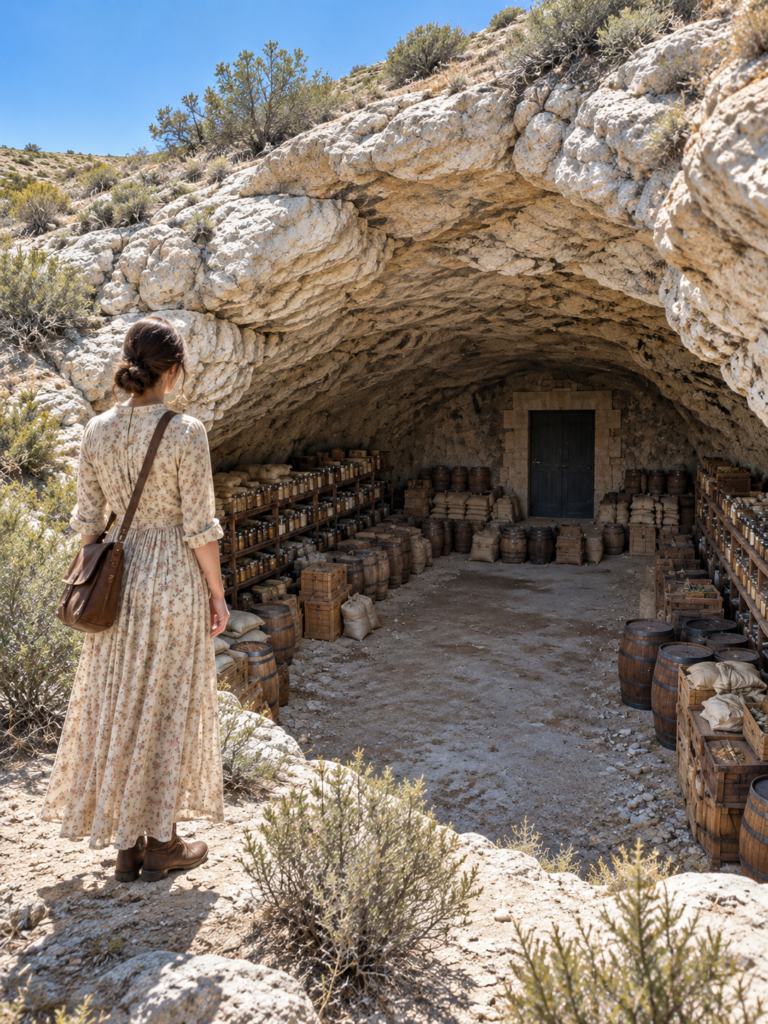
The passage opened into a chamber large enough to hold several wagons.
And inside it were rows of wooden crates.
Dozens of them.
Some stood beneath stiff, dust-covered canvas. Others had been stacked neatly against the walls. Tin containers filled shelves carved from the stone.
Elizabeth held the candle higher.
“Good Lord.”
Someone had built an entire storeroom beneath the desert.
She approached the nearest shelf.
The tins contained flour, lard, and other provisions. Their labels were faded beyond easy reading, but several bore handwritten dates.
The first date made her blink.
It was forty years old.
She checked another.
Two years newer.
Then another.
The dates continued across decades.
Someone had returned to the cave repeatedly, leaving supplies that had been carefully stored and protected from the weather.
Elizabeth ran a finger across the lid of an old tin.
Why?
Why would anyone bring provisions into a hidden cave year after year?
And why had her father known about it?
Outside, thunder sounded again.
She hurried back to Juno.
The mare resisted the narrow entrance at first, planting her hooves and tossing her head. Elizabeth did not strike or drag her.
Instead, she stood close, rubbing her neck.
“You trusted Papa,” she whispered. “You can trust me.”
It took several minutes.
Finally, Juno lowered her head and followed Elizabeth through the stone opening.
Inside, Elizabeth removed the saddle, checked the mare’s hooves, and secured the rope Clyde had given her between two projecting rocks.
Then she placed her blanket on the sand and sat against the saddle.
She had a little water.
Some cornmeal.
A handful of beans.
And one candle that was already burning too quickly.
The supplies in the cave were old enough that she dared not rely upon them for food.
She ate sparingly and listened as the storm reached the ridge.
The rain began as a gentle tapping.
Then it became a steady roar.
Water rushed down the wash outside. Small stones rattled through the channel. Wind moaned through the narrow entrance, bending the candle flame sideways.
Elizabeth drew her blanket around her shoulders.
For the first time in eleven days, she allowed herself to remember the final morning with her father.
She had awakened to silence.
No cough.
No movement beneath the blanket.
She had known before she touched his hand.
Still, she had called his name.
Once.
Twice.
Then again, louder, because some foolish part of her believed that speaking loudly enough might bring him back.
Now, in the cold darkness of the cave, she pressed her forehead against her knees.
“I don’t know what you wanted me to do,” she whispered.
Juno shifted nearby.
Elizabeth looked up.
The mare was standing quietly, watching her.
She reached toward the animal and felt the familiar warmth of her coat.
“I’m trying, Papa.”
She extinguished the candle before it burned away completely.
And she waited for morning.
The storm lasted most of the night.
Elizabeth slept only in short intervals, waking whenever the sound of water changed.
Once, the wash outside filled with a sudden rush that made the entire cave seem to tremble.
She stood, ready to lead Juno farther inside if necessary.
But the water passed.
By dawn, the thunder had moved north.
Weak gray light entered the cave.
Elizabeth relit her candle.
She walked slowly between the crates, examining the careful construction.
The wood was planed pine.
The corners were joined with precise dovetails.
Whoever had made these boxes had possessed good tools, steady hands, and plenty of time.
A man hiding ordinary food would not have gone to such trouble.
She counted twelve crates in the first row.
Twelve in the second.
The third and fourth rows held the same number.
Farther back, the darkness concealed still more.
She brushed dust from a corner.
Beneath the canvas, the wood smelled faintly of old oil.
It reminded her of her father’s saddle.
She froze.
Thomas Weaver had always used a particular oil to protect leather and tools. He mixed it himself from ingredients he bought at the feed store.
The smell was difficult to forget.
Elizabeth touched the crate again.
Had her father been here?
She thought of a trip he had taken when she was seven.
He had disappeared north for nearly two weeks and returned with an exhausted horse, a torn coat, and a silence that had troubled her mother.
When Elizabeth asked where he had gone, he said he had been checking on some family business.
Her mother had looked at him across the supper table.
Thomas had stopped talking.
Elizabeth remembered that silence now.
It had not been anger.
It had been fear.
She continued examining the chamber.
Most crates wore a thick, even covering of dust.
But three appeared different.
Their upper corners had been brushed, leaving faint marks beneath newer dust.
Someone had handled them more recently.
Elizabeth bent close.
The sand near the first crate showed a shallow scrape, almost invisible.
She moved toward the wall, holding the candle low.
There, at shoulder height, a small letter had been carved into the stone.
W.
Below it was a date.
The year her father had left Dry Wells at nineteen.
Elizabeth touched the letter with trembling fingers.
“Weaver.”
The mark was too deliberate to be accidental.
She searched the wall for another.
Twenty paces farther, she discovered a narrow arrow scratched into the rock.
It pointed toward the darkness beyond the fifth row.
Elizabeth followed it with her eyes.
The cave extended deeper than she had believed.
For a moment, she considered going forward immediately.
But the light from her candle had grown weak.
She returned to the entrance, where rainwater had collected in a shallow depression among the rocks, well outside the strongest current of the wash.
She strained the water through a clean piece of cloth and refilled her canteen, setting it aside until she could make it safer to drink.
Then she checked Juno.
The mare had a small stone wedged against her hoof. Elizabeth eased it free with her father’s knife and ran her palm down the leg to make sure nothing was swollen.
“Always see to the horse first,” Thomas used to say.
She smiled sadly.
“You’d be proud of her, Papa.”
The mare nudged her shoulder.
Elizabeth returned to the rows of crates.
She found another W carved on a box near the far wall.
But the date beneath it was older than the first.
That made her stop.
The arrangement was not random.
The marks had been placed in a sequence.
She returned to the first W, paced the wall to the arrow, and followed the arrow’s direction into the deepest section.
At the very back stood a shorter sixth row containing only four crates.
The fourth crate bore the oldest mark.
Elizabeth studied the dates.
Then she understood.
The crates had been arranged from the back of the cave toward the entrance.
Her father had not meant the third crate she would encounter upon entering.
He had meant the third crate from the beginning of the hidden arrangement.
The beginning was at the back.
Elizabeth knelt beside the third crate.
Its canvas covering had been cut along one seam and carefully folded back beneath itself.
She gripped the heavy wooden box.
It refused to move.
She dug her heels into the sand and pushed again.
Nothing.
Finally, she stood, set her shoulder against the wood, and leaned forward with all her strength.
The box scraped across the stone.
An inch.
Then several more.
Dust rose around her boots.
Elizabeth coughed and stepped back.
Behind the crate, something black caught the candlelight.
Iron.
She raised the flame.
Three long hinges had been fastened to a narrow wooden door built directly into the rock.
The wood was dark oak.
Two iron bands crossed its face.
A heavy ring hung where a handle should have been.
There was no visible lock.
Elizabeth stood motionless.
Her father had not sent her north to find silver.
He had sent her to find a door.
And someone had spent forty years making certain nobody else discovered it.
Part 3
The iron ring was cold beneath Elizabeth’s fingers.
She pulled.
The door held firm.
For one terrible moment, she wondered whether her father had intended her to open something that could no longer be opened.
She placed both hands around the ring and leaned backward.
The hinges groaned.
A narrow black line appeared along the frame.
Then the door moved.
A draft of stale air rushed against her face, nearly extinguishing the candle.
Elizabeth waited for the flame to settle.
She pulled the door fully open.
Beyond it lay a second chamber.
This one was smaller, with a flat stone floor and rough walls that seemed to have been shaped by hand. Unlike the outer storeroom, it contained little dust.
Four wooden chests stood against the left wall.
Each was reinforced with iron bands.
Each bore faded black lettering.
Elizabeth approached the first and raised her candle.
Two large letters remained clearly visible.
U.S.
Below them she made out another word.
ARMY.
And beneath that:
PAYROLL.
She read it again.
Army payroll.
Elizabeth knew enough about the frontier to understand what those words meant.
Soldiers stationed at distant forts sometimes received their wages in cash delivered by guarded wagon. Those shipments could carry more money than most working families would see in a lifetime.
But why would four army payroll chests be hidden inside a cave on the Weaver claim?
She lifted the first lid.
Empty.
The second chest was empty too.
So were the third and fourth.
Each had been forced open at some earlier time. The broken metal fittings had been replaced, but the damage remained visible around the edges.
Elizabeth stepped backward.
This was not a treasure waiting to be discovered.
It was evidence of something terrible.
On the opposite wall stood a small pine table.
Three objects rested upon it.
A tin box filled with folded letters.
A thick ledger bound in dark cloth.
And a packet of documents wrapped in oilcloth.
Elizabeth carried the candle across the chamber.
She opened the tin first.
The letters were old, their paper yellowed and brittle. Some were written in hurried pencil, others in ink that had faded to brown.
The earliest bore a date forty-one years in the past.
She unfolded it carefully.
The message described a government payroll wagon traveling between a railhead and a military fort.
There were six soldiers assigned to guard it.
The writer knew the route, the expected arrival time, and the narrow stretch of canyon where the wagon would be forced to slow down.
Elizabeth read the letter twice.
Then she opened the next.
It mentioned rifles.
Horses.
A dry wash leading toward the north ridge.
And a man who would wait at the mouth of the canyon to prevent anyone from escaping.
The third letter described the same plan.
A fourth contained a sum of money so large Elizabeth had to count the digits again.
Her breathing changed.
She opened another letter.
There, written in a firm, unmistakable hand, was a name she recognized.
James Hollister.
She stared at the signature.
The loops of the letters matched the initials she had noticed engraved on Hollister’s expensive saddle fittings.
He had written instructions for the robbery.
He had selected the road.
He had arranged the meeting place.
And he had ordered the stolen money carried into the northern ridge.
Elizabeth’s hands began to shake.
She searched through the remaining letters.
A second name appeared repeatedly.
Weaver.
Her grandfather.
He had been assigned to guard the canyon entrance with a rifle.
Another participant, a young man of seventeen, had been ordered to manage the horses.
Then Elizabeth found a letter written after the robbery.
Six soldiers were dead.
The payroll was gone.
And the thieves had divided the money.
For several seconds, Elizabeth could hear nothing except the faint sound of her own breathing.
Her grandfather had participated in the killing of six men.
Her father had known.
And James Hollister—the wealthy, respected landowner who had offered her two hundred dollars—had been the man who planned it.
She sat down heavily on one of the empty chests.
The candle trembled in her hand.
She remembered the laughter in the mercantile.
The way Royce had called her father a fool.
The way the entire town had treated the Weaver claim as proof that three generations of her family possessed nothing but stubbornness.
All those years, the people laughing had lived beneath the influence of a man whose fortune began with stolen soldiers’ wages.
Elizabeth looked toward the table again.
The ledger waited.
She opened it.
Its first page contained four words written in faded ink.
The seed. The road.
Below them were figures.
Amounts divided.
Payments made.
Land purchased.
Cattle acquired.
At first, the entries were small.
Then the amounts increased.
A pasture bought from a struggling rancher.
A mining claim purchased from a disappointed prospector.
A neighboring property taken through an unpaid debt.
Another claim.
Another pasture.
Another piece of land.
The years advanced page by page, and with them the names of families Elizabeth did not know.
Families who had once owned pieces of the valley.
Men who had borrowed money when drought ruined their cattle.
Women who had sold inherited ground because their husbands had died.
People who had accepted small payments for claims they had been told were worthless.
The ledger recorded all of it.
And every acquisition led back to the first entries.
The stolen payroll.
James Hollister had used the money from the robbery to establish himself in the valley. Over four decades, his wealth had grown into the ranches, buildings, and influence that now made him the most powerful man in Dry Wells.
Elizabeth closed the book.
Her grandfather’s guilt was already terrible.
But there was something worse about the ledger.
It showed how a crime committed on one forgotten road could shape the lives of people who never knew the crime had happened.
Then she reached for the oilcloth packet.
Inside was a handwritten statement.
She recognized her father’s writing immediately.
His letters leaned slightly to the right, carefully formed despite the tremor that had troubled his fingers in later years.
At the top was a date from eleven years earlier.
The spring he had disappeared from Carson Flats.
Elizabeth’s heart pounded.
She began to read.
Thomas described his father’s final illness and the confession he had made before dying.
The elder Weaver had admitted his involvement in the payroll robbery. He had admitted that soldiers were killed, that Hollister was the organizer, and that the cave had been used to hide stolen money and supplies.
He had carried the secret for years.
His conscience had finally forced him to tell his son.
But before Thomas could confront the matter, his father had died.
Thomas himself had returned to the ridge when Elizabeth was seven.
He had found the cave.
He had opened the hidden chamber.
He had read the letters and ledger.
And he had discovered that the man who ruled Dry Wells was responsible for the deaths of six soldiers.
Elizabeth continued reading.
One paragraph made her stop.
Her father had written that he intended to report everything.
Then he had crossed out the sentence.
Beneath it, in smaller writing, he had explained why.
He had a wife and a child.
Hollister controlled the valley.
Several men who worked for Hollister carried guns, and Thomas knew that a dead man’s accusation would mean little without proof.
He feared that if he challenged Hollister without protection, his family would suffer.
So he had put the documents back inside the cave.
He had sealed the door.
Then he had returned home.
Elizabeth remembered her mother’s face when Thomas came back from that journey.
The silence at supper.
The way her mother had rested a hand on his wrist.
She had understood that he was carrying something dangerous.
And she had loved him enough not to ask him to carry it alone.
Elizabeth turned another page.
Her father’s writing became more personal.
He spoke of the shame he felt about his own father.
He wrote that a man’s wrongdoing did not become innocent merely because it had been hidden for a lifetime.
He said he had tried to live honorably, although he knew that honest work could never undo the suffering caused by the stolen money.
Then came a passage Elizabeth read three times.
Thomas had written that silence could protect innocent people, but it could also become an excuse for allowing injustice to continue.
He had wanted to choose the right moment.
He had spent years waiting for one.
And he feared he had waited too long.
Elizabeth pressed the paper against her lap.
She could almost hear his voice.
He had never been a man who complained.
Even when debt overwhelmed him, he had worked.
Even when sickness weakened him, he had tried to rise each morning.
He had carried a burden she had never suspected.
At the end of his statement was a final paragraph.
The documents were being left for the person who came after him.
The writer asked that they be delivered to an honest authority capable of investigating the crime.
He did not demand revenge.
He did not ask that his family be excused.
He asked only that the truth be examined fairly and that the innocent dead not remain forgotten.
Beneath the paragraph was a blank line where a name should have been written.
Elizabeth rested her finger against the empty space.
Her father had not finished.
Perhaps he had been waiting until she was old enough.
Perhaps he had hoped never to burden her.
Perhaps he had simply run out of time.
She looked at the four chests.
Then at the ledger.
Then at the letters.
She imagined six soldiers riding along a lonely road, thinking of the wages waiting at the end of their journey.
She imagined their mothers and wives waiting for letters that would never arrive.
She imagined her grandfather standing with a rifle while those men died.
A wave of shame passed through her.
Not because she had committed the crime.
But because she carried the name of someone who had.
For a moment, she wanted to leave everything where it was.
She could close the door.
Replace the crate.
Ride back to Dry Wells.
Accept Hollister’s two hundred dollars.
And begin a comfortable life somewhere far away.
No one would blame her for refusing a dangerous burden.
She was only eighteen.
She had just buried her father.
She was hungry, exhausted, and nearly penniless.
What right did the dead have to demand more from her?
She looked down at the final paragraph.
Then she remembered something Thomas had told her when she was twelve.
They had found a calf tangled in an old wire fence.
The animal had been struggling for hours, cutting its legs each time it kicked.
Elizabeth had been frightened.
“Papa, it’ll hurt us.”
Thomas had handed her his coat.
“Maybe. But being afraid of getting hurt doesn’t mean we leave something helpless.”
They had freed the calf together.
Elizabeth sat quietly with the statement in her hands.
Her father had spent years trying to decide when to speak.
She would not spend the rest of her life waiting.
She gathered the letters, ledger, and statement.
She wrapped them carefully in the oilcloth and secured the packet beneath her coat.
Before leaving, she returned each empty chest to its original position.
Then she closed the door and pushed the heavy crate back across the stone.
When she reached the outer chamber, Juno lifted her head.
Elizabeth rested her forehead against the mare’s warm cheek.
“I found it,” she whispered.
The words should have brought relief.
Instead, they frightened her.
Because now she understood why Hollister had offered two hundred dollars for a worthless claim.
He was not buying the land.
He was buying silence.
Elizabeth saddled Juno and left the cave.
The storm had passed.
The desert lay washed beneath a gray morning sky, with small streams running briefly through channels that had been dry for months.
The air smelled of wet sage.
She looked south toward Dry Wells.
Then north toward the empty hills.
She knew Hollister would send men to find her when she failed to return.
If they discovered the documents, her father’s final effort would be lost.
She could not simply ride down the main road.
According to the map, an old well stood east of the ridge beside the ruins of a line camp.
Perhaps she could take shelter there and decide her next move.
She turned Juno east.
They had traveled less than half a mile when Elizabeth heard a woman calling.
The voice came from below the ridge.
Then a child cried out.
Elizabeth rode to the edge of a rocky slope and looked down.
A wagon lay tilted into the mud.
One wheel had broken.
A mule stood motionless in the traces.
A woman held a little girl on her hip while a boy sat against the wagon tongue, his arm hanging awkwardly against his chest.
Elizabeth looked south.
The road to Dry Wells was still empty.
She could keep going.
She could leave the strangers behind.
She might reach safety before Hollister’s men found her.
Then the boy raised his pale face and called for his mother.
Elizabeth closed her eyes briefly.
Her father had left her a terrible choice.
And the desert had already given her another.
She turned Juno toward the broken wagon.
Part 4
The woman saw Elizabeth approaching and stepped protectively in front of her children.
“Please,” she called. “My boy’s hurt.”
Elizabeth dismounted.
“I can see that. What happened?”
“The storm caught us in the wash. The wheel sank, and when the wagon tipped, he fell.”
The woman looked close to exhaustion.
Her dress was stained with mud. One sleeve had torn at the shoulder. The little girl in her arms had stopped crying and was watching everything with the vacant expression of a child who had been frightened for too long.
“My husband died a month ago,” the woman said suddenly. “We’re going south to stay with my brother. I thought we could make the crossing before the rain.”
Elizabeth nodded.
She knew that desperate people sometimes explained their troubles before anyone asked, as though hardship required a defense.
“What’s your name?”
“Mary Bell.”
“I’m Elizabeth Weaver.”
Mary glanced toward the mare.
“Can you take us to town?”
“Not by the main road. There may be dangerous men looking for me.”
Mary stared at her.
Elizabeth understood how strange that sounded.
“I haven’t harmed anyone,” she added. “But I have something they want.”
Mary studied her for a moment.
Then she looked at her injured son.
“My boy’s name is Micah. He’s seven.”
Elizabeth knelt beside him.
“Hello, Micah.”
The boy tried to smile.
“Hello, ma’am.”
“Does your arm hurt?”
He nodded.
“More when I move.”
Elizabeth examined it carefully.
The elbow was swollen, and the forearm lay at an unnatural angle.
She could not be certain whether the bone was broken or displaced, but she knew he needed proper medical attention as soon as they could get him safely to town.
“I’m going to keep it still,” she told him. “It may hurt while I get it supported.”
Micah bit his lip.
“I won’t cry.”
“You can cry if you need to. That doesn’t make you any less brave.”
She found two smooth pieces of wood among the wagon’s broken fittings and padded them with folded cloth. Keeping the arm in the position Micah could best tolerate, she fashioned a splint and sling.
The boy gasped when she moved the cloth beneath his elbow.
Mary held his good hand.
“That’s it, sweetheart. You’re doing fine.”
When the work was finished, Elizabeth checked his fingers.
They were warm.
He could move them.
That was encouraging.
But she knew he still needed a doctor.
She stood and looked at the wagon.
One wheel had collapsed completely.
The axle was bent.
They could not repair it without proper tools.
“There’s an old line camp east of here,” Elizabeth said. “It has stone walls and a well. We can shelter there.”
“How far?”
“Less than a mile, I think.”
Mary looked at the mule.
“I can’t carry both children.”
“You won’t have to.”
Elizabeth lifted Micah onto Juno’s saddle, supporting his injured arm while he settled against the saddle horn.
Then she helped Mary free the mule from the damaged traces.
The little girl, Annie, began crying when her mother set her down.
Elizabeth crouched beside her.
“Would you like to ride with me?”
Annie studied her uncertainly.
“I want Mama.”
“Mama will be right beside us.”
Using the rope Clyde had given her, Elizabeth fashioned a simple support to help carry the child against her hip while keeping one hand free for the mare.
Then they started walking.
The mud clung to their boots.
The mule followed reluctantly.
Micah swayed with Juno’s careful steps, sometimes closing his eyes against the pain.
Elizabeth kept watching the distant road.
Every few minutes, she stopped and listened.
Mary noticed.
“Who are you afraid of?”
Elizabeth did not answer immediately.
“Men who believe powerful people ought to be protected from the consequences of what they’ve done.”
Mary frowned.
“That sounds like trouble.”
“It is.”
“Then why don’t you run?”
Elizabeth glanced toward the two children.
“I’m learning that running doesn’t always leave trouble behind.”
They reached the line camp shortly before noon.
Its walls were built from rough stones fitted without mortar. Most of the roof had fallen, but one corner remained intact, offering enough shade and protection for the children.
The well held a shallow supply of water.
Elizabeth checked that it was clear and drew some into a bucket. She was careful not to give the children more than small amounts until she could assess whether it was safe.
Mary settled Micah beneath the surviving roof.
Annie curled beside him and fell asleep almost immediately.
Elizabeth tied Juno and the mule inside the ruined enclosure.
Then she reached into her satchel and offered Mary the remaining beans and cornmeal.
“It’s not much.”
Mary looked at the food.
“You’ll need some yourself.”
“We can share.”
They sat together in the shade for a few minutes.
Neither spoke much.
Mary finally broke the silence.
“My husband was a good man. Worked himself half to death keeping that wagon moving. When the fever took him, I thought the children and I would have to give up everything.”
Elizabeth looked toward the sleeping girl.
“I lost my father eleven days ago.”
Mary’s expression changed.
“Oh, honey.”
The simple tenderness in those two words nearly broke Elizabeth’s composure.
She had endured the funeral.
The long ride.
The humiliation in town.
The storm.
The cave.
The terrible documents.
And through all of it, she had forced herself to remain steady.
But Mary Bell, a stranger with almost nothing, had offered the first kindness that asked her to be nothing more than a grieving daughter.
Elizabeth lowered her eyes.
“I don’t know what I’m supposed to do without him.”
Mary reached across the space between them and squeezed her hand.
“You do the next thing that needs doing,” she said. “Then the next. That’s how I’ve been getting through the days.”
Elizabeth nodded.
That was something her father might have said.
A breeze moved through the ruined camp.
Annie stirred in her sleep.
Micah rested his injured arm against the makeshift sling.
For several minutes, the world seemed almost peaceful.
Then Elizabeth heard hoofbeats.
She rose immediately.
Two riders appeared on the southern road.
They were moving slowly toward the ridge.
One wore a pale waistcoat.
The other wore a flat-brimmed hat.
Royce.
And the red-faced man from the mercantile.
Elizabeth watched them approach.
She could hide behind the ruined wall.
She could wait for the men to pass.
But she knew they would search the camp.
If they discovered Mary and the children, the strangers might become bargaining pieces in a conflict they knew nothing about.
Elizabeth turned to Mary.
“I need you to stay here.”
Mary stood.
“What are you going to do?”
“Meet them before they reach the wall.”
“You can’t face two armed men alone.”
“I won’t let them find the children.”
Mary looked at the road, then at Elizabeth.
She understood.
“Be careful.”
Elizabeth checked that her father’s packet remained secure beneath her coat.
Then she untied Juno, considered taking the mare, and changed her mind.
The horse would be safer with the children.
She walked toward the road on foot.
The two riders spotted her before she reached the bend.
Royce raised one hand.
“Miss Weaver!”
Elizabeth stopped.
“Mr. Royce.”
The men approached at a walk.
Royce glanced over her shoulder toward the ruined camp.
“Had ourselves quite a time finding you.”
“I wasn’t trying to be found.”
“So it seems.”
His companion rested a rifle across his saddle.
Royce gave her a friendly smile.
“Mr. Hollister’s concerned about your safety.”
“That’s thoughtful of him.”
“He’d like you back in Dry Wells.”
“Why?”
“To settle the matter of your father’s property.”
“My father’s property isn’t for sale.”
Royce’s smile thinned.
“Girl, you’ve already made this harder than it needs to be.”
Elizabeth remained still.
“What do you want?”
“The map.”
She shook her head.
“There’s nothing on the map worth your trouble.”
“Then hand it over.”
“I can’t.”
Royce studied her face.
“You found something.”
It was not a question.
Elizabeth said nothing.
The red-faced man shifted in his saddle.
Royce leaned forward.
“Listen carefully. Mr. Hollister has been generous. He offered you money, a fresh start, and protection. Most people in your position would’ve thanked him.”
“My position?”
“You’ve got no family. No money. No friends here. And a claim nobody wants.”
Elizabeth felt anger rise.
“You’re wrong.”
Royce lifted an eyebrow.
“About which part?”
“Someone wants that claim badly enough to send two armed men after a hungry eighteen-year-old girl.”
His companion glanced uneasily toward the road.
Royce’s expression darkened.
“You’re clever. Your father was clever too. Didn’t do him much good.”
Elizabeth took one step forward.
“Don’t talk about my father.”
“Then give me what you found.”
She could see the rifle clearly now.
The red-faced man was trying to look calm, but his fingers moved along the wooden stock.
Royce continued speaking in a quieter voice.
“There are children up there, aren’t there?”
Elizabeth felt a cold tightening in her stomach.
“Leave them out of this.”
“That depends on you.”
“You have no reason to threaten them.”
“I’m not threatening anybody. I’m offering to help.”
“Then ride away.”
Royce looked at her for a long moment.
He seemed almost disappointed.
“You don’t understand how things work in this valley.”
Elizabeth thought of the ledger.
The names of families whose land had passed into Hollister’s hands.
The forty years of transactions.
The six dead soldiers.
“I understand more than you think.”
Royce’s smile disappeared completely.
He straightened in the saddle.
“Last chance.”
Elizabeth did not move.
“No.”
The red-faced man shifted the rifle.
Then another sound came from below the southern ridge.
Hooves.
Not two horses.
Several.
The rhythm grew louder.
Royce turned.
Five riders came around the bend at a steady trot.
Four wore dark coats.
The fifth rode slightly ahead, a silver star pinned to his chest.
He was a broad-shouldered man with a short gray beard and a face weathered by years of travel.
He brought his horse to a stop beside Elizabeth.
“Miss Elizabeth Weaver?”
She looked up.
“Yes, sir.”
“Nathan Barrow. United States deputy marshal, assigned through the territorial office.”
Royce went rigid.
The red-faced man lowered his rifle.
Barrow looked directly at Elizabeth.
“I’ve been looking for you.”
Elizabeth’s pulse quickened.
“Why?”
“Your father wrote to my office.”
She stared at him.
“My father?”
“Yes.”
“When?”
“Eleven days ago. The letter was posted from Carson Flats shortly before his death. It reached us four days ago.”
Elizabeth felt her hand move instinctively toward the packet beneath her coat.
Barrow noticed but made no attempt to touch her.
“He told us his daughter would likely come to Dry Wells carrying a map. Said there might be documents hidden on the Weaver claim.”
Elizabeth could barely speak.
“He never told me.”
“I don’t believe he wanted to frighten you before you reached the ridge.”
Barrow paused.
“He also wrote that he’d spent too many years waiting to do the right thing. Said he wasn’t willing to leave the burden entirely on his daughter.”
Elizabeth closed her eyes.
Her father had arranged for someone to come.
He had not sent her into danger without trying to protect her.
He had reached beyond his dying room, beyond his weakness and fear, and made one final effort to ensure she would not face Hollister alone.
“Do you have the documents?” Barrow asked.
“Yes, sir.”
“Are they safe?”
“Yes.”
The marshal nodded.
“Then your father kept his word.”
He turned toward Royce.
“Mr. Royce, you and your companion will ride back to town with my men.”
Royce opened his mouth.
“Marshal, I assure you there’s been some misunderstanding.”
“Then you’ll have every opportunity to explain it.”
Barrow glanced at the rifle.
“I’d appreciate it if neither of you reached for a weapon.”
The four riders moved forward.
The red-faced man looked at Royce.
Royce said nothing.
Within moments, both men were riding south under escort.
Barrow dismounted beside Elizabeth.
“Are you hurt?”
“No.”
“Anyone else up there?”
“A widow and two children. Her wagon broke in the storm. The boy’s arm is injured.”
Barrow looked toward the camp.
“We’ll see to them.”
He accompanied Elizabeth back to the ruined enclosure.
Mary rose when she saw the badge.
Elizabeth introduced them and explained what had happened.
Barrow knelt beside Micah.
The boy looked at the silver star.
“Are you going to arrest her?”
The marshal smiled gently.
“No, son. Quite the opposite.”
Micah glanced at Elizabeth.
“She’s the one who helped us.”
“So I’ve heard.”
Barrow promised Mary a wagon, food, and transportation south once Micah had received medical attention.
Then he turned to Elizabeth.
“Your father described you as a capable girl.”
Elizabeth looked down.
“He said that?”
“He said you knew how to keep your head when everyone else lost theirs.”
For the first time since his death, she smiled without forcing herself.
Barrow helped her bring Juno from the enclosure.
“You’ve done enough out here. Come back to Dry Wells with me.”
Elizabeth mounted.
The packet pressed against her ribs.
This time, she was not riding toward a mystery.
She was carrying its answer.
And when the small procession entered Dry Wells that afternoon, everyone came out to watch.
Royce rode at the front beneath the watchful eyes of the marshal’s men.
Elizabeth followed on her gray mare.
Behind her rode Nathan Barrow.
The townspeople recognized the badge.
The boy at the horse trough stood and stared.
The shopkeeper came outside, wiping her hands on her apron.
Clyde stepped from the livery.
No one laughed.
Barrow led Elizabeth into the county clerk’s office.
A thin man named Mr. Henshaw stood behind a desk covered with papers and registers.
“Miss Weaver,” the marshal said, “this is the man who can help us establish what happened.”
Elizabeth reached beneath her coat.
She removed the oilcloth packet.
And for the first time since opening the hidden door, she placed her father’s burden into another person’s hands.
Part 5
Mr. Henshaw untied the cord carefully.
He unfolded the oilcloth.
The ledger came first.
Its dark cover was worn along the spine, and its pages had turned the color of old parchment.
He opened it beneath the afternoon light.
At first, his expression remained unchanged.
Then he turned to the second page.
And the third.
He leaned closer.
“Where did you find this?”
“In a cave on my father’s claim.”
Henshaw looked at Barrow.
The marshal nodded.
“Keep reading.”
The clerk adjusted his spectacles.
He studied the dates, the figures, and the signatures.
His fingers stopped on one particular entry.
“I know this handwriting.”
Elizabeth leaned forward.
“You do?”
“I’ve registered Mr. Hollister’s land transactions for nearly thirty years. I’ve seen his signature hundreds of times.”
He turned another page.
“It’s his.”
Barrow removed his hat and placed it on the desk.
“Look at the earliest entries.”
Henshaw obeyed.
The room grew silent.
He followed the figures backward until he reached the first page.
There were four words at the top.
The seed. The road.
Below them were amounts paid to three men.
Then expenditures for horses, land, cattle, and supplies.
Henshaw looked toward Elizabeth.
“Do you understand what these figures suggest?”
“Yes, sir.”
“Tell me.”
“My grandfather helped rob an army payroll wagon forty-one years ago. Six soldiers were killed. Mr. Hollister planned the robbery and used the money to build his fortune.”
Henshaw slowly removed his spectacles.
For a moment, he looked much older.
“Dear God.”
Barrow opened the tin box.
He read the letters one at a time.
The clerk examined the signatures.
Then they reviewed Thomas Weaver’s statement.
Elizabeth sat quietly while the men worked.
Outside, the sound of ordinary life continued.
A wagon rolled past the window.
Someone called for a blacksmith.
A dog barked beside the livery.
It seemed impossible that an entire town could continue its afternoon while forty years of buried wrongdoing lay exposed on a desk.
After nearly an hour, Barrow closed the ledger.
“We’ll need to verify the original payroll records,” he said. “And the military reports from the ambush.”
Henshaw nodded.
“There were stories about a government wagon disappearing years ago. My father told me once. Said the soldiers were found in the canyon after the thieves had gone.”
“Was anyone arrested?”
“No. The reports blamed a gang of unknown highwaymen. Nobody could prove who organized it.”
Barrow looked at the letters.
“Now we have names.”
Elizabeth felt a sharp pain in her chest.
“One of them is mine.”
The marshal turned toward her.
“Your grandfather’s name is in these letters. That does not make you responsible for his actions.”
“He helped kill those men.”
“Yes.”
“My father knew.”
“Yes.”
“And he waited eleven years before telling anyone.”
Barrow was quiet for a moment.
Then he said, “Your father was wrong to wait so long. But he made a decision before he died to bring the truth forward. That matters too.”
Elizabeth looked down at her hands.
She had wanted someone to tell her that Thomas had done everything right.
But perhaps loving someone did not require believing they had never failed.
Perhaps it meant seeing their failures and understanding how hard they had struggled to rise above them.
“What happens now?” she asked.
Barrow rose.
“We speak to James Hollister.”
Henshaw looked uncertain.
“He owns half the property in this valley.”
“Not the territorial office.”
“He has friends in important places.”
“Then they’ll have to decide how much their friendship is worth.”
The clerk glanced at Elizabeth.
“And the girl’s land?”
“That question will be examined in due course.”
Elizabeth stood.
“I’m not asking for money.”
Barrow looked at her.
“I know.”
“I want those six soldiers remembered. And I want people to stop calling my father a fool.”
The marshal’s expression softened.
“Then we’ll begin with the truth.”
He sent a boy to deliver a message to Hollister’s house.
The boy returned twenty minutes later.
And shortly afterward, a bay gelding with a white blaze appeared outside the clerk’s office.
James Hollister had come alone.
He dismounted, looped his reins around the hitching rail, and climbed the three wooden steps.
He opened the door without knocking.
His black hat was in his hand.
“Marshal.”
“Mr. Hollister.”
The old landowner looked at the ledger.
For one instant, his face seemed to lose all its color.
Then he turned toward Elizabeth.
Neither spoke.
Hollister approached the desk.
He touched the worn cover with two fingers.
“I wondered what happened to this.”
Barrow watched him carefully.
“Do you recognize it?”
“Yes.”
“Is it yours?”
“It is.”
“And are the entries in your handwriting?”
Hollister nodded.
For the first time since Elizabeth had met him, he seemed genuinely tired.
“May I sit?”
Henshaw brought him a chair.
The old man lowered himself into it.
He placed his hat on his knees.
Then he looked at the documents again.
For several minutes, Barrow questioned him.
Hollister answered in short sentences.
He did not deny planning the robbery.
He did not deny receiving the stolen money.
He admitted that the original capital for his land purchases had come from the missing army payroll.
He spoke of the crime as something distant, almost separate from the old man sitting in the chair.
Finally, Barrow asked about the soldiers.
Hollister looked toward the window.
“We hadn’t intended to kill all of them.”
Elizabeth felt her entire body go cold.
Barrow’s voice sharpened.
“Six men died.”
“I know.”
“You brought armed men to stop a guarded government wagon. What did you expect?”
Hollister did not answer.
Elizabeth stood.
“Did my grandfather shoot one of them?”
Hollister looked at her.
The question seemed to trouble him more than anything Barrow had asked.
“He held the canyon mouth.”
“Did he shoot anyone?”
“I don’t know whose bullet struck which man.”
Elizabeth pressed her lips together.
She had known this would hurt.
But knowing did not make it easier.
Hollister lowered his gaze.
“Your grandfather was desperate for money. I offered him a share.”
“He could’ve refused.”
“Yes.”
“So could you.”
The old man nodded.
“Yes.”
Elizabeth looked at his expensive coat, polished boots, and neatly trimmed gray hair.
She thought of the hungry families whose names appeared in the ledger.
The ranchers who had lost their land.
The people who had borrowed against crops that never grew.
The miners who had sold claims for pennies while Hollister bought every acre surrounding the hidden cave.
“You spent forty years telling people the north ridge was worthless,” she said.
“It had no silver.”
“But it held the proof.”
Hollister looked up.
“Yes.”
“You tried to buy my claim because you knew my father might have told me.”
“Yes.”
“And when I refused?”
Hollister’s eyes moved toward the door.
“I sent Royce to make sure you didn’t come back carrying anything from the ridge.”
Elizabeth swallowed.
“Did you tell him to kill me?”
A long silence followed.
“No,” Hollister said at last.
Barrow studied him.
“But you knew Royce carried a rifle.”
Hollister lowered his eyes.
“Yes.”
Elizabeth felt anger rise through her grief.
“You were willing to let whatever happened happen, as long as your secret stayed buried.”
The old man said nothing.
The answer was in his silence.
Outside, voices gathered.
Word had traveled through Dry Wells faster than the afternoon wind.
Men who once tipped their hats to Hollister stood uneasily on the sidewalk.
Women watched from shop doorways.
The boy from the horse trough peered through the window.
Hollister looked once more at Elizabeth.
“Your father was a better man than his father,” he said quietly.
She did not answer.
“And a better man than me.”
“Yes,” Elizabeth said.
Her voice did not tremble.
“Yes, he was.”
Barrow closed the ledger.
“Mr. Hollister, you’ll come with us.”
The old man did not resist.
He stood slowly, lifted his hat, and settled it upon his head.
At the doorway, he paused.
He looked toward Elizabeth, as though searching for words that might soften what had happened.
But nothing came.
Then he walked down the steps.
Barrow followed.
The crowd parted.
James Hollister, who had spent forty years buying land, extending credit, commanding loyalty, and deciding whose future in Dry Wells would prosper, crossed the street under the watch of federal officers.
No one applauded.
No one cheered.
And no one laughed.
Elizabeth emerged from the clerk’s office behind him.
The shopkeeper was standing outside the mercantile.
Tears ran down her cheeks.
Clyde stood beside the livery with his hat pressed against his chest.
He inclined his head.
Not because Elizabeth was wealthy.
Not because she had power.
But because he finally understood the burden she had carried into town.
The elderly woman sat on her bench outside the adobe house.
As Elizabeth passed, the woman opened her pale eyes.
“You found the door.”
Elizabeth stopped.
“Yes, ma’am.”
“And what was behind it?”
Elizabeth considered the question.
“Something my father couldn’t put right alone.”
The old woman nodded.
“That is often how the hardest things are left.”
Elizabeth sat beside her.
For the first time since arriving in Dry Wells, she no longer felt like a stranger.
“Did you know?” she asked.
“I knew there was an old wrong in that family. I knew your grandfather was frightened of something, and I knew Hollister had reasons to want the ridge. But I never knew the whole of it.”
“Why didn’t anyone ask questions?”
The old woman looked down the street.
“Some people were afraid. Some owed Hollister money. Some were grateful to him. And some found it easier to believe a comfortable lie.”
Elizabeth folded her hands.
“My father kept quiet too.”
“Yes.”
“He was afraid.”
“Of course he was.”
The old woman reached for her hand.
“Courage isn’t always something a person has when he needs it. Sometimes it comes late. Sometimes a man gets only one last chance to use it.”
Elizabeth looked at her.
“Do you think he deserved forgiveness?”
“That’s not for me to decide.”
The old woman squeezed her fingers.
“But I think he wanted to leave you something cleaner than the history he’d inherited.”
Elizabeth finally began to cry.
Not loudly.
There was no collapse into the old woman’s arms, no dramatic confession.
Only tears that came quietly after too many days of refusing to fall.
She wept for the father who had loved her.
For the mistakes he had made.
For the years he had carried his shame alone.
And for the terrible knowledge that she would never again hear him tell her he was proud.
The old woman sat beside her until the tears stopped.
Then she gave Elizabeth a clean handkerchief.
“Come along, child. You’ve got living left to do.”
The months that followed were not easy.
There were hearings.
Sworn statements.
Long journeys by officials who had to inspect the cave, compare the handwriting, and recover military records from government archives.
Surveyors returned to the north ridge with maps and measuring instruments.
The four empty payroll chests were documented.
The letters were copied.
Hollister’s ledger was entered into evidence.
The old army reports confirmed that six soldiers had been killed during the payroll robbery forty-one years before.
The theft had never been solved.
Now, after four decades, the dead finally had names to place beside their killers.
The territorial court also examined Hollister’s later property transactions.
Some were legitimate purchases made with money obtained through his business.
Others involved coercion, fraudulent accounting, or debts recorded in ways that favored him unfairly.
The court could not simply undo forty years of history.
Some families had moved away.
Some owners had died.
Some properties had changed hands several times.
But the investigation exposed enough wrongdoing to strip Hollister of much of the influence he had spent his life accumulating.
He was convicted and imprisoned.
He did not return to Dry Wells.
His fine bay gelding was eventually sold.
The expensive saddle with its silver fittings hung in Clyde’s livery for years, gathering dust.
Nobody wanted to buy it.
Elizabeth’s own claim was formally recognized.
The north ridge belonged to the Weaver family by an old and valid title that Hollister had never managed to acquire.
She was offered money for it almost immediately.
A mining company expressed interest in surveying the ground.
Another rancher suggested using part of the ridge for grazing.
Elizabeth refused both offers.
“I don’t want to sell it,” she told Henshaw.
The clerk studied her.
“It’s your property. You can do as you please.”
“Then I want it left as it is.”
Henshaw smiled.
“Your father would’ve understood that.”
A portion of the money recovered through the proceedings was made available for restitution.
Elizabeth received a modest settlement connected to the wrongs done to her family’s property.
It was not a fortune.
But it was enough to give her a beginning.
She used part of it to buy a small plank house behind the mercantile.
The house had two rooms, a narrow porch, and a lean-to where Juno could shelter from bad weather.
Elizabeth repaired the fence herself.
She patched the roof with help from Clyde.
She planted beans beside the southern wall, where the sun reached the soil early.
And on the first evening after moving in, she placed her father’s old coffee mug on the kitchen table.
She stood looking at it for a long time.
Then she set a fresh cup beside it.
The house felt terribly quiet.
But this time the quiet was different.
It was not the silence of a rented room where someone had died.
It was the silence of a place where someone could begin living again.
The mercantile owner offered Elizabeth work.
She accepted.
Each morning, she swept the wooden floor, weighed flour, measured beans, sorted shelves, and learned to keep the books.
She discovered that she had inherited her father’s careful way with figures.
The woman who had once warned her away from the north ridge began treating her almost like family.
Whenever business was slow, they drank coffee together behind the counter.
Sometimes they spoke of Thomas.
Sometimes they spoke of nothing important at all.
Elizabeth found comfort in both.
Clyde kept a stall ready for Juno whenever the mare needed shelter.
One afternoon, Elizabeth tried to pay him.
He pushed the coin back across the counter.
“Your father’s girl,” he said.
And that settled the matter.
Mary Bell and her children remained in Dry Wells until Micah’s arm was properly examined and treated.
The boy recovered well.
A replacement wagon was arranged, along with supplies for the journey south.
Before leaving, Mary brought both children to Elizabeth’s house.
Annie ran to hug her.
Micah approached more slowly, his arm still supported in a sling.
“I wanted to thank you,” he said.
Elizabeth crouched to his height.
“You’ve already thanked me.”
“But Mama says you could’ve kept riding.”
Elizabeth looked at Mary.
The widow’s eyes filled.
Elizabeth turned back to the boy.
“My father taught me that when someone needs help, you do what you can.”
Micah considered this.
Then he nodded seriously.
“I’m going to remember that.”
Elizabeth smiled.
“Then he’ll have taught you something too.”
Mary embraced her before climbing onto the wagon.
“You gave us more than shelter,” she whispered. “You made me believe strangers can still be good.”
Elizabeth watched the wagon roll south until the dust swallowed it.
She thought of the broken wheel.
The boy’s frightened face.
The little girl sleeping against her shoulder.
And the moment on the ridge when she had almost ridden away.
Her father had left her documents that could expose a crime.
But perhaps the most important inheritance he had given her was the simple knowledge that she should never let fear decide who deserved her help.
Later that autumn, Elizabeth returned to the clerk’s office.
Henshaw had received correspondence concerning the soldiers killed in the robbery.
Some had left wives.
Others had parents or siblings.
After so many years, not all the families could be found.
But several surviving relatives had been identified.
Elizabeth read the names carefully.
She had never known these men.
Yet their deaths had shaped her life before she was born.
She asked Henshaw how she could contribute toward the restitution effort.
“You’ve already done more than anyone could reasonably ask,” he said.
“I know.”
“Then why give away money you might need?”
Elizabeth looked toward the window.
“Because my grandfather took something from those families. I can’t bring the men back. But I can choose what happens to the part of the money that came to me.”
Henshaw did not argue.
She kept enough to maintain her house and care for Juno.
The remainder of her settlement went toward the surviving families of the dead soldiers.
It would not erase their loss.
It would not change the past.
But Elizabeth wanted the money to travel somewhere better than it had traveled forty-one years earlier.
She signed the papers in her father’s careful style.
Then she walked home.
Winter brought cold nights and thin frost to the high ground.
Elizabeth learned to keep her little stove burning without wasting wood.
She stored food carefully and repaired Juno’s shelter before the worst weather arrived.
There were difficult days.
Days when her wages barely covered what she needed.
Days when memories of Carson Flats left her unable to finish supper.
Days when she wished her father could see the house she had made.
But there were good days too.
The first morning she woke and did not immediately feel afraid.
The first meal she cooked for guests.
The first spring rain that filled the barrel beside her porch.
And the first time someone introduced her not as the Weaver girl, but as Miss Elizabeth Weaver, owner of the north ridge.
A year after the documents were discovered, the elderly woman from the adobe house died quietly in her sleep.
Elizabeth helped carry her coffin to the little church with the leaning steeple.
She placed a small bundle of desert flowers on the grave.
Then she stood for a while beneath the blue morning sky.
The woman had once warned her that what was hidden in darkness would come at a cost.
She had been right.
Elizabeth had lost the comfortable belief that her family history was simple.
She had learned that good men could be afraid, that respected men could be wicked, and that the truth did not always bring happiness when it arrived.
But she had also gained something she would never have found by accepting Hollister’s money.
She had learned that her life could be built on her own choices rather than the crimes or mistakes of the people who came before her.
And she had learned that dignity was worth more than the price another person was willing to pay for her silence.
One evening near the end of that first year, Elizabeth saddled Juno and rode north.
She followed the same road she had taken during the storm.
Past the last buildings of Dry Wells.
Past the old wagon track.
Past the places where the wind moved through the sagebrush.
She did not ride all the way to the hidden cave.
The government had sealed the inner chamber after examining its contents, and the ridge itself had returned to silence.
Instead, Elizabeth stopped on a low rise overlooking the valley.
The sun was setting.
Its golden light stretched across the rooftops of Dry Wells, warming the white church steeple and the dusty street.
From here, the town looked small.
Just a collection of buildings surrounded by an enormous country.
It seemed strange that a place so small could hold so much sorrow and so many secrets.
Elizabeth dismounted.
Juno lowered her head to the sparse grass.
The evening wind moved softly through the rocks.
Elizabeth reached into her coat and removed the folded map.
The paper had softened along its creases from being opened so many times.
She studied the marks her father had drawn.
Three ridges.
One well.
One dry wash.
And the small penciled cross.
For a long moment, she looked at the place where everything had begun.
She remembered Thomas standing beside her when she was a child, teaching her how to read the tracks of animals after rain.
She remembered his laughter when she first managed to saddle Juno without help.
She remembered the smell of his coat when he carried her inside during winter storms.
And she remembered his final night.
The room above the feed store.
The low lamp.
His shaking hand.
The words he struggled so desperately to speak.
Behind the third crate.
Elizabeth folded the map.
“You knew I’d go,” she whispered.
Juno lifted her head.
“You knew I wouldn’t sell it.”
The mare stepped closer.
Elizabeth rested her hand against the warm gray neck.
“I wish you’d told me everything, Papa.”
Her voice broke slightly.
“I wish you’d trusted me sooner.”
The breeze moved across the hillside.
There was no answer.
Only the soft sound of Juno breathing beside her.
Elizabeth looked toward the valley again.
“But I understand why you were afraid.”
She stood quietly as the last sunlight touched the ridge.
“I was afraid too.”
For the first time, she did not feel the need to defend every choice her father had made.
He had been a good man.
He had also been a frightened man.
He had delayed something important.
And at the end of his life, he had tried to make it right.
His final gift had not been the land.
It had not been the hidden cave.
It had not been the chance to reclaim a lost fortune.
It had been a choice.
A chance for his daughter to face the truth he had spent years avoiding, and to decide what kind of woman she wanted to become.
Elizabeth slipped the map back inside her coat.
Far below, a lamp appeared in the window of her little house.
She could almost imagine her father waiting there.
Not sick.
Not coughing.
Just sitting at the kitchen table with his old mug, ready to ask whether she had remembered to water Juno.
Elizabeth smiled through her tears.
“I found it, Papa.”
She looked once more toward the darkening north ridge.
“And I didn’t come for the silver.”
She placed one hand against the mare’s shoulder.
“I came to carry what you couldn’t.”
Then she mounted Juno.
The old gray horse turned willingly toward the valley.
And together they rode down the hill toward the little house behind the mercantile, where a warm stove, an honest day’s work, and a life of her own were waiting.
Behind them, the north ridge settled into darkness.
Its secret had survived forty years.
But it would no longer rule the lives of those who came after.
And in Dry Wells, the town that had once laughed at a penniless orphan girl finally knew the worth of the inheritance her father had left her.
It was not gold.
It was not silver.
It was the courage to tell the truth, the strength to endure its consequences, and the freedom to build a better life from what remained.

