
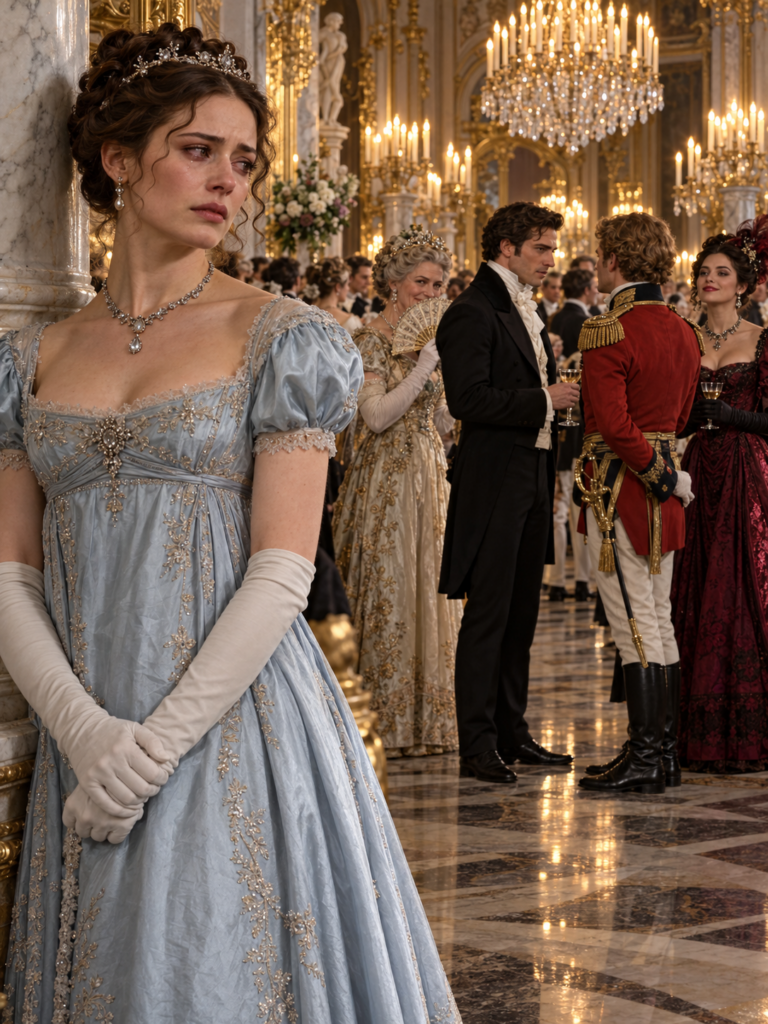
Lady Ursula’s fan shifted downward, exposing her mouth just as she gave Petronella her next instruction.
“Keep reminding him how unhappy she is. By Lady Day, he will persuade himself that sending her home is an act of kindness.”
Petronella’s answer was immediate.
“And if she refuses?”
“Then we make remaining here intolerable.”
Finanella looked from one woman to the other.
For a year, she had assumed that her humiliation was the consequence of her husband’s indifference.
Now she understood that someone had been encouraging it.
The Duke was responsible for his own coldness.
But his aunt had made certain he never questioned the picture she painted of his wife.
Finanella picked up her wineglass.
Her hand remained steady.
Across the table, Captain Nathaniel was watching her.
Unlike the others, he had never treated her birth as a disgrace.
He had repeatedly urged his cousin to be kinder.
And now his concerned expression suggested that he knew something was wrong.
Later that evening, Nathaniel found the Duke alone in the library.
Finanella did not witness their conversation.
But what Nathaniel said would become important long afterward.
“Tell me one thing you know about your wife,” he demanded.
The Duke frowned.
“She is accomplished.”
“That’s what her father told you. What do you know because you have asked her?”
The Duke gave no answer.
Nathaniel stood near the fireplace.
“You have spent a year punishing her because you dislike the circumstances of your marriage.”
“I did not deceive her.”
“No. You merely let her discover your resentment one dinner at a time.”
The Duke looked toward the dark window.
At last he spoke.
“On our wedding morning, she told me she had chosen me because I had an honest face.”
Nathaniel waited.
“And?”
“I have been ashamed to look at her since.”
“Then perhaps you should begin by apologizing.”
Upstairs, Finanella knew nothing of this.
She was seated beside her dressing-room fire, reading a letter from Halifax.
It contained news of her father’s business, the latest cloth orders, and the successful sale of a blue worsted her mother had once designed.
Her mother had died three winters before.
But the mill still produced fabrics in the colors she had chosen.
Finanella touched the pale blue shawl folded beside her.
Her mother’s hands had selected that shade.
Her mother’s hands had taught her to speak silently.
And those same hands had taught her that dignity did not depend upon other people’s permission.
In the weeks that followed, Finanella began observing Oakhurst differently.
She watched the housekeeper quietly correct shortages in the household accounts.
She watched the steward speak of tenant repairs.
She watched the Duke arrange help for a widowed tenant and decline an offer from a merchant who wanted to buy the estate’s valuable oak trees.
She saw compassion in him.
But never directed openly toward her.
Once, from the long gallery, she saw him tell Nathaniel that he wished he could return the year of marriage she had wasted beside him.
That sentence hurt more than his insults.
Because it revealed that he knew.
He understood that she had been unhappy.
Yet he still did nothing.
Then Christmas arrived.
Oakhurst filled with holly, candles, musicians, and neighboring families.
Lady Petronella performed upon her grand harp in the drawing room.
Lady Ursula presided over the gathering as though she were the mistress of the house.
Finanella had been given a narrow chair near the door.
She sat there in ice-blue silk, watching faces illuminated by candlelight.
The music began.
Ursula opened her fan.
“Look at her,” she murmured. “Dressed like a mill girl pretending to be a duchess.”
A friend smiled.
“She cannot understand music at all, can she?”
“Poor thing. She can barely understand conversation.”
Petronella glanced over from the harp.
Ursula continued.
“By Lady Day, she will be on her way back to Halifax. Then this house can have a proper mistress.”
Finanella remained seated.
Across the room, the Duke stood beside Nathaniel.
The captain was speaking earnestly.
Finanella watched.
“Look at your wife,” Nathaniel said. “She has been put by the door like an unwanted guest.”
The Duke looked toward her.
Then he spoke words so unexpected that Finanella almost failed to understand them.
“She is the only person in this house who has never lied to me.”
Nathaniel waited.
The Duke continued.
“And I have never spoken one truly kind word to her. I no longer know how to begin.”
Finanella set her teacup down.
The harp reached the final notes.
As the last string fell silent, she rose.
She crossed the drawing room slowly, passing the musicians, the crowded sofa, and the women who had mocked her.
Her husband watched her approach.
She stopped directly before him.
His lips parted.
But she spoke first.
“You might begin,” she said quietly, “with good evening, Ivo.”
Nathaniel went completely still.
The Duke stared at her.
Across the room, Petronella’s hands froze above the harp.
Finanella turned toward Lady Ursula.
And before her aunt could raise the painted fan again, the Duchess began walking toward the sofa.
Finanella crossed the polished floor while every eye in the drawing room followed her.
Lady Ursula remained on the sofa, surrounded by her guests.
Her painted fan was half raised.
Finanella stopped before her.
“Aunt Ursula,” she said, “may I ask you something?”
The older woman smiled.
“Certainly, my dear.”
“Do you truly believe I cannot understand what people say during a musical performance?”
Ursula’s smile faltered.
“I cannot imagine what you mean.”
“Then perhaps I should explain.”
Finanella spoke clearly, without raising her voice.
She repeated the remarks about her blue gown.
The insults concerning her hearing.
The plan to send her back to Halifax.
And the promised arrival of Lady Radley as Oakhurst’s next mistress.
The room became utterly silent.
Ursula lowered her fan.
“Where did you hear such nonsense?”
“From your lips.”
“What?”
“I read lips, Aunt. I have done so since childhood.”
A woman near the fireplace gasped.
Finanella continued.
“I can understand many things said in a room where the speaker believes music has made the conversation private.”
Ursula’s face lost its color.
“This is preposterous.”
“No. It is something you did not know about me.”
Finanella glanced toward the Duke.
“None of you ever thought to ask.”
The words reached him more powerfully than any shouted accusation.
He stood motionless beside Nathaniel.
Lady Ursula struggled to recover herself.
“You have been spying upon your own family?”
“I have sat where I was instructed to sit. I have looked at people who assumed I understood nothing. That is not spying.”
Ursula opened her mouth.
For once, nothing came out.
Finanella did not prolong her humiliation.
She had said what she needed to say.
She turned toward the door.
But the Duke moved.
“Finanella.”
It was the first time she remembered seeing her own name on his lips.
She stopped.
He looked at Nathaniel.
“Would you play something?”
Nathaniel stared at him.
“Now?”
“Yes.”
The captain approached the pianoforte.
He played the opening notes of a gentle country air.
The Duke came toward his wife and bowed.
“Finanella, would you dance with me?”
She looked at his extended hand.
Twelve months of silence lay between them.
She could refuse.
She knew that.
And the knowledge made the decision her own.
“Yes,” she said.
He led her onto the small space cleared before the musicians.
The guests drew back their chairs.
The Duke danced with careful stiffness.
Finanella followed the steps with a grace he had never taken the trouble to notice.
When he bent toward her ear to speak, she shook her head.
“Face me.”
He immediately straightened.
“Is this better?”
“Yes.”
He kept his face toward hers.
“Good evening, Finanella.”
She smiled faintly.
“Good evening, Ivo.”
It was the first dance of their marriage.
And the beginning of a conversation they should have had a year earlier.
Later that night, a knock sounded at Finanella’s sitting-room door.
She opened it to find her husband holding a candle.
“May I come in?”
She stepped aside.
He placed the candle where its light fell across his face.
The deliberate gesture almost undid her.
He had remembered.
He wanted her to understand every word.
“I owe you an apology,” he began.
Finanella waited.
“I married you because your father’s money could save this estate. I allowed my shame over that bargain to become cruelty toward you.”
Her throat tightened.
“You called me a mill.”
“I did.”
“And you told your cousin you had married it.”
“Yes.”
“You knew I was standing in the same ballroom.”
“I thought you could not hear me.”
“Would that have made the words kinder?”
“No.”
He lowered his eyes, then deliberately lifted them again.
“I was dishonorable. I cannot ask you to forget it.”
Finanella sat beside the fire.
“Then why are you here?”
“Because I wish to stop being the husband you have known.”
He took a breath.
“And because I would like to know the woman I married.”
She considered him.
“Knowing me will require listening, Ivo. Not merely speaking.”
“I understand.”
“Then sit down.”
He sat.
And for the first time, they talked without the protection of titles.
She told him about Halifax.
About her father, who had begun life as a weaver’s apprentice.
About her mother, who had lost her hearing after a fever and learned a different way to communicate.
She told him about the pattern room at the top of the mill, where her mother had selected colors for cloth sent throughout England.
“She was cleverer than most of the businessmen who came to bargain with her,” Finanella said.
The Duke smiled.
“I should have liked to meet her.”
“You would have been frightened of her.”
“Very likely.”
“She would have known exactly why you married me.”
His smile vanished.
“Yes.”
“But she might have liked you better if you had been honest about it.”
He accepted the rebuke.
The following morning, Finanella began teaching him.
They stood at opposite ends of the long gallery.
She instructed him to face the window.
“Your mouth disappears when you lower your chin,” she said.
He lifted it.
“And you turn aside whenever you are embarrassed.”
“That is an unfortunate habit.”
“A very inconvenient one.”
He smiled.
She made him speak slowly and clearly while she watched.
Then she began introducing the simple signs her mother had used at home.
A thumb pressed toward the chest, followed by a calming motion.
Steady.
Two fingers lifted toward the temple.
Clever.
A hand turning over like a page.
Later.
The Duke practiced each one.
He was awkward.
Sometimes he confused the movements.
Sometimes he spoke without realizing he had turned his face away.
Finanella corrected him.
And he learned.
Not because he had been commanded to.
Because for the first time, understanding his wife mattered more to him than preserving his dignity.
Their marriage changed in small ways.
He began sitting where she could see him at meals.
He asked about her letters from Halifax.
He consulted her regarding household expenses and tenant repairs.
He learned that she possessed an excellent grasp of accounts.
He also discovered that she could be very funny.
One evening, an elderly neighbor began recounting a hunting story he had already told several times that winter.
Across the dinner table, the Duke silently formed the words:
“The unfortunate pheasant has died again.”
Finanella burst into laughter.
The neighbor stopped speaking.
Several guests stared.
The Duke continued carving his meat with great solemnity.
That evening, she laughed again after they were alone.
It was a sound he realized he had never heard from her during the first year of their marriage.
He found himself wanting to hear it every day.
But happiness at Oakhurst did not come without a cost.
Lady Ursula remained resentful.
Lady Petronella had returned to her brother’s house, and the widow’s brother, Sir Eustace Rell, began spreading a story through the county.
Finanella’s mother, he claimed, had not simply been deaf.
She had been confined in an attic because she was mentally unsound.
Her strange hand movements were proof of an inherited condition.
And the Duke had been deceived into marriage.
The gossip was ugly.
It wounded Finanella in a place her husband’s apologies could not reach.
She could bear insults about her own birth.
But not about her mother.
At church, she read Sir Eustace repeating the accusation to several gentlemen.
Soon the rumor traveled through drawing rooms and dining rooms.
Invitations stopped arriving.
Former acquaintances avoided her.
Lady Ursula encouraged the talk.
One evening at dinner, the Duke caught his aunt whispering the same accusation to a neighboring lady.
He had been studying lipreading throughout the winter.
He was still far less skilled than Finanella.
But he understood enough.
He set down his knife.
“Aunt Ursula. Repeat that aloud, if you please.”
She smiled.
“Repeat what, my dear?”
“Your remarks concerning my wife’s mother.”
The table fell silent.
“I read your lips,” he said.
Ursula stared.
“My wife has been teaching me.”
Her face stiffened.
“Someone must protect the family’s reputation.”
“By slandering the mother of its Duchess?”
“You know perfectly well what the county is saying.”
“I know what you have helped it say.”
She drew herself upright.
“You would choose a mill girl over your father’s sister?”
“I choose my wife.”
The Duke rose.
“Your carriage will take you to Bath tomorrow. You will not remain at Oakhurst.”
Ursula looked around the table for support.
No one spoke.
Finanella watched her aunt leave.
She felt no triumph.
Only the terrible weariness that follows a long struggle.
The next morning, Ursula departed.
For the first time, Finanella and her husband began to live in their house without its rooms being governed by another woman’s contempt.
The Duke shortened the enormous dining table.
He had Finanella’s place set directly opposite his own.
“Can you see me properly?” he asked.
“Perfectly.”
“Is there anything else you want changed?”
Finanella considered.
“I want to be included in decisions that concern this house.”
“Then you shall be.”
“And I want my father’s money spoken of honestly. It rescued Oakhurst, but I am not the money.”
The Duke lowered his head.
“I know that now.”
She looked at him.
“Good. Because I intend to remind you if you forget.”
He almost laughed.
“I hope you will.”
Their new peace lasted until Sir Eustace appeared at Oakhurst.
The Duke received him outside, refusing to admit him to the house.
By chance, Finanella was in the long gallery overlooking the terrace.
She saw the two men arguing.
Sir Eustace spoke openly.
He proposed that the Duke end the marriage and eventually marry Petronella.
The Duke refused.
Then Sir Eustace threatened to repeat his accusations publicly at the Lady Day ball, which had been arranged months earlier.
Finanella watched her husband turn toward the light.
“I should never have married her,” his lips said.
Her breath stopped.
Then he turned away.
The rest of his answer vanished from sight.
Finanella stood frozen.
All the kindness of the past months seemed suddenly uncertain.
All the conversations.
The lessons.
The dances.
The way he had begun saying her name.
Had it been guilt?
Had he regretted the marriage all along?
She stepped back from the window.
Then she went upstairs.
By the time the Duke found her, her traveling trunk stood open on the bedroom floor.
Her Halifax gowns were folded inside.
Her mother’s shawl lay across the top.
Finanella was kneeling beside it, carefully packing the last of her belongings.
The Duke stopped in the doorway.
“What are you doing?”
She did not look up.
“I saw you speaking to Sir Eustace.”
“Then you saw me dismiss him.”
“No. Your back was turned.”
He moved nearer.
“What did you see?”
She raised her head.
“I saw you say that you should never have married me.”
The Duke went very still.
Then he knelt in front of her where the daylight could illuminate his face.
“Finanella,” he said, “read the whole sentence now.”
She looked directly at him.
He spoke slowly.
“I should never have brought you into this house without telling you what kind of man I was, how burdened the estate had become, and how ashamed I felt of accepting your father’s help.”
Her eyes filled.
He continued.
“I should never have allowed my aunt to govern your life. And I should never have let you spend your first year as my wife believing you were unwanted.”
Finanella covered her mouth.
“That is what I told Sir Eustace,” he said.
She closed her eyes.
“I saw only the beginning.”
“Yes.”
“I thought—”
“I know what you thought.”
For a long moment, neither spoke.
Then he asked quietly, “Do you wish to leave?”
Finanella looked toward her open trunk.
“I wanted to leave because I believed you had deceived me again.”
“And now?”
She breathed shakily.
“Now I need to know whether you will stand beside me when Sir Eustace speaks publicly.”
“I will.”
“But I will not hide behind you.”
He nodded.
“Then tell me what you want to do.”
Finanella rose slowly.
She took her mother’s pale blue shawl from the trunk.
“I want the Lady Day ball to go ahead.”
The Duke looked at her.
“Even with all the gossip?”
“Especially because of it.”
She held the shawl against her chest.
“They have spent weeks saying my mother was confined because she was mad. I shall not let them make her memory into a disgrace.”
“Then what shall we do?”
Finanella met his eyes.
“We shall invite the county.”
“And Sir Eustace?”
“Let him come.”
She folded the shawl carefully.
“I have spent a year watching people speak while believing I could not understand them.”
Her voice steadied.
“On Lady Day, I intend to make certain they understand me.”
The Duke looked at his wife for a long moment.
Then he stood beside her.
“Tell me how I can help.”
And for the first time in their marriage, Finanella knew he was asking not because he wished to rescue her, but because he was finally ready to stand at her side.
The Duke did not reach for Finanella’s trunk.
He waited until she closed it herself.
Then he asked whether she wished the maid to unpack it.
“Not yet,” she said.
He nodded.
There was something important in that small exchange.
A year earlier, he might have commanded that the trunk be taken away, assuming that a wife who remained beneath his roof had necessarily forgiven him.
Now he understood that staying and forgiving were two separate decisions.
And both belonged to her.
For the next several days, Oakhurst prepared for the Lady Day ball.
The servants polished silver, cleaned chandeliers, and carried furniture away from the ballroom walls.
Finanella supervised the arrangements herself.
She chose the flowers.
She reviewed the guest list.
She asked the housekeeper to make certain the staff had sufficient help for the evening.
The Duke did not interfere.
When she requested his opinion, he gave it.
When she disagreed, he listened.
Once, while examining the supper arrangements, he observed her correcting a complicated calculation without consulting the steward.
“Your father taught you that?” he asked.
“My mother taught me most of it.”
He smiled.
“Then I am indebted to her as well.”
Finanella looked at him.
“You are.”
He accepted the answer with good grace.
But the approaching ball hung over them both.
Sir Eustace had continued his campaign.
The county whispered that the Duchess’s mother had been hidden away because of some dreadful defect.
Others claimed Finanella’s habit of reading lips was evidence of unnatural cleverness.
Some believed the rumors.
Some doubted them.
Most repeated them because they made interesting conversation.
Finanella knew how society worked.
A lie, passed from drawing room to drawing room, could become accepted truth before its subject had an opportunity to answer.
She also knew that not every person in the county was cruel.
One afternoon, while she rode through the village in the carriage, a farmer’s wife approached.
“Your Grace,” the woman said, “I hope you’ll not trouble yourself about what people are saying.”
Finanella looked at her.
The woman continued.
“My sister’s boy lost his hearing after a fever. He’s a fine wheelwright now. There are fools who think a person loses their wits with their hearing. They are wrong.”
Finanella felt tears gather.
“Thank you,” she said.
The woman curtsied awkwardly.
Then she returned to her business.
In the carriage, Finanella pressed her handkerchief against her eyes.
Ivo sat beside her.
He did not tell her not to cry.
He did not say the woman’s kindness made the gossip unimportant.
He simply took her hand when she offered it.
They rode home in silence.
It was a kinder silence than any they had shared during the first year of marriage.
That evening, they stood together in the long gallery.
The light from the west-facing windows was fading.
Finanella was watching the park.
Ivo stood close enough that she could see his reflection beside hers.
“Do you remember the day I first spoke to you at your father’s house?” he asked.
She turned.
“Of course.”
“I was terrified.”
That surprised her.
“Of my father?”
“Of what I had gone there to ask.”
He looked toward the darkening landscape.
“I had inherited debts I could scarcely describe without shame. Every month brought another demand. The cottages needed roofs. The land needed seed. The house itself was falling into disrepair.”
Finanella listened.
“When your father proposed the marriage settlement, I understood it would save Oakhurst. But I was ashamed that the family name I had been taught to prize could not keep its own tenants sheltered.”
“You might have told me.”
“I should have.”
“You treated me as though I had created the debts.”
“Yes.”
He turned fully toward her.
“I cannot excuse that.”
She studied him.
“Why didn’t you speak to me after the wedding?”
“Because you looked at me with such trust. And every time I saw it, I remembered what I had accepted.”
Finanella’s expression softened, but her voice remained firm.
“You could have asked whether I regretted my choice.”
“I know.”
“You could have asked why I had made it.”
He nodded.
“Why did you?”
She considered for a moment.
“Because I believed you might be a good man who had fallen upon difficult circumstances.”
He closed his eyes briefly.
“And then I spent a year proving the opposite.”
“Not entirely.”
He looked at her.
“I watched you with your tenants,” she said. “I saw you refuse to sell the estate’s oak trees. I saw you help a widow whose rent was overdue.”
He seemed startled.
“You saw that?”
“From the gallery.”
“I had no idea.”
“I know.”
She smiled faintly.
“Much of our difficulty has been caused by things you had no idea I knew.”
For the first time that evening, he laughed.
Then the laughter faded.
“Will you ever trust me as you did before we married?”
Finanella thought carefully.
“Not in quite the same way.”
The answer hurt him.
She saw it.
But she continued.
“Before, I trusted a man I hardly knew. Now I am learning to trust a man who has disappointed me, admitted it, and begun to behave differently.”
He looked at her.
“That is a slower sort of trust,” she said. “But perhaps a stronger one.”
Ivo took her hand.
“I can live with slow.”
She squeezed his fingers.
“So can I.”
The night before the ball, he found her beside the gallery window once more.
She was wearing her mother’s blue shawl.
He watched her hands as she adjusted it.
“There’s one sign you’ve never taught me,” he said.
“Which one?”
“The one you showed me when we spoke of your mother and father.”
He touched two fingers to his lips, then moved them toward his heart.
Finanella looked at him.
“Why do you want to know?”
“Because you said it belonged to people who loved each other.”
She lowered her eyes.
“My mother made it for my father.”
“Does it have words?”
“It means something very close to ‘I love you.’”
He held his hand still.
“Will you teach me?”
Finanella considered his face.
Then she smiled.
“Ask me tomorrow.”
“Tomorrow?”
“After the ball.”
He looked mildly disappointed.
She laughed.
“Patience, Ivo.”
He bowed.
“I shall endeavor to possess some.”
On Lady Day, the ballroom at Oakhurst shone with candlelight.
Three great chandeliers hung above the polished floor.
The musicians tuned their instruments.
Guests arrived in silks, satins, embroidered waistcoats, and glittering jewels.
Nearly the entire county seemed determined to attend.
Finanella knew why.
They had come to see whether the Duchess would be humiliated.
Whether the Duke would withdraw his protection.
Whether Sir Eustace Rell would repeat his accusations.
And whether the marriage they had mocked for a year would finally collapse.
She entered beside her husband.
Her gown was pale blue.
Not merely an elegant fashionable shade.
It was Garside blue, the color her mother had created in the pattern room of the Halifax mill.
The silk caught the light with the cool brilliance of winter sky.
Ivo looked at her as they reached the ballroom.
“You look beautiful.”
She studied his mouth.
“Thank you.”
He hesitated.
“I ought to have said that more often.”
“Yes,” she replied.
He gave a small, rueful smile.
“Then I shall have to improve my habits.”
She allowed him to lead her forward.
The room watched.
The first dance belonged to the Duke and Duchess.
It was an unmistakable declaration of their changed relationship.
Some guests smiled.
Others whispered.
Finanella caught fragments of conversation whenever faces turned toward her.
“Isn’t she clever?”
“Can she really read everything?”
“Her mother, you know—”
“Sir Eustace says—”
She let the words pass.
The evening was not yet over.
Later, she danced with Nathaniel.
He stepped on the edge of her slipper and apologized so extravagantly that she nearly laughed aloud.
Then he attempted one of her mother’s signs.
He performed it so badly that it resembled a man brushing a fly from his face.
“What did you mean to say?” she asked.
“Your husband is an idiot.”
“That is not what you signed.”
“What did I sign?”
“Something very close to ‘I have misplaced a spoon.’”
Nathaniel laughed.
“Then perhaps we should begin the lessons again.”
She was still smiling when she saw Sir Eustace Rell standing near the musicians’ gallery.
His sister Petronella sat beside him.
Both had arrived despite the coldness of their reception.
Sir Eustace watched the Duchess with the satisfaction of a man who believed he had already won.
Petronella wore gold silk.
Her painted fan was folded across her lap.
When Finanella looked toward her, the widow turned away.
Then the musicians stopped for the interval before supper.
The ballroom filled with conversation.
Servants circulated with trays.
Guests moved toward the refreshments.
Sir Eustace stepped into the cleared center of the floor.
He raised his glass.
“Your Grace,” he called.
The Duke turned.
Finanella saw the deliberate theatricality of it.
Sir Eustace intended to make certain every guest heard.
“We are all friends here,” he began. “And there is an uncomfortable question that has troubled the county for several weeks.”
Conversation faded.
He turned toward Finanella.
“Duchess, forgive my plain speaking.”
She looked directly at him.
“Plain speaking is often preferable to whispers, Sir Eustace.”
A few guests exchanged glances.
He smiled.
“Then you will not object if I ask whether the stories concerning your mother are true.”
Ivo moved forward.
Finanella raised her hand slightly.
Wait.
He stopped.
The small movement was enough.
Sir Eustace continued.
“Was your mother confined in an attic in Halifax because she was incapable of rational conversation?”
A murmur moved through the crowd.
“And do you still use the strange signs she made with her hands?”
Finanella stood very still.
Sir Eustace lifted his glass.
“If such a condition was concealed before the marriage, there may be serious questions concerning what this family was told.”
Several guests looked toward the Duke.
Others watched Finanella’s hands.
They expected her to tremble.
Instead, she walked into the center of the ballroom.
She stopped at a courteous distance from Sir Eustace.
Then she faced the room.
“My mother,” she said clearly, “was not mad.”
The silence deepened.
“She lost her hearing after a severe fever when I was a little girl.”
Sir Eustace opened his mouth.
Finanella continued before he could interrupt.
“My father took her to London, where she learned to understand speech by watching the movement of people’s lips.”
She glanced across the assembled guests.
“I was a child. I attended lessons with her. And because children are curious, I learned alongside her.”
A woman near the wall lowered her fan.
“My mother returned to Halifax and resumed her work.”
Finanella’s voice grew steadier.
“She managed the pattern room of my father’s mill. She selected colors, judged the quality of cloth, and dealt with buyers who traveled from London to purchase our fabrics.”
She looked toward Sir Eustace.
“The attic of which you have spoken so freely was not a place of confinement.”
She paused.
“It was her workshop.”
A whisper traveled through the crowd.
“The highest room in the mill,” Finanella continued, “with windows on every side and excellent light for judging colors.”
Sir Eustace’s expression altered.
Only slightly.
But she saw it.
“My mother was not hidden away,” Finanella said. “Men came to her to ask her opinion. They paid for her judgment. They relied upon it.”
She touched the skirt of her gown.
“This silk is dyed in a shade she developed.”
Then she turned toward Lady Mapleton.
“Your blue pelisse is another example of her work.”
Lady Mapleton looked down at the elegant fabric she wore.
Finanella continued.
“My mother’s name was Marjorie Garside.”
Her voice remained clear.
“And many of you have worn her work without ever knowing the name of the woman whose eye for color made it possible.”
The room was completely silent.
Finanella lifted her hands.
“These are some of the signs she taught me.”
She pressed her thumb toward her heart, then lowered her open palm.
“This means steady.”
She raised two fingers toward her temple.
“This means clever.”
She turned one hand as though turning a page.
“And this means later.”
She paused.
“They were ways for my mother and me to speak to one another when speech was inconvenient or difficult. They were never evidence that she lacked intelligence.”
Her gaze returned to Sir Eustace.
“Quite the contrary.”
A few guests smiled.
Finanella allowed herself a breath.
“My mother once told me that people who speak cruelly when they believe they cannot be understood reveal more about themselves than about the person they are insulting.”
Sir Eustace’s smile had disappeared.
“For weeks,” she said, “you have repeated untrue stories about her in churchyards, drawing rooms, and dining rooms.”
He shifted his weight.
“You cannot know every private conversation, madam.”
“No,” Finanella answered. “I cannot.”
She held his gaze.
“But I have seen enough.”
She spoke without triumph.
“You believed that because my mother was deaf, she must have been incapable. You believed that because I learned to read lips, the ability was suspicious. And you believed that because I came from a family of manufacturers, I ought to be grateful for a title even when its society treated me unkindly.”
A faint stir passed through the assembled company.
“None of those beliefs is true.”
She lowered her hands.
“I am proud of my father, who built a prosperous business through work. I am proud of my mother, who continued to contribute to that business after losing her hearing. And I will not permit either of them to be treated as a disgrace.”
Sir Eustace stared at her.
His glass remained suspended in his hand.
He opened his mouth.
No words came.
From the far side of the ballroom, Finanella saw Ivo watching her.
His face was fully illuminated.
He did not turn away.
His lips moved.
Slowly.
Clearly.
Only two short sentences.
“Stay.”
Then:
“I love you.”
Finanella felt her breath catch.
She read the words again in her memory.
Not because she had misunderstood them.
Because she had waited so long to see them.
Then Ivo spoke aloud.
“Finanella.”
Every head turned toward him.
He crossed the ballroom.
“I owe my wife more than a public declaration,” he said. “But I will begin with one.”
He stopped beside her.
“I married her because her father’s money could save Oakhurst. I let my shame over that bargain turn into neglect.”
The room was motionless.
“She has been kinder to me than I deserved. She has shown more honor beneath this roof than many who boast of their ancestors.”
His voice was firm.
“I love her.”
He looked directly at her.
“And I regret that I allowed a year to pass before telling her.”
Finanella’s eyes filled.
Ivo turned toward Sir Eustace.
“You have insulted my wife’s mother in my house.”
Sir Eustace drew himself upright.
“Your Grace—”
“You will leave.”
Petronella rose.
Ivo looked toward her.
“Your sister will accompany you.”
The widow’s face reddened.
“We were invited.”
“And your welcome has ended.”
He did not shout.
He did not threaten.
He simply made his decision unmistakable.
Sir Eustace looked around for an ally.
None came forward.
Lady Mapleton stood beside the older women near the wall, touching the blue fabric Finanella had mentioned.
The vicar looked deeply uncomfortable.
Old Sir Osbert, who had spent decades delivering lengthy stories about his hunting exploits, turned his back on Sir Eustace with deliberate finality.
Others followed.
Petronella closed her fan.
She took her brother’s arm.
Together, they walked toward the ballroom doors.
Finanella watched them go.
She remembered her own journey across that same room on the night her husband had refused to dance with her.
Then she had walked alone.
Now the Duke stood at her side.
The doors closed.
For a moment, no one spoke.
Then Nathaniel called to the musicians.
“Gentlemen, there is still a supper dance to be played.”
The fiddlers reached for their instruments.
A murmur of relieved conversation moved across the room.
The Duke turned to Finanella.
“I believe I gave away the supper dance last time.”
“You did.”
“It was a serious mistake.”
“One of several.”
He bowed his head.
“Indeed.”
She looked at him.
“Are you going to ask me properly?”
He stepped back and bowed.
“Your Grace, would you honor me with the supper dance?”
Finanella smiled.
“Yes, Ivo.”
She placed her hand in his.
The musicians began.
They moved into the figure together.
At first, neither spoke.
Then Ivo looked toward her.
“There is something I wish to tell you.”
“Then face me.”
He did.
“I cannot restore the first year of our marriage.”
“No.”
“But I can promise that I will no longer hide behind shame when honesty is required.”
She watched him carefully.
“And I will no longer allow others to decide how you are treated in your own home.”
“You may defend me,” she said. “But you must also allow me to answer for myself.”
“I shall.”
“And when you do not understand me, you must ask.”
“I will.”
She studied his face.
“Then perhaps we shall manage very well.”
He smiled.
“I should like that.”
The dance carried them beneath the chandeliers.
Around them, other couples turned.
The room that had once felt impossibly long now seemed filled with light and movement.
Ivo spoke again.
“May I ask you something?”
“Yes.”
“The sign.”
She knew immediately which one he meant.
Her mother’s sign.
The one she had not taught him.
“The one for love?” she asked.
He nodded.
“Will you show me now?”
Finanella slowed.
For a moment, the dancers passed around them.
She raised two fingers to her lips.
Then touched them gently to her heart.
Ivo watched.
He repeated the movement.
Awkwardly.
Carefully.
But correctly.
She felt tears slide down her cheeks.
“I love you,” he said aloud.
Finanella looked at him.
There was no coldness in his expression now.
No calculation.
No refusal to meet her eyes.
Only the man she had hoped to know when she married him.
“I love you too,” she answered.
His face changed.
Astonishment.
Relief.
Joy.
She almost laughed at how clearly she could read it.
“When did that happen?” he asked.
She smiled through her tears.
“I cannot tell you the day. But I remember seeing you tell your steward that the widow’s rent should be forgiven.”
“You saw that?”
“Of course.”
He shook his head in wonder.
“I believe there is nothing I have ever done that escaped your notice.”
“Many things did. You kept turning your back.”
He laughed.
Then he lifted her hand to his lips.
When the dance ended, he asked whether he might kiss her.
She answered yes.
And beneath the light of the chandeliers, before the county that had once watched her humiliation, he kissed his wife.
Not as an act of public rescue.
Not to claim her in triumph over the people who had mocked her.
But because they had spent a year apart while living beneath the same roof, and had finally chosen to begin their marriage together.
The scandal did not disappear overnight.
Society was not so easily corrected.
Some people continued to whisper.
Others sought opportunities to apologize.
The Duke and Duchess accepted those apologies they believed sincere and declined those that were offered merely to recover an invitation.
Lady Ursula remained in Bath with a comfortable allowance but no authority over Oakhurst.
Petronella did not return as a guest.
Sir Eustace discovered that his conduct had damaged his own standing far more effectively than the rumors had damaged Finanella’s.
Within Oakhurst, the most important changes were quieter.
Finanella no longer sat at the far end of the dining table.
She reviewed household matters with the housekeeper and steward.
Her father continued to send reports from Halifax, and she discussed the mills’ work openly with her husband.
When servants sought her instructions, they addressed her as the mistress of the house rather than waiting for Lady Ursula’s opinion.
Ivo began bringing matters to her before decisions were made.
They disagreed sometimes.
On repairs.
On spending.
On how many visitors to invite.
On whether Nathaniel should be permitted to recount his military adventures at dinner after the third glass of wine.
But they talked.
And neither mistook disagreement for rejection.
Finanella continued teaching Ivo the signs her mother had used.
He learned slowly.
Sometimes he confused one with another.
Sometimes she had to remind him to keep his face where she could see it.
He no longer treated the correction as an embarrassment.
Instead, he would smile, turn toward the light, and begin again.
Once, during a long dinner, Sir Osbert began recounting the familiar hunting story in which the same unfortunate pheasant met its end.
Finanella looked down the table.
Her husband was watching her.
His lips moved silently.
“The bird appears doomed to die every winter.”
She pressed her napkin to her mouth.
Her shoulders shook with laughter.
Across the table, Ivo maintained an expression of perfect innocence.
The guests wondered what they had missed.
That became one of the enduring mysteries of Oakhurst.
At balls, at dinners, in church, and across the long gallery, the Duke and Duchess would sometimes exchange a silent conversation.
He would turn his face toward her.
She would watch.
Then her hands would answer.
Sometimes the message was practical.
Sometimes amusing.
Sometimes a private reassurance on a difficult day.
And occasionally, when the room was full and neither could cross it easily, Ivo would lift two fingers toward his lips and touch them to his heart.
Finanella would make the same sign in reply.
The gesture belonged to her mother before it belonged to them.
And that was why Finanella treasured it.
Her mother had lost her hearing, but not her intelligence, her work, her humor, or her love.
Her daughter had inherited the language that helped her communicate.
And now she had brought that language into a marriage that had nearly been destroyed by the refusal to communicate at all.
Years later, whenever Finanella stood beneath the chandeliers at Oakhurst, she sometimes remembered the evening when she had waited alone beside the marble pillar.
She remembered the insults.
The isolation.
Her husband’s turned back.
And the long walk across the ballroom toward the door.
But those were no longer the only memories the room held.
There was Christmas Eve, when she had finally spoken.
There was Lady Day, when she had defended her mother’s name.
And there were countless evenings afterward when her husband had turned toward her from the farthest end of the room, making certain she could see his face.
Their happiness did not come because the Duke discovered that his wife possessed a remarkable skill.
It came because he finally understood that she was a person he had failed to know.
And because Finanella, who had spent so long reading everyone else’s words, had at last chosen to speak her own.
One evening, long after the guests had departed, she stood in the empty ballroom with the chandeliers lowered and most of the candles extinguished.
Ivo appeared in the doorway.
He looked toward her.
His lips moved.
“Come upstairs, my love.”
She smiled.
Then lifted her hands.
Steady.
Later.
He laughed silently.
Then waited.
She crossed the ballroom at her own pace.
When she reached him, she slipped her hand into his.
And together they left the room where she had once been the loneliest woman in England.
Behind them, the last candles flickered above the polished floor.
No whispers followed.
No one turned away.
And for the rest of their lives, whenever the Duke wished to tell his wife that he loved her, he remembered the simplest lesson she had ever taught him.
First, he turned his face toward her.
Then he made certain she could see every word.

