
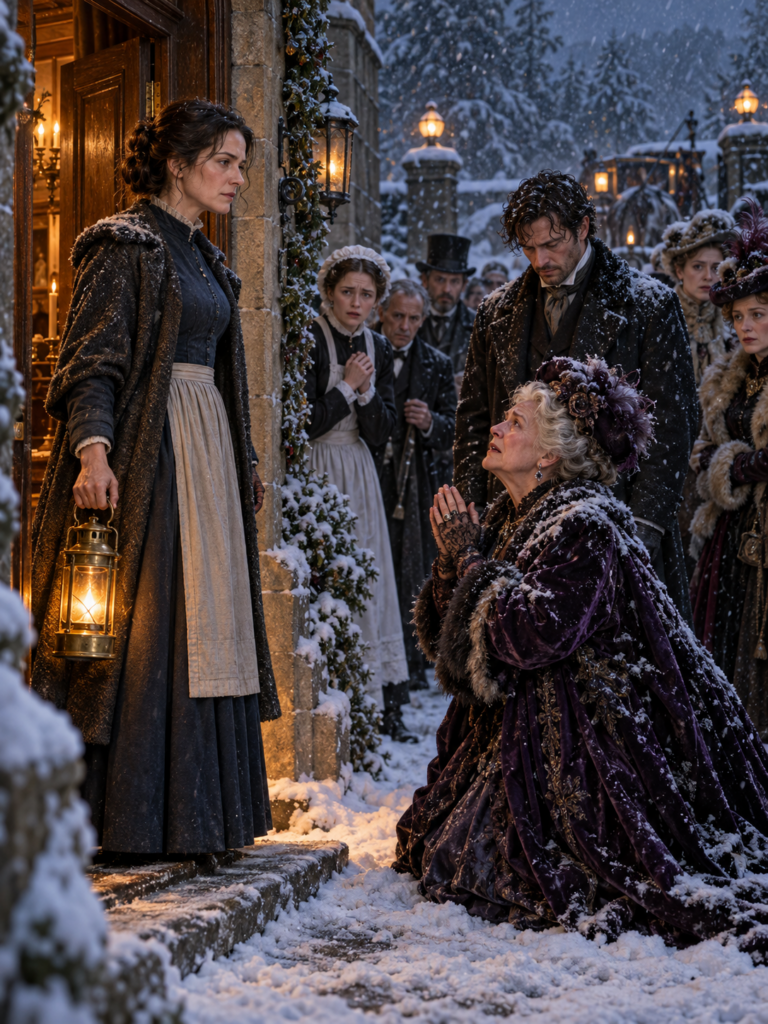
Rosenwen pulled the door wide and pointed toward the kitchen.
“Bring Mr. Crowl inside first. Quickly, but don’t let him fall.”
The dowager stumbled over the threshold, still waiting for some acknowledgment of her plea.
None came.
Rosenwen was already moving toward the coachman.
The elderly man could barely stand. His hands were pale and stiff, and his speech had become slow.
“Can you feel your fingers?” she asked.
“Not properly, Your Grace.”
“Then we’ll get you warm and have those hands attended to. No rubbing them.”
She turned to the servants.
“Take off his wet outer coat. Find dry blankets. Someone fetch the water prepared in the scullery.”
Octavian appeared behind her.
“I’ll get it.”
For the first time that evening, Rosenwen looked directly at her husband.
Snow covered his dark hair. His expensive coat hung heavily from his shoulders.
She handed him an empty basin.
“The brass can is beside the scullery door.”
He took it without argument.
Inside the lodge, the great hearth burned brightly. The smell of fresh bread drifted from the kitchen, and warm lamps illuminated the crimson-painted hall.
The guests stood astonished.
This was supposed to be the shabby house where the duke had hidden his unsuitable bride.
Instead, it was the only safe refuge for miles.
Rosenwen directed the household with a steady voice.
“Wet garments by the hearth. Blankets from the upstairs press. Those who can walk unaided should help those who cannot.”
The cook emerged, her nightcap crooked.
“Merciful heavens. How many?”
“Enough to keep us occupied,” Rosenwen answered. “We’ll begin with bread and ham. Save the hot broth for those who need it most.”
The servants immediately set to work.
Octavian returned carrying water.
Rosenwen asked him to place it near Crowl, then directed him to help bring in the elderly passengers.
He obeyed.
Not because she was his wife.
Because she knew what needed doing.
An older lady began shaking uncontrollably as a footman removed her soaked cloak. Rosenwen moved her closer to the fire and had dry coverings brought.
A young servant stood trembling near the stairs.
“Have you eaten?” Rosenwen asked.
The girl shook her head.
“Then sit beside the kitchen fire before you carry another thing.”
“But Lady Evadne—”
“Can wait until you’ve had food.”
The girl looked as though nobody had ever said such a thing to her.
Meanwhile, the dowager surveyed the hall.
“I require a proper bedroom.”
“You shall have one.”
“Not some damp little chamber.”
“The rooms are dry. I repaired the roof last spring.”
The dowager seemed uncertain whether she had heard correctly.
Rosenwen handed her a candle.
“My room is across the passage. You may use it tonight.”
There was an uncomfortable pause.
The woman who had excluded her from Kellerby Hall now stood in her own doorway, expecting comfort.
Rosenwen offered it without asking forgiveness in return.
Octavian watched his mother climb the stairs.
Then he looked at the repaired paneling, the polished brass, the full coal scuttles, and the orderly shelves.
“Who restored this house?” he asked softly.
Rosenwen met his eyes.
“I did.”
He looked down at her hands.
They were reddened from the cold, with small scars left by months of work.
For a year he had imagined her living here in miserable dependence.
He had never troubled himself to discover the truth.
“You did all this?”
“With help where it was needed.”
“Rosenwen—”
“Your Grace, there are people still coming through the gate. We can discuss the house later.”
He stepped aside immediately.
Near two in the morning, the last exhausted guests had been fed and settled. Crowl rested beside the kitchen fire while arrangements were made to continue watching his injured hands.
Rosenwen finally sat on a stool.
Her father’s lantern stood on the table beside her.
Octavian came through the kitchen doorway, carrying another bucket of coal.
He placed it near the range and looked at her.
“I should have listened to you.”
She gave a tired sigh.
“You did not hear my warning. Your mother wouldn’t allow the carriage to stop.”
“I heard enough afterward.”
“And still you did nothing.”
He lowered his eyes.
“Yes.”
The admission surprised her.
Outside, the wind struck the shutters with renewed force.
From above came the dowager’s voice, complaining that the bed was too narrow.
Rosenwen closed her eyes briefly.
Octavian stood motionless.
Then a servant hurried into the kitchen.
“Your Grace, the north-side door has begun letting snow into the passage.”
Rosenwen rose despite her exhaustion.
Octavian reached for the tools.
“Tell me what needs repairing.”
She looked at him for a long moment.
Then she placed the lantern in his hand.
“Come with me.”
Octavian followed Rosenwen through the narrow passage, holding her father’s lantern high enough to illuminate the doorframe.
A fine stream of snow had gathered along the floorboards.
Rosenwen examined the gap above the door.
“The upper fastening has shifted. There’s a board in the washhouse and nails beside the tools.”
“I’ll fetch them.”
“You needn’t.”
“I would rather be useful than stand watching you do everything.”
She turned toward him.
It was the first sensible thing he had said to her in a year.
“Then bring the shorter board,” she said. “The long one will obstruct the door.”
He returned with the board and tools, then worked beneath the lantern while Rosenwen held the timber in position.
The first hammer blow struck his thumb.
He inhaled sharply.
She looked at him.
“Are you hurt?”
“Only my dignity.”
“That should recover.”
He glanced up.
She was almost smiling.
For an instant, they might have been two ordinary people repairing their home.
Then the memory of their marriage settled between them again.
She held the board.
He drove the nails.
And when they finished, the drifting snow no longer entered.
Rosenwen tested the door twice.
“That will hold until we can make a proper repair.”
Octavian replaced the hammer.
“I remember this passage.”
“Do you?”
“I came here once as a boy. The house was already beginning to decay.”
“It had decayed considerably more by the time I arrived.”
He looked toward the newly repaired ceiling.
“My mother told me the lodge was comfortable.”
Rosenwen gave a quiet laugh.
“Your mother also told me the cook was elderly because experienced servants were best suited to a quiet household.”
“And was she?”
“She is experienced. She is also nearly unable to manage the stairs, which is why your mother no longer wanted her at Kellerby.”
Octavian looked ashamed.
“I didn’t know.”
“You didn’t ask.”
She took the lantern from him.
That ended the conversation.
The storm continued through the following day.
By morning, the lane had disappeared beneath deep snow. The carriages remained abandoned on the moor, and no one could safely travel back to Colbrook or Kellerby.
Lynwood had become a crowded island of warmth amid the winter.
Rosenwen organized the household carefully.
Food would be shared according to need. Able-bodied guests would carry water and coal. No servant was to be sent outside alone, and those suffering from cold injuries were to be watched closely.
Some aristocratic visitors were surprised to discover they were expected to assist.
Most complied after seeing how much work the crowded house required.
Octavian carried water until his shoulders ached.
He broke ice from the pump, brought in fuel, helped prepare additional sleeping spaces, and listened when Rosenwen explained how the household supplies must be rationed.
He had spent much of his life being served.
He was learning, without ceremony, what service demanded.
On the second morning, Lady Evadne Colbrook complained about breakfast.
“This bread is terribly coarse.”
Rosenwen was in the kitchen overseeing the next meal when she heard the remark.
Octavian stood in the doorway.
“The bread was prepared from my wife’s own stores,” he said. “If you prefer something else, you’ll have to wait until the roads reopen.”
Evadne looked shocked.
“Your Grace!”
“You’ve eaten it twice already.”
The dowager turned toward her son.
“Octavian, there is no need to be disagreeable.”
He looked at her.
“Then let us all stop being disagreeable.”
He carried the empty coal scuttle away.
Rosenwen heard the exchange from the passage.
She did not thank him.
She had spent a year being insulted while he stood silent.
One small defense did not erase that.
But she noticed it.
On the third morning, the snow briefly eased.
Lady Evadne decided she could tolerate Lynwood no longer.
Her family’s estate possessed a winter sledge, and she announced that someone should fetch it from Colbrook.
Rosenwen was kneading dough when Evadne entered the kitchen.
“I intend to send Patty and one of our grooms to my father’s house.”
Rosenwen stopped working.
“You cannot.”
Evadne raised her eyebrows.
“I beg your pardon?”
“The moor is buried. The road cannot be followed safely. Those two will not get there.”
“The snow has stopped.”
“For the moment.”
“They’re young and strong.”
“That won’t help them distinguish a drift from a ditch.”
Evadne smiled coldly.
“I hardly require lessons in managing servants from a miner’s daughter.”
Rosenwen’s expression did not change.
“You may insult my family if you wish, Lady Evadne. But you must not send people into danger because you dislike sleeping under my roof.”
Evadne turned and left.
Rosenwen resumed kneading, though she worked faster now.
A quarter of an hour later, she looked through the kitchen window.
Two figures were moving up the buried lane.
Patty, Evadne’s young maid, wore a borrowed shawl.
Beside her trudged Watt, a groom carrying a spade.
Rosenwen set down the dough immediately.
By the time she reached the hall, they had disappeared beyond the rise.
She found Octavian splitting logs in the yard.
“Evadne sent Patty and Watt toward Colbrook.”
The axe stopped halfway through his next movement.
“Into this weather?”
“Yes.”
He dropped it.
“Can we bring them back?”
“We must try.”
He followed her to the gate.
The wind was already rising.
By noon, snow covered their earlier footprints.
By afternoon, the moor had vanished behind a wall of white.
Patty and Watt had not returned.
The entire house understood the danger.
Guests crowded into the hall, whispering anxiously.
Lady Evadne sat on the stairs, her face pale.
Rosenwen fastened her father’s greatcoat over her dress and wrapped a scarf around her hair.
The dowager approached.
“The men must form a search party.”
“They will,” Rosenwen answered.
“But you are staying inside. This is work for men who understand the moor.”
Rosenwen looked at her.
“Most of these gentlemen don’t know where the boundary wall breaks. I do.”
“You will not go out there giving orders.”
Octavian entered the hall.
Snow lay across his shoulders.
He approached his mother and spoke clearly enough for everyone to hear.
“This is my wife’s house, Mother.”
The dowager stared.
“She fed you, sheltered you, and gave you her own bed. You are a guest here.”
A silence fell.
“She knows this ground better than any of us. We will follow her directions.”
His mother opened her mouth.
He continued.
“And you will thank her for what she has already done.”
The dowager’s face flushed.
For a long moment, Rosenwen thought she would refuse.
Then she said stiffly, “Thank you.”
Rosenwen merely nodded.
The missing servants mattered more than the dowager’s humiliation.
She turned toward the gathered men.
“I need ropes, lanterns, stakes, and six people strong enough to walk in deep snow.”
They began moving.
Within minutes, the hall became a place of urgent preparation.
Ropes were joined and checked. Lanterns were filled. Spare blankets were gathered, along with warm coverings for anyone they found.
Rosenwen planned a search along the most likely line of travel.
Patty and Watt would have followed the old boundary wall until the snow obscured its course. Near a break in the stones, they might have lost their direction.
It was a dangerous place, but it provided their best starting point.
She secured one end of the rope near the gate.
Octavian took a position just behind her.
“You don’t have to come,” she said.
“I know.”
“You’ve never traveled these hills in such weather.”
“No. But I’ll follow your instructions.”
She examined his face.
He was not demanding the right to lead her.
He was offering to help.
“Then keep the rope secure,” she said. “And if I stop, you stop.”
They went into the storm.
Within a short distance, Lynwood vanished behind them.
The wind drove snow against their faces. Their boots sank into hidden hollows, and the ropes kept the party connected when the blowing snow swallowed the figures ahead.
Rosenwen carried the brass lantern.
Its flame, protected by the horn window, gave them a small circle of golden visibility.
She placed lamps at intervals where they could serve as a return route, while the men secured the line behind her.
Octavian followed.
He had never understood what it meant to trust another person with his life.
Now every safe step depended upon his wife’s judgment.
They reached the old wall.
Rosenwen ran a gloved hand over the snow-covered stones and led them along its sheltered side.
Several times she stopped to listen.
Once she called into the wind.
No answer came.
The daylight weakened.
Octavian felt cold penetrating his boots.
He could scarcely imagine how two lightly dressed servants might have survived so long.
Then the rope ahead of him suddenly slackened.
“Rosenwen!”
He pulled it.
For one terrible moment, there was no answering resistance.
He dropped to his knees near the wall.
Below him, Rosenwen had slipped into a concealed hollow of deep snow.
She was struggling to lift herself while keeping her lantern from being buried.
Octavian reached down.
“Take my arm!”
She caught his sleeve.
He braced himself against the stone and pulled while another man secured the rope.
Together they brought her back onto firmer ground.
For a moment she remained on her knees, coughing snow from her mouth.
Octavian knelt beside her.
“Are you injured?”
“No. Only shaken.”
“We can return.”
She shook her head.
“Not without them.”
He looked into her face.
Her eyelashes were white with snow.
She was frightened.
And determined.
He understood then that courage did not mean an absence of fear.
It meant continuing when fear offered every reason to stop.
They found a little shelter behind the wall and paused to recover their breath.
Octavian crouched beside her.
“Rosenwen.”
She looked at him.
“I owe you an explanation.”
“Not now.”
“I have owed it for a year.”
She remained silent.
He forced himself to speak.
“My father left the estate close to ruin. Your father’s money preserved it. I married you because I believed it was the only way to save my family.”
“I know that.”
“What you don’t know is that I was ashamed.”
Her expression tightened.
“Of me?”
“Of myself.”
He looked down at his gloved hands.
“I inherited a title I could barely afford to maintain. I needed the money of a man I would once have considered beneath my family. Each time I looked at you, I was reminded of what I’d agreed to.”
“And so you sent me away.”
“Yes.”
“You allowed your mother to do it.”
“Yes.”
She looked out into the storm.
“I came from Cornwall knowing you might never love me. My father warned me not to expect affection from a marriage arranged for money.”
Octavian said nothing.
“But I thought I would at least be permitted to live beneath the same roof as my husband.”
Her voice caught.
“I watched through the carriage window after the wedding. I thought you might follow.”
He closed his eyes.
“I should have.”
“You didn’t come for a year.”
“No.”
“I stopped looking after the first month.”
The words hurt him more than any accusation.
She drew her coat closer.
“We have people to find, Your Grace.”
He nodded.
“Yes.”
They rose.
Rosenwen lifted the lantern.
And together they continued around the bend in the wall.
A little farther on, she noticed something dark standing above the snow.
She raised the lantern.
A spade handle.
A gray shawl had been tied around it.
“There!”
They hurried forward.
Beyond the marker stood a low shepherd’s shelter, nearly hidden beneath the drifts.
Octavian forced the door open.
Inside, on a heap of dried bracken, lay Patty and Watt.
The groom had wrapped his coat around them both.
Patty barely stirred.
Rosenwen dropped to her knees.
“Patty, can you hear me?”
The young maid opened her eyes.
At the sight of Rosenwen’s lantern, she began to cry.
“We thought no one would find us.”
Rosenwen took her hand.
“You left us a marker. That was clever.”
Watt managed a weak smile.
“I remembered what you said about leaving something that could be seen.”
“You did well.”
The searchers covered the pair with dry blankets and spare coats.
Watt could stand with support.
Patty could not safely make the walk unaided.
Octavian knelt.
“I’ll carry her.”
Rosenwen looked at him.
“Can you manage the distance?”
“Yes.”
“Then keep her covered and stay on the line.”
He lifted the exhausted maid carefully.
The party turned toward home.
Ahead of them, their lanterns shone through the dark.
One light led to the next.
At the far end of that fragile chain waited Lynwood Lodge.
And for the first time since their marriage, Octavian followed his wife without wishing to be anywhere else.
Octavian adjusted Patty’s weight against his back and stepped toward the first lantern.
The young maid scarcely had strength to hold his shoulders.
Rosenwen walked ahead, her father’s lamp swinging from one gloved hand.
“Keep to the line,” she called. “No one passes the next light until the person behind has caught up.”
The men obeyed.
They moved slowly through the darkness, their boots sinking into the snow that continued to drift around the wall.
Watt stumbled twice, but the footmen supporting him kept him upright.
Octavian’s legs began to ache beneath Patty’s weight. His shoulders burned, and his breath came hard.
He did not complain.
He remembered the day of his wedding.
He had stood in an ancient chapel wearing velvet and gold, believing himself a man trapped by circumstances.
Rosenwen had stood beside him, a stranger who had surrendered her future to a marriage of duty.
When his mother sent her away, he had watched.
He had considered his silence a way of preserving dignity.
Now he understood how little dignity there had been in it.
The woman he had abandoned was leading him safely through a storm.
And the servants whom his mother’s chosen companion had risked were alive because Rosenwen refused to leave them behind.
At last, the lamps near Lynwood came into view.
Jory Crowl stood by the gate, his injured hands covered and held close beneath a blanket.
When he saw the search party, he raised his lantern.
“Here they are!”
The door opened.
Warm light spilled across the snow.
Guests and servants crowded the hall as Octavian entered carrying Patty.
He laid her carefully upon a prepared settle while Rosenwen directed the others to bring dry coverings and summon what medical assistance could safely be obtained.
The cook hurried forward with warm drinks and food.
Lady Evadne stood halfway down the staircase.
Her eyes fixed upon Patty.
For a moment she appeared unable to speak.
The maid looked up.
“My lady?”
Evadne’s lips parted.
Then she turned away.
Rosenwen watched her go.
She made no comment.
There was more urgent work to do.
The night passed with scarcely anyone sleeping.
By morning, Patty and Watt were alert and able to eat at the kitchen table, although their exposure and painful hands and feet still required careful watching.
Crowl remained indoors, complaining mildly whenever Rosenwen inspected his fingers.
“You should rest, Mr. Crowl.”
“I’ve been resting three days, Your Grace.”
“And I should like you to remain able to drive another twenty years.”
“That seems an ambitious sentence.”
“Then don’t give me cause to extend it.”
The old coachman smiled.
Octavian watched from the doorway.
He had never heard his wife speak to a servant as though rank made the person less deserving of dignity.
Later, he found Crowl seated in a sheltered corner of the yard, taking a brief breath of fresh air.
The coachman looked at him.
“Her Grace gave me ten minutes outside, Your Grace. I reckon she’ll send someone to fetch me if I stay eleven.”
Octavian sat beside him.
“Crowl, what exactly did she say when we passed her gate on our way to Colbrook?”
The coachman turned his covered hands over in his lap.
“She said the sky was wrong and the rooks were home early. Said we wouldn’t get back across the moor if we left it too late.”
Octavian listened.
“She told me she’d put a light at the gate if we needed it. Said she’d mark the lane as far as she could.”
“And my mother stopped you from answering?”
“Yes, Your Grace.”
Crowl hesitated.
“I’d have turned the carriage around then and there if it had been my decision.”
Octavian stared toward the house.
He had spent years believing that authority belonged naturally to those born with titles.
Yet the person who had known the danger best had possessed the least power to stop it.
Rosenwen had understood the weather.
Crowl had understood the road.
Neither had been heard.
And everyone had nearly died because of it.
That afternoon, Octavian entered the parlor where his mother and Lady Evadne sat beside the fire.
Evadne was complaining again.
“The food has been so dreadfully plain.”
The dowager agreed.
“One cannot expect refined tastes in a house managed by someone of Rosenwen’s upbringing.”
Octavian stopped beside the hearth.
“Enough.”
Both women looked up.
His mother frowned.
“Octavian?”
“You will stop speaking of my wife in that manner.”
Evadne gave a brittle laugh.
“Surely we may discuss the bread.”
“You have eaten her bread, slept beneath her roof, and relied upon her judgment to keep you alive.”
His voice remained controlled.
“If you cannot show her ordinary courtesy, you will at least stop insulting her while accepting her hospitality.”
The dowager straightened.
“I am your mother.”
“I know.”
“I have devoted my life to the Kellerby name.”
“And she has done more to honor that name in four days than I have done in a year.”
The words settled heavily between them.
His mother stared at him as though she no longer recognized her son.
He did not soften them.
Then he left.
Rosenwen had heard the exchange from the passage.
When he emerged, she stood holding a tray.
“You’ve upset her,” she said.
“Yes.”
“She’ll blame me.”
“I know.”
“Then why did you do it?”
“Because I should have spoken a year ago.”
Rosenwen studied him.
“Words spoken late can still be true.”
“I hope so.”
“But they don’t undo what happened.”
“No,” he answered. “They don’t.”
She carried the tray into the kitchen.
He followed and took the heavier end when she asked for help.
That evening, he found her asleep at the kitchen table.
An unfinished inventory lay near her elbow. The candle beside it had burned low.
For a few moments, he simply watched her.
Her hands were marked by work. Her face was pale with exhaustion. A strand of dark hair had escaped its pins.
He had met this woman only twice before marrying her.
Then he had avoided her for a year because she reminded him of his own failures.
Now he was beginning to understand how much courage that avoidance had cost her.
He removed his coat and placed it over her shoulders.
She woke immediately.
“You’ll be cold,” she murmured.
“I’ve survived worse.”
She glanced at his thumb, still bruised from the hammer.
“I heard you strike yourself on the stairs.”
He looked surprised.
“You heard that?”
“The cook heard it. She said you showed admirable restraint.”
Rosenwen’s mouth curved slightly.
He sat opposite her.
“Tell me about your father.”
The request changed her expression.
For a moment, she seemed uncertain why he would want to know.
Then she began.
She told him about Captain Pascoe, who had worked underground long before prosperity came.
He had understood the language of mines, she said: the creak of strained timber, the sound of water behind stone, the silence that sometimes meant something dangerous had changed.
He believed a man responsible for others should notice what threatened them before they had to beg for help.
On the night a deep mine level flooded, he had arranged lamps along the escape route.
He had remained near the rear, accounting for his workers until everyone had reached safety.
“He always counted the men out before counting himself,” Rosenwen said.
Octavian looked at her.
“I walked at the back when we came down from the carriages.”
“I saw.”
“I wanted to be certain everyone had reached the lodge.”
She lowered her eyes.
“My father would have approved of that.”
He looked toward the brass lantern resting near the hearth.
“Did he leave you that?”
“Yes. The money went into Kellerby. The lantern was the part I brought here for myself.”
The words made him look away.
Her father had surrendered a fortune to secure her future.
Octavian had rewarded that sacrifice by shutting her out.
“I am sorry,” he said.
Rosenwen was quiet.
Then she answered, “I believe you.”
He looked up.
“But believing you doesn’t mean I know what should happen next.”
“I understand.”
She folded his coat more tightly around her shoulders.
For once, he did not try to find a convenient answer.
He stayed beside her until the candle was nearly spent.
Over the following days, the snow began to weaken.
The household settled into a quieter routine. Those who had been injured recovered strength. The guests grew more helpful, and Rosenwen no longer had to remind them that work was required to keep so many people warm and fed.
The cook’s knees were still troublesome, so Octavian carried heavy supplies without being asked.
He discovered which cupboard held the clean linen and which bucket belonged beside the kitchen range.
He learned how quickly coal disappeared when every room was occupied.
He learned that the woman he had once considered a stranger possessed an entire life of knowledge and habits he had never cared to discover.
And Rosenwen learned that the Duke of Kellerby could listen.
He could take correction.
He could laugh at himself.
But she also knew that a few days of useful labor did not prove he could defy his mother when the whole county was watching.
That question remained unanswered.
On the final night before the thaw, Rosenwen walked to the gate with her father’s lantern.
The storm had cleared, leaving a hard sky full of stars.
Octavian followed her.
“Why do you keep lighting it?” he asked.
“Because someone may still be traveling.”
“The road is closed.”
“A road is never so empty that you can be certain nobody needs a light.”
She hung the lantern from its hook.
The small flame glowed behind the horn window.
Octavian stood beside her.
“When the road opens, the guests will leave.”
“Yes.”
“My mother will return to Kellerby.”
“I expect so.”
“And I shall have to return with her.”
Rosenwen looked across the snow.
“You are the duke.”
He hesitated.
“I don’t want to go without you.”
She turned toward him.
“Wanting is easy, Octavian.”
He had never heard his name spoken quite that way.
Not as an accusation.
Not as a title.
As a reminder that the man beneath the rank must decide what he was willing to do.
“You wanted me gone once,” she said. “All it took was a carriage.”
He accepted the truth.
“Yes.”
“If you want me at Kellerby now, it will take more than another carriage.”
“What will it take?”
“I don’t yet know whether I want to return.”
He looked at her.
“Then I won’t ask for an answer tonight.”
She nodded.
“Good night.”
He remained at the gate after she went indoors.
Above him, her father’s lantern continued burning.
And he understood that love, if he dared call what he felt by that name, required more than wishing she would forgive him.
It required making himself worthy of her trust without demanding that trust as payment.
The thaw arrived before morning.
Water dripped from the eaves, and the buried lane turned to slush.
The coachmen and footmen worked to recover the stranded carriages. By afternoon, enough of the route was passable for the guests to depart carefully.
One by one, they came to Rosenwen’s door.
Some thanked her awkwardly.
Others embraced her.
The elderly lady whom she had settled near the fire took both her hands.
“You saved us, my dear.”
Rosenwen smiled.
“We were fortunate to have enough shelter.”
“Nonsense. You made that shelter.”
The woman kissed her cheek before leaving.
Watt thanked her with a solemn bow.
Patty, still recovering from her ordeal, embraced her unexpectedly.
Rosenwen held the young maid for a moment.
“Take care of yourself.”
“I shall, Your Grace.”
Lady Evadne descended the stairs without looking at Rosenwen.
She passed through the hall, followed by Patty.
At the threshold, the maid turned once more and gave Rosenwen a grateful curtsy.
Then she hurried after her mistress.
The dowager came last.
She wore her violet traveling cloak, carefully brushed and fastened.
At the door, she paused.
For one brief moment, Rosenwen wondered whether the woman might offer a sincere word.
The dowager looked at her.
Then she turned away.
Octavian watched his mother climb into the carriage.
He returned to the doorway.
“Come back to Kellerby with me,” he said.
Rosenwen stood very still.
“Now?”
“Yes.”
“Because the storm has ended?”
“Because you are my wife, and you should never have been sent away.”
She considered him.
“You are right about that.”
Hope rose in his face.
Then she placed one hand against the door.
“But I will not be carried back like another parcel because you have decided the arrangement should change.”
His expression fell.
“Rosenwen—”
“I arrived here alone on my wedding day. I built a home because you left me no other choice. If I ever return to Kellerby, it will be because I choose to.”
He nodded slowly.
“What would you have me do?”
“Go home, Octavian.”
He looked at her for several seconds.
Then he stepped back.
“I won’t force you.”
She closed the door.
Not angrily.
Not dramatically.
But firmly.
He remained on the step until he heard her move away.
Then he walked down the path and climbed onto the carriage box beside Crowl.
The coachman glanced at him.
“Your Grace?”
“I’ll ride with you.”
Crowl said nothing more.
That evening, Kellerby Hall seemed colder than Octavian remembered.
His mother spoke during dinner about damaged carriage wheels, ruined velvet, and the inconvenience of the snow.
He listened without answering.
At ten o’clock, he rose.
“Where are you going?” she demanded.
“To Lynwood.”
“In this weather?”
“The road is clear enough to walk.”
“Send a carriage.”
“No.”
He took his coat and left.
The three miles were wet and uncomfortable.
Meltwater ran along the hedges. Mud clung to his boots, and branches dropped cold water onto his shoulders.
He walked without a servant or driver.
At Lynwood’s gate, the brass lantern was burning.
He stopped beneath it.
Then he approached the door and knocked.
A long moment passed.
The bolt moved.
Rosenwen opened the door with a candle in her hand.
She looked at his muddy clothes.
“Your Grace?”
“I didn’t come to summon you.”
She said nothing.
“I came because I should have knocked on this door a year ago.”
His voice was quiet but steady.
“I cannot undo what I allowed. I cannot give you back the year you spent wondering why your husband wouldn’t come to see you.”
Rosenwen watched him.
“But I can stop hiding behind my mother’s wishes. And I can come here as a man who wants to know his wife, if she permits it.”
She looked down at his muddy boots, then back at his face.
“What if I never return to Kellerby?”
“Then I shall have to learn how to visit Lynwood properly.”
“And your mother?”
“She will no longer decide where you live.”
Rosenwen’s expression softened.
“You would come three miles simply to talk?”
“Yes.”
“Even when there isn’t a storm?”
“Especially then.”
For the first time, she laughed without restraint.
Then she opened the door wider.
“Boots by the fire.”
He laughed too.
And he stepped inside.
He did not claim her forgiveness that night.
He sat in the kitchen while she finished her work. He listened when she spoke. He answered questions she had waited a year to ask.
He returned again over the following days, sometimes on foot, sometimes in the carriage with Crowl.
They shared meals.
They walked along the lane.
They spoke about the marriage, about his father’s debts, about her life in Cornwall, and about the future neither had been allowed to imagine honestly.
Octavian admitted that he had never disliked Rosenwen.
He had disliked the circumstances that made him dependent upon her father’s fortune.
He had punished her for the shame he felt toward himself.
She told him that his silence had hurt more deeply than his mother’s open cruelty.
“At least your mother made her opinion plain,” she said. “You let me spend a year wondering whether I was too disagreeable even to visit.”
He did not defend himself.
“You deserved an answer. I gave you none.”
“And now?”
“Now I want to spend my life answering properly, if you’ll allow me the chance.”
She did not say yes immediately.
But she no longer closed the door.
A fortnight after the thaw, Rosenwen chose to return to Kellerby Hall.
She did not abandon Lynwood.
She insisted that the lodge remain available to her, that the servants who had worked beside her be treated fairly, and that her husband never again allow his mother to decide her place in the marriage.
Octavian agreed.
They traveled the three miles together in daylight.
Rosenwen carried her father’s lantern.
When they reached the great house, Octavian offered his arm.
She took it freely.
The grand rooms felt unfamiliar.
But she no longer entered them as a girl waiting to be accepted.
She entered as the woman who had survived their rejection and discovered her own strength.
In the weeks that followed, Octavian began making changes that were visible long before the county gathered to observe them.
He included Rosenwen in household decisions.
He listened to her judgment about repairs and servants.
He visited Lynwood with her instead of treating the place as a shameful reminder.
And when his mother attempted to speak of Rosenwen as though she were an unwelcome guest, he corrected her plainly.
The dowager disliked it.
She eventually chose to visit relatives elsewhere.
Lady Evadne was no longer welcomed as an alternative to the duke’s wife.
But Rosenwen’s greatest change was not that the two women lost influence.
It was that she no longer needed their approval.
At the next great gathering held at Kellerby, the doors of the hall opened to receive the county.
Candles burned along the walls, and the servants had decorated the beams with greenery.
Octavian entered with Rosenwen on his arm.
She wore a gown of deep blue silk, modestly adorned with a small brass pin shaped like a miner’s lamp.
He did not lead her into the room as an apology to the guests.
He led her there as his equal in the life they had chosen to share.
Before the assembled company, he spoke of the storm.
He told them that his wife had warned of the danger and had been ignored.
He acknowledged that she had prepared Lynwood, laid the lanterns, fed the stranded guests, and led the search for the missing servants.
Then he spoke of his own conduct.
“I sent my wife away on the day we married,” he said. “I allowed her to be humiliated because I was too proud to admit my own shame.”
The room fell silent.
“I was wrong.”
Rosenwen looked up at him.
He continued.
“My wife gave shelter to people who had refused her kindness. She saved lives without asking whether those lives belonged to the nobility or to its servants.”
He turned toward her.
“And I have learned that a great house is worth very little if its master lacks the courage to do what is right.”
He took her hand.
“I cannot promise never to fail. But I promise never again to use silence as an excuse for failing you.”
Rosenwen’s eyes filled.
She squeezed his hand.
“I believe you,” she whispered.
Then she smiled through her tears.
“And now, Your Grace, I believe you owe your wife a dance.”
He laughed.
“I believe I do.”
He led her onto the floor.
The music began.
For the first time, Rosenwen danced in the great hall as a woman whose presence was neither tolerated nor purchased.
She was there because she had chosen to be.
And the man holding her had finally learned that love was not possession, rank, or duty.
It was the daily courage to honor another person’s freedom.
Years afterward, visitors entering Kellerby Hall could still see a battered brass miner’s lantern hanging beside the front door.
It had once guided men out of a flooded mine.
Later, it had marked a path through a deadly snowstorm.
To Rosenwen, it would always mean something more.
It was proof that her father’s lessons had survived him.
That kindness did not require submission.
That dignity could endure humiliation.
And that a person shut outside one door could build a home warm enough to shelter even those who had turned her away.
Whenever the weather turned cold, Rosenwen still had the lantern lit.
Sometimes Octavian carried it to the gate himself.
He never again mistook the woman holding the light for someone beneath him.
And whenever they saw its glow from the lane, they knew they were coming home.

