
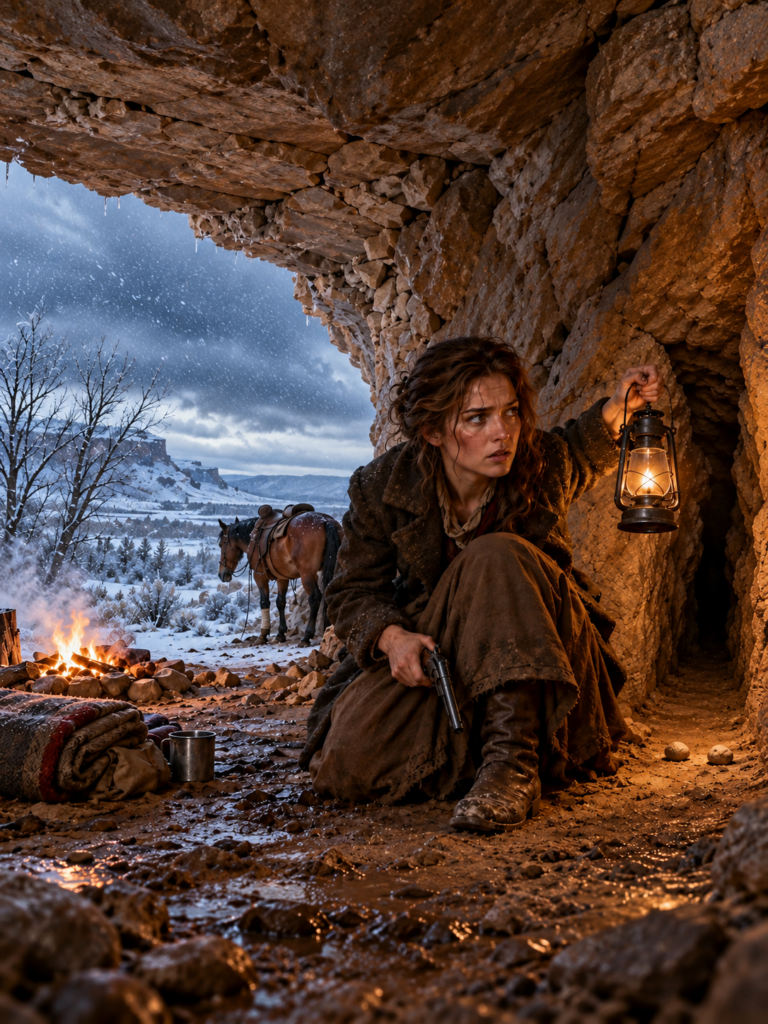
she heard three taps from the dark of a wyoming cave then the storm sealed them inside with the man three riders wanted to kill
Part 1
Wyoming Territory, October 1888. By late afternoon Eliza Mercer knew she would not reach the next settlement before dark. Her mare had gone lame six miles back, forcing Eliza to lead the animal through broken country while a hard wind pushed down from the mountains. The trail had narrowed into a shelf above a dry creek bed. Every shadow seemed longer than the last. She had left Fort Laramie two days earlier with flour, bacon, coffee, matches wrapped in oilcloth, a blanket, a skinning knife, and a small revolver. She had expected trouble from weather, bad water, a lame horse, perhaps even wolves. She had not expected to lose daylight this completely.
Then she saw the cave. It opened beneath a sandstone ridge, wide enough for a horse to shelter beneath the outer ledge and deep enough to escape the wind. Eliza stopped twenty yards away. She studied the ground first. No fresh hoof prints, no human tracks, no bones, no recent fire. She tied the mare beneath a cottonwood and entered with a lantern. The cave narrowed after thirty feet, then widened into a low chamber. The floor was mostly stone. A thin crack in the rear wall disappeared into darkness. Near the entrance, several flakes of sandstone lay beneath a long fracture running across the underside of the overhang. Eliza noticed it, but the rock above still looked solid enough. Nothing moved. Nothing breathed. Nothing smelled alive. For a woman alone in open country with night coming fast, it looked like luck.
Eliza carried her supplies inside. She built a small fire near the entrance where smoke could escape safely. Then she spread her blanket against the driest wall. Only one detail bothered her. Near the rear chamber, three stones sat in a perfectly straight line. Nature rarely arranged stones that neatly. Eliza stared at them, then she laughed at herself. Someone had probably camped there years ago. Outside, the wind strengthened. Inside, the cave remained still. Eliza believed she was alone. She would stop believing that before midnight. For now, survival mattered more than questions.
Before darkness settled completely, Eliza checked the mare again. The animal’s right foreleg was swollen but not broken. That mattered. A broken leg would change everything. Eliza washed the joint with water, wrapped it with cloth, loosened the saddle, and moved the mare beneath the cave overhang where the sandstone blocked most of the wind. Then she began counting supplies. Four pounds of flour, a small slab of bacon, coffee, salt, matches, one blanket, twenty cartridges, enough for several days if she was careful. Not enough to waste. She gathered dead cottonwood branches before the light disappeared and stacked them beneath the overhang. Near the creek bed, she found rabbit tracks and a narrow trickle of water trapped between rocks. The place could sustain her for a night, possibly two.
Back inside, she mixed flour, salt, and water into a stiff dough and cooked a flat cake in her skillet. She ate half with a thin slice of bacon. The rest she wrapped for morning. The routine settled her nerves. Work usually did. By full dark, the temperature dropped sharply. Eliza moved her blanket closer to the entrance but kept enough distance from the outdoor-facing fire to avoid sparks. The revolver stayed beside her. The lantern remained within reach. Then she looked toward the rear chamber. The three stones seemed different. The middle one had been upright before. Now it lay flat. Eliza frowned. Perhaps she had kicked it while carrying wood. Perhaps not.
Part 2
Then came a sound from somewhere behind the crack. Tap. Tap. Tap. Eliza froze. For almost a minute, nothing followed. Then it came again. Three slow taps, exactly the same. She picked up the revolver, but she did not move toward the sound yet. Outside, the mare stamped nervously. The wind rose. A faint trickle of grit fell from the fractured overhang near the cave mouth. Eliza glanced upward. Then silence returned. She looked toward the dark entrance, then toward the deeper blackness behind her. Whatever was making the noise was inside. Whatever weather was coming was outside. For the moment, she was trapped between two unknowns.
Eliza raised the lantern and walked toward the rear chamber. The firelight weakened behind her. Every step changed the sound of the cave. Her boots echoed differently as the ceiling lowered. The narrow crack she had dismissed earlier no longer looked like a simple fracture. It looked like a passage. Eliza crouched. Scratches marked the stone beside it. Not random scratches, parallel marks. Something had been dragged through there. She held the lantern closer. A thin current of air brushed her cheek. The passage continued somewhere beyond the wall. Eliza called out, “Who’s there?” Nothing. She waited. Then came one tap, not three. Eliza backed away.
Her first instinct was to leave. Her second was more practical. Outside, clouds had swallowed the stars. The wind had become strong enough to bend the cottonwoods. Her mare could barely walk. Leaving shelter now would trade one unknown danger for several obvious ones. So Eliza changed the problem. She moved her bedding closer to the cave mouth. She stacked several pieces of dry wood within reach of the fire. She tied an empty tin cup to a length of cord and stretched it across the floor between herself and the rear chamber. Anything crossing the line would make noise. Then she sat with the revolver across her knees. Hours passed. The tapping stopped. The wind did not.
Near midnight, Eliza began to believe whatever had made the sound had gone quiet for good. Then the cup moved. It scraped once across the stone. Eliza raised the revolver. A shadow shifted beyond the firelight, and from the darkness came a human voice, weak, hoarse. “Don’t shoot.” Eliza aimed toward the sound. “Come into the light.” A cough answered her. Then the shadow moved forward. The man who emerged looked older than Eliza expected. Gray beard, hollow cheeks, one boot missing. His left trouser leg had been cut open below the knee and wrapped in filthy cloth. He carried no gun. Eliza did not lower hers.
“Name?”
“Caleb Voss.”
“How long have you been back there?”
“Six days, maybe seven.”
“You were here when I came in.”
Caleb nodded.
“Why didn’t you speak?”
“Didn’t know who you were.”
“And the tapping?”
“Trying to find out if you were alone.”
Eliza’s grip tightened. “You could have asked.”
Caleb gave a tired smile. “People who mean harm answer questions, too.”
That bothered her more than the tapping. “Who are you hiding from?”
Caleb looked toward the entrance. “Men from a mining camp south of here.”
“Why?”
“A claim dispute.”
Eliza watched his face. There was more. She knew it. But the man was shivering. His injured leg smelled wrong, and the temperature outside was falling. Eliza lowered the revolver a few inches. “Sit down.”
Caleb leaned against the stone. Eliza unwrapped the cloth around his calf. The wound was deep, but not rotten. The surrounding skin was swollen and hot. “You should have cleaned this.”
“With what?”
That answer irritated her because it made sense. She boiled water, let it cool, then washed dirt from the wound while Caleb clenched his jaw. She tore a strip from the hem of an extra petticoat and wrapped the leg again.
“That cloth worth much?” Caleb asked.
“So is burying a man.”
Outside, sleet began striking the rocks. Whatever Caleb had hidden from her would have to wait. Neither of them was going anywhere before morning.
Part 3
By sunrise, the weather had worsened. Wet snow covered the trail. The mare stood beneath the overhang with her head low. Eliza checked the injured leg again. Still swollen, still usable. She rubbed the joint, walked the mare in a slow circle beneath the ridge, then tied her where the wind was weakest. Caleb watched from the cave.
“You know horses.”
“My father raised them.”
“You traveling alone?”
Eliza looked at him. “That your business?”
“No.” He understood.
The storm continued. Travel was impossible. Eliza counted supplies again. Two people changed everything. Food that might have lasted her four or five days could disappear much faster. Fuel would burn faster. Water would require more trips. Caleb was weak enough that he could not gather much. Eliza divided the bacon into exact portions and made the flour cake smaller.
“I can eat less,” Caleb said.
“You already have.”
That ended the argument. She melted snow in the skillet when the creek became difficult to reach. She rationed coffee. She collected dead branches whenever the snowfall eased. Caleb repaired a split harness strap while sitting near the entrance. He showed Eliza how to twist rawhide scraps into stronger cord. The next morning he helped her build a simple deadfall trap along the rabbit trail. Most of their energy went into ordinary problems: food, heat, water, the mare, Caleb’s leg. That was what survival actually felt like, not one heroic moment, a hundred small decisions that could each become dangerous if ignored. The cave mystery mattered less during daylight. Then Eliza noticed Caleb watching the rear passage again, not casually, protectively.
“What’s back there?”
Caleb looked away. “Old workings.”
“A mine?”
“Not much of one.”
“Then why do you keep looking at it?”
Caleb said nothing. Eliza knew the mystery was not over. But outside, the wind rose again. Survival remained the larger problem.
On the third day, the storm weakened enough for Eliza to search farther along the creek. She found rabbit tracks beneath brush and several dry limbs caught above the snowline. She also found old cattle chips beneath an overhang and carried them back for fuel. Not pleasant, useful. Caleb approved. “Burns longer than pride.” Eliza almost smiled. Back inside, she prepared a thin stew from bacon scraps and the last of a rabbit caught in the deadfall. Caleb ate slowly. His fever had eased. The wound looked cleaner. Only then did Eliza return to the question he had avoided. She lifted the lantern. “I’m going back there.”
Caleb stiffened. “You don’t need to.”
“That usually means I do.”
Eliza entered the narrow passage. Twenty feet in, it opened into a second chamber. Pick marks scarred the stone. A broken shovel lay against one wall. In the corner sat a wooden chest, not iron, not expensive, just heavy. Eliza opened it. Inside were rolled claim papers, two boxes of cartridges, a small pouch of gold dust, dried beans, a bottle of strong frontier spirits, and several strips of preserved meat. She lifted the bottle. “For drinking?”
Caleb shook his head. “Mostly wounds, sometimes cold nights.”
Eliza stared. Then she heard Caleb behind her. “I told you not to come back here.”
“You let me ration flour while this sat twenty feet away.”
“That cash isn’t all mine.”
Eliza turned. “Whose is it?”
Caleb leaned against the wall. “Mine and two partners. The men looking for you?”
He nodded.
“What happened?”
“We found color farther up the ridge. Argued over the claim. They wanted to sell. I didn’t.”
“That explain your leg?”
“No.” Eliza waited. Caleb sighed. “The argument got ugly. I took the papers and left before they could file without me. Slipped on shale coming here.”
Eliza looked at the food. “You nearly let both of us go hungry over paper.”
Caleb said nothing. That angered her more than the gold dust. She took the beans, meat, and spirits. The papers stay. Caleb did not object. For Eliza, the mystery had finally produced something useful, food, something to clean the wound, cartridges, not treasure. Survival.
The supplies changed their chances. Eliza cleaned Caleb’s wound with the strong spirits diluted with boiled water. She cooked beans slowly near the cave entrance. The preserved meat stretched their flour farther. For the first time since the storm began, they had enough food to think beyond the next meal. Then the mare lifted her head. Eliza heard hoofbeats. Three riders appeared beyond the cottonwoods. Caleb’s face changed. “My partners.”
Eliza looked at him. “You said two.”
“The third might be from camp.”
The riders stopped outside the cave. One called, “Voss.” Caleb reached instinctively toward his belt. No weapon. Eliza kept her revolver holstered. “Let me talk first.”
“That’s a bad idea.”
“So is three rifles pointed into a cave.”
She stepped beneath the overhang. The riders remained twenty yards away. The oldest introduced himself as Jonah Price. “We want the claim papers.” Eliza looked back at Caleb. Caleb said nothing. Jonah continued. “He took them after we agreed to sell.”
Caleb shouted from inside. “You agreed. I didn’t. There were three names on that claim and two of you planned to cut me out.”
The argument escalated immediately. Eliza understood enough. No one was innocent. No one had come specifically to kill anyone, but resentment, money, and pride had brought armed men into a snowstorm that could still become deadly. Eliza raised her voice. “You can argue over paper after the weather clears.”
Jonah laughed. “We rode two days for those papers.”
“And if the storm closes again, you’ll spend three days dying beside them.”
That silenced him. Snow had started falling again. The riders looked toward the sky. Eliza made the decision. “Bring the horses under the ridge. No rifles inside the cave.”
Jonah stared. Caleb stared harder. “You inviting them in?”
“I’m preventing four fools from freezing outside while you fight over dirt.”
One by one, the riders dismounted. Human conflict had followed Caleb to the cave. But weather was about to make it secondary.
Part 4
By nightfall, five people and four horses were crowded beneath the ridge. The cave had gone from lonely shelter to cramped survival camp. Eliza organized what Caleb and the riders were too angry to organize themselves. Firewood near the entrance, horses beneath the outer overhang, wet coats hung where heat could reach them, food divided, water melted, weapons unloaded and stacked where everyone could see them. Jonah objected. Eliza looked at him. “Then sleep outside with your rifle.” He handed it over.
The storm intensified after midnight. Snow drove horizontally across the opening. Wind pushed smoke back toward the cave. Eliza and Jonah built a low stone reflector and shifted the fire farther toward the side where the draft pulled smoke outward. Caleb’s fever returned. One of Jonah’s men helped Eliza hold him still while she changed the bandage. For several hours old enemies worked without talking about the claim. Then grit began falling from the fractured sandstone above the entrance. Eliza looked up. The same crack she had noticed on her first evening had widened. “Move the horses.”
Jonah barely had time to turn. A deep cracking sound rolled through the ridge. The outer ledge broke loose. Stone and snow crashed down. The horses screamed. The fire scattered. Darkness swallowed the cave. Eliza grabbed the lantern. The entrance was not sealed completely. Most of it was buried. Only a narrow opening near the upper edge remained. Cold air still moved through it. That meant they could breathe. It did not mean they could leave.
Jonah stared at the blocked entrance. “We dig.”
Eliza shook her head. “Not from underneath that slab. Another shift could bury them.”
Caleb spoke from the floor. “The rear passage.”
Everyone looked at him. “There’s another opening higher on the ridge.”
Eliza remembered the air flow. “How far?”
“Maybe sixty yards through the rock.”
“Wide enough?”
“For people.” Eliza looked toward the horses. “Not for them.”
The storm had changed the problem again. They could escape. But survival now meant deciding what they refused to leave behind.
Eliza entered the rear passage first. Lantern in one hand. Revolver in the other. Not because she expected a fight, because narrow caves made people nervous. Jonah followed. Behind them, two men supported Caleb. The passage climbed gradually. At one point, they had to crawl beneath a shelf of stone. Cold air grew stronger. Then Eliza saw pale light. The upper opening was partly blocked by snow, but not stone. They dug with hands, a broken shovel, and a skillet. After twenty minutes, Jonah pushed through. Wind struck his face. They had an exit. But Eliza immediately turned back. “The horses.”
Jonah stared. “You can’t get them through here.”
“I know.”
They returned to the main chamber. The animals were terrified, but alive. The entrance blockage was dangerous from inside. So Eliza proposed another route. They climbed out the upper opening, descended the ridge from outside, and approached the collapsed entrance from the safer side. The storm had weakened. Working from above, they removed snow first, then smaller stones. The large slab remained, but they did not need to move it completely. They needed enough space for a horse. For nearly two hours, they dug. Hands froze. Gloves soaked through. Jonah’s youngest rider began shivering badly. Eliza ordered him inside through the upper passage to warm himself. No argument. By afternoon, they opened a narrow channel beside the slab. Eliza led her mare through first. The animal hesitated, then stepped into daylight. One horse after another followed. When the last animal emerged, nobody cheered. They were too tired.
Eliza looked back at the cave. The place she had feared because something mysterious lived inside had almost killed them for a much simpler reason. Stone, snow, weather. The Old West rarely needed monsters. Nature was usually enough.
Part 5
The storm broke the next morning. Blue sky appeared above the ridge. Sunlight flashed across miles of snow. Caleb could not ride alone. Jonah placed him on a horse and tied his injured leg carefully to the saddle. The claim papers remained inside Eliza’s coat. She had taken them from the chest the night before. Caleb noticed. “So, now you’re stealing them?”
“No.”
“What are you doing?”
“Keeping three angry men from shooting each other until we reach a town with someone paid to listen.”
Jonah laughed. Caleb did not. They agreed to take the dispute to a land office and, if necessary, a marshal. Nobody liked the solution. That was one reason Eliza trusted it. Before leaving, they divided the remaining food. The hidden cache had become communal supplies. The gold dust remained untouched. Caleb looked toward the cave. “You thought it was empty.”
“I was wrong.”
“You regret going inside?”
Eliza checked her mare’s leg. The swelling had gone down. “No.”
Caleb raised an eyebrow. “You found me.”
“I found shelter.”
They started toward the freight road. The cave slowly disappeared behind the sandstone ridge. Eliza thought about the first night. The three stones, the tapping, the hidden man, all of it had frightened her, but none of it had been what nearly trapped them beneath the mountain. Behind them, the cave remained dark and silent. Ahead, the trail curved toward open country. Eliza tightened her grip on the mare’s lead rope. Then she kept walking.


