
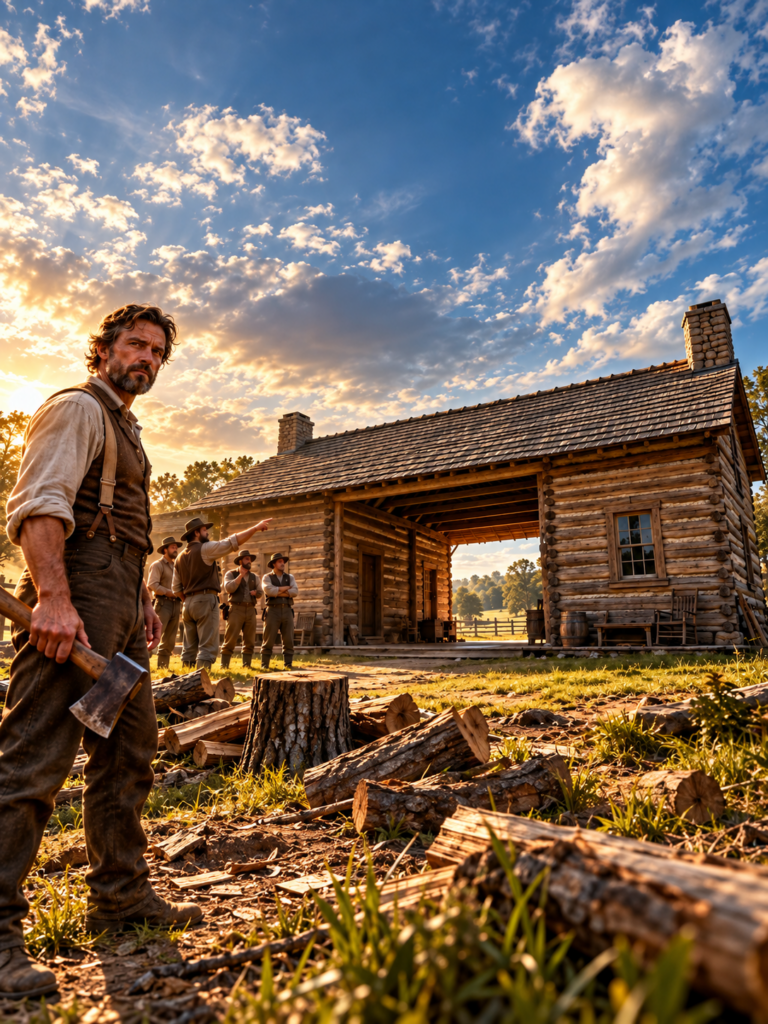
Part 1
The strangest thing about Samuel Reed’s new house was not what he had built.
It was what he had deliberately left out.
In the spring of 1838, on a modest farm in Middle Tennessee, the thirty-six-year-old farmer stood before the beginnings of his new home while his nearest neighbor stared at the ground in disbelief.
Two foundations had been marked out. One lay to the west, the other to the east. Between them stretched twelve feet of untouched ground.
Thomas Bell, whose farm bordered Samuel’s to the east, studied the measurements for a long moment.
“Where’s the middle going?” he finally asked.
Samuel straightened from the stake he had been driving into the earth.
“There isn’t going to be one.”
Thomas looked at him.
“One what?”
“Middle wall.”
Thomas glanced from one set of stakes to the other. He had helped raise enough cabins to know how a house was supposed to begin. Walls met at corners. Rooms stood beside other rooms. A man with limited timber did not leave twelve feet of perfectly good building space standing empty.
“You’re putting two cabins next to each other?”
“Under one roof.”
Thomas waited for the rest of the explanation.
Samuel picked up his measuring line.
“That’s the house.”
For a moment, Thomas thought his neighbor was having some fun at his expense. Then he realized Samuel meant every word.
And Thomas laughed.
He would remember that laughter months later, on an August night when he arrived at the same house carrying blankets while his wife struggled to comfort their exhausted little boy.
By then, the twelve feet Thomas considered wasted would have become the most valuable space anywhere on their stretch of countryside.
But Samuel did not yet know how that summer would unfold.
He only knew what years of uncomfortable nights had taught him.
And he had decided he would never build another house that kept the breeze outside.
Samuel Reed was not a man given to unnecessary experiments.
His farm was small enough that every acre mattered. He owned two horses, several hogs, and a collection of carpenter’s tools that had once belonged to his father. His corn crop depended on the weather, and the weather had never shown much concern for how hard a man worked.
He understood the price of timber, the weight of a roof beam, and the labor required to lift a log into place.
When something broke, Samuel tried to repair it before considering a replacement. When something wore out, he looked for another use for it. He did not have the resources to build carelessly.
That was one reason his new house attracted so much attention.
People who knew Samuel found it difficult to believe that a practical man would intentionally construct something that looked so wasteful.
But there was a difference between wasting something and leaving it open for a purpose.
Samuel had learned that difference inside his first cabin.
The old cabin had been a sturdy, ordinary structure. It had thick log walls, a stone chimney, one principal living room, a single door, and two small windows.
In winter, Samuel considered it a good house.
The walls held back bitter winds. The chimney gave the family a place to gather around a fire. The roof kept rain from their bedding and belongings. When the countryside turned cold and gray, the cabin offered the kind of shelter a working farmer appreciated.
Summer revealed a different nature.
By July, the roof spent long afternoons absorbing sunlight. The stone chimney, so welcome in January, seemed determined to hold warmth long after the cooking fire had died.
The two windows admitted daylight but very little moving air.
Their positions had been chosen for convenience during construction, not for ventilation.
And the single door could do only so much.
Samuel would return from working outside, step across the threshold, and feel the unpleasant stillness settle around him.
The field might be hot. The air beneath a tree might be hot. But outside, at least, the occasional breeze could touch his face.
Inside the cabin, the heat seemed to have nowhere to go.
Sometimes he opened both windows and stood beside the door, waiting.
A little air might enter one opening and die before reaching the other side of the room.
Sometimes he could hear leaves moving beyond the walls while the air inside remained utterly motionless.
That was what troubled him most.
There was wind somewhere.
His house simply refused to let it through.
In the Upland South, families knew how to arrange their days around heat.
Work began early, often before sunrise. The most demanding chores were done while the ground still held some of the night’s coolness. By midday, people looked for shade or found work that required less exertion.
A cooking fire could turn an already miserable room into a place nobody wanted to occupy.
At night, doors and windows were opened, bedding was moved, and people tried to find a comfortable place to rest.
Samuel accepted heat as part of living in Tennessee.
What he could not accept was the idea that a house had to make the heat worse.
The matter had become painfully personal during a particularly difficult summer when his wife fell ill.
Her sickness frightened him.
Samuel knew that people became ill for many reasons. He did not pretend to know that the cabin had caused her condition. He had neither the knowledge nor the evidence to make such a claim.
But he remembered how desperately she needed rest.
He remembered the evenings when she lay awake, unable to settle comfortably as the warmth lingered inside their home.
He remembered opening the door and then the windows, hoping that somewhere in the dark there would be enough air to bring her relief.
When that failed, he carried bedding outside.
Some nights they slept on the porch.
Other nights, beneath a tree.
They had built their cabin to protect themselves from the elements, yet in summer they repeatedly abandoned its protection in search of comfort.
Samuel found something deeply wrong with that.
His wife eventually recovered, and daily life returned to its familiar pattern.
There was corn to tend, livestock to care for, fences to repair, and work enough to fill every daylight hour.
But Samuel never forgot those nights.
He would be working with his father’s tools or tending the horses when the memory returned: the open windows, the useless doorway, the heavy atmosphere of the little cabin.
He began to think about houses differently.
Most men asked whether a house would keep the weather out.
Samuel began asking whether it would also let the right kind of weather in.
Years before he started rebuilding, Samuel had traveled south with a timber crew.
The journey had exposed him to buildings unlike the familiar cabins around his own farm.
At several homes, he noticed an arrangement that initially seemed incomplete.
There would be one enclosed section on one side, another section several yards away, and a single roof covering both.
Between the two stood a broad, open passage.
No front wall closed it.
No back wall stopped it.
A person could stand beneath the roof and look straight through to the ground beyond.
Samuel’s first reaction had been the same one Thomas Bell would later have.
He assumed the owner had not finished building.
But during one stop, in the middle of a hot day, Samuel sat beneath such a roof.
The change was immediate.
Sunlight struck the ground beyond the building, yet the passage itself remained shaded.
Air entered one open end and traveled beneath the roof toward the other.
The rooms on either side were warm, but the passage offered a kind of relief that the enclosed spaces could not.
Samuel sat quietly, noticing where the air moved.
He watched how doors opening from the rooms into the middle space could admit some of that movement into the house itself.
There was nothing mysterious about it.
The roof provided shade. The open ends permitted the breeze to pass. The arrangement gave people a sheltered place to sit without trapping them behind walls.
Still, the simplicity impressed him.
A man could spend time and timber sealing every opening in a building, only to discover that he had sealed out the very thing he wanted most.
Samuel carried that memory home.
It stayed with him through years of work and through the uncomfortable summers inside his own cabin.
When he finally had enough material and assistance to begin a replacement house, he knew exactly what he wanted to attempt.
He was not trying to invent a new way of living.
He had seen the design work.
He intended to build a version of it on his own land.
Thomas Bell was one of the first people to realize that Samuel’s strange foundation markings were not temporary.
At first, Thomas supposed his neighbor might reconsider once the actual work began.
That seemed reasonable.
There were plenty of decisions a builder could change while the stakes were still in the ground.
But Samuel continued.
He raised one section of the house on the western side, then another on the eastern side.
Each was essentially a small log cabin.
The western room would serve as his principal living and sleeping space. The eastern section would provide room for storage, guests, and the work that needed shelter.
The twelve-foot gap would remain between them.
As the logs rose higher, the empty center became increasingly noticeable.
Men traveling along the nearby road slowed to examine the work.
Some asked whether Samuel had run short of timber.
Others wondered whether he had made a mistake in his measurements.
One neighbor studied the two separate structures and offered the obvious solution.
“Why not connect them before you put the roof on?”
Samuel continued fitting the logs.
“Because I want the space between.”
The man looked at him as though he had answered a different question.
“If you want two cabins, why not just build two cabins?”
Samuel tried to explain.
“I want one roof. I want both rooms. And I want air moving between them.”
“But you could have another room there.”
“I could.”
“Then why wouldn’t you?”
Samuel paused, considering how much explanation the man was prepared to hear.
“Because that room would stop the wind.”
The answer seemed to satisfy Samuel.
It did not satisfy the visitor.
Before long, Samuel’s house had become an easy subject of conversation.
The jokes were not always cruel. Most came from people who believed they were watching an otherwise sensible farmer make an expensive mistake.
They knew how much effort it took to cut, haul, shape, and raise timber.
They knew the usefulness of enclosed space.
And they understood that a house built without a middle room appeared to offer less for the same amount of work.
That was the argument Thomas returned to whenever he visited.
“You’ve got the timber,” he told Samuel one afternoon. “You’ve got the roof going over it anyway. Why not make use of what’s underneath?”
“I will.”
Thomas looked at the open ground.
“Use it for what?”
“Living.”
Thomas shook his head.
Samuel could not blame him for finding the answer strange.
Before encountering such a house himself, he would have thought much the same thing.
He had once looked at an open passage and seen a construction job left unfinished.
Only after sitting in its shade had he understood what the builder intended.
Samuel had learned something that could not be fully explained with stakes and measurements.
His neighbors would have to experience it.
The next stage of construction made the building look stranger still.
Samuel began setting the heavy beams that would support the roof.
These extended over the western room, crossed the open middle, and continued across the eastern section.
For the first time, the two structures became visibly connected.
But the connection only emphasized what Samuel had refused to enclose.
From a distance, the new house appeared nearly complete.
There were walls at either end, a continuous roof above, and the familiar shape of a farm dwelling.
A traveler approaching from the front might expect a doorway somewhere near the middle.
Instead, the entire center of the building stood open.
One could look beneath the roof and see the field on the other side.
Thomas visited again while Samuel was working near the passage.
He stopped several yards away and studied the building.
Then he smiled.
“Samuel, you’ve built yourself a house with a road through it.”
Samuel glanced up.
He understood the joke.
But he also liked the description.
“That’s near enough,” he replied.
Thomas laughed. “You’ll have wagons passing through your parlor next.”
“Not wagons.”
“What, then?”
“Air.”
Thomas looked at the passage, then back at Samuel.
Samuel returned to his work.
He had no interest in winning an argument about a house that was not yet finished.
The important thing was to build it properly.
He laid a wooden floor across the central passage, raising it slightly above the ground.
He arranged the roof so that it extended beyond the walls, helping shield the passage from sunlight even when the sun stood at an angle.
He fitted doors opening from both enclosed sections directly into the middle.
He also provided windows along the outer walls.
That last detail mattered.
The rooms were not meant to remain sealed boxes standing beside an outdoor corridor.
When conditions allowed, a door toward the passage and a window toward the outside could be opened together.
Air would have a route through the room.
Whether that air would be cool depended on the weather.
Samuel knew he could not command the wind or lower the temperature of a hot summer day.
But he could stop building barriers that prevented whatever breeze existed from reaching the places where people lived.
As work progressed, he found satisfaction in small, practical details.
A door that swung freely.
A floorboard fitted securely.
A beam resting where it belonged.
The tools inherited from his father remained close at hand. Their familiar handles and worn surfaces connected this unusual project to years of ordinary labor.
Samuel was not abandoning the skills he had been taught.
He was applying them to a different understanding of what a house ought to do.
Still, there were moments when the criticism weighed on him.
A building required material that could not easily be replaced. Every hour spent shaping timber was an hour taken from other necessary work.
If Samuel’s memory of those southern houses had misled him, the mistake would be expensive.
And he was building where the same neighbors who questioned him would see the result every day.
He had no grand explanation that could guarantee success.
He only had experience, observation, and the determination not to repeat the discomfort of his first cabin.
He kept building.
By early June, the new house was finished.
The weather had already begun to warm, and Samuel wasted little time moving his bedding into the western room.
The building looked exactly as he had intended.
Two enclosed sections stood beneath one roof.
Between them stretched the broad passage, open from front to back.
During the first several days, Samuel paid close attention to how the house behaved.
Morning sunlight shifted across the ground outside. The shade beneath the center roof changed shape as the hours passed. When wind crossed the field, he watched where it entered and where it left.
The passage was pleasant.
But early June was not a serious test.
Most of the neighboring houses were reasonably comfortable too.
The days were warm, but not yet punishing. A person could still work through much of the afternoon without feeling that the very air had become an enemy.
One evening Thomas stopped by.
Samuel was near the central passage when his neighbor approached.
Thomas stepped beneath the roof and leaned against a post.
For a few moments neither man spoke.
A mild breeze crossed the field and moved along the shaded space.
Thomas noticed it.
He adjusted his position slightly, letting the moving air reach him.
“Well,” he said at last, “I’ll give you this much.”
Samuel looked toward him.
“It’s a pleasant place to stand.”
Samuel nodded.
Thomas glanced at the two enclosed rooms.
“But pleasant isn’t the same as useful.”
Samuel waited.
“You’ve used enough roof to cover another room. All that space, and you haven’t even put walls around it.”
“The roof keeps off the sun.”
“So would a roof over a proper room.”
“Not the same way.”
Thomas gestured toward the empty passage.
“A man needs room for his things, Samuel. Room for his family. Room to stay out of the weather.”
Samuel let the words settle.
Thomas was expressing a concern that any farmer with limited resources would understand.
An additional enclosed room was easy to value.
It could hold furniture, supplies, tools, visitors, or bedding.
An open passage offered no such obvious promise.
Samuel glanced toward the evening light beyond the building.
“Maybe I’ll find more use for this than you think.”
Thomas smiled.
“Maybe you will.”
But his tone suggested that he doubted it.
After Thomas left, Samuel remained in the passage for a little while.
The breeze had weakened.
He could still feel the difference between the open center and the air resting inside the western room.
Not a dramatic difference. Not yet.
Enough, however, to remind him why he had built it.
He knew summer had only begun.
June passed, and July approached.
The fields dried.
Rain became scarce.
Corn leaves began curling beneath the afternoon sun, and the ground grew hard underfoot.
By midday, even the shade offered little comfort.
The weather was changing.
And for the first time, Samuel’s neighbors were about to discover that the strange opening through his house was more than a construction decision.
It was an answer to a problem none of them could escape.
Part 2
By the middle of July, the land around Samuel Reed’s farm had taken on the exhausted appearance that came with a long spell of hot, dry weather.
The corn stood beneath the sun with its leaves curling inward during the afternoons.
Dust clung to the road.
The ground, once soft enough to work without much complaint, had hardened until even simple chores required more effort.
Samuel rose early to tend his animals and attend to whatever work could be done before the worst heat arrived.
His two horses sought relief wherever shade could be found. The hogs became less active during the brightest hours. Even the familiar sounds of the farm seemed quieter at midday.
By late morning, Samuel could already feel the warmth collecting beneath his clothing.
He knew better than to pretend he could work through every hour as though the season had not changed.
Men who spent their lives outdoors learned to respect heat. They learned when to work and when to stop, when to drink, and when an unnecessary task could be put aside until the evening.
Inside the neighboring cabins, however, the trouble did not end when the day’s work was finished.
The houses had spent hours beneath the sun.
Roofs absorbed heat. Stone chimneys remained warm. Cooking fires added to the discomfort.
Opening a window sometimes helped, but only when there was enough breeze to reach it.
And when the air outside scarcely moved, the air inside could become unbearable.
Thomas Bell knew the problem well.
He had lived in his own cabin long enough to understand its habits.
In cold weather, he appreciated every thick wall and tight corner.
During this hot spell, those same walls seemed determined to keep the previous afternoon inside long after evening arrived.
His family spent more time outdoors, looking for shade and whatever moving air they could find.
At night, they opened the door and windows.
Sometimes a breeze entered.
Sometimes nothing happened.
Thomas would sit and listen to the sounds beyond the doorway, wondering how the air outside could feel so different from the air trapped around his family.
It was an irritation he had known for years.
He had accepted it because there seemed to be little alternative.
Then he began thinking about Samuel’s house.
Not seriously at first.
The memory would come to him during the worst part of the afternoon: the wide covered opening, the wooden floor, the way the breeze had moved beneath the roof during his earlier visit.
He remembered telling Samuel the space was pleasant but useless.
The judgment had seemed obvious at the time.
Now, with the temperature climbing and the nights growing uncomfortable, Thomas found himself reconsidering what usefulness meant.
Samuel’s new house did not escape the heat.
The western room warmed during the day. The eastern section warmed as well.
On afternoons when the air outside was nearly still, the open passage offered shade but little moving air.
Samuel did not mistake his design for a miracle.
He could sit beneath the roof and feel hot.
He could step into either room and find the air uncomfortable.
The difference was that his house did not prevent a breeze from passing through when one finally arrived.
Even a slight movement of air could be felt in the central opening.
A weak current that might have gone unnoticed elsewhere traveled beneath the roof and across the shaded floor.
Samuel began arranging his afternoons around that advantage.
When his work allowed it, he moved a chair into the passage.
From there, he could look across the fields, keep an eye on the farm, and perform small tasks without sitting inside an enclosed room that had been warming since morning.
He found he could remain useful even when the heat made heavier work unwise.
A tool handle could be examined.
A piece of harness could be repaired.
An ordinary chore that required patience rather than strength could be completed while the air moved around him.
The center of the house became the place where work and rest met.
His wife appreciated the space as well.
The shaded floor offered somewhere to sit without retreating entirely indoors or moving bedding and belongings out into the open yard.
She remembered the discomfort of their old cabin as clearly as Samuel did.
Neither of them had forgotten how hard it could be to rest when a house held warmth long after sunset.
Samuel did not take satisfaction in proving his neighbors wrong.
He was simply relieved to discover that the arrangement was doing what he had hoped.
Then Thomas began visiting.
The first time Thomas came during the hottest part of the day, he claimed he was passing through.
Samuel found him standing near the opening, looking down the length of the passage.
“Warm day,” Thomas remarked.
“That it is.”
Thomas stepped beneath the roof.
A faint breeze moved past them.
He stood quietly for a moment before asking about the work Samuel had been doing.
Samuel answered, and the conversation turned to ordinary farm concerns.
They discussed the dryness of the soil, the condition of the corn, and the tasks that still needed attention.
Thomas stayed longer than a passing visitor ordinarily would.
When he finally left, Samuel made no comment.
A few days later, Thomas returned carrying a damaged piece of harness.
“I was going to see if you could help me with this,” he explained.
Samuel examined it.
“Set it down here.”
They took their seats in the passage.
Thomas chose a chair near the center.
Samuel brought out the tools he needed, and the men worked while the sun shone hard beyond the shade.
Thomas occasionally paused and looked toward the western end of the opening.
The moving air was faint, but it was there.
The repair did not take the entire afternoon.
Thomas stayed anyway.
After that, the visits became increasingly ordinary.
Sometimes Thomas brought a loose tool handle. Sometimes a cracked wooden box. Sometimes he arrived with nothing more than an excuse to talk.
Samuel began noticing where his neighbor preferred to sit.
Always near the center.
Always where the moving air seemed strongest.
One afternoon Thomas shifted his chair several inches, then leaned back with a small expression of satisfaction.
Samuel glanced at him.
Thomas caught the look.
“What?”
“Nothing.”
“You’ve got something to say.”
Samuel picked up the piece of wood he had been working on.
“Seems you’ve found a good spot.”
Thomas looked toward the open field.
“Better than sitting out in the sun.”
Samuel nodded.
There was no need to say more.
The building itself was making the argument.
Still, Thomas had not fully abandoned his earlier doubts.
The covered passage offered comfort, certainly, but comfort alone did not explain whether the sacrifice of an enclosed room had been worthwhile.
A farmer needed storage.
He needed space for sleeping, work, visitors, and possessions.
Samuel’s house had less enclosed floor area than it might have had.
Thomas continued to believe that mattered.
But another thought had begun troubling him.
For most of his life, he had counted the usefulness of a building by the things its walls could hold.
Now he was spending his afternoons in a space made useful by the absence of walls.
The contradiction stayed with him.
As July drew toward its end, the heat became harder to dismiss as an ordinary seasonal inconvenience.
Work slowed.
Families adjusted their routines.
Meals were prepared with increasing attention to how much heat a cooking fire would leave behind.
People rose early and tried to complete the day’s most demanding tasks before the sun climbed too high.
By afternoon, shade mattered more than conversation.
Neighbors who would normally pause beside the road to exchange news sometimes offered only a brief greeting before continuing toward shelter.
Samuel watched the landscape from his passage.
He had known hot summers before, but the prolonged dryness made this one especially uncomfortable.
He worried about the corn.
A farmer could adjust where he sat or slept, but he could not persuade a thirsty field to produce rain.
Every curled leaf reminded him of how much remained beyond his control.
When Thomas arrived, their conversations often returned to the weather.
“Ground’s getting harder,” Thomas said one afternoon.
Samuel nodded.
“Could use rain.”
“Could use several days of it.”
They looked across the field.
Neither man expected a conversation to change anything.
Eventually Thomas lowered himself into the chair he now used without asking.
He had grown so familiar with the passage that he sometimes arrived and settled there before Samuel came out from one of the rooms.
One day Samuel opened the western door and found his neighbor already seated.
Thomas looked up.
“Hope you don’t mind.”
Samuel glanced at the chair.
“Seems you know where to find it.”
Thomas gave a short laugh.
He no longer made jokes about Samuel having built a road through his house.
That description had stopped sounding foolish.
The open center was becoming part of the farm’s daily life.
Samuel repaired tools there. He rested there. When the breeze permitted, it offered a better place to spend the afternoon than either of the enclosed rooms.
But the design had not yet faced the condition that troubled Samuel most.
The heat of the night.
August brought a stretch of weather that made July seem forgiving.
The days were oppressively hot.
Worse, the nights offered almost no relief.
Normally, a family enduring a difficult afternoon could look forward to the evening.
The sun would disappear, the ground would gradually lose some warmth, and a breeze might begin moving across the fields.
During this spell, the air remained unpleasant even after darkness settled.
Houses that had absorbed heat throughout the day continued releasing it into their rooms.
Bedding felt warm.
People changed positions repeatedly, searching for some small measure of comfort.
Children grew restless, and adults slept badly.
Thomas watched his family struggle.
His youngest boy had begun lying on the floor near the open doorway.
The child had discovered that the occasional movement of air near the entrance was more comfortable than remaining farther inside.
Thomas could not fault his reasoning.
The boy was simply looking for relief wherever he could find it.
But seeing him there bothered Thomas.
A child ought to be able to sleep in his own home without searching the floor for a cooler place.
Thomas tried leaving the doorway open.
He opened the windows.
He waited for the warmth to ease.
The cabin remained stifling.
When a weak breeze finally crossed the yard, it brushed the doorway without traveling far into the room.
Thomas thought again of Samuel’s house.
For the first time, he did not think about the missing room.
He thought about the opening.
Samuel was dealing with the same oppressive weather.
His western sleeping room was warm, and he knew it would not become comfortable simply because the sun had disappeared.
But unlike his neighbors, he had a way to change how the building received the evening air.
Near sunset, he opened the windows along the outer walls.
He opened the door from the western room into the central passage.
The passage itself remained unobstructed, allowing air to enter one end and continue through the other.
He watched the light fade beyond the roof.
The day did not suddenly become cool.
He could still feel the warmth in the floorboards and in the air.
But as the evening progressed, the shaded passage began to feel less oppressive than the enclosed rooms.
Occasional breezes moved across the farm.
They traveled through the center of the building, and some of that air could reach the rooms through the open doors.
Samuel had hoped for precisely this behavior when he laid out the foundations.
Now, in the worst weather of the summer, he could test it.
He moved a narrow bed into the passage.
The bed fit beneath the roof without closing off the route of the wind.
He could rest there sheltered from dew and light rain while remaining exposed to whatever breeze passed across the field.
The arrangement would not have been ideal in severe weather, but on these hot, dry nights it offered something his old cabin never had.
A protected place to sleep where the air was free to move.
Samuel lay beneath the roof and listened to the sounds of the farm.
Outside, insects continued their nighttime chorus.
The occasional shifting breeze carried the smell of dry earth.
The stars were visible beyond the open ends of the passage.
He could feel the warmth of the season, but he no longer felt imprisoned by the house.
That difference mattered.
He remembered the nights in the old cabin when his wife had been ill, when he had carried bedding outdoors because there was simply nowhere comfortable to rest inside.
He remembered standing beside the open door, waiting for air that never seemed to reach the room.
The new house could not prevent illness or command cooler weather.
He knew that.
But it could offer his family a more flexible way to live with difficult conditions.
For Samuel, that was enough to justify the work.
He had not built a perfect house.
He had built one that gave him a choice.
At Thomas Bell’s cabin, another difficult evening was unfolding.
His youngest son could not settle.
The boy had spent hours in the heat, and the warmth inside the house refused to ease.
He had already tried sleeping near the doorway.
This time even that offered little comfort.
Thomas’s wife tried to soothe him.
She arranged his bedding, helped him move to a less confined spot, and stayed beside him while he struggled to rest.
But the child continued crying.
The sound wore on everyone.
Thomas stood near the doorway, feeling the weak nighttime breeze against his face.
For a long time he said nothing.
He had spent weeks laughing at Samuel’s unusual house.
Then he had spent weeks enjoying the shade beneath its roof.
He knew what waited there.
The thought of asking his neighbor for help made him uncomfortable, though Thomas could not reasonably explain why.
Samuel had never been unkind to him.
He had never demanded an apology for the jokes.
He had allowed Thomas to sit in the passage, work there, and enjoy the breeze as often as he wished.
The difficulty lay entirely in Thomas’s pride.
As long as he visited during the afternoon to mend a tool or exchange a few words, he could pretend the design was merely convenient.
Going there after dark with his exhausted family would mean acknowledging something more important.
Samuel’s house could provide relief that Thomas’s own house could not.
His wife looked toward him.
The child was still crying.
Thomas knew that no amount of stubbornness would make the cabin cooler.
“We could try Samuel’s place,” he said.
His wife considered the suggestion.
“The open middle?”
Thomas nodded.
“There’s more air there.”
She looked down at their son.
That settled it.
There was no need to discuss whose idea had been better.
Their child needed sleep.
Samuel was near the passage when he heard someone approaching from the darkness.
He turned toward the sound.
Thomas’s wife came into view carrying their youngest son.
The boy was exhausted, his earlier crying reduced to occasional unhappy sounds.
Samuel rose.
Behind her, a few moments later, Thomas arrived carrying blankets.
For a brief instant, the two men looked at each other.
Samuel understood why they had come.
Thomas glanced toward the bed in the middle of the passage.
“He’s having trouble sleeping,” he said quietly.
Samuel stepped aside.
“Bring him in.”
That was all.
No joke about the unfinished house.
No reminder of the wasted timber.
No comment about the road through the middle.
Samuel helped them arrange bedding across the wooden floor.
The passage was broad enough to accommodate the family without sealing either end.
Thomas’s wife settled beside her son.
The child shifted restlessly at first, still unsettled by the miserable evening.
Then a faint current of air moved beneath the roof.
It brushed across the passage and continued toward the opposite field.
The boy grew quieter.
His breathing became more regular.
Before long, he was asleep.
His mother remained beside him, her exhaustion evident now that the crying had stopped.
She, too, eventually fell asleep.
Thomas did not.
He sat near the edge of the passage, looking out across the dark countryside.
Samuel gave him room to think.
Every few minutes another weak breeze approached.
Thomas could feel it move through the building.
It entered the open end, crossed the shaded floor, touched the bedding, and passed out the other side.
Nothing obstructed it.
The same air that had barely reached the inside of Thomas’s cabin could travel freely beneath Samuel’s roof.
Thomas looked toward his sleeping son.
Then he looked at the two enclosed rooms standing on either side of the passage.
For months he had imagined the center as a room that Samuel had failed to build.
Now he understood that closing the passage would destroy the very quality that made it useful.
The absence was not an accident.
It was the design.
Thomas sat quietly as the night deepened.
He had arrived carrying blankets and a tired child.
He was leaving behind an opinion he had held with absolute confidence.
And while his family slept in the center of the house he had mocked, Thomas finally understood what Samuel had known from the beginning.
Sometimes the most valuable part of a building is the space its builder has the courage to leave open.
Part 3
The next morning, Thomas Bell did not leave Samuel Reed’s farm with the same certainty he had brought to it earlier that spring.
He had spent much of the night watching his wife and youngest son sleep beneath a roof that covered no enclosed room.
The experience unsettled him.
Not because Samuel had done anything extraordinary.
There had been no remarkable invention, no complicated machinery, and no sudden change in the weather.
The night had remained hot.
The breeze had remained weak.
Yet Thomas had seen his child finally rest in a place that offered something his own cabin could not.
Moving air.
When morning arrived, Thomas helped gather the blankets.
His wife looked more rested. Their little boy, who had struggled so badly the previous evening, was no longer crying.
Samuel came into the passage as they prepared to leave.
Thomas hesitated, then looked toward the opening.
“He’s had more sleep here than he’s had at home these past nights.”
Samuel nodded.
“Glad it helped.”
Thomas shifted the blankets in his arms.
For a moment, he seemed ready to say something else.
He looked at the beams stretching overhead, the wooden floor beneath his feet, and the two rooms on either side.
It was the same building he had laughed at.
Nothing about its construction had changed.
Only his understanding of it.
“I suppose you knew what you were doing,” Thomas said.
Samuel considered the words.
“I hoped I did.”
Thomas gave a small smile.
That answer made the admission easier.
Neither man needed to turn the moment into a contest with a winner and a loser.
Samuel had built something he believed would work.
Thomas had doubted him.
The summer had settled the disagreement better than either man could have done with words.
And as Thomas walked home with his family, he carried a new awareness of the limitations of his own cabin.
The walls he had always trusted to provide protection had also kept something necessary outside.
Word of Samuel’s comfortable passage spread without much effort.
In a farming community, neighbors noticed where people gathered.
They noticed who visited whom, which houses offered a shady place to rest, and where children seemed most comfortable during a difficult afternoon.
Thomas had been spending more time at Samuel’s place for weeks.
Now his wife and youngest child had slept there during one of the hottest nights of the summer.
That was harder to dismiss as a passing curiosity.
Over the following evenings, others began finding reasons to visit.
Samuel’s sister came with her daughter.
They spent time in the shaded center, where the open ends allowed the faint evening breezes to pass.
An older neighbor arrived because his own cabin remained uncomfortably warm long after sunset.
The visits were not organized, and Samuel made no attempt to turn his home into some grand community gathering place.
People simply came because they had discovered that the passage offered relief.
Children played there during the day, protected from direct sunlight.
Women sat sorting beans while the moving air passed through the space.
Tools were repaired.
Ordinary conversations continued.
Sometimes meals were eaten beneath the roof.
The opening Samuel’s neighbors had once dismissed as wasted space became one of the busiest parts of the house.
Its usefulness changed throughout the day.
In the morning, it might offer a sheltered place to work.
At midday, it became a shaded retreat from the direct sun.
In the evening, it served as a gathering place.
On the most uncomfortable nights, bedding could be arranged across its wooden floor.
Nothing about the structure needed to be rebuilt to accommodate these different purposes.
That flexibility was part of its strength.
Samuel watched the activity with quiet satisfaction.
He had originally wanted a house that would keep his family from suffering through the same stifling nights they had known in their first cabin.
He had not expected the central passage to become a place his neighbors would depend upon as well.
Yet there they were.
The same people who once questioned every foot of open space now occupied it willingly.
The arrangement seemed natural once they experienced it.
That was what Samuel found most interesting.
A thing could appear foolish when judged from the outside and become perfectly sensible once someone understood what it was meant to accomplish.
The roof was still a roof.
The rooms were still rooms.
The empty center had not become more enclosed, more elaborate, or more impressive.
It had simply been given the opportunity to prove its worth.
But the design had one weakness that Samuel never ignored.
The opening that welcomed a gentle breeze could also admit a strong wind.
And before the summer ended, the weather changed in a way that threatened to expose that weakness.
One day, clouds gathered as a storm approached.
The wind, which had been so welcome during the heat, began increasing sharply from the southwest.
The air moved with a force unlike the faint currents that had provided relief on the hottest afternoons.
Samuel watched the change.
The passage that ordinarily allowed a gentle breeze to travel beneath the roof now stood directly exposed to the stronger wind.
Rain followed.
For the first time that summer, the open middle of the house seemed likely to become a disadvantage.
Thomas, familiar with the structure by then, immediately recognized the problem.
The space he had learned to appreciate might be comfortable during a hot evening, but a severe storm was something else entirely.
A roof with no enclosing walls beneath it could not be treated like an ordinary room.
Wind-driven rain might enter from either end.
Loose belongings could be disturbed.
The comfortable passage that had sheltered sleeping families now offered a direct route for rough weather.
Thomas looked toward Samuel.
“This is the part I was worried about.”
Samuel was already preparing the passage for the approaching storm.
He had not ignored the possibility of bad weather when building the house.
The open center had been designed primarily for shade and ventilation, but Samuel understood that openness was not always desirable.
He had made heavy shutters and simple removable barriers that could be used when conditions demanded greater protection.
They did not permanently enclose the middle.
They allowed him to reduce its exposure temporarily.
Samuel began putting those protections in place.
Thomas watched him work.
The arrangement was straightforward.
There was no elaborate system to operate and no need to change the structure itself.
The barriers could help limit the force of wind and rain entering the passage while leaving the building’s essential design intact.
Thomas studied the shutters.
“You planned for this?”
Samuel continued securing what needed to be secured.
“Had to.”
Thomas glanced toward the darkening sky.
“Thought you wanted the wind coming through.”
“Not every kind of wind.”
The answer was so ordinary that Thomas nearly laughed.
Of course.
A farmer who built a door did not expect to leave it open in every kind of weather.
A man who opened a window for summer air closed it when rain blew toward his bed.
Samuel had approached the central passage with the same practical understanding.
It could remain open when the weather made openness useful.
It could be partially protected when conditions changed.
The storm passed through the countryside, bringing the wind and rain that had threatened the comfortable space.
Samuel’s design was not without limitations.
The passage was still more exposed than an enclosed room, and the temporary barriers did not transform it into one.
But Samuel had never claimed that the open middle should provide every possible form of protection.
He had built a house that could respond to different conditions rather than forcing the family to endure one fixed arrangement throughout the year.
When the dangerous weather eased, the barriers could be removed.
The passage could open again.
And the next gentle breeze could pass beneath the roof as freely as before.
Thomas carried the lesson home.
He had spent much of his life believing that the strength of a house lay in the permanence of its walls.
Walls kept things out.
That was their purpose.
Rain belonged outside. Cold wind belonged outside. Unwelcome weather belonged outside.
But Samuel’s home suggested a more complicated truth.
Sometimes a wall provided protection.
Sometimes it prevented comfort.
And sometimes a structure served its occupants better by allowing them to choose how open or closed it should be.
Thomas began noticing details in his own cabin that he had previously accepted without question.
He noticed how sunlight warmed the roof.
He noticed where the windows faced.
He noticed how air entered through the doorway but often failed to move farther into the room.
He noticed where his family gathered during the hottest hours and where they avoided sitting.
Most of all, he noticed how different the air could feel just outside the cabin.
He had known these things for years without thinking of them as problems a builder might solve.
His cabin had always been familiar.
And familiarity had made him stop questioning it.
Samuel’s house had changed that.
By September, the worst heat had passed.
The days grew more tolerable, and the nights slowly became easier.
Thomas and his family returned to spending most nights in their own home.
The children no longer needed to search so desperately for moving air.
Samuel continued using his central passage for work, rest, and ordinary household activities.
As cooler weather approached, the house settled into another season.
The dramatic contrast between his building and the neighboring cabins became less noticeable.
When the air itself was comfortable, almost any sheltered place could feel pleasant.
But the summer had left its mark.
Thomas no longer looked at Samuel’s house and saw wasted timber.
He saw an arrangement that had allowed a family to live more comfortably during weather that had made nearly everyone else miserable.
Samuel had sacrificed enclosed floor area, certainly.
Yet he had gained something equally important.
A shaded passage that could serve as workspace, sitting area, sleeping place, and a route for ventilation.
The structure had not created cold air.
It had simply made better use of the air already moving across the farm.
Thomas understood that now.
And understanding it meant he could no longer look at his own house in quite the same way.
The following spring, Thomas Bell began making changes.
He was adding a new room beside his existing cabin.
A year earlier, he might have placed the addition directly against the old walls and created a larger enclosed building.
That would have seemed the sensible approach.
It was how he had always understood construction.
But Thomas had spent an August night watching his young son sleep in Samuel’s covered passage.
He remembered that night more vividly than any argument about timber or floor space.
So when he planned the new room, he left a broad opening between it and the existing cabin.
He arranged for a roof to cover the intervening space.
He did not copy Samuel’s house exactly.
There was no need.
His property, his existing building, and his family’s needs were not identical to Samuel’s.
What mattered was the principle.
Two enclosed spaces could share a roof while leaving an open passage between them.
That passage could provide shade, admit a breeze, and offer a useful place to work or rest without confining people inside another warm room.
Thomas had once thought Samuel’s design meant giving up a room.
Now he understood that the opening itself could function as part of the living space.
Samuel watched the work with interest.
The change was not the kind of triumph a man could measure in money or acreage.
Thomas had not come before the entire community to announce that he had been wrong.
Samuel had not asked him to.
The proof was quieter.
A man who once laughed at a building was now applying its lessons to his own home.
Samuel had never needed anything more.
What neither man had invented was the basic form of the house.
Across the American South and the expanding frontier, families had been constructing variations of this arrangement for years.
Some built two separate enclosed sections beneath one shared roof from the beginning.
Others started with a single cabin.
As the household grew or its needs changed, a second room or cabin might be constructed several feet away.
A roof could then connect the two, leaving a central passage open.
The arrangement became known as a dogtrot house.
Its defining features were straightforward: two enclosed sections, a shared roof, and an open middle passage.
There was no machinery to maintain and no complicated invention hidden inside the walls.
Its usefulness came from understanding shade, airflow, and the daily realities of living in a warm climate.
The roof prevented direct sunlight from striking the passage.
The open ends allowed breezes to travel through.
Doors connecting the rooms to that middle space could help ventilate the enclosed interiors.
Families could sit, work, eat, or rest there while remaining sheltered overhead.
It was a practical response to conditions that people in the region knew well.
Samuel had encountered the design while traveling with a timber crew.
He had remembered it because he had experienced the comfort of sitting in such a passage on a hot day.
When his own circumstances finally allowed him to build again, he brought that lesson home.
He had not needed a formal knowledge of architecture.
He had needed only to recognize the difference between a house that blocked moving air and one that welcomed it.
That recognition shaped every important decision he made during construction.
The twelve-foot opening.
The continuous roof.
The raised wooden floor.
The doors facing the central passage.
The windows on the outside walls.
The overhanging roofline.
The removable protections for severe weather.
Individually, none of these details seemed extraordinary.
Together, they created a house that could accommodate the changing conditions of a Tennessee summer.
In later years, many houses built in this fashion would lose their open middle passages.
Owners would look at the roofed space and imagine the additional enclosed room they could create there.
It was an understandable temptation.
Families needed more storage, more sleeping space, and more room for the belongings of daily life.
Closing the passage could provide those things.
But the change also removed something essential.
The breeze no longer traveled freely through the middle.
What had once been a shaded outdoor space became another enclosed room capable of holding summer heat.
The building gained walls and lost the quality that had made its original arrangement so useful in warm weather.
Samuel Reed had understood that tradeoff before he drove the first stake into the ground.
His neighbors had not.
They measured his new house by the enclosed space it seemed to lack.
Samuel measured it by what that openness would allow.
And in the summer of 1838, when the heat settled across the farms of Middle Tennessee, the difference between those two ways of thinking became impossible to ignore.
He remembered the old cabin, the sleepless nights, and the helpless feeling of standing beside an open window while the room remained hot.
He remembered his wife’s illness and the uncomfortable evenings when the two of them had carried bedding outdoors in search of rest.
Those memories had shaped his decision long before Thomas Bell made the first joke.
And he remembered the night Thomas arrived with blankets, following his wife and their exhausted child through the darkness.
Samuel had not demanded an apology.
He had helped arrange a place for them to sleep.
That was what the passage had been built for.
Not for winning an argument.
Not for proving himself cleverer than his neighbors.
For living.
For working.
For resting.
For giving people a little relief when the summer seemed determined to deny it.
The house was not the largest on the countryside, nor the most elaborate.
It was not free from the dangers and discomforts of weather.
But it understood something about the land on which it stood.
A house did not always need to seal its occupants away from the world to protect them.
Sometimes it needed to let part of that world pass through.
And the most useful place in Samuel Reed’s home remained the very space everyone had originally insisted should be filled.
A roof overhead.
A wooden floor beneath.
Two solid rooms on either side.
And twelve feet of open air in the middle.
The neighbors had looked at that empty passage and thought Samuel had forgotten to finish his house.
But nothing had been forgotten.
Nothing was missing.
The empty space was what made the house work.


