
Part 1
By the beginning of summer, nearly everyone in Callahan Valley had an opinion about Tessa Callaway’s goats.
Most of those opinions were delivered with a laugh.
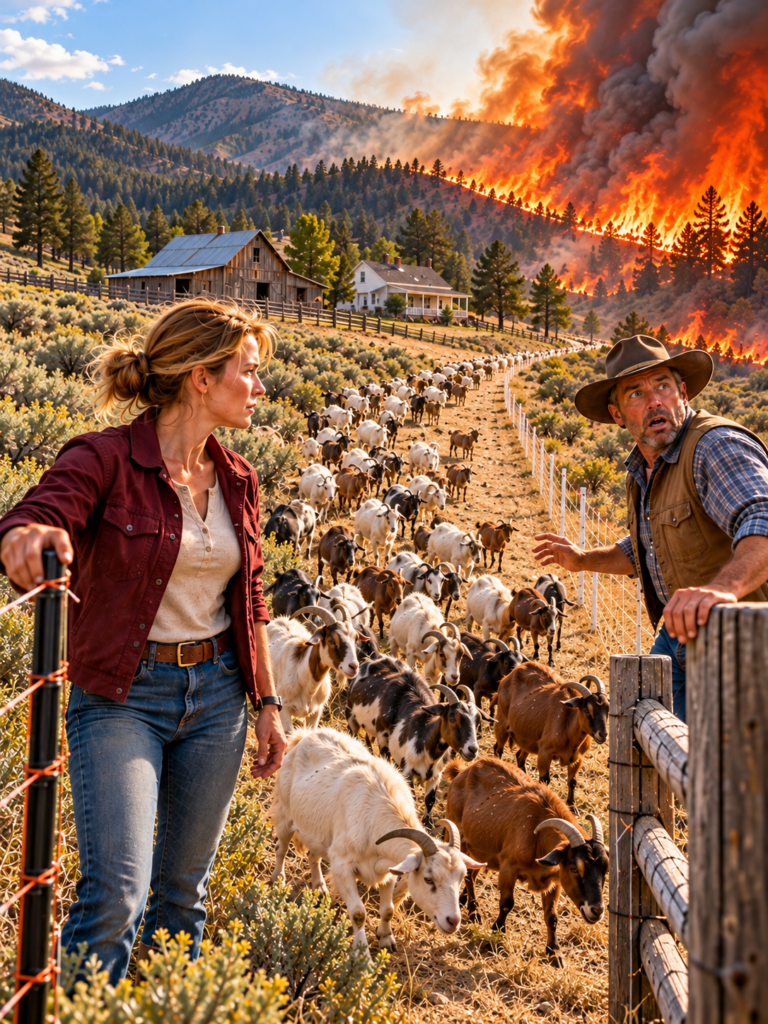
There were forty-seven animals altogether, a ragged assortment of Spanish crosses, Kiko mixes, old does, and scarred survivors that looked as though they had been gathered from the wrong end of every livestock auction in the state. They wandered across the dry hillside behind Juniper Hollow Ranch, nibbling at sagebrush, climbing through blackberry thickets, and stripping leaves from anything their mouths could reach.
To the neighboring cattlemen, it was a ridiculous sight.
Preston Blackwood, whose family had owned land in the valley for generations, told people that Tessa had managed to turn perfectly usable ranch country into a bargain-priced petting zoo.
Grant Worthington went further. Standing outside the feed store one afternoon, he offered to bet that half her goats would be dead before the first winter storm.
Tessa heard about both remarks.
She heard about most of the others, too.
In a valley where a man’s cattle prices, machinery purchases, and marital troubles could become public knowledge before lunchtime, forty-seven goats were enough to keep the conversation going for months.
Yet Tessa never gave anyone the argument they seemed to want.
Each morning, she went outside, checked her fencing, hauled water, and moved her animals into another section of brush.
When somebody asked why she was keeping such an odd little herd, her answer was always the same.
“They’re enough for what I need.”
That became the funniest sentence in Callahan Valley.
It would remain funny until the western sky turned orange.
Three months later, when the valley faced a wildfire more severe than anything the district had seen in nearly thirty years, people would remember those words for a very different reason.
But in April, when the goats first arrived, none of them knew what was coming.
And Tessa had no intention of explaining.
Juniper Hollow Ranch had been sitting on the market for almost two years before Tessa bought it.
The property consisted of 240 acres on the western edge of Callahan Valley, where rolling bench country rose toward a rugged rim of dry slopes and scattered juniper.
The house needed a new roof. The barn leaned just enough to make a stranger nervous. The well produced water most days, though it had an irritating habit of losing pressure at inconvenient moments.
There were rotten fence posts, neglected gates, and patches of ground so thick with blackberry vines that a person could barely walk through them.
The real estate agent had described the place as an opportunity for someone willing to work.
Tessa had worked long enough to recognize what those words usually meant.
At thirty-eight, she had spent practically her entire adult life on ranches belonging to other people. She had pushed cattle across three states, repaired wire fences in freezing weather, hauled feed through mud deep enough to swallow a boot, and saved every dollar she could without asking whether the effort looked like much of a life.
She had never owned much.
What she wanted was a piece of ground where the decisions belonged to her.
Juniper Hollow was the first place she could afford.
On the day she signed the papers, she stood outside the barn and looked toward the western hills.
The spring grass was already beginning to lose its color. Under the sagebrush lay years of dead growth, gray branches packed against dry stems and brittle weeds. Juniper limbs drooped close to the ground. Tangled vines climbed into fence wire and disappeared beneath the trees.
The place looked peaceful beneath the morning sun.
It also looked dangerous.
Tessa walked the slope slowly, stopping to pull handfuls of dead grass from beneath the brush.
She broke one of the dry stems between her fingers.
It snapped like a matchstick.
Then she looked uphill toward the western rim and followed the contours of the land with her eyes.
She was not thinking about how many calves the pasture could support.
She was thinking about what would happen if a fire came down that slope with the wind behind it.
During her first month, neighbors arrived with advice.
Most meant well, or believed they did.
They recommended starting with twenty cattle, improving the lower pasture, building toward sixty head, and selling calves in the fall.
That was how ranching had been done in Callahan Valley for four generations.
Nobody saw much reason to change.
Tessa listened, thanked them, and continued making notes on graph paper at her kitchen table.
She drew the house, barn, access road, western slope, and property boundaries.
Then she started dividing the land into narrow sections.
By the second week of April, her first investment was coming up the county road in a livestock trailer.
The sound reached the ranch before the truck did.
Forty-seven goats crowded against the trailer walls, bleating and stamping until the whole vehicle seemed to rattle.
When the rear gate opened, they poured out in a chaotic wave of brown, gray, black, and white.
Several were too thin. A few had old scars. One gray Spanish-cross doe had a torn ear and a small brass bell that made a soft, irregular clanging sound as she walked.
That doe went straight toward the blackberry.
Tessa watched her seize a mouthful of leaves and start chewing.
For the first time all morning, she smiled.
By evening, the whole valley knew what she had bought.
Grant Worthington arrived the following afternoon.
He was forty-five, wealthy enough to own a modern ranch three miles east, and proud of a shop building that was better finished than most homes in the county.
His truck was polished. His boots looked expensive. He liked being the fellow who could make a group of men laugh.
He stopped beside Tessa’s fence and lowered his window.
“Well, I had to come see it for myself.”
Tessa was coiling loose wire beside a gate.
“See what?”
Grant nodded toward the hillside.
“Whatever you call that operation. I’m still trying to figure out whether you’re starting a ranch or a petting zoo.”
He chuckled, waiting for her to join in.
Tessa kept working.
“Gate’s open if you want to look closer.”
Grant glanced at the goats.
One was standing on its hind legs, pulling leaves off a shrub. Another had its head buried in a thorny tangle.
He laughed again, although this time there was less confidence behind it.
“No, thanks. I’ve seen enough.”
He drove away without getting out.
Three days later, Preston Blackwood came up the same road.
Preston was fifty-two and headed Blackwood Cattle Holdings, a sprawling operation that had helped define the valley’s social order for decades.
His family had owned ground there since before the county courthouse was built.
At public fundraisers, Preston was generous and polished. He donated readily to the volunteer fire department, shook hands with elected officials, and knew when a photographer was nearby.
In private, he had little patience for people who failed to recognize the difference between themselves and the Blackwoods.
He parked beside the gate and studied the animals.
“Forty-seven?” he asked.
Tessa nodded.
“That’s an unusual number.”
“It’s the number I bought.”
Preston regarded a skinny doe working its way through a patch of sagebrush.
“Not what I’d call a serious herd.”
Tessa said nothing.
He leaned against his truck.
“I’ve seen people move into this valley thinking livestock’s like buying furniture. Something you pick because it looks interesting.”
Tessa gathered another length of wire.
“These don’t seem especially interested in furniture.”
His smile tightened.
He had come prepared to offer advice, and perhaps a warning. What he had not expected was a woman who showed no interest in either.
“Well,” he said finally, “I suppose you’ll find out.”
She watched him drive away, then returned to her fencing.
The goats continued eating.
That was the part nobody bothered to notice.
As spring moved toward summer, the brush behind Juniper Hollow began disappearing.
It did not disappear evenly.
Long pale strips emerged across the hillside, separated by darker bands of untouched vegetation. The borders were strangely precise. In some places the goats had removed practically everything beneath shoulder height, leaving open ground, stubble, and the woody skeletons of shrubs.
From the county road, the treated sections looked ruined.
To people accustomed to judging pasture by the amount of grass growing on it, Tessa appeared to be destroying her own land.
At the feed store, men shook their heads.
At the café, they joked about her animals eating the ranch down to dirt.
When someone bought the wrong size bolt or received less coffee than expected, another man would put on a flat, humorless voice.
“They’re enough for what I need.”
Everyone laughed.
Tessa occasionally heard it when she walked into a room.
She would buy her supplies, pay the bill, and leave.
Her refusal to defend herself only encouraged them.
They assumed silence meant she could not explain what she was doing.
In reality, every evening she returned to her kitchen table and studied the marks spreading across her hand-drawn map.
She owned several thousand feet of portable electric netting, eleven rolls altogether, with two solar-powered chargers and a water tank she hauled from paddock to paddock.
No grazing section was larger than two acres.
She moved the goats every two or three days, making certain each group of animals had water and enough vegetation to keep working.
They ate what cattle usually ignored.
Blackberry leaves vanished first. Sagebrush lost its tender growth. Goats stretched upward to reach low branches, stripped fine twigs, and reduced tangled vines to bare stems.
They cropped cured grass close to the ground and cleared away the small, dry growth beneath larger shrubs.
Those ordinary, unattractive materials mattered more than they appeared to.
In wildland firefighting, much of that vegetation was known as ladder fuel.
A ground fire could feed on it, climb into the lower branches of trees, and reach the canopy. Once a fire began moving through continuous brush and overhead fuels, it could spread with a speed and intensity that defeated even well-equipped crews.
Tessa had learned that lesson long before she owned Juniper Hollow.
The goats knew nothing about it.
They merely ate.
And after several weeks, the work began forming a pattern that someone with the right experience could recognize.
His name was Cole Barrett.
Cole was sixty-one and had spent twenty-six years on wildland fire crews, including nine seasons on a hotshot crew.
He had worked enough dangerous country to understand that fire did not always behave the way frightened people expected.
He had also seen what happened when firefighters were asked to compensate for years of neglected preparation.
After retirement, he had promised his wife that he would stop examining every hillside as though it might ignite before supper.
It was a promise he rarely kept.
One morning in the middle of May, Cole was driving past Juniper Hollow when he noticed a pale strip running above the lower bench.
He slowed.
Then he pulled onto the shoulder.
From the road, the treated ground stretched across the uphill side of the barn. The brush had been thinned in a broad, continuous band, with an almost unnaturally sharp boundary where the goats had finished eating.
Cole studied it for a long time.
What interested him was not simply that the vegetation was gone.
It was where the work had been done.
If Tessa had been trying to maximize livestock feed, she would have started with the most nutritious grazing.
Instead, she had concentrated her animals where a fire approaching from the western hills would encounter the ranch’s buildings.
The cleared strip was wider than ordinary grazing management required.
And its position was too deliberate to be accidental.
When Tessa came down from the house carrying a post driver, Cole was still standing at the fence.
He turned toward her.
“Where’d you learn to do that?”
She followed his gaze uphill.
“Do what?”
He pointed toward the treated band.
“Lay out your ground like that.”
She set the post driver down.
For a moment, she appeared to consider how much to say.
Then she explained the fencing, the rotation, and the way goats could strip the fine vegetation cattle left behind.
Cole listened closely.
He already understood the mechanics.
What he wanted to know was whether she understood the purpose.
But Tessa volunteered nothing about that.
When he finally drove away, he glanced back several times.
He knew what the hillside was beginning to resemble.
He just could not understand why nobody else seemed to see it.
In early June, Grant Worthington gave the property a new name.
He was standing in the feed store parking lot with several other ranchers when he announced that Tessa had created the Callaway Desert.
The name caught immediately.
People repeated it over coffee, across fence lines, and at livestock gatherings.
It sounded clever. It made the pale hillside easy to ridicule. And because Tessa never objected, the name seemed to belong to everyone.
Preston Blackwood soon gave the mockery a more respectable appearance.
He hosted the summer landowners meeting in an equipment building on his property, arranging rows of folding chairs and catered sandwiches for the ranch owners and business people who attended.
He spoke at length about responsible land management.
His new pivot irrigation system featured prominently.
So did the price.
He displayed an industrial flail mower, large enough to grind standing brush into mulch, and described it as the kind of modern equipment serious landowners ought to use.
Then he showed an aerial photograph of Juniper Hollow.
Several people leaned forward.
On the screen, the pale strips stood out against the dark vegetation surrounding them.
Preston used words such as inexperience and overgrazing.
He spoke about the dangers of mismanagement and the importance of protecting land values.
He never mentioned Tessa by name.
He did not need to.
Every person in the room knew whose hillside they were looking at.
Tessa had not been invited.
That evening, while the people gathered at Blackwood Cattle Holdings discussed her supposed mistakes, she was at home repairing a gate with tools carried in an old pickup.
Her equipment was modest: eleven rolls of portable netting, two solar chargers, a water tank, and a 1994 truck whose second gear was nearly gone.
There was no expensive machinery hidden behind the barn.
No fleet of workers.
No new irrigation system.
Only a woman moving forty-seven animals from one section of brush to another.
Ten days after the meeting, Preston drove up to Juniper Hollow with an offer.
He spoke pleasantly, as if he were doing her a favor.
Starting out was difficult, he said. A ranch that required too much investment could become a burden. There was no shame in admitting that some land was beyond a person’s means.
Then he offered to purchase her western eighty acres.
It was the steep, brush-choked ground facing the rim, the part of the ranch that looked hardest to use and commanded the best view.
His proposed price was roughly half its actual value.
Tessa listened without interrupting.
Preston mistook her silence for uncertainty.
“Better to sell a piece to a neighbor now,” he told her, “than lose the whole place to a bank in a couple of years.”
She looked toward the western slope.
The goats were working along the brush line, their small figures moving through the afternoon sunlight.
“No.”
Preston studied her face.
“You might want to think about it.”
“I have.”
“You’re turning down a reasonable offer.”
“I’m not selling.”
The finality of her answer seemed to trouble him more than an angry refusal would have.
He left convinced she was making a foolish mistake.
He could not imagine why a woman with so little money would refuse the chance to escape a problem he believed she had created.
And he certainly could not imagine that she regarded the western eighty acres as one of the most important parts of her ranch.
Cole returned during the third week of June.
This time, he walked along the fence with Tessa instead of remaining beside the road.
The work had progressed considerably since his first visit.
He studied the cleared strips, their widths, the way they connected, and the sections Tessa intended to treat next.
Finally, he stopped.
“You’re not running those goats for weight gain.”
Tessa looked at him.
“No.”
“You’re taking fuel off the ground.”
She did not answer immediately.
Cole pointed toward the higher slope.
“And you’re doing it where a fire would try to come through.”
“Yes.”
For a few moments they stood in the sunlight, listening to the distant bell on the gray doe.
Cole felt an unexpected rush of respect.
For nearly three decades, he had watched landowners postpone brush reduction until the smoke was already visible. Here was someone who had spent her first spring doing precisely the work he wished more people would do.
“Why don’t you tell them?” he asked.
Tessa glanced toward the county road.
“Tell who?”
“Everybody making jokes about this place.”
She shook her head.
“They wouldn’t listen.”
“I would. I’d stand up at the next meeting and explain what you’re doing.”
Her expression changed.
For the first time since he had known her, Cole saw genuine discomfort behind her reserve.
“Would you do something for me instead?”
“Depends what it is.”
“Keep it to yourself.”
He stared at her.
“Tessa, this is exactly what people around here ought to be learning.”
“I know.”
“Then why hide it?”
She studied the rough ground beneath her boots before answering.
“If I’m right, they’ll see it themselves.”
Cole wanted to argue.
He thought about the farmers who might benefit, the houses that could be protected, and the years of work that could begin if the valley understood what was happening.
But Tessa was already gathering her fence stakes.
He could tell the conversation was over.
At the end of June, the state forestry office released its seasonal fire outlook.
Snowpack had reached only thirty-one percent of normal.
Moisture levels in the valley’s living brush were falling toward conditions usually seen much later in the summer.
The report warned that the coming season could become one of the most severe in several decades.
It was discussed on the morning agricultural radio program and posted at the feed store.
Most people read it, shook their heads, and returned to ordinary business.
Tessa read it at her kitchen table.
Then she folded the paper, went outside, and moved her fence.
Part 2
July arrived with the kind of heat that made even experienced ranchers uneasy.
The valley went nineteen days without measurable rain.
Then twenty-six.
By the thirty-fourth day, the grass had lost nearly every trace of green, and dust lifted behind passing trucks in pale clouds that hung above the road long after the vehicles disappeared.
The creek behind Juniper Hollow shrank into disconnected pools.
Cheatgrass that had been golden in June turned almost white, crumbling beneath a boot. Sagebrush leaves curled in the heat. The afternoon wind, which ordinarily eased after sunset, continued blowing well into the night.
County officials announced burn restrictions.
Two forest campgrounds closed.
On some afternoons, humidity dropped into single digits.
Cole Barrett watched the weather reports more carefully than he cared to admit.
Tessa watched her map.
Until July, she had spread the goats’ work across the property in an orderly rotation. Now she began concentrating their efforts around the places she could not afford to lose.
First came the house.
She worked the animals through successive paddocks until a ring of short, cropped vegetation extended approximately 150 feet from the building.
Every section of fence was cleared of dry grass that might carry flames along the wire.
Then she turned toward the barn and equipment shed, creating a second protective band and connecting it with the first.
The access road came next.
She treated both sides until the road was bordered by open ground rather than a continuous wall of brush.
Tessa understood something that few landowners considered until the danger was already present.
A fire engine could not protect a building if its crew could not reach it safely.
And a driveway surrounded by burning vegetation could become a trap.
She wanted firefighters to have room to enter, turn around, and work without flames closing behind them.
The final section was the western slope.
It was the ground Preston Blackwood had tried to buy.
Above Juniper Hollow, the hillside climbed toward the rim, steepening in places where a fire pushed uphill would gather speed as rising heat preheated the vegetation ahead.
Tessa spent much of August working that slope.
She moved the netting in disciplined stages, keeping the goats concentrated on the brush, sometimes working the same difficult ground until the smaller fuel had been thoroughly reduced.
The treated band stretched across the western approach to the ranch.
In its narrow sections, it measured roughly 200 feet deep.
Where the slope was steepest, it approached 400 feet.
For twenty-two days, the goats worked there under Tessa’s constant supervision.
The result was not attractive by ordinary ranching standards.
The hillside looked scraped and faded.
But beneath the harsh summer light, a continuous interruption had appeared in the vegetation that once connected the western rim to her buildings.
Tessa examined the finished ground with the fatigue of someone who knew there was still more to do.
The gray doe’s bell sounded somewhere above her.
She looked toward the sound, checked the next section of netting, and returned to work.
In August, the volunteer fire department held its annual pancake breakfast.
Nearly ninety people filled the room, sitting at long tables with paper plates and coffee cups.
Tessa attended without much expectation of conversation.
She was standing near the serving line when Preston Blackwood noticed her.
He was surrounded by acquaintances, enjoying the easy attention that had followed him through most of his adult life.
“Tessa,” he called, loud enough for several tables to hear.
She turned.
“I’ve been meaning to ask. What’s your plan if a fire ever comes down out of those hills?”
The room began to quiet.
Preston smiled.
“Going to have those forty-seven goats line up along the fence and blow it out?”
Laughter spread across the tables.
A few people looked uncomfortable. Most joined in.
Tessa waited until the noise died.
“No,” she said.
Preston raised his eyebrows.
“They’ve already done their part.”
She turned back toward the serving table, collected her pancakes, and went to an empty seat.
Preston laughed again.
So did a few others.
But something about her answer remained with him.
Not the words themselves.
The certainty.
She had not spoken about what she hoped the animals might accomplish.
She had spoken as though the important work was already behind her.
For several days, Preston found himself remembering the way she had said it.
Then he dismissed the thought.
A stubborn woman with a few goats was not going to teach him anything about managing land.
By early September, his irritation had taken a more official form.
At a landowners association meeting, Preston raised concerns about browsing animals near common fences. He suggested that such animals could damage vegetation along shared property lines or find their way through fencing designed for cattle.
Grant Worthington followed with a written complaint to the county.
He accused Tessa of improperly stripping vegetation along a boundary shared with Blackwood Cattle Holdings.
The complaint required Tessa to stop working long enough to defend her own conduct.
She drove to the county office carrying her deed, survey documents, and photographs of the temporary electric netting.
The photographs showed that her goats were being confined a full fifteen feet inside her property line.
She spent two days dealing with the matter and lost additional working time to the disruption.
The complaint was dismissed without a hearing.
No one apologized.
Preston claimed to be surprised that the issue had reached the county.
Grant avoided discussing it.
Tessa returned to Juniper Hollow, unloaded her paperwork, and walked straight back to the western boundary.
She widened the cleared strips in the places where her neighbors had objected most strongly.
To anyone watching from the road, it looked like pure stubbornness.
To Tessa, it was unfinished work.
One evening in September, Cole Barrett found her sitting on the porch steps.
The setting sun hung low behind a layer of smoke-colored haze, although the evening air did not yet carry the smell of a nearby fire.
Cole lowered himself onto the steps beside her.
They had spent much of the summer discussing paddock sizes, vegetation, and the likely direction of seasonal winds.
But there was something about Tessa’s work he still did not understand.
She was not simply cautious.
She acted like someone who knew precisely what she was trying to prevent.
He watched the goats moving across the far slope.
Then he asked the question he had been holding back for months.
“What happened to you?”
Tessa turned slightly.
“What do you mean?”
“Something taught you all this. I don’t think it was a book.”
She was quiet.
Cole waited.
He had spent enough years around people who had survived terrible situations to know that rushing an answer usually made it disappear.
Finally, Tessa spoke.
When she was in her late twenties, she had worked four seasons on a ranch in the foothills of Northern California.
It was a large, established cattle operation, the kind built over several generations through hard work and careful saving.
In her fourth season, when she was twenty-seven, a wildfire came out of a canyon below the property.
It was two in the afternoon.
The wind was behind the flames.
Within roughly ninety minutes, the fire had destroyed the hay barn, the shop, approximately three hundred tons of feed, nine miles of fencing, and most of a herd that the family had spent decades building.
Cole said nothing.
Tessa looked down at her hands.
“What I remember most isn’t what it looked like.”
She paused.
“It was the noise.”
The sound had filled the canyon before the flames reached the buildings.
Then smoke covered the sky so completely that the middle of the afternoon became dark.
People had tried to move equipment, open gates, and save what animals they could.
But the fire moved faster than anyone could work.
Tessa remembered standing helplessly with a shovel and realizing that the choices that mattered had been made long before that afternoon.
Brush had been allowed to accumulate.
Dry vegetation had grown against fences and beneath trees.
There had been no practical way to undo years of neglect while a wind-driven fire was already approaching.
Then she told Cole about one strange exception.
On the eastern shoulder of that California ranch, there had been a section of approximately sixty acres.
Years earlier, during two summers in the 1990s, the owner’s father had run goats through that ground. He had kept the brush from returning to its former density.
When the fire reached the section, it did not disappear.
It burned.
But the flames stayed lower, consuming the limited vegetation on the ground rather than climbing through a continuous mass of brush.
Fence posts remained standing.
A barn beyond the treated area survived.
Nobody on the ranch had paid much attention to the connection.
Tessa had never forgotten it.
“I kept thinking about that piece of ground,” she said.
Cole looked out toward her hillside.
“Eleven years?”
She nodded.
“For eleven years.”
There had been times, she told him, when she could still remember the strange color of the afternoon smoke and the terrible realization that there was nothing left to do.
She had learned that a wildfire was not something that chose its victims according to fairness, wealth, or the intentions of the people living in its path.
Its behavior depended heavily on weather, terrain, and the amount and arrangement of fuel available to burn.
Reduce that fuel in the right places, and a future fire might behave differently.
Not harmlessly.
Not predictably in every circumstance.
But differently enough to give people a chance.
“When I bought this place,” she said, “I knew what I wanted finished before I ever saw smoke.”
Cole considered the western slope, the carefully connected bands, and the small herd still feeding in the last of the daylight.
Now he understood why she had refused Preston’s offer.
And why the mockery had never persuaded her to stop.
There was nothing he could say that would improve on what she had already done.
So he sat beside her until the sun disappeared.
Two days later, smoke rose thirty-seven miles west of Callahan Valley.
The fire started on a Tuesday afternoon on public land in the Ridgeline drainage.
Investigators suspected a vehicle, though the precise cause had not been confirmed.
At first, the news sounded like another unpleasant but manageable wildfire.
By nine that evening, the burning area had reached eight hundred acres.
On Wednesday, firefighters had two hand crews, six engines, and aircraft assigned to the incident.
By noon, the fire had grown to 4,100 acres.
Still, most ranchers in Callahan Valley continued their ordinary routines.
Thirty-seven miles seemed like a considerable distance.
There was a mountain divide between the fire and the country where they lived.
People had cattle to move, fences to mend, and hay to handle.
Preston Blackwood spent much of Wednesday arranging business with a livestock buyer in Nebraska.
Grant Worthington worked around his water troughs.
Tessa checked the weather and studied the western rim.
By evening, the sunlight had taken on a hard red tint.
A faint smell of burning juniper drifted across the valley.
On Thursday morning, the wind changed.
What had been a relatively moderate southwest wind swung toward the west-northwest and strengthened sharply.
Sustained speeds reached approximately twenty-five miles per hour, with gusts near forty.
Humidity fell to seven percent.
By early afternoon, the fire had crossed its first containment line.
Two hours later, it crossed the highway that many residents had believed would hold it.
The burning area surged from approximately eleven thousand acres to thirty-one thousand in one operational period.
A Type 1 incident management team was ordered in.
The emergency had grown beyond what local resources could reasonably control.
Friday brought ash.
At first, the flakes were so light they resembled gray dust.
Then they began collecting on windshields, porch railings, water tanks, and the backs of animals standing in open pasture.
The sun became a dim red disk behind the smoke.
At two in the afternoon, the valley looked as though evening had arrived several hours early.
Electricity flickered.
Then the power failed.
County officials issued an evacuation warning for the western part of Callahan Valley.
Residents were told to prepare to leave.
For many families, it was the first warning of that kind they had ever received.
At the café, nobody joked about Tessa’s goats.
Tessa had written her emergency checklist in July.
She kept it where she could reach it, and now she worked through each item without wasting time on decisions she should already have made.
Her twelve cattle and two horses went into a livestock trailer and were moved to a leased pen eleven miles east.
She returned to Juniper Hollow and backed the trailer beside the barn, leaving it hitched to the truck.
She filled the 2,000-gallon water tank.
Beside it, she positioned a gasoline-powered pump and a hose where firefighters could find and use them if conditions permitted.
She moved propane bottles away from the house.
She cleaned dry needles out of the roof valley.
She opened interior gates so any loose animals would have a route toward the cleared ground instead of being trapped against a fence.
Then she moved the forty-seven goats into the central paddock, where they had already consumed most of the fine vegetation months earlier.
The brass bell on the old gray doe sounded as the herd settled.
Tessa paused long enough to count the animals.
All forty-seven were there.
Four miles east, Preston Blackwood was discovering how little his expensive machinery could accomplish against a deadline.
Blackwood Cattle Holdings controlled 1,100 deeded acres and another 4,000 under lease.
Large portions of that land had not received serious brush treatment in years.
There were nine miles of fencing with sagebrush standing chest-high.
Four hundred acres of meadow carried deep, cured grass that Preston had deliberately saved for fall feed.
A juniper windbreak planted by his grandfather bordered the main corral complex.
It was beautiful.
It was also packed with dry, flammable material.
His industrial flail mower could process perhaps six acres during a long day’s work.
He had hundreds of acres needing attention.
And by then, the forecast gave him less than a day.
All the expensive equipment on his property could not change the amount of time remaining.
Around four that afternoon, Grant Worthington pulled into Juniper Hollow.
He stepped out of his truck and stood beside the gate.
For once, he did not smile.
Ash drifted between them.
He held his hat with both hands.
“Tessa, you really think it’s coming this far?”
She looked toward the smoke column leaning east over the hills.
“It’s already coming.”
Grant swallowed.
She studied him for a moment.
“Your hay shed. Metal roof or wood?”
He hesitated.
He was not certain.
The fact seemed to bother him more than her answer.
He drove home to check.
The Friday night incident briefing was released at 9:15.
The fire had expanded to approximately 58,000 acres after a nine-mile run during the afternoon.
Forecasters expected west-northwest winds of thirty to thirty-five miles per hour, with gusts reaching fifty-five.
The projected spread aligned with the drainage leading toward Callahan Valley.
One fire behavior analyst described the event as the district’s most significant wildfire in nearly thirty years.
Local radio repeated the assessment.
By ten o’clock, practically everyone in the valley had heard it.
At 11:40 that night, the county issued mandatory evacuation orders.
Cole Barrett sat at his kitchen table with a laptop and paper map.
He studied the projected path and followed the direction of the wind with his finger.
The fire was positioned to move through the western half of Blackwood Cattle Holdings.
Beyond that lay the common property line Preston had spent September complaining about.
And beyond the line stood Juniper Hollow Ranch.
Cole stared at the map.
He knew Tessa had built the best protective system she could with the resources available to her.
He also knew that extreme winds could carry embers far beyond treated ground and ignite structures without a continuous wall of flames ever reaching them.
There were no guarantees.
Not for Preston.
Not for Grant.
Not for Tessa.
Saturday morning, the ranchers left.
Tessa departed Juniper Hollow at 7:40.
Her dog rode in the cab beside her. She carried a box of important documents and her grandmother’s quilt.
Everything else remained behind.
She knew better than to risk her life defending a barn after evacuation had been ordered.
The important preparations had taken four months.
There was nothing meaningful she could accomplish in the final few minutes that would justify staying.
As she drove down the county road, the pale bands on her hillside disappeared behind the smoke.
She did not look back.
By ten that morning, the parking lot on a rise in Danbury, eighteen miles east, held approximately sixty vehicles and two hundred people.
Ranchers stood beside their trucks.
Families clustered around radios.
People stared west through binoculars and camera lenses, searching for houses and barns that were too far away to see clearly.
Every twenty minutes or so, another report came over the fire radio.
The voices were calm.
That made the news sound worse.
Tessa stood near the edge of the lot.
Cole was there, and so were Grant Worthington and Preston Blackwood.
For the first time since she had arrived in Callahan Valley, nobody seemed interested in what the other person owned.
They were all watching the same sky.
And just after one o’clock, the fire came over the western rim.
Part 3
From eighteen miles away, the wildfire did not look like anything moving across the ground.
It looked like the sky itself was burning.
A continuous orange front spilled over the western rim, pushed by a wind strong enough to drive embers far ahead of the main flames.
Smoke rose into a towering column, dark at its base and copper-colored where the sun struck it.
The fire moved down the slopes with terrifying speed.
In the Danbury parking lot, conversations faded.
People who had spent their entire lives in ranch country stood shoulder to shoulder, watching something none of them could control.
At approximately 2:30 that afternoon, the fire reached the western boundary of Blackwood Cattle Holdings.
Preston’s phone began ringing.
The first calls concerned the fence line.
Dry brush had grown around posts and through wire for years. Now flames followed those connected fuels through the boundary corridor, burning from one section to the next.
Then came word about the meadow.
Four hundred acres of grass, saved all summer for fall feed, provided a continuous layer of dry material.
The fire crossed it in minutes.
At 3:10, the old juniper windbreak caught.
Preston had grown up with those trees.
His grandfather had planted them, and Preston had always considered them part of the ranch’s identity.
Now fire raced through the branches and hurled burning embers across the corral area.
Some traveled a quarter mile.
Two landed on the hay barn.
Another call came.
Then another.
Preston stood apart from the crowd with his phone pressed against his ear.
He had spent decades building an operation that could withstand poor cattle prices, equipment failures, difficult winters, and almost any ordinary business setback.
He owned a pivot irrigation system, a massive brush mower, a water truck, and a shop equipped with machinery worth more than Tessa Callaway’s entire ranch.
None of those investments could remove the fuel his land had already accumulated.
And none could reach backward into the previous spring, when there had still been time to prepare.
By late afternoon, he stopped answering some of the calls.
He simply stood looking west.
Around four o’clock, Grant Worthington learned that his hay shed had burned.
Part of his pipe fence was gone, too.
For once, Grant offered no colorful language and no jokes.
He listened to the report, lowered his phone, and stared toward the smoke.
Then his gaze drifted toward Tessa.
She stood a short distance away, her face tired but composed.
Grant had never known what to make of her silence.
Now, for the first time, he wondered whether her refusal to argue had been confidence rather than ignorance.
At 5:20, the advancing fire reached the western boundary of Juniper Hollow Ranch.
Cole Barrett was watching through binoculars.
He knew the treated slope lay directly ahead of the flames.
He also knew that what happened next depended on more than the goats’ work.
The wind was still dangerous. The fire was throwing embers. Even widely cleared ground could not guarantee a building’s survival under those conditions.
Tessa understood the same thing.
She did not expect the fire to stop at her fence.
It didn’t.
Flames entered Juniper Hollow and began consuming the vegetation that remained.
But as the front pushed into the broad treated band on the western slope, its behavior began to change.
On neighboring land, continuous chest-high brush had supported flames fifteen to thirty feet long. Fire had moved upward through shrubs and low branches, generating enough heat to ignite vegetation ahead of the main front.
Along Tessa’s treated hillside, that fuel continuity had been broken.
The shrubs were separated.
The accumulated dead material had been reduced.
Low limbs and tangled vines had been stripped away, and much of the fine grass was cropped close to the ground.
There was still material to burn.
Just far less of it.
Over several hundred feet, the flames dropped lower.
Instead of continuing through a dense wall of vegetation, parts of the fire settled into scattered ground fuels.
Some sections burned with flame lengths of only two or three feet.
Other patches burned irregularly as the front separated into smaller fingers.
The wind remained strong.
Embers continued to travel.
But the fire was no longer behaving everywhere as the nearly continuous wall of flame that had crossed Blackwood’s land.
Around 5:40, a structure protection group approached Juniper Hollow.
It consisted of four engines and a water tender.
The crews had spent much of the afternoon retreating from one threatened property to another.
Everywhere they tried to work, heavy unburned vegetation had threatened their escape routes. There were few places where they could establish a defensible position.
Then they came up Tessa’s access road.
The vegetation on both sides had been cleared.
The road was wide enough to permit vehicle movement without forcing the engines against burning brush.
As they approached the buildings, the crew found a broad ring of cropped ground surrounding the house and barn.
There was a filled water tank.
Beside it stood a pump and hose.
The equipment was not sophisticated, but its purpose was obvious.
The supervisor studied the scene.
Here was somewhere the crews might be able to work.
They set their engines in position.
Embers landed on the roof and were extinguished.
A fence along the northern side ignited, but firefighters kept the flames from carrying into the buildings.
Fire moved around the treated center of the property, consuming remaining vegetation on both sides.
The crews worked against the smaller fires they could reach, holding their position as conditions allowed.
Nothing about it was effortless.
The wind, heat, and flying embers remained dangerous.
But the preparation had given the firefighters something they had struggled to find all afternoon.
Room to operate.
A place to stand.
And a chance to defend the structures without becoming trapped by the fire themselves.
In Danbury, nobody yet knew exactly what the firefighters were doing.
The ranchers could only watch the fire’s progress through binoculars and the long lens of a television camera that someone had mounted on a tripod.
For hours, the advancing flames had appeared almost unbroken.
Across Juniper Hollow, that pattern changed.
The front seemed to thin.
It separated into irregular sections.
Some flames dropped noticeably lower along the western bench.
Cole watched through the binoculars, then handed them to Grant.
“Look at that slope.”
Grant adjusted the focus.
He knew the hillside.
He had driven past it dozens of times that summer.
He had stood outside the feed store and named it the Callaway Desert.
Now he recognized the pale strips crossing the ground.
He lowered the binoculars.
“The desert,” he said quietly.
Cole nodded.
“That’s what you’ve been calling it.”
Grant looked at Tessa.
She had not moved.
Cole turned toward the burning hills.
“That’s not dead land. It’s treated ground. She’s been building those strips all summer.”
Grant said nothing.
“Forty-seven goats,” Cole continued. “Four months of work. All finished before that fire started.”
Preston stood close enough to hear.
For a long time, nobody spoke.
Tessa watched the hillside where she had spent so many mornings driving fence stakes into dry ground.
She knew her ranch was burning.
She knew some of her work was being destroyed.
And she knew she might still lose everything the goats had been meant to protect.
But she also saw that the fire was moving differently across her property.
That was all she had ever hoped to change.
The wildfire continued burning for days.
When it was finally declared fully contained eighteen days later, the incident covered approximately 94,000 acres.
No one had died.
The incident commander would later say that, of all the numbers attached to the fire, it was the one that mattered most.
But the losses were severe.
Blackwood Cattle Holdings had suffered devastating damage.
Nine miles of fencing were destroyed, along with the hay barn containing three hundred tons of feed.
A tractor shed, two equipment trailers, and the old juniper windbreak were gone.
Roughly six hundred acres of fall pasture had burned.
The main house survived, protected in part by the irrigated lawn around it, and Preston’s cattle had been moved safely east before the worst conditions arrived.
He had the financial resources to rebuild.
That did not make the losses easier to accept.
Grant Worthington had lost his hay shed, approximately a quarter mile of pipe fencing, and eighty acres of ground.
Much of his damage was insured.
Juniper Hollow had not escaped unharmed.
Approximately two thousand feet of fence had burned along the western and northern boundaries.
A small storage shed behind the barn was reduced to its concrete slab. Inside it had been a welder and most of Tessa’s spare fencing supplies.
Around sixty acres of upper ground had burned, some hot enough to kill the sagebrush outright.
Along the eastern edge, flames had consumed grass down to bare earth.
Two goats developed respiratory problems from smoke exposure and required attention for about a week.
There would be months of work before the ranch looked normal again.
But the house was standing.
So were the barn, the equipment shed, the wellhouse, and the pump.
All forty-seven goats had survived.
So had the cattle, horses, and other animals.
On a Tuesday morning, when authorities finally reopened the roads, Tessa drove back through Callahan Valley.
The familiar hills had become a landscape of black slopes and surviving patches of pale grass.
Fence wire sagged between charred posts.
The air smelled of wet ash and burned wood.
She stopped at her gate.
For a moment, she did not get out.
She looked at the house.
Then at the barn.
Then toward the hillside where the goats had worked all summer.
The damage was real.
She could not afford to replace everything quickly, and she knew she would be repairing fences well into the following year.
But the center of Juniper Hollow was intact.
The part of the ranch she had feared losing most was still there.
She stepped out of the truck and stood beside the road.
After eleven years, the terrible afternoon in Northern California no longer felt quite so unfinished.
She had not defeated a wildfire.
She had prepared for one.
And this time, that preparation had mattered.
Three weeks later, the fire district held a debriefing.
Approximately forty people attended.
A fire behavior analyst presented maps of the final perimeter and explained where the fire had slowed, changed direction, or been successfully contained.
She described the influence of weather, topography, available fuel, and the locations where firefighters had been able to establish holding lines.
One section of the map drew particular attention.
It was the northeast corner of Juniper Hollow Ranch.
Along that boundary, Tessa had created a treated strip approximately three hundred feet wide.
When the wildfire reached the area, its intensity had dropped enough for a bulldozer and two engines to establish an anchor point.
The crews held that line through the night.
Had the fire continued unchecked down the eastern side of the drainage, it might have moved through the neighboring Harrington property and threatened four additional ranches on the eastern bench.
The analyst was careful not to claim that the grazing treatment alone had determined the outcome.
The wind had weakened after midnight.
Fire behavior involved many interacting factors.
Nevertheless, the treated strip had given crews a place to work when they needed one.
Without it, the line might not have been established.
Evelyn Harrington sat in the third row.
She was fifty-eight and owned nine hundred acres that had belonged to her husband’s family since the 1940s.
Throughout the summer, she had quietly agreed with Preston Blackwood.
She believed that modern machinery and financial resources offered more reliable answers to land management than a small herd of browsing animals.
She had never been particularly cruel to Tessa.
She simply had not taken her seriously.
Now she studied the map of the boundary between their properties.
The narrow pale strip had been cut into Tessa’s own ground.
And the line held there had helped protect land Tessa did not own.
Evelyn left the meeting without saying much.
She stood beside her car for several minutes before driving home.
A few days later, Cole Barrett visited Juniper Hollow again.
He found Tessa near the barn, rolling up a section of electric netting.
The old gray doe grazed nearby, her brass bell making a faint sound whenever she lowered or raised her head.
Cole helped gather the loose wire.
Then he stopped.
“There’s something I’ve been trying to figure out.”
Tessa pulled another section of netting straight.
“What’s that?”
“That northeast strip.”
She glanced toward the distant boundary.
“What about it?”
“Your house is nowhere near it. Neither is the barn.”
“No.”
“That’s two-thirds of a mile from anything you own that needs protecting.”
Tessa kept working.
Cole studied her.
“You spent eighteen days running the goats through there during the hottest part of the summer.”
“I remember.”
“Why?”
She stopped winding the netting.
For a while, she looked across the ranch.
The northeast corner was barely visible from where they stood.
She could see the darkened ground and the line of surviving vegetation beyond it.
Then she turned back toward Cole.
“Fire doesn’t know whose fence it is.”
Cole said nothing.
Tessa bent to collect another section of wire.
He looked toward the northeast boundary again.
Until that moment, he had assumed she had been working to protect her own buildings and animals.
It was a reasonable assumption.
But the treated strip near Evelyn Harrington’s property had not been placed there because it surrounded anything belonging to Tessa.
It had been placed there because the terrain and likely fire movement made the location important.
Tessa had been looking beyond her deed lines.
Beyond the neighbors who mocked her.
Beyond the people who wanted to buy her land or tell her how to manage it.
She had treated the ground where treatment might do the most good, even when that meant spending weeks protecting a boundary that offered little immediate advantage to herself.
Cole thought about the summer landowners meeting and Preston’s speech on stewardship.
Then he thought about the eighteen days Tessa had spent moving forty-seven goats through heat and dust.
He resumed helping with the netting.
Years later, when Cole spoke at local fire safety meetings, he would repeat her answer.
He never found a clearer way to explain what he had learned that afternoon.
On the third Saturday in October, Preston Blackwood drove to Juniper Hollow.
He came alone.
There was still ash caught in the seams of his truck’s hood.
For the first time, he parked outside the gate and waited.
Tessa saw him from the barn and walked down the slope.
She assumed he had come about the burned boundary fence.
Two thousand feet of wire had been damaged along lines they shared, and local custom required neighboring owners to divide certain repair costs.
She had already calculated the figures.
The paper was folded in her shirt pocket.
She hoped the conversation would be short.
Preston stood beside the fence, watching the goats work a surviving patch of sagebrush along the northern draw.
He seemed different without an audience.
There was no polished smile, no speech prepared for the benefit of nearby ranchers.
He watched the gray doe lift her head and move to another shrub.
Then he asked, “Where did you buy those goats?”
Tessa looked at him.
For a moment, she thought she might have misunderstood.
“The goats?”
“Yes.”
He kept his eyes on the hillside.
“Where’d you find them?”
Tessa knew exactly what that question meant.
She remembered the April afternoon when he had stood in nearly the same place and dismissed her herd as too small to be taken seriously.
She remembered his lecture about inexperienced people buying livestock as though it were furniture.
She remembered the landowners meeting, the aerial photograph, the complaint, and his offer to buy the western eighty acres for half their worth.
Here, at last, was the opportunity to return every insult.
She could ask whether forty-seven was still too few.
She could ask how his expensive flail mower had performed when the fire reached his pasture.
She could remind him of the pancake breakfast and the joke that had brought an entire room to laughter.
Preston would have no convincing answer.
For several seconds, Tessa looked at him.
Then she said, “I’ll get you the number.”
She went inside the house.
When she returned, she carried a small notepad.
She wrote down the name and telephone number of the livestock broker two counties away who had sold her the original herd.
Preston accepted it.
“Thank you.”
Tessa turned as though the conversation were over.
Then she stopped.
She went back into the house and returned with another sheet of paper.
It was a photocopy of the grazing rotation plan she had drawn in March.
The sections, acreages, and rest periods were marked by hand.
She held it out.
Preston looked at the page, then at her.
“What’s this?”
“My rotation plan. You’ll need to adjust it for your ground.”
He studied the markings.
“You’re giving me this?”
She nodded.
“Why?”
Tessa considered him for a moment.
“You don’t have to believe me about anything, Preston. You don’t have to like me, either.”
He lowered the papers.
“I’m not asking you to,” she continued. “But next time, maybe stop laughing long enough to look first.”
Preston opened his mouth.
Then closed it.
For twenty years, he had addressed nearly every important landowners meeting in Callahan Valley.
He was accustomed to finding the right words.
Standing beside Tessa’s fence, he could not think of any.
Finally, he folded the papers carefully.
“Thank you,” he said.
Then he climbed into his truck and drove away.
Tessa watched until the vehicle disappeared down the road.
She still had to negotiate the cost of that boundary fence.
But for the moment, she returned to the barn.
There was work to finish.
By November, six ranchers had contacted Tessa about targeted grazing.
Some had seen the treatment at Juniper Hollow before the fire.
Others had attended the debriefing or spoken with firefighters.
They wanted to know whether goats could reduce brush along their fences, windbreaks, and steep hillsides.
Tessa explained what the animals could do and what they could not.
Goats could reduce certain kinds of vegetation under careful management.
They could not remove every fire hazard.
Nor could they guarantee protection against extreme winds and ember storms.
But with time, fencing, water, and a properly planned rotation, they could help change how fuel was distributed across a property.
Grant Worthington was the last of the six to call.
He spent nearly a minute making awkward conversation before he reached the reason for his call.
He wanted Tessa to bring her goats to the north side of his ranch in the spring.
There was brush there that needed clearing before the dry season.
He wondered whether she might do something similar to what she had accomplished at Juniper Hollow.
Tessa let him finish.
“Yes,” she said.
Grant released a breath.
Then she added, “But this time, they’re not working for free.”
Grant paused.
And for the first time since she had known him, he laughed without making anyone else the joke.
“Fair enough.”
A year later, Juniper Hollow remained a modest ranch.
Tessa had not suddenly become wealthy.
The 1994 pickup was still in service, although its transmission had finally been rebuilt.
The house still needed work on the roof.
There were continuing repairs, bills, and all the ordinary problems that came with owning a piece of country that demanded something from its owner every day.
But the goats had created an income she had not originally counted on.
In February, she registered a business called Hollowline Grazing.
She acquired a used gooseneck trailer and two guardian dogs.
Over the following eighteen months, the herd grew from forty-seven animals to 210.
She began accepting fuel-reduction contracts from April through September, working across four counties.
The local fire district recommended her services in writing.
In its second season, Blackwood Cattle Holdings signed a three-year contract covering approximately nine hundred acres of fence line and windbreak treatment.
Preston paid every invoice early.
He never made a public speech about his change of mind.
He did not need to.
The contracts, the paid invoices, and the treated strips appearing across his land said enough.
That winter, the hand-painted sign Grant Worthington had once posted near his gate disappeared.
It had carried an arrow pointing west and the word Desert.
Nobody publicly admitted taking it down.
And nobody brought it up again.
Gradually, the appearance of Callahan Valley changed.
Some landowners began clearing brush from access roads.
Others treated the vegetation around buildings or opened breaks along fence lines.
More began managing the slopes where wind-driven fires might gain momentum.
Not every ranch adopted goats.
Not every owner became an expert in fire behavior.
But the valley had learned to think about the ground differently.
People had begun asking what might happen before the smoke appeared.
For Cole Barrett, that change was worth more than the embarrassment of any one rancher.
For Tessa, it meant there was a place in the valley for the work she had believed in all along.
And sometimes, that was enough.
Of all the animals that came off the original trailer, Tessa remained especially fond of the old gray Spanish-cross doe.
The goat still had the torn ear she had carried when Tessa bought her.
And she still wore the small brass bell from the liquidation sale.
She had been the first animal to approach the blackberry on that April morning.
Through the years that followed, she continued to lead the herd toward whatever brush was waiting to be cleared.
When the doe eventually died of old age, Tessa removed the bell and hung it on a post beside the barn door.
The following spring, she placed it around the neck of the next lead animal.
And she continued that practice every year.
On quiet evenings, when the herd moved along the slopes above Juniper Hollow, the bell’s familiar sound would drift down through the cooling air.
Tessa sometimes stopped on her porch to listen.
Beyond the barn, the western hillside carried the marks of new growth, repaired fencing, and the careful work of another season.
It was not the largest ranch in Callahan Valley.
It had never been the most impressive.
But the house remained standing beneath the western rim, and the barn still sheltered the tools and animals that gave the place its living.
Sometimes Tessa remembered the laughter at the feed store.
Sometimes she remembered Preston standing beside the fence with her rotation plan in his hands.
Most often, though, she thought about the evening she returned after the wildfire and saw the roof of her house rising above the blackened ground.
She had lost fencing, supplies, a shed, and sixty acres of vegetation.
She had not escaped the fire without cost.
But the animals had helped create the conditions in which firefighters could protect her buildings, and one carefully placed strip of treated ground had helped protect neighbors who had never believed in her work.
Tessa had never needed everyone to admit she was right.
She had needed the ground to be ready.
As the last light faded over Juniper Hollow, she could hear the goats moving through the sagebrush.
The bell rang once.
Then again.
She stood listening until the sound grew faint against the evening wind.
Tomorrow, she would move the fence.
And the goats would keep working.


