
Part 1
The eviction notice had been hanging on Svetlana’s apartment door for three days when the notary called to tell her that her mother was dead.
For a moment, she stood in the narrow kitchen of her rented apartment in Yekaterinburg, unable to answer. Eight-month-old Petya was crying in his stroller, and four-year-old Misha was sitting at the table, pushing a piece of stale bread around his plate.
“I’m sorry for your loss,” the woman on the telephone said. “Your mother, Galina, named you as the beneficiary of her estate. You’ll need to come to the office to discuss the inheritance.”
Inheritance.
It was a word Svetlana had not allowed herself to think about for years. Her mother had never been wealthy. As far as Svetlana knew, Galina had lived on a modest income in a small town deep in the Ural countryside, far from anyone who might have asked questions about her private life.
Still, an inheritance meant something. Perhaps there were savings. Perhaps enough to pay the overdue rent, buy groceries, and give Svetlana a little time to find steady work.
Six months earlier, her husband had died, leaving her alone with two small boys and bills she had no idea how to pay. The insurance money had disappeared into funeral expenses, rent, groceries, and the ordinary costs of keeping two children alive.
She had sold almost everything that wasn’t essential. The television was gone. So was her wedding jewelry, apart from a plain ring she couldn’t bring herself to surrender.
Some evenings, after the boys fell asleep, she sat at the kitchen table calculating how many days remained before their landlord could force them out.
Misha had started asking when his father was coming home. At first, Svetlana had explained death as gently as she could. Now she simply held him whenever he asked, because she had run out of ways to explain something she barely understood herself.
When the notary called, hope appeared so suddenly that Svetlana was almost frightened of it.
The next morning, she took both children to the office.
The notary, an elderly woman with carefully arranged gray hair, opened a folder and reviewed several documents before placing a small envelope on the desk.
“Your mother left you her house and the property on which it stands.”
Svetlana stared at her.
“Is there anything else?”
“The estate documents don’t list other financial assets.”
“No bank account? No savings?”
“Nothing substantial was reported.”
Inside the envelope were several keys, their metal darkened with rust. One was smaller than the others, but Svetlana barely noticed it.
She recognized the larger keys immediately.
They belonged to the house where she had grown up.
The house she had spent ten years trying to forget.
For a few seconds, she couldn’t speak. Then she quietly thanked the notary, gathered the documents, and left.
Outside, she stood beside the stroller while Misha tugged at her coat.
“Mommy, are we going home?”
She looked toward the street, where people were hurrying to work with coffee cups and briefcases, moving through lives that seemed impossibly distant from hers.
“Yes, sweetheart.”
But by the time they reached their apartment, Svetlana knew that their home would not be theirs much longer.
She had inherited a decaying house in a remote Ural town, a place filled with memories she had worked desperately to bury.
And now it was the only roof she could offer her sons.
Three days later, she packed their clothes into two bags, folded the eviction notice into a drawer she no longer needed, and bought three bus tickets with some of her remaining money.
The ride into the countryside was long and uncomfortable.
Petya cried whenever the bus bounced over a pothole. Misha sat beside the window, clutching the worn teddy bear his father had given him.
Svetlana watched the familiar city disappear, replaced by fields, forests, and stretches of road that seemed to lead nowhere.
She had left this region ten years earlier after a terrible argument with her mother.
At eighteen, she had wanted independence, friends, and a chance to build a life outside the small town. Galina had answered nearly every request with restrictions and warnings.
Don’t go out so late.
Don’t trust strangers.
Don’t tell people our private business.
As a teenager, Svetlana had interpreted those warnings as proof that her mother wanted to control everything she did.
Their final argument had ended with Galina standing in the kitchen, her face pale with anger.
“If you leave like this,” her mother had said, “you’ll discover that the world isn’t as kind as you think.”
“And you’ll discover that I can live without you,” Svetlana had replied.
She had gone to Yekaterinburg, found work, married, and started a family.
Pride had prevented her from returning. Silence had slowly become habit.
Now Galina was gone, and Svetlana would never know whether her mother had spent those years waiting for a telephone call.
The bus finally reached the little town late in the afternoon.
Svetlana stepped down with Petya in her arms, her bags hanging from one shoulder while Misha struggled with the high steps behind her.
The air smelled of dry grass and earth. Old wooden houses lined the quiet streets. Beyond them rose the familiar silhouettes of the Ural hills.
Nobody was waiting.
She asked an elderly man for directions to her mother’s address.
He studied her face before answering.
“You’re Galina’s daughter?”
Svetlana nodded.
He pointed down the road, then hesitated.
“That house has been shut up for years. People say your mother hardly went inside after you left.”
Svetlana looked at him sharply.
“Then where did she live?”
“Mostly with relatives for a while, from what I heard. Your mother never told people much.”
He tipped his cap and continued walking.
His words followed Svetlana along the dusty road.
After fifteen minutes, she stopped before a leaning iron gate.
The house stood beyond it.
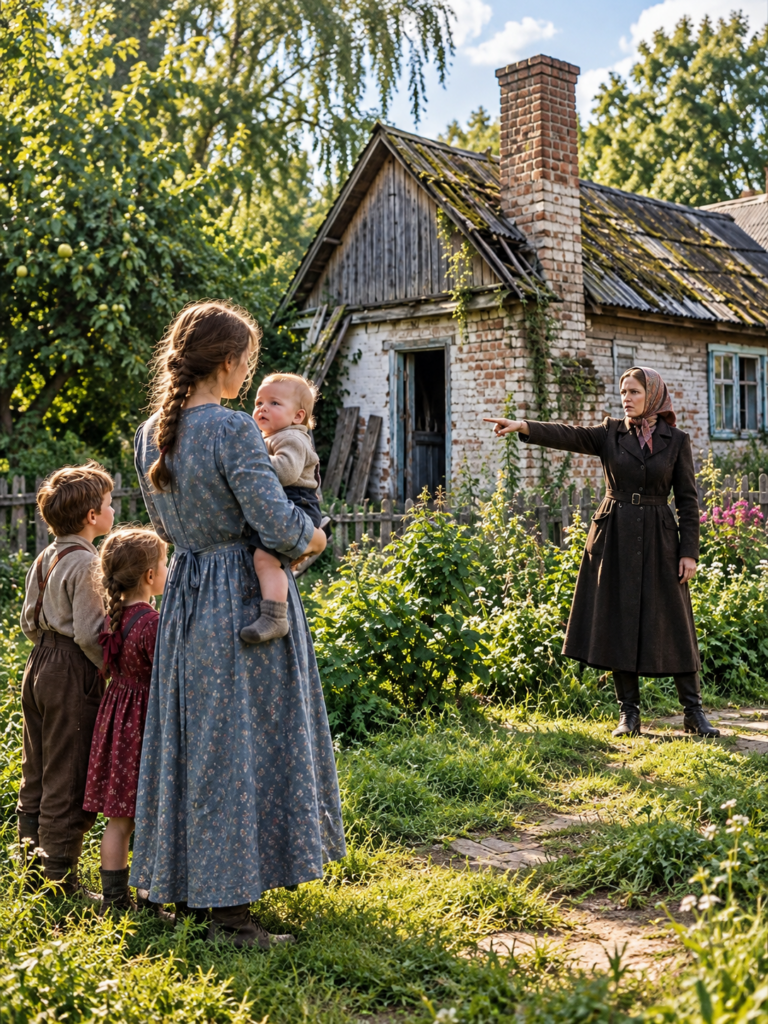
Its once-blue walls had faded to a grayish color. Paint hung in brittle strips beneath the windows. One corner of the roof sagged, and weeds had swallowed the narrow path to the front steps.
In the yard stood an old cherry tree, dry and twisted.
Svetlana remembered climbing it as a child, staining her dress with fruit while her mother shouted for her to come down before she broke her neck.
Now the branches held no leaves.
Misha looked up at the house.
“Mommy, are we going to live here?”
Svetlana could see the doubt in his expression.
“For now, sweetheart.”
“Is it safe?”
She glanced at the warped porch boards.
“We’ll make it safe.”
She wanted to believe that.
The front door resisted when she turned the key. She pushed against it with her shoulder until the lock finally gave way.
A damp, stale smell drifted into the yard.
Inside, the furniture was covered with yellowed sheets. Cobwebs stretched between the bookshelves, and dust lay so thick across the floor that every step left a clear footprint.
Svetlana placed the stroller near the entrance and began opening windows.
As the evening light entered the house, familiar objects emerged from the darkness.
The old green velvet sofa.
The tall wooden bookcase.
The dining table with a scratched corner where she had once done her schoolwork.
On the wall hung a clock stopped at 3:15.
And in the center of the dining table lay a white envelope.
Her name was written across it.
Svetlana approached slowly.
She would have recognized her mother’s handwriting anywhere: narrow letters, pressed firmly into the paper, with the final strokes leaning slightly to the right.
Inside was a single sheet.
My dear Svetlana,
If you’re reading this, I am no longer here.
I know I was strict with you. I know I hurt you. I wish I had been brave enough to explain everything while we still had time.
I did what I thought would protect you, although I understand now that protection can sometimes feel like punishment.
This house holds more than unhappy memories. It holds a truth I never had the courage to tell you.
What you’re looking for is in the place where you cried the most.
Forgive me.
Mom.
Svetlana read the letter again.
And again.
What you’re looking for.
What did that mean?
She hadn’t come looking for anything except shelter.
The letter left her angry in a way she hadn’t expected. Even in death, Galina seemed to be giving her instructions instead of answers.
“Mommy?”
Misha stood beside her.
“Why are you crying?”
Svetlana quickly wiped her cheek.
“I’m just tired.”
He slipped his small hand into hers.
“Can we have dinner?”
She folded the letter and placed it carefully in her pocket.
They ate the remaining bread and a few biscuits from her bag. Then Svetlana arranged makeshift beds in the living room using the cleanest sheets she could find.
There was no electricity. The power had been disconnected.
After feeding Petya, she laid him down beside his brother. Misha fell asleep with his teddy bear tucked beneath his chin.
Svetlana sat on the sofa in the fading light and listened to the boards creak as the house cooled.
The place where you cried the most.
She remembered crying in the kitchen after arguments with her mother.
She remembered crying in the yard when other girls laughed at her old clothes.
But there was one place where she had hidden all her worst unhappiness.
Her childhood bedroom.
At the far end of the hallway.
She found an old candle, lit it, and walked carefully past the kitchen and bathroom.
The bedroom door scraped against the floor when she opened it.
Nothing appeared to have changed.
The narrow bed still stood beneath the window. A dark wooden wardrobe leaned against the opposite wall. On a shelf lay several schoolbooks, their covers curling from years of damp.
She remembered being twelve, sobbing because her mother wouldn’t allow her to visit a friend.
Fifteen, crying because she felt awkward and unwanted.
Eighteen, packing a suitcase and promising herself she would never come back.
Svetlana moved through the room, brushing dust from the furniture.
Then the candlelight caught something unusual.
Behind the wardrobe, near the corner, the wall was a slightly different shade.
She crouched.
A rectangular section of plaster looked smoother and newer than the surrounding surface.
She pushed against the wardrobe.
It barely moved.
She put her shoulder against it and tried again, ignoring the sting in her back.
The heavy wood dragged across the floor, exposing a narrow line in the wall.
Not a crack.
A seam.
Svetlana ran her fingers along it.
A small piece of plaster crumbled beneath her thumb.
She picked at the edge, revealing a loose brick.
Her breathing quickened.
Another brick came free. Then another.
Behind them was a hollow space.
She raised the candle and leaned closer.
Inside lay a small metal safe, a carved wooden chest, and several bundles wrapped in old cloth.
For a moment, she simply stared.
Then she pulled out the nearest bundle.
The string disintegrated when she loosened it. She unfolded the cloth across her lap.
Several rough stones rolled into her palm.
One was deep green. Another had a faint pink glow. Others appeared pale blue or golden in the candlelight.
Svetlana knew almost nothing about gemstones, but she had seen enough documentaries to recognize that these were not ordinary pebbles.
Emeralds.
Tourmalines.
Perhaps aquamarines.
She opened another bundle.
More stones.
And another.
There were dozens of them, possibly hundreds, some no larger than peas, others surprisingly heavy in her palm.
Her first impulse was to laugh.
It seemed impossible.
Her mother had lived modestly, wearing the same winter coat year after year and repairing things rather than buying replacements.
How could such a woman have kept all this hidden?
Svetlana carefully returned the stones to their cloth wrappings and pulled the small safe from its hiding place.
It had an old-fashioned keyhole.
She stared at it, then remembered the smaller key in the inheritance envelope.
She hurried back to the living room, checked that the boys were still asleep, and searched through the papers.
The small key slid into the safe’s lock.
It turned.
Inside were yellowed certificates, handwritten records, several black-and-white photographs, and a little black notebook.
On its first page, written in careful, unfamiliar handwriting, were the words:
Anna Ivanovna. 1943.
Svetlana knew that name.
Anna Ivanovna was her great-grandmother, a woman Galina had mentioned only occasionally.
According to family stories, Anna had worked in the Ural mining region, near Murzinka, during a time when precious stones were drawn from the earth by people who spent their lives underground or bent over rough ground.
Svetlana began reading.
Anna’s diary described long working days, dangerous conditions, and the uncertainty of earning a living from the mines. She had not simply been a miner’s wife. She had worked in the industry herself, developing an unusual ability to identify promising mineral deposits.
She had learned which stones were valuable, which buyers were honest, and which middlemen cheated workers who didn’t understand what they had found.
Over the years, Anna had quietly kept some of the finest gemstones she acquired through her work.
She had intended them as protection for the generations who would follow her.
But as mining declined and life around the industry became increasingly dangerous, she moved away, carrying the stones to the remote house.
There, she concealed them behind a wall.
She planned to tell her daughter when the time was right.
That day never came.
Anna died unexpectedly, leaving her daughter unaware of the fortune hidden in the family home.
Svetlana’s grandmother had spent her life worrying about money, never suspecting that valuable stones lay only a few feet from the room in which she slept.
Svetlana kept reading until she found later notes and papers left by her mother.
Years earlier, during repairs in the bedroom, Galina had found Anna’s journal and uncovered the hiding place.
She had discovered the stones, the documents, and the family secret.
But instead of selling them or revealing the discovery, she had closed the wall again.
She feared that news of the gemstones would bring dishonest buyers, thieves, and people who might threaten her family.
She feared that sudden wealth would turn relatives against one another.
And she feared making a mistake that could never be undone.
So she told nobody.
Even after Svetlana left home, Galina kept the secret.
When illness made her aware that her time was running out, she had prepared the letter and arranged for the house to pass to her daughter.
Svetlana set the journal down.
For ten years, she had believed her mother wanted nothing to do with her.
Now she was sitting in the house Galina had preserved, holding evidence that her mother had left her a chance at a different life.
It didn’t erase the arguments. It didn’t make the loneliness of her childhood imaginary.
But it suggested that Galina had been carrying fears Svetlana had never understood.
She opened the letter again.
What you’re looking for is in the place where you cried the most.
Svetlana lowered her face into her hands.
She cried for her mother, for the reconciliation they would never have, for the husband who would never see his sons grow up, and for the years she had spent believing she had no one left.
When the tears finally stopped, she looked around the room.
The stones were still there.
The treasure was real.
But she had no idea what they were worth, whether she could legally sell them, or whom she could trust.
She wrapped everything carefully and hid the bundles, chest, and safe inside the wardrobe beneath old clothing.
Then she pushed the wardrobe back against the wall.
Before dawn, she finally lay down beside her children.
She had been awake almost all night when Misha tugged at her sleeve the next morning.
“Mommy, I’m hungry.”
Petya was crying again.
Svetlana rose, exhausted, and prepared breakfast from the last biscuits and bread.
While Misha ate, she checked her phone. The signal was weak, but she managed to search for information about gemstone appraisers in the Urals.
The results were confusing.
She needed somebody who understood raw stones. Somebody discreet. Somebody who would not take advantage of a frightened widow with no money.
She was still searching when someone knocked at the front door.
Svetlana stopped.
“Who’s there?” Misha whispered.
She gestured for him to stay quiet.
Through the narrow opening she saw a broad-shouldered man in his fifties, with graying hair and a weathered face.
He held a cap in both hands.
“Good morning,” he said. “My name is Stepan. I used to live near your mother. I wanted to offer my condolences.”
“Thank you.”
“I saw someone had opened the house. Thought perhaps you needed help. I can repair doors, windows, whatever needs fixing.”
He looked past her into the hallway.
Svetlana instinctively shifted to block his view.
“That’s kind of you, but we’re managing.”
“An old place like this needs work.” He smiled faintly. “Your mother never allowed anyone inside. People always wondered why she kept it shut.”
“She liked her privacy.”
“That she did.”
Svetlana began closing the door.
Stepan placed a hand against the frame.
“If you decide you need something, I’m just around the corner. Anything at all.”
His words were polite, but his gaze lingered on the interior of the house.
She thanked him again and closed the door firmly.
A moment later, she turned the key.
“Who was that man?” Misha asked.
“A neighbor.”
“I don’t like him.”
Svetlana looked at the locked door.
“Neither do I, sweetheart.”
By the afternoon, she had remembered somebody else.
Andrey Smirnov.
He had been one of her few friends at school, a quiet boy who loved geology and could identify stones other children ignored.
Years earlier, he had moved to Yekaterinburg and become a mining engineer.
She searched social media until she found his profile.
He was working in mineral consulting and gemstone services.
She sent a short message, asking whether he remembered her and whether they could speak privately.
His reply came within fifteen minutes.
Of course I remember you. I’ll call shortly.
When her phone rang, she stepped into the yard, keeping the children within sight.
Andrey’s voice was warm and familiar.
“Svetlana? It’s been years. How are you?”
She almost answered automatically.
Instead, she told him about her mother’s death, the old house, and the unusual stones.
He was quiet for several seconds.
“How many stones are we talking about?”
“A lot. I don’t even know how many.”
“Do you know what kind?”
“Some look like emeralds. There are pink ones, blue ones. I might be completely wrong.”
“Where are you?”
“At my mother’s old house, not far from Nizhny Tagil.”
Andrey’s voice became serious.
“Listen carefully. Don’t show them to anybody in town. Don’t take them into a jewelry shop and ask for a price.”
“Why?”
“Because if they’re real, you need proper testing, documentation, and someone who knows the market. There are good people in this business, but there are also people who would see you as an easy target.”
Svetlana glanced toward the street.
“Can you help?”
“I know a certified gemologist in Yekaterinburg. His name is Pavel Sergeyevich. We work together. I can arrange an appointment tomorrow morning.”
Relief made her knees feel weak.
“Thank you, Andrey.”
“Bring a sample of the stones, and be careful. Promise me you won’t tell anyone else until we know what you’re dealing with.”
“I promise.”
Later, Svetlana took the children to the small grocery store.
The shopkeeper recognized her immediately as Galina’s daughter.
After offering condolences, the woman spoke affectionately about her mother’s quiet habits.
“She never caused trouble,” the shopkeeper said. “Always paid what she owed. Hardly spoke about herself.”
Svetlana hesitated.
“Did anyone ever seem unusually interested in the house?”
The woman looked up.
“Stepan. He kept trying to buy that property. Said he wanted to build several houses to rent out. Your mother refused every offer.”
Svetlana remembered Stepan’s hand on the doorframe.
“Did he know her well?”
“Nobody really knew Galina well. But Stepan certainly wanted that land.”
On her way back, Svetlana kept looking over her shoulder.
That evening, after feeding the boys and putting them to bed, she selected a number of promising stones and wrapped them individually in clean cloth.
She packed them into an old backpack.
The remaining stones and documents stayed hidden inside the wardrobe.
She had just managed to fall asleep when a faint scraping noise woke her.
She lay still.
Another sound came from the kitchen.
Wood creaked under pressure.
Svetlana sat upright and listened.
Somebody was outside the back door.
The handle moved.
Then came the unmistakable scrape of metal against the lock.
She reached for the wooden handle of a broken mop leaning beside the wall.
Her hands were shaking, but she forced herself to walk toward the kitchen.
The door shifted against its frame.
Someone was trying to open it.
Svetlana stopped a few feet away.
“Get away from my house!” she shouted. “I’ve already called the police!”
The movement stopped.
For one terrible second, she heard nothing.
Then footsteps rushed across the overgrown yard.
She remained motionless, clutching the mop handle.
Only when the sounds had faded did she check the lock, drag a chair against the back door, and return to her children.
Misha was awake.
“Mommy, what’s wrong?”
She sat beside him.
“Someone was outside. They’re gone now.”
“Are we in trouble?”
Svetlana looked toward the dark hallway.
She didn’t know whether the intruder had been Stepan, another curious neighbor, or someone who knew more about the house than she did.
But she understood one thing.
Whatever lay hidden behind that wall, she could no longer leave its future to chance.
“We’re going to the city in the morning,” she told Misha.
“Are we leaving Grandma’s house?”
“Just for a little while.”
She held him until he fell asleep.
Then she sat awake beside the backpack, listening to the darkness outside.
At sunrise, she would take her sons and the stones to Yekaterinburg.
For the first time in years, she had something precious to protect.
And she was determined not to lose it.
Part 2
The bus to Yekaterinburg left at seven in the morning.
Svetlana arrived at the station fifteen minutes before departure, pushing Petya’s stroller with one hand and holding Misha’s hand with the other.
The backpack pulled heavily against her shoulders.
She had packed enough stones to obtain a meaningful appraisal, but their combined weight was nothing compared with the responsibility she felt carrying them.
Every stranger seemed to be watching.
A man reading a newspaper near the ticket window made her nervous. A woman who glanced at the stroller caused her to tighten her grip on the bag.
She knew she was behaving irrationally, but after the attempted break-in, even ordinary curiosity felt threatening.
She bought the tickets with nearly all her remaining cash.
If the stones were worthless, she would have no money for the return journey.
The bus was sparsely occupied. Svetlana chose a seat toward the back and wedged the backpack between her feet.
Misha leaned against her and fell asleep.
Petya eventually settled after feeding.
For nearly three hours, the countryside slid past the windows.
Svetlana thought about her mother.
For years, she had imagined Galina growing old in bitter solitude, refusing to admit that their argument had been unnecessary.
Now she pictured her sitting alone with Anna Ivanovna’s diary, knowing what was hidden in the house but unable to decide what to do with it.
Had Galina ever considered calling her daughter?
Had she picked up the phone and put it down again?
Svetlana remembered birthdays when she had almost made that same call.
Two stubborn women had wasted ten years waiting for the other to speak first.
When the bus entered Yekaterinburg, Svetlana opened her eyes and checked the time.
She sent Andrey a message.
I’m here.
His response arrived immediately.
Pavel Sergeyevich is expecting you. I’ll send the address. The office is near 1905 Square.
She took a taxi to the city center, paying with a credit card that was already at its limit.
The building was old but well maintained, with high windows and an understated entrance.
A plaque identified the office as Smirnov and Partners, Gemology and Mineral Consulting.
Inside, a receptionist directed her to the second floor.
Svetlana climbed the stairs slowly, carrying Petya while Misha followed with his teddy bear.
At Room 203, she knocked.
“Come in.”
Behind a large wooden desk sat a silver-haired man wearing glasses and a neatly pressed shirt.
He stood when he saw her.
“Svetlana? I’m Pavel Sergeyevich. Andrey told me you’d be coming.”
His voice was calm, and his handshake was firm without being forceful.
He pulled out a chair for her.
“Please sit down. There’s plenty of room for the children.”
Misha settled on the carpet while Svetlana held Petya in her lap.
The office contained microscopes, magnifying lenses, precision scales, and lamps arranged across a workbench.
Certificates and mineral specimens lined the shelves.
Pavel Sergeyevich took his seat.
“Andrey tells me you’ve discovered some stones in an inherited family property.”
“Yes.”
“May I see them?”
Svetlana opened the backpack.
She unwrapped the stones one bundle at a time, arranging them carefully on the desk.
At first, Pavel observed without speaking.
Then he reached for a deep green stone nearly the size of a walnut.
He held it beneath a lamp, rotating it slowly.
His expression changed.
He adjusted his glasses, picked up a magnifying lens, and examined the stone again.
Svetlana watched his face.
“Is something wrong?”
“No,” he said. “Quite the opposite.”
He placed the stone gently on a white cloth.
“Where did you say these came from?”
“My mother’s house. They belonged to my great-grandmother, apparently. She worked around the old Ural mines.”
“Near Murzinka?”
“That’s what her diary says.”
Pavel looked at her with renewed interest.
“That would be consistent with what I’m seeing.”
“Are they real?”
“I cannot give you a definitive answer without proper testing. But this appears to be a remarkable emerald specimen.”
He studied several more stones.
“Some of these may be high-quality emeralds, along with tourmalines and other valuable minerals. The region has produced extraordinary material.”
Svetlana felt her mouth go dry.
“What are they worth?”
Pavel removed his glasses.
“It’s too early to make a reliable valuation. Size alone tells us very little. We need to examine clarity, inclusions, color, structure, and the characteristics of each stone.”
He paused.
“But based on this initial inspection, if the remaining collection is similar in quality, we could be talking about fifty to a hundred million rubles. Possibly more.”
Svetlana stared at him.
She had entered the building wondering whether the stones might pay a few months’ rent.
Now he was describing a sum she could scarcely comprehend.
“Millions?”
“Potentially. But please understand that this is a preliminary estimate, not a sale price.”
She looked down at Petya, who was sleeping with one small fist curled against her coat.
Misha had abandoned his teddy bear and was watching her.
“Mommy?”
She pressed her lips together, but tears came anyway.
“Mommy, why are you crying?”
She reached for him and pulled him close.
“Because something good might have happened to us.”
Pavel quietly moved a box of tissues across the desk.
He allowed her a few minutes before discussing what came next.
The stones would require detailed examination and documentation. He could prepare an inventory, photograph each specimen, and arrange professional testing.
There were also questions of provenance and lawful ownership that could not be resolved by laboratory work alone.
Svetlana listened carefully.
“How long will the testing take?”
“Several days. Perhaps a week.”
“And I can trust that they’ll be safe?”
He showed her the office’s secure storage arrangements and explained the written custody procedure.
Every stone she left would be photographed and recorded against a receipt. The documents would identify what had been received, who was responsible for it, and how it would be returned or transferred.
He did not ask her to accept a verbal promise.
That reassured her more than anything else.
After reviewing the inventory, Svetlana signed the receipt and watched as the gemstones were secured.
“One more thing,” Pavel said before she left. “Be discreet. Until we understand the collection and its ownership, avoid discussing it with anyone who doesn’t need to know.”
“I understand.”
“Andrey mentioned you’re staying outside the city?”
“Yes.”
“Be careful traveling back and forth.”
Outside, Andrey was waiting beside a car.
Svetlana recognized him before he spoke.
He was older, with a few lines around his eyes, but he still had the same easy smile she remembered from school.
“Well?” he asked. “How did it go?”
She looked at him, struggling to find words.
“He thinks they’re real.”
Andrey smiled.
“I suspected they might be.”
“He said they could be worth millions.”
His expression turned serious.
“Then I’m very glad you came to the right place.”
He helped her with the stroller.
“Where are you staying?”
Svetlana looked away.
“I hadn’t thought that far ahead.”
“Do you have somewhere to go?”
She shook her head.
Andrey was quiet for a moment.
“I have an apartment nearby. It’s not large, but there’s a bedroom and a sofa. You and the boys can stay there until we sort this out.”
“I can’t ask you to do that.”
“You didn’t ask.”
“Andrey—”
“Svetlana, we were friends for years. I’m not going to leave you standing on the sidewalk with two children.”
She looked down, embarrassed by how close she was to crying again.
“Thank you.”
He opened the car door.
“Come on. The boys need lunch.”
His apartment was small but comfortable, with clean floors, warm radiators, and a kitchen full of ordinary things that Svetlana had stopped taking for granted.
He prepared food while she changed Petya and helped Misha wash his hands.
That evening, after the children were asleep, Svetlana sat at the kitchen table with Andrey.
For the first time, she told someone the full story of the house.
She described the letter, the repaired wall, the black notebook, and Anna Ivanovna’s history.
She told him about Stepan.
Then she described the attempted break-in.
Andrey leaned back in his chair.
“Did you actually see anyone?”
“No.”
“Then we shouldn’t assume it was him.”
“I know. But he wanted the house, and someone tried to open the back door.”
“You should report it when you return. And until then, don’t go back alone if you can avoid it.”
Svetlana nodded.
“What if these stones really are worth what Pavel thinks?”
Andrey considered the question.
“Then you need to protect yourself from making decisions too quickly.”
“I’ve been living on borrowed time for months. It’s hard not to think about all the things I could pay for.”
“Pay for what you need. But if the money comes through, don’t let fear of being poor push you into spending like you have something to prove.”
She gave a tired smile.
“That sounds like the sort of advice you used to give me before exams.”
“And you didn’t always listen then, either.”
She laughed.
It was the first ordinary laugh she’d had in weeks.
The next five days passed slowly.
Every morning, Andrey left for work. Every evening, he returned with groceries and asked whether she had heard from Pavel.
Svetlana cared for the boys, washed their clothes, cooked simple meals, and tried to keep her mind occupied.
But every time her telephone rang, she felt a jolt of expectation.
On the fifth day, Pavel called.
“I’ve completed the evaluation. Can you come to my office tomorrow morning?”
“Yes. Of course.”
“Good. I have encouraging news.”
She wanted to ask how encouraging, but he preferred to explain the findings in person.
The following morning, Andrey stayed with the boys while Svetlana traveled to the office.
Pavel greeted her with a thick folder.
Inside were photographs, measurements, reports, and detailed descriptions of the specimens.
He explained the categories of gemstones, their condition, the significance of the larger pieces, and the factors affecting their potential market value.
Then he placed the overall valuation before her.
It exceeded the upper end of his original estimate.
The collection was worth more than a hundred million rubles.
Svetlana read the figure several times.
She felt strangely detached, as though she were looking at someone else’s paperwork.
For months, she had been afraid to open her mailbox.
Now she was holding a report suggesting she might be able to secure her sons’ futures for decades.
Pavel gave her time to absorb the information.
Eventually, he asked, “Have you thought about how you want to proceed?”
“What choices do I have?”
“We can approach established jewelry companies interested in purchasing rough gemstones. A direct transaction may be quicker. Alternatively, a specialized auction might attract a higher price, but it would take longer.”
“How much longer?”
“Possibly two or three months. A direct sale might be arranged considerably sooner, once the legal requirements are satisfied.”
Svetlana thought about the old house.
She thought about her empty wallet, the overdue bills, and her sons sleeping in a friend’s apartment.
“I’d prefer a direct sale.”
“That is reasonable. But before anything is sold, we need to address the ownership documentation.”
He closed the report.
“The fact that you found the stones in a property you inherited doesn’t automatically answer every legal question. We need to establish the history as far as possible and make sure any transaction complies with the applicable rules.”
Svetlana felt her excitement give way to worry.
“I don’t understand any of that.”
“You don’t have to handle it alone. I can recommend a lawyer experienced in inheritance and mineral-related property matters.”
He wrote down a name.
Dmitry Volkov.
“He’ll review the estate documents and the historical records. He can also advise you about any declarations, taxes, and paperwork required before a lawful sale.”
“Will it be expensive?”
“Professional help will cost money, yes. But it is necessary with something of this value.”
She thanked him and took the folder.
On her way out, she stopped beside a window overlooking the city.
Cars moved through the square. People hurried past shops and office buildings.
Only a few days earlier, she had crossed those same streets carrying a backpack she feared might contain worthless stones.
Now, for the first time, she could imagine a future that wasn’t determined by the next bill.
She called Dmitry Volkov that afternoon.
He was direct and practical.
At their meeting the next day, he examined Galina’s inheritance documents, Anna Ivanovna’s diary, and the records recovered from the safe.
He explained that the collection’s history needed to be documented, with particular care given to the transfer of ownership and any requirements connected to the gemstones’ origin.
They discussed the estate inventory, supporting evidence, potential tax obligations, and the legal documentation necessary for a transaction.
“Your family papers are useful,” Dmitry told her. “They establish a history worth investigating and documenting. We’ll need to make sure the formal records support the transaction.”
Svetlana signed the documents he prepared to begin the process.
For the first time, the family diary felt like more than an account of a remarkable woman’s life.
It had become a link between generations.
Anna’s work had created the collection.
Galina had preserved it.
Now Svetlana had to decide how to use it.
Three days later, Pavel called again.
A jewelry company in Moscow was interested in purchasing the collection.
The proposed price was enormous, and the buyer was prepared to move forward once the necessary documentation was complete.
Svetlana listened as Pavel explained the conditions.
She was tempted to say yes immediately, but she remembered Andrey’s advice and asked Dmitry to review the transaction.
Over the following two weeks, the paperwork was completed.
The collection was inventoried, the ownership history was reviewed and documented, and the required formalities were addressed with professional assistance.
The sale was finalized.
Then, one Friday morning, Svetlana received a call from her bank.
A representative confirmed that the agreed payment had arrived in her account.
Svetlana stood in Andrey’s living room, holding her phone against her ear.
She checked the amount herself.
The money was there.
For several seconds, she didn’t move.
Misha came running from the other side of the room.
“Mommy, will you play with me?”
She knelt and held him tightly.
“Yes, sweetheart.”
“Why are you squeezing me?”
“Because I love you.”
He wriggled in her arms.
“I know that, Mommy.”
She laughed through tears.
A little later, she sat on the sofa while Petya crawled across the carpet toward his brother.
Nothing about the room had changed.
The furniture was the same. The morning sunlight came through the same curtains. Somewhere in the kitchen, the kettle clicked off.
But the frightening arithmetic of her life had ended.
She no longer had to choose between groceries and rent.
She no longer had to wonder whether the boys would have a place to sleep.
That evening, she invited Andrey to dinner.
They went to a small restaurant, where Misha ate french fries and Petya made a cheerful mess of his food.
Svetlana insisted on paying.
Andrey raised his glass.
“To your great-grandmother.”
“And my mother,” Svetlana added.
“And to you.”
She smiled.
“What am I supposed to do with all this money?”
“First, make sure you and the children have a good place to live.”
“I want an apartment here. Somewhere quiet. Misha needs his own room, and Petya needs a proper crib.”
“That sounds like a good start.”
“And I want to save for their education. I don’t want them growing up afraid of money.”
“Then find a reliable financial adviser. Take your time. There’s no reason to rush into anything.”
They discussed investment accounts, conservative assets, and setting aside enough for everyday expenses.
Svetlana had no desire for luxury cars or expensive clothes. She wanted security, not attention.
But there was one question she couldn’t put aside.
“What about the house?” Andrey asked.
She looked down at the table.
“I’ve been thinking about that.”
“Do you want to sell it?”
“Part of me does. I could walk away and never go back.”
“And the other part?”
“The other part thinks I owe my mother something.”
Andrey waited.
“I spent ten years hating that house. Now I know something about what happened there, something about the women who lived before me.”
She paused.
“I don’t think I can simply sell it to the first person who offers money.”
“Especially not Stepan.”
“Especially not Stepan.”
“Then what are you going to do?”
Svetlana watched Misha help his little brother pick up a dropped toy.
“I’m going back.”
Andrey frowned.
“You don’t need to put yourself in danger. You could handle the property through an agent.”
“I know. But someone tried to break into that house. And I still haven’t stood inside it without feeling like an angry eighteen-year-old.”
“You don’t owe the place anything.”
“Maybe not.”
She thought of Galina’s letter.
“But I owe myself the chance to decide what it means to me now.”
Andrey looked at her for a long moment.
“Then at least speak to the police first.”
“I will.”
As they left the restaurant, Svetlana felt the cool evening air against her cheeks.
She had secured the money.
She had secured a future for her children.
But there was still an old house in the countryside, a broken wall in a childhood bedroom, and a question she had carried for ten years.
Could she return to that place without becoming the frightened, angry girl who had once run away from it?
She intended to find out.
Part 3
Svetlana returned to the Ural town on a Saturday morning.
This time, she did not arrive carrying her entire life in two worn bags.
She had money, a secure place to stay in Yekaterinburg, and professionals helping her manage the responsibilities that came with her unexpected wealth.
But as the taxi passed the familiar streets, her stomach tightened.
Money had changed her circumstances.
It had not erased her memories.
She asked the driver to stop outside the local police station.
With Petya in her arms and Misha holding her hand, she went inside and reported the attempted break-in.
The investigator was a middle-aged man with a thick mustache and a patient manner.
He listened carefully as she described the noise at the back door, the moving handle, and the footsteps in the yard.
“Did you see the person?” he asked.
“No.”
“Do you suspect anyone?”
“There’s a neighbor named Stepan. He has been trying to buy the property for years. He came to my door shortly before someone attempted to enter the house.”
The investigator wrote down the information.
“That gives us someone to speak with. It doesn’t establish who was there.”
“I understand.”
He agreed to look into the incident and arrange for patrol officers to pass through the neighborhood.
Svetlana thanked him.
When she left the station, the sky was clear, and the town was beginning its ordinary Saturday routine.
A woman was sweeping her front steps. Two men stood beside an old car, discussing something under its open hood. Somewhere nearby, a church bell rang.
Nothing about the town suggested that anything extraordinary had happened.
Svetlana walked to the house.
The leaning gate was still there.
The blue paint was still peeling.
The cherry tree stood motionless in the yard.
She unlocked the front door and went inside.
Dust lay across the furniture just as she had left it.
This time, she didn’t feel quite so helpless.
She opened the windows, allowing fresh air to move through the rooms, and let Misha play outside where she could watch him.
Then she walked down the hallway to her childhood bedroom.
The wardrobe still concealed the broken section of wall, although she had left the opening partly exposed after removing the collection.
She moved the furniture aside and looked into the empty compartment.
A few fragments of plaster remained on the floor.
The small hiding place had protected a fortune through decades of uncertainty.
Now it was empty.
Svetlana touched the edge of the wall.
She remembered the little girl who had sat on that bed, listening to her mother’s angry footsteps in the hallway.
She remembered the teenager who believed every restriction was an insult.
And she remembered the woman who had returned with two children, convinced that her mother had left her nothing of value.
“Mom,” she whispered.
Her voice sounded strange in the quiet room.
“I wish you had told me.”
She waited, almost as though an answer might come.
“I wish we’d had one more conversation. Just one.”
For years, Svetlana had imagined confronting Galina and demanding explanations for everything that had hurt her.
Now those answers were beyond reach.
The diary and hidden stones had given her a different picture of her mother, but not a perfect one.
Galina had been frightened. She had been secretive. She had sometimes mistaken control for love.
She had also protected something precious for the daughter she no longer knew how to reach.
Svetlana could acknowledge all of it.
She didn’t have to pretend her childhood had been happy.
She didn’t have to believe that every decision Galina made had been right.
She only had to decide whether she wanted to spend the rest of her life carrying the same anger.
“Thank you for leaving me a chance,” she said quietly.
Her eyes filled.
“And I forgive you.”
The words were barely louder than a breath.
But afterward, something in her shoulders relaxed.
From the yard came Misha’s voice.
“Mommy! Look what I found!”
She wiped her face and went outside.
He was holding a small, smooth stone, proud of his discovery.
“Is this a treasure?” he asked.
Svetlana crouched beside him and examined it.
“I don’t think this one is worth much money.”
Misha looked disappointed.
“But it’s a treasure if you like it,” she added.
He considered that.
“Then I’m keeping it.”
She smiled.
“That’s a good idea.”
Later that afternoon, someone knocked at the front door.
Stepan stood on the porch.
Beside him was the investigator.
Svetlana felt a familiar moment of apprehension, but she kept the door open.
The investigator explained that he had spoken with Stepan about the incident and his interest in the property.
Stepan held his cap awkwardly.
“I’m sorry if I frightened you when I came by,” he said.
Svetlana studied him.
“Did you try to break into my house?”
He shook his head.
“No. I didn’t.”
“Someone did.”
“I know what you told the officer. But it wasn’t me.”
There was no evidence to prove otherwise.
The investigator made it clear that the incident had not been solved.
Stepan shifted his weight.
“I won’t pretend I wasn’t interested in the place,” he admitted. “I’ve wanted the land for years. I thought I could put some rental houses here.”
“My mother refused to sell.”
“She did. Every time I asked.”
“And now you thought I’d sell?”
“I thought you might not want to keep an old house in this condition.”
He glanced toward the yard.
“I could make a fair offer.”
Svetlana looked beyond him at the crooked fence and the dry cherry tree.
Only a few weeks earlier, she might have agreed immediately. The property had seemed like a burden she could barely afford to carry.
Now she understood its history.
“No, Stepan.”
He frowned.
“You’re certain?”
“I’m certain. The house isn’t for sale.”
For a moment, he appeared ready to argue.
Then he placed his cap on his head.
“Well. If you change your mind, you know where to find me.”
“I won’t be changing my mind.”
Stepan nodded and walked away with the investigator.
Svetlana watched until they turned the corner.
She did not know who had been outside her kitchen door that night.
Perhaps she never would.
But she would no longer allow uncertainty about Stepan to decide the future of her family’s home.
Over the following months, Svetlana began building the life she had imagined during the long nights in Andrey’s apartment.
She rented a spacious three-bedroom apartment in a quiet Yekaterinburg neighborhood.
There were large windows, a balcony, and a playground near the building.
Misha got a room of his own, decorated with pictures of superheroes.
Petya had a sturdy crib, soft blankets, and enough space to crawl without bumping into stacks of belongings.
Svetlana bought a comfortable bed for herself.
The first night she slept there, she woke before dawn out of habit, expecting to worry about rent.
Then she remembered.
The bills could be paid.
The children were safe.
She lay still, listening to the soft sounds of their breathing through the open bedroom doors.
For the first time since her husband’s death, she allowed herself to go back to sleep.
With Andrey’s help, she found a financial adviser.
She set aside money for everyday expenses, arranged savings for the boys’ education, and invested much of the remaining proceeds conservatively.
She did not buy an expensive car or fill her closet with designer clothes.
There were no extravagant parties.
Her greatest luxuries were ordinary ones: fresh groceries without checking every price, warm winter clothes for the boys, medical appointments without financial panic, and the freedom to spend afternoons with her children.
Yet she continued thinking about the old house.
One morning, she called a small construction company based near the town.
“I want to restore a family property,” she explained. “Not rebuild it into something modern. I want it to look like the house I remember, only safe and cared for.”
She returned to meet the workers and discuss the repairs.
The roof needed attention.
Several window frames had to be replaced.
The walls required cleaning, repairs, and fresh blue paint.
The damaged floorboards needed strengthening, and the electrical system had to be made safe.
They cleared the weeds from the yard and repaired the leaning gate.
Svetlana visited whenever she could, sometimes bringing the boys.
She watched the house slowly emerge from its neglected condition.
The most difficult decision concerned the dead cherry tree.
She stood beneath its twisted branches for a long time before agreeing that it had to be removed.
When the workers finished clearing the ground, she planted a young cherry sapling in nearly the same spot.
Misha helped press earth around the roots.
“Will it get as big as the old one?” he asked.
“Someday.”
“Can I climb it?”
“When it’s strong enough.”
“How long?”
“A while.”
He sighed with the impatience of a four-year-old.
Svetlana laughed.
“Some things are worth waiting for.”
Inside the house, she made one room special.
The childhood bedroom where she had discovered the gemstones became a place dedicated to her family’s history.
She arranged framed photographs of Anna Ivanovna, her grandmother, and Galina.
The old diary was preserved and displayed with care. Beside it, she placed a framed copy of her mother’s final letter.
She kept the original documents protected.
For the first time, the women of her family had a place where their stories could be remembered together.
Anna, who had worked in the mines and saved what she could.
Her daughter, who had lived in poverty without knowing what lay hidden nearby.
Galina, who had discovered the secret and guarded it through years of fear and silence.
And Svetlana, who had inherited the responsibility of deciding what it would mean for those who came next.
The restoration took three months.
When it was finished, the house stood bright and welcoming behind its repaired gate.
On a sunny Saturday, Svetlana brought Misha and Petya to see it.
Misha ran across the yard, laughing, and tried to climb the young cherry tree before his mother called him back.
Petya crawled across the soft grass, delighted by the unfamiliar textures beneath his hands.
Svetlana sat on the restored porch with a cup of coffee.
She could hear birds in the nearby trees and her sons playing only a few feet away.
The house no longer looked abandoned.
More importantly, it no longer felt abandoned.
That evening, after putting the children to bed in their freshly painted rooms, Svetlana went for a walk.
She passed the central square, where a group of young people sat playing guitars.
She walked by the old church, its walls illuminated by yellow lights, and past the grocery shop where she had learned of Stepan’s interest in the property.
Several townspeople greeted her.
She recognized some faces from childhood.
Others belonged to people she had met during the renovation.
For the first time, she didn’t feel like a runaway daughter returning in disgrace.
She felt like a woman visiting a place she had chosen to keep.
When she returned home, she found a basket on the porch.
Inside were fresh fruit and a small handwritten note.
Dear Svetlana,
It’s wonderful to see this house alive again. Your mother would have been proud of you.
Welcome home. If you ever need anything, just call.
With love, Irina Pavlovna.
The note was from an elderly neighbor who lived two houses away.
Svetlana sat on the porch steps and read it twice.
She had spent years believing that this town held nothing for her except disappointment.
Yet here was a neighbor offering kindness without asking for anything in return.
She carried the basket inside and placed the note beside her mother’s letter.
The following morning, as she watched the boys eat breakfast, an idea began to take shape.
The gemstones had given her more security than she had ever expected.
But Anna Ivanovna’s diary had told the story of a woman who worked hard, understood the value of opportunity, and saved what she could for people she would never meet.
Svetlana had benefited from that decision.
What would it mean to carry it forward?
She began talking to people in the community.
The local school principal told her about children whose families couldn’t afford extra academic support.
A priest described women who wanted to learn practical skills but lacked access to training.
Several town leaders spoke about residents who had ideas for small businesses but couldn’t obtain the modest funding needed to begin.
Svetlana listened.
She knew what it felt like to have no financial margin, no place to turn, and no realistic way to improve a difficult situation.
She wanted to help others find opportunities before desperation became their only choice.
With professional advice and assistance from local organizers, she established a small community institution.
It offered free tutoring for children from low-income families, practical workshops for women, and a modest microloan fund for residents trying to start small businesses.
The institution was not elaborate.
Its rooms were simply furnished, and much of the work depended on dedicated teachers and volunteers.
But its doors were open.
She named it the Anna Ivanovna Institute of Strength.
At the opening ceremony, Svetlana stood before a modest gathering of townspeople.
She had prepared a few remarks, although speaking in public still made her nervous.
Misha sat near the front with Andrey, while Petya rested in his stroller.
Svetlana looked at the people who had come to celebrate.
“My great-grandmother was a strong woman,” she began. “She worked hard and saved something valuable for her family.”
She glanced toward a photograph of Anna displayed near the entrance.
“My mother protected that inheritance because she believed it might one day help the people she loved.”
Her voice trembled slightly.
“And I was the one who received it.”
She paused.
“For a long time, I thought being wealthy meant never having to worry about money again. And I won’t pretend that financial security isn’t important. It is. It gives people safety and choices.”
She looked at the children sitting with their parents.
“But I’ve learned that wealth can also mean giving someone an opportunity to build a better life.”
A few people nodded.
“I want this institute to offer some of those opportunities. Education. Skills. A chance to try again.”
When she finished, the audience applauded.
Svetlana stepped away from the small podium, embarrassed but pleased.
Andrey approached with Misha beside him.
“That was a good speech,” he said.
“I almost forgot half of it.”
“Nobody noticed.”
Misha pulled at her hand.
“Mommy, is this place ours?”
“It’s for the people who need it.”
He looked around at the bright rooms.
“Can I come here?”
“Of course.”
“Then I like it.”
She bent down and kissed his forehead.
For months, her decisions had revolved around surviving.
Now she had the freedom to consider what kind of life she wanted to create.
The institute grew gradually, finding its place in the community.
Children began attending after-school lessons. Women gathered for workshops, sharing ideas and learning practical skills. Local residents approached the microloan program with plans they had once considered impossible.
Svetlana remained involved, but she also protected time for her sons.
Misha started school in Yekaterinburg and came home each afternoon eager to explain everything he had learned.
Petya took his first steps and began speaking his first words.
Svetlana made new friends, maintained her connection with the town, and continued to rely on Andrey’s friendship and sensible advice.
She also began considering something she had once set aside as an impossible dream.
University.
She had always wanted a higher education, but marriage, motherhood, and financial hardship had pushed the possibility farther and farther away.
Now she could study if she chose.
She began looking at programs and imagining herself in a classroom again.
Not because she needed to prove her worth.
Because she still had a future of her own to build.
A year after discovering the hidden compartment, Svetlana sat on the porch of the restored house, watching the sun sink toward the Ural hills.
Misha and Petya were playing in the yard.
The young cherry tree had grown quickly, its branches stronger and fuller than they had been the previous summer.
To Svetlana’s delight, it had produced its first small crop of cherries.
She watched Misha reach carefully for a ripe one.
“Not too many,” she called.
He grinned.
“Just one!”
She smiled and leaned back in her chair.
The evening breeze carried the scent of grass and fruit.
From the village came distant voices, a dog barking, and the quiet sounds of families finishing their day.
She took out her phone and opened a photograph of Galina.
It had been taken many years earlier.
Her mother was standing beside the old kitchen window, wearing a simple cardigan, her hair pulled neatly away from her face.
She was smiling shyly, almost as though she hadn’t expected anyone to take her picture.
Svetlana studied the image.
For much of her life, she had remembered her mother as a stern voice, a list of restrictions, and a closed door at the end of an argument.
Now other memories came back more easily.
Galina sewing a button onto her school uniform late at night.
Galina leaving the warmest piece of bread for her daughter.
Galina standing at the gate during the first snowfall, waiting for Svetlana to return from school.
Those memories had always been there.
Anger had simply made them harder to reach.
“I wish you could see the house now, Mom,” Svetlana whispered.
She glanced toward the yard.
“The boys love it.”
Petya laughed as Misha chased him across the grass.
“And I think you’d love them.”
Svetlana looked back at the photograph.
“I understand more than I did before. I understand why you were afraid.”
She was quiet for a moment.
“I still wish we’d had more time. I wish we hadn’t wasted so much of it.”
A tear slipped down her cheek.
But the feeling beneath it was no longer the old bitterness.
It was grief softened by acceptance.
“Thank you for what you left me,” she said. “And for the chance to do something good with it.”
She put the phone away.
Across the yard, Misha called out.
“Mommy! Come look!”
Svetlana rose and walked toward her sons.
As she crossed the grass, she passed the cherry tree, now growing where the old dead tree had once stood.
She thought about Anna Ivanovna working in the mines, saving precious stones for a future she would never see.
She thought about her grandmother, unaware of the hidden wealth, carrying on through ordinary hardship.
She thought about Galina, keeping a secret she had been too frightened to share.
And she thought about the frightened widow who had arrived here one evening with two children, a stroller, and an envelope of rusty keys.
That woman had hoped only to survive another month.
She could never have imagined the life that now surrounded her.
Svetlana had found valuable gemstones behind a bedroom wall, but their discovery had led her toward something she hadn’t known she needed.
A connection to her family’s past.
The freedom to forgive without forgetting.
The confidence to make her own decisions.
And the opportunity to give her children the stable childhood she had wanted for herself.
The money had made those choices possible. It had given her time, safety, and resources.
But deciding what to do with those gifts had been her responsibility.
Misha caught her hand.
“Mommy, are we staying here tonight?”
“Yes, sweetheart.”
“And tomorrow?”
“We can stay tomorrow, too.”
He smiled and ran toward his brother.
Svetlana watched them beneath the warm evening sky.
For the first time, she felt no need to escape the place where she had grown up.
She had a home in Yekaterinburg, where her children could learn and grow.
She had this old house in the Ural countryside, where four generations of women had left their stories.
And she had built a sense of home within herself, one no landlord, unpaid bill, or painful memory could take away.
As the sunset turned the distant hills orange and violet, Svetlana understood that returning had not meant surrendering to her past.
It had meant choosing what to carry forward.
She followed her sons across the yard, their laughter rising into the evening air.
And at last, she was home.


