
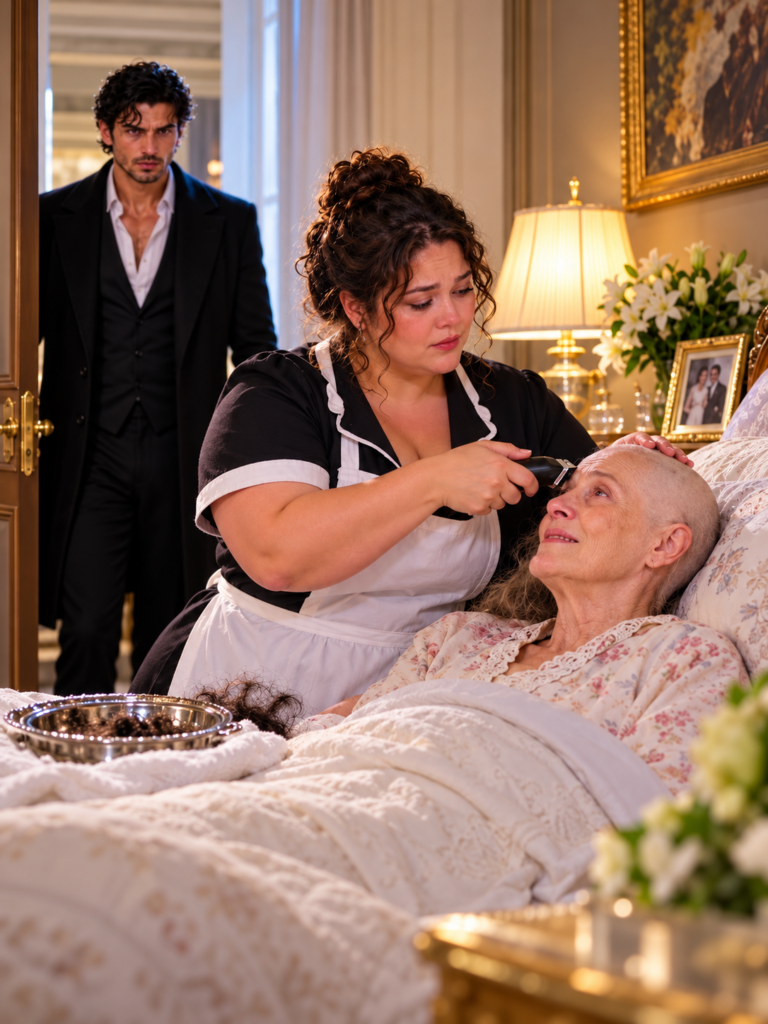
The Mafia Boss Came Home Early and Caught His Curvy Housekeeper Shaving His Dying Mother’s Hair—Then She Forced Him to Stay
Part 1
Richard Carter had walked into gunfire without lowering his head. He had sat across from men who wanted him dead and made them forget how to speak. He had built an empire so carefully guarded that even his own men checked their breathing before they entered his office. But at 3:17 on a gray Thursday afternoon, he stopped outside his mother’s bedroom like a boy who had opened the wrong door in the dark.
The meeting with the Marino family had ended before it began. One of their sons had gotten brave, then gotten scared, and by noon the whole conversation had been pushed to another day. Richard did not like wasted time. He did not like surprise. He liked rooms prepared before he entered them, cars waiting before he needed them, answers given before he asked the question. So when his black car rolled through the iron gates of the Carter estate nearly four hours earlier than expected, the guards at the front post straightened so fast one of them knocked his shoulder against the stone column.
The driveway curved between tall black trees and winter roses his mother had planted years ago, back when she still walked the grounds with pruning shears in one hand and a silk scarf tied over her hair. The mansion rose at the end of the drive, wide and pale and silent beneath the clouds. It had too many windows and not enough warmth. Cameras watched every angle. Men in dark suits stood near every entrance. Steel lined the doors. The glass was reinforced. Everyone in the city called it the Carter Mansion, but Richard had always thought it looked more like a beautiful prison. Maybe that was why it suited him.
He entered through the side door beside the east hall. Usually the mansion smelled like polished wood, smoke from the library fireplace, expensive flowers chosen by decorators, and the faint sharp bite of medicine from his mother’s wing. Today it smelled different. Ginger. Warm bread. Fresh laundry. The soft sweetness of flowers that had not come from any florist he paid. There was music playing somewhere, very low, old jazz, the kind his mother used to hum while she cooked on Sundays before the Carter name became too heavy for ordinary kitchens.
Richard stopped near the hall mirror and listened. The house was not silent. That was the first strange thing. For months, Eleanor Carter’s illness had pulled all sound from the mansion. Nurses walked softly. Guards whispered. Maids moved like ghosts. Doctors spoke in careful, even voices that made bad news sound polite. Richard had ordered the best care in the city—private oncology specialists, night nurses, imported medicine, a chef trained in medical diets, security around every appointment. He had turned his mother’s illness into an operation because operations could be controlled. Pain could not be bullied. But he had still tried.
Now, from the hallway beyond the sitting room, he heard a woman laugh. Not loudly. Not carelessly. Just one small laugh, warm and breathless, as if someone had made her forget for half a second that the room had ever held sickness. Then he heard his mother’s voice. Thin. Tired. Alive.
“Valerie Cross, if you make me look like a peeled potato, I will haunt you.”
A younger woman answered, “Mrs. Carter, with your bone structure, please. You could be bald in a potato sack and still make half the women in this city jealous.”
His mother laughed again. Richard did not move. Valerie Cross. He knew the name, barely. She was one of the housekeepers, newer than most, hired by Mrs. Alvarez because two maids had quit after his mother’s treatment grew worse and the work became heavier. Richard remembered signing off on the payroll increase. He remembered being told Valerie was young, dependable, and mouthy in a way Mrs. Alvarez called either a problem or a blessing depending on the day. He had seen her once from across the kitchen hall, carrying a basket of sheets so high it nearly hid her face. She was round and soft-bodied with thick arms, full cheeks, and dark curls always trying to escape whatever clip held them back. One of the guards had called her the little storm cloud after she snapped at him for tracking mud across a clean floor. Richard had not cared enough to ask more.
Now he cared.
He walked toward his mother’s bedroom without sound. The closer he came, the stronger the ginger smelled. There were flowers on the small table outside her door. Not the stiff white lilies his assistant ordered every Monday. These were wild-looking orange and yellow blooms in a chipped blue vase. Cheap flowers. Alive flowers. Beside them sat a tray with a mug, crackers, a folded cloth, and a small bottle of lotion. None of it looked medical. None of it looked planned. It looked chosen.
The door stood half open. Richard stopped before the crack of light. His mother sat near the window in a soft robe, thin shoulders covered by a pale blanket. The afternoon light touched her face with a kindness the room had not known in months. She had lost too much weight. Her cheeks were hollow. Her hands looked smaller. Her hair, once thick and silver and brushed every morning with care, was almost gone. Chemotherapy had taken it in cruel handfuls, leaving uneven strands she tried to hide beneath scarves. Richard had offered wigs from Paris. She had smiled at him like he was a good son and worn none of them.
Valerie Cross knelt on a folded towel in front of her. She was not wearing the crisp black uniform the staff wore when Richard was home. Her sleeves were rolled up. One shoulder of her gray sweater had slipped down slightly, and there was a streak of shaving cream on her wrist. Her round face was wet with tears she was trying badly to ignore. In one hand she held a small electric razor. In the other she held Eleanor’s fingers. She was shaving his mother’s head. Slowly. Carefully. Tenderly.
Richard’s first instinct was anger. It rose fast and familiar. Who had allowed this? Where was the nurse? Why was a housekeeper touching his mother like family? Why had no one told him? His jaw locked. His hand moved halfway toward the door.
Then his mother spoke. “Is it awful?”
Valerie paused. She did not give the quick, cheerful lie most people gave sick women. She looked up at Eleanor’s face. Really looked, as if she owed her honesty more than comfort. “It is hard,” Valerie said softly. “But awful? No. Awful is those green curtains your son let the decorator put in the west parlor.”
Eleanor’s mouth trembled. Then she laughed through a breath that nearly broke. “I hate those curtains.”
“I know. Every woman with eyes hates those curtains. My Richard thinks expensive means tasteful. Your Richard thinks black is a personality.”
Eleanor laughed again, and this time one tear slipped down her cheek. Valerie set the razor aside and reached up with the cloth, dabbing gently beneath her eye before the tear reached her chin. “There,” she whispered. “Don’t waste good crying on curtains.”
Eleanor covered Valerie’s hand with her own. Her fingers curled around the younger woman’s wrist. Not weakly. Not like a patient receiving care. Like someone holding onto a rope in deep water. “I was afraid,” Eleanor said.
Valerie’s face changed. The humor softened and disappeared, leaving something gentle and almost fierce behind. “I know.”
“I did not want him to see me like this. Richard.”
Eleanor nodded. “He has seen worse things than hair falling out.”
“Not on me.”
Valerie lowered her eyes for a second, and Richard felt something inside his chest tighten. Because she understood. Not because someone had explained it to her. Not because a doctor had used the right words. She simply understood that Eleanor Carter, widow of a dangerous man and mother of a more dangerous one, was not afraid of death in that moment. She was afraid of being looked at with grief. She was afraid of becoming a wound in her son’s eyes.
Valerie picked up a small hand mirror from the bed. “Do you trust me with my hair?”
“Too late to say no.”
“With your face.”
Eleanor swallowed. “That is enough.”
Valerie stood carefully because her knees seemed to hurt from kneeling. She brushed the last soft strands from Eleanor’s robe, then took the silk scarf from the chair and tied it loosely around Eleanor’s neck, not over her head. She turned the chair toward the mirror on the vanity. Eleanor looked away at first.
“Mrs. Carter,” Valerie said.
“I look sick.”
“You are sick.”
Eleanor closed her eyes. Valerie moved beside her. “But sick is not ugly. Tired is not ugly. Bald is not ugly. Scared is not ugly. You know what is ugly? Pretending none of this is happening while everyone walks around you like your pain is a fancy vase they might break.”
Richard felt the words land in the hallway like they had been meant for him, though Valerie had no idea he was there. Eleanor opened her eyes. She looked into the mirror. Her breath shook. Valerie stood behind the chair, one hand resting on her shoulder. In the glass they looked nothing alike. Eleanor, thin and pale, made from old money and old sorrow. Valerie, young and soft and plain in the way real people were plain, with tired eyes and a mouth that looked built for trouble. But the room around them seemed warmer because both of them were in it.
“I look like my mother,” Eleanor whispered.
Valerie smiled. “Was she pretty?”
“She was terrifying.”
“Then yes, exactly like her.”
Eleanor reached up and touched her bare head. Her fingers trembled, then steadied. She stared at herself for a long time. Richard watched from outside the door, unseen, unmoving, suddenly aware that he had spent a fortune to keep his mother alive and almost nothing of himself to help her live. The nurse had not done this. The doctor had not done this. He had not done this. The housekeeper had.
Valerie picked up the tray and brought the ginger tea closer. “Small sip. Don’t argue. I have already fought the kettle and won.”
“I am not thirsty.”
“That is tragic because the tea has been working on its personality for ten minutes.”
Eleanor gave her a tired look. Valerie gave it right back. After a moment, Eleanor took the mug. Valerie helped guide it to her mouth, but she did not make her feel helpless while doing it. Richard noticed that. He noticed everything now, too late and all at once. Valerie never snatched the cup. She never spoke over her. She never called her brave in that flat voice people used when they did not know what else to say. She made room for Eleanor to be angry, scared, vain, funny, weak, and still herself.
Richard stepped back from the door before either woman could see him. He moved down the hall with the same silence that made grown men nervous. But now the silence felt different. It did not feel powerful. It felt empty.
In the main hall, Mrs. Alvarez saw him and nearly dropped the stack of towels in her arms. “Mr. Carter,” she breathed. “We were not told you had returned.”
“No,” he said.
Her eyes flicked toward the corridor behind him. She was older, sharp-faced, loyal to his mother since before Richard was born. He trusted her more than most men with guns. But even she looked afraid now.
“Where is the nurse?” Richard asked.
“In the downstairs office, speaking with the pharmacy.”
“And Miss Cross?”
“With your mother.”
Richard’s eyes cooled. “I saw.”
Color drained slightly from her face. “Mr. Carter, I can explain.”
“Can you?”
“It was Mrs. Carter’s request that the housekeeper shave her head. That Valerie stay with her.” Mrs. Alvarez lifted her chin a fraction. It was a brave little movement from a woman who had cleaned blood out of this house more than once and never asked questions. “The shaving was Valerie’s suggestion. Your mother cried this morning after her hair came out on the pillow. She refused the nurse. She refused me. She refused breakfast. Valerie went in with clean sheets and somehow got her to drink tea, eat toast, and swear at your curtains. I considered that progress.”
Richard looked toward the hall again. “How often does she sit with her?”
Mrs. Alvarez did not answer quickly enough. Richard turned back. “How often?”
“At night. Sometimes.”
“She is paid for housekeeping.”
“Yes.”
“Not nursing.”
“No.”
“Not private care.”
“No.”
“Then why is she doing it?”
Mrs. Alvarez looked tired suddenly. Older than she had five seconds before. “Because your mother asks for her.”
That should have been enough. It was not. Richard’s voice dropped. “And why was I not told?”
Mrs. Alvarez’s expression changed in the smallest way. Not guilt. Not fear. Disappointment. That was worse. “You are told many things, Mr. Carter,” she said softly. “But you are not always available to hear them.”
For three seconds, nobody in the hall moved. One guard near the archway looked at the floor as if the marble had become deeply interesting. Richard stared at Mrs. Alvarez. Men had died for less disrespect than that in another house under another kind of king. But this was not another house. This was his mother’s home, and Mrs. Alvarez had been wiping his mouth with napkins long before anyone called him boss.
“You will send Miss Cross to my office tomorrow morning,” Richard said.
Mrs. Alvarez’s face went still. “Mr. Carter—”
“Tomorrow morning.”
“Your mother will ask why.”
“Then tell her I am speaking with an employee.”
“She will not like that.”
Richard’s eyes cooled. “I was not asking permission.”
Mrs. Alvarez bowed her head. “No. You rarely do.”
He left her standing in the hall. That evening, Richard did not go to his mother’s room. He told himself she was tired. He told himself the doctor had said rest was important. He told himself walking in after what he had seen would embarrass her. Those were clean reasons. Sensible reasons. Lies dressed better than most. Instead, he went to his office and spent four hours staring at reports he did not read. Outside his office doors, men came and went with quiet urgency. Someone needed permission for a shipment at the docks. Someone else needed approval on a property transfer. A captain from the south side waited forty minutes to tell him that two street crews were getting restless. Richard answered when necessary. His voice remained calm. His decisions remained sharp. No one looking at him would have known that in the middle of discussing territory he was remembering a cheap blue vase of flowers outside his mother’s room.
At midnight he walked to the east wing. The hallway lights were low. A guard stood near the corner. Richard dismissed him with a look. The closer he came to Eleanor’s room, the slower his steps became. Her door was partly open again, not wide, just enough for light to spill across the floor. Valerie was there. She sat in the armchair beside the bed, one leg tucked under her in a way that would have made his etiquette tutor faint. A book rested open in her lap, but she was not reading from it anymore. Eleanor slept with one hand outside the blanket. Valerie held it loosely between both of hers. Her head had tipped back against the chair. She was asleep too, mouth slightly open, curls falling over one cheek, her body folded awkwardly as if comfort had lost a fight with exhaustion.
On the bedside table sat three things Richard had not ordered. Honey lozenges. A small jar of lemon balm. A framed photograph of Eleanor holding Richard as a child. He had not seen that photograph in years. He remembered it vaguely—his mother laughing, his own small hand gripping her necklace, his father somewhere outside the frame. He did not know where Valerie had found it.
Eleanor stirred. Valerie woke instantly. “I’m here,” she whispered, before Eleanor even asked. His mother’s fingers tightened. “I had the dream again.”
“I know.”
“I was in the garden, and I could hear Richard calling, but I could not find him.”
Valerie leaned forward. “You found him. He’s just tall now and much worse at smiling.”
Eleanor’s eyes were still closed, but her mouth curved faintly. “He smiled as a boy.”
“I believe you.”
“He had dimples.”
“No.”
“Yes, Mrs. Carter. I am going to need proof. That man looks like he was carved out of unpaid taxes.”
Eleanor let out a soft breath that almost became a laugh. Richard stood in the darkness outside the room and felt something sharp press under his ribs.
“He is good,” Eleanor whispered.
Valerie was quiet.
“He is,” Eleanor insisted, as if arguing with someone who had not spoken. “He has done terrible things, but he is good to me.”
Valerie’s voice softened. “I think he loves you very much. He pays very well.”
“That is not the same thing.”
Richard looked down. Eleanor’s eyes opened. She stared at the ceiling. “No. It is not.”
For a moment, Valerie said nothing. The room was filled with the soft hum of the medical machine near the wall. Then she rubbed Eleanor’s hand between her palms, warming the thin fingers. “Maybe he is scared,” Valerie said. “Some people bring money when they don’t know how to bring themselves.”
Richard hated her a little for understanding him that clearly. He hated her more for saying it kindly.
“He used to bring me weeds,” Eleanor murmured, “from the garden when he was four. He would say they were brave flowers because they grew where nobody wanted them.”
Valerie smiled. “That sounds like him.”
“No, it does not. Not now. But somewhere under all that expensive gloom, maybe.”
Eleanor closed her eyes again. “Do not let him scare you.”
Valerie looked toward the door then, and for one wild second Richard thought she had seen him, but her eyes moved only to the shadow, then back to Eleanor. “I’ve met scarier men,” she said.
Richard’s hand flexed at his side. Eleanor opened one eye. “Have you?”
Valerie’s smile stayed in place, but something behind it went quiet. “Everyone has history.”
“That is not an answer.”
“It is the one you’re getting tonight. You need sleep.”
“Bossy girl.”
“Living legend, actually.”
Eleanor smiled and drifted back toward sleep. Valerie stayed awake this time. She smoothed the blanket, checked the water, adjusted the flowers. Then she sat again and stared at the floor with such tired tenderness that Richard suddenly understood she had not been performing kindness for anyone. No one was watching. No one was paying her extra. No one had asked her to turn a dying woman’s room into the only gentle place in the mansion.
Richard stepped away before she could catch him. The next morning his office felt colder than usual. It sat at the back of the mansion behind two guarded doors, with dark shelves, dark wood, and tall windows that looked over the frozen courtyard. Men had confessed in that office. Men had begged there. Men had made deals they regretted for the rest of their lives. Richard had designed it that way. The room made people remember who held power before he had to say a word.
Valerie Cross walked into it carrying a dust cloth, not because she had been cleaning, because apparently she had decided if she was going to be summoned by a mafia boss she might as well look busy. One of Richard’s men opened the door and stepped aside. Valerie entered with her chin up. Her uniform was neat but not perfect. Her black dress fit her wide hips tightly, and the apron strings were tied a little crooked in the back. Her curls had been pinned up, but two had already escaped near her temple. She looked nervous for exactly half a second when she saw him behind the desk. Then her eyes moved around the office, took in the guards, the closed doors, the heavy silence, and settled back on him.
“You wanted to see me, Mr. Carter.” Her voice was calm. Not sweet. Not timid. Calm.
Richard leaned back in his chair. “Sit.”
She looked at the chair in front of his desk, then at him. “Am I being fired?”
“Sit.”
“That sounds like a yes with furniture.”
One of the guards near the wall coughed once, badly hiding amusement. Richard did not look at him. The guard went still. Valerie sat. She did not perch on the edge like most staff did when brought before him. She lowered herself fully, folded her hands over the dust cloth in her lap, and waited. Her body was large, soft, human in a room built for sharp lines and hard men. Somehow that made the room look ridiculous instead of making her look out of place.
Richard studied her. “You were hired as a housekeeper.”
“Yes.”
“To clean rooms, wash linens, maintain assigned areas, and assist Mrs. Alvarez.”
“Yes.”
“Not to provide medical care.”
“I don’t provide medical care.”
“You shaved my mother’s head.”
“That is grooming, technically.”
His eyes narrowed. “Be careful.”
“I usually am. Yesterday had razors.”
The room went silent again. Richard felt his patience tighten. He was not used to people answering him like this. He was used to fear, flattery, lies, sometimes hatred if the man was already doomed. Valerie gave him none of those. She looked at him as if he was a difficult piece of furniture blocking the room.
“My mother is vulnerable,” he said.
“Yes.”
“She is ill.”
“Yes.”
“She requires trained professionals.”
“She has them.”
“Then explain why you are in her room at midnight holding her hand.”
Valerie’s expression changed. Not much, just enough to tell him that the question had touched something real. “Because trained professionals go home at the end of shifts. She has night nurses.”
“She has nurses who check machines and write numbers on charts. That is their job.”
“I know.”
“Then what is yours?”
Valerie looked down at her hands. For the first time since entering, her mouth lost its sharpness. “My job is to clean the room, change the sheets, empty trash, make sure the flowers are not dead. If anyone remembers, flowers are supposed to be alive.” She looked back up. “But your mother is not a room, Mr. Carter.”
The words were simple. Soft, even. They still struck harder than an insult.
Richard’s voice lowered. “Do not speak to me about my mother as if you know her better than I do.”
Valerie did not flinch. “I know how she likes her tea.”
His jaw tightened.
“I know she hates being called strong when she is scared. I know she pretends to sleep when the evening nurse comes in because she does not want another person asking her about pain levels. I know she misses the garden and asks what the roses look like even when it is too cold for roses. I know the blue blanket makes her itch, but she keeps using it because you bought it and she does not want to hurt your feelings.”
Richard said nothing. Valerie’s voice remained steady, but there was a tremble under it now. Anger, not fear. “I know she cries around two in the morning quietly because she thinks nobody can hear her. I know she is lonely in a house full of people paid to watch her. I know the guards outside her door protect her from enemies but not from being afraid. I know the doctors talk over her when they think she is too tired to understand. I know she says your name when she is half asleep.”
Richard’s hand curled around the arm of his chair. Valerie saw it. She stopped for one breath, then continued anyway. “And I know you pay for everything. The medicine, the doctors, the food, the nurses, the machines, all of it. I know that. She knows that. Everyone knows that. But money does not sit beside someone at night. Money does not notice when tea tastes like metal after treatment. Money does not tell a woman she still looks like herself when she is scared to look in the mirror.”
Richard stood. The guards straightened. Valerie’s eyes lifted with him, but she did not rise. Her face had gone pale, but her chin remained high. “You think I have neglected her?”
“I think you have mistaken providing for staying.”
The sentence landed between them and stayed there. Richard walked around the desk slowly. Most people leaned away when he moved toward them. Valerie did not, though her fingers tightened around the dust cloth. He stopped in front of her, tall and still, looking down at the woman who had just accused him of failing the only person in the world whose love he had never had to earn.
“You work in my house,” he said quietly.
“Yes.”
“You eat because I pay you.”
“I eat because I work.”
A guard shifted his weight. Richard ignored him. “I can remove you from this estate in two minutes.”
Valerie’s mouth parted slightly. Fear passed through her eyes at last. Not fear for herself, exactly. Fear of losing the room upstairs. Fear of leaving Eleanor alone. Richard saw it, and the seeing did something unpleasant to him. She swallowed. “Yes, you can.”
“And still you speak this way to me.”
“You asked questions. I did not ask for judgment.”
“No. Men like you usually don’t.”
The room chilled. Richard stared at her. Valerie stared back. Somewhere beyond the office walls, a cart rolled quietly over marble. The ordinary sound felt strange in the middle of such stillness.
Then a voice came from the doorway. “Richard.”
He turned. Eleanor Carter sat in her wheelchair just beyond the open office doors, wrapped in a cream shawl, her bare head uncovered. Mrs. Alvarez stood behind her with both hands on the chair handles and the tight expression of a woman who had tried and failed to stop her. One nurse hovered in the hallway, looking deeply alarmed. Eleanor did not look at any of them. She looked only at her son.
Richard crossed the room at once. “You should be resting.”
“I was resting. Then I was told you summoned Valerie.”
His eyes moved to Mrs. Alvarez. She looked back without apology.
“Mother,” he said, softer. “This does not concern you.”
Eleanor laughed once. It was thin, but it still had old steel inside it. “My own room, my own care, my own friend, and my own son. How lucky I am to be uninvolved.”
Valerie stood quickly. “Mrs. Carter, you should not have come down here.”
“No, dear. I should have come down here years ago and taught my son that a frightening office does not make him right.”
One of Richard’s men suddenly found the window fascinating. Richard crouched in front of the wheelchair. He did not think before doing it with his mother. His body remembered gentleness before his pride could stop it. “You are tired.”
“I am dying, Richard. Tired is included.”
His face tightened. “Do not say that.”
“It becomes no less true because you dislike hearing it.”
Valerie looked away, giving them the small mercy of not watching too closely. Richard noticed that too. He was beginning to notice too much about her. Eleanor placed her hand on his cheek. Her palm was cool. “Why are you threatening the girl?”
“I am not threatening her.”
“Please. I was married to your father for thirty-one years. I know what a Carter man sounds like when he is building a cage and calling it concern.”
Richard closed his eyes for half a second. “She crossed boundaries.”
“She crossed a room when I was crying.”
“She is not trained.”
“She is kind.”
“She is staff.”
Eleanor’s face changed. The softness left it slowly. What remained was the woman who had once stood between Richard’s father and a rival with a knife. The woman who had raised a boy in a house where love was often hidden under rules because rules were safer. “No,” Eleanor said. “She is Valerie.”
The silence afterward was heavier than shouting. Eleanor looked past him to Valerie. “Come here, darling.”
Valerie hesitated. Richard saw the conflict in her face. Employee. Housekeeper. Woman being watched by armed men. Friend being called by a dying woman. Then she stepped around Richard and came to Eleanor’s side. Eleanor took her hand.
“Tell him what you told me last night.”
Valerie’s eyes widened. “No.”
“Yes, Mrs. Carter.”
“Valerie.”
Valerie pressed her lips together. Richard stood slowly. “What did she tell you?”
Eleanor answered for her. “That when pain gets bad, people stop asking what you need and start deciding what they can bear to see.” Richard went still. “She said people like charts because charts do not cry back. She said people send flowers because flowers are easier than sitting in silence. She said sons sometimes buy blankets when what they want is forgiveness for not knowing how to watch their mothers suffer.”
Valerie whispered, “I did not say it like that.”
“You were kinder,” Eleanor said. “I am not feeling kind at the moment.”
Richard looked at Valerie. She looked miserable now. All the courage from earlier folding inward. It was the first time she seemed truly young. “I did not know she would repeat that,” Valerie said.
“No,” Richard said. “I imagine you did not.”
Eleanor squeezed Valerie’s hand. “This girl has sat with me through fevers. She has held the bowl when I was sick and pretended not to notice when I hated myself for needing it. She found my old records and played the songs your father used to complain about. She brings me ginger tea because water tastes like pennies. She tells me when I am being dramatic and lets me be dramatic anyway.” Her voice shook, but she did not stop. “The doctors keep me alive. You pay them to do that. I am grateful, truly. But Valerie has reminded me that I am still a person inside all this.” Eleanor touched her bare head. “Yesterday she gave me back my face.”
Richard could not speak. Eleanor looked at him the way she had when he was a boy caught lying with chocolate on his hands, loving him, seeing him, refusing to spare him. “If you fire her,” she said, “I will leave this house.”
The nurse made a small sound in the hall. Mrs. Alvarez closed her eyes like a woman who had expected this and still wished it had been said with less force. Richard’s voice came out quiet. “You cannot leave.”
“I can do many things you would rather I not do.”
“You need medical equipment.”
“I need peace more.”
“You need care.”
“I have care.”
His eyes moved to Valerie, then back to his mother. “You would leave this estate over a housekeeper.”
Eleanor’s gaze sharpened. “I would leave because my son still thinks people are measured by what title he gives them.”
Valerie looked down. Her cheeks had gone pink. Whether from anger, embarrassment, or the effort not to cry, Richard could not tell. “I am not trying to take anything from anyone,” Valerie said softly. “I know my place.”
“No, you do not,” Eleanor said. “That is what I like about you.”
Despite everything, Valerie let out a tiny broken laugh. Richard looked at them together—his mother thinner than she should be, Valerie round and stubborn and somehow standing like a shield beside a woman no army could save. He had entered this conversation certain of his authority. Now he felt like the only stranger in his own house. He could still fire Valerie. One sentence would do it. Everyone in the room knew that. He could send her away with a check so large she would have no practical reason to refuse. He could hire three more nurses, two companions, a therapist, a private chef, a musician if his mother wanted songs. He could replace function. He could not replace trust. And the worst part was that his mother knew it. Valerie knew it. Even Mrs. Alvarez knew it.
Richard turned away and walked back behind his desk. Not because he needed distance. Because he needed somewhere to put his hands. “Miss Cross,” he said.
Valerie straightened. “Yes.”
“You will continue your housekeeping duties.”
Eleanor’s shoulders eased slightly.
“And you will be compensated for any additional hours spent with my mother.”
Valerie’s mouth opened. “That is not necessary.”
“It is.”
“I did not do it for money.”
“I know that.”
The quiet answer stopped her more effectively than any command. Richard kept his eyes on the papers on his desk, though he was not reading them. “Mrs. Alvarez will adjust your schedule. You will not work unpaid nights. You will report any medical concerns to the nurse. You will not make decisions beyond your role without informing the household manager.”
Valerie’s eyes narrowed. “Is that your way of saying I can stay?”
Richard looked up. “That is my way of saying you were never leaving.”
Eleanor smiled, slow and satisfied. Valerie did not smile. Not at first. She studied him as if searching for the trap. Richard found, to his irritation, that he wanted her to find none.
“And if I disagree with something,” she asked.
“Then you will tell Mrs. Alvarez.”
Valerie lifted one eyebrow. Richard exhaled through his nose. “Or me.”
The room changed in a way no one commented on. A small thing had moved. Not softened exactly. Shifted. Eleanor leaned back in her wheelchair, suddenly exhausted. Valerie noticed before Richard did. She stepped close at once. “You need to go back upstairs.”
“I was enjoying winning.”
“You can enjoy winning in bed.”
“I knew I liked you.”
Richard came around the desk. “I’ll take her.”
Valerie’s hand remained on the wheelchair. So did Mrs. Alvarez’s. For one strange second, all three of them stood around Eleanor as if deciding who had the right to care for her. Eleanor solved it by looking at her son. “You may push the chair.”
Richard took the handles. Then she looked at Valerie. “You will walk beside me.”
Valerie nodded. “Yes, ma’am.”
They moved through the doorway together. The guards stepped back. The nurse hurried ahead. Mrs. Alvarez followed with a look that said she was already rearranging the entire day in her head. Richard pushed the chair slowly. He had commanded cars through blocked streets, men through dangerous rooms, whole crews through nights that ended in blood. But pushing his mother’s chair down the hall felt harder because there was no power in it, only care. The wheels whispered over the marble. Eleanor rested one hand on the armrest. Valerie walked beside her, matching the pace without thinking.
“You have meetings today?” Eleanor asked.
“Yes.”
“Cancel one.”
Richard looked down at her. “Which one?”
“I do not care. Practice.”
Valerie coughed into her hand. Richard’s eyes moved to her. “Something funny?”
“No, Mr. Carter.”
His mother smiled with her eyes closed. “She is lying.”
“I noticed.”
Valerie’s mouth twitched. “I was only thinking that Mrs. Carter has a gift for leadership.”
“She raised me,” Richard said.
Valerie looked at him then. Really looked. Not at the suit. Not at the reputation. Not at the dangerous man the city whispered about. At him. For a second her expression held something he did not know what to do with. Curiosity, maybe, or surprise, as if she had not expected him to answer like a son. Then Eleanor’s fingers brushed Valerie’s wrist. “Tea when we get upstairs?”
“Ginger or the fancy mint one that tastes like lawn clippings?”
“Ginger.”
“Good choice. The lawn clipping tea has been getting arrogant.”
Eleanor laughed softly. Richard pushed the chair and listened. By the time they reached his mother’s room, the air had warmed with morning light. Valerie went in first, opened the curtains halfway, checked the blanket, moved the vase closer to the bed, and fussed with the pillows while pretending she was not fussing. Richard watched from the doorway. He had seen women move through luxury with hunger, caution, calculation, or boredom. Valerie moved through his mother’s room with ownership of a different kind—not as if the room belonged to her, as if the person inside it mattered enough for every small thing to be done right.
Eleanor settled back into bed with Richard’s help. She was lighter than he remembered. Too light. He tucked the blanket around her and tried not to let his face change. His mother caught his wrist. “Do not disappear now,” she whispered.
Richard looked at her. “I have work.”
“Yes, you always do.”
Valerie busied herself with the tray, suddenly very focused on spoons. Eleanor’s grip was weak, but Richard felt trapped by it in a way no enemy had ever managed. “I am not asking for all day,” she said. “Just five minutes.”
Five minutes. He had wasted more than that waiting for men to lie to him. He had spent longer choosing whether to punish betrayal. He had given more time to enemies than his mother was asking from him now. Richard sat in the chair beside her bed. Eleanor closed her eyes, still holding his wrist. Valerie glanced over and for once she said nothing. She only placed a cup of ginger tea on the side table, close enough for when Eleanor woke. Then she turned to leave.
“Miss Cross,” Richard said.
She stopped at the door. He looked at the blue vase, the lozenges, the lotion, the photograph, the room that no longer felt like a waiting place for bad news. “Send me the receipts for anything you purchased for my mother.”
Her shoulders stiffened. “That is not why I bought them.”
“I know.”
She turned slightly. “Then why ask?”
“Because kindness should not cost you your grocery money.”
Valerie stared at him. It was not a grand apology. Richard Carter did not yet know how to make one. But something in his voice must have reached her because her face softened by the smallest amount. “I’ll think about it,” she said.
“That was not a request.”
“And that was not a no.”
For the first time in a very long while, Richard almost smiled. Valerie left the room quietly. Eleanor’s eyes remained closed, but her mouth curved. “Careful, Richard.”
He looked at his mother. “Of what?”
“That girl is not afraid enough of you.”
From the hallway, Valerie’s voice floated back, clear and dry. “I heard that, Mrs. Carter.”
Eleanor’s smile widened. Richard looked toward the open door, where the scent of ginger tea lingered, and the house beyond seemed less dead than it had yesterday. Somewhere downstairs his men still waited. Phones still rang. Deals still needed answers. The city still feared him. His enemies still watched the gates. But for five minutes Richard Carter stayed beside his mother and did nothing but hold her hand. And in a mansion built on silence, that small act felt almost dangerous.
Part 2
Five minutes became eleven. Richard noticed only because the antique clock on his mother’s mantle gave a soft little chime, and the sound made him look up as if he had been caught doing something he did not know how to explain. Eleanor had fallen asleep with her fingers still resting against his hand. Her grip was weak, barely more than the memory of holding on, but Richard did not move. Outside the room the house continued without him. Phones rang somewhere downstairs. A guard spoke into a radio and lowered his voice when he passed the door. In another life—the one Richard had built with rules and fear and perfect timing—those sounds would have pulled him away. They were the sounds of business waiting, of men needing orders, of money changing hands, of danger asking to be managed before it grew teeth. But inside Eleanor’s room, time had changed shape. It had become smaller and softer, made of breathing, warm blankets, ginger tea, and the pale afternoon light touching his mother’s bare head.
Richard looked at her face and tried to remember the last time he had simply sat beside her without checking his watch. He could remember hospital hallways, appointments, phone calls with specialists, signing papers, asking nurses questions they answered too carefully. He could remember sending flowers after every treatment, though now, looking around the room, he realized he had never once asked what kind she liked. He could remember wiring money to a research clinic in Boston because one doctor mentioned a trial that might help. He could remember threatening an insurance director who delayed approval for a scan, and he remembered the man’s shaking hands when he fixed it in twelve minutes. What Richard could not remember was the last time he had been still enough for his mother to fall asleep while touching him.
That thought stayed with him long after Eleanor awoke. She opened her eyes slowly, as if climbing through water. For a second she seemed confused, and then she saw him. Her face softened in a way that hurt to look at. “You stayed,” she whispered.
Richard kept his hand where it was. “You asked.”
“I asked many things.”
“I heard this one.”
Her mouth trembled, but she hid it by turning her head toward the tea. “It will be cold now.”
“I can call someone.”
“No.” She squeezed his hand as much as she could. “Do not call someone for every little thing.”
Richard looked toward the tray. He had no idea how long tea remained warm. He had no idea whether she could lift the cup alone today. He had no idea if ginger tea needed honey or if honey made nausea worse. These were small things. Ridiculously small. Men had trusted him with shipments worth millions and secrets that could burn half the city, and he did not know how his own mother took tea when she was sick. He reached for the cup. “Do you want it?”
Eleanor watched him carefully. “Yes.”
He lifted it, then paused. “Honey?”
She smiled faintly. “A little.”
He added some. “Too much.” He knew it the moment her eyebrows lifted.
“That is not a little,” she said. “It is a little for a man my size. It is a swamp.”
Richard looked down at the cup. “Should I start over?”
“No. Give me my swamp.”
The corner of his mouth moved before he could stop it. He held the cup while she took two small sips. Some of the tea trembled near the rim. He steadied it, careful not to make a production out of helping. He remembered Valerie doing that the day before—helping without making Eleanor feel helpless. It seemed like a simple thing until he tried it.
By the time he left the room, thirty-two minutes had passed. Mrs. Alvarez stood near the stair landing with a folded sheet in her arms and a look on her face that suggested she had already heard everything from the walls themselves. “Cancel the eleven o’clock,” Richard said.
Her eyes widened before she controlled them. “The meeting with Mr. Bellini?”
“Yes.”
“He has been waiting since nine.”
“Then he is well practiced.”
“And the lunch with Mr. Voss.”
“Move it.”
“To when?”
Richard looked back toward his mother’s hallway. “Tomorrow.”
“Tomorrow is full.”
“Then empty it.”
Mrs. Alvarez studied him for one second longer than any employee should have dared. Then she nodded. “Yes, Mr. Carter.”
He started down the stairs, then stopped. “Mrs. Alvarez.”
“Yes.”
“What kind of flowers does my mother like?”
For the first time in years, Mrs. Alvarez looked at him as if she had no idea what to do with her face. “Wild flowers,” she said after a moment. “The messier the better. She says flowers should look as if they survived something.”
Richard nodded once and continued down the stairs. By evening the white lilies were gone from Eleanor’s room. In their place sat three vases filled with goldenrod, orange roses, purple asters, and greenery that looked as if it had been cut from the side of a road instead of arranged by someone with a French accent and a bill too high for common sense. Valerie noticed immediately. Richard knew because he was standing in the hall when she arrived with clean towels and stopped so suddenly one nearly slipped from the stack. She stared at the flowers. Then she stared at him.
“You did that?”
Richard’s hands were in his pockets. “I own the house. Many things happen inside it.”
“That is a very dramatic way to say yes.”
“I did not arrange them personally.”
“I figured. Nobody bled.”
He looked at her. “Do flowers often attack you?”
“With enough attitude, anything is possible.”
Eleanor, propped against pillows inside the room, smiled without opening her eyes. “Do not let him pretend. He asked Mrs. Alvarez what I liked.”
Valerie’s eyebrows rose. “Did he survive the question?”
“Barely,” Richard said.
Valerie walked past him into the room, and Richard caught the scent of soap, laundry heat, and something sweet. Maybe vanilla from the kitchen. She wore a clean uniform now, but it was already fighting a losing battle against her body and the day. A loose curl stuck to her cheek. There was a faint flower mark near her elbow. He did not know why he noticed these details. He noticed anyway. Valerie set the towels in the cabinet.
“The flowers are nice.”
Richard said nothing.
She looked over her shoulder. “That was a compliment, Mr. Carter. People usually respond.”
“I am deciding whether it was sincere.”
“It was. Don’t ruin it.”
Eleanor laughed softly from the bed. “She is good for you.”
“No,” Richard said. “She is loud.”
“I contain multitudes,” Valerie replied.
Richard had no idea why that almost made him laugh. He left before anyone could see it happen. Over the next several days the house began betraying him with evidence. Once Richard had noticed Valerie, he could not stop seeing the invisible trail she left behind. A folded blanket warmed near the radiator before Eleanor’s afternoon nap. A bowl of plain rice waited when nausea made everything else impossible. A little bell sat on the side table—not the silver service bell Richard had bought and Eleanor hated, but a small brass one with a cheerful sound Valerie said was less depressing. A notebook appeared by the nurse’s chart, filled in Valerie’s round handwriting. Not medical instructions. Human instructions. Tea before pills if stomach is bad. No lavender lotion on treatment days. She says she likes silence, but only if someone stays. Play Billie Holiday low when pain spikes. Do not say brave unless she says it first.
Richard found himself reading the notebook twice. On the third night he returned from a meeting near the docks just after one in the morning. The house was quiet. Rain moved against the windows in silver lines. His coat smelled faintly of smoke and cold air. Usually he would go straight to his office, pour one drink, and let the night finish sharpening itself inside him. Instead he stopped near the stairs because he saw light coming from the kitchen.
Valerie sat at the kitchen table with her shoes off. Her feet were swollen. One ankle rested on top of the other, and she had a pencil tucked behind her ear. In front of her lay receipts, a small notebook, and a mug of something that had gone untouched long enough to stop steaming. She was adding numbers with the concentration of someone trying to make them behave. The kitchen was warm and dim, smelling of cinnamon and boiled ginger. On the stove a pot simmered low.
Richard stood in the doorway. “You are off duty.”
Valerie jumped, then pressed a hand to her chest. “Do you haunt your own kitchen?”
“It is my kitchen.”
“That does not answer the haunting part.”
He walked in. “Why are you awake?”
“Why are you?”
“I asked first.”
“And yet I am more tired, so I should get priority.”
Richard looked at the receipts. “What are those?”
Valerie’s hand moved too quickly to cover them. “Nothing.”
Richard reached for one. She slapped her palm on top of it. For one still second both of them looked at her hand on his. A guard would have apologized. A captain would have stepped back. Most men would have gone pale. Valerie looked horrified, but she did not move fast enough to pretend it had not happened. “I am so sorry,” she said.
Richard looked at their hands. Hers was warm, smaller than his, soft across the fingers, rough near the thumb from cleaning. “Are you protecting receipts from me?”
“I am protecting my dignity from tea and lozenges.”
Her eyes narrowed. “You read upside down very well.”
“I read many things.”
“That sounds illegal.”
“Sometimes.”
She removed her hand slowly. Richard picked up the receipt. Ginger tea. Honey sticks. Unscented lotion. Soft toothbrushes. Peppermint candies. A small blanket from a discount store. Flowers. More flowers. Lemon crackers. He checked the dates. Many were from before yesterday—before his permission, before extra pay, before anyone had noticed. He looked at her. “You bought these?”
Valerie reached for the mug and held it between both hands. “Your mother needed them.”
“With your money.”
“That is usually how buying works.”
“Do not joke.”
Her mouth tightened. “Do not use that voice with me when I have already had a twelve-hour day and your house has too many stairs.”
Richard set the receipt down carefully. “How many nights have you stayed past your shift?”
She looked away.
“Valerie.”
Her eyes came back to him sharply. It was the first time he had used her first name. Not Miss Cross. Not housekeeper. Valerie. The sound did something strange in the room. It softened the edge of the table, the rain, the long dark hour between them. She swallowed. “A few.”
“How many?”
“Define.”
“Do not make me ask Mrs. Alvarez.”
Valerie sighed. “Most. Most nights recently, yes.”
“Unpaid.”
“I did not ask to be paid.”
“That was not the question.”
“She was afraid,” Valerie said, and the simple answer took the fight out of her voice. “At night it gets worse. Pain gets louder when the house is quiet. She tries not to call the nurse because she hates feeling like a burden. So I started sitting for a little while after my shift. Then a little while became longer. It happens.”
“Kindness does not happen by accident.”
She looked down at the table. “Sometimes it does. You see someone crying and you sit down. Then the next night you remember they might cry again.”
Richard had no answer for that. The pot on the stove began to tremble. Valerie rose too quickly, winced, and reached for the counter. Richard moved before thinking. His hand caught her elbow. She went still beneath his touch, not frightened exactly, alert, as if every part of her had learned at some point in life to measure a man by how he touched when he had power to squeeze. Richard released her at once. Her eyes lifted to his.
“I was steady,” she said softly.
“You were not.”
“I was steady enough.”
He stepped back. “Sit.”
“No.”
“Valerie.”
“I said no.” Her voice was quiet, but there was steel under it. “I have been ordered all day by the nurse, by the laundry schedule, by your mother when she insisted she did not need soup and then ate the entire bowl, by Mrs. Alvarez, by my own feet, which are staging a worker’s revolt. I am not sitting because you used your boss voice.”
Richard studied her. “What voice should I use?”
She looked surprised. The question had surprised him too. Valerie’s mouth opened, closed, then softened around the edges. “Try asking.”
The rain tapped the windows. The pot hissed. Somewhere in the hall an old pipe clicked. Richard said slowly, “Would you sit down, please?”
Valerie stared at him as if he had just handed her a weapon and asked her not to use it. Then she sat. Richard turned off the stove. He poured the liquid into a mug because that seemed like the next obvious action, though he did not know whether he did it correctly. Valerie watched him in silence. “That is too much,” she said.
He looked into the mug. “It is tea.”
“It is lava.”
He set it down. “It will cool.”
“You really do solve everything by waiting for it to become less dangerous.”
“That has not been my usual method.”
“No,” she said. “I guessed.”
He sat across from her. It was a mistake. He knew that as soon as he did it, because the kitchen suddenly felt smaller. Valerie looked different in the low light—less like staff, less like the woman who argued in hallways, more like someone who had been holding herself upright for other people until no one was looking. Her face was round and tired. Her lashes cast shadows under her eyes. Her uniform sleeve had ridden up enough to show a faint bruise near her wrist. Richard saw it. Valerie saw him see it. Her hand moved to cover the mark.
“It’s nothing.”
“I dislike that phrase.”
“I bumped into a shelf.”
He waited. She rolled her eyes, but there was a little sadness in it. “Fine. A supply closet shelf attacked me because I was rushing. No villain. No grand mystery. Just bad architecture and these hips turning corners before the rest of me gets notified.”
Richard’s gaze did not move from the bruise. Valerie leaned back. “Do not make that face.”
“What face?”
“The one that looks like someone is about to disappear.”
“I do not make people disappear over shelves.”
“That is comforting. I’ll inform the furniture.”
Despite himself, Richard’s mouth almost curved again. Valerie noticed. Her expression changed with quiet victory. “There. See? Your face can do things.”
“My face does many things.”
“Threatening does not count as range.”
He looked at her for a long moment. “You are very bold for someone sitting in my kitchen at one in the morning with stolen receipts.”
“They are not stolen receipts. They are my receipts.”
“Not anymore.”
Her smile faded. “Richard.”
The name shifted something. She seemed to realize she had used it only after it left her mouth. Heat climbed into her cheeks. “Mr. Carter.”
“No,” he said.
“No what?”
“Say it again.”
Her eyes widened slightly. “That feels like a trap.”
“It is not.”
She studied him with open suspicion. “You want your housekeeper to call you Richard? At one in the morning, after she has insulted my face and accused my stove of making lava, formalities seemed dishonest.”
Valerie looked down at her mug. “Richard, then.”
His name in her voice was not like other people saying it. Men said it with fear. Women said it with calculation. His mother said it with love and worry woven together. Valerie said it like she was testing whether he was human under all the black suits. He reached into his jacket and removed his wallet. She immediately sat up.
“No.”
“You do not know what I am doing.”
“You are reaching for money with the confidence of a man who thinks money is a broom.”
“A broom?”
“Something you use to sweep discomfort away.”
He paused. “That was unkind.”
“Yes,” she said. “It was also accurate.”
Richard set the wallet on the table and leaned back. “Then tell me how to do this.”
Valerie blinked. He pushed the receipts toward her. “You spent your money caring for my mother. I cannot allow that to continue.”
“I am not a charity case.”
“I did not say you were.”
“You’re looking at those receipts like they offend you.”
“They do. Because I bought cheap lotion. Because you gave my mother what she needed while I was standing in rooms full of men pretending urgency belonged to them.”
Valerie’s anger softened before she could hide it. Richard looked at the receipts again. “I cannot repay the reason you did it. I know that. But I can repay the cost.”
She was quiet for a long time. Then she said, “I don’t want your money to turn it into something less.”
“It will not.”
“You don’t know that.”
“No,” he admitted. “I do not.”
That honesty seemed to disarm her more than any argument. She reached for the pencil behind her ear and tapped it against the table once. “Fine. Receipts only. No bonus. No dramatic envelope. No weird rich-person number that makes everyone uncomfortable.”
“What is a weird rich-person number?”
“Anything with too many zeros given too casually.”
He looked at her. “Receipts only. And if I buy something else, it is because your mother needs it, not because I am shopping for your approval.”
“I understand.”
“Do you?”
“Yes.”
She searched his face. Whatever she saw there made her nod once. “Okay.”
Richard took the receipts, folded them, and placed them inside his jacket. The act felt small, but Valerie watched it like it meant something. Maybe because he had not thrown them away. Maybe because he had not tossed money at her. Maybe because for once he had asked how to give instead of deciding how someone should receive.
The next morning an envelope appeared in Valerie’s locker. It contained the exact amount from the receipts down to the cents and a note in Richard’s handwriting. For what she needed. Not for why you gave it. Valerie stared at it for almost a full minute before tucking it carefully into her bag. Richard did not know that. Mrs. Alvarez told him, pretending she was reporting household matters, but her eyes were too pleased to be professional.
After that night the shape of the mansion began to change more quickly. Not enough for outsiders to notice. Not enough for Richard’s enemies to smell weakness. But inside the walls, small rebellions of warmth appeared. Richard started coming to Eleanor’s room in the mornings before business. At first he stayed stiffly beside the bed, asking practical questions in a voice that made the nurse answer as if standing trial. Valerie would interrupt from the corner with something like, “She means do you want breakfast, not a medical deposition,” and Eleanor would smile into her pillow while Richard glared without heat. Then Richard began learning. He learned not to stand near the foot of the bed like a doctor. He learned Eleanor hated when people whispered in her room because whispering made her feel already gone. He learned nausea made sweet smells cruel. He learned that when Eleanor said she wanted to be alone, she sometimes meant it, but sometimes she meant she did not want to ask anyone to stay. Valerie taught him the difference by looking at the window. If Eleanor looked outside while saying it, she needed quiet. If she looked at her hands, she needed someone brave enough not to leave.
“You made that up,” Richard said the first time Valerie explained it.
“I observed it.”
“It sounds made up.”
“You sound emotionally constipated.”
Eleanor choked on a laugh. Richard stared at Valerie. “That is not an appropriate thing to say in front of my mother.”
“Oh, please,” Eleanor said. “I have known this since you were eight.”
Valerie looked delighted. “Eight?”
“No,” Richard said.
“He refused to cry after falling out of a tree,” Eleanor said. “Bones sticking wrong in his little arm, face white as milk. And when I cried, he patted my shoulder with his good hand and said, ‘Do not worry, mother. I have assessed the damage.’”
Valerie pressed both hands to her mouth. “Tiny, terrifying accountant.”
Richard pointed toward the door. “You may go.”
“I may not. I am on blanket duty.”
“Blanket duty is suspended.”
“Too late. I unionized.”
Eleanor laughed until it turned into coughing. And for one frightening moment the room snapped back into illness. Valerie moved first, but she did not panic. She helped Eleanor sit forward, placed the cloth beneath her mouth, and nodded to Richard. “Water.”
He got it quickly. Too quickly, because some spilled over his hand. Valerie did not comment. She only took the glass and guided it to Eleanor’s lips. When the coughing passed, Eleanor leaned back, exhausted but smiling faintly. “Worth it.”
“No jokes if you cannot survive them,” Richard said.
His mother’s eyes softened. “Then make better ones while I still can.”
The room went quiet. Valerie looked away. Richard stayed where he was, the water still cold on his hand, his mother’s words settling into him like a command he did not know how to obey.
That afternoon Isabella Foster arrived. The mansion seemed to know before Richard did. The temperature shifted. Guards straightened. Staff moved more carefully. A sleek silver car stopped near the front steps, and Isabella stepped out beneath a black umbrella held by a driver who looked nervous about the rain touching her. She wore a cream coat, high heels, pearl earrings, and the kind of beauty that made people forgive cruelty before it spoke. Her dark hair was smooth enough to reflect light. Her smile had been practiced in expensive mirrors. She had been in Richard’s life for nearly a year, though never fully inside it. Girlfriend was the word newspapers used when they needed a caption. Arrangement was the word Richard never said aloud.
She entered the house without waiting to be announced. “Richard,” she called from the foyer, removing her gloves finger by finger. “Your front gate has become suspiciously dramatic. I was questioned twice.”
Richard came down the stairs slowly. “You were not expected.”
“I rarely am. It keeps people honest.” Her eyes moved over him with quick assessment. His open collar, the lack of tie, the fact that he had come from the east wing, not his office. Something flickered in her expression. “How is Eleanor?”
“Resting.”
“I brought something.” Isabella gestured, and her driver stepped forward with a white box tied in silver ribbon. A silk head wrap from Milan. “The woman at the boutique said it is very tasteful for illness.”
Richard did not take the box. “Tasteful for illness.”
Isabella’s smile tightened. “You know what I mean.”
“No,” he said. “I am not sure I do.”
Before she could answer, Valerie crossed the foyer carrying a tray with a bowl of soup and two small cups. She moved carefully, eyes on the tray, until she saw Isabella. Then she slowed. Isabella’s gaze dropped over her body with such clean, elegant contempt that Richard felt the air sharpen.
“And who is this?” Isabella asked.
Valerie stopped. “Valerie Cross. Housekeeping.”
Isabella’s smile returned, softer and worse. “How charming.”
Valerie looked at Richard for half a second, then back to Isabella. “I try not to be, but it happens.”
Richard nearly closed his eyes. Isabella did not laugh. “You are taking food upstairs.”
“Yes, ma’am.”
“To Eleanor.”
“Yes.”
“How sweet.” Isabella stepped closer and lifted the edge of the napkin covering the bowl without asking. “Is that medically approved?”
Valerie’s fingers tightened around the tray. “It is plain broth with rice. The nurse approved it.”
“The nurse,” Isabella repeated. “How reassuring.”
Richard came down the last step. “Valerie knows what my mother can eat.”
Isabella looked at him. Not at Valerie. At him. “Does she?”
“She does.”
A small silence opened between them. Isabella lowered the napkin. “I only ask because staff can become confused when families are vulnerable. They begin to feel included in matters beyond their position.”
Valerie’s face went still. Richard’s voice cooled. “Careful.”
Isabella smiled as if he had amused her. “I am always careful.”
“No,” he said. “You are usually polished. It is not the same thing.”
The foyer became very quiet. Valerie shifted the tray. “I should take this up before it gets cold.”
Isabella turned back to her. “Of course. We would not want all that effort wasted.” Her eyes moved again, this time lingering with deliberate cruelty on Valerie’s hips, her apron, the fullness of her arms. “Though I imagine effort is something you understand.”
Valerie absorbed it without blinking, and somehow that made the insult worse. She had heard things like that before. Richard could tell. It did not surprise her. It only landed where old bruises lived. Something in him went cold. “Isabella,” he said.
The single word made even the driver near the door lower his eyes. Isabella looked at him, faintly irritated. “What?”
“You will not speak to her that way.”
Her face changed. “Not much. Just enough. To the maid?”
Valerie inhaled quietly. Richard stepped closer to Valerie. The correction moved through the foyer like a struck match. Isabella’s smile disappeared completely. “I see.”
“No,” Richard said. “You do not.”
Valerie looked trapped now, and Richard understood suddenly that defending her in front of a woman like Isabella could turn into another kind of exposure. He turned to her, his voice lowered. “Take the soup to my mother.”
Valerie hesitated.
“Please,” he added.
Her eyes flickered. Then she nodded and walked toward the stairs. Richard watched until she reached the landing, not because he meant to, but because some protective instinct in him refused to turn away before she was out of Isabella’s reach. When he looked back, Isabella was staring at him with something sharp and bright in her eyes.
“Well,” she said softly. “That explains the rumors.”
Richard’s expression did not change. “What rumors?”
“That you have become distracted.”
“By my dying mother.”
“Do not make me vulgar, Richard. It does not suit either of us.”
“You manage without help.”
Her jaw tightened. “People are talking. You cancel meetings. You spend mornings upstairs. Now you are defending household staff by name in the foyer.”
“My house is not a newspaper column.”
“No. It is worse. It is a throne room, and everyone notices who stands close to the chair.”
Richard looked toward the stairs where Valerie had disappeared. “Valerie cares for my mother.”
“Valerie is paid to clean.”
“She showed up when people with better clothes did not.”
Isabella’s eyes flashed. “I came here with a silk head wrap tasteful for illness.”
“That was not fair.”
“No,” Richard said. “It was honest.”
For a moment Isabella looked genuinely wounded. Then pride covered it like silk over a blade. “Be careful, Richard. Women like that know how to appear necessary. A little softness. A little loyalty. A few tears in the right rooms. Men mistake it for goodness because they want to be forgiven for noticing.”
Richard’s face became very still. “Women like what?”
Isabella glanced up the stairs. “Hungry women.”
The words were quiet, almost graceful. That made them uglier. Richard stepped close enough that her driver turned pale. “Leave.”
Isabella stared at him. “Excuse me?”
“You heard me.”
“You are throwing me out over a housekeeper.”
“I am removing you from my mother’s home because you insulted a woman who has done more for this family in two months than you have done in a year.”
Color rose in Isabella’s face. “You will regret saying that.”
“Perhaps.” Richard looked toward the door. “But not today.”
For several seconds Isabella did not move. Then she laughed once, cold and unbelieving. She took the white box from her driver and placed it on the foyer table as if leaving evidence of her own generosity. “Give Eleanor my love,” she said.
Richard said nothing. Her heels clicked sharply across the marble. The front door opened. Rain blew in. Then she was gone, and the house seemed to exhale. Richard stood alone in the foyer for a moment, listening to the fading sound of her car. He expected regret. Some professional part of him waited for it, because Isabella Foster was connected, wealthy, useful, and dangerous in the quiet social way that could poison rooms before anyone smelled it. Instead all he felt was relief. That worried him more than regret would have.
He went upstairs. Near Eleanor’s room he found Valerie standing in the hall with her back against the wall and the empty tray pressed to her stomach. Her eyes were bright, though she had clearly refused to let herself cry. When she saw him she straightened. “I am sorry,” she said.
Richard stopped. “For what?”
“For causing trouble.”
“You did not.”
“People like her do not need much help finding a reason.”
“She insulted you.”
Valerie gave a small shrug. That was not a shrug at all. It was armor. “I’ve heard worse.”
“That does not make it acceptable.”
“No. It makes it familiar.”
Richard looked at her carefully. The hallway was dim, lit by small golden lamps along the wall. Downstairs thunder rolled softly over the city. Valerie held the tray like a shield. Her face was composed, but he could see the old hurt beneath it. Not fresh. Practiced. The kind of hurt people learn to arrange their expressions around. “She was wrong,” he said.
Valerie looked away. “You do not have to say that.”
“I rarely say things I do not have to say.”
That made her look back. Richard’s voice remained quiet. “You belong in this house because my mother wants you here. Because you earned trust. No one ordered her to give you because you are good at what you do. Not because of me. Not because of Isabella. Not because anyone allows it.”
Valerie’s throat moved. “You sound like you practice that in the stairwell.”
“I did not.”
“Then that was annoyingly decent off the top of your head.”
He almost smiled. “I apologize.”
“No, you don’t.”
“No.”
For the first time since Isabella arrived, Valerie’s mouth curved a little. Then Eleanor called faintly from inside the room. “Are you two flirting in my hallway?”
Valerie nearly dropped the tray. “No, Mrs. Carter.”
Richard closed his eyes. Eleanor’s voice floated out again, tired but pleased. “Liars. Both of you.”
Valerie looked at Richard in horror. Richard looked back at her, and for one brief second the hallway between them felt warmer than it should have. Not safe, exactly. Nothing in his life was safe. But different. Softer. Dangerous in a quieter way. Then the medical monitor inside Eleanor’s room gave a sudden uneven beep. Valerie turned before Richard did. The tray clattered softly against the hallway table as she set it down and rushed inside. Richard followed her, the warmth vanishing so quickly it felt like a door slamming shut.
Eleanor sat half-raised in bed, one hand pressed against her chest. Her face had gone gray. The nurse moved from the corner chair, startled awake and reaching for the call button, but Valerie was already at Eleanor’s side. “Breathe with me,” Valerie said, calm and low. “In through your nose if you can. Slow. That’s it. Richard, get the doctor on the house line. Tell him her breathing changed and she has chest pressure.”
For once, no one questioned who was giving orders. Richard moved. His hands did not shake as he called the doctor. His voice did not break. He gave the information clearly, exactly, dangerously calm. But when he turned back toward the bed he saw his mother’s eyes searching the room with blind fear, and all the money in the world became useless in his hands. Valerie looked at him. “Come here.”
The command was soft. Urgent. Richard stepped closer. “Sit beside her,” Valerie said. “Hold her hand.”
“I called the doctor.”
“I know. Now hold her hand.”
Richard sat. Eleanor’s fingers were cold when they found his. Her breathing hitched. Valerie stayed on the other side of the bed, one hand on Eleanor’s shoulder, her voice steady as a candle protected from wind. “You are not alone,” Valerie whispered. “You hear me? You are not alone. Richard is here. I am here. The doctor is coming. Just this breath. Only this one.”
Richard held his mother’s hand and realized with a fear so clean it almost humbled him that there was nothing to threaten, nothing to buy, nothing to command. The room did not care who he was. Cancer did not lower its eyes because Richard Carter had entered. Pain did not step back for his name. His mother looked at him, terrified and small in a way he had never allowed himself to see. “I’m here,” he said. The words came out rough.
Valerie’s eyes flicked to him, then softened. “Tell her again.”
Richard leaned closer, holding his mother’s hand between both of his. “I’m here, Mom.”
Eleanor’s breathing shook. Her eyes filled with tears. “I’m here,” he said again. Because finally, after all the money, all the doctors, all the locked gates and armed men and perfect systems, he understood that this was the one thing he should have been saying all along. “I’m not leaving.”
Valerie stayed beside them, silent now, her hand still steady on Eleanor’s shoulder. Outside, rain struck the windows. Downstairs, Richard’s world waited with all its sharp edges and dark demands. But inside that room everything had narrowed to a dying woman, a son learning how to stay, and the housekeeper who had somehow become brave enough to teach him.
The doctor arrived twenty-three minutes later, but by then the worst of the episode had passed. Eleanor’s breathing had steadied into something thin and tired, like a candle that had survived a hard draft but lost most of its flame. The nurse checked her pulse. The doctor listened to her chest, adjusted medication, asked careful questions, and spoke in that soft medical voice Richard had come to hate. Not because it was cruel. Because it was gentle in a way that always meant there was less hope hiding behind it than before. Richard stood near the bed with his hands in his pockets, his shoulders straight, his face still. To anyone else he looked calm. To Valerie he looked like a man holding a cracked glass too tightly and pretending his hand was not bleeding.
She stood on the other side of the room, close enough to help, far enough not to intrude while the doctor spoke. Her apron was wrinkled. Her curls had fallen loose around her face. One sleeve had been pushed up past her elbow during the panic and never fixed. She watched Eleanor more than she watched the doctor, because doctors watched numbers and Valerie watched people. Eleanor’s eyes kept drifting toward Richard. Each time they did, he moved closer without realizing. When the doctor finally finished and stepped into the hallway to speak with the nurse, Richard followed him. Valerie stayed behind and adjusted Eleanor’s blanket.
“Do not fuss,” Eleanor whispered.
“I am not fussing.”
“You are smoothing the same corner.”
“It offended me.”
Eleanor’s mouth curved weakly. “You look tired.”
“That is rude coming from a woman who just scared ten years off my life.”
“Good. You were too young.”
Valerie tried to smile, but it shook before it formed. Eleanor noticed. She always noticed more than people wanted her to. “Come here,” Eleanor said.
Valerie obeyed. She sat on the edge of the bed carefully, as if the mattress itself might bruise. Eleanor reached for her hand. Valerie gave it at once. “My son is difficult,” Eleanor whispered.
“That has reached my attention.”
“Yes. He will try to turn grief into work.”
Valerie looked toward the open door. In the hall, Richard stood with the doctor, his back straight and his jaw locked. He was not speaking loudly, but the shape of him looked like command, like negotiation, like a man trying to find the right price for mercy. “He loves you,” Valerie said.
“I know. That is why I am worried.”
Valerie looked back at her. Eleanor’s fingers tightened a little. “Promise me something.”
“No. I do not like promises requested by sick women in soft voices. They are always impossible.”
Eleanor’s eyes warned. “Promise me you will not let him become only stone again.”
Valerie went still. “Mrs. Carter—”
“He listens to you.”
“No,” Valerie said quickly. Too quickly. “He argues with me. That is different.”
“At his age that may be the same thing.”
Valerie looked down at their joined hands. Eleanor’s skin felt cool and thin, but her grip held old authority. “I cannot be responsible for what Richard becomes.”
“No,” Eleanor whispered. “Only for reminding him he has a choice.”
The words settled in Valerie’s chest and stayed there. Before she could answer, Richard returned. The doctor had left. His face held that blank, controlled look that meant he had heard something painful and refused to let anyone see where it entered him. Valerie stood. “I should go make fresh tea.”
“Stay,” Eleanor said.
Richard looked at his mother, then at Valerie. “You need rest.”
“I need both of you to stop deciding what I need while standing in my room.”
Valerie pressed her lips together to keep from smiling. Richard saw it and gave her a warning look that had become almost useless. Eleanor’s voice softened. “Sit down, Richard.”
He sat. Closer. He moved the chair nearer the bed. Not like a visiting banker. Like her son. Something changed in his face. Slowly he leaned forward and rested his elbows on his knees. Eleanor reached for his hand. He gave it. Valerie stood near the foot of the bed, suddenly unsure where to put herself until Eleanor lifted her other hand. “You too.”
Valerie hesitated. Richard looked at her, and for once there was no command in his eyes, no warning, no guarded distance. Only quiet permission. Valerie moved to the other side of the bed and took Eleanor’s hand. Eleanor closed her eyes. A tear slipped into the hollow near her temple. “I am not afraid right now,” she whispered.
Richard’s hand tightened. “Good.”
“I was afraid before.”
He bowed his head. “I know.”
“No. I do not think you did.”
The room went silent. Richard closed his eyes. When he spoke, his voice was rough and low. “I did not want to see you hurting. That is not the same as protecting me from hurt. I know that now.”
Eleanor opened her eyes and looked at Valerie. “She taught you.”
Richard followed his mother’s gaze. Valerie looked down, uncomfortable beneath the weight of it. “Yes,” Richard said quietly. “She did.”
Valerie swallowed. “I mostly shouted.”
“That is how I learn,” he said.
Eleanor laughed once, barely, but it was real. Then she breathed in slowly, and for several minutes nobody spoke. Rain tapped softly against the windows. The machines hummed. The house seemed to hold itself still around them.
After that night Richard stopped pretending his mother’s illness was only a schedule to manage. He still called doctors. He still demanded updates. He still paid for every option that existed and several that existed only because he made powerful people answer their phones at unreasonable hours. But something in him shifted. He stopped asking only what could be done. He began asking what Eleanor wanted. Sometimes what she wanted was small. She wanted the curtains open in the morning, but only halfway. She wanted the wild flowers replaced before they looked tired because dying flowers were dramatic in the wrong way. She wanted broth, then hated broth, then wanted toast cut into thin strips the way Valerie did it. She wanted Billie Holiday on rainy afternoons. She wanted Richard to read to her, though he read every sentence like a court document until Valerie leaned in from the chair and whispered, “Less kidnapping threat, more bedtime story.”
Richard stopped reading and looked at her over the book. “Would you like to do it?”
“No. I am enjoying the crime novel version of gardening advice.”
Eleanor smiled with her eyes closed. “She is right. You sound as if the roses owe you money.”
Richard tried again, softer this time. It was not perfect. It was enough. Valerie became part of the rhythm of the room so naturally that no one announced it. In the mornings she brought tea and opened windows if Eleanor wanted air. In the afternoons she argued about soup, lotion, blankets, and whether Eleanor was allowed to skip medication because it tasted like regret. At night, when the pain became heavier and fear moved into the corners, Valerie sat beside the bed. Sometimes Richard sat too. Sometimes he arrived late, smelling of cold air and expensive wool, and Valerie would look at him with tired disapproval until he removed his coat and stayed.
The first time he fell asleep in the chair, Valerie found him near dawn, his hand still resting on Eleanor’s blanket. His neck was bent at an impossible angle, his suit wrinkled, his hair slightly loose from its usual perfect shape. The sight made her stop in the doorway. Without the sharp lines of wakefulness he looked younger. Still dangerous somehow, but not untouchable. Just a son who had stayed until exhaustion finally took him. Valerie picked up the spare blanket from the sofa and crossed the room quietly. She covered his shoulders. Richard stirred before she could move away. His hand closed lightly around her wrist. For one second she froze. His eyes opened. Not fully. Just enough to find her.
“Sorry,” he murmured, releasing her at once.
“It is fine.”
“I thought you were leaving.”
“I was putting a blanket on you.”
“I did not ask for one.”
“No. People who need blankets rarely do.”
He looked at her in the dim room. Eleanor slept between them, her breathing soft and uneven. Dawn pressed gray light against the curtains. “You do that often,” Richard said.
“What?”
“Notice what people do not ask for.”
Valerie’s fingers tightened around the edge of the blanket. “Someone has to.”
The words came out too quietly. Too old. Richard heard what she did not say. He always heard more with her now. Maybe because she made less effort to impress him than anyone he had ever known. Maybe because she had no idea how many locked doors inside him she had already opened just by refusing to whisper around pain. “Who noticed for you?” he asked.
Valerie looked away. The silence answered before she did. Richard sat up slowly. “Valerie—”
“No,” she said, but there was no anger in it, only warning. “Not now.”
He did not push. That surprised her. It should not have by then, but it did. She had grown used to men treating silence like locked property. Richard, for all his power, was learning to stand outside a door without breaking it down. “All right,” he said.
She looked back at him, and something in her face changed. Relief, maybe. Or grief. It was hard to tell in the early light.
Two days later Eleanor asked to go outside. The nurse objected. The doctor advised caution. Mrs. Alvarez worried about the cold. Richard immediately suggested heating lamps, a medical chair, two guards, a doctor on standby, and a ridiculous number of blankets. Valerie listened to all of them with her arms folded. Eleanor looked at her. “Help me.”
Valerie turned to Richard. “She wants to sit in the garden, not invade Canada.”
“It is cold.”
“We own coats.”
“She is weak.”
“She knows.”
“The ground is uneven.”
“We will use the stone path.”
“What if she needs oxygen?”
“We bring it.”
“What if she gets worse?”
Valerie’s voice softened. “Then she gets worse in the garden instead of staring at it through glass.”
Richard went silent. Eleanor watched him, waiting. Finally he nodded. “Ten minutes.”
“Twenty,” Eleanor said.
“Fifteen.”
“Eighteen,” Valerie said.
Richard stared at her. She smiled sweetly. “I am neutral.”
“You are many things. Neutral is not one of them.”
They took Eleanor outside just after noon. The winter garden was not beautiful in the obvious way. The trees were bare. The rose bushes had been cut back. The fountain was covered. But the sky had cleared, and sunlight lay across the stone path like something offered. Richard pushed the wheelchair slowly. Valerie walked beside them with a blanket over one arm and a thermos of tea in the other. Eleanor breathed in as if the air had returned to her after months away. “There,” she whispered. “That smell.”
Richard looked around. “Cold dirt.”
“Earth,” Eleanor corrected.
Valerie leaned toward him. “Try to sound less like a landlord.”
“I own the earth under this garden.”
“Exactly the problem.”
Eleanor laughed. The sound turned into a cough, but she waved them both off and insisted on staying the full eighteen minutes. At minute nineteen she looked at Richard with triumph in her tired eyes. “You have been defeated,” she said.
“So it seems.”
“By two women and a thermos.”
“A historic battle,” Valerie grinned.
Richard saw it and forgot for a moment that grief was waiting at the edge of every day. That evening Isabella sent a message asking to speak. Richard read it in his office while Valerie stood near the desk with Eleanor’s updated comfort list. The list had grown ridiculous and precise. No carnations. No vanilla candles. Warm socks before medication. Lemon crackers only from the blue tin because the red tin ones taste like dust and betrayal. Valerie noticed his expression.
“Bad news?”
“No. Business.”
“Isabella.”
Her face closed a little. “Oh.”
Richard set the phone down. “She wants to apologize.”
“Then you should let her.”
He looked up. “Why?”
“Because maybe she means it.”
“You do not believe that.”
“No,” Valerie admitted. “But Eleanor raised a gentleman somewhere under all the murder tailoring. So you should at least hear it.”
“Murder tailoring.”
“You know what you wear.”
He leaned back in his chair. “Are you jealous?”
The question left his mouth before caution could catch it. Valerie went still. The air changed so quickly he regretted it at once. A flush rose in her cheeks—not soft and pretty, but startled and defensive. She looked down at the paper in her hands. “No,” she said. “I know my place, remember?”
Richard stood. “Valerie, that came out wrong.”
“Yes,” she said. “It did.”
She laughed once without humor. “No. I mean my answer came out wrong. Your question was worse.”
“I should not have asked it.”
“No. You should not have.”
He came around the desk but stopped well away from her. He had learned that distance could be respect if a person had spent too long being crowded. She held the paper tighter. “I am not jealous. I do not have any right to be jealous. I work in your house. I care for your mother. You are who you are, and I am who I am. Isabella belongs in rooms I would be asked to clean after. So no. I am not jealous.”
Every sentence was calm. Every sentence hurt. Richard’s voice dropped. “She does not belong in any room where cruelty is mistaken for elegance.”
Valerie looked up then, eyes bright with anger she did not know where to put. “Do not do that.”
“What?”
“Say things that make it easy to forget the world is not that simple.”
He took that quietly. Outside the office, footsteps passed and faded. The mansion breathed around them. Richard said, “I do not want Isabella.”
Valerie looked away.
“I am not saying that to make your world simple.”
“Then why are you saying it?”
“Because it is true.”
Her throat moved. “Truth can still be dangerous.”
“Yes,” he said. “I know.”
For a long moment neither of them moved. The room was full of things they could not say yet. Eleanor was dying upstairs. Richard’s world remained violent and complicated. Valerie had learned not to trust softness too quickly. Desire in that moment would have been selfish if either of them reached for it, so they did not. Valerie placed the comfort list on his desk. Her hand trembled only once. “Your mother wants the blue tin crackers,” she said.
Richard nodded. “I will get them.”
That night Eleanor’s pain worsened. Not suddenly. That would have been easier to fight. It came slowly, wave after wave, taking more from her each time it receded. The doctor changed the plan. The nurse stayed closer. Mrs. Alvarez cried in the pantry and denied it to anyone who asked. Richard canceled every meeting without explanation. Men who had never waited on him learned to wait. Men who complained once did not complain twice. For three days the east wing became the whole world. Richard learned how to warm lotion between his palms before touching his mother’s hands. He learned to lift her carefully when the pillows needed changing. He learned which music helped and which made her cry. He learned that there were moments when words were too heavy and silence, if shared properly, could become mercy.
Valerie stayed with him through most of it. Not always in the room. Sometimes in the hallway. Sometimes in the kitchen making tea no one finished. Sometimes folding blankets with red eyes and dry hands. Richard watched her become tired in layers. Her steps slowed. Her jokes became smaller. Once near dawn he found her standing in the laundry room with both hands gripping the edge of the sink, crying silently while the dryer turned beside her. He almost left to give her privacy. Then he remembered everything she had taught him. He stepped inside. Valerie wiped her face quickly. “I’m fine.”
“No.”
She tried to laugh. “That was not a question.”
“No,” he said. “It was not.”
Her face crumpled before she could stop it. “I hate this part.”
Richard stood beside her, not touching, just there. “She is so tired,” Valerie whispered. “And she keeps apologizing to me. Like she is inconveniencing everyone by dying.”
Richard looked down at the sink. Water dripped from the faucet in slow, steady beats. “I do not know how to do this,” he said.
Valerie turned her head toward him.
“I know how to end problems. I know how to find enemies. I know how to make men regret lying to me. I know how to build walls and buy silence and punish betrayal. I do not know how to sit in a room and love someone while losing them.”
Valerie’s eyes filled again, but her voice was gentle. “Nobody knows how. You just stay.”
Richard looked at her. “Even when it hurts?”
“Especially then.”
Something broke open in him. Not loudly. Not dramatically. Just enough for his next breath to hurt. Valerie saw it. She reached for his hand, then stopped herself. Richard looked down at the almost touch. This time he closed the distance. His fingers wrapped around hers carefully, giving her every chance to pull away. She did not. Her hand was warm and soft and tired in his. They stood there in the laundry room, surrounded by folded sheets and machine hum, holding on to each other for one quiet moment while grief moved through the house like weather.
Eleanor died four nights later. It happened close to morning when the sky outside the windows had begun turning pale but the sun had not yet risen. The room smelled of tea, clean linen, and the wild flowers Valerie had changed the evening before. Eleanor had been drifting in and out for hours. Sometimes she knew where she was. Sometimes she thought Richard was a boy again. Once she told Valerie to stop stealing jam from the kitchen, then laughed weakly when Valerie swore she had been framed by toast. Just before dawn Eleanor opened her eyes with sudden clarity. “Richard,” she whispered.
He was beside her instantly. “I’m here.”
“Valerie.”
“I’m here too,” Valerie said, voice breaking.
Eleanor looked between them. Her face was very thin, but peaceful in a way that made Valerie’s heart ache. “Good.”
Richard held one hand. Valerie held the other. Eleanor’s gaze rested on her son. “Do not become your father when grief comes.”
Richard’s face twisted. “I won’t.”
“You will want to.”
He lowered his head over her hand. “I know.”
“Be softer than him. Be braver than him.”
“I will try.”
“No.” Her fingers moved faintly against his. “Do it.”
A broken sound left him. “Yes, Mom.”
Then Eleanor looked at Valerie. “You brought life back into a house ruled by fear.”
Valerie shook her head, tears falling freely now. “You made it easy.”
“No. I made it necessary.”
Eleanor breathed in slowly. “Let yourself be loved by someone who does not make you smaller.”
Valerie covered their joined hands with her other palm. “Mrs. Carter—”
“Promise.”
Valerie could barely speak. “I promise.”
Eleanor’s eyes moved back to Richard. A faint smile touched her mouth. “And Richard.”
“Yes.”
“If you love her, do not protect her by choosing for her.”
He went completely still. Valerie looked down, crying harder. Richard’s voice was raw. “I understand.”
“Good. Finally.” Even then she managed to sound pleased with herself. Her breathing changed after that. The nurse stepped forward, then stopped when Richard shook his head. No one needed to disturb the moment with explanations. Everyone in the room already knew. Eleanor Carter passed with her son holding one hand and Valerie holding the other. For a while nobody moved. The mansion, usually so full of controlled silence, became truly silent. Not frightened. Not obedient. Grieving.
Richard did not cry loudly. He lowered his forehead to his mother’s hand and went still. Valerie stayed with him. She did not say it would be okay. She did not say Eleanor was in a better place. She did not reach for words too small for the room. She simply stayed on the other side of the bed, holding the hand that was no longer holding back. When Richard finally looked up, his eyes were red. Not empty. Broken open. Valerie met his gaze through her tears. “I’m here,” she whispered. And he believed her.
Part 3
The weeks after Eleanor’s death blurred into black suits, white flowers, murmured condolences, and rooms full of people who had not known her laugh but spoke as if they understood her soul. The funeral was large because the Carter name was large. Politicians came. Businessmen came. Women in pearls cried carefully into handkerchiefs. Men who feared Richard bowed their heads and spoke of his mother as if kindness were a title given after death. Valerie stood near the back. She wore a plain dark dress and kept her hands folded in front of her. Mrs. Alvarez stood beside her. Richard saw her from the front pew. He saw how she tried to make herself smaller in a crowd that did not know what to do with her. He saw Isabella across the aisle too, perfect and pale, watching him with an expression he no longer cared to translate.
When the service ended, people moved toward Richard in a slow, respectful wave. They offered sorrow. They offered alliances dressed as sympathy. They offered stories polished clean for the occasion. Richard accepted them all with the old stillness, but he felt separate from it now. The old armor fit differently—too tight in some places, too hollow in others. Then he saw Valerie slip toward the side door. He left a senator mid-sentence. Outside the air was cold. Valerie stood near the stone steps, breathing carefully as if she had just escaped a room that had become too heavy.
“You were leaving,” Richard said.
She turned. “You were surrounded.”
“I noticed.”
“You should go back.”
“No.”
“Richard.”
He walked closer. “My mother would have wanted you near.”
Valerie’s eyes filled, but she blinked it away. “Your mother is the only reason I belonged in there.”
“That is not true.”
“It feels true.”
He stopped in front of her. “Then feel it. But do not call it fact.”
Her mouth trembled. “You sound like her.”
“I hope so.”
That broke her just a little. She covered her face with one hand, and Richard stepped closer, then stopped himself. Eleanor’s last words lived between them. Do not protect her by choosing for her. “May I?” he asked.
Valerie looked up. His arms were slightly open, uncertain in a way she had never seen from him. She nodded. Richard held her gently. Not like a man claiming. Like someone being trusted with something fragile and precious. Valerie stood stiff for one second, then folded into him and cried against his coat. He bowed his head over her hair. Around them cars waited, guards looked away, and the cold city kept moving.
“I miss her,” Valerie whispered.
“So do I.”
“She should be here to insult your tie.”
“She hated this tie.”
“She had taste.”
“She liked you.”
“She had excellent taste.”
A sound left him. Half laugh, half grief. Valerie felt it against her cheek and held on.
After Eleanor’s death people expected Richard Carter to become worse. That was what grief did to men like him, they whispered. It sharpened them. It gave them permission to punish the world for taking something from them. His rivals waited for reckless violence. His captains waited for impossible orders. Isabella sent one final message asking if he wanted company in his anger. He did not answer. Instead Richard did something no one expected. He opened Eleanor’s private garden to children from the cancer ward every Saturday. At first it made no sense to anyone. Guards hated it. Doctors worried. His men complained quietly about security risks until Richard looked at them and the complaints died. But Valerie understood the first time he mentioned it. They stood in Eleanor’s room, untouched since the morning she died except for fresh flowers Valerie still changed every week.
“She said flowers should look like they survived something,” Richard said.
Valerie looked at him. “So should people.”
He nodded slowly. “Help me build something.”
That something became the Eleanor Foundation. Richard had money, land, influence, lawyers who could turn an idea into legal structure before lunch, doctors who answered his calls, hospital administrators who suddenly became very cooperative when he asked why poor families waited months for screenings while wealthy ones found appointments in days. He could build the walls, fund the programs, protect the staff, and force doors open. But Valerie knew what suffering actually needed once the doors were open. She sat across from him in his office with a notebook full of ideas and told him the truth, as usual.
“Early screenings,” she said. “Transportation vouchers. Child care during appointments. Comfortable waiting rooms. Not those cold ones with old magazines and chairs designed by people who hate spines.”
Richard wrote it down.
“Tea stations,” she continued. “Real blankets. Not hospital sandpaper. Volunteers trained to sit with people, not just hand them forms. A closet with headscarves, soft hats, lotion, toothbrushes. Things people forget until they need them and then feel embarrassed asking.”
Richard looked up. “You want to build a closet?”
“I want to build dignity.”
He lowered his pen. Valerie looked suddenly self-conscious. “That sounded dramatic.”
“No,” he said. “It sounded correct.”
So they built it. The Eleanor Foundation opened six months later in a renovated wing of a community clinic on the south side, far from the marble hospitals that photographed charity better than they practiced it. The waiting room had warm lights, comfortable chairs, flowers in mismatched vases, and a tea station Valerie inspected like a general before battle. Richard funded mobile screening vans, treatment grants, comfort care packages, and patient advocates trained to help families navigate the parts of illness that did not come with medicine bottles.
On opening day Richard stood beside Valerie near the entrance while a local doctor thanked donors and reporters took photographs. He wore a dark suit because some habits took longer to die. Valerie wore a deep blue dress Mrs. Alvarez had insisted made her look like trouble at a wedding. She had argued, lost, and secretly loved it.
“You are frowning,” Valerie whispered.
“I am listening.”
“You listen like a statue judging taxes.”
“Would you prefer I smile?”
“Not suddenly. You’ll frighten the children.”
A little girl walked by holding a stuffed rabbit and staring openly at Richard. Valerie leaned down and whispered, “He only looks scary because nobody has fed him yet.”
The girl considered that, then held out one cracker from her snack packet. Richard looked at the cracker, then at Valerie. “Take it,” Valerie whispered. “This is diplomacy.”
Richard accepted the cracker with grave seriousness. “Thank you.”
The girl nodded, satisfied, and walked away. Valerie’s shoulders shook. “You are enjoying this,” he said.
“So much.”
He looked at her—blue dress, bright eyes, soft body full of life and stubbornness—standing in the middle of the thing they had built because his mother had loved her and he had learned to listen. “Good,” he said.
Her laughter faded slowly. Their eyes held too long. Neither of them looked away quickly enough. But grief had taught them patience, and Eleanor’s last words had taught Richard restraint. So he did not turn that moment into a demand. He let it live. He let Valerie choose what to do with it.
One year after Eleanor’s death, Richard went to the cemetery alone at sunrise. He carried simple flowers. Not lilies. Never lilies. Wild-looking yellow and orange blooms tied with twine. The city was still waking beyond the iron fence, but the cemetery remained quiet. Eleanor’s grave sat beneath an old tree near a stone bench Valerie had chosen because Eleanor would have wanted visitors to sit, not hover dramatically like tragic statues. Richard placed the flowers against the headstone. “Good morning, Mom,” he said. The first time he had spoken aloud at her grave he had felt foolish. Now it felt like another kind of staying. He told her about the foundation. About the first mobile van serving three neighborhoods in one week. About a woman who found a lump early because screening was free and close enough to reach by bus. About the children who liked the garden. About Mrs. Alvarez refusing to retire. About Valerie arguing with a hospital director until the man approved more patient transport funds just to escape the meeting.
“She is still loud,” Richard said. The wind moved through the tree above him. He looked down at the stone. “You were right about all of it.”
He stayed until the sun warmed the grass, then drove to the foundation. By the time he arrived the building was already alive. A receptionist laughed near the front desk. Someone rolled a cart of comfort packages down the hall. A child complained loudly about orange juice having pulp. The waiting room smelled of tea and toast. In the center of it all stood Valerie, arguing with a delivery man about flowers.
“I ordered wild arrangements,” she said, hands on hips. “These look like they’re afraid of their own vase.”
The delivery man looked helpless. “Ma’am, they’re premium.”
“Premium does not mean alive. It means someone charged extra for anxiety.”
Richard stopped near the entrance and watched her. She turned as if she had felt him there. Their eyes met across the room. Her face softened in a way that still felt new every time. “You’re late,” she said.
“I was visiting my mother.”
That quieted her immediately. She walked toward him, leaving the delivery man to rethink his life beside the anxious flowers. “How was she?” Valerie asked.
“Still opinionated.”
“She would hate those flowers.”
“She would.”
Valerie looked back. “I knew it.”
Richard’s mouth curved. “You are fighting on behalf of a dead woman’s floral preferences.”
“Loyalty does not expire.”
“No,” he said softly. “It does not.”
The teasing faded between them, replaced by something deeper and familiar now. Not heavy. Just true. They had spent a year building something out of grief. A year learning each other in ordinary ways. Richard knew Valerie drank coffee with too much cream when she was tired. Valerie knew Richard pretended not to like cinnamon rolls and always took the corner piece. He knew she hated being helped without being asked. She knew he got quiet when he missed Eleanor most. He had learned to ask. She had learned slowly to believe asking did not make the care less real.
They walked together to Eleanor’s garden behind the foundation. Children had painted stones along the path. The roses were beginning to bloom. Valerie stopped beside a bench and looked at the flowers with a satisfied little nod. “Now those,” she said, “look like they survived something.”
Richard looked at her instead. “They had a good teacher.”
She rolled her eyes. “If you are about to say something charming, warn me. I need to sit down.”
“You are difficult.”
Her smile faltered for half a second. Old memory passing across her face. He saw it and corrected himself gently. “And I love that about you.”
Valerie went still. The garden seemed to quiet around them. Somewhere inside a child laughed. A breeze moved through the leaves. Richard stood in front of her. No guards close enough to hear. No office. No command in his posture. Only a man who had once mistaken power for protection and had been loved enough to learn better. “Valerie,” he said. “I love you.”
Her eyes filled.
“I have for longer than I admitted to myself. I love your sharp mouth and your impossible heart. I love that you made my mother laugh when the rest of us were afraid to breathe too loudly. I love that you argue with delivery men, doctors, nurses, guards, and me with the same terrifying confidence. I love that you brought warmth into a house I had allowed to become cold.”
Her tears spilled over. He took one careful breath. “But I will not ask you to step into my life because I decided there is space for you. I will not protect you by choosing for you. I will not turn love into another room you have to earn permission to leave. If you want me only as the man who helps run this foundation, I will be that. If you want distance, I will give it. If you want time, it is yours. And if you want me, Valerie Cross, then I am here.”
For a long moment she only looked at his hand. Then she laughed through tears. “That was very rehearsed.”
“It was.”
“How many times?”
“Thirty-seven.”
“Obsessive. Prepared. Emotionally suspicious.”
“Fair.”
She wiped her cheeks, but more tears came. “You know I am still scared.”
“I know.”
“You know your world still scares me.”
“It scares most intelligent people.”
“You know I will not become some quiet woman in black standing behind you at parties.”
“I would never survive the disappointment.”
A watery laugh escaped her. Then Valerie placed her hand in his. Richard did not pull. He let her come the rest of the way. She stepped close, close enough that her dress brushed his suit, close enough that he could smell vanilla soap and coffee and the flowers she had just insulted. She looked up at him—round face tearful, eyes bright, mouth trembling with the kind of courage that did not look like fearlessness. It looked like choosing anyway. “I want you,” she whispered. “But not if I have to become smaller to fit.”
Richard’s hand closed gently around hers. “Then do not shrink. I will make room.”
“You cannot command room into existing.”
“No,” he said. “But I can move the walls.”
Valerie stared at him for one second, then shook her head. “That was annoyingly good.”
“I practiced that one too.”
She laughed, and this time he smiled fully. Not the small almost-smile she had spent a year collecting like rare evidence. A real smile. Warm. Unguarded. A little stunned by its own existence. Valerie touched his face as if she had the right. He leaned into her palm like a man who had been waiting his whole life to be touched without fear. When they kissed it was not dramatic enough for the kind of legends people told about Richard Carter. No thunder. No music swelling. No enemies falling to their knees. Just morning light in Eleanor’s garden, children laughing somewhere inside the foundation, wild flowers bright near the path, and Valerie’s hand resting against Richard’s chest where his heart beat fast and human beneath the expensive suit.
When they finally pulled apart, Valerie whispered, “Your mother would have made a comment.”
Richard looked toward the flowers. “Several.”
“She would say I took long enough.”
“She would say I took longer.”
“She would be right.”
“She often was.”
Valerie leaned against him, and Richard wrapped his arms around her carefully. Not to hold her in place. But to let her rest. Inside the foundation someone called her name. A patient needed help. A delivery man had probably returned with flowers that looked even more frightened. The world was still full of work, pain, money, illness, danger, and impossible little needs that did not solve themselves. But Richard no longer believed love was proven by control. Valerie no longer believed kindness had to mean disappearing into other people’s pain. Together they had built something softer than power and stronger than fear.
A year ago the Carter mansion had been a fortress where people whispered around a dying woman and called it respect. Then a curvy young housekeeper with tired feet, sharp words, and a heart stubborn enough to challenge grief had walked into Eleanor Carter’s room and made it warm again. She had not saved Eleanor from death. No one could. But she had saved her from being lonely before it came. And in doing so she saved Richard too. Not all at once. Not with speeches or miracles. With ginger tea. With wild flowers. With receipts folded carefully on a kitchen table. With jokes in hallways and silence beside hospital beds. With the courage to tell a dangerous man that money was not the same thing as love.
Richard Carter was still feared in the city. Men still lowered their voices when he entered certain rooms. Enemies still watched him. His name still carried weight in places where the lights were low and deals were made without paper. But at the Eleanor Foundation children knew him as the tall man who accepted crackers with serious respect. Nurses knew him as the man who funded comfort before publicity. Families knew him as the one who made impossible appointments possible. And Valerie knew him as the man who had finally learned to stay.
Later that afternoon, when the new flowers arrived, they were messy, bright, uneven, and perfect. Valerie placed them in the waiting room herself. Richard stood beside her holding the vase while she arranged the stems. “You’re doing it wrong,” she said.
“I am holding glass.”
“You are holding it judgmentally.”
“It is a vase. It cannot feel judgment.”
“That is exactly what a judgmental man would say.”
Richard looked down at her. “Valerie.”
“Yes.”
“I love you.”
She paused with one orange flower in her hand. Her smile came slowly, soft and full and still a little disbelieving. “I love you too,” she said. Then she pushed the flower into place and added, “Even though you hold vases like weapons.”
Richard laughed. And somewhere in the garden beyond the windows the flowers moved in the wind like they had survived something and bloomed anyway.


