
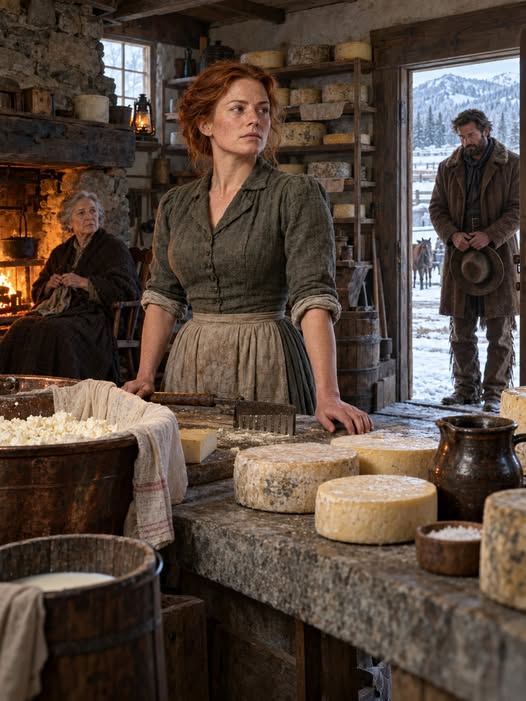
Annot lowered a rope.
It struck water.
Not deep.
Seven feet, perhaps eight.
Pleasance sat back on her heels.
For a moment neither woman spoke.
Then Annot began laughing.
Not because anything was solved.
Because after three days of being told what she did not own, what she could not use, and what Clayton Coverdale could take away, there was water beneath her own floor.
Pleasance laughed too.
They did not celebrate long.
The well had been sealed for almost twenty years.
The water might be fouled.
The stones might have shifted.
There was no bucket, no windlass, and no certainty it would produce enough for a working dairy.
Annot tied a clean jar to the rope and lowered it carefully.
When she brought it up, the water was clear.
Pleasance held the lantern close.
“No smell.”
“That proves nothing.”
“Your grandmother would have said the same.”
Annot looked at her.
Pleasance smiled.
“She was difficult.”
“I have been told.”
“You resemble her when someone tries to cheat you.”
“That has not been said kindly.”
“It was not always meant kindly.”
They boiled the first water before using it.
Then the second.
Then the third.
By midnight Annot had enough to scrub the stone table, wash two pails, and begin cooling the morning milk.
The batch was late.
The curd set unevenly.
Her arms shook by the time she filled the old press.
But the milk was not wasted.
At dawn she sat on the floor beside the press and listened to whey dripping into a bucket.
Pleasance had gone home two hours earlier.
Annot had not slept.
She looked at the knife on the table.
Her grandmother had worked in this room.
Not a story.
Not a memory.
Here.
At this stone.
With that knife.
Something about the knowledge steadied her.
By Thursday she had drawn nine usable cheeses from the first ten gallons.
Not beautiful cheeses.
Not yet.
Two cracked along the edge.
One pressed unevenly.
Another had caught too much heat and would have to be watched.
But they existed.
Annot scrubbed a shelf, laid them in a row, and turned each by hand.
Then she heard boots outside.
Rufus Jopling entered without knocking.
He looked first at the dry spring trough.
Then at the cheese shelf.
His face changed.
“How?”
Annot kept turning the cheese.
“Good morning, Mr. Jopling.”
He stepped farther inside.
“Where did you get water?”
“Here.”
“There is no water here.”
“There is now.”
His gaze traveled over the floor.
Annot had replaced the stone slab but left the iron ring exposed.
Jopling saw it.
He stared.
“That well was closed.”
“Yes.”
“By Coverdale.”
“Before my agreement.”
He looked at her sharply.
Annot wiped her hands.
“You leased me Low Garth for one year. Building and fenced yard.”
“That does not give you rights below the soil.”
“Then I suppose Mr. Coverdale may wish to explain which sentence in the agreement excludes a well inside the building.”
Jopling did not answer.
He had written the document himself.
Annot knew it.
He knew she knew it.
His eyes moved to the cheese again.
“You have no right to buy milk from Coverdale tenants.”
“I did not.”
“Whose?”
“That question does not belong to the lease.”
Jopling’s mouth tightened.
He left without another word.
Two hours later Clayton Coverdale arrived.
This time he came alone.
He entered the creamery and stopped before the shelf.
Nine cheeses.
Small.
Rough-edged.
Worth almost nothing yet.
But not stones.
Clayton looked at them for a long moment.
Then at the floor.
“You found the old well.”
“Yes.”
“You knew it was there?”
“No.”
“Who told you?”
“Pleasance Alderson remembered it.”
His expression sharpened.
“She is my tenant.”
“She did not sell me milk.”
“That is not what I asked.”
Annot placed another cheese onto the shelf.
Clayton walked toward the open press.
“You think this changes something?”
“It changes whether I have water.”
“You still have no herd.”
“I never planned to have one.”
His eyes narrowed.
“Then you intend to buy.”
“Yes.”
“From outside my land.”
“Yes.”
Clayton almost smiled.
“You will pay more for milk than Outhwaite does.”
“Yes.”
“Transport will cost you.”
“Yes.”
“You cannot make money that way.”
“Then I will fail.”
He studied her.
Perhaps he had expected pleading.
Perhaps anger.
He seemed almost offended by neither.
“You enjoy making this difficult.”
Annot looked at him.
“No. You enjoy making it difficult. I am merely continuing after you do.”
The smile vanished.
He turned and walked out.
That afternoon the first real obstacle arrived.
The Dinsdales could not continue ten gallons every day.
Their own butter trade required part of the milk, and one cow had gone lame.
Annot needed another supplier.
She had six shillings and fourpence less what she had spent on salt, cloth, and repairs.
She could not buy a cow.
Could not borrow from anyone Clayton controlled.
Could not promise cash she did not have.
So she began walking.
Not to Coverdale farms.
Beyond them.
Small freeholds.
Widows with two cows.
Hill families whose milk spoiled before it could reach the railroad cream buyer.
A shepherd with three Jerseys kept mostly for the household.
Annot told each one the truth.
She was making hard cheese.
She could pay one penny above Outhwaite’s rate.
Not immediately.
In six weeks on the first batches.
Longer on the larger wheels.
She would weigh every delivery in front of them.
Reject sour milk.
Record every gallon.
No secret deductions.
No forced exclusivity.
Some laughed.
Two shut the door.
One told her Clayton would crush her before Michaelmas.
Annot thanked him for his time.
By the end of the week she had promises totaling twenty-eight gallons every other day.
Not enough for profit.
Enough to continue.
Then Pleasance came again.
This time she brought three women.
Mrs. Iveson.
Mrs. Thwaite.
And Agnes Dinsdale.
All had learned at Low Garth when they were girls.
None could sell milk to Annot under their Coverdale leases.
But there was nothing in those leases forbidding them from entering her creamery.
“What do you want?” Annot asked.
Mrs. Iveson put a clean apron on the stone table.
“To see whether Barbary’s granddaughter knows how to salt curd properly.”
Annot stared at her.
Pleasance took off her shawl.
“Apparently we have concerns.”
They worked until evening.
No wages were offered.
Annot would not pretend otherwise.
They came because the old room meant something to them.
That first week, they corrected her twice.
The second week, once.
By the third, Annot corrected Agnes.
Pleasance smiled and said nothing.
Word traveled.
Not that Low Garth was successful.
It was too early for that.
Word traveled that the old creamery had smoke from its chimney again.
That women were working there.
That cheese sat on the shelves where mice had lived a month before.
That Clayton Coverdale had cut the spring and Annot Curtain had found water beneath the floor.
That story grew with each telling.
By September, Outhwaite noticed.
His clerk showed him milk figures from the surrounding freeholds.
Small quantities were disappearing.
Not enough to damage his contracts.
Enough to irritate him.
He rode to Low Garth with Clayton.
Annot was washing molds.
Outhwaite entered first.
“I hear you are paying above market.”
Annot did not look up.
“I pay what I agreed.”
“You are distorting prices.”
“With twenty-eight gallons every other day?”
“It starts somewhere.”
“So did your monopoly.”
Clayton’s face hardened.
Outhwaite smiled.
“You think that word frightens me?”
“No.”
Annot set the mold down.
“I think accurate words usually annoy the people they describe.”
Clayton moved between them before Outhwaite answered.
“Enough.”
Annot looked at him.
He looked around the creamery.
The shelves were fuller now.
Three rows.
Some cheeses small.
Some larger.
Each marked only by date scratches on the boards, not paper labels.
“You will not sell on Coverdale land,” Clayton said.
“I have not.”
“You will not solicit my tenants.”
“I do not.”
“No deliveries through my roads.”
Annot went still.
The easiest road from Low Garth to the railroad town crossed almost two miles of Coverdale property.
The old creamery lane joined it near the southern gate.
“You leased me access.”
“To Low Garth.”
“And from it.”
“To the boundary.”
Clayton knew what he was doing.
The alternative route to town was nearly five miles longer and climbed badly after rain.
Outhwaite watched her face.
There.
That was what they had come for.
Not law.
Cost.
Another little turn of the screw.
Annot dried her hands.
“Then I will use the other road.”
Clayton’s mouth twitched.
“You always say that.”
“What?”
“That you will simply do the harder thing.”
“No.”
She looked at him.
“I say I will do the available thing.”
The first cheese went to market in October.
Annot carried six wheels in a borrowed cart.
The longer road took almost two hours.
She arrived after better stalls had already been claimed.
A grocer offered less than the milk had cost.
She refused.
A hotel cook tasted one and bought two.
A railway porter bought a wedge for his wife.
A widow who kept lodgings asked whether Annot would return the following week.
She returned with eight wheels.
Then twelve.
The cheese was not extraordinary because of some secret recipe.
It sold because it was clean, consistent, firm enough to travel, and tasted like good milk rather than the sourness people had begun accepting from rushed production.
Annot improved it batch by batch.
She changed the salting.
Adjusted the press time.
Built a better drying rack from salvaged timber.
Pleasance showed her how Barbary had once wrapped the larger wheels in cloth to reduce cracking.
Annot tested it.
It worked.
Money began returning.
Slowly.
The first thing she did was pay Dinsdale.
Every penny.
He counted the coins twice.
“You could have carried this another fortnight.”
“I said six weeks.”
“You need a new pot.”
“I know.”
“You still paid me.”
“I know.”
By November, two more freeholders were delivering.
Annot bought a secondhand copper kettle with a dent along one side.
She hired Agnes Dinsdale two mornings a week.
Paid her.
Not much.
But in cash.
Pleasance refused wages.
“You could not afford me.”
Annot looked at her.
Pleasance looked offended.
Then they both laughed.
Clayton stopped laughing.
Outhwaite had begun complaining.
Not because Annot’s volume threatened his total purchases.
It did not.
Because his own customers had begun asking why her cheese was better.
His system rewarded volume.
Milk traveled farther.
Waited longer.
Was pooled more carelessly.
He paid low because Coverdale tenants had no choice.
Annot paid more because her suppliers did.
That difference entered the cheese.
Outhwaite blamed her.
Clayton blamed the gossip.
Rufus Jopling blamed women who ought to know better than to make business out of sentiment.
Then November turned cold.
One evening Annot found Pleasance waiting outside Low Garth.
Not alone.
Three Coverdale tenant wives stood with her.
Each carried a small cloth purse.
Annot frowned.
“What is this?”
Mrs. Iveson stepped forward.
“We want cheese.”
“You can buy Outhwaite’s at Coverdale store.”
“We know.”
“It is cheaper.”
“We know that too.”
Annot looked from one face to another.
Mrs. Thwaite opened her purse.
Coins.
Small ones.
Carefully saved.
“My husband says we should not cause trouble.”
“Then do not.”
“He also says your cheese is better.”
“That is not sufficient reason to risk your lease.”
Mrs. Thwaite’s face tightened.
“It is our money.”
Annot went quiet.
There it was.
Not rebellion.
Not revenge.
Choice.
The very thing Clayton had removed from their milk.
“We are not asking you to sell on Coverdale property,” Mrs. Iveson said.
“We walked here.”
Annot looked toward the dark road.
“You walked two miles?”
“Yes.”
“For cheese.”
Pleasance folded her arms.
“You sound surprised.”
Annot sold them three small wheels at market price.
No discount.
No secret gift Clayton could call inducement.
They paid.
Then they walked home carrying Low Garth cheese beneath their shawls.
The next week seven women came.
After that, eleven.
Then men began coming too.
A stable hand.
A shepherd.
Two tenant farmers.
They had almost no spare money.
That made the coins matter more.
Every purchase said the same thing without anyone needing to say it aloud.
They preferred to choose.
By the first week of December, Clayton knew.
He was standing inside the Coverdale store when one tenant family walked past the front window.
Father.
Mother.
Two daughters.
The man had just collected his monthly account settlement.
Coins were in his hand.
The store sold Outhwaite cheese.
He did not enter.
The family kept walking downhill toward Low Garth.
Clayton watched them until they disappeared beyond the wall.
Jopling stood behind him.
“This is becoming deliberate.”
Clayton said nothing.
“They want you to see.”
Clayton turned.
“No.”
Jopling blinked.
Clayton looked back through the window.
“They want to buy her cheese.”
For the first time, something in his voice sounded less like anger than realization.
Jopling disliked it.
“The distinction is meaningless.”
“No.”
Clayton had spent his life understanding land through control.
Who leased.
Who grazed.
Who delivered.
Who owed.
Who depended.
He had believed dependence was loyalty because both produced obedience.
Now his own tenants were spending scarce coins to walk past his store.
Not because Annot had promised them anything.
Not because she had incited them.
Because something made with freely purchased milk had become better than something made from milk people were compelled to sell.
That irritated Clayton more than defiance would have.
Defiance could be punished.
Quality was harder.
On December twentieth, Outhwaite made his final attempt.
He rode to Low Garth before dawn.
Annot was turning cheeses in the aging room.
Agnes had not yet arrived.
He closed the door behind him.
“I will buy you out.”
Annot kept working.
“No.”
“You have not heard the offer.”
“No.”
“You are becoming repetitive.”
“So are you.”
He walked between the shelves.
“Twenty pounds.”
Annot looked at him then.
It was more money than she had seen at once in years.
He knew that.
“Thirty.”
Her stomach tightened.
With thirty pounds she could leave Coverdale entirely.
Buy two cows somewhere else.
Rent a proper dairy.
Never sleep under a patched creamery roof again.
Outhwaite watched her calculate.
“Forty.”
Annot set down the cheese she held.
“What do you want?”
“Your remaining lease. Equipment. Stock.”
“And?”
“You stop buying milk in the district for three years.”
There.
Not Low Garth.
Her.
He did not want the creamery.
He wanted the competition gone.
Annot wiped her hands slowly.
“You told Clayton I had no cow.”
“You don’t.”
“You laughed because I had no water.”
“You found some.”
“You blocked the road.”
“You found another.”
Outhwaite’s patience thinned.
“That is business.”
“No.”
Annot looked at him.
“That is the part you misunderstand.”
She gestured toward the shelves.
“This is business.”
He followed her hand.
Cheese.
Rows of it.
Milk bought by agreement.
Labor paid when she could afford to pay it.
Suppliers who could walk away.
Customers who could do the same.
Outhwaite’s face went cold.
“You think virtue makes profit?”
“No.”
“Then what are you proving?”
Annot considered that.
“Nothing to you.”
She opened the door.
“You should go.”
His eyes narrowed.
“Your lease ends in spring.”
“In four months.”
“Coverdale will not renew.”
“I know.”
“What happens then?”
“That question belongs to me.”
He left.
But after he was gone, Annot sat down.
For the first time in months, fear entered cleanly.
He was right.
Christmas success did not solve April.
Low Garth was not hers.
The well was not hers.
The fenced yard was not hers.
She had built something on borrowed ground.
Clayton could take the key back.
That evening Pleasance found her sitting beside the old press.
“You look like Barbary did the year the cattle fever came.”
“That cannot be good.”
“She looked terrible.”
Annot laughed once.
Then told her.
Pleasance listened.
“What will you do?”
“I do not know.”
“That is unusual.”
“I am trying it for variety.”
Pleasance sat beside her.
“Your grandmother never owned this place either.”
Annot turned.
“What?”
“She ran it.”
“For Coverdale.”
“At first.”
Pleasance looked toward the old well.
“Then the women ran it together. Milk from six holdings. Sometimes ten. Nobody called it theirs because nobody had a word for what it was.”
“A cooperative.”
“If you like long words.”
Annot stared at the floor.
Pleasance continued.
“Barbary kept books. Every family had its milk marked. Cheese sold together. Money divided by contribution after expenses.”
“What happened?”
“Old Mr. Coverdale bought most of the surrounding farms. Leases changed. Families left. The creamery closed.”
Annot looked around.
“What happened to the books?”
Pleasance shrugged.
“Your grandmother kept everything.”
They searched until midnight.
Nothing.
Christmas Eve came cold and bright.
Annot opened Low Garth before sunrise because orders waited.
Agnes arrived carrying holly.
Annot objected.
Agnes ignored her.
By nine, buyers began coming.
Not crowds.
Families.
Workers.
A schoolmistress from the next parish.
The hotel cook.
Two railroad men.
Freeholders.
Coverdale tenants.
Coins clicked onto the stone table.
Small money.
Earned money.
Chosen money.
Near noon a horse stopped outside.
Clayton entered.
Conversation died.
He removed his gloves.
No one moved.
Annot stood behind the stone table.
For a moment the scene resembled the day he had given her the key.
Only nothing else was the same.
The roof was sound over the working half.
Copper shone above the hearth.
Cheeses lined clean shelves.
The press worked.
The well rope hung neatly from its hook.
And Clayton’s tenants stood inside with Low Garth cheese in their hands.
Clayton saw all of it.
Then his eyes found Annot.
“I believe this is mine.”
He held out one hand.
For the key.
Several people stiffened.
Annot did not.
“The lease ends in April.”
“I know.”
“Then why are you asking now?”
“I am not.”
Clayton looked at the room.
“I am reminding you.”
Annot reached into her apron pocket.
She took out the rusted key.
Everyone watched.
Then she placed it on the stone table between them.
Clayton’s expression changed.
“What are you doing?”
“You wanted it back.”
“In April.”
“I know.”
“Then why give it now?”
Annot looked around Low Garth.
Because the answer had become clear during the night.
“I do not need the key to prove this worked.”
Silence.
Clayton stared at her.
Annot continued.
“You gave me a ruin because you believed the building was the value.”
She touched the stone table.
“It wasn’t.”
Her eyes moved to Pleasance.
Agnes.
The Dinsdales.
The tenants.
“It was knowledge. Milk. Work. Trust. People choosing where to sell and where to buy.”
Clayton’s face hardened.
“And where exactly will you put all that when I take the building?”
“I don’t know yet.”
The honesty struck harder than confidence would have.
“I may rent somewhere else. I may build. I may fail.”
She looked at him.
“But Low Garth will be empty again.”
Clayton glanced around.
That truth was visible.
The machinery belonged mostly to Annot now.
The suppliers belonged to no one.
The buyers could not be leased.
The knowledge could not be locked inside a building.
Clayton could take Low Garth.
He could not take what made it alive.
Then Pleasance spoke.
“There is something you should see.”
She walked to the rear wall.
In her hand was a small leather ledger.
Annot stared.
“Where did you get that?”
“Under my bed.”
“You said you did not know where the books were.”
“I said Barbary kept everything.”
Pleasance laid it on the stone table beside the key.
“I never said she kept them here.”
Annot opened it.
Her grandmother’s handwriting.
Milk weights.
Names.
Expenses.
Cheese sales.
Payments divided among families.
Page after page.
Near the back, one entry had been underlined twice.
Low Garth Improvement Fund.
Small sums.
Weekly.
Saved toward purchasing the creamery from the Coverdale estate.
Annot looked at Pleasance.
“They meant to buy it.”
“Yes.”
“What happened?”
“Your grandmother became ill. Two families left. Then the new leases came.”
Clayton had gone very still.
Pleasance looked at him.
“Your grandfather refused the sale.”
No accusation.
Only history.
Clayton looked down at the rusted key.
Something changed in his face.
Not shame exactly.
Recognition.
A pattern old enough to have become inheritance.
He picked up the key.
Everyone watched.
Then he turned it once between his fingers.
“How much?”
Annot frowned.
“How much what?”
“For Low Garth.”
No one breathed.
Annot stared at him.
“I have almost nothing.”
“I did not ask what you have.”
He looked around the creamery.
“How much is it worth?”
She understood slowly.
He was not offering a gift.
Good.
She would not have taken one.
“The building?”
“The building, fenced yard, well, and permanent access by the lower road.”
Annot considered.
Clayton named a figure.
Too high.
She said so.
He lowered it.
Still high.
She countered.
Jopling, who had entered unnoticed behind him, looked scandalized.
Clayton ignored him.
They argued for twenty minutes in front of half the valley.
Roof condition.
Wall repairs.
The value of the well.
The ruined eastern room.
Road rights.
Drainage.
By the end, Clayton named a price Annot could not pay immediately but might manage across five years.
“No milk restrictions,” she said.
“This sale would have nothing to do with milk.”
“In writing.”
“Yes.”
“Permanent right to the lower road.”
“Yes.”
“Water below the building included.”
“Yes.”
“And if I miss one installment?”
“Thirty days to correct it.”
“Sixty.”
“Forty-five.”
“Done.”
Clayton held out his hand.
Annot looked at it.
Then shook.
Jopling made a sound.
Clayton turned.
“Write it.”
“Mr. Coverdale—”
“Write it.”
Jopling looked at the tenants.
At the cheese.
At the key.
Then opened his book.
Annot did not smile until Clayton had left.
When she finally did, Agnes began crying.
Pleasance told her to stop because tears near cheese were unsanitary.
Everyone laughed.
After Christmas, the changes spread slowly.
Not because Annot set out to reform Coverdale.
She did not.
She had cheese to make.
But Clayton changed the milk agreement the following spring.
Not completely.
Outhwaite remained buyer for much of the ranch milk.
But exclusivity ended.
Families could reserve a stated amount for outside sale after household use.
Prices had to be posted in advance.
No tenant could be removed merely for selling to another lawful buyer.
Outhwaite objected.
Clayton let him.
That surprised everyone.
Most of all Outhwaite.
Annot bought milk from some Coverdale families.
Not all.
She refused poor milk regardless of friendship.
She rejected one delivery from a tenant who had publicly defended her at Christmas.
The man looked offended.
Annot pointed to the pail.
“It is sour.”
“You bought from Iveson yesterday.”
“Iveson’s was clean.”
“So that is how it is?”
“That is exactly how it is.”
He left angry.
He returned three days later with clean milk.
Low Garth grew.
Carefully.
Never quickly.
Annot added a second press.
Then a third.
Agnes became full-time.
Two younger girls apprenticed under Pleasance, who continued insisting she was retired while appearing six mornings a week.
Annot purchased the creamery outright in four years instead of five.
On the day she made the final payment, Clayton rode down alone.
She met him outside.
He carried no witnesses.
No Jopling.
No black gloves.
Only the old rusted key.
Annot looked at it.
“I already have one.”
“The copy.”
He held out the original.
“The estate kept it.”
She took it.
For a moment they both remembered the rain.
The crowd.
His laughter.
“Milk the stones,” Annot said.
Clayton’s face tightened.
“I said that.”
“You did.”
“I was cruel.”
“Yes.”
He looked toward the creamery.
“I thought giving you something useless would settle what I owed.”
Annot waited.
“It did not.”
“No.”
He nodded.
There was nothing to forgive merely because he had finally named it.
And he did not ask.
That mattered too.
“You built well,” he said.
Annot looked at him.
“No.”
Clayton frowned.
She turned toward the open doorway.
Inside, Agnes was arguing with a supplier.
Pleasance was teaching a girl how to cut curd.
On the shelves stood wheels made from milk brought by families who could now choose where to sell.
“We built well.”
Clayton followed her gaze.
Then nodded.
Years later, people told the story badly.
They said a fired dairywoman had been paid with a ruined creamery and somehow turned it into the richest cheese business in the valley.
That was not true.
Low Garth never made Annot rich in the way Clayton Coverdale was rich.
It made enough.
Then more than enough.
It paid wages.
It bought milk fairly.
It survived weak summers.
It kept reserves against winter.
It eventually bought a wagon.
Then another.
Its cheeses reached the railroad town, then two counties beyond.
But the thing Annot valued most never appeared in any account.
Every Christmas Eve, tenant families still walked past the Coverdale store.
Some bought there.
Some did not.
That choice was the point.
At Low Garth they came through the door with coins in their hands.
Not because anyone required them.
Not because a lease directed them.
Not because Annot had rescued them.
They came because they wanted what she made.
One Christmas, many years after the first, Annot stood beside the stone table holding Barbary Curtain’s old knife.
A young apprentice beside her was cutting her first curd.
Her hand shook.
Annot put two fingers against the girl’s wrist.
“Do not force it.”
“I’m trying not to spoil it.”
“You will spoil some.”
The girl looked alarmed.
Annot smiled.
“Everyone does.”
Across the room, Pleasance—older now, seated because her knees had finally defeated her argument that chairs encouraged laziness—laughed.
Outside, cold water ran through the restored stone trough.
Annot had reopened the spring after purchasing Low Garth, not because she needed it anymore, but because she wanted water visible where Clayton had once believed he could stop the work by cutting it off.
The well remained too.
She kept both.
One as convenience.
One as memory.
Above the creamery door hung the rusted key.
Not polished.
Not framed.
Simply hung from an iron peg where everyone could see it.
When strangers asked why she kept an old key that no longer fitted the newer lock, Annot usually gave the shortest answer.
“It opened more than he intended.”
Then she returned to work.

