
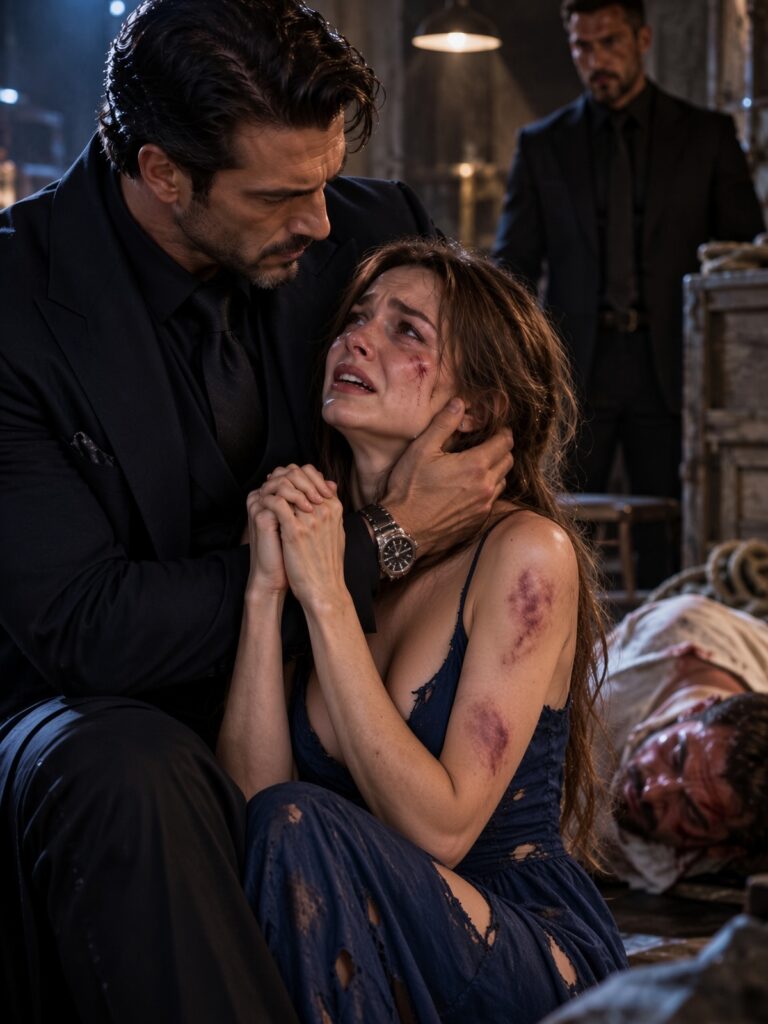
Dominic Ashford entered an abandoned waterfront warehouse expecting to collect a debt—and found a woman chained to a concrete pillar, blood dried in her hair, whispering, “Just kill me quickly.”
He should have walked away, because saving a stranger from Vincent Caldwell’s men meant inheriting whatever secret they had nearly destroyed her to protect.
Seventeen days later, Dominic would stand in her bedroom and ask one question that changed the war completely: “Are you FBI?”

PART 1 — THE WOMAN CALDWELL LEFT CHAINED IN THE DARK
The warehouse smelled of wet concrete, rust, and old rain.
Dominic Ashford recognized the building type immediately. Forgotten industrial property near the river, surrounded by rail lines and vacant lots, useful precisely because nobody respectable had any reason to be there after midnight.
He had come for Terrence Cole.
Cole had spent seven months manipulating freight records, stealing from Ashford-controlled routes, and directing suspicion toward Dominic’s people. Dominic had waited until three independent sources confirmed it before responding.
He never rushed anger.
Anger was expensive when used carelessly.
Marco DeLuca walked half a step behind him, fifty-one years old, broad shouldered, silver beginning at his temples. Two other men spread through the warehouse without instruction, checking side rooms while rain tapped against broken skylights.
Then Dominic stopped.
Terrence Cole was not there.
A woman was.
She had been chained upright to a concrete support column near the rear wall.
Her wrists were torn where metal had rubbed against them. One eye was swollen shut, her shirt had been ripped at one shoulder, and bruises darkened the skin along her arms and collarbone.
The injuries were not random.
That bothered Dominic most.
Someone had taken time.
“Caldwell,” Marco said quietly.
Dominic walked forward.
The woman heard him.
Her reaction was immediate.
She twisted against the chains, trying to press herself into the concrete as though becoming smaller might protect what remained of her.
Dominic stopped several feet away.
He crouched.
“Hey.”
Her good eye opened.
Dark brown.
Feverish.
Still alert enough to measure him.
Then she whispered:
“Just kill me quickly.”
Marco’s jaw hardened.
Dominic said:
“No.”
Her lips trembled.
“I can’t go back.”
“You’re not going back.”
“You don’t understand.”
“I understand enough.”
She tried laughing.
Pain stopped it.
“He’ll come back.”
“Who?”
Silence.
Dominic looked at the chain.
Then at Marco.
“Cut her loose.”
Marco did not move immediately.
“Dominic.”
“Cut it.”
The bolt cutter snapped through the first link.
The woman’s arms dropped when the chain released.
A small cry escaped her before she could stop it.
Dominic removed his coat and placed it around her shoulders.
She stared down at the black wool as though unsure what kind of trap kindness represented.
“Can you stand?”
“I think so.”
She could not.
Her knees folded after one step.
Dominic caught her.
Her entire body locked.
Not merely frightened.
Conditioned.
“Look at me.”
She didn’t.
“I’m not the man who did this.”
No response.
“And I’m not taking you back to him.”
Slowly, some fraction of the rigidity left her muscles.
Dominic lifted her.
She was lighter than he expected.
Too light.
Behind them, one of his men said the building was clear.
No Cole.
No Caldwell crew.
Only restraints, a stained table, several abandoned water bottles, and the woman Dominic now carried toward the exit.
Outside, rain swept across the loading yard.
Felix opened the SUV door.
Dominic lowered her carefully into the back seat.
Her fingers immediately gripped the frame.
“Where are you taking me?”
“Somewhere with a doctor.”
“Police?”
“No.”
That made her look at him properly for the first time.
Something shifted behind her eye.
Recognition.
Calculation.
“What’s your name?”
“Ash.”
Her breathing stopped for half a second.
“Ashford?”
Dominic said nothing.
She leaned back against the seat.
“Oh.”
That single word held more knowledge than it should have.
Dominic closed the door.
And as the SUV pulled away from the warehouse, he looked at the battered stranger beside him and understood that finding her had not interrupted his war with Vincent Caldwell.
It had just revealed that the real war had already begun.
PART 2 — HE THOUGHT HE HAD RESCUED CALDWELL’S PRISONER. THEN SHE CONFESSED WHO SENT HER.
The Ashford estate stood fourteen miles outside the city behind old stone walls disguised by ivy and trees.
People called it a mansion.
Dominic called it infrastructure.
Security cameras covered the property without being obvious. The gates looked decorative but were reinforced. A separate west wing allowed visitors to stay without entering the private residence or operational areas of the house.
The woman was taken there.
Dr. Adrian Reinhardt arrived forty minutes later.
He had treated Ashford men for nearly two decades and possessed the weary bedside manner of someone who had long ago accepted that his patients rarely told him how injuries happened.
He spent nearly an hour inside the guest suite.
When he came out, he found Dominic waiting against the opposite wall.
“Three fractured ribs.”
“Both wrists badly lacerated.”
“Mild concussion.”
“Significant dehydration.”
He removed his glasses.
“There’s also nerve irritation in the left hand.”
“Permanent?”
“Too early.”
“What else?”
Reinhardt hesitated.
“Whoever did this wasn’t losing his temper.”
Dominic already knew.
“He wanted information.”
“Yes.”
The doctor lowered his voice.
“She’s been under sustained physical stress for a while.”
“How long?”
“I can’t tell you from one examination.”
“Days?”
Reinhardt looked toward the closed bedroom door.
“Some injuries are older.”
Dominic’s jaw tightened.
“She needs rest.”
“No interrogations.”
“That includes whatever version you call conversation.”
“Two weeks minimum.”
“I heard you.”
“You usually hear me.”
Reinhardt picked up his bag.
“You rarely listen.”
That night Dominic tried to return to ordinary work.
There was nothing ordinary left in it.
Freight disputes.
Union negotiations.
A nightclub manager skimming receipts.
One of his lieutenants requesting approval for a property acquisition.
All solvable.
All familiar.
Yet the sentence from the warehouse returned between phone calls.
Just kill me quickly.
By three in the morning, Dominic gave up pretending he was tired enough to sleep.
He stood at the library window holding bourbon he never drank and tried to decide why he had brought her home.
Saving her complicated everything.
Caldwell would notice she was missing.
If Caldwell believed Ashford had extracted her, the rivalry changed from financial pressure into something personal.
Dominic should have delivered her anonymously to a hospital.
He had not.
That fact remained irritatingly resistant to analysis.
On the third morning, he knocked on the guest-room door.
One knock.
Then waited.
“Come in.”
The woman sat propped against the headboard wearing a charcoal sweater Agnes had brought from the household supply closet.
The swelling around her eye had improved.
Both wrists were wrapped.
She looked less close to death.
And considerably more difficult.
“I want to leave.”
“Good morning.”
“I said I want to leave.”
Dominic sat near the door.
“You can barely breathe deeply without pain.”
“I can breathe.”
“That isn’t the same standard Reinhardt uses.”
Her eyes narrowed.
“You always ignore what people ask?”
“Frequently.”
“Comforting.”
He almost smiled.
Almost.
“Name.”
She hesitated.
“Evelyn Harper.”
“Real?”
Her gaze sharpened.
“Are we doing background checks now?”
“Evelyn.”
“Yes.”
He let the lie sit.
Not because he knew it was one.
Because something about the way she answered told him truth would be negotiated inch by inch.
“How do you know Vincent Caldwell?”
“I worked for him.”
“Doing?”
“Administrative support.”
Dominic looked at her hands.
Even injured, they were unusually controlled.
An administrator who checked exits every time the door opened.
Who had recognized the Ashford name while half-conscious.
Who had stayed alive through deliberate interrogation for several days.
“What kind of administration gets you chained inside a warehouse?”
“The kind where you learn things your employer prefers you not to know.”
“What things?”
Her shoulders tightened.
“Nothing I’m giving you.”
“All right.”
She stared.
“You really like that phrase.”
“It saves time.”
“Am I your prisoner?”
Dominic considered.
“You’re under protection.”
“That’s a prettier word.”
“Practically, there are similarities.”
“At least you admit it.”
“Caldwell’s people are watching several roads.”
“You have no money.”
“No identification I’ve verified.”
“No phone.”
“You are injured.”
“If you walk through that gate this morning, your odds become unpleasant.”
“And you decide when they’re pleasant again?”
“Yes.”
Her mouth hardened.
“I don’t like you.”
“That’s manageable.”
Something flickered in her face.
Annoyance.
Then the smallest surprise.
He stood.
“Reinhardt is coming this afternoon.”
“Agnes will bring food.”
“Stay out of the east operational wing.”
She leaned back.
“Or what?”
Dominic opened the door.
“Or Marco will follow you around looking offended.”
That earned him the first hint of reluctant amusement.
He left before it became anything else.
Evelyn violated the east-wing restriction the next day.
Not dramatically.
She simply appeared in the library.
Calvin Pierce, Dominic’s security director, found her standing barefoot in front of a bookcase reading a volume on criminal procedure.
He called Dominic.
“She’s in the east library.”
“Reading?”
“Yes.”
“Is she opening safes?”
“No.”
“Leave her alone.”
“Sir.”
“Calvin.”
A pause.
“Understood.”
The following morning, Agnes found Evelyn in the kitchen making coffee at 5:52.
The old housekeeper later reported that Evelyn had somehow identified the correct beans, grinder, and machine without anyone showing her.
“She watches.”
Agnes said.
“Everyone watches.”
“Not like her.”
Dominic looked up.
“How?”
“Like a woman measuring a room.”
That joined several other details Dominic had already noticed.
Evelyn remembered every name after hearing it once.
She always selected chairs with clear sightlines.
She never stood with her back to a doorway.
When a helicopter crossed the estate unexpectedly one afternoon, she looked up before everyone else and automatically tracked its direction.
Administrative assistant.
Perhaps.
On day seven, she attempted escape.
Calvin called Dominic shortly after dawn.
“West garden.”
Dominic found Evelyn standing three hundred yards from the house between two security officers.
No one touched her.
Good.
She wore borrowed running shoes and a dark jacket.
Her face carried no embarrassment.
Only irritation that the attempt had failed.
“You made it farther than I expected.”
she said.
Dominic stopped in front of her.
“That was praise.”
“I don’t need praise.”
“You need antibiotics.”
“I’m leaving.”
“You’re not.”
Her expression chilled.
“You said under protection.”
“Yes.”
“This is detention.”
“Then let’s call it protective detention if terminology improves your morning.”
One security officer looked away to hide his expression.
Evelyn folded her arms.
“Why do you care?”
The question was not hostile.
That unsettled him more.
He answered with the safest version.
“Caldwell left you chained in a building on territory he knew I monitor.”
“If he wants you badly enough to do that, you matter.”
“Anything connected to Caldwell’s interest affects me.”
“So I’m useful.”
“Yes.”
Her expression changed.
Something closed.
Dominic saw it.
He almost corrected himself.
Instead:
“And because leaving you there would have been wrong.”
She looked back at him.
That mattered more.
It irritated him that it mattered more.
“Come inside.”
After a moment, she did.
The escape attempt changed the rules.
Not officially.
Dominic simply stopped pretending confinement would make her cooperative.
He allowed her greater movement inside the estate, provided she remained inside the perimeter.
She accepted.
Not gracefully.
But she accepted.
The evenings became the strangest part.
Dominic worked late in the library.
Evelyn slept badly.
At first they occupied opposite ends of the room and ignored each other.
Then one night, without looking up from a book, she asked:
“Terrence Cole.”
Dominic stopped writing.
“What about him?”
“He was why you were at the warehouse.”
“Yes.”
“Did you find him?”
“No.”
“And the man who tortured me?”
“He won’t bother you again.”
Her page stopped turning.
“Did you kill him?”
Dominic looked at her.
“You asked whether he would return.”
“I answered.”
“That isn’t an answer.”
“It is the answer I’m giving.”
She studied him.
Perhaps she should have looked horrified.
Instead, she nodded.
Then said:
“The warehouse was one of three.”
Dominic’s pen stopped.
“Three?”
“Caldwell rotates personnel through secondary sites every ten days.”
She gave him two addresses.
“What do you want for that information?”
“Nothing.”
“Why give it?”
She looked back at the book.
“Because I hate him more than I distrust you.”
He wrote down the addresses.
Something shifted between them.
Not trust.
The possibility that trust might someday become less absurd.
Seventeen days after the warehouse, Marco entered Dominic’s study carrying a surveillance photograph.
“We caught two Caldwell men near County Road.”
Dominic looked.
“How close?”
“Twelve miles.”
“Reconnaissance.”
“Likely.”
Marco put down another file.
“And one of our inside sources says Caldwell is telling everyone the woman is FBI.”
Dominic looked up.
“He has proof?”
“Claims communications intercepts.”
The library conversations.
The exits.
The controlled movements.
The flawless memory.
Pieces rearranged themselves.
Coldly.
Painfully.
Dominic stood.
The walk to the west wing felt longer than usual.
He entered Evelyn’s room without knocking.
She sat beside the window.
The moment she saw his face, her posture changed.
Not fear.
Recognition that the hour she had known would arrive finally had.
Dominic stopped in the center of the room.
“Are you FBI?”
Two seconds.
No performance.
No insult.
No denial.
Evelyn lifted her chin.
“Yes.”
The word struck harder than Dominic expected.
He remained silent.
She had prepared for anger.
He saw that immediately.
She was braced for shouting.
Threats.
Violence.
Dominic gave her none.
“How long?”
“Undercover?”
“Yes.”
“Three years.”
“Inside Caldwell’s operation.”
“Yes.”
“Was Ashford part of your assignment?”
Her eyes shifted.
That was enough.
“Answer.”
“Yes.”
Dominic turned toward the window.
The grounds beyond it were washed in late-afternoon rain.
“And after I pulled you out?”
“My standing directive required me to assess your organization if opportunity arose.”
He laughed once.
No humor.
“The injured woman in my guest room was running an intelligence assessment.”
“At first.”
He turned.
“At first.”
Evelyn’s professional composure developed a crack.
“The situation changed.”
“For whom?”
“For me.”
Silence.
He crossed to the door.
“Dominic.”
He stopped.
“I didn’t send reports from here.”
“Because you couldn’t?”
“Initially.”
“And later?”
She looked at him.
“I chose not to.”
“Why?”
The answer came too slowly.
Not because she lacked one.
Because she had too many.
Dominic opened the door.
“I need time.”
Her face tightened.
“Am I locked in?”
“Tonight.”
“Then your answer to whether I’m a prisoner is finally clear.”
He looked back.
“You lied to me for seventeen days.”
“I lied because telling you I was federal could have gotten me killed.”
“And now?”
Her eyes held his.
“Now I’m afraid not telling you the rest might get you killed.”
That stopped him.
Dominic turned fully.
“What rest?”
Evelyn exhaled.
“My cover didn’t fail by accident.”
“Someone inside the bureau gave Caldwell information only my supervisors had.”
Dominic’s expression changed.
“And if Caldwell knows I’m here, whoever burned me may know too.”
“Meaning?”
She stood despite the pain in her ribs.
“Meaning Vincent Caldwell may not be the only enemy moving toward this house.”
Dominic stared at her.
For seventeen days, he had been deciding whether Evelyn Harper was a victim, an asset, a liar, or something far more dangerous.
Now he understood the answer.
She was all four.
And somewhere outside the Ashford estate, someone inside the federal government had just learned their missing undercover agent was alive.
PART 3 — SHE WAS SENT TO DESTROY HIS EMPIRE. INSTEAD, SHE FOUND THE MAN WHO HAD SACRIFICED HER FIRST.
Dominic unlocked the door at 6:47 the next morning.
Evelyn had not slept.
Neither had he.
Calvin escorted her to the main study.
Unlike the library, the study had never been casual territory.
Operational meetings happened there.
Decisions happened there.
Dominic stood beside the windows with both hands behind his back.
“Sit.”
She did.
He turned.
“Talk.”
So Evelyn finally stopped rationing the truth.
The operation began three years earlier.
Vincent Caldwell’s network moved people, cash, and contraband through legitimate logistics companies across several states.
The Bureau wanted an inside source.
Evelyn had experience in financial investigations, language training, and undercover fieldwork.
Her cover identity placed her inside one of Caldwell’s administrative companies.
For nearly three years, she collected.
Accounts.
Routes.
Payoffs.
Personnel.
Front companies.
Then four months earlier, something went wrong.
“An intercepted communication.”
she said.
“It contained operational details.”
“Enough for Caldwell to identify me.”
“Where did it originate?”
“My field office.”
Dominic’s face hardened.
“They burned you.”
“I didn’t know who.”
“And your handler?”
“Special Agent Dennis Marsh.”
“Trusted?”
“For six years.”
“He knew Caldwell had you?”
Evelyn’s silence returned.
Dominic leaned forward.
“Did he know?”
“Yes.”
The word almost disappeared.
Dominic stood.
“Your own people knew you were being held.”
“They believed extracting me immediately would compromise the case.”
He stared.
She continued because stopping was worse.
“Caldwell thought he controlled me.”
“As long as I remained alive, he continued operating.”
“The Bureau kept surveillance around the network.”
“For how long?”
“Four months.”
Something dangerous entered Dominic’s stillness.
“He tortured you for four months.”
“Not continuously.”
“Do not defend them with technicalities.”
She looked down.
“They decided I was more useful inside.”
“Alive?”
“Useful.”
The distinction sat between them.
Dominic’s hand tightened around the back of the chair.
“And once I pulled you out?”
“My standing instructions were to gather anything possible on Ashford operations.”
“How convenient.”
“Dominic.”
“What?”
“I’m telling you because I’m done following that directive.”
“Why?”
She held his gaze.
“Because the people who gave it to me left me inside a room with Caldwell for four months.”
“And because you didn’t.”
Dominic said nothing.
She continued:
“You found me by accident.”
“You had no operational reason to save me.”
“Saving me made your life harder.”
“You did it anyway.”
His expression changed by less than a degree.
Enough.
“I don’t know what I am to you.”
she said.
“I know what they decided I was.”
“A disposable intelligence asset.”
“I’d rather be useful to the man who carried me out than useful to the people who decided I could stay there.”
Dominic walked to the window.
Rain had stopped.
Autumn light crossed the gardens.
“What do you want?”
The question shocked her.
“Excuse me?”
“Everyone keeps deciding what you are.”
“Caldwell.”
“The Bureau.”
“Me.”
His eyes came back to her.
“What do you want?”
Evelyn thought.
“Stay alive.”
“Good.”
“Expose whoever burned me.”
“Possible.”
“Finish Caldwell.”
Dominic’s jaw moved.
“Likely.”
“And after?”
“I don’t know.”
He nodded.
“Honest.”
She almost smiled.
He opened the door.
“You have free movement inside the estate.”
“The perimeter remains closed.”
“So, half trust.”
“Quarter.”
“Generous.”
He paused.
“One condition.”
“What?”
“No more operational lies.”
She looked at him.
“Same condition for you.”
“That may be harder.”
“I know.”
He almost smiled.
The next week altered the estate.
Evelyn was no longer treated as a guest.
Not exactly.
Nor was she fully trusted.
Marco made certain she understood that.
When she entered a room, his eyes followed.
When she asked a question, he remembered it.
When she suggested a change, he demanded evidence.
She respected him more for it.
One afternoon Dominic called her into the study.
Marco stood beside the desk.
On the laptop screen was a grainy photograph taken inside a parking structure.
Evelyn recognized the first man immediately.
Dennis Marsh.
Her handler.
Her throat tightened.
The second man was unfamiliar.
“Who?”
Dominic said:
“Hargrove.”
“Caldwell’s external communications director.”
Evelyn stared.
“Source?”
“Our surveillance.”
“They met twice.”
“When?”
“Past ten days.”
Evelyn did the math.
After she disappeared from Caldwell.
After she arrived at Ashford.
“What were they exchanging?”
“We don’t know.”
Marco watched her carefully.
She barely noticed.
Marsh had been the one person inside the Bureau she had trusted without qualification.
The man who recruited her.
Trained her.
Told her not to become emotionally attached to cover identities.
The man who had said four months earlier:
Hold position. We are working extraction.
“Maybe he was looking for me.”
she said.
Marco’s eyes narrowed.
“Meeting Caldwell’s communications chief?”
“He wouldn’t contact Caldwell openly.”
“Would he?”
“I don’t know.”
She hated saying it.
Dominic said:
“Your face says you’ve wondered about him before.”
She looked at him.
“Not Marsh.”
“Someone.”
“Who?”
She walked toward the photograph.
“The intercept that exposed me contained details Marsh didn’t control.”
“Operational extension dates.”
“Financial-protection authorizations.”
“That information sat above him.”
“How high?”
“Regional command.”
Dominic folded his arms.
“Names.”
“Assistant Director Raymond Coyle.”
“Two supervisory agents under him.”
“Marsh.”
She paused.
“But if Marsh were compromised, Caldwell would not need Hargrove meeting him in a garage now.”
Marco leaned toward the screen.
“Explain.”
“If Marsh were already theirs, they would use cleaner channels.”
“This looks like assessment.”
“Or recruitment.”
“Or bait.”
Dominic watched her.
“Meaning someone may want you to think Marsh is compromised.”
“Yes.”
“What about Coyle?”
“He signed every extension keeping me undercover.”
Marco muttered:
“Including while Caldwell had you.”
Evelyn’s face hardened.
“Yes.”
The breakthrough came at 5:40 three mornings later.
Calvin woke Evelyn.
“Study.”
She knew before reaching it that something had happened.
Dominic stood beside the desk.
Marco was there.
An analyst sat before an audio waveform.
“Play it.”
Dominic said.
Dennis Marsh’s voice filled the room.
Evelyn knew it instantly.
The recording was a conversation with another man.
At first, ordinary coded operational language.
Then dates.
Decisions.
References to keeping “the Harper asset” in place.
The second man said:
Caldwell needs to believe she’s burned completely. Once he pushes harder, Ashford will react.
Marsh answered:
You’re gambling with her life.
I’m following the approved structure.
The second man laughed.
The structure is mine. You follow orders.
Evelyn’s blood turned cold.
The analyst stopped playback.
“We voice-matched the second speaker.”
A name appeared.
ASSISTANT DIRECTOR RAYMOND COYLE.
She stared.
The audio continued.
Coyle discussing how Evelyn’s cover failure would create pressure on Caldwell.
How her eventual rescue—or disappearance—could become leverage against Ashford.
How an emergency federal inquiry could be timed alongside Caldwell retaliation.
Dominic looked at her.
“Your operation wasn’t meant to take down Caldwell.”
“No.”
Her voice sounded far away.
“Caldwell was the entry vehicle.”
“For what?”
She turned toward Dominic.
“You.”
The room stilled.
“Coyle wanted an undercover path into Caldwell because Caldwell’s network overlapped yours.”
“He positioned me there knowing that if my cover failed, one of two things happened.”
“Caldwell killed me and blamed Ashford.”
“Or Ashford interfered and gave Coyle probable cause to start building a federal conspiracy case around both organizations.”
Marco swore.
Evelyn kept going.
“Caldwell was never the finish line.”
“You were.”
Dominic’s eyes became very cold.
“And you?”
She looked at the audio file.
“I was the fuse.”
No one said anything.
Then Calvin’s voice came through the secure line.
“Three vehicles moving on the eastern road.”
Dominic turned.
“Distance?”
“Under four miles.”
“Caldwell?”
“Likely.”
Evelyn crossed toward the estate map.
“Coyle is moving too.”
Marco looked at her.
“How do you know?”
“Because this only works if Caldwell hits first.”
“He creates armed chaos.”
“Then Coyle arrives with federal authority while everyone is reactive.”
“Your lawyers get buried managing federal seizure.”
“Caldwell’s remaining people destroy whatever ties him to trafficking.”
“Coyle gets both organizations damaged and walks away as the man who cleaned it up.”
Dominic asked:
“How long?”
Evelyn looked at the road.
“Minutes.”
The estate moved.
Security tightened.
Household staff were transferred into an interior protected area.
Calvin took command of the perimeter.
Dominic prepared to remain.
Evelyn stopped him.
“No.”
He looked at her.
“What?”
“If you sit here defending this house, Coyle wins.”
“Caldwell wants your attention here.”
“His actual evidence is somewhere else.”
“The waterfront compound.”
“Yes.”
“What’s there?”
“Physical records.”
“Trafficking ledgers.”
“Payment structures.”
“Corrupt contacts.”
“Insurance against everyone.”
Marco shook his head.
“You’re telling us to leave while armed men approach.”
“I’m telling you Calvin can hold this property long enough.”
“If we secure Caldwell’s records and send copies to someone outside Coyle’s chain, his entire structure collapses.”
Dominic looked at Calvin through the security feed.
“How long?”
Calvin answered:
“Twenty minutes comfortably.”
“Longer if necessary.”
Evelyn said:
“We only need one clean channel.”
“To whom?”
Dominic asked.
She thought of Marsh arguing with Coyle on the recording.
You’re gambling with her life.
“Dennis Marsh.”
Marco frowned.
“The man in the parking garage.”
“He wasn’t betraying me.”
Evelyn said.
“He was looking.”
“Coyle wanted me suspicious of the only person who could expose him from inside.”
Dominic held her gaze.
“You’re certain?”
“No.”
Everyone looked at her.
She added:
“But certainty is a luxury.”
“I’m choosing the evidence.”
Dominic made the call.
Calvin would hold the estate.
Dominic, Marco, Evelyn, and a limited team moved through the west exit before Caldwell’s vehicles reached the main gate.
No heroic convoy.
No reckless charge.
The purpose was evidence preservation.
Evelyn contacted Marsh from a clean phone while they were moving.
He answered on the fourth ring.
“Who is this?”
“Harper.”
Silence.
Then:
“Evelyn?”
His voice broke.
She closed her eyes.
“I’m alive.”
“Where are you?”
“No time.”
“Coyle burned me.”
Another silence.
Longer.
“I know.”
Her eyes opened.
“What?”
“I found pieces.”
“Not enough.”
“Listen carefully.”
She gave him the Ashford attorney’s secure contact.
The audio file.
Caldwell warehouse location.
The existence of physical evidence.
Then:
“I need DOJ OIG and an independent prosecutor.”
“Not Eastern Region.”
“Not Coyle’s chain.”
Marsh said:
“You think I can build that in minutes?”
“You spent four months letting me sit inside Caldwell’s cage.”
“Consider this your opportunity to move quickly.”
Pain entered his silence.
“You’re right.”
“Dennis.”
“I’m here.”
“If I’m wrong about you, I die.”
“You’re not wrong.”
“Prove it.”
The call ended.
At the waterfront compound, Dominic’s people never entered first.
They stopped two blocks away.
That surprised Marco.
“Why are we waiting?”
Evelyn watched her phone.
“For Marsh.”
Sirens appeared four minutes later.
Not Eastern Regional Bureau.
Justice Department Office of Inspector General.
Federal tactical vehicles.
A prosecutor from another district.
Dominic looked at Evelyn.
“You invited federal agents to Caldwell’s compound.”
“Yes.”
“While I’m standing beside you.”
“Yes.”
“Bold.”
“You wanted honesty.”
“Apparently.”
Marsh stepped from the second vehicle.
Evelyn had not seen him in four months.
He looked ten years older.
Their eyes met.
Neither moved for a second.
Then Marsh crossed toward her.
Stopped before touching.
“You look terrible.”
“So do you.”
His mouth twitched.
Then vanished.
“I’m sorry.”
“Later.”
She pointed toward the compound.
“Caldwell has a sublevel document room.”
“South wall.”
“Manual destruction system.”
“Move fast.”
Marsh turned to the federal commander.
The operation happened under warrant.
That mattered.
Independent agents entered.
Caldwell’s men were detained where possible.
Gunfire occurred inside but ended quickly.
Dominic remained outside the perimeter with counsel and OIG agents, a decision that cost him pride and preserved the legal integrity of everything that followed.
Twenty-one minutes later, Marsh emerged carrying a sealed evidence pouch.
His face looked different.
“What?”
Evelyn asked.
“We found your file.”
She froze.
“My Bureau file?”
“No.”
“Caldwell’s.”
Inside were surveillance photos.
Intercept transcripts.
Her undercover schedules.
Then a three-page directive.
Coyle’s signature.
Evelyn read the first paragraph.
Her hands went cold.
Coyle had ordered the intercept manufactured.
Not leaked.
Manufactured.
He personally supplied Caldwell enough information to expose her.
Her capture had not been an operational failure.
It had been engineered.
Marsh had spent four months trying to locate her while Coyle repeatedly redirected search resources.
“He knew.”
she whispered.
Marsh said nothing.
“He knew Caldwell had me.”
“Yes.”
“And kept you away.”
“Yes.”
Evelyn looked toward the dark water beyond the warehouse.
Her ribs hurt.
Her wrists hurt.
Memory hurt.
Dominic stood several feet away.
He did not approach until she looked at him.
That choice meant more than comfort would have.
“Coyle?”
she asked.
Marsh answered:
“OIG teams are moving.”
“His emergency authority was frozen ten minutes ago.”
“He’s at the Eastern Regional command center.”
“He doesn’t know the warrant reached us before his operation launched.”
Dominic looked at Marsh.
“And Caldwell?”
“He fled before entry.”
Evelyn’s head snapped up.
“Where?”
One agent approached with a tablet.
“Secondary warehouse near the freight district.”
Evelyn recognized it.
“Exit site.”
she said.
“Cash.”
“Passports.”
“Emergency vehicles.”
Marsh shook his head.
“You’re done.”
“No.”
“Evelyn.”
“He tortured me for four months.”
“I know.”
“You don’t.”
Marsh closed his mouth.
Dominic stepped between them verbally before physically.
“No one is hunting Caldwell privately.”
Evelyn looked at him.
“You agree with Marsh?”
“I agree that Caldwell’s next destination belongs in the warrant.”
“And if federal teams are late?”
“They won’t be.”
“How do you know?”
“I don’t.”
Dominic held her gaze.
“But if we take him ourselves now, everything Coyle ever wanted becomes true.”
That stopped her.
Coyle had built his entire operation around proving Ashford and Caldwell were indistinguishable.
Dominic refusing the easiest violent path destroyed that narrative better than any speech could.
Evelyn gave the location.
Marsh transmitted it.
Caldwell was arrested before dawn.
Not killed in a warehouse.
Not executed by a rival.
Arrested beside a vehicle loaded with currency, false documents, and records linking him to the trafficking operation.
Evelyn watched the live confirmation from an OIG command room.
CALDWELL IN CUSTODY.
She stared at the message.
Dominic stood beside her.
“It’s over.”
“No.”
She surprised herself.
He looked at her.
“Not yet.”
She pointed toward the evidence from Coyle.
“He built all of this.”
“Then finish it.”
Coyle was arrested at 8:32 that morning.
The investigation expanded for months.
The evidence recovered from Caldwell’s compound showed that the corruption inside the regional bureau was deeper than one man but narrower than Evelyn feared.
Coyle had built a protected circle around himself.
Two supervisors.
A contractor.
Several confidential sources paid through improper channels.
Marsh had not been part of it.
His parking-garage meeting with Hargrove had been an unauthorized attempt to locate Evelyn after official channels failed him.
He admitted violating procedure.
He also produced the notes that helped prove Coyle repeatedly blocked extraction plans.
During Evelyn’s first formal interview with OIG, an investigator asked:
“When did you first believe your own chain of command might have deliberately sacrificed you?”
Evelyn looked through the glass toward Marsh.
Then toward Dominic, seated farther back beside counsel.
“Before I had evidence.”
“What stopped you from reporting it?”
“To whom?”
The investigator had no answer.
Her testimony lasted eleven hours across two days.
She did not protect herself.
She also did not protect Ashford.
She documented what she had observed during seventeen days inside his estate.
Security structure.
Personnel.
Operations she personally knew.
What she did not know, she said she did not know.
Dominic instructed his attorneys to cooperate with all lawful requests.
Marco hated that.
“You’re voluntarily opening books?”
“Selected books.”
“Still.”
Dominic looked at him.
“Evelyn is giving a full accounting.”
“If I ask her to tell the truth and then punish her because part of it applies to me, that makes my promise worthless.”
The scrutiny cost Ashford.
Several legitimate subsidiaries faced audits.
Two older enterprises were divested.
Dominic shut down businesses whose profit depended on coercion and illegal shipping.
Some of his men left.
Garrett called him weak.
Another lieutenant accused Evelyn of corrupting him.
Dominic replied:
“She did.”
When Marco heard about that answer, he laughed for nearly a minute.
Coyle’s prosecution took eighteen months.
He was convicted on corruption, obstruction, conspiracy, and civil-rights-related charges connected to the deliberate exposure of a federal undercover agent.
Other officials faced discipline or prosecution according to their individual conduct.
The Bureau publicly described Evelyn’s treatment as “a catastrophic institutional failure.”
She hated the phrase.
Failure suggested machinery malfunction.
Someone had designed this.
Still, official language could only travel so far.
She resigned eight days after Caldwell’s arrest.
Dennis Marsh met her at a diner.
No tactical vehicles.
No secure room.
Just coffee.
He read her letter.
“This detailed?”
“Yes.”
“It could hurt you.”
“I know.”
“You were undercover three years.”
“I know.”
“You were one of the best agents I ever supervised.”
“I know that too.”
Marsh looked down.
“I should have gotten you out.”
“Yes.”
No comfort.
No lie.
He deserved truth too.
“I kept believing procedure would eventually work.”
he said.
“I know.”
“I’m sorry.”
Evelyn looked through the diner window.
A mother helped a small boy zip his coat.
Cars moved through ordinary rain.
“I believe you.”
Marsh seemed surprised.
“That doesn’t make me want my job back.”
“No.”
“You understand?”
“Yes.”
He held out his hand.
She shook it.
Professional.
Final.
Outside, Felix waited by the car.
“Home?”
he asked.
The word caught her.
She looked at him.
“Estate.”
“Right.”
But she had heard the first word.
And she did not correct it.
Ashford changed slowly.
That was important.
There was no miraculous conversion.
Dominic had built his empire through methods he could not erase by opening legitimate companies and writing checks.
But he began dismantling the parts he no longer wanted to defend.
Illegal freight operations.
Protection businesses.
Debt collections built on fear.
Weapons brokerage.
Each exit cost him money and authority.
One evening, Marco stood in the library.
“You’re giving up leverage.”
“Yes.”
“Other families will notice.”
“They already have.”
“They may move.”
“Then we respond.”
Marco looked toward Evelyn reading near the fireplace.
“Was this her idea?”
“No.”
“Would you have done it without her?”
Dominic thought.
“No.”
Marco nodded slowly.
“Then it was her idea.”
Evelyn looked up.
“I can hear you.”
“Good.”
Marco turned to her.
“I still don’t trust federal agents.”
“I resigned.”
“I’m aware.”
“And?”
“I dislike you less.”
“That may be the warmest thing you’ve ever said.”
“Don’t become comfortable.”
She smiled.
Weeks became months.
Her ribs healed.
The nerves in her left hand mostly recovered.
The scars on her wrists remained.
She stopped covering them.
Agnes noticed first.
Said nothing.
One morning Evelyn was chopping vegetables when Agnes placed another knife beside her.
“The good one.”
she said.
“For what?”
“You’re destroying those tomatoes.”
Evelyn laughed.
Domestic life felt absurd.
She had spent three years memorizing criminal ledgers and four months calculating how much pain she could survive without giving Caldwell names.
Now Agnes was teaching her not to crush basil.
She liked it more than she admitted.
She also began working.
Not for Dominic.
With an independent consulting group helping companies identify trafficking risks in logistics chains.
Her experience mattered.
The work was legitimate.
Her identity no longer needed to be hidden.
She kept the name Evelyn Harper.
It had always been hers.
No cover there.
When a journalist later asked why she did not write a memoir, she said:
“Because suffering is not automatically public property just because someone survives it.”
The interview ended quickly after that.
Dominic and Evelyn remained something impossible to define for nearly a year.
He never asked her to stay permanently.
She stayed.
He never entered her room without knocking.
She stopped locking it.
They worked in the same library.
Walked the grounds.
Argued over politics.
Food.
Security.
Whether Agnes’s coffee could legally qualify as coffee.
Some nights they said almost nothing.
Those were often the best.
One autumn evening, Dominic finally told her the complete story of his father.
Not the mythology.
The facts.
His father died when Dominic was nineteen.
Rival men killed him during what was supposed to be a negotiation.
Dominic inherited an organization already bleeding power.
At nineteen, grief had become irrelevant because weakness invited destruction.
“So you killed them.”
Evelyn said.
“Yes.”
“All of them?”
“The men responsible.”
She held his gaze.
“Do you regret it?”
Dominic thought before answering.
“I regret becoming good at it.”
That was more honest than no.
She looked toward the fire.
“I don’t remember the woman I was before undercover work.”
“What was she like?”
“Optimistic.”
“That sounds exhausting.”
Evelyn laughed.
“Terrible.”
“She believed institutions meant what they said.”
“Definitely exhausting.”
The laughter faded.
“She might not like me now.”
Dominic looked at her.
“She never met Vincent Caldwell.”
“No.”
“She never met Coyle.”
“No.”
“She never walked out of a warehouse.”
“No.”
“Then she doesn’t get a vote.”
Evelyn stared.
“That is disturbingly wise.”
“I have moments.”
“Rare.”
They sat quietly.
Then Dominic turned down the lamp.
No confession.
No kiss.
Not yet.
Trust needed more time.
Three months later, Evelyn received Marsh’s message.
COYLE CONVICTED ON ALL MAJOR COUNTS. SENTENCING NEXT MONTH. Thought you should hear it from me.
She was in the east garden.
Late-afternoon sunlight turned the grass bronze.
She read it twice.
Then sat.
Agnes appeared five minutes later with coffee.
“You have a frightening ability to know when people need caffeine.”
“I have eyes.”
Agnes left.
Dominic came outside shortly afterward.
“Felix told you?”
“Marsh.”
“Coyle?”
“Convicted.”
Dominic sat across from her.
For a while neither spoke.
Then:
“It’s over.”
Evelyn looked at him.
“The last time you said that, we were standing in Caldwell’s evidence room.”
“I remember.”
“It wasn’t over.”
“No.”
“Maybe it never fully is.”
He nodded.
She looked toward the wall at the far edge of the property.
The same wall she tried to reach on day seven.
“What?”
Dominic asked.
“I used to hate that wall.”
“I know.”
“You knew?”
“Calvin reported the escape attempt in humiliating detail.”
“Traitor.”
“He remains proud of catching you.”
“I was injured.”
“He leaves that part out.”
She smiled.
Then became serious.
“The first week, I thought this place was another cage.”
“And now?”
Evelyn looked around.
Autumn trees.
Stone paths.
Library windows glowing warm behind them.
Agnes arguing with someone inside about groceries.
Marco crossing the terrace while talking on a phone.
“Now I know doors can be locked for two different reasons.”
Dominic waited.
“One is to keep you in.”
“The other is to keep danger out.”
“Sometimes.”
“Yes.”
“Sometimes both.”
He appreciated the correction.
Silence.
Then Evelyn said:
“I’ve wanted to ask you something for a long time.”
“What?”
“The warehouse.”
Dominic’s face changed.
“When I asked you to kill me.”
His hand tightened slightly around the coffee cup.
“You understood what I meant.”
“Yes.”
“Why didn’t you leave me?”
He looked at her for a long time.
“Because you were still fighting.”
“I was chained to a wall.”
“You were arguing with me.”
She almost laughed.
“I asked you to kill me.”
“Exactly.”
“That was an argument?”
“For you.”
She shook her head.
He continued:
“You watched me the whole time.”
“Even half-conscious.”
“You were assessing whether I was worse than Caldwell.”
“You were terrified and still collecting information.”
“You weren’t done.”
Evelyn swallowed.
“How did you know?”
Dominic looked toward the garden.
“Because I’ve been not done before.”
His answer sat between them.
Simple.
Enough.
Evelyn reached across the table.
Placed her hand over his.
Dominic went still.
For a man who controlled rooms by entering them, he became surprisingly careful whenever her choice was involved.
He turned his hand beneath hers.
Did not tighten his fingers until she did.
“I want to stay.”
she said.
“You already live here.”
“I know.”
“You’ve taken over half the library.”
“I know.”
“Agnes orders food you like without asking me.”
“That seems like an Agnes problem.”
A smile appeared.
Real.
Rare.
Evelyn took a breath.
“I mean stay.”
His expression sobered.
“With you.”
The wind moved through the trees.
Dominic said nothing immediately.
She appreciated that.
“Are you sure?”
“No.”
His brow lifted.
“That’s not reassuring.”
“I spent three years living as somebody else.”
“Then four months as a prisoner.”
“Then I accidentally fell into the house of a criminal syndicate and helped dismantle half his operation.”
“Certainty may be temporarily outside my professional skill set.”
Dominic’s thumb moved once against her hand.
“What are you sure of?”
“That when I imagine leaving, it feels like running.”
“And I’m tired of running.”
He nodded.
“What else?”
“I trust you.”
Something shifted in his face.
Not pleasure.
Something deeper.
Almost painful.
“That seems reckless.”
“Extremely.”
“And?”
She smiled.
“I’ve always had poor judgment around warehouses.”
Dominic laughed.
A low sound she had heard only twice before.
Then he stood.
Walked around the small garden table.
Stopped beside her.
Evelyn looked up.
He waited.
That was the thing she loved most.
He waited.
She stood.
Closed the distance herself.
The kiss was not dramatic.
No desperation.
No claim.
Just two people verifying something they had already known for months and had finally become brave enough to name.
When they separated, Dominic rested his forehead lightly against hers.
“Changed.”
he said.
She knew what he meant.
The word she had used in the locked bedroom the night he learned she was FBI.
The situation changed.
At the time she had meant loyalty.
Then trust.
Now something else.
“Yes.”
she whispered.
“It changed.”
A year later, the Ashford estate was still guarded.
Dominic remained a dangerous man by the standards of people who had reason to know.
But the organization surrounding him was no longer the same one Evelyn had been assigned to infiltrate.
Most revenue came from legitimate freight logistics, commercial property, security consulting, and infrastructure.
Some families called Dominic softened.
Others called him smarter.
Marco called it “more paperwork than any criminal organization should ever have survived.”
Evelyn reminded him it was no longer supposed to be one.
“Technicality.”
he said.
Her consulting practice expanded.
She helped companies recognize labor trafficking in complex supply chains.
Occasionally she advised federal task forces.
Never undercover.
Never again.
Marsh visited once.
Dominic disliked him immediately.
Marsh noticed.
“You know I was her supervisor.”
“Yes.”
“That may be why you’re looking at me like that.”
“Yes.”
Evelyn sighed.
“You’re both exhausting.”
They drank coffee in the library.
Marsh looked around.
“This is not where I imagined you ending up.”
“Neither did I.”
“You happy?”
She considered.
“Yes.”
Marsh nodded.
“Then I’ll try not to ruin it.”
Dominic said:
“Excellent instinct.”
After Marsh left, Evelyn looked at Dominic.
“You were rude.”
“I was restrained.”
“You asked whether he had always been that bad at extraction.”
“He deserved worse.”
“He did.”
Dominic blinked.
“You agree?”
“Of course.”
“Then why am I being scolded?”
“Because I enjoy it.”
That became ordinary life.
Arguments.
Coffee.
Work.
Silence.
Not peace in the childish sense of nothing bad ever happening.
A more durable peace.
The kind built from knowing which door was yours.
Which people would answer.
Which truths could survive being spoken.
Two years after the warehouse, a young woman arrived at Evelyn’s consulting office carrying a sealed file.
Twenty-six.
Terrified.
Employee of a shipping contractor.
She had discovered evidence that workers were being transported under fraudulent documentation.
She wanted to report it.
She was afraid the company would identify her.
Evelyn sat across from her.
“What do you want?”
The woman blinked.
“I just told you.”
“No.”
“You told me what you found.”
“I’m asking what you want.”
“To be safe.”
“Good.”
“What else?”
“I want them stopped.”
“Good.”
“Anything else?”
The woman hesitated.
“I want my life afterward.”
Evelyn’s throat tightened.
“That one matters most.”
She contacted counsel.
Independent investigators.
A legitimate federal task force outside the compromised regional office.
Every decision was explained before it was made.
No one treated the witness as bait.
Months later, the case succeeded.
The young woman remained alive.
Employed elsewhere.
Visible.
One afternoon she mailed Evelyn a card.
Only one sentence:
Thank you for never making me prove I was worth protecting.
Evelyn took the card home.
Dominic found her reading it in the garden.
“You okay?”
“Yes.”
“You’re crying.”
“I can perform both functions simultaneously.”
“Impressive.”
She handed him the card.
He read it.
Then looked at her.
“You did that.”
“We did.”
“No.”
He gave the card back.
“You did.”
Evelyn sat beside him.
For a moment she looked across the lawn toward the western wall.
The same wall.
Day seven.
Escape attempt.
She remembered Calvin intercepting her.
Remembered hating Dominic.
Remembered thinking protection was simply captivity with better furniture.
Maybe sometimes it was.
The difference was choice.
That was what she had learned.
The FBI had called her sacrifice operational necessity without giving her a choice.
Caldwell had called her suffering leverage.
Coyle called her an asset.
Dominic, even when imperfectly, had eventually learned to ask:
What do you want?
That question had changed everything.
The sun lowered.
Warm light touched the stone.
Dominic reached toward her hand.
Stopped just before contact.
Even now.
Even after years.
Waiting.
Evelyn smiled.
“You know you can hold my hand.”
“I know.”
“Then why are you waiting?”
“Because I like hearing you say yes.”
Something inside her softened.
“Show-off.”
“Is that yes?”
She placed her hand in his.
“Yes.”
He closed his fingers around hers.
Firm.
Warm.
No trap.
No assignment.
No operation waiting underneath.
Years earlier, Dominic Ashford had walked into a warehouse because he intended to confront a man who stole from him.
Instead he found a dying FBI agent chained to a pillar.
Evelyn Harper entered his life as a complication.
Then an intelligence threat.
Then a betrayal.
Then the person who helped save his organization from a war engineered by men who considered both of them expendable.
But that was not the story she preferred.
When people asked how they met, Evelyn usually said:
“He was somewhere he shouldn’t have been.”
Dominic replied:
“So were you.”
Both were true.
One spring evening, they returned from the city as rain began.
Not heavy.
Just enough to darken the gravel driveway.
Evelyn stepped from the car.
The scent stopped her.
Wet concrete.
Rust from the iron gate.
Rain.
For one brutal second, the warehouse returned.
Cold floor.
Chains.
Caldwell.
Her wrists hurt even though they had not hurt in years.
Dominic was beside her.
He did not touch her.
“Evelyn.”
She closed her eyes.
Breathed.
“One minute.”
“You have it.”
Rain dotted her hair.
The memory passed slowly.
Not disappearing.
Moving through.
When she opened her eyes, Dominic was still there.
Exactly where she had asked him to remain.
She looked at the old scars around her wrists.
Then toward the house.
Warm windows.
Agnes’s kitchen light.
Marco’s car parked badly near the service entrance.
Calvin probably watching them on a security feed and pretending he wasn’t.
Home.
Evelyn held out her hand.
Dominic took it.
They walked toward the front steps.
Halfway there, she stopped.
“What?”
he asked.
“I just realized something.”
“Dangerous.”
“The night you found me…”
“Yes?”
“I told you to kill me.”
His expression sobered.
“And you told me no.”
“Yes.”
“I hated you for that.”
“I suspected.”
She smiled.
“Thank you.”
Dominic looked at her for a long moment.
Then shook his head.
“No.”
“No?”
“You don’t thank me for deciding you deserved to live.”
“You proved that afterward.”
Evelyn stared.
The rain became slightly heavier.
Drops tapping leaves.
Stone.
The shoulders of his coat.
“What am I supposed to say to that?”
“For once?”
He opened the door.
“Nothing.”
She laughed.
Then stepped inside.
Years earlier, she had believed survival meant keeping enough distance between herself and everyone else that no one could reach the parts capable of hurting.
The warehouse destroyed that illusion.
The Bureau destroyed another.
Dominic destroyed the last one without intending to.
He taught her that the opposite of captivity was not isolation.
It was choice.
The freedom to leave.
The freedom to stay.
The freedom to tell the truth and know the person listening might still be there when it was finished.
She paused inside the doorway and looked back at the rain.
Then at Dominic.
There would be no fairy-tale ending.
Men had died.
People had betrayed institutions they swore to serve.
Dominic could not erase the empire he inherited simply by deciding to become better than it.
Evelyn could not erase four months of torture simply because the people responsible went to prison.
Some nights she still woke with metal around her wrists.
Some nights Dominic still sat alone in the library carrying ghosts he had never learned to name.
Healing did not mean those nights stopped existing.
It meant morning still belonged to them afterward.
Dominic touched the light switch.
Warm light filled the foyer.
Evelyn stepped farther inside.
The door closed behind her.
Not locked.
Not yet.
She turned the deadbolt herself.
And for the first time in her life, the sound of a lock sliding into place did not mean someone had trapped her.
It meant she had chosen where she wanted to stay.


