
Part 1
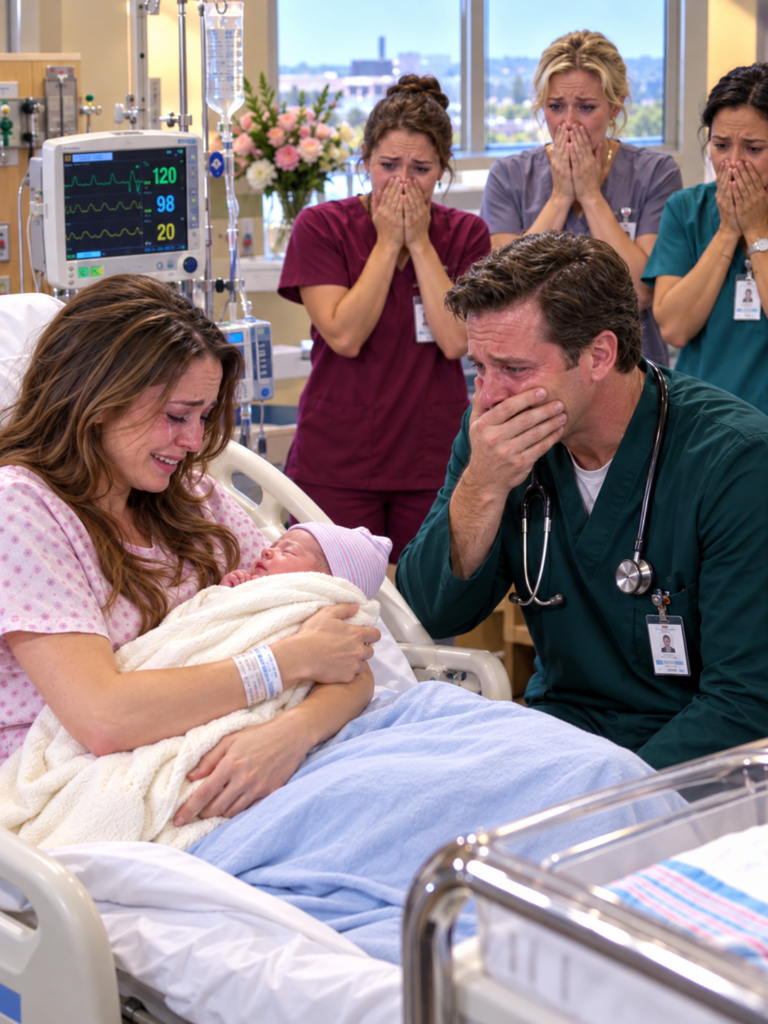
The doctor stood beside my hospital bed, staring at my newborn as though someone had opened a door into his past.
I pulled the blanket higher around my son’s shoulders.
“I’m sorry,” I said. “Do I know you?”
He blinked, seemingly remembering where he was.
“No. Forgive me.”
His name badge read Dr. Daniel Mercer.
He looked to be in his early sixties, with silver hair, tired blue eyes, and the kind of careful posture that made me think he had spent most of his life making difficult decisions.
He was wearing a white coat over a pale blue shirt. One sleeve had been pushed halfway up his forearm, exposing an old leather watch.
“My name is Claire,” I said. “Claire Bennett.”
“I know. I was asked to review your son’s examination notes.”
He glanced toward the bassinet, then back at me.
“May I ask who his father is?”
The question landed harder than it should have.
I had answered it on admission forms. I had answered it for nurses. I had answered it for the woman in billing who wanted to know whether anyone else would be responsible for payment.
Every time, I had felt the same little sting.
“His name is Nathan.”
Daniel’s expression changed.
“Nathan what?”
“Mercer.”
The doctor’s hand tightened around the metal rail of my bed.
For a moment, neither of us spoke.
Then he sat in the chair beside me.
“Nathan Mercer is my son.”
I stared at him.
My baby made a small noise against my chest, but I barely noticed.
“That isn’t possible.”
Daniel’s face softened with sadness.
“I imagine Nathan told you his father was dead.”
“He told me he didn’t have one.”
The doctor lowered his eyes.
“That sounds like Nathan.”
It was such a familiar kind of disappointment that I almost became angry immediately.
I had spent seven months carrying a child whose father had disappeared the morning after learning about the pregnancy.
Seven months of missed calls, unpaid bills, swelling ankles, and nights when I lay awake trying to decide whether I should hate him or worry that something terrible had happened.
Now a stranger was sitting beside my bed claiming to be the father Nathan had always insisted didn’t exist.
“Look,” I said, “I’ve just been through fifteen hours of labor. I haven’t slept properly in two days. If there’s something you need to tell me, please say it plainly.”
Daniel nodded.
“You’re right.”
He glanced at the baby.
“First, congratulations. Your little boy is healthy, and you did remarkably well.”
“Thank you.”
“What’s his name?”
“Oliver.”
Something tender moved across his expression.
“Oliver,” he repeated.
Then he looked at me.
“Claire, I haven’t spoken properly to my son in almost nine years.”
I swallowed.
“He hasn’t spoken to me in seven months.”
Daniel closed his eyes briefly.
And for the first time, I understood that the man sitting in front of me might be carrying a hurt almost as old as Nathan himself.
Nathan and I had met three years earlier at a neighborhood hardware store.
I was twenty-eight, recently divorced, and trying to repair a leaking kitchen faucet in the apartment I could barely afford.
He worked there on weekends while managing maintenance contracts for a small construction company.
I stood in the plumbing aisle holding two pieces of pipe that clearly didn’t belong together.
Nathan watched me for a moment.
“Planning to fix something,” he asked, “or threaten it into cooperating?”
I looked at him.
“Depends on how much this costs.”
He laughed.
It was a warm laugh, the kind that made you feel as though you had said something clever even when you hadn’t.
He helped me choose the right parts.
Then he wrote down instructions on the back of a receipt.
When I came back three days later because the faucet was leaking worse than before, he offered to look at it.
I told him I didn’t invite strange men into my apartment.
He said that was sensible.
Then he handed me the number of a licensed plumber.
An hour later, I called him.
Not because I needed the faucet fixed.
Because something about a man who respected the word no made me curious.
We married eighteen months later in a small ceremony at the county courthouse.
My best friend, Rosa, served as my witness.
Nathan wore a dark jacket that was slightly too big across the shoulders. He kept touching his wedding ring as though he couldn’t believe it belonged there.
I remember thinking I had finally found a person who understood that love didn’t need to be complicated.
I was wrong about that.
But I wasn’t entirely wrong about him.
Nathan could be patient, funny, considerate, and astonishingly gentle.
He noticed little things.
If I had a headache, he dimmed the lights without being asked.
If my shoes were wearing through, he quietly searched for replacements.
When I cried over a customer who had humiliated me at the grocery store where I worked, he made tea and listened without telling me to stop being sensitive.
But certain subjects caused him to close up.
His childhood.
His mother.
His father.
Once, while organizing old documents for our tax return, I came across a photograph hidden in a battered paperback.
A woman with dark hair stood in a garden beside a young boy.
The boy looked about seven.
He had Nathan’s narrow smile and thoughtful eyes.
“Is that your mother?” I asked.
Nathan took the photograph from my hand.
“Yes.”
“She was beautiful.”
“She was.”
“What’s her name?”
“Evelyn.”
“Do you have any other pictures?”
He put the photograph back into the book.
“Not many.”
That was the end of the conversation.
I didn’t press.
I had been raised in a home where curiosity was sometimes mistaken for criticism, and I had promised myself that marriage wouldn’t become a courtroom where every silence required an explanation.
Looking back, I wonder whether I confused giving someone privacy with allowing them to hide an entire part of themselves.
Daniel listened while I told him a little about our marriage.
Not everything.
I wasn’t ready to hand a stranger all the private pieces of my life simply because he claimed to be family.
But I told him how Nathan had reacted when I showed him the pregnancy test.
At first, he stared at the two pink lines.
Then he sat on the edge of our bed.
I had expected joy.
Or tears.
Even nervous laughter.
Instead, he asked, “Are you sure?”
I told him I had taken three tests.
He nodded, but his face had gone pale.
That evening, he barely touched dinner.
At midnight, I found him sitting at the kitchen table, looking at an old photograph of his mother.
“Talk to me,” I said.
He turned the picture facedown.
“I can’t do this.”
I sat opposite him.
“Can’t do what?”
“Be a father.”
I thought he meant he was frightened.
I reached for his hand.
“We’ll learn.”
He pulled away.
“You don’t understand.”
“Then help me.”
He stood.
“I need some time.”
I remember being irritated.
Not frightened yet.
Everybody needed time to absorb big news.
But when I woke the following morning, his side of the bed was cold.
His work boots were gone.
So was the brown suitcase from our closet.
On the kitchen counter, beneath the sugar bowl, he had left a note.
I’m sorry. I don’t know how to do this.
Eight words.
That was all.
At first, I assumed he would return by dinner.
Then by the weekend.
Then after his employer told me he had resigned without notice, I began to understand that he had not gone somewhere to think.
He had left.
Completely.
At least, that was what I believed.
Daniel listened without interrupting.
When I finished, he rubbed his face.
“I wish I could tell you I don’t recognize that behavior.”
I felt something harden inside me.
“Are you going to say he learned it from you?”
“No.”
That surprised me.
Daniel leaned forward.
“I’m going to say he learned to run from things he didn’t understand. Some of that began with me. But Nathan is an adult. The decision to abandon you was his.”
For the first time since the doctor entered my room, I loosened my grip on Oliver’s blanket.
“Then tell me what happened to your family.”
Daniel looked toward the window.
Outside, an early spring rain streaked the glass.
“My wife, Evelyn, died when Nathan was fourteen.”
“I know that much.”
“What he probably never told you is that Evelyn and I were already separated.”
I shook my head.
“He said you left when he was little.”
“We separated when he was eight.”
Daniel spoke slowly, choosing his words.
“I was a physician with a growing career and a terrible talent for convincing myself that every hour away from home was a sacrifice I was making for the family.”
He gave a faint, unhappy smile.
“Evelyn saw it differently.”
“She thought you didn’t care?”
“She thought I cared about being useful more than being present.”
I looked at Oliver.
That distinction already felt terribly important.
Daniel explained that their marriage had deteriorated through missed birthdays, broken promises, and arguments neither parent realized their child could hear.
They divorced.
Nathan stayed with Evelyn.
Daniel saw him on alternate weekends at first, then less frequently.
When Evelyn developed cancer, their already difficult communication became worse.
“I tried to help,” Daniel said. “I offered money, transportation, specialists. But I kept trying to solve everything like a medical problem.”
“What did she need?”
He looked at me.
“A husband who had learned how to listen ten years earlier.”
The answer silenced me.
Evelyn died after nearly two years of treatment.
Nathan moved into Daniel’s house.
They barely knew each other anymore.
Daniel expected rules to create stability.
Nathan needed grief to be acknowledged.
Instead, they argued about homework, friends, and curfews.
At seventeen, Nathan accused Daniel of never wanting him.
Daniel, exhausted and defensive, replied that he couldn’t keep begging someone who had already decided to hate him.
Nathan never forgot those words.
At eighteen, he left for college.
Over time, the calls stopped.
Daniel sent birthday cards.
Nathan returned none.
Eventually, even Christmas passed in silence.
“I told myself I was respecting his wishes,” Daniel admitted. “But there’s a difference between respecting someone’s boundaries and hiding behind them because rejection hurts.”
I watched the rain.
I recognized the excuse.
It was one I had made for Nathan more than once.
Daniel reached into his coat and removed his phone.
“There is something else you should know.”
My stomach tightened.
“What?”
“Nathan came to see me five months ago.”
I stared at him.
“Five months?”
Daniel nodded.
“He showed up at my house one evening. I almost didn’t recognize him.”
A hot wave of anger moved through me.
While I was trying to save money for diapers, Nathan had been sitting in his father’s house.
While I attended prenatal appointments alone, he had been rebuilding an old relationship.
“He told you about the baby?”
“Yes.”
“And me?”
“Yes.”
I shook my head.
“Then why didn’t you tell me?”
“I didn’t know where you lived.”
“He did.”
Daniel hesitated.
“He thought he did.”
I sat straighter.
“What does that mean?”
“He said he tried to come back to your apartment six weeks after leaving. Nobody answered. The landlord told him you’d moved.”
I remembered the apartment.
The eviction warning.
The way I had packed our dishes into boxes and carried them downstairs myself.
I had moved because I couldn’t afford the rent on one income.
“He could have called.”
“He told me your phone number had changed.”
“It had. The phone contract was under his name.”
Daniel nodded.
“I know.”
“Then he could have found my workplace.”
“He did.”
I stared at him.
“He went to the grocery store?”
Daniel’s expression became cautious.
“Someone told him you no longer worked there.”
I pressed my fingers against my forehead.
I had been transferred to another branch after my morning sickness made the early shifts impossible.
Nobody had told me Nathan came looking.
My throat tightened.
“But none of that excuses him.”
“No,” Daniel said. “It doesn’t.”
He put his phone away.
“There’s one more thing.”
I laughed bitterly.
“Of course there is.”
“Nathan asked me to give you a letter if I ever found you.”
I stared at him.
Then at the sleeping baby.
Then back at the doctor.
“Do you have it?”
Daniel reached into the inside pocket of his coat.
He took out a pale yellow envelope.
My name was written on the front in handwriting I would have recognized anywhere.
CLAIRE.
For seven months, I had imagined what I would say if Nathan ever contacted me.
Now his letter sat in front of me.
And suddenly I wasn’t sure I wanted to know.
Daniel held it out.
I didn’t take it immediately.
“Did you read it?”
“No.”
“Do you know what it says?”
“Only what Nathan told me.”
“What was that?”
Daniel swallowed.
“He said he was afraid the truth about his family would make you understand why he left.”
I looked at the envelope.
“That’s supposed to make me feel better?”
“No.”
Daniel’s voice became very quiet.
“I’m afraid it’s going to make everything more complicated.”
I took the letter.
But before I could open it, Oliver began to cry.
It was a small, offended cry, the kind newborns make when the world has failed to meet their expectations quickly enough.
I shifted him against my shoulder.
Daniel watched us.
And then I noticed something extraordinary.
He was crying too.
Not loudly.
Not dramatically.
Just tears slipping down the cheeks of a man who clearly wished he could stop them.
“What is it?” I asked.
Daniel stared at Oliver’s face.
“The little mark beside his eyebrow.”
I looked down.
Oliver had a faint crease above his left eye.
Almost invisible unless he frowned.
“Nathan has that,” I said.
Daniel nodded.
“So did Evelyn.”
I smiled despite myself.
“Well, I suppose family resemblance is a powerful thing.”
Daniel’s face changed.
He opened his mouth.
Then closed it again.
“What?” I asked.
“Claire…”
His fingers tightened around the arms of his chair.
“There’s something Nathan doesn’t know I discovered.”
The air seemed to leave the room.
“What are you talking about?”
Daniel glanced toward the door.
Then back at me.
“Evelyn was the only mother Nathan ever knew.”
I waited.
“But she wasn’t the woman who gave birth to him.”
Part 2
I stared at Daniel so long that he finally looked away.
“What did you just say?”
He folded his hands.
“Nathan was adopted.”
I glanced down at Oliver.
My son had stopped crying and was now sleeping against my chest, completely unaware that his family history was unraveling around him.
“Nathan knows he’s adopted?”
“Yes.”
“When did he find out?”
“When he was fifteen.”
I closed my eyes.
One year after losing his mother.
After being forced to live with the father he barely knew.
Another secret.
Another piece of ground pulled from beneath him.
“Why didn’t you tell him sooner?”
Daniel took a long breath.
“Because Evelyn was terrified he’d think she wasn’t really his mother.”
“That seems cruel.”
“It was a terrible mistake.”
I studied his face.
He didn’t try to defend it.
Perhaps that was why I was still listening.
Daniel explained that Evelyn had a younger sister named Rebecca.
The sisters were close despite being very different.
Evelyn was careful and orderly. Rebecca was adventurous, impulsive, and constantly making plans that changed by the following Tuesday.
Rebecca became pregnant at twenty-one.
The father, a young mechanic named Michael Harris, wasn’t ready to raise a child.
He offered some money and promised he might become involved later.
Rebecca was disappointed but determined.
She found a job.
Rented a small apartment.
Bought a secondhand crib.
And told Evelyn she intended to raise her baby herself.
But after Nathan was born, Rebecca developed a severe infection.
Her condition worsened rapidly.
Within days, she was gone.
I looked down at Oliver.
Suddenly the weight of him felt different.
I imagined holding a newborn and knowing I might not be there to watch him grow.
It made me feel sick.
“Evelyn took him in?”
Daniel nodded.
“Rebecca had named her as guardian.”
“And you adopted him?”
“Before his first birthday.”
He paused.
“Evelyn never considered him anything but her son.”
“Then why hide the truth?”
“Because grief can make people afraid of losing what they have left.”
I rubbed Oliver’s back.
Daniel explained that after Evelyn died, Nathan discovered adoption papers among her belongings.
The news devastated him.
He accused Daniel of lying.
Daniel tried to explain, but Nathan refused to listen.
It was then, Daniel said, that their relationship truly fractured.
“He felt his entire childhood had been built on a secret,” Daniel told me. “He asked whether I was really his father. I told him a signature on a birth certificate didn’t decide that. But I said it badly.”
“How badly?”
Daniel gave me a sad smile.
“I said biology wasn’t important.”
I winced.
“To a boy who had just learned his biological mother was dead?”
“Yes.”
“And he was grieving the woman who raised him.”
“Yes.”
Daniel shook his head.
“I wanted to reassure him. Instead, I made him feel that his questions didn’t matter.”
A nurse knocked gently on the door.
She wanted to check Oliver’s temperature and help me get settled.
Daniel rose at once.
“I should let you rest.”
I looked at the envelope in my hand.
“Wait.”
He stopped.
“Does Nathan know you’ve seen Oliver?”
“Yes. I mean, no. I haven’t contacted him.”
I nodded slowly.
“Don’t tell him yet.”
Daniel’s expression softened.
“Of course.”
“And don’t give him my number.”
“I won’t.”
He moved toward the door.
Then I asked the question that had been forming in my mind.
“Doctor Mercer?”
He turned.
“Do you think your son is a good man?”
Daniel stood very still.
Finally, he answered.
“I think Nathan is a man who has made a terrible choice. And I think he knows it.”
“That isn’t what I asked.”
“No.”
He looked down.
“But it’s the most truthful answer I can give you.”
I opened Nathan’s letter at eleven that night.
Oliver was asleep beside me.
The hospital was quiet except for distant footsteps and the soft hum of machinery.
Nathan’s handwriting filled three sheets of paper.
He had crossed out words and written corrections in the margins.
I could almost see him sitting at a table, struggling to say something that would make sense.
Claire,
I have written the first sentence of this letter more times than I can count.
There is no explanation that makes what I did acceptable.
You told me we were having a baby, and I ran away.
I know what that did to you.
Or at least I know enough to understand that I have no right to ask you to forgive me.
I stopped.
Tears had already begun blurring the page.
I wiped my face angrily.
I had cried enough over this man.
But I kept reading.
When you showed me the pregnancy test, I didn’t see a baby at first.
I saw a child waiting by a window.
I saw myself at eight years old, wondering why my father wasn’t coming.
I saw my mother crying when she thought I was asleep.
And I remembered finding those papers after her death and realizing that the people I loved had been keeping the most important part of my life from me.
I spent years telling myself I would never be like my father.
Then I began worrying that I would become exactly like him.
I was afraid of failing you.
And instead of telling you I was afraid, I failed you in the worst possible way.
I put down the letter.
For several minutes I watched Oliver sleep.
I hated that I understood some of what Nathan was describing.
Not the leaving.
Never that.
But the fear.
When I discovered I was pregnant, I had been afraid too.
I worried about money.
About losing my job.
About having a child who needed things I couldn’t afford.
The difference was that I had continued getting up every morning.
Nathan had left me to carry our fear alone.
I picked up the letter again.
I went to my father because I wanted to know if he had ever regretted leaving us.
What I learned was harder to accept.
He was not innocent. He hurt my mother. He disappointed me. He made mistakes that changed our family.
But he had also written letters I refused to read.
He had tried to visit when I wouldn’t open the door.
I had remembered the worst parts of him so clearly that I had forgotten everything else.
I don’t know if we can repair our relationship.
But I know I have to stop using what happened to me as permission to hurt someone else.
My hands trembled.
The final page was shorter.
I want to be a father to our child.
Not because I deserve the chance.
Because our baby deserves a father who shows up.
If you allow me into his life, I will be there.
If you never want me as your husband again, I will accept that.
I have found work. I am saving money. I am seeing a counselor because I should have asked for help long before I met you.
I don’t expect these words to fix anything.
I only want you to know I am trying to become someone who does not run every time love asks something difficult of him.
Nathan.
At the bottom was another sentence.
There is one more truth about my mother that I never told you. I hope someday I can explain it in person.
I read that sentence twice.
Then I folded the letter and placed it beneath my pillow.
I didn’t forgive Nathan that night.
But for the first time, I stopped imagining him as a man who had walked away without feeling anything.
That made the story more complicated.
And strangely, more painful.
The following afternoon, Rosa arrived carrying a bag of baby clothes and enough food to feed the entire maternity ward.
She was fifty-six, widowed, and had worked with me at the grocery store for six years.
When Nathan left, Rosa had been the person who drove me to appointments, helped me move, and sat beside me while I cried over bills I couldn’t pay.
She took Oliver into her arms.
“Oh, you sweet little thing.”
He opened one eye.
Rosa laughed.
“Already judging people. Definitely your mother’s son.”
I told her about Daniel.
At first she thought I was joking.
Then she sat down.
“His father?”
“Yes.”
“And Nathan went to see him?”
“Yes.”
Rosa looked at the floor.
Something about her silence made me uncomfortable.
“Rosa?”
She took a breath.
“Claire, there’s something I should have told you.”
I closed my eyes.
“Please don’t.”
“Nathan came to the store.”
I stared at her.
“When?”
“About three months ago.”
My voice became very quiet.
“You saw him?”
“Yes.”
“And you didn’t tell me?”
Rosa shifted Oliver carefully against her shoulder.
“He was asking where you’d moved.”
“What did you say?”
“That you were safe.”
“Did you give him my address?”
“No.”
I felt two different emotions at once.
Relief that she had protected my privacy.
Anger that she had made the decision without me.
“You should have told me.”
“I know.”
“You knew I was wondering whether he was alive.”
“I know.”
I looked away.
Rosa’s voice shook.
“You were eight months pregnant and barely sleeping. You had finally stopped checking your phone every ten minutes. I thought if I told you he’d appeared, it would tear you apart again.”
“Maybe it would have.”
She nodded.
“But it should have been your decision.”
I didn’t answer.
After a moment, Rosa said, “I’m sorry.”
I watched her holding my son.
She had been there for me when nobody else was.
That mattered.
But loving me didn’t give her the right to decide which truths I could handle.
“I need you not to do that again,” I said.
“I won’t.”
She kissed Oliver’s forehead.
“Promise.”
I went home two days later.
Rosa drove us in her old green sedan.
My apartment was a small second-floor unit above a florist’s shop.
It had one bedroom, a narrow kitchen, and windows that rattled when trucks drove past.
But it was mine.
I had arranged a crib beside my bed and put a changing table near the window.
On the refrigerator hung a calendar where I had marked every prenatal appointment.
There was an empty space at the bottom where I had once imagined writing Nathan’s work schedule.
When I brought Oliver inside, I stood there holding him for a long moment.
“We made it,” I whispered.
He yawned.
I laughed softly.
“I know. You’re not impressed.”
For the first week, I barely thought about Nathan.
There were feedings, laundry, sleepless nights, and the endless small tasks that came with keeping a newborn comfortable.
But Daniel called twice.
He asked whether Oliver was healthy.
Whether I needed help.
Whether there was anything I wanted him to tell Nathan.
On the second call, I surprised myself.
“Tell him his son is doing well.”
Daniel was silent for a moment.
“Would you like me to tell him anything else?”
“No.”
“Then that’s all I’ll say.”
Three days later, my phone rang.
An unfamiliar number appeared.
I let it go to voicemail.
Then a message arrived.
Claire. It’s Nathan.
Dad told me Oliver was born.
I’m grateful you’re both safe.
I know you don’t owe me a conversation. I won’t come to your home without asking.
But if there’s anything either of you needs, please tell me.
I read the message four times.
Then I turned off my phone.
That night, Oliver cried for nearly two hours.
I walked him around the apartment until my back ached.
I tried feeding him.
Changing him.
Rocking him.
Nothing worked.
At two in the morning, I sat on the kitchen floor with him against my shoulder and cried too.
For one terrible moment, I wanted to call Nathan.
Not because I had forgiven him.
Because I was exhausted, and the person who had promised to share this life with me was somewhere else.
I hated needing him.
Then I looked at Oliver.
He had finally fallen asleep.
His small fingers were curled into the collar of my shirt.
I whispered, “We deserve people who stay.”
The next morning, I answered Nathan.
Oliver is healthy. I’m tired. That’s all.
His reply came quickly.
Thank you for telling me.
Nothing else.
No demand.
No plea.
No request to see us.
I found that more unsettling than I expected.
Over the following two weeks, Nathan sent short messages.
He asked whether Oliver was feeding well.
Whether I needed groceries.
Whether the apartment was warm enough.
Sometimes I answered.
Sometimes I didn’t.
He never complained.
Then one evening, the water heater failed.
I discovered it when I tried to wash Oliver’s bottles.
The water remained cold.
I called the landlord.
No answer.
I left a message.
Then another.
At eight-thirty, with Oliver fussing and a sink full of dishes, I looked at Nathan’s number.
For ten minutes, I argued with myself.
Finally, I typed:
Do you know anyone who can repair a water heater?
He replied almost immediately.
Yes. I can arrange a licensed technician. You don’t have to see me.
That sentence changed something.
He hadn’t assumed that helping gave him the right to enter my home.
I stared at the screen.
Then I wrote:
You can come. But we’re going to talk.
He arrived forty minutes later.
I heard his footsteps outside my door.
Three quiet knocks.
I opened it.
Nathan stood in the hallway wearing a brown jacket and carrying a small toolbox.
He looked thinner.
His hair was longer.
There were lines around his eyes that hadn’t been there before.
For a moment, all I could see was the man who had kissed me goodnight and disappeared before sunrise.
“Hi,” he said.
I folded my arms.
“Hi.”
His gaze moved past me to the crib.
He stopped breathing for a moment.
“Is that Oliver?”
I nodded.
Nathan’s face crumpled.
He covered his mouth with one hand.
I had imagined our reunion so many times.
In some versions, I screamed.
In others, I slammed the door.
Sometimes he begged me to forgive him.
But I hadn’t expected him to stand there crying silently over a baby he had never held.
“Can I come in?” he whispered.
I stepped aside.
He entered carefully, as though the apartment belonged to someone whose trust he had no right to assume.
Which was exactly how I wanted him to behave.
Nathan walked toward the crib.
He stopped a few feet away.
Oliver was awake, moving his hands beneath the blanket.
“He’s beautiful,” Nathan said.
“He’s loud.”
Nathan laughed through his tears.
“That’s probably my fault.”
I almost smiled.
Then I remembered the empty apartment.
The note.
The months.
My expression hardened.
“Nathan, we need to talk before anything else.”
He turned toward me.
“I know.”
“Why didn’t you come back?”
He swallowed.
“I was ashamed.”
“That’s not an answer.”
“No.”
He looked down.
“I was scared, Claire. I thought if I stayed and failed, you and the baby would spend years hating me.”
“So you left us no choice but to feel abandoned?”
“Yes.”
His honesty irritated me.
I wanted him to argue.
To justify himself.
To say something foolish I could attack.
Instead, he stood there accepting everything.
“You don’t get to make your fear more important than what happened to me.”
“I know.”
“You missed the appointments. You missed the ultrasound. You missed me finding out we were having a boy.”
His eyes filled again.
“I know.”
“I worked until my feet were swollen. I moved because I couldn’t pay our rent. I lay awake wondering what I had done to make you stop loving me.”
Nathan shook his head.
“You didn’t do anything.”
“That doesn’t change what I believed.”
“No.”
His voice broke.
“I’m sorry.”
I watched him struggle to hold himself together.
For the first time, I realized I didn’t need him to suffer more.
I needed him to understand.
And then I needed him to behave differently.
“I’m not promising we’ll get back together,” I said.
“I know.”
“I don’t even know if I can forgive you.”
“I understand.”
“But Oliver deserves to know his father.”
Nathan looked toward the crib.
I nodded.
“You can hold him.”
His head turned sharply.
“Are you sure?”
“No,” I admitted.
“But I think you should.”
He washed his hands.
Twice.
Then sat carefully on the sofa.
I lifted Oliver and placed him in Nathan’s arms.
Nathan stared down at him.
Oliver looked up, blinking slowly.
“Hello, little man,” Nathan whispered.
His voice shook.
“I’m your dad.”
Tears slipped down his face.
“I’m sorry I wasn’t there when you arrived.”
I stood beside them.
My heart hurt.
But underneath the hurt was something else.
A small, stubborn hope.
Nathan looked up at me.
“If you’ll let me, I want to do this right.”
I shook my head.
“You don’t become his father by getting my permission.”
He frowned.
“Then what do I do?”
I looked at Oliver.
“You show up.”
Nathan nodded.
“Then I’ll show up.”
The repair technician arrived twenty minutes later.
While he worked, Nathan fed Oliver a bottle under my supervision.
He struggled with the angle.
Oliver objected loudly.
I corrected him.
Nathan listened.
It was awkward.
Ordinary.
Almost painfully normal.
When he left, I found an envelope on the kitchen table.
Inside was a copy of a lease.
Nathan had rented an apartment four blocks away.
There was also a note.
I didn’t move here because I expect you to take me back.
I moved here so that if you ever need me for Oliver, I can arrive before you have time to wonder whether I’m coming.
I sat at the table holding the paper.
For the first time since Nathan returned, hope frightened me more than anger.
The following morning, Daniel called.
His voice sounded unusually tense.
“Claire, may I ask you something?”
“What is it?”
“I found a box among Evelyn’s belongings.”
I waited.
“There were documents I thought I’d already seen.”
“About Nathan?”
“Yes.”
He paused.
“And Rebecca.”
I looked toward Oliver’s crib.
“What kind of documents?”
“Letters. Medical records. A photograph.”
My stomach tightened.
“Daniel, please tell me you’re not about to reveal another terrible secret.”
He sighed.
“I wish I could promise that.”
“What did you find?”
“A letter Rebecca wrote shortly before Nathan was born.”
I waited.
Daniel continued.
“There’s something in it that changes what Nathan has believed about his childhood.”
I closed my eyes.
“What?”
Daniel’s answer was almost a whisper.
“Rebecca knew she might not survive.”
Part 3
Three days later, Nathan and Daniel came to Rosa’s house.
I had chosen her dining room because I wasn’t ready to invite both men into my apartment for a conversation that might change our lives.
Rosa made coffee.
Then she took Oliver into the living room.
“If anybody starts shouting,” she announced, “I’ll be back before you finish the first sentence.”
Nathan gave a nervous smile.
Daniel looked as though he wanted to thank her.
I sat at the head of the table.
Not because I wanted authority.
Because after months of having decisions made without me, I wanted to be in the place where I could see everyone’s face.
Daniel placed a wooden box on the table.
Its brass corners were tarnished.
The lid had a small scratch running diagonally across it.
“I found this while clearing out the attic,” he said.
Nathan stared at it.
“Mom’s sewing box.”
Daniel nodded.
“She kept letters in the bottom drawer.”
He opened the lid.
Inside were photographs, birthday cards, and several envelopes tied together with faded blue ribbon.
He removed one.
The handwriting was slanted and hurried.
Nathan reached toward it, then stopped.
“Rebecca wrote that?”
“Yes.”
Daniel handed him the envelope.
Nathan turned it over.
“Why didn’t you show me this before?”
“I didn’t know it existed.”
Nathan stared at him.
“How can you not know what’s in your own house?”
Daniel didn’t answer immediately.
Then he said, “Because I spent years avoiding that room.”
The anger went out of Nathan’s face.
Daniel continued.
“After Evelyn died, I packed away her belongings. I told myself I was saving them for you. But eventually I realized I couldn’t bear to sort through them.”
Nathan lowered his eyes.
“I didn’t want them.”
“I know.”
“I thought everything in that house was a reminder that you hadn’t been there.”
Daniel nodded.
“And I let you believe that rather than explain how much I missed her too.”
Silence settled around the table.
I looked at the envelope.
“Read it.”
Nathan glanced at me.
I nodded.
“Please.”
He unfolded the pages.
The paper was thin and covered in blue ink.
For several moments, he read silently.
Then his expression changed.
“What?” I asked.
Nathan looked at Daniel.
“She knew?”
Daniel nodded.
Nathan stared at the letter.
“She knew something was wrong?”
Daniel leaned forward.
“Rebecca had been experiencing symptoms late in pregnancy. Her doctors believed they were manageable. There was no certainty about what might happen.”
Nathan shook his head.
“But she was worried.”
“Yes.”
He continued reading.
I watched his face.
He looked like a man trying to meet someone he had spent his entire life imagining.
Finally, he began to read aloud.
“Evelyn, if you ever find yourself looking after this little boy, please don’t spend his childhood trying to make up for the fact that I couldn’t stay.”
Nathan stopped.
His eyes filled.
He swallowed and continued.
“Tell him that I wanted him. Tell him that I bought his crib before I bought myself a proper bed. Tell him that I argued with you about names because you kept suggesting names that sounded like retired accountants.”
I laughed unexpectedly.
Daniel smiled through his tears.
“Rebecca hated the name Arthur.”
Nathan looked up.
“Mom wanted to call me Arthur?”
“Very much.”
I smiled.
“Oliver should be grateful we had other options.”
For a brief moment, the room felt lighter.
Then Nathan continued.
“If I’m not there, don’t let my absence become the most important thing he knows about me.”
His voice broke.
He put the letter down.
Daniel reached toward him.
Nathan shook his head gently.
“I need a minute.”
Nobody spoke.
From the living room, Oliver made a happy squealing sound.
Rosa murmured something to him.
Nathan looked toward the doorway.
Then he picked up the letter again.
“The next part,” he whispered, “is about you.”
Daniel sat very still.
Nathan read.
“Daniel is going to be terrified of doing everything wrong. He always tries to solve people’s problems before he lets them tell him what hurts. Remind him that children don’t need perfect fathers. They need fathers who come back to the table when the conversation gets difficult.”
Daniel lowered his head.
I watched his shoulders shake.
Nathan continued.
“And if my son grows up afraid that he isn’t enough, tell him love is not something he has to earn by getting everything right. He will make mistakes. So will the people who raise him. I hope somebody teaches him that a mistake should be answered with honesty, not disappearance.”
Nathan stopped reading.
The room went silent.
I felt tears sliding down my cheeks.
Those words had been written before Nathan was born.
Before Evelyn died.
Before the years of estrangement.
Before he met me.
Before he abandoned us.
Yet they described the wound running through three generations of his family.
Nathan looked at Daniel.
“Why didn’t Mom show me this?”
Daniel stared at the table.
“I don’t know.”
Nathan waited.
Daniel took a long breath.
“I suspect she wanted to tell you the truth when you were older. But the longer she waited, the more frightening it became.”
“She thought I’d stop loving her.”
“Yes.”
Nathan smiled sadly.
“I wouldn’t have.”
“I know.”
“I loved her.”
“I know that too.”
Nathan looked down at the letter.
“All those years, I thought everybody was hiding things because there was something wrong with me.”
Daniel covered his face.
“Oh, son.”
Nathan’s voice became quieter.
“I thought my biological father didn’t want me. I thought you didn’t want me. Then I found out Mom wasn’t my birth mother and decided even she had been afraid to tell me who I was.”
Daniel looked up.
“None of that was because you were unwanted.”
Nathan pressed his lips together.
“I know that now.”
I looked at him.
“Do you?”
He turned toward me.
For a moment, I saw the boy who had waited at windows and counted missed weekends.
Then I saw my husband.
The man who had frightened himself so badly with the possibility of abandonment that he had created it himself.
“I think I’m starting to,” he said.
We spent the next two hours talking.
Not every part of it was gentle.
Nathan asked Daniel why he hadn’t fought harder to stay involved after the divorce.
Daniel admitted he had allowed arguments with Evelyn to become excuses for missed visits.
Daniel asked Nathan why he had ignored letters and birthday calls even after becoming an adult.
Nathan admitted anger had become familiar enough that giving it up felt like losing part of himself.
I listened.
Sometimes I spoke.
Sometimes I challenged them.
When Daniel tried to explain Nathan’s disappearance as a consequence of childhood trauma, I stopped him.
“Understanding what happened to him is important,” I said. “But I need both of you to remember that I was the one who carried his child alone.”
Daniel nodded.
“You’re right.”
Nathan looked at me.
“I’ll never ask you to pretend I didn’t.”
“Good.”
There was no dramatic embrace.
Nobody declared everything forgiven.
But something important happened before we left.
Daniel handed Nathan the wooden box.
“I want you to keep this.”
Nathan shook his head.
“It’s yours.”
“It belongs to you too.”
Nathan ran his fingers over the lid.
Then he pushed it gently back toward his father.
“Keep it at your house for now.”
Daniel’s face fell slightly.
Nathan noticed.
“Not because I don’t want it.”
“Then why?”
Nathan took a breath.
“Because I want somewhere to go when I have questions.”
Daniel stared at him.
Then he smiled.
“You can come anytime.”
Nathan smiled back.
“I know.”
For the first time, I believed he might.
The weeks that followed were not easy.
Nathan began visiting Oliver regularly.
At first, he came twice a week.
Then three times.
He learned how to warm bottles, fold tiny clothes, and recognize the difference between a hungry cry and an exhausted one.
He learned that Oliver hated being placed in his crib too quickly.
He learned that singing made him settle.
Unfortunately, Nathan had a terrible singing voice.
I told him so.
He looked offended.
“Oliver seems to like it.”
“Oliver also likes chewing his own fist. His standards aren’t established yet.”
Nathan laughed.
It was a familiar laugh.
For a moment, our kitchen felt like it had before everything went wrong.
Then reality returned.
He went home to his apartment.
I locked the door.
And I remembered.
Some nights, after he left, I cried for reasons I couldn’t explain.
Other nights, I felt hopeful and then became angry with myself for feeling hopeful.
Rosa told me I didn’t have to decide anything.
Daniel told me Nathan was continuing counseling.
Nathan himself said very little about our future.
But he kept showing up.
He arrived when he said he would.
He brought the diapers he promised.
He washed bottles without waiting to be asked.
If he was going to be late, he called.
And every time he did, I felt some small part of my body stop bracing for disappointment.
One Saturday afternoon, three months after Oliver’s birth, Nathan was supposed to arrive at four.
At four-ten, I checked my phone.
No message.
At four-fifteen, I walked to the window.
At four-twenty, my heart began racing.
I remembered waking up to the empty bed.
The missing suitcase.
The note beneath the sugar bowl.
I called him.
No answer.
I sat on the sofa with Oliver in my lap, feeling foolish and furious at the same time.
Then the phone rang.
“Claire?”
“Where are you?”
Nathan’s voice sounded strained.
“I’m sorry. There was a collision near the highway exit. Traffic is completely stopped. I pulled into a parking lot to call.”
I closed my eyes.
“You should have called sooner.”
“I know.”
“Are you coming?”
“Yes.”
He paused.
“Unless you’d rather I didn’t.”
I looked at Oliver.
“No. Come.”
Nathan arrived twenty minutes later.
He stood at the door holding a bag of groceries.
“I should have told you as soon as I knew I’d be late.”
“Yes.”
He nodded.
“I won’t let that happen again.”
I studied his face.
Then I stepped aside.
“You called,” I said.
He looked confused.
“What?”
“You called.”
His expression changed.
He understood.
It wasn’t the lateness that mattered most.
It was the fact that he hadn’t disappeared into silence.
He put down the groceries.
“I’m going to keep doing that.”
“I hope so.”
And for the first time, hope didn’t feel quite so dangerous.
Daniel became part of Oliver’s life gradually.
At first, he behaved as though every visit required permission to exist.
He called ahead.
Brought sensible gifts.
And stayed no longer than an hour.
He once arrived with three different baby thermometers.
Rosa looked at the collection.
“Doctor, are you preparing this child for medical school?”
Daniel laughed.
The following week, he brought a stuffed elephant nearly as big as Oliver’s crib.
Rosa nodded approvingly.
“Much better.”
Daniel and Nathan began meeting for breakfast every other Sunday.
Sometimes they argued.
Sometimes Nathan came home irritated.
Sometimes Daniel called me afterward, worried he’d said the wrong thing.
I told him gently that he needed to speak to his son, not ask his daughter-in-law to interpret him.
He listened.
One Sunday, I arrived at Daniel’s house to find them assembling a small wooden rocking horse.
Nathan was sitting on the floor surrounded by screws.
Daniel held the instructions upside down.
“Dad,” Nathan said, “the diagram is clearly showing the other side.”
Daniel frowned.
“It’s not as clear as you think.”
“You practiced medicine for forty years.”
“Which has nothing to do with woodworking.”
I leaned against the doorway laughing.
Nathan looked up.
“Don’t encourage him.”
Daniel pointed at Nathan.
“He lost the screwdriver.”
“I put it on the table.”
“Then why is it under the chair?”
“Because somebody moved the chair.”
Oliver made a delighted squealing noise from my arms.
Both men turned toward him.
And suddenly they were smiling.
A father.
A son.
A grandson.
No secrets.
No speeches.
Just three generations in an untidy living room, arguing over a rocking horse that would eventually be assembled backward.
I stood there with tears in my eyes.
Not because everything was fixed.
Because they were still trying.
Six months after Oliver’s birth, I returned to work part-time.
Nathan rearranged his schedule to care for Oliver on two weekdays.
He began taking evening classes in construction management.
Daniel helped him prepare for an examination, although Nathan insisted his father made the material unnecessarily complicated.
Rosa continued visiting every week.
She had become Oliver’s honorary grandmother.
I began to feel like myself again.
Not the woman I had been before Nathan left.
Someone different.
Someone who knew she could survive more than she had once imagined.
Nathan and I started having dinner together occasionally after Oliver fell asleep.
At first, we talked only about practical things.
The doctor.
The grocery list.
His classes.
My work.
Then one evening, while we were washing dishes, he asked, “Do you ever think about us?”
I set down a plate.
“What about us?”
“Whether there’s anything left.”
I looked at him.
“I don’t know.”
He nodded.
“That’s fair.”
“What do you want?”
Nathan dried his hands.
“I want to be your husband again.”
The words hurt.
Not because they were wrong.
Because I had once wanted nothing more.
“I can’t pretend those seven months didn’t happen,” I said.
“I don’t want you to.”
“You made me feel replaceable.”
His expression tightened.
“I know.”
“You made me question everything I thought I understood about our marriage.”
He lowered his eyes.
“I know.”
“And sometimes when you’re late, even when you call, I still feel afraid.”
Nathan moved closer but stopped before touching me.
“I understand.”
I shook my head.
“I don’t think you can fully understand.”
He nodded.
“Then I’ll keep listening.”
I looked at him for a long time.
That answer meant more than any grand promise could have.
Nearly a year after Oliver was born, Nathan asked me to walk with him beside the river.
Daniel was babysitting.
It was a cool autumn afternoon.
The trees were turning gold, and the path was scattered with leaves.
We walked quietly for a while.
Then Nathan stopped near a bench.
“I want to ask you something.”
I looked at him suspiciously.
“If that’s a marriage proposal, you can save yourself the trouble. We’re technically still married.”
He laughed.
“No ring.”
“Good.”
We sat.
Nathan watched the water.
“I want to know whether you think we could ever live together again.”
I took a long breath.
“I’ve been thinking about that.”
He turned toward me.
“Really?”
“Yes.”
“And?”
I looked at my hands.
“For a long time, I thought forgiving you would mean admitting what you did wasn’t that bad.”
Nathan shook his head.
“It was.”
“I know.”
He waited.
“But I also don’t want that morning to control every decision I make for the rest of my life.”
His eyes filled.
I continued.
“I don’t trust the man who left me.”
“You shouldn’t.”
“But you’ve spent almost a year showing me someone different.”
Nathan swallowed.
“I’ve been trying.”
“I know.”
I looked toward the river.
“I don’t know whether we’ll ever stop being afraid of certain things.”
“Maybe we won’t.”
“But maybe we can stop letting fear make the decisions.”
Nathan held out his hand.
He didn’t reach for mine.
He waited.
I looked at it.
Then I placed my hand in his.
His fingers closed gently around mine.
“I forgive you,” I whispered.
Nathan closed his eyes.
A tear slipped down his cheek.
“Claire…”
“Don’t make a speech.”
He laughed shakily.
“I wasn’t going to.”
“You absolutely were.”
He smiled.
Then he squeezed my hand.
“Thank you.”
We sat there until the air grew cold.
When we finally stood, he asked whether I wanted to go home.
I looked at him.
“Yes.”
And for the first time, the word home felt as though it might someday include him again.
We didn’t move back together immediately.
I wanted time.
Nathan respected that.
Six months later, he began staying over occasionally.
A year after that, we found a small house with a narrow backyard and a maple tree beside the porch.
Daniel helped us move.
Rosa supervised.
Oliver, then nearly three, carried one plastic cup from the car and declared himself exhausted.
We laughed so hard that Rosa had to sit down.
The house wasn’t impressive.
The kitchen was small.
The bathroom needed repairs.
The back fence leaned slightly to the left.
But it had room for a family.
And this time, nobody was promising perfection.
We were promising presence.
That made all the difference.
On Oliver’s fifth birthday, Daniel brought a wooden box to our house.
It was Evelyn’s old sewing box.
The same one he had opened at Rosa’s table years earlier.
But now it had been cleaned and polished.
Inside were photographs.
Evelyn as a young woman.
Rebecca laughing on a college campus.
Nathan on his first bicycle.
Daniel holding him outside a small house.
There were letters too.
Copies of Rebecca’s note.
Birthday cards Daniel had never mailed.
A photograph of Michael Harris, Nathan’s biological father, whom Nathan had eventually met as an adult.
On top lay a blank journal.
Nathan looked at Daniel.
“What’s this?”
Daniel smiled.
“For Oliver.”
Nathan opened the journal.
The first page read:
The stories we want you to know.
Daniel cleared his throat.
“I thought we could write down the things that matter. Not just names and dates. The stories behind them.”
Nathan looked at the photographs.
“Even the difficult ones?”
Daniel nodded.
“Especially those.”
Oliver climbed onto his grandfather’s lap.
“Are there pictures of me?”
Daniel laughed.
“Not in the old ones.”
Oliver frowned.
“Why not?”
“Because you hadn’t arrived yet.”
Oliver considered that.
Then he pointed toward the kitchen.
“Can I have cake?”
Rosa burst out laughing.
Daniel kissed the top of his head.
“History can wait. Cake first.”
By the time Oliver was ten, he knew his family’s story.
Not every painful detail.
But enough.
He knew that Rebecca had given birth to Nathan.
He knew Evelyn had raised him.
He knew Daniel was his grandfather because love and commitment had made him family long before any paperwork did.
He knew that sometimes adults made mistakes.
And he knew that mistakes did not have to become secrets.
One afternoon, he brought the wooden box into the living room.
“Grandpa?”
Daniel looked up from his newspaper.
“Yes?”
Oliver held a photograph.
Two young women stood beneath a flowering tree.
One wore a pale summer dress.
The other had her hair tied back with a scarf.
“Which one is Rebecca?”
Daniel smiled.
“The one on the left.”
Nathan leaned over.
“No, Dad. That’s Mom.”
Daniel squinted.
“Are you sure?”
Nathan laughed.
“You still mix them up.”
“They looked very much alike.”
Oliver studied the picture.
Then he touched his eyebrow.
“I think I look like her.”
The room went quiet.
He was pointing at Rebecca.
There it was.
That faint crease beside his left eyebrow.
The same small mark Daniel had noticed in the hospital room when Oliver was only minutes old.
Daniel’s eyes filled.
“Yes,” he said softly.
“You do.”
Oliver smiled.
Then he went back to sorting photographs, unaware that a tiny resemblance had once opened the door to an entire family history.
I watched Daniel watching him.
And I remembered that rainy afternoon in the hospital.
My exhaustion.
My fear.
The stranger at my bedside.
The way he had cried over a face he recognized before he knew whose child he was looking at.
I had believed I was alone.
But the truth was far more complicated.
I had been surrounded by people who were lost in different ways.
A husband afraid of becoming his father.
A father afraid of losing his son again.
A mother who had hidden the truth because she feared love might not survive it.
And a young woman who had written a letter before giving birth, hoping the people left behind would find the courage to tell the truth.
None of them had been perfect.
Neither had I.
But over the years, we had learned that love wasn’t measured by never making mistakes.
It was measured by what people did after making them.
That evening, after Oliver went to bed, Nathan and I sat on our porch.
The maple leaves rustled above us.
A warm light glowed from the living-room window.
Inside, Evelyn’s old wooden box sat on a shelf beside our family photographs.
Daniel had gone home.
Rosa had left after stealing the last piece of birthday cake, insisting that someone needed to check whether it was still fresh.
Nathan reached for my hand.
“Do you ever think about the day Oliver was born?”
“Yes.”
“What do you remember?”
I considered the question.
The hospital bed.
The rain.
The pain.
The empty chair beside me.
The doctor’s stunned expression.
The letter.
All the things I didn’t know.
“I remember being afraid,” I said.
Nathan lowered his head.
“I’m sorry.”
“I know.”
He squeezed my hand.
“What else?”
I smiled toward the window.
“I remember thinking I had to do everything alone.”
Nathan looked at me.
“And now?”
I watched the light move across the photographs on our mantel.
There was one of Daniel holding newborn Oliver.
Another of Rosa laughing while Oliver grabbed her glasses.
One showed Nathan and Daniel beside the disastrous rocking horse.
And in the center stood a photograph taken that afternoon.
Daniel.
Nathan.
Oliver.
Me.
Rosa squeezed in at the edge, refusing to be left out.
All of us smiling.
Not because the past had disappeared.
But because it no longer had the final word.
“I remember something different now,” I said.
Nathan waited.
I leaned against his shoulder.
“I remember that it was the day our family began finding its way back.”
From upstairs came Oliver’s sleepy voice.
“Mom?”
I stood.
“Coming!”
Nathan rose beside me.
“I’ll get him.”
I reached for his hand again.
“We both will.”
We climbed the stairs together.
And that was the ending I had once believed was impossible.
Not a perfect family.
Not a family without hurt.
A family that told the truth.
A family that understood fear without allowing it to decide everything.
A family where people called when they were late, apologized when they were wrong, and returned to difficult conversations instead of disappearing.
Years earlier, I had entered a hospital carrying seven months of heartbreak.
I thought the empty chair beside my bed told me everything I needed to know about my future.
But the little boy in my arms had carried something nobody expected.
A face that reminded an old man of the family he thought he had lost.
A resemblance that led to a hidden history.
And a second chance none of us had known how to ask for.
That face didn’t magically repair our lives.
It simply gave us a reason to begin.
The rest required patience.
Honesty.
Forgiveness.
And the courage to stay.
When I look at our family now, I no longer see the empty chair from that hospital room.
I see the dinner table in our little house.
Daniel telling stories.
Rosa interrupting him.
Oliver asking questions.
Nathan reaching beneath the table to hold my hand.
Every chair occupied.
Every person imperfect.
Every one of us choosing to be there.
And I finally understand what Rebecca had hoped her son would learn long before any of us knew how badly we needed those words.
Love was never an examination.
It was a place at the table.
And this time, nobody had to earn the right to belong.


