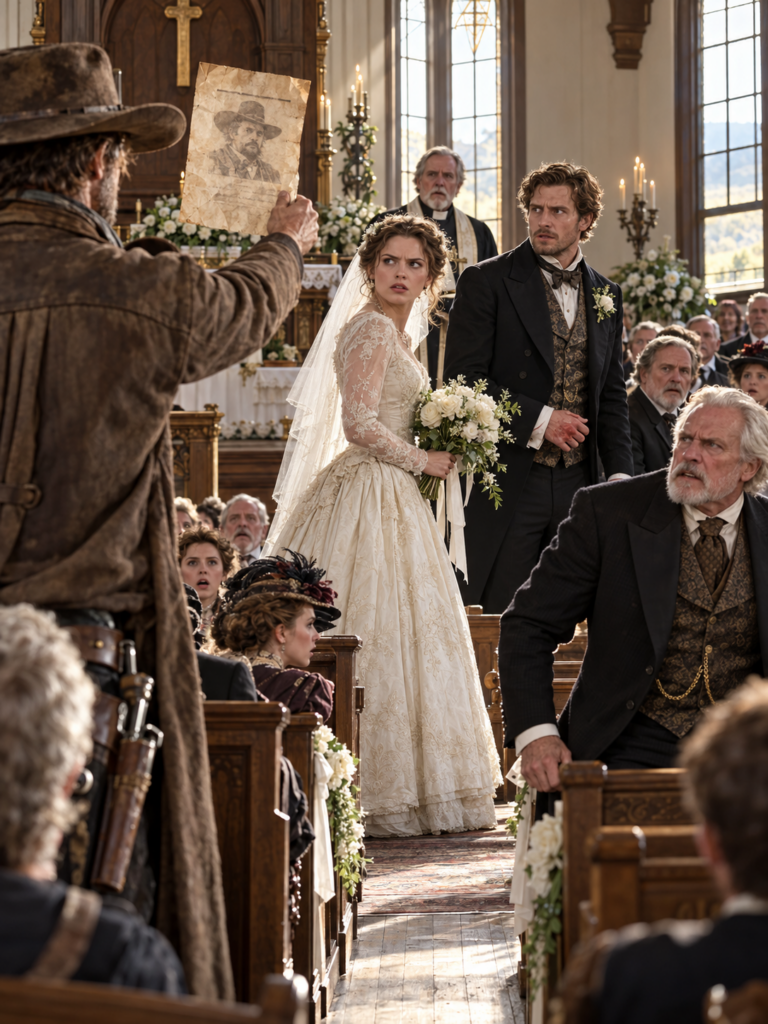
Lillian stepped toward Jonah and took the wanted poster from his outstretched hand.
The paper was worn, its edges softened by age and travel.
The face was younger than Adrian’s, without the careful grooming and polished appearance she knew.
But the eyes were unmistakable.
So was the shape of the jaw.
Beneath the portrait, the description identified a distinctive injury to the left hand.
Lillian slowly turned.
“Show me your hand, Adrian.”
Her fiancé stared at her.
“Surely you’re not taking this seriously.”
“Your left hand.”
Horace reached them.
“This has gone far enough.”
Lillian did not look at him.
“Father, please.”
Adrian held his arm stiffly at his side.
Jonah remained several steps away.
He had brought the evidence, but the decision was not his to make.
“I found that notice in an old law office,” he said. “The robbery happened five years ago. I was there with the payroll party.”
Lillian’s gaze returned to him.
“You were there?”
Jonah nodded.
“Two guards died. I saw the man who led the attack.”
“And you believe he was Adrian?”
“I recognized his voice first. Then his hand.”
A murmur passed through the congregation.
Adrian’s expression hardened.
“A hired cowhand makes an accusation against me, and suddenly my bride must answer to him?”
“She doesn’t answer to me,” Jonah said. “That’s why I came before the vows.”
Lillian looked again at the poster.
She remembered Adrian’s attentiveness.
The gifts.
The conversations.
His patient questions about her father’s banking arrangements.
Those memories did not disappear.
But their meaning had begun to change.
“Why didn’t you come to me sooner?” she asked Jonah.
“I went to your father.”
Horace’s face tightened.
“You offered a suspicion.”
“Yes, sir. I wanted stronger evidence before bringing it to her.”
Lillian turned toward her father.
“You knew?”
“I knew he had made a ridiculous accusation.”
“And you didn’t think I deserved to hear it?”
Horace opened his mouth, then closed it.
For once, his certainty had no ready defense.
Adrian stepped closer.
“Lillian, please. You know the man I’ve been to you.”
She raised one hand.
“Stay where you are.”
He stopped.
The congregation watched in absolute silence as the bride took control of the conversation her father and fiancé had both tried to manage.
“Jonah,” she said, “is there anything beyond the poster?”
He reached inside his coat.
“Yes.”
He withdrew a folded copy of a telegraph message.
Adrian moved sharply.
“That is private correspondence.”
Jonah did not hand it to the guests.
He gave it to Lillian.
She read the instructions.
Men were to be ready after the wedding.
The precise hour would follow once the sender entered Ashford’s private office.
Lillian read the words again.
Then she handed the paper to Horace.
Her father’s expression changed as he recognized the implication.
The bank had a valuable shipment approaching.
Certain details concerning its departure were kept in his office.
A trusted son-in-law could gain access under circumstances that would never be permitted to an ordinary visitor.
Horace looked toward Adrian.
“What is this?”
Adrian’s composure finally fractured.
“Business arrangements. Nothing more.”
“Why would your business require information from my private office?”
Adrian glanced toward the church doors.
Jonah noticed.
So did Lillian.
“Answer him,” she said.
For several seconds, the only sound was the rustle of someone shifting in a pew.
Then Adrian spoke with a tired bitterness Lillian had never heard from him.
“I needed the money.”
Her stomach tightened.
“The bank’s money?”
He did not deny it.
“I’d planned to obtain what I needed after the wedding.”
Horace gripped the telegraph copy.
Lillian felt the humiliation of understanding something she had once mistaken for devotion.
“Was any of it real?” she asked. “The books? The conversations? Everything you remembered about me?”
Adrian looked at her.
“I came here for the bank. I won’t pretend otherwise. But what I felt for you became real.”
Lillian held his gaze.
She wanted to believe him.
That was the cruelest part.
She could still remember every moment that had made her happy.
Yet he had hidden the very truth she needed in order to choose him freely.
Slowly, she removed her engagement ring.
“Perhaps you did care for me,” she said. “But you arranged matters so I could never know which part was honest.”
Her voice steadied.
“I won’t marry a man who made my trust part of a robbery.”
She placed the ring upon the altar rail.
Adrian stared at it.
Then his eyes moved toward the rear doors.
Jonah recognized the movement.
“Don’t,” he warned.
Adrian lunged into the aisle.
Guests scrambled back.
Horace caught Lillian’s arm as Jonah moved toward the fleeing man.
Adrian shoved through the open doors.
Jonah followed him onto the church steps, where two waiting men turned sharply at the commotion.
One reached for his horse.
Adrian ran toward the churchyard fence.
Jonah sprang after him.
And Lillian, gathering her skirts, hurried to the doorway just as the cowboy caught her former fiancé by the coat.
Jonah’s fingers closed around Adrian’s coat, wrenching him backward before he could clear the churchyard fence.
Adrian twisted violently.
The two men stumbled against the rails.
For an instant, Jonah saw again the chaos of the New Mexico robbery, the fallen guards, the desperate horses, and the face he had carried in memory for five years.
But he did not draw his revolver.
He caught Adrian’s shoulder, used the man’s forward momentum against him, and brought him down on the dry Texas earth.
“Stay down,” Jonah ordered.
Adrian struggled once.
Jonah held him.
Beyond the fence, the two men waiting outside realized their companion had been stopped.
One turned toward his horse.
The other began backing away.
Lillian stood on the church steps, watching the scene unfold.
Her wedding bouquet lay forgotten inside.
“Father!” she called. “The bank!”
Horace emerged behind her.
For perhaps the first time in his life, he acted immediately upon his daughter’s judgment without attempting to improve it.
He sent trusted bank guards to secure the building, instructing them to allow no unauthorized access to the office or vault.
The sheriff and his deputies arrived within minutes, summoned by the commotion spreading through town.
The two waiting accomplices were stopped before they could get away.
Adrian, whose carefully prepared identity had collapsed in less than an hour, was placed under arrest.
The sheriff examined the wanted poster and telegraph evidence while arranging to contact the authorities responsible for the New Mexico case.
Jonah stepped away when the lawmen took custody of the prisoners.
His breathing was heavy.
His coat was torn.
But the familiar composure had returned.
Lillian approached him.
“Are you hurt?”
“No, ma’am.”
“That was hardly a gentle fall.”
“I’ve had worse.”
She studied him.
“You’ve spent four years answering every question as though words cost money.”
“They’re sometimes expensive.”
“And today you chose to say something in front of an entire church.”
Jonah glanced toward the gathered townspeople.
“I thought it needed saying.”
She looked at his dusty face.
“You were right.”
He lowered his eyes.
The acknowledgment seemed to trouble him more than the struggle had.
Horace approached, holding the recovered telegraph copy.
“Creed.”
Jonah straightened.
“Sir.”
For years, their exchanges had concerned cattle movements, fence repairs, deposits, and practical errands.
Horace had valued Jonah because he was capable and discreet.
He had assumed those qualities meant the hired man should never question his employer’s judgment.
Now the banker stood facing the man whose warning he had dismissed.
“I owe you an apology,” Horace said.
Jonah said nothing.
Horace continued.
“You came to me with a serious concern. I refused to consider it because I believed my opinion of Adrian Vale mattered more than yours.”
“You had reason to want certainty.”
“I had reason to investigate. I chose not to.”
Lillian watched her father carefully.
His voice was quieter than usual.
“I was wrong.”
Jonah nodded.
“Thank you, sir.”
Horace glanced toward his daughter.
“And I was wrong to keep the matter from you.”
Lillian’s expression did not immediately soften.
“Yes, Father. You were.”
“I thought I was protecting you.”
“You were protecting the decision you had made.”
The words struck him.
He could not deny them.
For twelve years, Horace had built much of his life around keeping his daughter from disappointment.
Yet in his determination to prevent her from choosing poorly, he had trusted a polished stranger while dismissing the judgment of a loyal employee and the intelligence of his own child.
He looked toward the church.
The guests were dispersing.
The flowers still decorated the doorway.
What had been intended as a perfect public celebration had become a public humiliation.
But Horace understood that the humiliation belonged chiefly to the men who had tried to govern Lillian’s future without giving her the truth.
“I’ll do better,” he said.
Lillian studied him.
“I intend to see that you do.”
Despite everything, Jonah nearly smiled.
The days that followed brought official questioning and considerable attention from the town.
Adrian Vale was identified as Silas Rourke, wanted in connection with the payroll robbery in New Mexico Territory.
The surviving evidence tied him to the old crime, while his telegraph arrangements and conduct surrounding the Ashford bank revealed the attempted new scheme.
The recovered correspondence established that the wedding had been part of his effort to reach protected information concerning the bank’s valuable shipment.
The two men waiting outside the church were questioned about their roles.
The bank’s security arrangements were changed before the shipment proceeded.
Horace had learned how much damage could be done when a man mistook social polish for good character.
Jonah gave his account of the earlier robbery.
He described the route, the payroll party, and what he remembered of the attackers.
He spoke of the two guards who had been killed.
Their names were still clear in his mind.
So was the last evening he had spent with them before the journey.
One had promised to buy the others a drink after the delivery.
The other had spoken about returning home.
Neither promise had been fulfilled.
When Jonah finished his statement, he felt something he had not expected.
The weight of the old memory had not vanished.
But he no longer had to carry its unfinished questions alone.
The authorities had the man they had spent years seeking.
His testimony would finally be heard.
Several weeks later, after the reward had been approved and paid, Jonah accepted it without celebration.
He quietly arranged for half to be sent to the families of the two murdered guards.
He told very few people.
Lillian learned of it only when the bank clerk mentioned the transaction during a conversation that made its way back to her.
She did not question Jonah about the amount.
She understood the gesture.
He had remembered men whom much of the world had forgotten.
Meanwhile, Lillian struggled with the aftermath of the wedding.
The entire town knew what had happened.
For days, people spoke about the arrested impostor, the interrupted ceremony, and the cowboy whose memory had brought an old crime to light.
Some expressed sympathy.
Others treated the scandal as entertainment.
Lillian found both difficult to bear.
She remained at home more often than usual.
Not because she longed for Adrian.
Because she could not understand how she had been deceived so thoroughly.
She remembered conversations that once seemed affectionate.
Now she questioned every one.
Had Adrian brought her that book because he cared about her interests?
Or because remembering small details helped him appear trustworthy?
Had he asked her opinions about banking because he valued her intelligence?
Or because her answers might reveal something useful?
The uncertainty was exhausting.
One evening, she sat with Horace in his study while he reviewed papers from the bank.
“I should have noticed,” she said.
Horace looked up.
“Noticed what?”
“Something. Anything. Surely there must have been a moment when his story didn’t fit.”
Her father laid down his papers.
“Lillian, a man who means to deceive often spends considerable effort making sure his deception is difficult to see.”
“But I believed him.”
“So did I.”
She looked toward the window.
“You believed his manners.”
“Yes.”
“I believed he understood me.”
Horace was silent.
After a while, he said, “Trusting someone who works deliberately to earn your confidence isn’t a failure of intelligence.”
She turned back to him.
“Then how do I know whom to trust?”
Horace considered the question.
A month earlier, he would have answered without hesitation.
He would have offered his own judgment.
Perhaps another list of qualities.
Perhaps another rule concerning proper manners.
Now he shook his head slowly.
“I don’t know that any of us can be certain every time.”
Lillian studied him.
It was an unfamiliar admission.
“But I do know,” he continued, “that you deserved information I refused to give you. I shall never again pretend that protecting you means keeping you ignorant.”
She looked down at her hands.
“That would be a beginning.”
“Then let it be one.”
Her recovery was gradual.
She resumed walking near the stables in the mornings.
She spoke with the ranch hands.
She rode when the weather allowed.
And one morning, she found Jonah repairing a leather strap beside the stable door.
He looked up when she approached.
“Miss Ashford.”
“Jonah.”
She stood beside him.
“Why did you make that ride?”
He glanced at her.
“To get the poster.”
“I know what you went for. I want to know why.”
He set aside the strap.
“Because I thought you should know.”
“You were gone two days. You came back exhausted. You risked your position with my father and placed yourself in danger.”
He considered the plainness of her words.
“I couldn’t watch you marry that man without knowing who he was.”
“Because you cared about my father’s bank?”
“That mattered.”
“And?”
Jonah looked toward the horses.
Lillian waited.
She had learned that pushing him too quickly usually produced silence.
Finally, he said, “Because I cared what happened to you.”
Her heart moved strangely.
The answer was simple.
Yet he seemed to have spent an enormous amount of effort reaching it.
She leaned against the fence.
“You’ve always been rather good at noticing things without saying much.”
“Comes with the work.”
“You moved the watering trough after I mentioned it once.”
“It was a sound suggestion.”
“You stood up to my father when you knew he might dismiss you.”
“He needed warning.”
“You rode two days to put evidence in my hands.”
Jonah looked uncomfortable.
“Yes.”
Lillian studied him.
“Have you ever considered telling me what you want, Jonah?”
He seemed genuinely surprised.
“What I want?”
“For yourself.”
He was silent long enough that she almost thought he would refuse to answer.
Then he spoke.
“I’ve spent a great deal of time thinking that staying quiet was a way of showing respect.”
“Sometimes it is.”
“But not always.”
“No.”
He rubbed a thumb over the leather strap.
“I didn’t want to presume you would welcome anything more from me.”
“More than what?”
“Work. Conversation. The occasional opinion.”
Lillian smiled faintly.
“And did you want more?”
Jonah looked directly at her.
“Yes.”
The answer arrived without decoration.
She appreciated it more than he knew.
“Then perhaps you should practice saying such things.”
He gave a small, reluctant smile.
“I expect I’ll need practice.”
“You certainly will.”
In the weeks that followed, Jonah tried.
It was not always graceful.
He had spent four years maintaining careful distance.
He had considered Lillian the banker’s daughter and himself a hired cowboy whose place was to do his work well and leave other matters alone.
Now she had made it clear that respect did not require him to conceal every personal feeling.
One morning, he said, “I’d rather you rode with me tomorrow than accompanied your father into town.”
Lillian raised her eyebrows.
“Would you?”
“Yes.”
“Why?”
“Because I enjoy your company.”
She smiled.
“That wasn’t so difficult.”
“It was considerably more difficult than mending that fence.”
Another day, he told her he liked the way she laughed at things other people considered unimportant.
She informed him that this was not an especially polished compliment.
“I wasn’t attempting polish,” he answered.
“What were you attempting?”
“Truth.”
She looked at him for a long moment.
“Then keep practicing.”
Their friendship began changing.
Not suddenly.
Not because he had saved her from a disastrous marriage.
Lillian had no intention of replacing one engagement with another simply to escape the embarrassment of the first.
She needed time to trust her own judgment again.
Jonah understood.
He asked for nothing she was unprepared to give.
He learned to speak plainly.
She learned that his quiet manner did not mean he lacked thoughts or feelings.
And both discovered that ordinary conversation could reveal more than the grand attentions that had once impressed her.
Horace noticed, of course.
His daughter had begun spending an extraordinary amount of time near the stables.
At dinner one evening, he looked at her over his newspaper.
“You seem increasingly interested in horses.”
“I have always appreciated horses.”
“You complained about their smell when you were nine.”
“I was nine.”
“And now?”
“Now I’ve learned to appreciate the people who care for them.”
Horace lowered his newspaper slightly.
Lillian met his gaze.
He seemed about to offer an opinion.
Then he thought better of it.
“Well,” he said, “that’s a reasonable development.”
She hid a smile behind her cup.
For the first time, her father was learning how to let a conversation end without deciding its meaning for her.
Months passed.
The scandal lost its hold upon the town.
The bank continued its work.
Jonah remained employed on the Ashford property.
He and Lillian spent more time together, though neither hurried to name what was growing between them.
Then one morning she found him saddling a horse for a cattle-delivery journey to the county seat.
His bag was packed.
The horse stood patiently while he checked the girth.
“Going somewhere?” she asked.
“Taking cattle over to the county seat.”
“When will you return?”
“I expect to be back on Thursday.”
She studied him.
“Do you intend to stay around after that?”
Jonah stopped adjusting the saddle.
He turned.
“Depends.”
“On what?”
He looked at her with a steadiness she had come to recognize.
“Whether someone wants me to.”
Lillian stepped closer.
“Suppose someone does.”
“Then I’d like to know it.”
“Suppose she tells you plainly.”
“I’d be grateful.”
She smiled.
“Very well, Jonah Creed. I would like you to come back. And I would like you to tell me when you intend to return instead of leaving me to guess.”
He looked relieved.
“I can manage that.”
“And Jonah?”
“Yes?”
“Don’t make me discover what you want by watching where you put a watering trough.”
He laughed.
“I’ll try not to.”
Then he mounted his horse and rode away.
For the first time, he had told her the day he intended to return.
And for the first time, Lillian allowed herself to plan on being there when he did.
Lillian watched Jonah ride beyond the pasture gate, carrying with him a promise that seemed almost too ordinary to matter.
Thursday.
He would return on Thursday.
No elaborate farewell.
No dramatic declaration.
Just a clear statement from a man who had spent years speaking as little as possible.
Yet after everything she had endured, that simple certainty meant more to her than she could easily explain.
She had once believed that love was proved through grand attention.
Adrian had known how to make her feel extraordinary.
He had remembered her books, anticipated her preferences, and praised her opinions.
But he had concealed the purpose beneath his attentiveness.
Jonah had never been skilled at pleasing speeches.
For years, he had barely allowed himself to speak at all.
Yet when she had mentioned a more practical place for a watering trough, he had listened.
When he suspected danger, he had tried to warn her father.
And when his warning failed, he had sought evidence rather than demanding that anyone accept his word alone.
None of that meant she owed him her affection.
He had never suggested that she did.
That, more than anything, allowed her to consider what she truly wanted.
During the days of Jonah’s absence, Lillian returned to the routines she had begun rebuilding after the interrupted wedding.
She spent time at the bank, learning more about the decisions her father had long made without consulting her.
Horace was not immediately comfortable with the change.
He had spent years believing that important matters should be handled by him and explained afterward.
But the events surrounding Adrian had exposed the weakness in that habit.
His daughter had not been protected by ignorance.
She had been endangered by it.
One morning, as they reviewed a routine matter concerning the bank’s correspondence, Horace began making a decision without asking her opinion.
He caught himself.
Then he looked across the desk.
“What do you think, Lillian?”
She paused.
“Do you truly want to know?”
He gave a faint, embarrassed smile.
“I believe I had better begin somewhere.”
She offered her assessment.
He listened.
He did not agree with every part of it.
But he asked questions rather than dismissing the whole.
They talked until they understood one another’s reasoning.
As she left the office, Lillian realized that their relationship was changing in ways she had wanted for years.
Her father was beginning to recognize that she possessed judgment of her own.
She no longer needed to fight for every opportunity to demonstrate it.
The change was imperfect.
Horace still had strong opinions.
But he was learning to keep those opinions from becoming commands.
That evening, she found him reading in the sitting room.
“Father?”
He lowered his newspaper.
“Yes?”
“Thank you for asking what I thought this morning.”
He looked surprised.
“Was it so remarkable?”
“Rather.”
He sighed.
“I suppose I deserved that.”
“You did.”
He folded the paper.
“Lillian, I used to believe the best thing I could do after your mother died was make certain nothing harmed you.”
She sat opposite him.
“I know.”
“I could control who entered the house. I could decide which gentlemen were welcome. I could make sure you had everything money could provide.”
He paused.
“But I couldn’t make the world harmless.”
“No.”
“And I couldn’t make you wise by preventing you from making decisions.”
She smiled faintly.
“That would have been a difficult method.”
He returned the smile.
“I fear I applied it enthusiastically.”
They sat quietly for a moment.
Then Horace said, “I want you to understand something. Whatever becomes of your friendship with Jonah Creed, the choice belongs to you.”
Lillian looked at him closely.
“You’re certain?”
“I’m learning to be.”
She reached across the table and touched his hand.
It was not a complete repair of all the years he had spent overprotecting her.
But it was a beginning.
And for the first time, she believed they might come to know one another as two adults rather than a father issuing judgments and a daughter expected to receive them.
Thursday arrived.
Lillian spent the morning telling herself she had no intention of watching the road.
By noon, she had looked toward the pasture gate more times than she cared to admit.
When the afternoon sun began to lower, she carried a chair onto the porch.
Horace sat inside with his newspaper.
He had carefully positioned himself where he could see the front yard without appearing to look.
Lillian knew perfectly well what he was doing.
She chose not to mention it.
At last, a rider appeared along the road.
The horse moved at a steady, unhurried pace.
Even at a distance, she recognized Jonah’s posture.
He rode with the easy balance of a man who had spent much of his life in the saddle.
Lillian rose before she could stop herself.
As Jonah approached, he saw her standing on the porch.
His expression changed.
Not dramatically.
Just enough.
But she noticed.
He reached the yard, dismounted, and settled his horse before coming toward her.
“Afternoon, Miss Ashford.”
“Jonah.”
“I said Thursday.”
“So you did.”
“And it’s Thursday.”
“I can see that.”
He glanced toward the porch.
“Were you waiting?”
“Would it trouble you if I were?”
“No.”
“Good. Because I was.”
The answer left him smiling in a manner she had once believed him incapable of managing.
She stepped down to meet him.
“Was the journey satisfactory?”
“Yes. The cattle were delivered without trouble.”
“And you’ve returned when you promised.”
“I thought that important.”
“It is.”
He looked at her.
“May I ask you something?”
“Of course.”
“When I come back from the next journey, would you like me to tell you in advance again?”
Lillian tilted her head.
“Are you planning to leave without discussing it with me?”
“No.”
“Then I suppose you’re improving.”
Jonah chuckled.
“I’ve been trying.”
She grew more serious.
“Jonah, I don’t want you to think you must account for every movement simply because I care where you go.”
“I know.”
“I only want us to speak honestly.”
“So do I.”
“And if there comes a day when you wish to do something different, I would rather hear it from you than discover it afterward.”
He nodded.
“That seems fair.”
She took a small breath.
“And I intend to offer you the same.”
He studied her face.
“Then perhaps we’ve learned something useful.”
“I hope so.”
Inside the house, Horace made a considerable show of turning a page.
Lillian glanced toward the open window.
“Father is pretending not to listen.”
Jonah looked mildly alarmed.
“Is he?”
“Poorly.”
From inside came Horace’s voice.
“If Mr. Creed has finished his journey, there’s no reason he shouldn’t join us for supper.”
Lillian laughed.
Jonah removed his hat.
“If the invitation is genuine, sir, I’d be pleased.”
Horace appeared in the doorway.
“The table is already set.”
“For three?” Lillian asked.
Her father looked at her.
“Naturally.”
She shook her head.
Then she stepped aside so Jonah could enter.
It was a small domestic scene.
A banker, his daughter, and the cowboy who had once believed it wiser not to speak unless spoken to.
Yet something important had changed.
Horace no longer treated Jonah as a man whose honest judgment counted for less because of his work.
Lillian no longer mistook silence for indifference.
And Jonah no longer believed that respect required him to hide every feeling that might place him at a disadvantage.
They ate together.
They discussed the cattle delivery, the bank’s work, and the ordinary news of the county.
At one point, Horace asked Jonah’s opinion concerning a practical matter at the ranch.
Jonah answered plainly.
Horace considered the suggestion.
Then he agreed.
Lillian noticed the exchange.
A year earlier, her father might have offered instructions without listening.
Now he listened because the man’s experience was relevant.
It was another small sign of a household learning to change.
After supper, Lillian accompanied Jonah toward the porch.
The evening air was warm.
The light beyond the ranch had begun to soften.
For a while, they stood together without speaking.
Jonah looked toward the pasture.
Then he turned to her.
“I’ve something I’d like to say.”
Lillian smiled.
“That sounds promising.”
He looked almost embarrassed.
“I’m still not especially practiced at this.”
“I know.”
“But I don’t want you to have to guess.”
She waited.
“I missed you while I was away.”
The simplicity of it touched her.
She had heard polished compliments before.
She had received beautifully arranged declarations from a man who concealed his real intentions.
Jonah offered neither ornament nor performance.
Just a truth he had once been too guarded to say.
“I missed you too,” she answered.
He let out a quiet breath.
“I thought of you often on the road.”
“Did you?”
“More than was useful for concentrating on the distance.”
She laughed.
“That sounds almost like a compliment.”
“It was intended as one.”
“You’re getting better.”
He smiled.
“Slowly.”
She stepped nearer.
“Jonah, may I ask something in return?”
“Anything.”
“Why were you so determined not to let me know you cared?”
He considered the question.
For once, he did not retreat into a short answer.
“Part of it was your father,” he admitted. “He employed me. I had work to do, and I didn’t want to presume upon your kindness.”
“That much I suspected.”
“And part of it was what happened in New Mexico.”
She looked at him.
“The robbery?”
He nodded.
“I saw two men killed. I remembered their faces and the man who ordered the attack. But I couldn’t do anything useful with that memory for years.”
He rested a hand against the porch rail.
“Afterward, I found it easier to keep to myself. If I said little, I didn’t have to explain what I carried.”
Lillian remained quiet.
“I thought being careful meant not becoming involved in things beyond my place.”
“And then you saw Adrian.”
“Yes.”
“You tried to warn Father.”
“He wouldn’t listen.”
“You could have walked away.”
Jonah looked at her.
“I considered it.”
The admission surprised her.
“But then I thought about what might happen if I stayed silent.”
He paused.
“Those guards hadn’t been given a choice when they were attacked. I couldn’t bear the thought of standing by while another person walked into a danger I understood.”
Lillian reached for his hand.
“You didn’t make the decision for me.”
“No.”
“You brought me the truth.”
“That was all I had the right to do.”
She nodded.
“And it was enough.”
They stood close together as the last daylight slipped across the yard.
Lillian felt none of the urgency that had surrounded her earlier courtship.
There was no need for a proposal.
No need to promise a future before they had fully learned what it would mean.
She cared for Jonah.
He cared for her.
They had time to discover what those feelings might become.
And for the first time, she was content not to hurry.
The following weeks brought a gentle rhythm to their courtship.
Jonah continued his work with the cattle.
Lillian remained involved in the affairs of the Ashford household and took a more active interest in matters where she could contribute intelligently.
They rode together when their schedules allowed.
They talked during walks near the stables.
Sometimes Jonah spoke about his life before arriving in Texas.
Sometimes Lillian told him about her mother and the years since her death.
He listened without trying to solve grief that could not be solved.
She listened when memories of New Mexico made him quiet.
Neither treated the other’s past as an inconvenience to be erased.
There were awkward moments.
Jonah occasionally returned to his old habit of withholding an opinion.
Lillian would notice.
“You have something to say,” she would tell him.
“Possibly.”
“Then say it.”
He would sigh, consider his words, and begin.
Sometimes she disagreed.
Sometimes she teased him.
But he learned that disagreement need not mean disrespect.
And she learned that speaking plainly did not make affection fragile.
Horace watched the development with cautious interest.
He remained a banker who preferred certainty.
But he no longer attempted to manufacture it where human feelings were concerned.
One evening, he found Jonah waiting near the front steps while Lillian fetched her riding gloves.
“Creed,” he said.
“Sir.”
“You’ve treated my daughter honorably.”
Jonah looked uncomfortable.
“I’ve tried.”
Horace studied him.
“I once made the mistake of assuming I could recognize character by the way a man dressed or spoke.”
Jonah said nothing.
“I’ve discovered that such things may be of very little help.”
“Sometimes, sir.”
Horace almost smiled.
“You’re still a man of few words.”
“Not quite as few as before.”
“I’ve noticed.”
Lillian appeared in the doorway.
“Are you two agreeing about something?”
“An alarming development,” Horace replied.
Jonah smiled.
“Your father was just telling me I’ve improved my conversation.”
“I shall want witnesses.”
They laughed.
It was a sound that would once have seemed unlikely in that household.
As the seasons passed, Lillian and Jonah’s connection deepened into a chosen, steady partnership of affection.
There was no sudden transformation in social position.
Jonah remained a capable working cowboy, proud of his trade.
Lillian remained Horace Ashford’s daughter, with interests, responsibilities, and opinions of her own.
Neither expected the other to abandon those parts of life in order to prove devotion.
What changed was the way they made room for each other.
They spoke of future plans.
They discussed the challenges that differences in background and household expectations might bring.
They allowed those questions to exist openly rather than hiding them beneath compliments.
And when Jonah had to travel, he told Lillian when he expected to return.
Sometimes unforeseen work altered a plan.
When it did, he sent word when he reasonably could.
Lillian did not demand that every promise be effortless.
She valued that he treated it seriously.
One evening, months after the wedding that never took place, they stood near the same stable fence where Jonah had once corrected her saddle strap.
Lillian rested her arms along the top rail.
“Do you remember the first proper conversation we had?”
Jonah considered.
“The buckle?”
“Yes.”
“You were using the wrong one.”
“And you were enjoying my difficulty.”
“Only a little.”
“You admitted you intended to watch another minute.”
“I was younger then.”
She laughed.
“Not much younger.”
He looked at her.
“I remember something else about that morning.”
“What?”
“You weren’t angry because I corrected you.”
“Wasn’t I?”
“Not especially. You were annoyed because I waited so long to tell you.”
Lillian smiled.
“That’s true.”
Jonah nodded.
“Seems I’ve been learning the same lesson ever since.”
She reached for his hand.
“And what lesson is that?”
“That a truth worth telling generally ought to be told before somebody has to drag it out of you.”
She laughed softly.
“At last.”
He turned toward her.
“Lillian, I want you to know something.”
She studied his face.
“Yes?”
“I’d like to keep coming back to you. Not merely because the road leads here. Because I choose to.”
Her eyes filled slightly.
He continued.
“I don’t know every turn our lives will take. I can’t promise there won’t be hard days or disagreements. But I can promise I won’t leave you wondering whether my affection is real merely because I’m too stubborn to speak.”
Lillian held his hand more tightly.
“Then I’ll make you a promise too.”
“I’m listening.”
“I won’t let fear of being deceived keep me from trusting someone who has given me good reason to trust him. And I won’t expect you to read my mind simply because you notice everything else.”
He smiled.
“That sounds fair.”
“It is.”
He lifted her hand gently.
“May I kiss you?”
Lillian smiled through her emotion.
“I was beginning to wonder whether you’d ever ask.”
He leaned toward her.
Their kiss was quiet.
There was no crowd to witness it.
No grand declaration to make it important.
Only two adults who had taken the time to know one another and were choosing, without coercion or illusion, to begin a future together.
When they separated, Jonah looked at her with an expression she had never seen during the four years when he hid behind silence.
Open happiness.
Lillian touched his cheek.
“You look pleased with yourself.”
“I am.”
“Why?”
“Because this time I said what I meant.”
She laughed.
“And?”
“And the answer was worth hearing.”
The following morning, Jonah rode out to attend to cattle beyond the nearer pastures.
Lillian accompanied him to the gate.
“Thursday?” she asked teasingly.
“Not this time. I’ll be back this evening.”
“You’re certain?”
“As certain as the work allows.”
“Then I’ll see you at supper.”
He tipped his hat.
“I’d like that.”
She watched him ride away.
The Texas countryside stretched before him, bright with morning sunlight.
Once, he had preferred traveling because the road required less explanation than staying close to someone.
Now he found himself measuring a day’s work partly by the pleasure of returning.
Lillian turned toward the house.
Horace stood on the porch with his newspaper.
He looked from his daughter to the departing cowboy.
“Will he be joining us this evening?”
“He will.”
“Then I suppose we’d best set another place.”
Lillian smiled.
“Yes, Father.”
Horace nodded.
He did not ask whether Jonah was sufficiently wealthy.
He did not question the quality of his hat.
He did not attempt to decide what the relationship should become.
He simply went inside.
Lillian remained a moment longer, looking toward the road.
Months earlier, she had stood in a church believing that the greatest proof of love was being chosen by a man everyone admired.
She now understood something different.
Admiration was not honesty.
Fine manners were not character.
And protection without trust could become another kind of cage.
Jonah had not rescued her by claiming her.
He had given her the information she needed to reclaim a choice that had always belonged to her.
Then he had done something far more difficult for a man accustomed to silence.
He had told her what he wanted and allowed her to answer freely.
The road remained open before them.
Neither knew everything it would bring.
But that evening, when Jonah returned through the ranch gate as promised, Lillian was waiting on the porch.
She did not have to wonder whether he meant to stay.
He had already told her.
And when he stepped down from his horse, she went to meet him—not as a woman being saved, but as a woman who knew exactly whom she was choosing.