Celia held the photograph against her chest, her fingers gripping its worn edges.
“My family lives in Ohio,” she began. “My father raises horses. Not on the scale you do, but enough that I’ve spent most of my life working around them.”
Travis remained beside the stall door.
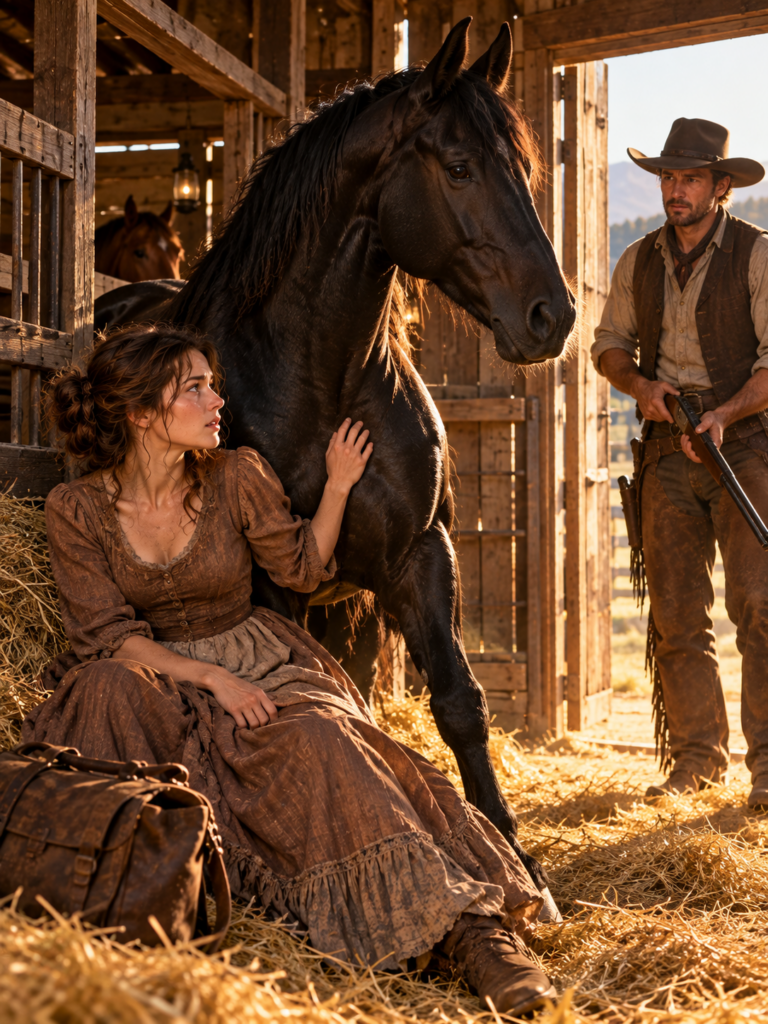
Midnight stood quietly near Celia, occasionally shifting his weight.
“My father arranged a marriage for me,” she continued.
Travis frowned.
“To whom?”
“A man with a considerable cattle operation. Nearly twice my age.”
“Did you agree?”
“No.”
The word came sharply enough to make Midnight flick an ear.
Celia stroked the horse’s neck.
“I told Father I wouldn’t marry him. We argued for two months. Every supper became another attempt to persuade me that the arrangement was sensible.”
“And was it?”
“For my father’s business interests, apparently.”
Travis said nothing.
Celia looked down at the photograph.
“My mother used to tell me that a good horseman learns to recognize when an animal is frightened instead of stubborn.”
She smiled sadly.
“Father taught me the same thing. But somehow, when I said I was frightened of the life he’d chosen for me, he decided I was simply being difficult.”
Travis studied her.
“Is your mother still in Ohio?”
“Yes.”
“Does she know where you are?”
“She knows why I left. Not where I’ve ended up.”
He nodded.
Celia hesitated.
“I saved money for two years. Worked when I could, sold a few belongings. I waited until I had enough to leave without depending on anyone else’s permission.”
“And then?”
“Then I boarded a train.”
Travis looked toward the open barn doors.
“You’ve traveled a long way to avoid something you never agreed to.”
“I didn’t know where I was going. I only knew where I wouldn’t stay.”
She looked at him.
“I’ve spent three weeks making sure nobody could decide my future for me.”
“And now you’re here.”
“Now I’m here.”
Midnight lowered his head beside her shoulder.
Travis glanced at the horse.
“You’ve made at least one friend.”
“He’s better company than most men I’ve met lately.”
“That’s a difficult standard to compete with.”
For the first time, Celia laughed without strain.
Then she tried to take another step.
Pain crossed her face.
Travis noticed immediately.
“Those feet need rest.”
“They’ll mend.”
“Likely. Faster if you don’t spend today walking on them.”
She looked toward the doorway.
“I can’t begin work while I’m unable to stand properly.”
“You don’t have to begin this morning.”
“But the wages—”
“Start when you’re fit to work. Breakfast isn’t conditional on it.”
Celia studied him.
She seemed to be measuring not merely his words but the ease with which he spoke them.
“You’re certain?”
“Yes.”
He turned toward the open door.
“There’s a bench outside if you’d rather sit in the sunlight while the room is prepared.”
She looked around the barn.
“And Midnight?”
“Will probably follow you.”
As though understanding his name, the stallion shifted toward her.
Travis shook his head.
“I suppose he’s already decided the matter.”
They moved slowly toward the entrance.
Celia walked without assistance, though Travis remained close enough to help if she asked.
When they emerged into the pale morning light, Hendricks was waiting with a bucket of water for the horse.
Midnight accepted the bucket but kept watching Celia.
The old ranch hand looked astonished.
“That’s the strangest thing I’ve seen in years.”
Travis glanced at him.
“You’ve lived a sheltered life.”
Hendricks grinned.
“Apparently so.”
Celia sat on the bench.
For the first time since the wagon axle broke, she was somewhere she could stop moving without fearing that she’d be ordered to continue.
She looked across the ranch.
The stables were solid.
The fencing was well maintained.
Men moved between their tasks with the practiced ease of people who understood their work.
Nothing here resembled the wealthy cattleman’s household her father had intended her to join.
And yet she was standing on another man’s property, accepting another man’s offer.
The thought unsettled her.
“Mr. Harlow?”
Travis turned.
“Yes?”
“Are you certain you won’t regret hiring somebody you found trespassing?”
He glanced at Midnight.
“Ask me after you’ve worked a week.”
“And if I decide the arrangement doesn’t suit me?”
“Then we’ll settle your wages.”
She watched him carefully.
He did not add a condition.
Did not ask for gratitude.
Did not suggest that shelter entitled him to anything.
Finally, Celia nodded.
“All right.”
Travis started toward the house.
But before he’d taken more than a few steps, Celia called after him.
“There’s something else you should know.”
He stopped.
“My father isn’t a man who accepts being refused.”
Travis turned back.
“Do you expect him to come looking?”
“I don’t know. But he may send someone.”
“And what would you want me to do?”
The question seemed to surprise her.
Celia looked down at her hands.
“I would want to speak for myself.”
“Then you shall.”
She lifted her eyes.
Travis gave a brief nod and continued toward the house.
Celia watched him go.
Midnight stood beside her, black against the morning light.
For weeks, she’d measured safety by how far she could travel from Ohio.
Now a stranger had offered her work, a room, and the right to make her own choices.
But there was still a man back east who believed those choices belonged to him.
And as Celia sat outside the barn, her hand resting against Midnight’s warm neck, she began to wonder how long it would be before her father discovered where she’d gone.
The thought troubled Celia as she sat beside Midnight, watching the road beyond Harlow Ranch.
For several minutes, she listened to the ordinary sounds of the morning.
Horses shifting in their stalls.
Harness buckles being fastened.
Hendricks calling to another worker across the yard.
Nothing suggested that anyone from Ohio was coming.
Still, she knew her father’s determination.
He had never been accustomed to losing an argument in his own household.
And she had done considerably more than argue.
She had left.
Travis returned carrying a plate of breakfast and a cup of coffee.
“Housekeeper’s busy this morning,” he said. “Thought you might prefer eating here.”
Celia accepted the plate.
“Thank you.”
He glanced at Midnight, who still stood nearby.
“You can leave him here a while if you’d like. He’s earned a quiet morning.”
“After all that fuss?”
“Especially after all that fuss.”
She smiled.
Travis returned to his work without expecting her to entertain him.
That alone made the breakfast taste better.
During the following days, Celia learned the rhythm of the ranch.
Travis rose early and kept a strict schedule. The horses were fed, exercised, inspected, and worked according to routines he’d refined over years.
He was skilled.
He was patient.
But he was also a man who preferred knowing exactly what each day would contain.
Celia noticed this almost immediately.
On her third morning, she watched him consult a small notebook before sending two workers to the north pasture.
“Do you plan everything?” she asked.
“Everything that can be planned.”
“And things that can’t?”
“I try not to invite them.”
She glanced toward Midnight.
“That must have been an inconvenient morning for you when you found me.”
“Considerably.”
“Yet you’ve survived.”
“Barely.”
She laughed.
He did not quite manage to hide his smile.
Her feet improved gradually.
Once she could work comfortably, she began helping with the horses.
Midnight greeted her at the barn entrance every morning.
Other horses were less immediately cooperative.
A nervous gelding named Rusty had become frightened of saddle equipment after a painful fall the previous winter.
He accepted a blanket but stiffened whenever someone reached for the girth.
Celia spent days working with him without attempting to mount.
She let him approach the tack.
She rewarded small improvements.
When he became frightened, she stopped rather than forcing the next step.
Travis watched with growing respect.
“He’s been difficult since the fall,” he said one afternoon.
“I can see why.”
“Will he ever be sound under saddle again?”
“I don’t know.”
The answer pleased him more than a confident promise would have.
Celia continued.
“I can help him become less afraid. I won’t pretend I can make him forget what happened.”
Travis nodded.
“That’s honest.”
“It’s the only way I know to train properly.”
Over the next three weeks, Rusty improved.
He stopped flinching at the blanket.
He began accepting the girth with less alarm.
There were setbacks.
Some days he allowed little progress.
Celia never treated those days as failure.
Travis noticed that she understood something he’d sometimes forgotten while managing a busy breeding operation.
A horse was not a piece of equipment that could be repaired according to a timetable.
It had memory.
And fear.
And reasons for resisting.
One afternoon, a neighboring stockman visited the ranch after hearing about Celia’s work.
He offered to hire her for a week to help with a difficult horse of his own.
Travis felt an immediate, unreasonable reluctance.
He wanted her to stay.
Not merely because she was useful.
Because he’d grown accustomed to hearing her voice in the stable.
He nearly told the neighbor that her services were unavailable.
Then he stopped himself.
Celia’s agreement had been clear.
Her work belonged to her.
So he turned toward her.
“It’s your decision, Miss Sutton. If you’d like the extra employment, I’ll make arrangements here.”
She studied him.
“You wouldn’t object?”
“Not if it’s work you want.”
“And if it meant leaving for a week?”
“Then I’d expect you back when the week’s finished. Provided you still wanted to return.”
She smiled.
“I appreciate that.”
She ultimately chose to remain at Harlow Ranch, explaining that she wanted to finish Rusty’s training before taking another assignment.
Travis was relieved.
Hendricks noticed.
The older ranch hand watched the neighbor ride away and looked at his employer.
“You appear mighty pleased about something.”
“Mind your work.”
“I am.”
“Then why are you standing here?”
“Observing a man who’s suddenly developed a great interest in where one particular employee chooses to work.”
Travis gave him a warning look.
Hendricks merely grinned.
“Never thought I’d see the day.”
That evening, Travis discovered Celia had kept a plate of supper warm for him.
He’d spent longer than expected repairing a section of fence and returned after the others had eaten.
She brought the plate from the stove.
“You missed supper.”
“I know.”
“That doesn’t mean you ought to miss eating.”
He accepted the food.
“You didn’t have to do this.”
“Neither did you have to drive six miles to retrieve my trunk.”
That had happened the previous week.
Word finally arrived that her belongings had been recovered from the disabled wagon and taken to the station in town.
Travis had hitched the wagon and offered to accompany her.
They’d collected her trunk, containing a few dresses, her mother’s sewing things, and a treasured photograph.
He hadn’t asked to inspect its contents.
When she explained what it held, he’d merely said that her belongings were hers and deserved to be returned.
Now, standing in the ranch kitchen, he looked at the warm meal she’d saved.
“Seems we’re both inclined to do things nobody asked us to do.”
Celia smiled.
“Provided they’re useful.”
“Provided they’re useful,” he agreed.
The closeness between them developed through these ordinary exchanges.
Travis began lingering in the stables longer than necessary.
Celia noticed him asking her opinion about horses he’d managed competently for years.
One afternoon, after he’d requested her assessment of the same mare for the third time, she put down her brush.
“Travis, are you genuinely uncertain about this horse?”
He hesitated.
“No.”
“Then why do you keep asking?”
He looked toward the stalls.
“I suppose I enjoy talking with you.”
She smiled.
“That’s a much more reasonable explanation.”
He looked at her.
She turned back to the horse before he could see how much the admission had pleased her.
But affection did not make them agree about everything.
Their first serious disagreement came over a young horse a buyer expected to inspect the following morning.
The animal was progressing, but not as quickly as Travis hoped.
Watching from the fence, he became impatient.
“Ask a little more of him,” he suggested. “The buyer comes tomorrow.”
Celia continued working.
The horse took a hesitant step.
Travis spoke again.
“He needs to stop testing you.”
Celia turned sharply.
“I’ll use my own judgment, thank you.”
Travis fell silent.
For a moment, his pride flared.
He owned the ranch.
He understood the horses.
He had every right to discuss the work.
But as he watched Celia patiently settle the young animal, he recognized what he’d done.
He had allowed the buyer’s schedule to matter more than the horse’s readiness.
His father would have been disappointed.
By evening, the horse had made genuine progress without being forced.
Travis approached Celia near the tack room.
“I owe you an apology.”
She looked up.
“For what?”
“For trying to rush your work.”
She waited.
He continued.
“My father taught me that pushing a frightened horse only teaches it to expect more fear. I forgot that because a buyer was coming.”
Celia studied him.
“I know these animals, Travis. I’ve worked with difficult horses since I was young.”
“I know.”
“Then trust me to do the work you’re paying me to do.”
“I will.”
She nodded.
“Good.”
There was no dramatic reconciliation.
No declaration.
Only a boundary clearly stated and accepted.
Yet something between them grew stronger.
That evening, they sat on the porch with coffee cooling between them.
Travis told her about the woman he’d once intended to marry.
He had been in his early twenties.
They’d imagined a future together until she decided ranch life wasn’t what she wanted.
She had been honest about it.
Travis had let her go.
But the disappointment had changed him.
He began arranging his days so carefully that nothing unexpected could disturb them.
“I told myself I was being sensible,” he admitted.
“Were you?”
“Partly.”
“And the rest?”
He looked toward the darkening pasture.
“The rest was fear of wanting something I couldn’t make stay.”
Celia considered his words.
“I understand wanting control over your own future.”
He turned toward her.
“My father has spent years telling me what would make a proper life,” she continued. “He decided what I should do, whom I should marry, and where I should live.”
She looked down at her hands.
“By the time I left, I could hardly bear the thought of someone else choosing anything for me.”
Travis nodded.
“I’m not asking to make those choices.”
“I know.”
She glanced toward him.
“That’s why I can sit here.”
The words affected him more than she realized.
For a long while, neither spoke.
Midnight moved quietly in the nearby stable.
The evening grew cool.
And Travis Harlow, who had spent years making his life orderly enough to resist disappointment, began to understand that the woman beside him had become the part of his day he most wanted to keep.
Six weeks after Celia’s arrival, a rider appeared at the ranch gate.
It was a gray afternoon.
Travis was near the yard when the stranger dismounted.
The man introduced himself as Pemberton.
“I’m looking for Celia Sutton.”
Travis felt an immediate tightening in his chest.
“What business do you have with her?”
“Her father hired me to bring her home.”
From the stable entrance, Celia heard every word.
Midnight stood beside her.
The stallion raised his head sharply as Pemberton’s horse shifted nervously near the gate.
Travis remained still.
He remembered what Celia had asked on her first morning.
She wanted to speak for herself.
So instead of answering for her, he turned toward the stable.
“Celia?”
She stepped into the yard.
“I’m here.”
Pemberton looked relieved.
“Miss Sutton. Your father has been worried.”
Celia stopped several paces away.
“Then you may tell him I’m safe.”
“He expects you to return.”
“I won’t.”
“The marriage arrangement—”
“Was never mine to make.”
Pemberton frowned.
“Your father believes you’ve had time to reconsider.”
“I have.”
“And?”
“I’ve decided that I’m not marrying a man I never chose.”
The stranger glanced at Travis.
“Perhaps Mr. Harlow has influenced—”
“No.”
Celia’s voice stopped him.
“Mr. Harlow has given me employment. The decision to leave Ohio was mine before I ever met him.”
Pemberton looked uncomfortable.
“Your father sent me a considerable distance.”
“I’m sorry for the wasted journey. But that doesn’t change my answer.”
She drew herself upright.
“Tell him I have honest work. Tell him I’m safe. And tell him that if he wishes to write, he may do so without arranging my future in the same letter.”
Pemberton considered her.
Then he glanced at Midnight, who stamped once and unsettled the stranger’s horse.
The man gathered his reins.
“I’ll deliver your message.”
“Thank you.”
He mounted and rode away.
Celia watched until he disappeared beyond the road.
Only then did she release the breath she’d been holding.
Travis stood beside her.
“That took courage.”
She gave a tired smile.
“I’ve had considerable practice being frightened.”
He looked at her.
“Your wages remain the same.”
Celia frowned.
“What?”
“And your room is yours as long as you work here, regardless of anything else.”
“Why are you telling me that?”
Travis drew a slow breath.
“Because there’s something I hope to ask you soon.”
She became very still.
He continued.
“And I want you to know your answer won’t change your employment, your wages, or your right to leave.”
Celia looked at the man who had given her shelter without demanding gratitude.
The man who had accepted correction.
The man who had learned to ask rather than command.
For the first time, the thought of staying no longer frightened her.
“What are you going to ask?” she whispered.
Travis looked toward the stable, where Midnight stood quietly watching them.
Then he turned back.
“Something I want you to answer only when you’re certain.”
Celia held his gaze.
And for the first time since leaving Ohio, she realized that she already knew what she wanted her answer to be.
Celia knew what her answer would be, but she did not offer it before Travis found the courage to ask.
That mattered to her.
For years, she’d been expected to accept decisions other people made.
Now she wanted something very different.
She wanted to hear a man ask what kind of future she desired.
And she wanted the freedom to answer without fear.
Travis seemed to understand.
After Pemberton left, he didn’t demand an explanation of her feelings.
He didn’t ask whether she loved him.
He simply went back to work.
Celia returned to the stable.
Midnight greeted her with a low nicker.
She rested her forehead briefly against his neck.
“You’ve caused a great deal of trouble, haven’t you?”
The stallion shifted his weight.
She smiled.
“Though I suppose most of it has been worthwhile.”
Over the next several days, Celia watched Travis more closely than ever.
She noticed how he’d begun consulting her before changing the training schedule.
He still made decisions about the ranch.
She still performed the work she’d been hired to do.
But their discussions had become genuine exchanges rather than instructions followed by polite agreement.
When she suggested altering the order in which the horses were exercised, he asked why.
She explained.
He considered the reasoning.
And when she was right, he made the change.
The difference meant more to her than compliments.
She had spent much of her life hearing that she was capable with horses, only to be told that her judgment about her own future was unreliable.
Travis did not separate those two things.
He trusted her knowledge.
He was learning to trust her choices.
One evening, she found him repairing a fence near the west pasture.
She stood beside him without speaking.
He finished tightening a wire before looking up.
“Something on your mind?”
“Yes.”
He set down his tools.
Celia looked across the field.
“When I left Ohio, I didn’t have a plan beyond getting away.”
He waited.
“I thought freedom meant being somewhere nobody could tell me what to do.”
“That’s understandable.”
“But I’ve been thinking about what comes afterward.”
Travis studied her.
“And what have you decided?”
She smiled faintly.
“That being free to leave matters less if there’s nowhere you want to remain.”
He took a slow breath.
“Celia.”
She met his eyes.
“I like this ranch. I like the horses. I like the work.”
“I’m glad.”
“And I’ve discovered that I like the man who runs it.”
Travis looked almost stunned.
Celia’s smile deepened.
“Though he can be rather stubborn.”
“I’ve heard that.”
“And he occasionally forgets his own advice.”
“I’ve heard that too.”
“But he listens when he’s wrong.”
Travis looked down at his tools.
“I’m trying.”
“I know.”
She stepped closer.
“I think you understand what I’m telling you.”
“I believe I do.”
“Then when you’re ready to ask your question, I’d appreciate hearing it plainly.”
Travis looked at her for a long moment.
Then he nodded.
“I’ll do that.”
He did not ask that evening.
Nor the following morning.
For nearly two days, he found himself unable to settle on words that sounded sufficient.
He tried speaking them aloud while working alone.
He tried imagining how he would explain what she meant to him.
Each attempt became awkward.
He had spent years training horses, negotiating sales, and managing men.
He had never struggled so much with a simple sentence.
Hendricks noticed.
The older ranch hand watched Travis inspect a stretch of fencing that had required no attention since spring.
“You expecting that fence to run away?”
Travis glanced at him.
“What?”
“You’ve examined it four times.”
“Making certain it’s sound.”
“Looks sound to me.”
Travis continued working.
Hendricks leaned on a post.
“Reckon there’s something else you’re trying to settle.”
“Have you no work of your own?”
“Plenty. But yours is more entertaining.”
Travis gave him a look.
Hendricks grinned and walked away.
That evening, Celia joined Travis on the porch.
Midnight stood in the nearby stable yard, visible through the fading light.
A gentle wind moved through the grass.
Travis had been sitting for several minutes before she arrived.
When she took the chair beside him, he straightened.
“I have something to ask.”
Celia folded her hands in her lap.
“About a horse?”
He smiled nervously.
“For once, no.”
“Then it must be important.”
“It is.”
He looked at her.
“Celia, when I first found you in the barn, I thought you were another complication in a life I’d worked very hard to keep orderly.”
She raised an eyebrow.
“How flattering.”
He laughed softly.
“Let me finish.”
“Go on.”
“I thought if I planned everything carefully enough, I could avoid another disappointment.”
“And did it work?”
“For a while.”
“Until Midnight refused to move?”
“Until Midnight refused to move.”
They smiled at each other.
Travis continued.
“You changed the way I look at this place. The horses, the work, even the quiet evenings.”
His voice became steadier.
“I don’t want you here because you need shelter. I don’t want you to stay because I pay your wages.”
Celia listened.
“I want you here because I love you.”
Her expression softened.
“And I’d like to spend my life building something with you, if that’s what you want too.”
He took her hand gently.
“Celia Sutton, will you marry me?”
She looked at him for a moment.
Then she smiled.
“At last, you’ve found a question you haven’t asked me three times already.”
Travis exhaled a nervous laugh.
“Does that mean I ought to ask again?”
“No.”
“Then—”
“Yes, Travis.”
His face changed.
“Yes?”
“Yes. I’ll marry you.”
She leaned toward him.
He met her halfway.
Their kiss was quiet and unhurried.
Nearby, Midnight gave a low nicker.
Celia laughed against Travis’s shoulder.
“Apparently he approves.”
“He seems to have been arranging this longer than either of us.”
“Then perhaps we ought to give him some credit.”
“I think he’s already quite satisfied with himself.”
They remained on the porch until the light faded.
But the decision to marry did not mean Celia surrendered the independence she’d traveled so far to protect.
The following morning, they discussed practical matters.
Her work.
Her wages before the wedding.
How responsibilities would be shared afterward.
The horses she intended to continue training.
The changes she hoped to make to the stable routine.
Travis listened carefully.
“I don’t expect you to stop working with the horses,” he told her.
“Good. Because I don’t intend to.”
“I thought as much.”
“And I want a voice in decisions concerning the animals I train.”
“You’ve earned that.”
Celia shook her head.
“It’s not a favor.”
“No,” Travis agreed. “It isn’t.”
She looked at him with affection.
“Then we understand each other.”
“I believe we do.”
They also discussed her father.
Celia knew he would eventually learn of the marriage, whether she informed him directly or not.
She preferred to tell him herself.
That week, she wrote a letter.
She explained where she lived.
She described her work.
She told him she intended to marry Travis Harlow.
And she made clear that the decision was hers.
There was no anger in the letter.
No attempt to punish her father.
But there was also no apology for refusing the marriage he’d arranged.
She told him that she hoped they might someday know each other again without every conversation becoming an argument over who should govern her life.
When she finished, she read the letter once more.
Then she sealed it.
Travis offered to take it into town.
“I’ll come with you,” she said.
He nodded.
They rode together.
At the post office, Celia handed over the letter herself.
When she stepped outside, she felt strangely light.
For the first time, she’d told her father the truth without trying to persuade him that she had a right to it.
She had simply stated her choice.
A reply arrived about a month later.
Celia recognized the handwriting immediately.
She carried the envelope to the porch and opened it while Travis sat nearby.
Her father had written more carefully than usual.
He admitted that he had taught her to trust her judgment when working with horses but had failed to extend that same respect to her decisions about marriage.
He acknowledged that she’d been right to refuse an arrangement she did not want.
He wrote that he regretted allowing his business ambitions to determine what he thought her future ought to be.
And he asked whether he might attend the wedding.
Not to give permission.
Not to decide anything.
Simply to witness the life she had chosen.
Celia read the letter twice.
Travis waited without interrupting.
Finally, she looked up.
“He’s asking to come.”
“How do you feel about that?”
She looked at the paper.
“I don’t know.”
“Then you needn’t answer today.”
She smiled faintly.
“You’ve become very good at that.”
“At what?”
“Giving me time.”
Travis took her hand.
“It’s yours to take.”
Celia considered the letter for another day.
Then she wrote a brief reply.
Her father would be welcome as a guest.
He would not be expected to escort her or speak on her behalf.
He would be asked to respect the decision she had already made.
She sent the letter without revising it.
And for the first time, she felt that the relationship with her father might someday change without requiring her to become the obedient daughter he’d once expected.
The wedding took place that autumn.
It was a small gathering at Harlow Ranch.
Hendricks helped prepare the yard.
The other ranch hands attended in their best clothes.
Neighbors came with food and good wishes.
Midnight stood in his pasture, watching the activity with the restless interest of an animal who disliked being excluded from anything important.
Celia wore a simple dress she’d chosen herself.
Her mother’s sewing things had helped her make the final alterations.
She carried the photograph she’d brought from Ohio among her personal belongings, a reminder of the home she’d left without surrendering all that had been good in it.
Her father arrived quietly.
He looked older than she remembered.
For a moment, neither knew what to say.
Then he removed his hat.
“Celia.”
“Father.”
He glanced toward the gathering.
“You look well.”
“I am.”
His eyes moved toward the stables.
“I hear you’ve been doing fine work with the horses.”
“I have.”
He nodded.
A long silence followed.
Then he said, “I was wrong to think I knew better than you what kind of life you ought to live.”
Celia studied him.
The apology did not erase the months of arguments or the fear that had driven her across the country.
But it mattered.
“Thank you for saying that.”
He looked toward Travis.
“He seems a decent man.”
“He is.”
“Does he treat you well?”
“He listens when I tell him he isn’t.”
Her father blinked.
Then, unexpectedly, he smiled.
“Your mother says that sounds like a good arrangement.”
Celia laughed softly.
“She would.”
Her father did not ask for more.
He took his seat among the guests.
And when Celia walked toward Travis, she did so because she wanted to.
No one gave her away.
No one spoke as though she were property passing from one household to another.
She simply crossed the yard to the man she loved.
Travis took her hands.
His expression held the same quiet wonder she’d seen on the evening he proposed.
They exchanged their vows beneath the open Dakota sky.
When they kissed, Midnight gave a loud, indignant call from the pasture.
Several guests laughed.
Hendricks shook his head.
“That horse still thinks he ought to be consulted.”
Travis looked toward the stallion.
“He usually is.”
Celia smiled.
“Then we’d better keep him satisfied.”
After the wedding, life at Harlow Ranch changed gradually.
Travis no longer arranged every hour of every day without considering anyone else’s wishes.
Celia continued training horses.
They discussed which animals needed patience, which were ready for more demanding work, and how best to manage the stable schedule.
Sometimes they disagreed.
Sometimes Celia’s judgment proved better.
Sometimes Travis saw something she’d overlooked.
But neither treated disagreement as disobedience.
They had learned too much to return to that kind of life.
And the ranch flourished through steady work rather than sudden miracles.
Midnight continued greeting Celia each morning at the stable entrance.
Rusty improved enough to accept more handling, though the memories of his fall never entirely disappeared.
Celia never called that failure.
She judged his progress by what he could manage comfortably.
Travis admired that about her.
She measured success by trust earned, not fear overcome through force.
Two years after their marriage, their son Samuel was born.
The household changed again.
Sleepless nights replaced some of the quiet evenings they had once spent together.
New responsibilities required adjustments to the ranch schedule.
Travis learned that caring for a baby demanded patience of a kind no horse had ever taught him.
Celia discovered that she could love her child deeply and still miss the work she enjoyed.
They made room for both truths.
As Samuel grew, she brought him into the stable yard during safe, supervised visits.
Midnight became accustomed to his presence.
The stallion, once so determined to keep strangers away from the barn, stood calmly while Celia held the child nearby.
Travis watched one morning.
“That horse seems to have made another decision.”
Celia smiled.
“He does like choosing his own company.”
“He’s become rather generous with it.”
“Perhaps we’ve all improved.”
Three years after Samuel’s birth, their daughter Ruth arrived.
She announced herself with a strong voice and a temperament Travis insisted had come directly from her mother.
Celia disagreed.
“She’s inherited your stubbornness.”
“Impossible.”
“You argued with a fence post for two hours yesterday.”
“It was improperly set.”
“And yet you insist she’s like me.”
Travis smiled.
“I’ve always admired your determination.”
“An excellent answer.”
Their home grew busier.
The children learned early that horses were living creatures requiring respect, not toys to be handled carelessly.
Travis and Celia taught them to observe.
To speak calmly.
To understand when an animal wanted distance.
To recognize that affection did not erase the need for caution.
When Samuel turned five, Travis helped him take his first short ride around the yard on a suitable, gentle horse.
He walked beside the saddle, keeping a steady hand nearby.
Celia watched from the fence.
Samuel’s face shone with excitement.
“Did you see, Mama?”
“I saw.”
“I stayed on!”
“You did.”
Travis smiled.
“And you remembered to sit straight.”
Samuel looked enormously proud.
Three years later, when Ruth reached the same age, she began her own lessons.
She was more impatient than her brother had been.
She wanted to ride without assistance.
Celia knelt beside her.
“Do you remember what we tell the horses?”
Ruth frowned.
“What?”
“There’s no need to hurry when you’re learning something important.”
Ruth considered that.
Then she looked at Midnight standing nearby.
“Even him?”
“Especially him.”
Travis laughed.
The old stallion had grown calmer over the years, though he remained a powerful animal.
He no longer reacted to every unfamiliar sound with suspicion.
He had learned the routines of a household full of people.
And Celia remained his favorite.
Each morning, he waited for her near the stable door.
Sometimes Samuel accompanied her.
Sometimes Ruth came too.
The children loved the great black horse, though Travis and Celia never forgot that even a trusted animal required careful handling.
They supervised every visit.
Midnight seemed content simply to stand nearby and receive their attention.
One afternoon, Celia watched Samuel carefully braid a loose ribbon into a small section of the stallion’s mane while Travis held Midnight.
Ruth stood beside them, offering entirely unsolicited advice.
“Not like that, Samuel.”
“I know how.”
“You’re doing it crooked.”
“You’re not helping.”
Celia laughed.
Travis glanced toward her.
“That sounds familiar.”
“Don’t start.”
“I was merely observing.”
She smiled.
“That’s what you always say.”
Later, when the children were resting in the house after a long day, Celia returned alone to the barn.
She stopped at the entrance.
The same entrance where Travis had found her years earlier.
For a moment, she could almost see herself as she’d been that first morning.
A frightened young woman in a dusty dress.
Blistered feet.
A small bag beside her.
No clear destination.
And a black stallion standing between her and the world.
She remembered the sound of Travis’s boots approaching.
The rifle in his hand.
The way he’d lowered it as soon as he saw her.
She remembered telling him that she had no intention of belonging to another man simply because he offered shelter.
And she remembered his answer.
Then don’t.
Those two words had mattered more than he knew.
She heard footsteps behind her.
Travis approached carrying a lantern.
“Thought I might find you here.”
Celia turned.
“How did you know?”
“You come out here when you’ve something on your mind.”
She smiled.
“You notice more than you let on.”
“I’ve had years of practice.”
He stood beside her.
Midnight raised his head from the stall.
Travis glanced at the horse.
“Still keeping watch?”
Celia rubbed the stallion’s neck.
“He seems to think it’s his duty.”
“Always has.”
She looked around the barn.
The stalls were familiar.
The wooden beams had darkened with age.
The stable smelled of hay, leather, and horses.
Nothing about the place seemed frightening now.
Yet she remembered how desperate she’d been for shelter on that first night.
“I was afraid you’d find me,” she said.
Travis looked at her.
“I know.”
“I thought you’d order me out. Or ask questions I wasn’t ready to answer.”
“I nearly did ask too many.”
“You asked enough.”
He smiled faintly.
“But you let me decide whether to stay.”
“Seemed only fair.”
She turned toward him.
“You have no idea how much that meant.”
Travis set the lantern on a shelf.
“I think I understand better now.”
Celia rested her hand against his arm.
“Back then, I was listening for footsteps because I was afraid of who might come through the door.”
“And now?”
She smiled.
“Now I listen for yours because I know you’re coming home.”
Travis drew her gently into his arms.
She leaned against him.
For a while, they listened to Midnight shifting quietly in the stall.
Then Travis spoke.
“There’s a considerable distance between those two things.”
Celia nodded.
“The finest distance I’ve ever traveled.”
He kissed her forehead.
She looked toward the stable entrance, where the last evening light lay across the yard.
“Do you ever think about that morning?”
“Often.”
“What do you remember most?”
Travis considered.
“The horse refusing to move.”
“Not very romantic.”
“The woman who told me she’d appreciate knowing whether I intended to shoot her.”
Celia laughed.
“I was frightened.”
“I know.”
“And tired.”
“I know that too.”
“And I had no intention of staying anywhere long.”
He looked at her.
“I’m grateful you changed your mind.”
She shook her head.
“I didn’t change it because I had nowhere else to go.”
“I know.”
“I stayed because I wanted to.”
Travis held her gaze.
“That’s the only reason I ever wanted.”
The years continued passing.
Samuel grew into a boy who loved horses and asked endless questions.
Ruth proved just as eager to learn, though she approached every new lesson with the confident belief that she would soon master it.
Travis taught them patience.
Celia taught them to trust their observations.
Together, they showed their children that a person’s strength was not measured by how completely others obeyed.
It was measured by the care taken with someone else’s trust.
Celia remained close to her parents through letters and occasional visits when circumstances allowed.
Her father never again tried to arrange her future.
Their relationship was not suddenly perfect.
They still disagreed.
But he learned to ask about her work with genuine interest.
And she learned that accepting his apology did not require surrendering the independence she had fought to establish.
Travis remained devoted to the ranch.
He still rose early.
Still inspected the horses.
Still kept records and planned for the coming seasons.
But he no longer believed that a life without surprises was the safest life worth having.
Some of his happiest moments had arrived entirely unplanned.
A woman in his barn.
A frightened horse that refused to move.
A warm supper kept for him after dark.
A disagreement that taught him humility.
A marriage entered freely.
Two children filling the house with laughter.
None of it would have existed if Midnight had simply obeyed him that first morning.
One evening, after the children’s voices had faded from the yard, Travis and Celia stood together beside the barn door.
Midnight watched them from his stall.
Celia smiled at the old horse.
“He knew something you didn’t.”
Travis raised an eyebrow.
“Did he?”
“He knew I was worth trusting.”
“I learned quickly.”
“Not quite as quickly as he did.”
Travis laughed.
“I’ll grant him that.”
She turned toward her husband.
“And you knew something I didn’t.”
“What’s that?”
“That I could stay somewhere without surrendering myself.”
His expression softened.
“You discovered that on your own.”
“Perhaps. But you gave me the room to discover it.”
He took her hand.
The lantern burned steadily behind them.
Outside, the Dakota evening spread across the fields.
Travis remembered the carefully ordered life he’d built after his first disappointment.
He’d believed that avoiding uncertainty would keep him from being hurt.
Celia remembered leaving Ohio with a small bag and enough money to travel, uncertain whether freedom would mean anything more than endless movement.
They had both been wrong about what safety required.
He hadn’t needed to control every outcome.
She hadn’t needed to avoid every attachment.
What they’d needed was the chance to choose one another without obligation or fear.
Travis looked toward Midnight.
“Suppose he deserves our thanks.”
Celia smiled.
“He’s had them every morning for years.”
“Then one more won’t hurt.”
He approached the stall and rested his hand against the black horse’s neck.
“Good judgment, old fellow.”
Midnight gave a contented breath.
Celia laughed softly.
Then she joined Travis beside the stall.
Years earlier, she had arrived with nothing but exhausted feet, a battered bag, and the determination never again to let someone else decide her life.
That morning, Midnight had stood between her and the barn door as though the whole world depended upon keeping her safe.
Now she stood in the same place with a husband who respected her freedom, children who filled their home with life, and work she had never been asked to abandon.
Travis took her hand.
And when they finally walked toward the house together, Midnight remained quietly at the stall entrance.
He no longer needed to keep anyone away.
The woman he’d guarded had found the place she wanted to be.
And this time, she had chosen to stay.