
Part 1
The first thing I remember about that birthday is the smell of burnt garlic.
My daughter-in-law, Vanessa, had been trying to cook dinner, which ordinarily would have been a lovely gesture. Except she hadn’t actually intended to cook for me. She had forgotten it was my birthday until my grandson mentioned it over breakfast.
By six that evening, she’d ordered Italian takeout, transferred everything into serving dishes, and told the children she’d been preparing a special dinner all afternoon.
I didn’t correct her.
At seventy-three, you learn that correcting people isn’t always worth the trouble it brings.
My name is Evelyn Mercer. I spent thirty-six years working as an elementary school librarian in San Antonio, Texas. I raised one son, survived one devastating loss, and learned to live on a modest retirement income without asking anybody for a thing.
Or at least, that was the woman I used to be.
Four years earlier, after my husband Daniel died, my son Nathan persuaded me to sell our little house and move into his home.
“Mom, you’ve been alone too long,” he’d said. “We’ve got plenty of room. The kids would love having you here.”
I remember standing in my old kitchen, looking at the faded yellow curtains Daniel had hung the spring before he became ill.
“Are you sure Vanessa won’t mind?”
Nathan had put both hands on my shoulders.
“You’re family. Of course she won’t mind.”
I wanted to believe him so badly that I ignored the little hesitation before his answer.
So I sold the house.
I gave away furniture that had belonged to my parents, packed thirty-eight years of marriage into cardboard boxes, and moved into the downstairs bedroom of Nathan’s four-bedroom home.
At first, things were wonderful.
My granddaughter, Sophie, was six then. She would climb into my lap after school and ask me to read the same stories over and over. My grandson, Ben, was nine, full of questions about dinosaurs and airplanes.
Vanessa thanked me for helping with the children.
Nathan brought me coffee on Sunday mornings.
I felt needed.
Then, somewhere along the way, being needed turned into being expected.
I began preparing breakfast because both parents left early for work. Then I started making the children’s lunches. Then dinner became my responsibility because Vanessa was too exhausted after spending all day managing her real estate office.
Before long, I was doing the grocery shopping, laundry, dishes, school pickups, and most of the housecleaning.
Nobody announced the arrangement.
Nobody asked whether I agreed.
It simply happened.
And because I loved them, I let it.
That was my mistake.
Not loving them.
Forgetting that love doesn’t require a person to disappear.
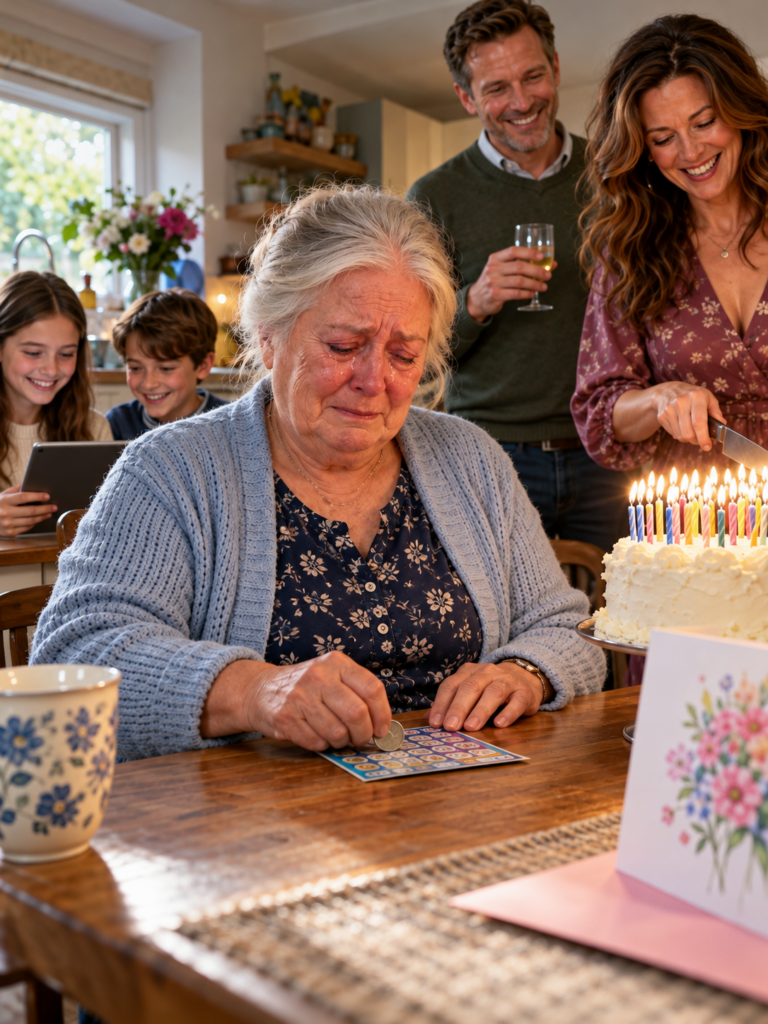
On the evening of my seventy-third birthday, I sat at the far end of the dining table while Vanessa arranged the takeout containers she had emptied into her good ceramic bowls.
The children were distracted by their phones.
Nathan had just come home from work and still wore his company polo shirt.
“Everybody ready?” Vanessa asked brightly.
She placed a cake in the center of the table.
My cake.
A vanilla sponge with strawberry filling.
I’d baked it that morning because I knew nobody else would remember to buy one.
Vanessa stuck seven candles into one side and three into the other.
“There,” she said. “Seventy-three. Goodness, Evelyn, that’s getting up there.”
Nathan chuckled.
I smiled politely.
They sang “Happy Birthday,” although Ben barely looked up from his screen.
After I blew out the candles, Vanessa reached into her purse.
“Oh, and we got you something.”
She slid a narrow paper envelope across the table.
Inside was a scratch-off lottery ticket.
Two dollars.
The price was printed boldly in the corner.
Vanessa grinned.
“We figured you already have everything you need. Maybe you’ll win enough to treat yourself to a little shopping trip.”
Nathan laughed.
“Or a bus ticket somewhere exciting.”
Vanessa laughed harder.
I looked at my son.
For a second, I waited for him to say something kind.
Maybe that it wasn’t much, but they’d wanted to surprise me.
Maybe that he’d take me out to lunch that weekend.
Anything.
Instead, he reached for another helping of pasta.
“Go on, Mom. Scratch it. Let’s see whether we’re retiring early.”
Vanessa winked.
“Only if she shares.”
The children giggled.
I picked up a quarter from the little dish beside the kitchen telephone.
The ticket had a bright blue background decorated with gold stars. Across the top were the words Texas Golden Fortune.
I scratched the first row.
Nothing.
The second row revealed two matching symbols.
Then the third.
I rubbed the quarter across the final silver square, brushing the gray dust away with my thumb.
Three matching symbols.
A prize amount printed beneath them.
I stared.
The number was so large that my brain refused to understand it.
I turned the ticket slightly toward the overhead light.
Then I counted the zeros.
Once.
Twice.
My pulse thudded behind my ears.
“Evelyn?”
Vanessa’s voice seemed to come from another room.
“Are you finished? You’re getting scratch dust all over the table.”
I looked up.
She was holding a paper towel toward me.
Nathan was pouring himself another glass of iced tea.
Ben had returned to his game.
Sophie was licking frosting from her fork.
Nobody was watching the ticket.
I turned it facedown.
“Looks like I didn’t get lucky,” I said.
Vanessa made a theatrical little sigh.
“Well, there goes your shopping spree.”
Nathan smiled.
“Better luck next year, Mom.”
I folded the ticket into a napkin and slipped it inside my cardigan pocket.
Then I cleared the dessert plates.
I remember how carefully I moved.
How I rinsed every dish.
How I wiped the counter twice because I needed something ordinary to do while my mind raced.
Later, when everyone had gone upstairs, I locked my bedroom door.
I took the ticket from my pocket and laid it on Daniel’s old writing desk.
Under the yellow light of my bedside lamp, I read the prize again.
Eight million dollars.
Eight million.
I sat so suddenly that the chair scraped against the hardwood floor.
For a long time, I could only stare.
Then I started crying.
Not loudly.
Not with the kind of joyful shriek people make in lottery commercials.
I pressed my hand over my mouth and let tears run down my face.
Because the first person I wanted to tell was dead.
Daniel would have known exactly what to say.
He would have studied the ticket through his old reading glasses, checked it three times, and then smiled that crooked smile of his.
“Well, Evie,” he’d have said, “I suppose we can finally replace that old refrigerator.”
I could almost hear his laughter.
Instead, I sat alone in a bedroom that didn’t belong to me, inside a house where I’d spent the evening washing dishes on my own birthday.
Eventually, I opened my laptop.
I found the lottery’s official instructions and carefully compared the symbols and prize rules.
Then I checked again.
The numbers didn’t change.
I photographed both sides of the ticket, put it into a protective sleeve from my box of family photographs, and tucked it inside the locked drawer of Daniel’s desk.
For the first time in years, I had something that belonged entirely to me.
And I wasn’t ready to give it away.
The next morning, Vanessa knocked on my door at six fifteen.
“Evelyn? Can you take Ben to school today? I’ve got an early showing.”
I was still sitting on the edge of my bed, looking at the drawer.
“Of course,” I answered automatically.
Then she added, “And we need more laundry detergent.”
I closed my eyes.
For a moment, I wanted to fling open the door and tell her everything.
I wanted to ask how she’d feel knowing the woman she treated like unpaid help might now have more money than she’d earn in her entire career.
But I heard Daniel’s voice in my memory.
Never make a big decision when you’re hurt, Evie. Sleep on it first.
So I said nothing.
After I dropped Ben off, I drove to a small bank branch across town and requested access to a safe-deposit box. I placed the ticket inside, then went home and searched for the phone number of a woman I hadn’t spoken to in nearly ten years.
Her name was Patricia Lowell.
She had been the attorney who helped Daniel and me prepare our wills.
When I called, she recognized my voice immediately.
“Evelyn Mercer? Good heavens. How are you?”
“I need some advice, Patricia.”
“Certainly. What’s happened?”
I looked through the windshield at a mother pushing a stroller along the sidewalk.
“I may have come into some money.”
There was a pause.
“How much money?”
I swallowed.
“Enough that I’m frightened of making a mistake.”
Patricia invited me into her office the following afternoon.
She was seventy herself, with silver hair, sharp blue eyes, and the kind of expression that made people reconsider telling lies.
I brought my photographs and the original ticket, retrieved from the bank that morning.
She examined everything.
Then she put the ticket down.
“Evelyn, before we discuss anything else, tell me one thing.”
“All right.”
“Who knows?”
“Nobody.”
“Not even Nathan?”
I shook my head.
Patricia removed her glasses.
“Good. Let’s make sure you understand your options and the claim requirements before you change that.”
Over the following weeks, she helped me hire a financial adviser and a tax professional who regularly worked with lottery winners. We discussed claiming procedures, the risks of publicity, and ways to protect my privacy to the extent Texas law allowed.
When the prize was eventually processed, I received considerably less than the headline amount after the applicable payout terms and taxes were accounted for.
But it was still more than I could ever have imagined possessing.
I sat in Patricia’s office the day everything was finalized.
She slid a statement toward me.
“How do you feel?”
I looked at the balance.
“Like somebody made a mistake.”
She smiled.
“They didn’t.”
I stared at the paper for another minute.
Then I asked a question that surprised even me.
“Patricia, what would it cost to buy a little house?”
She leaned back.
“What kind of house?”
“One with a garden. Maybe a porch. Two bedrooms. Nothing fancy.”
“In San Antonio?”
“Close enough that the grandchildren could visit. Far enough that nobody could drop their laundry off on the way to work.”
Patricia watched my face.
Then she laughed.
Not cruelly.
Warmly.
“Evelyn, I think that’s an excellent place to start.”
But the money wasn’t the only reason I began making plans in secret.
Three weeks after my birthday, I overheard a conversation that stripped away the last illusion I’d been holding onto.
It was nearly ten at night.
I’d gone downstairs for a glass of water when I heard Vanessa speaking in the den.
“Your mother can’t live here forever, Nathan.”
I stopped in the hallway.
Nathan sighed.
“She’s only seventy-three.”
“Exactly. She’s not getting younger.”
“She’s healthy.”
“For now.”
I gripped the edge of the wall.
Vanessa continued.
“Ben’s getting older. He needs more space. And honestly, your mother has gotten far too comfortable.”
There was a pause.
Then Nathan said something I have never forgotten.
“I don’t know what you expect me to do with her.”
With her.
As though I were a broken appliance they couldn’t decide whether to repair or throw away.
Vanessa lowered her voice.
“We need to start looking at options.”
I returned to my bedroom without the water.
That night, I sat beside Daniel’s photograph until almost dawn.
I thought about Nathan as a little boy.
The summer he broke his wrist falling from a bicycle.
The winter he had pneumonia and I slept in a chair beside his hospital bed.
The year Daniel’s factory shut down and we both took extra jobs so Nathan wouldn’t have to give up his college plans.
I remembered holding him after his first serious girlfriend broke his heart.
I remembered his wedding day.
And I wondered when my son had started thinking of me as a problem that needed solving.
The next morning, I called Patricia.
“I’ve changed my mind about the size of the house,” I told her.
“Oh?”
“I want three bedrooms.”
“Planning for guests?”
“Yes,” I answered. “But I want to choose when they come.”
By early summer, I found a small brick-and-stone cottage in a quiet neighborhood near the edge of the city.
It had a red front door, a wide back porch, and an overgrown garden filled with rosemary bushes.
The previous owner had been a retired music teacher.
There were bookshelves built into the living room and an enormous old pecan tree in the backyard.
The first time I stepped inside, I felt something I hadn’t felt since selling the home Daniel and I shared.
I could imagine growing old there without being afraid.
My friend Ruth came with me for the second viewing.
Ruth and I had worked together at the elementary school for twenty-one years. She was the only friend I’d confided in about my situation, though I hadn’t told her the full amount I’d won.
She walked through the kitchen, opened the pantry, and smiled.
“Well, Evelyn, this place has your name written all over it.”
I ran my fingers along the wooden counter.
“Do you think it’s too much?”
“Too much for whom?”
I hesitated.
“Just me.”
Ruth turned to face me.
“You raised a child, buried a husband, worked your whole life, and spent four years taking care of everybody else. Why does everything you want have to pass some test of being modest enough?”
I looked away.
She touched my arm.
“Buy the house.”
So I did.
I closed on the property in June.
I bought a pale blue sofa, a new bed, and a dining table large enough for six.
I hired a gardener to restore the backyard.
Then I bought a small wooden sign for the kitchen.
It said:
Home is where you can finally put your feet up.
I laughed when I saw it.
Then I bought it anyway.
Still, I couldn’t quite bring myself to leave Nathan’s house.
Part of me felt guilty.
Another part wanted to see whether the conversation I’d overheard had been spoken out of frustration rather than genuine intention.
Maybe Nathan would talk to me.
Maybe he’d notice I was tired.
Maybe he’d ask what I wanted.
So I waited.
I continued cooking dinner, taking the children to school, and folding laundry while my own beautiful little house sat empty across town.
I visited twice a week.
Sometimes I sat on the porch with a cup of coffee and imagined what it would feel like when I finally moved in.
Then I’d return to Nathan’s house and hear Vanessa shouting from upstairs that someone had forgotten to unload the dishwasher.
One afternoon in August, Sophie found me sitting alone in the garden behind Nathan’s house.
She was ten then, with Daniel’s dark eyes and a serious expression that always made me smile.
“Grandma?”
“Yes, sweetheart?”
“Are you sad?”
I set down my pruning shears.
“Why do you ask?”
She sat beside me.
“Because you don’t sing anymore.”
I looked at her.
“What?”
“You used to sing when you made pancakes. And when you watered the flowers. Now you don’t.”
Children notice things adults become skilled at ignoring.
I put an arm around her shoulders.
“I’ve just had a lot on my mind.”
She leaned against me.
“Mommy says you’re probably going to move somewhere with old people.”
My hand went still.
“She said that?”
Sophie nodded.
“She said it would be good for you because you’d have friends your own age.”
I swallowed.
“And what do you think?”
She considered the question.
“I think you already have friends.”
I kissed the top of her head.
“Yes, sweetheart. I do.”
Then she asked the question that nearly broke my heart.
“If you go away, can I still see you?”
I pulled her closer.
“Always.”
She wrapped both arms around my waist.
“Promise?”
“I promise.”
That night, I lay awake thinking about her.
I had money now.
Enough to disappear into a peaceful life and never worry about anyone else’s approval again.
But independence wasn’t the same as abandoning the people I loved.
I didn’t want to punish my grandchildren for their parents’ choices.
I didn’t even want to punish Nathan.
I wanted him to understand what he’d lost sight of.
And I wanted him to understand before it was too late.
In September, Patricia and I established separate educational trusts for Ben and Sophie, with independent administration and restrictions that would prevent either parent from treating the funds as household spending money.
I funded them without telling the children.
That decision gave me more satisfaction than buying the house.
Daniel had always believed education was the one gift nobody could take away from a child.
I could almost see him smiling when I signed the papers.
Then October came.
And with it, the first unmistakable sign that Vanessa and Nathan had stopped discussing my future and started arranging it.
I was sorting socks in the laundry room when Vanessa walked in holding her phone.
“Evelyn, what’s your Social Security number?”
I looked up.
“Why?”
She seemed irritated by the question.
“I’m filling out some paperwork.”
“What paperwork?”
“Just preliminary stuff.”
I folded a pair of Ben’s athletic socks.
“Preliminary for what?”
She gave a small sigh.
“Senior housing. Nathan and I are trying to get an idea of what’s available.”
I placed the socks in the basket.
“I haven’t asked you to find me senior housing.”
“We know. That’s why we’re helping.”
“Have you asked whether I want to move?”
Vanessa crossed her arms.
“Evelyn, please don’t make this difficult. We’re doing what responsible families do.”
“Then responsible families should speak to the person whose life they’re planning.”
Her eyes narrowed.
“Fine. We’ll discuss it with Nathan.”
She walked away.
I stood alone beside the washing machine, trembling.
Not because I was frightened of losing my home.
I already owned another one.
But because I finally understood that Nathan and Vanessa were prepared to make decisions about me without ever asking whether I agreed.
Two weeks later, they invited me to sit down after Sunday dinner.
The children had gone upstairs.
Vanessa had made tea, which was unusual enough to make me suspicious.
Nathan sat at the dining table with a cream-colored folder in front of him.
“Mom,” he began, “we’ve found someplace we think you’ll really like.”
Vanessa pushed a glossy brochure toward me.
Willow Creek Senior Residences.
On the cover, an attractive gray-haired couple were laughing beside a swimming pool.
I studied the photograph.
“What’s this?”
“A wonderful retirement community,” Vanessa said. “They have activities, exercise classes, meals, transportation. Everything.”
Nathan cleared his throat.
“We toured it last weekend.”
I looked at him.
“You toured it?”
He nodded.
“Without me?”
“Mom, we wanted to make sure it was nice before bringing it up.”
I opened the brochure.
Inside were photographs of small furnished apartments, a communal dining room, and a recreation center.
The apartments looked pleasant enough.
That wasn’t the problem.
“Have you reserved something?” I asked.
Vanessa smiled.
“There’s a one-bedroom unit available in December. We paid a holding fee.”
I looked at my son.
“And when exactly were you planning to tell me?”
Nathan shifted in his chair.
“That’s what we’re doing now.”
“When would you like me to move?”
He glanced at Vanessa.
She answered.
“December fifteenth.”
I looked at the calendar hanging beside the refrigerator.
It was October twenty-sixth.
Less than seven weeks.
“And why December fifteenth?”
Nathan rubbed the back of his neck.
“Ben needs his own room downstairs. He’s getting older.”
“He already has a bedroom.”
“Yes,” Vanessa said, “but he wants more privacy. And we’re considering turning the upstairs office into a guest room.”
I stared at her.
For four years, I had organized my life around their needs.
Now they wanted my bedroom.
Not because I was unsafe.
Not because I was ill.
Not because I had asked for assistance.
Because my presence had become inconvenient to their floor plan.
Nathan leaned forward.
“Mom, don’t look at it that way. You’ll have your own place. You won’t have to worry about cooking or cleaning anymore.”
I almost laughed.
I hadn’t worried about cooking and cleaning.
I’d been doing it for them.
Vanessa placed her hand over mine.
“You’ll be happier with people your own age.”
I looked at her manicured nails resting against my skin.
Then I looked at my son.
“Is this what you want, Nathan?”
He hesitated.
Just a second.
But it told me everything.
“I think it’s best for everybody,” he said.
I slowly withdrew my hand.
I could have told them about the lottery ticket.
About the money.
About my beautiful little house with the red door.
I could have watched Vanessa’s expression change from irritation to astonishment.
But suddenly, I knew that wasn’t the moment.
Because if I told them now, the conversation would stop being about how they’d treated me.
It would become about what I could do for them.
So I folded the brochure, placed it neatly beside my plate, and smiled.
“All right,” I said. “I’ll make arrangements.”
Vanessa’s shoulders dropped with relief.
Nathan exhaled.
“Thanks for understanding, Mom.”
I looked at him.
“Of course.”
Then I stood and began clearing the table.
For the last time.
That evening, after the house went quiet, I called Patricia.
“They gave me a moving date,” I told her.
“When?”
“December fifteenth.”
She was silent for a moment.
“Evelyn, do you want me to arrange your movers?”
“Yes. But there’s something else I need to look into first.”
“What is it?”
I looked around the bedroom I’d occupied for four years.
The curtains were mine.
The dresser was mine.
Daniel’s photograph stood beside the lamp.
Everything else belonged to Nathan.
“Patricia, I want to know exactly how much of my money has gone into this house.”
Her tone changed.
“Why?”
“Because I think I’ve been paying for more than groceries.”
I opened the bottom drawer of my desk.
Inside was a thick envelope containing old bank statements, receipts, and a notebook where I’d recorded household expenses since moving in.
I had kept those records out of habit.
For thirty-six years, I had balanced the school library’s accounts down to the last dollar.
I’d never imagined that same habit might one day be necessary to protect myself from my own family.
“I want to make sure,” I told Patricia, “that when I walk out of this house, I leave nothing behind that they can claim still belongs to them.”
And for the first time, I heard real concern in her voice.
“Evelyn, bring me everything you’ve got.”
Part 2
Patricia’s office smelled of fresh coffee and lemon furniture polish.
I arrived carrying a canvas shopping bag filled with folders, receipts, and the notebook I’d kept since moving into Nathan’s house.
Patricia cleared the center of her desk.
“Let’s see what you’ve brought.”
For almost two hours, we went through the records.
There were grocery receipts, pharmacy purchases for the children, utility bills I’d paid when Nathan was between jobs, and copies of checks I’d written for household repairs.
Some of the expenses were ordinary.
Some were considerably larger.
Four years earlier, shortly after I sold my house, Nathan had told me he and Vanessa were struggling financially.
His employer had reduced his hours. Vanessa had recently opened her real estate business, and their mortgage payments were becoming difficult to manage.
One evening, Nathan came to my bedroom looking embarrassed.
“Mom, can I ask you something?”
He sat on the edge of my bed, his hands clasped together.
“We’re short on the mortgage and a couple of other bills. Just temporarily.”
I still remembered how much it hurt to see him worried.
“How much do you need?”
“About thirty thousand.”
I didn’t even hesitate.
I’d received a little over $180,000 from selling my house after paying the remaining mortgage and closing costs. That money, along with my retirement savings, was supposed to help support me for the rest of my life.
But Nathan was my son.
I thought he was protecting my future by giving me a place to live.
Helping him seemed like protecting his.
He promised to repay me when Vanessa’s business improved.
At my suggestion, we wrote a simple loan agreement. He signed it at the kitchen table, telling me I was being unnecessarily formal.
“Mom, you know I’m good for it.”
“I do,” I’d said.
And I had believed him.
Later, I lent him another eighteen thousand dollars for a replacement roof.
That money was documented too.
And when the upstairs bathroom needed repairs, I paid the contractor directly because Nathan said his credit cards were already stretched thin.
By the time Patricia finished examining everything, she had separated the documents into three piles.
“These are household expenses,” she said, pointing to the first pile. “These are contributions that would be difficult to characterize as loans without additional evidence.”
Then she touched the third pile.
“And these appear to be documented loans.”
I leaned forward.
“How much?”
“Forty-eight thousand dollars in signed agreements. We also need to verify the payment history and whether there’s been any repayment.”
I stared at her.
Forty-eight thousand dollars.
I’d nearly forgotten the total.
Not because the money hadn’t mattered.
Because every time Nathan needed help, I had thought of it as a separate emergency.
Patricia studied me.
“Did he ever make payments?”
“For the first few months. Maybe five hundred dollars here and there.”
“Then nothing?”
I shook my head.
“He said things were still tight.”
“And you’ve never demanded repayment?”
“No.”
“Why not?”
I looked toward her office window.
“Because I thought I was living in his home as part of the family. I didn’t want money to make things uncomfortable.”
Patricia waited.
Then she asked a question I hadn’t expected.
“Did Nathan charge you rent?”
“Not exactly.”
“What does that mean?”
“He asked me to contribute toward the mortgage. I paid six hundred dollars a month for the first two years, then eight hundred after that.”
Patricia raised her eyebrows.
“On top of the cooking, childcare, groceries, and other expenses?”
“Yes.”
She sat back.
“Evelyn, I want you to understand something. Helping your family isn’t wrong. Neither is contributing to a household where you live. But it doesn’t mean your son can pretend those signed loans never existed.”
I pressed my fingertips together.
“He probably doesn’t even remember what he owes.”
“Then perhaps it’s time somebody reminded him.”
I shook my head.
“Not yet.”
Patricia frowned.
“Evelyn—”
“I don’t want to take his home. I don’t want to ruin his marriage or frighten the children.”
“Nobody’s suggesting that.”
“I just want to leave with my dignity.”
Her expression softened.
“Then let’s make sure you do.”
We agreed that she would prepare a complete accounting of the loans and review my financial records for anything unusual.
She also advised me to secure my documents, change passwords on accounts I had accessed from shared devices, and make certain nobody could use my personal information without authorization.
I told her about Vanessa asking for my Social Security number.
Patricia became very still.
“Did you give it to her?”
“No.”
“Good.”
She leaned across the desk.
“Evelyn, regardless of how generous you’ve been, don’t sign anything they give you without having someone independent review it. Especially paperwork involving property, financial accounts, or powers of attorney.”
I nodded.
It was sensible advice.
I had no idea how important it would become.
That evening, when I returned home, Vanessa was standing in the kitchen beside a stack of mail.
“Where have you been all day?”
I set down my handbag.
“Out.”
“Out where?”
“Visiting a friend.”
She frowned.
“Well, I wish you’d told me. I had to leave the office early to pick up Sophie.”
I looked at the clock.
It was barely four thirty.
“I told you this morning I had an appointment.”
“You said you might be out. You didn’t say you’d be gone all afternoon.”
I took off my cardigan.
“Vanessa, she’s your daughter.”
Her expression changed.
“What is that supposed to mean?”
“It means occasionally picking her up from school shouldn’t be treated as an emergency.”
She stared at me.
Then gave a little laugh.
“Wow. Somebody’s in a mood.”
I walked past her.
Behind me, she muttered something about how retirement must be nice.
For once, I didn’t turn around.
The next few weeks were uncomfortable.
Vanessa began leaving printouts from Willow Creek on the dining table.
Meal plans.
Activity schedules.
Transportation services.
She spoke about the place as though I’d already agreed to become a permanent resident.
One afternoon, she announced that she’d spoken to their admissions coordinator about my furniture.
“They said the apartment is furnished, so you won’t need to bring much.”
I looked up from the newspaper.
“I’ll be taking my own things.”
“Well, obviously your clothes.”
“And my desk.”
She glanced toward the hallway.
“The antique one?”
“Yes.”
“But Nathan wanted to use that for his office.”
“It belonged to Daniel’s father.”
Vanessa shrugged.
“I’m sure he wouldn’t mind if it stayed in the family.”
I folded the newspaper.
“It is staying in the family. With me.”
She looked annoyed.
“There’s no reason to get territorial about furniture.”
“Then there shouldn’t be any difficulty with me taking it.”
That evening, Nathan came into my room.
“Mom, Vanessa says you were upset about the desk.”
I looked at him.
“Did she mention that she expected me to leave it behind?”
He rubbed his forehead.
“She just thinks it would look good in the office.”
“So do I.”
He looked confused.
I smiled faintly.
“In my office, Nathan.”
He let out a tired breath.
“Mom, please. We’re all under enough stress.”
I turned away.
It seemed there was always enough stress in the house to excuse everybody’s behavior except mine.
Two days later, I began moving my belongings out.
Not openly.
I took small things whenever I visited my new house.
My jewelry box.
My photograph albums.
Daniel’s collection of pocket watches.
The quilt my mother made for our wedding.
Ruth helped me carry boxes into the spare bedroom.
She watched as I placed Daniel’s photograph on the mantel.
“How much longer are you going to keep pretending you don’t have a home?”
I straightened the frame.
“Until I’m ready.”
“Evelyn, you’ve been ready for months.”
I looked around the room.
“I suppose I have.”
“Then what’s stopping you?”
I couldn’t answer immediately.
At last, I said, “I keep hoping Nathan will ask me to stay.”
Ruth’s face softened.
“Oh, honey.”
I sat down on the sofa.
“Not because I want to stay. I don’t. I just want to know that the thought of losing me matters to him.”
She sat beside me.
For a while, neither of us spoke.
Then she said something that stayed with me.
“Sometimes people don’t understand what you’ve been carrying until you put it down.”
I leaned against her shoulder.
I cried for a few minutes.
Then I got up, made us coffee, and showed her the plans for my garden.
There were still things worth looking forward to.
In early November, Nathan called a family meeting.
He waited until the children had gone to bed, then asked me to join him and Vanessa in the living room.
I found a large folder sitting on the coffee table.
Vanessa wore her business voice, the bright, reassuring tone she used with real estate clients.
“We’ve been reviewing the logistics of your move.”
I sat in Daniel’s old armchair.
“What logistics?”
“Your accounts, medications, monthly income, and the cost of Willow Creek.”
I looked at her.
“My finances are private.”
Nathan leaned forward.
“Mom, nobody’s trying to pry. We just need to know whether you can afford the place.”
“I can afford my living arrangements.”
Vanessa exchanged a glance with him.
“That’s not really an answer.”
“It is the answer.”
She opened the folder.
“Willow Creek costs more than most people expect. They told us they would need documentation of your income and assets.”
I reached for the brochure.
“Did they?”
“Yes.”
“Did you sign anything on my behalf?”
“No,” Nathan said quickly.
Vanessa hesitated.
“Just the reservation inquiry.”
I placed the brochure down.
“Then there shouldn’t be a problem. I’ll communicate with them myself.”
Vanessa pressed her lips together.
“Evelyn, this is exactly why we wanted to handle it. You’re turning a simple move into a whole production.”
Nathan looked exhausted.
“Mom, we’re trying to help you.”
I turned toward him.
“Then help me by listening.”
He fell silent.
“I haven’t asked either of you to manage my finances. I haven’t asked you to choose my home. And I haven’t said I’m unable to take care of myself.”
Vanessa folded her arms.
“Nobody said you were incapable.”
“Then stop treating me that way.”
There was a long silence.
Finally, Nathan said, “Can we please just get through the next month peacefully?”
I studied his face.
He looked so much like Daniel at that age that it hurt.
“Yes,” I said. “We can.”
I stood to leave.
Then Vanessa called after me.
“Just so we’re clear, Evelyn, we can’t keep carrying your expenses after December.”
I stopped.
Turned.
And looked directly at her.
“Which expenses?”
She blinked.
“Excuse me?”
“Which of my expenses have you been carrying?”
Nathan shifted in his seat.
Vanessa gave a sharp laugh.
“Well, the mortgage, utilities, maintenance, everything that comes with owning a house.”
I nodded slowly.
“The mortgage I contributed to every month?”
She frowned.
“And the groceries I bought? The school supplies? The children’s clothes? The household repairs?”
“Evelyn, you lived here.”
“Yes. I did.”
I looked at Nathan.
“And I contributed.”
His eyes dropped.
I walked out before either could answer.
That night, I made a list.
Not of the things I was taking.
Of the things I was leaving behind.
A family that assumed my time belonged to them.
A kitchen where I couldn’t remember the last meal somebody cooked for me.
A bedroom that had become an obstacle.
And the old belief that being a good mother meant never saying no.
Three nights later, Sophie knocked on my door.
She was wearing pink pajamas and clutching a stuffed rabbit by one ear.
“Grandma?”
“Come in, sweetheart.”
She stepped inside and closed the door.
Then she looked toward the hallway.
“Mommy and Daddy were arguing.”
I put down my book.
“About what?”
“You.”
My stomach tightened.
I patted the bed.
She climbed up beside me.
“Mommy said you were making everything harder.”
I waited.
“Then Daddy said you were upset because you didn’t want to go to Willow Creek.”
“What did your daddy say after that?”
Sophie looked down.
“He said it was already decided.”
I felt something settle inside me.
Not anger exactly.
More like the final click of a lock.
Sophie twisted the rabbit’s ear.
“Grandma, will they let us visit you?”
I gathered her into my arms.
“Of course they will.”
“What if they don’t?”
I held her a little tighter.
“Then I’ll make sure they understand how important it is.”
She looked up.
“Will there be cookies where you’re going?”
Despite everything, I laughed.
“Sweetheart, I think there will be a very good kitchen.”
She smiled.
“Good. Because you make the best chocolate chip cookies.”
After she went to bed, I sat in silence.
I’d spent months worrying that leaving might hurt the children.
Now I understood staying wasn’t protecting them from anything.
It was teaching them that love meant accepting whatever treatment other people chose to give you.
I didn’t want Sophie growing up believing that.
I didn’t want Ben believing it either.
The next morning, I called the moving company.
I scheduled the movers for December first.
Then I called Patricia.
“I’m not waiting until the fifteenth.”
“Are you certain?”
“Yes.”
“And what about the loan agreements?”
I looked through the window at the bare branches of the backyard oak.
“I want Nathan to have a chance to acknowledge them himself.”
Patricia considered that.
“We can send a formal accounting and offer to discuss a reasonable repayment arrangement. But I’d recommend letting my office handle the paperwork.”
“All right.”
Then I asked her one final question.
“Patricia, can they force me to move into Willow Creek?”
“Not simply because they’re your family. You’re an adult who can make her own decisions.”
I felt a strange sense of relief.
“Good.”
“Why do you ask?”
“Because Vanessa has started using words like ‘confused’ and ‘overwhelmed’ when she talks about me.”
Patricia sighed.
“Evelyn, document anything concerning. And don’t let anyone pressure you into signing authority over to them.”
I promised I wouldn’t.
I thought that would be the end of it.
I was wrong.
The confrontation began on the Sunday after Thanksgiving.
Nathan had invited Vanessa’s parents over for dinner.
I’d cooked the turkey, the stuffing, and two pies, although Vanessa introduced the meal as something we’d all prepared together.
After dessert, her mother, Diane, turned to me.
“I hear you’re finally moving somewhere more suitable.”
I set down my coffee.
“Suitable?”
“Willow Creek. Vanessa showed us the brochure. It looks lovely.”
“It’s a very nice facility,” I said.
Diane smiled.
“Well, you must be relieved. At your age, it gets difficult managing things alone.”
I glanced at Nathan.
He was staring into his pie plate.
“I’ve managed things alone for most of my life,” I said.
Diane’s smile faltered.
“Oh, I didn’t mean—”
“I know.”
Vanessa gave an exaggerated little laugh.
“Mom, Evelyn’s just nervous about the change.”
“I’m not nervous,” I answered.
She turned toward me.
“Then why do you keep making little comments?”
The table became quiet.
Ben stopped chewing.
Sophie looked between us.
I folded my napkin.
“Because nobody here has asked me where I actually want to live.”
Vanessa’s father cleared his throat.
“Well, surely Nathan’s only looking out for you.”
I looked at my son.
“Are you?”
Nathan’s face flushed.
“Mom, don’t do this in front of everybody.”
“Do what?”
“Make it sound like we’re throwing you out.”
Vanessa pushed back her chair.
“That is completely unfair.”
I felt my hands begin to tremble.
Not from fear.
From the effort of keeping my voice level.
“I’ve lived here for four years. I’ve helped raise your children. I’ve contributed financially. I’ve taken care of this home. And the first time I heard that you wanted me to move was after you’d already chosen a place and paid a reservation fee.”
Diane looked at her daughter.
“Vanessa, is that true?”
Vanessa’s cheeks reddened.
“We were trying to make things easier.”
“For whom?” I asked.
Nobody answered.
Then Nathan said quietly, “Mom, please.”
Something in his voice stopped me.
He sounded ashamed.
But he still wasn’t defending me.
I stood.
“Excuse me. I think I’ll turn in early.”
As I reached the doorway, Vanessa spoke.
Her voice was low, but not low enough.
“She’s becoming impossible.”
I didn’t turn around.
I had finally learned that not every insult deserved an audience.
The following morning, I found a manila envelope outside my bedroom door.
Inside was a packet of forms.
The first page was headed Durable Power of Attorney.
Several spaces had been marked with yellow sticky notes.
One requested my signature.
Another listed Nathan as the person who would receive authority to act on my behalf.
I read the papers twice.
Then I carried them to the kitchen.
Vanessa was sitting at the island, scrolling through her phone.
“What are these?”
She glanced up.
“Oh, good. You found them.”
“Why do you want me to sign a power of attorney?”
“So Nathan can help manage your affairs if needed.”
“If needed?”
She put down her phone.
“Evelyn, you’re moving into senior living. It’s normal to get these things organized.”
“Did an attorney prepare them for me?”
“No. They’re standard forms.”
“Did I ask for them?”
She sighed.
“You’re making this sound sinister.”
I held up the pages.
“These would give Nathan considerable authority over my finances.”
“Only if they were executed and used according to their terms. We thought it would be convenient.”
“Convenient for whom?”
Vanessa’s expression hardened.
“Do you know what? I am tired of that question.”
I placed the papers on the counter.
“Then here’s a simple statement. I will not sign these.”
She stared at me.
“Evelyn—”
“No.”
It was such a small word.
Two letters.
I couldn’t remember the last time I’d said it to her without apologizing afterward.
I turned to leave.
She called after me.
“Nathan needs to know about this.”
I stopped.
“Tell him.”
Then I walked out.
That afternoon, Nathan came home early.
He knocked on my bedroom door and entered before I answered.
“Mom, what’s going on?”
I was wrapping Daniel’s pocket watches in tissue paper.
“Packing.”
“Vanessa says you refused to sign the paperwork.”
“That’s correct.”
He rubbed his forehead.
“We’re not trying to take advantage of you.”
“Then why did you hand me legal documents without explaining what they meant?”
He hesitated.
“We thought it would make things easier.”
I looked up.
“Nathan, you keep saying that. But everything you’ve arranged seems to make things easier for you.”
He sat on the bed.
“That’s not fair.”
“Then tell me what’s fair.”
He looked tired.
“Mom, I have a job. Vanessa has a business. We’ve got two kids, a mortgage, a million responsibilities. We can’t keep doing everything.”
I stared at him.
“What exactly have you been doing for me?”
He opened his mouth.
Then closed it.
I waited.
Finally, he said, “We’ve given you a home.”
I felt the words land.
I thought of my little house, sold four years earlier.
The money I’d lent him.
The checks I’d written.
The countless hours spent making his family’s life easier.
And the empty house across town where my red front door waited for me.
I reached into my desk and removed a copy of our first loan agreement.
I handed it to him.
“Do you remember this?”
He looked at the paper.
His expression changed.
“Where did you get that?”
“From my records.”
He read his own signature.
“Mom, that was years ago.”
“Yes.”
“What’s your point?”
“My point is that I helped keep this house when you were struggling. I’ve never held that over your head. But don’t sit here and tell me I owe you everything because you’ve given me a bedroom.”
His face tightened.
“I never said you owed me everything.”
“You said you gave me a home.”
He looked away.
“That money was family helping family.”
“It was a loan, Nathan. You asked me for it. You promised to repay it.”
He stared at the paper.
Then his voice hardened.
“So that’s what this is about? Money?”
I almost laughed.
“You’re the one who brought up the mortgage.”
Nathan stood.
“Vanessa was right. You’ve been acting differently for months.”
“Maybe I have.”
He looked at me.
“What’s happened to you, Mom?”
I thought about the lottery ticket.
The money.
My new house.
The beautiful quiet life waiting beyond their front door.
Then I looked at the boy I’d raised, now a middle-aged man who seemed to think a mother’s love entitled him to everything she had.
“I’ve started remembering who I was before everybody needed something from me.”
He shook his head.
“I don’t even know what that means.”
“I know.”
He left without another word.
That night, I called Patricia and told her everything.
She listened carefully.
Then she said, “Evelyn, there’s something you need to know.”
My stomach tightened.
“What?”
“Vanessa contacted my office this afternoon.”
I gripped the phone.
“Why?”
“She asked whether I represented you. My assistant didn’t disclose anything. Vanessa said the family was concerned about your judgment and wanted to know whether you had recently made major financial decisions.”
I closed my eyes.
Patricia continued.
“She also said you might be suffering from confusion related to grief and age.”
I couldn’t speak.
“Evelyn?”
“I’m here.”
“Are you all right?”
I looked toward Daniel’s photograph.
For weeks, I’d wondered whether Vanessa would become kinder when she realized I was leaving peacefully.
Instead, she was trying to turn my independence into evidence that something was wrong with me.
“Patricia,” I whispered, “what do I do?”
“First, don’t panic. A relative expressing concern doesn’t take away your rights. Second, we’re going to make sure your decisions are properly documented and independently verified.”
I swallowed.
“Could she find out about the money?”
“Your information remains confidential in my office. But she may already suspect you have resources she doesn’t know about.”
I sat very still.
Patricia’s voice softened.
“Evelyn, you’re not obligated to disclose your finances to Vanessa. But given what’s happening, I think it’s time for a carefully managed conversation with Nathan.”
I looked at the calendar.
December first was three days away.
I had planned to leave quietly.
Now it seemed that would not be possible.
The next morning, Nathan came downstairs carrying a letter.
He looked angry.
“Mom, why am I getting correspondence from your attorney?”
I set down my tea.
“Because she reviewed some old records.”
He slapped the envelope onto the table.
“Forty-eight thousand dollars?”
Vanessa appeared behind him.
“What?”
Nathan turned to her.
“Mom’s lawyer says we still owe her money.”
Vanessa grabbed the letter.
She read it rapidly.
Then looked at me.
“You hired a lawyer to come after us?”
“Patricia is my longtime attorney.”
“You’re demanding money while we’re trying to find you a comfortable place to live?”
“I’m asking that we acknowledge the loans Nathan signed.”
Vanessa’s face reddened.
“This is unbelievable.”
Nathan lowered himself into a chair.
“Mom, we don’t have forty-eight thousand dollars sitting around.”
“I know.”
“Then what do you expect us to do?”
“Discuss a reasonable repayment plan.”
Vanessa made a sharp sound of disbelief.
“So we’re supposed to pay for your retirement and repay old family favors?”
I looked at her.
“You’re not paying for my retirement.”
She stared.
“What?”
“I’ll be paying for my own living arrangements.”
Nathan looked up.
“With what?”
I folded my hands.
“My own money.”
Vanessa’s eyes narrowed.
“What money?”
I held her gaze.
“Money that belongs to me.”
For a moment, nobody spoke.
Then she gave a strange, humorless laugh.
“All right. That’s enough.”
She stepped closer to Nathan.
“I’ve been saying for months that something isn’t right.”
I felt a chill.
“Vanessa.”
She ignored me.
“First she starts disappearing during the day. Then she refuses to tell us where she’s going. Now she suddenly has a lawyer and thinks we owe her a fortune.”
Nathan looked troubled.
“Mom, where have you been going?”
“To appointments. To see friends. To take care of my affairs.”
“What affairs?”
“Mine.”
Vanessa threw up her hands.
“See? She won’t answer anything.”
I looked at Nathan.
“Do you honestly believe I’m incapable of managing my own life?”
He hesitated.
And that hesitation hurt almost as badly as the answer he’d given me about Willow Creek.
Finally, he said, “I think something’s going on that you’re not telling us.”
I stood.
“You’re right.”
Both of them looked at me.
I picked up my teacup.
“And on December first, I’ll explain everything you need to know.”
Vanessa crossed her arms.
“What happens December first?”
I looked around the kitchen one last time.
The kitchen where I’d cooked thousands of meals.
The kitchen where my grandson had learned to read recipes.
The kitchen where my daughter-in-law had laughed at a two-dollar birthday gift.
And where my son now stood wondering whether I could be trusted to make my own decisions.
“That’s the day,” I said, “I stop living according to your plans.”
Then I walked away.
Behind me, Vanessa demanded that Nathan do something.
For the first time in four years, I didn’t stay to hear what he decided.
Part 3
On the morning of December first, I woke before sunrise.
For years, I’d started my days by listening for footsteps overhead.
Vanessa’s heels crossing the bedroom floor.
Nathan opening the shower.
The children arguing over who had used the last of the orange juice.
That morning, I heard nothing.
The house was quiet.
I sat on the edge of my bed and looked at my two suitcases.
Every meaningful possession I owned had already been moved to my new house.
The suitcases held the last of my clothes, a few books, my toiletries, and the pale blue cardigan I’d worn on my seventy-third birthday.
I picked it up.
Ran my fingers along the pocket.
And remembered the folded lottery ticket.
How strange that the smallest gift I’d received in years had become the thing that finally gave me the freedom to choose my own life.
At seven thirty, I dressed in navy slacks, a white blouse, and Daniel’s favorite pearl earrings.
Then I went downstairs and made myself a cup of coffee.
I didn’t cook breakfast.
I didn’t pack lunches.
I didn’t unload the dishwasher.
I sat at the kitchen table, drinking coffee from my favorite blue mug.
At eight fifteen, the doorbell rang.
Nathan came downstairs, still buttoning his shirt.
“Who’s that?”
“I believe they’re here for me.”
He opened the door.
Two movers stood on the porch.
Behind them was a white truck.
Nathan stared.
“Mom?”
I stood.
“Good morning.”
He looked from me to the truck.
“What’s going on?”
“I’m moving.”
He blinked.
“Today?”
“Yes.”
“But Willow Creek isn’t expecting you until the fifteenth.”
“I’m not going to Willow Creek.”
Before he could respond, another car pulled into the driveway.
Patricia stepped out carrying a leather briefcase.
Ruth arrived a moment later.
Nathan looked thoroughly confused.
“What is all this?”
I placed my cup in the sink.
“It’s exactly what I told you. I’m making my own arrangements.”
Vanessa hurried downstairs, tying the belt of her robe.
“Why is there a moving truck outside?”
Nathan turned toward her.
“Mom says she’s leaving.”
Vanessa looked at me.
“Leaving for where?”
“My home.”
She frowned.
“Willow Creek isn’t your home yet.”
“No,” I said. “It isn’t.”
Patricia entered behind Nathan.
“Good morning, everyone.”
Vanessa recognized her name immediately.
“So you’re the attorney.”
Patricia gave a polite nod.
“Patricia Lowell. I’m here at Mrs. Mercer’s request.”
Vanessa folded her arms.
“Well, perhaps you can explain why she’s behaving so irrationally.”
Patricia’s expression didn’t change.
“Evelyn has asked me to help her complete a move and discuss some outstanding financial matters. There’s nothing irrational about either.”
Vanessa looked offended.
“You don’t know what we’ve been dealing with.”
Patricia set her briefcase on the dining table.
“I’m familiar with the concerns you’ve raised. I’ve also met with Evelyn extensively. She understands her decisions and has made them independently.”
Nathan looked between us.
“Mom, would you please just tell us what’s happening?”
I took a breath.
“Sit down, Nathan.”
He pulled out a chair.
Vanessa remained standing.
I sat across from my son.
For a moment, I studied his face.
He still had the small scar above his left eyebrow from falling off his bicycle when he was eight.
I remembered holding a clean towel against the wound while he cried.
I’d promised him everything would be all right.
Now I wondered whether I’d spent too much of his life promising that without teaching him how to make things right himself.
“Ten months ago,” I began, “Vanessa gave me a scratch-off lottery ticket for my birthday.”
Vanessa gave an impatient sigh.
“What does that have to do with anything?”
I looked at her.
“Quite a lot, actually.”
I reached into my handbag and placed a photograph of the ticket on the table.
Nathan leaned forward.
His brow furrowed.
Then his eyes widened.
“What’s that?”
“The ticket.”
“Why are you showing us this?”
“Because it won.”
He stared.
“Won what?”
“Eight million dollars was the advertised prize.”
Nobody moved.
I could hear the ticking of the kitchen clock.
Vanessa let out a short laugh.
“That’s not funny, Evelyn.”
“I’m not joking.”
Nathan picked up the photograph.
He studied the symbols.
Then the prize amount.
“Eight million?”
“Before the applicable deductions and payout adjustments. I received less than that, but enough to live comfortably.”
Vanessa’s mouth fell open.
She looked at Nathan.
Then at me.
Then back at the photograph.
“You knew?”
I nodded.
“Since my birthday.”
Nathan slowly lowered the paper.
“Mom… you’ve had this money for ten months?”
“Yes.”
“And you didn’t tell us?”
“No.”
His face filled with disbelief.
“Why?”
It was the question I’d anticipated for months.
I’d imagined giving a fierce speech.
Telling them how selfish they’d been.
Reminding them of every insult.
But sitting there, looking at my son, I no longer wanted to wound him.
I only wanted him to understand.
“Because the night I won, Nathan, I wasn’t sure whether you loved having me here or simply loved everything I did for you.”
His face changed.
I continued.
“I’d spent my birthday making my own cake. Vanessa gave me a two-dollar ticket and laughed about whether I’d win bus fare. You laughed too.”
Vanessa looked down.
“I didn’t mean anything by it.”
“Perhaps you didn’t,” I replied. “But I remember how you both laughed while I cleaned up the dishes.”
Nathan opened his mouth.
I held up my hand.
“Please let me finish.”
He nodded.
“Three weeks later, I heard you talking in the den. Vanessa said I couldn’t stay forever. You asked what you were supposed to do with me.”
Nathan’s face drained.
He remembered.
I could see it.
“I stood in that hallway,” I said, “and listened to my own son discuss me like an obligation he couldn’t escape.”
“Mom…”
“I had spent my whole life trying to make sure you never felt unwanted. And in that moment, I realized I had become unwanted in your home.”
Tears rose in my eyes.
I let them.
For once, I didn’t feel responsible for making everyone else comfortable.
Nathan covered his mouth.
Vanessa shifted uneasily.
“We were under stress,” she said.
I nodded.
“I know.”
“You don’t understand what it’s like trying to manage a business and two children and all the bills—”
“Vanessa, I do understand.”
She stopped.
“I raised Nathan. I worked full-time. Daniel lost his job twice. We had bills, repairs, sick relatives, and months when we had to choose carefully what we could afford.”
I looked at her.
“But we never made my mother feel she had to earn a place in our family by washing our clothes.”
The room fell silent.
Patricia opened her briefcase and removed a folder.
“Evelyn has asked me to provide you with copies of certain documents.”
She placed them on the table.
Nathan looked down.
At the top was the closing statement for my new house.
He stared at the address.
“What’s this?”
“My home,” I answered.
He looked at the purchase date.
“June?”
“Yes.”
“You bought a house in June?”
“I did.”
“Where?”
“On the west side. Near Oak Hollow Park.”
His eyebrows rose.
“That’s a beautiful neighborhood.”
“It is.”
Vanessa reached for the statement.
“A house? You bought an entire house without telling us?”
I looked at her.
“Just as you selected my retirement apartment without asking me.”
She pulled back her hand.
I continued.
“It has three bedrooms, a garden, and a lovely porch. Ruth has helped me furnish it. I’ve been visiting all summer.”
Nathan looked at me as though I’d become a stranger.
“You’ve been living another life.”
“No,” I said softly. “I’ve been preparing to have one.”
For a long moment, he said nothing.
Then his eyes moved to Patricia’s folder.
“What about the money Mom lent us?”
Patricia spoke.
“The signed agreements remain valid obligations unless resolved otherwise. Evelyn doesn’t intend to demand immediate repayment. She has authorized me to discuss a reasonable arrangement with you.”
Vanessa’s expression sharpened.
“So you really are going to make us pay.”
I looked at her.
“I am asking Nathan to honor what he promised.”
“But you’re rich now!”
The words came out so quickly that everyone turned toward her.
Vanessa blinked.
Then repeated herself, quieter.
“You have more money than you’ll ever need.”
I studied her.
“And you believe that means the money you borrowed no longer matters?”
She looked away.
Nathan stared at his wife.
“Vanessa, stop.”
She turned toward him.
“What?”
“Just stop.”
It was the first time I’d heard him speak to her that way when I was in the room.
He looked back at me.
“Mom, I’ll pay you back.”
I nodded.
“Thank you.”
“It’ll take time.”
“I understand.”
He swallowed.
“But I don’t want you to think that’s all I care about.”
I said nothing.
He wiped a hand over his face.
“God, Mom. I can’t believe you were sitting here with all that money while we were planning where to send you.”
“Neither can I.”
His eyes filled.
“I’m so sorry.”
I wanted to reach across the table and comfort him.
That instinct was so deeply rooted in me that it almost overcame everything I’d learned.
But I stayed where I was.
“An apology is a beginning, Nathan. It’s not the whole repair.”
He nodded slowly.
“I know.”
Outside, one of the movers knocked on the front door.
Ruth stepped into the hallway to direct them upstairs.
Vanessa was still standing beside the kitchen island.
Her face was pale.
“So what happens now?” she asked.
I turned toward her.
“Now I move into my house.”
“And the children?”
“They are welcome to visit me.”
Her jaw tightened.
“You’re going to make us look terrible.”
I felt an unexpected sadness.
Even now, after everything I’d told her, her first worry was how other people might see her.
“Vanessa, I’m not going to tell our neighbors your private business. I’m not interested in humiliating you.”
She crossed her arms.
“But you expect us to explain why you aren’t going to Willow Creek.”
“You can tell them I made other arrangements.”
Nathan looked up.
“Mom, what about Ben’s room?”
I almost smiled.
“That’s for you and Vanessa to decide.”
He stared at the table.
Then gave a small, miserable laugh.
“Right.”
I stood.
“There is one other thing I want you to know.”
Both of them looked at me.
“I’ve arranged educational trusts for Ben and Sophie. Their future schooling will have financial support, according to the trust terms.”
Nathan blinked.
“You did that?”
“Yes.”
Vanessa straightened.
“How much?”
I shook my head.
“The details are being handled by independent trustees. The children will be informed at the appropriate time.”
She opened her mouth.
I continued before she could speak.
“The money isn’t a reward for either of you, and it isn’t a substitute for your responsibilities as parents. It’s something Daniel and I would have wanted to do for our grandchildren.”
Nathan looked at me for a long moment.
Then he began to cry.
Not loudly.
He put his elbows on the table and covered his face.
I remembered him at twelve, crying because he’d failed a math test.
I’d told him one bad grade didn’t define him.
Now I wondered whether one bad season of his adult life had to define him either.
Perhaps not.
But he would have to prove that.
I stepped behind his chair and rested a hand on his shoulder.
“I love you, Nathan.”
He reached up and covered my hand with his.
“I love you too, Mom.”
I swallowed.
“Then let’s learn how to love each other without making either of us disappear.”
He nodded against his hands.
At nine forty, the movers finished loading the truck.
I took one last walk through my old bedroom.
The walls looked strangely bare.
The closet was empty.
There was a lighter rectangle on the floor where Daniel’s desk had stood.
I opened the window for a moment.
The morning air was cool.
Somewhere outside, a bird was singing.
I thought of all the evenings I’d sat in that room feeling ashamed of wanting something different.
All the times I’d told myself to be grateful.
All the times I’d mistaken being useful for being loved.
Then I closed the window and walked downstairs.
Nathan stood by the front door.
“Can I help with your bags?”
“Thank you.”
He carried both suitcases outside.
Vanessa remained in the kitchen.
She didn’t say goodbye.
I didn’t force one.
As Nathan placed the luggage in Ruth’s car, he looked at me.
“Mom, will you send me your address?”
I smiled.
“Of course.”
He hesitated.
“Can I come see you sometime?”
“Yes.”
His face brightened slightly.
“But call first,” I added.
He gave a surprised laugh.
Then nodded.
“Fair enough.”
I hugged him.
And for the first time in years, I hugged my son without wondering what he’d ask me to do afterward.
When Ruth started the car, I looked through the windshield at the house one last time.
Four years earlier, I’d entered it carrying boxes and believing I was gaining a family home.
Now I was leaving with two suitcases, a fortune I had never expected, and a heart that was still bruised.
But I was leaving on my own terms.
Ruth glanced at me.
“Ready?”
I looked ahead.
“More than ready.”
The first thing I did when we reached my house was unlock the red front door.
The movers had already arranged most of the furniture.
Sunlight spilled across the living room floor.
My blue sofa stood beneath the window.
Daniel’s desk occupied a corner of the room, beside shelves lined with my favorite books.
And on the kitchen counter sat a little vase of yellow flowers Ruth had brought the previous day.
I walked slowly through each room.
My bedroom.
My office.
The guest rooms.
Then I stepped onto the back porch.
The pecan tree stretched over the yard, its branches moving in the breeze.
I sat in one of the rocking chairs.
Nobody needed dinner.
Nobody had left laundry on my bed.
Nobody was waiting for me to solve a problem.
For the first time in years, the silence felt like a gift.
Ruth came outside carrying two mugs of tea.
She handed me one.
“Well?” she asked.
I looked out at the garden.
“I think I’m home.”
She squeezed my shoulder.
And I cried.
Not because I was unhappy.
Because I’d forgotten how peaceful happiness could feel.
The first month wasn’t entirely easy.
I missed the children.
I missed hearing Ben thunder down the stairs.
I missed Sophie’s endless questions about everything from clouds to why people sometimes cried when they were happy.
I even missed Nathan.
But I didn’t miss the exhaustion.
I didn’t miss the feeling of being watched whenever I sat down.
I didn’t miss apologizing for having preferences.
For a while, Nathan called only about the loan paperwork.
Patricia helped arrange payments he could realistically manage.
I made clear that I wasn’t asking him to sell his home or sacrifice the children’s needs.
He signed the repayment agreement.
And he made the first payment when he said he would.
It was a small but meaningful step.
Then, one Saturday morning, my telephone rang.
I answered expecting Patricia.
Instead, I heard Nathan.
“Hi, Mom.”
“Hello, sweetheart.”
There was a pause.
“How are you?”
I smiled.
“I’m well. How are you?”
“Good. Tired.”
I waited for the question.
A favor.
A request.
A problem.
But none came.
Instead, he asked, “What’s your house like in the morning?”
I looked through the kitchen window at sunlight falling across the rosemary bushes.
“Beautiful.”
“Yeah?”
“The birds are especially noisy.”
He laughed.
“Sounds terrible.”
“Oh, dreadful. I may have to charge them rent.”
He laughed harder.
And suddenly, for a few minutes, we were simply mother and son again.
No bills.
No chores.
No unspoken obligations.
Just a conversation.
Before he hung up, he said, “Mom?”
“Yes?”
“I didn’t call because I need anything.”
My throat tightened.
“I know.”
“Okay.”
He paused.
“I just wanted to hear your voice.”
I looked toward Daniel’s photograph.
“Then call again.”
He did.
Not every day.
Not even every week.
But often enough that I stopped feeling surprised when I saw his name on the screen.
In January, Nathan brought Ben and Sophie to visit.
Vanessa didn’t come.
I suspected she was still angry.
Perhaps she was embarrassed.
Perhaps she resented the money I’d kept from her.
Perhaps all three.
I decided that her feelings were hers to work through.
I no longer considered them my assignment.
Ben ran through the front door and immediately asked whether he could explore the backyard.
Sophie stopped in the living room.
Her eyes widened.
“Grandma!”
I smiled.
“What is it?”
She turned slowly, taking in the bookshelves, the fireplace, and the sunlight streaming through the windows.
“This is your house?”
“It certainly is.”
“All yours?”
“All mine.”
She looked toward her father.
Then back at me.
“Does that mean nobody can tell you to move?”
I crouched in front of her.
“That’s right.”
She considered this very seriously.
Then she wrapped her arms around my neck.
“Good.”
I held her close.
That one word was worth more than anything I’d purchased.
Later, while the children played outside, Nathan stood in my kitchen looking at the framed photographs on the wall.
There was one of Daniel holding him as a baby.
One of Nathan graduating from college.
One from his wedding.
And a newer picture of Ben and Sophie standing beside me at a school concert.
He studied them quietly.
Then he turned to me.
“Mom, I’ve been thinking about something.”
I was slicing apples for the children.
“What is it?”
“All those years when Dad was sick.”
I put the knife down.
Nathan leaned against the counter.
“You did everything. The appointments, the bills, the house. And after he died, I thought having you move in would mean you didn’t have to handle everything alone anymore.”
I waited.
“But somehow we turned you into the person who handled everything for us.”
His voice cracked.
“I don’t know how I let that happen.”
I looked at him.
“I do.”
He frowned slightly.
“How?”
“Because it happened a little at a time.”
He stared at me.
“One meal. One errand. One favor. And every time I said yes, everyone assumed I’d say yes the next time.”
I gave a small smile.
“Including me.”
Nathan looked down.
“I should’ve noticed.”
“Yes,” I said gently. “You should have.”
He nodded.
I continued.
“But I also should’ve spoken up sooner. I was so afraid of making anyone unhappy that I let myself become unhappy instead.”
He sat at the table.
“I’m trying to teach the kids better.”
I looked at him.
“How?”
He smiled faintly.
“Ben’s learning to do his own laundry. Sophie helps pack her lunch. And I cook dinner three nights a week.”
I raised my eyebrows.
“Do you?”
“Well, I’m trying.”
I laughed.
He laughed too.
Then his face became serious.
“Vanessa and I are seeing a counselor.”
I was surprised.
“Are you?”
He nodded.
“We’ve been arguing about everything. But we’re trying to figure things out.”
I reached across the table.
“I hope you do.”
He took my hand.
“Mom, I don’t expect things to go back to how they were.”
“Neither do I.”
He looked up.
“Would you want them to?”
I thought about it.
Then shook my head.
“No, Nathan. I wouldn’t.”
He squeezed my hand.
“Good. Neither would I.”
Spring arrived slowly that year.
The pecan tree grew new leaves.
My roses began blooming.
I joined a local book club, started volunteering two mornings a week at the community library, and took a watercolor class that proved I had absolutely no talent for painting straight lines.
I loved every minute of it.
Sometimes I went an entire afternoon without looking at the clock.
That still felt luxurious.
On my seventy-fourth birthday, Nathan called a week in advance.
“Mom, what would you like to do?”
I smiled.
“Nothing complicated.”
“Dinner?”
“That sounds nice.”
“At your house or ours?”
I thought for a moment.
“Mine.”
There was a short pause.
Then he asked, “Would you like me to bring the food?”
I laughed.
“Yes, Nathan. I would.”
He arrived with the children at five thirty.
Vanessa came too.
It was the first time she’d been inside my house.
She stood in the entryway, looking around.
“Well,” she said quietly, “it’s beautiful.”
“Thank you.”
She glanced toward the back garden.
“I didn’t realize you’d done so much with the place.”
“I’ve had time.”
There was an awkward silence.
Then she turned toward me.
“Evelyn, I know things between us haven’t been good.”
I waited.
She looked down at her hands.
“I’ve thought a lot about what happened. I didn’t treat you fairly.”
It wasn’t a grand apology.
There were no tears.
No dramatic promises.
But it was the first time Vanessa had acknowledged what she’d done without explaining why I should understand it.
“Thank you for saying that,” I replied.
She nodded.
“I hope someday things won’t feel so uncomfortable.”
I considered my answer.
“Respect takes practice, Vanessa. We can start there.”
She looked at me for a moment.
Then nodded again.
“I’d like that.”
And for the first time, I believed she might actually mean it.
We ate dinner around my table.
Nathan had picked up barbecue from a little restaurant Daniel used to love.
Ben told us about his science project.
Sophie announced that she wanted to become a veterinarian, an astronaut, and possibly a professional baker.
We laughed until my sides hurt.
After dinner, Nathan brought out a chocolate cake.
This time, I hadn’t baked it.
He lit the candles while the children sang.
Then Sophie handed me a small wrapped box.
“Open mine first, Grandma!”
Inside was a little silver necklace.
A heart-shaped pendant hung from the chain.
On the back, someone had engraved three words.
You are loved.
My vision blurred.
I looked at Sophie.
“Did you choose this?”
She nodded proudly.
“Daddy helped.”
Nathan smiled.
“I figured you might want something a little better than a lottery ticket this year.”
The table went quiet for a second.
Then I began to laugh.
Not because the memory didn’t hurt anymore.
But because I finally had the freedom to find a little humor in it.
I touched the necklace.
“It’s perfect.”
Later, after Vanessa and the children had gone out to the garden, Nathan helped me carry dishes into the kitchen.
He noticed a small wooden box on the bookshelf.
Inside, protected beneath glass, was the photograph of my winning lottery ticket.
Beside it stood an old picture of Daniel and me on our thirtieth wedding anniversary.
Nathan studied them.
“Why did you keep that ticket?”
I stood beside him.
“For a long time, I thought it was because it made me wealthy.”
“And now?”
I looked at Daniel’s photograph.
“Now I think it reminds me of something more important.”
Nathan waited.
“For years, I thought I needed somebody else’s permission to have a life. Your father’s death made me afraid of being alone. And because I was afraid, I kept making myself smaller so I wouldn’t lose the family I had left.”
I touched the edge of the wooden frame.
“That money gave me choices, Nathan. But I still had to find the courage to make them.”
He nodded slowly.
“I’m glad you did.”
I looked at him.
“Me too.”
He leaned over and kissed my cheek.
Then he went outside to help Sophie pick flowers.
I stayed in the kitchen for a moment.
Through the window, I could see the children racing across the lawn.
Vanessa was talking to Nathan beneath the pecan tree.
The late afternoon sunlight shone on their faces.
There had been a time when that picture would have made me ache to be part of everything they did.
Now I could simply enjoy seeing them happy.
I had my own happiness waiting inside these walls.
My books.
My garden.
My friends.
My quiet mornings.
My evenings on the porch with a cup of tea and no one telling me what I should be doing.
At seventy-four, I still had days when I missed Daniel so fiercely that I reached for his hand before remembering he was gone.
I still worried about Nathan.
I still wished Vanessa and I had found our way to understanding each other sooner.
And I knew that no amount of money could undo the hurt of those four years.
But I had stopped believing that the hurt had to determine the rest of my life.
That evening, after everyone went home, I carried my birthday flowers onto the porch.
I wore my new necklace.
The little silver heart rested against my chest.
As the sun went down, I rocked gently in my chair and listened to the wind moving through the pecan leaves.
My telephone buzzed.
A message from Nathan.
Happy birthday, Mom. Thank you for having us. Love you.
I smiled.
Then I typed back.
Love you too, sweetheart. Drive safely.
I put the phone down.
There was no request for babysitting.
No grocery list.
No laundry waiting.
Just a son wishing his mother a happy birthday.
And a mother who finally knew she didn’t have to sacrifice herself to be loved.
The little scratch-off ticket had once been handed to me as a joke.
Its prize had given me financial security, a house of my own, and the opportunity to protect my grandchildren’s futures.
But the most valuable thing it helped me recover had no price.
It was the right to open my own front door, sit in my own chair, and decide what kind of life I wanted to live.
I looked up at the first evening star.
“Well, Daniel,” I whispered, “I finally learned.”
Then I smiled.
Because the girl he’d married all those years ago—the stubborn one who loved books, planted flowers, laughed too loudly, and dreamed of a peaceful little house—had never really disappeared.
She had only been waiting for me to come home.


