
PART 3
“Done.”
Emma stared beneath the cabinet.
“That’s it?”
“That’s it.”
“I’ve been fighting it for an hour.”
“You fought water with towels.”
“I panicked.”
“Reasonable.”
I wiped my hands.
Started packing.
“Send me the bill.”
“No.”
“Nathan.”
“It was half an hour.”
“You drove thirty minutes.”
“Emma.”
She stopped.
I lifted the toolbox.
Then she said:
“Stay.”
I turned.
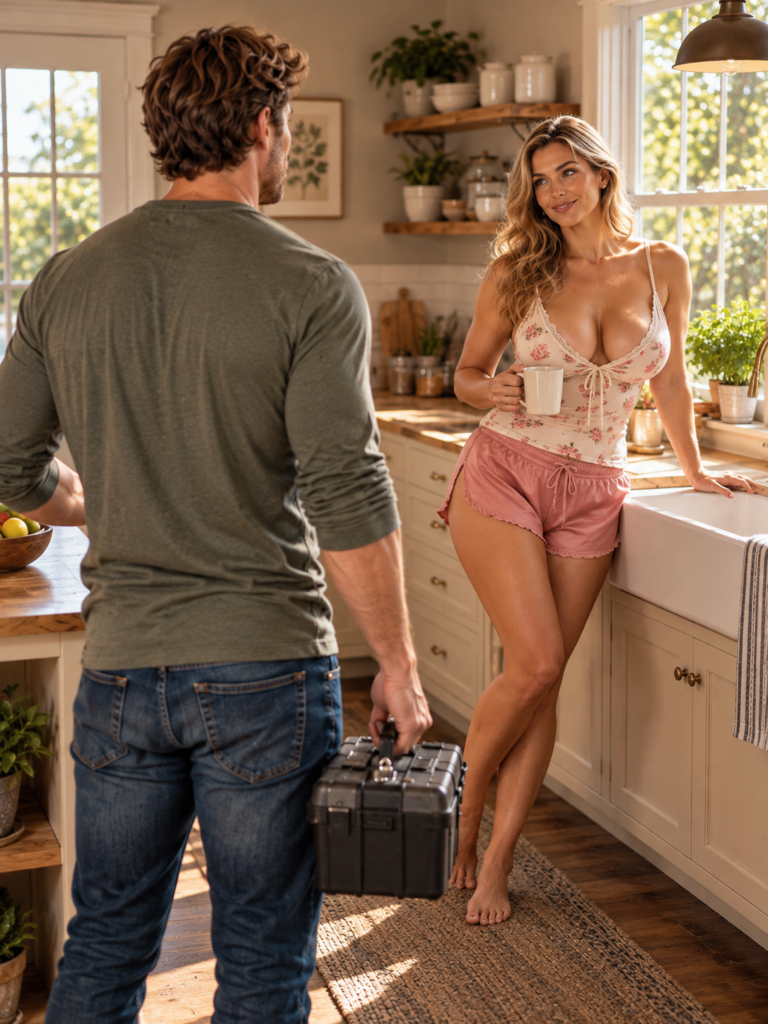
She stood beside the kitchen table.
Both hands wrapped around the back of a chair.
“I’ve been waiting for an excuse.”
For several seconds, I thought I had misunderstood.
An excuse for what?
She was not flirting.
Nothing in her expression suggested seduction.
She looked relieved.
And frightened.
“I could’ve called another plumber.”
I set the toolbox down slowly.
“Yes.”
“I know.”
Outside, rain struck the windows harder.
Emma pulled out a chair.
“Coffee?”
It was eight thirty.
“I’ll regret it.”
“So will I.”
She poured anyway.
We sat across from each other.
For a long time neither spoke.
Then Emma said:
“Everything fell apart after you and Olivia divorced.”
I nearly laughed.
“Seems dramatic.”
“I don’t mean because of you.”
She shook her head.
“The divorce didn’t break us.”
She looked at her coffee.
“It exposed us.”
That sentence got my attention.
“Olivia moved.”
“I know.”
“Dad blamed Mom for raising us to ‘chase feelings instead of commitment.’”
“That sounds like Charles.”
“Mom blamed Dad for making Olivia believe success was the only thing that made people safe.”
Also plausible.
“They stopped speaking except when absolutely necessary.”
“Still married?”
“Technically.”
“They live together?”
“Same house.”
“That sounds healthy.”
“They use separate floors.”
I stared.
Emma laughed sadly.
“My brother moved to Denver.”
“Michael?”
“Yes.”
“He barely visits.”
“Why?”
“He says every family gathering becomes a tribunal.”
I knew the feeling.
“Christmas?”
“Gone.”
“Thanksgiving?”
“Sometimes Mom goes to Michael’s. Sometimes Dad goes hunting.”
“Birthdays?”
“Texts.”
Emma swallowed.
“You used to hold people together more than I realized.”
That made me uncomfortable.
“No.”
“Yes.”
“I fixed toilets.”
“You also came.”
She looked at me.
“Every time.”
I did not know what to do with that.
Emma continued.
“When Mom fought with Dad, you changed the subject.”
“When Olivia got impatient, you helped in the kitchen.”
“When Michael disappeared outside because residency was destroying him, you went with him and didn’t ask questions.”
“I barely remember that.”
“He does.”
She looked down.
“You were doing emotional labor before any of us knew how to name it.”
I laughed softly.
“I was avoiding arguments.”
“Maybe both.”
Fair.
Then Emma said:
“I owe you an apology.”
“No.”
“Yes.”
“What did you do?”
“Nothing.”
“Then we’re done.”
“That is exactly what I did.”
Her eyes lifted.
“Nothing.”
I stopped smiling.
She remembered the jokes.
The ones about my work.
Charles asking whether I had “finally graduated from unclogging toilets” after I became a master plumber.
Diane introducing me to people as “Olivia’s husband—he works in maintenance.”
The Christmas joke.
Olivia laughing.
Emma sitting there.
Watching.
“I knew it bothered you.”
“How?”
“You got quieter.”
“Everybody gets quieter around your father.”
“Nathan.”
She would not let me escape.
“I should have said something.”
“You were her sister.”
“I was also an adult.”
“Barely.”
“I was twenty-nine.”
“Still young.”
“That is generous.”
She shook her head.
“You always helped us.”
“We were family.”
“And we made you feel like your work was something to apologize for.”
“Not everyone.”
“Enough.”
Her eyes filled.
“I remember you washing dishes after Thanksgiving while Dad and Uncle Peter talked about Michael becoming a doctor like the rest of us had finally produced somebody worth bragging about.”
“That was years ago.”
“I know.”
“I don’t need you to apologize for your family.”
“I need to.”
Why?
I almost asked.
Then understood.
Sometimes apologies are not only for the person receiving them.
Sometimes people need to stop being the version of themselves who remained silent.
“Okay.”
Emma blinked.
“That’s it?”
“Yes.”
“Do you forgive me?”
“That sounds larger than necessary.”
“Maybe.”
I thought.
“You were not the reason my marriage ended.”
“I know.”
“You were not responsible for Olivia laughing.”
“I know.”
“You could have spoken.”
“Yes.”
“And maybe you should have.”
A tear slipped down her cheek.
“But I don’t want you carrying three more years of guilt because you didn’t defend a thirty-five-year-old plumber at Christmas.”
Emma laughed through tears.
“Thirty-four.”
“Thank you.”
“You’re welcome.”
I took a drink of terrible late-night coffee.
“Forgiven.”
She covered her face briefly.
“Thank you.”
That should have been the conversation.
It wasn’t.
Emma asked the question nobody had asked me since the divorce.
“Did you ever stop loving her?”
I stared into the coffee.
“That depends what you mean.”
“Olivia.”
“I know.”
Outside, thunder rolled somewhere far away.
“I stopped wanting the marriage back.”
“When?”
“Before the papers were final.”
Emma looked surprised.
“Then why were you so wrecked?”
“Because not wanting something back does not mean you didn’t want it to work.”
That was a distinction I had taken years to understand.
“I grieved the future.”
“What future?”
“The one we planned.”
Children.
We had discussed two.
Never tried seriously because there was always another promotion, another financial target, another “better year.”
A house with a big kitchen.
Road trips.
Retirement somewhere warmer.
Growing old enough to complain about each other’s hearing.
Small things that never happened.
“I don’t love Olivia the way I did.”
I looked at Emma.
“But sometimes I still miss the man who believed we would become those people.”
Emma’s eyes filled again.
“That makes sense.”
“Does it?”
“Yes.”
She wiped her cheek.
“Because I miss the family I thought we had.”
That was the real reason she had called.
Not Olivia.
Not guilt.
Loneliness.
Diane had undergone hip surgery two months earlier.
Emma had handled most of the recovery because Charles was emotionally absent even while physically in the same house.
Michael called but lived several states away.
Olivia sent flowers and money.
Barely called.
Emma had taken leave from work.
Drove her mother to appointments.
Bought groceries.
Changed dressings.
Listened to Diane complain about Charles.
Then listened to Charles complain that Diane complained.
When Diane finally recovered enough to function independently, Emma returned to her farmhouse.
Silence.
“No one calls unless they need something.”
She said it without self-pity.
That made it sadder.
“I realized last week I had gone almost six months without having one honest conversation.”
“That can’t be true.”
“I talk all day.”
“Work?”
“Yes.”
“Friends?”
“Most married.”
“That doesn’t mean—”
“I know.”
She smiled sadly.
“But everyone got busy.”
She had become the dependable one.
The aunt.
The daughter.
The coworker who covered.
The friend who remembered birthdays.
The person everybody assumed was fine because she rarely created emergencies.
“I could have called someone else about the sink.”
“Yes.”
“I could have watched a video.”
“Please don’t.”
“I could’ve called a plumber.”
“I am a plumber.”
“You know what I mean.”
I did.
She looked at me.
“I called because I trusted you.”
That landed harder than expected.
“You had every reason to hate us.”
“I don’t hate you.”
“I know.”
“That is apparently why I called.”
I sat back.
Emma exhaled.
“I didn’t need somebody to fix the sink.”
“You definitely did.”
She laughed.
“Okay. I needed that too.”
Then:
“But mostly I needed a friend.”
There are sentences that feel flattering.
That one felt like responsibility.
Not burden.
Something gentler.
“I can do friend.”
Emma nodded.
“I thought maybe.”
We talked until midnight.
Not only about Olivia.
That was important.
Emma told me she had almost moved twice but could not leave her mother.
That she wanted to take a pottery class and kept postponing it because doing something purely for herself felt irresponsible.
I told her my business had grown.
That Marcus had become a partner.
That I had once driven to the lake alone on a Saturday and sat in the truck for an hour because I realized I had forgotten how to relax without a task.
She laughed.
“That is the most Nathan thing I’ve ever heard.”
“Thank you.”
“It wasn’t praise.”
At twelve fifteen, I finally stood.
My back complained.
Too much coffee.
Too much history.
I picked up my toolbox.
Then noticed the dead porch light.
“That’s out.”
Emma looked toward it.
“For weeks.”
“You have bulbs?”
“Probably.”
We found one in the laundry room.
Two minutes.
New bulb.
I flipped the switch.
Warm light spread across the wet porch.
Emma stood in the doorway.
“It’s brighter already.”
Something in her voice made me look back.
She was not talking about the light.
I understood.
Neither of us said it.
I drove home in the rain feeling strangely lighter.
Not healed.
People use that word too easily.
But less alone.
The following Sunday, Emma texted.
Coffee?
I replied:
Is something broken?
Nothing.
Suspicious.
I went anyway.
Sunday coffee became a habit.
Not every week.
Most.
Sometimes I fixed things.
A loose hinge.
A toilet that ran.
One gutter bracket.
Emma became irritated after the third repair.
“You know you’re allowed to visit without bringing tools.”
“I don’t understand the concept.”
“Try.”
So the next Sunday I brought no tools.
She gave me coffee.
We sat on the porch.
Said almost nothing.
A storm built over distant fields.
It was one of the nicest afternoons I had experienced in years.
People assumed things eventually.
Of course they did.
Small towns and former in-laws create dangerous information networks.
My employee Marcus saw Emma at my shop once.
“So.”
“No.”
“I didn’t ask.”
“You were going to.”
“Is she Olivia’s sister?”
“Yes.”
“That seems messy.”
“It isn’t.”
He looked unconvinced.
“Are you dating?”
“No.”
That answer remained true.
Months passed.
Our friendship deepened.
Nothing romantic happened.
Not because there was no affection.
There was.
But affection does not automatically require romance.
Emma needed someone safe.
So did I.
Turning that safety immediately into a relationship would have asked both of us to interpret healing as attraction before we knew the difference.
We did not.
She dated someone briefly that winter.
A history teacher named Paul.
Nice man.

I met him once.
No jealousy.
That told me something.
They ended after three months because he wanted to move quickly toward marriage and Emma had only recently learned she did not need to fill every empty space just because someone offered.
I went on a few dates too.
One woman, Claire, lasted several months.
Emma liked her.
Claire eventually moved for work.
No heartbreak.
Just life.
Our friendship survived other relationships.
That proved what it was.
Diane recovered.
Charles remained difficult.
Emma changed how she handled him.
One Sunday she called.
“I told Dad to stop.”
“Stop what?”
“Complaining about Mom to me.”
I smiled.
“How’d that go?”
“He said family should support family.”
“And?”
“I told him support is not the same as becoming the complaint department for a marriage you refuse to address.”
I laughed.
“Who are you?”
“Someone with a therapist now.”
“Ah.”
Emma had started therapy after our first few months of Sunday coffee.
She realized loneliness had been only part of the problem.
She had built an identity around being easy to need.
Never asking.
Never causing discomfort.
Watching.
Helping.
Staying quiet.
Her guilt over my marriage was connected to that.
Speaking would have risked conflict.
Emma avoided conflict almost as much as I did.
We had simply used different methods.
I disappeared into usefulness.
She disappeared into observation.
That became something we talked about often.
Healing, we learned, did not look like becoming fearless.
It looked like tolerating more honesty without fleeing.
Nearly a year after the leaking sink, Olivia called.
I had not spoken to her in almost eight months.
We exchanged occasional practical emails because one small retirement-account issue from the divorce remained.
Nothing personal.
When her name appeared, I stared.
Then answered.
“Hello?”
“Nathan.”
Her voice was familiar enough to tighten my chest.
Not painful.
Just history.
“Hi.”
“Do you have a minute?”
“Yes.”
She paused.
“I heard you’ve been seeing Emma.”
I closed my eyes.
Here it came.
“Seeing is a generous interpretation.”
“She said you’re friends.”
“We are.”
“That’s what I meant.”
“Okay.”
Silence.
Then Olivia surprised me.
“I’m glad.”
I sat down.
“What?”
“I’m glad she called you.”
“How do you know she called me?”
“She told me.”
“When?”
“Last week.”
Olivia exhaled.
“We actually talked.”
That seemed significant.
“How is she?”
“Better than me.”
Old Olivia would have made the sentence a joke.
This time it sounded like assessment.
“I owe you an apology.”
My body stiffened automatically.
“Olivia.”
“Please.”
I stayed quiet.
“I was cruel to you.”
She did not blame work.
Her father.
Seattle.
Our communication style.
She named specific things.
Laughing at Christmas.
Correcting the way she described my business because she was embarrassed by what other people might think.
Treating my refusal to move immediately as evidence I did not support her.
Using my quietness as an excuse not to ask whether I had stopped speaking because she had stopped listening.
“I thought I was outgrowing my old life.”
Her voice cracked.
“And I made you part of what I thought I had to outgrow.”
I closed my eyes.
There are apologies you imagine receiving for years.
In those fantasies, the other person finally says everything perfectly.
You feel vindicated.
Power returns.
Reality was quieter.
I mostly felt sad.
“I hurt you too.”
“I know.”
“I shut down.”
“Yes.”
“I expected you to read what I refused to say.”
“Yes.”
“I resented your success sometimes.”
Olivia went quiet.
“Did you?”
“Yes.”
Not because she was successful.
Because her success had become proof, in my mind, that I mattered less.
That was mine.
“I’m sorry.”
We both said it.
Different things.
Same conversation.
Then Olivia said:
“I don’t want another chance.”
“Good.”
She laughed unexpectedly.
“Wow.”
“You know what I mean.”
“I do.”
“I don’t want one either.”
“That’s why I called.”
Her voice softened.
“I think for years I avoided apologizing because I was afraid you’d think it meant I wanted to rewrite everything.”
I understood.
“Some chapters don’t need rewriting.”
“No.”
“Just a better ending.”
“Yes.”
We talked for another twenty minutes.
Olivia told me Seattle had not become the perfect life she expected.
She had succeeded professionally.
Then changed companies.
Then changed again.
A relationship ended.
Another never became serious.
She had started rebuilding something with Emma.
She and Diane were speaking more honestly.
Charles remained Charles.
No miracle there.
Before hanging up, Olivia said:
“Nathan?”
“Yeah?”
“Thank you for being kind to Emma.”
“She’s my friend.”
“I know.”
Another pause.
“You were always good at showing up.”
That sentence hurt more than criticism.
Because once, I had wanted Olivia to notice.
Now I no longer needed it.
“Take care of yourself.”
“You too.”
We ended the call.
I sat in silence afterward.
No rage.
No fantasy about what might have been.
No wish she had called three years earlier.
For the first time, I could accept Olivia’s apology without using it to negotiate with the past.
That was closure.
Not forgetting.
Not deciding everything had happened for a reason.
Just releasing the demand that yesterday become different before today was allowed to feel complete.
Emma came for coffee the next morning.
At my house for once.
She saw my face.
“What?”
“Olivia called.”
Emma stopped.
“Oh.”
“She apologized.”
“How do you feel?”
I thought.
“Fine.”
“That sounds suspicious.”
“No.”
I smiled.
“Actually fine.”
Emma sat.
“Do you wish—”
“No.”
Immediate.
She nodded.
“Good.”
We drank coffee.
That was all.
Years have passed since the broken pipe.
Emma and I remain close.
That surprises people who prefer every emotionally intimate relationship between a man and woman to become romantic.
Ours never did.
Maybe it could have.
That isn’t the same as saying it should have.
There was one evening, about two years after the sink, when we talked about it directly.
We were sitting on her porch.
Summer.
Fireflies in the field.
Emma said:
“Did you ever wonder?”
“Yes.”
She laughed softly.
“Me too.”
We looked at each other.
No tension.
No regret.
Then she said:
“I think I needed you too much at first.”
“I think I needed being needed.”
She nodded.
“That could have become confusing.”
“Yes.”
“Do you regret not trying?”
I thought honestly.
“No.”
“Me neither.”
That conversation protected the friendship.
We were not two people afraid to admit romance.
We were two people secure enough not to manufacture it.
Emma eventually met someone.
His name was Daniel Price.
Widower.
Two grown daughters.
He owned a small bookstore in town and approached life at a speed Emma initially found suspicious.
He did not text constantly.
Did not demand every evening.
Did not need her to prove affection through availability.
He invited.
Accepted no.
Asked again later.
They married after three years.
I attended.
So did Olivia.
That was the first time Olivia and I had been in the same room since the divorce.
We hugged.
Briefly.
Warmly.
No electricity.
No grief.
Just two people who had once promised forever and later learned forever had not been theirs.
At the reception, Emma pulled me aside.
The same woman who once said stay in a rainy kitchen.
She looked toward Daniel.
“He knows about the sink.”
“Poor man.”
“He says I used plumbing fraud to obtain emotional support.”
“Accurate.”
She laughed.
Then hugged me.
“Thank you.”
“For what?”
“Staying.”
That word again.
“I was already there.”
“You know what I mean.”
I did.
I had stayed that night.
But Emma had stayed too.
Through my resentment.
Through conversations about Olivia.
Through my attempts to turn every emotion into something that could be repaired mechanically.
Friendship saved both of us from a narrower life.
Not dramatically.
No miracle.
Sunday coffee.
Phone calls.
Porch storms.
Ordinary Tuesdays.
She taught me how to stop treating usefulness as the only safe way to receive love.
I taught her, maybe, that speaking did not automatically destroy relationships.
Sometimes it created real ones.
My life changed too.
Marcus eventually bought another twenty percent of the plumbing business.
I stopped working six days a week because I realized no amount of financial security could make a life meaningful if work consumed every place meaning might enter.
I took vacations.
Actual ones.
The first time I shut off my work phone for three full days, I checked the screen approximately forty times.
Growth is imperfect.
I started seeing a woman named Rachel seven years after the divorce.
Different Rachel from any family story.
An elementary school principal.
Divorced.
Funny.
Terrible at home repairs.
Very respectful of professionals.
The first time her kitchen faucet leaked, she said:
“I’m calling somebody.”
I said:
“I am literally standing here.”
“You are off duty.”
I fell in love with her partly because of that sentence.
We married two years later.
Emma stood on my side at the ceremony.
Not technically as anything.
Just near enough.
Olivia sent a card.
That was right too.
Rachel knew the entire story.
Not as competition.
History.
She once asked:
“Do you think Emma saved you?”
“No.”
“Why not?”
“Because that makes me sound passive.”
I thought.
“She opened a door.”
Rachel smiled.
“And?”
“I eventually walked through.”
That was closer.
People love the word repair when talking about emotional pain.
Maybe because it promises a return to original condition.
Fix the crack.
Replace the broken part.
Restore function.
My work taught me that real repair is rarely that simple.
Sometimes a pipe fails because the material has aged.
You do not restore the old pipe.
You remove it.
Install something new.
Sometimes water damage means the cabinet itself must change.
Sometimes the smartest repair is not returning something to what it was.
It is making the system safer than before.
That is what happened to me.
Emma did not repair my marriage.
Olivia’s apology did not restore our family.
Sunday coffee did not return the Hart household to the days before everything cracked.
Some things stayed broken.
Charles and Diane eventually separated formally after forty-three years of marriage.
Michael remained across the country.
Olivia never returned permanently.
The old Christmas dinners never came back.
Instead, new structures formed.
Emma had Daniel.
Olivia rebuilt a quieter relationship with her siblings.
Diane created her own life.
I built mine.
Different.
Not lesser.
That was the lesson I missed for years.
I thought healing meant getting back what had been taken.
Marriage.
Family.
Certainty.
The future I had imagined.
But second chances do not always return the same relationship.
Sometimes the second chance is with yourself.
A chance to stop defining your worth through somebody who stopped seeing it.
A chance to learn that work can be honorable without being your entire identity.
A chance to receive friendship without earning it through repairs.
A chance to forgive without reopening the door.
Emma and I still laugh about the leaking sink.
The farmhouse belongs to her and Daniel now.
I was there last spring.
Daniel called because their water pressure dropped.
He sounded apologetic.
“I know you’re retired from emotional plumbing.”
“I’m not retired from actual plumbing.”
The problem was a failing pressure regulator.
Simple.
I replaced it.
Emma made coffee.
Daniel watched.
“You test everything twice.”
“Yes.”
“Emma said.”
“She complains.”
“She admires it.”
“Dangerous information.”
Afterward, the three of us sat on the porch.
The porch light still worked.
Not the same bulb, obviously.
Light bulbs are not symbols durable enough for fifteen years.
But the fixture remained.
Emma looked at it.
“Remember?”
“Of course.”
“It’s brighter already.”
I laughed.
“You knew what you were doing.”
“No.”
She smiled.
“That’s the funny part.”
Maybe she hadn’t.
Neither had I.
That rainy night, I thought I had finished a repair in twenty-five minutes.
Shut off the water.
Replace the line.
Tighten the fittings.
Test.
Done.
The important work began when I put the toolbox back down.
When somebody said stay.
When I did.
There are people who enter our lives because we need romance.
Others because we need forgiveness.
Some arrive because they carry the truth about a version of ourselves we forgot.
Emma remembered who I had been inside her family when I remembered only the humiliation.
She remembered the dishes.
The fences.
The water heaters.
The way I showed up.
Her apology could not change the past.
But it helped me stop reducing nine years of marriage and family to its ugliest moments.
Olivia had hurt me.
I had hurt her.
Her family had underestimated me.
I had allowed my resentment to become silence.
All of those truths could exist together.
The world did not need one villain for the story to make sense.
That was another kind of peace.
When I was younger, I believed every broken thing demanded repair.
Now I know some things need repair.
Some need replacement.
Some need to be left alone.
And some need to be understood before you decide which one they are.
My marriage needed to end.
My resentment needed to end too.
My friendship with Emma needed room.
Olivia’s apology needed no reward beyond being heard.
And the man I became after divorce needed something I could never have installed with a wrench.
Permission to stop treating loneliness like proof I was strong.
That is what the broken sink gave me.
Not romance.
Not destiny.
Not some convenient reunion where everybody realized the wrong sister had always been the right woman.
Something quieter.
A friend.
An apology.
A porch light.
A few years of Sunday coffee.
A better understanding of why my marriage ended.
And eventually a life I no longer measured against the one that failed.
The greatest repair I ever made was not under Emma’s kitchen sink.
It was not my marriage either.
It was the belief that being left meant I had become less valuable.
That took longer than twenty-five minutes.
It took years.
It took honesty.
It took learning that a person can regret the future they lost without wanting the relationship back.
It took realizing that forgiveness does not require reunion.
And it took a rainy Thursday evening when a woman I barely thought of as family called because she did not really need a plumber.
She needed someone she trusted to sit at her kitchen table.
And, without knowing it, so did I.
The End.


