
Part 1
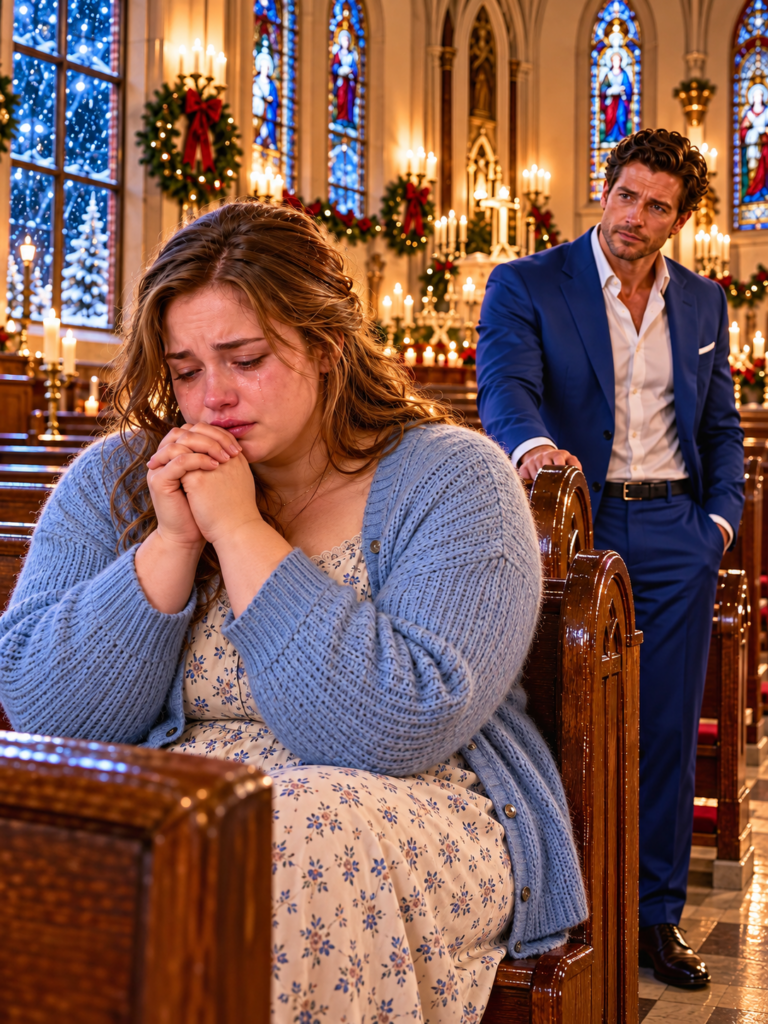
By the time Grace Miller whispered her prayer, she believed everyone else had left the church.
She was wrong.
A few pews behind her, a man worth more money than she could imagine sat motionless in the fading candlelight. He had come to Cedar Falls to bury the last unfinished piece of his relationship with his father, sell the family house, and return to the life he understood.
He had no intention of becoming involved in anyone else’s pain.
Then he heard six words that reached something he had spent twelve years refusing to confront.
“God, I just want someone who’ll stay.”
Thomas Wilder didn’t move.
Grace had no idea he was listening.
And neither of them knew that another man would eventually hear that same desperate prayer—and use it to nearly destroy everything she had left.
Snow had been falling over Cedar Falls, Iowa, since late afternoon.
It gathered along the sidewalks, covered parked cars, and turned the parking lot outside St. Matthew’s Church into a quiet expanse of white.
Grace hurried up the church steps with her seven-year-old son, Wyatt, holding tightly to her hand.
She was ten minutes late.
Again.
Her shoulders ached from carrying grocery boxes all afternoon, and although she had removed her work apron in the church restroom, she could still smell the faint mixture of cardboard, cleaning solution, and produce on her clothes.
A tiny hole remained in her cardigan where she pinned her employee name tag every morning.
Wyatt barely noticed.
“Mom,” he whispered, lifting her phone toward her, “they’re saying another two inches by midnight.”
Grace glanced at the weather radar glowing on the screen.
“Then we’d better get our praying done before we get snowed in.”
Wyatt smiled.
Weather was his favorite subject. He could identify storm fronts, explain the difference between sleet and freezing rain, and spend an entire afternoon watching radar animations without becoming bored.
Grace couldn’t afford to buy him the expensive things other children had.
But watching the weather was free.
She led him toward the last pew.
Partly because his boots were wet, and she didn’t want him tracking snow onto anyone’s polished shoes.
Mostly because sitting in the back made it easier to disappear.
The church was beautiful that evening.
Candles flickered beside tall windows. The organ filled the sanctuary with an old hymn, and families sat shoulder to shoulder in their finest winter clothes.
Grace looked down at her worn cardigan.
Then she folded her hands in her lap and listened.
During the greeting, a family ahead of them left several coats scattered across the aisle. Grace quietly picked them up and arranged them on the pew so nobody would trip.
When the offering plate reached her, she hesitated.
Milk.
Bread.
Gasoline until Friday.
She mentally rearranged the numbers.
Then she placed two dollars in the plate.
Wyatt leaned against her arm.
“Caden’s getting the big LEGO truck for Christmas. The one with lights.”
Grace felt the familiar pressure behind her ribs.
She couldn’t promise anything like that.
Not this year.
Instead, she brushed a stray lock of hair from his forehead.
“What’s your radar saying about Saturday?”
His face brightened immediately.
“Saturday’s going to be huge.”
“Then we’ll have to keep watching.”
Several rows behind them sat Thomas Wilder.
Thirty-eight years old. Founder and CEO of Cascade Forecast Systems, a Seattle-based software company with three hundred employees and clients across the country.
At work, Thomas was known for making difficult decisions without raising his voice.
He had built a company around predicting uncertainty.
Storm behavior. Weather patterns. Infrastructure risks.
Yet there was one thing he had never learned to handle.
The people who expected him to come home.
Two days earlier, he had flown from Seattle to begin clearing out his late father’s house.
Howard Wilder had lived in Cedar Falls for decades.
He had fixed neighbors’ broken steps, helped elderly parishioners through snowstorms, and attended the Thanksgiving Eve service at St. Matthew’s every year.
Thomas hadn’t attended in years.
He was there now only because the thought of leaving Howard’s familiar pew empty on the first Thanksgiving without him felt unbearable.
The final hymn ended.
Families began leaving in clusters, discussing dinner plans and holiday travel.
Thomas remained seated.
Above the sanctuary, a small red light glowed beside the church’s livestream camera.
A sign underneath explained that services remained available online afterward.
He noticed it without giving it much thought.
Then Pastor Samuel Baker approached Grace’s pew.
“Wyatt, could I borrow a strong helper for a couple of minutes?”
The boy practically jumped up.
“Sure!”
Grace smiled.
“I’ll be right here.”
The vestibule doors closed behind them.
For the first time all day, Grace was alone.
Or so she thought.
She didn’t kneel.
She didn’t raise her hands.
She simply lowered her head.
Her shoulders sagged, and the careful composure she maintained for customers, coworkers, neighbors, and her son finally slipped away.
“I’m tired,” she whispered.
The words sounded unfamiliar in the empty church.
She swallowed.
“I’m so tired of being the person who stays for everybody.”
Her voice trembled.
“God, I just want someone who’ll stay for me.”
A tear slipped down her cheek.
“Someone who doesn’t disappear when life gets hard.”
That was all.
No request for money.
No demand for a miracle.
Just one exhausted woman asking not to be abandoned again.
When footsteps sounded in the vestibule, Grace quickly wiped her face.
Wyatt burst through the doors.
“Pastor Sam says I carry things like a grown-up!”
Grace forced a smile.
“I believe it.”
She zipped his coat to his chin and guided him into the falling snow.
She never looked behind her.
Thomas sat completely still.
He had heard every word.
Not because he had been trying to listen.
He simply hadn’t known how to leave.
And now one word kept repeating in his mind.
Stay.
His father had asked him to come home for Thanksgiving every year.
Every year, Thomas had promised to try.
Every year, something more urgent had appeared.
A meeting.
A contract.
A crisis at Cascade.
He had also lost someone he once loved because he kept treating their relationship like an appointment he could reschedule.
He knew how to arrive when he was needed professionally.
He knew how to leave before anyone asked too much emotionally.
But staying?
Staying had never been his strength.
Eventually, Thomas rose and walked toward the exit.
In the vestibule, a volunteer sign-up sheet caught his eye.
Howard’s Thanksgiving Table — Everyone Welcome.
His father’s handwriting appeared across the top.
Beside the coordinator’s name, Howard’s had been crossed out.
Underneath, written in fresh blue ink, was another name.
Grace Miller.
Thanksgiving morning arrived cold and bright.
Thomas climbed the rear steps of St. Matthew’s carrying two enormous roasting pans that had belonged to his father.
His plan was uncomplicated.
Deliver the pans.
Offer condolences to whoever needed them.
Leave.
Pastor Samuel opened the kitchen door before Thomas knocked.
His eyes went from the pans to Thomas’s face.
“You’ve got Howard’s jaw,” the pastor said quietly.
Thomas shifted the weight in his arms.
“I’d rather not make a big deal out of being here.”
Samuel studied him for a moment.
“Then we won’t.”
He stepped aside.
“Come in out of the cold.”
The fellowship hall was chaotic.
Volunteers moved folding chairs. Children chased one another between tables. A woman near the kitchen was trying to count serving trays while answering two questions at once.
“We planned for sixty,” Samuel explained. “Then the factory layoffs happened. We’ve got over ninety people coming, and two volunteers called in sick.”
Thomas looked across the room.
At the center stood Grace Miller.
A pencil was tucked behind her ear. She wore the same cardigan from the night before.
She directed a teenager to unfold extra chairs, made room beside the heater for an elderly gentleman, and quietly prepared takeout containers for men who lingered near the entrance without wanting to sit down.
She never embarrassed them by asking why they wouldn’t join everyone.
Instead, she handed over the food as though they were helping her by taking it.
Thomas watched her pack a meal for a young mother holding a baby.
Grace added generous portions of turkey, fresh bread, and two slices of pumpkin pie.
Then she scraped what remained into a small container for herself.
Later, when Pastor Samuel offered her an entire apple pie to take home, she asked whether there would be enough left for everyone.
Samuel assured her there would.
Only then did she accept it.
Thomas had spent years in meetings about charitable giving, employee welfare, and corporate responsibility.
He had approved contributions larger than the church’s annual operating budget.
But watching Grace calculate whether she was permitted to take home a pie unsettled him more than any boardroom discussion ever had.
Downstairs, he found sacks of bread cubes, celery, and onions piled beside the basement kitchen counter.
An index card was taped inside a cabinet.
He recognized the handwriting instantly.
Sausage stuffing. Serves sixty. Make extra. Somebody always comes late.
Thomas stood staring at the card.
He remembered his father making stuffing in that kitchen.
He remembered the smell of onion and sage.
He remembered being young enough to think there would always be another Thanksgiving.
Then he took off his coat and rolled up his sleeves.
He was halfway through chopping onions when a small voice interrupted him.
“Are you crying?”
Thomas turned.
The boy from the back pew stood in the doorway wearing a red sweater.
“It’s the onions,” Thomas answered.
Which was mostly true.
“I’m Wyatt.”
“Thomas.”
Wyatt noticed the phone propped against a flour container.
A weather map filled the screen.
“Is that snow?”
Thomas nodded.
“See that band over Waterloo?”
Wyatt approached immediately.
“Why isn’t it moving?”
“Cold air’s holding the system in place.”
“Like traffic?”
“Exactly like traffic.”
Wyatt considered that.
“What do you do?”
“I work for a software company in Seattle.”
“Do you make weather apps?”
“Something like that.”
Grace appeared in the doorway minutes later and found her son explaining jet streams to a stranger twice his height.
Her expression became cautious.
Then she noticed the chopped vegetables.
She handed Thomas a dish towel.
“If you’re cooking, you’re washing dishes afterward.”
Thomas looked at her.
“Fair enough.”
For the first time in longer than he wanted to admit, he didn’t mind being given an ordinary chore.
The stuffing was served at one.
Several older men paused after the first bite.
One closed his eyes.
“That’s Howard’s recipe.”
Thomas lowered his gaze.
After the meal, he and Grace worked beside each other at the large kitchen sink.
Steam rose from the hot water.
Grace scrubbed a roasting pan.
“The man who started this dinner,” she said, “Howard Wilder. He was a good person.”
Thomas kept his hands submerged.
“He was.”
“After my husband died, my front door wouldn’t latch properly.”
She smiled faintly at the memory.
“Howard came over with his toolbox before I even asked for help. Wouldn’t accept a dollar.”
Thomas looked at her.
“What did he say?”
“That doors ought to close properly, and people ought to come back through them.”
The words settled heavily between them.
Grace continued washing.
Thomas couldn’t.
A stranger knew a version of his father he had rarely made time to see.
He could have told Grace the truth right then.
That Howard was his father.
That Cascade was his company.
That his supposedly ordinary life in Seattle was built on wealth and responsibility.
But the confession caught somewhere behind his teeth.
He liked how she treated him.
Not as a CEO.
Not as Howard Wilder’s successful but absent son.
Just Thomas.
A man capable of chopping onions and washing dishes.
And for one more day, he wanted to remain that man.
When the hall finally emptied, he stepped into the vestibule and removed an old card from his wallet.
It was a copy of his father’s stuffing recipe, mailed to him the previous November.
Two handwritten words stood at the top.
Next year?
Thomas had never answered.
Grace’s Honda was still in the repair shop that evening.
When Thomas found her outside, she was carrying several aluminum trays filled with leftovers.
“Are you walking?” he asked.
“Six blocks.”
“In this snow?”
“I’ve done it before.”
He glanced at the trays.
“Let me carry the heavy ones.”
Grace hesitated.
She had spent three years learning that accepting help often came with consequences.
Sometimes those consequences were obvious.
Sometimes they arrived months later, disguised as disappointment.
Finally, she handed him two containers.
“To the door,” she said. “Not inside.”
Thomas nodded.
“To the door.”
They walked through the falling snow while Wyatt enthusiastically discussed clouds that were invisible behind the dark sky.
At Grace’s apartment building, Thomas set the trays on the doorstep and stepped back.
Wyatt looked up at him.
“Will you come back tomorrow?”
Grace’s expression changed.
“Wyatt.”
The boy fell quiet.
“Mr. Thomas is visiting, sweetheart. He’s busy.”
Thomas noticed the fear underneath her correction.
It wasn’t simply a mother protecting her son from a stranger.
It was the fear of someone who had watched a child wait for a man who never returned.
Thomas couldn’t blame her.
He had been that man in other people’s lives.
And as Grace closed the door, he realized something that frightened him more than any corporate loss.
For the first time in years, he wanted to prove someone wrong about leaving.
But he had no idea whether he knew how.
Part 2
Thomas began finding reasons to visit St. Matthew’s.
He told himself it was practical.
His father’s house contained boxes of items the church could use, and the building needed repairs.
He fixed a loose basement railing.
Moved donations.
Spent an entire morning wrestling with an aging snowblower that seemed personally offended by the idea of starting.
Some days he saw Grace for five minutes near the coffee urn.
Other days they exchanged a wave across the parking lot.
He never insisted on more.
He was learning that being welcome somewhere wasn’t the same as being entitled to someone’s time.
One Saturday, he found two old weather books in a recycling box beside the donation shelves.
Clouds and Storms.
Tornado Alley.
He brought them to Pastor Samuel.
“Think Wyatt would like these?”
Samuel smiled.
“Ask his mother.”
When Thomas showed them to Grace, she examined both covers.
“Were these being thrown away?”
“Yes.”
“Then he’ll love them.”
Her gratitude was warm but uncomplicated.
He hadn’t rescued her.
He had simply found something useful.
Thomas was beginning to understand how much that distinction mattered.
On Sunday, he accompanied Grace and Wyatt toward the corner after church.
Wyatt was eating an oatmeal cookie.
“Check for raisins,” Thomas warned him.
Wyatt froze.
Grace turned.
“How did you know he hates raisins?”
“He told me.”
“Of course he did.”
Thomas looked down the street, suddenly puzzled.
“Now, where did I park the car?”
Grace stared at him.
Then she laughed.
It came so unexpectedly that she covered her mouth.
“You can remember a seven-year-old’s opinion about raisins, but you can’t remember an entire car?”
“Apparently not.”
They found the rental two blocks away beneath a layer of snow.
While Wyatt drew weather symbols on the frosted rear window, Grace told Thomas about her husband.
Josh Miller had died three years earlier after an equipment accident at a local factory.
Wyatt had been four.
“For the first couple of weeks, everyone came,” she said. “Neighbors. Family. People from church.”
She scraped snow from the windshield with her sleeve.
“Casseroles on the porch. Cards in the mailbox. Everyone saying to call if I needed anything.”
Thomas listened.
“Then they went back to their lives,” Grace continued. “Which is fair. People have their own problems.”
Her voice carried no bitterness.
That somehow made it harder to hear.
She explained how Josh’s medical bills had taught her to examine insurance charges line by line.
How she had learned bookkeeping skills because she couldn’t afford to overlook a mistake.
How an insurance settlement related to the equipment manufacturer’s coverage had been delayed for three years.
It was finally expected in mid-December.
“Every cent goes into Wyatt’s college fund,” she said.
Thomas looked at her.
“You’ve already decided?”
“Josh would have wanted that. And I want Wyatt to have choices.”
Her expression sharpened slightly.
“It’s not rescue money.”
“No,” Thomas said. “It isn’t.”
She had trusted him with something important.
He knew it was time to offer a truth of his own.
“Howard Wilder was my father.”
Grace stopped brushing snow from the car.
“What?”
“The man who fixed your door. The man who started Thanksgiving dinner.”
Her gaze searched his face.
“You’re Howard’s son?”
Thomas nodded.
“I should have told you in the kitchen.”
“Why didn’t you?”
He looked toward the church steeple.
“He invited me home for Thanksgiving every year. For twelve years, I kept saying I’d come the next year.”
Grace said nothing.
“There was always work. Something urgent.”
He exhaled.
“I lost someone else because of the same habit. She got tired of being the person I could postpone.”
Grace studied him carefully.
“Did you have reasons?”
“Plenty.”
“People who leave usually do.”
She didn’t say it cruelly.
There was no anger in her voice.
Just experience.
Thomas would have preferred anger.
Anger could be argued with.
That quiet statement couldn’t.
The following Tuesday, a stranger walked into the church basement and changed the atmosphere almost immediately.
His name was Wade Corrigan.
He was broad-shouldered, neatly dressed, and possessed the easy confidence of someone comfortable among strangers.
He said he was a contractor who had recently moved from Des Moines.
A widower.
He mentioned his late wife quietly, as though speaking of her still hurt.
He had found St. Matthew’s online while searching for a church involved in Thanksgiving community service.
Pastor Samuel was delighted.
Apparently, their livestream and community posts were reaching people beyond Cedar Falls.
Within an hour, Wade knew half the volunteers by name.
He repaired a wobbling table leg without being asked.
Made elderly Mr. Hanson laugh so hard he had to sit down.
And listened to Grace with an attentiveness Thomas couldn’t ignore.
When Grace talked about losing Josh, Wade didn’t offer shallow sympathy.
“Grief changes the shape of a house,” he told her. “You spend years walking around the spaces where someone used to be.”
Grace went still.
Then her shoulders relaxed.
Thomas watched from near the coffee station.
He told himself he should be glad.
Grace deserved someone who could understand her.
Someone whose life was already rooted in Iowa.
Someone who didn’t have a company three states away demanding his attention.
Then Wade lowered his voice.
“I’ll tell you something about me, Grace.”
She looked up.
“I’m not the kind of man who disappears when life gets hard.”
Thomas’s hand stopped moving.
Hot coffee overflowed the cup and splashed across his fingers.
He barely felt it.
Those were Grace’s words.
Not merely the same sentiment.
Almost the exact phrasing she had whispered in the supposedly empty church.
Thomas looked toward Wade.
The man was smiling gently at Grace.
And Grace was smiling back.
Over the next week, Thomas’s unease grew.
He postponed the listing of his father’s house, telling the realtor he needed more time to clear out the workshop.
That was partly true.
The rest of the truth was harder.
He didn’t want to leave.
And he didn’t trust Wade.
But suspicion wasn’t evidence.
Thomas knew that.
He also knew his own judgment was compromised.
Grace seemed happier.
Wade brought carnations to the grocery store, leaving them at the counter where her coworkers could admire them.
He rebuilt the damaged step outside her apartment without asking for payment—or permission.
Grace mentioned it to Thomas one afternoon.
“He just showed up and fixed it.”
She sounded astonished.
“Who does that?”
Thomas wondered why a man she’d barely met wanted to make himself indispensable so quickly.
He didn’t voice the thought.
Not yet.
That evening, Wyatt told Wade about his old bicycle.
It had been sitting in the shed for years, training wheels still attached.
Nobody had taught him how to ride it.
Wade crouched until they were eye to eye.
“First warm Saturday, buddy. You and me.”
Grace’s fingers tightened around her coffee cup.
She said nothing.
Thomas noticed.
But he didn’t yet know what memory had made her uncomfortable.
He only knew that every instinct he possessed told him something was wrong.
And the only way to explain his strongest reason would be to admit that he had overheard her private prayer.
For nearly two weeks, he had kept that knowledge to himself.
Now another man seemed to be using it.
Thomas tried a smaller warning.
“He’s only been here about a week,” he said one evening as he and Grace stacked folding chairs. “He seems to know a lot about you already.”
Grace placed a chair against the wall.
“He listens.”
“I’m sure he does.”
“Some people do, Thomas.”
He recognized the frustration in her voice.
“I just think you should be careful.”
She turned toward him.
“For three years, nobody stayed long enough to fix a broken step.”
Her eyes shone.
“Now somebody does something kind for me, and you can’t even be happy about it?”
Thomas searched for an answer that wouldn’t require revealing the prayer.
There wasn’t one.
Grace picked up her coat.
“The settlement is coming next week,” she said more quietly. “Wade’s been showing me pictures of a farmhouse outside town.”
Thomas went still.
“A farmhouse?”
“A big yard. Space for Wyatt to run around.”
She smiled tiredly.
“It’s probably just talk. But it’s nice to imagine.”
She left him standing among the folding chairs.
A settlement arriving next week.
A man proposing a shared home.
A stranger who knew exactly what Grace desperately wanted to hear.
Thomas had spent years building software designed to recognize dangerous patterns before they became disasters.
He was staring at one now.
And Grace believed he was simply jealous.
The next afternoon, Thomas was clearing snow from the church walkway when a yellow taxi pulled into the parking lot.
Its windshield was streaked with road salt.
The meter still displayed the fare from Waterloo’s airport.
A woman climbed out wearing a long coat and expensive heels entirely unsuitable for an Iowa winter.
She looked at the church, then at Thomas.
Grace stood in the doorway behind him holding an inventory sheet.
Wade was coming down the steps with a box of canned goods.
The woman called across the parking lot.
“Excuse me. I’m looking for Thomas Wilder, CEO of Cascade Forecast Systems.”
Thomas closed his eyes briefly.
Wade stopped walking.
Grace looked from the woman to Thomas.
The visitor approached.
“Rebecca,” Thomas said.
“You’ve stopped answering your phone.”
“You didn’t need to fly here.”
“Apparently I did.”
Rebecca surveyed the volunteers gathering near the doorway.
Then she spoke clearly enough for everyone to hear.
“I have a board of directors waiting for their CEO, and three hundred employees wondering whether Thomas Wilder intends to come back.”
Nobody moved.
Mrs. Lund, an older volunteer, narrowed her eyes.
“Cascade Forecast? Isn’t that the big Seattle company in the news?”
Rebecca nodded.
“Yes.”
Grace looked at Thomas as though she were seeing him for the first time.
The rental car.
The weather software.
The careful answers about his work.
The ease with which he seemed able to spend weeks away from earning a paycheck.
Everything suddenly fitted together.
Later, she found him beside his car.
“I don’t care that you’re rich,” she said.
Thomas faced her.
“Grace—”
“I care that you knew everything about me.”
He stopped.
“You watched me count grocery money. You knew about Josh. The bills. Wyatt’s college fund. The settlement.”
Her voice shook.
“And I didn’t even know who you were.”
“I never lied to you.”
Grace gave a small, painful laugh.
“No. You just let me stand there with all my secrets showing while you kept yours hidden.”
Thomas had negotiated with angry investors and frustrated executives.
He could dismantle a hostile argument in minutes.
But there was nothing to dismantle here.
She was right.
Wade appeared beside them and gently lifted a box from Grace’s arms.
He looked at Thomas with an expression of mild sympathy.
“Men like him get curious,” he told Grace. “Then they fly home.”
Thomas watched Grace turn away with Wade.
For the first time, his money felt less like power and more like another reason she might never trust him.
That evening, he found Grace brushing snow from her repaired Honda.
“There is something else you need to know,” he said.
She didn’t stop brushing.
“What now?”
“On Thanksgiving Eve, I was in the church. A few pews behind you.”
Her movements slowed.
“After the service?”
“Yes.”
Grace turned.
Thomas forced himself to continue.
“I heard you praying.”
The color drained from her face.
He hated himself for what came next, but he said it anyway.
“Wade repeated your words. About not disappearing when life gets hard.”
Grace’s mouth parted.
“That was exactly what I said.”
“I know.”
“I said it to God.”
“I know.”
She stepped backward.
“You heard that?”
“I didn’t mean to. But yes.”
“And you kept it to yourself?”
Thomas couldn’t answer quickly enough.
“That was the most private thing I’ve said in three years,” Grace whispered.
He reached toward her, then stopped.
“I think Wade knows what you said too. I think—”
“Now you’re using my prayer against him?”
“No. I’m trying to tell you—”
“Tell me what, Thomas?”
Her voice rose.
“That because you’re a powerful man who’s used to getting what he wants, you get to decide which people I’m allowed to trust?”
He shook his head.
“That’s not what this is.”
“Then why didn’t you tell me earlier?”
He had no explanation that made the delay acceptable.
Grace opened her car door.
“Stay away from my son.”
Thomas felt the words strike.
“Grace—”
“Until I decide otherwise.”
She got into her car and drove away.
Thomas stood alone in the parking lot.
He had finally told the truth.
And the truth had cost him the fragile trust he’d been trying so hard to earn.
That night, Thomas sat at his father’s kitchen table.
Howard’s chipped red coffee mug rested beside his phone.
He called Rebecca.
“I need someone to look into Wade Corrigan.”
Rebecca was quiet for a moment.
“Behind Grace’s back?”
“She won’t listen to me.”
“Then let her not listen.”
“Rebecca, I think he’s dangerous.”
“And what happens if you start managing her life in secret?”
Thomas looked at the red mug.
Rebecca continued.
“You were angry because she thought you were hiding things. You want to prove her wrong by hiding another thing?”
He rubbed his forehead.
“You don’t understand.”
“I understand more than you think.”
Her voice softened.
“She liked you when you were just Thomas. I suspect you liked that too.”
Thomas remained silent.
“You can’t use your power to get around her boundaries.”
He knew she was right.
He ended the call without ordering an investigation.
Across Cedar Falls, Grace’s phone lit up with a bank notification.
The settlement had arrived.
Three years of delays were over.
For the first time since Josh died, there was a substantial amount of money in her account.
She sat at the kitchen table staring at the screen.
Wyatt’s future.
The college fund.
The promise she had made herself.
An hour later, Wade knocked on her door.
He carried a small velvet box and a photograph.
The photograph showed a white farmhouse, a red barn, and a wide snowy yard.
Wade sat beside her.
“Marry me, Grace.”
She stared at him.
He opened the box.
Inside was a ring.
“My part is ready,” he explained. “The seller wants a cash offer. We just need your share transferred into the title company’s escrow account by Friday.”
Grace looked from the ring to the picture.
“The house would be ours,” Wade said. “Yours. Mine. Wyatt’s.”
It was everything she had once imagined.
A home.
A family.
Someone willing to stay.
But something about how quickly he moved from marriage to transferring money troubled her.
She hadn’t answered when Wyatt ran into the room in his pajamas.
“Mom! The weather service upgraded the warning!”
He held out her phone.
A blizzard warning filled the screen.
Outside, the wind had begun to rise.
By sunrise, the highways would be closing.
Power lines would start falling across Black Hawk County.
And St. Matthew’s Church would be transformed into an emergency shelter.
The storm would force everyone to reveal what mattered most.
Especially the men who had promised Grace they would stay.
Part 3
By nine the following morning, Cedar Falls had nearly vanished behind blowing snow.
Wind roared across the streets.
Ice accumulated on power lines until they snapped beneath the weight.
Entire neighborhoods lost electricity.
St. Matthew’s Church still had partial power through an aging backup generator, and the county asked Pastor Samuel to open the fellowship hall as a temporary warming shelter.
Grace arrived before most volunteers.
She called the grocery store from her car.
“I can’t make my shift today.”
Her manager reminded her that she wouldn’t be paid.
Grace looked at the families already gathering beside the church doors.
“I understand.”
She ended the call.
Then she went inside.
She knew which pantry shelves held infant formula.
Which older parishioners lived alone.
Which families had no transportation.
Which children needed special food.
Within an hour, she had established a registration table, a supply inventory, and a line for people needing assistance.
She barely noticed when Thomas entered through the side door, snow covering his shoulders.
He didn’t approach her.
He went directly to Pastor Samuel.
“Where do you need me?”
“Cots. They’re in the truck outside.”
Thomas nodded.
He carried cots into the hall.
Then bottled water.
Then bags of salt for the icy wheelchair ramp.
He worked until his hands ached.
He never approached Wyatt.
Grace had told him to stay away from her son.
So he did.
By noon, the generator’s diesel gauge had fallen below a quarter tank.
Thomas knew exactly whom to call.
Cascade’s clients included utility crews throughout the Midwest.
One phone call could secure a fuel delivery.
But when he offered, Pastor Samuel shook his head.
“Everything goes through Carol at the county office.”
Thomas frowned.
“I can get a truck here faster.”
“Maybe. But if five people independently request the same truck, nobody remembers to request blankets.”
Thomas opened his mouth.
Then stopped.
He took out his phone and called Carol.
For once, he resisted the instinct to take control simply because he could.
Grace noticed.
Later, she watched him begin directing volunteers around the hall.
Halfway through, he caught himself and returned the decisions to the shelter coordinator.
He made the same mistake twice.
Both times, he corrected himself.
Grace didn’t know what to make of it.
Thomas had always seemed certain of himself.
Now he was choosing to listen.
And she couldn’t decide whether that made him more trustworthy—or simply more difficult to forget.
By late afternoon, Grace was exhausted.
A medication list for an elderly diabetic man disappeared from her registration table.
She turned sharply toward a younger volunteer.
“I told you to keep that in the folder. This isn’t a bake sale.”
The girl’s face flushed.
Grace heard the cruelty in her own voice.
She stopped immediately.
“I’m sorry.”
The volunteer looked up.
“That wasn’t fair,” Grace continued. “I’m exhausted, but that isn’t your fault.”
She handed over her pen.
“Could you take the table for an hour? I think I need to sit down.”
For the first time that day, she allowed herself to rest.
Wade had promised to arrive early.
He hadn’t come.
Instead, his messages kept appearing.
Transfer the money tonight before the storm knocks out the internet.
Grace called him.
Voicemail.
Another message arrived.
We can’t lose this opportunity.
She stared at the screen.
Beside her sat Dolores Vandermeer, a seventy-four-year-old widow wrapped in two church blankets.
County deputies had brought her from a house without heat.
Dolores glanced at Grace’s phone as Wade’s smiling photograph appeared.
Her expression changed.
“Who is that?”
Grace looked up.
“A friend. Wade.”
Dolores gripped the blankets more tightly.
“Wade?”
“Yes. Wade Corrigan.”
The elderly woman studied the photograph.
“Two years ago, in Dubuque, a man who looked exactly like that started seeing my sister.”
Grace felt her stomach tighten.
“What was his name?”
“Wayne.”
Dolores swallowed.
“My sister Marian had just lost her husband. He said he understood loneliness. Talked about buying a place together.”
Grace couldn’t move.
“He knew things about her,” Dolores continued. “Things she couldn’t remember telling him. Where she volunteered. What she missed about her husband. The things she was afraid of.”
“What happened?”
Dolores’s eyes filled.
“Her savings disappeared. So did he.”
Grace looked down at the phone.
Wade’s photograph was still on the screen.
She had wanted someone to understand her.
She had never considered that understanding could be manufactured.
That evening, Thomas was sorting supplies near the kitchen when Rebecca called on speakerphone.
She had been trapped by the storm in her hotel.
“If you’re staying there,” she said, “I need full authority to finish the acquisition.”
Thomas stopped arranging boxes.
The deal represented eleven months of work.
One of Cascade’s largest planned acquisitions.
He had personally guided every major negotiation.
“You’re sure?” Rebecca asked.
He glanced at the families sleeping under borrowed blankets.
Then at Pastor Samuel working in the kitchen.
Then at Grace across the hall.
“Yes.”
“Thomas, the board is expecting you.”
“They’ll have you.”
“You’re handing over the whole deal?”
“You know what needs to be done. Finish it properly.”
Around the corner, Grace stood holding a carton of blankets.
Thomas didn’t see her.
She had heard every word.
For the first time, she understood the scale of what remaining in Cedar Falls was costing him.
It wasn’t just time.
It was control over something he had spent nearly a year building.
She didn’t approach him.
She went back to work.
Near midnight, Thomas served soup.
Washed coffee mugs.
Helped an elderly man inflate an air mattress that kept losing air.
After two in the morning, he finally fell asleep on a folding chair near the door.
He slept for barely ninety minutes.
Grace watched from across the dimly lit hall.
He wasn’t trying to impress her.
He wasn’t asking for forgiveness.
He wasn’t even looking in her direction.
He was simply doing the work nobody else had finished.
And she realized how unfamiliar that kind of presence felt.
Shortly before dawn, the radio crackled.
Several roads had reopened.
Rebecca arranged for a car to collect Thomas and take him to the airport.
Grace heard about it indirectly.
She didn’t ask him whether he was leaving.
She told herself it no longer mattered.
But when Wyatt woke, he noticed the empty cot near the wall.
Thomas’s work gloves were gone.
His coat was missing.
Wyatt looked toward the door.
“Mom?”
Grace turned.
“Did he leave?”
The question was quiet.
Careful.
The voice of a child who had learned that asking whether someone was coming back could hurt worse than hearing the answer.
Grace felt an old memory open inside her.
After Josh died, his younger brother Brent had come around often.
One afternoon, he knelt beside Wyatt’s bicycle in their driveway.
“First warm Saturday, champ,” he promised. “You and me.”
Wyatt had been so excited.
Every weekend that spring, he asked whether the weather was warm enough.
Whether Uncle Brent was coming.
Whether they could finally take the training wheels off.
Brent gradually stopped visiting.
Then he stopped calling.
And one Saturday in May, Wyatt stopped asking.
The bicycle remained in the shed.
Training wheels attached.
Helmet hanging from the handlebars.
Grace had survived the funeral.
The hospital bills.
The quiet apartment.
But she had never forgiven herself for allowing her son to believe another man would stay when she couldn’t be certain.
Now Wyatt was looking at her with the same frightened hope.
Grace kissed the top of his head.
“Let me check.”
She walked toward the entrance, bracing herself.
Pastor Samuel intercepted her.
“Grace, look at the task board.”
He pointed toward the whiteboard where volunteers recorded their responsibilities.
Near the bottom was a line written in neat block letters.
T. Wilder — Supply delivery. Peterson family, broken furnace. Howard’s truck. Return 12:10.
Grace stared.
“He sent Rebecca’s driver away,” Samuel explained. “Took two volunteers and Howard’s old truck instead.”
Grace read the words again.
Return 12:10.
Thomas hadn’t disappeared.
He had told people where he was going.
And when he would come back.
Something painfully simple.
Something nobody had ever taught her to expect.
Grace sat at the registration table and opened her laptop.
She had spent three years untangling medical statements, insurance paperwork, and billing errors.
She knew how to examine a document.
She knew how to follow a financial detail that didn’t make sense.
And she had almost transferred her son’s college fund because a man had told her what she wanted to hear.
Not anymore.
She opened Wade’s property documents.
The title company listed on the papers was not licensed to operate in Iowa.
She checked the bank routing number.
It led to a small financial institution in another state.
Then she ran a reverse-image search on the farmhouse photograph.
The image appeared almost immediately.
An old real-estate listing.
Nebraska.
Sold four years earlier.
Grace felt her hands turn cold.
There was no farmhouse waiting for her and Wyatt.
No legitimate escrow account.
No future being purchased.
Only a transfer that would have taken everything she had spent three years fighting to protect.
She closed her eyes.
Then she remembered something Wade had said when he first arrived at St. Matthew’s.
He had found the church online.
Through its Thanksgiving outreach.
Grace looked toward Pastor Samuel.
“Do you still have the Thanksgiving Eve livestream?”
“Of course.”
“I need to see it.”
Samuel led her to his office.
They opened the archived recording.
The final hymn played.
Families left.
The camera continued recording as the sanctuary emptied.
And there, in the last pew, sat Grace Miller.
Alone.
She heard her own exhausted voice coming through the computer speakers.
“God, I just want someone who’ll stay.”
Her breath caught.
The recording hadn’t stopped.
Her prayer had been public.
Anyone who opened the archive could have heard it.
The view counter showed forty-one views.
Samuel frowned.
He opened the livestream management dashboard and examined the available account activity.
Most views came from regular church members.
Several were anonymous.
One account had opened the recording three separate times during the week after Thanksgiving.
The account name was W. Corrigan.
Grace brought a hand to her mouth.
Two men had heard her prayer.
Thomas had heard it accidentally and remained silent.
Wade had found it online and studied it.
One had struggled to tell the truth.
The other had turned her deepest longing into a script.
Grace sat back.
Thomas had been wrong to hide what he knew.
But Wade’s apparent understanding had been something far more deliberate.
He had borrowed the most vulnerable words of her life and returned them to her as a promise.
Then he had tried to collect her money.
Grace felt anger rise through her fear.
Not helplessness.
Anger.
This was her life.
Her child.
Her husband’s settlement.
She would decide what happened next.
At noon, Wade Corrigan walked into St. Matthew’s.
Snow clung to his boots.
Car keys hung from one hand.
He smiled when he saw Grace.
“Ready, Gracie? We can still make it to the title office.”
Grace stood near the registration desk.
“I don’t think so, Wade.”
His smile faltered.
Then he noticed the people standing beside her.
Dolores Vandermeer, still wrapped in a church blanket.
Pastor Samuel.
And a Black Hawk County sheriff’s deputy.
Dolores looked at Wade for a long moment.
“Wayne.”
The name struck him harder than an accusation.
His friendly expression vanished.
Wade took one step toward the exit.
The deputy moved to intercept him.
“Sir, I need you to stay right here.”
Wade tried to speak.
But the documents, the bank information, and the account activity had already given the deputy reason to investigate further.
Within minutes, the confrontation was over.
There was evidence of attempted wire fraud and an outstanding Illinois warrant under another identity.
The deputy led Wade toward the doors.
Grace stood motionless.
Her heart was pounding.
She had been frightened.
She had nearly made a catastrophic mistake.
But she had found the evidence herself.
She hadn’t needed Thomas to secretly investigate Wade.
She hadn’t needed a wealthy man to purchase her safety.
She had used the skills she already possessed.
And she had protected what belonged to Wyatt.
As the deputy escorted Wade outside, the side door opened.
Thomas entered carrying an empty supply box.
Two volunteers followed him.
His boots were soaked.
His hair was damp from melting snow.
The wall clock read 12:10.
Exactly.
Thomas looked toward the front of the hall.
He saw Wade in handcuffs.
Dolores standing near the deputy.
Grace beside Pastor Samuel.
He understood enough.
He didn’t rush toward her.
Didn’t demand an explanation.
Didn’t try to take credit for having suspected Wade.
He set the empty box beside the wall and let Grace finish speaking with the deputy.
This was her victory.
He had no intention of stealing it.
His phone vibrated.
Rebecca.
“The highways are open,” she said. “If you leave now, you can still catch the afternoon flight and handle the acquisition yourself.”
Thomas looked across the shelter.
Several elderly residents were waiting for transportation.
The kitchen still needed cleaning.
A dozen folding tables stood covered with cups and empty food containers.
He had spent his life believing his presence mattered most wherever the largest financial decision was being made.
Now he wasn’t so sure.
“The deal is yours, Rebecca.”
A pause.
“You mean that?”
“Yes.”
“What are you going to do?”
Thomas watched an exhausted volunteer try to stack chairs alone.
“Stay until the work is finished.”
That evening, after the last family boarded a county bus, Grace found Thomas wiping down tables.
The hall was finally quiet.
She stood beside him for a moment before speaking.
“Wyatt has a bicycle.”
Thomas lowered the cloth.
She looked toward the empty windows.
“It’s been in our shed since Josh died.”
He listened.
“Josh’s younger brother promised he’d teach Wyatt to ride it. First warm Saturday. Those were his exact words.”
Grace swallowed.
“Wyatt waited all spring.”
Thomas set the cloth down.
“Brent stopped coming,” she continued. “And eventually Wyatt stopped asking.”
She finally faced him.
“When Wade said the same thing, I wanted to believe him. I wanted Wyatt to have someone who would teach him the things Josh never got the chance to.”
Thomas didn’t interrupt.
“I’m not asking you for promises,” Grace said. “But if you want to be part of our lives, you need to understand something.”
She met his eyes.
“Wyatt will believe what you do long before I believe what you say.”
Thomas looked at her for several seconds.
He didn’t offer a sweeping declaration.
Didn’t promise never to disappoint her.
Didn’t try to convince her that a CEO could buy enough time to become a perfect partner.
Instead, he asked one question.
“What time are the volunteers coming back to finish cleaning?”
Grace almost smiled.
“Eight.”
Thomas nodded.
“I’ll be here.”
The next morning, Wyatt stood at the glass doors of St. Matthew’s.
Outside, dawn spread pale light across the snow.
Thomas was already there.
Beside Pastor Samuel, he was clearing ice from the wheelchair ramp.
Wyatt pressed his hands against the glass.
For a moment, he didn’t move.
Then he pushed open the door and ran outside.
“Thomas!”
Thomas looked up from the shovel.
His expression softened.
“Morning, Wyatt.”
Wyatt glanced at the cleared section of ramp.
“You came back.”
Thomas rested his hands on the shovel.
“I said I would.”
Wyatt nodded as though recording an important observation.
Then he asked whether Thomas knew the difference between freezing rain and sleet.
Thomas smiled.
“I have a feeling you’re going to tell me.”
After the cleanup, Grace slipped into the sanctuary.
She walked toward the same pew where she had prayed on Thanksgiving Eve.
The church was empty again.
The candles were gone.
Winter sunlight stretched across the wooden seats.
She sat down.
For a while, she simply listened to the quiet.
Then the pew creaked.
Someone sat beside her.
Grace didn’t look up.
She knew.
Thomas rested his hands on his knees.
“I heard you that night,” he said.
She nodded.
“I know.”
“I didn’t know what to do with what I heard.”
He looked toward the altar.
“I’ve spent a lot of my life leaving before people could expect too much from me.”
Grace remained silent.
“I can’t promise I’ll never disappoint you,” he continued. “That would be a lie.”
She turned toward him.
“But I know I’ve let work and fear make too many of my decisions. I don’t want them deciding every goodbye anymore.”
Grace looked at his hands.
They were roughened from days of physical work.
Not the hands she would have expected from a wealthy CEO.
She thought about Howard’s red coffee mug.
The stuffing.
The snow-covered ramp.
The task board.
The return time written in precise block letters.
Thomas wasn’t offering perfection.
He was offering effort he had already demonstrated.
“I think,” she said quietly, “I’m ready to see what happens next.”
He looked at her.
“Slowly.”
“Slow is good.”
The side door creaked open.
Wyatt appeared in his snow boots.
He walked down the aisle, climbed onto the pew, and settled between them.
Then, without hesitation, he took Thomas’s hand.
“Will you be here next Thanksgiving?”
Thomas looked at Grace.
“And every Thanksgiving after that,” he answered, “if your mom will have me.”
Grace had heard beautiful promises before.
She no longer believed beauty made them true.
But this promise came after the difficult days.
After the work.
After Thomas had respected a boundary that hurt him.
After he had returned when leaving would have been easier.
For the first time in years, she allowed herself to hope.
The following year wasn’t perfect.
It was something better.
It was real.
In February, Wade Corrigan pleaded guilty.
Investigators connected him to widows across three states.
He had found several of his targets through church websites, memorial posts, and publicly accessible community videos.
Ordinary places where grieving people shared parts of themselves while trying to feel less alone.
Marian, Dolores’s sister, eventually recovered part of her savings.
At St. Matthew’s, Pastor Samuel changed the livestream procedures.
The camera would be turned off immediately after every service.
Grace’s insurance settlement remained untouched.
Every cent stayed where she intended.
Wyatt’s college fund.
Her money.
Her decision.
In April, Grace secured a full-time bookkeeping position with better pay.
Only then did she quit her evening grocery-store shifts.
She still worked hard.
But she no longer came home smelling of produce and floor cleaner after fourteen-hour days.
Wyatt noticed the difference first.
His mother was home for dinner.
She laughed more.
Sometimes she even had enough energy to watch weather forecasts with him before bed.
Thomas continued running Cascade Forecast Systems.
He didn’t abandon three hundred employees or pretend his responsibilities had disappeared.
Instead, he gave Rebecca greater authority over day-to-day operations.
He divided his time between Seattle and Cedar Falls.
Some weeks were difficult.
Travel was exhausting.
Plans changed.
He and Grace disagreed about schedules, decisions, and how quickly their lives should become intertwined.
But they talked.
And when they couldn’t immediately fix something, they returned to the conversation.
In May, the first truly warm Saturday arrived.
Wyatt walked into the shed and brought out his bicycle.
The training wheels were still attached.
His helmet hung from the handlebars.
He found Thomas on the porch.
“Will you teach me?”
Thomas looked at him.
Wyatt hadn’t been pressured.
Grace hadn’t asked him to make the offer.
The boy had chosen for himself.
Thomas stood.
“Let’s see what we can do.”
They removed the training wheels in the driveway.
Wyatt fell twice.
Both times, Thomas helped him stand.
On the third attempt, the bicycle rolled forward.
Wyatt pedaled.
And kept pedaling.
“Mom!” he shouted. “Look!”
Grace stood on the porch with a hand over her mouth.
She watched her son ride across the driveway, laughing so hard he could barely steer.
Thomas jogged behind him.
For one brief moment, Grace thought about Josh.
How much he would have loved seeing this.
The happiness didn’t erase the grief.
But it made room beside it.
Thomas still made mistakes.
One Saturday in June, a crisis at Cascade forced him to cancel a promised trip to the county fair.
Grace felt the old fear rise immediately.
She remembered every unanswered call.
Every canceled visit.
Every version of maybe next time.
But an hour later, Thomas called her himself.
“I did the thing I said I was trying to stop doing,” he told her.
Grace sat quietly on the couch.
“No excuses,” he continued. “I should have handled the schedule differently. I’ll be there in the morning.”
And he was.
At eight o’clock.
Not because every problem had been solved.
Not because he had become incapable of disappointing her.
Because he was learning to return.
Grace slowly discovered the difference between disappointment and abandonment.
One hurt.
The other disappeared.
Thomas sometimes caused the first.
He was determined not to become the second.
As the year progressed, Grace began building something beyond her own family.
At St. Matthew’s, she helped establish a support program for single parents and widows.
There were emergency grocery cards.
Childcare exchanges.
Assistance with confusing medical bills.
And on the first Tuesday of every month, Dolores Vandermeer led a fraud-awareness workshop for older parishioners.
Thomas provided the initial funding.
But Grace insisted the church committee control the program.
It wouldn’t be a wealthy man’s personal charity.
It would belong to the community.
Thomas understood.
He was beginning to recognize that the most meaningful help didn’t always come with ownership.
Sometimes it meant placing resources in capable hands and stepping away.
He also withdrew his father’s house from the market.
The place still smelled faintly of wood polish and old books.
Howard’s workshop remained cluttered with tools.
And the chipped red mug stayed in the kitchen.
Thomas no longer wanted to erase the physical evidence of a life he had failed to appreciate.
He wanted to learn how to inhabit it.
The following Thanksgiving, Howard’s community dinner served one hundred and twelve people.
Thomas stood at the stove with his sleeves rolled up.
Beside him, Wyatt balanced on a small stool and stirred the stuffing with both hands.
Grace stood in the doorway watching them.
She could almost imagine Howard smiling.
The recipe was the same.
The kitchen was the same.
But something important had changed.
Last year, Thomas had arrived intending to leave.
This year, he had helped prepare the meal from the beginning.
He knew the volunteers.
Remembered the names of families.
Knew which older gentleman needed a seat near the heater.
And when someone arrived late, he made sure there was enough food.
Just as Howard had taught him.
That Saturday, Grace and Thomas married at St. Matthew’s.
It was a small ceremony.
No extravagant display of money.
No attempt to transform the church into something luxurious.
Just family, friends, flowers, and the people who had witnessed their difficult beginning.
Wyatt stood proudly beside them.
Grace wore a simple wedding dress.
Thomas watched her walk down the aisle with an expression she had once thought men reserved for grand promises.
But she knew better now.
Love wasn’t established by a wedding.
The wedding was one more choice in a year filled with ordinary decisions.
Showing up.
Listening.
Apologizing.
Adjusting.
Coming back.
After the reception, the three of them slipped away into the quiet sanctuary.
They sat together in the last pew.
Wyatt fell asleep between them, exhausted from cake, laughter, and being hugged by practically everyone in Cedar Falls.
Thomas reached into his jacket pocket.
He removed an old, worn card.
Grace recognized his father’s handwriting.
The stuffing recipe.
At the top were Howard’s familiar words.
Next year?
Thomas turned the card over.
Underneath, written in his own handwriting, were two new words.
This year.
Grace took the card carefully.
She opened her Bible and placed it between the pages so the edges wouldn’t bend.
Then she reached for Thomas’s hand.
A year earlier, she had sat in that same pew believing nobody was listening.
She had asked God for someone who wouldn’t disappear when life became difficult.
Now she sat beside a man who had disappointed people before, who had made mistakes, who was still learning to balance love with responsibility.
He wasn’t perfect.
Neither was she.
But he had stayed when staying demanded something from him.
He had returned when returning required sacrifice.
And he had learned that love couldn’t be measured by wealth, influence, or the ability to solve another person’s problems.
It could only be measured by what someone chose to do when walking away would be easier.
Grace glanced at Wyatt sleeping peacefully between them.
Then at Thomas.
For years, she had imagined the answer to her prayer would be someone promising never to leave.
Instead, it was someone who understood that even the best relationships would face disappointment, distance, conflict, and fear.
Someone willing to keep choosing them anyway.
Thomas gently squeezed her hand.
Outside, snow began falling over Cedar Falls once more.
Inside the church, three people sat together in the last pew.
And this time, when Grace lowered her head, she wasn’t asking God to send someone who would stay.
She was simply grateful that love had finally become something she could recognize.
Not in perfect words.
Not in expensive gifts.
Not in promises made too quickly.
But in the quiet certainty of a man coming back through the door.
Again.
And again.
And again.


