
Part 1
By the time Emily Carter stopped walking, she could barely feel her feet.
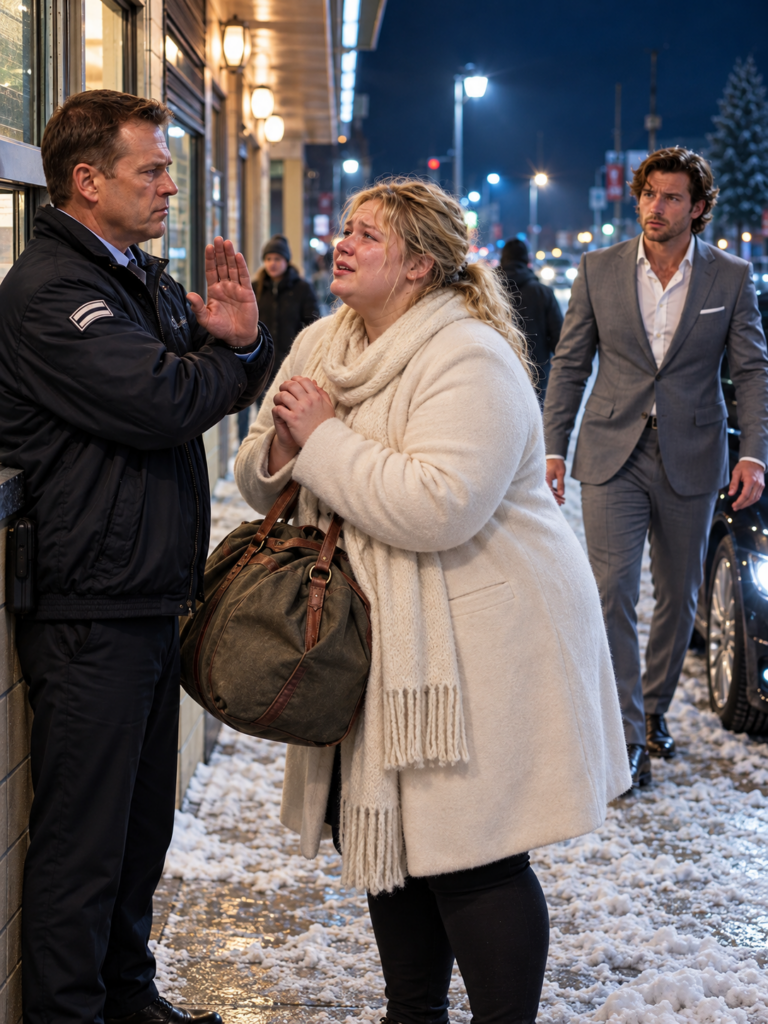
Snow had been falling for hours, covering the sidewalks in a thin white layer that grew deeper along the edges of the deserted street. Her shoes were soaked through. Each step sent a sharp ache up her legs, and the wind cut through her coat as though the fabric were no thicker than paper.
She was twenty-four years old, and everything she owned was packed into a small, battered suitcase.
Six months earlier, she had been a young woman with a job, an apartment, and a future she could almost see clearly.
Tonight, she had nowhere to sleep.
Emily stopped beneath the yellow light outside a closed department store. The storefront windows reflected a pale, exhausted stranger whose cheeks were red from the cold and whose dark hair clung damply to her face.
For a moment, she hardly recognized herself.
She lowered her suitcase beside her, rubbed her hands together, and looked down the empty street.
She had already visited three shelters. The first had been full before sunset. At the second, a tired volunteer had apologized and suggested another location. By the time Emily reached the third, the last available bed had been taken.
The woman behind the desk had looked genuinely sorry.
Emily had thanked her anyway.
She was becoming very good at thanking people for things they couldn’t give her.
Her stomach tightened with hunger. She couldn’t remember when she had last eaten a proper meal. There was a little money left in her coat pocket, but she had been saving it for a bus ride if she found somewhere safe to spend the night.
Now even that small plan seemed pointless.
She leaned against the cold brick wall and closed her eyes.
Her mother’s voice returned to her, gentle and familiar.
Don’t let the world make you cruel, sweetheart. Even when life hurts, hold on to the good inside you.
Emily pressed her lips together.
“I’m trying, Mom,” she whispered.
Her voice cracked.
For months, she had been trying.
Trying to stay strong through hospital visits and sleepless nights. Trying to pay bills that never stopped coming. Trying to return to work after burying the only person who had always believed in her.
Trying not to become another invisible person on a city sidewalk.
But tonight, surrounded by snow and silence, she had nothing left to give.
Her eyes filled with tears.
“I have nowhere else to go.”
The words were so quiet that she barely heard them herself.
She didn’t know someone else had.
A black luxury sedan had pulled up near the curb a few yards away. Its headlights briefly illuminated the falling snow before the engine shut off.
Daniel Brooks stepped out of the rear door, adjusting the collar of his expensive gray overcoat.
At forty-two, Daniel was the owner of several successful companies. His businesses employed hundreds of people, and his name appeared regularly in financial publications and local business reports.
Most people who met him noticed his wealth first.
The tailored suits. The luxury cars. The confident way he carried himself.
They rarely noticed the things Daniel preferred not to discuss.
The years when he had owned almost nothing.
The nights when hunger had kept him awake.
Or the memory of a stranger who had changed the course of his life with one simple act of compassion.
Daniel had just finished a difficult evening meeting and wanted nothing more than to return home.
But as he approached the sidewalk, he noticed the young woman standing beneath the storefront light.
At first, he assumed she was waiting for someone.
Then he saw her suitcase.
Her wet shoes.
The way she wrapped her arms around herself, not merely against the cold, but as though she were trying to protect the last small piece of dignity she possessed.
Daniel slowed.
He had seen that posture before.
He knew what it meant to stand somewhere because every other place had become unavailable.
Then he heard her whisper.
“I have nowhere else to go.”
Something inside him shifted.
For a moment, the street seemed to disappear, replaced by another winter night many years earlier.
He remembered a hungry boy hiding behind a grocery store.
A locked door.
A cold floor.
And the terrible fear of being discovered when he had nowhere else to run.
Daniel looked at Emily again.
He could have continued walking.
He could have told himself that someone else would help her. That there were organizations better equipped to handle situations like hers. That stopping to speak with a stranger so late at night was inconvenient.
Those would have been easy explanations.
He had heard versions of them throughout his childhood.
Instead, he walked toward her.
“Excuse me, miss.”
Emily startled.
Her hand immediately tightened around the handle of her suitcase.
Daniel stopped several feet away.
“I’m sorry. I didn’t mean to frighten you.”
Emily looked at him cautiously.
“It’s okay.”
Her voice was weak.
Up close, Daniel could see how badly she was shaking.
“Are you waiting for someone?”
She hesitated.
For a second, she considered lying.
If she said she was waiting for a friend, perhaps he would leave her alone. Perhaps she could avoid another embarrassing conversation.
But she was too exhausted to invent a convincing story.
“No, sir.”
Daniel glanced at the suitcase, then back at her face.
“Do you have somewhere safe to stay tonight?”
Emily lowered her eyes.
She shook her head.
The answer seemed to cost her more than he expected.
“I tried the shelters,” she said quietly. “They’re all full.”
Daniel glanced toward the snow-covered street.
“How long have you been outside?”
“A few hours.”
Her trembling hands told him it might have been longer.
He considered his next words carefully.
He knew that a frightened young woman had every reason to be suspicious of an unfamiliar man approaching her at night, no matter how expensive his coat looked.
“My name is Daniel Brooks,” he said. “I don’t want anything from you. But I’d like to help, if you’ll let me.”
Emily stared at him.
Help.
She had heard that word before.
Sometimes it came with conditions. Sometimes it came with disappointment. Occasionally, it was followed by questions that made her feel as though she were standing trial for being poor.
“What kind of help?” she asked.
Daniel didn’t seem offended.
“First, I’d like to make sure you don’t have to spend tonight out here.”
She looked away.
“I don’t have money for a hotel.”
“I understand.”
“And I can’t pay you back.”
“I haven’t asked you to.”
Emily searched his face for impatience, judgment, or a hidden expectation.
She found none.
That almost made it harder.
“Why would you help me?” she whispered.
Daniel could have mentioned his wealth.
He could have told her that the cost of a warm meal or a temporary room meant very little to him financially.
But those answers would not have addressed what she was really asking.
Instead, he said, “Because nobody should have to stand outside in weather like this wondering whether they’ll survive the night.”
Emily swallowed.
Daniel waited.
Then he asked a question she had not expected.
“Have you eaten anything today?”
Her face changed.
It was such an ordinary question.
Not What did you do wrong?
Not Why didn’t your family help?
Not How did you end up like this?
Just whether she had eaten.
Emily opened her mouth, but no answer came.
She tried again.
“I had some crackers this morning.”
Daniel looked at her for a long moment.
“Would you let me buy you dinner?”
Her eyes filled instantly.
She hated that she was crying in front of a stranger.
She had promised herself she wouldn’t.
Yet the simple offer reached a place inside her that months of grief had left painfully exposed.
“I’m sorry,” she whispered, covering her face.
Daniel remained where he was.
“You don’t need to apologize.”
But Emily couldn’t stop.
The tears came harder, accompanied by exhausted sobs she had been holding back since the morning she had carried her mother’s belongings out of the hospital.
“I’m sorry,” she repeated. “I don’t normally do this.”
“Take your time.”
People passed through the world carrying pain that was invisible until one small act caused it to overflow.
Daniel understood that better than most.
He did not reach for Emily or demand that she explain herself.
He simply waited beside her while snow gathered along the curb.
Eventually, she wiped her eyes with the sleeve of her thin coat.
“There’s a restaurant down the street,” he said gently. “It’s still open. We can walk there if you’re comfortable.”
Emily glanced toward the black car.
Daniel noticed.
“We don’t need to use the car.”
A little of the fear left her face.
“Okay,” she whispered.
She bent to lift her suitcase, but her numb fingers struggled with the handle.
“May I carry that?” Daniel asked.
She considered refusing.
Then she nodded.
The suitcase was surprisingly light.
Daniel didn’t comment on it.
Together, they walked toward the small family-owned restaurant glowing at the end of the block.
Emily kept her eyes on the sidewalk.
She had no idea what would happen after dinner.
But for the first time that evening, she was walking toward warmth rather than away from another locked door.
Inside, the restaurant smelled of fresh bread, coffee, and roasted vegetables.
A few customers sat in booths near the windows. Soft music played behind the low hum of conversation.
The owner greeted Daniel with polite recognition, then showed them to a quiet table.
Emily stood awkwardly beside the chair.
Her coat was wet.
Her shoes were dirty.
She was painfully conscious of the contrast between her appearance and Daniel’s tailored clothing.
“Is it okay if I sit here?” she asked.
Daniel looked almost puzzled.
“Of course.”
She lowered herself into the seat.
A server brought water and menus.
Emily opened hers and immediately looked at the prices.
Daniel noticed her expression.
“Please order whatever sounds good.”
“I don’t want anything expensive.”
“You don’t have to worry about the price.”
She looked at him uncertainly.
He added, “It’s just dinner, Emily.”
She had told him her name on the walk over.
Hearing him use it so naturally made something inside her relax.
She ordered soup, a chicken dinner, and hot tea.
When the food arrived, she tried to eat carefully.
After several bites, hunger overcame her embarrassment.
Daniel looked toward the window, giving her the privacy of not being watched while she finished almost everything on her plate.
Only when she set down her fork did he speak.
“Feeling a little better?”
Emily nodded.
“Much better. Thank you.”
“Good.”
She wrapped both hands around her tea.
For a while, neither spoke.
Then Emily looked across the table.
“You’re probably wondering how I ended up out there.”
Daniel shook his head.
“You don’t owe me your story.”
“I know.”
She paused.
“But I think I want to tell someone.”
And for the first time in months, Emily began speaking about everything she had lost.
She told him about the little apartment she had shared with her mother.
About the bakery where she had worked during the day.
About the evening classes she had taken because she dreamed of becoming a nurse.
“My mom used to joke that I was going to spend my whole life taking care of people,” Emily said, looking down at her cup.
“Did that bother you?”
“No.” A faint smile touched her lips. “It made me happy.”
Her smile disappeared.
“Then she got sick.”
Daniel listened as Emily described the hospital appointments, the medication expenses, and the long nights when she sat beside her mother’s bed, pretending not to be afraid.
At first, she believed that if she worked hard enough, she could keep everything together.
She used her savings.
Then she stopped attending school so she could care for her mother.
She fell behind on expenses.
The bills kept coming.
And one rainy morning, after months of fighting an illness that had gradually taken away her strength, her mother died.
Emily stopped speaking.
Daniel waited.
“I thought losing her would be the worst part,” she finally said.
Her voice trembled.
“But after the funeral, everything else started falling apart too.”
She explained that she had tried to return to her regular schedule at the bakery.
She wanted to be dependable.
She wanted to work.
But grief followed her everywhere.
Some mornings, getting out of bed felt impossible.
She missed shifts.
She struggled to concentrate.
Eventually, her employer replaced her.
“I know I wasn’t doing a good job anymore,” she admitted. “I understood why they couldn’t keep waiting for me.”
Daniel said nothing.
“But I kept thinking I could fix it. Find another job. Catch up on rent.”
She looked away.
“I was always just a little too late.”
The eviction came soon afterward.
Emily had contacted a relative who had previously promised to help if she ever needed anything.
At first, the relative responded.
Then the calls went unanswered.
The messages remained unread.
Finally, Emily stopped trying.
“I sold some things,” she said. “But there wasn’t much.”
Her fingers tightened around the cup.
“And tonight was the first night I couldn’t find anywhere to sleep.”
Daniel felt an old, familiar ache settle in his chest.
He knew what it was like to explain circumstances that sounded unbelievable to people who had never experienced them.
He also knew how quickly hardship could convince someone that they had somehow become less deserving of kindness.
Emily looked up.
“I don’t want you to think I’m lazy.”
The words struck him harder than anything else she had said.
“I don’t.”
“I used to work all the time.”
“I believe you.”
“I had plans.”
“I’m sure you did.”
She swallowed.
“I still want to become a nurse.”
Daniel leaned slightly forward.
“Then why are you talking about that dream as though it’s already gone?”
Emily gave a sad little laugh.
“Because I don’t even have a place to sleep tonight.”
She looked down at her hands.
“School feels like something that belongs to another person.”
Daniel studied the young woman sitting across from him.
She was exhausted, frightened, and grieving.
But beneath all of that, he could still see the determination with which she had once built her future.
Perhaps she could no longer see it herself.
That didn’t mean it had disappeared.
“Emily,” he said, “would you be willing to hear an idea?”
She looked up.
“What kind of idea?”
“One that begins with making sure you’re safe tonight.”
She waited.
“And after that?”
Daniel considered her question.
Then he answered quietly.
“After that, we can find out how much of your future is still waiting for you.”
For the first time since her mother died, Emily felt something she had almost forgotten.
Not happiness.
Not certainty.
Something smaller.
Something frightening because it could so easily be taken away.
Hope.
Part 2
Daniel did not begin by making promises about a perfect life.
He knew better.
A person who had lost everything did not need grand speeches from someone whose circumstances were comfortable.
They needed something that would still be there in the morning.
After dinner, Daniel helped Emily arrange a safe place to sleep for the night.
He made sure she understood where she would be staying and that she could make the decision herself.
Emily thanked him so many times that he eventually smiled.
“You’ve thanked me enough for one evening.”
She looked embarrassed.
“Sorry.”
“And you’ve apologized enough, too.”
That surprised a small laugh out of her.
It was the first time he had heard her laugh.
The sound was brief, but it changed her face.
Daniel realized just how young she looked when fear wasn’t controlling every expression.
Before they parted, he told her he would help her look into longer-term arrangements the following morning.
“You don’t have to do that,” Emily said.
“I know.”
“You already bought me dinner and found me somewhere to stay.”
“Those things will help tonight. Tomorrow has its own problems.”
She lowered her eyes.
“You’re really coming back?”
Daniel understood the question beneath the question.
Would he become another person who made a promise and disappeared?
“Yes,” he replied. “I’ll be here.”
Emily wanted to believe him.
But trust had become difficult.
Over the past six months, she had learned that people could mean well and still leave. Some didn’t know how to help. Others grew tired of hearing about problems that couldn’t be solved quickly.
She had stopped expecting anyone to stay involved long enough to make a difference.
That night, she lay in a clean bed staring at the ceiling.
The room was warm.
There was running water, a locked door, and a lamp beside the bed.
Ordinary things.
Things she had once taken for granted.
Now they seemed almost luxurious.
She placed her suitcase near the wall and unzipped it.
Inside were a few pieces of clothing, personal papers, and a photograph of her mother taken years earlier.
Emily lifted the photograph.
Her mother was smiling at the camera in the little apartment kitchen.
The picture had been taken on a bright Sunday afternoon when their biggest concern had been whether Emily would finish her homework before dinner.
She traced the edge of the photograph with her thumb.
“Someone helped me tonight, Mom.”
Her throat tightened.
“I don’t know why.”
She rested the picture against the bedside lamp.
Then she climbed beneath the blanket.
For several minutes, she remained awake, listening to the quiet room.
No traffic rushing past her on the sidewalk.
No footsteps making her nervous.
No need to keep walking because standing still had become unbearable.
Eventually, exhaustion pulled her into a deep sleep.
The following morning, Emily woke suddenly.
For one terrible second, she didn’t know where she was.
Then she saw the lamp, the clean walls, and her suitcase beside the bed.
Memories of the previous night returned.
The snow.
The restaurant.
Daniel Brooks.
She sat upright and looked toward the window.
Daylight streamed through the curtains.
A familiar worry immediately surfaced.
What if he didn’t return?
What if she had misunderstood everything?
What if last night’s kindness was all there was?
She reminded herself that even if Daniel never appeared again, he had already done more than most strangers would have.
She could not demand anything beyond that.
Still, she found herself listening for the phone.
When Daniel contacted her as promised, the relief was almost painful.
He had already begun making inquiries about temporary housing and community assistance programs.
But he wanted Emily to be part of every decision.
He did not intend to move her around like an object that needed to be placed somewhere convenient.
They met that morning to discuss what she needed.
At first, Emily struggled to answer.
She had spent so much time surviving one problem at a time that thinking beyond the next twenty-four hours felt overwhelming.
Daniel took a notebook from his coat pocket.
“Let’s start with the things that are making life difficult right now.”
Emily hesitated.
“Everything?”
A small smile crossed his face.
“We can work with a long list.”
She looked down.
“I need somewhere to live.”
He wrote it down.
“I need a job.”
Another note.
“And some of my documents are missing. I lost track of things when I moved out of the apartment.”
Daniel nodded.
“What about school?”
Emily’s expression changed.
“I don’t know if that’s realistic anymore.”
“Put it on the list anyway.”
She stared at him.
“Why?”
“Because you told me it’s important to you.”
She thought about that.
Then, slowly, she nodded.
Over the next several days, Daniel helped Emily secure a safe temporary apartment.
It was modest, with simple furnishings and a small kitchen, but when Emily opened the door for the first time, she stopped in the entrance.
The living room had a window overlooking the street.
There was a sofa, a table, and enough space for her suitcase.
Beyond it was a bedroom with a neatly made bed.
She stepped inside as though she were afraid that moving too quickly might cause everything to vanish.
“It’s really for me?” she asked.
“For now, yes.”
She glanced at Daniel.
“How long can I stay?”
They discussed the temporary arrangement and the support available while she worked toward becoming financially independent.
Daniel was careful not to make promises he couldn’t keep.
He wanted her to understand what had been arranged and what steps would come next.
Emily listened closely.
She had learned how dangerous uncertainty could become.
When he finished explaining, she looked around again.
Then she walked to the window.
Outside, people hurried along the sidewalk, carrying shopping bags and cups of coffee.
For the first time in weeks, Emily could watch the street without wondering where she would sleep when night arrived.
Her eyes filled.
Daniel remained near the doorway.
“Is everything all right?”
Emily nodded.
“I’m just trying to remember what it feels like to have a door I can close.”
Daniel understood.
He did not interrupt.
A few moments later, she turned toward him.
“Mr. Brooks, I don’t know how I’ll ever repay you.”
“Daniel is fine.”
She gave a nervous smile.
“Daniel.”
“And you don’t owe me a debt for accepting help.”
She looked uncertain.
He continued, “What matters is what you decide to do with the opportunity.”
That sentence stayed with her long after he left.
The apartment solved one urgent problem, but Emily’s situation was far from simple.
Replacing her missing documents required forms, appointments, and patience.
There were offices to visit, identification records to confirm, and questions she sometimes found humiliating.
She disliked explaining that she no longer had a permanent address connected to many of her records.
She disliked being reminded of all the things she had lost.
But this time, she did not face the process entirely alone.
Daniel connected her with people who understood how to navigate the necessary steps.
He helped her find a community program designed to assist people returning to education after financial hardship.
When Emily first entered the program office, she felt out of place.
Other applicants sat in chairs holding folders and paperwork.
A woman at the front desk asked about her educational background.
Emily explained that she had previously taken evening classes while working at a bakery.
She had stopped when her mother became ill.
“Why do you want to return?” the woman asked.
Emily sat a little straighter.
“Because I still want to become a nurse.”
For the first time in months, she heard herself say those words without immediately apologizing for them.
The program representative explained the available resources and what Emily would need to do to resume her education.
There would be work ahead.
She would need to rebuild her academic routine, manage her expenses, and commit to a demanding schedule.
None of it would happen overnight.
Emily listened to every word.
For the first time since losing her apartment, a difficult future seemed better than having no future at all.
But she still needed steady income.
Daniel had been considering that problem.
One afternoon, he invited Emily to discuss a possible opportunity at one of his companies.
She arrived carrying a folder of her documents, wearing the neatest clothes she owned.
Her nervousness was obvious.
Daniel offered her a seat.
“Emily, there’s something I’d like to ask you.”
She sat with her hands folded in her lap.
“Okay.”
“Have you ever considered working in community outreach?”
She blinked.
“I’m not sure what that involves.”
Daniel explained that one of his companies had a department focused on community programs, local partnerships, and assistance initiatives.
The position would provide steady work while allowing her to continue her studies.
Emily listened, increasingly stunned.
“You’re offering me a job?”
“I’m offering you the opportunity to take a position, yes.”
She looked down at her folder.
“But I don’t have experience in that kind of department.”
“You have experience working with people. You understand responsibility, and you know how much community resources can matter.”
“Knowing what it feels like to need help doesn’t mean I’d automatically be good at giving it.”
Daniel regarded her thoughtfully.
“That’s true.”
His agreement surprised her.
He continued, “You’d have to learn the work. You’d have responsibilities and expectations, just like anyone else.”
Emily considered that.
She had feared he might offer her a meaningless position created out of pity.
But the more he explained, the clearer it became that he expected her to contribute.
He was not suggesting she sit at a desk simply because he felt sorry for her.
He was offering her a chance to earn stability.
“What if I’m not good enough?” she asked.
“Then you’ll need to learn and improve. The same as every other employee.”
She looked at him.
He smiled slightly.
“I’ve hired people with far more experience who still had plenty to learn.”
Emily laughed softly.
Then her expression grew serious.
“Why are you doing all this?”
Daniel leaned back.
She had asked variations of the same question since their first meeting.
He had answered gently, but never completely.
Now he realized she needed something more than reassurance.
She needed to understand why he believed in helping someone he had only recently met.
Daniel looked toward the window.
For several seconds, he seemed to be considering a memory.
“Did I ever tell you about my father?”
Emily shook her head.
“No.”
“He disappeared when I was a boy.”
She went still.
Daniel rarely spoke about his childhood.
People in his professional world knew him as a businessman who had built successful companies, but very few knew what had come before.
“My family didn’t have much to begin with,” he said. “After my father left, things became much worse.”
Emily listened without interrupting.
“There was a time when I didn’t have anywhere safe to sleep.”
She stared at him.
It seemed impossible to connect the man sitting in front of her with the life he was describing.
Daniel continued.
“I spent nights in the back room of a closed grocery store.”
Emily felt a chill.
He was watching her carefully now, not to measure her reaction, but because the memory still carried a weight he could feel.
“I was hungry most of the time. Scared, too. I thought if people discovered me, they’d just send me away.”
“What happened?” Emily whispered.
“Someone noticed.”
His expression softened.
“A stranger bought me dinner. Then helped me find temporary shelter.”
Emily’s eyes began to shine.
Daniel looked down at his hands.
“That person didn’t solve every problem in my life. Didn’t give me a fortune or guarantee that everything would work out.”
He paused.
“But I remember how it felt when someone looked at me and saw a human being instead of a problem.”
Emily could barely speak.
“Is that why you stopped that night?”
Daniel met her eyes.
“Yes.”
The answer was simple.
It made more sense than any grand explanation he could have offered.
He continued, “I know what it feels like when everyone else seems to have somewhere to go and you don’t.”
Emily remembered standing beneath the department store light, certain that nobody would ever understand how frightened she was.
All that time, the wealthy stranger approaching her had carried a memory painfully similar to her own experience.
“But you became successful,” she said.
“Eventually.”
“How?”
“Years of work. Mistakes. People who gave me opportunities. And people who expected me to make something of those opportunities.”
His expression grew thoughtful.
“Success didn’t erase what happened to me, Emily.”
She said nothing.
“It just gave me the ability to do something when I saw someone else going through it.”
Tears slipped down her cheeks.
She wiped them away.
“I thought you helped me because you felt sorry for me.”
Daniel shook his head.
“I helped you because you needed help. Those aren’t the same thing.”
Emily looked down.
For months, she had believed her circumstances had somehow reduced her value.
She had measured herself against every loss.
A job she couldn’t keep.
A home she couldn’t afford.
A degree she might never complete.
But Daniel was asking her to separate her worth from her situation.
It was difficult.
It was also the first lesson she needed to learn before she could truly begin again.
She lifted her head.
“If I take the job, I want to earn it.”
“That’s what I expect.”
“And I don’t want special treatment just because you know what happened to me.”
Daniel nodded.
“Fair enough.”
She took a breath.
“Then I’d like to try.”
Daniel smiled.
“Good.”
When Emily left that meeting, she walked down the street holding her folder against her chest.
She still had unpaid obligations to sort through.
She still missed her mother so fiercely that some mornings she could hardly breathe.
She still worried about what would happen if she failed.
But for the first time in a long while, she was not simply waiting for another disaster.
She was preparing to build something.
And the opportunity Daniel had placed in front of her was only the beginning.
Part 3
The first months were harder than Emily expected.
She had imagined that finding work and returning to school would make everything feel normal again.
Instead, she discovered that rebuilding a life required a different kind of endurance.
Every morning, she woke early enough to prepare for work.
Her position in the community outreach department involved organizing information, helping coordinate assistance activities, answering questions, and learning how different support programs served people facing difficult circumstances.
At first, Emily worried constantly about making mistakes.
She took careful notes.
She asked questions.
She stayed focused even when the work felt unfamiliar.
Her coworkers gradually came to see her as someone dependable.
She was not the most experienced employee.
But she listened.
And when someone needed an answer, she did her best to find it rather than simply passing the problem along.
There were moments when her past made certain conversations especially difficult.
Once, while reviewing information about emergency housing assistance, she found herself remembering the woman at the shelter who had apologized because every bed was taken.
Emily stared at the paperwork longer than necessary.
She remembered the shame of asking for a safe place to sleep.
The fear of hearing there was no room.
And the awful thought that she might have to keep walking until morning.
A coworker noticed her expression.
“Everything okay?”
Emily looked up.
“Yes.”
She hesitated.
“Actually, I was just thinking about how much it matters when someone explains what options a person still has.”
Her coworker nodded.
“It can make a big difference.”
Emily glanced at the paperwork again.
“I know.”
She returned to her work with renewed attention.
She could not personally solve every hardship that passed through the department.
But she could make sure she treated people respectfully.
That mattered.
After work, she attended her classes.
When she returned to her apartment, she prepared something simple to eat and opened her textbooks.
Some nights, she studied until her eyes burned.
Other nights, she fell asleep at the small kitchen table, waking an hour later with her cheek pressed against an open notebook.
She would blink at the clock, frustrated with herself, then move her books to the bedroom and try again.
There were examinations that frightened her.
Assignments that took far longer than she expected.
Days when grief interrupted her concentration without warning.
Sometimes she would see a woman who resembled her mother in a grocery store, and the sight would leave her struggling to hold back tears.
Other times, she would prepare a meal her mother had taught her to make and instinctively reach for her phone before remembering there was nobody to call.
Those moments never disappeared completely.
But Emily began learning that continuing her life did not mean leaving her mother behind.
Her mother’s love had shaped the person she was trying to become.
And every time Emily returned to her books after an exhausting day, she felt she was carrying part of that love forward.
Daniel remained a steady presence, though he was careful not to take over her life.
He sometimes asked how her studies were progressing.
He listened when she described a difficult week.
He offered practical guidance when she requested it.
But he did not interfere with every decision.
He understood that helping Emily regain independence meant allowing her to build confidence in her own judgment.
One afternoon, several months into her new routine, Emily saw Daniel during a visit to the outreach department.
She was working through a stack of documents when he stopped near her desk.
“How’s everything going?”
She looked up.
“Busy.”
“Good busy or bad busy?”
Emily considered.
“Mostly good.”
He noticed the textbook beside her notebook.
“Studying during lunch?”
“Trying to.”
“How are your classes?”
She smiled.
“Harder than I remembered.”
Daniel laughed quietly.
“That sounds familiar.”
Emily looked at him.
“Can I ask you something?”
“Of course.”
“Do you ever get tired of working so much?”
Daniel thought about the question.
“Sometimes.”
“Then why keep doing it?”
He glanced around the department before answering.
“Because the work matters. And because responsibility doesn’t disappear when you’re tired.”
Emily nodded.
That was something she was beginning to understand.
He looked back at her.
“But neither does the need to rest. Don’t forget that part.”
She gave a small, embarrassed smile.
“I’ve been trying.”
“Keep trying.”
After he left, Emily returned to her paperwork.
She realized that his advice was different from what she had expected when they first met.
He did not constantly remind her to be grateful.
He did not use her circumstances as proof of his generosity.
He simply treated her like someone who was capable of doing difficult things.
For Emily, that was becoming more important than she could easily explain.
As the months passed, her confidence returned in small, almost invisible steps.
The first time she paid her own monthly expenses from her salary, she sat at her kitchen table and looked at the receipts for several minutes.
They were ordinary expenses.
Nothing glamorous.
But she had paid them herself.
She could scarcely remember the last time such a simple accomplishment had made her feel so proud.
Later, when she passed an important examination, she walked out of class grinning.
She reached for her phone, eager to tell someone.
For a moment, the old sadness returned.
Her mother would have been the first person she called.
Emily stood outside the building and let herself miss her.
Then she sent Daniel a short message telling him she had passed.
His response came later.
He congratulated her and told her to keep going.
Emily smiled at the screen.
It wasn’t a dramatic exchange.
But it reminded her that her progress mattered to someone.
She continued working and studying.
Gradually, the woman who had once struggled to meet anyone’s eyes began speaking with growing assurance.
She no longer apologized each time she asked a question.
She no longer assumed that every setback meant she was failing.
When she didn’t understand something, she worked until she did.
When she made mistakes, she corrected them.
And when difficult memories returned, she gave herself permission to feel them without allowing them to define the rest of her day.
There were still moments of doubt.
One evening, after a particularly exhausting week, Emily sat alone in her apartment staring at a page of notes that made little sense.
Her mind felt crowded.
Work had been demanding.
Her classes were moving quickly.
And she had begun wondering whether she had taken on more than she could manage.
She closed the textbook.
“What if I can’t do this?” she whispered.
The apartment was quiet.
She looked toward the photograph of her mother on a nearby shelf.
For a moment, she imagined what her mother might say.
Not that everything would be easy.
Her mother had never made promises like that.
She would probably remind Emily how far she had already come.
Then she would tell her to get some sleep.
Emily almost laughed.
She turned off the lamp and went to bed.
The next morning, she woke early and opened the textbook again.
The difficult material had not become simple overnight.
But after resting, she could finally begin to understand it.
That was how much of her new life unfolded.
Not through one spectacular victory.
Through hundreds of decisions to keep going.
By the time nearly a year had passed since the night Daniel found her, Emily’s circumstances had changed in ways she sometimes struggled to believe.
She had a stable place to live.
She was earning an income.
She was progressing through her nursing education.
And, perhaps most importantly, she no longer believed her future had ended when she lost her home.
But there was something she had wanted to do for weeks.
Something personal.
Something she had been planning quietly.
She wanted to return to the place where Daniel had found her.
Not because she wanted to relive the worst night of her life.
Because she wanted to see that place again as the woman she was becoming.
On a cold evening, almost a year after their first meeting, Emily walked along the familiar street.
Winter had returned.
The air carried the same sharp chill she remembered, although the snowfall was lighter this time.
Cars passed slowly beneath the streetlights.
A few pedestrians hurried along the sidewalks, their coats pulled tightly around them.
Emily stopped in front of the closed department store.
The yellow light above the storefront glowed just as it had that night.
For several seconds, she stood perfectly still.
The memories came back with startling clarity.
Her wet shoes.
The weight of the suitcase.
The desperate search for somewhere safe to sleep.
She could almost hear her own frightened voice.
I have nowhere else to go.
Emily looked down.
Tonight, there was no suitcase beside her.
She wore her nursing uniform, a symbol of the path she was now following through her training.
In her hands was a small bouquet of flowers.
She had chosen them carefully.
They were not expensive.
That was intentional.
Daniel could buy almost anything he wanted.
The flowers weren’t meant to impress him.
They were meant to express something she had struggled to put into words.
A few minutes later, a black car stopped near the curb.
Daniel stepped out.
He saw Emily standing beneath the storefront light and smiled.
“You picked an interesting place to meet.”
Emily looked at him.
“I know.”
He glanced toward the closed store, then back at her.
For a moment, recognition settled across his face.
“This is where we met.”
She nodded.
“Almost a year ago.”
Daniel looked around.
The street seemed ordinary.
Just another block in a busy city.
But he knew that certain places held memories no one else could see.
“Why did you want to come back here?” he asked.
Emily looked down at the bouquet.
“Because I wanted to remember something.”
“What?”
“How different everything feels now.”
Daniel waited.
Emily turned toward the storefront.
“I remember standing right here.”
Her voice was steady, although her eyes had begun to shine.
“I was freezing. I hadn’t eaten properly. I was scared to ask anyone for help.”
Daniel said nothing.
“I kept thinking that if I could just find one place to sleep, maybe I’d be able to figure out the next day.”
She gave a sad little smile.
“But I couldn’t even find that.”
She looked at him.
“And then you showed up.”
Daniel slipped his hands into his coat pockets.
“I’m glad I did.”
Emily nodded.
“So am I.”
She glanced at the flowers, then held them out.
“These are for you.”
Daniel looked genuinely surprised.
“For me?”
She smiled.
“Yes.”
He accepted the bouquet carefully.
“Thank you, Emily.”
She drew a slow breath.
“I’ve been trying to figure out how to tell you what that night meant.”
“You’ve already thanked me.”
“I know.”
She paused.
“But I don’t think I ever really explained.”
Daniel looked at her attentively.
Emily felt her throat tighten.
“When my mom died, I thought I’d lost the most important part of my life.”
She looked toward the snow along the curb.
“Then I lost my job. And my apartment. And everything kept happening so fast that I didn’t know who I was anymore.”
Daniel’s expression softened.
“I started believing the worst things about myself,” she continued. “That I wasn’t dependable. That I wasn’t strong enough. That maybe I had ruined my chance at having a future.”
She swallowed.
“And that night, standing here, I felt like I wasn’t worth anyone’s time.”
Daniel looked at her with quiet concern.
“But you stopped,” she said. “You listened to me.”
Her eyes filled.
“You didn’t make me explain why I deserved dinner. You didn’t treat me like I should be ashamed of needing help.”
She pressed her hands together to keep them from trembling.
“You helped me find an apartment. You helped me replace my documents. You helped me return to school. You gave me a chance to work.”
Daniel started to respond, but she gently shook her head.
“Please. I need to finish.”
He nodded.
Emily took another breath.
“I used to think those were the biggest things you gave me.”
Her voice grew softer.
“But they weren’t.”
Daniel watched her.
“The biggest thing was that you helped me believe I still had something to offer.”
A tear slipped down her cheek.
“Even after losing everything, I was still someone.”
Daniel lowered his gaze for a moment.
He had spent much of his adult life surrounded by measurements of success.
Profits.
Investments.
Expansions.
Contracts.
He understood the importance of those things, but standing on that sidewalk, holding a small bouquet of flowers, he was reminded of something no financial report could measure.
A life that had begun moving forward again.
Emily wiped her cheek.
“I don’t know if you realize what you did for me.”
Daniel looked at her.
“I know what someone once did for me.”
She smiled through her tears.
He continued, “There was a time when I thought the world had already decided what I was worth.”
Emily listened.
“And then someone treated me like my life mattered.”
He glanced at the flowers.
“I’ve never forgotten that.”
She stepped closer, her expression filled with gratitude.
“I won’t forget it either.”
For a while, they stood quietly beneath the light.
The city moved around them.
Cars passed.
Snowflakes drifted through the cold air.
Somewhere farther down the street, a shop owner lowered a metal security gate.
To anyone watching, they might have appeared to be two people sharing a simple conversation on an ordinary winter evening.
But Emily knew what had changed.
The first time she stood there, she had felt as though the world contained no place for her.
Now she understood that a single night did not determine the rest of her life.
She was not the frightened woman she had been.
And yet she still carried that woman’s memories.
She wanted to.
Because those memories would help shape the kind of nurse she hoped to become.
Daniel glanced at her uniform.
“How are the studies going?”
Emily smiled.
“Still hard.”
“Still worth it?”
She answered immediately.
“Absolutely.”
He nodded with approval.
“Then keep going.”
She laughed softly.
“I plan to.”
He looked toward the storefront once more.
“Your mother would be proud of you.”
Emily pressed her lips together.
For a moment, she couldn’t answer.
Then she whispered, “I hope so.”
Daniel shook his head gently.
“From everything you’ve told me about her, I think she’d recognize the person you’ve become.”
Emily looked down, letting his words settle.
She remembered her mother’s advice about kindness.
About not allowing cruelty to change who she was.
For months, Emily had wondered whether she had failed to live up to those words.
Now she understood something she hadn’t considered before.
Kindness was not only something a strong person gave to someone weaker.
Sometimes it was the very thing that helped a struggling person find the strength to stand again.
And when that strength returned, they could offer kindness to others.
That realization stayed with her as she continued her education.
The months that followed brought more demanding coursework, further training, and new responsibilities.
Emily remained committed to the goal she had almost abandoned.
She completed her studies and eventually graduated from nursing school.
On graduation day, she stood among her classmates wearing her graduation attire, feeling an overwhelming mixture of pride, disbelief, and sadness.
Her mother wasn’t there to see it.
That absence would always matter.
But Emily knew she had carried her mother’s influence into every class, every long study session, and every difficult moment when quitting might have seemed easier.
The degree represented more than an academic accomplishment.
It represented a future rebuilt after she had believed there was nothing left.
Daniel’s help had opened a door.
Emily had done the work required to walk through it.
After graduation, she became a nurse at a community clinic.
The work was demanding.
Some patients arrived with complicated medical needs.
Others were frightened by the possibility of receiving bad news.
Many faced financial difficulties or personal circumstances that made getting care especially stressful.
Emily quickly learned that the clinic served people who were carrying far more than their visible illnesses.
There were patients who apologized for not coming sooner because they had been unable to afford transportation.
People who struggled to complete forms because they were exhausted or overwhelmed.
People who avoided eye contact because they expected to be judged.
Whenever Emily recognized that fear, she remembered the night she had stood beneath the storefront light.
She remembered how difficult it had been to admit she needed help.
How ashamed she had felt about having no money.
And how a simple question about whether she had eaten had allowed her to feel human again.
One afternoon, a woman arrived at the clinic looking particularly distressed.
Her clothing was worn, and she clutched a small bag tightly against her chest.
When Emily approached, the woman immediately began apologizing.
“I’m sorry. I don’t know if I’m supposed to be here.”
Emily pulled up a chair so they could speak at eye level.
“You’re welcome to ask for help.”
The woman looked uncertain.
“I don’t have much money.”
“We can start by finding out what you need.”
The woman’s eyes filled.
Emily recognized that expression.
She had seen it once in the reflection of a department store window.
It was the look of someone who had endured so many disappointments that even kindness felt unfamiliar.
Emily kept her voice gentle.
“Would you like to tell me what’s been happening?”
The woman hesitated.
Then she began to speak.
Emily listened without rushing her.
She didn’t assume she understood everything.
She didn’t demand that the woman justify why her circumstances had become difficult.
She focused on the care and resources the clinic could provide.
And as the conversation continued, the woman gradually relaxed.
Her shoulders lowered.
Her hands stopped gripping the bag quite so tightly.
Emily recognized another familiar thing.
The small relief of discovering that asking for help did not always lead to rejection.
That evening, after finishing her shift, Emily stepped outside the clinic.
The sky was turning orange above the buildings.
People hurried home, carrying groceries, meeting friends, and making plans for the evening.
Emily stood for a moment and watched them.
She thought about the person she had been on that winter night.
The young woman who believed there was no future beyond the cold sidewalk.
The woman who had whispered that she had nowhere else to go.
Then she thought about Daniel.
He had not rescued her by taking away every challenge she would ever face.
He had helped her reach a place where those challenges no longer seemed impossible.
He had reminded her that she mattered.
And he had trusted her to build a life of her own.
Emily smiled faintly.
She knew she would never forget him.
Not because he was a millionaire.
Not because he owned successful businesses or drove an expensive car.
But because, when he encountered someone who had lost almost everything, he had chosen compassion instead of indifference.
Years of hardship had taught Daniel the value of being seen.
Now Emily carried that lesson into her own work.
Whenever someone entered the clinic feeling frightened, embarrassed, or hopeless, she tried to offer the same patience she had received.
She could not promise that every problem would disappear.
She could not guarantee that every journey would be easy.
But she could listen.
She could help people understand their options.
And she could remind them, through the way she treated them, that difficult circumstances did not erase their dignity.
Sometimes patients wanted to explain every mistake or misfortune that had brought them to the clinic.
Emily would listen when those details mattered.
But she never approached them as though they needed to earn compassion by proving they had suffered enough.
Instead, she would offer a gentle smile and ask the question that had come to define her work.
“Where would you like to begin again?”
Because Emily Carter had once stood on a freezing sidewalk with a suitcase and no place to sleep.
She had believed her life was finished.
Then a stranger stopped and asked whether she had eaten.
That single conversation led to shelter, work, education, and the chance to reclaim her future.
And in time, the frightened young woman became someone who could extend that same compassion to others.
Daniel Brooks had never claimed that his kindness made him extraordinary.
He knew the truth was much simpler.
Long before he became wealthy, someone had helped him when he had nothing.
And years later, he had chosen to pass that kindness forward.
Emily did the same.
The help that began with one warm meal did not end with her graduation, her career, or her newfound stability.
It continued through every frightened patient she treated with dignity and every person she encouraged to believe that another beginning was possible.
The snow-covered street remained where it had always been.
The department store light still shone above the sidewalk.
And somewhere in the city, there would always be someone facing a night that seemed too difficult to survive alone.
But Emily now understood what Daniel had taught her.
Losing everything did not mean losing her worth. And having nowhere else to go did not mean there was nowhere left to begin.


