
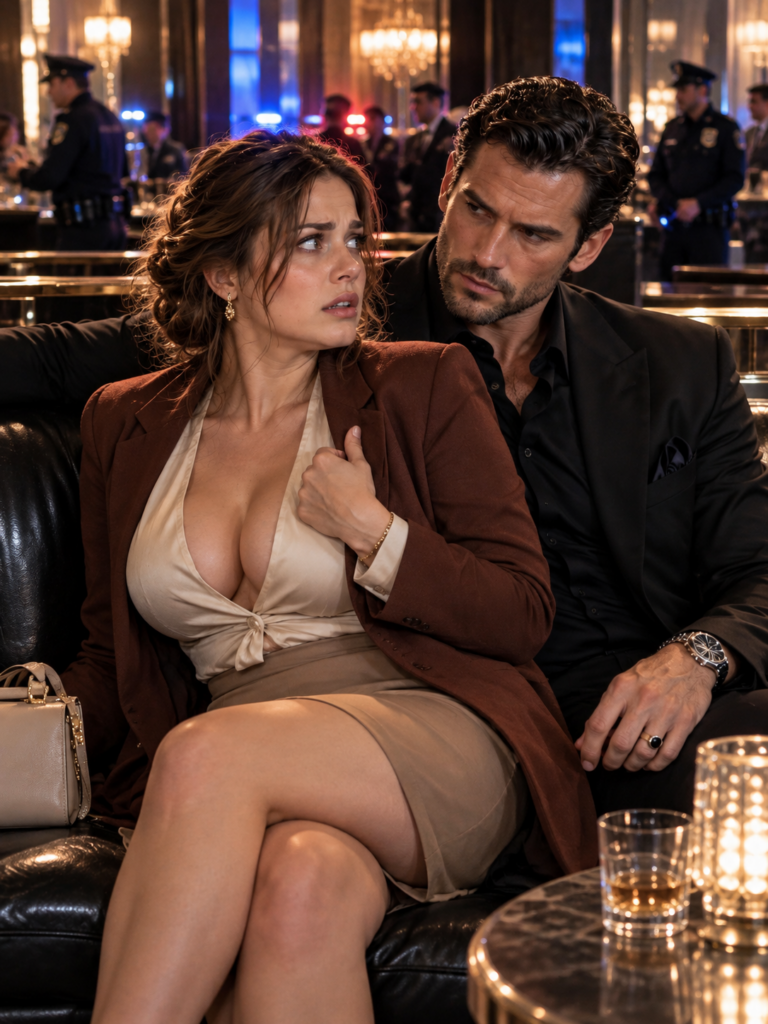
The front window of my bar exploded before I heard the gunshot, and the men who walked through the shattered glass knew my full name.
Three hours later, after the police told me I was probably a witness to something I couldn’t even remember, I opened my apartment door and a stranger’s hand clamped over my mouth.
Then the same cold voice I had heard during the shooting whispered against my ear, “Don’t scream, Elena. I’m the only reason you’re still alive.”

PART 1 — THE MAN WAITING IN MY APARTMENT
The jazz stopped in the middle of a note.
One second, I was wiping down the mahogany bar at Vespers while amber bourbon reflected the low gold lights.
The next, the front window blew inward.
Glass crossed the room like glittering rain.
Someone screamed.
Then came the gunshots.
Not wild.
Not panicked.
Three controlled bursts that punched into the piano, the mirrored shelves, and the wall behind our best booth.
I dropped behind the counter.
My knees landed in broken glass.
The smell of whiskey, gunpowder, expensive cologne, and fear filled my lungs.
“Nobody move.”
The voice came from the other side of the bar.
Deep.
Controlled.
Terrifying precisely because it didn’t need volume.
“We’re looking for someone.”
Shoes moved across the floor.
Polished black leather.
Several men.
“Young woman. Late twenties. Dark hair. Works here.”
My blood went cold.
Marcus, the owner, tried to speak.
“This is a private establishment. I can’t just—”
A dull impact cut him off.
His body hit the floor.
The voice returned.
“Where is Elena Voss?”
I stopped breathing.
Me.
They knew my name.
I had spent three years mixing cocktails at Vespers.
I paid rent late twice.
I watched cooking shows.
I called my parents every Sunday.
I had never joined a gang, witnessed a murder, borrowed money from dangerous people, or done anything remotely important enough to justify men shooting through a bar to find me.
Tasha’s frightened voice came from near the service hall.
“She—she went to the storage room.”
Footsteps moved away from me.
I shifted.
My elbow touched a bottle.
Glass clicked against glass.
Tiny sound.
In that silence, it rang like a church bell.
The footsteps stopped.
Turned.
Came back.
I pressed both hands over my mouth.
The cabinet behind me smelled like lemon oil and old wood.
A pair of black shoes stopped directly on the other side of the counter.
Then sirens rose somewhere outside.
One.
Two.
More.
A curse in another language.
The cold voice sharpened.
“Move.”
Footsteps retreated.
The kitchen door slammed.
Silence.
I remained on the floor for thirty seconds after they disappeared because my legs no longer belonged to me.
When I finally stood, blood ran from shallow cuts in both knees.
The club looked destroyed.
Tables overturned.
Bullet holes in the piano.
The stained-glass window that gave Vespers its name reduced to jagged teeth.
Marcus held a towel against his bleeding nose.
“Elena.”
His voice shook.
“Jesus Christ.”
“I don’t understand.”
Police entered before he could answer.
For the next two hours, I repeated the same things.
No enemies.
No criminal boyfriend.
No gambling debt.
No drugs.
No threats.
A detective with tired eyes finally asked, “Did anything strange happen here earlier this week?”
“No.”
“Anyone unusual?”
“This is a Manhattan bar. Everyone is unusual.”
He almost smiled.
Then his expression hardened.
“Someone believes you saw or heard something.”
“But I didn’t.”
“Maybe you don’t know you did.”
At two in the morning, a patrol officer drove me home.
My building looked exactly the same.
Graffiti near the mailboxes.
Broken intercom.
Curry smell from the third floor.
The officer waited until I got inside.
I climbed four flights.
Unlocked my apartment.
Stepped into darkness.
A hand covered my mouth.
An arm locked around my waist.
I bit down.
Hard.
The man barely reacted.
“Don’t.”
That voice.
The same voice from Vespers.
My blood froze.
“Don’t scream. Don’t fight. Don’t run.”
He carried me into my own living room and set me on the couch.
Then stepped back.
“Lamp.”
My shaking hand found the switch.
Light filled the room.
He was younger than I expected.
Mid-thirties.
Dark hair.
Sharp jaw.
Charcoal three-piece suit.
Blood—not his, I thought—staining one white cuff.
His gray eyes fixed on me.
“My name is Dante Rossi.”
I stared.
“And as of tonight, Elena, whether you like it or not—”
He glanced once toward my apartment door.
Then back at me.
“—you’re coming with me.”
PART 2 — THE SAFE HOUSE WAS NEVER SUPPOSED TO FEEL LIKE HOME
I laughed.
I knew immediately it was the wrong response.
Fear had hollowed me out so completely that the sound came from somewhere beyond reason.
High.
Short.
Almost hysterical.
“I’m what?”
Dante Rossi did not smile.
He stood between me and the door, one hand loose at his side, his posture unnervingly relaxed for a man who had broken into my apartment after participating in a shooting.
“You witnessed something Tuesday night.”
“I witnessed nothing.”
“You don’t remember.”
“That’s because nothing happened.”
“Something happened.”
He crossed to my kitchen as if he owned the lease, opened two cabinets, found a glass, filled it with water, and placed it in front of me.
The domestic normality of the gesture made me angrier.
I pushed it away.
“Get out.”
“No.”
“I’m calling the police.”
“They cannot keep you alive.”
“They were just here.”
“And the men who shot up your workplace waited until the police left before coming to your building.”
My hand froze halfway toward my phone.
Dante glanced toward the window.
“They’re not downstairs yet.”
“Who?”
“The Volkov Bratva.”
The name meant nothing.
My face must have shown it.
Dante sat in the chair opposite me.
“Tuesday. Around eleven. A man sat at the far end of the bar.”
I stared at him.
“Older. Gray suit. Expensive watch. Ordered Macallan neat.”
A memory moved.
Rain against the windows.
Slow night.
A man at the end of my bar.
Then another man arrived.
Cheap suit.
Nervous hands.
They had spoken quietly.
I had half listened while drying glasses.
“What about him?”
“He was one of Alexei Volkov’s lieutenants.”
Dante’s voice remained flat.
“Yesterday morning, his body was pulled from the East River.”
My stomach turned.
“He had agreed to cooperate with federal investigators.”
I shook my head.
“No.”
“The second man you saw was federal.”
“I didn’t know that.”
“Volkov doesn’t care what you knew.”
“I didn’t hear anything.”
“They don’t care about that either.”
He leaned forward.
“If there is a chance you heard a name, address, date, shipment location, anything—then you’re a liability.”
Tears stung my eyes.
“So why are you here?”
“Because I know how Volkov thinks.”
“That isn’t an answer.”
Dante’s jaw moved.
“They took my sister seven years ago.”
The room went still.
“She was twenty-four.”
Something in his expression disappeared behind stone.
“Wrong place. Wrong conversation. Wrong men.”
“I’m sorry.”
“Don’t be.”
He looked toward the window.
“I spent three months making sure everyone involved stopped breathing.”
The water glass suddenly seemed very far away.
“You killed them.”
“Yes.”
No apology.
No pride either.
Just fact.
I stood.
“You expect me to leave with you after telling me you murdered people?”
“I expect you to leave because people who murder more casually are four minutes away.”
My heart pounded.
“You’re insane.”
“Possibly.”
Dante checked his watch.
“Pack essentials.”
“No.”
“Then I carry you.”
“You cannot kidnap me.”
He looked around my studio apartment.
“Tonight, kidnapping is not your biggest problem.”
Footsteps sounded in the hallway.
Heavy.
Several.
Dante looked toward the door.
“They’re early.”
Every argument died.
Wood creaked outside.
Then someone struck my door.
Once.
Twice.
Dante crossed the room.
Opened my bedroom window.
Cold November air rushed inside.
“What are you doing?”
“Fire escape.”
“There isn’t one.”
He climbed through.
A narrow metal landing sat beyond the window, attached to the neighboring building.
I had lived there four years and never noticed it.
Behind me, the door shuddered.
Dante extended his hand.
“Now, Elena.”
I stared at it.
At him.
At darkness four stories below.
The front lock cracked.
I took his hand.
His grip closed around mine.
Warm.
Steady.
Uncompromising.
“Down.”
We moved.
Above us, my apartment door splintered open.
Flashlight beams cut through my bedroom.
Dante pulled me down another ladder.
Then another.
My feet slipped twice.
He caught me both times.
We landed in the alley.
“Run.”
We ran.
Behind dumpsters.
Through a narrow service passage.
Across a street.
I could barely breathe.
Dante pulled me into a dark doorway and covered my mouth when voices passed nearby.
“Slow breathing.”
His lips were near my ear.
“In through your nose.”
My vision had begun tunneling.
“Out.”
I tried.
“That’s it.”
“I can’t.”
“Yes, you can.”
He loosened his hand.
“You’re not dying.”
“What a comforting distinction.”
Something almost like amusement moved through his eyes.
Then disappeared.
Three blocks later, a black Mercedes waited.
The driver opened the door.
“Boss.”
The word chilled me.
I looked at Dante.
“Who are you?”
He waited until we were moving.
Then said, “The Rossi family controls several businesses in lower Manhattan.”
“What kind?”
“Import. Construction. Real estate. Hospitality.”
“Legitimate?”
“Mostly.”
I stared.
“You’re mafia.”
He looked almost offended.
“We prefer organized business network.”
“Oh my God.”
“Yes.”
“You’re actually mafia.”
“Apparently.”
“You sound bored by that.”
“I’ve known for years.”
The car crossed into Manhattan.
City lights spread across the river.
My old life remained behind me.
At that exact moment, I remembered Tuesday.
Not everything.
Fragments.
The second man had whispered:
“Thursday.”
Then:
“Warehouse on Pearl.”
Then:
“Three witnesses. One matters.”
I had heard it.
I had simply thought it was another conversation between men trying to sound important.
My stomach dropped.
Dante noticed.
“What?”
“I remember something.”
His entire body changed.
Not visibly to most people.
To me, suddenly, yes.
“What?”
I told him.
Thursday.
Warehouse.
Three witnesses.
One matters.
Dante swore softly.
“You were closer than I thought.”
“What does it mean?”
“That Volkov’s lieutenant gave a federal contact a meeting location.”
“Then I really am a witness.”
“You are.”
“And the police—”
“If Volkov has someone inside local law enforcement, reporting what you remember without protection could kill you before morning.”
I covered my face.
Dante’s voice softened.
“Look at me.”
I lowered my hands.
“You’re alive.”
“For now.”
“For tonight.”
His eyes held mine.
“That’s what matters.”
We entered an underground garage.
Private elevator.
Penthouse.
Floor-to-ceiling glass.
Black-and-gray furniture.
Art that looked either priceless or criminally ugly.
Dante pointed toward a bedroom.
“Yours.”
“A lock?”
“Inside.”
“You stay here?”
“Yes.”
“No.”
His eyebrow rose.
“No?”
“I don’t want you sleeping ten feet away from me.”
“The apartment has three bedrooms.”
“Oh.”
His mouth almost moved.
“Disappointed?”
“Die.”
“Not tonight.”
He gave me a burner phone.
“No outside calls.”
“This is prison.”
“This is protection.”
“That is what kidnappers say.”
“I imagine so.”
“I hate you.”
“Good.”
He loosened his tie.
“Hate keeps people alert.”
Then he stopped at the hallway.
I asked, “Why me?”
He looked back.
“Because you deserve to live.”
“That cannot be enough.”
“For me, it is.”
He hesitated.
“My sister was a bartender.”
That answered more than he intended.
Then he left me alone.
For the first time since Vespers, I sat on a bed and realized nobody knew where I was.
I should have been terrified.
Instead, I slept.
That frightened me more.
The next morning smelled like coffee.
Dante stood at the kitchen counter wearing jeans and a black sweater instead of a suit.
Without the formal clothes, he looked less like a criminal king and more like someone who might have designed buildings or taught philosophy in another life.
He pushed scrambled eggs toward me.
“Rules.”
“Of course.”
“You stay inside.”
“I hate this rule.”
“No old accounts.”
“Hate that too.”
“No calls except approved numbers.”
“Any fun rules?”
“Panic buttons beside every light switch.”
I blinked.
“What happens if I press one?”
“Armed response under three minutes.”
“Jesus.”
“That isn’t the fun rule.”
“There is a fun rule?”
“Don’t touch the scotch in the blue cabinet.”
“Why?”
“It’s older than you.”
I looked at the cabinet.
“I’m absolutely touching it now.”
For the first time, Dante smiled.
Barely.
But enough to change his face.
Then he left.
The day crawled.
I read three pages of a book.
Watched twenty minutes of television.
Took a forty-minute shower.
Paced.
Looked out the windows despite instructions.
Wondered if Marcus reopened Vespers.
Whether Tasha blamed me.
Whether my parents thought I had vanished.
At 9:47 p.m., the door opened.
I jumped.
Dante entered.
Blood covered his knuckles.
“You’re hurt.”
“Not mine.”
“That is not reassuring.”
I found the first-aid kit beneath the sink.
“Sit.”
His eyebrows rose.
“Why?”
“Because you’re bleeding on the furniture.”
He sat.
I cleaned his hands.
His skin was warm.
Knuckles split.
Swollen.
“What happened?”
“Conversation.”
“With someone’s face?”
His mouth twitched.
“Something like that.”
“You’re horrible.”
“I’ve been called worse.”
I wrapped gauze around his right hand.
Then his left.
“You could have run today,” he said.
I looked up.
“Where?”
“Anywhere.”
“And been killed?”
“Probably.”
“Terrible sales pitch.”
Dante watched me.
“Most people would still try.”
“I’m not most people.”
“No.”
His voice changed slightly.
“You’re not.”
The room became too small.
My fingertips still rested near his wrist.
His pulse beat against them.
I pulled away.
“You should rest.”
“Thank you.”
The way he said my name stopped me.
“Elena.”
Soft.
Careful.
I turned back.
“Why do you do this?”
“This?”
“The violence.”
His face became unreadable.
“You’re intelligent. Educated. You could be anything.”
“I am what I need to be.”
“That is not an answer.”
He looked toward the city.
“The world contains men like Volkov.”
“And you think that makes you necessary?”
“No.”
He gave a tired smile.
“I think it makes monsters inevitable.”
Then:
“I prefer being the monster other monsters fear.”
He left me standing in the kitchen.
I told myself I should be horrified.
Part of me was.
Another part waited for the sound of his key the next night.
Then the next.
Then the next.
Three days became five.
Every night, Dante returned carrying pieces of violence.
Bruised ribs.
Split lip.
A cut along his eyebrow.
Blood that was sometimes his.
Sometimes not.
I became familiar with antiseptic.
Butterfly strips.
Ice packs.
“You’re getting good at this,” he murmured one night.
“You’re providing practice.”
He flinched when I cleaned the cut.
“Sorry.”
“Don’t apologize.”
“I am literally hurting you.”
“I’ve had worse.”
“Again, not comforting.”
He laughed quietly.
Then his hand caught my wrist.
Not hard.
Just enough to stop me.
“Why don’t you hate me?”
I looked at him.
“Do you want me to?”
“It would be easier.”
“For who?”
His thumb moved once over my pulse.
“Elena.”
The window exploded.
Dante hit me before the sound registered.
His body covered mine.
Glass rained down.
Gunshots ripped through the couch.
One.
Two.
Three.
Four.
Cold air rushed through the destroyed window.
Dante rolled away, weapon already in his hand.
“Stay down.”
I pressed myself against the carpet.
He crawled toward the opening.
Looked out.
Then swore.
“Sniper.”
My ears rang.
“Are they gone?”
“Yes.”
“Are you sure?”
“No.”
He grabbed my arm.
“Move.”
“You said this place was safe.”
“It was.”
That one word terrified me.
He shoved clothes into a black bag.
“Thirty seconds.”
“Where are we going?”
“Somewhere even my organization doesn’t know.”
We took seventeen flights of stairs.
My lungs burned by the parking level.
Instead of the Mercedes, Dante unlocked an old gray Honda.
I stared.
“You own this?”
“My mother did.”
Twenty minutes later, we stopped in Astoria.
A narrow brick townhouse.
Dead window boxes.
Ordinary curtains.
Nothing that suggested money or violence.
“My mother’s house.”
“She lives here?”
“Italy.”
“Your men know?”
“No.”
“Marco?”
“No.”
I stared.
“You have a place your own second-in-command doesn’t know exists?”
Dante looked at the house.
“Some memories are not part of business.”
Inside smelled like lavender and dust.
Furniture under white sheets.
Photographs everywhere.
Dante as a child.
Gap-toothed.
Smiling.
Dante at seventeen.
Dante in his twenties beside a young woman with the same gray eyes.
Lucia.
His sister.
I looked away before he saw me staring.
“You take upstairs.”
“And you?”
“Couch.”
I turned on him.
“They almost killed you.”
“They almost killed you.”
“Because of me.”
“No.”
He moved closer.
“Because of Volkov.”
“Stop doing that.”
“What?”
“Acting like consequences disappear if you assign them correctly.”
His expression changed.
“I could have watched you die tonight.”
“You didn’t.”
“You don’t know that you’ll keep winning.”
“No.”
The answer came honestly.
That scared me more.
Dante cupped my face.
Both hands.
Gentle.
“Listen.”
His thumbs rested beneath my cheekbones.
“I am very good at keeping people alive.”
“You can still die.”
“Yes.”
“Then why risk it?”
Pain moved briefly through his eyes.
“Because you’re innocent.”
“That cannot be enough.”
“It should be.”
His voice lowered.
“And because looking at you doesn’t hurt.”
I stopped breathing.
“Not much in my life can claim that anymore.”
His hands remained on my face.
The lavender smell of the old house wrapped around us.
“Dante.”
“Go upstairs.”
“Why?”
“Before I do something we both complicate.”
He stepped back.
I went.
I did not sleep.
At dawn, I heard him speaking Italian downstairs.
I found him in the kitchen wearing jeans and a white undershirt.
Purple bruises covered his ribs.
“Find where they’re staging.”
He ended the call when he saw me.
“Coffee?”
That became our ritual.
His mother’s kitchen.
Strong coffee.
Gray morning.
The first place where Dante did not seem to be performing power.
One afternoon, while he was gone, I opened an old photo album.
Lucia.
Beach.
Birthdays.
A Christmas where Dante wore a sweater that should have been illegal.
When he returned, he saw the album.
I froze.
“Sorry.”
He looked at Lucia’s photograph.
“She hated that dress.”
“She looks happy.”
“She was.”
“Did she know what you did?”
“Enough.”
“Did she approve?”
“No.”
That surprised me.
Dante sat.
“She loved me.”
A pause.
“That’s not the same as approval.”
He closed the album.
“She tried to live outside the family.”
“And Volkov’s people killed her.”
“Different men.”
“Same world.”
“Yes.”
He looked toward me.
“That is why I keep telling you to leave when this is over.”
The words hurt unexpectedly.
“I thought you wanted me alive.”
“I do.”
“Apparently at a distance.”
His jaw tightened.
“Elena.”
I walked away before he could explain.
That evening he returned with bad news.
“Volkov’s shipment moves tomorrow.”
“That’s good.”
“No.”
He poured scotch.
“There’s a federal task force targeting the same warehouse.”
“So let them.”
“If they move first, Volkov may assume the witness survived long enough to talk.”
“Me.”
“Yes.”
“And if you move first?”
“I interfere with federal evidence.”
I stared.
“Wonderful options.”
“Exactly.”
“What do you do?”
“Improvise.”
His eyes held mine.
“If tomorrow goes badly, Marco has instructions.”
“No.”
“You don’t know the instructions.”
“I know I hate them.”
“New identity. Money. Transportation.”
“Stop.”
“Elena.”
“No.”
I grabbed his wrist.
“Come back.”
He became very still.
“What?”
“Don’t guarantee anything.”
My voice broke.
“Just come back.”
His hand rose.
Touched my hair.
“You got under my skin.”
His voice was barely above a whisper.
“In one week, you made me care about coming home.”
My chest tightened.
“That’s dangerous.”
“For both of us.”
“Maybe.”
“Men like me don’t get to keep things.”
“I didn’t ask you to keep me.”
His eyes darkened.
“Aren’t you?”
I had no answer.
Maybe I was.
Coffee.
First aid.
Lavender mornings.
The sound of his key.
I had begun imagining after.
That was terrifying.
“I should go upstairs.”
Neither of us moved.
Dante’s hand slid into my hair.
“If I kiss you, will you stop me?”
“I don’t know.”
“That isn’t no.”
“It isn’t yes.”
“I know.”
He leaned closer.
“Tell me to stop.”
His forehead touched mine.
“This is stupid.”
“Yes.”
“Dangerous.”
“Yes.”
“We barely know each other.”
“Yes.”
“You’re technically holding me in a safe house.”
“Unhelpful wording.”
I almost laughed.
Dante whispered:
“Tell me to stop.”
I didn’t.
His mouth touched mine.
Soft first.
Question.
I answered by gripping his shirt.
The kiss deepened.
Heat.
Scotch.
Fear.
Something like relief.
When we separated, both breathing hard, Dante kept his forehead against mine.
“Mistake.”
“Probably.”
“Cannot happen again.”
I looked at him.
“Coward.”
His eyes opened.
“Tomorrow.”
“What?”
“When you’re safe.”
His thumb touched my lower lip.
“Then we decide what this is.”
“And if there is no tomorrow?”
“There will be.”
“You just said no guarantees.”
“I changed my mind.”
I smiled despite everything.
“Arrogant.”
“Yes.”
He left at dusk the next day.
Black clothing.
Silent boots.
Weapon at his side.
Marco arrived one hour later carrying Thai food.
“You’re the babysitter?”
“I prefer protective supervision.”
“You’re the babysitter.”
Marco sighed.
We ate at the kitchen table.
“How long have you known him?”
“Fifteen years.”
“What was he like before Lucia?”
Marco stopped eating.
“You should ask him.”
“I did.”
“That means he told you more than he tells most.”
“I want to understand.”
Marco considered.
“He laughed more.”
My chest hurt.
“He trusted faster.”
“And afterward?”
“He decided if nobody got close, nobody could be taken from him.”
“Then why me?”
Marco smiled slightly.
“Ask him.”
“You all say that.”
“Family policy.”
At nine, Marco’s phone buzzed.
His expression changed.
“What?”
“Federal task force moved early.”
“Is that bad?”
“Dante has to go now.”
Ten.
Eleven.
Midnight.
Marco paced.
At 12:47, his phone rang.
Color drained from his face.
“Where?”
Pause.
“How bad?”
Another.
“I’m bringing her.”
He ended the call.
My entire body went cold.
“Dante?”
“Alive.”
“Marco.”
“Shot.”
The world tilted.
“Twice.”
We drove fifteen minutes.
Industrial buildings.
Dark streets.
Then a warehouse.
Inside smelled like iron and smoke.
Dante lay against a wall.
Black shirt soaked with blood.
One man pressed gauze into his side.
Another wound crossed his shoulder.
His skin was nearly gray.
“You brought her?”
His voice was weak but furious.
I dropped beside him.
“Shut up.”
The man moved.
I took over pressure.
Blood warmed my fingers.
“You need a hospital.”
“No hospital.”
“You are dying.”
“Dramatic.”
“You have a hole in your side.”
“One hole.”
His attempt at a smile failed.
“Shoulder is a graze.”
“You’re impossible.”
Marco called a doctor.
Not emergency services.
Someone private.
Dante’s hand touched my cheek.
“Shipment’s gone.”
“I don’t care.”
“Federal task force has evidence.”
“I don’t care.”
“Volkov will be finished.”
“I don’t care!”
My voice cracked.
“I don’t care if being safe means watching you die.”
Dante’s eyes struggled to focus.
“Worth it.”
“No.”
“You’re worth it.”
“No.”
He started slipping.
“Dante.”
His hand dropped.
“Look at me.”
His eyes closed.
“Dante!”
I grabbed his face.
“You promised.”
Nothing.
“You promised there would be tomorrow.”
His breathing changed.
Slow.
Shallow.
“Don’t you dare make me live in a world where you don’t exist.”
His eyes opened once.
Barely.
“Bossy.”
Then rolled back.
He collapsed.
The doctor arrived.
Everything became hands.
Scissors.
Blood.
Metal.
Orders.
I stood against the wall because there was nowhere useful for me to put my fear.
Marco stood beside me.
“Has he survived worse?”
“Yes.”
His voice lacked conviction.
They removed the bullet.
Controlled the bleeding.
The doctor used words I hated.
Internal damage.
Blood loss.
Unstable.
When dawn entered through dirty windows, Dante was still alive.
I pulled a chair beside him.
Took his hand.
“You are not allowed to die.”
My voice shook.
“You do not kiss me once and then escape the conversation by dying.”
His fingers did not move.
“I have things to say.”
Nothing.
“And you are going to hear all of them.”
His hand twitched.
I leaned closer.
“I’m staying.”
For the first time, I said it without knowing whether he would ever hear.
“I’m not going anywhere.”
Dante woke thirty-six hours later.
His fingers tightened around mine.
“Elena.”
That one broken whisper became the most beautiful sound I had ever heard.
I stood too fast.
The chair fell.
“You’re awake.”
“Apparently.”
“Pain?”
“Yes.”
“Doctor?”
“No.”
“Water?”
“Later.”
“Are you—”
“Stop.”
He tried to smile.
“Too many questions.”
“You were unconscious for a day and a half.”
“Fair.”
He tried sitting.
Immediately went white.
“Idiot.”
I adjusted his pillow.
Dante watched me.
“You stayed.”
“Where else would I go?”
“Home.”
The word landed strangely.
“You’re safe now.”
I stopped.
“Volkov is in federal custody.”
He continued carefully.
“His operation is collapsing. Marco can arrange an apartment. Work. Money. Whatever you need.”
I stared.
“You’re sending me away.”
“I’m giving you your life back.”
“Is that what you want?”
His eyes moved away.
“What I want isn’t relevant.”
“Coward.”
His gaze snapped back.
“Elena.”
“Don’t tell me this is trauma.”
“It is trauma.”
“Don’t tell me my feelings are imaginary.”
“I’m saying they are complicated.”
“So are yours.”
He went silent.
I took his hand.
“I don’t want Vespers.”
“You loved that bar.”
“I loved knowing what tomorrow looked like.”
“And now?”
“I don’t.”
My eyes burned.
“I sat here thinking you were going to die.”
He swallowed.
“And all I could think was that I never told you I don’t want the life I had.”
“Elena.”
“I don’t want normal.”
“You don’t know this world.”
“Then teach me.”
Dante looked devastated by the request.
“You’re asking for violence.”
“I’m asking for choice.”
“Enemies.”
“Choice.”
“Fear.”
“Choice.”
He cupped my face weakly.
“What if I’m too damaged?”
“What if you aren’t?”
Silence.
Then:
“If you stay, things change.”
“What things?”
“You learn to protect yourself.”
“Okay.”
“You understand the business.”
“Okay.”
“You understand who our enemies are.”
“Okay.”
“You never romanticize it.”
“I already watched you almost die.”
His eyes closed briefly.
“Fair.”
“And you?”
“What about me?”
“You stop deciding what is best for me without asking.”
Dante looked at me.
“That might be the harder condition.”
“It is.”
His thumb brushed my cheek.
Then he nodded.
“Deal.”
I kissed him.
Gentler than the first time.
He was fragile now.
Human.
Mortal.
The kiss felt more dangerous because of that.
When we pulled apart, Dante whispered:
“You’re insane.”
“Probably.”
“My family will hate this.”
“I bartended in Manhattan. I can handle difficult customers.”
He laughed.
Immediately grabbed his side.
“Don’t make me laugh.”
“That sounds like control.”
“Already regretting this.”
But he was smiling.
Dante recovered slowly.
I learned his medication schedule.
Helped clean wounds.
Watched his strength return.
Marco brought updates.
Alexei Volkov charged federally.
Network collapsing.
Assets seized.
Lieutenants cooperating.
I should have been relieved.
Instead, I became restless.
What happened when danger ended?
Was I still someone Dante wanted in daylight?
Seven days after waking, the doctor cleared him to leave the warehouse.
We did not return to the Astoria house.
Dante took me to Tribeca.
Not the sterile penthouse.
His actual home.
Books.
Old records.
Family photographs.
A piano.
“You play?”
“Used to.”
“For me sometime?”
He looked at the keys.
“Maybe.”
That night, we slept beside each other.
Nothing dramatic.
My head on his chest.
His heartbeat beneath my ear.
“Thank you for staying.”
“Thank you for coming back.”
“This gets difficult from here.”
“I know.”
“Danger doesn’t disappear because Volkov is arrested.”
“I know.”
“People will test you because of me.”
“Then teach me the test.”
His arm tightened.
“Welcome to the family, Elena.”
I smiled against his chest.
“Terrible recruiting process.”
“Effective.”
The following weeks changed me.
Not into someone unrecognizable.
Into someone less helpless.
Sophia Moretti, a former military contractor with sharp eyes and no patience, taught me practical self-defense.
“Your goal is not to win a fight,” she said.
“Your goal is to survive one.”
That distinction mattered.
Dante insisted I understand emergency exits, situational awareness, and how to call for help without freezing.
He also arranged legal firearm instruction.
I hated the range.
The noise.
The smell.
The irreversible nature of every trigger pull.
“I don’t know if I could use one on a person.”
“I hope you never do.”
Dante secured the weapon after training.
“But if somebody makes you choose between your life and theirs?”
His eyes held mine.
“Choose yours.”
The business was harder.
Dante introduced me to people who had known him longer than I had been legally allowed into bars.
Marco.
Angela Costa, who ran several restaurants and finances.
Vincent Caruso, young and arrogant.
Dominic Ferraro, dock operations.
They evaluated me without pretending otherwise.
At dinner, Vincent said:
“She doesn’t look like much.”
“I am sitting here.”
“Good. Saves repetition.”
Dante’s voice dropped.
“Vincent.”
He raised both hands.
“Testing.”
Angela looked at me.
“Can you keep secrets?”
“I bartended three years. Of course.”
“That isn’t what I mean.”
She leaned forward.
“Can you know Dante has killed people and not turn him into a fantasy?”
The table quieted.
“Can you understand some of what he does is ugly without deciding ugliness becomes goodness because you love him?”
That question mattered.
I looked at Dante.
He did not rescue me.
Good.
“I watched him nearly bleed out.”
I turned back to Angela.
“I don’t think blood is romantic.”
A pause.
“I also don’t think pretending the world is clean makes it clean.”
Angela’s eyes sharpened.
“I’m still deciding what I can live with.”
“Good answer.”
“It wasn’t meant to impress you.”
“That’s why it did.”
The dinner loosened.
Under the table, Dante took my hand.
Not possessive.
Grounding.
One month later, we flew to Naples.
Dante’s mother lived in a white villa overlooking the bay.
Isabella Rossi was tiny.
Silver-haired.
Elegant.
Eyes exactly like her son.
She studied me.
Then said:
“You are the bartender my son almost died for.”
I swallowed.
“Yes.”
“Come.”
Lunch lasted three hours.
She questioned me about my parents.
Education.
What I wanted.
Whether Dante frightened me.
“Sometimes.”
“Good.”
I blinked.
“If you were never afraid of him, you would not understand him.”
Then she added:
“But do not confuse fear with obedience.”
That sounded like a lesson earned.
Later, alone in the garden, Isabella said:
“After Lucia died, Dante became a job wearing a man’s face.”
I looked toward the terrace where he took a call.
“He thought usefulness could replace living.”
“You changed that.”
“I don’t think I did.”
Isabella smiled.
“Good.”
“Why?”
“People become dangerous when they believe they can fix another human being.”
Her fingers touched mine.
“Love him gently.”
A pause.
“But do not make his healing your career.”
Back in New York, winter came.
Snow.
Cold sidewalks.
City lights reflected in black ice.
I trained.
Worked occasionally at a Rossi-owned restaurant—not as a cover, but because I refused to become financially ornamental.
Dante objected at first.
Then stopped himself.
“What?”
“I was about to say you don’t need to work.”
“I know.”
“I hate learning in real time.”
“I enjoy it.”
I handled event operations three afternoons a week.
Normal tasks.
Schedules.
Invoices.
Vendor problems.
It mattered to have work that was mine.
Dante began playing piano again.
Only late at night.
Only when he thought I was reading.
The first time, I stood in the hallway.
Did not interrupt.
He played something slow.
Sad.
When it ended, I said:
“That was beautiful.”
He looked startled.
Then embarrassed.
“Never tell Marco.”
“Blackmail material.”
“Exactly.”
Three months after Vespers, Vincent called at three in the morning.
Dante was awake before the second ring.
His expression changed as he listened.
“What?”
I sat up.
He ended the call.
“Dmitri Volkov.”
“Who?”
“Alexei’s nephew.”
I remembered the surname.
My stomach chilled.
“He was in prison overseas. Released early.”
“What does he want?”
“Revenge.”
Dante sat on the edge of the bed.
“He blames me for his uncle.”
“And me?”
“You existed.”
I exhaled.
“Apparently enough.”
Dante rubbed both hands over his face.
“I’m moving you.”
“No.”
“Elena.”
“We made a deal.”
“This is different.”
“You say that every time you want control back.”
His eyes flashed.
“This is war.”
“Then show me what participation looks like without turning me into bait or furniture.”
Dante went silent.
Not because he agreed.
Because part of him knew I was right.
Dmitri did not rush.
That frightened everyone more.
He entered the city quietly.
Used three men.
Changed vehicles.
No public threats.
No theatrical messages.
“He wants maximum impact,” Marco said during one strategy meeting.
“Meaning me.”
Dante’s jaw hardened.
“Yes.”
I hated seeing fear in him.
Real fear.
Not for himself.
For me.
We increased security.
Moved locations unpredictably.
Sophia refreshed every safety drill.
I carried a legal concealed weapon under arrangements that took far more paperwork and instruction than criminal movies ever showed.
The important lesson remained escape first.
Fight only if trapped.
A week into the threat, I finally said:
“I’m tired of being moved like luggage.”
Dante looked at me.
“So am I.”
“Then stop waiting for him to choose the place.”
Marco leaned forward.
“What are you suggesting?”
“A controlled exposure.”
Dante’s face hardened instantly.
“No.”
“You haven’t heard it.”
“No.”
I almost smiled despite tension.
“You sound like yourself.”
“No.”
Marco rubbed his forehead.
“I’m leaving you two to marry or kill each other.”
“We’re not married,” I said.
“Technical issue.”
The actual plan came from a security consultant, not me.
A public dinner at a Rossi restaurant.
Controlled routes.
Law-enforcement liaison through a trusted federal contact.
No lone heroics.
No fantasy where I sat unprotected waiting to shoot attackers.
I would appear.
Security would watch.
The objective was identification, not execution.
Dante hated every second.
But he accepted the professional plan because it gave me agency without pretending training made me invincible.
The dinner happened on a Thursday.
I wore red.
Not because I wanted to be bait.
Because I liked the dress.
That distinction mattered to me.
Dante sat two tables away, appearing to meet a business associate.
Marco controlled security outside.
Federal surveillance remained beyond visible range.
For one hour, nothing.
At 8:47, two men entered.
My pulse changed.
They did not look at me immediately.
That was worse.
One ordered a drink.
The other scanned exits.
I knew enough now to recognize attention disguised as boredom.
I touched the hidden emergency signal beneath the table.
Marco’s voice came softly through my earpiece.
“Confirmed. Stay seated.”
I did.
Every instinct screamed to move.
I stayed.
The men separated.
One shifted toward the service hallway.
The other toward the exit.
Then everything happened quickly.
Restaurant staff moved civilians toward the kitchen under a prearranged fire-safety pretext.
Security intercepted one man near the hall.
The second reached beneath his jacket.
I moved behind cover.
Dante crossed the room.
A gunshot sounded.
Then another.
Glass broke.
Screaming.
But unlike Vespers, I was not alone beneath a bar wondering why someone wanted me dead.
I knew the exit.
I knew where Marco was.
I knew my job.
Stay alive.
The second man fell under return fire from armed security.
The first was detained.
Police arrived legitimately.
Federal agents took control.
No disappearing bodies.
No magical cleanup.
Statements.
Evidence.
Cameras.
Ugly reality.
I sat in the kitchen afterward with my hands shaking around water.
Dante crouched in front of me.
“Look at me.”
I did.
“You okay?”
“I’m shaking.”
“That’s normal.”
“I didn’t freeze.”
“No.”
“I wanted to.”
“But you didn’t.”
I laughed once.
Then started crying.
Dante pulled me against him.
Not caring who saw.
“I hate this world.”
“I know.”
“I hate that this happened.”
“I know.”
“I still don’t want you deciding for me.”
His arms tightened.
“I know.”
The captured man provided enough information to identify Dmitri’s local network.
Two nights later, Dmitri called Dante directly.
Speakerphone.
His voice was young.
Educated.
Calm.
“Rossi.”
“Volkov.”
“You made this personal.”
“You sent armed men after my partner.”
The word landed in me.
Partner.
Not property.
Not girl.
Partner.
Dmitri laughed.
“She’s leverage.”
I leaned toward the phone.
“I have a name.”
Silence.
Then:
“I see why you keep her.”
Dante’s expression turned lethal.
“What do you want?”
“A meeting.”
“No.”
“One meeting ends it.”
“How?”
“You and me.”
His voice chilled.
“No police. No soldiers. No clever federal friends.”
“You want revenge.”
“I want balance.”
Dante’s mouth hardened.
“There is no balance between your uncle choosing prison-worthy crimes and my refusal to die for him.”
Dmitri laughed softly.
“Tomorrow. Midnight. Red Hook.”
The line died.
The same warehouse where Dante had nearly bled to death.
He stared at the phone.
“No.”
I looked at him.
“No what?”
“You’re not going.”
“Neither are you alone.”
“Elena.”
“We made another deal.”
“No self-sacrifice.”
He closed his eyes.
“This one was implied.”
Marco arrived within an hour.
The discussion lasted three.
No suicidal meeting.
No walking into a warehouse unarmed because a criminal demanded honor.
Instead, Dante’s attorney relayed the threat to the federal task force already handling Volkov matters.
Dmitri had outstanding warrants and enough active evidence against him that agents wanted him.
A controlled operation formed.
Dante hated involving law enforcement.
He hated losing control even more.
But he had spent months telling me that care meant survival, not pride.
Now he had to prove he believed it.
Midnight arrived.
Red Hook.
Dante and I waited in a secure surveillance vehicle several blocks away.
He was furious.
“I should be inside.”
“No.”
“I’m the target.”
“Exactly.”
He looked at me.
“You are enjoying this.”
“A little.”
“You’ve become intolerable.”
“You trained me.”
Federal teams entered.
Dmitri realized too late the warehouse was surrounded.
He attempted to flee through a rear loading bay.
Agents arrested him after a brief exchange that ended without the cinematic bloodbath I had feared.
No execution.
No mafia tribunal.
No disappearance into a river.
Handcuffs.
Evidence.
Court.
Consequences that did not require Dante to become worse than the man he hated.
When the confirmation arrived, nobody cheered.
Dante exhaled.
Long.
Like he had been holding the same breath since Lucia died.
“It’s over,” Marco said.
Dante looked at me.
“For now.”
I reached across.
Took his hand.
“For now is enough.”
That night we returned to Tribeca.
Dawn began whitening the city.
I stood near the windows.
The same kind of windows that once exploded around us.
Dante came behind me.
Not touching.
Waiting.
“Elena.”
“Yes?”
“I love you.”
No warehouse.
No blood.
No dying confession.
Just morning.
I turned.
He looked almost annoyed at his own vulnerability.
“Probably have for a while.”
“Probably?”
“I dislike emotional imprecision.”
I smiled.
“I love you too.”
His eyes changed.
“Even though you’re controlling.”
“I’m improving.”
“Dangerous.”
“Yes.”
“Morally gray.”
“Charcoal.”
“Impossible.”
“Frequently.”
I laughed.
Then he kissed me.
Not because danger had ended.
Because we were alive after it.
And because for the first time, survival was no longer the only thing holding us together.
PART 3 — THE LIFE WE CHOSE AFTER SURVIVING IT
The hardest part of loving Dante was not violence.
It was ordinary life.
Violence announced itself.
A shattered window.
A threatening phone call.
A suspicious car.
Ordinary life arrived disguised as choices no one could make for us.
Where to live.
What work I wanted.
How much security was reasonable.
Whether Dante could know where I was every minute simply because he had once watched people try to kill me.
That last one nearly ended us.
Four months after Dmitri’s arrest, I walked out of a bookstore in SoHo and saw Marco’s cousin across the street.
He pretended to study a newspaper.
Badly.
I crossed.
“Hi, Antonio.”
He froze.
“Elena.”
“Beautiful weather.”
“Yes.”
“How long have you been following me?”
His face became the face of a man who wanted to be anywhere else.
“I’m not following you.”
“You have been outside three stores.”
Silence.
“Dante?”
Antonio said nothing.
That was enough.
I went home.
Dante entered the apartment thirty minutes later.
He saw my face.
“What?”
“You assigned surveillance.”
His expression barely shifted.
“Security.”
“Without telling me.”
“You had no reason to worry.”
I laughed.
“That sentence is almost impressive.”
“Elena.”
“You promised.”
“I promised to stop making decisions for you.”
“And?”
“This is different.”
“There it is.”
His jaw hardened.
“There were credible concerns.”
“What concerns?”
“A Volkov associate was released pending trial.”
“And you thought I should not know?”
“I did not want to drag you back into fear.”
“So you put a man behind me for three weeks?”
“Four days.”
“That is your defense?”
“I was protecting you.”
“No.”
My voice broke.
“You were protecting yourself from being afraid.”
The sentence stopped him.
I grabbed my coat.
“Where are you going?”
“To Maya’s.”
“Maya who?”
“My friend.”
“I know which Maya.”
“Then why ask?”
“Because you’re angry.”
“Yes.”
“Don’t leave angry.”
I stared.
“You do not get to make the hallway unsafe because you dislike my emotion.”
Something in his face changed.
He stepped aside.
Immediately.
That mattered.
I left.
Maya—an old Vespers customer who had become a friend after my life resurfaced publicly enough that pretending I had been on vacation became impossible—opened her door and handed me wine before I explained.
“You love him,” she said later.
“Yes.”
“And you might leave him.”
“Yes.”
“Those can coexist.”
I hated that answer.
Which meant it was useful.
Dante did not call repeatedly.
No security outside Maya’s building.
No demands.
At 10:14, one text.
I am sorry. I will be home whenever you want to talk. No one is following you.
I returned after midnight.
Dante sat at the kitchen island.
No scotch.
No suit.
Just him.
“I canceled the surveillance.”
“Good.”
“I should have told you the threat.”
“Yes.”
“I thought not knowing would let you feel normal.”
“I do not want a fake normal.”
“I know.”
“You do now.”
He nodded.
“I was afraid.”
The word cost him.
“Say more.”
He looked at his hands.
“When Lucia died, I was not there.”
I waited.
“I had men watching her.”
His voice became rough.
“She discovered them. Made them leave.”
He swallowed.
“Two days later, the men who killed her found her.”
My anger shifted.
Did not vanish.
Shifted.
“So you decided if you loved me enough, you would never let me make the same choice.”
“Yes.”
“And what did Lucia actually want?”
His eyes closed.
“Freedom.”
“Dante.”
“I know.”
He lifted his gaze.
“I turned my grief into your cage.”
The truth hurt him.
I saw it.
“I forgive the fear.”
He waited.
“Not the decision.”
“Fair.”
We created rules.
Actual ones.
Written because Dante trusted paper when emotions made him stupid.
Threat information shared immediately.
Security level discussed together.
Emergency unilateral actions allowed only if danger was immediate and specific.
Then disclosed as soon as safe.
No routine surveillance without consent.
Marco called the document “the relationship constitution.”
Dante threatened to fire him.
Marco remained employed.
I also changed.
I stopped treating independence as proof I needed nobody.
That was its own kind of control.
One night, I stayed late at the restaurant operation I had begun helping manage.
A man lingered outside after closing.
Probably nothing.
My instinct said:
Handle it alone so nobody thinks you are weak.
I stopped.
Called security.
Then Dante.
“Someone’s outside.”
His voice sharpened.
“Location?”
I told him.
“Stay inside. Marco is five minutes.”
“I know.”
“You okay?”
“Yes.”
“Good.”
No lecture.
No I told you so.
The man left before Marco arrived.
Maybe innocent.
Maybe not.
The point was not whether danger existed.
The point was that asking for help no longer felt like surrender.
I did not become a mafia princess.
I hated the phrase.
Dante learned that quickly.
I became operations director for two Rossi hospitality businesses.
Legitimate ones.
Restaurants.
Private-event venues.
A small boutique hotel.
I was good at it.
Bartending had taught me things no MBA program could.
People revealed themselves when ordering drinks.
They revealed more when a wedding ran two hours late and the kitchen lost power.
I built scheduling systems.
Reduced vendor theft.
Standardized staff protections against harassment.
Angela laughed when I told her.
“You joined organized crime and immediately wrote an HR manual.”
“I contain multitudes.”
Dante overheard.
“I regret everything.”
“You should.”
I earned my salary.
Independent payroll.
My own account.
My own tax filings.
It mattered.
Not because I expected Dante to betray me.
Because love felt cleaner when dependence was a choice rather than architecture.
Isabella visited New York that spring.
She watched Dante and me argue about whether the hotel needed a second security entrance.
“You two are exhausting.”
Dante kissed her cheek.
“You raised me.”
“I regret several techniques.”
She looked at me.
“He asks now?”
“Mostly.”
“Good.”
“And she says no often.”
“Excellent.”
Dante looked betrayed.
“Mama.”
Isabella smiled.
“A man with unlimited yes becomes a fool very quickly.”
Then she asked when we were marrying.
I nearly choked.
Dante calmly continued drinking coffee.
“See?” I said. “This family is not subtle.”
Isabella waved one hand.
“I am old. Subtlety wastes time.”
“We are not discussing marriage.”
Dante finally spoke.
“No?”
I looked at him.
His face was innocent.
Too innocent.
“Oh no.”
“What?”
“You have considered it.”
“That is not illegal.”
“Did you buy something?”
“No.”
Too fast.
Isabella looked delighted.
I pointed at both of them.
“Absolutely no surprises involving legal commitments.”
Dante raised both hands.
“Understood.”
To his credit, he did not propose.
Not then.
Instead, six months later, we went to dinner at a small Italian place in Queens.
No private room.
No security visible.
Marco somewhere nearby because reality remained reality.
Dante put down his fork.
“I want to talk about marriage.”
I stared.
“That is disturbingly mature.”
“I dislike your tone.”
“Continue.”
“I want it.”
He looked at me.
“Not because you stayed.”
A pause.
“Not because I almost died.”
Another.
“Not because I want to lock something down.”
His hands remained flat on the table.
“I want ordinary years with you.”
That sentence hit harder than diamonds would have.
“What does ordinary mean to you?”
“Arguing over groceries.”
“Strong start.”
“Knowing where your shoes are.”
“I never know.”
“Exactly.”
“More?”
“You making fun of my music.”
“I haven’t heard enough to mock it properly.”
“You insisting every employee deserves two consecutive days off.”
“They do.”
“Me pretending to resist and then changing policy.”
I smiled.
“What about danger?”
“It exists.”
“What about enemies?”
“Maybe.”
“What about your work?”
“Complicated.”
“What about mine?”
“Yours.”
That answer mattered.
I reached across the table.
“I want to discuss marriage.”
Dante’s shoulders lowered.
“No ring?”
“Not tonight.”
“Good.”
“You sound disappointed.”
“I own patience now.”
“Recently acquired.”
“Expensive.”
We spent two months discussing the unromantic pieces.
Money.
Security.
Where we would live.
Whether my parents knew enough about his world to make informed choices about contact.
How we handled children if we ever had them.
That question nearly broke him.
“Children?”
“You brought it up.”
“You did.”
“You said if.”
“I know.”
He stared at his coffee.
“Do you want them?”
“Maybe.”
He looked toward me.
“You?”
Fear.
Immediate.
Not because he disliked children.
Because love multiplied vulnerability.
“I don’t know.”
I touched his hand.
“That is allowed.”
He nodded.
We signed a prenup.
Separate lawyers.
Full disclosures.
The legitimate businesses transparent.
My employment protected separately.
No theatrical proof of trust through financial recklessness.
Marco called it “romance by legal review.”
I told him he was lucky Dante loved him.
Then we chose a ring together.
Not enormous.
Not something that could buy a building.
A vintage platinum setting.
Small diamond.
I loved it.
Dante stared at it.
“You’re sure?”
“Yes.”
“It’s modest.”
“I bartended for tips.”
“You manage businesses now.”
“And still have normal hands.”
He laughed.
We married in early autumn.
Seventy people.
My parents.
Isabella.
Marco.
Angela.
Vincent, who had matured approximately three percent.
Tasha from Vespers.
Marcus, whose nose healed slightly crooked after the shooting.
No journalists.
No political figures.
No people invited solely because refusing them would create offense.
The ceremony happened in the courtyard of one of our restaurants.
String lights.
Olive branches.
Long tables.
My father cried before I reached the aisle.
My mother told him to get himself together while crying harder.
Dante waited near the front wearing a dark suit and looking more nervous than he had while bleeding in a warehouse.
That amused me.
When I reached him, I whispered:
“You’ve faced assassins.”
“This is worse.”
“Comforting.”
Our vows were not poetic.
Mine:
“I promise not to mistake fear for truth.”
His:
“I promise not to make decisions for you simply because losing you terrifies me.”
Mine:
“I promise to ask for help before proving I don’t need any.”
His:
“I promise to come home whenever I can.”
That line nearly broke me.
Not always.
Not forever.
Whenever I can.
Honest.
Then:
“And when I cannot, I promise you will know why.”
We married.
Nobody fired a gun.
Marco considered that one of the event’s greatest successes.
Marriage did not magically clean Dante’s world.
Some Rossi business remained in the gray spaces between legitimate and not.
That became harder for me over time, not easier.
Love did not erase moral discomfort.
Two years into the marriage, I told him:
“I cannot be involved in anything where fear is part of the revenue model.”
His face hardened.
“This is how certain neighborhoods stay stable.”
“That is the justification.”
“It is also reality.”
“Then reality can change.”
We fought for two days.
Not screaming.
Worse.
Quiet.
Then Dante surprised me.
He asked:
“What would you change first?”
Not:
You don’t understand.
Not:
This is my world.
What would you change?
We started with lending operations connected to two Rossi-controlled businesses.
Predatory fees ended.
Formal contracts replaced informal pressure.
Collections shifted toward legal mechanisms.
Revenue dropped.
Vincent complained.
Angela said it would stabilize long-term.
Dante did not become lawful because love purified him.
That would have been childish.
But some parts of the organization moved.
Slowly.
Toward daylight.
He found that boring structures could also preserve power.
Contracts.
Compliance.
Ownership.
Political influence used openly rather than through intimidation.
“Are you turning me into a businessman?” he asked one night.
“You own six legitimate companies.”
“Insulting.”
“You like spreadsheets now.”
“That is confidential.”
I smiled.
He kissed me.
The criminal side shrank.
Not disappeared overnight.
But shrank.
Dante had spent his life believing violence was what prevented worse men from taking everything.
Sometimes he had been right.
Sometimes he had never tested another option.
There was grief in realizing both.
Marco eventually became head of security for the legitimate holding group.
“I used to have more exciting work.”
“You were shot twice in one year,” I said.
“Exciting.”
“Therapy.”
“Cruel woman.”
He went.
Vincent surprised everyone by becoming excellent at union negotiations once he stopped treating intimidation as a personality.
Angela already understood money better than all of them.
She became CFO of the legitimate group.
Dante hated the title.
Angela enjoyed that.
Five years after Vespers, the old bar reopened after renovation under new ownership.
Marcus invited us to its anniversary.
I almost refused.
The night before, I dreamed of breaking glass.
Woke with my heart racing.
Dante sat up immediately.
“What?”
“Vespers.”
He understood.
“We don’t go.”
I looked at him.
The old Dante would have decided.
The newer one waited.
“I want to.”
“Then we go.”
“Security?”
“Enough that you don’t notice.”
“Impossible.”
“Challenge accepted.”
The bar smelled different.
Fresh wood.
New glass.
Same piano, restored.
A gold-filled repair line crossed one side where a bullet had damaged the casing.
Marcus refused to replace it.
“History,” he said.
Tasha hugged me for nearly a minute.
“You look expensive.”
“I married well.”
Dante raised an eyebrow.
“That’s your version?”
“You married terrifying.”
“Better.”
At the bar, Marcus poured me the drink I used to make after closing.
Ginger.
Lime.
Bourbon.
I looked toward the spot where I once hid beneath the counter.
My knees remembered broken glass before my brain did.
Dante stood beside me.
Did not touch.
Waited.
I reached for his hand.
Then he held mine.
“I thought I was nobody that night,” I said.
“You weren’t.”
“I thought ordinary meant unimportant.”
“Doesn’t.”
“I know now.”
The jazz quartet started.
Different musicians.
Same kind of slow trumpet.
For a moment, I was twenty-eight again.
Scared.
Broke.
Trying not to bleed on the floor.
Then Marcus said:
“You know what’s funny?”
“What?”
“The man Volkov killed.”
My shoulders tightened.
“What about him?”
“The federal agent who met him came by last month.”
Dante looked toward Marcus.
“Why?”
“He wanted to know whether anyone here ever remembered the witness conversation.”
I stared.
“What did you tell him?”
“That Elena remembered enough.”
I looked at Dante.
He said nothing.
Marcus wiped the bar.
“The warehouse on Pearl ended up becoming part of the biggest organized-crime case in Brooklyn that decade.”
“I know.”
“And Elena Voss?”
His eyes softened.
“She became famous around here for disappearing.”
I laughed.
“Wonderful legacy.”
“No.”
Marcus leaned closer.
“For surviving.”
That word landed differently now.
After the event, Dante and I walked outside.
Cold November air.
Almost exactly five years since the first night.
“You okay?” he asked.
“Yes.”
“Actually?”
“Actually.”
We stood beneath the awning.
“Do you ever regret it?”
“What?”
“Taking my hand out that window.”
I thought.
“No.”
He nodded.
“I regret making you.”
“You gave me a choice.”
“I threatened to carry you.”
“Technically.”
“Not my finest consent practice.”
I laughed.
“Growth.”
His face became serious.
“I’m sorry.”
“For that?”
“For all the moments when fear made me believe your survival belonged to me.”
I looked at him.
“Thank you.”
He waited.
“I forgive you.”
That mattered too.
Forgiveness was not saying captivity had been romantic.
It was naming what had been wrong after we were strong enough to see it without losing what became right later.
One year after that, Isabella died.
Quietly.
Naples.
Morning.
Dante was with her.
So was I.
She held his hand.
Then mine.
“Do not let him become the job again,” she whispered.
Dante gave a broken laugh.
“Mama.”
She looked at him.
“And you.”
“What?”
“Do not make her your reason for being human.”
His face crumpled.
“Be human because you chose it.”
Those were almost her last coherent words.
At the funeral, Dante stood straight through everything.
Until we returned to the villa.
Then he sat on the kitchen floor.
Exactly where his mother once made pasta when he was a child.
I sat beside him.
No fixing.
No speeches.
He cried.
For Lucia.
For Isabella.
Maybe for himself.
Afterward, he played piano for three hours.
I listened from the doorway.
Years passed.
The Rossi organization became less mafia and more family holding company with an ugly history everyone stopped pretending was glamorous.
Some enemies remained.
Some debts remained.
But our life contained more mornings than wars.
Coffee.
Staff meetings.
My mother complaining Dante bought her gifts that were too expensive.
My father and Marco arguing about baseball.
Angela sending me financial reports with passive-aggressive notes.
Dante leaving his shoes exactly where I tripped over them despite possessing an enormous closet.
We did eventually have a child.
A daughter.
Lucia Elena Rossi.
Dante cried when the nurse placed her on his chest.
Not dignified tears.
Full-body, shaking grief and joy.
Our daughter opened her eyes.
Looked at him.
Then screamed.
I laughed despite exhaustion.
“Excellent judgment.”
Dante stared.
“She hates me.”
“She’s six minutes old.”
“Enough time.”
He held her like glass.
For the first weeks, every sound woke him.
Every cough meant danger.
Every closed eye lasted too long.
One night I found him standing beside the crib at three in the morning.
“She’s breathing,” I whispered.
“I know.”
“Then come back to bed.”
“What if—”
“Dante.”
He looked at me.
Fear.
The same fear that once created guards behind my back.
I walked beside him.
“Ask.”
He understood.
“Will you sit with me five minutes?”
“Yes.”
So we sat.
Not because the baby needed two guards.
Because he needed company while learning that loving someone did not require eliminating every uncertainty.
Lucia grew.
Loud.
Stubborn.
Marco claimed those were genetic traits from both sides.
Dante disagreed.
I agreed with Marco.
Our daughter loved music.
Animals.
Buttons she was forbidden to press.
At three, she discovered the panic button remaining in one wall from the old security system.
She pressed it.
Four men arrived downstairs.
Dante stared at her.
Lucia clapped.
I laughed until I cried.
“Your daughter.”
“Our daughter.”
“Joint custody?”
“Very funny.”
One autumn afternoon, years after everything began, we took Lucia to Vespers for lunch before opening hours.
Marcus still owned a share.
The stained-glass window had been rebuilt.
Not identical.
New pieces alongside surviving fragments.
Lucia stood beneath it.
“Pretty.”
“Yes.”
Dante looked at me.
I knew what he remembered.
Glass exploding.
Blood.
Running.
A hand through a window.
I walked toward the old bar.
Reached underneath.
The cabinet still smelled faintly of lemon oil.
Marcus had left one small scratch inside the wood.
My fingernail had made it that night.
I touched it.
Dante stood behind me.
“Want it repaired?”
“No.”
He waited.
“It doesn’t hurt.”
Not exactly true.
But true enough.
“Good.”
Lucia ran toward us holding a paper umbrella from a drink.
“Daddy.”
Dante crouched.
She put the umbrella behind his ear.
He accepted the humiliation.
I smiled.
The feared Dante Rossi, once described by newspapers with words like ruthless, untouchable, violent, now stood in a quiet bar with a pink umbrella behind his ear while a four-year-old instructed him not to move.
Life did not erase what he had been.
It added to it.
That was more honest.
That night, after Lucia slept, Dante and I sat near the windows of our apartment.
The city burned gold beneath us.
“You know,” he said, “this all happened because you couldn’t mind your own business at work.”
I stared.
“I was literally polishing a glass.”
“You listened.”
“I overheard six words.”
“Dangerous curiosity.”
“You broke into my apartment.”
“Protective entrance.”
“You threatened to carry me out unconscious.”
“Poor phrasing.”
“You kidnapped me.”
“Temporary protective relocation.”
I laughed.
“You are impossible.”
“Yes.”
He took my hand.
Then grew quiet.
“If I could change one thing…”
I waited.
“What?”
“I would still come for you.”
His thumb moved over my wedding ring.
“But I would ask you to trust me instead of assuming fear gave me the right to choose for you.”
I studied him.
“You think twenty-eight-year-old Elena would have gone willingly with a mafia boss?”
“No.”
“Correct.”
“I would have carried you anyway.”
“Dante.”
“Improving, not cured.”
I laughed.
He leaned closer.
“Do you regret staying?”
I thought of my old studio.
Vespers.
The destroyed window.
The penthouse.
His mother’s lavender kitchen.
The warehouse.
Blood under my fingernails.
Training.
Fights.
Our wedding.
Isabella.
Our daughter asleep down the hall.
“No.”
Not because danger had been beautiful.
It wasn’t.
Not because normal had been boring.
Normal had been precious.
I finally understood that too.
“I don’t regret choosing you after I was free to leave.”
Dante became completely still.
That distinction mattered.
It always would.
I squeezed his hand.
“You saved my life.”
He looked at me.
“But staying became my choice.”
His eyes softened.
“Yes.”
“And that is why it lasted.”
Outside, a siren moved somewhere far below.
Neither of us reacted.
Not every siren belonged to us.
Not every danger was ours to solve.
Not every uncertainty required control.
Dante lifted my hand and kissed the inside of my wrist where, years earlier, he had once felt my pulse racing beneath terrified skin.
“What?” I asked.
“Nothing.”
“You’re thinking.”
“Yes.”
“About?”
“The first night.”
“My apartment?”
“Yes.”
“You were terrifying.”
“You bit me.”
“You deserved it.”
He smiled.
“You still do that when frightened?”
“Only if necessary.”
“Good.”
He leaned back.
“Useful skill.”
I rested my head against his shoulder.
“You once told me you were the monster other monsters feared.”
“I remember.”
“Still true?”
Dante considered.
“Sometimes.”
“And the rest of the time?”
He looked toward our daughter’s room.
“At the moment?”
“Yes.”
He smiled.
“I’m the man who has to make pancakes at six thirty because Lucia refuses to eat the ones you make.”
“That child has been corrupted by wealth.”
“Your pancakes are terrible.”
I gasped.
He laughed.
And there it was.
The strangest ending to the most violent beginning of my life.
Not a gunshot.
Not a warehouse.
Not a body disappearing into dark water.
Laughter.
Coffee tomorrow morning.
A child demanding pancakes.
A man who once thought love meant protecting everything through force learning that sometimes love meant waiting for an answer.
I had once believed safety meant nothing bad could happen.
I knew better now.
Safety was being able to tell the truth without fearing what love would do with it.
Safety was boundaries people respected even when they hated them.
Safety was knowing where the exits were—and knowing I was not trapped.
I looked toward the rebuilt stained glass in the photograph Marcus had sent me that afternoon.
Old fragments.
New pieces.
Light passing through all of it.
That was us.
Not untouched.
Not innocent.
Not pretending the broken parts had never existed.
Simply rebuilt honestly enough to hold.
Dante’s arm tightened around me.
“Elena?”
“Hmm?”
“Tomorrow.”
“What about it?”
“Stay home for breakfast.”
“Why?”
“I’m making pancakes.”
I smiled against his shoulder.
“Is that a threat?”
“Yes.”
“Then I should call Marco.”
“He’s invited.”
“Of course he is.”
“Angela too.”
“This is becoming a meeting.”
“Family breakfast.”
I closed my eyes.
Years earlier, men had shattered a window because they believed I had heard too much.
Dante had climbed into my life because he believed keeping me alive mattered more than asking permission.
We had spent everything after that learning the difference between saving someone and owning the choices that came next.
The lesson had cost blood.
Years.
Arguments.
Fear.
Love.
I would not romanticize the cost.
But I would not deny the life we built afterward either.
I turned my hand beneath Dante’s until our fingers locked together.
“Six thirty?”
“Six thirty.”
“I’m sleeping until seven.”
“No.”
“There’s the mafia boss.”
“Allegedly.”
I laughed.
And somewhere beyond the windows, New York kept moving—loud, dangerous, ordinary, alive—while the man who once dragged me out of one life sat beside me waiting for morning.
This time, neither of us was running.


