
Part 1
The box was heavier than I expected.
Someone had written KITCHEN—FRAGILE across the top in thick black marker, but whatever was inside rattled every time I shifted my grip. I carried it past a white moving truck, up three brick steps, and through the blue front door of the house I had purchased twenty-three days earlier.
My house.
The words still felt unfamiliar.
For eleven years, I had saved money, worked overtime, declined vacations, and made decisions around a future nobody else could see. I had imagined the first time I would walk through that doorway carrying something that belonged to me.
I had pictured a houseplant.
Maybe a bottle of champagne.
Certainly not my sister-in-law’s dinner plates.
“Careful with that,” Vanessa called from the kitchen. “Those were a wedding gift.”
I stopped just inside the doorway.
She stood beside the marble island wearing cream-colored trousers and gold bracelets, one hand resting on her hip. Her blond hair was pulled into a perfect ponytail, and a pair of sunglasses rested on her head.
She looked completely at home.
That was the first thing that frightened me.
Not the moving truck.
Not the furniture.
The confidence.
Vanessa looked like a woman who had already decided the world owed her something and was merely waiting for the paperwork to catch up.
“Where do you want this?” I asked.
She glanced at the writing.
“Pantry, probably. Unless you want to unpack it for me.”
I carried the box into the pantry.
The shelves were already crowded with groceries I hadn’t purchased.
Cereal boxes. Coffee tins. Paper towels. Three enormous plastic containers of protein powder.
Someone had even replaced the small brass hooks I had installed beside the door with a wooden sign that read HOME SWEET HOME.
I put the box down.
Then I stood very still.
My name is Claire Bennett. I was thirty-six years old that October, unmarried, without children, and employed as a procurement director for a regional hospital network in Maryland.
I mention those details because my family had spent most of my adult life treating them as evidence that I needed less than everyone else.
No husband meant no real household.
No children meant no important responsibilities.
A good salary meant money that should always be available when someone else needed it.
And a quiet personality meant that disagreements could be settled by simply talking over me.
My older brother, Daniel, had always occupied the opposite position.
He was forty, married, handsome in a tired sort of way, and possessed the remarkable ability to make every personal setback sound like a tragedy inflicted upon him.
When Daniel lost a job, it was because management didn’t appreciate his talent.
When he accumulated credit-card debt, it was because he had been trying to provide a good life for his family.
When Vanessa wanted something they couldn’t afford, my parents usually found a way to help.
I had learned not to complain.
Complaining made my mother cry.
And when my mother cried, my father reminded me that family was supposed to stick together.
It was a remarkably effective system.
For everyone except me.
“Claire?”
My mother’s voice came from the dining room.
I turned.
She was holding a cardboard box filled with framed photographs.
“Would you help me decide where these should go?”
I looked inside.
There was Daniel and Vanessa’s wedding portrait. A photograph of my parents on a cruise. Several pictures of Vanessa’s nieces and nephews.
Not one photograph of me.
“Where did these come from?”
“Your brother’s apartment, sweetheart.”
“I can see that.”
She frowned.
“There’s no need to sound sharp.”
I looked beyond her into the dining room.
My dining room.
Someone had already pushed my antique oak table against the wall.
A much larger glass dining set stood in its place.
Six upholstered chairs surrounded it, their metal legs resting directly on the hardwood floor.
“Mom,” I said quietly, “why is Daniel’s furniture in this house?”
Her expression shifted.
Not into confusion.
Into discomfort.
She glanced toward the kitchen.
“Your father thought we should discuss everything once you arrived.”
“Discuss what?”
“Claire, please. Not in front of the movers.”
I studied her face.
There were moments in a person’s life when the truth became visible before anyone spoke it.
This was one of them.
My mother already knew something was wrong.
She simply hoped I would be too polite to make it uncomfortable.
“Where’s Dad?”
“Out back with Daniel.”
I walked toward the French doors.
As I passed the kitchen, Vanessa handed a mover a handwritten floor plan.
“No,” she said, pointing toward the staircase. “The primary bedroom is ours. The room at the back can be for guests.”
The mover looked uncertain.
“Ma’am, that bed frame won’t fit through the doorway without taking it apart.”
“Then take it apart.”
He sighed.
I continued outside.
My father was standing near the detached garage with Daniel.
They stopped talking when they saw me.
Daniel looked away first.
That told me more than either of them intended.
“Claire,” Dad said.
“Whose moving truck is that?”
Daniel rubbed his forehead.
“Can we not start with accusations?”
“It’s a question.”
Dad folded his arms.
“We’ve been trying to reach you.”
I took out my phone.
There were two missed calls from my mother the previous evening and one text from Daniel that said:
Big family weekend. Hope you’re around.
Nothing else.
“I’ve been working,” I said. “What is happening?”
My father glanced toward the house.
“Daniel and Vanessa needed somewhere stable.”
I waited.
He continued.
“Their lease situation became complicated.”
“Complicated how?”
Daniel exhaled.
“We decided not to renew.”
“Why?”
“Because we had an opportunity.”
I looked from him to Dad.
“What opportunity?”
Dad’s jaw tightened.
“This property, Claire.”
For several seconds, I couldn’t make sense of the sentence.
Then I understood what he was suggesting.
“You mean my property?”
Daniel looked at me sharply.
“Don’t start throwing that word around.”
“What word?”
“Mine.”
I stared at him.
Dad stepped closer.
“We know you’ve worked hard. Nobody is denying that.”
“Then explain why your furniture is being moved into my house.”
Daniel gave a short, humorless laugh.
“Because Mom and Dad said they’d help us settle here.”
“Settle here?”
He gestured toward the house.
“You’ve got four bedrooms, Claire. Four. And you’re one person.”
I looked at my father.
“Did you tell him I bought this house for him?”
Dad’s face reddened.
“I told him we could work something out.”
“What does that mean?”
“It means,” he said, lowering his voice, “that sometimes family arrangements don’t need to be handled like business transactions.”
I almost smiled.
My father had spent thirty-two years working as an insurance adjuster.
He had once made me reimburse him for a damaged garden hose because I had borrowed it and forgotten to return it.
But apparently a million-dollar house could now be handled informally.
“Dad, whose name is on the deed?”
His eyes moved toward the backyard fence.
“Claire—”
“Whose name?”
Daniel interrupted.
“Vanessa said everything was being transferred.”
My stomach tightened.
“Transferred by whom?”
“Mom and Dad.”
I stared at him.
Daniel stared back.
Then, very slowly, I realized the worst part.
My brother had not simply assumed our parents owned the house.
Someone had deliberately encouraged that belief.
And everyone had counted on my reluctance to create a scene.
I walked back inside.
Vanessa was instructing two movers to carry a large television into the downstairs sitting room.
“Vanessa,” I said.
She turned.
“Oh, good. Could you ask your father whether we’re keeping the garage refrigerator?”
“Who told you this house was yours?”
She blinked.
Then she smiled.
The smile was almost sympathetic.
“Claire, honey, I know this is difficult.”
“Answer me.”
She lowered her voice.
“Your mother explained everything.”
“Everything?”
“That you’ve been investing in property, and this house was part of the family’s long-term plans.”
I felt the blood leave my face.
“What long-term plans?”
She looked irritated now.
“Daniel and I need a permanent home. You know that.”
“That doesn’t answer my question.”
“Your parents said you would be reasonable.”
I looked toward my mother.
She was standing near the dining table, twisting her wedding ring.
“Mom?”
She didn’t answer.
Vanessa continued.
“Nobody is saying you can’t visit. And frankly, we’re very grateful for your contribution.”
“My contribution?”
She nodded.
“You’re doing something wonderful for your brother.”
For a moment, I couldn’t speak.
Then I heard my father entering behind me.
“Let’s all lower our voices.”
Vanessa brightened.
“Harold, please explain to Claire that we’re not trying to exclude her.”
My father looked trapped.
Good.
For once, I wanted him to feel trapped.
He cleared his throat.
“We thought there might be a way for Daniel and Vanessa to live here while Claire continued building her investments.”
I turned toward him.
“Without paying rent?”
Daniel appeared behind him.
“We never discussed rent.”
“Clearly.”
My father spoke more firmly.
“Claire, your brother has two children.”
That was technically true.
Daniel had two children from his first marriage, sixteen-year-old Emma and thirteen-year-old Noah.
They lived primarily with their mother in Virginia and spent alternating weekends with him.
I loved those children.
They had nothing to do with the financial decisions their father made.
“They need space when they visit,” Dad continued.
“So do I,” I said. “That’s why I bought four bedrooms.”
Vanessa laughed.
It was a quick, dismissive sound.
“You don’t need four bedrooms.”
Something inside me became very quiet.
I had spent almost my entire adult life hearing variations of that sentence.
You don’t need such an expensive vacation.
You don’t need a newer car.
You don’t need to save that much.
You don’t need all that space.
It was astonishing how often the people who had contributed nothing to my savings felt qualified to decide what I deserved.
I looked around the kitchen.
Their groceries were in my pantry.
Their glasses stood on my counter.
Their photographs leaned against my walls.
My parents had known about my house for less than a month.
Somehow, that had been enough time to plan a move without telling me.
I could have demanded everyone leave immediately.
I could have threatened to call the police.
But looking at Daniel’s expression, I noticed something important.
He wasn’t surprised that I was upset.
He was surprised that I was questioning him at all.
That distinction mattered.
I looked toward the moving crew.
“How much more is there to unload?”
Vanessa blinked.
“What?”
“How much?”
She glanced at the truck.
“About another hour.”
I nodded.
“All right.”
My mother exhaled with relief.
Dad relaxed his shoulders.
Daniel gave Vanessa a small, triumphant look.
They thought I had surrendered.
Vanessa even stepped forward and squeezed my arm.
“I knew you’d understand once you thought about it.”
I smiled.
“Actually, I’d like everyone to finish bringing things inside.”
My father frowned.
“Claire?”
“There’s something I want you all to see when you’re done.”
Vanessa laughed.
“Oh, is it a housewarming surprise?”
I looked directly at her.
“Something like that.”
Then I took another box from the truck.
And while they celebrated, I began counting every item they carried into my house.
By four-thirty, nearly everything had been unloaded.
Daniel’s sectional occupied my living room.
Vanessa’s exercise equipment filled the sunroom.
Their king-size bed had been assembled in the primary bedroom, which I had intended to sleep in that evening for the first time.
My mother’s photographs were arranged on the dining room mantel.
Someone had even placed a scented candle on the kitchen island.
Vanessa lit it.
“Now it feels like home,” she announced.
I watched the flame flicker.
Then I asked the movers to wait outside.
Their supervisor, a broad-shouldered man named Luis, looked confused.
“Is there a problem, ma’am?”
“Possibly. I may need a written inventory and your company’s moving authorization.”
He glanced toward Vanessa.
“She signed the contract.”
“I understand.”
He hesitated.
“Are you the homeowner?”
“Yes.”
He looked at my face for a long moment.
Then he nodded.
“I’ll be by the truck.”
When the front door closed, I placed my handbag on the island.
Vanessa was opening a bottle of sparkling wine.
Daniel had already taken off his shoes.
My mother sat at the table, smiling weakly.
My father stood beside the refrigerator.
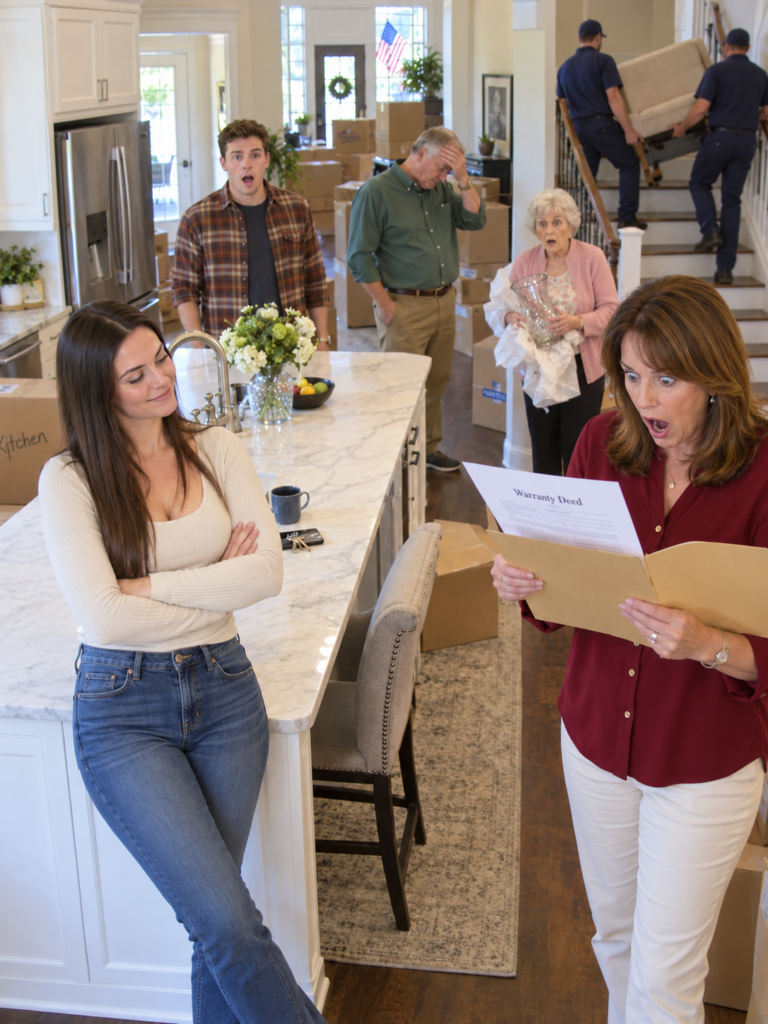
I opened my bag and removed a blue folder.
Vanessa barely noticed.
“Can we please enjoy this for five minutes?” she said.
I slid the folder across the counter.
“Sure. But first, I want you to read something.”
Daniel picked it up.
He looked at the first page.
Then the second.
His expression changed.
“What is this?”
“The recorded deed.”
He stared at me.
I watched the moment understanding reached him.
His mouth opened slightly.
Then he looked toward our father.
“Dad?”
My father closed his eyes.
Vanessa stepped forward.
“What?”
Daniel held out the document.
She snatched it from him.
Her eyes moved rapidly over the page.
Then she stopped.
“Claire Bennett,” she read aloud.
She looked up.
“Why is your name here?”
“Because I bought the house.”
Vanessa gave a strained laugh.
“No. Your parents bought this house.”
“No.”
“They said they were helping Daniel.”
“They were supposed to help Daniel find a rental.”
Silence.
My mother began crying.
Daniel turned toward her.
“Mom, you told us the house was arranged.”
She pressed a tissue to her mouth.
“I said your father was making arrangements.”
Vanessa looked at Dad.
“You told me Claire was investing through the family.”
He stared at the floor.
I felt something cold settle into place.
There it was.
Not confusion.
Not a misunderstanding.
A story they had repeated until it sounded like permission.
I reached for the folder.
“Page three,” I said. “Read the closing statement.”
Vanessa didn’t move.
“Read it.”
Daniel took the paper.
His face drained.
“One million, forty thousand dollars,” he whispered.
The house had been listed at $1.08 million. After inspections and negotiations, I had purchased it for $1.04 million.
I had put down a substantial deposit accumulated over years of savings and proceeds from a previous condominium sale.
The rest was financed through a conventional mortgage.
Every payment was mine.
Every obligation was mine.
Every risk was mine.
Daniel looked at the document again.
“Claire, you actually bought this?”
“Yes.”
Vanessa slammed her palm against the island.
“You should have told us!”
I stared at her.
“Why?”
“Because we wouldn’t have moved everything!”
“Exactly.”
My father raised his voice.
“Enough. We need to discuss a reasonable solution.”
I picked up my phone.
“I agree.”
Then I called my attorney.
Her name was Rebecca Shaw.
She had represented me during the purchase and had spent much of our first meeting warning me about the complications of property ownership.
I hadn’t expected my family to become the first complication.
When she answered, I explained what had happened.
Then I put her on speaker.
Rebecca asked three questions.
Had I signed any lease?
No.
Had I granted anyone permission to occupy the property?
No.
Had anyone provided proof that they had a legal right to live there?
No.
Rebecca was silent for a moment.
Then she said, “Claire, don’t allow anyone to establish an ongoing occupancy arrangement without legal advice. Document everything, and don’t attempt to remove people or belongings by force. I’ll help you determine the proper next steps.”
Vanessa crossed her arms.
“This is ridiculous.”
Rebecca continued.
“I also recommend preserving the moving documents and any messages about how this arrangement was presented.”
My father’s face changed.
I noticed.
So did Rebecca, perhaps from the silence.
“Is there something else I should know?” she asked.
I looked at Dad.
“Apparently, my parents told everyone this house was available.”
Rebecca paused.
“Claire, I think we should meet tomorrow morning.”
I agreed.
After ending the call, Daniel sank into a chair.
Vanessa stared at my mother.
“Where are we supposed to go?”
I looked at the furniture.
The boxes.
The candle.
The photographs.
Then I looked at my father.
“That,” I said, “is the question you should have answered before you brought them here.”
Nobody spoke.
For the first time in my life, my family’s silence wasn’t a sign that I had failed them.
It was a sign that the truth had finally caught up.
But I still didn’t know how much of that truth had been hidden from me.
And the next morning, I would discover something that made the moving truck seem almost harmless.
Part 2
I spent that first night in a hotel fifteen minutes from my own house.
That decision still bothers me when I remember it.
Not because the room was uncomfortable.
It was clean and quiet, with white towels and a view of a parking lot.
What bothered me was the absurdity of paying for a hotel while six people occupied a house whose mortgage would be withdrawn from my account in less than two weeks.
Daniel and Vanessa stayed there with their children, who arrived that evening expecting an ordinary weekend visit with their father.
I hadn’t known Emma and Noah were coming.
When Emma called me at seven, her voice was small.
“Aunt Claire?”
“Hi, sweetheart.”
“Dad says there’s been a misunderstanding.”
I sat on the edge of the hotel bed.
“There has.”
“Is this your house?”
I closed my eyes.
“Yes.”
She was quiet.
Then she said, “I thought so.”
My chest tightened.
“Why?”
“Because Grandma kept telling Dad not to mention it around you.”
I gripped the phone.
“When?”
“Last Sunday. At dinner.”
I remembered that Sunday.
My parents had invited me for roast chicken, but I’d declined because I was reviewing contractor estimates.
My mother had left a voicemail saying I was becoming distant.
I hadn’t returned it.
Emma continued.
“Dad said you were going to be angry. Grandma said you’d calm down once you saw everyone was happy.”
I couldn’t speak.
“Aunt Claire?”
“I’m here.”
“Are you angry at us?”
The question nearly broke me.
“No, Emma. Never at you or Noah.”
She exhaled.
“Okay.”
Then, very quietly, she added, “I don’t think Dad should have done this.”
I looked out at the dark parking lot.
“Neither do I.”
After we hung up, I sat in silence for a long time.
My niece had understood something the adults had chosen to ignore.
That knowledge hurt more than Vanessa’s accusations.
Because it meant they hadn’t simply acted impulsively.
They had discussed my reaction.
Anticipated my anger.
And proceeded anyway.
The following morning, I arrived at Rebecca Shaw’s office carrying the deed, closing statement, copies of my mortgage documents, and a notebook I’d started the previous evening.
Rebecca’s office occupied the second floor of an old brick building near downtown Annapolis.
There were framed maps on the walls and a small pot of lavender on her desk.
She listened without interrupting.
When I finished, she leaned back.
“Have your parents ever had access to your financial accounts?”
“No.”
“Ever held power of attorney?”
“No.”
“Have you signed anything authorizing them to act on your behalf?”
“Absolutely not.”
She made a note.
“Then let’s look at what they actually represented to your brother.”
I showed her the messages I’d received.
There wasn’t much.
My mother had sent a few questions about the neighborhood after learning about the purchase.
Dad had asked whether the property had a carriage house.
Daniel had texted about wanting to visit someday.
None of it explained how everyone ended up moving in.
Rebecca looked up.
“Did your parents attend the closing?”
“No.”
“Did they know the purchase price?”
“Yes. I told them after closing.”
“When did you tell them?”
“Three weeks ago.”
She nodded.
“And when did your brother end his lease?”
“I don’t know.”
“That matters.”
I stared at her.
“Why?”
“Because I’m trying to determine whether this was a spontaneous assumption or something planned.”
I thought about Emma’s call.
Then I remembered something else.
Two weeks before moving day, Dad had asked whether I intended to renovate the detached garage immediately.
He’d seemed unusually interested in whether it had plumbing and electricity.
I’d explained that it would become a small studio eventually, but not until spring.
At the time, I’d assumed he was making conversation.
Now I wasn’t sure.
Rebecca asked whether I had kept copies of my father’s messages.
I had.
She read them.
Then she looked at me carefully.
“Claire, has your father ever handled real estate transactions for the family?”
“He helped my aunt sell her house after my uncle died.”
“Did he manage the paperwork?”
“Most of it.”
She nodded slowly.
“Then he understands how property ownership works.”
I felt embarrassed by how much that simple observation hurt.
My father knew.
Of course he knew.
He understood deeds, titles, signatures, ownership, and liability.
He had not made an innocent mistake.
He had chosen to behave as though my legal rights could be negotiated after the fact.
Rebecca closed the folder.
“I want copies of every communication involving this move.”
“How do I get those?”
“Ask your brother. Ask your parents. We can also preserve what you already have and address any legal requests through the proper process.”
I looked down.
“What about their belongings?”
“We’ll handle this carefully. Their presence doesn’t magically transfer ownership, but occupancy rules can be complicated. I don’t want you taking steps that create additional problems.”
She paused.
“Claire, you’re allowed to be angry.”
I gave a tired laugh.
“Apparently that’s debatable.”
Rebecca’s expression softened.
“Only with people who benefit from you never expressing it.”
I looked away.
I had spent years believing my calmness was a virtue.
It was, in many circumstances.
But somewhere along the way, my family had stopped seeing it as composure.
They saw it as surrender.
At eleven, I drove to my parents’ house.
Dad answered after the second knock.
He looked exhausted.
“Claire.”
“I need to talk.”
He stepped aside.
My mother was sitting in the living room folding laundry.
When she saw me, she put down a towel.
“Sweetheart, we were just discussing what to do.”
“Good,” I said. “Then maybe we can discuss what you’ve already done.”
Dad sighed.
“Do we have to do this now?”
“Yes.”
I sat across from them.
For a moment, all three of us looked like we were attending an awkward family meeting about an unpaid utility bill.
Then I asked the question that had kept me awake.
“When did you decide Daniel could move into my house?”
My mother looked at Dad.
He rubbed his jaw.
“We never decided that officially.”
“Unofficially, then.”
“Claire,” Mom said, “your brother was desperate.”
“He had an apartment.”
“His landlord was raising the rent.”
“How much?”
She hesitated.
“Three hundred dollars a month.”
I stared at her.
“You arranged for him to move into my million-dollar house over a three-hundred-dollar rent increase?”
Dad leaned forward.
“It wasn’t just the rent. Daniel had been struggling with debt.”
“What debt?”
Mom shook her head.
“That’s private.”
I almost laughed.
“His debt is private, but my house is apparently communal?”
Dad struck the arm of his chair.
“Watch your tone.”
I stopped speaking.
The room became still.
Then I realized something.
I was thirty-six years old.
I owned a home.
I managed a department responsible for purchasing millions of dollars’ worth of medical supplies.
And my father still expected me to shrink when he raised his voice.
“No,” I said.
He blinked.
“What?”
“No. I’m not going to watch my tone to make this conversation easier for you.”
My mother’s eyes filled with tears.
“Claire, please.”
I turned toward her.
“Did you tell Daniel I agreed to this?”
She looked at her hands.
“I said you wouldn’t let family suffer.”
“That isn’t what I asked.”
She whispered, “I thought you would help.”
“By giving away my home?”
Dad stood.
“Nobody asked you to give it away.”
“Then what exactly was the arrangement?”
He looked at the window.
I waited.
Finally, he said, “We thought Daniel could stay there temporarily.”
“For how long?”
“Until he got back on his feet.”
“Six months?”
No answer.
“A year?”
My mother’s silence was worse.
I felt something inside me collapse.
“You never intended to put a time limit on it.”
Dad’s expression hardened.
“You’re making assumptions.”
“Then tell me the plan.”
He couldn’t.
Instead, Mom spoke.
“Claire, when your grandfather passed, he wanted this family to look after one another.”
I knew that sentence.
I’d heard it at holidays, graduations, weddings, and every financial crisis Daniel had ever experienced.
Our grandfather, Thomas Bennett, had been a carpenter who lived in the same modest house for forty-eight years.
He believed in hard work and helping people when they needed it.
He had also believed in keeping one’s word.
I wondered what he would have said about this.
“Grandpa never told me to surrender everything I earned,” I said.
Mom looked wounded.
“That’s not fair.”
I leaned forward.
“Neither is arranging to occupy someone’s home without permission.”
Dad crossed his arms.
“Your brother would’ve done the same for you.”
The lie was so effortless that I almost admired it.
When I’d undergone surgery at twenty-nine, Daniel hadn’t visited.
He’d sent a text asking whether I could still help him move a refrigerator the following weekend.
When I’d lost my first job during a hospital merger, he’d suggested I sell my car and lend him the proceeds because he had a business opportunity.
When I’d paid off my student loans, he’d joked that I was finally financially useful.
But he’d never actually helped me with anything substantial.
I looked at Dad.
“Give me one example.”
He frowned.
“Of what?”
“Of Daniel sacrificing something important for me.”
Silence.
My mother began crying.
Dad looked away.
I stood.
“That’s what I thought.”
As I reached the door, Mom called after me.
“We were going to tell you.”
I stopped.
“When?”
She couldn’t answer.
And I realized that the truth might not have been intended to reach me until long after Daniel and Vanessa had settled in.
That afternoon, Daniel called.
I almost ignored him.
Then I remembered Emma and Noah.
I answered.
“Claire, can we meet?”
“Where?”
“Somewhere neutral.”
I suggested a diner off Route 50.
He arrived twenty minutes late.
His hair was damp, his eyes shadowed, and he looked as though he’d slept badly.
He sat across from me without removing his jacket.
“Vanessa’s furious.”
I stirred my coffee.
“That makes two of us.”
He looked down.
“I didn’t know the house was completely yours.”
I studied him.
“What did you think?”
“That Mom and Dad were helping with the purchase.”
“They didn’t contribute a dollar.”
He looked embarrassed.
“Dad made it sound like there was some kind of family arrangement.”
“Why didn’t you ask me?”
Daniel gave a long sigh.
“Because I knew you’d say no.”
There it was.
The answer I’d been waiting for.
Not confusion.
Not a misunderstanding.
He knew I hadn’t agreed.
He simply hoped that if enough people got involved, refusing would become too uncomfortable.
I sat back.
“Then you knew you were doing something wrong.”
He shook his head.
“I thought once we moved in, you’d realize it made sense.”
“For whom?”
“Claire, I’ve got kids.”
“You had kids when you signed your last lease.”
He looked irritated.
“Why do you always make everything sound so simple?”
“Because sometimes it is.”
He leaned forward.
“Vanessa has been under a lot of pressure.”
“What pressure?”
He rubbed his forehead.
“Our credit cards are maxed out. Her online shop hasn’t been doing well. I’ve been covering everything.”
Daniel sold commercial flooring.
He had a decent income, but his commissions varied.
He and Vanessa had always spent money as though every good month would last forever.
A leased SUV.
Designer furniture.
Weekend trips.
Restaurant dinners photographed for social media.
I had assumed they were comfortable.
Now I wasn’t so sure.
“How much do you owe?” I asked.
He shook his head.
“That’s not relevant.”
“It becomes relevant when you use debt to justify taking my house.”
He looked away.
Then he said something that changed the conversation.
“Dad said you’d already promised.”
I stared at him.
“When?”
“Three weeks ago.”
“What exactly did he say?”
Daniel hesitated.
“He said you had agreed that the property should be used for the family’s benefit.”
I felt sick.
“Those were his words?”
“Yes.”
“And you believed him?”
He shrugged helplessly.
“Why wouldn’t I?”
I thought about that.
Then I asked, “Did he show you anything?”
Daniel looked at his hands.
“Some paperwork.”
My coffee cup stopped halfway to my mouth.
“What paperwork?”
“A letter.”
I placed the cup down.
“What letter?”
He swallowed.
“Something with your signature.”
For several seconds, the restaurant sounds seemed to move very far away.
Silverware clinked.
A waitress laughed near the counter.
Someone pushed a chair across the tile floor.
I could hear all of it.
But my attention remained fixed on Daniel.
“My signature?”
He nodded.
I spoke carefully.
“Daniel, I have never signed a letter giving you permission to live in my house.”
His face changed.
“Claire—”
“Show me the letter.”
He looked frightened now.
“I don’t have it.”
“Who does?”
“Dad.”
I sat perfectly still.
Then I took out my phone and called Rebecca.
By Monday morning, Rebecca had sent a formal request that all documents related to the supposed occupancy arrangement be preserved and provided.
My father called seventeen minutes after receiving it.
He was furious.
“How dare you threaten your own family?”
I stood in my office with the door closed.
“Did you show Daniel a letter bearing my signature?”
Silence.
“Dad?”
“I was trying to help.”
“Did you?”
He sighed.
“It wasn’t supposed to become a legal issue.”
My hands began trembling.
“What wasn’t?”
He didn’t answer.
Then he said, “Your mother is devastated.”
I closed my eyes.
For years, that sentence had ended every argument.
Your mother is devastated.
Your mother couldn’t sleep.
Your mother has been crying.
It was always my responsibility to absorb whatever caused those feelings.
Not this time.
“Send the letter to Rebecca,” I said.
“Claire—”
“Today.”
Then I ended the call.
I sat at my desk for a long time.
My assistant knocked once and asked whether I wanted lunch.
I told her I wasn’t hungry.
But hunger wasn’t the problem.
I was beginning to understand that my family had moved beyond assuming I would agree.
They had started creating evidence that I already had.
The letter arrived the following afternoon.
Rebecca called me into her office.
She had placed a single sheet of paper on the conference table.
It was dated September 12.
Three days after I’d told my parents about the purchase.
At the top was my full name and the property address.
The letter stated that I welcomed Daniel Bennett and Vanessa Bennett to occupy the residence as part of an informal family accommodation.
It included language describing their arrangement as open-ended.
At the bottom was a signature.
My signature.
Or something meant to resemble it.
I stared at the paper.
The loops in the C were wrong.
The final stroke of Bennett curved upward instead of down.
But at a quick glance, the signature looked plausible.
Rebecca watched my face.
“Did you sign this?”
“No.”
“Have you ever authorized anyone to sign on your behalf?”
“No.”
She nodded.
“We’ll preserve this and the original if we can obtain it. We should also establish how it was created and whether anyone relied on it.”
I stared at the signature.
My father had once taught me to sign my name when I was ten years old.
He’d sat beside me at the kitchen table and shown me how to make the capital letters clear.
I remembered him smiling when I finally got it right.
Now someone had tried to copy that signature to take control of my home.
I felt tears rising.
Rebecca slid a tissue box toward me.
For a moment, I hated myself for crying.
Then I stopped resisting.
“I would have helped him,” I whispered.
Rebecca said nothing.
“I would have helped Daniel find a rental. I might even have paid the deposit. I could have covered moving expenses.”
I wiped my face.
“But they didn’t ask.”
“No,” she said.
“They decided I wasn’t allowed to choose.”
Rebecca looked at the paper.
“That seems to be the heart of it.”
I stared at my name.
My father had not merely lied about what I wanted.
He had tried to turn my silence into a written agreement.
I felt something harden inside me.
Not hatred.
Certainty.
I would never again let these people speak for me.
On Wednesday, Rebecca arranged for us to review the moving company’s documents.
Luis had been cooperative.
He remembered me because he said he’d never seen someone help unload furniture into a house while looking so upset.
His company had a digital work order.
Vanessa had booked the move.
The pickup address matched Daniel’s former apartment.
The delivery address was mine.
Under the question asking whether the customer owned or rented the destination property, Vanessa had selected OWNER.
The account notes included a sentence that made Rebecca pause.
Father of occupant confirms daughter approved transfer of residence for family use.
I read it twice.
“Transfer?” I whispered.
Rebecca frowned.
“That’s an odd choice of words.”
She requested the company’s booking communications.
We also obtained copies of messages Daniel voluntarily forwarded.
Some were ordinary.
Moving times.
Truck availability.
Furniture measurements.
Others were not.
In one message, Vanessa wrote:
Are we absolutely sure Claire can’t change her mind after we’re in?
My father replied:
She’ll complain at first, but she won’t throw family out. Once the children settle, she’ll accept it.
I stared at that sentence.
It was like discovering a hidden map of every family argument I’d ever lost.
They knew exactly what they were doing.
They knew I’d be upset.
They knew I would hesitate to hurt the children.
And they had built their entire plan around that hesitation.
There was another message.
This one from my mother.
Please don’t tell Claire until everything is ready. She gets anxious when decisions are made too early.
I read it again.
Then again.
Anxious.
That was what she’d called my right to make decisions about my own property.
Rebecca sat quietly beside me.
Finally, I asked, “Can I have copies?”
“Of course.”
I placed the messages in my folder.
I no longer needed to imagine their intentions.
They had written them down.
The following weekend, I returned to the house with Rebecca and a property manager she had recommended.
Daniel and Vanessa were still there under a short written temporary arrangement prepared after the initial confrontation, while we worked through the proper procedure for ending their occupancy.
The agreement stated clearly that it did not create ownership rights or promise an extension.
It also required them to preserve the property and cooperate with removal arrangements.
I had agreed to a brief period partly because of Emma and Noah.
And partly because Rebecca had warned that a careless lockout could create legal complications.
By then, I was tired enough to appreciate careful advice.
When we arrived, Vanessa opened the door.
She looked different.
Her hair was messy.
She wore an old sweatshirt.
Her face was pale.
“What do you want now?”
“I need to inspect the property.”
She stepped aside reluctantly.
The house smelled of stale coffee and takeout food.
Boxes crowded the hallway.
A large television had been mounted above the fireplace.
My stomach tightened.
“I never authorized that.”
Vanessa shrugged.
“We needed somewhere to put it.”
Rebecca took photographs.
We found scratches on the floors.
A cracked cabinet hinge.
Two holes in the wall beside the staircase.
None of it was catastrophic.
But every mark felt like evidence of the same assumption.
That I would absorb whatever they caused.
Upstairs, I discovered something worse.
My bedroom closet was filled with Vanessa’s clothes.
On the dresser stood a silver-framed photograph of her and Daniel.
The room I’d spent months imagining was no longer recognizable.
I touched the closet door.
Vanessa stood behind me.
“You’re acting like we destroyed the place.”
I turned.
“Why did you move into my bedroom?”
She looked incredulous.
“Because it’s the primary bedroom.”
“That isn’t an answer.”
She crossed her arms.
“Claire, I don’t know what you want me to say.”
“Try the truth.”
Her face tightened.
“The truth is that you’re making all of us miserable over a house you barely need.”
I looked at her.
“And you need it?”
“We’re married. We have children.”
“You have a family. That doesn’t make my property yours.”
Her eyes flashed.
“You think you’re so much better than everyone because you have money.”
I felt an unexpected sadness.
“I don’t think that.”
“Yes, you do. You drive around acting humble, but you’re just waiting for everyone to see how successful you are.”
I looked around the room.
The clothes.
The perfume bottles.
The bedspread I hadn’t chosen.
“Vanessa, I didn’t tell anybody about my savings because I didn’t want this.”
She stared at me.
“For years, every time I accomplished something, you turned it into a reason I should pay for something else. I kept my plans private because I wanted one thing that belonged to me.”
Her mouth tightened.
“Then maybe you shouldn’t have bought such a big house.”
I laughed.
Not because it was funny.
Because she still didn’t understand.
There was no amount of explanation that could make her accept that my life didn’t require her approval.
I walked past her.
As I reached the staircase, I heard her mutter something.
At first, I thought I’d misunderstood.
Then she said it louder.
“Your father promised us we’d never have to leave.”
I stopped.
Rebecca looked up from the foyer.
“What did you say?”
Vanessa froze.
Daniel appeared from the hallway.
“Vanessa, don’t.”
She turned on him.
“Why should I keep pretending?”
I slowly descended the stairs.
“What did Dad promise?”
Nobody answered.
Then Vanessa looked at Daniel.
“Tell her.”
Daniel closed his eyes.
And in that silence, I realized the fake letter might not have been the worst thing my father had done.
Daniel eventually spoke.
“Dad said he’d help us stay permanently.”
I felt my heartbeat in my throat.
“How?”
Daniel looked ashamed.
“He said he could convince you to add us to the deed.”
I stared at him.
“He wanted me to give you ownership?”
“He said it would protect the family.”
Rebecca stepped forward.
“Did he prepare any documents?”
Daniel nodded.
“Some drafts.”
I turned toward him.
“Where are they?”
He hesitated.
“Dad’s study.”
I remembered that room.
The dark wooden desk.
The filing cabinets.
The framed insurance certificates.
The family photograph above the bookshelf.
My father had always kept important documents there.
He had taught me never to sign anything I hadn’t read.
And now he had apparently been preparing paperwork to persuade me to surrender an ownership interest in the most valuable asset I’d ever purchased.
I felt physically ill.
Rebecca spoke calmly.
“Daniel, I need you to understand something. You should not destroy, alter, or conceal any documents related to this matter.”
He nodded.
Vanessa looked at her husband with sudden fury.
“You said your parents could handle this!”
He rounded on her.
“I believed Dad!”
“You believed what you wanted to believe,” I said.
Both of them fell silent.
That was the first time Daniel looked genuinely ashamed.
But shame wasn’t enough.
Not anymore.
I took out my phone.
“I want both of you to stop using the house address for anything that suggests you own this property. No new furniture. No alterations. No promises to anyone.”
Vanessa opened her mouth.
Rebecca said, “Those requirements are already in the temporary agreement.”
Vanessa closed it.
I looked at Daniel.
“And I want every message Dad sent you.”
He nodded.
For a brief moment, I almost felt sorry for him.
Then I remembered the fake signature.
The bedroom.
The moving truck.
The months of planning.
I left before I could change my mind.
The most painful conversation happened two evenings later.
Not with Daniel.
Not with Vanessa.
With my mother.
She came to my office after work and waited near my car.
She wore the navy cardigan I’d bought her for Mother’s Day.
Her eyes were swollen.
“Claire, can we talk?”
I stood beside the driver’s door.
“About what?”
“Your father.”
I said nothing.
She took a shaky breath.
“He never meant for things to go this far.”
I stared at her.
“Did you know about the letter?”
She looked down.
That was my answer.
“Mom?”
“I knew he was preparing something.”
“Did you know he put my signature on it?”
Her lips trembled.
“I told him it was a bad idea.”
I felt as though the ground had shifted.
“You knew.”
She began crying.
“He thought you would sign eventually. He said it was only to keep Daniel from worrying.”
I looked at her.
“And you let him show it to Daniel?”
She pressed her hands together.
“Claire, your father has always taken charge of family problems.”
“By lying?”
She winced.
“He was trying to keep everyone together.”
I shook my head.
“No. He was trying to keep Daniel comfortable.”
“That’s unfair.”
I opened my car door.
“Mom, when I was twenty-seven, I asked if I could stay in your guest room for three months after my apartment flooded.”
She frowned.
“I remember.”
“You said I needed to learn independence.”
“You were an adult.”
“Yes. I was.”
I looked at her steadily.
“Daniel is forty.”
She looked away.
I continued.
“When I needed help, you called it character building. When Daniel needs help, you call it family responsibility.”
She began crying harder.
I felt the familiar instinct to comfort her.
To apologize.
To tell her everything would be fine.
The habit was almost physical.
Then I remembered the message she’d sent Vanessa.
Don’t tell Claire until everything is ready.
I placed my hand on the car door.
“Did you ever intend to tell me before they moved in?”
Her silence lasted too long.
Finally, she whispered, “We hoped you’d see how happy they were.”
I closed my eyes.
There it was.
The truth.
They hadn’t wanted my permission.
They had wanted my surrender.
I got into the car.
My mother leaned toward the window.
“Claire, please don’t destroy your father over this.”
I looked at her.
“He did this himself.”
Then I drove away.
And for the first time in my life, I didn’t turn around to see whether she was crying.
The final complication arrived on Friday morning.
Rebecca called while I was reviewing a supplier contract.
“Claire, I need you to come in.”
Something in her voice made me sit up.
“What’s wrong?”
“Your father has retained an attorney.”
I stared at the wall.
“What?”
“His attorney contacted me regarding the property dispute.”
I felt my stomach drop.
Rebecca continued.
“They’ve suggested that there may have been an understanding involving shared family funds.”
I almost laughed.
“That’s impossible.”
“I know what your closing records show. But I want to review any financial transfers between you and your parents.”
I opened my laptop.
My parents had given me birthday gifts over the years.
Christmas checks.
A few hundred dollars on occasion.
Nothing remotely connected to the purchase.
Then I remembered something.
Eight months earlier, my father had transferred ten thousand dollars to me.
I had immediately returned it.
He’d claimed he was testing a new banking process because he was worried about an account issue.
I’d thought it strange at the time.
Now my hands went cold.
“Rebecca?”
“Yes?”
“Dad sent me ten thousand dollars last winter.”
She paused.
“What happened to it?”
“I sent it back the same day.”
“Do you have the records?”
“Yes.”
“Send them.”
I did.
An hour later, she called again.
“Claire, the records clearly show you returned the funds.”
I exhaled.
“But?”
“Your father appears to be relying on the original transfer to support his version of events.”
I stared at the phone.
He hadn’t merely tried to take possession of my house.
He was trying to create a financial story in which I owed him something.
And the thought that haunted me wasn’t whether he would succeed.
Rebecca was confident the records contradicted his claim.
It was the realization that my own father had been building a case against me while smiling across the dinner table.
That evening, I sat alone in my hotel room and cried until I could barely breathe.
I wasn’t crying over the house.
I was crying over the father I thought I had.
The man who had taught me how to ride a bicycle.
The man who had held my hand at the hospital when I broke my wrist.
The man who had told me to work hard because nobody owed me anything.
Apparently, he’d meant nobody owed me anything.
By midnight, I had made a decision.
I would no longer negotiate my right to my own life.
And when the family gathered the following week to settle the matter, I would make sure every fact was placed on the table.
Part 3
The meeting took place in a conference room at Rebecca’s office the following Thursday.
It wasn’t a courtroom.
There was no judge.
No audience.
No dramatic entrance.
Just a polished table, a pitcher of water, several legal folders, and the people who had spent years assuming my future was theirs to arrange.
My father arrived first with his attorney, a gray-haired man named Peter Collins.
Mom followed.
Daniel and Vanessa came five minutes later.
Vanessa wore a tailored navy dress and carried a leather handbag.
She looked prepared to argue.
Daniel looked like a man attending his own sentencing.
I sat beside Rebecca.
For the first time, I wasn’t nervous about saying no.
I was nervous about what saying no might finally end.
Peter began politely.
“My clients acknowledge that the property is legally titled in Ms. Bennett’s name.”
Vanessa shifted in her chair.
My father stared straight ahead.
Peter continued.
“However, there appears to have been a series of informal family discussions that led Daniel and Vanessa to believe they had permission to occupy the residence.”
Rebecca nodded.
“We understand that’s their position.”
Peter glanced at Dad.
“There may also have been some confusion concerning financial contributions.”
Rebecca opened a folder.
“I think we can resolve that quickly.”
She placed the closing statement on the table.
Then my mortgage documents.
Then the bank records showing my down payment.
Then the record of my father’s ten-thousand-dollar transfer.
And the matching record showing I returned it less than two hours later.
Peter studied the documents.
My father didn’t move.
Rebecca spoke carefully.
“There was no financial contribution from Mr. or Mrs. Bennett toward this purchase. The funds in question were returned before the property was acquired.”
Peter turned toward my father.
“Harold, were you aware these records existed?”
Dad cleared his throat.
“I knew the money had been returned.”
Peter’s expression changed slightly.
He looked back at Rebecca.
“Understood.”
There was no dramatic accusation.
No raised voice.
But I saw the moment my father realized his own attorney hadn’t been given the full truth.
Rebecca placed another document on the table.
The letter.
My forged signature sat at the bottom.
My father stared at it.
My mother started twisting her ring.
Rebecca looked toward Peter.
“Ms. Bennett denies signing or authorizing this document. We have preserved the copy provided and requested the original. We also have messages indicating that Mr. Bennett knew his daughter had not agreed to the arrangement.”
Peter read the letter slowly.
Then he looked at my father.
“Harold, who prepared this?”
Dad said nothing.
“Harold?”
My father’s face reddened.
“I drafted it.”
Peter waited.
“And the signature?”
My father looked at me.
For a second, I thought he might finally apologize.
Instead, he said, “Claire was always going to help.”
I felt something inside me break.
Not loudly.
Not suddenly.
Like a thin thread pulled too far.
Rebecca spoke.
“That’s not authorization.”
Dad slammed his hand against the table.
“She would’ve helped if we’d asked!”
The room went still.
I looked at him.
“Yes,” I said.
Everyone turned toward me.
“I probably would have.”
My father’s anger faltered.
I continued.
“If you’d told me Daniel was struggling, I would have helped him search for a rental. I might have helped with a deposit or temporary expenses. I would have talked about what I could afford.”
Daniel looked down.
“But you didn’t want help,” I said. “You wanted control.”
My mother began crying.
Dad’s voice softened.
“Claire, I was trying to protect your brother.”
“From what?”
He didn’t answer.
“From his debts? From his decisions? From having to live within his means?”
Daniel shifted in his chair.
I turned toward him.
“I’m not saying you’ve had an easy year. I’m saying your difficulties don’t erase my rights.”
His eyes filled.
“I know.”
Vanessa shook her head.
“This is getting nowhere.”
Everyone looked at her.
She leaned forward.
“Fine. Claire owns the house. Nobody is arguing that now. But throwing us out accomplishes what, exactly? We have nowhere permanent to go.”
I looked at her.
“Have you applied for rentals?”
She folded her arms.
“Of course.”
“How many?”
She glanced at Daniel.
He answered quietly.
“Three.”
“And?”
“One rejected us because of our credit. One was too expensive. We haven’t heard from the third.”
I nodded.
“What about a smaller apartment?”
Vanessa’s face tightened.
“We need enough room for the children.”
Daniel spoke softly.
“We can make a two-bedroom work for now.”
Vanessa whipped toward him.
“Excuse me?”
He didn’t look at her.
“I said we can make it work.”
It was the first time I’d heard him contradict her without immediately retreating.
Vanessa stared at him.
Then she turned back to me.
“You’ve humiliated us.”
I shook my head.
“I didn’t tell your friends this was your house.”
Her mouth opened.
I continued.
“I didn’t post photographs claiming ownership. I didn’t invite your family to celebrate. I didn’t sign a moving contract for a property I didn’t own.”
Her face reddened.
“And I didn’t make promises using someone else’s name.”
My father looked down.
Rebecca slid a proposed resolution across the table.
It required Daniel and Vanessa to remove their belongings by an agreed date under a legally appropriate written arrangement.
It addressed property damage and the cost of restoring unauthorized alterations.
It required everyone to stop claiming I had promised occupancy or ownership.
And it established that any future requests or disputes involving the house would go through counsel.
Peter reviewed it.
Then he asked for a short private conversation with his clients.
We stepped outside.
I stood by the window overlooking the street.
Rebecca joined me.
“How are you holding up?”
I watched a woman across the road help an elderly man into a car.
“I thought I’d feel better.”
She nodded.
“Sometimes ending a harmful arrangement feels like grief before it feels like relief.”
I looked at her.
“Do you think I’m being cruel?”
“No.”
She paused.
“But I don’t think cruelty is what worries you.”
“What do you mean?”
“I think you’re afraid that once you stop meeting their expectations, they won’t know how to love you.”
I stared at the street.
I hadn’t realized how precisely that fear could be described.
After a moment, I whispered, “Maybe they never did.”
Rebecca didn’t try to reassure me.
She simply stood beside me.
And somehow that kindness was easier to accept than another promise that everything would work out.
The agreement was signed that afternoon after revisions and legal review.
Daniel agreed to remove his belongings.
Vanessa signed reluctantly.
My parents acknowledged they had no authority to grant occupancy or transfer ownership.
The parties also addressed the disputed letter and related claims without pretending the signature had been authorized.
I reserved my right to take further action if additional evidence or damage required it.
I didn’t demand a public confession.
I didn’t need one.
I needed my home.
I needed the lies to stop.
And I needed them to understand that I was no longer willing to negotiate my boundaries through guilt.
When everyone stood to leave, my father approached me.
He looked older than he had three weeks earlier.
“Claire.”
I turned.
He swallowed.
“I made a mistake.”
I waited.
“I thought I was doing what was best for the family.”
I looked at him for a long time.
Then I said, “You didn’t think about what was best for me.”
He lowered his head.
“No.”
It was a small word.
The first honest one I’d heard from him in weeks.
I wanted it to fix everything.
It didn’t.
But I acknowledged it.
“Thank you for saying that.”
He looked hopeful.
“Maybe we can put this behind us.”
I shook my head.
“Not yet.”
His face fell.
I continued.
“An apology is a beginning. It isn’t a way to skip the consequences.”
He nodded slowly.
For once, he didn’t argue.
Daniel and Vanessa moved out eight days later.
This time, there was no celebration.
No cheering relatives.
No champagne.
No photographs for social media.
A smaller moving truck pulled into my driveway just after eight in the morning.
Luis wasn’t part of the crew this time.
The new movers worked efficiently while Rebecca’s recommended property manager checked rooms and documented the condition.
I stayed mostly in the kitchen.
I had promised myself I wouldn’t become emotional.
That promise lasted until I saw Emma carrying a small box downstairs.
She was wearing a gray hoodie and holding a framed photograph against her chest.
“Aunt Claire?”
I turned.
“Hi, sweetheart.”
She looked around.
“Dad says we’re moving into an apartment next week.”
“That’s what I heard.”
She nodded.
Then she approached me.
“I’m sorry about all this.”
I felt my throat tighten.
“Emma, you have absolutely nothing to apologize for.”
She looked down.
“Grandma said you were making things hard for everyone.”
I closed my eyes briefly.
Then I crouched slightly so we were looking directly at each other.
“Sometimes adults disagree about what’s fair,” I said. “But none of this is because of you.”
She nodded.
I continued.
“Your dad and I have things to work out. That doesn’t change how much I love you and Noah.”
Her eyes filled.
“Can we still come visit?”
The question hurt.
Because part of me wanted to say yes immediately.
To promise holidays and weekends and everything that had existed before.
But I had learned that promises made to comfort someone could become obligations nobody had agreed to thoughtfully.
So I answered carefully.
“I hope so. We’ll work out a way that keeps things comfortable for everyone.”
She hugged me.
I held her for a long moment.
Then I watched her carry the box toward the truck.
That was when I understood something my parents never had.
Protecting children didn’t require protecting adults from the consequences of their choices.
It required giving children honesty, stability, and love without making them responsible for the conflict.
By noon, most of the furniture was gone.
Vanessa came downstairs carrying her handbag.
She had removed the temporary curtains.
The walls looked bare.
She stopped beside the island.
For a moment, neither of us spoke.
Then she said, “I really thought this was going to be our home.”
I looked at her.
“I know.”
Her eyes narrowed.
“Do you enjoy knowing that?”
“No.”
She looked away.
“I was embarrassed when people found out.”
I waited.
She ran a hand through her hair.
“I told my sister. My friends. Everyone.”
“You told them something you hadn’t verified.”
She sighed.
“I know that now.”
I didn’t respond.
Then, quietly, she said, “Your father made it sound certain.”
I looked at her.
“You wanted it to be certain.”
She nodded reluctantly.
“Maybe.”
That single word was more acknowledgment than I’d ever expected from her.
She glanced toward the empty living room.
“Daniel and I have been fighting.”
I said nothing.
“He thinks we need to stop spending so much.”
“That sounds worth discussing.”
She gave a tired laugh.
“He says we should sell the SUV.”
I looked at her.
“Will you?”
She shrugged.
“Maybe we have to.”
For the first time, I saw something other than entitlement in her expression.
Fear.
Not fear of me.
Fear of the life she might actually have to live.
I could understand that fear without taking responsibility for solving it.
Vanessa picked up her bag.
“I guess this is goodbye.”
I nodded.
“For now.”
She looked as though she wanted to say something else.
Then she walked out.
I watched her go.
No triumphant music played.
No dramatic final insult followed her.
Just the sound of the front door closing.
And the strange relief of hearing it close behind someone who no longer had permission to stay.
My father arrived shortly before the movers finished.
He carried a toolbox.
“I thought I’d help patch the holes,” he said.
I looked at him.
“Dad, the repairs are being handled professionally.”
He nodded.
“I know. I just wanted to do something.”
That sentence almost undid me.
Because for most of my life, I had desperately wanted him to do something for me.
Not financially.
Not grandly.
Just something that showed he saw me as a person with needs, rather than a resource waiting to be assigned.
I stepped onto the porch.
“Can we talk?”
He put down the toolbox.
We sat on the steps.
The afternoon sun warmed the brick beneath us.
For a while, neither of us spoke.
Then he said, “Your grandfather would’ve been ashamed of me.”
I looked at him.
“What makes you say that?”
He stared at his hands.
“He used to tell me that taking something from family doesn’t become right just because they’re family.”
I remembered that.
Grandpa Thomas had believed kindness mattered most when nobody was keeping score.
But he’d also believed promises meant something.
Dad sighed.
“I was afraid Daniel was going to lose everything.”
“So you tried to give him something that wasn’t yours.”
He nodded.
“I told myself you’d understand eventually.”
I looked toward the yard.
“Did you ever consider asking me?”
He was quiet.
Then he said, “I thought you’d say no.”
I turned toward him.
“Then you knew I hadn’t agreed.”
His eyes filled.
“Yes.”
The admission hung between us.
He wiped his face.
“I’ve always worried more about Daniel because he makes such a mess of things. You were different. You seemed capable of handling anything.”
I felt tears rising.
“Dad, being capable doesn’t mean I don’t need anyone.”
He looked at me.
“I know.”
“No,” I whispered. “I don’t think you did.”
He lowered his head.
I continued.
“I spent years trying to make you proud. I thought if I worked hard enough, saved enough, made the right decisions, eventually you’d see me.”
His shoulders trembled.
“I am proud of you.”
“Then why did every achievement become another reason I should give something away?”
He had no answer.
I looked toward the house.
“I didn’t buy this place to punish Daniel. I bought it because I wanted somewhere peaceful. Somewhere I could stop being the family emergency fund.”
Dad nodded.
“I understand.”
I wanted to believe him.
But understanding spoken in one afternoon couldn’t erase decades of behavior.
So I said something I’d never said before.
“I need distance from you and Mom.”
His face crumpled.
“How much?”
“I don’t know.”
He looked at the toolbox beside him.
Then he nodded.
“All right.”
We sat together for another minute.
When he stood, he reached toward me.
For a second, I considered hugging him.
Then I stepped back.
Not because I hated him.
Because I wasn’t ready.
He seemed to understand.
He picked up the toolbox and walked to his car.
I watched him drive away.
And for once, I didn’t chase someone else down to make sure they were comfortable with my decision.
The house was officially empty again at three-seventeen that afternoon.
I know the exact time because I looked at my watch when the last truck pulled away.
The driveway was clear.
The porch was quiet.
The front door stood open.
I walked through each room slowly.
The living room had scuff marks near the fireplace.
The dining room floor needed refinishing.
The upstairs walls required patching.
A cabinet hinge had been damaged.
But those were practical problems.
Problems I knew how to solve.
I had spent my career solving practical problems.
What I hadn’t known how to solve was the feeling that my family valued my usefulness more than my happiness.
I stood in the primary bedroom.
For the first time, it was empty.
No Vanessa.
No king-size bed.
No perfume bottles.
No framed wedding photograph.
Just sunlight falling across the floorboards.
I opened the closet.
The shelves were bare.
I laughed.
Then I cried.
I sat on the floor with my back against the wall and cried until the afternoon light began to fade.
I cried for the child who’d learned to be easy.
For the young woman who’d paid her own way through college while watching her brother receive help without explanation.
For the adult who’d mistaken silence for harmony.
And for the house I’d nearly lost before I’d even spent one night inside.
When I finally stood, I wiped my face and went downstairs.
I turned off the lights.
Locked the back door.
And stayed.
The following weeks were quieter than I expected.
The repairs took time, but the contractors were professional.
The hardwood floors were restored.
The damaged walls were patched and painted.
I replaced the cabinet hardware.
I hired a locksmith to change the locks.
I updated the alarm system and installed exterior cameras.
I didn’t do those things because I expected my family to return.
I did them because ownership had become something I wanted to experience without fear.
I also changed my address with the bank, updated my insurance information, and organized every property document in a secure file.
Rebecca advised me on the remaining reimbursement issues.
Some were resolved through the written agreement.
Others required additional discussion.
I let her handle them.
My days were full enough without turning every evening into another family argument.
Daniel and Vanessa eventually rented a modest two-bedroom apartment outside Annapolis.
Their monthly expenses were lower.
Daniel sold the leased SUV early, accepting the financial consequences of ending the contract.
Vanessa found part-time administrative work.
Her online shop continued, but she stopped treating it as a guaranteed source of income.
I heard these details through Emma, who sometimes called just to talk.
I never asked her to carry messages.
That mattered to me.
Children shouldn’t be used as bridges between adults who refuse to repair their own relationships.
My parents stopped calling every day.
At first, the silence felt unnatural.
Then it began to feel peaceful.
My mother sent one email asking whether I would attend Thanksgiving.
I declined.
She wrote back that the holiday wouldn’t be the same without me.
I didn’t respond.
For once, I allowed that to be true without making it my responsibility.
In early December, Daniel called.
I considered ignoring him.
Then I answered.
“Hi, Claire.”
“Hi.”
He sounded nervous.
“I wanted to tell you something.”
I waited.
“I spoke to the kids.”
My stomach tightened.
“About what?”
“About the house. About what happened.”
I sat down.
“And?”
“I told them I was wrong.”
I closed my eyes.
He continued.
“I told Emma I should’ve asked you before making plans. And I told Noah that Grandma and Grandpa weren’t the people who owned the house.”
I felt my throat tighten.
“Thank you.”
He was quiet.
Then he said, “I owe you an apology.”
I looked toward the window.
Snow was beginning to collect along the porch railing.
“I know.”
He gave a sad laugh.
“Yeah. I guess you do.”
For a moment, neither of us spoke.
Then he said, “I’ve been thinking about how things were when we were kids.”
I waited.
“Whenever I messed up, Dad fixed it. Whenever you did something well, everyone assumed you’d keep doing well.”
I closed my eyes.
He continued.
“I think I got used to that.”
I stared at the snow.
“I think you did, too.”
He sighed.
“I was jealous of you.”
That surprised me.
“Why?”
“Because you always seemed to have your life together.”
I almost laughed.
“Daniel, I worked for it.”
“I know.”
“No, I don’t think you did.”
He was quiet.
I continued.
“I had setbacks. I had problems. I had nights when I was afraid I couldn’t pay my bills. I just didn’t ask Mom and Dad to solve everything.”
He exhaled.
“I know that now.”
I didn’t know whether he truly did.
But something in his voice sounded different.
Less defensive.
Less certain that everyone else owed him comfort.
He cleared his throat.
“I don’t expect things to go back to normal.”
“Good.”
He laughed softly.
“That’s fair.”
Then he said, “I hope someday you’ll come see our new place.”
I looked toward the kitchen.
My kitchen.
The one I’d finally furnished with my own things.
“Maybe someday.”
I meant it.
Not as a promise.
As a possibility.
And that was enough.
Christmas came quietly.
I decorated the house with white lights and a wreath made from pine branches.
I placed a small tree in the living room.
I unpacked my favorite ornaments, including a chipped wooden star Grandpa Thomas had made when I was little.
It was crooked.
One point was shorter than the others.
He’d carved it from a scrap of oak and written my name on the back.
I hung it near the top.
On Christmas Eve, Emma and Noah visited for two hours.
Their mother drove them over and stayed for coffee.
She’d never been involved in the dispute and was careful not to speak badly of Daniel in front of the children.
I appreciated that.
We baked cookies.
Played cards.
Watched an old holiday movie.
Noah asked whether the carriage house would become a game room.
I laughed.
“Probably not. I’m thinking about renovating it into a studio.”
Emma smiled.
“For you?”
“Maybe for a renter someday.”
She nodded thoughtfully.
Then she looked around the living room.
“This place feels different now.”
I watched the fire flicker in the fireplace.
“How?”
She considered the question.
“Quiet.”
I smiled.
“That’s what I was hoping for.”
After they left, I stood by the front window and watched their car disappear down the street.
I felt something warm and unexpected.
Hope.
Not hope that the past would somehow become harmless.
Not hope that everyone would finally agree I had been right.
Hope that I could build relationships without surrendering myself to keep them.
That was new.
And it was enough.
Three months after moving day, my father sent a handwritten letter.
I almost threw it away.
Then I recognized his careful block handwriting.
I sat at the kitchen table and opened it.
He didn’t ask for money.
He didn’t ask me to help Daniel.
He didn’t explain why his intentions had supposedly been good.
He wrote that he had spent years confusing my independence with a lack of need.
He admitted he had lied.
He admitted he had signed my name without permission.
And he acknowledged that he’d tried to solve Daniel’s problems by making decisions about something that belonged to me.
Near the end, he wrote one sentence that made me stop.
I thought being a good father meant rescuing the child who was falling. I forgot that the child standing on her own feet still deserved someone standing beside her.
I read that sentence three times.
Then I folded the letter.
I didn’t call him immediately.
I didn’t rush to forgive him.
I placed the letter in my desk drawer and allowed myself to consider what rebuilding trust might actually require.
Not guilt.
Not holiday pressure.
Not pretending nothing had happened.
Consistent honesty.
Respect for boundaries.
Time.
I still loved my father.
That was the difficult part.
Love hadn’t disappeared simply because trust had been damaged.
But I’d finally learned that loving someone didn’t require giving them unlimited access to my life.
A few days later, I wrote back.
I thanked him for acknowledging what he’d done.
I told him I wasn’t ready for regular visits.
But I said that if he wanted to rebuild our relationship, we could start with occasional phone calls.
He replied with two words.
I understand.
For the first time, I hoped he actually did.
By spring, the house had become everything I’d imagined.
Not perfect.
Better than perfect.
Mine.
I painted the kitchen a soft cream.
I replaced the living room rug.
I planted lavender beside the front steps and herbs in raised beds behind the garage.
I bought a comfortable reading chair and placed it beside the window overlooking the backyard.
On weekends, I drank coffee on the porch and watched boats move through the distant harbor.
Sometimes neighbors stopped to talk.
Sometimes I invited friends over for dinner.
Sometimes I did absolutely nothing.
And that last part felt almost revolutionary.
Nobody called to tell me what I should do with my extra bedrooms.
Nobody asked why I needed such a large kitchen.
Nobody treated my peace as a resource that should be redistributed.
The house was simply a house.
A place to wake up.
Cook meals.
Read books.
Listen to rain.
Make plans.
Change my mind.
Close the door.
And open it only when I wanted to.
One afternoon, I found the blue folder from the closing on the shelf in my office.
The folder that had exposed everything.
The deed was inside, along with the original purchase documents and copies of the records Rebecca had advised me to keep.
I took out the first page.
My full name stood beneath the property address.
Claire Elizabeth Bennett.
Sole owner.
I ran my thumb along the edge of the paper.
For years, I’d thought freedom would arrive when my family finally understood me.
When my mother stopped comparing me to Daniel.
When my father acknowledged my accomplishments.
When my brother began treating me as an equal.
When Vanessa stopped measuring my worth by what I could provide.
But standing there, I realized I’d been waiting for the wrong thing.
Freedom hadn’t arrived when they changed.
It arrived when I stopped letting their expectations decide what I was allowed to keep.
I returned the deed to its folder.
Then I walked downstairs.
The afternoon sunlight stretched across the restored hardwood floors.
The kitchen smelled faintly of fresh coffee.
Outside, a breeze moved through the lavender beside the porch.
I opened the front door and stepped into the sunlight.
There was no moving truck in the driveway.
No furniture waiting to be carried.
No family gathering to explain why someone else deserved what I’d worked for.
Just my home.
My name on the deed.
And a quiet life I no longer needed anyone’s permission to live.
For the first time, I understood that the most important thing I’d purchased wasn’t the house.
It was the space to become someone my family had never allowed me to be.
Myself.


