
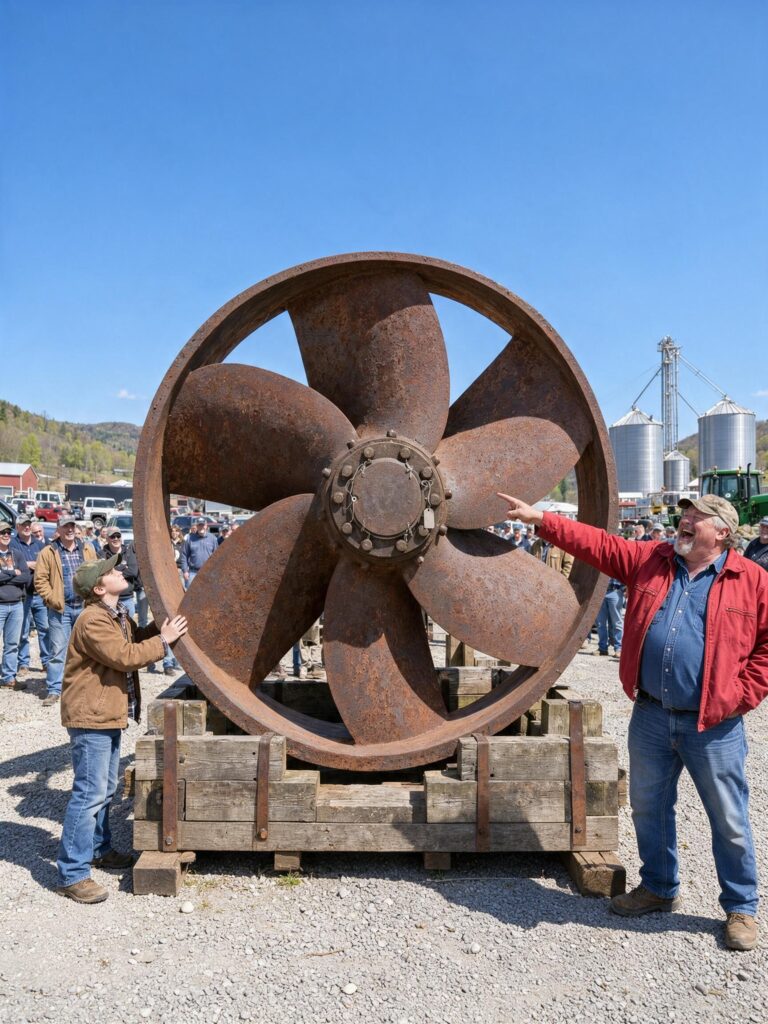
the whole town laughed when a boy paid forty-five dollars for eight tons of sealed iron — and a mine on the other side of the world paid a hundred and twenty-four thousand to take it home
Part 1
Gary Stoler laughed so hard he had to brace a hand on his knee. When a man that size laughs, the whole auction yard laughs along. “Forty-five dollars,” he hollered, pointing up at the rusted iron wheel in its cradle of timbers. “Forty-five dollars for eight tons of nothing. Son, you just bought the biggest pinwheel in Pennsylvania.”
The boy he was laughing at was twelve years old, one hand flat on a blade taller than his grandfather. His name was Milo Rusnak, and fifteen minutes earlier nobody in Kettle Run had paid him any mind.
The county was selling off the last yard of the old Kettle Run Coal and Coke Company that April morning, a weedy acre of gravel locked up since before Milo was born. Lyall Bours, who had called every farm sale in three townships, was turning it into money one lot at a time. The morning was bright and cold enough that breath showed. Folding tables held pie and coffee. Men in barn coats walked the rows with numbered cards, and the smell of the yard was rust, wet gravel, and the sweet burn of somebody’s cigar.
At the far corner stood a wheel of rust-brown cast iron in a cradle of railroad ties, fourteen feet across, six broad curved blades fanning out from a hub the size of a bathtub.
“Lot number seventy-three,” Lyall said into his microphone. “Mine ventilation fan rotor only. Eight tons. Buyer removes it in five days at buyer’s expense. Who will start me at five hundred?”
Nobody moved. Lyall tried three hundred, then one. A woman near the pie table said it looked like a ship’s propeller that had lost the ocean. A man said it would take a crane and a prayer.
“You’re wasting your breath, Lyall,” Gary Stoler called from the front row. “That thing’s going on my truck either way.”
Gary owned Stoler Iron and Metal out on the state road, and he held the county contract for clearing whatever didn’t sell. If lot seventy-three went unsold, he’d haul it off free and melt it down. A man doesn’t bid on a thing he’s about to get for nothing. He stood with his red canvas work jacket hanging open, fifty-eight years old, gray goatee, a voice like a tractor horn. People in Kettle Run didn’t much like Gary, but they listened to him because Gary had money and Gary had opinions, and he gave the second away free.
That was when Milo raised his hand. He had forty-five dollars in his jeans. Grass money and can money, every cent of it his.
“Forty-five,” he said.
Lyall peered over the crowd as if he’d heard a bird talk. “Son, you understand that’s eight tons?”
“Yes, sir.”
Gary was grinning. He didn’t bid. He was enjoying himself too much already. The gavel came down on the plywood podium. Sold to the young man in the green cap for forty-five dollars. And that was when Gary Stoler started laughing, and the whole crowd went right along with him.
Gary came across the gravel with the jacket flapping. “Tell you what,” he said, loud enough for the pie table to hear. “Sign that over to me and I’ll haul it Friday. No charge. You’re out forty-five, but you learned something. That’s cheap tuition.”
Somebody behind him said, “Take the deal, kid.”
Milo didn’t answer. He was looking at the hub. Right in the middle of the wheel sat a heavy iron bearing cap bolted down with twelve big bolts. Through every bolt head ran a twist of thin wire, and each wire ended in a little crimped seal of soft gray metal, no bigger than a shirt button. From the last seal hung a tin tag stamped by hand, letter by letter.
Spare. Luzon. Keep sealed. Do not run.
“What’s Luzon?” Milo asked.
“It’s where your money goes when you lose your mind,” Gary said, and the yard laughed again.
Milo’s grandfather got there about then. Walt Rusnak was seventy-four, white mustache, a navy work coat, a gray wool cap, and thirty-one years underground before the Kettle Run mines closed. He walked all the way around the wheel without a word, then bent close to the hub and studied the seals for a long time.
“Who put those on, Pap?” Milo asked quietly.
“Somebody who meant it.” Pap touched the tag with one thick finger. “My old shift boss used to say it. Nobody wires a seal on junk.”
“Ah, come on, Walt.” Gary’s nephew Travis was already pulling a breaker bar out of a truck bed. “Pop that cap and let’s settle it. Ten minutes with a wrench. If them bearings aren’t rusted solid, I’ll eat my hat.”
“No,” Milo said. He wasn’t loud. He was just clear. “It says keep sealed. So I’m keeping it sealed.”
Gary threw both hands up at the crowd. “There you go. He bought a mystery and he won’t even look at it. Folks, that’s the smartest money spent in Kettle Run all year.”
The laughter that came after that was the worst part. Some of it was just people being people on a Saturday. Some of it was the kind that says you have already been decided about, and nothing you do will change the verdict. Milo kept his palm on the cold iron and said nothing more. He would not open it there. Not with forty people watching and a breaker bar on the tailgate.
That evening Pap called Frank Sedlak, who had run a rigging crew for the strip mines for forty years and still kept a boom truck and a lowboy behind his house. Frank said he’d do it for diesel and a pie. Milo’s mother, Renata, came home from her night shift at the nursing home the next morning to find her son asleep at the kitchen table with a library book about mine ventilation under his cheek. The house on Second Street smelled like coffee and the wool of Pap’s coat drying by the stove. Renata was a narrow woman with tired eyes and hands that smelled faintly of the lotion the home used on the residents. She worked nights so somebody would be home when Milo got off the bus.
Pap told her the whole thing over coffee.
“Forty-five dollars,” she said finally. She looked at Milo, who had woken up and was trying very hard to look like he hadn’t. “Why’d you do it, honey?”
“Because somebody sealed it up and wrote a place on it. And nobody at that auction even asked what the place was.”
Renata was quiet for a while. Then she reached over and straightened his cap. “Then I guess we’d better find out.”
On Wednesday Frank’s boom truck backed into the coal-company yard, and half of Kettle Run found a reason to drive slowly past the fence. Frank rigged the wheel with heavy nylon slings while Milo stood well back behind the yellow tape beside Pap, wearing a hard hat that came down over his eyebrows. The winch groaned. Eight tons of rusted iron rose off the railroad ties as gently as a church bell being hung. Frank set it on the flatbed, ran four steel bands over the blades, checked every one twice, and the whole parade crawled out onto the state road at fifteen miles an hour.
They had to pass Stoler Iron and Metal on the way. Gary was out front by his scale house in that red jacket, and when he saw the flatbed coming he leaned on his horn and held it there while his yardmen clapped slow and loud.
“When you’re ready to sell it by the pound, kid,” he yelled, “you know where I am.”
Frank set the fan down in the side yard of Pap’s house on Second Street, on a crib of fresh timbers, and tied a blue tarp over the hub to keep the rain off the seals. The wheel stood taller than the porch roof. It blocked the morning sun from the kitchen window. The neighbors came out on their steps to look at it the way people look at a car that has gone through somebody’s fence.
By Friday the whole town had a name for it. Milo’s pinwheel. Gary had seen to that. He’d posted a photo from the auction on the Kettle Run community page: Milo standing small beside the great rusted wheel, captioned, twelve-year-old pays forty-five dollars for eight tons of scrap, refuses to look inside, kids today. Two hundred people laughed at it. Renata read the comments once at the end of a long shift, then put her phone face down on the table and left it there until morning.
At school it was worse because it was out loud. A boy named Braden spun his finger in the air whenever Milo walked into the cafeteria. Somebody taped a paper pinwheel to his locker. In gym class the teacher said, “Let’s see if you can run as fast as your fan, Rusnak,” and the whole class laughed, and the teacher laughed too, as if it were all harmless.
Milo didn’t fight about it. He did something that looked a lot stranger to the other kids. He went to the library.
Part 2
The librarian at Kettle Run Middle School was Mrs. Adaeze Okafor, who wore red-framed glasses and mustard cardigans and had a habit of answering a question with three better ones. When Milo asked her where Luzon was, she didn’t laugh. She opened a world atlas on the table between them.
“There,” she said, her finger on a long, ragged island in the western Pacific. “Luzon. The biggest island in the Philippines. And up here, in these mountains, the Cordillera. Gold country for a very long time. Why do you ask?”
Milo told her about the tag. Mrs. Okafor folded her hands. “A coal company in Pennsylvania kept a spare fan with a Philippine island stamped on it,” she said slowly. “That is a very specific thing to write on a piece of tin. What else is on it?”
So the next morning before school, while Pap kept an eye on him from the porch, Milo scrubbed the grime off the hub around the cap with a stiff brush and a bucket of soapy water, careful never to touch the seals. The iron was cold. The soap ran rust-colored down the blades and into the grass. And there, cast right into the iron in raised letters, was a name. Harwick Fanworks, Wilkes-Barre, Pennsylvania. Pattern 440.
Mrs. Okafor called the county historical society, and by the following Tuesday a volunteer had found a water-stained trade catalog from the Harwick Fanworks, printed when Pap’s own father was a boy. Near the back was a photograph of a great six-bladed wheel exactly like the one in Pap’s side yard, with a dozen men in shirtsleeves lined up in front of it. Under it, in small print, the catalog said that pattern 440 had been built for the Kettle Run Coal and Coke Company and its sister property, the Santa Ines gold mine in the mountains of Benguet, on the island of Luzon. Two rotors had been cast. One had crossed the Pacific on a freighter to the top of the Santa Ines air shaft. The other had been kept back as a spare.
“It’s the twin,” Milo whispered.
“It’s the twin,” Mrs. Okafor said. “Now let’s see if the first one is still turning.”
It wasn’t. In the great earthquake that shook northern Luzon in 1990, the original rotor had cracked across its hub and been cut up for scrap. The stone fan house had survived, standing over the old shaft like a chimney with nothing to pull. And then Mrs. Okafor found an article from a Manila newspaper only a few months old. A cooperative of small-scale miners, some two hundred and sixty families, had won permission from the Philippine government to reopen the Santa Ines mine and work it safely. But the old fan house had been declared a heritage structure, and the permit required its original fan to be restored to working order. A modern fan would not fit the historic casing. Tearing the casing out was forbidden, and the Harwick patterns had burned with the factory long ago. The cooperative’s chief engineer, a woman named Marisol Bautista, said they had searched the world for nine years for a rotor cast from pattern 440, and that without one, nobody could go back underground.
Milo read that last sentence three times. He thought about two hundred and sixty families standing at a stone house with nothing in it to pull the bad air out. He thought about Pap’s hands, the way the knuckles stayed swollen from thirty-one years of a different mountain. He thought about a tin tag that said do not run, and about Gary Stoler’s breaker bar on a tailgate.
That night, at the kitchen table, with his mother reading over his shoulder and Pap pretending not to listen from his recliner, Milo wrote his first email to anyone outside Kettle Run. He said who he was and how old he was, because his mother said that was only fair. He said he’d bought a fan at an auction for forty-five dollars with a tin tag that said spare, Luzon, keep sealed, do not run, and the words pattern 440 cast in the hub. He attached four photographs. Then he added one more line because it seemed important. Nobody has opened it. I won’t let them.
The answer came at three in the morning, which was three in the afternoon in the mountains of Luzon. Renata saw it first on her break at the nursing home, and she called the house so early that Pap answered thinking somebody had died.
Dear Milo. Please do not open it. Do not let anyone open it. Can we talk by video tomorrow? Marisol Bautista.
They talked the next evening. Milo and his mother and Pap crowded around Renata’s laptop at the kitchen table. The radiator knocked. Outside, the blue tarp over the hub moved a little in the wind. Engineer Bautista was a small, straight-backed woman in her forties with her black hair pinned in a low bun and a white hard hat on the desk beside her. Behind her, through an office window, green mountains rose so steep they looked folded.
“Milo,” she said, smiling. “Do you know how many people told me I was chasing a rumor?”
“About as many as told me I bought junk.”
She laughed, a real laugh, and something in Milo’s chest unknotted for the first time in two weeks. Then she explained. When a spare rotor was set aside in those days, the fan man at the mine would pack its bearings in heavy grease, bolt the cap down, and wire and seal every bolt. As long as the seals were whole, anyone could know for certain that the bearings had never been run, never been opened, never let in a drop of water.
“Our lender in Manila will release money for a sealed spare,” she said. “They will not release money for a question mark. If someone had opened that cap at your auction, Milo, even for one minute just to look, we would have a rusty wheel and a story. Because you didn’t, we may have a mine.”
“What happens next, ma’am?” Pap asked.
“The bank requires an independent appraisal. A certified machinery appraiser, in person, with witnesses, before any money moves. I will fly there myself with the original drawings. If the numbers match and the seals are whole, the cooperative will pay whatever the appraiser says it is worth. The money is our government’s restoration grant, and the rules are strict. Not one peso more. Not one peso less.”
When the call ended, nobody said anything for a long time. The laptop fan whirred. Out in the yard the wheel stood black against the streetlight. Then Pap got up, poured himself two fingers of something he usually saved for Christmas, said, “Nobody wires a seal on junk,” and drank it.
News travels faster than the truth in a small town, and the truth tends to show up late and out of breath. Within a week everybody knew somebody from overseas had called the Rusnak boy about the pinwheel. Nobody knew the details, which made it worse. At the diner the counter man started a running joke. Still sealed, Walt? Still worth a million? And Pap would say, still sealed, and eat his eggs.
Gary Stoler came by on a Tuesday. He parked half on the curb in front of Pap’s house and walked up the side yard in his red jacket like he owned the place. The motion light Frank had rigged on the garage snapped on and threw his shadow across the blades.
“Heard you got yourself a pen pal,” he said. “I’ll make you an honest offer. Three hundred cash today. That’s six times what you paid, son.”
“No, thank you,” Milo said from the porch steps.
“Five hundred.”
“No, thank you.”
Gary’s smile thinned. “Let me explain something, because nobody else will. Whoever’s on the other end of that phone is going to take one look at a rotten wheel and go home. Then you’ll have eight tons of iron in your granddad’s yard and no way to move it, and I’ll be the only man in this county who’ll take it. My price won’t be five hundred then. It’ll be thirty.”
“Then I guess I’ll call you,” Milo said.
Gary laughed, short and ugly. At his truck he turned around. “Them seals ain’t going to last forever, kid. Things happen to junk left out in a yard.”
Pap came down the steps then, slow, the way old miners move, and stood at the pickup’s open window.
“Gary,” he said quietly. “If anything happens to that wheel, I’ll know where to look. And so will every man who ever worked underground with me.”
Gary drove off. But from that night on, Pap sat on the porch with his coffee until the streetlights came on, and the motion light lit the side yard like a ball field whenever a cat walked past. Milo checked the seals every morning before school. He’d lift the corner of the blue tarp, count the twelve wires with his eyes, and lay the tarp back down. After one three-day rain he found water pooled in the tarp right over the cap, and with Pap holding the stepladder steady he bailed it out with a coffee can, one careful scoop at a time. He never once touched a bolt.
At school Braden still spun his finger, but it had less company. A few kids had started asking what Luzon was. Milo told them it was an island. He did not tell them about the two hundred and sixty families. That part was not a cafeteria story yet. It was a kitchen-table story, and he meant to keep it there until somebody who knew iron could stand in the yard and say whether the seals had done their work.
Part 3
The appraiser the bank chose was Dale Havstick out of Harrisburg, a senior accredited appraiser of machinery and equipment with thirty-four years of valuing industrial iron behind him. He called the house in early June with very practical questions. Was the ground level? Was the wheel braced? Had anyone touched the seals?
“No, sir,” Milo said. “Nobody.”
“Keep it that way. I want witnesses. People who can say afterward what they saw with their own eyes. Who do you have?”
Milo had thought about that a great deal. In the cafeteria, and in gym class, and every time Pap came home from the diner with the joke still on him.
“Everybody who laughed,” he said.
So that’s who they invited. Mrs. Okafor printed the invitations plain and polite. Saturday the fourteenth of June, ten in the morning, the side yard on Second Street. An independent appraisal of lot seventy-three. Folding chairs provided. Pap borrowed the chairs from the hall at St. Casimir’s. Milo delivered the invitations himself on his bicycle: to Lyall Bours at the auction barn, to the gym teacher, who read it twice and turned a little pink, and to Braden’s mother at the gas station. The last one he walked right up to the scale-house window at Stoler Iron and Metal.
Gary read it with his glasses pushed down his nose, then laughed so loud that two of his yardmen came around the corner to see what was funny.
“You want me at your little ceremony?”
“Yes, sir. You were there when I bought it.”
Gary looked at him for a long moment. Then he tucked the card into the pocket of his red jacket. “Oh, I’ll be there. I’ll bring my thirty dollars.”
The week before the fourteenth, Milo did not sleep well. He checked the tarp twice a night. Renata, coming in from the nursing home at dawn, would find him on the porch in his jacket with a flashlight, counting wires. She did not tell him to stop. She brought him a blanket and sat with him until the streetlights went out, and then she sent him to bed because a boy who had kept a seal whole for two months was not going to lose it to being too tired to see straight.
Pap oiled the stepladder hinges so they wouldn’t squeak. Frank came by and looked at the crib of timbers and said the ground would hold a man and a cap both. Mrs. Okafor brought a box of paper envelopes and a pencil and did not explain them. She said a record was a kindness you did for the future, and that somebody in ninety years might want to know the wires had been whole when they were cut.
The fourteenth of June came up bright and blue, the whole valley smelling of cut grass. By nine there were thirty-eight folding chairs in Pap’s side yard, set in crooked rows, facing the great rusted wheel, and nearly every one was full. Lyall Bours came in his straw hat. Frank Sedlak parked his boom truck at the curb just in case. Mrs. Okafor brought a notebook. Father Wojcik sat at the end of the second row. The gym teacher stood at the back, which Milo thought was about right. Braden came with his mother and did not spin his finger in the air. Neighbors who had looked at the wheel the way they looked at a car through a fence now looked at it the way people look at a thing that might have a name.
Engineer Marisol Bautista arrived at a quarter to ten after thirty hours of travel, still in her navy field jacket, a long cardboard tube under one arm and her white hard hat under the other. When she saw the wheel rising above the porch roof, she stopped on the sidewalk and didn’t move for a while. Then she walked over and shook Milo’s hand like he was the president of something.
“You kept it shut,” she said.
“Yes, ma’am.”
“That is the whole of the work, some days.”
Dale Havstick came last. A silver-haired man in a tweed sport coat and wire-rimmed glasses, with a clipboard, a camera, and a canvas tool bag. He asked everyone to stay in their seats, and he began. He photographed the wheel from every side. He measured the blades and the hub. He read the cast letters aloud, and Engineer Bautista unrolled the old drawings across a card table and read the same words back from the paper, and the folding chairs went very quiet. Pattern 440. Six blades. The bore. The pitch. The numbers on the paper and the numbers in the iron were the same numbers, spoken twice, once by a man from Harrisburg and once by a woman who had flown across an ocean to hear them.
At ten after ten a pickup pulled up behind the boom truck, and Gary Stoler got out in his red jacket. He didn’t take a seat. He stood at the back by the garage with his arms folded, and when a couple of the diner men glanced around at him, he grinned and lifted his chin at the fan as if to say, here comes the good part.
Dale climbed the stepladder beside the hub and examined the seals one at a time with a magnifying glass. The yard could hear the ladder creak and the small sound of the glass against the wire. Then he turned to face the chairs.
“For the record,” he said, “every seal on this bearing cap is intact. None of these wires has been cut, retwisted, or replaced. In my professional opinion, this cap has not been opened since the day those seals were crimped.” He looked down at Milo. “Young man, it’s your fan. I’ll need your permission to cut them.”
Milo looked at Pap. Pap nodded.
“Go ahead, sir,” Milo said.
The first snip of the side cutters was loud in that quiet yard. Then the second. Then all twelve. Each cut seal went into a paper envelope that Mrs. Okafor held open. Frank handed up a breaker bar, and the first bolt cracked loose and turned, and so did the rest. They had been greased before they went in by someone who knew a stranger would need them to turn one day. Frank and Dale lifted the heavy cap away together and set it on the grass.
Nobody in the folding chairs breathed.
Under the cap, the bearing was packed solid in old grease the color of butter, still soft, with a sheet of oiled paper laid across the top. Dale lifted a corner of the paper. Beneath it, the steel rollers and races were bright. Not dull. Not pitted. Bright as the day they were ground, throwing the June sun back at thirty-eight people who had come, most of them, to see rust.
Engineer Bautista put her hand over her mouth. On the underside of the oiled paper, in faded pencil, someone had written a line. Auggie Petroski, fan man. Packed for the Santa Ines, in case she ever needs it.
“She needs it,” the engineer said softly.
Pap made a sound in his throat that was not quite a word. He had known men like Auggie. Men who packed a thing right and wrote their name on it and did not stay to see whether the mountain ever called. He took his cap off and held it in both hands, which he did not do for weather.
Dale spent another forty minutes checking the bore of the hub against the drawings, the pitch of every blade, the numbers stamped on the races. The sun moved. Somebody’s chair creaked. Gary Stoler did not move from the garage. He was staring at the bright steel under the open cap the way a man stares at a number he had decided, in April, was zero.
Then Dale climbed down, cleaned his glasses on his tie, and put them back on.
“I’ll read this the way I’ll write it,” he said, and every chair in the yard leaned forward. “This is an original Harwick rotor, cast from pattern 440, matching in every measured dimension the drawings for the Santa Ines fan house in Benguet. Its bearings are unrun and preserved under unbroken seals. No other rotor from this pattern is known to exist. Considering that a replacement cast from new patterns would cost well over three hundred thousand dollars and take two years, I appraise the fair market value of this rotor, as it stands, at one hundred and twenty-four thousand dollars.”
For a second nobody made a sound. Then Lyall Bours, who had sold ten thousand lots and never once been surprised by a number, said, “Well, I’ll be.”
Part 4
Engineer Bautista stood and held up a folded letter. “On behalf of the Santa Ines Miners Cooperative, and with the restoration grant of the Republic of the Philippines, we offer Milo Rusnak the appraised value, one hundred and twenty-four thousand dollars, for this fan, to reopen our mine.” She turned to him. “If you will sell it to us.”
Milo looked at his mother. Renata had both hands pressed to her cheeks and her eyes were full. Pap was nodding and couldn’t seem to stop. The yard smelled of cut grass and old grease and the coffee somebody had brought in a thermos and forgotten to pour. Milo thought about the tag, and about Auggie’s pencil, and about a stone house on a mountain that had been breathing wrong for thirty years.
“Yes, ma’am,” he said. “It was always yours. I just kept it shut.”
The yard came apart. People were on their feet. Father Wojcik was clapping with his hands over his head. Mrs. Okafor was crying into her notebook. Frank Sedlak picked Milo up off the ground, all twelve years of him, and set him back down again. Braden’s mother put a hand on her son’s shoulder, and Braden looked at the grass. The gym teacher, at the back, took his cap off and did not put it on again.
And at the back of the yard by the garage, Gary Stoler stood with his arms folded against his red jacket, his mouth hanging open, and said nothing at all. He was staring at the bright steel under the cap. Then slowly, people began to turn around and look at him. Nobody planned it. They just turned, one after another, the diner men and the neighbors and Lyall Bours in his straw hat, and looked at the big man in the red jacket who had laughed at the county sale until he had to hold his knee.
Gary’s face went white as the paper in Mrs. Okafor’s envelope.
It was Lyall who finally spoke. He didn’t raise his voice. He’d been an auctioneer too long to need to.
“Gary,” he said. “At my sale, you told forty people that wheel was eight tons of nothing. Want to tell them again?”
Gary opened his mouth. Closed it. Then he walked back to his pickup and drove off down Second Street slower than anybody had ever seen him drive anything. The motion light on the garage snapped on as he passed and snapped off again. Nobody clapped for that. They didn’t have to. The quiet he left behind did the work the laughter had done in April, only it faced the other direction.
Renata sat down on the porch steps because her knees had decided they were done. Pap brought her a glass of water and stood beside her with his cap still in his hands. Engineer Bautista knelt by the open cap and read Auggie’s line again, out loud this time, so the chairs could hear the name of the man who had packed the grease. Auggie Petroski. Fan man. In case she ever needs it. A woman in the second row, whose father had worked the Kettle Run tipple, said she remembered an Auggie, a Pole from the east end who could true a pulley by eye. Pap said that would be him. He did not say more. Some men you honor by not turning them into a story before the iron is home.
Dale Havstick wrote the figure on his clipboard and had Milo, Renata, and the engineer sign beneath the description of the seals. Mrs. Okafor numbered the twelve envelopes. Frank put the cap back on loosely, not sealed, because the seals had done their job and the next hands to touch the bolts would be the hands that set the wheel into a casing on the other side of the world. They tarped the hub again. The chairs came down. The pie somebody had brought got eaten standing up, because nobody wanted to go inside and miss the wheel while it was still in the yard.
That night Milo sat at the kitchen table with the tin tag in his hand and did not feel like a boy who had won. He felt like a boy who had not ruined a thing a dead man had packed for a mine he would never see. Renata, across from him, said the money would go in an account with both their names on it until he was old enough to argue with her about college. Pap, in the recliner, said nothing for a long time. Then he said the shift boss had been right, and that was enough.
The money arrived nine days later in a single wire from Manila, and Renata read the figure four times before she would sign anything. She called the nursing home and asked for two days off, which she had not done in three years. The supervisor said take them. News had reached the night shift. One of the residents, a woman who had kept house for a mine superintendent in the fifties, asked Renata to tell the boy that air was the first thing you owed a man who went underground, and the last thing you checked before you let him.
This time when Frank’s crew loaded the fan onto the lowboy, half the town came out on purpose. People lined Second Street with their phones up. Kids from Milo’s school sat on the curb, and a few of them waved at him, which he noticed. The wheel rolled toward the port at Baltimore at fifteen miles an hour, right past Stoler Iron and Metal, where nobody honked this time, and the scale-house blinds were down. Gary was not in the yard. Travis was. He watched the flatbed go by and did not clap. He had been the one with the breaker bar in April. He put his hands in his pockets and went back to the shear.
It crossed the Pacific in the hold of a cargo ship, the same ocean its twin had crossed nearly a hundred years before, and went north from Manila into the mountains on a flatbed that crawled up switchbacks so steep the driver took them in pieces. Engineer Bautista sent photographs from the road: the wheel lashed under a canvas, the green ridges folding up behind it, men in hard hats walking alongside on the worst bends because a load that size did not get hurried on a mountain.
On a morning in late September, in the stone fan house at the top of the old Santa Ines shaft, a crew of miners in white hard hats lowered it into the iron casing it had been made for, and it fit. The bolts Auggie had greased turned for them the way they had turned for Dale. The cap went back on. The drawings matched the iron one last time, in the place the iron had been cast to stand.
Part 5
Engineer Bautista sent the video that night. Milo watched it at the kitchen table with his mother, Pap, and Mrs. Okafor. The laptop was the same one they had crowded around in May. Somebody threw a switch. The great wheel shuddered and creaked and began to turn, slowly, then faster, until the six blades blurred into one gray circle, and a long sigh of air rose out of the fan house, as if the mountain were breathing out for the first time in thirty years.
Then the camera swung to the mouth of the mine, where a line of men and women in hard hats and headlamps stood waiting. And one by one, with the fresh air pulling past them, they walked back inside to work.
At the very end the miners held up a hand-painted bed sheet. Salamat, Milo. Thank you.
Pap had to go out on the porch for a minute after that. Renata let him. She knew the sound a man makes when a thing he spent his life doing gets done right by somebody else’s mountain, and she knew it was not a sound you followed. When he came back in he poured coffee he did not drink and sat in the recliner with his cap on his knee. Mrs. Okafor closed her notebook. Milo rewound the video to the moment the air sighed out of the stone house, and he watched it twice, because he wanted to be sure he had heard what he thought he had heard. A mountain exhaling. A line of people walking in.
That fall the county commissioners took up the scrap-clearing contract at their regular public meeting. Lyall Bours spoke, and so did Frank, and so did a few people who had let Gary haul things away over the years and now wondered what exactly they had let go. A woman from the historical society brought the Harwick catalog and set it on the rail. The commissioners voted unanimously to end the arrangement and put every unsold lot back up for public bid. Gary sat in the back row in his red jacket, staring at the floor, and did not speak. The contract had been easy money and a chance to be the man who knew what junk was. Both of those things had a hole in them now, the size of a bearing cap and a pencil line from a fan man named Auggie.
Milo put most of the money away for college, because his mother insisted and because he wanted to study engineering now. He put a new roof on Pap’s house. The old one had been leaking over the north bedroom since the winter Pap’s wife died, and Pap had been catching it in a dishpan and saying it could wait. It could not wait. The new shingles went on in October, and Pap stood in the yard with his arms folded and said it was more roof than an old miner needed, and then he went inside and did not put the dishpan back.
He bought his mother a car that started in the winter. The old one had a habit of dying in the nursing-home lot at six in the morning, and Renata had a habit of not mentioning it. The new one turned over on the first try. She argued about the price and lost, the way she had argued about the roof and lost, and then she drove it to work and came home with the heater on and her hands warm, which was the argument Milo had been making without saying it.
He gave the school library a new shelf of history books on the condition that it be labeled, in Mrs. Okafor’s handwriting, things nobody bothered to ask about. She wrote the label herself, in the same hand she used on overdue slips, and she put the Harwick catalog photocopy on the end of the shelf where a boy looking for an island might find a fan.
He kept only one thing. Before the fan left Second Street, Engineer Bautista had handed him the paper envelope with the twelve cut seals inside it, and the little tin tag.
“These belong to the one who kept them,” she said.
The tag hangs on a nail above Milo’s desk now. Spare. Luzon. Keep sealed. Do not run. When people ask what it means, he tells them about Auggie Petroski, the fan man, who packed a set of bearings for a mine on the other side of the world, just in case, and about a whole yard full of people who laughed at a thing because nobody bothered to read it. And when they ask how he knew, he just smiles and tells them what his grandfather said on that gravel lot.
Nobody wires a seal on junk.
On a Saturday in November, after the first hard frost, Pap and Milo walked the empty crib of timbers in the side yard where the wheel had stood. The grass under it was pale. The motion light still worked. Down on the state road, Stoler Iron and Metal was open, and the scale house blinds were up again, and Gary was buying iron the way he always had, only quieter, and without the county’s unsold lots coming to him for nothing. Pap looked at the pale rectangle in the grass and said the yard was big enough now for a garden if anybody wanted one. Milo said maybe in the spring. They went in for supper. The tag stayed on its nail. Somewhere in the Cordillera, a stone house pulled air, and two hundred and sixty families had a shift to work, because a boy in a green cap had refused to let a stranger pop a cap for the entertainment of a Saturday crowd. The mountain did not know his name. The bed sheet had. That was enough.


