
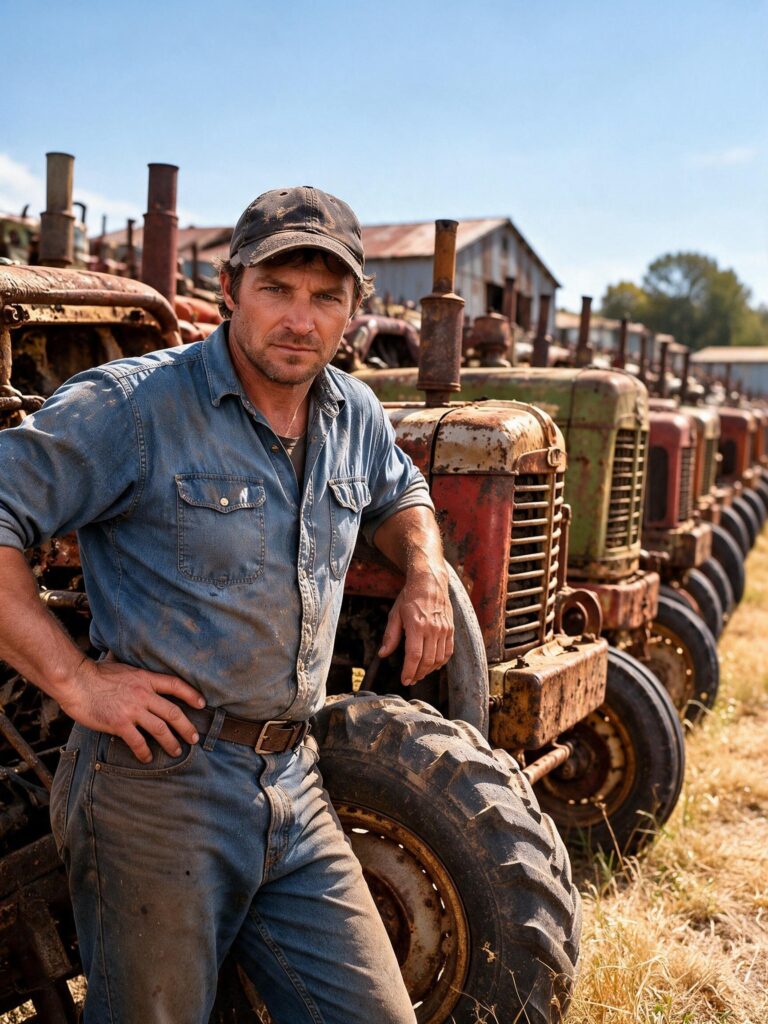
the bank smiled when it sold a drowning kansas farmer forty-seven rusted tractors for twenty-five hundred dollars and nine years later came begging to buy them back
Part 1
The bank manager was smiling. That was what Cal Hendricks remembered most. Not the wind cutting across the lot. Not the smell of old diesel and wet rust. The smile. Douglas Puitt stood in a weed-choked yard behind a shuttered equipment dealership on a gray October afternoon, hands in the pockets of a coat that had never met a grease gun, and smiled the way a man smiles when a problem is about to leave his books.
Forty-seven tractors sat around them in crooked rows, sinking into the grass. Paint faded to chalk. Tires flat and cracked. Seats split open, foam spilling out like stuffing from an old couch. One had a young sumac growing straight through its front axle, the trunk already thicker than a man’s wrist. A faded sign on the dealership door still said HOLLIS IMPLEMENT, and under it, in smaller letters nobody had bothered to scrape off, PARTS AND SERVICE.
“Twenty-five hundred,” Puitt said. “For all forty-seven. Honestly, Mr. Hendricks, you’d be doing us a favor.”
Cal had a late-payment notice folded in his shirt pocket. Puitt knew it. Everyone at Prairie Union Bank knew it. The paper had been there three weeks, soft at the creases from being taken out and put back. To the bank, this was a problem being solved. Forty-seven worthless machines gone from the ledger for less than the price of a used pickup. To Cal, it was something else. Something he was not ready to say out loud, because saying it would make it a plan, and a plan could fail in front of his wife.
He shook the man’s hand. The grip was dry and brief. Nine years from now that same bank would come looking for those tractors. It would not be smiling.
Cal was forty-one. He farmed a hundred and sixty acres in north-central Kansas. Wheat and soybeans, and a small herd of cattle that had been smaller every year since his father died. The land had belonged to his great-grandfather, then his grandfather, then his father. When his father died two years earlier, the land came to Cal. So did the debt. Hospital bills from a long last winter. A second mortgage taken out to cover them, signed at the kitchen table while his father slept in the front room and the oxygen machine kept its small relentless time. By that autumn the balance stood at one hundred and eighty-six thousand dollars, and Cal had missed two payments.
If he failed, he would not just lose money. He would be the man who lost the farm after four generations. The thought sat in him like a stone he had swallowed and could not bring back up.
His wife, Marne, taught fifth grade in town and kept the family books at the kitchen table after the dishes were done. She never raised her voice about the numbers. She laid them out night after night and let them speak. Mortgage. Hospital. Feed. Fuel. The property-tax account, which she would not touch even when the checking account went thin. She had a way of setting a pencil down parallel to the paper that meant she had already done the math and was waiting to see if he would do it too.
Cal was not a natural talker. He was a fixer. As a teenager he had spent summers in his uncle’s repair shop two counties over, learning how machines fail and why. A bearing tells you it is dying if you put your hand on the housing. A seal weeps before it gives. Oil that looks like chocolate milk has already decided the ending. Neighbors still brought him broken equipment before they would call a dealer. He did the work in the evenings, under a shop light that buzzed, and he did not charge enough, and Marne did not say so more than once a year.
Which brought them to the tractors.
Hollis Implement had been a family dealership. When it went bankrupt, Prairie Union Bank, the dealership’s lender, took everything pledged as collateral. That included forty-seven tractors. A mix of trade-ins, repossessions, and unsold stock, mostly from the late sixties through the seventies. Marlos, almost all of them. The same three-cylinder diesel his father had run until the transmission housing cracked and the world informed Cal that some iron could not be replaced by wishing.
To Douglas Puitt, the math was simple. The lot cost six hundred dollars a month to lease. Insurance was a headache. The machines had sat outside for years. An auctioneer had told him the trucking would cost more than the hammer price. Buyers wanted running equipment, and almost none of these ran. The bank’s board wanted the lot cleared before year-end. Puitt was not a villain. He believed selling them cheap was the smartest move on the table. On paper, he was right.
Cal said yes because of a number he had never forgotten.
Three years earlier his own tractor, an old Marlo three-cylinder, the same workhorse his father had used, cracked its transmission housing in the middle of planting. He assumed a replacement would take a week. It took four months. Marlo had been swallowed in a merger in 1979. The foundry that cast the housings had closed. No aftermarket company had ever bothered to copy the part. He finally found one through a stranger in Ohio and paid eleven hundred dollars for a piece of iron the size of a breadbox. He remembered standing in the shop with the housing on the bench, turning it in his hands, thinking that eleven hundred dollars was a cruel price for a thing the factory had once cast by the thousand and then decided to forget.
Two weeks before Puitt’s offer, Cal drove past the Hollis lot on his way back from the co-op. He noticed the tractors were Marlos. Dozens of them. He pulled over. He walked the rows with his hands in his pockets, checking cast numbers on bell housings, and a question started forming that he did not yet have the courage to call a plan. If one housing cost eleven hundred dollars, what was sitting in this field?
He did not know. That was the honest truth. He had a hunch, not a balance sheet.
That night he told Marne at the kitchen table. The late-payment notice was between them, unfolded for once. The wind moved the loose screen on the back door. She looked at the savings account, the one meant for property taxes, and then at him.
“Twenty-five hundred,” she said.
“Plus fuel to haul them. I figured six, seven hundred if I borrow Dale’s flatbed and don’t rush it.”
She was quiet a moment. The pencil stayed parallel to the paper. “What’s the worst that happens? We lose it.”
“Then we’d better not lose it.”
She nodded once. It was not enthusiasm. It was permission, which in their house was a harder thing to give and worth more.
The bank gave him sixty days to move everything. Cal borrowed the flatbed, burned six hundred and forty dollars in fuel, and hauled the machines two at a time to his back pasture. Mornings before chores. Evenings after. The diesel in the flatbed knocked on the hills. He chained the tractors down himself because he did not trust a hurry. Total cost so far, three thousand one hundred and forty dollars. Every dollar of it had come out of the tax account Marne had protected, and she had written the withdrawal in the book without comment and then closed the book.
His neighbors watched the convoy roll past. One of them, Harlan Briggs, leaned on a fence post with his cap pushed back and called out, “Planning a museum, Cal?”
Cal just waved. His hands were black to the wrists. The sumac tractor came on the last load, the little tree still growing through the axle because he had not had the heart, or the saw, to cut it on the bank’s lot. He set it at the far end of the pasture where the grass was longest. That night he stood at the kitchen window and looked at the dark shapes in the field. Forty-seven machines. A hundred and sixty acres that might not be his by spring. A wife who had not said I told you so, because she had not told him anything except the worst case, and then had let him try it.
He did not sleep well. He was not sure he had earned sleep.
Part 2
The first mistake was choosing with his eyes.
Tractor number seven looked like the best of the bunch. Green paint mostly intact. Tires holding air. A seat that only needed recovering. It sat a little higher in the grass than the others, as if it had been cared for longer, or at least neglected less recently. Cal decided it would be his proof of concept. If he could make one machine presentable and sell it, the rest of the pasture would stop looking like a joke Harlan Briggs could tell at the co-op.
He spent nineteen hundred dollars on it. A rebuild kit for the injection pump. New tires. A seat. Fresh paint in a green that was close enough to the old Marlo color if you did not stand in direct sun. He worked nights in the shop while Marne graded papers at the table, and sometimes she came out and held the light without being asked. He listed it at six thousand. He took photographs in the good morning light and wrote a description that used the word restored more than the word inspected.
A buyer drove up from Oklahoma. He brought his own mechanic, a quiet man who did not shake hands until he had looked at the machine. They walked around it. The buyer liked the paint. The mechanic did not say what he liked. He pulled the dipstick.
The oil came out looking like chocolate milk.
Coolant had leaked into the engine. The block was cracked. Rainwater, or a freeze years earlier, or both. The tractor was beautiful and finished. The buyer thanked him. He was polite about it, which was worse than if he had been rude. The mechanic wiped the dipstick on a rag and handed it back, and the two of them got in the truck and left a long stripe of clean gravel where they had turned around.
Cal stood in the yard with the dipstick still in his hand until the dust settled.
He sold number seventeen to a neighbor for eleven hundred dollars two weeks later, because he needed the money to feel like movement and because the neighbor needed a tractor for a hay rake and did not care if the sheet metal was tired. That meant a loss of about eight hundred dollars on the machine, plus the nineteen hundred he would never see again in labor and parts on number seven. He did the arithmetic on the back of a feed receipt and then did it again, as if the numbers might soften if he was more careful with them.
That night at the kitchen table, Marne did not say a word. She did not have to. The pencil was parallel to the paper. The tax account was lighter. The late-payment notice had been joined by a second one.
“Maybe that’s the answer,” Cal said finally. His voice sounded like it belonged to someone older. “Maybe the bank was right.”
She looked at him. “Do you believe that?”
“I believe the oil was milk. I believe I painted a cracked block.”
“That’s not the same as believing the bank.”
He did not have a reply that was honest. He went to bed. He could not sleep. Around midnight he pulled on his boots and a coat and went out to the pasture with a flashlight.
The beam moved over flat tires and split seats and the sumac, which had not noticed it had been moved. He started asking a different question. Not which one looked best. Why number seventeen had failed, and why number seven had failed prettier.
He walked the rows. The tractors that looked worst, the ones with peeling paint and rusted fenders, were often the ones that had been parked under old tarps near the back of the Hollis lot. He remembered the tarps. He had hauled two of them home still tied down, heavy with pooled rain, and cut them off in the pasture. Some of those engines turned over by hand when he put a wrench on the crank nut. Some had dry, clean oil, dark but honest, the color of work and not the color of water. The pretty ones had sat out in the open where a buyer might see them from the road. Rain had crept in through open exhaust stacks and worn caps. Cosmetic condition told him almost nothing. What mattered was water, and what water had touched.
That was the first lesson. A shiny tractor can be worthless. An ugly one can be worth real money.
He stood in the dark with the flashlight dying and felt something loosen in his chest that was not quite hope and not quite shame. He had failed. He had also stopped judging tractors by how they looked. In the kitchen window the light was still on. Marne had not gone to bed. When he came in she did not ask what he had found. She poured what was left of the coffee, which had been sitting since supper and tasted like the bottom of the pot, and he drank it standing up and said, “The ugly ones might be the good ones.”
“All right,” she said. “Then we look at the ugly ones.”
The next clue came from tractor number thirty-one.
It was a filthy, rust-caked machine, half buried under a collapsed tarp at the far end of the pasture. Cal had nearly written it off as scrap on the first walk-through. He was scraping mud off its bell housing with a putty knife, looking for a serial plate, when he noticed something odd. The casting number ended in a different suffix than the others, and the ribbing on the housing was thicker. He compared it against three other tractors in the row. None matched. The iron was heavier in his hands when he rocked the housing. Not imagination. Weight.
He did something he rarely did. He picked up the phone.
Ray Dukes was eighty-one, a retired dealership mechanic in southern Missouri who had worked on Marlos for thirty years. Cal had his number on a card in the shop drawer from the winter he had hunted the eleven-hundred-dollar housing. He described the casting. The suffix. The ribbing. The way the webbing sat thicker along the bottom edge.
Ray was quiet for a moment. Cal could hear a television in the background, and then the television went quiet too.
“That’s the heavy-duty casting,” Ray said. “They only built it for about three years in the mid-seventies. Fixed a weakness in the earlier design. The first housings cracked if you worked them hard in the cold. Everybody wants one now and nobody can find one. You sure about the suffix?”
“I’m looking at it.”
“Then don’t scrap that tractor. Don’t even wash it until you’ve pulled the housing and photographed the number. People will call you a liar if you don’t have the picture.”
Then Ray explained the rest, and it changed the shape of the pasture.
Between 1968 and 1979, Marlo had used the same three-cylinder diesel block across five different models. Injectors, pistons, cylinder heads, even the water pumps were interchangeable. That meant one dead tractor could keep four living ones running. Orchards, vineyards, and small farms across the country still ran these machines because they were narrow, and cheap to fuel, and simple enough that a man could fix them with the tools already in his shop. Demand had not disappeared. The supply of parts had. The merger had killed the foundry. The aftermarket had shrugged. What was left was whatever had not yet rusted into the ground or been cut up for the scale.
Cal pulled the transmission from number thirty-one the next day. It was dry. Clean. The gears turned without the bright grit that means a bearing has already given up. He photographed it on a sheet of plywood in the shop, wrote an honest description that included the casting suffix and the words heavy-duty and dry storage, and posted it on a restoration forum for fourteen hundred dollars. He expected to wait weeks. He checked the listing that night and again in the morning, feeling foolish.
It sold in two days to a buyer in Oregon.
The buyer’s follow-up message was short. Do you have any more?
Cal stood in the pasture, phone in his hand, looking at the rows of tractors. The first fourteen hundred dollars had covered nearly half of what he had spent. The wind moved the collapsed tarp. Somewhere in the sumac a bird shifted and went still. The real shock was bigger than the money. He had not sold a tractor. He had sold a part. Forty-six machines were still sitting there, and he had been trying to sell them as tractors because that was what the bank had called them.
That night he and Marne started a spreadsheet at the kitchen table. Forty-seven rows. Casting numbers. Engine condition. Transmission type. Sheet metal. Tires. Attachments. Any implements that had come with the machine, including a sickle bar he had nearly left on the lot because it looked like junk and had turned out to be complete. It took eleven nights. Marne typed because her handwriting was the one the school could read, and Cal called out numbers with a flashlight still in his pocket from the pasture. When they finished, the truth was clear enough to say out loud.
The tractors were not one asset. They were forty-seven separate decisions.
And now Cal understood why they had value. It had nothing to do with being old. Old alone is cheap. Plenty of old tractors are worth nothing but the hauling fee. They had value because certain designs, certain engines, and one very specific transmission housing had become impossible to buy. Depreciation had done its work on the bank’s books. The usefulness of those machines had not depreciated at all. It had just moved from the machine to the parts inside it.
He stopped trying to restore everything. He sorted the yard into four groups and painted a number on each rear rim with a stencil so he would not trust his memory.
Restore. Eleven tractors with sound engines and worthwhile frames.
Part out. Nineteen machines worth more as components than as whole tractors.
Preserve. Five rare or unmodified models that collectors might one day want, including one narrow orchard configuration he did not yet know was an orchard configuration.
Sell as-is. Twelve that were too expensive to fix, but useful to someone with a workshop and time.
Eleven. Nineteen. Five. Twelve. Forty-seven.
For the first time, the question was not only whether he could save himself. It was whether he had found a business. He did not say the word business at the table. Marne wrote the four groups on a fresh sheet and taped it inside the cabinet where the late notices had been, and neither of them mentioned the swap.
Part 3
The answer began with a pickup truck that had Kansas dust on it by the time it reached the lane, and Washington plates under the dust.
A fruit grower named Ben Talis had driven nearly nine hundred miles after seeing a photograph Cal had posted of tractor number twenty-two, a machine he had planned to list for around three thousand dollars. Ben was a lean man in his fifties with orchard tan on his forearms and the patience of someone who has driven a long way and does not intend to waste the last mile. He walked straight past the restored green tractor, the one with the chocolate-milk block still sitting like a lesson, and went to number twenty-two.
He crouched and looked underneath.
“Narrow fender,” he said. “Orchard configuration. Low-profile exhaust. Original. These are almost impossible to find. You put a regular tractor in a tight row and you spend the season scraping fruit off the fenders. This one was built to slip between the trees.”
Cal had not noticed. He had been looking at engine numbers. Ben was looking at the shape of the machine.
“I’ll give you sixty-five hundred,” Ben said. “Cash, if it starts.”
It started on the third try. The exhaust coughed, cleared, and settled into the dry rattle Cal had grown up hearing from his father’s Marlo. Ben listened with his head cocked, then nodded. He counted the bills at the tailgate. Cal counted them again at the kitchen table that night, because some numbers need to be touched.
Sixty-five hundred dollars for a machine the bank had called garbage. He had recovered his three thousand one hundred and forty dollars twice over. Marne set the stack beside the ledger and did not smile right away. She ran the deposit in her head first. Then she looked at him.
“He drove nine hundred miles,” she said.
“For the fenders.”
“For what the fenders mean.” She tapped the spreadsheet. “We need a column for what a machine is shaped to do. Not just what it is.”
A question began to gnaw at him after Ben’s taillights disappeared down the county road. If a single rough tractor could bring in sixty-five hundred dollars, what were the other forty-six worth? He did not get rich. He got busy. The pasture stopped being a museum and became a yard with a logic to it. Parts on pallets under a tarp that actually shed water. Restorations in the shop, one at a time, no paint until the oil ran clean. The five preserved machines moved into the dry end of the cattle shed after the cattle moved to the north pasture, because Cal had learned what rain did and did not intend to relearn it.
In the first year he sold two restored tractors, eleven transmissions, and a stack of engine parts. Revenue, fourteen thousand eight hundred dollars. After costs, he cleared about nine thousand. Enough to catch up on the missed mortgage payments and breathe. He walked into Prairie Union with the late notices and a check, and the teller stamped them paid without looking up. Douglas Puitt was not in the lobby. Cal did not ask for him. He drove home with the stamped papers on the seat and put them in the drawer where the tax account book lived, and that night he slept through until the alarm.
Year two, a mechanic in Nebraska started calling every few weeks for injectors. He wanted the mid-seventies set, not the earlier ones, and he wanted them tested. Cal built a little bench rig out of a scrap pump and a coffee can and learned to listen for the uneven tick that meant a nozzle was lying. A collector in Ontario bought one of the preserved models after a winter of letters and photographs. A neighboring farmer asked about an affordable machine for his hay operation, and Cal built one from three donors: a sound block from a tractor with a ruined transmission, a heavy-duty housing from number thirty-one’s sister, sheet metal off a machine that had sat in the weather and looked better than it was. The neighbor paid thirty-two hundred and brought back a pie his wife had made, which Marne said was not a business model and then ate anyway.
Word spread, mostly by phone, mostly from mechanics who trusted one another more than websites. Ray Dukes sent two men his way and refused a finder’s fee. “You listened,” he said. “That’s the fee.”
Cal kept careful records. He logged which casting numbers sold fastest, which combinations caused trouble, which restorations lost money. Number seven stayed in the yard as a reminder until he finally parted the sheet metal and scrapped the block, and even then he kept the dipstick on a nail by the shop door. He learned to walk away from machines that looked tempting and did not pencil out. A man from Wichita wanted him to restore a pretty Marlo with a cracked block and fresh paint already on it, and Cal told him no in the driveway, politely, and went back to a rusty housing that would actually sell.
By year three, revenue reached seventy-one thousand dollars. He hired his first part-time help, a neighbor’s son named Eli, who was good with a wrench and better at listening. Eli was nineteen. He had been headed for a job in town that he did not want, and his father had asked Cal, carefully, whether there was anything in the pasture for a boy who liked machines and did not like asking for directions twice. Cal put him on teardown. No paint. No customer talk. Pull, tag, photograph, crate. Eli took to it. He started keeping his own notes on which bolts seized and which housings lied about their suffix if you did not wipe the mud off first.
In year four, an importer in Queensland, Australia, ordered six transmission housings shipped in a sea container along with a dozen other parts. Cal had to learn what a phytosanitary certificate was, and Marne learned it faster, and they stood in the yard the morning the truck came for the container and watched iron that had sunk into Kansas grass leave for a country neither of them had seen. The check cleared. The mortgage payment that month included extra principal for the first time. Cal wrote the amount on the stub and looked at it a while before he put it in the envelope.
By year five, annual revenue was two hundred and twelve thousand dollars. He employed three people, all local. Eli full time. A welder from the next township who could save a fender Cal would have thrown away. A woman named Ruth who had kept books for a feed store and now kept his, which freed Marne to teach fifth grade without also teaching the spreadsheet after dark. The farm changed with it. The mortgage balance, once one hundred and eighty-six thousand, dropped to one hundred and forty-two, then ninety-eight. The barn roof got replaced before the next winter instead of after the next leak. The old cattle fence went up again, posts set straight, wire tight enough to matter. Marne stopped picking up summer-school shifts. She did not announce it. She simply did not sign the form, and when Cal noticed in August she said the tomatoes needed her more than the district did.
Nobody at the kitchen table talked about foreclosure anymore.
The tractors had not just made money. They had bought the farm time. Then they had bought it a future. Cal still walked the pasture some nights, not with a flashlight now, with the shop light spilling far enough to see the rows. Fewer machines. Better order. The sumac tractor was gone, parted out, the little tree cut and burned in a brush pile that had smelled like green wood for a day. He did not miss the tree. He missed, in a way he did not say, the version of himself who had not known what he was looking at. That man had been poorer. He had also been lighter, because he had not yet learned how much of a life could turn on a casting suffix and a dry crankcase.
Prairie Union Bank noticed slowly.
First, Cal’s payments went from late to on time. Then from on time to early. Then extra principal started arriving with each check. A loan officer named Nora Bell flagged the account. Cash flow looked unusual for a wheat and soybean farm this size. She pulled the deposit records. Out-of-state checks. A wire from an Oregon orchard. A payment from a company in Australia. She wrote a note in the file and did not, yet, walk it down the hall.
Then a regional farm magazine ran a feature on a Kansas farmer keeping vintage Marlos alive. The writer had spent a morning in the shop. She had gotten the casting story mostly right. Douglas Puitt read it in his office with the door half shut. The article had a photograph. In the background, behind a row of restored tractors, stood a familiar gray barn. Puitt knew the barn. He had driven past it on the way to a foreclosure two years before Cal’s, and he had not stopped.
He drove out that week.
Cal was under a tractor when the bank vice president’s polished shoes appeared beside the creeper. He slid out and wiped his hands on a rag that did not help much. Puitt looked at the yard. Restored machines lined up under a roof that had not been there when the bank held the paper. A shop with three workers. Pallets of parts waiting for shipment, tagged in Eli’s careful hand. The smell of solvent and hot metal and, under it, the old smell of diesel that had started all of this.
“Cal,” Puitt said. “Where is all this money coming from?”
Cal met his eyes. The late-payment notice was long gone from his pocket. He did not need it.
“From the tractors you sold me.”
Neither man spoke. A truck rumbled down the county road. Somewhere behind the shop, an engine turned over and caught, clean, the way an engine sounds when water has not been allowed to write the ending. Puitt nodded once, a small motion that was not quite an apology and not quite a calculation, and got back in his car.
On the drive back he did the math. Forty-seven tractors sold for twenty-five hundred dollars. Comparable restored machines were bringing nine to fourteen thousand. Rare housings alone had fetched fourteen hundred apiece, and some had fetched more since. But he understood something worse than the arithmetic. Market value was not the same as guaranteed profit. The bank did not own Cal’s records. It did not know which serial numbers mattered. It had no buyers in Oregon or Ontario. It certainly did not have a man who could tell a good engine from a cracked one by the color of the oil.
The bank had not just sold tractors. It had sold a business it never knew existed.
Part 4
In year eight, another dealership went under two counties west, and Prairie Union inherited sixty-three tractors.
This time the bank was determined to do it right. Puitt said so in the Monday meeting, and Nora Bell wrote it down. They would not repeat the Hollis mistake. They would not hand a fortune to a farmer for the price of a used pickup. Puitt hired a restoration shop in Salina and assigned a junior manager to oversee sales. The junior manager was earnest. He had a spreadsheet. He did not have a dipstick habit.
They picked the best-looking machines first. Fresh paint. New decals. Polished chrome on the ones that had chrome. The bank spent thirty-eight thousand dollars on ten tractors before selling a single one. Photographs went up on the bank’s website under a heading that said HERITAGE EQUIPMENT. The green was brighter than Marlo had ever painted it. The seats were new. From the road, they looked like the answer.
Then the problems piled up.
The shop ordered engine parts without checking casting codes, and half the rebuild kits did not fit. A water pump for a 1972 housing will not bolt to a 1969 block if nobody has taught you to look. Machines that had sat under cover at the dead dealership were moved outside for the photographer’s light, and then left outside, and rain got into engine blocks that had been perfectly dry. The junior manager reported that the tractors were weathering in a way that suggested character. Nora Bell, who had driven out on her own time, reported that the oil on two of them had started to haze.
The polished tractors went to a general farm auction in November. Buyers there wanted working machines at working prices. A man with a hay operation does not pay fourteen thousand dollars for a decal. Nobody in that crowd was looking for a narrow-fender orchard model, and nobody knew what a heavy-duty housing was worth, because the auctioneer called them tractors and not housings. One machine sold. Then another, cheap. The rest passed. The bank hauled them back to a lot it was once again paying to lease.
After fourteen months, Prairie Union had spent fifty-eight thousand dollars and recovered thirty-one thousand. Fifty-one tractors still sat unsold, fading in the weather. A sumac had not grown through any of them yet. It would, if they waited.
Puitt studied the report in his office with the door shut. The magazine photograph was still in the file, gray barn and all. He finally understood what Cal Hendricks had really bought that October afternoon. It was not forty-seven tractors. It was the ability to know which ones mattered. The bank had tried to buy the ability with paint. Paint had not been the thing.
He did not call Cal that week. Pride is a slow expense. It does not show up on a ledger until the quarter is already ruined. He drove past the Hendricks lane once, on a Tuesday, and saw Eli loading a crate onto a pallet jack, and he did not turn in. At home that night he told his wife the bank had been outplayed by a man with a flashlight, and she asked him whether he was angry or embarrassed, and he said both, and that neither would move the fifty-one tractors.
Winter came hard that year. Cal’s yard kept working. The cattle had hay. The mortgage check went out early. Marne’s fifth graders built a model of a watershed out of papier-mâché, and one of them asked if her husband was the tractor man from the magazine, and she said yes and did not add that the tractor man still wiped his boots twice so he would not track the pasture into her kitchen. On a Sunday in January, Ray Dukes died in his sleep in southern Missouri. Cal drove down for the funeral with a heavy-duty housing in the truck, cleaned and tagged, and set it on the shop bench of Ray’s nephew with a note that said he listened, so this one is his to sell or keep. He did not stay for the lunch. The road home was long and the light was already going, and he wanted to be back before the shop closed, because Eli had a teardown that needed a second set of eyes on a suffix.
By spring the bank’s fifty-one tractors had been joined by rain and by a board that wanted the loss explained in a single slide. Puitt could explain the loss. He could not explain the knowledge. That was the part that sat with him. A room full of bankers had looked at broken machines and seen broken machines. A farmer with a late notice in his pocket had looked at the same iron and asked what it could still become. The difference had cost the bank a business, and then cost it fifty-eight thousand dollars trying to invent the business backward.
He had the folder made in May. Appraisal printouts. A short letter. No lawyers. He told Nora Bell he was going himself, and she said that was either decent or unwise, and he said he would find out which.
Part 5
In year nine, Douglas Puitt drove back to the farm. He did not bring lawyers. He did not bring a foreclosure notice. He brought a folder and a nervous kind of humility that sat on him like a coat he had borrowed.
Cal met him at the shop door. It was a bright afternoon, wind out of the south, the kind of Kansas light that makes rust look honest. Eli was in the back tagging a crate for Queensland. Ruth’s radio played low in the office. The five preserved tractors stood in the dry shed with their original paint, unmolested, because Cal had turned down offers for all of them. He liked knowing they were there. He liked that the bank did not.
“I’ll be direct,” Puitt said. “We made a mistake selling those tractors. We’d like to buy back whatever you have left.”
By then, forty-two of the original forty-seven had been restored, parted out, or sold. They were in orchards in Washington, hayfields in Nebraska, a workshop in Ontario, a container yard on the way to Australia. Five remained.
Puitt slid a piece of paper across the workbench. Ninety thousand dollars for the five.
Cal read the number. A year earlier that figure would have felt like a miracle. It would have cleared what was left of the mortgage and left money for the cattle and the roof and a summer in which Marne did not have to choose. He thought about the chocolate-milk oil. About Harlan Briggs on the fence post. About the tax account, emptied, and the eleven nights of the spreadsheet. About his father’s housing, eleven hundred dollars, four months, a stranger in Ohio.
“They’re not for sale,” he said.
Puitt nodded slowly. He had expected that. The wind moved a tag on a pallet. Then he said the other thing, the one that had taken him longer to write.
“We have more inventory coming. We don’t know how to handle it. Would you consider working with us?”
Here was the moment. Cal could have made the man squirm. He could have named a price that reflected every humiliating afternoon, every neighbor’s smirk, every sleepless night with a flashlight in a pasture full of other people’s leftovers. Marne had told him, the night before, when he said Puitt had called ahead, that revenge was a luxury the farm had not required in order to survive. She had not told him what to say. She had set the pencil down parallel to the paper and let him do his own math.
“Here’s what I do,” Cal said. “You pay me a fee to inspect and sort each lot. I get first right to buy anything at fair appraised value. And any restoration work you need done goes to people in this county first. Eli. The welder. The shop in Beloit if they can hold the casting codes. Not a place that paints first and checks the oil second.”
Puitt did not argue. He did not need to. The fifty-one tractors were still fading on a lot the bank was paying to keep. Knowledge had a price. He had just been told what it was, and it was not ninety thousand dollars for five machines a man did not want to sell.
“I owe you an apology,” he said.
Cal thought about it. The polished shoes were scuffed now at the toe, from the gravel. The smile from nine years ago was not on the man’s face. What was there was simpler. A person who had been wrong in public and had driven out anyway.
“You didn’t do anything wrong,” Cal said. “You looked at a lot full of broken tractors and saw broken tractors. So did everyone else. I got lucky. I just had to hunt for a housing.”
It was not the whole truth. Luck had been the lot, and the suffix, and Ray Dukes answering the phone. The rest had been eleven nights, and a dipstick, and a wife who would risk the tax account once and not twice. But it was true enough to shake on. They shook hands again. This time nobody was smiling for show.
At the start, the bank had controlled Cal’s future. A late notice in a shirt pocket. A balance of one hundred and eighty-six thousand dollars. A smile in a weed-choked lot. Now the bank needed his expertise. He did not need revenge. The results were enough. The mortgage would be paid off in year eleven, the last check written at the kitchen table with Marne across from him and the pencil, for once, set aside. The farm would still belong to the Hendrickses. Wheat and soybeans and a small herd, and a shop that employed three people who lived close enough to drive home for supper.
Years later, Cal stood in another field. Different county. Different bank. Rows of dusty machines sunk into the weeds, waiting for someone to decide what they were worth. A young buyer walked beside him, holding a clipboard, sent by a lender who had decided to pay for an inspection before it paid for paint. The young man looked at the rust and the flat tires and asked the question everyone asks.
“They’re just junk, aren’t they?”
Cal ran his hand along a bell housing and wiped the mud until the casting number showed. Thicker ribbing. A suffix he knew in his sleep. Dry, when he cracked the fill plug and looked. Not milk. Not yet a promise. A question with a better answer than the one the boy had brought.
“They’re broken,” he said. “That isn’t the same thing.”
The forty-seven tractors were gone by then, scattered across orchards, hayfields, and workshops from Washington to Queensland. The sumac was a stump in a pasture that grew hay again. The dipstick from number seven still hung on the nail by the shop door, and Eli, who was not a boy anymore, still pointed it out to new help when they reached for a paint gun too early. Douglas Puitt retired the year after the handshake. He sent a short note. It did not mention the twenty-five hundred dollars. It mentioned the heavy-duty housing, and said he had finally learned to ask which machines had sat under a tarp.
Cal kept the note in the drawer with the paid mortgage. On a gray October afternoon not unlike the first one, he walked out to the lane and watched a flatbed turn in, another lot, another bank, iron that had been called worthless by people who had not put a hand on it. Marne was at the kitchen window. She lifted a hand. He lifted his. The wind smelled like diesel and wet rust and, under that, like a farm that was still theirs.
The bank had been right about one thing. Those tractors were broken. Where it went wrong was assuming that broken meant worthless. Cal’s advantage was never the tractors themselves. It was a habit of mind. When everyone else looked at a wreck and asked what it was worth today, he asked a different question. What could it still become? Value is not always found in what something is. Sometimes it is hidden in what the right person knows how to make it become. Nothing is truly worthless. It is only waiting for someone willing to read the iron instead of the paint, and to keep reading after the first answer comes up the color of milk.


