Part 1
The first thing Duke Julian Ravenscroft noticed about the cottage was that someone had repaired its broken front step with a piece of an old coffin.
He recognized the wood by its dark polish and the peculiar brass nail still embedded near one edge. It had probably come from the abandoned chapel storehouse, where discarded funeral furnishings had been left to rot for years.
The second thing he noticed was the smoke.
It rose from the chimney in a miserable gray thread, thin enough to suggest that whoever lived inside had nearly exhausted the morning’s firewood.
Neither observation improved his mood.
Julian had ridden six miles through a bitter April rain to remove a tenant who had not paid rent for three months. He considered the journey an unfortunate necessity, made more irritating by the fact that the tenant was reportedly a young woman who believed kindness entitled her to disregard a contract.
His estate steward, Mr. Harkort, had described her as troublesome.
“Miss Eleanor Reed,” he had said that morning, placing the unpaid accounts before Julian. “Twenty-six years old. Unmarried. No respectable family remaining in the district. She takes in sick laborers, feeds beggars, and has converted the cottage into something approaching an infirmary. I have warned her repeatedly.”
Julian had examined the figures.
Ravenscroft land supported hundreds of families. Rent paid for roads, drainage, repairs, wages, and the considerable expense of maintaining an estate that had been entrusted to his family for generations.
One tenant could not simply decide that private charity excused public obligation.
“Has she been offered additional time?”
“Twice, Your Grace.”
“And she refused to settle?”
“She became impertinent.”
Julian had folded the notice himself.
Now, standing beneath the cottage’s leaking eaves, he wondered why he had not simply instructed the steward to carry out the eviction.
Then he knocked.
Nothing happened.
He knocked again, harder.
A bolt scraped behind the door.
It opened just wide enough to reveal a young woman in a faded blue gown. Her dark hair had been twisted into a hurried knot, and the sleeves of her dress were rolled above slender wrists marked by small scratches.
She was pale, plainly exhausted, and holding a kitchen knife.
Julian looked at the knife.
The woman looked at his boots.
“If you’re selling anything,” she said, “you have chosen a poor customer.”
“I am not selling anything.”
“Then you have chosen a poor hour.”
“I am Julian Ravenscroft.”
Her expression changed, though not in the manner he expected.
She did not curtsy.
She did not apologize.
Instead, she tightened her grip on the door.
“Then I suppose Mr. Harkort has finally sent you.”
“He has informed me of the circumstances.”
“Has he?”
There was something sharp in the question.
Julian removed his gloves.
“Miss Reed, you owe twenty-one pounds in outstanding rent. You have ignored repeated notices, and my steward informs me that you have refused every reasonable arrangement.”
“I refused nothing. I asked for time.”
“Three months is considerable time.”
“So is six months,” she answered.
Julian felt an unexpected sting.
Six months.
Exactly six months since his younger brother had disappeared.
For an instant, he wondered whether she knew. Every family on his land knew that Thomas Ravenscroft had vanished during a journey north and that the search had ended without a body.
But the woman’s expression suggested no deliberate cruelty.
Only fatigue.
“I have no wish to make this unpleasant,” Julian said.
“Then you have arrived too late.”
A harsh sound came from somewhere inside.
Not a scream.
A cough.
It was deep and violent, ending in a terrible struggle for breath.
The woman’s face changed immediately.
She turned away from Julian.
“Hold on,” she called. “I’m coming.”
The knife disappeared onto a nearby table as she hurried down the passage.
Julian stood outside for one stunned moment.
Then another cough came.
He pushed the door open.
“Miss Reed!”
The cottage was scarcely larger than his dressing room at Ravenscroft Hall.
There was a kitchen hearth, two chairs, a rough table crowded with brown medicine bottles, and a staircase so narrow that Julian could not imagine carrying a trunk up it.
Clean strips of linen hung above the fire. A kettle simmered beside a cracked basin. On the table lay a loaf of bread wrapped carefully in cloth.
But beneath these humble details, he noticed an unsettling order.
Every bottle was labeled.
Every cloth was folded.
Every instrument had its place.
Someone was fighting a battle here, and whatever the battle concerned, she was fighting it with almost military discipline.
Another cough shook the ceiling.
Julian looked toward the stairs.
The woman was already halfway up.
“Stay downstairs!” she called.
He ignored her.
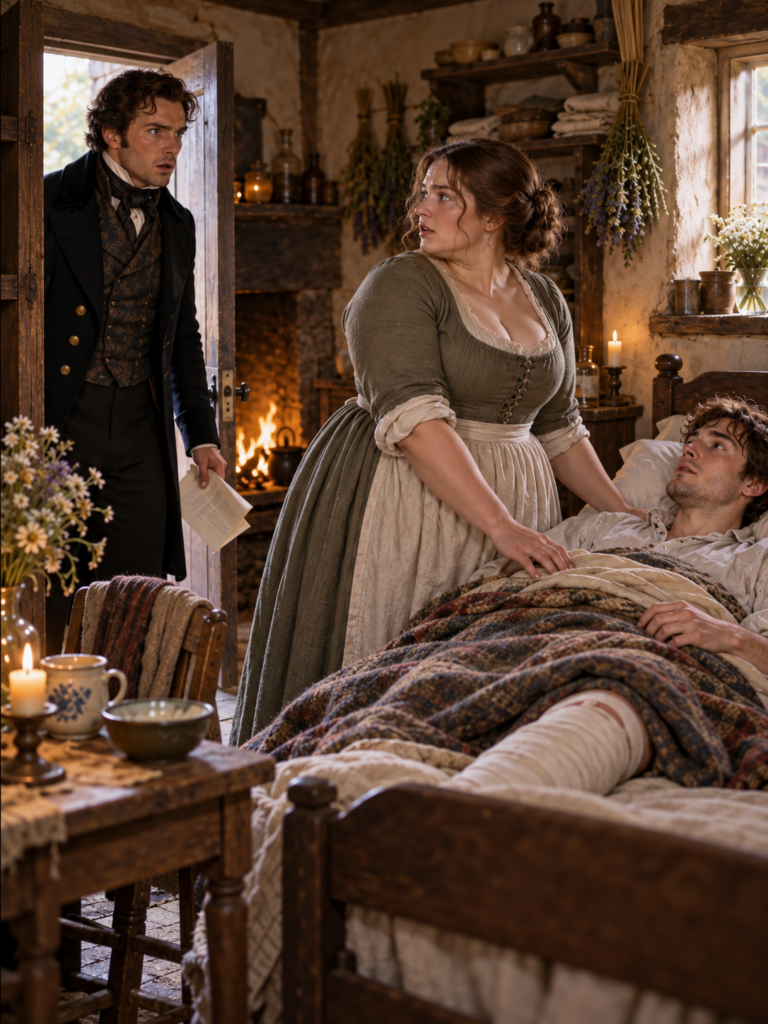
The upstairs room was low beneath the sloping roof. Rainwater tapped into a bowl near the window. A narrow bed stood against the far wall, its blankets piled around a figure whose breathing sounded painfully labored.
Eleanor knelt beside him, supporting his shoulders.
“Slowly, Tom. There now. Don’t try to speak.”
Julian stopped at the doorway.
Tom.
A common name.
An insignificant coincidence.
Yet something about the thin hand gripping Eleanor’s sleeve made his stomach tighten.
There was a crooked little finger on the left hand.
Thomas had broken that finger falling from an apple tree when he was twelve.
It had never healed straight.
Julian stepped closer.
The man turned his head.
His face was half-hidden beneath unkempt hair and a rough beard. A deep scar ran from his temple toward the edge of his eyebrow. Fever had hollowed his cheeks until the bones beneath them seemed ready to pierce the skin.
But Julian knew the shape of that face.
He had seen it in boyhood, laughing across a breakfast table.
He had seen it bruised after a riding accident.
He had seen it furious, wounded, and finally turned away from him during their last argument.
He had seen it every night in dreams for half a year.
“Thomas?”
The name scarcely left his mouth.
The sick man’s eyes opened.
Gray eyes.
The same as Julian’s.
For a heartbeat, the world seemed to stop.
Then the man recoiled so violently that his injured leg struck the wooden bedframe.
He cried out.
Eleanor caught him before he could fall.
“Tom! Look at me!”
But Thomas was staring past her.
At Julian.
His mouth opened.
“No.”
Julian took another step.
“Thomas, it’s me.”
“No!”
The cry was so frightened that Julian stopped.
Thomas seized Eleanor’s wrist.
“Don’t let them take me.”
She turned toward Julian with sudden fury.
“Get out.”
“He is my brother.”
“Then behave like someone who wishes him to survive. Get out!”
Julian had not been ordered from a room since he was a child.
For a moment, pride rose instinctively.
Then Thomas began shaking.
Julian backed away.
He stood in the passage, one hand braced against the wall, listening as Eleanor murmured quiet reassurances.
The duke who could command an estate, dismiss servants, summon magistrates, and influence members of Parliament found himself powerless before the closed door of a rented cottage.
His brother was alive.
His brother was afraid of him.
And Julian had no idea which discovery hurt more.
An hour passed before Eleanor came downstairs.
Julian had not moved from the kitchen.
Rain continued striking the little windows. The fire had burned low. His gloves lay untouched on the table beside the eviction notice.
She glanced at the paper.
Then at him.
“He’s sleeping.”
Julian rose.
“How long has he been here?”
“Nearly nine weeks.”
“Nine weeks?”
“I found him beside the old limestone quarry.”
“That quarry is less than four miles from my house.”
“Yes.”
Julian stared at her.
“Why was I not informed?”
Eleanor’s tired face became very still.
“I informed your household.”
“Impossible.”
“I wrote twice.”
“To whom?”
“Mr. Harkort.”
The name fell between them.
Julian shook his head.
“Harkort has managed Ravenscroft affairs for nineteen years. He would have informed me immediately.”
Eleanor crossed to a cupboard and retrieved a small wooden box.
Inside were several folded letters.
She handed him one.
The paper bore the steward’s unmistakable signature.
Miss Reed,
No member of the Ravenscroft household is presently missing. You are advised to refrain from spreading unfounded rumors concerning the family. If your patient requires parish assistance, apply through the proper authorities.
Yours,
Edmund Harkort
Julian read it twice.
Then a third time.
His brother had vanished in October. The letter was dated February.
Every newspaper within fifty miles had carried Thomas’s disappearance.
Harkort could not possibly have been unaware.
“Where is the other letter?” Julian asked.
“The first received no answer.”
“And you accepted this?”
“I had a man with a shattered leg upstairs, Your Grace. I wrote to the magistrate as well, but he was away. I had neither the money nor the means to hire a carriage and travel across the county searching for people who might believe me.”
Julian looked at her properly for the first time.
Her gown had been mended at both elbows. There were shadows beneath her eyes, and her hands were cracked from repeated washing.
“Why did you not send for a physician?”
“I did.”
“And?”
“The first demanded payment in advance. The second came once, set the leg, and left instructions. I have been following them as well as I can.”
Julian felt sick.
“You should have come to Ravenscroft Hall.”
She gave him a long look.
“Your steward had already warned me against causing trouble.”
He opened his mouth.
No words came.
Eleanor returned to the hearth.
“I sold my mother’s silver spoons in March,” she said quietly. “Then my winter cloak. Then the little watch my father left me. The apothecary has given me credit where he can.”
“Why?”
She turned.
“Why what?”
“Why sacrifice everything for a stranger?”
For the first time, genuine anger entered her voice.
“Because he was dying.”
Julian said nothing.
“Because he was cold, and frightened, and alone in a ditch. Because when I asked his name, he could barely remember it. Because he kept begging someone not to leave him.”
She paused.
“And because I know what it is to wait for help that never comes.”
Julian heard something in those final words that made him want to ask more.
Instead, he looked toward the staircase.
“Does he remember what happened?”
“Pieces.”
“What pieces?”
“An overturned carriage. Men arguing. A lantern swinging in the dark.”
“Who attacked him?”
“I don’t know.”
“Has he named anyone?”
Eleanor hesitated.
That hesitation frightened Julian more than any immediate answer could have.
“What has he said?” he demanded.
She walked to the table and lifted a small book bound in faded green cloth.
“I kept a record of his condition. Dates, fevers, things he said when he seemed lucid.”
Julian opened it.
The handwriting was careful.
There were notes about medicines, food, sleep, and the slow healing of Thomas’s leg.
Then he found another kind of entry.
March 12. Patient awakened distressed. Repeated that the north farms were being charged twice.
March 18. Mentioned a black book. Could not explain.
March 23. Became agitated at the sound of carriage wheels. Said the men had been waiting.
April 2. Asked whether Julian had read the accounts. Began crying when told no one had come.
Julian gripped the edge of the table.
He remembered their last conversation.
Thomas had burst into his library holding a bundle of estate papers.
He had claimed that repairs were being charged to buildings that had not been touched for years. He insisted that several tenants were paying rents that never appeared in the proper books.
Julian had been preparing for a parliamentary meeting.
Harkort had already assured him that Thomas misunderstood the accounts.
He had called his brother irresponsible.
Thomas had called him blind.
They had not spoken kindly to one another again.
Three weeks later, Thomas disappeared.
Julian slowly closed the notebook.
“What is the black book?”
“I hoped you might know.”
He did not.
And for the first time in nineteen years, he wondered what else he did not know about the man entrusted with his estate.
By evening, Julian had sent a rider to summon his family physician from the neighboring county.
He instructed the messenger to tell no one at Ravenscroft Hall where he had gone.
Eleanor watched the messenger disappear through the rain.
“You suspect your steward,” she said.
“I suspect nothing yet.”
“That is not what your face says.”
Julian stood near the doorway.
“Suspicion without proof destroys reputations.”
“So does refusing to suspect men who have earned your trust.”
He looked sharply at her.
She did not retreat.
“You have known Harkort for years,” she continued. “I understand that. But I have lived under his authority. I know what happens when a poor person challenges his word.”
“What happens?”
“The complaint is lost. The rent increases. The repairs are postponed. Or a notice appears demanding payment that cannot possibly be made.”
Julian glanced toward the paper on her table.
His notice.
For the first time, he wondered whether Eleanor’s eviction had been entirely about unpaid rent.
Before he could speak, a floorboard creaked overhead.
They both turned.
Thomas stood at the top of the staircase.
He had dragged himself from bed and was leaning heavily against the wall.
His face was ashen.
“Thomas!” Julian moved instinctively.
His brother flinched.
Julian stopped.
Eleanor hurried to the stairs.
“Tom, you mustn’t be standing.”
But Thomas hardly seemed to hear.
He was staring at Julian’s coat.
More precisely, at the silver buttons engraved with the Ravenscroft family crest.
“That coat,” Thomas whispered.
Julian looked down.
“What about it?”
Thomas shook his head.
“The man on the road.”
Julian’s blood went cold.
“Which man?”
Thomas closed his eyes, struggling.
“He had the crest. I thought…”
His breathing quickened.
“I thought you sent him.”
Julian felt the words strike deep.
“Thomas, I would never—”
“I know.”
The whisper was barely audible.
Thomas opened his eyes.
“I think I know now.”
For the first time, his fear seemed to shift into something more painful.
Shame.
He swallowed.
“The man said you knew about the book.”
Julian did not move.
“What man?”
Thomas’s lips trembled.
“The one who opened the carriage door.”
Eleanor reached the top step.
“Enough. He’s exhausted.”
But Thomas grabbed the banister.
“He said the duke had given his permission.”
The silence seemed to press against the cottage walls.
Julian’s voice was almost soundless.
“Permission for what?”
Thomas looked directly at him.
“To make certain I never came home.”
A gust of wind rattled the window.
Then Thomas’s knees gave way.
Eleanor caught him against the wall as Julian rushed forward, forgetting his rank, his pride, and the careful distance that had separated them.
Together they carried him back to bed.
Later, after the physician arrived and Thomas’s fever was brought under control, Julian stood alone in the downstairs kitchen.
He took the eviction notice from his pocket.
He unfolded it beside the fire.
He looked at the signature beneath the order.
His own.
For years, he had believed his greatest duty was to protect the name of Ravenscroft.
Now his brother lay upstairs, nearly murdered by men who had invoked that name as their authority.
And a penniless woman had spent everything she possessed keeping him alive.
Julian held the notice above the flames.
Then he stopped.
Burning the paper would be easy.
Far easier than understanding how it had come to be written.
He folded it carefully and put it back into his coat.
Outside, rain darkened the fields.
Somewhere beyond them stood Ravenscroft Hall, with its illuminated windows, locked offices, and long corridors filled with servants who obeyed without question.
Julian had believed it the safest place in England.
Now he feared it contained the man who had ordered his brother’s death.
And at dawn, he intended to return there smiling.
Part 2
Ravenscroft Hall had never looked more magnificent than it did on the morning Julian returned home with the knowledge that someone beneath its roof might be a murderer.
Sunlight washed the eastern windows. The gravel paths had been swept clean, the stable boys were exercising horses in the lower meadow, and a footman opened the great oak doors before Julian had even dismounted.
Everything was precisely as it should be.
That disturbed him.
For the better part of two decades, Julian had measured the success of his household by its quiet efficiency. Bills were settled. Servants knew their duties. Visitors were received with dignity, and the hundreds of families dependent upon his estates were managed through a network of stewards and agents.
He rarely considered how much of that order rested upon one man’s word.
Edmund Harkort was waiting in the entrance hall.
“Your Grace. I trust the matter with Miss Reed has been resolved.”
Julian handed his gloves to the footman.
“Not entirely.”
Harkort’s expression barely changed.
“A regrettable woman. I warned you she might be difficult.”
“She is indeed difficult.”
Julian kept his voice dry.
“Particularly when convinced she is right.”
The steward permitted himself a thin smile.
“Such women often confuse stubbornness with principle.”
Julian examined him.
Harkort was a narrow-shouldered man in his late fifties, dressed with the sober precision of someone who wished to appear indispensable rather than important. His hair had silvered at the temples. His hands were soft and carefully maintained.
Julian had known him since childhood.
Harkort had arranged the late duke’s funeral, guided Julian through his inheritance, and sat beside him during difficult estate negotiations.
When Julian’s mother died, Harkort had quietly ensured that the household continued running while the family mourned.
He had seemed part of the structure of Ravenscroft itself.
Yet yesterday Julian had held a letter proving that this trusted man knew a wounded stranger had been found near the quarry and had deliberately discouraged further inquiry.
“Bring me the northern estate accounts,” Julian said.
Harkort’s smile faded slightly.
“Certainly. Is there a particular concern?”
“I intend to review the repairs before authorizing the summer expenditure.”
“Of course. I can prepare a summary.”
“The original ledgers, Harkort.”
A short silence followed.
“As you wish, Your Grace.”
Julian watched him walk away.
Only after the steward disappeared did he allow himself to breathe.
For three hours, Julian sat in the library studying figures that had once seemed perfectly ordinary.
The account books were beautifully kept.
That was the first troubling thing.
Every payment had its date, every supplier its name, every expense its proper column.
There were invoices for drainage work, roof repairs, bridge maintenance, seed grain, and wages paid to laborers throughout the estate.
But when Julian began comparing the entries with older records, small contradictions appeared.
A bridge near Hazelbrook had been repaired twice within five months.
A tenant cottage that Julian remembered visiting the previous autumn had supposedly received a new roof, although he had seen its old slate tiles with his own eyes.
The north mill had been charged for repairs to machinery that had been removed from service years earlier.
Individually, the figures could be explained.
Together, they suggested something ugly.
Julian made copies of several entries and placed them in a locked drawer.
Then he sent a sealed letter to a solicitor in London who had no connection to the Ravenscroft estate.
He requested a discreet investigation into three suppliers whose names appeared repeatedly in the books.
By afternoon, Julian had discovered something else.
The rents collected from the northern farms were recorded in amounts substantially lower than the sums that appeared on several surviving tenant receipts.
Someone had been collecting more than the accounts admitted.
Julian thought of Eleanor Reed’s worn gown and the empty shelves in her cottage.
He thought of the twenty-one pounds she owed.
Then he wondered how many other families were being punished for debts that had been calculated dishonestly.
He rang for a servant.
“Ask Mr. Harkort to join me.”
When the steward entered, Julian was standing beside the window.
“I have noticed several discrepancies.”
Harkort inclined his head.
“Which discrepancies, Your Grace?”
“The Hazelbrook bridge repairs. The charges against the north mill. Certain tenant receipts.”
“Ah.”
Harkort seemed almost relieved.
“Your brother raised similar concerns before his unfortunate disappearance.”
Julian kept his expression motionless.
“Did he?”
“Indeed. Poor Thomas became rather fixated upon the accounts.”
“Why poor Thomas?”
The steward paused.
“Only because the experience must have troubled him. He was never comfortable with the responsibilities of the estate.”
Julian remembered speaking nearly those exact words himself.
“Perhaps I was mistaken about his abilities.”
Harkort looked at him with cautious surprise.
“Your Grace?”
“Nothing. Explain the Hazelbrook figures.”
The steward began speaking.
His explanations were smooth, detailed, and accompanied by several documents.
Julian listened without interrupting.
He would once have found them reassuring.
Now he heard something else.
Harkort never admitted uncertainty.
Every answer was complete. Every difficulty had already been anticipated. Every mistake belonged to an absent clerk, a careless contractor, or the confusion of a young man who could no longer defend himself.
Julian realized that he had mistaken the absence of questions for evidence of competence.
When Harkort finished, Julian nodded.
“Very well.”
The steward gathered his papers.
“Is there anything further?”
“Not today.”
At the doorway, Harkort stopped.
“I understand Miss Reed has been telling rather extraordinary stories about the injured men she shelters.”
Julian’s fingers tightened against the window frame.
“Has she?”
“Villagers exaggerate. It is her habit to invite trouble, and she appears to enjoy the attention.”
“Then perhaps we should give her less of it.”
Harkort smiled.
“Precisely my view.”
He left.
Julian waited until the door closed.
Then he crossed the library and locked it.
The steward had just revealed something he should not have known.
Julian had told no one at Ravenscroft Hall that Eleanor’s patient was connected to Thomas.
Yet Harkort had introduced the subject without being asked.
It was not proof.
But it was enough to convince Julian that every hour mattered.
At the cottage, Eleanor was discovering that survival could become more frightening after help arrived.
The physician Julian had summoned returned each afternoon. Fresh food appeared at her door, together with coal, clean linen, and medicines she could never have afforded.
Thomas’s fever had begun to settle.
His leg, though badly weakened, was showing signs of healing.
For the first time in months, Eleanor no longer counted the hours until she would have to choose between feeding herself and buying another bottle of medicine.
Yet she found little comfort in the change.
By noon, three villagers had stopped speaking when she approached the well.
The baker who had once allowed her to purchase bread on credit now insisted upon immediate payment.
And someone had scratched a single word into the wood beside her front door.
THIEF.
Eleanor stared at it for a long time.
Then she fetched a cloth and attempted to scrub it away.
The letters remained.
Thomas saw the mark that evening when she opened the door to admit the physician.
“Who did that?”
“No one worth worrying about.”
He watched her carefully.
“Ellie.”
It was the name he had given her during the weeks when he could remember almost nothing else.
She turned toward him.
He was sitting in the chair beside the hearth, a blanket across his knees.
“Tell me.”
She sighed.
“The village has decided I kept a wealthy gentleman hidden in my house so that I could demand money from his family.”
Thomas’s face darkened.
“That’s a lie.”
“I know.”
“I’ll tell them.”
“You will do no such thing while you can barely stand.”
He looked furious.
Then the fury faded into distress.
“I brought this upon you.”
Eleanor sat beside him.
“No. Someone who wanted you frightened and silent brought this upon both of us.”
Thomas stared at the fire.
After a while, he said, “I remember being ashamed of him.”
“Of whom?”
“Julian.”
She waited.
“He cared more about his duty than anything else. More than our father ever did, perhaps. When the old duke died, Julian was only twenty-seven. Everyone expected him to know how to manage everything.”
“That is a terrible burden for a young man.”
Thomas gave a bitter smile.
“He carried it so well that he forgot other people might know things he did not.”
Eleanor thought of the duke standing helplessly in her kitchen.
“He is beginning to remember.”
Thomas looked at her.
“Do you think so?”
“I think he is discovering that obedience is not the same as loyalty.”
Thomas watched the flames for several moments.
Then his voice dropped.
“The last thing I said to him was that he had become our father.”
Eleanor said nothing.
“Our father was not cruel,” Thomas continued. “But he could make you feel as though disappointing him was worse than dying.”
His eyes filled.
“I wanted Julian to be different.”
“He may still become different.”
Thomas shook his head.
“You don’t understand. I told him I never wanted to see him again.”
Eleanor reached toward his hand, stopping just short.
Thomas took it.
“I’ve had six months to wonder whether those were the last words he’d ever hear from me.”
“No,” she said quietly. “You have had six months to survive. There will be time for other words.”
He looked at her for a long while.
“Did anyone ever tell you that you have an unpleasant habit of making sense?”
“Frequently.”
“Julian will find it unbearable.”
Eleanor smiled despite herself.
“Then perhaps it will be good for him.”
Julian came after nightfall.
He arrived alone, wearing a plain riding coat instead of the dark blue garment bearing his family buttons.
Eleanor noticed the change immediately.
“Have you abandoned your dukedom?”
“Only its more conspicuous tailoring.”
“An improvement.”
He glanced at the scratched word beside her door.
His smile vanished.
“Who did that?”
“It hardly matters.”
“It matters to me.”
“Then find out who is paying people to repeat lies about your brother.”
Julian looked at her.
“How much do you know?”
“Enough to recognize a campaign of gossip when one begins.”
He entered the kitchen and found Thomas asleep near the fire.
For several moments, he simply stood looking at him.
The lamplight softened Thomas’s face. Without the fever and terror that had dominated their first meeting, he looked more like the troublesome younger brother Julian remembered.
Eleanor lowered her voice.
“He walked three steps today.”
Julian turned.
“Without help?”
“With a great deal of help. He complained throughout.”
A faint smile touched Julian’s mouth.
“That sounds like Thomas.”
It disappeared almost immediately.
“I have been examining the estate accounts.”
“And?”
“My brother was right.”
Eleanor said nothing.
Julian took several folded sheets from his coat and placed them on the table.
“There are payments to contractors who may not exist. Repairs charged twice. Rents that appear to have been collected improperly.”
“Does Harkort know you are investigating?”
“He knows I have begun asking questions.”
“Then we should expect him to move against you.”
“He cannot easily remove me from my own estate.”
Eleanor looked toward Thomas.
“He need not remove you.”
The implication settled heavily between them.
Julian sat down.
For the first time, Eleanor saw that he had aged in the few days since their meeting.
His face was drawn. His eyes were tired.
He looked less like a powerful aristocrat than a man who had discovered the foundations of his life might be rotten.
“I accused Thomas of laziness,” he said.
She listened.
“I told him he mistook suspicion for intelligence. I said Harkort understood the estate better than either of us.”
Julian stared at his hands.
“He was trying to protect our tenants. And I treated him like a foolish child.”
Eleanor considered him.
“Will you tell him that?”
“Yes.”
“Then perhaps that is where you should begin.”
He looked up.
“You make it sound simple.”
“No. I make it sound necessary.”
A small movement came from the chair.
Thomas had awakened.
Neither had noticed.
He looked from Eleanor to Julian.
“I heard enough.”
Julian rose.
“Thomas—”
“Sit down.”
Julian stopped.
Thomas gave a tired smile.
“I’ve waited years to say that to you.”
Slowly, Julian sat.
For a moment, neither brother spoke.
Then Thomas said, “I thought you knew.”
Julian’s chest tightened.
“About the accounts?”
“About the men who came for me.”
“No.”
Thomas lowered his gaze.
“They told me you were tired of my accusations. That I’d embarrassed the family. That you wanted the matter settled.”
Julian swallowed.
“I never gave such an order.”
“I believe you now.”
“Why now?”
Thomas looked toward Eleanor.
“Because she said a man who meant to have me killed would hardly spend three nights sleeping in a chair beside my bed.”
Julian turned toward her.
“You noticed?”
“It was difficult not to notice. You snored.”
Thomas laughed.
The sound was weak, but unmistakable.
Julian’s eyes stung.
He had been prepared to face accusations, grief, perhaps even hatred.
He had not expected the simple mercy of hearing his brother laugh again.
After a long silence, Thomas leaned forward.
“There was a book.”
Julian stiffened.
“The black ledger?”
Thomas nodded.
“I found it in Harkort’s private office. It was not part of the official accounts. It contained names, figures, and payments that had been hidden from the estate books.”
“What became of it?”
“I took it with me.”
“Was it in the carriage?”
Thomas shut his eyes.
“Yes. I meant to bring it to you. I knew you would believe me if you could see the evidence.”
Julian waited.
“The men stopped us before we reached the south road. One struck the driver. I heard horses screaming, and then the carriage overturned.”
Thomas’s hands began trembling.
Eleanor moved closer.
“You need not finish tonight.”
“No. I remember something.”
He pressed his palms against his temples.
“I got away. I remember crawling through wet grass. The book was inside my coat.”
He looked at Julian.
“There was an old boundary stone.”
“Where?”
“Near the quarry. The one with the broken crown carved into it.”
Julian knew the place.
The stone marked an ancient division between Ravenscroft land and a neighboring estate that had disappeared generations before.
Thomas gripped the chair.
“I hid the book.”
Eleanor leaned forward.
“Under the stone?”
Thomas shook his head.
“Not under.”
His voice became strained.
“Inside.”
The next morning, Julian and Eleanor rode toward the abandoned quarry.
Julian had insisted she remain at the cottage.
Eleanor had replied that the boundary stone lay beyond a collapsed sheep track and that he was welcome to spend the entire day searching the wrong hillside.
He had abandoned the argument.
Now they traveled side by side beneath a sky the color of cold iron.
The countryside had begun to awaken from winter. Primroses dotted the banks. Young leaves trembled on the hedgerows. Beyond the fields, Ravenscroft Hall stood on its distant rise, elegant and imposing against the clouds.
Eleanor followed Julian’s gaze.
“From here it looks beautiful.”
“It has always looked beautiful.”
“That must make it difficult to imagine what happens in its shadow.”
He turned toward her.
There had been a time when such words would have angered him.
Now he asked, “Was your father a tenant here?”
“No.”
“What did he do?”
“He practiced medicine in a small town near York.”
Julian looked surprised.
“That explains your knowledge of injuries.”
“I learned by watching him. He believed a person should know how to keep another alive until proper help could arrive.”
“What happened to him?”
“He died during a fever outbreak when I was nineteen.”
“And your mother?”
“Two years later.”
Julian was quiet.
“I had a brother,” Eleanor continued.
He looked at her.
“He was younger than I was. His name was Samuel.”
“What happened?”
“He injured his hand while apprenticed to a carpenter. The wound became infected. His employer refused to pay for a physician, and Samuel was too ashamed to tell me how ill he had become.”
Her voice remained steady, though her fingers tightened on the reins.
“By the time I reached him, there was little anyone could do.”
Julian felt the weight of what she had not said.
“How old was he?”
“Seventeen.”
He looked away toward the distant hills.
“I’m sorry.”
Eleanor nodded.
“When I found Thomas, he had been lying in the rain long enough that his skin had gone blue. For a moment, I thought he was already dead.”
She paused.
“Then he opened his eyes.”
Julian waited.
“He asked whether someone was coming for him. I told him yes, although I had no idea whether anyone would.”
She glanced at Julian.
“I suppose I couldn’t bear to tell another frightened young man that help was not coming.”
Julian had thought he understood her kindness.
Now he realized it had been shaped by grief as deeply as his own stern sense of duty.
“You saved my brother,” he said.
“I know.”
He almost smiled.
“You have no talent for false modesty.”
“Would it improve the truth?”
“No.”
They rode on in silence.
But something had changed between them.
Julian no longer saw merely the stubborn tenant who had defied his authority.
He saw a woman who had endured the destruction of her own small family and still chosen to protect a stranger.
And Eleanor, watching his care as he guided her horse across a difficult stretch of ground, began to understand that beneath Julian’s pride lay a man who had spent years confusing responsibility with the refusal to need anyone.
They found the boundary stone shortly before noon.
It stood near a tangle of thornbushes, half-buried beneath centuries of rain and soil.
A weathered crown had been carved into its upper face.
One side was cracked.
Julian knelt beside it.
“Thomas said inside.”
Eleanor dismounted and examined the stone.
“There is a narrow hollow here.”
She brushed away moss.
The crack concealed a small cavity, just wide enough for a hand.
Julian reached inside.
His fingers touched cold stone, damp soil, and something wrapped in stiff cloth.
He pulled it free.
A narrow black book lay beneath layers of oilskin.
For several moments, he could only stare.
Thomas had carried this evidence while fleeing men who intended to kill him.
Even injured and terrified, he had hidden it where someone might someday recover it.
Julian opened the cover.
The first pages contained columns of figures.
Then came names.
Suppliers.
Tenants.
Private payments.
And finally, an entry that made Julian’s entire body go rigid.
E. Ravenscroft — quarterly allowance.
Eleanor looked over his shoulder.
“Who is E. Ravenscroft?”
Julian’s voice sounded hollow.
“My cousin.”
“Lord Edwin?”
He nodded.
Edwin Ravenscroft was the son of Julian’s late uncle. Charming, elegantly mannered, and perpetually short of money, Edwin had spent much of the previous year at Ravenscroft Hall.
Under the terms governing the family’s hereditary title and entailed estate, Edwin stood next in the succession after Julian and Thomas, assuming neither brother left a legitimate male heir.
Julian turned another page.
Payments had been made to Edwin through two companies supposedly providing building supplies.
The amounts were substantial.
More troubling still, they began only weeks before Thomas discovered the fraud.
Eleanor traced a date with her finger.
“This payment was made three days before the carriage was attacked.”
Julian stared at the entry.
Beside it were three words.
North road arrangement.
The sum was four hundred pounds.
Enough to purchase a respectable cottage.
Enough to hire desperate men willing to carry out a criminal instruction.
Julian closed the book.
“Edwin.”
The name tasted like poison.
Eleanor watched his expression.
“Do not mistake a suspicious entry for proof of murder.”
Julian looked at her.
“My cousin received money from the man who concealed Thomas’s existence.”
“Yes.”
“He stood to benefit if Thomas died.”
“Yes.”
“And the payment was made just before the attack.”
“Yes.”
“Then what more would you have me believe?”
“The truth,” she answered. “But all of it.”
Julian turned away.
For a moment, she feared his anger would overcome him.
Instead, he lowered himself onto the boundary stone and covered his face with both hands.
Eleanor stood beside him without speaking.
When he finally looked up, his expression was unlike anything she had seen before.
“I invited Edwin into my home after Thomas disappeared,” he said.
His voice was quiet.
“He comforted me. He sat beside me through the Christmas season. He told me there was no use torturing myself with hope.”
Eleanor felt cold.
“He encouraged you to accept your brother’s death?”
“Repeatedly.”
Julian looked toward the distant Hall.
“And I thanked him for his kindness.”
They returned by a different route, keeping beneath the trees where the road could not easily be observed.
Neither spoke much.
Near the cottage, Eleanor noticed fresh hoofprints in the soft ground.
They were recent.
Too recent.
The front door stood open.
Julian dismounted before his horse had fully stopped.
“Eleanor, stay here.”
She ignored him.
They ran inside.
The kitchen table lay overturned.
Medicine bottles had been smashed against the hearth.
The cupboard doors hung open, and every drawer had been pulled out.
For one terrible instant, Eleanor could hear only the pounding of her own heart.
“Thomas!”
No answer.
She rushed upstairs.
The bed was empty.
The blankets had been thrown to the floor.
A dark stain marked the white pillow.
Julian reached the doorway behind her.
He saw the room.
Then he saw Eleanor’s face.
Neither needed to speak.
On the bedside table lay a folded sheet of paper.
Julian picked it up.
The handwriting was neat, controlled, and horribly familiar.
Your Grace,
The account book belongs to the estate and must be returned.
Your brother has already suffered enough through his unfortunate confusion.
If you value his life, come to Ravenscroft Hall before midnight.
Come alone.
And bring the book.
There was no signature.
But Julian knew who had written it.
Eleanor looked at the blood on the pillow.
Then she looked at him.
“Will you go?”
Julian folded the letter.
“Yes.”
“Alone?”
His eyes moved toward the black ledger in his hand.
For a moment, the old Julian Ravenscroft might have ordered her to remain behind, commanded the servants, and ridden into danger certain that authority would prevail.
But the man who stood before Eleanor now understood what such certainty had already cost.
“No,” he said.
“Not this time.”
Part 3
By ten o’clock that night, every window in Ravenscroft Hall blazed with candlelight.
To anyone approaching along the southern drive, it would have appeared that the duke was entertaining distinguished guests.
A carriage waited beneath the portico. Footmen stood beside the entrance. The old housekeeper had been instructed to prepare the drawing room, and two extra fires burned against the chill of the spring evening.
But the household was not preparing for a celebration.
It was preparing for a reckoning.
Julian had sent his London solicitor a copy of several pages from the black ledger before leaving the cottage. He had also sent for the county magistrate, a man whose authority did not depend upon the Ravenscroft household.
Most importantly, he had asked Eleanor to do something that went against every instinct she possessed.
She was to remain out of sight.
Not because he doubted her courage.
Because Thomas might need her more than Julian needed another witness.
Eleanor had agreed on one condition.
“If your brother is alive when this is finished,” she had told him, “you will allow him to decide where he wishes to recover.”
Julian had looked at her for a long moment.
Then he had answered, “I will.”
It was perhaps the first promise of its kind he had ever made.
Edmund Harkort waited in the library.
Lord Edwin Ravenscroft stood beside the fireplace, one hand resting on the mantel.
Both men turned when Julian entered.
Edwin smiled.
“My dear cousin. I had begun to fear you wouldn’t come.”
Julian closed the door.
“Where is Thomas?”
Harkort bowed slightly.
“Your brother is being cared for.”
“Where?”
“There is no need for hostility, Your Grace.”
Julian took the black ledger from beneath his coat and placed it on the table.
“Then perhaps you can explain this.”
Edwin’s smile faltered.
Harkort took one step forward.
“May I?”
Julian rested a hand on the book.
“First, my brother.”
Edwin sighed.
“You always were rather stubborn, Julian. Though never quite so stubborn as Thomas.”
“Where is he?”
“In a secure room.”
“What have you done to him?”
“Very little,” Edwin replied. “Unfortunately, Thomas has made reasonable arrangements rather difficult.”
Julian felt a cold fury rise through him.
He forced it down.
“And what arrangement do you propose?”
Harkort spoke before Edwin could answer.
“The ledger contains private financial matters that have been misunderstood. If it is surrendered, certain difficulties may still be resolved discreetly.”
“Discreetly.”
“Without scandal.”
Julian looked at him.
“My brother was attacked. A carriage driver may have been murdered. A woman has been threatened and slandered. And you speak to me of scandal?”
Harkort’s face tightened.
“Your Grace, I have served this family faithfully for nineteen years.”
“So you have often reminded me.”
“I protected your father from ruinous expenditures. I protected you from tenants who would gladly exploit your generosity. I kept these estates solvent while your brother squandered his time chasing grievances.”
Julian studied him.
“By inventing suppliers?”
Harkort said nothing.
“By charging repairs twice?”
“Complicated estates require certain accommodations.”
“By stealing from people who could barely afford bread?”
The steward’s eyes hardened.
“You have never understood what it takes to maintain a great house.”
Julian almost laughed.
There it was.
The explanation beneath every missing payment, every silenced complaint, every ruined tenant.
The belief that Ravenscroft Hall mattered more than the people whose labor sustained it.
Edwin moved away from the fireplace.
“Enough. We can settle this without exchanging insults.”
Julian turned.
“Can we?”
“Of course.”
Edwin spread his hands.
“You have the title. You have the estates. You have more income than any man could reasonably spend. Harkort made use of funds that would scarcely be missed.”
“Those funds belonged to the estate.”
“And eventually they might have benefited the family.”
Julian stared at him.
“Which family?”
For the first time, Edwin looked uncomfortable.
“Don’t be tedious.”
“Yours?”
Edwin’s expression hardened.
Julian opened the ledger.
“Four hundred pounds, paid three days before Thomas’s carriage was attacked. Another eight hundred distributed over the following months.”
He looked directly at his cousin.
“How much was my brother’s life worth to you?”
Edwin crossed the room so quickly that his chair struck the wall.
“You had better be careful.”
“Why?”
“Because accusations have consequences.”
Julian’s voice remained quiet.
“So does attempted murder.”
For a heartbeat, no one moved.
Then Edwin smiled again.
It was no longer a pleasant smile.
“You have no evidence that I ordered anyone killed.”
“Perhaps not.”
Julian turned toward Harkort.
“But I have evidence that you knew Thomas was alive.”
The steward’s face went pale.
Julian removed Eleanor’s letter from his pocket.
“You received this in February. You answered it. And when Miss Reed could no longer pay her rent because she was keeping Thomas alive, you recommended her eviction.”
Harkort’s lips parted.
“That woman—”
“That woman,” Julian interrupted, “did what every member of this household failed to do.”
The steward looked toward Edwin.
Julian saw the exchange.
And suddenly, he understood something.
The two men were not allies bound by loyalty.
They were accomplices bound by fear.
“Harkort,” Julian said, “who ordered the attack?”
Edwin laughed sharply.
“This is absurd.”
Julian ignored him.
“Was it your decision to kill Thomas? Or his?”
Harkort’s hands began to shake.
“Your Grace, I never intended—”
“Be silent!” Edwin snapped.
The steward flinched.
Julian noticed.
He also noticed that Edwin had moved closer to the bell beside the fireplace.
“Don’t touch that,” Julian said.
Edwin stopped.
The smile vanished completely.
“You came alone, as instructed.”
“I did.”
“Then perhaps you should remember your position.”
Julian looked at him.
“My position?”
“Your brother is still in this house. Whether he leaves it depends upon how sensibly you behave.”
A terrible stillness settled over the room.
Julian had suspected that Edwin hoped to inherit the family title and estates.
Now he saw something even more dangerous.
Edwin had convinced himself that the inheritance ought to be his.
Thomas had become an obstacle.
And Julian, having discovered the truth, was becoming one as well.
Beneath the western wing, Thomas Ravenscroft sat on a cold stone floor with his injured leg stretched before him.
The room had once been used to store wine.
Now its iron-bound door was locked from the outside.
A candle burned in a niche, throwing uncertain light across the walls.
Thomas had been carried there by two men who warned him not to struggle. One had struck him when he demanded to know where they were taking him.
The blood on Eleanor’s pillow had come from a shallow cut above his ear.
But his greatest torment was not the pain.
It was the thought that Eleanor might have returned to the cottage and found him gone.
He could imagine her terror.
He could imagine Julian’s rage.
Worst of all, he could imagine both of them doing something reckless to save him.
Thomas shut his eyes.
For months, he had believed he was dying.
Then Eleanor had found him.
She had washed blood from his face, warmed his frozen hands, and remained beside him through nights when he woke unable to remember his own name.
And Julian, whom he had once believed incapable of listening, had come to sit quietly near his bed, asking permission before moving closer.
Thomas had been given back a family.
He was not prepared to lose it again.
A faint sound came from beyond the door.
Three soft taps.
A pause.
Then two more.
Thomas lifted his head.
It was a pattern he recognized.
Eleanor used it whenever she entered his room at night, so he would know who was approaching before she touched the latch.
“Ellie?”
“Quietly,” came a whisper.
Thomas nearly cried out with relief.
The lock scraped.
The door opened a few inches.
Eleanor slipped inside carrying a lantern.
Behind her stood an elderly housemaid named Mrs. Bell, who had served at Ravenscroft Hall since before Julian was born.
Thomas stared at them.
“How did you—”
“Your brother had the good sense to ask the servants which doors Harkort usually keeps locked,” Eleanor whispered.
Mrs. Bell lifted her chin.
“And Mr. Harkort had the foolishness to believe we never noticed what happened beneath our own noses.”
Eleanor knelt beside Thomas.
“Can you stand?”
“Not quickly.”
“Then we shall be slow.”
He caught her wrist.
“Julian?”
“Keeping your cousin occupied.”
Thomas’s face changed.
“Edwin is here?”
Eleanor nodded.
He swallowed.
“I remember his voice.”
Her expression softened.
“Then you can tell the magistrate when you are safe.”
With Mrs. Bell’s help, they raised him.
Every movement sent pain through his leg.
But Thomas did not complain.
He had survived six months of darkness.
He would endure a little more.
Upstairs, Edwin had taken a pistol from the drawer of the library desk.
Julian stood motionless beside the table.
Harkort had retreated toward the wall.
“You cannot seriously intend to shoot me in my own library,” Julian said.
Edwin’s hand trembled.
“I would prefer not to.”
“Then put it down.”
“You should have left the accounts alone.”
Julian looked at him with something approaching pity.
“Thomas said the same thing was told to him.”
“Thomas was always interfering.”
“He was trying to prevent theft.”
“He was threatening everything!”
The sudden shout seemed to surprise Edwin himself.
For a moment, he struggled to recover his composure.
Julian did not move.
“What everything?”
Edwin’s eyes flashed.
“My future. My standing. My place in this family.”
“You had a place.”
“A place at your table! A place at Christmas! A place granted whenever Your Grace felt generous enough to remember I existed!”
The resentment poured from him now.
“My father died with debts. I spent years begging assistance from men who bowed to you. I watched you inherit an estate you barely understood, while I was expected to be grateful for an allowance.”
Julian heard the bitterness.
He also heard the deliberate way Edwin had transformed humiliation into justification.
“You could have asked me for help.”
Edwin laughed.
“Help? You would have given me money and expected gratitude. Harkort offered something better.”
“Access to the accounts.”
“An opportunity.”
“And Thomas discovered it.”
Edwin’s eyes narrowed.
“Your brother should have minded his own affairs.”
Julian felt the last remnants of his affection for his cousin fall away.
“His family was his affair.”
“Then he should have learned to keep quiet.”
Harkort stirred near the wall.
“Lord Edwin, please.”
“Not another word from you.”
Julian turned toward the steward.
“Tell me what happened on the northern road.”
Harkort looked from Julian to the pistol.
His mouth worked soundlessly.
Then he whispered, “The carriage was only meant to be stopped.”
Edwin went rigid.
“Harkort.”
“The book was to be recovered,” the steward continued. “Lord Edwin said Thomas could be sent abroad afterward. He said arrangements had already been made.”
Julian’s voice was scarcely audible.
“And the driver?”
Harkort looked down.
“He resisted.”
“What happened to him?”
“I don’t know.”
“You do know.”
The steward began trembling harder.
“One of the men struck him. The horses bolted. The carriage overturned. Everything happened too quickly.”
Julian felt a moment of dreadful relief that the man had not immediately confessed to murder.
But relief did not erase the violence.
“Was the driver killed?”
“He survived,” Harkort whispered. “We paid him to leave the county.”
Edwin swore.
“You miserable fool.”
Harkort looked toward him with naked hatred.
“You said no one would be hurt!”
The pistol shifted toward the steward.
Julian moved before Edwin could aim.
He seized his cousin’s wrist.
The weapon discharged.
The report shattered the room’s silence.
Glass burst from the window behind Julian.
Edwin stumbled backward, struck the edge of the table, and dropped the pistol.
Julian kicked it beneath a cabinet.
Then the library doors opened.
The county magistrate entered with two constables.
Behind them stood Julian’s solicitor.
And between Eleanor and Mrs. Bell, supported by a wooden crutch, stood Thomas Ravenscroft.
For several seconds, Edwin stared as though he had seen a ghost.
Thomas met his gaze.
“No more,” he said.
His voice was weak.
But every person in the room heard it.
The investigation did not end that night.
Julian had once imagined justice as a single dramatic confrontation in which guilt became obvious and punishment followed immediately.
The truth proved slower.
The magistrate took statements.
The ledger was examined.
The solicitor traced payments through bank accounts and false suppliers.
The carriage driver, located in a village near the coast, eventually returned under protection to give his account.
He confirmed that two hired men had stopped the carriage and that he had been struck while trying to defend Thomas.
The surviving attackers were identified through payments and correspondence found among Harkort’s papers.
Harkort, faced with evidence he could no longer deny, admitted his role in the financial fraud and the plan to seize Thomas’s book.
He insisted that he had not ordered Thomas’s death.
Edwin denied almost everything.
But denial could not erase the payments, the witnesses, or the instructions preserved in the correspondence.
Both men were committed to stand trial.
The case became the subject of considerable public attention.
For a time, the Ravenscroft name appeared in newspapers more often than Julian could bear.
Society whispered.
Old acquaintances wrote letters expressing carefully worded sympathy.
A few urged him to settle matters privately for the family’s sake.
Julian answered none of them.
He had finally learned what protecting the family truly required.
It did not mean hiding disgrace.
It meant refusing to allow another innocent person to suffer in order to preserve appearances.
Thomas’s recovery took months.
There were difficult mornings when his leg ached so severely that he could scarcely leave his bed.
There were nights when a carriage rattling over the stones outside the Hall awakened memories he could not control.
But he no longer woke alone.
Julian began visiting him every morning before breakfast.
At first, their conversations were awkward.
They spoke about horses, estate repairs, the weather, and the progress of the investigation.
Then one morning, Thomas found Julian standing at the foot of his bed holding a stack of documents.
“What are those?” Thomas asked.
“Accounts.”
Thomas groaned.
“I have endured a broken leg and attempted murder. Must I also endure bookkeeping?”
Julian smiled.
“I thought you might like to inspect them.”
Thomas studied him.
“You’re asking me?”
“Yes.”
“To inspect your estate accounts?”
“Our estate accounts.”
Thomas looked down at the papers.
Something in his face changed.
For years, he had wanted his elder brother to take his concerns seriously.
Now Julian was offering him not merely an apology, but responsibility.
“Are you certain?”
“No,” Julian replied.
Thomas laughed.
Julian continued, “I am certain only that I have made a great many decisions without sufficient knowledge. I should prefer not to repeat the experience.”
Thomas opened the first ledger.
“Then you had better sit down. Your handwriting is atrocious.”
Julian pulled up a chair.
And for the first time since their father died, the brothers began learning how to manage their inheritance together.
Eleanor returned to her cottage when Thomas was well enough to spend his nights at Ravenscroft Hall.
She refused Julian’s offer of permanent rooms in the house.
She refused the new gowns he attempted to send.
And when he suggested that he might quietly forgive her unpaid rent, she fixed him with such a severe expression that he abandoned the idea before finishing his sentence.
“I will pay what I owe,” she told him.
Julian stood beside her kitchen table.
“Your expenses in saving Thomas far exceeded the rent.”
“Then make a proper accounting of them.”
He blinked.
“What?”
“You employ clerks, do you not?”
“Several.”
“Then allow one to calculate the cost of the medicine, food, and care I provided. If you wish to reimburse me for services rendered, we can discuss a reasonable amount.”
Julian slowly smiled.
“You are negotiating with me.”
“I am preventing you from confusing gratitude with ownership.”
The smile faded into something warmer.
“Very well.”
The arrangement was made.
Eleanor received payment for Thomas’s care, sufficient to clear her legitimate debts and restore what she had borrowed. She accepted it because the compensation was documented and the decision was hers.
But Julian discovered that paying an obligation was considerably easier than speaking about the feelings that had begun to grow between them.
He found reasons to visit the cottage.
A broken gate required inspection.
The north road needed resurfacing.
The village physician wished to discuss the possibility of a small infirmary.
On one memorable afternoon, Julian arrived carrying a basket of pears and announced that Ravenscroft Hall had produced too many.
Eleanor examined the basket.
“Your orchards are on the southern estate.”
“Yes.”
“Those trees will not bear ripe pears until autumn.”
Julian looked at the fruit.
Then at her.
“I may have purchased them.”
“You may?”
“I did purchase them.”
“Why?”
He hesitated.
“Because you said last week that you liked pears.”
Eleanor stared at him.
Then, unexpectedly, she laughed.
Julian had heard her smile in her voice before.
He had seen amusement touch her face.
But he had never heard her laugh freely.
For a moment, he forgot every carefully prepared sentence.
She took the basket.
“Thank you, Julian.”
It was the first time she had used his given name without challenge or irritation.
He remembered it for the rest of his life.
Summer came to Ravenscroft country.
The fields turned green and gold. The damaged bridge at Hazelbrook was rebuilt. The tenants’ accounts were audited, and payments collected dishonestly were returned wherever the surviving records allowed them to be traced.
Julian appointed a new steward under stricter oversight.
No single man would again control the estate’s correspondence, accounts, and tenant petitions without independent review.
He also began visiting the farms himself.
At first, the tenants were uncomfortable.
A duke standing in a muddy yard listening to complaints about drainage was an uncommon sight.
But Julian learned to ask questions without deciding the answers in advance.
He discovered that people spoke more freely when they believed their words would not cost them their homes.
And he discovered that his title opened doors but did not necessarily reveal what lay behind them.
One afternoon, near the end of August, he rode to Eleanor’s cottage.
The front step had been replaced.
The roof no longer leaked.
Wildflowers grew beneath the window, and the kitchen smelled of fresh bread.
Eleanor was in the garden cutting rosemary.
When she saw him, she stood.
“You have come at an inconvenient hour.”
Julian smiled.
“I seem to have developed that habit.”
“Have you brought another basket of suspicious fruit?”
“No.”
“Another repair proposal?”
“No.”
“Then what is it?”
Julian took a folded paper from his coat.
Eleanor eyed it.
“That rarely promises anything good.”
He held it out.
It was the eviction notice.
The very paper he had carried on the morning they met.
She recognized the signature immediately.
“Why have you kept this?”
Julian looked toward the little house.
“Because I nearly made the worst mistake of my life here.”
Eleanor lowered her gaze.
“You did not know Thomas was inside.”
“No.”
“You believed I had refused to pay my rent.”
“Yes.”
“Then perhaps you should stop punishing yourself for coming.”
Julian shook his head.
“It is not the coming I regret.”
She looked up.
“It is how little I wished to understand before deciding what should happen to you.”
The wind moved softly through the rosemary.
Julian continued.
“I thought a good duke was a man who knew his duty and carried it out without hesitation.”
“And now?”
“Now I think he must also know when to listen.”
Eleanor watched him carefully.
“You have become quite thoughtful.”
“I have had a demanding teacher.”
“Poor man.”
He smiled.
Then the smile faded.
“Eleanor, I did not come to discuss the estate.”
She became still.
Julian took a breath.
“I have spent much of my life believing that my home was something I possessed. Its land, its rooms, its history, its responsibilities.”
He glanced toward the cottage.
“Then I came here and discovered that a home can be the smallest place in the world, provided someone inside refuses to abandon the people who need her.”
Eleanor’s fingers tightened around the rosemary.
“Julian…”
“I love you.”
The words were simple.
He had considered a dozen grander ways of saying them.
Now none seemed necessary.
“I love your courage. I love your stubbornness. I love that you see people I have spent too long overlooking.”
He paused.
“And I love that you do not become kinder to me merely because I am a duke.”
Her eyes brightened.
“That would be a dreadful reason.”
“Yes.”
He stepped closer, but stopped before reaching for her.
“I would like to marry you, Eleanor. Not because you saved Thomas. Not because I owe you anything. And not because I believe a title or a great house should persuade you.”
He looked directly into her eyes.
“I am asking because I cannot imagine the years ahead without wanting to share them with you.”
For a long moment, she did not answer.
Then she asked, “And the cottage?”
Julian blinked.
“The cottage?”
“If I refuse you, will I remain your tenant?”
“Of course.”
“Will the village infirmary still be established?”
“If the arrangements are sound, yes.”
“Will your brother still be permitted to visit me?”
Julian’s mouth curved.
“I doubt either of us could prevent him.”
Eleanor considered him.
“And if I accept?”
“Then we shall decide together what our lives ought to be.”
She looked down at the eviction notice.
Once, that paper had represented everything she feared about the powerful.
The right to command.
The privilege of deciding another person’s fate without knowing their heart.
Now the man who had signed it stood before her asking a question and accepting that the answer belonged entirely to her.
She laid the rosemary on the garden wall.
“Do you remember what I said when we first met?”
Julian smiled faintly.
“Several things. Most were unflattering.”
“I told you that you had chosen a poor hour.”
“Yes.”
She stepped toward him.
“You have chosen a much better one.”
Then she took his hand.
“Yes, Julian.”
For a moment, he could not speak.
Eleanor smiled through sudden tears.
“That means I will marry you.”
“I understood.”
“You do not look as though you did.”
He laughed and drew her gently into his arms.
For once, neither of them had anything left to argue about.
One year later, the little cottage at the northern edge of Ravenscroft land remained standing.
It was no longer a neglected building with a leaking roof and an uncertain future.
A second room had been added, together with a small dispensary, clean beds, and a proper stove. A physician from the neighboring town visited twice each week, while Eleanor supervised the care of those who could not afford treatment.
The infirmary was supported by estate funds and private contributions, but Eleanor insisted upon keeping its accounts open to examination.
Julian had never objected.
He considered the arrangement an excellent safeguard against another steward acquiring dangerous habits.
Thomas visited frequently.
His leg had healed with a permanent stiffness, and he walked with a cane on cold mornings.
He disliked being reminded of either fact.
One afternoon, Eleanor found him attempting to carry a heavy crate across the infirmary floor.
“Put that down.”
“I am perfectly capable.”
“You are limping.”
“I always limp.”
“That is not an argument.”
Thomas set the crate down with exaggerated suffering.
“Marriage has made you even more commanding.”
From the doorway, Julian answered, “She required very little encouragement.”
Eleanor turned.
“And you are late.”
“I was delayed by the bridge inspection.”
“You were delayed because you insisted upon discussing every stone with the mason.”
Julian looked at Thomas.
“You see what I endure.”
Thomas grinned.
“Daily miracles of patience.”
Their laughter filled the little room.
Outside, the late afternoon sun fell across the fields.
Children hurried along the lane. A farmer stopped to ask about medicine for his wife. Somewhere beyond the hedgerows, church bells marked the hour.
Julian watched Eleanor move among the patients with quiet assurance.
He remembered her standing in the doorway on that rainy April morning, exhausted and holding a kitchen knife.
He remembered the cough from upstairs.
The face on the pillow.
Thomas’s terrified eyes.
And the little green notebook that had forced him to question everything he believed about his household.
It seemed impossible that an entire life could turn upon such a narrow threshold.
Later that evening, after the last patient departed, Eleanor found Julian alone beside her old wooden desk.
He was holding the eviction notice.
Again.
She shook her head.
“You still keep that dreadful thing?”
“Yes.”
“Why?”
He examined the faded signature.
“Because it reminds me how close I came to losing everything that mattered before I even knew I had found it.”
Eleanor came to stand beside him.
“You did not lose us.”
“No.”
He folded the paper.
“But I might have, had I continued believing that being right mattered more than understanding.”
She took the notice from his hand and placed it in the drawer.
“Then I think we have learned enough from it.”
Julian slipped an arm around her waist.
“Perhaps.”
She leaned against him.
Outside, a carriage rolled slowly past the cottage.
For an instant, both of them heard it.
And both remembered another carriage, another road, and the terrible months when Thomas had vanished from the world.
But upstairs, in the room that had once held a dying stranger, Thomas was laughing with a young farm boy whose injured ankle he had been helping to bandage.
The sound carried through the floorboards.
Strong.
Unmistakable.
Alive.
Eleanor closed the drawer.
Julian kissed her forehead.
And together they listened to the laughter of the brother they had almost lost.
The eviction notice remained inside the desk, a reminder of the day a duke came to take a poor woman’s home and discovered the truth hidden beneath his own.
He had arrived carrying the power to cast her out.
He had left carrying the first doubt that would change his life.
And in the end, the woman he had intended to evict had given him something neither wealth nor title could secure.
His brother’s life.
His family’s future.
And a home that finally deserved the name.