
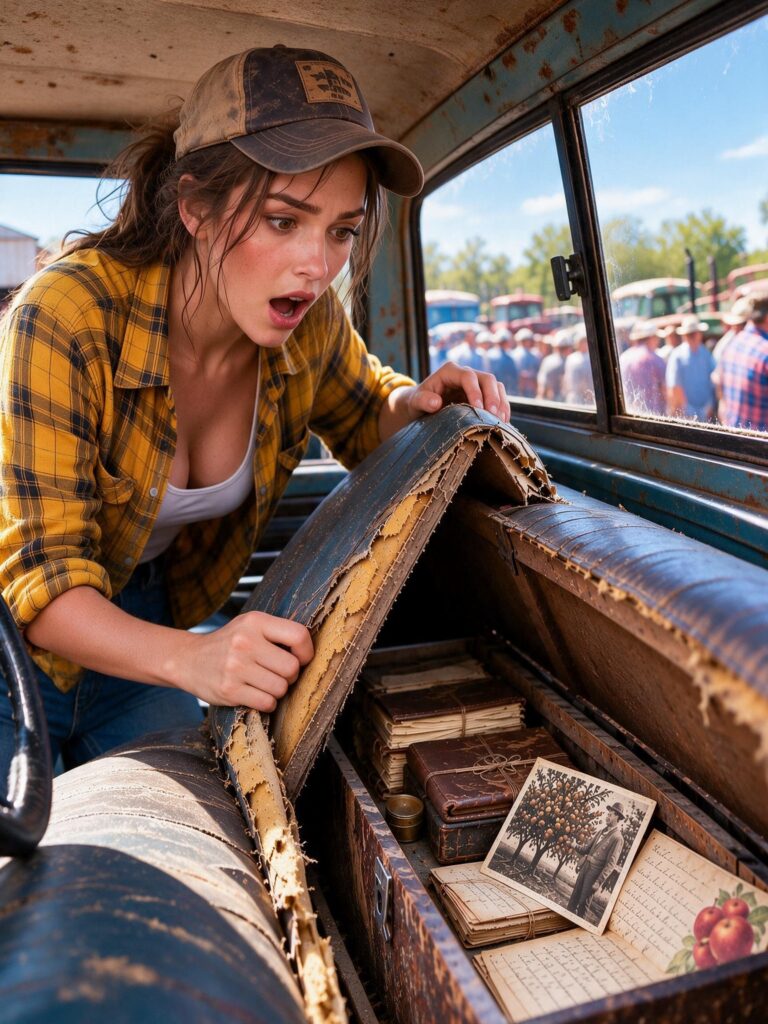
she bought a rusted farm truck for nine hundred twenty dollars and found an old man’s cider notebooks hidden behind the seat while his grandson watched the orchard die
Part 1
The gavel came down at nine hundred and twenty dollars, and the sound of it was small in the cold air of Columbia County. Romy Dolan stood with her bid card still raised a second too long, as if the auctioneer might take it back if she moved. He didn’t. He pointed at her with the handle of the gavel the way a man points at weather he has already decided to ignore, and just like that she owned a 1988 Ford F-250 with a cracked windshield, a bed full of rust holes the size of dinner plates, and a smell like wet hay and old motor oil baked into the upholstery.
She was twenty-five. The flannel at her cuff had a coffee stain that had set in on the drive up from the city two weeks before, and the boots on her feet had already resold themselves twice, once at a thrift store in Hudson and once off a porch in Germantown where a woman had set them out with a cardboard sign that said TAKE IF THEY FIT. Her dark hair was pulled back in a knot that had given up on being tidy sometime around dawn. When she was nervous she tapped two fingers against her thumb, counting something only she could see. She did it now, standing in the gravel lot outside the farm-equipment auction, while a man in a Carhartt jacket loaded a cultivator onto a trailer and did not look at her.
She was broke in the specific way that comes from quitting a city job on principle and finding out principle does not pay rent. The job had been at a food magazine that ran photographs of orchards it had never stood in. She had written a paragraph about a Hudson Valley cider that tasted, she had said, like the memory of weather. Her editor had changed it to notes of green apple and a clean finish. She had quit on a Thursday. By the following Monday she had put a down payment on six overgrown acres outside the town of Ghent, because the listing had said the soil drained and the well still pulled, and because she had wanted, with a stubbornness that frightened her a little, to grow something that had not been rewritten by anybody.
What she needed urgently was a truck that ran. She could not move a bag of lime or a single fence post without one. The F-250 ran, mostly. It coughed twice getting out of the lot, a wet diesel cough that turned a few heads, and then settled into a steady rattle she decided, standing on the running board with both hands on the wheel, to call personality. The clutch was heavy. The heater blew cold air that smelled faintly of mice. The bench seat had a split along the driver’s side that showed yellow foam, and the dome light flickered when she shut the door.
She drove it home to the rented room she was still finishing out of, a second-floor walk-up over a hardware store whose sign had lost the letter H. She parked under a maple going orange at the edges and sat there a minute listening to the engine tick as it cooled. For the first time in months she felt as if she had done something right. Not smart, maybe. Not safe. Right. The six acres were a mile of county road and a dirt lane away, nothing on them yet but goldenrod and a fallen fence and a sugar maple that had split in some winter she had not been there for. The truck was ugly and loud and hers. She put her forehead against the steering wheel and let herself have the one small minute.
It was that night, digging under the bench seat for a spare set of keys the auction clerk had sworn were in the cab, that her hand found something that was not keys.
The gap where the seatback met the frame was full of grit and a dried leaf and the kind of dust that only accumulates when a thing has not been moved in years. Her fingers closed on leather. She pulled. It stuck, then gave. What came free was a folio, cracked at the spine, worn soft at the corners, tied shut with a shoelace that had long since lost its color. The weight of it surprised her. She sat in the cab with the door open and the dome light flickering and untied the lace with cold fingers.
Inside were notebooks. Three of them. The paper had gone the color of weak tea. The hand was small and careful and pressed hard enough to show through the page, the way a man writes when he does not trust his memory and does not want to trust anyone else’s. Grafting records, dated by year and by row. Scion source. Rootstock. Take rate. Notes on bloom and bud, on a late frost in ’91, on a wet June that had blackened the new growth before he could get the ladder around. A section near the back of the second notebook, written slower, more deliberate, as if he were setting down something he did not want to lose.
A cider recipe. Specific gravities noted in the margin. A blending ratio. A line that read, simply, Patience is the whole of it. More than yeast. More than apples.
And tucked between the last two pages, a photograph. The corners were soft and furred from handling. A man in his middle years stood beneath a single apple tree so heavy with fruit the lower limbs nearly touched the ground. He was not smiling. He had one hand on the trunk the way a person rests a hand on a shoulder. Behind him the orchard rows ran back into a bright, ordinary afternoon.
Romy sat with the dome light draining the truck’s battery and asked the question out loud to nobody.
“Whose were these?”
And why had they spent however many years riding hidden behind a bench seat instead of sitting on a shelf where a man could find them?
Columbia County is small, and people like to talk about apples.
She started with the auctioneer’s clerk the next morning, a woman named Dot who kept a thermos on the counter and knew everybody’s truck by the sound it made coming up the drive. Dot looked at the photograph for a long moment and said, “That’s Ellis Faulk. Lord. I haven’t seen that face in a while.” She tapped the tree with one nail. “That’s the tree, too. Or it was. He ran an orchard a few miles out of Ghent for forty years. Before his hands gave out and his knees went, he was locally famous for a heritage apple nobody had managed to name commercially, and a hard cider people still talk about the way they talk about things they assume are gone for good.”
At the diner in Ghent the woman behind the counter, whose name was Marlene and whose coffee was strong enough to stand a spoon in, said the same thing and then said more. Ellis had sold the place off and moved into a small apartment in town when he got too old to manage it alone. The farm had changed hands once, briefly. The man who bought it had lasted inside of two years. He had auctioned the equipment. Apparently, without knowing it, he had auctioned the knowledge that rode along hidden in the cab.
“And the orchard?” Romy asked.
Marlene wiped the counter that did not need wiping. “Still sitting out there. Half dead. Ellis’s grandson has it now. Reed. Nice boy, or he was. Doesn’t speak much to anybody about it. People say he’s watching it go under. People say he ought to sell before the county does it for him.”
Romy should have mailed the notebooks to the old man and called it a good deed finished. She knew that. She sat with them three nights running at the kitchen table in the rented room, the radiator knocking, the hardware store dark below her, reading grafting records like they were a language she was starting, against her better judgment, to love. She traced the dates with her finger. She read the line about patience until she could have said it without looking. On the third night she put the folio on the passenger seat of the truck and set an alarm for before dawn.
The Faulk orchard sat at the end of a dirt lane off Route 9. Maybe fifteen acres of trees gone shaggy and wild, suckers thick around the trunks, deadwood silvering in the high branches. The October morning was cold and bright. Frost still held in the shade of the stone wall. Romy drove in with the folio on the seat beside her and no real plan beyond showing somebody what she had. The lane was rutted. The F-250 took the ruts like an old dog taking stairs, complaining and continuing.
The man who came out of the equipment barn had Ellis’s jaw and Ellis’s height and none of his ease. Reed Faulk was twenty-eight, broad through the shoulders from years of orchard work that had not, by the look of the place, been enough. Dark-haired. A guarded, watchful face that made it clear he would rather be doing almost anything else than talking to a stranger standing in his driveway. He had a pruning saw in one hand and sawdust on his forearms. He looked at the folio under her arm the way a man looks at a summons.
“Can I help you?” he said, in the tone of a man who hoped the answer was no.
She told him what she had found. Plainly. She handed him the top notebook so he could see the handwriting for himself.
His face did something complicated when he opened it. Recognition. And then something harder underneath it. He read two pages in silence, standing in his own driveway with the saw still in his other hand. A jay called from the deadwood. Somewhere behind the barn a bird made a sound that was not quite a bird.
“Where’d you get this?”
“Behind the bench seat of a truck I bought at auction. Nine hundred and twenty dollars. I think it used to belong to the people who bought this place off your grandfather.”
“And you drove out here because.”
“Because this is your grandfather’s handwriting. And because I think you need it a lot more than I do.”
He closed the notebook. The cover made a soft sound. “People around here have been telling me for two years I ought to just sell this place before it finishes dying on its own. Now a stranger shows up with my grandfather’s cider recipe in her hand. You want to tell me what you actually want, or should I guess?”
It was not an unfair question, and it needled her a little, the suspicion in it. So she needled back.
“I want to grow apples that taste like something, Mr. Faulk, and sell them for more than a dollar a pound to a man who doesn’t care what they’re called. I don’t want your orchard. I want six acres a mile from here that I already own and nothing growing on them worth the name. I was hoping you’d let me learn from what’s in these books, since it sounds like you’ve got trees dying for lack of exactly what’s written in them.”
That stopped him. He looked at the notebooks again, then at her, and something behind his eyes shifted. Not trust. Not yet. Just the recognition that he was standing in front of a problem that might, infuriatingly, have a solution he had not asked for.
“I don’t have money to pay anybody,” he said.
“I don’t have an orchard. Call it even for now.”
He did not smile. Not quite. But he stepped back from the doorway of the barn in a way that was its own kind of invitation, and the cold bright morning moved past them both into the dark of the equipment bay, where an old press sat under a tarp and a length of hose had been coiled so carefully it looked like a man trying to keep one small thing in order while the rest of the place went to weather.
Part 2
What Reed had, and what Romy quickly understood she needed, was the orchard itself. The land. The trees. Whatever was left of his grandfather’s famous apple, a variety nobody had ever formally registered, known locally just as the Faulk apple. Firm and tart and strange in a way that made a cider taste like something instead of like sweetened water. What Romy had was the written record of how Ellis had done it. And Reed, who came to admit this slower, over several weeks of stiff, careful conversation across the tailgate of her truck, had a head for the work and no head at all, by his own flat accounting, for turning a craft into something that could pay its own bills.
They met in the mornings because the afternoons belonged to the second job he kept in town, stocking shelves at the feed store until the lights on the orchard house could stay on. He did not offer her coffee the first week. The second week he set a dented thermos on the tailgate and did not say it was for her, and she drank from the cup without asking whose it was. The third week he told her, without looking at her, that his grandfather used to mark the rows by compass heading because the old stone wall at the southeast corner had been there longer than the deeds.
They found the mother tree together on that third week, working off a hand-drawn map in the back of the second notebook. The map was pencil gone faint. Rows by heading. Distance from the wall. A note in the margin that said do not graft the north side after the fifteenth, the wood stays wet. They walked the southeast corner with the notebook open between them. Wild raspberry had taken the understory. A black locust leaned over the row like a man who had given up standing straight. And there, half swallowed, stood a single enormous apple tree that nothing else on the place resembled. Gnarled. Lichen-silvered. Still stubbornly bearing a scatter of small, dense, deep-red apples that had not fallen even though the rest of the orchard had already given its fruit to the ground or the deer.
Reed picked one. He split it with his thumbnail and handed her half without a word.
She bit into it and understood in about four seconds what all the talk in town had been about. It was tart enough to make her eyes water, and then underneath, something like honey and stone. The juice ran down her wrist. She did not wipe it.
“This is it,” Reed said. His voice had gone careful, the way a man’s voice goes when he is standing next to a thing he has been afraid to name. “This is the only one left. Everything else he ever grafted off of it is gone. Cut. Died. Sold off in pieces. This tree is the whole variety now. If this tree goes, there’s no more Faulk apple anywhere. Ever.”
That single fact reorganized everything they did from then on.
Grafting, Romy learned, meant taking a short length of one-year-old wood from the mother tree, scion wood, cut dormant in late winter before the buds broke, and joining it to a rootstock, a separate young tree chosen for its roots rather than its fruit, so that the two grew together as one. Done right, it was the only way to clone a specific apple variety exactly. Apple seeds do not grow true to their parent. Every Faulk apple tree that had ever existed, including the mother tree itself, had started life as a graft, not a seed. Ellis had written it in the first notebook as if he were explaining it to a person who might someday need it and might not have him there to ask. Romy read that page in the truck with the heater finally working and felt the particular loneliness of a man writing instructions for a future he could not see.
Their first attempt, in early spring, failed almost completely.
She had been impatient to see something take. The winter had been long. The six acres still had nothing on them worth the name, and the rented room still smelled like radiator dust, and she had wanted, badly, a green thing that was hers and his and the old man’s at once. She cut her scion wood too thick. She shaved the cuts at angles that did not match. When she bound scion to rootstock with grafting tape, the thin green layer just under the bark on each piece, the cambium, where new growth actually happens, never lined up. Out of thirty grafts, two leafed out weakly and died by June. She stood over the row of dead whips with her hands in her jacket pockets and did not cry, because crying felt like a luxury the trees had not offered her.
“Cambium doesn’t forgive,” Reed told her, standing beside her in the same posture, as if they had agreed without speaking to look at the failure the same way. “You can be an inch off and it still won’t take. Has to touch. Has to line up on at least one side. Clean. Or there’s nothing for the wood to heal into.”
He did not say she had wasted the wood. She heard it anyway. That night she wrote the number on her kitchen wall in pencil. Thirty. Two. Dead by June. Under it she wrote the line from the notebook, not because it comforted her, but because she did not want to be the kind of person who only wrote down the wins.
The second round they cut thinner. Matched carefully, side to side. Bound tight. Sealed with wax at the cut end to keep the wood from drying out. Twelve of eighteen took. She wrote that number on the wall too, larger, and stood back from it as if it might change if she looked away.
Not everything that went wrong was a grafting problem.
In July they lost an entire row of three-year-old trees to fire blight. It is a bacterial disease that moves fast in warm, wet weather, blackening new growth from the tip backward until it looks scorched, which is where the name comes from. Reed caught it a week later than he should have because he was out at the second job, trying to keep the lights on. By the time they cut the infected limbs back well below any sign of blackened wood, the way Reed said his grandfather always had, the disease had already jumped two trees over. They lost both entirely. Pulled them in August. Burned the wood instead of composting it so the bacteria would not carry over in the mulch. The burn pile smoked for two days. Romy stood upwind with her sleeves over her hands and thought about how much of a life could be reduced to what you were willing to set fire to in order to save the rest.
Their first batch of cider went to vinegar, and that one hurt the worst because it felt the most avoidable.
They had pressed four hundred pounds of apples that September. The Faulk apple, mixed per the notebook’s ratio with two other varieties for acid and tannin, a tart seedling from the north row and a tannin-heavy unnamed tree Ellis had marked only as wall tree, good mouth. They let the juice ferment in a food-grade barrel in the equipment barn without controlling what yeast got at it. Wild yeast off the apple skins took over before they had thought to add a cultured strain. Alongside it, because the barrel was not airtight and the barn was not cool enough, the bacteria got in too. The kind that turns alcohol into acetic acid. The thing that makes vinegar vinegar. By November the whole barrel smelled like salad dressing. Romy lifted the lid and the smell came up into her face and she laughed once, short and ugly, because if she did not laugh she was going to put her fist through the stave.
Ellis’s notebook, they realized too late, had a line about it. Keep it cold till it’s working proper, and keep air off it after. They had read the line and not understood, until they had lived it, exactly how much weight those few words were carrying.
Reed stood over the ruined barrel with his hands braced on the rim. The barn was cold. Outside, the first real frost had silvered the mother tree’s remaining leaves. He said the thing Romy would remember twice. Once in defeat. Once, eight months later, in triumph.
“My grandfather used to say an orchard doesn’t owe you anything for trying. It only pays out for getting it right.”
At the time it landed like an accusation. She took it. She had earned it. She went home and wrote the sentence on the kitchen wall under the graft numbers, and then she turned the notebook back to the first page and started again, slower, the way the hand in the book had been slow when it was setting down something it did not want to lose.
Part 3
They went into town once that first winter and tracked down Ellis Faulk himself.
The apartment was on the ground floor of a house that had been split into three, on a street in Ghent where the sidewalks heaved from maple roots. Reed knocked like a man who was not sure he would be welcome. The door opened on a frail man in his eighties with Reed’s same watchful eyes gone soft and pale. He had a cardigan buttoned wrong. His hands, when he reached for the folio, shook in a fine constant way that had nothing to do with cold.
He was delighted. He was a little disbelieving. He held the top notebook the way a person holds a thing they had already buried.
“I looked for these,” he said. His voice was thin and exact. “After I sold. I thought the fellow who bought the place had them in the house. He said he hadn’t seen them. I figured they’d gone out with the trash, or into a box somebody didn’t open.” He turned a page. The handwriting met him like a relative. “Behind a truck seat. I’ll be damned.”
He could not climb a ladder anymore. He could not steady a graft. His hands shook too much for the knife work, and he said so without apology, the way a man states a fact about weather. But he answered what questions they brought him, slow and precise, correcting a date here, a ratio there. He told them cultured cider yeast would behave itself in a way wild yeast never would. He told them patience, in his recipe, mostly meant not bottling before the specific gravity had dropped far enough to tell him the sugars were truly done fermenting, not just slowed. He made Romy read the hydrometer the way he had read it, eye level, no tilt, and he nodded when she got it right as if she had passed a small examination he had not announced.
He could not run anything for them. The notebooks and their own four hands were still going to have to do the actual work. But he sent them back out to the orchard that day with something steadier in both of them than they had come in with. At the door he put a hand on Reed’s shoulder, brief, and said, “You don’t have to save all of it. You have to save the tree. The rest is just acres.”
Somewhere in all of this, without either of them quite naming it, the space between them had changed.
It happened in small places. Reed’s hand over hers, steadying a graft when her wrists were shaking from cold, his palm rough and sure and gone again the second the tape held. An argument at dusk over whether to pull a dying row that was not really about the row at all, but about how scared he was of losing the only thing his grandfather had ever handed him. The last inch of coffee in the thermos left for the other one without being asked. A silence in the cab of the F-250 that stopped feeling like suspicion and started feeling like two people who did not need to fill the road with talk.
And then there was Pippen.
The emu had come with the property from the previous owner’s failed attempt at diversifying livestock. A nosy, gangly bird with a look in his eye that suggested he had opinions about the orchard and intended to act on them. Reed had never had the heart to sell him. “He’s mean,” Reed said, the first time the bird came around the end of the row at a trot. “And he’s useless. And he was here when I got here, so he’s staying.” Pippen developed an early and persistent habit of interrupting them at exactly the wrong moments. He swiped apples off the sorting table. He made off once with Reed’s good pruning saw at a dead sprint across three rows, while both of them chased him, shouting, the saw bouncing in his beak like a prize he had won fair. On one particularly dark evening, when the light had gone blue and Romy had turned to say something she had not yet decided the shape of, Pippen shoved his long ridiculous neck directly between their faces at the precise second the something was about to be said, as if personally offended at the idea of being left out of it.
Reed, red-faced, swore at the bird. Romy laughed so hard she had to sit down in the grass. It was, in its way, the closest they had come to it yet. She sat there with her knees up and the cold coming through her jeans and watched Reed try to look angry and fail, and she thought, with a clarity that startled her, that she was going to stay long enough to see whether the grafts held. Not because of him. Because of the tree. And also, if she was honest in the dark where nobody could audit her, because of him.
Their first sale came almost by accident. That same difficult first autumn, before the vinegar disaster had finished teaching them, a dozen bottles of a small early batch had, against expectation, come out clean and good. A neighbor down the road smelled them pressing apples and wandered over out of curiosity. He tried a glass. He stood with it a moment, looking at the mother tree as if the taste had pointed him at it. Then he paid forty dollars for four bottles on the spot, cash, mostly out of goodwill, and told them his wife would want the rest if they ever had more that didn’t smell like pickles.
It barely covered the cost of the bottles. It proved something. Romy wrote it on the kitchen wall under the graft numbers. People will pay for it if it’s real.
By the second autumn, with twelve grafted trees finally into their third leaf and the orchard’s older trees pruned back hard and sprayed on schedule against the blight, they had enough fruit. The mother tree. Two of Ellis’s surviving unnamed seedling trees that turned out to carry some of the same character, tart first, then the honey and the stone. They pressed eleven hundred pounds. The cider that came off that batch used cultured yeast this time. Fermented cool, in a cleaned and sealed barrel, in the back of the barn where Reed had hung a thermometer and checked it the way a man checks a fever. Blended by taste against Ellis’s notebook ratios until Reed declared it close enough to what he remembered from boyhood to make his throat tight.
It came out dry. Sharp. Long on the finish. Nothing like the syrupy commodity stuff sold at the big regional presses for eight dollars a gallon. They bottled two hundred and ten bottles in the equipment bay with the door open and the October light coming in sideways. Pippen was shut in the old sheep pen for the duration and made his feelings known to the entire county.
A chef named Saurin, who ran a small farm-to-table place in Hudson, bought a case to taste and put it on his menu inside a week. He called Reed, not Romy, because Reed’s number was the one on the handwritten label, and he said, “This tastes like somebody paid attention. Don’t change it.” And a buyer named Priya Alcott, who ran a bottle shop forty minutes south and had a reputation for hunting down exactly this kind of thing, tasted it standing at her own counter, went quiet for a second, and then asked how many cases they could commit to for the spring.
She paid eighteen dollars a bottle wholesale. More than double what either of them had dared hope. She took every bottle they had left after Saurin’s case. Forty-two of them. Cash on delivery. She loaded them herself into the back of a station wagon that already smelled like other people’s good decisions.
It was not a living yet. It was real, and it was theirs. And for the first time since Reed had inherited a dying orchard, he said the word maybe out loud about its future. They were in the truck, headed back up the lane, the empty crates rattling. He said it to the windshield, not to her. Romy noted it was the first optimistic word she had heard out of him since October, and she did not spoil it by telling him so.
That night she added the number to the kitchen wall. Eighteen. Forty-two. Maybe. The pencil was getting short. She did not sharpen it. She liked the evidence that the wall had been written on by a hand that was tired and still writing.
Part 4
The trouble came in the spring of the second year, in two pieces that landed almost on top of each other.
The first piece was the fire blight again, worse this time, and it hit the mother tree directly. A cluster of blackened, wilting shoots at the crown. Reed found them on a wet gray morning in May. He stood looking at them for a long time before he said anything to Romy at all. When she came up the row with the grafting knife already in her pocket, because she had learned to carry it the way other people carry keys, he did not turn around. He said, “It’s in the top.” His voice was flat. “I cut what I can reach. I can’t reach the rest without the tall ladder, and the tall ladder has a cracked rung I’ve been meaning to fix since March.”
They had taken sixty grafts off that tree over two seasons and had thirty-one living young trees to show for it. It should have felt like security. It did not. Not with the original standing there blackening limb by limb while they cut and burned and prayed the infection would not reach the main trunk before they got ahead of it. The entire variety, every bottle of cider they would ever make, still rested on that one old tree’s survival long enough to finish securing its line in younger wood. If it died before they had taken enough scion wood to be sure the graft stock would hold and propagate reliably on its own, something genuinely irreplaceable would be gone. Not a product. A thing that had taken a man’s forty years and a boy’s inheritance and a stranger’s nine hundred and twenty dollars and turned them into a taste nobody else had managed to keep.
The second piece arrived four days later as a phone call. Then a visit.
A regional cider company, midsized, with distribution across three states, had heard about the Priya Alcott account and the small, strange, well-reviewed cider coming out of an old Hudson Valley orchard. They wanted exclusive rights to the Faulk apple. To buy out the variety entirely. Propagated at scale on contracted land. Put on shelves nationally under their own label. The man who came to the orchard wore clean boots and a jacket that had not met a burn pile. He was polite. He was not cruel. He stood in the driveway where Romy had stood two years before with the folio under her arm, and he looked at the mother tree with the respectful interest of a person who has already converted a living thing into a line item.
The number they offered for full exclusive rights and a non-compete on growing or selling the variety independently was ninety-five thousand dollars.
It was, by any honest measure, enough to save the Faulk orchard outright. Pay off its back taxes. Replace the failing equipment. Put both of them on stable footing for years. The press needed a new bladder. The well pump had started to knock. Reed’s second job had cost him a week of blight he would not get back. Ninety-five thousand dollars should have been an easy yes.
Instead it broke something open between them.
Reed, frightened in a way he did not have good words for, watched Romy sit with the offer letter for two days without immediately rejecting it, and the fear curdled into something uglier and more familiar to him. The oldest story in the valley. An outsider showing up, finding something worth money, and walking off with it. He had heard that story about his grandfather’s buyer. He had heard it about farms up and down Route 9. He had not expected to hear it in his own mouth, aimed at her.
“You found the notebooks in a truck,” he said, low and furious, standing in the barn with the mother tree’s cut, blackened limbs still smoking faintly on the burn pile outside. The smell of it was in his clothes. “You didn’t grow up watching this place die. Maybe this is just numbers to you. Maybe ninety-five thousand dollars sounds like a very reasonable thing to take for my grandfather’s whole life’s work.”
“I’m sitting with it because I’m trying to be fair to both of us,” she said. Her hands were clean for once. She hated that they were clean. “Not because I’ve decided anything. You don’t get to stand there and tell me what I want before I’ve told you myself.”
“Then tell me.”
She didn’t have the answer fully formed yet. The letter was on the tailgate under a stone so the wind would not take it. The number was large enough to pay for the six acres outright, large enough to mean she would not have to choose between lime and rent, large enough to scare her because of how reasonable it sounded when she said it in her head. In the silence where the answer should have been, he took it as confirmation of everything he was afraid of. And she took his face closing over as confirmation of everything she had started to suspect about why he never let anyone close to anything that mattered to him.
They didn’t speak for six days.
The work did not stop, because blight does not pause for a fight. They cut on opposite ends of the row. They burned on a schedule Reed wrote on a feed-store receipt and left on the barn nail. The mother tree kept dying in slow motion the entire time. Each morning the black had moved a little farther down. Romy dreamed of cambium that would not meet. She woke at four and lay in the rented room listening to the hardware store’s cooler kick on below her and thought about the line in the notebook. Patience is the whole of it. She was not sure patience was what she was practicing. She was sure that if she waited for Reed to speak first, the tree would finish what the blight had started, and the variety would become a story people told in a diner about something they assumed was gone for good.
On the fifth night she drove out anyway. She did not go to the house. She walked the southeast corner with a flashlight and stood under the mother tree and put her hand on the trunk the way the man in the photograph had. The bark was cold and rough and alive. Up in the crown she could see, even in the bad light, the places where the green had quit. Lower down, below the cuts, the wood was still sound. She counted usable shoots the way she counted on her fingers when she was nervous. There were enough. There were not enough if she waited.
She went home and sharpened the grafting knife on the stone Reed had given her in March and had pretended was just a spare.
Part 5
It was Romy who moved first, not with words, but with work.
She went out alone before dawn on the seventh day with the grafting knife and a cooler of ice and cut every usable length of healthy scion wood still left on the mother tree. The halflight was blue and cold. Her breath showed. She worked fast and careful, racing wood that was browning from the crown downward, taking only what was still green under the bark when she nicked it with her nail to check. The ladder with the cracked rung held because she had wrapped the crack with tape the night before, alone, in the barn, while Pippen watched her from the pen and made a low sound that might have been commentary. She filled the cooler. She did not go to the house. She did not leave a note. The note was the work.
She grafted the whole lot onto rootstock that afternoon. Forty-four new grafts in a single day, more than they had ever attempted at once, because she understood with total clarity that the only thing that mattered right now was making absolutely sure the variety could not be lost, even if the old tree finally gave out. Her hands split at the thumbs. The wax got in her hair. She matched cambium until her eyes burned, and when a cut did not line up she cut it again instead of hoping. Twelve of eighteen had taught her what hoping cost. By the time the light went long and gold across the rows, the new whips stood in their line, taped and sealed, ugly and possible.
Reed found her in the row at dusk. He had the look of a man who had driven to town and driven back and not known, until he saw the cooler and the tape and the wax on her sleeves, what the day had been for. He understood what she had been doing before she said a word.
“You could have sold the rights,” he said quietly. “And let the company keep it going somewhere safe. Instead you’re out here trying to save the thing for nothing.”
“It was never going to be nothing,” she said. She did not stand up. Her knees had opinions about the day. “I just wasn’t going to decide what it’s worth without you in the room.”
He sat down in the wet grass across from her, between the rows, in the lingering apple-scented dark. For a while he did not talk. A thrush tried a note and thought better of it. When he spoke, it was the thing he had been circling for days.
His grandfather had given everything he had to one piece of land and one strange apple nobody else had bothered to save. Selling the rights to a company that would own it, rename it probably, grow it on contracted acreage somewhere in Pennsylvania with his grandfather’s name nowhere on the label, that was not saving the orchard. That was finishing the job of losing it, just with better money attached.
“I don’t want to be the Faulk who sold it,” he said. “I’d rather go under honest.”
“You’re not going under,” she said. “I just grafted forty-four trees today. We’ve got thirty-one more from last year starting to bear next season. Give me two more years and we won’t need their ninety-five thousand. We’ll make our own.”
He looked at the row. At her hands. At the mother tree, scarred at the top, still standing. He nodded once, the way his grandfather would nod two years later over a glass, a small motion that carried more agreement than a speech.
They turned the company down the following week. A short, plain letter that took Reed four drafts to get the tone right on. Civil and firm. No hard feelings stated, and meant. Romy read the last draft at the kitchen table and did not add a word. Some sentences do not need a second hand.
The mother tree held on. Scarred and asymmetric, but alive. Its crown cut back hard to clean wood. By July it was pushing new green growth from well below where the blight had been. Romy walked out to it every morning for a month as if the green might be a trick of the light. It was not a trick. The leaves were small and bright and ordinary and worth more than the letter under the stone.
It was that evening, with the new growth still raw and bright on the old tree and the whole business of saving it finally actually finished, that Reed reached over without any particular ceremony and took her hand where it rested on the porch step. She let him. Neither of them said anything especially clever about it, which was its own kind of relief after two years of being clever at each other. He kissed her there in the ordinary porch light with apple smell still on both their hands. Somewhere off in the dark, Pippen made an enormous, affronted noise at being left out of whatever was happening, which neither of them minded even slightly.
From there it grew the way real things grow, in stages that each existed because the one before it had worked.
The thirty-one grafted trees from the first two seasons came into bearing the next year. Light, but real. Enough fruit that they pressed six hundred gallons instead of one hundred and fifty. Priya Alcott’s order became a standing account, forty cases a season. Saurin’s restaurant put the cider on tap instead of by the bottle, which meant a steadier draw than either of them had dared plan for. A second bottle shop in Hudson signed on the year after. Then a third account up near Kinderhook. Then two more restaurants between Chatham and Rhinebeck that heard about it by word of mouth before anyone had to go looking for them.
By the fourth year the mother tree’s descendants numbered better than two hundred grafted trees across what had been the dead, overgrown back acreage of the Faulk orchard. They bore enough fruit, alongside the original seedling trees, to press eleven thousand pounds of apples a season and bottle close to four thousand bottles of what they had started calling, plainly, Faulk Heritage Cider. Wholesale at twenty dollars a bottle. Nine standing accounts across three counties. Just under nine thousand dollars a year in cider sales alone, which was not a fortune and was, finally, enough. Enough to hire their first real hand. A quiet, steady young man from Chatham named Elias Brandt, who had grown up on a dairy farm and took to orchard work like he had been doing it all his life. He coiled hoses without being asked. He did not try to rename the apple. Reed trusted him with the tall ladder, which was its own kind of vow.
Romy and Reed married the following spring in the orchard itself, under trees that four years earlier had been suckered-over deadwood nobody believed in. The guests stood between the rows because there was no aisle, only grass and the smell of bloom. Ellis came in a folding chair Reed carried from the barn, and he did not speak during the short ceremony, and he did not need to. Nobody was especially surprised when Pippen, uninvited and entirely undeterred, wandered through the middle of it and made off with half a sheet cake before anybody could stop him. Marlene from the diner laughed until she had to borrow a napkin. Dot the auction clerk, who had driven out because she said she liked to see where a truck ended up, told anybody who would listen that she had known the F-250 was going to amount to something. She had not known. It did not matter. The cake was a loss. The afternoon was not.
The first full harvest off the saved and grafted trees came that autumn, heavier than either of them had let themselves hope for. The evening they finally poured the first bottle of that year’s run, clear, deep gold, sharp and long on the finish, exactly the way Ellis’s old notebook had promised, Reed held his glass up to the barn light and said, quiet, mostly to himself, that his grandfather had always said an orchard doesn’t owe you anything for trying. It only pays out for getting it right. And this time the words landed the way they were always supposed to. Not as an accusation. As a simple earned fact standing right there in the glass between them.
A year on, old Ellis Faulk, ninety now and slower than ever but steady enough for one more good outing, let Reed drive him out to the orchard on a bright October afternoon. He sat in a folding chair in the shade of the restored mother tree, its crown uneven but thick with leaf and fruit, while Romy poured him a glass of that season’s cider. The truck she had bought for nine hundred and twenty dollars was parked at the end of the row, uglier than ever, still running. The folio was not in it. The notebooks sat on a shelf in the farmhouse kitchen, pages soft with handling, where anyone could find them.
Ellis drank slowly. He looked up through the branches at the tree he had planted from a seedling sixty years before. He did not say a single word about business, or deals, or money. He turned the glass in the light the way he must have done ten thousand times across forty years, checking the color, the clarity, the way it caught gold at the rim.
“Tastes like it did,” he said finally, to no one in particular.
That was the whole of his verdict. It was enough to make Reed’s eyes go bright for a second before he looked away toward the rows. The thirty-one trees had become two hundred. The two hundred would become more. Elias Brandt was coiling a hose near the barn, giving the old man his space. Reed stood with one hand resting on the back of his grandfather’s chair, not saying much, because there was not much that needed saying. Romy sat on the grass with her knees pulled up, watching Ellis, and felt the particular quiet of a thing that had nearly been lost and had not been.
Pippen, having given up on the folding chair, wandered off toward the press shed and could be heard a moment later making an enormous commotion over something he almost certainly was not supposed to have. Ellis laughed at the sound of it, a dry, delighted laugh, and lifted his glass an inch toward the tree above him. Nobody needed him to explain what that meant. The orchard that afternoon smelled the way it had that first October, when a woman in resold boots had driven out with a folio under her arm and no plan except to show somebody what she had found. Crushed apple skins. Damp leaf litter. The faint vinegar-sweet tang of pomace drying in the sun by the press shed. Patience, the old man had written, is the whole of it. More than yeast. More than apples. She believed him now. Not because the sentence was beautiful. Because the glass in his hand was full, and the tree above him was alive, and the truck at the end of the row still started when she turned the key.


