
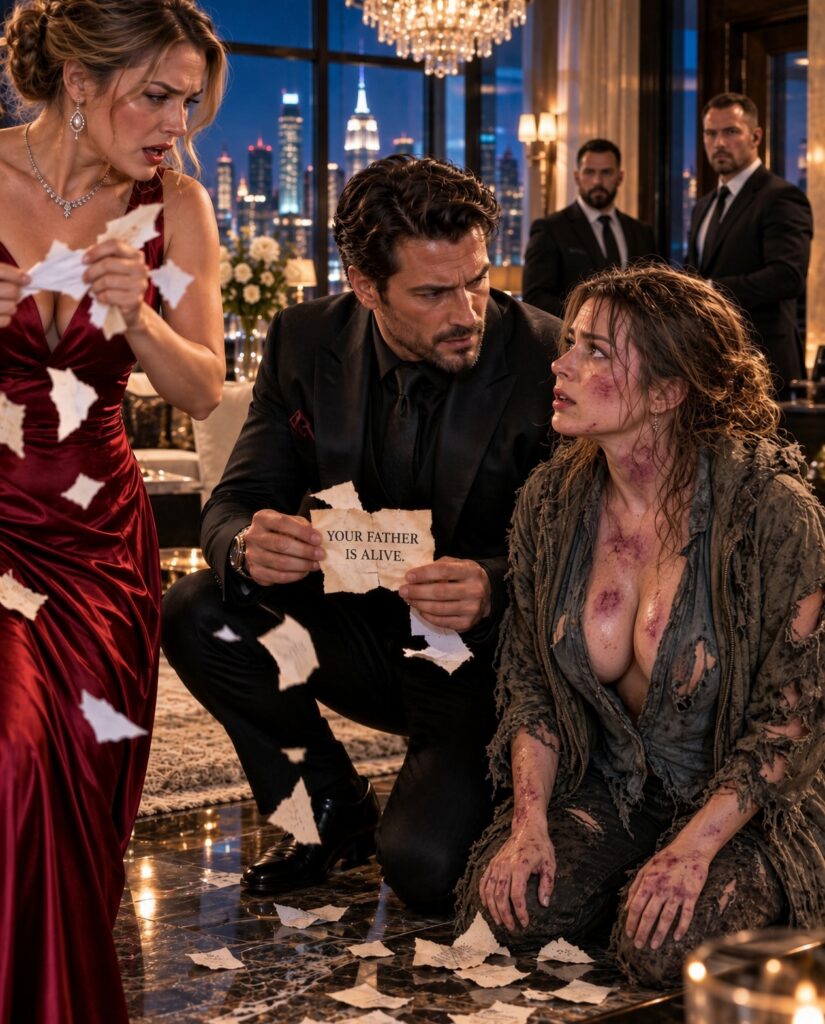
The Homeless Woman Brought a Torn Letter to New York’s Most Feared Mafia Boss—His Fiancée Destroyed It, Until Four Surviving Words Exposed the Brother’s Murder, a Stolen Empire, and the Father Everyone Told Her Had Died Eight Years Earlier
A homeless woman spent her last four dollars crossing Manhattan in a September storm to deliver Roman Moretti a warning, only to watch his glamorous fiancée tear the letter into pieces and order security to throw her back into the rain.
Then Roman found four surviving words on the marble floor—ASK WHO BETRAYED LUCA—and every locked door inside Harbor Crest Tower suddenly became more dangerous than the woman everyone had mocked in the lobby.
By midnight, Emily Carter would learn that her father had not died eight years earlier as she had been told, Roman would discover his brother’s murderer shared his own blood, and the most powerful man in the building would have to choose between protecting his empire and exposing the truth that could destroy it.

PART 1 — THE LETTER HIS FIANCÉE COULD NOT AFFORD TO LET HIM READ
“If Mr. Roman Moretti does not read this letter in the next ten minutes, someone inside this tower is going to die.”
Emily Carter’s voice cracked across Harbor Crest Tower’s marble lobby.
Three security guards turned.
So did half a dozen guests dressed for Roman Moretti’s engagement celebration forty floors above.
Emily stood beneath the chandeliers soaked from the September rain, her faded jeans dark at the knees and her oversized gray shirt clinging to shoulders gone thinner during four months of homelessness.
She looked like the last person anyone in that building expected to carry a warning worth hearing.
“Ma’am, you need to leave.”
The head guard took her arm.
Emily pulled away.
“I’m not asking for money.”
“I’m not asking to see his apartment.”
“Just give him this.”
She held up a battered cream envelope.
She had protected it beneath her shirt for six blocks after spending the last four dollars in her pocket on a bus downtown.
An elderly man outside a shuttered subway entrance had pressed it into her hands before paramedics took him away.
He had been shaking.
Bleeding near one temple.
And terrified enough to make Emily ignore every instinct telling her to mind her own business.
One name had left his mouth clearly.
Roman Moretti.
“What is going on?”
A woman crossed the lobby in a crimson designer gown.
Vanessa Sinclair.
Roman’s fiancée.
Diamonds at her throat.
A face Emily recognized from gossip magazines displayed at convenience-store counters she could no longer afford to shop in.
“She says she has an urgent message for Mr. Moretti,” a guard explained.
Vanessa’s eyes dropped to the envelope.
For half a second, fear crossed her face.
Emily saw it.
Then the smile returned.
“Give it to me.”
“I was told Roman has to read it himself.”
Vanessa stepped closer.
“You think a man like Roman is interrupting two hundred guests because some homeless woman wandered in from the rain?”
Several people laughed.
Emily’s cheeks burned.
“You can laugh after he reads it.”
Vanessa’s smile vanished.
She snatched the envelope.
“No!”
Emily lunged.
Security restrained her.
Vanessa tore the letter once.
Twice.
Again.
White scraps fluttered across the polished floor.
Emily stared.
“You don’t understand what you just did.”
Vanessa leaned near enough for Emily to smell expensive perfume.
“I understand perfectly.”
The elevators opened.
Every guard straightened.
Every conversation died.
Roman Moretti stepped out wearing black trousers and a white shirt with the sleeves rolled to his forearms.
At thirty-eight, he controlled construction firms, clubs, shipping interests and a family name New Yorkers still spoke carefully.
But what stopped Emily was not wealth.
It was the tiredness behind his eyes.
He saw her on her knees gathering scraps.
Saw two guards holding her.
Saw Vanessa above her.
“Let her go.”
They obeyed instantly.
Vanessa hurried toward him.
“Roman, she’s nobody.”
Emily rose slowly.
Humiliation shook through her body, but she held out one torn fragment.
“A stranger told me your life depended on this.”
Roman took it.
Four handwritten words remained.
ASK WHO BETRAYED LUCA.
His face emptied.
Luca had been Roman’s younger brother.
Dead three years.
The official story said a drunk driver caused the crash.
The Moretti family had never released suspicions of betrayal publicly.
Vanessa went pale.
Roman saw that too.
He lifted his eyes from the paper and looked around the lobby.
Not at Emily anymore.
At everyone else.
“Lock the doors.”
His voice barely rose.
Security moved anyway.
“Phones on the desk.”
“No calls leave this building.”
Vanessa froze.
Roman crouched and picked up another piece of the letter.
Then another.
He looked at Emily.
“Help me put it back together.”
For the first time in months, someone was speaking as if her memory mattered.
Emily knelt beside him.
And as they fitted the torn pieces together beneath a chandelier worth more than every possession she had ever owned, one sentence slowly appeared between them:
WEST SERVICE ELEVATOR. 11:40 P.M. DO NOT LET THE WOMAN BESIDE YOU SEE THIS.
Roman looked at the clock.
11:17.
Then he looked up at Vanessa.
And Vanessa Sinclair stopped pretending she was not afraid.
PART 2 — THE WOMAN THEY THREW OUT KNEW WHICH FACE DID NOT BELONG
For several seconds, nobody in the lobby spoke.
Rain ticked against the forty-foot windows.
The quartet playing upstairs had stopped, but faint footsteps and music still drifted from the ballroom floors above, where two hundred people believed they were attending a celebration.
Roman remained crouched beside the security desk.
“What happens at 11:40?”
Emily asked.
His eyes shifted toward the elevators.
“My private detail changes floors.”
“How many people know that?”
“Six.”
Vanessa gave a short laugh.
“Roman, come on.”
He looked at her.
“Anyone could have learned the schedule.”
“No.”
His answer was quiet.
“They couldn’t.”
He turned toward his head of security, Anthony Russo.
“Change the rotation.”
“No one uses the west elevator.”
Anthony reached for his radio.
Emily suddenly grabbed Roman’s wrist.
Every guard tensed.
She let go immediately.
“Sorry.”
Roman looked at her.
“But him.”
She pointed toward a broad-shouldered security officer near the entrance.
“I’ve seen him before.”
The guard’s face hardened.
“You’re mistaken.”
Emily shook her head.
“No.”
She had spent four months sleeping in shelters, waiting rooms, bus stations and, twice, beneath a church awning.
You learned faces.
Especially faces that looked at you more than once.
“He was across Canal Street tonight.”
“When that old man handed me the envelope.”
The guard scoffed.
“Hundreds of people cross Canal Street.”
Emily looked at Roman.
“He never checked his phone.”
“Never looked at traffic.”
“He was watching us.”
Roman stepped between them.
“Name?”
The guard swallowed.
“Derek Shaw.”
“Three years with the building, sir.”
“Why were you on Canal?”
“Dinner.”
A hesitation.
Tiny.
Roman noticed it.
So did Emily.
“Where?”
Derek’s hand moved toward his belt.
Anthony’s men hit him before he reached the radio clipped at his waist.
He was against the wall in seconds.
Vanessa gasped.
Emily did not.
She was watching Derek’s face.
Not panic.
Anger.
Being discovered had offended him more than being restrained frightened him.
“Take him downstairs,” Roman said.
“Alive.”
Derek glared at Emily as two guards dragged him away.
“You’re listening to a street rat.”
Roman turned.
“Her name is Emily Carter.”
The entire lobby seemed to contract.
“Use it.”
Emily looked at him.
He did not touch her.
Did not make a performance of defending her.
He simply restored her name to a room that had erased it.
It hurt almost more than the insult.
“You may have saved everybody here from walking into something blind,” Roman said.
Emily shook her head.
“I remembered a face.”
“Most people don’t remember someone fifty feet away in the rain.”
“Most people haven’t slept outside.”
Her voice came quieter.
“Noticing who notices you becomes useful.”
Something changed in Roman’s expression.
Not pity.
Thank God.
He removed his suit jacket.
Emily stiffened.
“I don’t need charity.”
“Good.”
He held it out.
“Because that’s not what I offered.”
The lobby air-conditioning had her shaking.
After one second, she took it.
Warm.
Heavy.
Clean cedar and faint tobacco.
An absurdly expensive thing wrapped around a woman whose backpack contained two shirts, deodorant, a library card and every document she could not afford to lose.
“Why did you believe me?” she asked.
Roman glanced at the Luca fragment.
“Because someone who wanted money could have sold this.”
“You could have thrown it away.”
“You didn’t.”
Emily looked down.
“The man who gave it to me was scared.”
“Name?”
“He didn’t tell me.”
“Paramedic called him Mr. Bell.”
Roman went still.
Not slowly.
Completely.
“Bell?”
“Yes.”
“You’re certain?”
“Samuel Bell.”
Anthony looked at Roman.
Neither man spoke for a moment.
Emily’s stomach tightened.
“Who is he?”
Roman answered.
“Luca’s driver.”
“Was.”
“He disappeared six days after Luca died.”
“We believed he betrayed him.”
Emily remembered the elderly man trembling beneath the subway awning.
“He didn’t look like somebody enjoying betrayal.”
Roman’s mouth tightened.
One of Anthony’s men hurried from the security room carrying a tablet.
“Boss.”
“We pulled west-corridor footage.”
The video showed an empty hallway.
Time stamp: 10:56.
A hooded man entered.
He crouched beside an electrical panel and slid a black case behind it.
Before leaving, he turned just enough for the camera to catch a profile.
Emily leaned closer.
Her heartbeat changed.
“I saw him.”
Roman looked at her.
“Tonight?”
“When I came inside.”
“He was standing beside Vanessa.”
Every face in the lobby turned.
Vanessa stared at Emily.
“That is ridiculous.”
“I spoke to dozens of guests.”
Roman enlarged the frame.
A silver watch flashed beneath the man’s sleeve.
His face hardened.
“Marcus Vale.”
Emily looked at him.
“You know him?”
“He works for my uncle.”
Vanessa recovered first.
“Then Aleandro’s staff was probably checking the building.”
Roman did not answer.
Emily kept looking at the image.
“He opened your car door.”
Vanessa’s eyes sharpened.
“You expect Roman to trust the memory of a woman who sleeps on sidewalks over the woman he is marrying?”
The sentence hit every bruised place Emily carried.
Restaurant managers who saw her clothing before her résumé.
Recruiters who saw the shelter mailing address.
The landlord who told her “women like you” always had excuses.
But Roman did not look at Vanessa.
He looked at Emily.
“Did he open her car door?”
“Yes.”
Roman nodded once.
“Then we verify it.”
Anthony’s specialists removed the black case.
No explosion.
No bomb.
That should have been reassuring.
It wasn’t.
Inside were stolen building credentials, photographs of Roman’s private floor, a cloned access card and printed copies of his midnight legal signing schedule.
Anthony looked at the registered access number.
Then at Vanessa.
“Whose?”
He hesitated.
Roman noticed.
“Say it.”
“Miss Sinclair’s.”
Vanessa laughed.
Too quickly.
“My card went missing last week.”
“You reported that?” Roman asked.
“No.”
“I didn’t realize.”
Emily watched her fingers.
Vanessa kept turning the diamond engagement ring around and around.
A frightened habit.
Roman saw it too.
More torn fragments were recovered near the revolving doors.
Under the edge of a rug.
Beside a brass planter.
Anthony’s men placed them in clear sleeves.
Roman and Emily worked together.
Word by word.
Sentence by sentence.
Finally:
ROMAN — LUCA DISCOVERED THE ENGAGEMENT WAS ARRANGED FROM INSIDE YOUR FAMILY. DO NOT SIGN ANYTHING TONIGHT.
Roman stared.
Upstairs waited the legal agreement finalizing the merger between several Moretti real-estate holdings and Sinclair Capital.
Publicly, it was a business partnership marking the approaching marriage.
Privately, it shifted enormous voting rights and asset-control mechanisms at midnight.
Vanessa took one step toward him.
“Roman.”
“No.”
“Your brother has been dead three years.”
“Anyone could manipulate you with his name.”
“Samuel Bell wrote this.”
“You don’t know that.”
Emily looked at Vanessa.
The terror was no longer subtle.
“When I said Samuel’s name, you weren’t surprised.”
Vanessa’s eyes snapped toward her.
“You were afraid.”
“Hattie—”
She caught herself.
Wrong name.
Emily’s blood chilled.
Roman did too.
“What did you call her?”
Vanessa blinked.
“Nothing.”
Roman’s voice lowered.
“You just called her Hattie.”
Vanessa’s face whitened.
Emily’s stomach twisted.
“My name is Emily.”
“I misspoke.”
“Why that name?”
No answer.
Vanessa lunged.
Not toward Roman.
Toward Emily.
Her hand closed around Emily’s arm.
“You have no idea what you’re doing.”
Roman caught Vanessa’s wrist and removed it.
“Do not touch her again.”
Emily was shaking.
She did not move behind him.
Instead, she reached into the inside pocket of the jacket wrapped around her shoulders.
She removed one tiny folded scrap.
Roman stared.
“I hid it.”
“Why?”
“I didn’t know who I could trust.”
Fair.
He opened it.
Six words.
THE TRAITOR SHARES YOUR BLOOD, ROMAN.
Roman’s face changed.
Then every light in Harbor Crest Tower went black.
Vanessa screamed first.
Emergency lighting flickered red along the marble floor.
Security radios erupted into static.
Roman’s hand found Emily’s forearm.
Not gripping.
Guiding.
“Stay with me.”
She let him move her behind one of the marble columns.
Then she heard it.
Metal.
A rhythmic clicking near the west service corridor.
“Roman.”
He turned.
“Listen.”
A fire door being manually released.
She knew the sound.
Shelter doors had similar mechanisms.
People who lived indoors rarely listened to exits.
People who lived outside always did.
“Someone is opening the service door.”
Roman raised two fingers.
Three guards moved.
A shadow rushed through the corridor.
A struggle.
Glass breaking.
Then the backup lights returned.
Marcus Vale lay facedown on the marble.
Two guards restrained him.
A small device sat near his hand.
Anthony picked it up.
“Remote building access.”
“Doors.”
“Elevators.”
“Camera loop.”
Roman crouched.
“Who gave you the order?”
Marcus laughed.
“Family.”
“Which family?”
Marcus smiled.
Then a phone rang inside his jacket.
Anthony pulled it out.
The screen showed:
ALEANDRO MORETTI.
Roman stared.
His uncle.
The man who took him and Luca into his home after their father died.
The man who stood at Luca’s grave with one hand on Roman’s shoulder.
The man who negotiated the Sinclair engagement.
Roman answered on speaker.
“Roman.”
Aleandro’s voice sounded irritated rather than frightened.
“Whatever that girl has told you, she is part of it.”
“Get her out before she destroys everything.”
Vanessa seized the opening.
“You see?”
“Your own uncle is warning you.”
Emily looked at Roman.
For one terrible second, she remembered what she was.
No address.
No family influence.
No money.
No proof anyone important valued.
She started removing his jacket.
“If you think I’m lying, I’ll leave.”
Roman’s eyes dropped toward the jacket.
Then back to her face.
“But don’t sign anything tonight.”
He took the jacket from her hands.
And placed it around her again.
“I told you to stay.”
“Roman—”
“I am not throwing you back into a storm because somebody powerful told me to stop asking questions.”
Her throat tightened.
“Why?”
He looked around the lobby.
“Everyone in this building came tonight wanting something from me.”
“A merger.”
“Access.”
“Status.”
“Money.”
He looked at her.
“You arrived with nothing and still risked everything.”
Vanessa turned away.
Roman saw that too.
Marcus began laughing again.
“Ask her.”
Roman turned.
“Ask her why Bell chose her.”
Emily stared.
“What does that mean?”
“He didn’t find her by accident.”
Marcus nodded toward the torn letter.
Roman looked at Emily.
She remembered Samuel’s eyes beneath the awning.
The way he studied her face.
Then something returned.
“He asked my last name.”
“What exactly?”
“He said…”
Her voice weakened.
“Are you Daniel Carter’s girl?”
Roman stopped breathing.
Anthony’s head lifted.
Emily looked between them.
“My father?”
Roman said nothing.
Her fear sharpened.
“My father died eight years ago.”
Roman slowly shook his head.
“No.”
“My mother told me—”
“Daniel Carter died three years ago.”
The lobby tilted.
“What?”
“Your father was Luca’s accountant.”
“No.”
“My father repaired industrial HVAC systems.”
“That may be what he told you.”
Emily stepped backward.
The marble felt unstable beneath her shoes.
“No.”
“He died eight years ago.”
“Car accident in Pennsylvania.”
“That is what my mother said.”
Roman’s voice softened.
“Emily.”
“Daniel Carter died the same night Luca did.”
Before she could respond, every monitor in the lobby turned on.
A grainy recording filled the screens.
Samuel Bell.
Bruised.
Alive.
Looking directly into the camera.
“Roman.”
“If you are watching this, Aleandro knows Emily reached you.”
Roman’s face hardened.
“Do not trust your uncle.”
Samuel coughed.
“Luca discovered what Aleandro was doing.”
“Daniel Carter helped him hide the proof.”
Emily covered her mouth.
Samuel continued.
“And Emily…”
His voice broke.
“Your father died protecting Roman’s brother.”
Her knees nearly gave way.
Roman caught her elbow.
Only long enough to steady her.
Then released it.
The recording flickered.
“Daniel copied the financial records before Luca confronted Aleandro.”
“He hid the evidence somewhere only Emily could reach.”
Samuel looked straight at the camera.
“Think about the last birthday card he ever sent you.”
The recording ended.
“My bag.”
Emily’s voice barely came out.
Security had taken her canvas backpack at entry.
Anthony retrieved it.
Emily knelt on the marble floor and opened the zipper.
Plastic envelope.
Her father’s last birthday card.
She had carried it through shelters.
A motel eviction.
A week sleeping in a twenty-four-hour bus terminal.
The paper had been protected better than her shoes.
Inside:
Happy nineteenth, Em. You always hear what everyone else misses. Never lose that. Love, Dad.
Beneath the message sat a tiny music note.
And the number:
314.
Roman stared.
“What does that mean?”
“I thought it was a joke.”
“My dad taught me piano.”
“He loved pi.”
“Three-point-one-four.”
Then a memory surfaced.
“Grand Central.”
“What?”
“He rented storage there once.”
“Locker 314?”
“Maybe.”
Roman checked the time.
11:36.
Twenty-four minutes until the Sinclair merger executed automatically.
“Anthony.”
“Grand Central.”
“Now.”
Vanessa shook her head.
“This is insane.”
“You are risking hundreds of millions on a homeless woman’s birthday card.”
Emily looked at her.
“Then why are you terrified of what’s inside?”
Vanessa said nothing.
That silence did more damage than any confession.
Roman called his corporate attorney.
“Freeze every Moretti signature authority attached to tonight’s merger.”
The attorney’s voice came over speaker.
“We can suspend most.”
“The Sinclair agreement has a secondary authorization.”
“Who?”
A pause.
“Your uncle.”
Roman stared at Vanessa.
“You knew.”
She lifted her chin.
“Aleandro said the merger would stabilize the family.”
“He said after Luca you became too cautious.”
Roman’s face went cold.
“My brother died because he found your arrangement?”
“I did not know anyone would die.”
The entire lobby stopped breathing.
Vanessa realized what she had said.
“Roman…”
Too late.
A slow clap sounded from above.
Everyone looked up.
Aleandro Moretti stood on the mezzanine.
Silver hair.
Perfect charcoal suit.
Four armed loyalists behind him.
“You always were too emotional where Luca was concerned.”
Roman moved slightly in front of Emily.
Aleandro smiled.
“There.”
“Again.”
“Protecting something that can be used against you.”
Emily stepped sideways until she stood beside Roman.
“I’m not something anyone gets to use.”
Aleandro’s smile faded.
Roman looked at her.
The smallest trace of respect crossed his face.
Aleandro lifted a tablet.
“At midnight, the merger executes.”
“Then Sinclair controls the real-estate voting pool.”
“I control Sinclair.”
“And the Moretti empire finally belongs to people who understand how power works.”
Roman checked the clock.
11:38.
Emily noticed the image on Aleandro’s tablet.
Grand Central.
Locker 314.
Open.
A courier held a small steel box.
Aleandro smiled.
“Your precious evidence is already on its way to me.”
Emily stared at the courier’s face.
She knew him.
“He was the paramedic.”
Roman looked at her.
“The man who took Samuel.”
Emily’s pulse accelerated.
Then she looked again at the birthday card.
Not the number.
The note beside it.
Three handwritten musical notes on the back fold.
She had always assumed they were Dad decorating the card.
Now she remembered him sitting at their old upright piano.
Playing those three notes.
Then tapping the wood beneath middle C.
“Truth has rhythm, Em.”
Her breath caught.
“The locker is fake.”
Aleandro’s smile faltered.
Roman turned.
“What?”
“314 wasn’t telling me where to look.”
“My father taught piano.”
She unfolded the card fully.
Three notes.
“It was telling me what to play.”
Every phone in the lobby buzzed at once.
Emily’s cheap prepaid screen lit.
Unknown number.
IF YOU WANT YOUR FATHER’S PROOF, COME TO THE BALLROOM BEFORE MIDNIGHT. ALONE.
Roman took the phone.
Read it.
“No.”
Emily looked at him.
“Roman.”
“You do not walk into that room alone.”
Aleandro laughed from above.
“Then the proof disappears.”
Roman ignored him.
Emily looked at the card.
The notes.
The old Steinway upstairs she had seen through the ballroom doors when security dragged her in.
“My father attended Moretti events.”
“He knew this building?”
Roman nodded.
“Luca held fundraisers here.”
Emily’s eyes widened.
“The piano.”
They moved upstairs with security.
Not alone.
Roman refused that condition.
He also refused to pretend Emily had no say.
“You choose whether we continue.”
he told her inside the elevator.
“If you want out, we stop.”
She stared.
“Can you stop the merger without the evidence?”
“Maybe.”
“Can you prove Luca’s murder?”
“No.”
Emily looked at the three notes.
“Then we continue.”
Her choice.
The ballroom was chaos.
Guests clustered beneath red emergency lighting.
Servers whispered.
Security blocked exits without explaining why.
At the far end stood a black Steinway.
Emily walked toward it.
Vanessa followed under guard.
Aleandro remained on the mezzanine level above with his men, separated from Roman’s group by security teams holding a tense line.
No one fired.
Too many civilians.
Too many witnesses.
Power suddenly had an audience.
Emily sat at the piano.
Her fingers shook.
She played the three notes.
Nothing.
Aleandro smiled.
“Beautiful.”
“Meaningless.”
Emily stared at the keys.
Her father used to tell her cheap pianos developed habits.
One sticky key.
One sharp hammer.
One note slightly proud.
Then she saw it.
Middle C sat a fraction higher than the others.
She pressed.
Click.
Something released beneath the keyboard.
Roman crouched.
A slim compartment opened.
Inside:
A flash drive.
A sealed notebook.
And one envelope.
EMILY.
Her father’s handwriting.
She stopped breathing.
Roman reached toward the envelope.
Then stopped.
“It’s yours.”
That mattered.
She opened it.
Emily,
If you are reading this, I failed to come home.
Her vision blurred.
I told you I repaired HVAC systems because I wanted my work with Luca Moretti to remain outside our house. I thought secrecy protected you. I understand now that secrecy also left you unprepared. I am sorry.
Emily wiped her eyes.
She kept reading.
Luca discovered that Aleandro had been moving Moretti assets through Sinclair companies while building enough voting authority to remove Roman. Luca wanted to take the evidence to federal investigators. I helped him copy it.
Roman’s jaw tightened.
If Luca and I are gone, do not give the evidence to anyone simply because they have the Moretti name. Make them earn your trust.
Emily stopped.
Looked at Roman.
He looked almost ashamed.
As though her dead father had reached through three years to judge him.
The final paragraph read:
Never believe being overlooked means you are powerless. People show you everything when they assume you do not matter. You always noticed more than anyone I knew. If that gift has cost you, I am sorry. I hope one day it becomes the thing that brings you home.
Emily pressed the letter against her mouth.
For four months, she had no home.
The sentence hurt too much.
Roman inserted the flash drive into the ballroom presentation system only after Anthony’s cyber specialist created a forensic copy.
Evidence first.
Preservation.
Then display.
Files flooded the screen.
Bank transfers.
Recorded calls.
Ownership agreements.
Shell corporations.
Sinclair Capital.
Aleandro.
Marcus Vale.
Payments to Derek Shaw.
Payments tied to the false paramedic service.
And two names associated with the fatal car-crash cover-up.
Luca Moretti.
Daniel Carter.
Dead.
Vanessa began crying.
Roman looked at her.
Not angrily.
Worse.
Without affection.
“I didn’t know they planned to kill Luca.”
Emily turned.
“You knew about the scheme.”
Vanessa lowered her eyes.
“I knew Aleandro needed Roman removed after the marriage.”
“He said no one would be hurt.”
“You let security throw me into the rain.”
Vanessa looked up sharply.
Emily continued.
“You destroyed the letter before you knew exactly what it said.”
“That means you knew enough.”
Silence.
Roman removed Vanessa’s engagement ring.
He did not rip it off.
Did not humiliate her.
He simply held out his hand.
After several seconds, Vanessa pulled it free herself.
Placed it in his palm.
Roman set it on the piano beside Daniel Carter’s letter.
“The engagement is over.”
No speech.
No revenge.
Just fact.
At 11:57, Roman’s attorney confirmed the evidence was sufficient to challenge the secondary authorization and obtain an emergency freeze on the merger.
No assets transferred.
No midnight coup.
Aleandro’s face finally changed.
But then Roman’s attorney said something else.
“Roman.”
“There’s a problem.”
“What?”
“The flash drive contains evidence that several Moretti assets in the merger originated in illegal operations.”
The ballroom went quiet.
Roman’s eyes narrowed.
“How many?”
“Enough.”
“How bad?”
“If regulators receive this entire file…”
The attorney hesitated.
“…you may stop Aleandro and destroy your own holding structure at the same time.”
Aleandro slowly began smiling again.
“There.”
he said.
“The part Luca never understood.”
Roman stared at the screen.
“You expose me…”
Aleandro continued.
“…you expose yourself.”
Emily looked at Roman.
At the legitimate billionaire.
At the feared Moretti heir.
At a man whose fortune had been inherited through businesses built partly on things he claimed no longer to practice.
The next choice would reveal more about Roman Moretti than anything he had said to her all night.
Aleandro spread his hands.
“Delete the drive.”
“Save the empire.”
“Your brother is already dead.”
Roman’s face went completely still.
And Emily understood why her father’s final letter had not told her to trust Roman.
It had told her to make him earn it.
PART 3 — HE COULD KEEP THE EMPIRE OR TELL THE TRUTH, BUT NOT BOTH
No one moved.
The great ballroom looked almost unreal beneath emergency lighting.
White roses surrounded the stage.
Crystal reflected dull red from the backup lamps.
Two hundred guests stood trapped inside a celebration that had become an accounting of murder, fraud and inheritance.
Emily remained beside the piano.
Her father’s letter trembled between her fingers.
Roman stared at the projected files.
Aleandro waited.
He looked almost relaxed now.
That was what frightened Emily.
He thought he finally understood the board.
“You see?”
Aleandro said.
“You expose me and prosecutors look at every asset Luca copied.”
“Construction.”
“Clubs.”
“Port contracts.”
“Political payments from twenty years ago.”
“Your father.”
“Your mother’s trust.”
“Everything.”
Roman said nothing.
Aleandro smiled.
“People love a reformed criminal empire until someone gives them the old books.”
A few guests looked toward Roman.
The fear in the room shifted.
Until now, Roman had been victim.
Brother betrayed.
Fiancé deceived.
Target of a coup.
The drive made him something more complicated.
Beneficiary.
Emily watched his face.
This was the point.
Not whether he could intimidate Aleandro.
Whether truth remained valuable when it stopped flattering him.
Roman turned toward Anthony.
“Call Elena Marquez.”
Anthony blinked.
“Roman.”
“You heard me.”
Aleandro’s smile vanished.
Emily looked at Roman.
“Who is Elena?”
“Federal financial-crimes investigator.”
Vanessa gasped.
Aleandro stared.
“You wouldn’t.”
Roman’s voice remained calm.
“My brother wanted these records turned over.”
“Luca was naive.”
“Maybe.”
Roman looked at Daniel’s letter.
“He was still right.”
Aleandro descended one stair.
His guards tightened around him.
“You will burn everything our father built.”
Roman finally looked at him.
“No.”
“My father helped build things that should have burned years ago.”
Silence.
“Some businesses are legitimate.”
“They survive.”
“Some assets are contaminated.”
“We surrender them.”
“Some people committed crimes.”
“They answer for them.”
Aleandro’s face twisted.
“You sound like a prosecutor.”
“No.”
Roman looked toward Emily.
“I sound like someone tired of burying people to keep buildings.”
One of Aleandro’s men moved.
Anthony’s security responded.
Weapons rose.
Guests screamed.
Roman lifted his hand.
“No shooting.”
The command cut through everyone.
Aleandro laughed bitterly.
“Soft.”
Roman did not look away.
“No.”
“Surrounded by witnesses.”
“Evidence duplicated.”
“Authorities already being contacted.”
“I gain nothing by turning this room into another funeral.”
It was not mercy.
It was discipline.
A different kind of power.
Emily looked at the clock.
12:01.
Midnight had passed.
The merger had not executed.
For the first time all night, she breathed fully.
Then Roman’s attorney appeared through the ballroom doors with two members of outside counsel.
“We have the emergency order.”
“Sinclair merger frozen.”
“All secondary authorizations suspended.”
“And federal agents are on the way.”
Aleandro closed his eyes.
The old world was ending not in gunfire.
In paperwork.
Emily found that strangely appropriate.
Vanessa sat down.
Her shoulders shook.
“I didn’t want Luca dead.”
Roman did not answer.
She looked at Emily instead.
“Tell him.”
Emily almost laughed.
“Tell him what?”
“That I didn’t know.”
“You knew enough to destroy a warning.”
“I was afraid.”
“So was I.”
Vanessa stared.
Emily continued.
“The difference is fear made me carry the letter farther.”
“It made you tear it up.”
No cruelty.
Only truth.
Federal agents entered at 12:24.
Elena Marquez led them.
Fifty-one.
Gray suit.
Hair tied back.
No dramatic badge waving.
She looked at Roman.
“You understand what giving me this file means.”
“Yes.”
“You may be interviewed as a subject on some legacy matters.”
“I understand.”
“Your companies could face asset forfeiture.”
“I understand.”
“You should call separate criminal counsel.”
“Already done.”
Marquez studied him.
Then Emily.
“And you?”
Emily stiffened.
“I carried the letter.”
“That’s what I’m told.”
Marquez looked toward Daniel Carter’s envelope.
“I knew your father.”
Emily’s throat closed.
“You did?”
“Briefly.”
“He contacted my office three days before he died.”
The room disappeared.
“What?”
“He never made the meeting.”
Marquez’s voice softened.
“I’m sorry.”
Emily nodded because words would fail.
Samuel Bell was found alive before dawn.
The false paramedic team had diverted him to a private clinic in Queens, planning to move him after the merger.
Marcus Vale’s seized phone led investigators there.
Samuel suffered two cracked ribs and dehydration but remained conscious.
At six-thirty, Emily stood beside his hospital bed.
Roman waited outside.
Not invited in.
Another point in his favor.
Samuel looked smaller under white sheets.
He smiled when he saw her.
“Daniel’s girl.”
Emily stopped beside the bed.
“Why me?”
“You looked like him.”
Her eyes filled.
“You recognized me outside the subway?”
“Immediately.”
“How?”
“Eyes.”
He coughed.
“Your father looked at rooms the way you do.”
“Like everybody else is talking too loudly to hear what matters.”
Emily laughed once through tears.
Then anger returned.
“You could have found me earlier.”
Samuel’s face changed.
“Yes.”
“Why didn’t you?”
“I was hiding.”
“So was I.”
Fair.
He closed his eyes.
“After Luca and Daniel died, Aleandro’s people hunted anyone connected to the files.”
“I thought your mother had moved you.”
“She did.”
“Then she died.”
“When?”
“Two years ago.”
Samuel opened his eyes.
Emily answered.
“Cancer.”
“After that I lost the apartment.”
“Then the car.”
“Then…”
She gestured vaguely.
Everything.
Nothing.
Samuel’s eyes filled.
“I didn’t know.”
“No.”
Emily swallowed.
“Everyone keeps saying that.”
“Tell me about my father.”
She sat.
Samuel told her slowly.
Daniel Carter had begun as an accountant for legitimate Moretti construction companies.
He disliked the family.
Respected Luca.
The two became friends because both wanted the new generation separated from the criminal financial structures Aleandro still maintained.
Daniel secretly helped Luca map contaminated assets.
Their plan was not to take down Roman.
It was to give him a choice.
Clean house willingly.
Or have authorities do it.
“They believed he might choose right,” Samuel said.
Emily looked toward the door.
“Did they?”
“Yes.”
“Why?”
Samuel smiled weakly.
“Luca loved his brother.”
“That isn’t evidence.”
Samuel laughed.
“You really are Daniel’s daughter.”
Roman drove Emily nowhere after the hospital.
He offered.
She declined.
Instead, Marquez arranged transportation to a victim-services office because Emily needed to give a formal statement and because, as Marquez put it, “a billionaire’s penthouse is not neutral housing.”
Roman accepted that immediately.
That surprised Emily.
Men with money usually assumed their generosity solved logistics and moral questions simultaneously.
Roman was learning faster.
By noon, Vanessa retained counsel and began cooperating.
Not heroically.
She wanted reduced exposure.
Fine.
Motives did not need to be pure for evidence to remain useful.
She admitted Aleandro introduced the merger as a way to stabilize Moretti assets through Sinclair’s clean corporate structure.
She knew Roman would gradually lose voting control.
She knew Luca’s death had been convenient for Aleandro.
She claimed she never knew murder was planned.
Investigators would determine what could be proved.
Emily had no interest in becoming Vanessa’s judge.
She had enough work surviving being Emily.
Aleandro was charged initially with financial conspiracy, obstruction and attempted corporate fraud.
The murder investigation took longer.
Months.
Phone archives.
Old GPS data.
Recovered bank transactions.
Samuel’s testimony.
Daniel’s copied records.
Marcus Vale’s cooperation after his attorney saw the evidence.
Eventually prosecutors alleged Aleandro had financed the staged crash that killed Luca and Daniel.
Not because Luca threatened family honor.
Because Luca threatened the money.
Murder often wears grand language afterward.
Its motive can be brutally ordinary.
Roman’s consequences arrived too.
That mattered to Emily.
Federal review found several Moretti businesses had indeed benefited from historic racketeering proceeds before Roman took control.
Some properties were surrendered.
Several clubs sold.
Two port-related holdings entered negotiated forfeiture.
Roman’s construction company survived after independent review confirmed its modern contracts were substantially legitimate.
His hotel interests remained.
He lost hundreds of millions in paper value.
Maybe more.
He never complained to Emily.
That mattered more than the number.
The Moretti organization changed structurally.
Not because one dramatic night purified it.
Real change was uglier.
Lawyers.
Auditors.
Independent directors.
Dismissed managers.
Closed cash businesses.
Employees terrified about pensions.
Unions negotiating severance.
Victims making claims.
Roman discovered that dismantling corruption harmed people who had never participated in it.
So he created a transition fund under independent trustees.
Not hush money.
Not charity tied to loyalty.
Documented employee support.
One afternoon, Emily saw him arguing with his finance chief.
“We cannot fund everyone,” the man said.
“Then prioritize hourly workers.”
“But senior managers have contracts.”
“They have lawyers.”
Roman’s voice sharpened.
“The bartender with two kids does not.”
Emily stayed outside the room.
Roman never knew she heard.
She remembered what her father wrote.
Make them earn your trust.
One expensive choice at a time.
Emily moved into temporary housing.
Not Roman’s private apartment.
A studio leased through the Moretti Foundation’s independent housing program.
Thirty-day agreement.
No obligation.
Case manager.
Key in Emily’s name.
The first night, she stood inside holding the key and cried.
The studio was small.
White walls.
Secondhand furniture.
A refrigerator humming loudly in one corner.
Perfect.
A door she could lock.
A shower she did not have to leave after seven minutes.
A cabinet where food could remain overnight and still be there in the morning.
People who have always had homes underestimate shelves.
Shelves are extraordinary.
Roman visited three days later.
He knocked.
Emily opened the door but did not move aside.
He noticed.
“May I come in?”
Another point.
“Yes.”
He entered.
Looked around.
No comment about size.
No promise to buy anything.
He brought a brown paper bag.
“What’s that?”
“Food.”
Her expression changed.
He lifted both hands.
“You can throw it out.”
“Anthony said your refrigerator is empty.”
Emily glared.
“Anthony should mind his business.”
“I told him the same thing.”
She looked inside.
Bread.
Eggs.
Cheese.
Apples.
Soup.
No champagne.
No luxury nonsense.
She let him live.
“I came about work.”
Emily stiffened.
“Roman.”
“Not for me personally.”
He placed a folder on the table.
The independent review team handling the contaminated Moretti holdings needed document specialists.
Emily laughed.
“I was a receptionist before everything fell apart.”
“You also reconstructed a destroyed warning from scraps, remembered a man fifty feet away in rain, identified behavioral inconsistencies all night and decoded a message your father hid inside music.”
“That is not a résumé.”
“No.”
He looked at her.
“It is evidence.”
The team’s director was Elena Marquez’s former forensic investigator, Rachel Kim.
Emily interviewed with Rachel.
Not Roman.
Important.
She failed the first technical test.
Also important.
The work required financial-document analysis she had never done.
Rachel did not pretend courage equaled qualification.
Instead, she offered Emily a six-month paid research-assistant position with training.
Emily accepted.
That felt better than being handed a title she had not earned.
Roman paid nothing directly.
The salary came through the independent restructuring entity.
Emily checked.
Twice.
Then checked again.
Rachel noticed.
“You trust paperwork more than people.”
“Yes.”
“Good starting point.”
Emily studied at night.
Financial crime basics.
Corporate structures.
Evidence logs.
Excel until her eyes hurt.
She was good at pattern recognition.
Not magically good at everything.
Her first spreadsheet broke twice.
She called one formula “financial witchcraft.”
Rachel made her start again.
Emily loved her for it.
Competence became something she could build instead of something Roman declared she possessed.
Daniel’s notebook became her private anchor.
Investigators returned the original after imaging it.
Most of it was accounting shorthand.
Some pages contained ordinary father things.
Grocery lists.
Music he wanted to teach Emily.
A note reminding himself to repair the kitchen faucet.
Then one page:
Emily notices what adults think children miss. Dangerous gift. Teach her not to confuse noticing with responsibility.
She cried over that sentence.
Her father had known.
Emily had spent childhood trying to manage her parents’ tension.
Then poverty.
Then her mother’s illness.
Then homelessness.
Noticing everything.
Feeling responsible for all of it.
Daniel had wanted something different for her.
Roman’s engagement scandal became tabloid fuel.
MAFIA HEIR DUMPED FIANCÉE AFTER HOMELESS WOMAN EXPOSES FAMILY TREASON.
Emily hated the headline.
The next week:
ROMAN MORETTI’S MYSTERY WOMAN MOVES INTO HIS BUILDING.
Technically false.
Foundation housing occupied a lower residential annex in another property.
Still, strangers photographed Emily entering work.
Her old homelessness became entertainment.
Before-and-after pictures appeared online.
People praised her “glow-up” after she bought two work outfits with her own paycheck.
She hated that most.
As if cleanliness made her more human.
Roman’s communications director suggested correcting the story publicly.
Emily said no.
Then changed her mind.
Not because of romance rumors.
Because a columnist described her as “a destitute drifter lucky enough to catch a billionaire’s attention.”
Emily wrote a statement herself.
Rachel helped remove anything compromising investigations.
It read:
My name is Emily Carter. I was homeless. That is a housing condition, not a personality type, moral diagnosis or measure of intelligence. I delivered a letter because an injured man asked me to. Everything after that belongs to ongoing legal processes. Please stop treating poverty as a character flaw and wealthy attention as a rescue narrative.
Roman read it after publication.
Then called.
“That was terrifying.”
“Good.”
“I may frame it.”
“Don’t.”
“Understood.”
Their friendship grew strangely.
Coffee in public.
Occasional walks.
No private yacht.
Emily would have pushed him into the Hudson.
Roman learned she hated expensive restaurants because menus without prices made her anxious.
She learned he hated hospitals.
Luca died before Roman reached the emergency room.
For years, antiseptic smells brought him back to that night.
Trauma ignores net worth.
One snowy evening, Roman told her the truth about his first years running the family.
“I did things I’m not proud of.”
Emily looked at him.
“Criminal things?”
“Yes.”
She appreciated the lack of decoration.
“Violent?”
“I authorized intimidation.”
“Debt collection through threats.”
“I knew some men carried weapons.”
“Did you order anyone killed?”
“No.”
“Did people get hurt because of what you approved?”
“Yes.”
Silence.
Emily looked into her coffee.
“Why tell me?”
“Because your father told you not to trust the Moretti name.”
“He was right.”
“Yes.”
“And because if this becomes…”
Roman stopped.
“What?”
“Anything beyond friendship.”
Her heart moved strangely.
“…you should know the part that makes me least impressive before you decide.”
Emily studied him.
That was new.
A man volunteering the information most likely to cost him something.
“Are you asking me out?”
“No.”
“Good.”
Roman blinked.
She almost smiled.
“I’m asking if someday I can.”
“That is a very Roman sentence.”
“What does that mean?”
“You scheduled a future question.”
He laughed.
The sound surprised both of them.
Aleandro’s criminal case moved toward trial.
Then Vanessa’s cooperation produced another layer.
The Sinclair merger had not merely been designed to take Roman’s control.
Aleandro planned to place several contaminated Moretti assets into Sinclair entities and then trigger a law-enforcement tip after Roman signed.
Roman would appear responsible for laundering the legacy funds personally.
Aleandro intended to remove him through prosecution if the board coup failed.
“Family.”
Emily said when Roman told her.
He nodded.
“Complicated.”
“No.”
She shook her head.
“That word is doing criminal amounts of work.”
Aleandro eventually pleaded guilty after Marcus and Derek agreed to testify.
The murder case included conspiracy charges connected to Luca and Daniel’s deaths.
He received a long sentence.
Vanessa pleaded to financial-conspiracy and obstruction-related charges and received a lesser sentence after cooperation.
Emily did not attend.
Neither did Roman.
They both read the judgments later.
Justice arrived without an audience from the people most injured.
It still counted.
Samuel Bell survived.
He moved into witness protection temporarily, then retired under his own name once the cases ended.
He and Emily built a relationship slowly.
He carried guilt for failing Daniel.
Emily sometimes resented him.
Both were true.
One Thanksgiving, Samuel brought a photograph.
Daniel and Luca sitting on the hood of an ugly sedan.
Laughing.
Emily had never seen her father look that young.
On the back Daniel had written:
Luca says Roman thinks smiling in photographs looks weak. Roman is an idiot.
Emily laughed for five straight minutes.
Then showed Roman.
He stared.
“My brother wrote that?”
“My father did.”
Roman sighed.
“They were both dead to me eventually anyway.”
Emily laughed harder.
The first time Roman formally asked Emily to dinner as a date, nineteen months had passed.
Her housing was permanent now.
Her own lease.
Her own salary.
She had completed professional certificates in anti-money-laundering analysis and corporate investigations.
Rachel had promoted her to analyst after she passed the same assessment everyone else took.
No Roman intervention.
Emily verified that too.
They stood outside her office.
Roman looked unexpectedly nervous.
“Dinner.”
Emily lifted an eyebrow.
“As friends?”
“No.”
He swallowed.
“Clearly not.”
She let him suffer for two seconds.
“Okay.”
“That means yes?”
“Yes.”
He exhaled.
Emily smiled.
“The terrifying Roman Moretti.”
“I have no idea what you’re talking about.”
“Of course.”
The restaurant had prices on the menu.
He had remembered.
Emily noticed.
Of course she did.
Dating Roman required boundaries immediately.
Security remained the biggest problem.
After a threatening letter arrived at Emily’s office, Roman quietly doubled the agents around her apartment.
She discovered it when the same man appeared at a coffee shop three mornings in a row.
At dinner, she placed her fork down.
“How many?”
Roman knew instantly.
“Two.”
“You added people without asking.”
“Threat assessment changed.”
“Then tell me.”
“I didn’t want to frighten you.”
Emily stared.
“Do you hear yourself?”
His jaw tightened.
“I was protecting you.”
“No.”
“You were deciding for me because your fear felt more important than my consent.”
The sentence hit.
Roman went silent.
“What would you have said?”
“If you had asked?”
“Yes.”
“I would have agreed to one person near the building and another available on call.”
He looked annoyed.
“Not enough.”
“Then we negotiate.”
“Threats do not negotiate.”
“I’m not asking threats to.”
“I’m asking you.”
He leaned back.
Power hated negotiation when urgency gave it an excuse.
Emily waited.
Finally Roman said:
“You’re right.”
“Good.”
“I still hate it.”
“Also allowed.”
He removed one guard the next day.
Changed procedures so Emily received threat briefings directly.
She could request or decline additional measures except in narrowly defined imminent-danger situations reviewed with law enforcement.
Formal.
Annoying.
Healthy.
Roman discovered that boundaries often looked like paperwork.
Perhaps that was why his family had avoided them for generations.
Emily made mistakes too.
When Roman’s legitimate businesses faced a major lawsuit tied to historical Moretti conduct, she began secretly reviewing documents after hours.
Rachel found her.
“Are you assigned?”
“No.”
“Then stop.”
“I can help Roman.”
Rachel folded her arms.
“You can also destroy attorney-client boundaries and create discovery problems.”
Emily froze.
Right.
Noticing did not equal responsibility.
Her father’s notebook.
She closed the files.
That lesson would take a lifetime.
Roman noticed she was distracted.
“What are you doing?”
“Trying not to save you from your own lawyers.”
He smiled.
“Progress.”
She glared.
He liked her glare too much.
Three years after Harbor Crest, Roman sold the tower.
Not because the building was cursed.
Because independent restructuring advisors recommended reducing luxury real-estate concentration.
The buyer planned to convert part into hotel residences.
Before closing, Roman asked Emily whether she wanted anything from the old lobby.
“No.”
Then she reconsidered.
The brass table near which they reconstructed the letter.
The buyer agreed to release it.
Emily donated it to the investigative training center Rachel later founded.
A small plaque read:
Evidence is often recovered by people others fail to notice.
No mention of mafia bosses.
Perfect.
Roman asked Emily to marry him four years after they met.
Not in Harbor Crest.
Not beneath chandeliers.
At her apartment.
The apartment she had chosen and paid for.
He arrived carrying groceries because Emily had texted:
If you come over, bring milk.
He brought milk.
Bread.
Tomatoes.
And, inexplicably, six lemons.
“Why?”
“They looked good.”
“Nobody needs six lemons.”
“I panicked.”
She laughed.
Then noticed he was sweating.
“Roman?”
He put the grocery bag down.
“No security emergency.”
he said.
“Good opening.”
“No legal emergency.”
“Better.”
“No one is trying to kill me.”
“We’re really improving.”
He smiled.
Then reached into his pocket.
Emily stopped him.
“Before you do whatever that is…”
Roman froze.
“If you’re proposing because you think we’ve reached the next logical stage, don’t.”
“I’m not.”
“If it’s because your mother keeps asking—”
“She stopped after I threatened to move to Alaska.”
“Effective.”
“If you think marriage means I become part of the Moretti business—”
“No.”
“My accounts stay mine.”
“Yes.”
“My job stays mine.”
“Yes.”
“My name professionally stays Carter.”
“Yes.”
“You cannot put property in my name without asking.”
Roman looked wounded.
“I learned from the security-guard incident.”
“Barely.”
He removed the ring.
Simple.
Elegant.
Not the kind of diamond Vanessa once wore.
“Emily Carter.”
His voice changed.
“You arrived in my building with nothing anyone in that lobby respected except the truth.”
Her eyes filled.
“I thought power meant knowing who to trust before anyone could betray you.”
“You taught me trust is not certainty.”
“It is giving someone enough freedom to disappoint you and watching what they choose.”
Emily swallowed.
Roman continued.
“I want a life where you are free enough to leave and still choose to come home.”
The room became very quiet.
“That is the only kind of marriage I know how to ask for now.”
Emily cried.
Roman waited.
No assumption.
Finally she held out her hand.
“Yes.”
His shoulders dropped.
Then she looked at the groceries.
“Still too many lemons.”
“Marriage can survive disagreement.”
“Not this one.”
They signed a prenup.
Emily insisted.
Roman agreed immediately.
His lawyers prepared forty-eight pages.
Emily’s lawyer returned seventy-one.
Roman stared at the revised document.
“This woman hates me.”
Emily looked delighted.
“She’s excellent.”
“Is that what competence looks like?”
“Yes.”
“Terrifying.”
They married at City Hall.
Samuel Bell attended.
Rachel.
Anthony.
Roman’s mother.
Elena Marquez, who claimed she came only to make sure nobody committed financial crimes during the reception.
Roman told her the guest list had improved considerably.
Emily wore a cream dress she bought herself.
Not couture.
Not thrifted because she had no choice.
Mid-priced.
Perfectly fitted.
The distinction meant more to her than diamonds ever could.
There was no newspaper exclusive.
No Moretti-branded spectacle.
The photograph Emily loved most showed Roman standing on the courthouse steps looking at her while she laughed at something Samuel said.
No pose.
No empire.
Just a man whose hand remained open beside hers instead of closed around it.
Life after marriage did not become magically safe.
Roman still had enemies.
Emily still woke some nights expecting shelter staff to tell her she had to leave before sunrise.
Trauma ignores paperwork too.
She went to therapy.
Roman eventually did as well.
He resisted for eight months.
Emily never forced him.
One afternoon he came home and announced:
“I have discovered therapists ask invasive questions.”
Emily stared.
“That is the business model.”
“I dislike it.”
“Keep going.”
He did.
They never had children.
Not because Roman needed an heir.
That concept died with the old empire.
Emily decided she did not want motherhood enough to build her life around it.
Roman was surprised.
Then examined why he had assumed children belonged in the picture.
Tradition.
Name.
Legacy.
None were good enough reasons to create a person.
So they did not.
His mother complained for exactly two dinners.
Emily handed her a brochure for volunteer mentoring programs.
Roman laughed for ten minutes.
Emily’s career grew.
Senior investigator.
Then director.
Eventually she left the Moretti restructuring team entirely and co-founded an independent forensic-intelligence consultancy with Rachel.
Roman invested nothing.
His choice.
Emily’s requirement.
Their clients included charities, public companies and occasionally law enforcement.
She became known for interviewing overlooked staff first.
Receptionists.
Custodians.
Drivers.
Junior analysts.
People executives treated as scenery.
Not because they always knew everything.
Because they often saw things power forgot to hide around them.
At a conference years later, someone introduced Emily as:
The homeless woman who saved Roman Moretti.
She walked onto the stage.
Adjusted the microphone.
Then corrected him.
“My name is Emily Carter.”
“I’m a corporate investigations specialist.”
“I was homeless for four months.”
“That is something that happened to me.”
“It is not my profession.”
The audience became quiet.
Then she smiled.
“Also, Roman would like everyone to believe I saved him.”
“I mostly brought paperwork.”
Laughter.
Roman, sitting in the back, looked offended.
Good.
Her presentation was called:
Invisible Witnesses: What Organizations Miss When Status Determines Credibility.
She spoke about evidence.
Not heroism.
Why security ignored her.
Why Vanessa could destroy the letter publicly because she assumed Emily lacked authority.
Why Derek’s face mattered.
Why staff observations matter.
Why poverty changes threat awareness.
Why treating someone as disposable can blind institutions to information only that person possesses.
The talk became more famous than the original scandal.
Emily preferred that.
Samuel died at eighty-two.
Peacefully.
Emily sat beside him.
Near the end, he asked:
“Did Daniel get you home?”
She thought about her father’s letter.
I hope noticing becomes the thing that brings you home.
Emily held Samuel’s hand.
“Yes.”
Then:
“But not where he expected.”
Samuel smiled.
“Daniel rarely expected correctly.”
He died an hour later.
Emily cried for days.
Roman grew older.
The Moretti name changed with him.
Not erased.
Impossible.
But no longer automatically associated with private armies and midnight arrangements.
His legitimate companies became professionally governed.
Independent boards.
Compliance officers with real power.
Roman stepped down as executive chairman at sixty-two.
Anthony joked that civilization had finally won.
Roman called him a traitor.
Some traditions remained safe.
Emily found Daniel’s old piano decades later.
The instrument had been stored after the Moretti evidence case concluded.
Roman quietly arranged for investigators to release it once every legal hold ended.
He did not give it to her automatically.
He asked:
“Do you want it?”
Emily stood in the warehouse looking at the cracked black wood.
The middle C still sat slightly high.
“Yes.”
That piano entered their home.
Not restored perfectly.
Emily refused.
The scratches belonged.
On the twentieth anniversary of the Harbor Crest night, she sat at it after dinner.
Roman stood nearby holding two glasses of wine.
“Play the notes.”
She did.
Three notes.
The same tiny sequence Daniel had drawn beside 314.
Roman sat beside her.
“Still sounds ominous.”
“It’s three notes.”
“They ruined my engagement.”
Emily looked at him.
“Vanessa ruined your engagement.”
“Technicality.”
“Important technicality.”
He smiled.
Then Emily played something else.
The simple song Daniel had taught her when she was seven.
Her hands were slower now.
Still accurate.
Roman listened.
He had learned to do that well.
When she finished, he said:
“Your father would be proud.”
Emily looked at the keys.
“Maybe.”
“You don’t believe me?”
“I don’t need to know.”
That surprised him.
She continued.
“For a long time I needed dead people to approve how I survived.”
“My father.”
“My mother.”
“I needed to imagine they understood.”
She looked at Roman.
“I understand now.”
“That is enough.”
Roman died first.
Seventy-nine.
Heart failure after a short illness.
Not violence.
No revenge from an old enemy.
No final mafia war.
He considered the ordinariness insulting.
In the hospital, Emily sat beside him.
His hands had become thin.
Still warm.
He opened his eyes near dawn.
“You kept the letter?”
“Yes.”
“The torn one?”
“In an evidence archive.”
“Of course.”
His mouth moved faintly.
“You were always very romantic.”
“You proposed beside six lemons.”
“That was strategy.”
“That was panic.”
“Same skill set.”
She laughed through tears.
He looked toward the window.
“You know…”
“What?”
“When you walked into Harbor Crest…”
“You weren’t there yet.”
“I know.”
“I’m creating atmosphere.”
“Continue.”
“I thought people survived by being powerful enough that nobody could hurt them.”
Emily squeezed his hand.
“And?”
“I was very stupid.”
“Yes.”
He smiled.
“Marriage requires softer feedback.”
“You waited forty years to mention that.”
His breathing weakened.
“Emily.”
“Yes?”
“I’m glad you didn’t leave.”
She bent closer.
“Which time?”
“The lobby.”
He looked at her.
“But I’m more glad you always could.”
Her throat closed.
That sentence was their entire marriage.
Freedom first.
Then choice.
Again.
Again.
Again.
Roman died minutes later with Emily’s hand in his.
She did not feel saved.
She felt widowed.
There was dignity in accurate words.
Years afterward, Harbor Crest Tower changed owners twice.
The ballroom became an event venue again.
Young couples married beneath the same chandeliers.
Most had no idea about the Moretti scandal.
Good.
Buildings do not need to remain monuments to the worst night that happened inside them.
Emily returned once at eighty-one.
Rachel had died years earlier.
Anthony too.
Emily walked with a cane now.
The concierge did not recognize her.
Excellent.
He asked whether she needed assistance.
“Yes.”
She smiled.
“Where is the old west service elevator?”
He blinked.
“Employees only.”
“Perfect.”
Some habits survive age.
The hotel manager eventually recognized her name and nearly panicked.
Emily asked him not to.
She wanted only the piano.
It remained in the ballroom.
Different finish.
Same instrument.
Middle C repaired now.
She sat.
Played three notes.
Nothing clicked.
The hidden compartment had been removed decades earlier.
Good.
Secrets should not become architecture forever.
A young cleaner stood near the doorway.
Watching.
Emily noticed.
“Do you play?”
The woman shook her head.
“No.”
“Want to?”
She looked terrified.
“I’m working.”
“That was not the question.”
Slowly, the cleaner approached.
Emily moved aside on the bench.
“Three notes.”
she said.
“That’s where I started.”
The young woman pressed the keys.
Wrong rhythm.
Emily smiled.
“Again.”
For a few minutes, neither knew who the other was.
No Moretti story.
No consultant résumé.
No homeless-woman headline.
Just an old woman teaching someone three notes.
Emily preferred it that way.
Before leaving, she stood in the lobby.
The marble had been replaced.
The old brass table was gone.
No evidence remained that a soaked twenty-seven-year-old woman once knelt there picking pieces of a destroyed letter off the floor while wealthy people laughed.
Emily could still see her.
Gray shirt.
Wet curls.
Backpack containing almost nothing.
Four dollars gone.
No bed waiting.
Still refusing to leave until someone listened.
For decades, people called that bravery.
Emily thought the truth was less glamorous.
She simply knew what being ignored cost.
And she was tired of helping powerful people remain comfortable while danger stood directly in front of them.
The concierge approached.
“Ms. Carter?”
“Yes?”
“Your car is ready.”
Emily smiled.
Her own car.
Her own apartment waiting.
Her own keys.
She walked toward the revolving doors.
Then stopped.
Outside, rain had begun.
Soft September rain.
Exactly like that night.
She thought of Vanessa tearing the letter.
Derek reaching for his radio.
Samuel beneath the subway awning.
Daniel writing three notes.
Luca trying to expose his uncle.
Roman standing beneath the chandelier telling the guards:
Her name is Emily Carter. Use it.
At the time, that sentence felt like rescue.
Age had changed her understanding.
Roman had not given her a name.
He had merely been the first powerful man in a long time willing to say the one she already had.
The distinction mattered.
Emily stepped outside.
The rain touched her face.
She did not hurry away from it.
A young hotel employee held out an umbrella.
“Ma’am?”
Emily accepted.
“Thank you.”
Then handed it back after reaching the car.
No humiliation.
No test.
Just kindness.
Ordinary.
The best kind.
Before getting in, she looked once more at Harbor Crest Tower.
It had once contained a criminal empire.
A murder conspiracy.
A false engagement.
A terrified homeless woman.
And enough evidence to force a powerful man to decide whether truth mattered when truth cost him almost everything.
People still told the story as if Emily had saved Roman Moretti that night.
She had.
He saved her later in certain ways too.
Housing connected her to stability.
His willingness to listen opened professional doors.
His love mattered.
But neither debt explained their life.
She had learned that long ago.
Roman did not make her intelligent.
Homelessness did not make her brave.
Her father’s secret did not make her important.
Wealth did not make Vanessa evil.
Power did not automatically make Roman worthy.
Every person became visible through decisions.
Vanessa destroyed the letter.
Samuel carried it.
Daniel hid evidence.
Aleandro chose control.
Roman surrendered part of an empire rather than bury the truth.
Emily stayed when leaving would have been easier.
Then, later, she left rooms when staying would have required surrendering herself.
That was the story.
Choices.
Repeated.
She climbed into the car.
On the back seat rested the worn canvas backpack from the night everything changed.
Emily had kept it.
Not because she romanticized poverty.
She hated when people did that.
There was nothing noble about being cold, frightened, hungry or uncertain where you would sleep.
She kept it because the bag reminded her of something else.
Everything she truly needed to remain herself had fit inside very little.
A birthday card.
A name.
A memory.
The willingness to pay attention.
The driver asked:
“Home?”
Emily looked out at the rain.
Home.
For months of her youth, that word had sounded like a place other people owned.
Then it became an apartment.
Later a house with Roman.
Later still, after he died, something stranger.
A state of no longer waiting for somebody else to decide whether you were allowed to remain.
“Yes.”
she said.
“Home.”
As the car pulled away, Emily opened Daniel’s birthday card one last time.
The paper had yellowed.
The fold was fragile.
Three tiny musical notes still sat beside the number 314.
Beneath them, in her father’s handwriting:
You always hear what everyone else misses. Never lose that.
Emily smiled.
Daniel had been wrong about one thing.
For many years, that gift did not bring her home.
It cost her.
It made rooms uncomfortable.
Made employers defensive.
Made powerful people wish she would stop noticing.
But eventually she learned that the answer was never to notice less.
It was to stop confusing other people’s discomfort with evidence that she was wrong.
The girl they tried to throw into the rain had not walked into Harbor Crest carrying power.
She carried something more dangerous.
Information nobody important wanted to hear.
That was why Vanessa tore the letter.
Why Aleandro tried to silence Samuel.
Why Daniel died.
Why Luca died.
And why Roman’s real transformation began only when he understood that protecting truth required being willing to lose the advantages built by hiding it.
Emily closed the card.
Rain blurred Manhattan into silver beyond the window.
And somewhere behind her, Harbor Crest Tower disappeared between buildings.
Once, she had arrived there without a home.
Without money.
Without status.
Without anyone waiting for her upstairs.
She left decades later understanding something no tower, fortune or feared surname had ever been able to teach her.
Being overlooked and being powerless were never the same thing.
The world simply depended on overlooked people believing they were.
And the night Emily Carter stopped believing it, an empire began to fall.


