
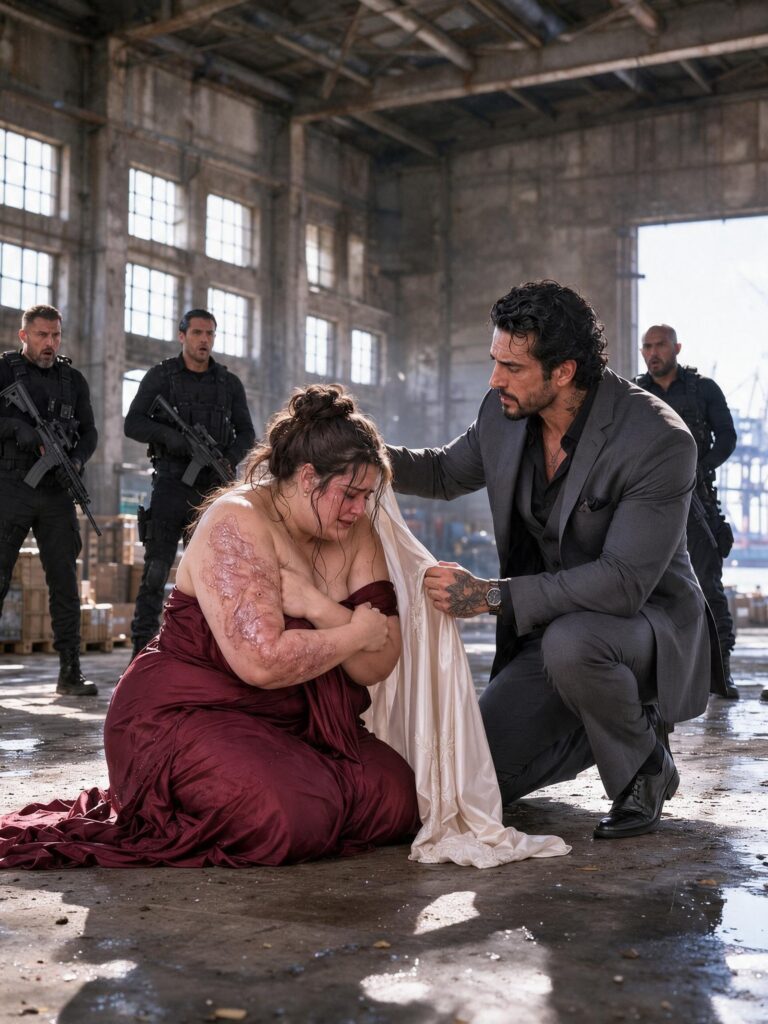
The Mafia Boss Kidnapped the Wrong Bride — and Refused to Give Her Back When He Saw the Scars She Hid for Her Sister
Part 1
The bridal suite smelled of hairspray, warm champagne, and a panic no one was allowed to name.
Mave Collins knelt on the plush carpet with a mouthful of pins and the hem of her sister’s gown between her fingers. The penthouse air-conditioning had died an hour ago. The maroon bridesmaid dress clung to her thighs and pinched under her ribs, and the white satin robe thrown over her shoulders — a gift, the back of it stitched with Bride Squad in cheap gold thread — did nothing to cool her. Sweat slid down her spine. She ignored it. Khloe was radiant, thin, and vibrating, and the lace at the bodice would not lie flat.
“It’s uneven,” Khloe said to the floor-to-ceiling mirror. “You’re making it uneven.”
“Stand still,” Mave mumbled around the pins.
She had always been the background. At two hundred and forty pounds she did not fit the designer samples, did not fit the cameras, did not fit the story Gideon Blake wanted told about the woman he was marrying at six o’clock. Khloe handled the smile. Mave handled the logistics, the vendors, the hem, the lie that everything was fine. Their father liked it that way. Gideon, who owned half the city’s shipping ports and most of its judges, had never once looked at Mave long enough to learn her name without a prompt.
The oak door did not open. It splintered.
Wood blew across the carpet. Khloe screamed. The pins scattered, bright and useless. Three men in tactical black came through the wreckage smelling of damp wool and gun oil, moving with the ugly efficiency of men who had rehearsed this in a room without mirrors.
One caught Khloe and lost her. She bit his glove, thrashed, and bolted for the adjoining bath. The deadbolt shot home. A voice in the hall barked that they had sixty seconds.
Mave tried to stand. The dress fought her. A hand tangled in her dark hair. Canvas scraped her face. Burlap and stale tobacco filled her lungs, and then she was off her feet, a shoulder driving into her stomach, her sensible flats connecting once with a shin before the grip on her thighs tightened and the stairwell took the rest of her breath.
“Got her. Move.”
She hit the ribbed floor of a van like wet cement. Doors slammed. Tires shrieked. Zip ties yanked her wrists behind her back until her fingers went cold. She curled tight in the dark and did not pray. Prayer was for people who believed the universe kept ledgers. Mave did math. Gideon Blake’s enemies wanted his bride as a chip. When they learned they had taken the fat, unremarkable sister, they would not negotiate. They would put a bullet in her and let the river finish the job. Simple economics.
Forty minutes of potholes. Then brine, rust, old fish. Rough hands hauled her upright. Her knees buckled. Concrete scuffed under her shoes.
“Put her in the chair.”
The voice was not loud. It did not need to be. It had weight, and the other men moved faster because of it.
She was shoved into wood. Her arms were bound to the spindles. The hood came off. Fluorescent light stabbed. She blinked until the warehouse resolved: dust in the beams, three men near the door with rifles slung casual as coats, and the man in front of her, who made the room arrange itself around his silence.
Declan Hayes. She knew the name from her father’s study, from conversations that stopped when she entered with coffee. The ghost of the north side. Tall, built like a man who had worked docks before he owned them, wearing a charcoal suit that cost more than her car. Hard lines. A stare that could freeze blood.
He lit a cigarette with a silver lighter. The clink echoed. Smoke froze in his lungs when he finally looked at what his men had brought him.
Not the bride. A round face flushed and wet. Heavy arms. A thick waist. Maroon satin bunched at her knees. A robe that said Bride Squad and meant nothing.
He turned his head. “Finn.”
“Yeah, boss. Just like you said. Right out of the suite.”
Declan leaned in. Peppermint, tobacco, violence. “What is your name?”
Her throat was sandpaper. “Mave. Mave Collins.”
He straightened. He did not yell. “Finn. You absolute idiot. You kidnapped the wrong sister.”
Panic moved through the men like a draft. Finn paced, hand on his buzzed scalp. “She had the white robe. She was in the middle of the room. The other one ran into the bathroom.”
“So you grabbed the one fixing the hem instead of kicking down a door.” Declan’s tone had no inflection at all. He rubbed the bridge of his nose. “Gideon isn’t trading a shipping container for the sister. He doesn’t like the family. He likes the photograph.”
Mave sat perfectly still. Every word confirmed the arithmetic she had done in the van. Worthless currency.
Finn shifted. “Should I put a silencer on? We can dump her in the bay, cut our losses, hit him another way.”
She closed her eyes. Here it was. Not cinematic terror. Just a deep, profound tiredness. Tired of the dress. Tired of the zip ties. Tired of a lifetime spent apologizing for the space she took.
“Shut up.”
Declan walked around the chair. Heavy steps. A predator circling something wounded, not yet sure if it would bite. He stopped behind her. Cold steel kissed her wrists. The ties snapped.
“Stand up.”
Her hands tingled and burned as blood returned. She pushed herself up on shaky legs. She was nearly six feet, a big woman in every sense, and beside him she still felt entirely without cover.
“Take the coat off.”
“What?”
“Gideon sews micro-trackers into hems and collars. Anywhere his people go. I need to know you aren’t broadcasting our coordinates to a hit squad.”
“I don’t have a tracker.”
“I don’t care what you think you have. Robe off. Dress to the waist.”
Her blood went cold. The order was not sexual. His eyes were clinical. The humiliation was not. She had spent twenty-eight years hiding under cardigans, empire waists, dark colors. The thought of standing half-bared under these lights, in front of armed men, brought bile up her throat.
“Please,” she whispered. The word tasted like metal. “Please don’t.”
He stepped into her space. Close enough that she saw the faint gray flecks in his dark eyes. “I am not asking. You do it, or Finn does.”
She looked at Finn. He looked eager to repair his mistake. Her hands shook on the knot. The white satin slid to the dirty concrete. The maroon dress had a side zipper. It stuck. A small sob escaped her, frustration more than fear.
Declan swatted her hands away and drew the zipper down in one smooth, aggressive motion. “Straps.”
She shut her eyes. Tears finally got past her lashes. She pushed the heavy satin off her shoulders. The bodice fell to her waist. Plain black bra. Pale skin. Freezing air. She wrapped her arms across her torso, trying to hide her stomach, trying to become smaller than physics allowed.
“Arms down.”
She shook her head.
He caught her wrists. Not gentle. Not trying to break her. He drew her arms to her sides and began the sweep, looking for a blink of light or the hard lump of a sewn-in chip.
He stopped at her ribs.
The silence changed. Not the silence before an execution. The silence of men who had run out of categories.
The entire left side of her torso, from the ribs down around the stomach and over the hip, was a network of scars. Puckered. Angry. Deep. Roped tissue like melted wax poured over raw earth. Third-degree burns that had taken years to close, pulling the skin tight and uneven, a map of prolonged agony that no amount of loose clothing had ever fully disguised.
Declan had seen violence. He had inflicted it. This was not a bullet hole or a clean knife wound. This was survival written on a body and then asked to apologize for the handwriting.
He let go of her wrists.
“What happened to you?”
The cold edge was gone. What remained was rough and quiet.
She pulled her arms back across her stomach. Shame burned her cheeks hotter than the lights. “Car crash. I was sixteen. A fire.”
“You pulled someone out.”
“My sister was trapped in the passenger seat.” She stared at the floor because his face was worse. “The tank caught before I could get clear.”
He looked at her, at the flush, at the tears she was fighting, and he thought of the unblemished bride locking a bathroom door while this woman carried the physical cost of that life. He thought of a family that would spend a fortune to erase a hairline mark on Khloe’s cheek and call Mave’s body a weight problem. He thought of a fiancé who would not pay a dime.
He picked up the robe and draped it over her shoulders. Carefully. As if the satin had become something else.
“Boss,” Finn said. “What’s the play? We dumping her?”
Declan did not look at him. He watched the way she braced for the answer. He saw the grit it took just to stay on her feet.
“No.” He drew the lapels together over her chest. “We’re keeping her.”
Finn stared. “She isn’t leverage.”
“I didn’t say she was.”
“Gideon will—”
“Gideon will do what Gideon does.” Declan’s voice dropped. “Get her out of this building. Brownstone. No windows on the room. Food. Clothes that aren’t a costume. And Finn — if I hear the word bay again tonight, you will be the one explaining it to the water.”
Mave’s knees nearly went. Not relief. Relief was too clean. This was the vertigo of a sentence being commuted into a different kind of sentence. She clutched the robe shut with numb fingers and did not thank him. Thanking him felt like agreeing that her life was his to keep.
He noticed. Of course he noticed.
“You can hate me in the car,” he said. “Hate me in the room. Do not mistake this for mercy that expires. You walked through fire for people who will not say your name on the news. I am not putting you back in their hands so they can finish the job.”
“You don’t know them,” she said.
“I know the type.” He nodded at the door. “Move.”
They took her out a side entrance, past the smell of fish and diesel, into a black SUV with the dome light off. She sat with the robe clutched closed and the ruined dress underneath, watching the docks slide away in the side mirror. Declan sat across from her, not beside her. He did not touch her again. He smoked with the window cracked and looked at the city as if he were already rearranging it.
“If you run,” he said, “you will not get far, and you will not get anywhere kind. That is not a threat. It is the map.”
“I wasn’t going to run.”
“No,” he said. “You weren’t.”
The brownstone was old and reinforced, a spare room with gray walls, a navy quilt, no windows, an air vent humming near the ceiling. The deadbolt clicked on the outside. Mave sat on the edge of the mattress and stared at the blank wall opposite, still wearing the dress, still wearing her sister’s robe, and understood that the night had not ended.
It had only changed owners.
Somewhere across the city, a wedding was being postponed, a story was being written, and a man who had looked at her scars instead of her size had just refused to give her back.
Part 2
Two hours, maybe three. Time lost its edges.
The lock turned. Declan came in without the jacket, sleeves rolled to the elbows, forearms corded with muscle and faded ink. A plastic bag in one hand. A styrofoam container in the other. He set the food on the desk and tossed the bag onto the bed.
“Change. Finn went to a box store on the edge of the territory. I told him to err large. If it’s wrong, say so.”
She did not reach for the bag. “Why are you doing this?”
“Because you’re shivering and that dress is a torture device.”
“I mean keeping me.” The adrenaline had burned off and left her hollow. “You saw the scars. You know I pulled Khloe out of that car. My father spent three hundred thousand dollars fixing a hairline fracture on her cheekbone. He bought me a gym membership and a therapist. They don’t care about me, Mr. Hayes. Gideon doesn’t. I am zero leverage.”
He turned the chair around and sat with his arms over the back, watching her with that same unsettling attention. “Declan. And you’re right. You aren’t leverage.”
A short, bitter laugh. “So I’m a stray you couldn’t put down.”
“Eat.”
Garlic and seasoned meat. Her stomach cramped hard enough to hurt. She had not eaten since yesterday. Brides did not allow their squads to bloat before the photos. She stood, joints popping, and opened the container. Lamb and rice, a plastic fork jammed in the side. The first bite was hot, salty, greasy, and the best thing she had tasted in months. He watched her eat. He did not look away when rice fell on the robe. He did not flinch at the speed of a hunger she had been trained to hide.
“I made a call,” he said. “A contact inside Gideon’s camp. I wanted to see how he was playing the extraction.”
The fork stopped.
“He told the guests there was a security threat. He evacuated Khloe to his estate.” A muscle leapt in Declan’s cheek. “He told the police that in the chaos, one of the bridesmaids went missing. He did not use your name. Ten minutes ago he issued a statement. He called you a tragic casualty of a city plagued by gang violence.”
The lamb turned to ash. She set the fork down.
A tragic casualty. In less than four hours her family and her almost-brother-in-law had run the numbers, cut the loss, and used her disappearance to polish Gideon’s tough-on-crime story. She was not a missing person. She was a talking point.
“I see,” she said. She wiped her mouth with the back of her hand. The well was dry. No tears came.
Declan stood. He dwarfed the room and did not crowd her. “They threw you away. A woman who walked through fire for them. They threw you to the wolves and did not blink.”
“I told you.” She looked up, cynical mask back in place. “I’m the fat, ugly sister. Bad for the brand. This is a clean break.”
He reached out. She flinched. He only brushed a tangled lock of hair behind her ear. Calloused. Warm.
“They are fools,” he said. “They look at you and see a liability. I look at those scars and I see the only person in that penthouse who knows how to survive.”
He stepped back. “Eat. Change. Sleep. Tomorrow everything changes.”
She did not ask what that meant. She waited until the deadbolt clicked, then opened the bag. Gray sweatpants. A heavy black hoodie. Soft, enormous, uninterested in her waist. She peeled off the maroon dress and stood for a moment in the ugly light with the robe open, looking down at the map on her ribs because there was no mirror and no one to perform for. The scars pulled when she breathed. They always had. She had learned to sleep on her right side so the left did not wake her.
She put on the clothes. For the first time in a decade nothing pinched. She lay on top of the quilt, not under it, and stared at the vent until sleep took her sideways.
The explosion came at three.
It rattled her teeth. Dust rained from the ceiling. The vent shrieked and died. The deadbolt did not unlock. The frame blew inward in a cloud of plaster. Mave rolled off the mattress, hit the hardwood hard enough to bruise her shoulder, and did not make a sound. She scrambled under the oak desk and pulled her knees in.
Gunfire downstairs. Handguns and the heavier thud of automatic weapons. A scream. Boots on the stairs.
“Mave.”
Declan filled the shattered doorway, white with drywall dust, a dark stain spreading across the left shoulder of his shirt, a pistol in his right hand. “Get up.”
She crawled out, bare feet slipping on plaster. “What’s happening?”
“Gideon didn’t come for you.” He caught her uninjured shoulder and shoved her toward the back hall. “He tracked the van. He’s using the kidnapping as the excuse to wipe the north safe house. Decapitate my crew. Play the grieving hero before sunrise.”
“He’s trying to kill you.”
“He’s trying to kill everyone in this building. Including the tragic casualty.”
Smoke and sulfur in the stairwell. Finn at the bottom landing, laying fire through a shattered kitchen window. Declan’s knee buckled. He hit the wall. The stain on his shoulder had doubled.
Mave did not panic. Panic was for people who believed someone was coming. She hauled his good arm over her shoulders. She was strong in the ways that never made a wedding program: boxes, furniture, a screaming sister dragged from a burning car. She knew how to use her weight.
“Move.”
“I can walk.”
“Shut up and lean on me. If you bleed out in this hallway, I’m dead anyway.”
He looked at her. Stubborn grit, no performance. He nodded once and gave her the weight.
Finn threw smoke and shouted them toward the garage. Two SUVs idled. She shoved Declan into the back seat and climbed in after him. The vehicle smashed through the wooden door and peeled into the rain.
Inside, only harsh breathing and the squeal of tires. Declan slumped, dropped the gun, pressed his hand to the shoulder. Blood seeped through his fingers.
Mave unzipped the hoodie, yanked it off, and grabbed the hem of the white T-shirt underneath. It would not tear. “Knife.”
Finn passed a blade over the console. She scored a strip free, exposing the thick scarred flesh of her lower stomach, and did not care. She pushed Declan’s hand away.
“Press your back into the seat.”
She packed the cloth into the wound and tied a longer strip under his arm, then bore down with both hands. Brutal. Unyielding. He hissed. His head fell back. Streetlights strobed across her face, the sweat at her brow, the set of her jaw.
“You’re good at this.”
“I had a lot of surgeries.” She did not ease the pressure. “You learn how to stop the bleeding or you die.”
His good hand came up. Bloodstained fingers wrapped her wrist. Not to push her off.
“Gideon thinks he won tonight,” Declan said. The cold authority was back, even through the blood loss. “He thinks he erased you.”
“He did.”
“No.” The grip tightened. His eyes locked on hers, ferocious, possessive, unbearably awake. “Gideon Blake threw away a queen because he only wanted a photograph. You aren’t collateral anymore. You aren’t a hostage.”
“Then what am I?”
“You’re mine,” he said. “And we are going to burn his empire to the ground.”
The SUV hit the expressway. Rain hammered the roof. His blood was warm under her palms, and the vow sat between them like a lit match in a closed car. She did not pull her wrist free. She also did not answer. Answering would make it true, and she had spent her life being true for people who spent her and called it love.
Ahead, the north side was already burning behind them. Ahead, a man who had refused to give her back was bleeding into her hands. And somewhere in a guarded estate, her sister was safe, unscarred, and already practicing the face she would wear at the funeral they had scheduled without a body.
Part 3
They did not go to a hospital. Hospitals kept records, and records kept Gideon.
The second safe house was a brick walk-up over a closed print shop, three rooms and a medic Declan paid in cash and silence. By the time they carried him up the back stairs, his skin had gone the color of candle wax. Mave stayed. No one asked her to. Finn looked at her once, at the blood on her hands and the strip of her own shirt still bound under Declan’s arm, and did not tell her to wait in the hall.
The bullet had gone through. The medic cleaned, stitched, and shot him full of something that knocked the fight out of his eyes. Mave washed in a steel sink until the water ran pink and then clear. She put the hoodie back on. She sat in a kitchen chair with her bare feet on cold linoleum and listened to the rain and the low voices in the next room arguing about routes, judges, and whether the north crew was still a crew.
Near dawn Declan woke. She heard the shift of the mattress and went to the doorway because leaving felt like the old life, the one where she fixed the hem and disappeared.
He was propped on his good side, shirt off, bandage stark against his chest. The ink on his forearm was a compass with no north. He looked at her as if checking she had not been a fever.
“You should have run at the garage,” he said. His voice was wrecked. “Finn would have let you. I told him, if I went down, she walks.”
“You didn’t tell me that.”
“I was busy bleeding.”
“I wasn’t going to leave you in a hallway so Gideon could call it two casualties and sleep.” She stayed in the doorway. Distance felt like the only power she had left. “That doesn’t make me yours.”
Something in his face eased. Not a smile. The absence of the claim, tested and not slapped down, but not swallowed either.
“No,” he said. “It doesn’t. Sit anyway. You’re swaying.”
She sat on the edge of the bed because her legs had opinions. The quilt smelled like antiseptic and rain. For a long minute neither of them filled it.
“When I was sixteen,” she said, “Khloe was dating a boy with a fast car and no sense. I was in the back because our father said I needed to get out of the house. The boy missed a turn. We went into a guardrail and then a ditch. The front end folded. Khloe was screaming and the belt was jammed and I climbed over the seat and got her out through the broken window. I went back for the boy. The tank went before I cleared the door. He died. She broke a cheekbone. I spent four months in a burn unit while my father gave interviews about his brave younger daughter and his recovering elder one. When I came home, the brave one had a new nose job scheduled and I had a gym membership.”
Declan’s jaw worked. “And Gideon.”
“Gideon saw the wedding package. Ports, judges, a pretty wife, a family that doesn’t ask questions. I planned the seating chart. I was not on the letterhead.”
“He used you tonight.”
“He used a hole where I used to be.” She looked at her hands. Clean now. Still broad. Still hers. “If you want to burn him because he hit your house, do it. Don’t dress it up as a rescue. I have had enough of men narrating my life while I hold the pins.”
He was quiet so long she thought the medication had taken him. Then he said, “I kept you because I looked at what the fire did and what you did anyway, and I could not hand you to a river or to him. The rest — the vow in the car — that was blood loss and fury. Some of it was true. The possession was not a right. I don’t get to take what they threw away and call it mine because I was the one who caught it.”
She had not expected the correction. It landed harder than the claim.
“Then what do you want?” she asked.
“A choice.” His eyes were clear despite the pallor. “Stay. Help me end him. Not as a hostage. Not as payment. As the woman who knows how his house lies, because you built half the lies. Or walk out that door at noon with money, a new name, and a car Finn will not follow. I will not come after you. I will still end him. You will not owe me the ending.”
The offer sat in the room like a door propped open. She thought of the statement. Tragic casualty. She thought of Khloe’s deadbolt. She thought of three hundred thousand dollars on a cheekbone and a therapist for the girl who had done the burning.
“If I stay,” she said, “I am not your queen because you said so in a car. I am not your proof that you’re better than him. I decide what gets burned. And if you ever tell Finn to put a silencer on me, I will not be tired the second time.”
“Agreed.”
“And I want to look my father in the face before this is over. Not for him. For me.”
“Agreed.”
She nodded once. The nod felt like stepping off a ledge she had been standing on since she was sixteen. “Then I’m not walking out at noon.”
He exhaled, shaky, and closed his eyes. His good hand lay on the quilt between them, not reaching. She put hers beside it. Not quite touching. Close enough to feel the heat.
The war that followed was not a single night. Gideon had expected a corpse and a headline. What he got was a woman the city had already buried, feeding Declan the architecture of his own myth.
Mave knew the wedding vendors who were not vendors. She knew which judge had been promised a berth at the new terminal, which shipping manager skimmed the manifests, which reporter had been paid to call the kidnapping a tragedy before the police finished the canvass. She wrote it down in a cheap notebook at the print-shop table while Declan healed and Finn stopped looking at her like a mistake. On the fourth day she called a number she was not supposed to have and left a message for her father in a voice she barely recognized.
“You told the papers I was a casualty. I’m not. If you want the seating chart, the wire records, and the name of the man Gideon paid to say I ran off with a gang, you will meet me. Alone. Tomorrow. The old coffee shop on Reed. If Khloe comes, I leave. If Gideon comes, you will not like the ending.”
Declan wanted to put three men on the roof. She let him put one in a car across the street and went in alone, hoodie zipped, scars hidden, chin up.
Her father was already in the back booth, smaller than she remembered, expensive coat, the face he used for donors. He stood when he saw her and did not hug her.
“You look—” He stopped. “We thought—”
“You hoped,” she said. She did not sit. “Say my name.”
“Mave, this is not the place.”
“You didn’t use it on television. Use it here.”
He glanced at the door. “Gideon is under enormous pressure. The attack on that house was a response to your abduction. If you come home, we can correct the statement. Quietly. Khloe is frantic.”
“Khloe locked a bathroom door and let them take me.” The words were calm. That surprised her more than him. “You spent three hundred thousand on her face and handed me a treadmill. Gideon called me a casualty so he could raid a rival and look like a savior. I have the vendor list. I have the judge. I have the man who wrote the statement before the police report existed. I am not coming home to be corrected.”
“What do you want?” It was the first honest question he had asked her in years.
“I want you to hear it from me, not from a headline. I lived. I am not your spare. And I am done fixing hems for people who will not open a door.”
She left the notebook copies on the table. Not all of them. Enough. Outside, the rain had thinned. Declan was not in the car. He was on the sidewalk, coat collar up, arm in a sling, looking like a man who had broken his own order because the ten minutes had been too long.
“I told you one man,” she said.
“I lied.” His eyes searched her face. “Did he touch you?”
“No. He didn’t even say he was sorry.” She found, oddly, that it did not hollow her. “I don’t need him to.”
That night Gideon tried one last time to write the ending. A car at the print shop. A man with a badge that was real and a loyalty that was not. Declan would have met it with guns. Mave met it with the copies, sent at midnight to three reporters who hated being used, and to the one judge Gideon had not bought. By morning the tragic casualty had a name, a photograph from the wedding preparations that showed her on her knees with pins in her mouth, and a paper trail that made the raid look like what it was.
Gideon ran. Ports can hide a man for a while. They cannot hide him from the people he shorted. Declan did not put the bullet in him. He did not need to. The empire ate itself once the lies lost their author. Khloe called once. Mave let it ring, then sent a single sentence: I pulled you out. I will not do it again. That was the closure she could live with. Not forgiveness. A closed door she had locked herself.
On the seventh night the print shop was quiet. Declan’s sling was off. The bandage was smaller. He found her at the table with the notebook closed and tea going cold.
“It’s done,” he said. “He’s in the wind. The statement was retracted. Your father told a reporter you were never missing, only misidentified. Coward’s version. It still puts your name back in the world.”
“I already put it back.”
“I know.” He stood on the other side of the table, not crossing. “The car is still yours if you want it. New name. Noon rule still stands. I won’t come after you.”
She looked at him. The ghost of the north side, exhausted, careful with his hands, the man who had ordered a robe back over her shoulders when the room expected a river. She thought of the car vow and the correction after it. She thought of her own voice in a coffee shop, steady.
“I don’t want a new name,” she said. “I want this one. And I am not staying because you kept me. I am staying because I chose the door you opened, and because when I had your blood on my hands I did not want you to die. That is not payment. That is mine to give.”
He came around the table slowly, giving her time to take it back. She didn’t. His hand rose, stopped short of her cheek.
“May I?”
“Yes.”
He touched her face as if it were the scarred places too, with the same care he had used on the robe. “I don’t want you as proof,” he said. “I don’t want you as strategy. I want the woman who told me to shut up and lean on her. I want mornings that aren’t a war. If you stay, you stay as my equal. Not my captive. Not my symbol. My choice, the way I am asking to be yours.”
“You already are,” she said, and the truth of it did not scare her the way the burlap had. “Not because you refused to give me back. Because when you saw what I survived, you asked what happened instead of what I was worth.”
He kissed her then, brief, unsteady, more vow than hunger. She kissed him back with her hand fisted in his shirt, broad and certain, a woman who had decided the size of her own life. Outside, the city kept its old stories. Inside, the overlooked sister closed the notebook, and the man who had stolen the wrong bride kept the only promise that mattered: he would not let go unless she told him to, and she did not tell him to.


