
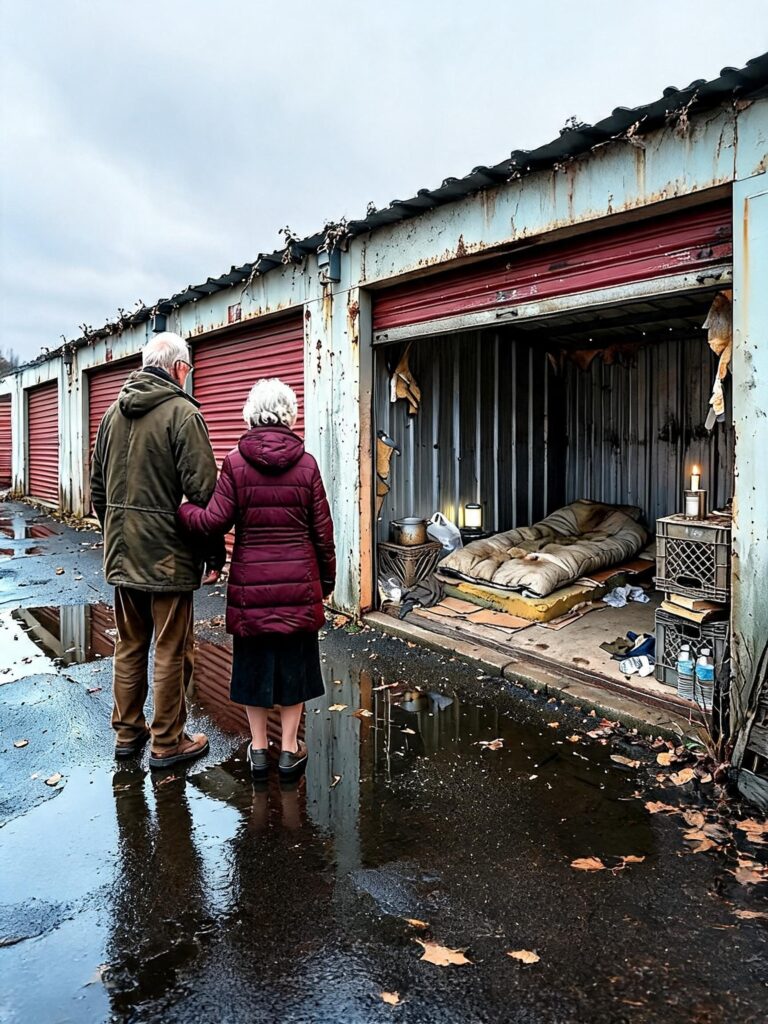
Part 1
The day Harold Meadows lost his house, his oldest son sent a locksmith instead of coming to say goodbye.
At seventy-four years old, Harold stood beside his battered Ford pickup and watched a stranger drill through the lock on a front door he had hung with his own hands forty-seven years earlier.
The sound was almost unbearable.
Not because the drill was particularly loud, but because Harold remembered every hour he had spent making that door fit. He remembered working beneath a bare lightbulb after midnight, shaving stubborn edges with his father’s old hand plane while his young wife, Evelyn, sat on an overturned paint bucket and talked about the family they hoped to raise.
Back then, they had owned almost nothing.
A half-acre outside a small North Carolina town. A secondhand pickup. A box of tools. And a belief that if two people worked hard enough, they could make something that lasted.
Now, nearly five decades later, their home belonged to someone else.
“Mr. Meadows?”
The locksmith stood on the porch, holding a shiny brass cylinder.
“I’ve been instructed to replace every exterior lock.”
Harold stared at the cylinder.
“Those instructions come from my son?”
The locksmith hesitated.
“From the conservator, sir.”
Harold gave a small, humorless laugh.
“Same man.”
Evelyn stood beside the truck, holding two suitcases.
She was seventy-two, with silver hair pinned neatly behind her head and the patient expression of a woman who had spent thirty years feeding schoolchildren who sometimes had no breakfast waiting at home.
She had cried only once that morning.
It happened when she opened the kitchen cabinet and saw the blue ceramic mixing bowl her mother had given her as a wedding present.
The instructions from the conservator’s office said they could take clothing, medications, and limited personal possessions.
The bowl was considered household property.
So Evelyn had placed it carefully back on the shelf.
She had done the same with the framed family photographs, the wedding china, and the cedar chest Harold built when their first child was born.
Forty-seven years of living had been reduced to two suitcases and one small canvas roll of hand tools.
“Harold,” she said quietly.
He turned.
“We ought to go.”
He looked at the house one last time.
The porch railing needed another coat of paint. The maple by the driveway had grown so wide its roots had begun lifting the concrete. A birdhouse still hung from the front eave, crooked because their youngest son had nailed it there when he was nine.
His oldest son, Craig, had called the place a financial burden.
His daughter, Donna, had agreed.
And Jesse, the youngest, had sat in court with his head lowered, saying nothing while a judge placed their finances and property under Craig’s control.
The paperwork called it protection.
Harold had another word for it.
But he kept that word to himself.
He opened the passenger door for Evelyn, put the suitcases behind the seat, and drove away before the locksmith finished his work.
Neither of them looked back.
Three days earlier, Harold had been replacing a rotten porch board when Craig arrived in a silver sedan.
Beside him was a woman carrying a leather folder.
“Dad, we need to talk.”
Harold rested his hammer on the railing.
“Then talk.”
“Inside would be better.”
Craig wore a charcoal suit and expensive leather shoes that seemed made for polished office floors rather than gravel driveways.
He had become a real estate developer in Charlotte, and somewhere along the way, he had developed the habit of speaking to his parents as though they were troublesome customers.
Inside the kitchen, Craig introduced the woman as Patricia Engel, a case coordinator assisting with a petition concerning Harold’s finances.
Harold didn’t sit down.
He watched Craig place a thick stack of papers on the oak table.
It was the same table Harold had built when Craig was twelve.
The boy had helped sand its legs.
Now the grown man spread legal documents across the wood as though he owned it.
“We’re concerned about you and Mom,” Craig began.
“Concerned about what?”
“The house. The bills. Your health. Your ability to keep managing everything.”
Harold frowned.
“I’ve been managing things for a long time.”
“I know that, Dad. But circumstances change.”
Evelyn came in from the laundry room.
“What kind of circumstances?”
Craig glanced toward Patricia.
“We’ve petitioned for a conservatorship.”
The word hung over the table.
Evelyn slowly put down the basket of folded towels she was carrying.
“You want the court to put our affairs in your hands?”
“We want to make sure you’re safe.”
Harold pulled out a chair and sat.
“Craig, are you telling me you want control of my bank accounts?”
“Temporarily, if necessary.”
“And my land?”
“It’s all part of protecting your assets.”
Harold studied his son’s face.
There was something he recognized in that expression.
It was the look Craig used when he wanted a deal signed before the other person had time to ask questions.
“The property taxes are behind,” Craig continued. “The roof leaks. The back bedroom needs electrical work. And you aren’t getting any younger.”
“The taxes are behind because you borrowed eight thousand dollars from us last spring.”
Craig’s face tightened.
“That’s a separate issue.”
“Funny how it’s separate when you’re the one owing money.”
Evelyn pulled out another chair.
“Who else knows about this?”
“Donna agrees. Jesse understands why we’re doing it.”
“Did Jesse agree,” she asked, “or did he just keep quiet?”
Craig looked away.
Patricia opened her folder and began asking Harold questions about his medications, his driving, and his daily routines.
He answered each one.
Then he asked a question of his own.
“Have you ever seen this house before today?”
She paused.
“No, sir.”
“Then how do you know I can’t maintain it?”
She made a note.
Craig rubbed his forehead.
“Dad, you’re making this harder than it needs to be.”
Harold leaned forward.
“Son, I built this house before you were born. I poured the footings, framed the walls, laid the roof, and worked six days a week to pay for the materials. If you think I’m just going to sign it away because you’ve brought a folder into my kitchen, you’re mistaken.”
Craig closed the folder.
“Then we’ll let the court decide.”
The hearing happened Thursday morning.
Harold and Evelyn arrived in the clothes they normally wore to church.
Craig came with an attorney.
Donna spoke by telephone.
Jesse sat in the back row.
The proceeding moved faster than Harold expected. There were documents he hadn’t seen, statements about his declining ability to manage finances, and references to a medical evaluation he didn’t remember undergoing.
The judge approved an emergency arrangement giving Craig authority over their assets pending further review.
Harold tried to object.
His lawyer was someone the court had arranged at short notice. The man had barely spoken to them.
“Your Honor,” Harold said, standing slowly, “I understand exactly what my son is trying to do.”
He was told to sit down.
When the hearing ended, Jesse approached him in the hallway.
“Dad—”
Harold waited.
Jesse swallowed.
“I didn’t think it would happen like this.”
“How did you think it would happen?”
His youngest son had no answer.
Harold walked past him.
By Friday afternoon, Craig had finalized arrangements with a development company he had already been negotiating with. The conservatorship gave him the authority he claimed he needed to complete a sale that had clearly been prepared before the hearing.
Harold and Evelyn were ordered to vacate.
Their bank account was restricted.
Their furniture remained.
Their home was gone.
Now, driving west past the outskirts of town, Harold heard Evelyn open her purse.
She counted their cash twice.
“Two hundred and twelve dollars.”
“I’ve got forty-three.”
“And half a tank of gas.”
He nodded.
They passed the grocery store, the church where their children had been baptized, and the little elementary school where Evelyn had worked until retirement.
At the edge of town stood a county shelter.
Harold slowed.
Evelyn looked through the windshield at the crowded parking lot.
“Should we stop?”
He stared at the building.
Then he drove on.
“Where are we going?”
“There’s a place I remember.”
“What kind of place?”
He tightened his grip on the steering wheel.
“Don’t know yet.”
About four miles outside town, beyond a welding shop and an abandoned tire business, Harold turned through a leaning chain-link gate.
An old sign hung above the entrance.
MILBROOK MINI STORAGE.
Several letters were missing.
Behind the fence stood a row of weather-beaten metal storage units. Rust streaked their doors. Weeds pushed through the gravel. One roof had collapsed, and a tree had grown through a section of broken fencing.
Evelyn looked at her husband.
“Harold, what are we doing?”
“Looking.”
He parked beside the last building.
Around the back stood two smaller units, almost hidden by blackberry vines and pine saplings.
The door of Unit 14 was partly open.
A cut padlock hung from its latch.
Harold took a flashlight from the truck and stepped inside.
The beam swept across a concrete floor.
Then a rocking chair.
A sewing machine.
Cardboard boxes.
Folded quilts.
And a row of framed photographs resting against the far wall.
Evelyn stopped in the doorway.
“Oh, Harold.”
Someone had carefully packed an entire life into this forgotten metal room.
A woman’s wedding portrait stood beside a photograph of two little girls wearing matching Easter dresses.
There were mason jars filled with buttons and thread, a shelf of books, and a faded apron hanging from a nail.
The space smelled of dry cedar, dust, and something faintly floral.
Evelyn lifted the lid from a box marked Books and keepsakes.
Inside were four leather-bound journals.
She opened the first.
Written neatly on the inside cover was a name.
Margaret Callaway.
Evelyn turned several pages and began reading.
The woman had lost her husband young. She had raised two daughters by sewing for neighbors, repairing church clothes, and taking alterations from anyone willing to pay.
Years later, the daughters had grown up and left home.
One moved away.
The other stayed nearby.
And when Margaret became elderly, the daughter who remained had taken control of her finances.
Then her house.
Then the decision about where she would spend the rest of her life.
Evelyn reached an entry written in shakier handwriting.
Margaret described being told she could no longer live independently.
She wrote about her daughter’s assurances that everything was being done out of love.
And she wrote about the terrible silence that followed when her daughter stopped visiting.
Evelyn sat down on a cardboard box.
“Harold?”
He looked over.
“What?”
“This woman lost her home.”
He came closer.
Evelyn held up the journal.
“Her own daughter took it from her.”
For a long moment, neither spoke.
Outside, a freight train sounded its horn in the distance.
Harold looked at Margaret’s photographs, then at his wife.
“Maybe that’s why I brought us here.”
Evelyn brushed dust from the rocking chair.
“Are you saying we should stay?”
“Just tonight.”
“There’s no water.”
“I know.”
“No bathroom.”
“I know.”
“And the floor’s concrete.”
Harold looked down at the canvas tool roll in his hand.
He had kept those tools even when he was forced to leave everything else.
His father had given him the first chisel when Harold was fourteen.
“I can do something about the floor.”
Evelyn studied him.
In forty-seven years of marriage, she had seen that expression many times.
It was the look Harold wore whenever something was broken and he was already figuring out how to repair it.
She set the journal down.
“Then I’ll find us something to sleep on.”
That night, they spread Margaret’s old quilts over the concrete.
They ate crackers with peanut butter and shared the last bottle of water from the truck.
Harold lay on his back staring at the corrugated metal ceiling.
Evelyn lay beside him, her hand resting on his arm.
The building clicked and groaned as the temperature dropped.
His hip hurt.
His shoulders hurt.
And somewhere deep inside him was a pain he could not reach with his hands.
After a long silence, Evelyn whispered, “Do you think Craig knows where we are?”
Harold closed his eyes.
“He knows where we aren’t.”
“Do you think he’ll call?”
Harold listened to the wind moving through the broken fence.
“No.”
Evelyn moved a little closer.
They had lost the house where they raised three children.
They had lost the savings they thought would carry them through old age.
They had lost the belief that their children would protect them when they became vulnerable.
But Harold could still feel Evelyn’s hand against his.
And as long as she was beside him, he had not lost everything.
Outside, the night grew cold.
Inside Unit 14, two people who had spent their whole lives making a home for others tried to fall asleep in a place the world had forgotten.
Part 2
Harold woke the next morning unable to straighten his back.
For nearly a minute, he lay perfectly still beneath Margaret’s faded blue quilt, waiting for the stiffness in his hips to ease.
When he finally sat up, his knees cracked loudly.
Evelyn was already dressed.
She had folded the extra blankets and was writing on the back of an old gas receipt.
“What’s that?” Harold asked.
“A list.”
“Of what?”
“Things we need before one of us goes crazy.”
He put on his glasses.
At the top she had written:
Water. Bathroom. Food. Warm place to sleep. Permission to stay.
Harold pointed at the last item.
“That one might be the hardest.”
“I know.”
She looked around the storage unit.
“We can’t pretend this is ours just because nobody’s been here in a while.”
Harold nodded.
His father had taught him that a man could be poor without becoming dishonest.
He intended to keep that lesson.
“I’ll find out who owns it,” he said.
Evelyn folded the receipt.
“And while you’re doing that, I’m going to find some water.”
The nearest gas station was a quarter mile down the road.
Evelyn walked there carrying an empty plastic jug and her purse.
The morning was cool, with mist clinging to the low fields beside the highway.
At the station, she bought bottled water, used the restroom, and washed her face beneath a flickering fluorescent light.
When she looked into the mirror, she almost didn’t recognize herself.
Yesterday she had been a retired school employee who owned a home.
Today she was an elderly woman washing up in a gas station because she had nowhere else to go.
She gripped the edge of the sink.
For one terrible moment, she wanted to cry so badly that she could barely breathe.
Then she straightened her collar.
Her mother had always told her that dignity wasn’t something other people could give or take away.
It was something a person carried.
Evelyn dried her hands and went outside.
On the walk back, she passed a little roadside diner.
A hand-painted sign read RUTH’S.
Through the window, she saw a woman with short gray hair carrying plates to a booth.
The smell of bacon drifted through an open kitchen vent.
Evelyn hadn’t eaten a hot meal since Thursday.
She stopped walking.
Inside, the woman glanced up and noticed her.
For a few seconds, their eyes met.
Evelyn lowered her head and kept walking.
Back at the storage units, Harold had already begun working.
He had dragged several usable boards from the collapsed Unit 11 and arranged them by length on the gravel.
Some were warped.
Some were rotten.
Others were straight enough to build with.
He had also discovered sheets of plywood beneath a fallen roof panel, protected from rain by a layer of old roofing felt.
When Evelyn returned, he was pulling bent nails from a two-by-four.
“Found us some lumber,” he said.
“Found us some water.”
She set the bottles beside the door.
They looked at each other.
And for the first time since leaving their house, Evelyn almost smiled.
Harold built a raised sleeping platform that afternoon.
He had no power saw and no electric drill.
He used his father’s handsaw, an old brace, a square, and a hammer with a worn hickory handle.
He measured every board twice.
He fitted joints as carefully as if he were building furniture for a customer.
By sunset, the platform stood eight inches above the concrete floor.
It wasn’t elegant.
But it was level.
Harold placed both palms against the frame and leaned his weight on it.
The wood held.
Evelyn spread Margaret’s quilts across the plywood.
Then she sat on the edge and pressed her hand against the surface.
“Well,” she said, “at least I won’t wake up feeling like I’ve slept in a parking lot.”
Harold leaned against the wall, wiping sweat from his forehead.
“Give me a few days.”
“What happens in a few days?”
He looked around the room.
“We make it better.”
The next morning, he drove into town to visit Dawson’s Hardware.
The store had stood on Main Street since before Harold was married.
Its old red sign had been replaced, but the bell over the door still rang the same familiar note.
A broad-shouldered man behind the counter looked up.
He studied Harold for several seconds.
“Harold Meadows?”
Harold stopped.
“That’s right.”
“I’m Kevin Dawson. My father used to run this place.”
Harold looked at him again.
“Little Kevin?”
Kevin laughed.
“Not so little anymore.”
Harold remembered a twelve-year-old boy sweeping sawdust while his father sold nails by the pound.
Kevin remembered something else.
“You built our back-room shelving,” he said. “Dad kept it for thirty years.”
“Good oak.”
“Good carpenter.”
They talked briefly about Kevin’s father, who had died two winters earlier.
Then Kevin asked what Harold needed.
Harold took off his cap.
He could have told the whole story.
He could have explained Craig, the hearing, the sale, and the night on the concrete floor.
But the words wouldn’t come.
“I need some materials,” he said. “Insulation, screws, plywood. Maybe a little roofing compound.”
Kevin reached for a notepad.
“How much?”
“Enough to finish a place.”
“Cash or account?”
Harold looked at his boots.
“Account, if you’ll allow it.”
Kevin waited.
“I can work it off,” Harold added. “Repairs, carpentry, whatever you need.”
Kevin tore a sheet from the pad.
“Let’s get you what you need.”
“You didn’t ask where I’m working.”
“Didn’t figure it mattered much.”
Harold lifted his eyes.
“Kevin, I don’t know when I can pay.”
Kevin leaned on the counter.
“When I was twelve, you fixed a broken door at our house during an ice storm. My dad offered you money. You said neighbors didn’t need invoices every time somebody picked up a hammer.”
Harold vaguely remembered the storm.
Kevin smiled.
“Seems like a reasonable business policy to me.”
Harold stood very still.
Then he nodded.
“Thank you.”
Kevin loaded plywood, insulation, fasteners, and a roll of plastic sheeting into the truck.
He also slipped in a battery lantern.
Harold noticed.
“That’s not on the list.”
“Store promotion,” Kevin said.
There was no promotion.
Neither man mentioned it again.
By the end of the week, Unit 14 had a raised bed, an insulated partition, and a narrow living area.
Harold hung a curtain between the two spaces using an old sheet from Margaret’s boxes.
He built shelves from salvaged lumber.
He repaired the rocking chair.
He cleaned the rust from the door hinges and installed a proper lock, though he understood that the lock did not make the place legally theirs.
Evelyn sorted Margaret’s belongings.
She treated every item with care.
The photographs went onto a shelf rather than into the trash.
The quilts were washed and aired.
The journals remained together.
Each evening, after Harold finished working, Evelyn sat beside the open door and read aloud from Margaret’s life.
It became their ritual.
Margaret had once owned a little yellow house on Elm Street.
Her husband, Robert, had died after a workplace accident, leaving her with two young daughters and a mortgage.
She had survived by sewing until her fingers swelled and her eyes ached.
She altered prom dresses.
She hemmed uniforms.
She repaired church banners.
She raised her children on hard work, vegetable gardens, and meals stretched from whatever she could afford.
The oldest girl, Karen, eventually moved to Florida.
The youngest, Linda, stayed close enough to visit.
Then, when Margaret turned seventy, Linda convinced her to sign a power of attorney.
Not long afterward, the yellow house was sold.
Margaret was placed in a care facility.
Linda promised to visit.
At first, Margaret wrote about waiting by the window every Sunday.
Later, she stopped writing about Sunday at all.
One evening, Evelyn closed the journal and looked at Harold.
“How does a daughter forget the woman who raised her?”
Harold was sanding a rough board.
He stopped.
“Maybe they don’t forget.”
“Then what?”
“Maybe remembering makes them uncomfortable.”
Evelyn watched him for a while.
“Are you talking about Margaret’s daughter?”
Harold resumed sanding.
“I don’t know anymore.”
The following morning, Evelyn finally walked into Ruth’s Diner.
She entered through the back door because she was afraid the customers might recognize her.
The gray-haired woman from behind the counter was peeling potatoes.
“Can I help you?” she asked.
Evelyn held her purse with both hands.
“I wondered if you had any bread from yesterday that I might purchase at a discount.”
The woman studied her.
“What’s your name?”
“Evelyn Meadows.”
“I’m Ruth Prior.”
Evelyn nodded.
Ruth wiped her hands on her apron.
“You’re staying out at those old storage units.”
It wasn’t a question.
Evelyn felt her cheeks grow hot.
“Yes, ma’am.”
“With your husband?”
“Yes.”
Ruth glanced at the clock.
Then she pulled out a stool.
“Sit down.”
“Oh, I didn’t come to bother you.”
“Didn’t say you did.”
Ruth disappeared into the kitchen.
A few minutes later, she returned carrying a cup of coffee, two warm biscuits, scrambled eggs, and a small dish of homemade jam.
Evelyn stared at the plate.
“I can’t afford all this.”
“Then it’s a good thing I didn’t ask you to.”
Evelyn swallowed.
“Mrs. Prior—”
“Ruth.”
“Ruth, I’m not looking for charity.”
Ruth pulled out the stool beside her.
“Neither was I when my husband died.”
Evelyn looked up.
Ruth spoke quietly.
“Left me this diner, a mortgage, and eleven hundred dollars in unpaid bills. One morning, a woman I barely knew showed up at my back door carrying two bags of groceries.”
She paused.
“Wouldn’t let me pay her. Said somebody had helped her once, and now it was her turn.”
Ruth pushed the plate closer.
“I’ve been trying to pass that favor along ever since.”
Evelyn took a small bite of biscuit.
It was hot.
Soft.
Buttery.
The simple comfort nearly undid her.
She looked down until she could trust her voice.
“Thank you.”
Ruth nodded toward the sink.
“You want work?”
Evelyn looked up sharply.
“What kind?”
“Breakfast help. Coffee, dishes, setting tables, keeping these truck drivers from walking off with my good silverware.”
Evelyn almost laughed.
“I worked in a school cafeteria for thirty years.”
“Then you’re overqualified.”
“I can’t promise how long I’ll be able to stay.”
“Neither can I.”
Ruth held out her hand.
“Five-fifteen tomorrow morning?”
Evelyn shook it.
“I’ll be here.”
When she returned to Unit 14 carrying leftover biscuits and soup, Harold was sitting on the platform, examining a splinter in his palm.
She set the food on the small table.
“I found work.”
Harold looked up.
“Where?”
“Ruth’s Diner.”
“What’ll she pay?”
“Ten dollars a morning. Breakfast and lunch included.”
Harold lowered his eyes.
“Evie, you shouldn’t have to do that.”
She sat beside him.
“Do what?”
“Work at your age because I couldn’t keep a roof over your head.”
Evelyn took his hand.
“Harold Meadows, I married a carpenter, not a bank account.”
He turned away.
She squeezed his fingers.
“I didn’t marry that house, either.”
For a moment, he couldn’t speak.
Then he looked at her.
“I’m sorry.”
“Don’t be sorry for what Craig did.”
He nodded slowly.
“Just help me keep going.”
“I intend to.”
Within two weeks, their little storage unit began to feel less like an emergency shelter and more like a home.
Not a comfortable home.
Not a proper home.
But a place where two cups stood beside each other on a shelf, clean blankets covered a level sleeping platform, and the smell of fresh coffee occasionally replaced the dust.
Then one evening, while Evelyn was reading Margaret’s third journal, she found something folded between its pages.
It was a yellowed document.
The edges had begun to crack.
At the top, in faded type, were the words PROPERTY DEED.
Evelyn unfolded it carefully.
“Harold?”
He was outside, repairing a broken wooden chair.
“What is it?”
“Come look at this.”
He stepped inside.
Evelyn spread the document on the table.
It described 3.2 acres of land purchased by Margaret Callaway in 1983.
The parcel included the wooded ground behind the main storage buildings and the two rear units.
Unit 14 was one of them.
Harold studied the signature.
“Margaret owned this place?”
“At least this part of it.”
“Who owns it now?”
Evelyn opened the journal to another page.
“That’s what I can’t figure out. She wrote about Linda handling paperwork, but there’s no mention of a completed transfer.”
Harold leaned back.
“So we may be sleeping on a dead woman’s property.”
“That seems to be exactly what we’re doing.”
He was quiet for a moment.
“Then we’d better find out who has the right to tell us to leave.”
Evelyn folded the deed.
But before she could answer, headlights moved across the metal wall.
An engine idled outside.
Harold switched off the lantern.
They listened.
The vehicle remained in the gravel lot for several minutes.
Then the tires crunched slowly backward.
The headlights passed across the doorway once more before disappearing toward the highway.
Harold waited until the engine faded.
Evelyn reached for his hand.
“Who would come out here after dark?”
Harold thought of Craig.
Of the house.
Of everything that had happened so quickly.
“I don’t know,” he said.
But the next morning, someone had left a paper bag beside their door.
Inside were canned soup, fresh bread, two apples, and a jar of peanut butter.
There was no note.
And the peanut butter was the exact brand Evelyn had bought for their family for forty years.
Part 3
Harold examined the groceries three times.
He recognized the peanut butter immediately.
Evelyn had been buying the same brand since Craig was a little boy. She used to spread it on crackers for the children when money was tight and there was nothing else in the house worth calling a snack.
“Somebody knows us,” Harold said.
Evelyn stood beside the table.
“Plenty of people in town know us.”
“Not this well.”
He turned the jar in his hand.
Then he set it down.
“I don’t like people sneaking around here.”
“Maybe they’re afraid we’ll refuse their help.”
“Then they should knock.”
Evelyn didn’t argue.
She had been married long enough to understand that her husband’s anger wasn’t really about groceries.
For most of his life, Harold had been the person other people called when something broke.
He repaired church doors without sending bills. He rebuilt porches for widows who couldn’t afford contractors. He fixed broken fences for neighbors and sometimes accepted vegetables or a homemade pie instead of cash.
Now strangers were leaving food on his doorstep.
He didn’t know how to be the person receiving kindness.
And it embarrassed him.
That Saturday, Harold drove to Dawson’s Hardware to inquire about work.
Kevin was carrying a stack of paint buckets when Harold entered.
“Morning, Harold.”
“Morning.”
Kevin noticed the folded piece of paper in Harold’s hand.
“What’s that?”
“A list of jobs I can do.”
Kevin looked at it.
“Carpentry, roofing, repairs, fence work, cabinet installation?”
“Still got my hands.”
Kevin smiled.
“Give me a few copies. People ask me for contractors every day.”
Harold hesitated.
“I’m not licensed for everything. Can’t do major electrical work anymore. Roof work’s getting harder.”
“Then don’t take those jobs. There’s plenty of work at ground level.”
Harold nodded.
Kevin pinned the list beside the register.
Before Harold left, a man wearing work boots and a faded ball cap entered the store.
Kevin pointed toward Harold.
“Jim, you know Harold Meadows?”
The man turned.
He was seventy-one, broad through the shoulders, with a face weathered by years of outdoor work.
“Know of him.”
Harold extended his hand.
“Harold.”
“Jim Teague.”
They shook.
Jim studied him.
“You still doing carpentry?”
“As long as my knees cooperate.”
Jim chuckled.
“I heard you’re working out by the old storage place.”
Harold’s expression changed.
“I’m staying there.”
Jim grew serious.
“I heard that, too.”
There was an awkward silence.
Then Jim said, “I worked for the power company forty years. Retired six years ago. I might be able to help you get a proper electrical service arranged, if the property owner approves it.”
Harold crossed his arms.
“Can’t afford much.”
“Didn’t say anything about money.”
“Nothing’s free.”
Jim studied him.
“Back in 1994, my wife and I had a place out on Palmer Road. Front porch was rotten. My little girl nearly went through the boards.”
Harold looked up.
“I remember that porch.”
“You came on a Saturday. Worked until dark. Charged me for lumber and wouldn’t accept a penny for labor.”
Harold shrugged.
“Had time that weekend.”
Jim smiled faintly.
“Well, I’ve got time this weekend.”
Two days later, Jim returned with electrical supplies and a licensed contractor he knew from his old job.
The abandoned service required inspection and utility approval, but once the necessary repairs and paperwork were finished, Unit 14 had a working overhead light and several properly installed outlets.
Harold stood beneath the switch while Evelyn waited near the doorway.
“Go ahead,” she said.
He flipped it.
Warm light filled the little room.
Evelyn looked at the shelves, the painted plywood partition, and Margaret’s photographs.
Then she began to cry.
Harold immediately crossed the room.
“What’s wrong?”
She shook her head.
“Nothing.”
He put his arms around her.
“I can turn it off.”
That made her laugh through her tears.
“No, you old fool. Leave it on.”
For the first time since leaving their home, Evelyn could read after sunset without holding a flashlight.
And when she opened Margaret’s journal that evening, the pages looked almost golden beneath the new light.
Over the next month, small acts of kindness changed their lives.
Ruth sent home leftover food after the breakfast rush.
Kevin continued supplying materials on credit.
Jim helped locate a safe water connection.
A church member donated a small refrigerator.
Another neighbor brought two secondhand chairs.
Harold accepted each item reluctantly.
Then he found a way to give something back.
At Ruth’s Diner, he replaced the cracked counter and repaired three wobbly stools.
At a widow’s farmhouse, he rebuilt the front steps.
For the church, he installed shelving in the fellowship hall.
One afternoon, a young mother named Hannah called him about a kitchen cabinet that had pulled away from the wall.
When Harold arrived, he found two little children sitting on the floor with coloring books.
Hannah apologized for the mess.
“Don’t apologize for children living in a house,” Harold said.
He examined the cabinet and discovered the original installer had used short screws that barely reached the wall studs.
“Shouldn’t have happened,” he muttered.
He removed the cabinet, repaired the damaged mounting board, and secured everything properly.
Hannah watched him work.
“My daddy used to fix things like that.”
Harold glanced over.
“Where is he now?”
“He passed away last year.”
“I’m sorry.”
She nodded.
“He always said a job wasn’t finished until you could trust it.”
Harold smiled.
“Your daddy knew something.”
When he finished, Hannah offered him sixty dollars.
Harold looked toward the children.
One had fallen asleep against the other.
“Forty’ll do.”
She protested.
He shook his head.
“Keep the rest. Buy them some ice cream.”
That evening, Harold returned to Unit 14 with forty dollars in his shirt pocket and a bag of tomatoes Hannah had insisted he take.
Evelyn was chopping onions.
“How’d it go?”
“Cabinet won’t fall down again.”
“How much?”
“Forty.”
She glanced at him.
“Harold.”
“What?”
“You’re still charging people like it’s 1985.”
He washed his hands.
“Girl’s raising two kids alone.”
Evelyn sighed.
Then she kissed his cheek.
“You’re impossible.”
“So I’ve been told.”
The work slowly restored something Harold had nearly forgotten.
Not his youth.
His knees still hurt.
His hands stiffened every morning.
He couldn’t climb ladders the way he once had, and he often needed to rest after an hour of steady labor.
But people still needed what he knew.
That mattered.
One afternoon, while repairing a storage door, he heard a truck approaching.
A man got out, carrying a small leather briefcase.
“Mr. Meadows?”
“That’s me.”
“I’m Daniel Mercer. Ruth Prior asked me to come speak with you.”
Harold lowered his hammer.
“About what?”
“Your house.”
Harold’s expression closed.
“I don’t have a house.”
Daniel nodded.
“I know. I’m an attorney.”
Harold stared at him.
“Then you’ve wasted your trip.”
Daniel didn’t leave.
Instead, he looked at the repaired doors and the neatly stacked lumber.
“You did all this?”
“Most of it.”
“Quite a difference from the photographs Ruth showed me.”
Harold said nothing.
Daniel opened his briefcase.
“Mrs. Meadows mentioned some paperwork involving a conservatorship.”
“That business is finished.”
“Maybe not.”
Evelyn appeared in the doorway.
“Harold, at least hear him out.”
The three of them sat beneath the narrow awning Harold had built outside Unit 14.
Daniel examined the court papers.
He read the petition carefully.
Then he read it again.
“Who prepared this medical evaluation?” he asked.
Harold frowned.
“What evaluation?”
Daniel turned the paper around.
“This report says an independent physician assessed your decision-making capacity.”
Harold leaned forward.
“No doctor ever examined me.”
“None?”
“Only a woman who came with Craig. She asked questions in my kitchen.”
Daniel wrote something in his notebook.
“And the hearing took place in another county?”
“Craig arranged it.”
Daniel looked at Evelyn.
“Did either of you receive formal notice before the emergency petition was filed?”
Evelyn shook her head.
“We didn’t know until Craig walked into our kitchen.”
Daniel leaned back.
“There’s enough here to investigate serious procedural problems. It may be possible to challenge the appointment.”
Harold rubbed his jaw.
“You saying I can get my house back?”
“I’m saying the process deserves a much closer examination. I won’t promise you an outcome until I’ve reviewed the court file and the property records.”
Harold looked toward the road.
A truck passed, carrying a load of hay.
He watched it disappear.
“Another family may already be living there.”
Evelyn looked at him.
“That doesn’t mean we should let Craig keep our money.”
Daniel nodded.
“Even if restoring the property isn’t practical, there may be ways to recover assets or seek compensation. We need to establish what happened first.”
Harold was silent for a long time.
Then he asked, “How much will it cost?”
“We can discuss a reduced fee and payment arrangements. Ruth already made it clear she wasn’t sending me out here to collect a big retainer.”
Harold smiled despite himself.
“That woman doesn’t take no for an answer.”
“No, sir. She doesn’t.”
Evelyn brought Margaret’s journals outside.
“There’s something else.”
She handed Daniel the deed.
He examined the faded document, turning it carefully beneath the afternoon light.
“Where did you find this?”
“In these journals.”
“Margaret Callaway?”
Evelyn nodded.
“She owned the land behind the storage facility. We’ve been staying in one of the two units on her parcel.”
Daniel checked the legal description.
“This could be important.”
Harold frowned.
“Important how?”
“If the deed was recorded and the property was never transferred, it may still be part of Mrs. Callaway’s estate.”
“She died years ago.”
“That doesn’t automatically mean the land belongs to whoever happens to be using it.”
“We know that,” Harold said firmly.
Daniel nodded.
“Good. Because the proper approach is to locate the heirs, check the tax and title records, and determine whether someone can legally authorize you to remain.”
Evelyn looked at the journals.
“Margaret had two daughters.”
“Then they’re where we’ll start.”
Harold stared at the old photograph hanging beside the door.
Margaret was smiling in her wedding dress.
“She worked her whole life for that land,” he said.
Daniel closed the folder.
“Then we’ll do this the right way.”
It was the first time in weeks Harold had heard someone speak about his future as though he still had choices.
After Daniel left, Harold sat quietly beneath the awning.
Evelyn poured him coffee.
“You feeling better?”
He watched the sun lower behind the pine trees.
“Not yet.”
“Why?”
He looked at Unit 14.
At the shelves.
At the bed.
At the repaired doors.
“I spent forty-seven years building a house that was supposed to last the rest of our lives.”
Evelyn sat beside him.
“And?”
He shook his head.
“Never imagined I’d be starting over at seventy-four.”
She rested her head against his shoulder.
“Neither did I.”
For a while, they said nothing.
Then Evelyn whispered, “But we’re still starting.”
Harold looked at the little porch.
The boards were rough.
One corner needed another support.
The roof wasn’t quite straight.
And the old storage unit would never look like the house they had lost.
But something about Evelyn’s words stayed with him.
The next morning, he went outside before sunrise and began building the porch properly.
Part 4
By the sixth week, Unit 14 had become the strangest little home in the county.
A wooden porch stretched from its metal doorway.
Two chairs stood beneath an awning that kept off the rain.
Evelyn had placed three flowerpots along the railing, and green shoots were beginning to emerge from the soil.
Inside, clean white walls brightened the narrow space.
Margaret’s photographs hung in carefully measured rows.
There was a small dining table made from pallet wood, a sleeping room separated by a curtain, and a sewing machine Evelyn had cleaned and oiled until it worked again.
Harold had even built a narrow shelf beside the bed for her reading glasses.
Ruth came to visit one Sunday afternoon.
She stood in the doorway and looked around.
“Well, I’ll be.”
Harold wiped his hands on a rag.
“What?”
Ruth smiled.
“You two have done more with this little room than some people do with a whole house.”
Evelyn laughed.
“Don’t encourage him. He’ll start building a second story.”
Harold looked toward the ceiling.
“Wouldn’t work. Not enough structure.”
Both women laughed.
For a moment, the three of them forgot why Harold and Evelyn were living there at all.
Then Ruth noticed an old photograph on the wall.
“Who’s that?”
“Margaret Callaway,” Evelyn answered.
Ruth stepped closer.
Her expression changed.
“I remember her.”
Evelyn looked up.
“You knew Margaret?”
“Not well. She used to bring sewing work to a dry cleaner in town. Quiet woman. Always carried a brown handbag.”
Ruth touched the edge of the picture.
“Then she disappeared. I heard her daughter put her somewhere.”
Evelyn nodded slowly.
“She ended up in a care facility.”
Ruth shook her head.
“People don’t always understand how lonely a person can get after the family stops coming.”
Evelyn looked at Margaret’s journals.
“I think she understood it better than most.”
That evening, Ruth stayed for coffee.
They sat beneath the awning, listening to crickets in the tall grass.
A breeze carried the smell of cut hay from a neighboring field.
For a little while, Harold almost felt peaceful.
Then a black sedan turned off the highway.
It approached slowly, tires crunching across the gravel.
Harold recognized the driver before the car stopped.
Craig.
His oldest son stepped out wearing a dark blazer and polished shoes.
He looked at the repaired fencing.
The cleared lot.
The porch.
The light shining through the open door.
For several seconds, he simply stared.
“Dad?”
Harold stood.
“Craig.”
Craig walked toward the porch.
“What on earth are you doing out here?”
“Living.”
Craig looked around again.
“In a storage unit?”
“You can see it plain enough.”
“This is ridiculous.”
Evelyn rose from her chair.
“Good afternoon to you, too, Craig.”
Craig glanced at his mother.
“Mom, this isn’t safe. You shouldn’t be here.”
She folded her arms.
“Where would you suggest?”
“The assisted living facility I told you about.”
Harold stepped down from the porch.
“That place you picked without asking us?”
“It’s a proper facility. With trained staff.”
“I don’t need somebody telling me when to eat breakfast.”
“Dad, you’re seventy-four.”
Harold looked at him.
“Been seventy-four every day since my birthday. Hasn’t stopped me yet.”
Craig frowned.
He walked toward the repaired door of Unit 12, then looked at the lumber stacked beside the fence.
“Who’s paying for all this?”
“People who still trust my work.”
Craig’s face hardened.
“You shouldn’t be doing manual labor at your age.”
Harold felt the old anger rising.
He remembered Craig at ten years old, running through the backyard with a toy hammer.
The boy had followed him everywhere.
He had wanted to measure boards, hold nails, and ride beside his father in the truck.
Once, after Harold helped him build a birdhouse, Craig had proudly declared that he was going to build houses when he grew up.
And he had.
Only somewhere along the way, he’d stopped understanding what a home meant.
“Why are you here?” Harold asked.
Craig shifted his weight.
“There’s another property matter.”
Harold waited.
“Granddad’s lot on Miller Road. The taxes are overdue, and it isn’t generating income.”
Harold went still.
“What about it?”
“I’m arranging a sale.”
“No.”
Craig sighed.
“Dad, it’s just empty land.”
“That land belonged to my father.”
“I know.”
“That’s where he taught me to frame a wall.”
Craig looked frustrated.
“Sentiment doesn’t pay property taxes.”
Harold took one step closer.
“That’s the problem with you, Craig. You think if a thing doesn’t make money, it doesn’t matter.”
“That’s not fair.”
“You sold the house your mother and I built. Now you want to sell your grandfather’s land.”
“The conservatorship gives me authority to manage those assets.”
Harold’s voice grew quiet.
“Your attorney ought to check the court docket.”
Craig frowned.
“Why?”
“Because I’ve got a lawyer now.”
The words landed harder than Harold expected.
Craig stared at him.
“Who?”
“Daniel Mercer.”
“He’s a small-town property attorney.”
“He’s my attorney.”
Craig gave a strained laugh.
“Dad, this is getting out of hand.”
Harold shook his head.
“It got out of hand the day you walked into my kitchen with those papers.”
Craig looked at Evelyn.
“Mom, talk some sense into him.”
Evelyn stepped beside her husband.
“I have been doing that for forty-seven years.”
She paused.
“And right now, he makes perfect sense to me.”
Craig looked between them.
For the first time, he seemed uncertain.
Harold continued.
“Daniel says the court may have made serious mistakes. Says that medical report wasn’t properly supported. Says we weren’t given the notice we should’ve received.”
Craig’s face changed.
“Those are legal technicalities.”
“Then you won’t mind having a judge look at them.”
Craig opened his mouth.
Closed it.
Then he pointed toward the unit.
“You can’t seriously prefer this place to your own home.”
Harold looked back at the porch.
At Evelyn’s flowers.
At the warm light inside.
“I didn’t choose to lose our home.”
He turned toward his son.
“But I can choose what happens to me afterward.”
Craig said nothing.
A moment later, he returned to his car.
He left without embracing his mother.
Without asking whether they needed anything.
And without apologizing.
After the car disappeared, Evelyn sat heavily in her chair.
Harold remained standing.
His hands were trembling.
He looked down at them.
He hated that they trembled.
He hated that his son could still hurt him so deeply.
Evelyn reached for his hand.
“Come sit down.”
He shook his head.
“I need to finish the porch.”
“Harold—”
“If I stop working, Evie, I’m going to start thinking.”
She studied his face.
Then she nodded.
He picked up his hammer.
And he worked until the evening light disappeared.
Three nights later, the mystery of the groceries was solved.
Evelyn had been preparing for bed when she heard a car on the road.
She stepped outside quietly.
Beyond the fence, a familiar vehicle stopped beneath a pine tree.
The driver got out.
He carried a paper bag in one hand and placed it beside the gate.
Then he stood there for a moment, looking toward the little porch.
Evelyn recognized him immediately.
Jesse.
Her youngest child.
He returned to his car without knocking.
The next morning, Evelyn told Harold.
They were sitting outside drinking coffee.
“It’s Jesse.”
Harold lowered his cup.
“What is?”
“The groceries.”
He didn’t speak.
“I saw him last night.”
Harold looked toward the road.
“The boy who sat in that courtroom and didn’t open his mouth.”
Evelyn nodded.
“Yes.”
“The boy who watched his brother take everything we owned.”
“Yes.”
Harold stood.
“Then he should’ve brought his courage instead of groceries.”
He walked to his truck and slammed the door harder than necessary.
Evelyn watched him drive away.
She understood his anger.
But she also remembered Margaret’s journals.
One passage described an apology from Karen, the daughter who lived far away.
Margaret had written about struggling to accept it because the daughter had remained silent while Linda made decisions that destroyed her independence.
Yet Margaret had also admitted that hearing her daughter’s voice again mattered more than she wanted to confess.
Evelyn went inside and opened the journal.
She ran her fingers over the handwriting.
Then she looked at the photograph of the two little girls.
It occurred to her that families could be broken in more than one way.
Sometimes by greed.
Sometimes by fear.
Sometimes by people who saw something wrong and lacked the courage to stop it.
None of those things excused the damage.
But they weren’t all the same.
A week later, Jesse finally knocked.
Harold was sitting on the porch, sharpening a chisel.
Evelyn was working inside.
Jesse approached slowly.
He carried two straight pine boards and a bag of groceries.
“Hi, Dad.”
Harold continued sharpening.
“Jesse.”
Jesse set the boards against the wall.
“I brought some lumber.”
“I can see that.”
“I thought you might use it.”
Harold tested the chisel against his thumbnail.
“What do you want?”
Jesse looked down.
For a long moment, he couldn’t speak.
Then he said, “I should’ve stopped Craig.”
Harold raised his eyes.
Jesse’s voice shook.
“I knew you didn’t need a conservator. I knew Mom could take care of herself. But Craig kept saying he understood the legal side better than the rest of us, and I didn’t want to cause a fight.”
Harold placed the chisel on the table.
“So you let him take our house.”
Jesse swallowed.
“Yes.”
“And then you left food at the gate like we were stray dogs.”
Jesse’s eyes filled.
“I didn’t know how to face you.”
Harold leaned back.
“You could’ve started by walking up that driveway before the hearing.”
“I know.”
Silence settled between them.
A crow called from the pine trees.
Inside, Evelyn stopped moving.
Jesse finally looked up.
“I’m sorry, Dad.”
Harold studied him.
He saw a grown man.
But he also saw the small boy who once followed him through the garage asking questions about every tool.
The boy had not been cruel.
The man had been cowardly.
And the harm was real.
“I’m not ready to forgive you,” Harold said.
Jesse nodded.
“I understand.”
“Might take a long time.”
“I know.”
Harold picked up the chisel.
“Got a job tomorrow. Lady needs new steps behind her house.”
Jesse looked confused.
“What?”
“Steps. Rotten clear through. Could use somebody to hold boards.”
Jesse stared at him.
“Are you asking me to help?”
“I’m telling you there’s work.”
His son wiped his face.
“What time?”
“Seven.”
Jesse nodded.
“I’ll be here.”
Harold returned to his sharpening.
Jesse stood for another moment, then turned toward his car.
As he reached the gate, Harold called after him.
“Jesse.”
His son stopped.
“Yes, Dad?”
“Bring work gloves.”
The next morning, Jesse arrived at six-fifty.
He worked beside his father for seven hours.
They didn’t talk about the house.
They didn’t talk about Craig.
They talked about measurements, wood grain, and the right way to support a stringer.
At lunch, Jesse handed Harold a thermos.
“Coffee. Mom said you’d want some.”
Harold took it.
“She was right.”
It wasn’t forgiveness.
Not yet.
But it was the first honest thing they’d built together in years.
Meanwhile, Daniel’s investigation was uncovering increasingly troubling facts.
The original conservatorship petition had been filed in a jurisdiction that appeared improper.
The required medical evidence was seriously deficient.
And the financial records raised questions about whether Craig had acted in his parents’ interests when arranging the house sale.
The buyer’s connections to Craig’s development business also demanded scrutiny.
Daniel filed a motion seeking to vacate the conservatorship and preserve the remaining assets.
Craig hired an expensive attorney from Charlotte.
A hearing was scheduled.
Then Daniel came to the storage unit with more news.
“The court has temporarily restricted further property sales pending review,” he told Harold.
“What about Miller Road?”
“The lot hasn’t transferred. The sale can be stopped for now.”
Harold lowered himself into a chair.
He closed his eyes.
His father had died twenty-eight years earlier.
The old man had left behind little money, an assortment of worn tools, and that small piece of land.
But Harold remembered the afternoons they spent there.
He remembered learning how to drive a nail straight.
He remembered his father’s rough hands guiding his own.
And he remembered the words his father spoke the day Harold finished building his first shed.
Don’t be ashamed of honest work, son. There’s nothing small about making something that lasts.
Harold opened his eyes.
“That’s the one piece I want back,” he said.
Daniel nodded.
“We’ll do everything we can.”
There was one more development.
The investigation into Margaret Callaway’s property had confirmed that the rear parcel remained titled in her name.
The larger storage facility, including the twelve main units, belonged to an investment company in Asheville.
Margaret’s 3.2-acre parcel was separate.
It contained Unit 14.
The place Harold and Evelyn had turned into a home.
Daniel had begun proceedings to locate Margaret’s heirs and resolve the estate.
In the meantime, he was seeking a lawful arrangement allowing the couple to continue caring for the neglected property.
The company owning the main units had also been contacted.
Its representative had been astonished to learn that somebody was repairing the abandoned facility.
Instead of demanding Harold leave, the company offered him a maintenance agreement and a modest lease for use of a workshop in Unit 12, subject to the necessary approvals.
But the future of Unit 14 remained uncertain.
Margaret’s daughters would have the strongest claim.
Harold listened carefully.
“Then if they want their mother’s property, we’ll give it back.”
Evelyn looked at him.
“And where will we go?”
He stared at her.
He had no answer.
Outside, rain began striking the metal roof.
Harold thought of the little room they had repaired, the porch he’d built, and the life they were slowly making.
He had already lost one home to his own children.
Now he might lose another to the children of a woman he’d never met.
For the first time since arriving at Unit 14, he felt truly frightened.
Part 5
The morning of the hearing was cold and clear.
Harold stood beside his truck wearing the only good shirt Evelyn had packed when they lost their house.
It was light blue, with a collar that refused to sit properly.
Evelyn had ironed it twice.
Now she stood before him, adjusting the collar again.
“You look handsome.”
Harold snorted.
“Look like an old man who borrowed somebody’s church clothes.”
“You look like my husband.”
He glanced at her.
“That supposed to be a compliment?”
“Biggest one I’ve got.”
She straightened his jacket.
For a few seconds, neither moved.
Then Harold looked toward Unit 14.
The porch was finished.
The flowerpots were green.
And the two chairs stood beneath the awning where they’d spent so many evenings together.
“Whatever happens today,” he said, “I don’t regret coming here.”
Evelyn took his hand.
“Neither do I.”
They drove to the courthouse in silence.
Daniel met them beside the entrance.
Jesse was already waiting.
He wore a clean work shirt and held a folder containing copies of financial records he had helped his mother gather.
“Morning, Dad.”
Harold nodded.
“Morning.”
Jesse fell into step beside him.
This time, when they entered the courthouse, Harold’s youngest son did not sit quietly at the back.
He took a seat directly behind his parents.
Craig sat across the aisle with his attorney.
He looked tired.
His expensive suit was carefully pressed, but dark circles hung beneath his eyes.
Donna was present, too.
She sat several seats away from Craig, twisting a tissue in her hands.
When Evelyn noticed her daughter, she paused.
Donna stood.
“Mom.”
Evelyn looked at her.
There was so much she could have said.
Instead, she nodded.
“Donna.”
Then she continued walking.
The hearing lasted most of the morning.
Daniel presented the irregularities in the original conservatorship proceedings.
He reviewed the notice failures, the medical assessment that had not been properly performed, and the circumstances surrounding Craig’s rapid sale of the family home.
Craig’s attorney argued that his client had acted from genuine concern.
He described Harold’s age, the deteriorating house, the unpaid taxes, and the family’s alleged belief that independent living was becoming dangerous.
Harold listened without interrupting.
For years, he had believed that if he worked hard and lived honestly, people would know what kind of man he was.
Now he sat in a courtroom while strangers discussed his capacity to manage his own life.
The judge eventually turned toward him.
“Mr. Meadows, would you stand, please?”
Harold rose slowly.
“Yes, ma’am.”
“Can you explain why you’re contesting the conservatorship?”
He looked toward Craig.
Then he faced the judge.
“Because I never needed it.”
The judge waited.
Harold continued.
“My wife and I got behind on some bills. Our house needed repairs. I’m seventy-four, and I can’t work as fast as I used to.”
He swallowed.
“But I know where I am. I know what I own. I know who I owe money to. And I know the difference between somebody helping me and somebody taking over my life.”
The courtroom was very quiet.
“I built that house forty-seven years ago,” he said. “Raised three children in it. Worked through good years and bad ones. My wife and I weren’t rich, but we weren’t helpless.”
He took a breath.
“My son decided our home was worth more to somebody else than it was to us.”
Craig shifted in his seat.
Harold didn’t look at him.
“I’m not asking this court to make me young again. I’m asking it to let me be the man I still am.”
The judge studied him for several seconds.
Then she nodded.
“Thank you, Mr. Meadows.”
After further argument and review of the evidence, the court ruled that the conservatorship had been improperly established.
The appointment was vacated.
Harold and Evelyn regained control over their financial decisions and remaining assets.
The court also ordered an accounting of the transactions made during Craig’s appointment.
Additional legal proceedings would be required to resolve the house sale and determine any restitution.
It was not an instant return of everything they had lost.
But the order restored something that mattered enormously.
Their legal independence.
Outside the courthouse, Evelyn stood beneath the stone steps, clutching Daniel’s hand.
“Thank you.”
The young attorney smiled.
“We still have work to do.”
“I know.”
“But today was important.”
Harold stood a few feet away.
He was looking at the sky.
For weeks, he had carried an invisible weight that pressed harder than any lumber he’d ever lifted.
Now, for the first time, that weight had begun to move.
Craig approached him near the parking lot.
“Dad.”
Harold turned.
His son stopped several feet away.
“I didn’t want any of this.”
Harold looked at him.
“Then why’d you do it?”
Craig swallowed.
“The taxes were getting worse. The house needed more work than you could handle. I thought I could fix everything if I got control of the situation.”
“You fixed it for yourself.”
Craig looked away.
“I made mistakes.”
Harold waited.
For a moment, he hoped his son might finally say what needed saying.
That he’d been greedy.
That he’d been ashamed of his father’s aging.
That he’d chosen money and convenience over his parents’ trust.
But Craig only said, “I didn’t expect it to end like this.”
Harold nodded slowly.
“Neither did I.”
He started toward the truck.
Then he stopped.
“Craig?”
His son looked up.
“You can build a fine house with expensive materials. But that doesn’t mean you know how to make a home.”
Craig’s face tightened.
Harold continued.
“I tried to teach you that when you were little. Somewhere along the road, you forgot.”
He turned away.
Craig didn’t follow.
Jesse drove behind his parents on the way back to the storage units.
At a stoplight outside town, Harold glanced in the rearview mirror.
His youngest son’s truck was there.
Still following.
It was a small thing.
But Harold noticed.
Over the following weeks, Daniel helped the couple recover control of their remaining savings.
After the accounting and immediate legal orders were resolved, approximately sixty-two thousand dollars was available to them from assets Craig had not successfully transferred or spent.
The Miller Road lot was also preserved.
The pending sale was canceled.
The dispute over the old house was more complicated.
The sale had involved a development company, title documents, and third parties who claimed to have purchased the property in good faith.
Daniel continued pursuing financial remedies against those responsible.
Harold was told there might be a path toward recovering further compensation.
But he didn’t want the family now occupying the house thrown out.
One afternoon, Daniel asked why.
They were sitting on the porch of Unit 14.
“Mr. Meadows, you’ve got every reason to want that property restored.”
Harold looked toward the road.
“I do.”
“Then why aren’t you pushing for it?”
Harold thought about the young children he’d glimpsed in the backyard when he drove past the house the previous week.
He had seen a little girl running beneath the maple tree.
A boy carrying a soccer ball.
And a woman standing on the porch, calling them inside.
“They didn’t take my house,” Harold said. “Craig did.”
Daniel nodded.
“I understand.”
“I don’t want to become somebody who makes innocent people homeless just because I know how it feels.”
The attorney closed his folder.
“Then we’ll keep pursuing the financial claims.”
Harold looked at his hands.
“That’ll do.”
With part of the recovered money, Harold paid every dollar he owed at Dawson’s Hardware.
Kevin tried to wave off a portion of the bill.
Harold refused.
“You gave me credit when I had nothing but my word. I’m paying you back.”
Kevin laughed.
“You’ve always been a stubborn old cuss.”
“Been one a long time.”
They shook hands across the counter.
Then Harold bought new lumber, better insulation, a proper tool cabinet, and a set of woodworking clamps.
Not because he was trying to replace the home Craig had sold.
But because there were still things he wanted to build.
Jesse began coming every Saturday.
At first, the two men worked mostly in silence.
They repaired storage doors.
They replaced rotten porch boards at the church.
They built a small outdoor deck behind Ruth’s Diner.
One afternoon, Jesse was fitting a railing when Harold noticed his son checking the angle of a post.
“That’s crooked.”
Jesse frowned.
“Looks straight.”
“Looks and is aren’t always the same.”
Harold handed him a level.
Jesse adjusted the post.
The bubble centered.
“There.”
Harold nodded.
“Better.”
Jesse smiled faintly.
“You know, I used to think you were too particular about stuff like that.”
“Still think so?”
Jesse glanced at the freshly secured railing.
“No.”
They continued working.
After a while, Jesse said, “I remember helping you build the birdhouse at home.”
Harold paused.
“The one over the porch?”
“Yeah.”
“You nailed the roof on backward.”
Jesse laughed.
“I did not.”
“You surely did.”
They laughed together.
Then the laughter faded into something quieter.
Jesse rested his hand on the railing.
“I’m sorry about the house, Dad.”
Harold looked at him.
“I know.”
“I wish I could undo it.”
“So do I.”
Jesse lowered his eyes.
Harold picked up a screw.
“But you can’t undo it. All you can do is decide what kind of man you’re going to be from here.”
Jesse nodded.
“Then I want to do better.”
Harold handed him the drill.
“Start with that last railing.”
It was the nearest thing to forgiveness either of them was ready for.
And for now, it was enough.
Donna’s return took longer.
She called Evelyn at Ruth’s Diner one morning, crying so hard she could barely speak.
She apologized for agreeing with Craig.
She said she had been frightened by the stories he’d told about their father’s health.
She said she never imagined her parents would end up in a storage unit.
Evelyn listened.
Then she asked a question.
“Donna, when Craig told you we couldn’t manage anymore, did you call us?”
Silence.
“Did you come see the house?”
“No.”
“Did you ask your father what was happening?”
Donna began crying again.
“No, Mom.”
Evelyn closed her eyes.
“That’s what hurts.”
“I’m sorry.”
“I believe you are.”
“Can you forgive me?”
Evelyn looked through the diner window.
Across the road, an elderly customer was helping his wife out of their car.
He waited patiently while she adjusted her coat.
“Donna, forgiveness isn’t something you can ask for on a Tuesday morning and expect delivered before lunch.”
Her daughter’s breathing became uneven.
“I know.”
“You want to make things right? Come here. Visit your father. Spend time with us. Help us with something that needs doing. And don’t disappear when it becomes uncomfortable.”
There was a long pause.
“I’ll come,” Donna whispered.
Evelyn nodded.
“We’ll see.”
Then she hung up.
Ruth quietly placed a fresh cup of coffee beside her.
Evelyn took it.
Neither woman spoke.
Some wounds needed time before anyone could tell whether they were healing.
But the biggest surprise came in late October.
Daniel arrived at Unit 14 carrying an envelope.
Harold was sitting on the porch, sanding a new wooden chair.
Evelyn was reading the fourth volume of Margaret’s journal.
Daniel climbed the steps.
“I’ve got news about the Callaway property.”
Harold put down his sandpaper.
“Bad news?”
“Not exactly.”
Evelyn closed the journal.
Daniel sat beside them.
“We located Margaret’s older daughter, Karen, in Florida.”
Evelyn leaned forward.
“Is she all right?”
“She’s well. She confirmed her mother died several years ago. She also confirmed that Linda had handled most of Margaret’s affairs.”
Harold waited.
“Does she want the land?”
“At first, she wasn’t sure what she wanted.”
Daniel opened the envelope.
“I sent her copies of the deed, explained the condition of the property, and told her about the journals.”
Evelyn looked down at the leather book in her lap.
“What did she say?”
Daniel smiled slightly.
“She asked me to tell her about the people living in her mother’s old storage unit.”
Harold frowned.
“What’d you tell her?”
“The truth.”
“All of it?”
“All of it.”
Daniel withdrew a letter.
“She sent this.”
Evelyn took the paper.
Her hands trembled as she unfolded it.
Karen wrote that she’d spent years avoiding the memory of what happened to her mother.
She admitted that although Linda had taken control of the house, she herself had done too little to intervene.
Distance, work, and her own family had become excuses.
By the time she fully understood how alone Margaret had become, the opportunity to repair their relationship was nearly gone.
Now, learning that another elderly couple had found shelter among her mother’s belongings left her with feelings she couldn’t easily explain.
She wrote that she remembered her mother talking about the storage property.
Margaret had once dreamed of turning part of it into a small sewing workshop where women struggling to support their families could learn a useful trade.
That dream had never happened.
But Karen believed her mother would have been touched to know that the property had given two vulnerable people a place to begin again.
She was willing to cooperate in settling the estate and establishing a lawful long-term lease for Harold and Evelyn, while the remaining ownership issues were resolved.
She also wanted to visit.
Evelyn lowered the letter.
Tears were running down her cheeks.
Harold sat motionless.
Daniel waited.
Finally, Harold cleared his throat.
“She’s letting us stay?”
“She’s willing to work toward an arrangement that would let you remain here legally. There are still estate matters to settle and local requirements to address, but it’s a very promising start.”
Harold looked toward the door of Unit 14.
The little room had become their refuge.
He had been afraid it would disappear as quickly as their first home.
Now, for the first time, they had a real chance to stay.
He rubbed his eyes.
“Well,” he said quietly, “I reckon we ought to make sure the place is worth keeping.”
Daniel laughed.
“From what I can see, you’ve already done that.”
During the months that followed, the legal arrangements progressed.
Karen cooperated with the estate proceedings.
Linda was formally notified, though her involvement remained limited.
With Daniel’s help, Harold and Evelyn obtained permission to continue maintaining and occupying the parcel under a written arrangement while the remaining requirements were resolved.
An inspector reviewed the improvements and identified changes needed before the unit could be treated as an approved residence.
Harold listened carefully.
He didn’t argue.
He had spent his life respecting the difference between something that looked solid and something that was actually safe.
Together with licensed professionals and volunteers from town, he made the necessary improvements.
The old building was strengthened.
The electrical work was inspected.
Proper plumbing and sanitation facilities were installed.
Weatherproofing replaced the makeshift repairs that had carried them through their first desperate weeks.
It took money, paperwork, patience, and more time than Harold liked.
But eventually, the place they had first entered through a broken padlock could be occupied lawfully.
When the final approval arrived, Evelyn framed the document and hung it near the front door.
Harold laughed when he saw it.
“Forty-seven years in a proper house and you never framed the building permits.”
Evelyn smiled.
“That house wasn’t nearly so hard to keep.”
The town newspaper eventually published a story about them.
Harold refused to pose for photographs.
“Take pictures of the work,” he told the reporter. “Leave my face out of it.”
So the article showed the little porch, the workshop, the garden, and the repaired storage buildings.
It described an elderly couple rebuilding their lives after losing their home.
It also described the neighbors who had helped.
Ruth.
Kevin.
Jim.
Jesse.
And the quiet generosity of a woman named Margaret Callaway, whose belongings had sheltered strangers long after her death.
People began driving out to see the place.
Some came because they were curious.
Others came because they wanted Harold to repair something.
A few came simply to shake his hand.
Harold didn’t particularly enjoy the attention.
But he discovered something surprising.
People still respected a man who could build with his hands.
They respected Evelyn, too, for the way she’d made an abandoned room feel welcoming.
And they respected the idea that growing old did not mean a person’s usefulness had ended.
One afternoon, an elderly widower stopped by carrying a broken kitchen chair.
He stood awkwardly beside the porch.
“Mr. Meadows?”
“That’s me.”
“My wife used to sit in this chair. One leg broke last week.”
Harold examined it.
The wood was worn smooth from years of use.
A small flower had been carved into the backrest.
“Your wife make this?”
“No. Her daddy did.”
Harold nodded.
“How long you had it?”
“Fifty-six years.”
Harold turned the chair over.
“Well, no reason it shouldn’t last another fifty-six.”
The old man smiled.
For the next hour, Harold repaired the joint while the widower sat nearby and told stories about his wife.
When the job was finished, the man reached for his wallet.
Harold waved it away.
“Buy me a cup of coffee next time you’re in town.”
The man looked at the chair.
His eyes filled.
“Thank you.”
Harold nodded.
“Take care of it.”
After the widower left, Evelyn stepped onto the porch.
“You didn’t charge him.”
“No.”
She folded her arms.
“Harold.”
He smiled.
“Chair had a good history.”
Evelyn shook her head.
Then she leaned down and kissed him.
“Still impossible.”
One evening in late October, Evelyn sat in Margaret’s rocking chair with the final journal open on her lap.
She had been reading slowly for weeks.
Not because the handwriting was difficult.
Because she didn’t want the woman’s voice to end.
The last entry was written in uneven letters.
Margaret was old by then.
Her hands shook.
She wrote about the houses she’d cleaned, the clothes she’d sewn, and the garden she’d kept despite her aching knees.
She remembered carrying sleeping children to bed.
She remembered the sound of her husband’s truck pulling into the driveway.
She remembered how desperately she had wanted her daughters to grow into people who would never be lonely.
And she admitted that somewhere along the way, she’d confused being needed with being loved.
But near the end, Margaret wrote something that made Evelyn stop reading.
She wanted whoever found her belongings to know that her life had mattered.
Not because she had owned a house.
Not because she had saved money.
Not because her children remembered to visit.
But because she had loved people, helped neighbors, made useful things, and left behind a little goodness in places that might otherwise have been forgotten.
Evelyn closed the journal.
She sat for a long time, listening to the evening.
Harold came around the corner carrying a folded work apron.
He’d spent the afternoon organizing his tools in Unit 12.
“You finish it?” he asked.
Evelyn nodded.
“Yes.”
“What’d she say?”
Evelyn looked at the journal.
“She wanted somebody to know she was here.”
Harold lowered himself into the chair beside her.
He looked toward Margaret’s photograph hanging inside the open doorway.
“Well,” he said softly, “we know.”
Evelyn reached for his hand.
The sun was setting beyond the pine trees.
Light spilled across the little porch, touching the repaired railing and the pots of rosemary Evelyn had planted.
In the workshop nearby, Harold’s tools hung in neat rows.
His father’s old level rested on the workbench Jesse had helped him install.
On Saturdays, father and son still worked together.
They argued about measurements.
They drank coffee from a thermos.
And sometimes they laughed about things that had happened thirty years earlier.
Donna had begun visiting once a month.
The first visits were uncomfortable.
She cried.
Evelyn listened.
Harold spoke very little.
But Donna kept coming.
One afternoon, she helped her mother plant flowers.
Another weekend, she washed the windows and spent three hours sorting donated clothes for a local charity.
Little by little, her apologies began to take the form of something more useful.
Craig remained distant.
He had legal and financial matters of his own to resolve.
Harold no longer checked the road each evening hoping to see his oldest son’s car.
Some relationships could be repaired.
Some required more time.
And some might never return to what they had been.
Harold had finally accepted that loving his children did not mean he had to excuse what they did.
Evelyn leaned against his shoulder.
“Do you ever miss the old house?”
Harold watched a small bird land on the porch railing.
“Every day.”
“Me too.”
He turned toward her.
“But I don’t miss who we became trying to keep everybody happy.”
Evelyn thought about that.
Then she nodded.
“No.”
Harold looked around the little home.
He remembered their first night on the concrete floor.
The cold.
The hunger.
The terrible silence after losing everything.
He remembered wondering whether his life had become a burden.
Whether the years he’d spent raising children, fixing houses, and helping neighbors had amounted to anything at all.
Now he could see the answer.
It was in Ruth’s friendship.
In Kevin’s trust.
In Jim’s kindness.
In Jesse’s determination to do better.
In the people who continued knocking on his door because they believed he could help.
And most of all, it was in Evelyn, sitting beside him after forty-seven years of marriage, still reaching for his hand.
“Evie?”
“Yes?”
“You remember what my daddy used to say?”
“About what?”
“Building things.”
She smiled.
“He said a man ought to make something strong enough to outlast him.”
Harold nodded.
“I used to think he meant houses.”
Evelyn looked at the little porch.
“And now?”
He squeezed her hand.
“Now I’m not so sure.”
The evening wind stirred the leaves.
A freight train sounded in the distance.
Inside Unit 14, the overhead light shone across Margaret’s photographs.
The repaired door stood open.
And the wooden porch remained solid beneath their feet.
Harold Meadows had lost the house he built with his own hands.
He had lost his savings, his security, and much of the trust he once placed in his children.
But he had not lost his ability to work.
He had not lost his kindness.
He had not lost the woman who stood beside him when everything else disappeared.
And in an abandoned storage unit that nobody had wanted, he had discovered something his oldest son had never understood.
A house could be bought, sold, seized, or demolished.
A home was something different.
It was built whenever people chose to care for one another.
And at seventy-four years old, Harold Meadows was still building.


