
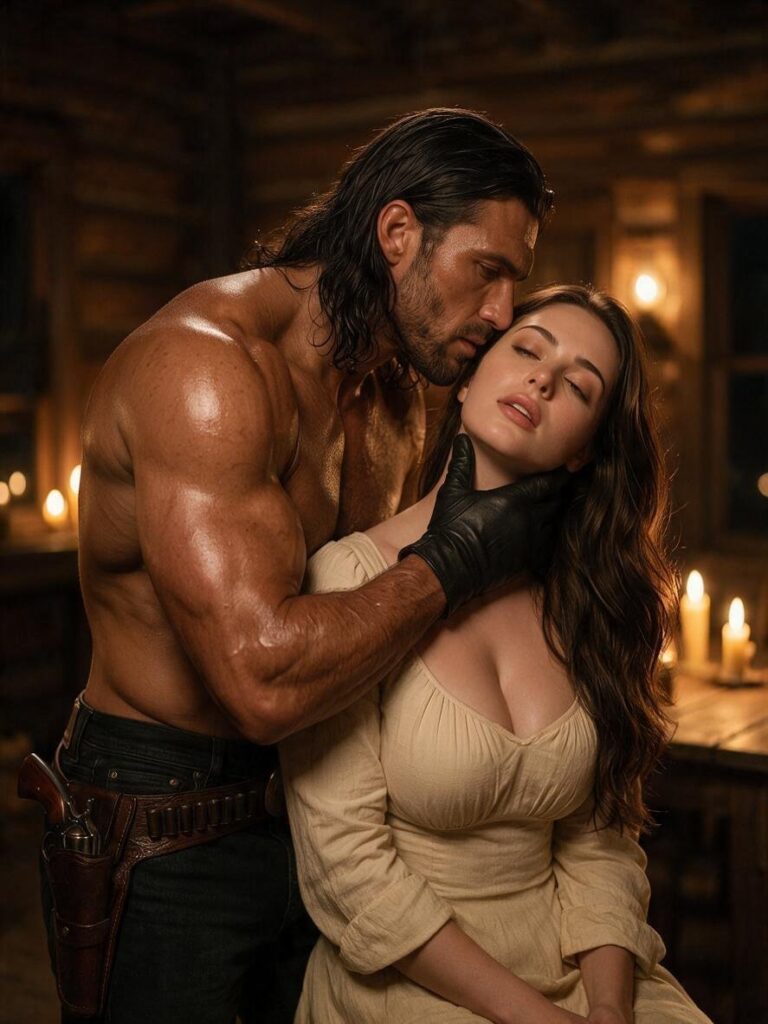
“I’ve never been touched,” the bride whispered, her voice barely louder than the snow falling outside. “Not once. Not the way you’re looking at me right now.”
And Elias Crane, the man the whole valley called a savage, the man who had buried more wolves and worse than wolves than any soul in the high country, forgot how to breathe.
Because sometimes the thing that changes a woman’s life isn’t cruelty. It’s the first time a dangerous man holds her like she still belongs to herself, like she still has a choice.
Forty-one days before Clara Whitmore stood barefoot on a cabin floor at the top of the world and whispered those words to the most feared man in the territory, she was a stranger to all of it—to the cold, to the wilderness, to him.
The westbound train smelled of coal smoke and other people’s lives.
Clara Whitmore sat with her gloved hands folded in her lap, her spine as straight as the boarding school in Boston had taught her to keep it, and watched the green of the East surrender mile by mile to something raw and endless and brown.
She had a small leather case beside her boots. Inside it was everything she owned that mattered: her mother’s silver locket, a Bible with a cracked spine, three dresses folded with care, and a single letter she had read so many times the creases had gone soft as cloth.
The letter was from a man named Samuel Hartley.
She did not love Samuel Hartley. She had never met him. But she had read his words until she half believed she did.
He wrote like a kind man. He wrote of a clapboard house with a porch that faced the morning, of a general store he owned in a town called Ashford Crossing, of a quiet life and steady hands, and a wife who would never want for bread.
He had written in the last letter, “I am no poet, Miss Whitmore, but I will be good to you. That much I can promise on my mother’s grave.”
A girl could build a whole future on a sentence like that.
Clara had.
She was 22 years old, and she was running not from anything as dramatic as the dime novels described. She was running from a house in Boston that had stopped being hers the day her father died and her uncle’s family moved in. From a future that had narrowed to two doors: marry the widowed Mr. Puit, who was 53 and smelled of liniment and looked at her the way a man looks at a piece of furniture he intends to own, or become the unpaid governess to her cousin’s children until she was too old and too gray to be anything else.
She had chosen a third door, a door that opened onto a thousand miles of nothing and a stranger’s promise at the end of it.
“You’ll be killed out there,” her aunt had said, not unkindly, the morning Clara left. “Or worse.”
“What’s worse than being killed?” Clara had asked.
Her aunt had not answered.
But Clara thought on the train that she finally understood.
Worse was being alive in a life you had never once chosen. Worse was a body that did everything it was told and a heart that had forgotten the sound of its own wanting.
So she watched the West unspool through the smudged window and let herself, just a little, hope.
She let herself imagine it in the long, swaying hours between stations.
A porch that faced the morning, he had written.
She imagined sitting on it with her coffee while the sun came up over country wide enough to hold any future she dared to dream. She imagined a kitchen of her own, where no aunt would count the sugar she used. She imagined, most of all, the simple, unfamiliar luxury of being wanted, of being chosen by someone for once rather than tolerated, managed, or sold.
She did not need Samuel Hartley to be handsome. She did not need him to be young.
She needed only what he had promised: kindness, and a door she might one day call her own.
She was 22, and she had never once in her life been the one to decide where she would sleep, what she would eat, whom she would marry.
The train carried her west at 30 miles an hour, and with every mile the old life loosened its grip, and Clara Whitmore breathed a little deeper and let herself believe that the third door would open onto something better than the two she’d left behind.
The train reached Ashford Crossing on the ninth day in a cold so sharp it felt like a slap.
Samuel Hartley was not there to meet it.
A skinny boy of perhaps 14, with a runny nose and an oversized coat, was holding a square of paper with her name printed on it in a careful, uneven hand.
Clara stepped down onto the platform, her boots finding frozen mud, her breath fogging in front of her face, and looked around at the town that was meant to be her home.
It was smaller than she had imagined: a single street of leaning buildings, a church with a crooked steeple, mountains rising behind it all like the shoulders of something enormous, sleeping white with early snow.
“Miss Whitmore?” The boy’s voice cracked. “You Miss Clara Whitmore?”
“I am.” She tried to smile. “Are you Mr. Hartley’s boy?”
The boy looked at his boots.
“No, ma’am. I work at the livery. Mr. Garrett, he runs the livery. He had me come.” He swallowed. “There’s been a—I don’t rightly know how to say it, ma’am.”
Something cold that had nothing to do with the weather settled into Clara’s chest.
“Say what?” she asked. “Where is Mr. Hartley?”
The boy looked up at her then, and there was something terrible and gentle in his young face. The look of a child made to carry news too heavy for him.
“Mr. Hartley passed, ma’am. Three weeks back. Fever took him quick. Wasn’t but two days.”
The platform tilted.
Clara gripped the iron rail of the train steps.
Around her, the town went on with its small, frozen business. A man unloading crates, a dog barking somewhere, the wind moving through the gap in the buildings like a thing alive.
“That’s not possible,” she heard herself say. “I have his letter. He wrote to me. He said—”
“I’m awful sorry, ma’am.” The boy shifted his weight. “Mr. Garrett, he said you’d best come to the livery and we’d figure what’s to be done with you.”
What’s to be done with you?
As though she were a crate. As though she were a horse no one had claimed.
Clara stood very still on the platform at the top of the world, 22 years old, a thousand miles from anyone who had ever known her name, and understood that the third door she had chosen had just closed behind her with the dead man’s last breath.
She did not cry. She had been raised not to cry where people could see.
She picked up her leather case, lifted her chin the way her mother had taught her, and followed the boy down the frozen street.
The livery was warm, at least, warm with the smell of hay and horse and the iron tang of the forge in the next room.
Mr. Garrett turned out to be a broad, balding man with kind eyes and an apron stained dark with years of work. He gave Clara a stool by the stove and a tin cup of coffee so strong it made her eyes water.
And he told her, with the awkward tenderness of a man unused to women’s grief, everything he knew.
Samuel Hartley had been a decent man, a widower himself, lonely, getting on in years. He had ordered himself a bride the way other men ordered seed catalogs, and he’d been so pleased when Clara’s letters came back kind.
Half the town had known he was expecting her.
And then the fever had come through the way it did some autumns, and it had taken Samuel Hartley and the Puit baby and old Widow Beal all in the same hard fortnight.
“He paid your passage,” Garrett said, turning his hat in his hands. “Paid it in full in advance. That was Samuel. Always paid his debts up front.” He cleared his throat. “Trouble is, ma’am, there’s no debt to you. There’s no—there’s no arrangement that holds, now he’s gone. You see my meaning.”
Clara saw his meaning.
She had no husband, no home, no money but the few coins sewn into her hem, and a return ticket she could not afford and would not use if she could. There was nothing in Boston to return to but the two doors she had fled.
“I have skills,” she said. Her voice came out steadier than she felt. “I can read and write and cipher. I can sew. I can teach. I can keep accounts. Surely there is—”
“Ain’t no school here, ma’am,” Garrett said gently. “Ain’t no work for a lady. This is rough country, men’s country.”
He looked genuinely pained.
“I’d take you in myself, but I got six mouths already and a wife who’d skin me. I’m only telling you true so you can think clear.”
Clara wrapped both hands around the tin cup and stared into the black coffee and tried very hard to think clear.
And that was the moment the door opened.
It opened the way weather opens a door. A gust of cold, a flurry of snow, a darkness filling the frame.
And then a man stepped through it, and the whole livery seemed to grow smaller around him.
He was the largest man Clara had ever seen.
Not merely tall, though he was that. He had to stoop to clear the lintel. He was built broad through the shoulders in a way that strained the seams of his weathered coat. His forearms corded where the sleeves were rolled, his hands the size of dinner plates.
A dark beard hid the lower half of his face. Above it, his eyes were a startling pale gray, sharp as a blade, catching light, and they moved across the room once—Garrett, the boy, the horses, the stranger by the stove—and missed nothing.
There was snow caught in his beard and in the dark hair that fell to his collar. There was a long gun slung across his back and a knife at his belt that was nearly a short sword.
And there was something in the way the boy went still, the way Garrett’s jovial face tightened, that told Clara this man was feared.
“Crane,” Garrett said, and his voice had changed. “Careful now. Wasn’t expecting you down till the thaw.”
“Needed shoes for the bay.” The man’s voice was low and rough, a voice that did not seem to be used often. “Brought pelts to trade. Beaver and two wolf.”
He shrugged a heavy bundle off his shoulder and set it on the floor without effort, though Clara could see it must have weighed a great deal.
“I’ll wait.”
His pale eyes moved to Clara then, just for a moment.
She felt that gaze like a hand laid flat against her chest.
Not improper. There was nothing leering in it. It was worse than that somehow.
It was a look that saw her, that took in the fine wool of her travel dress and the city polish of her boots and the redness around her eyes and the leather case at her feet, and understood the entire shape of her ruin in the space of a breath.
Then he looked away as though she were not his concern.
And that was almost a relief.
“Who is that?” Clara asked Garrett, low.
Garrett busied himself with the coffee pot.
“Name’s Elias Crane. Lives up the mountain. Trapper. Keeps to himself.” A pause. “Mostly.”
“Mostly?”
Garrett glanced at the big man who had crouched by his pelts and was inspecting one of the wolf hides with those enormous, surprisingly careful hands.
“There’s stories,” he murmured. “Folks say he killed a man. More than one. Say he came up that mountain 10 years back running from something and never came down to stay. Some say he’s half wolf himself.”
Garrett shook his head.
“I don’t hold with most of it. He’s always dealt fair with me. But folk are scared of him, ma’am. And out here, scared and true ain’t so different. You do well to keep your distance.”
Clara looked at the man called Elias Crane.
He had not killed her. He had barely looked at her.
And yet she understood the warning in her bones.
She did not know, could not have known, that the dangerous stranger by the door was the only person in that frozen town who was about to offer her a way to live.
It happened because of the storm.
The talk in the livery went around in circles for the better part of an hour. Garrett sent the boy to fetch the parson, thinking the church might know what charity could be scraped together.
The parson came, a thin, anxious man, and wrung his hands and spoke of the Christian duty to the widow and orphan, though Clara was neither, only something stranger, a bride with no groom, and offered nothing but prayer, which Clara accepted with a politeness she did not feel.
And all the while, through the one grimy window, the snow came down harder.
By the time the parson left, the street outside had vanished into white. The wind had risen to a howl.
Garrett went to the door, looked out, and shut it again with a grim face.
“No one’s traveling tonight,” he said. “Storm set in. Could be two days, could be five. This time of year, you can’t say.”
He turned to Clara, and she saw the calculation in his kind, tired eyes. Six mouths already, a wife who’d skin him, and now a stranded city girl with nowhere on earth to sleep.
It was Elias Crane who spoke.
He had been silent so long that Clara had nearly forgotten he was there, a great shadow crouched by the forge, mending a strap on his pack.
He did not look up when he spoke.
“She can have the cabin.”
The room went very still.
Garrett blinked. “Crane—”
“I have a cabin up the mountain. Sound roof, good stove, plenty of wood and meat for winter.”
He set down the strap and rose to his full towering height.
And now he did look at Clara, and those pale eyes were unreadable.
“Town’s got no place for her. I’ve got room. It’s no kindness. It’s just true.”
“Now hold on,” Garrett said. “You can’t just—she’s a lady, Crane. A respectable woman. You can’t take her up that mountain alone. The two of you. That’s—”
“Then marry us.”
Crane said it flat, like a man stating the price of grain.
“Parson’s not 10 minutes gone. Call him back. Make it lawful. I’ll not have the town saying I dishonored her.” His jaw tightened beneath the beard. “I’ll not have her freeze in a stable either, while you all pray over her and do nothing.”
Clara stood up so fast the stool scraped.
“I beg your pardon,” she said, and her Boston schooling rang in every clipped syllable. “I am not a—I am not livestock to be passed between men. You don’t know me. I don’t know you. You cannot simply decide.”
And then Elias Crane did something that undid her entirely.
He stopped.
He took a half step back, putting more space between them, and he raised both of those enormous, scarred hands, palms open, the way a man calms a frightened horse.
“You’re right,” he said.
The roughness in his voice had gentled.
“That was wrong of me. I spoke over you like you weren’t standing right there.”
He lowered his hands slowly.
“So I’ll say it to you then. Not to him. To you.”
Clara’s heart was pounding.
She did not sit, but she did not run either.
“I’m offering you shelter through the winter,” Elias Crane said. “A roof, a fire, food. Nothing more than that. Unless you ever want more, which you won’t, and that’s fine. I’ll sleep by the door. You’ll have the bed. I won’t touch you. I won’t come near you. Come the thaw, if you want to leave, I’ll take you down this mountain myself and put you on any train you choose, and you’ll never see my face again.”
He paused.
“Marrying’s just to keep the town’s tongues off you, a name on a paper. It means nothing more than you let it mean.”
His pale eyes held hers.
“But it’s yours to choose, not mine, not his. If you say no, I’ll ride out tonight, and you can take your chances here, and I’ll think no less of you for it.”
The fire popped in the forge.
The wind screamed against the walls, and Clara Whitmore, 22, ruined a thousand miles from anyone, stood frozen between a town that offered prayers and a stranger who offered a door.
It’s yours to choose.
No man had ever said those words to her.
Not her father, who loved her but ruled her. Not her uncle, who owned her. Not Mr. Puit, who would have bought her. Not even dead Samuel Hartley, who had been kind but who had still ordered her like seed from a catalog.
This terrifying mountain of a man, this rumored killer with snow in his beard and a knife like a short sword at his belt, he was the first.
“What’s your name?” she asked. “Your given name.”
“Elias.”
“Elias.”
She tested it.
Then she lifted her chin the way her mother had taught her and looked the most feared man in the territory dead in the eye.
“If I marry you, Elias Crane, I want it understood that I am not yours. I am my own. The paper changes nothing about that.”
Something moved behind his pale eyes. It might have been respect. It might have been the very first ghost of something warmer.
“I’d want it no other way,” he said.
They were married in the church with the crooked steeple, with Garrett and the livery boy for witnesses and the anxious parson rushing through the words as though afraid the snow would bury them all before he finished.
It was the least romantic wedding in the history of the West.
There were no flowers. There was no music. The bride wore a travel dress stiff with nine days of train soot, and the groom wore a coat that smelled of wood smoke and wolf.
And when the parson said, “You may kiss the bride,” in his thin, nervous voice, Elias Crane did not move toward Clara at all.
He only looked at her, a question in those pale eyes, and when she gave the smallest shake of her head, he nodded once and turned to sign the paper instead.
And Clara, watching him honor that tiny, silent no in front of God and witnesses, felt something in her chest she could not name.
They left within the hour.
The storm had eased to a steady fall, and Elias said they had to ride while they could or be trapped in town for days.
He set Clara on the bay mare, wrapped in two of his own thick wool blankets that swallowed her whole and smelled, not unpleasantly, of him—of cedar and smoke and cold, clean air.
He walked, leading the horse by the bridle, his own broad back to the wind, breaking the trail with his body so the mare would have an easier path.
The mountain rose around them like a held breath.
Clara had never seen anything like it.
The pines stood black and enormous, their branches bowed under white. The world was silent but for the crunch of snow and the mare’s breathing and the wind in the high boughs.
Now and then a clump of snow would fall from a branch with a soft wump, and Clara would startle, and Elias would say without turning, in that low, rough voice, “Just the trees shedding their load. Nothing to fear.”
And somehow, impossibly, she believed him.
They climbed for hours.
The light went amber, then blue, then nearly gone.
“How much farther?” Clara asked. Her teeth had begun to chatter despite the blankets.
“Close now.”
He glanced back at her, and his pale eyes flicked over her face, reading the cold in it.
Without a word, he stopped, unwound the scarf from his own neck, leaving his throat bare to the wind, and reached up to wrap it around her face, over her nose and mouth, tucking it with those huge, careful hands.
“Your scarf,” she said, muffled. “You’ll freeze.”
“I have a thicker hide than you.”
Was that almost humor in his voice?
“Keep it on.”
He turned and walked on into the dark, breaking trail, his bare neck red with cold, and did not mention it again.
Clara watched the back of this enormous, frightening stranger who had given her his scarf and thought, The town is wrong about you. They have to be wrong about you.
She did not yet know how right and how wrong they both were.
The cabin appeared out of the darkness like something from a story.
It sat in a small clearing where the trees drew back, low and broad and solid, built of squared logs chinked tight against the wind, with a stone chimney standing cold against the snow.
A lean-to sheltered a stack of split wood taller than Clara. A second, larger shelter stood off to the side for the animals.
Everything was made plain and made to last, made by hands that knew exactly what the mountain would do to anything that was not.
Elias lifted Clara down from the mare as though she weighed nothing, his hands spanning her waist, setting her on her feet in the snow so gently she barely felt the ground.
And then he stepped back at once, that careful distance again, and busied himself with the horse.
“Go in,” he said. “Door’s not locked. Nothing up here to lock against but weather. I’ll see to the bay and start the fire when I’m done.”
The cabin’s single room surprised her.
She had expected squalor, a killer’s den, filth and bones, the den of a half-wild man.
Instead, she found order.
A swept floor, a broad bed in the corner, the blankets folded square, a stone hearth, cold now, with a heavy iron pot and a kettle, a table built for a giant, two chairs, shelves.
And this stopped her breath.
Shelves of books.
Two dozen at least, their spines worn soft with reading.
Shakespeare, a volume of poems, a book on the stars, a worn Bible, histories of places far away.
And pelts, yes, and traps hung on the wall, and the long gun on its pegs. But beneath all the rough trade of his life ran a current of something else entirely.
Something thoughtful.
Something lonely.
Clara stood in the cold, dark cabin of the most feared man in the territory and ran her gloved finger along the spine of a book of poems and felt the first crack open in everything she had been told to believe.
The door opened.
Elias came in stamping snow from his boots, his arms full of wood.
He saw her by the shelf and went still for a moment, and something flickered across his face, almost embarrassment, as though she had caught him at something private.
“They were here when I came,” he said quickly. “The man before me. I didn’t—”
“You’ve read them,” Clara said.
It was not a question.
The spines were too worn, the books too obviously loved.
He didn’t answer.
He knelt at the hearth and built the fire with quick, economical movements, and within minutes flame was crawling up through the kindling, and warmth, blessed living warmth, began to push back the dark.
But Clara had seen the color rise above his beard, and she thought, He is ashamed to be more than they say he is.
Someone somewhere taught this enormous man to hide the gentlest parts of himself.
He made true on every word of his bargain that first night.
He fed her a stew of venison and dried roots, and something green he’d put up in autumn, richer and better than anything she’d eaten on nine days of train food.
He gave her the bed, would not hear a word against it, and made himself a pallet of furs on the floor by the door, his gun within reach.
He turned his broad back while she changed into her nightdress behind a blanket he’d strung on a line for her privacy.
He banked the fire, said a low, “Good night, Mrs. Crane,” into the dark, and was asleep, or seemed to be, within minutes.
Clara lay in the warm bed in the strange cabin and listened to the breathing of the giant by the door and the wind clawing at the roof and waited to feel afraid.
She did not feel afraid.
That was the strangest thing of all.
The storm kept them in for four days.
And in those four days, Clara Whitmore learned the shape of the man she had married.
He rose before light. By the time she woke each morning, the fire would be roaring, the kettle hot, and Elias would be gone, out checking his trap lines, seeing to the animals, hauling wood, returning with snow on his shoulders and cold coming off him in waves, and always something useful in his hands.
He spoke little, but Clara, who had spent her life among people who spoke a great deal and meant almost none of it, began to find she preferred it.
She learned that his silence was not emptiness.
It was attention.
He noticed everything.
He noticed when she was cold before she did, and a blanket would appear across her shoulders. He noticed she favored the venison over the rabbit and served her venison without comment.
He noticed on the second day that she kept rubbing her hands, and that night he produced a small pot of bear grease and beeswax and set it wordlessly by her place at the table for the chapping she’d not even mentioned.
“How did you know?” she asked, turning the little pot in her fingers.
He shrugged his enormous shoulders.
“You stopped using your hands for things. People do that when their hands hurt.”
No one had watched Clara that closely in her entire life.
It unsettled her.
It warmed her.
She did not know what to do with either feeling, so she said only, “Thank you, Elias.”
And he nodded and said nothing.
And somehow that nothing was the most eloquent thing anyone had said to her in years.
By the third day, she had stopped hiding behind the privacy blanket to do small things.
By the fourth, she had begun to talk.
She talked because the silence, comfortable as it was, left too much room for the grief and fear she’d been outrunning since Boston.
She talked about her mother, dead these six years, about the locket in her case, about ballet she’d learned as a girl and given up, about books she’d loved, about the way the light fell in the Boston house in October.
She did not expect him to listen. She talked the way one talks to a fire to fill the silence.
But Elias Crane listened.
He listened the way he did everything, completely, with his whole still attention, those pale eyes on her face.
And on the fourth evening, when she ran out of words and fell quiet, embarrassed at how much she’d said, he did something he had not done before.
He talked back.
“My mother kept bees,” he said into the firelight. “Back in Pennsylvania, long time ago.”
His huge hands turned a piece of wood he was whittling, slow and steady.
“She used to say a hive was the only true democracy in nature. Everyone working, no one master.” A pause. “I think on that sometimes up here. How the wild’s got its own order. And it isn’t cruel exactly. It’s just true. It does what it does.”
He glanced at her.
“You’d have liked her, I think. She read every book in that county, married a hard man who couldn’t read a word, and loved him anyway. And I never did understand it.”
It was the most he had ever said.
Clara held very still, the way one holds still when a wild thing comes close, afraid to startle it back into the trees.
“Is that why you came here?” she asked softly. “Your father, the hard man.”
The whittling stopped.
For a long moment, Elias stared into the fire, and Clara saw something old and dark move behind his eyes, and she thought she had pushed too far.
“Some of it,” he said at last. “There’s things I’ve done, Clara. Things the town’s right to whisper about. I’ll not lie to you and say I’m a gentle man. I’m not. I have blood on me that won’t wash off.”
He met her eyes, and there was no plea in his, no excuse, only a terrible honesty.
“But I never once hurt anyone who wasn’t trying to hurt me or mine first. That much I can swear. And I’ll never hurt you. Not if the whole mountain comes down. That’s the truest thing I’ve got to give.”
The fire crackled.
Outside, the storm had finally gone quiet, and through the window the stars burned cold and enormous over the snow.
“I believe you,” Clara whispered.
And she was astonished to find that she did.
There was a night in that long first stretch of snowed-in days that Clara would hold close to her heart for the rest of her life, though at the time she did not understand its weight, only that something in her chest had shifted and would not shift back.
She woke in the small hours to firelight and the sound of weeping that was not weeping.
It was Elias.
He was asleep on his pallet by the door, and he was caught in some dream that had hold of him, and his great body had gone rigid, his breath coming short and ragged, his huge hands fisted in the furs.
He made no cry. Even asleep, even unguarded, the man would not let himself cry out.
But his face in the dim red light was twisted with an old, deep grief, and his lips moved around a name Clara could not hear.
She lay still and watched him, this enormous, frightening man laid low by something in his own sleeping mind, and her heart ached so fiercely she could not bear it.
She should have left him to it.
A wise woman would have.
He had told her plainly there were dark things in his past, and a man’s nightmares are his own private country, and she had no right to cross the border.
But she could not lie there and watch him suffer alone.
She rose barefoot, the cold floor biting at her feet, and crossed the small room and knelt beside his pallet.
She did not wake him.
She had heard somewhere that you must never wake a man fighting in his sleep, that you must call him gently back.
So she laid her small hand against his broad shoulder, light as a falling leaf, and she began to speak low and soft, the way her mother had once spoken to her through childhood fevers.
“Easy now,” she murmured. “Easy. You’re safe, Elias. You’re in your cabin on your mountain, and the fire is warm, and the snow’s falling soft, and there’s nothing here that can hurt you. Easy now. Come back. Come back to the warm.”
Slowly, slowly, the rigid lines of his body eased.
The terrible grief smoothed from his face. His breathing lengthened and gentled.
And just as Clara began to draw her hand away, thinking him settled back into true sleep, his own enormous hand came up and closed over hers.
Not gripping.
Not trapping.
Only holding, the way a drowning man holds the thing that keeps him afloat.
And he let out a long, shuddering breath, and in a voice thick with sleep he murmured one word.
“Stay.”
Clara’s breath caught.
She did not know if he was awake. She did not know if he knew it was her or thought her some figure from his dream, some ghost of comfort his lonely mind had conjured.
But she looked at that huge, scarred hand holding hers so carefully in the firelight.
And she looked at his face, gone peaceful at last.
And she made a decision she did not fully understand.
She stayed.
She settled herself on the floor beside his pallet, her hand still in his, her back against the warm stones of the hearth, and she stayed there in the small hours while the fire burned down and the snow fell and the giant slept on, holding her hand like an anchor.
And at some point she too drifted off there on the hard floor, more at peace than she had been since long before Boston.
When she woke at first light, she was alone, and there was a folded blanket tucked carefully over her, and the fire was already roaring, and Elias was gone to his trap lines as he always was.
They never spoke of it.
Not that morning, not for weeks.
He gave no sign he remembered, and she gave no sign she did.
And the thing passed between them unnamed.
But something had changed all the same.
She had heard him ask in his sleep for the one thing the whole world had taught him never to ask for out loud.
Stay.
And without quite knowing it yet, Clara had already begun to answer.
The storm broke on the fifth day, and Elias told her she was free to go.
“Trail’s passable now,” he said over breakfast, not looking at her, his voice carefully empty. “I gave you my word. Say the word back, and I’ll take you down to the crossing today. Put you on the eastbound. You’ll be in Denver by week’s end.”
He set down his cup.
“You owe me nothing. The marriage can be undone. Parson knows a circuit judge. You can go home.”
Home?
Clara turned the word over and found it had no meaning anymore.
There was no home in Boston. There never had been. Not really. Only two doors and a narrowing life.
And here, on this terrible, beautiful mountain, in this cabin full of books and bear grease and a giant who watched her hands for pain—
“I’d like to stay,” she said. “A while longer, if that’s all right.”
Elias went very still.
He did not look up, but she saw his huge hand tighten around the cup just slightly.
“It’s your choice,” he said. “It was always your choice.”
“Then I choose to stay.”
And neither of them said anything more, but something had shifted in the room, some current that had not been there a moment before, and they both felt it, and neither dared to name it.
The days grew into weeks, and the weeks taught Clara things about herself she had never known.
She learned she was not the fragile city flower the West had expected.
She learned to keep the fire, to cook on the open hearth, to mend the rough tears in Elias’s heavy clothes with a steady hand.
He taught her patiently to load and fire the long gun, standing close behind her to steady the heavy barrel, his broad chest warm at her back, his low voice in her ear, saying, “Breathe out, then squeeze. Don’t pull.”
And the first time she hit the target, a knot in a distant pine, she whooped with a joy so unladylike that Elias actually laughed.
It was a startling sound, rusty, as though it had not been used in years.
It transformed his whole hard face, crinkled the corners of those pale eyes, showed white teeth in the dark beard.
Clara stared at him, the gun forgotten in her hands.
“What?” he said, the laugh fading into something self-conscious.
“Nothing,” she said. “I’ve just—I’ve never seen you laugh. You should do it more. It suits you.”
The color rose above his beard again.
He looked away, busying himself with the powder horn, and muttered something that might have been, “Haven’t had much cause these 10 years.”
And Clara felt that crack in her chest open wider.
She was beginning to understand the danger she was in.
It was not the danger the town had warned her of.
It was a far sweeter, far more terrifying danger.
She was beginning to want to be near him, to watch for the sound of his boots on the snow at evening, to save up small things through the day to tell him at the fire, to notice more and more the breadth of his shoulders and the gentleness of his enormous hands and the way his pale eyes softened when they landed on her.
She had married a stranger to survive a winter.
She had not planned to fall for him.
That had not been part of the bargain at all.
It was the fever that broke the last wall between them.
It came in the seventh week, riding in on a vicious cold snap that drove the temperature so low the trees cracked like gunshots in the night.
Elias had been out long on the trap lines, too long, pushing to bring in meat before the worst of it set in, and he came home in the blue dark, soaked through and shaking.
By midnight, he was burning.
Clara woke to the sound of him.
The great silent man who never made a sound in his sleep was muttering, thrashing on his pallet by the door, his skin radiating heat she could feel from across the room.
She lit the lamp and knelt beside him and laid her hand on his forehead and snatched it back.
He was scalding, burning up, his beard wet with sweat, his pale eyes glassy and unseeing when they fluttered open.
“Elias.” She gripped his huge shoulder, shook it. “Elias, you’re burning. You’ve taken a fever.”
“Fine,” he slurred. “Tend the fire. Cold for you.”
“You are not fine. Hush. Let me think.”
And then Clara Whitmore—boarding-school Clara, who had never nursed anyone, who had been raised to faint prettily at the sight of blood—discovered what she was made of.
She worked through the night and into the next day and the night after that.
She stripped his soaked shirt, and even feverish and afraid, she could not help but see the map of his body, the slabs of muscle, the old scars, a knife’s white seam across the ribs, a pucker that could only be a healed bullet wound.
And she sponged him with snowmelt to bring the fever down.
She forced willow bark tea between his cracked lips, the way her mother had once done for her.
She piled every blanket and pelt in the cabin over him when the chills came and stripped them off again when the burning rose.
She kept the fire roaring and the kettle hot, and she did not sleep, would not sleep, for three days.
In his fever, he talked.
He talked of a brother dead, of a fire long ago, of a man he’d killed.
“He had it coming. He had it coming. But God, the look on him.”
And Clara held his huge, burning hand through the worst of it and said, “Hush now. Hush. You’re safe. You’re here. You’re safe.”
Until the words ran together and lost their meaning and became only sound, only comfort, only her voice in the dark keeping him tethered to the world.
And on the third night, the fever broke.
She felt it break.
She had her palm on his chest, half dozing in the chair she’d dragged beside his pallet, and she felt the scalding heat give way all at once to a clammy coolness, felt his ragged breathing ease into something deep and steady.
And when she pressed her hand to his forehead, it was only warm now, only the warmth of a living man.
And she put her face in her hands and wept with a relief so total it frightened her.
When she lowered her hands, his pale eyes were open, clear, watching her.
“You stayed,” Elias said.
His voice was a wreck, barely there.
“Three days. You didn’t sleep. I heard you the whole time. Your voice.” He swallowed with effort. “Thought I dreamed you. Thought a man like me doesn’t get—”
He stopped, his pale eyes clear and defenseless in a way she had never seen them, filled with something raw.
“Why’d you stay?”
Clara looked at the enormous, frightening, gentle man she had nursed back from the edge of death, lying spent and bare and undefended in the firelight.
And she stopped being afraid of the truth.
“Because somewhere in these seven weeks,” she whispered, “you stopped being the man the town warned me about, and you became the man I can’t imagine leaving.”
Elias healed slowly.
He was a strong man, and the fever had been a hard one, and for the better part of a week Clara would not let him rise, which galled him to no end.
A man unused to being still, unused to being cared for, unused to needing anyone at all.
But there was a sweetness in those days of his mending that neither of them had words for.
She read to him from the book of poems, the worn one she’d found that first night, her voice filling the cabin in the long, firelit evenings.
He listened with his eyes closed, and once she looked up to find him watching her instead of listening, his pale gaze on her mouth, and she lost her place on the page and had to start the verse again, her cheeks burning.
There was an afternoon that week she never forgot.
The light came thin and golden through the cabin’s one window, and the worst of his fever weakness had passed, and Clara had set herself to a chore she’d been putting off: combing the snarls and dried sweat of three sick days from her own long, dark hair, which had come loose from its careful bun and tangled past all hope.
She sat on the low stool by the fire, fighting the comb through it, wincing, until a low voice spoke behind her.
“Let me.”
She turned.
Elias had pushed himself up against the wall, pale still but steady, and he was holding out one enormous hand for the comb.
Clara stared at him.
“You’ll only make it worse,” she said. “Those hands are made for skinning bears, not—”
“My mother had hair to her waist,” he said. “Black as yours. When she was sick at the end, I did this for her every evening.”
He waited.
“Let me, Clara.”
And so she turned back to the fire, and she gave the most feared man in the territory her comb, and she sat very still while he gathered the heavy, dark length of her hair in one huge, careful hand and began, with a gentleness that stopped her breath, to work the tangles free.
He was patient past all belief.
Where the snarls were worst, he did not pull. He held the hair above the knot the way a careful man does, taking the strain on his own fingers so it would not pull at her scalp, and worked the comb through in small, slow strokes until the tangle gave.
The fire popped, the light went amber, and Clara sat with her eyes half closed and the rough, tender weight of his hands moving through her hair, and felt something in her chest unspool as slowly and surely as the knots.
No one had touched her hair since her mother died.
No one had touched her at all.
Not with tenderness.
Not in years and years.
And now this giant of a man, this rumored killer, sat behind her in the firelight and tended her like something precious and asked nothing and took nothing.
And Clara felt her eyes sting hot and did not know why.
“There,” Elias murmured at last, drawing the comb through one final time, smooth and unresisting now from crown to end.
His hand lingered a moment in her hair, just a moment, and then withdrew, careful, respectful, back to the careful distance.
“Done.”
Clara did not turn around right away.
She did not trust her face.
“Thank you,” she said softly to the fire.
“Hm,” said Elias behind her, which from him was a whole speech.
And neither of them said another word for a long while, and the silence was warm and full and said everything they were both still too afraid to say aloud.
She fed him broth, and he let her.
That proud, feared man let her hold the cup to his lips, and the intimacy of it, her fingers at his jaw, his pale eyes holding hers over the rim, made the air in the cabin feel thick and charged.
And little by little, the careful distance Elias had kept since the very first night began, by inches, to close.
It was not a thing either of them decided.
It was a thing that simply happened the way the thaw happens, not all at once, but in a thousand small surrenders.
His hand, when he passed her a cup, would let her fingers linger against his.
She, mending his shirt by the fire, would sit a little closer than the work required.
When he was strong enough to rise at last and moved about the cabin again, they were forever finding themselves near in the small space, brushing past one another, and neither of them stepped away as quickly as they once had.
The wanting in the cabin grew so thick you could have cut it with his great knife.
And then one evening it broke open.
A blizzard had come down again, sealing them in, the wind howling its old song against the logs.
They had eaten. The fire was high.
Clara was at the hearth, banking the coals for the night, and she rose too quickly, and her bad ankle, the old dancer’s injury, turned beneath her, and she gasped and started to fall.
Elias caught her.
He crossed the room faster than a man his size had any right to move and caught her against his chest.
One enormous arm wrapped around her back.
And suddenly Clara was pressed full against him, her palms flat on the broad, warm wall of his chest, her face tilted up, and his pale eyes were inches from hers and burning.
Neither of them moved.
She could feel his heart slamming under her hand. She could feel the heat of him, the iron strength of the arm around her, and the careful, trembling stillness with which he held her, as though she were made of glass, as though one wrong breath might break her, as though he were holding the most precious and most dangerous thing in the world.
“Clara.”
Her name came out of him low and ragged.
“I’m going to set you on your feet now and step back because if I don’t—”
His jaw worked. The arm around her trembled.
“Because I told you I’d never touch you, and I keep my word. And right now I am—God help me—I am holding to that word by a thread.”
And Clara Whitmore, who had crossed a thousand miles to choose her own life, made her choice.
“Don’t step back,” she whispered.
His pale eyes flared.
“Clara—”
“I’ve never been touched,” she whispered, her voice barely louder than the snow falling outside, her hands curling into the fabric of his shirt. “Not once. Not the way you’re looking at me right now. Every man who ever wanted me wanted to own me, wanted to put me behind a door. You’re the only one who ever set me free.”
Her breath shook.
“So don’t step back, Elias. I’m not asking you as a wife you bargained for. I’m choosing you the way you let me choose everything. Do you understand? I’m choosing you.”
For a long, trembling moment, the most feared man in the territory simply looked at her as though he could not quite believe the world had handed him this.
And then Elias Crane lowered his head, and his savage whisper against her ear, rough and low and undone, blew every careful wall in Clara’s mind to dust.
“Then God forgive me,” he breathed. “Because I have wanted to do this since the moment you lifted your chin in that livery and told me you’d never be mine. And it was the wanting to be let—that’s what ruined me. I’d have walked off this mountain for a single word from you.”
And he kissed her.
It was nothing like Clara had imagined a kiss from such a man might be.
It was not savage at all.
Not at first.
It was achingly, devastatingly gentle, a giant’s restraint, his enormous hand cradling the back of her head as though she were the most fragile thing he’d ever held.
Asking.
Always asking, even now.
And when she rose up into it, when she answered him, when she made it clear with every line of her body that the answer was yes, yes, yes, only then did the gentleness deepen into something with heat in it, something that made her gasp against his mouth and cling to him and forget entirely that she had ever been cold or alone or afraid.
When they finally broke apart, both of them shaking, he pressed his forehead to hers and held her like a man holding the whole of his fortune.
“You’ll be the death of me, Clara Crane,” he murmured.
“No,” she whispered back, smiling against his lips. “I rather think I’ll be the life of you.”
They had three weeks of happiness before the past came up the mountain.
And oh, what weeks they were.
Clara would remember them all her life.
The long, bright, cold days, the firelit nights, the slow, unhurried discovery of one another.
Elias laughed now often, that rusty, wonderful sound growing easier each time.
He read to her, too, in his low, rough voice. He taught her the names of the stars from the book on his shelf, the two of them bundled in furs in the doorway, looking up at the burning sky.
He told her, piece by piece, the whole dark story of his past, the brother, the fire, the man he’d killed who’d murdered that brother.
And she held him through the telling of it and loved him no less.
And he wept once, just once, a hard man’s hard tears.
And she understood it was the first time in 10 years he had let anyone see.
They were happy.
They were, against all the odds the world had given them, happy.
And then, on a gray afternoon with snow threatening, three riders came up the mountain trail.
Elias saw them first.
He always saw everything first.
He went to the window at some sound Clara hadn’t even heard, and his whole body changed.
The ease went out of it, and the old stillness came back, the predator stillness, and his hand drifted to the long gun on its pegs.
“Riders,” he said quietly. “Three coming up slow.”
He glanced at her, and there was a question in his face.
“They’re not mountain, Clara. Town clothes, city clothes.” A pause. “One of them’s wearing a coat I know in Boston.”
Clara’s blood went to ice.
She went to the window.
She looked, and her heart stopped.
The man riding in front, picking his fastidious way up the snowy trail on a horse he clearly hated, wrapped in a fine wool coat far too thin for the mountain.
She would have known him anywhere.
The narrow face. The cruel small mouth. The liniment and money smell she could almost catch from here in memory.
“Puit,” she breathed. “Mr. Puit from Boston. The man my uncle wanted me to—”
She could not finish.
“What is he doing here? How did he—”
“Your uncle?” Elias said grimly. “Find a runaway girl? You ask at every station on the line. Station master at the crossing remembers a Boston lady who married a mountain man and went up the hill.”
His jaw was iron.
“They’ve come a long way, Clara. Men don’t come this far for nothing.”
The knock came at the door.
Sharp, entitled, three raps.
And then a voice she had prayed never to hear again.
“Clara. Clara Whitmore, I know you’re in there. Open this door. I’ve come a very long way to collect what’s owed.”
What’s owed?
As though she were a debt.
As though she were a thing.
Elias set his huge hand on her shoulder.
“You don’t have to open it,” he said low. “You don’t have to do a single thing you don’t want. This is your home and your land and your choice. And any man who says otherwise goes through me.”
His pale eyes burned.
“But I’ll not decide for you. What do you want, Clara?”
And Clara Whitmore, who had run from this very man across a thousand miles, who had once been so afraid of him, looked at the door and found, to her own astonishment, that she was not afraid anymore.
Because she was not the girl who had run.
That girl had been alone.
This woman had chosen her life and chosen the man beside her and learned to load a gun and break a fever and survive a mountain.
This woman had a home.
“Open it,” she said. “I want to look him in the eye.”
Elias opened the door.
He opened it and filled the whole frame with his enormous body, the long gun cradled easy in his arms, and Clara saw Mr. Puit’s fastidious face go slack with fear at the sheer mountainous size of him.
Behind Puit, the two hired men, rough fellows, the kind money buys in railroad towns, shifted uneasily and put their hands near their pistols.
“You’re trespassing,” Elias said.
His voice was very quiet and very flat, and somehow that was more frightening than any shout.
“This is my land. Speak your business and go.”
“My business,” Puit sniffed, drawing himself up, trying to recover his city dignity, “is with the woman behind you. Clara Whitmore. She is—there were arrangements. Her uncle and I had an understanding. She fled in the night like a common thief, and I have spent considerable money tracing her, and I’ll have her back, or I’ll have the law on the both of you.”
His small, cruel eyes found Clara over Elias’s shoulder.
“Come now, Clara. This episode is finished. Look at you, living like a savage’s woman in a hovel. I am prepared to be magnanimous. Come home and we’ll say no more about it.”
Clara stepped out from behind her husband.
She stood beside him in the doorway, not behind him.
Beside him.
And she lifted her chin the way her mother had taught her.
“There was no arrangement, Mr. Puit,” she said. “There was a transaction my uncle wished to make, of which I was the goods. I never agreed to it. A woman cannot flee an agreement she never made. I am not a thief. I stole nothing but myself, and I had every right to it.”
Puit’s face purpled.
“Now you listen here, you ungrateful little—”
“Careful.”
Elias did not raise his voice.
He did not raise the gun.
He only said the one word, and the temperature in the doorway seemed to drop 10 degrees, and Puit’s mouth snapped shut.
Clara went on, her voice ringing clear in the cold air.
“I am married, Mr. Puit, lawfully wed in the church at Ashford Crossing, witnessed and signed. I am Clara Crane now. Whatever you imagine is owed you, it was paid the day I left Boston. Paid in your freedom from a wife who would have hated you every day of her life.”
She let that land.
“You spent your money chasing a woman who was never yours. That is no one’s loss but your own. Now there is the door, and there is the mountain, and the snow is coming. I’d start down before dark.”
For a long moment, Puit stared at her, at the woman who had been a frightened girl transformed into something he no longer recognized.
Something with steel in her spine and a mountain at her back.
Then his cruelty got the better of his sense.
He gestured sharply at his two hired men.
“I didn’t come a thousand miles to be lectured by a runaway. Take her. He can’t shoot all three of—”
He never finished.
Elias moved.
Clara had never seen anything like it.
Would never see anything like it again.
The enormous man crossed the porch in a blur, and there was no gunfire, no blood, only a terrible, efficient violence too fast to follow.
The long gun stock cracked across the wrist of the first hired man, who shrieked and dropped his pistol in the snow.
A fist the size of a ham took the second one square in the chest and folded him clean off his feet into a drift.
And then Elias had Puit by the front of his fine, thin coat, lifted half off the ground, the man’s polished boots kicking at air, brought up nose to nose with that terrible bearded face.
“You came to my home,” Elias said very softly. “And you put your hands toward my wife.”
He gave Puit a single shake that rattled the man’s teeth.
“There are men buried on this mountain who did less. The only reason you’ll ride down breathing is that she”—a jerk of his head toward Clara—”is a kinder soul than I am. And I’ll not put more blood in front of her than I have to.”
He set Puit down, stepped back, picked up the dropped pistols from the snow, broke them open, emptied the cartridges into his huge palm, and tossed the empty guns at the hired men’s feet.
“Get on your horses,” Elias said. “All three. Ride down. If I ever see your face north of the crossing again, I’ll not be gentle twice.”
They went.
Puit, white-faced and shaking with rage and terror both, hauled himself onto his hated horse, and the three of them turned and fled down the mountain trail and did not look back.
Clara stood in the doorway and watched them shrink into the white distance and disappear.
That night, Clara could not stop shaking.
It was not fear.
The danger was gone, ridden down the mountain into the dusk.
It was something else, something she could not name that set her trembling by the fire long after the venison was eaten and the cabin was warm.
Elias watched her from across the hearth, his pale eyes worried, and finally he came and knelt before her chair and took both her cold hands in his enormous, warm ones.
“Talk to me,” he said. “You’ve gone somewhere I can’t follow.”
“When you held him up like that,” Clara whispered. “When you—I saw it, Elias. For just a moment, I saw the man the town is afraid of. The man the stories are about. The killer.”
She made herself meet his eyes.
“And I wasn’t afraid of you. That’s what frightens me. I should have been afraid, and I wasn’t. What does that make me?”
Elias was quiet for a long moment, his thumbs moving slow over the backs of her hands.
“It makes you someone who saw the whole of me,” he said at last, “and didn’t run. Clara, I’ll not lie to you and pretend that man isn’t in here. He is. He always will be. I’ve done dark things, and I’m capable of darker. And today you saw it true.”
His jaw tightened.
“But I need you to hear the rest. That man, the one in the doorway, he’s a door I keep shut. I only open it when something I love is in danger.”
He pressed her hands to his chest over his heart.
“And the thing that decides whether it opens isn’t rage. It’s you. You’re the lock on that door now. As long as you’re safe, it stays shut. That’s the truth of me. I’d rather you know it and choose than not know it and stay blind.”
And then he said the thing that broke her open entirely, the thing that made him forever the only man she could have loved.
“And if knowing it makes you want to go,” Elias said, “then I’ll take you down this mountain tomorrow, and I’ll put you on any train you name, and I’ll never once try to stop you. The same as I promised that first night. I meant it then, and I mean it more now.”
His pale eyes shone wet in the firelight.
“I will never be the door you can’t open from the inside. Not for you. Never for you. You can walk out of my life any morning you choose, and I’ll hold the door, and I’ll thank God I had you at all.”
He swallowed.
“That’s what love is, near as I can figure. It’s keeping your hand open even when everything in you wants to close it tight and hold on.”
Clara slid off the chair and into his arms, onto the floor with him before the fire, and wept.
Not from fear now, but from the sheer, overwhelming relief of being, for the first time in her whole life, completely and freely chosen and completely and freely free.
“I don’t want to go,” she sobbed into his chest. “I never want to go. Don’t you understand, Elias? Every door in my life was shut by someone else. You’re the first one who held one open. How could I ever leave the only man who ever let me stay because I wanted to?”
He held her then.
This enormous, gentle savage of a man held her against his hammering heart while the fire burned low and the stars wheeled cold and bright over the cabin at the top of the world.
“Then stay,” he murmured into her hair. “Stay because you want to every day. That’s all I’ll ever ask. Not because you owe me. Not because there’s nowhere else. Just because you keep choosing it. Choosing me.”
His voice broke.
“Will you do that, Clara? Will you keep choosing me?”
“Every day,” she whispered fiercely, lifting her face to his. “Every single day for the rest of my life, I choose you. I’ll choose you tomorrow, and I’ll choose you when we’re old, and I’ll choose you with my last breath. I choose you, Elias Crane.”
And he kissed her slow and deep and reverent.
The most feared man in the territory, undone on the floor of his own cabin by a woman who had crossed a thousand miles to learn that the strongest thing on the whole frontier was not a gun or a fist or a name that made men afraid.
It was a hand held open.
It was a door left unlocked.
It was the freedom to stay.
Spring came late to the high country that year, as it always did.
But it came.
The snow drew back from the clearing in shrinking gray patches. The ice broke on the creek with a sound like distant thunder, and the water ran loud and cold and silver down the mountain.
Green came creeping back into the world.
First the brave small shoots at the edge of the melt, then the soft haze of new leaves on the aspens, then all at once an explosion of wildflowers across the high meadow that took Clara’s breath clean away.
She had survived her first mountain winter.
She had come up that trail a ruined bride wrapped in a stranger’s blankets.
And she would come down it, when they chose to, for supplies, for the small business of living, as Clara Crane, who could shoot and skin and keep a fire, who knew the names of the stars, who was loved completely and freely by the strongest, gentlest man she had ever known.
They went down to Ashford Crossing in the late spring, the two of them, to trade pelts and buy what the winter had used up.
And Clara watched the town watch them.
Watched the whispers follow Elias the way they always had.
Watched the careful, fearful distance people kept from the savage of the mountain.
But she walked beside him now, her arm through his, her chin high.
And when old Garrett at the livery looked at her with frank astonishment—the city girl he’d half expected to find frozen in a snowbank, alive and glowing and happy on the arm of the man the whole valley feared—Clara only smiled.
“You were wrong about him, Mr. Garrett,” she said. “The whole town’s wrong about him. There’s no gentler man in all this country. You just have to be brave enough to look.”
And Garrett, turning his hat in his hands, looked at the way the great, fearsome Elias Crane’s pale eyes followed his wife around the livery, soft, devoted, helplessly tender, and slowly, wonderingly, he began to believe her.
The stories about Elias Crane never fully died.
Stories like that never do.
But a new story began to travel alongside the old ones, passed from porch to porch through the long mountain evenings.
The story of the savage of the high country and the Boston bride who tamed him, though anyone who truly knew them understood it was never taming at all.
It was choosing.
It was two people who had every reason in the world to close their hands, learning instead to hold them open.
Years later—and they had many years, more than the stories ever guessed—there was a child, and then another, dark-haired, pale-eyed children who grew up wild and free and fearless on the mountain, who learned the names of the stars from their enormous, gentle father and to read from their fierce, loving mother, who never once in all their growing knew a door in that cabin that locked from the outside.
And on winter nights, when the storms came down and sealed them all in warm and safe together, Clara would sometimes catch her husband watching her across the firelit room, the same way he had watched her that very first night in the livery, when she was a stranger and he was a fear and the whole future was a closed white blank.
“What?” she would ask him, smiling the way she had a hundred times.
And Elias Crane, once the most feared man in all the territory, brought low and lifted high by the gentleness of a woman who had crossed a thousand miles to choose her own life and chosen him, would only smile back, that rusty, wonderful smile that had grown so easy now, and say the truest thing he knew.
“Just grateful,” he’d murmur, “every day that you keep choosing to stay.”
And every day she did.


