
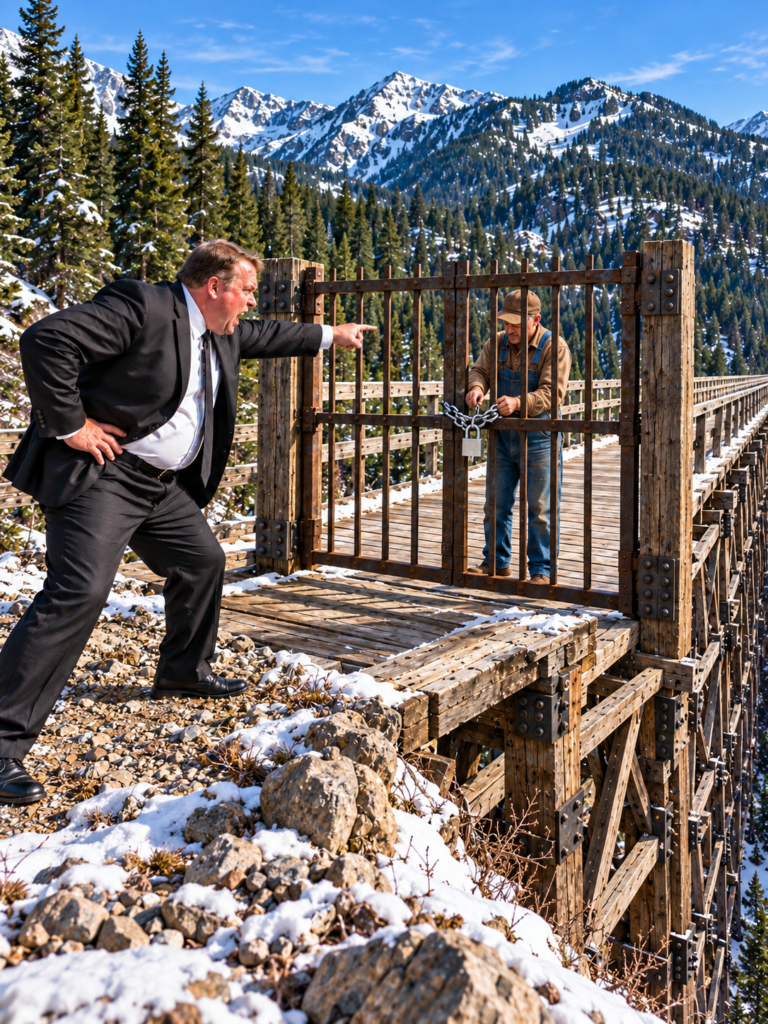
the bank locked the only road to his 84-acre farm to force him to sell—so the 72-year-old farmer rebuilt a forgotten bridge they could never control
Part 1
At seventy-two, Walter Mercer had learned that trouble rarely announced itself with thunder.
Sometimes it arrived quietly on an ordinary September morning, while coffee was still cooling in a chipped blue mug and fog was lying low over the soybean fields.
Walter stepped off the porch of the farmhouse his father had built outside Logan, Ohio, pulled his canvas jacket tighter around his shoulders, and heard an engine idling somewhere beyond the maple trees.
That was unusual.
Nobody came up Mil Creek Road that early except feed trucks, neighbors, or somebody who was lost.
Walter walked past the equipment shed and through the thin morning mist until the road came into view.
Then he stopped.
Six steel posts had been driven into the ground.
A heavy chain gate stretched across the road.
In the center hung a white sign with black lettering announcing that the road had been temporarily closed for a safety inspection.
Walter read it twice.
Mil Creek Road was the only route wide enough for trucks to reach his eighty-four-acre farm. His family had used it for decades. Now, without warning, the road had been chained shut.
Two workers in orange vests were loading tools into a utility truck.
Walter approached them.
“Morning.”
Neither man looked comfortable.
The older one nodded. “Morning, Mr. Mercer.”
Walter pointed toward the gate.
“What is this?”
The worker reached through his open window and handed Walter a folded sheet of paper.
“We were told to install it.”
“Told by who?”
“The bank.”
Walter looked at him.
“The bank doesn’t own my farm.”
“No, sir.”
“Then why is the bank closing my road?”
The younger worker stared at the gravel.
The older man said, “You’ll have to call them.”
Walter unfolded the notice.
There was no engineering report.
No reopening date.
No county inspection number.
No explanation beyond the claim that safety concerns required temporary closure.
At the bottom was the name of First Valley Agricultural Bank.
Walter folded the paper again.
“Did anybody inspect the road?”
The worker hesitated.
“Not that I saw.”
That answer stayed with Walter.
He watched the truck disappear beyond the gate before walking back toward the farmhouse.
Mil Creek Road had been part of his life for so long that he could almost measure his seventy-two years by what had traveled over it.
His father’s old Ford tractor.
His mother’s station wagon.
The school bus that had carried Walter and his brother into town.
The truck that had brought lumber when Walter and his wife, Elaine, added two bedrooms to the farmhouse after their second child was born.
The ambulance that had taken Elaine to the hospital during her final winter.
Walter stopped beneath the maple trees she had planted.
There were eleven of them.
There had once been twelve.
Lightning had split one during a storm years earlier, and Walter had never replaced it.
Elaine had said twelve looked too formal anyway.
“Eleven has character,” she had told him.
She had been gone nine years.
Walter still talked to her when nobody was around.
“You seeing this?” he murmured.
The leaves moved in the breeze.
Walter went inside and called the bank.
He waited eleven minutes before the branch manager came on the line.
“Walter.”
The voice belonged to Raymond Voss.
Raymond was in his late forties, broad around the waist, always dressed too formally for a small agricultural bank. Even at livestock auctions, he wore a dark suit and a red tie.
He had visited Walter twice during the past six months.
Both times he had wanted to buy the farm.
The first offer had been $185,000.
Walter refused.
The second had been $230,000.
Walter refused again.
Now there was a gate across the road.
“What did you do to Mil Creek?” Walter asked.
Raymond sighed as though Walter were inconveniencing him.
“There are concerns about the road.”
“What concerns?”
“Safety.”
“Whose?”
“Walter, I don’t have the engineering details in front of me.”
“There aren’t any engineering details on the notice either.”
“We’re being cautious.”
“We?”
“The bank.”
Walter looked through the kitchen window toward the fields.
The bank had acquired the neighboring 216 acres east of him after another farmer went bankrupt earlier that year.
But owning neighboring land did not make Walter’s road theirs.
“How long is it closed?”
“I can’t tell you that.”
“A day?”
“I don’t know.”
“A week?”
“I said I don’t know.”
“Harvest starts soon.”
“I understand.”
“No, Raymond. I don’t think you do.”
Walter had corn to move.
Feed to bring in.
Diesel deliveries.
Veterinary visits.
Mil Creek Road was not a scenic driveway.
It was the artery of the farm.
Raymond lowered his voice.
“There are other roads.”
“Narrow county roads that add half an hour.”
“Temporarily.”
Walter said nothing.
Then Raymond added, almost casually, “Of course, the bank’s offer on the property is still available.”
Walter’s fingers tightened around the telephone.
There it was.
Not proof.
Not yet.
But something.
Ten days earlier, Walter had refused Raymond’s second offer.
Now his road was closed.
Walter did not accuse him.
He simply asked, “Anything else?”
“No.”
Walter hung up.
The detour added nearly thirty-five minutes each way.
By the end of the first week, Walter had spent more money on diesel than he normally used in almost three weeks of local hauling.
His feed supplier added a delivery surcharge.
The man who hauled grain told Walter he might have to charge more during harvest because the back roads were too narrow for a fully loaded trailer.
Then Walter received his monthly loan statement.
Balance remaining: $31,700.
He sat at the kitchen table looking at the number.
The farm was collateral.
Raymond knew it.
The bank knew it.
If Walter’s operating costs rose enough during harvest, he could fall behind.
And if he fell behind badly enough, the bank would gain leverage over the very property it wanted.
Walter stood and walked toward the hall.
Above a cabinet hung a photograph taken in 1978.
Walter, young and lean.
Elaine beside him.
His father, Henry Mercer, holding Walter’s first son.
Behind them stood the barn.
Walter remembered his father saying, “Land doesn’t make a man rich just because it’s worth money. It makes him rich because he knows where he belongs.”
Walter had thought it sounded old-fashioned.
At seventy-two, he understood.
The farm contained more than acreage.
Elaine’s maples were there.
His children had learned to drive there.
His father was buried three miles away.
His mother’s handwriting remained inside an old cookbook in the kitchen.
Every fence had a story.
Every field had a scar.
Walter was not interested in becoming rich by selling it.
That night, he carried a cardboard tube and three old notebooks from the upstairs closet to the kitchen table.
His father’s property maps.
Walter spread them beneath the yellow light.
East was useless.
The bank controlled nearly everything beyond that boundary now.
North was steep.
South eventually curved back toward Mil Creek Road.
West was Pine Hollow Gorge.
Walter traced it with one finger.
Seventy-six feet across at the narrowest point.
More than forty feet deep.
For as long as Walter could remember, the gorge had been treated as an impassable boundary.
But his father’s oldest map showed something strange.
A thin line crossed it.
Walter brought the paper closer to the lamp.
The line continued west toward an abandoned logging road that eventually met County Road 93.
He searched through the notebooks.
Most contained ordinary things.
Fence repairs.
Hay yields.
Engine part numbers.
Rainfall totals.
Then he found an entry from the late 1960s.
Three sentences.
Storm damage.
West bridge railing broken.
Repair before cattle move.
Walter stared at the words.
“Bridge?”
He had never seen a bridge there.
The next morning he carried a shovel, pruning saw, tape measure, and thermos through the western woods.
He spent two hours cutting through thorn bushes.
Then he found the first stone.
Not natural stone.
Cut limestone.
He dropped to one knee and scraped leaves away.
More stone appeared.
A foundation.
Walter’s pulse quickened.
Across the gorge, nearly hidden beneath roots and moss, stood another.
He climbed carefully down the slope and found rusted steel anchors driven deep into the stone.
His father had been right.
There had been a bridge.
Walter stood at the edge of the gorge looking toward the opposite foundation.
For the first time since the gate appeared, something inside him changed.
Until that moment, Raymond Voss had controlled the situation.
The bank had closed the road.
The bank decided when it might reopen.
The bank decided how much pressure Walter would endure.
But nobody had closed the western route.
Nobody had even remembered it.
Walter smiled.
“All right, Dad.”
Then he looked across Pine Hollow.
“Let’s see what you left me.”
Part 2
Walter did not begin building immediately.
Age had taken some things from him, but impatience was not one of them.
At twenty-five, he would have bought lumber first and asked questions later.
At seventy-two, he had learned that the difference between courage and foolishness was often paperwork.
He drove to the county records office in Logan.
The woman behind the counter was named Martha Keene. She had silver hair cut short and reading glasses hanging from a chain around her neck.
Walter placed the old farm map on the counter.
“I’m looking for a road that disappeared.”
Martha smiled.
“You’d be surprised how many of those we have.”
For nearly three hours they searched survey records.
Then Martha pulled out a survey from 1958.
There it was.
A farm and emergency access route crossed the western edge of what was now Walter’s property, passed directly over Pine Hollow Gorge, and continued toward County Road 93.
Walter leaned over the paper.
“That’s it.”
Martha tapped another record.
“This copy is from 1984.”
Someone had written abandoned beside the route.
Walter frowned.
“Who abandoned it?”
“That’s what we need to find out.”
They searched meeting minutes.
County decisions.
Road records.
Nothing.
There was documentation showing that the bridge had suffered severe flood damage in 1969.
There were references to local farmers shifting traffic to Mil Creek Road.
But there was no formal decision surrendering the western right-of-way.
Walter sat back.
“So because people stopped using it, somebody wrote abandoned?”
“That appears possible.”
“Does writing a word on a copy close a legal access route?”
Martha gave him a careful look.
“That is a question for a lawyer.”
Walter understood the answer hidden inside her caution.
He thanked her and made copies.
On the drive home, his hands felt steadier on the wheel.
He might not be creating anything new.
He might be restoring something his family had simply stopped using.
That afternoon Walter measured the gorge again.
He drew a bridge on graph paper.
Double timber trusses.
Heavy treated beams.
Steel reinforcement where needed.
Wide enough for his pickup and compact tractor.
Not a monument.
Not a tourist attraction.
A working farm bridge.
He calculated materials.
The total made him sit back in his chair.
About $14,600.
Nearly half his savings.
Walter looked toward the empty chair across the kitchen table.
Elaine had managed the household accounts for forty-three years.
She would have asked three questions.
Is it necessary?
Can we afford it?
Will we regret not doing it?
Walter could hear her voice so clearly that he answered aloud.
“Yes.”
“Barely.”
“Yes.”
The next morning, Walter called the lumberyard.
Before he could place the full order, a certified letter arrived from First Valley Agricultural Bank.
He opened it at the kitchen table.
The bank objected to construction of a bridge, claiming that unauthorized structural changes could affect the value of collateral securing Walter’s loan.
Walter read the letter once.
Then again.
Then he laughed.
It was not a joyful sound.
“They close one road and tell me I can’t build another.”
That afternoon he drove into Logan and visited attorney Helen Brooks.
Helen was sixty-eight, with gray hair, a quiet voice, and the irritating habit of reading every line of every document before saying anything.
Walter liked her immediately.
She read his loan agreement.
Then the bank’s letter.
Then the property records.
Finally she removed her glasses.
“The bank does have a legitimate interest in protecting collateral.”
Walter’s face fell.
Helen raised one finger.
“I didn’t say they can stop you.”
She turned the agreement toward him.
“They can object if you damage the property or significantly reduce its value. Restoring legal access would normally increase usefulness and potentially increase value.”
“So they’re bluffing?”
“I didn’t say that either.”
Walter sighed.
“You lawyers enjoy this.”
“Immensely.”
She picked up the Mil Creek records.
“Now this interests me.”
“What?”
“The bank owns land beside portions of Mil Creek Road.”
“I know.”
“But this twenty-four-foot corridor appears to serve interior properties.”
Walter leaned closer.
“A right-of-way?”
“Possibly.”
“Meaning?”
“Meaning owning land beside a road is not necessarily the same as having legal authority to close the road.”
Walter became still.
Helen tapped the gate notice.
“If they closed a protected access corridor without authority, that creates a different problem for them.”
“Can we sue?”
“We can.”
Walter expected more.
Helen closed the file.
“But I don’t think we should. Not yet.”
“Why?”
“Because right now, we know what they did. We don’t know why.”
Walter thought of Raymond’s purchase offers.
Helen saw his expression.
“You think the closure is connected to the sale?”
“I do.”
“Thinking it and proving it are different jobs.”
Walter nodded.
“What do you suggest?”
“You build only if we can document that you’re acting within an existing right-of-way. I’ll keep digging into the records. And Walter?”
“Yes?”
“Photograph everything.”
So he did.
The gate.
The sign.
The road.
The old bridge foundations.
Every stage of construction.
Every letter.
Every receipt.
Walter began clearing the western route.
At first he worked alone.
He cut brush until his shoulders burned.
He hauled rotten branches.
He dug around the limestone foundations.
He removed loose material and cleaned the old anchor points.
By the third afternoon, his hands were blistered.
That evening, sitting on the porch, Walter flexed his fingers and looked down at them.
At seventy-two, pain lasted longer than it used to.
His right knee stiffened every evening.
His lower back complained whenever he lifted more than he should.
Elaine would have scolded him.
“You’re seventy-two, Walter, not thirty-two.”
“I know,” he whispered.
He did not stop.
On the fourth morning, a pickup arrived.
His neighbor, Earl Dawson, stepped out carrying two drills.
“Heard you’re building a bridge.”
Walter nodded.
“Heard right.”
Earl looked at the gorge.
“That’s a terrible idea.”
Walter waited.
Earl opened the truck bed.
“Brought tools.”
By noon, another neighbor arrived with steel cable.
Then another with a tractor.
A retired carpenter named Marvin Bell brought levels and clamps.
Nobody had organized them.
Nobody made speeches.
They simply came.
Rural people sometimes showed concern in ways that could be mistaken for silence.
They did not ask Walter how frightened he was.
They brought bolts.
They did not tell him they supported him.
They carried beams.
They did not say the bank had treated him unfairly.
They arrived before sunrise and left after dark.
Six days into construction, a black sedan came down the field lane.
Raymond Voss stepped out.
Black suit.
Red tie.
Polished shoes entirely unsuited for mud.
He stood with his hands on his hips, looking at the partially built bridge.
“Quite a project.”
Walter tightened a nut.
Raymond walked closer.
“You have an engineer?”
“Not yet.”
Raymond laughed.
“So a seventy-two-year-old farmer is going to trust his life to some wood stretched across a forty-foot drop?”
Walter looked up.
“I’ve trusted my life to older equipment.”
Several neighbors smiled.
Raymond’s expression tightened.
He stepped closer to Walter.
“I came because the bank is prepared to make another offer.”
Walter returned to the bolt.
“I’m not selling.”
“You haven’t heard it.”
“I don’t need to.”
“Two hundred seventy-five thousand dollars.”
Walter stopped.
Earl stopped drilling.
Raymond lowered his voice.
“And we’ll wipe out your remaining loan.”
For the first time, Walter looked directly at him.
“You told me my bridge could reduce the farm’s value.”
“It could.”
“And the road’s closed.”
“Temporarily.”
“So according to you, the farm is becoming harder to reach and I’m hurting its value.”
Raymond said nothing.
Walter wiped grease from his fingers.
“Then why did your offer go up forty-five thousand dollars?”
For several seconds, only the creek below them made noise.
Raymond looked toward the bridge.
Then toward the men working on it.
He turned and walked back to his car.
Walter watched him leave.
Earl came beside him.
“Well?”
Walter stared after the sedan.
“He wants this land worse than I thought.”
That night Walter did not sleep well.
At two in the morning he went downstairs, warmed coffee he did not need, and sat beside Elaine’s empty chair.
For the first time, he admitted something privately.
He was afraid.
Not afraid of Raymond.
Afraid of making one mistake.
One late loan payment.
One legal error.
One structural failure.
Walter did not have endless money.
The bank did.
He did not have employees or attorneys on salary.
They did.
His savings were shrinking.
His body hurt.
Harvest was approaching.
Pride was expensive.
There was a number, Walter knew, at which almost any tired old man could be tempted.
$275,000.
No debt.
No bridge.
No fight.
He could buy a small place closer to town.
His children would probably understand.
Walter stood and walked toward the hallway.
He stopped before the family photograph.
Elaine smiling.
His father holding the baby.
The old barn behind them.
Walter placed one hand against the frame.
“I’m tired, Ellie.”
For a moment, the house was completely silent.
Then the furnace clicked on.
Walter smiled sadly.
“You’d tell me to finish what I started.”
The next morning, he was back at Pine Hollow before sunrise.
Part 3
Two days later, Helen Brooks arrived at the farm carrying a thick folder.
Walter found her beside the half-finished bridge.
“You look pleased,” he said.
“For a lawyer, yes.”
“That worries me.”
She handed him a printed map.
“What am I looking at?”
“The reason they want your property.”
The map showed the bank’s 216 acres.
Several neighboring parcels.
And a large planned development.
Eco resort.
Conference center.
Estimated project value: roughly $18 million.
Walter traced the proposed entrance road.
His finger stopped.
His eighty-four acres sat directly in the way.
He looked at Helen.
“They need my land.”
“They strongly prefer it.”
“What happens if they don’t get it?”
Helen pointed north.
“They can build around you.”
Walter examined the contour lines.
“Through that slope?”
“Yes.”
“That’s steep.”
“Very.”
“They’d need drainage.”
“Yes.”
“Probably another bridge.”
“At least one.”
Walter slowly lowered the map.
“They’d spend millions.”
Helen nodded.
Everything suddenly made sense.
The two purchase offers.
Raymond’s repeated visits.
The gate appearing ten days after Walter rejected $230,000.
The new offer for $275,000.
His road had not become dangerous.
His refusal had become expensive.
Walter sat on a stack of lumber.
For several seconds, anger almost overwhelmed him.
He imagined Raymond sitting behind a clean desk in an air-conditioned office calculating how much discomfort an old farmer could absorb before surrendering.
Extra fuel.
Delayed feed.
Higher hauling costs.
Loan pressure.
Isolation.
Walter clenched his jaw.
Helen watched him.
“Do not do anything angry.”
“I wasn’t planning to.”
“You’re gripping that map hard enough to tear it.”
Walter loosened his hand.
“What do we do?”
“We keep documenting.”
“That’s it?”
“That’s not nothing.”
Walter stood.
“I’m finishing the bridge.”
Helen smiled.
“I assumed you would.”
Word spread.
Not through newspapers.
Not at first.
Through feed stores.
Church parking lots.
Diners.
Farm supply counters.
People heard that an old farmer’s road had been blocked after he refused to sell.
They heard he was rebuilding an abandoned bridge.
Some believed the bank had every legal right.
Some thought Walter was stubborn.
Most simply became curious.
And more neighbors came.
One Saturday, twelve people worked at Pine Hollow.
Someone brought sandwiches.
Someone else brought coffee.
A teenager from a nearby farm spent an afternoon carrying washers and bolts.
Walter caught him staring into the gorge.
“Scared of heights?”
“Yes, sir.”
“Good.”
The boy looked confused.
“People who aren’t scared are the ones I don’t want near the edge.”
Walter did not romanticize the project.
It was dangerous.
Every beam was measured twice.
Every connection was reinforced.
Nobody worked alone near the edge.
Walter planned to pay for an independent inspection before driving anything across.
He wanted freedom.
He did not want recklessness.
When the bridge was more than halfway complete, another letter arrived from the bank.
This one looked different.
Less threatening.
Almost generous.
First Valley would reopen Mil Creek Road immediately if Walter stopped construction and signed an agreement.
Walter carried the document directly to Helen.
She read page one.
Then page two.
Then page three.
Her expression hardened.
“There.”
She pointed.
Walter read.
The agreement required him to acknowledge the bank’s authority to control access along Mil Creek Road.
Another provision released the bank from claims connected with losses caused during the closure.
Walter leaned back.
“So they open the gate if I admit they had the right to close it.”
“Yes.”
“And I give up the right to recover what this has cost me.”
“Yes.”
Walter laughed softly.
“They want me to sign their proof for them.”
“That is one interpretation.”
“What’s yours?”
“The same one, except I charge by the hour.”
Walter folded the agreement.
“No.”
Helen nodded.
“I thought you’d say that.”
Walter requested an official county survey.
He wanted both routes examined.
Mil Creek Road.
The western right-of-way.
The survey crew arrived several days later.
Walter followed them at a distance.
He did not interfere.
Measurements were taken.
Markers checked.
Old records compared.
When the findings came back, Helen drove to the farm instead of calling.
Walter met her on the porch.
“Well?”
She held up the report.
“The old bridge foundations are inside the 1958 access corridor.”
Walter released a breath.
“And Mil Creek?”
“Also part of the access corridor serving interior properties.”
“Can the bank close it?”
“There is no valid county record giving them authority to do what they did.”
Walter sat slowly.
Helen continued.
“The word abandoned on the later copy appears to be exactly that. A notation. We still have no formal abandonment proceeding.”
For nearly a month, Walter had wondered whether he was the unreasonable one.
Banks had lawyers.
Managers spoke confidently.
Official letters arrived on heavy paper.
Signs used formal language.
Temporary closure.
Safety inspection.
Collateral protection.
Authority.
Those words had weight.
But paper did not become truth merely because somebody printed a logo at the top.
Walter looked across the yard.
“So I wasn’t imagining it.”
“No.”
He nodded once.
Then said, “Good.”
Helen seemed surprised.
“That’s all?”
“What else should I say?”
“I don’t know. I expected more celebration.”
Walter looked toward Pine Hollow.
“I’ll celebrate when I can drive my truck across.”
Three weeks after construction began, the final deck boards were secured.
The railings were reinforced.
An independent engineer inspected the structure.
Walter waited beside the gorge while the man examined the foundations, measured connections, checked loads, and walked the full length twice.
Finally he returned.
“For light farm vehicles?”
Walter nodded.
“Pickup. Small tractor.”
The engineer looked back at the bridge.
“I’d drive my own truck across it.”
That was enough.
The next morning half a dozen neighbors gathered.
Walter wished they had not.
He did not want an audience.
But they came anyway.
His old Ford pickup idled at the eastern edge.
Walter sat behind the wheel with both hands resting on it.
For a strange moment, he thought about Elaine.
They had bought that truck together.
She had complained about the color.
“Brown?” she had said. “You bought a brown truck?”
“It hides mud.”
“So does dirt.”
Walter smiled at the memory.
Then shifted into gear.
The front tires rolled onto the bridge.
The deck creaked.
Walter’s heart struck hard against his ribs.
He moved slowly.
Ten feet.
Twenty.
Halfway.
The gorge opened beneath him.
Walter did not look down.
The wooden deck vibrated, but the structure held.
He reached the opposite side.
His tires touched the old logging road.
Nobody cheered at first.
There was a moment of stunned quiet.
Then Earl shouted.
Walter looked in the mirror.
Men were waving.
Somebody clapped Marvin Bell on the shoulder.
Walter rested his forehead against the steering wheel.
He was not crying.
At least that was what he intended to tell anyone who asked.
He drove west.
The old logging road connected to County Road 93 exactly as the maps showed.
And then Walter discovered something that made him laugh out loud.
The new route was faster.
Not dramatically.
But enough.
Years of habit had convinced everyone Mil Creek Road was the best route simply because it was the route everybody used.
The forgotten western access put Walter closer to the highway into Logan.
When he returned, Earl stood waiting.
“How was it?”
Walter climbed out.
“Terrible.”
Earl frowned.
“Really?”
“Yeah. I got to town faster.”
Earl laughed.
Walter looked back at the bridge.
The bank had tried to isolate him.
Instead, it had forced him to rediscover something his own family had forgotten.
Within days, farm operations began returning to normal.
Feed trucks could reach him again.
Crops could leave.
The detour disappeared.
Walter made his next loan payment on time.
Then the next.
Whatever pressure the bank expected the gate to create was disappearing.
But the gate remained.
Every time Walter passed the eastern field, he could see the chain hanging across Mil Creek Road.
He stopped feeling trapped by it.
Now it looked almost foolish.
A lock on a door after somebody had discovered a second exit.
Then Helen called.
“Walter, I need you in town.”
“What happened?”
“A county review turned up communications between the bank and the developer.”
Walter felt a cold sensation in his stomach.
“What kind of communications?”
“The kind Raymond Voss probably wishes he had never written.”
Part 4
Helen placed the printed email on her desk.
Walter read it.
Then read it again.
Three weeks before the gate appeared, Raymond had written to representatives of the developer.
The wording was careful.
Corporate.
But the meaning was not.
Limiting the operating ability of the interior property might cause its owner to reconsider expectations regarding sale price.
Walter sat completely still.
Helen did not interrupt him.
Finally he said, “Interior property.”
“Yes.”
“That’s me.”
“Yes.”
“He didn’t even use my name.”
“No.”
Walter stared at the email.
That detail hurt more than he expected.
Not because he needed Raymond’s respect.
Because the language revealed how he had been viewed.
Not as Walter Mercer.
Not as a widower.
Not as a farmer who had worked the land most of his life.
Not as a customer who had borrowed money and made payments.
Interior property.
An obstacle on a development map.
Helen slid another email toward him.
In that one, Raymond indicated that the bank expected to control nearly three hundred acres before completion of the proposed transaction.
Walter did the math.
The bank’s 216.
His 84.
Three hundred.
“But they didn’t control mine.”
“No.”
“I never agreed.”
“I know.”
“He told them like it was already theirs.”
Helen nodded.
Walter leaned back.
For weeks he had imagined that the gate was a crude negotiating tactic carried out by one ambitious manager.
Now the picture looked worse.
The bank had a mortgage interest in his farm.
Raymond apparently believed that financial relationship could be turned into leverage for an unrelated real-estate deal.
Walter looked through the office window at traffic moving along Main Street.
“What happens now?”
“The development project is still undergoing approvals. These communications are relevant.”
“To the county?”
“Yes.”
“To the bank’s board?”
“Absolutely.”
Walter felt no satisfaction.
He thought he would.
Instead, he felt tired.
“I don’t want to spend the rest of my life in court.”
“You may not have to.”
“I don’t want the whole bank destroyed either.”
Helen studied him.
“They closed your road.”
“Raymond closed my road.”
“The distinction may matter.”
“It matters to me.”
The tellers at First Valley knew Walter by name.
A loan officer named Danny had helped him restructure equipment debt after Elaine died.
A young woman at the front counter had once driven to the farm after work to return a folder Walter accidentally left at the bank.
Those people had not put up the gate.
Walter wanted truth.
He did not want collateral damage.
The bank’s board opened an internal investigation.
The developer began asking questions.
The resort project slowed.
Then Raymond appeared at the farm one evening.
Walter was repairing a hinge on the machine shed when the black sedan stopped near the barn.
Raymond stepped out.
For the first time, he was not wearing a tie.
Walter continued working.
“I need to talk to you.”
“You’re talking.”
Raymond glanced toward the farmhouse.
“Privately.”
Walter put down his wrench.
“There’s nobody here but us.”
Raymond looked toward the bridge in the distance.
“The situation has gotten out of control.”
Walter almost smiled.
“You chained my road shut.”
“I know.”
“That felt pretty controlled.”
Raymond ignored the remark.
“The bank is prepared to reopen Mil Creek immediately.”
“You could’ve done that weeks ago.”
“We’ll also reimburse the entire bridge.”
Walter said nothing.
“And increase the purchase offer.”
“No.”
“You haven’t heard it.”
“Doesn’t matter.”
“Three hundred twenty thousand.”
Walter looked at him.
Raymond stepped closer.
“We’ll cover the bridge. Reopen the road. Pay three hundred twenty thousand for the property. This can end.”
“What do I have to do?”
“Withdraw the complaint.”
“There it is.”
“Walter, be reasonable.”
Walter’s expression changed.
For more than a month he had been remarkably patient.
But that word struck something.
“Reasonable?”
Raymond sighed.
“You know what I mean.”
“No. Tell me.”
“I’m saying there is enough money here for everybody to move on.”
Walter walked slowly toward him.
“I was reasonable when you offered me one eighty-five and I said no.”
Raymond remained silent.
“I was reasonable when you offered two thirty and I said no.”
Walter pointed toward Mil Creek Road.
“I was reasonable when I woke up and found a chain across the road my family had used for decades.”
Raymond looked away.
“I was reasonable when my feed cost more. When my fuel cost more. When I spent fourteen thousand dollars because I didn’t know whether you’d leave me trapped for a week or a year.”
“It wasn’t supposed to—”
Walter raised his hand.
“No.”
Raymond stopped.
Walter’s voice grew quieter.
“That’s the first time you’ve sounded worried about what it was supposed to do.”
Raymond rubbed his forehead.
“The project was under pressure.”
“So you put pressure on me.”
“I believed you’d sell eventually.”
“That gave you the right to close my road?”
“I thought we had more authority over that corridor than we apparently did.”
“Did you inspect it?”
Raymond did not answer.
“Did an engineer say it was dangerous?”
Silence.
“Was there any safety problem at all?”
Raymond looked toward the ground.
Walter had his answer.
He felt anger rise again.
But underneath it was something heavier.
Disappointment.
“You could’ve come here,” Walter said.
“I did.”
“No. You came here with offers.”
Walter pointed toward the porch.
“You could’ve sat down. Had coffee. Told me there was a development. Told me why the land mattered. You could’ve offered a fair deal and accepted no if that was my answer.”
Raymond’s jaw tightened.
“It wasn’t that simple.”
“It was exactly that simple.”
“The developer had deadlines.”
“That wasn’t my problem.”
“No.”
“And you made it my problem.”
Raymond exhaled.
“Yes.”
Walter looked at him for a long moment.
Then said, “I’m not selling.”
Raymond’s face hardened again.
“Even now?”
“Especially now.”
“You’re turning down $320,000.”
“I’m keeping my home.”
Raymond shook his head.
“You could make your life easier.”
Walter looked past him toward Elaine’s maple trees.
“At my age, easy and worthwhile aren’t always the same thing.”
Raymond left.
Several days later, the county board held a public meeting.
Walter did not enjoy public rooms.
He preferred barns.
Barns rarely required microphones.
But he sat beside Helen in the front row while county engineers reviewed the records.
The first major finding concerned the western access.
The old bridge corridor had never been formally surrendered.
The second concerned Mil Creek Road.
The portion blocked by the bank served a documented access function.
Then an engineer addressed the supposed safety inspection.
“There is no record of an inspection before the closure.”
A board member leaned forward.
“No structural report?”
“No.”
“No county request?”
“No.”
“No emergency declaration?”
“No.”
Walter heard murmuring behind him.
The board member held up a photograph of the sign.
“Then what was the documented safety condition that required this gate?”
The engineer paused.
“We have found none.”
The room became quiet.
Walter stared at his hands.
For weeks the words safety inspection had appeared on the gate like an official fact.
Now, publicly, the phrase had been stripped of its authority.
It had been an explanation without evidence.
County officials ordered access restored.
That afternoon, workers returned to Mil Creek Road.
Walter stood beneath Elaine’s maples and watched.
The chain came down.
The gate was removed.
The steel posts were pulled from the ground.
Nobody applauded.
Walter did not need applause.
He walked to the center of the road and stood there.
Gravel beneath his boots.
Open sky above him.
Nothing dramatic.
Just a road.
But for the first time in weeks, nobody else was deciding whether he had permission to use it.
That same day, the bank suspended Raymond pending completion of its investigation.
Walter heard about it from Helen.
“You won,” she said.
Walter shook his head.
“Not yet.”
“The road is open.”
“That part is over.”
“What part isn’t?”
Walter looked toward the bridge.
“Why it happened.”
The consequences came quickly after that.
The developer withdrew from the proposed deal.
Uncertainty over access rights and concerns about how the bank had represented nearby properties made the project too risky.
The bank’s internal review found that Raymond had spoken as though Walter’s eighty-four acres would become part of the transaction even though Walter had never agreed to sell.
Six weeks after the gate first appeared, Raymond lost his job.
First Valley publicly acknowledged that Mil Creek Road had not been closed through the proper process.
Then representatives of the bank requested a settlement meeting.
Walter sat across from three people in a conference room.
Helen sat beside him.
A senior bank officer opened a folder.
“We’re prepared to reimburse documented operating losses, reasonable legal expenses, and the majority of the bridge cost.”
Walter nodded.
“We would also be willing to forgive the remaining balance of your farm loan.”
Walter looked up.
“How much?”
“Your current payoff is slightly below the original $31,700 figure.”
“I know what I owe.”
The officer folded his hands.
“We can eliminate it.”
Walter looked at Helen.
She said nothing.
It was his decision.
Walter thought of the weeks of frustration.
The extra fuel.
The sleepless nights.
The pain in his back after hauling bridge lumber.
The humiliation of being treated like an obstacle.
Nobody in the room would have blamed him for taking every dollar offered.
Walter finally said, “Deduct what I actually lost.”
The bank officer frowned slightly.
“Excuse me?”
“Transportation costs. Legal bills. Reasonable bridge costs. Whatever the documents support.”
“And the balance?”
“I’ll pay it.”
The officer looked surprised.
“Mr. Mercer, the bank is willing—”
“I heard you.”
Walter leaned forward.
“You did something wrong. That doesn’t mean I get to do something I think is wrong.”
The officer was silent.
“I borrowed that money. I agreed to pay it back. You reimburse what your actions actually cost me, and I’ll finish paying what I owe.”
Helen looked down, hiding a small smile.
Walter added one more condition.
“I don’t want ordinary employees punished.”
“That isn’t part of—”
“It is for me.”
He thought of the workers who installed the gate.
They had followed instructions.
He thought of tellers and loan officers with mortgages, children, groceries, ordinary lives.
“Fix what was wrong. Don’t close the branch and hurt people who had nothing to do with it.”
The officer nodded slowly.
“I understand.”
Walter sat back.
For the first time since the dispute began, he felt something close to peace.
Not victory.
Peace.
There was a difference.
Part 5
Winter came early that year.
The first snow dusted Pine Hollow before Thanksgiving.
Walter stood on the bridge wearing a heavy brown coat, watching white flakes disappear into the creek.
Behind him, tires crunched over the wooden deck.
A pickup crossed slowly.
It belonged to a family living west of Walter’s property.
A windstorm had dropped a tree across another local road, and Walter had told them they could use the bridge whenever they needed.
The structure that had begun as his escape route had become something more.
A backup route.
A community crossing.
A second choice where there had once been only one.
First Valley appointed a new manager.
Mil Creek Road was fully reopened.
County records were updated so the access rights could not be casually disputed again.
The bank also contributed to a rural road maintenance initiative, partly as an attempt to rebuild trust.
Walter did not pretend one program erased what had happened.
But he believed repair had to begin somewhere.
He continued making his loan payments.
Each month he drove into Logan and handed over the payment himself.
The first time he did it after the settlement, the new manager looked surprised.
“You could mail this.”
“I could.”
“You could pay online.”
“I know.”
“Then why drive in?”
Walter smiled.
“Because I can.”
The manager laughed.
By spring, life on the farm looked ordinary again.
That was the thing Walter appreciated most.
Ordinary mornings.
Coffee.
Cattle.
Mud.
Diesel.
Fence repair.
Seed orders.
Rain forecasts.
He no longer woke thinking about lawyers.
He no longer examined every approaching car expecting another threat.
Elaine’s maples turned green.
Walter planted corn.
One afternoon, he heard a vehicle in the driveway.
Not the black sedan.
An older gray car.
A man stepped out.
Walter needed several seconds to recognize him.
Raymond Voss.
Without the suit, Raymond seemed smaller.
Older.
He wore jeans, a plain jacket, and work boots.
Walter came out of the barn.
Raymond stopped several yards away.
“I won’t stay long.”
Walter waited.
Raymond looked toward the house.
“I wanted to apologize.”
Walter said nothing.
“I should’ve done it sooner.”
“Yes.”
Raymond accepted that.
He shoved his hands into his jacket pockets.
“The development deal became everything.”
“That happens.”
“I kept telling myself it would help the town. Jobs. Taxes. New business.”
“Maybe it would have.”
“I started thinking anybody standing in the way was being unreasonable.”
Walter studied him.
Raymond continued.
“When you wouldn’t sell, I convinced myself that you were holding out for more money.”
“I wasn’t.”
“I know that now.”
Raymond looked toward the western fields.
“I thought pressure would make you realistic.”
Walter almost smiled.
“Realistic.”
“I know how that sounds.”
“Do you?”
“Yes.”
A long silence followed.
Finally Raymond said, “Losing the job was deserved.”
Walter did not answer.
“I don’t know what I’m doing next.”
“That part isn’t mine to decide.”
“No.”
Raymond glanced toward Pine Hollow.
“I heard people are using the bridge.”
“Sometimes.”
“You built something useful out of all this.”
Walter looked at him.
“I had help.”
Raymond nodded.
“I’m sorry.”
Walter believed him.
That did not erase what happened.
Forgiveness, Walter had learned after Elaine died, was not the same as pretending pain never existed.
Sometimes forgiveness simply meant deciding that another person’s mistake would not occupy the rest of your life.
Walter stepped toward the barn.
“You want coffee?”
Raymond looked surprised.
“I don’t want to impose.”
“That wasn’t my question.”
A few minutes later they sat on the porch.
Walter brought out two mugs.
They did not become friends.
Some stories do not need that ending.
Raymond finished his coffee, thanked Walter, and left.
Walter never saw him again.
By late summer, the bridge had weathered rain, snowmelt, spring flooding, tractors, pickups, and feed deliveries.
Walter inspected it regularly.
He tightened bolts.
Replaced two boards.
Resealed exposed timber.
He treated it as infrastructure, not a monument.
But in his workshop he kept three things on a shelf.
The first was a short piece of chain from the old Mil Creek gate.
The second was a copy of the 1958 access record.
The third was a scrap of timber left from the bridge construction.
His grandson Caleb noticed them one afternoon.
Caleb was nineteen and home from college.
He picked up the chain.
“Why keep this?”
Walter continued sharpening a mower blade.
“Reminder.”
“Of the bank?”
“Not exactly.”
Caleb picked up the old record.
“What about this?”
“Same reminder.”
“And the wood?”
“Same thing.”
Caleb laughed.
“You’re not making much sense.”
Walter shut off the grinder.
The workshop became quiet.
He wiped his hands.
“When that gate went up, I thought somebody had taken away my only road.”
Caleb nodded.
“They hadn’t.”
“You mean because the closure wasn’t legal?”
Walter shook his head.
“Because it wasn’t my only road.”
Caleb looked toward Pine Hollow.
Walter continued.
“The other one was there before you were born. Before your dad was born. I’d forgotten it. Everybody had.”
He touched the old map.
“Sometimes you use the same way so long you start believing it’s the only way.”
Caleb turned the chain over in his hand.
“So the bank did you a favor?”
Walter laughed.
“No.”
“Sounds like it.”
“They did something wrong.”
He pointed toward the bridge.
“What matters is what we did with it.”
That autumn marked one year since the gate had appeared.
Walter woke before daylight.
He made coffee.
Outside, fog lay across the fields exactly as it had that morning.
He walked past the barn.
Past the equipment shed.
Past Elaine’s maples.
Mil Creek Road was open.
No steel posts.
No chain.
No sign.
He could have driven into town that way.
Instead, Walter climbed into his brown pickup and headed west.
The tires rolled onto the bridge.
Morning light was beginning to reach the gorge.
Halfway across, Walter stopped.
He turned off the engine.
Silence settled around him.
Below, water moved over rocks.
A crow called somewhere in the trees.
Walter stepped out.
He rested both hands against the railing.
He thought about his father.
About Elaine.
About all the people who had come carrying drills, cable, sandwiches, bolts, tractors, and coffee.
He thought about how close he had come to accepting the easiest solution.
$275,000.
Then $320,000.
Enough money to leave.
Enough money to convince himself that leaving had been his own idea.
Walter looked back toward the farm.
The barn roof shone faintly in the rising sun.
Beyond it stood the house.
Eighty-four acres.
Not a kingdom.
Not a fortune.
Home.
Walter had never hated Raymond.
He had hated what Raymond tried to reduce him to.
A problem.
A parcel number.
An old man likely to surrender when life became inconvenient enough.
But age had taught Walter things Raymond had underestimated.
Old people knew inconvenience.
They knew grief.
They knew pain that did not disappear after a week.
They knew how to stretch money.
How to repair worn things.
How to wait.
How to survive long winters.
How to continue working after people they loved were gone.
Raymond had mistaken age for weakness.
Walter knew better.
A year earlier, he had stood at a locked road and believed his choices were shrinking.
Now he stood on a bridge that existed because he had refused to accept somebody else’s definition of his choices.
A pickup approached from the west.
Walter recognized Earl Dawson.
Earl stopped beside him.
“You break down?”
“No.”
“Then why are you standing in the middle of the road?”
Walter looked at the bridge.
“Thinking.”
“That’s dangerous at your age.”
Walter laughed.
Earl pointed toward town.
“Breakfast?”
Walter climbed back into his truck.
“Your turn to pay.”
They drove across the bridge.
By eight o’clock, Walter was sitting in a diner in Logan eating eggs and toast.
Nobody in the restaurant treated him like a hero.
He preferred it that way.
People asked about corn prices.
Weather.
A broken combine.
Somebody complained about property taxes.
Ordinary life had returned.
On the way home, Walter took Mil Creek Road.
He drove slowly through the place where the gate had once stood.
For one second, he could almost see it again.
Steel posts.
Chain.
White sign.
Then he passed the spot.
The road remained open behind him.
When Walter reached the farmhouse, he parked beneath the maple trees and sat there for a moment.
The farm was still his.
The loan was smaller.
The bridge was sound.
The land would one day pass to his children and grandchildren, just as he had always intended.
Walter had not saved the farm by destroying the bank.
He had not demanded every dollar he could take.
He had not humiliated the man who had tried to pressure him.
He had done something harder.
He had defended what belonged to him without letting the fight decide what kind of man he became.
The gate had been intended to make his world smaller.
Instead, it revealed a road nobody remembered.
The pressure had been intended to leave him isolated.
Instead, neighbors appeared.
The bank had tried to convince him that he had only one practical choice.
Instead, Walter built another.
Years later, when his grandchildren told the story, they rarely talked about the settlement.
They did not remember the exact purchase offers.
They forgot the wording of the bank letters.
What they remembered was the bridge.
They remembered their grandfather standing beside it with one hand on the railing.
They remembered driving across Pine Hollow in his pickup.
And they remembered what Walter told them whenever one of them complained that life had left no way forward.
He never gave them a speech.
He simply pointed toward the western woods.
“There’s almost always another road,” he said.
“Sometimes you just have to remember where it was.”


