
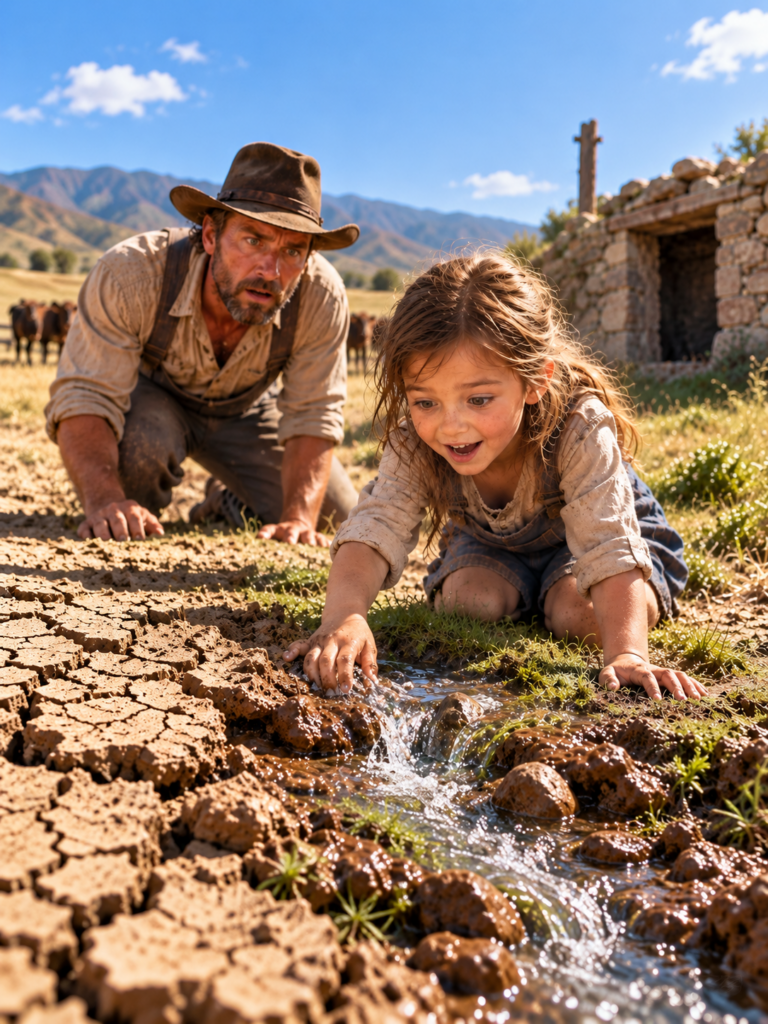
they shut off his family farm’s water during the worst drought in decades — then his 8-year-old daughter found what everyone else had missed
Part 1
By the time the county man snapped the padlock around Elias Marsh’s irrigation gate, the cattle had already learned not to walk toward the trough anymore.
That was what bothered Elias most.
Animals understood disappointment faster than people did.
For three generations, water had come down the old ditch at the eastern edge of Marsh Farm, crossed beneath the cottonwood fence line, and filled a concrete trough beside the lower pasture. Elias’s grandfather Otis had dug part of that ditch with a shovel. Elias’s father, Denny, had rebuilt the head gate after the flood of 1987.
Elias had grown up hearing water move through it at night.
Now there was silence.
The county employee avoided Elias’s eyes.
He was a young man in mirrored sunglasses driving a truck so new the temporary dealership tag was still taped inside the back window.
He checked something on a clipboard.
“Allocation priority changed this morning.”
“According to who?”
“Water district.”
“That ditch has supplied this farm longer than the water district has existed.”
The man shifted uncomfortably.
“I just have the order.”
“Show it to me.”
He handed Elias a photocopied form.
Elias read it twice.
The wording sounded official without saying much.
Temporary redistribution.
Critical agricultural priority.
Drought emergency.
No exact date for restoration.
No explanation for why Garrett Voss’s neighboring ranch would continue receiving water while Marsh Farm did not.
Elias folded the paper.
“Who signed this?”
The county man pointed toward the bottom.
Elias recognized the name.
Deputy district manager.
A man who had eaten barbecue at Garrett Voss’s Fourth of July parties for years.
Elias handed the document back.
“So that’s it?”
“I’m sorry.”
The man locked the valve.
Then he left.
Elias stood beside the dry ditch long after the truck disappeared over the hill.
Forty acres.
Twenty-three head of cattle.
Six acres of alfalfa.
A vegetable plot his wife Dana tended behind the house.
A mortgage they could barely manage even when the farm was producing normally.
The sky above northern New Mexico was a hard summer blue without a cloud anywhere.
It had not rained properly in seven weeks.
By noon, Elias had called three hauling companies.
By evening, he knew exactly how expensive survival would be.
Water brought in by tank truck cost more than the cattle would return at auction if he had to keep hauling it for long.
Dana came home from the clinic after dark and found Elias at the kitchen table.
A yellow legal pad sat in front of him.
Fuel.
Tank rental.
Feed.
Mortgage.
Veterinary account.
Every number seemed to lean in the wrong direction.
“How bad?”
Dana asked.
Elias rubbed both hands over his face.
“We can haul enough for the cows.”
“And the field?”
He shook his head.
“Not both.”
Dana sat opposite him.
She was thirty-seven and worked four days a week as a medical assistant in town. She had wanted to cut back her hours that summer because their daughter was out of school.
Instead, she understood before Elias said anything.
“I can pick up Saturdays.”
“No.”
“Elias.”
“You already work enough.”
“So do you.”
“That’s different.”
“Why?”
He had no answer that did not sound foolish.
A screen door creaked.
Their daughter Ren stepped into the kitchen.
She was eight, skinny-kneed, sun-browned, and almost always carrying a black-and-white composition notebook.
Dana smiled at her.
“You supposed to be in bed?”
“I was getting water.”
Ren filled a glass at the sink.
Then she looked at her father.
“Are we losing the farm?”
Dana’s expression changed.
Elias straightened.
“No.”
It came out too quickly.
Ren noticed.
She noticed everything.
Elias softened his voice.
“We have a water problem. That’s all.”
“Because Mr. Voss took it?”
Dana glanced at Elias.
He frowned.
“Who said that?”
“Nobody.”
“Then why would you say it?”
Ren shrugged.
“His cows still have water.”
Children sometimes made observations adults spent hours trying not to make.
The next afternoon Garrett Voss arrived.
He did not drive up to the house.
He stopped beside the fence.
Engine running.
Air-conditioning probably blowing full blast.
Garrett was forty-five, clean-shaven, broad through the shoulders, with the permanent tan of a man who spent enough time outdoors to look like a rancher but not enough to ruin his shirts.
The Voss family owned nearly four thousand acres.
Their ranch surrounded Marsh Farm on two sides.
For decades, the families had shared the ditch under an arrangement nobody had ever thought necessary to modernize.
When water was plentiful, both ranches used what they needed.
When it was scarce, they alternated days.
Otis Marsh had shaken hands with Garrett’s grandfather on it sometime in the early 1950s.
That had been sufficient until Garrett inherited.
“You holding up?” Garrett called.
Elias rested his arms on the top fence rail.
“You tell me.”
Garrett sighed.
“Drought’s hard on everybody.”
“Your troughs look full.”
“I’ve got priority allocation.”
“You have friends downtown.”
Garrett smiled slightly.
“You always did think everything was personal.”
“Someone shut off water that’s run here for seventy years. Feels personal.”
Garrett looked toward the brown alfalfa.
“I didn’t make the drought.”
“No.”
“You know I signed with Southwest Pure Water.”
Elias had heard.
A regional bottled-water company had negotiated a supply contract with Voss Ranch.
At first nobody cared.
Then rainfall disappeared.
Suddenly every gallon had a price.
Garrett’s water was worth more pumped into stainless tankers than used to keep a neighbor’s hay alive.
“I’ve got contractual obligations,” Garrett continued.
“That ditch isn’t yours alone.”
“According to current filing, it pretty much is.”
Elias stared at him.
Garrett drummed his fingers on the steering wheel.
“I could help you another way.”
“How?”
“Sell.”
Elias laughed once.
Not because anything was funny.
Garrett continued.
“Your father should’ve sold years ago.”
“My father died here.”
“I know.”
“My grandfather built that barn.”
“I know.”
“My daughter sleeps in the room I slept in.”
“And that changes the bank balance how?”
Elias’s jaw tightened.
Garrett leaned toward the open window.
“I’m not trying to insult you. I’m offering eighty-five thousand for forty acres that may not have dependable water six months from now.”
“You know exactly why it doesn’t have dependable water.”
“Reality doesn’t care about blame.”
“No.”
Elias looked toward the dry ditch.
“Men usually say that when reality is making them money.”
Garrett’s expression cooled.
“My offer won’t stay that high.”
“It already ain’t high.”
Garrett shifted into drive.
“Think about your family before pride makes the decision for you.”
He drove away.
That sentence stayed with Elias.
For the next three weeks, survival became repetitive.
Up at four-thirty.
Drive the rented tank to the municipal fill point.
Wait behind landscaping crews and contractors.
Pay.
Haul.
Pump into troughs.
Return.
Do it again.
Fuel disappeared faster than water.
The alfalfa yellowed.
Dana’s tomatoes curled at the edges.
They sold Elias’s father’s old flatbed truck to cover feed and hauling expenses.
Elias watched a teenager from Albuquerque drive it away and felt as if another piece of his father had left the property.
Neighbors grew careful around him.
Not unkind.
Careful.
Garrett Voss controlled grazing leases, trucking contracts, access roads, and water arrangements throughout the valley.
People with families did not volunteer to become his enemy.
Only one person seemed unaware of the social danger.
Ren.
She walked the farm with her notebook.
She wrote down which trees lost leaves first.
Which cattle stood where in the afternoon.
How quickly water disappeared from each trough.
One evening she asked Elias why five cows kept gathering beside the old springhouse.
“What springhouse?”
“The broken one.”
Elias knew immediately.
Two hundred yards uphill from the lower pasture stood a collapsed stone structure half swallowed by rabbitbrush.
Otis Marsh had built it before Elias was born.
By the time Elias was a child, nobody used it.
The roof collapsed in a winter storm.
Snakes moved into the foundation.
Denny always said to leave it alone.
“Probably shade,” Elias said.
“There isn’t shade there.”
“Then flies.”
“They have flies everywhere.”
Elias looked at her.
Ren opened her notebook.
“Grass there is green.”
“So?”
“Grass nowhere else is green.”
Elias was too tired for mysteries.
“Could be runoff from something.”
“It hasn’t rained.”
“Ren.”
She stopped.
He regretted his tone immediately.
“I’m sorry.”
“It’s okay.”
She closed the notebook.
Two mornings later, Ren disappeared after breakfast.
Dana found her kneeling beside the ruined springhouse.
Palm pressed flat against the ground.
“What are you doing?”
“It’s cold.”
Dana crouched.
The surrounding soil was hot and dry.
Near the stones, it was noticeably cooler.
A ribbon of grass, thin as a wagon track, remained green.
Ren pointed to a shallow depression.
“That wasn’t there last week.”
Dana brought Elias.
He stood with both hands on his hips.
Cattle watched from thirty yards away.
Ren moved closer to the broken stones.
“Listen.”
“To what?”
She raised one finger.
They stood still.
Wind moved through the dry grass.
A grasshopper clicked.
Then Elias heard it.
Very faint.
Water.
Not enough to call a stream.
More like a whisper under stone.
Elias crouched.
He pushed aside weeds.
The dirt beneath them was damp.
Something moved inside his memory.
His father.
Years earlier.
Denny sitting on the porch during another dry summer, pointing toward the hill.
Your granddad always said never tear that old springhouse out.
Why?
Because Otis didn’t build things without a reason.
At the time, Elias had laughed.
Now he stood.
“Come on.”
“Where?”
Ren asked.
“The attic.”
They searched Otis Marsh’s old trunk for almost an hour.
Tax papers.
Feed receipts.
Yellow photographs.
A broken pocket watch.
Letters tied with string.
Then Elias found a narrow ledger with water stains along the edges.
Otis’s handwriting filled the pages.
Livestock births.
Seed purchases.
Rainfall.
Fence work.
Near the back, one paragraph had been written darker than everything around it.
Elias read it once.
Then again.
Dana leaned over his shoulder.
Built springhouse over seep at base of hill. Never gone dry, including ’54. Keep channel clear. If land goes hard again, remember it is there. Don’t let anyone cap it and don’t let anyone tell you it ain’t worth protecting.
Ren watched her father’s face.
“What does it mean?”
Elias closed the ledger.
“It means your great-grandfather left us instructions.”
“For what?”
He looked out the attic window toward the ruined stones.
“For where to dig.”
Part 2
The first two days produced nothing except blisters.
The old springhouse had collapsed inward decades earlier.
Stone blocks filled what had once been a rectangular chamber.
Roots grew through cracks.
Pack rats had built nests beneath rotted boards.
Elias did not own an excavator.
Hiring one would cost money he no longer had.
So he dug by hand.
Ren carried smaller rocks.
Dana helped before and after clinic shifts.
At sunrise the heat was tolerable.
By ten, sweat soaked Elias’s shirt.
By noon, metal tools burned bare hands if left in the sun.
They cleared one corner.
Then another.
No water.
Only soil dark enough to keep Elias moving.
On the fourth afternoon, part of the stone wall shifted.
Elias stepped backward too slowly.
His boot slid.
He fell hard against a rock and landed on his right shoulder.
Pain shot through his arm.
For several seconds he could not breathe.
Dana ran to him.
“Don’t move.”
“I’m fine.”
“You can’t lift your arm.”
“I said I’m fine.”
“You said that when you cut your hand open on barbed wire.”
“That was different.”
“You needed nine stitches.”
Ren stood ten feet away.
Her face had gone white.
Elias saw it.
He forced himself upright.
“Hey.”
She looked at him.
“I’m okay.”
“You fell.”
“I noticed.”
“Because I said we should dig.”
“No.”
She was trying not to cry.
Elias went to her.
“This is not because of you.”
“If we didn’t dig—”
“If we didn’t dig, I’d be hauling water.”
He touched her shoulder with his good hand.
“And we still might be tomorrow.”
The doctor in town called it a severe strain.
Rest.
Ice.
No heavy lifting.
Elias laughed when he heard that.
Rest belonged to people whose problems stopped when they did.
That night he sat at the kitchen table with an ice pack against his shoulder.
Dana slept.
Ren had gone to bed.
The house was quiet.
Garrett’s business card lay beside the phone.
He had left it two days earlier.
New offer.
Seventy-eight thousand.
Lower than before.
Exactly as promised.
Elias picked up the card.
He imagined calling.
The conversation would be short.
Garrett would come in the morning.
Papers would follow.
Mortgage paid.
No more water hauling.
No more watching cattle lose weight.
Dana could stop taking extra shifts.
Ren could live somewhere with sidewalks and neighbors.
Elias hated how reasonable surrender sounded after midnight.
The kitchen door opened.
Ren entered.
She carried her notebook.
“You awake?”
Elias looked at the clock.
“Barely.”
She sat across from him.
Then she slid the notebook over.
One page had dates running down the side.
June 4 — cows near springhouse.
June 8 — green grass.
June 12 — dirt cool.
June 14 — heard water maybe.
June 17 — ground sinking.
June 20 — wet under west stones.
At the bottom she had drawn a crude map.
Elias traced the marks.
“You did all this?”
Ren nodded.
“Why?”
“Because it keeps changing.”
She looked at Garrett’s business card.
“You gonna sell?”
Elias was quiet.
“I don’t know.”
Ren looked disappointed but did not argue.
That somehow hurt more.
She stood.
“Good night.”
“Ren.”
She turned.
“Sometimes grown-ups get scared.”
“I know.”
“That doesn’t always mean they quit.”
She studied him.
Then she nodded.
The next morning Elias returned to the springhouse.
One arm nearly useless.
He worked slowly.
Dana called him three kinds of fool before helping anyway.
Two days later his shovel struck something flat.
Not bedrock.
Not random stone.
Laid stone.
He knelt.
Brushed dirt away.
A narrow channel appeared.
Hand-built.
Carefully fitted.
It curved beneath the collapsed springhouse.
Elias followed it.
The soil became wetter.
Ren crawled close.
“Dad.”
“I see it.”
At the bottom of the channel was a shallow stone basin.
Water trembled across its surface.
Not stagnant.
Moving.
Clear water emerged steadily from a crack in limestone no wider than the edge of a shovel.
For several seconds none of them spoke.
Then Ren put both hands into it.
She gasped.
“Cold.”
Elias laughed.
Actually laughed.
The sound startled him.
He had forgotten what it felt like.
Dana knelt and touched the water.
“Oh my God.”
Elias watched it fill the basin.
Spill into the old channel.
Disappear beneath rubble.
“How much is that?” Dana asked.
“Don’t know.”
“Enough?”
“Don’t know.”
Ren cupped water in her hands.
“Is it ours?”
That question ended the celebration.
Elias knew water law well enough to fear it.
Land ownership did not always equal water ownership.
A spring could connect to an aquifer.
An aquifer could be regulated.
A historic right could be claimed.
A modern permit could supersede assumptions made generations earlier.
“I don’t know yet,” he said.
Ren’s face fell.
“But it’s on our land.”
“I know.”
“Great-Grandpa built it.”
“I know.”
“Then why wouldn’t it be ours?”
Elias wished the world worked by eight-year-old logic.
“Because sometimes adults make simple things complicated.”
Within a week a licensed well contractor named Marvin Cruz inspected the source.
He measured flow.
Returned two days later.
Measured again.
“Twenty-eight gallons a minute.”
Elias stared at him.
“Steady?”
“So far.”
“In this drought?”
“That’s what makes it interesting.”
Marvin studied the exposed rock.
“My guess is a fractured limestone shelf. You’ve got groundwater coming down from the upland, hitting a barrier, and emerging here.”
“Connected to Voss’s ditch?”
“Probably not. Different elevation. Different geology.”
“Probably?”
Marvin grinned.
“You want certainty, hire a hydrologist.”
“How much?”
The grin disappeared.
“More.”
For the moment, twenty-eight gallons a minute was enough.
Elias ran temporary pipe to a stock trough.
The first time water filled it without arriving in a rented truck, the cattle crowded close.
Elias stood beside Ren.
One cow pushed another away.
Ren laughed.
“They know.”
“Know what?”
“That it’s staying.”
Elias wanted to believe her.
For five days, hope returned to Marsh Farm.
They irrigated Dana’s vegetable rows first.
Then a small section of alfalfa.
Elias shaved his hauling schedule in half.
Numbers on the yellow legal pad became slightly less impossible.
Then word spread.
Marvin’s assistant told his cousin.
The cousin worked fencing for Voss Ranch.
Three days later Garrett’s truck appeared.
He stopped beside the springhouse this time.
No smile.
“Heard you got lucky.”
Elias kept working on the pipe.
“Wouldn’t call digging in hundred-degree heat lucky.”
Garrett walked closer.
He looked at the water.
His expression was the same one Elias had seen at cattle auctions.
Calculation.
“How much?”
“Enough.”
“Flow rate?”
Elias stood.
“You come to congratulate me?”
Garrett ignored the question.
“That limestone runs under both properties.”
“Maybe.”
“Groundwater doesn’t respect fence lines.”
“Funny. You cared a lot about fence lines when you shut off my ditch.”
Garrett’s eyes narrowed.
“You filed a well permit?”
“It isn’t a well.”
“Diversion permit?”
“It’s an old developed spring.”
“How old?”
“Older than either of us.”
Garrett looked toward the reconstructed stones.
“You should talk to a lawyer.”
“Why?”
“Because if that source is part of the basin aquifer, you can’t just start taking twenty or thirty gallons a minute because it happens to come out on your land.”
Elias stepped closer.
“You knew there was water here?”
Garrett’s hesitation lasted less than a second.
But Elias saw it.
“No.”
“You sure?”
“I said I heard about it.”
“From who?”
“People talk.”
Garrett returned to his truck.
“Get a lawyer, Elias.”
The formal claim arrived four days later.
Voss Ranch argued that the Marsh spring drew from a shared groundwater source subject to basin restrictions.
Until ownership and regulatory status were resolved, Elias could be prohibited from expanding use.
Two county inspectors arrived that afternoon.
Polite.
Professional.
But they photographed everything.
Measured pipe diameter.
Asked when excavation began.
Asked how much water had been diverted.
Garrett had moved quickly.
Faster than a man surprised by the discovery should have.
That evening Elias spread the papers across the kitchen table.
Dana read them.
Ren sat nearby.
“What happens?”
she asked.
Elias rubbed his eyes.
“We prove the spring belongs here.”
“How?”
“That’s the problem.”
Ren stared at Otis’s old ledger.
Then she looked toward the trunk still sitting beneath the stairs.
“Maybe Great-Grandpa wrote something else.”
“We looked.”
“You looked once.”
Elias almost dismissed her.
Then he remembered the green grass everyone else had ignored.
“Go get the trunk.”
Part 3
Ren found the first useful paper tucked inside an old Farmers’ Almanac.
Not Elias.
Not Dana.
Ren.
She was turning pages because she liked the drawings of moon phases when a folded piece of brittle paper slipped onto the floor.
“Dad?”
Elias looked up.
The document had torn across the bottom.
At the top was a faded county survey stamp.
The visible text included:
…protected spring structure established 1938…
…within Marsh boundary…
Then the page ended.
Elias felt his pulse quicken.
“Where’s the rest?”
Ren searched the almanac.
Nothing.
Dana examined the torn edge.
“This came from something bigger.”
Elias called the county records office the next morning.
The clerk searched digitized files.
Nothing.
Older paper records had been moved twice.
One flood in the courthouse basement had destroyed boxes.
The woman suggested he contact Louise Pruitt.
“Who?”
“Retired surveyor.”
Louise was seventy-six and lived outside town in a small adobe house surrounded by mesquite and filing cabinets.
She answered the door wearing gardening gloves.
“I don’t do property disputes anymore.”
“I’m not asking you to survey.”
“What are you asking?”
Elias showed her the fragment.
Louise’s eyes changed.
“Where did you get this?”
“My grandfather’s things.”
She studied the stamp.
“I know that survey series.”
“Can you find the rest?”
“Maybe.”
“County can’t.”
Louise snorted.
“County couldn’t find its own parking lot if somebody moved the sign.”
She invited him inside.
One room was filled with banker boxes labeled by decade.
1950–59.
1960–69.
Road easements.
Subdivision plats.
Hydrology.
Water district.
Elias stared.
“You kept all this?”
“Copies.”
“Why?”
“Because governments throw away old records and then act surprised when old problems come back.”
They searched three hours.
Nothing.
Elias returned two days later.
Ren came with him.
Louise tolerated children badly for about ten minutes.
Then Ren asked why survey corners sometimes moved.
Louise spent twenty minutes explaining monuments, bearings, and fence errors.
By noon, they had become friends.
At one-thirty, Ren pulled a tube from behind a cabinet.
“Marsh?”
Louise turned.
The label read:
MARSH / VOSS BOUNDARY — 1958 RESURVEY.
Elias stopped breathing.
Louise unrolled the sheet across her dining table.
There it was.
The entire property.
Fence line.
Ditch.
Barn.
Springhouse.
A notation beside the spring structure placed it thirty-six yards inside the Marsh boundary.
Louise tapped the date.
“1958.”
“The water district didn’t exist then,” Elias said.
“Not until 1961.”
She looked closer.
“This helps.”
“Helps?”
“Doesn’t end it.”
Elias felt his brief excitement collapse.
“Why?”
“Because owning the structure doesn’t automatically prove the source is hydrologically separate.”
Ren asked, “What does hydrologically mean?”
Louise answered before Elias could.
“Where the water comes from underground.”
She pulled another box.
“If Voss claims the spring draws from the shared basin, we need geology.”
They searched again.
That afternoon Louise found a county hydrology study from the 1990s.
The study had been commissioned during a proposed subdivision that was never built.
Maps showed fractured limestone shelves beneath the hillside.
One isolated pocket discharged toward Marsh property.
Louise read the findings twice.
“This is your spring.”
“You’re sure?”
“Location matches. Elevation matches. Flow estimate even matches.”
“What does it say?”
“That the source is perched above the main basin aquifer. Hydrologically isolated.”
Elias sat down.
“So Garrett has no claim.”
“To this spring? Based on this? I’d say very little.”
Ren smiled.
“We won.”
Louise raised a finger.
“Never say that before a hearing.”
Then she found the letter.
It was inside the same folder.
Dated fourteen years earlier.
Commissioned by Voss Ranch.
Louise unfolded it.
Her eyebrows lifted.
“What?”
Elias asked.
She handed it over.
The letter summarized potential water sources available for future Voss Ranch expansion.
Near the bottom was a sentence:
An undeveloped historical spring appears to exist on adjacent Marsh property. Current use negligible. Source likely isolated from principal Voss basin access.
Elias read it again.
Then the address line.
GARRETT VOSS.
He had received the report personally.
“He knew.”
Louise nodded.
“He knew something was there.”
“For fourteen years.”
“Looks that way.”
Elias thought about every offer.
Every warning.
Reality doesn’t care about blame.
He felt anger rise.
Ren was watching him.
That stopped him from saying what he wanted to say.
They copied everything.
Louise agreed to testify if necessary.
Evidence should have made Elias feel safe.
Instead, pressure increased.
Someone at the feed store told him Voss was saying Marsh Farm had illegally diverted groundwater.
A county inspector returned.
Then the bank called asking whether Elias expected “operational disruption” to affect the mortgage.
That phrase could only have come from somewhere.
Dana came home furious.
“They’re trying to scare us into selling.”
“Yes.”
“What do we do?”
Elias looked at the papers.
“We stop being scared.”
But he was scared.
Money remained tight.
Legal fees accumulated.
One bad ruling could destroy them.
The spring kept flowing, but Elias limited use until the hearing.
Then Denny Cobb arrived.
He was twenty-six, nervous, and kept looking toward the road as if somebody might follow him.
“I need to talk to you.”
Elias let him inside.
Denny sat at the kitchen table.
Ren was doing homework nearby.
Dana poured coffee.
Denny did not touch it.
“My dad used to work seasonal maintenance for Voss.”
“I know.”
“Before he died.”
Elias nodded.
“What about it?”
Denny rubbed both palms on his jeans.
“I’m the one who told my cousin about your spring.”
“That how Garrett heard?”
“Yes.”
“At least you admit it.”
“I didn’t know he’d come after you.”
“Now you do.”
Denny swallowed.
“There’s something else.”
He glanced at Ren.
Elias said, “Speak.”
“My dad used to complain about Garrett.”
“That narrows nothing.”
Denny almost smiled.
Then became serious.
“He worked the ditch gates.”
Elias leaned forward.
“What about them?”
“The county said your gate got shut because of emergency allocation, right?”
“Yes.”
Denny shook his head.
“My dad’s old maintenance notebook is still at our house. Garrett ordered that gate closed before the district emergency order.”
“How long before?”
“Almost three weeks.”
Elias felt cold despite the heat.
“You’re sure?”
“I checked.”
“Why would your dad write that down?”
“Because the valve wasn’t broken. Dad thought it was strange. Garrett told him to shut your side and leave Voss flow unchanged. Dad wrote the date because he thought somebody would ask later.”
Dana whispered, “My God.”
Denny continued.
“My dad told me Garrett was trying to pressure you.”
“You willing to testify?”
Fear crossed Denny’s face.
“My cousin works for him.”
“I understand.”
“My mom leases pasture from him.”
“I understand.”
“If I sign something, that lease might disappear.”
Elias sat back.
This was the whole valley in one sentence.
Garrett did not need to threaten people openly.
He owned enough pieces of their lives.
Denny looked ashamed.
“I’m sorry.”
Elias remembered his own fear.
Garrett’s card beside the phone.
The temptation to sell.
He could not demand courage as if it cost nothing.
“You don’t owe me your family’s livelihood.”
Denny looked up.
“What?”
“I said you don’t owe me that.”
“But if I don’t say anything—”
“That’s your choice.”
Silence filled the room.
Ren stopped writing.
Denny looked at her.
“What would you do?”
Dana started to intervene.
Elias let the question stand.
Ren thought.
“If somebody took our water?”
“Yes.”
“I’d tell.”
“Even if it hurt you?”
Ren frowned.
“I don’t know.”
Denny smiled sadly.
“That’s probably the smartest answer.”
He left.
The next morning he returned.
He carried a signed statement.
“My mother told me my dad didn’t write things down so I could hide them.”
That statement changed the case.
Garrett had not merely taken advantage of a drought.
He had begun restricting Marsh Farm before the official emergency existed.
The hearing was scheduled for August 17.
The night before, Ren organized the evidence at the kitchen table.
She made labels.
-
old survey
water study
Garrett letter
Denny statement
Grandpa ledger
Elias watched her.
“You know lawyers charge a lot for this.”
“I’m cheaper.”
“How much?”
“Two dollars.”
“Highway robbery.”
She smiled.
Then became serious.
“You nervous?”
“Yes.”
“You said grown-ups get scared.”
“I remember.”
“And they don’t always quit.”
Elias looked at his daughter.
“No.”
He pulled two dollars from his wallet.
“They don’t.”
Part 4
Garrett Voss arrived at the water board hearing in a dark suit with an attorney from Santa Fe.
Elias arrived in clean jeans.
Dana beside him.
Louise carrying two map tubes.
Denny Cobb sitting three rows back.
Ren had wanted to attend.
Elias almost said no.
Then he realized the whole case existed because she had refused to stop noticing things.
She sat beside Dana with her notebook closed in her lap.
The board consisted of five members.
Three knew Garrett socially.
That bothered Elias.
Louise noticed.
“Evidence first,” she whispered.
“Worry second.”
Garrett’s lawyer opened smoothly.
He described the spring as part of a shared groundwater resource.
He emphasized drought conditions.
He described Elias’s excavation as “new development” requiring modern authorization.
He avoided mentioning seventy years of family history.
The argument sounded reasonable.
That was what made it dangerous.
Then Elias spoke.
He was not a lawyer.
He stumbled over one sentence.
Lost his place once.
But he told the truth plainly.
“My daughter noticed green grass by an old springhouse.”
He explained Otis’s ledger.
The excavation.
The water.
The county inspection.
Garrett’s claim.
Then Louise unrolled the 1958 survey.
The room leaned forward.
She identified the original monuments.
The historic property boundary.
The spring structure.
Thirty-six yards inside Marsh land.
Garrett’s lawyer stood.
“No one disputes the structure lies on Marsh property.”
Louise nodded.
“Good. That saves time.”
A few people smiled.
The lawyer continued.
“The issue is water source, not masonry.”
Louise smiled.
“I know.”
She produced the hydrology assessment.
The lawyer’s confidence changed slightly.
Louise explained perched groundwater.
Fractured limestone.
Hydrologic separation.
Old technical language became understandable as she traced lines across the map.
“The source feeding Marsh Spring does not originate in the principal basin channel used by Voss Ranch. This was established by county assessment more than twenty years ago.”
A board member adjusted his glasses.
“You’re certain this is the same spring?”
“Coordinates, geology, elevation, and discharge location all align.”
Garrett whispered to his lawyer.
The lawyer pivoted.
“Even if separate, current use represents a substantially expanded diversion requiring review.”
Elias produced Otis’s ledger.
Historic development.
Use dating back decades.
The board examined it.
Not enough alone.
Then came the 1958 survey language documenting the spring as an established agricultural water structure.
The lawyer argued age did not exempt regulation.
Maybe not.
But it destroyed the suggestion that Elias had secretly created a new extraction site.
Garrett remained composed.
Until Louise produced the letter.
The one commissioned by Voss Ranch.
Fourteen years earlier.
A board member read the relevant sentence aloud.
“An undeveloped historical spring appears to exist on adjacent Marsh property. Source likely isolated from principal Voss basin access.”
Silence.
Garrett stopped writing.
Elias watched him.
The board chairman looked over his glasses.
“Mr. Voss, did you receive this report?”
Garrett’s lawyer answered.
“My client does not recall every technical document—”
The chairman interrupted.
“I asked Mr. Voss.”
Garrett cleared his throat.
“It was years ago.”
“That is not an answer.”
“I may have received it.”
“Did you know before this summer that a separate spring likely existed on Marsh property?”
Garrett shifted.
“I knew there had historically been water there.”
Elias felt Dana’s hand tighten around his.
Ren did not move.
The chairman continued.
“Yet your claim filed last month represented the source as potentially part of the Voss shared system without mentioning this report.”
“My attorney filed based on current information.”
Garrett’s lawyer stood.
“We reject any implication—”
The chairman raised a hand.
“Sit down.”
That was when Garrett began to lose the room.
Then Denny Cobb testified.
His voice shook.
He explained his father’s maintenance notebook.
The date.
Garrett’s instruction to close the Marsh head gate.
Three weeks before the official drought redistribution.
Garrett’s lawyer attacked the statement immediately.
“Your father is deceased?”
“Yes.”
“So he cannot confirm your interpretation.”
“No.”
“You personally did not hear Mr. Voss give this alleged order.”
“No.”
“Then this is hearsay.”
Denny swallowed.
“Yes.”
The lawyer turned toward the board.
Garrett leaned back.
For the first time all morning, he looked relieved.
Denny spoke again.
“But I was there when Dad reopened it.”
The attorney stopped.
“What?”
“Two days later.”
Elias looked sharply at him.
Denny had not mentioned this.
“My dad thought Garrett didn’t have authority yet. He reopened Marsh flow.”
The attorney stared.
“What happened then?”
“Mr. Voss came personally.”
“You saw him?”
“Yes.”
“He told Dad to close it again?”
“Yes.”
The room changed.
Garrett stood.
“That is a lie.”
Too fast.
Too loud.
His lawyer grabbed his sleeve.
Garrett pulled away.
“I never—”
The chairman struck the table with his gavel.
“Mr. Voss, sit down.”
Garrett’s face reddened.
He sat.
Ren looked at Elias.
He saw it in her eyes.
The same look she had given the green grass.
She was noticing.
After four hours, the hearing ended.
No immediate ruling.
The board would issue one within fourteen days.
Those fourteen days felt longer than the whole drought.
Elias continued rationing water.
Garrett’s offers stopped.
Nobody from Voss Ranch came near the property.
Neighbors began calling again.
Some apologized for keeping their distance.
Elias did not punish them.
He understood fear better now.
One evening, Walter Hayes from two farms over arrived.
“I should’ve helped when your water went off.”
Elias shrugged.
“You’ve got your own family.”
“Still.”
Walter looked embarrassed.
“Garrett had my grazing lease.”
“I know.”
“He still does.”
“Then don’t get yourself thrown off it on my account.”
Walter shook his head.
“That’s the thing. If everybody thinks that way, a man like Garrett owns more than land.”
The board’s decision arrived on a Tuesday morning.
Dana was at work.
Ren was eating cereal.
Elias opened the envelope beside the sink.
He read the first page.
Then the second.
His hands began shaking.
Ren put down her spoon.
“What?”
Elias looked at her.
“The spring is ours.”
She stared.
“All ours?”
“All ours.”
She jumped from the chair.
Elias caught her.
His bad shoulder hurt.
He did not care.
The ruling recognized the historic Marsh spring as a separate source lying within Marsh property and outside Garrett’s claimed shared system.
The board also found the ditch closure had occurred without sufficient district authorization.
Garrett was ordered to restore Marsh Farm’s traditional shared-ditch allocation.
A formal finding was entered into the record regarding improper manipulation of a shared agricultural resource.
The decision did not make Elias rich.
It did something better.
It made the next year possible.
When Dana arrived home, Elias had taped the ruling to the refrigerator.
She read it.
Then sat down and cried.
Not dramatic tears.
Exhausted ones.
Months of fear leaving at once.
Ren stood beside the window.
Outside, water moved into the livestock trough.
Dana wiped her face.
“What now?”
Elias looked across the farm.
Brown pasture.
Half-dead alfalfa.
Broken springhouse.
Bills.
A mortgage.
Work everywhere.
He smiled.
“Now we rebuild.”
Part 5
The following summer was dry again.
Not as severe.
But enough to make people nervous.
By then, Marsh Farm had changed.
Elias rebuilt the springhouse using the original stone.
Ren insisted they preserve one cracked block with Otis Marsh’s initials scratched into it.
A solar pump moved water uphill to a storage tank.
Elias installed drip irrigation through Dana’s garden and the most vulnerable part of the alfalfa field.
Water use dropped sharply.
Cattle gained weight again.
Mortgage payments stopped arriving late.
Dana gave up her Saturday clinic shift.
For the first time in nearly a year, their kitchen table became a place for meals rather than bills.
Garrett Voss did not visit.
Until August.
Elias was repairing fence when he saw the familiar truck.
Garrett parked on the road.
For a moment neither man moved.
Then Garrett walked over.
He had lost weight.
His face looked older.
Elias rested his pliers on the fence post.
“What do you need?”
Garrett glanced toward the spring tank.
“Water.”
Elias said nothing.
Voss Ranch had expanded its bottling contract.
That summer the main basin dropped lower than expected.
Garrett’s allocation could not comfortably serve both cattle and commercial commitments.
Two of his stock tanks were nearly empty.
“How much?”
Elias asked.
“Enough for sixty head for maybe four days.”
“You still have ditch water.”
“Not enough.”
“And the bottling company?”
Garrett’s jaw tightened.
“Contract comes first.”
“To them.”
“Yes.”
Elias could have laughed.
Could have reminded him of every offer.
Eighty-five thousand.
Seventy-eight.
Reality doesn’t care about blame.
He could have charged three times market rate.
Garrett expected him to.
“What’s it going to cost?”
Garrett asked.
Elias considered.
Then named the same emergency rate he had charged another neighbor the week before.
Garrett frowned.
“That’s it?”
“That’s the rate.”
“I thought you’d—”
“What?”
Garrett looked at the ground.
“Nothing.”
Elias returned to the fence.
“Bring your tanker after six. I need the pressure for my own stock first.”
Garrett did not move.
“Why?”
Elias looked at him.
“Why what?”
“Why aren’t you making me pay for it?”
“You are paying.”
“You know what I mean.”
Elias thought about Ren sitting at the kitchen table.
Denny Cobb signing a statement that could have cost his mother a lease.
Louise digging through forty years of old files because truth mattered to her more than convenience.
His grandfather leaving instructions in a ledger.
His father insisting nobody tear down a ruin whose purpose Elias did not yet understand.
Then he thought about how close he had come to calling Garrett and selling.
Fear made people do things they were not proud of.
Sometimes power did too.
“I don’t want to become you just because I beat you once.”
Garrett flinched.
Elias had not intended the sentence cruelly.
It was simply true.
Garrett nodded.
“I’ll bring the truck at six.”
That evening Ren watched Voss Ranch’s tanker fill from the Marsh storage outlet.
“Why are we giving him water?”
“We’re selling him water.”
“You know what I mean.”
Elias smiled.
“Because his cows didn’t shut our gate.”
Ren thought about that.
Then nodded.
The next year, Elias built something nobody expected.
A reserve tank near the county road.
Ten thousand gallons.
Not free water.
Not unlimited water.
A community emergency reserve.
Any neighboring farm experiencing verified livestock shortage during a declared drought could draw a controlled amount at cost.
Walter Hayes helped pour the concrete pad.
Denny Cobb installed valves.
Louise Pruitt donated money for the permit fee and threatened Elias when he tried returning it.
“Young man, I have no children and more pension than sense. Let me buy a valve.”
They named nothing after anybody.
That was Elias’s rule.
“This ain’t a monument.”
It was simply useful.
Within two years, two other families discovered modest springs on their property.
Both began with strange observations.
One farmer noticed willows growing in a dry wash.
Another realized his sheep always bedded near the same rocky slope during hot weather.
Elias walked the land with them.
He carried Ren’s old lesson everywhere.
Look for what does not fit.
Green grass where everything else is brown.
Cool soil in summer.
Animals gathering without obvious reason.
Old stone.
Old trees.
Old stories.
Old people who remember things maps forgot.
Ren turned ten.
Then eleven.
Her notebooks multiplied.
Weather.
Birds.
Water.
Cattle behavior.
Plant growth.
One evening she sat beside the rebuilt springhouse with bare feet in the grass.
Water ran clear through the stone channel.
Elias came down carrying two fence staples he had found near Otis’s old barn.
He sat beside her.
“You remember the first time?”
“When you didn’t believe me?”
“I believed you.”
“You said it was probably shade.”
“I was tired.”
“You said flies.”
“I was extremely tired.”
Ren smiled.
Cattle drank nearby.
Not desperately.
Not crowding.
One lifted its head with water dripping from its mouth.
Then lowered it again.
Elias watched.
Animals drinking when they trusted water would still be there tomorrow.
That was wealth.
Not money.
Not acreage.
Not contracts.
Security.
Ren dipped her fingers into the spring.
“You think Great-Grandpa knew we’d need it?”
“No.”
“Then why’d he write it down?”
Elias looked at the old stone walls.
“Because he knew somebody might.”
She considered that.
“Like the survey lady keeping all those boxes.”
“Exactly.”
“And Grandpa telling you not to tear this down.”
“Yep.”
“And me writing down the cows.”
Elias smiled.
“You planning to compare yourself to three generations of adults?”
“I noticed it first.”
“Fair point.”
They sat quietly.
The sun lowered behind the ridge.
Water kept moving.
After a while Ren asked, “Were you really going to sell?”
Elias had never told her how close he came.
Children grew.
Soon enough they learned their parents were not as certain as they appeared.
“Yes.”
She looked at him.
“That night you showed me your notebook.”
“You had Mr. Voss’s card.”
“I did.”
“Would we have moved?”
“Probably.”
Ren stared at the water.
“Would you have been mad at me?”
“For what?”
“If we dug and didn’t find anything.”
Elias felt something tighten in his chest.
“No.”
“But you got hurt.”
“That wasn’t your fault.”
“We spent money.”
“Not your fault either.”
She picked at a blade of grass.
Elias understood.
“You know what scared me most that summer?”
“Losing the farm?”
“Yes.”
He paused.
“But later I realized there was something worse.”
“What?”
“Teaching you that when somebody powerful says something is hopeless, you should stop looking.”
Ren glanced up.
“That would’ve been dumb.”
Elias laughed.
“Children are merciless.”
“You always say tell the truth.”
“I regret that policy daily.”
They walked back toward the house after sunset.
Dana had dinner waiting.
The rebuilt pasture smelled faintly green after evening irrigation.
Crickets sounded from the ditch.
The springhouse stood behind them.
Not beautiful.
Not important to anybody passing on the road.
Just old stones around cold water.
Years later, people in the valley still told the story as if Ren Marsh had somehow discovered a hidden underground river.
That was not true.
The spring had never really been hidden.
Cattle had found it.
Grass showed it.
Cool soil showed it.
Otis’s ledger described it.
Surveyors had mapped it.
Hydrologists had documented it.
Garrett Voss himself had been told about it years earlier.
The water had always been there.
What disappeared was attention.
That distinction mattered to Elias.
Because the hardest years of his life taught him something no drought report or legal ruling ever could.
People often imagine salvation arriving dramatically.
A lottery ticket.
An unexpected inheritance.
A stranger offering help.
But sometimes survival begins with a child standing in a dead pasture asking why one narrow strip of grass is still green.
Sometimes the person who saves a farm is not stronger, richer, older, or more educated than everyone else.
Sometimes she is simply the one person who keeps looking after everyone else has decided there is nothing left to see.
And on Marsh Farm, whenever summer turned hard and the cattle gathered beside the cool stone trough, Elias still heard Ren’s voice from that first terrible year.
The ground feels different here.
He had almost walked past it.
Almost sold.
Almost believed a padlock, a lawyer, and a powerful neighbor could decide what his family’s land was worth.
Instead, an eight-year-old girl knelt in the weeds and paid attention.
Sometimes that was the whole difference.


