the duke asked for a quiet bride who would expect nothing—she arrived with a wild racehorse that could save everything he was about to lose
the duke asked for a quiet bride who would expect nothing—she arrived with a wild racehorse that could save everything he was about to lose
Part 1
The smell of hops lay over the valley that September like something green had been crushed beneath the whole sky.
It drifted from the drying houses in warm, bitter waves. It clung to fences, clothes, wagon canvas, and the hands of the pickers who had spent the last month stripping vines beneath an English sun that never seemed quite strong enough to dry the morning dew.
Melinda Montgrove carried the smell home on her sleeves every evening.
She did not mind it.
There were worse smells than honest work.
Ink, for one, had never bothered her either, though by the end of most days it stained the side of her middle finger and settled into the tiny cracks beside her nails.
That afternoon she sat beneath the old walnut tree beside Lady Hezuba’s farmyard with a writing board across her knees, a bottle of ink at her elbow, and six sheets of good paper held down by a smooth stone.
A line of hop pickers waited in the dust.
Most could not write well enough to send a letter home.
Some could not read at all.
Melinda wrote for them.
“Tell my mother the baby has started walking,” said a tired young woman standing in front of her.
Melinda dipped her pen.
“And tell her I made almost two pounds more than last year. But don’t tell my brother how much. He’ll ask for it.”
Melinda’s mouth twitched.
“I may phrase that last part more gently.”
“You can phrase it however you like so long as he doesn’t get the money.”
Melinda bent over the paper.
Her handwriting was the one remarkable thing about her, at least according to people who did not know her very well.
It was even and graceful without looking showy. Every letter stood cleanly beside the next. Lady Hezuba liked to say Melinda could make an overdue bill look like a marriage proposal.
When she finished, Melinda read the letter aloud.
The young woman listened with her lips slightly parted.
At the end she stared at the page.
“It looks like a lady wrote it.”
Melinda folded the sheet.
“It looks like you wrote it.”
The woman smiled.
Behind Melinda, something tugged her bonnet ribbon.
She did not turn around.
“No.”
Another tug.
The pickers laughed.
“Tumult.”
The chestnut horse withdrew his nose.
For three seconds.
Then he pushed it over the paddock rail again and tried to take the entire bonnet.
Melinda caught the brim.
“You have hay.”
Tumult blew warm air into her hair.
“You have oats.”
He nudged her shoulder.
“You ate an apple ten minutes ago.”
He showed no shame.
The horse was four years old, tall and bright chestnut, with long legs, powerful hindquarters, and a white star that began broad between his eyes and narrowed toward his nose.
Half the stable staff had stories about being kicked, bitten, dragged, thrown, or humiliated by him.
Melinda had none.
He had chosen her before he could properly stand.
Her brother Thomas had been there the night he was born.
Thomas had purchased the mare cheaply before leaving for India, already knowing she was in foal.
“Something to keep you occupied while I’m gone,” he had told Melinda.
The foal had arrived during a cold spring rain.
All legs, fury, and wet copper-colored hair.
Within minutes he staggered across the straw and buried his little nose in Melinda’s hands.
Thomas laughed so hard he had to sit on an overturned bucket.
“He’ll be trouble,” he said.
“Then why are you smiling?”
“Because trouble is sometimes the only thing that keeps people alive.”
That was the last spring Melinda saw her brother.
He sailed for India in June.
The letters came regularly at first.
Then one came in a stranger’s hand.
Lieutenant Thomas Montgrove had died of fever.
The officer writing was sorry.
Thomas had spoken of his sister often.
He had purchased a crimson silk shawl for her at a bazaar a week before falling ill, and his effects would be sent home.
The shawl arrived.
Thomas did not.
Tumult was the only living creature left who had known his voice.
People called the horse dangerous.
Melinda called him particular.
There was a difference.
The summons from Lady Hezuba came as Melinda finished the last letter.
A footman crossed the yard.
“Her ladyship wants you in the drawing room.”
“Now?”
“She said before the light goes.”
Melinda capped the ink.
She rubbed Tumult’s forehead between the eyes.
“I’ll be back.”
His ears followed her as she crossed the yard.
Lady Hezuba sat in the yellow drawing room with the curtains half closed.
Age had taken much of her sight but very little of her authority.
She was nearly eighty, straight-backed, silver-haired, and still capable of reducing grown men to apologetic boys with one lift of her chin.
A silver-handled cane rested across her knees.
“Sit.”
Melinda sat.
“Not there. Closer. I cannot see your face.”
Melinda moved.
Lady Hezuba held out a folded letter.
“My godson writes like a man trying to kill the paper. Read it.”
Melinda opened it.
The handwriting was dark, slanted, impatient.
The nib had torn the paper in two places.
She read aloud.
“My dear godmother. You asked what I intend to do. I intend to marry because I must, and before winter because I have neither the time nor the money for a season in London. Find me a quiet woman who will not mind a cold house and a dull husband. I can offer her my name, a roof, and very little else. I would prefer she not expect more. Yours, Harleston.”
Melinda stopped.
The room became very still.
A clock ticked on the mantel.
“Charming,” she said.
Lady Hezuba’s mouth twitched.
“He has always lacked poetry.”
“You are thinking of finding him a wife?”
“I already have.”
Melinda looked up.
Lady Hezuba tapped her cane once.
“You.”
Melinda stared at her.
“No.”
“That was not the answer I expected.”
“You did not ask a question.”
“Very well. Will you marry Jeremy, Duke of Harleston?”
Melinda looked down at the letter again.
Quiet.
People had called her that all her life.
Quiet girl.
Quiet companion.
Quiet little thing.
It was a word people used when they had stopped looking closely.
“I don’t know him.”
“You know more about him from that letter than you know about most men after six dinners.”
“That is not reassuring.”
“He is thirty. Honest. Proud. Difficult. Far too serious. He has black hair, blue eyes, a good estate, and almost no money.”
“A duke with no money.”
“England contains more of them than anyone likes to admit.”
Melinda folded the letter.
“Why does he need a wife now?”
Lady Hezuba was silent for a moment.
“His father died in the spring.”
“I knew that.”
“He left debts.”
“How bad?”
“Bad enough.”
Melinda’s eyes narrowed.
“And what does it cost me if I refuse?”
Lady Hezuba leaned back.
“That is why I chose you.”
“That is not an answer.”
“No. It is not.”
The old woman took a breath.
“At Michaelmas I leave this house. My daughter insists I go north to live with her. She has room for me and my maid, but not for a companion.”
Melinda understood immediately.
Lady Hezuba did not soften it.
“You would need employment.”
“As a governess.”
“Possibly.”
“A clerk.”
“If someone progressive enough would hire a woman.”
“A paid companion elsewhere.”
“Most likely.”
Melinda looked toward the fading light.
She had no parents.
No brother.
No inheritance.
She had some savings, a few dresses, books, the crimson shawl, and a horse nobody else could manage.
Lady Hezuba continued.
“Jeremy will not refuse anyone I send him.”
“Why?”
“Because he loves me.”
For the first time her voice softened.
“He came to me every summer from the time he could walk. When his younger brother died and his mother stopped being truly present in the world, he came here. I taught him to hold a fork. I taught him to write thank-you notes. I tried unsuccessfully to teach him not to hold grudges.”
She looked toward Melinda’s blurred shape.
“He is the nearest thing I have to a son.”
“And you believe I can help him.”
“I believe you will not be impressed by his title, frightened by his temper, or bored into stupidity by his silences.”
Melinda almost smiled.
Lady Hezuba leaned forward.
“You are quiet, Melinda. You are also the most stubborn woman I know.”
“That hardly sounds like a recommendation.”
“It is the highest compliment I can give.”
Melinda stood and walked toward the window.
Beyond the glass she could see Tumult moving along the paddock fence.
If she became a governess, he would have to be sold.
The thought came with such immediate pain that she knew her decision before she spoke.
“I will meet him.”
Lady Hezuba waited.
“On one condition.”
“Ah.”
“Tumult comes with me.”
There was a silence.
Then Lady Hezuba began to laugh.
She laughed until she coughed, then laughed again.
“He asked me for a quiet bride.”
Melinda looked back.
“I am quiet.”
“That horse is not.”
“That was not the condition.”
The crimson shawl came out of the cedar chest that night.
Melinda unfolded it slowly.
The silk caught the candlelight like water.
Saffron flowers ran around its border.
She had worn it only a handful of times.
She lifted it to her face and closed her eyes.
For one moment she could almost hear Thomas laughing in the stable.
Trouble is sometimes the only thing that keeps people alive.
A week later they left.
Lady Hezuba rode in her carriage.
Melinda walked behind it leading Tumult.
The road crossed hop country toward the chalk downs.
Drying houses with white cowls rose above the fields. Bare poles stood where vines had already been stripped. Smoke curled from chimneys.
For most of the journey Tumult behaved beautifully.
Then he saw geese.
The flock filled the road.
Tumult went up on his hind legs.
The goose girl screamed.
The carriage horses jumped sideways.
Lady Hezuba’s groom cursed.
Melinda stood with the lead rope slack.
“Tumult.”
The horse froze.
“Down.”
He came down.
He snorted at her as though she had personally arranged the geese to offend him.
Then he walked beside her like a gentleman.
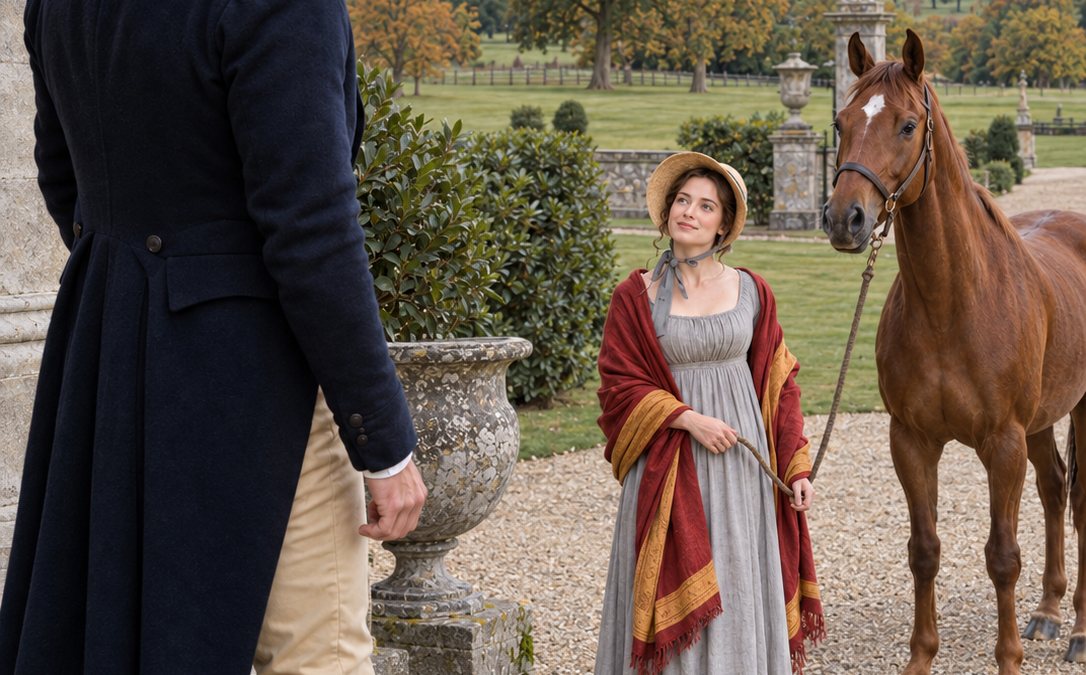
Late in the afternoon Whitnell appeared on the ridge.
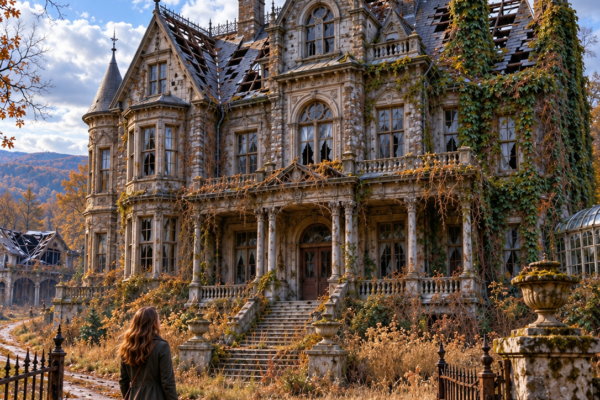
The house stood high above the valley, a broad gray mansion built when families expected to remain in one place forever.
Even from the road Melinda could see neglect.
Two chimneys smoked.
Six did not.
Several windows were shuttered.
The drive needed gravel.
One stone urn near the steps had cracked clean down the middle.
Jeremy, Duke of Harleston, waited outside.
He was tall.
That was the first thing Melinda noticed.
The second was his stillness.
He stood as if every unnecessary movement cost money.
His hair was black.
His eyes were startlingly blue.
He bowed to Lady Hezuba.
Then he looked toward Melinda.
Then toward Tumult.
Tumult chose that moment to dance sideways across the gravel.
Jeremy stared.
“I asked for a quiet bride.”
Lady Hezuba made a suspicious choking sound inside the carriage.
Melinda stopped in front of him.
He bowed.
“Miss Montgrove.”
“Your Grace.”
A stable boy hurried forward.
“I’ll take him, miss.”
He grabbed Tumult’s lead.
Tumult reared.
The boy jumped backward.
Jeremy instinctively reached for the halter.
Tumult swung his head violently.
Jeremy released him before losing a shoulder.
“Stand,” Melinda said.
The horse stood.
His sides heaved.
His ears flattened.
Then he pressed his nose against Melinda’s shoulder and sighed.
Jeremy looked at the horse.
Then at her.
“That animal,” he said, “is not quiet.”
“No, Your Grace.”
She adjusted her bonnet.
“I am.”
Inside the carriage Lady Hezuba finally lost the battle and laughed out loud.
Jeremy did not.
But something in his face almost remembered how.
Part 2
Whitnell was colder inside than outside.
The front hall smelled faintly of stone, beeswax, and rooms that had not been opened in months.
Furniture beneath sheets lined the west corridor.
Portraits in the gallery had been turned toward the wall to protect them from damp.
Only a handful of servants remained.
They moved carefully, as though the whole house had become a sick relative nobody wanted to disturb.
Melinda’s bedroom overlooked the stable yard.
From the window she could see rows of empty stalls.
Once, the estate must have kept dozens of horses.
Now there was only Tumult.
At dinner Jeremy spoke very little.
Lady Hezuba spoke enough for everyone.
“The potatoes are overboiled.”
Jeremy looked at his plate.
“They are potatoes.”
“That does not require them to surrender all dignity.”
Melinda hid a smile.
Lady Hezuba pointed her fork in Jeremy’s general direction.
“Do you ride anymore?”
Jeremy’s hand stopped.
“No.”
One word.
But it changed the room.
Lady Hezuba did not pursue it.
Melinda noticed.
After dinner she carried a lantern to the stable.
Tumult stood with his head over the half door.
When she entered he whickered.
“There you are.”
She rubbed his cheek.
“You’ve disgraced me already.”
He searched her pocket.
“No apple.”
He searched the other one.
“You are shameless.”
A voice came from the shadows.
“He has a racehorse’s shoulder.”
Melinda turned.
Jeremy stood near the opposite wall.
He had removed his evening coat.
In the weak lantern light he looked younger and more tired.
“My grandfather bred racehorses here,” he said.
He glanced around the empty yard.
“When I was a child every stall was full.”
Melinda waited.
“There were grooms sleeping above us. Exercise riders. Stud boys. A veterinarian who practically lived here every spring.”
He looked at Tumult.
“Now I cannot afford to feed my own riding horse.”
Melinda touched Tumult’s neck.
“He will not cost you.”
Jeremy’s expression tightened.
“You are to be my wife.”
“Possibly.”
His eyebrows rose.
“Possibly?”
“We have not married yet.”
“No.”
“Then until we do, he is my expense.”
Jeremy almost argued.
Instead he looked back at the horse.
“Who trained him?”
“No one.”
“That is obvious.”
Melinda’s eyes narrowed.
“He has had manners taught to him.”
“Poorly.”
Tumult pinned his ears.
Jeremy gave the horse a level look.
“At least we understand one another.”
Melinda nearly smiled.
Jeremy stepped closer but did not touch him.
“Has he been ridden?”
“Several people have tried.”
“That was not my question.”
“No one has remained on long enough for me to call it riding.”
Jeremy looked at her.
“Yet you brought him to a house that cannot afford him.”
“Yes.”
“Why?”
Melinda took a breath.
“My brother gave me his mother.”
She told him about Thomas.
Not everything.
Enough.
The mare.
The foaling.
Thomas laughing in the straw.
India.
The fever.
The letter.
When she finished, Jeremy stood very still.
“Then I understand.”
She looked at him.
“What?”
“Why you brought him.”
For the first time since arriving, she heard no title, no debt, no arrangement in his voice.
Only recognition.
Jeremy leaned against the stall.
“You should understand why I agreed to this marriage.”
“I assumed desperation.”
“That is close.”
He stared into the stable yard.
“My father borrowed heavily three years ago. Hops were selling well. He expanded acreage.”
“Then the blight came.”
“Two seasons.”
Melinda knew what that meant.
Entire gardens ruined.
Years of investment turned black on the poles.
“My father borrowed again to carry the tenants through the first year.”
Jeremy’s mouth tightened.
“He believed the second harvest would recover everything.”
“It did not.”
“No.”
“And now?”
“The debt is due at Michaelmas.”
“How much?”
Jeremy named the figure.
Melinda felt her stomach drop.
“That is more than the estate has.”
“Yes.”
“What happens if you cannot pay?”
“The creditor takes the hop gardens and three farms along the ridge.”
“And the house?”
“Eventually.”
“Who holds the debt?”
“Mrs. Isabel Goden.”
Melinda knew the name.
Her late husband had been one of the region’s largest hop factors.
Jeremy continued.
“She wants the gardens.”
“Why?”
“I do not know.”
“You don’t believe it is simply business.”
“No.”
He looked toward the empty stalls.
“I asked my godmother for a quiet wife because I did not want someone standing beside me while all this disappeared.”
“That is a strange reason to marry.”
“Yes.”
“I would almost call it selfish.”
“So would I.”
Melinda lifted the lantern.
Jeremy looked directly at her.
“I am sorry.”
She had not expected that.
“For what?”
“For asking for a woman who expected nothing. It was not a kind request.”
“No.”
“You may find I am often honest after it becomes useful.”
“That is still better than never.”
The corner of his mouth moved.
That was the nearest thing to a smile she had seen.
The next morning Melinda woke before dawn.
She led Tumult up an old track behind the stable.
The chalk shone pale beneath her boots.
At the top of the ridge she found what had once been the estate gallop.
A long green stretch of turf ran over the downs between leaning white posts.
Lady Hezuba’s old groom had followed carrying a saddle.
“You know he’ll have me off.”
“Yes.”
“That does not trouble you?”
“It troubles me less than it troubles you.”
The groom muttered.
Tumult allowed the saddle.
Allowed the girth.
Allowed the old man to mount.
Then put his head down and sent him into a patch of furze.
The groom landed with a sound like a collapsing wardrobe.
Tumult trotted away proudly.
“Monster,” the groom shouted.
Melinda walked down the gallop.
Tumult watched.
She kept walking.
When she was nearly a quarter mile away, she turned.
“Come.”
The horse lowered his head.
Then he ran.
Melinda had seen him gallop before.
But never on ground like that.
He stretched low and flat.
His hooves hardly seemed to touch the turf.
The sound rolled across the ridge like distant thunder.
Seconds later he reached her.
He stopped so close his chest nearly touched her shoulder.
He lowered his nose into her hands.
The groom had stopped complaining.
“Good Lord.”
Melinda turned.
Jeremy stood farther up the ridge.
He had followed without her noticing.
His face had changed.
Not much.
Enough.
He knew horses.
She could see that immediately.
“That,” the groom said, limping toward him, “is the fastest thing I’ve seen in forty years.”
Jeremy’s jaw tightened.
“He cannot be ridden.”
“Not by me.”
“There may be no difference.”
But his eyes remained on Tumult.
Later that morning Melinda accompanied Lady Hezuba to church.
The banns of marriage were read.
Every head turned.
She could feel the parish looking at her.
A woman whispered that the duke had found himself a church mouse.
Lady Hezuba struck her cane against the floor so sharply the vicar lost his place.
Afterward, Melinda stood in the churchyard while farmers and workers greeted Jeremy.
They were respectful.
They were also worried.
She saw it now.
The debt was not merely his.
If the hop gardens changed hands, families could lose work.
Tenants might lose leases.
The drying houses might close.
A title might fall on Jeremy.
The hardship would fall on everyone below him.
That afternoon Melinda opened the door to the study.
Cold ashes filled the grate.
Letters covered the desk.
Some were months old.
Many had never been opened.
She spent the rest of the day sorting them.
School repairs.
Drainage.
Tenant requests.
Accounts.
Family correspondence.
One request from a widow asking for work for her son.
She answered what she could.
She left Jeremy neat stacks labeled in pencil.
Drains.
School.
Estate.
Private.
Things only you can decide.
He found her near dusk.
“What are you doing?”
Melinda looked up from the floor.
“Answering people.”
Jeremy picked up a letter.
He read it.
Then another.
“This sounds like me.”
“You are welcome.”
“No.”
He looked genuinely unsettled.
“I mean exactly like me.”
“You write the way you speak.”
“Badly?”
“Briefly.”
He read another.
“Too directly.”
“Yes.”
“And yet somehow you have made it polite.”
“That is why people pay clerks.”
“I cannot pay you.”
“I noticed.”
Something flashed in his eyes.
Shame.
Melinda wished she could take the sentence back.
Instead she held out the pen.
“They need only your signature.”
Jeremy sat.
One by one he signed.
When he finished, he stared at the ink drying on the last page.
“I stopped opening them.”
Melinda folded a letter.
“Why?”
“Because every envelope felt like someone asking for something I could not give.”
She looked at the stacks.
“Most are not asking for money.”
“No.”
“Most only want to know someone heard them.”
Jeremy was silent.
Three days later Isabel Goden arrived.
She came in a yellow carriage drawn by matched bays.
Her dress was plum-colored velvet.
Her gloves looked expensive enough to pay a farm laborer for months.
She was a handsome woman in her early forties, confident and carefully dressed.
Her smile was warm.
Her eyes were not.
“So this is the bride.”
Melinda bowed.
“I had heard you were quiet.”
Mrs. Goden smiled wider.
“What a comforting quality in a duchess.”
Melinda said nothing.
Mrs. Goden looked toward the stable.
“But I confess I did not come to inspect you. I came to inspect your horse.”
She knew what she was looking at.
That became obvious immediately.
She examined Tumult’s legs, chest, shoulder, hocks.
She did not try to touch him when his ears went back.
Instead she laughed.
“Yes, yes. You are a king and I am beneath you.”
Then she turned to Jeremy.
“I will buy him.”
She named a figure.
Silence followed.
The amount was enormous.
Almost exactly the debt.
Jeremy’s face went blank.
Melinda felt the world contract around her.
With one word she could save Whitnell.
The gardens.
The farms.
The workers.
All she had to do was sell the last living connection she had to her brother.
Jeremy spoke first.
“The horse is not mine.”
Mrs. Goden looked amused.
“No?”
“He belongs to Miss Montgrove.”
“Then Miss Montgrove is fortunate.”
Her eyes settled on Melinda.
“A quiet bride and a loud horse. I suspect one must eventually go.”
She waited.
Melinda placed a hand against Tumult’s neck.
She remembered Thomas’s laughter.
Remembered the letter from India.
Remembered crying into the horse’s mane until daylight.
“No.”
Mrs. Goden’s smile did not move.
“No?”
“He is not for sale.”
“Even at that price?”
“Yes.”
Mrs. Goden pulled on her gloves.
“Sentiment is very expensive in the young.”
She left.
Melinda did not move until the carriage disappeared.
Then she turned.
Jeremy stood watching her.
“That money would have saved the estate.”
“I know.”
His face closed.
“Do you?”
“Yes.”
“Then why?”
She hated how much the question hurt.
“Because he is the last thing my brother gave me.”
Jeremy went still.
“When Thomas died, that horse stood beside me all night. He is the only living creature left who remembers my brother’s voice.”
She swallowed.
“And because you do not want him sold either.”
Jeremy’s eyes flashed.
“That is not relevant.”
“It is entirely relevant.”
“You do not know what I want.”
“I saw you watching him run.”
He looked away.
Melinda took one step closer.
“There is the Michaelmas Cup.”
Jeremy’s face changed instantly.
“No.”
“The purse is large.”
“No.”
“Tumult could win.”
“He cannot be ridden.”
“He could carry you.”
Jeremy looked at her.
Whatever pain moved through his expression was fast and deep.
“I do not race.”
“You know how.”
“I do not ride.”
“You stood on that gallop like a man watching his own heart run away from him.”
His voice hardened.
“Enough.”
Melinda did not retreat.
Jeremy stared at her for one long moment.
Then he turned and walked away.
Lady Hezuba found Melinda sitting in Tumult’s stall an hour later.
“I hear you refused enough money to rescue the estate.”
“Yes.”
“Excellent.”
Melinda looked at her.
“Excellent?”
“I did not arrange this marriage so you could sell your brother for it.”
Melinda’s throat tightened.
“He will not ride.”
Lady Hezuba’s expression changed.
“No.”
“Why?”
The old woman became quiet.
“His brother.”
“What happened?”
“That is not my story to tell.”
She pushed herself to her feet.
“But I will tell you this. Jeremy has spent years believing fear is the same thing as penance.”
Her cane tapped the floor.
“Those are not the same thing.”
Part 3
Jeremy came to the gallop two mornings later.
He wore an old brown riding coat.
He stood near the thorn bushes and watched.
He said nothing.
The next morning he returned.
On the third morning he held out one gloved hand as Tumult passed.
The horse stopped.
He stretched his neck.
Sniffed Jeremy’s palm.
Then nibbled his cuff.
“He likes you,” Melinda said.
“He thinks I have sugar.”
“You do.”
Jeremy looked offended.
“How do you know?”
“Because I saw you put it in your pocket.”
For a second he almost smiled.
The courtship between man and horse proceeded slowly.
Melinda was not sure which one was more suspicious.
On the fourth day Jeremy led Tumult down the track.
On the fifth he groomed him.
He removed his coat, rolled his sleeves, and worked a brush over the chestnut coat in long strokes.
He knew exactly what he was doing.
Melinda sat on the grain chest watching.
There was something painful about the ease of his hands.
A man remembering a language he had once spoken fluently.
She did not interrupt.
On the eighth morning Jeremy carried the saddle himself.
Mist covered the ridge.
Tumult watched him.
Jeremy checked the girth.
He lowered the stirrups.
Then he looked at Melinda.
“Talk to him.”
“About what?”
“Anything.”
She put a hand against the horse’s neck.
“Yesterday Mrs. Bell overboiled the cabbage.”
Jeremy gave her a look.
“You said anything.”
She continued.
“The vicar lost his sermon notes. Lady Hezuba accused the cat of stealing a piece of sole. The cat was innocent.”
Jeremy put his foot in the stirrup.
Tumult trembled.
Melinda kept talking.
Jeremy swung into the saddle.
The horse went rigid.
“Steady.”
One heartbeat.
Two.
Three.
Tumult exhaled.
Then walked.
Jeremy’s hands remained low.
His seat was quiet.
They crossed the whole gallop in white mist.
At the far end Jeremy stopped.
He looked down at Melinda.
His face was wet.
Perhaps from mist.
Perhaps not.
By the end of the week they were trotting.
Then cantering.
Melinda began to understand the strange thing happening between them.
Tumult trusted her.
Jeremy trusted her.
Because of that, each was willing to try trusting the other.
One bright morning Tumult became restless beneath Jeremy.
The horse wanted more.
Jeremy knew it.
Melinda could see the decision coming.
“Jeremy—”
He let the reins slip.
Tumult went.
They flew down the ridge.
The chestnut stretched into himself.
Jeremy folded low over his neck.
The sound of the hooves shook the ground.
They passed Melinda in a rush of wind.
And Jeremy laughed.
She had never heard it before.
It startled her.
For one second the man on Tumult’s back was not a duke, debtor, landlord, or grieving brother.
He was simply alive.
At the far end he pulled the horse up.
The laughter stopped.
By the time he rode back, his face was white.
He dismounted slowly.
His hands shook.
Melinda said nothing.
She took the reins.
Jeremy walked back alone.
At dinner he hardly spoke.
At midnight Melinda found him in Tumult’s stall.
He sat in the straw against the wall.
The horse stood above him.
Melinda came in.
She sat beside him.
Minutes passed.
“My brother’s name was David,” Jeremy said.
She waited.
“He was three years younger.”
Tumult shifted.
“He could ride. People say he feared horses. He didn’t. He feared speed.”
Jeremy stared at the lantern.
“There is an old chalk pit beside the racecourse. A hedge runs along the top. Boys used to jump it to prove they had courage.”
Melinda’s chest tightened.
“I jumped it when I was twelve.”
Jeremy’s voice remained level.
“David would not.”
He took a breath.
“When I was nineteen I mocked him for it.”
Melinda turned toward him.
“There were stable lads there. And a girl.”
Jeremy closed his eyes.
“I called him a coward.”
The word barely came out.
“That night he took my horse.”
Melinda understood before he finished.
“He rode to the pit.”
Jeremy nodded.
“He jumped the hedge.”
Silence.
“The horse cleared it.”
His hands tightened.
“David did not stay in the saddle.”
Melinda closed her eyes.
“I found him at dawn.”
Jeremy’s voice never broke.
That made it worse.
“My mother went into mourning and never truly came out. My father never spoke David’s name again.”
He looked toward Tumult.
“I stopped racing.”
“For how long?”
“Eleven years.”
“And today?”
“I forgot.”
He looked ashamed.
“For perhaps one minute, I forgot.”
His face folded.
Then he cried.
Quietly.
Melinda did not tell him it was not his fault.
She did not tell him David would forgive him.
She had hated such words after Thomas died.
People always tried to repair grief with sentences.
Grief did not work that way.
She took Jeremy’s hand.
That was all.
They sat in the straw.
Tumult lowered his head above them.
After a long time Melinda spoke.
“I did not bring him here to save Whitnell.”
Jeremy looked at her.
“I brought him because I could not lose him.”
She squeezed his hand.
“But I have watched him with you.”
Jeremy remained still.
“I think he has been waiting for someone who understands what he is.”
“You cannot know that.”
“No.”
She looked toward the horse.
“But I know what Thomas would tell me if he were here.”
“What?”
“That fear should not be mistaken for loyalty to the dead.”
Jeremy’s eyes closed.
Melinda continued.
“David died because he was trying to prove something.”
Jeremy’s face tightened.
“You do not honor him by spending the rest of your life proving that he ruined yours.”
The words were dangerous.
She knew it.
Jeremy looked at her.
Anger came first.
Then pain.
Then something softer.
“I will ride the cup.”
Melinda’s breath caught.
“Are you certain?”
“No.”
That almost made her laugh.
Jeremy looked at Tumult.
“But I will do it.”
They entered the Michaelmas Cup at the hiring fair.
The town square overflowed with laborers seeking work for the coming year.
Shepherds carried wool.
Carters held whips.
Dairymaids held milking stools.
Melinda set up a table beneath the market hall and wrote employment characters for anyone who needed one.
By noon a line stretched into the street.
A gray-haired shepherd came forward.
“Write that I never lost a lamb through carelessness.”
Melinda looked at him.
“How long did you work for Mr. Hall?”
“Thirty-one years.”
“And why were you let go?”
“His son says I’m too old.”
Melinda dipped her pen.
She wrote every year down.
The shepherd accepted the page with both hands.
Later she filled out the race entry.
Horse: Tumult.
Owner: Miss Melinda Montgrove.
Rider: His Grace, the Duke of Harleston.
Colors: crimson with saffron sash.
Jeremy read over her shoulder.
“Crimson with saffron?”
“My shawl.”
“No.”
“Yes.”
“That shawl belonged to your brother.”
“And so does the horse, in a way.”
She handed him the pen.
Jeremy signed.
Mrs. Goden stood nearby.
Melinda noticed something curious.
When the race list was posted, Mrs. Goden did not approach it closely.
She handed it to her steward.
“Read the entries.”
Something in her voice made Melinda watch.
The steward read.
Mrs. Goden listened.
Carefully.
Too carefully.
A thought came to Melinda.
She kept it to herself.
Two days before the race, Mrs. Goden visited Whitnell again.
This time she asked for Jeremy.
She sat in the library.
“I will give you another year.”
Jeremy stared at her.
“For what?”
“Withdraw the horse.”
“Why?”
“Because I wish my horse to win.”
She smiled.
“And because I remember your brother.”
Jeremy’s face drained.
Mrs. Goden tilted her head.
“Everyone remembers that morning.”
He said nothing.
“The chalk pit is still there.”
Jeremy’s hand tightened.
“The course runs beside it.”
Her tone remained almost kind.
“You will pass it at full gallop on a horse no man has ever controlled.”
She stood.
“I would hate to see history repeat itself.”
When she was gone, Jeremy remained in the library.
He tried to imagine the race.
All he could see was the pit.
David’s body.
The gray horse.
A hurdle used as a stretcher.
Then Melinda.
He imagined her running across the downs toward another fallen horse.
Another dead man.
He sat at the desk.
He wrote a withdrawal.
That evening he took the letter to Melinda.
She was trimming a pen.
“Will you copy this cleanly?”
She read it.
Then looked at him.
“No.”
Jeremy had expected anger.
Her quiet refusal was worse.
“She came today.”
He said nothing.
“She offered you time.”
Silence.
“She spoke about David.”
Jeremy’s jaw tightened.
“This is my decision.”
“No.”
He looked at her sharply.
“It is my horse.”
Melinda stood.
“And you have decided to withdraw him without asking me.”
“I would be the rider.”
“And I would be the owner.”
“You could lose him.”
“I know.”
“You could lose me.”
The room became silent.
Melinda’s eyes filled.
“Yes.”
Jeremy seemed almost startled by his own words.
“If I fall at that pit—”
“You may.”
“You say that very calmly.”
“I am not calm.”
Her voice trembled.
“I am terrified.”
Jeremy stared.
“But you asked for a quiet bride. Not a silent one.”
He looked away.
Melinda took one step closer.
“You do not get to decide what I am willing to risk.”
“Melinda—”
“My brother went across the world and died where I could not reach him. I know what loss is.”
Her voice broke.
“I am not asking you to be reckless.”
Jeremy looked at her.
“I am asking you not to let fear make every choice.”
She picked up his withdrawal letter.
“You wanted this in my handwriting.”
Jeremy’s face changed.
She understood him too well.
“So you would not have to see the fear in your own.”
He lowered his head.
“Yes.”
Melinda handed the page back.
“I will not write it.”
Jeremy stared at it.
Then tore it in half.
Again.
Again.
He dropped the pieces into the cold grate.
“I am sorry.”
He looked directly at her.
“That was cowardly.”
Melinda’s expression softened.
Jeremy took her hand.
“I will ride.”
He swallowed.
“And I will ride past the pit.”
That night rain began.
By dawn the valley was flooding.
The lower bridge washed out.
The only path to the racecourse lay across the high ridge through an old beech wood.
It was steep.
Narrow.
Half washed away.
The race began at noon the following day.
Tumult had to cross before morning.
Jeremy came into the drawing room soaked to the skin.
“We leave tonight.”
Lady Hezuba frowned.
“In this?”
“Yes.”
“You’ll kill yourselves.”
“We may miss the race otherwise.”
The old woman turned her blind eyes toward Melinda.
“The horse will not go without you.”
“No.”
“And Jeremy will not go without the horse.”
“No.”
Lady Hezuba sighed.
“Idiots.”
Then she pointed her cane.
“Take two lanterns.”
Part 4
They left at ten.
Jeremy went first with a lantern.
Melinda followed with Tumult.
The old groom brought up the rear.
Rain hammered the trees.
Inside the beech wood, darkness became complete.
The lanterns revealed only pieces of the path.
A root.
A stone.
White chalk under running water.
Then darkness again.
Tumult hated it.
He stopped twice.
The second time he backed toward the edge.
Melinda stood beside him.
“Easy.”
Thunder rolled.
The horse trembled.
She talked to him.
About apples.
About the stable.
About Thomas.
About nothing at all.
Eventually Tumult walked.
Halfway up the ridge lightning split the sky.
Thunder exploded directly above them.
Tumult reared.
Melinda’s feet left the ground.
The bridle pulled her toward a steep gully.
Then an arm wrapped around her waist.
Jeremy had dropped his lantern.
He caught her.
His other hand seized the reins.
Tumult came down.
For several seconds all three stood shaking.
“Are you hurt?”
Jeremy’s face was inches from hers.
“No.”
“You’re certain?”
“Yes.”
His arm remained around her.
Rain streamed from his hair.
Melinda could feel his heart hammering.
The old groom suddenly became fascinated with Tumult’s forelegs.
Jeremy slowly released her.
He picked up the lantern.
“Hold my coat.”
“I can walk.”
“Melinda.”
She heard the fear.
Not for himself.
For her.
She grasped the back of his coat.
They climbed.
Near dawn the trees ended.
They emerged onto the downs.
Below them, the valley had disappeared beneath a white sea of mist.
Hilltops rose like islands.
Drying-house cowls floated above fog.
The eastern sky turned gold.
Melinda stood speechless.
Jeremy came beside her.
His face softened when he saw hers.
“I have lived near this country my whole life,” she whispered.
“I’ve never seen it like this.”
Jeremy did not look at the valley.
He looked at her.
“I asked for a quiet bride.”
Melinda turned.
“I know.”
“I thought I wanted someone who would make no demands.”
She waited.
“A woman who would watch nothing. Ask nothing. Expect nothing.”
The sun broke above the ridge.
Jeremy lifted one hand.
He touched her cheek.
“I did not know how lonely that was.”
Melinda did not move away.
“I did not know,” he said again, “that a person could walk into a dying house and make it feel ashamed for giving up.”
She smiled faintly.
“That sounds uncomfortable.”
“It has been.”
He kissed her.
Slowly.
Carefully.
Tumult shoved his nose between them.
Melinda laughed against Jeremy’s mouth.
Jeremy looked at the horse.
“You have the worst timing of any animal born.”
Tumult searched his pocket.
By noon thousands had gathered for the race.
Farmers.
Pickers.
Tradesmen.
Servants.
Landowners.
Children sitting on shoulders.
Lady Hezuba arrived in a carriage after taking the long road.
“I cannot see the course,” she told her maid, “so you will tell me everything.”
“Yes, my lady.”
“If you faint, I shall dismiss you.”
“Yes, my lady.”
Jeremy mounted Tumult near the start.
The horse wore no special decoration.
Jeremy’s racing jacket had been made from old crimson silk found in a closed room at Whitnell.
There had been no saffron cloth for the sash.
Then the crowd pressed forward.
Tumult came apart.
He reared.
Spun.
Struck sideways toward another horse.
Jeremy fought to settle him.
Melinda saw his hands tighten.
Fear passed through the horse.
She knew what would happen next.
Without thinking, she pulled off her crimson shawl.
Thomas’s shawl.
She took out the little penknife she carried.
For years it had done nothing more dangerous than sharpen quills.
Now she cut into the saffron border.
The silk tore.
Her throat tightened.
She kept cutting.
A long yellow strip came free.
Melinda stepped to Tumult.
She pressed what remained of the shawl against his nose.
The horse breathed deeply.
His ears moved forward.
She tied the saffron strip from Jeremy’s shoulder to his hip.
He stared down at her.
“Your shawl.”
“I wrote crimson with saffron sash.”
“Melinda—”
“So it must be true.”
The starter called riders into line.
Melinda placed a hand on Tumult’s neck.
Then she looked at Jeremy.
“Come back.”
His face changed.
That was the whole truth between them.
Not win.
Not save the estate.
Come back.
“I will.”
The flag lifted.
The horses surged.
Tumult stood still for half a second.
Then followed.
He ran last at first.
The chestnut looked around as though insulted by the noise.
Ahead, Mrs. Goden’s bay took the lead.
The field disappeared around the hill.
Melinda gripped the rail.
She could see nothing.
The chalk pit lay beyond the rise.
Jeremy saw it before the turn.
The hedge.
The white cut of earth.
The place David had died.
For eleven years he had remembered it only at dawn.
Gray.
Cold.
Silent.
Now thousands shouted.
Tumult thundered beneath him.
Jeremy saw an opening along the inside.
Every rider avoided it.
Too close to the pit.
He could stay wide.
Safe.
He could lose.
Then he remembered David.
Not the body.
The boy.
David stealing pears from the orchard.
David laughing during prayers.
David frightened of speed but brave enough to admit it until Jeremy made fear into shame.
For the first time in eleven years, Jeremy allowed himself to remember his brother alive.
He bent low.
“Go.”
Tumult took the opening.
They flew beside the hedge.
Jeremy’s heart slammed against his ribs.
He did not look down into the pit.
He looked ahead.
When the field came into view again, a roar rose across the downs.
Melinda saw the chestnut.
Third.
Then second.
Jeremy was low along his neck.
The saffron sash streamed behind him.
Mrs. Goden’s bay led by two lengths.
Tumult closed.
One length.
Half.
The bay’s rider used his whip.
Jeremy did not.
He spoke.
Tumult gave him more.
They crossed the line almost together.
Silence held for one impossible second.
Then the judge raised his hand.
“Tumult!”
The crowd exploded.
Lady Hezuba’s maid began screaming.
Lady Hezuba struck the side of her carriage with her cane.
“What happened?”
“He won!”
“By how much?”
“A head!”
“I knew it!”
“You could not see him!”
“I did not say I saw him!”
Men threw hats.
Women cried.
Workers who had spent months fearing unemployment shouted Tumult’s name.
Melinda did not celebrate.
She saw the horse pull up sharply.
Too sharply.
Jeremy dismounted beyond the post.
He knelt beside Tumult’s left front leg.
Melinda climbed under the rail and ran.
“What happened?”
Jeremy looked up.
His face was strained.
“Tendon.”
Her stomach dropped.
“He gave too much.”
Tumult held one foot off the ground.
“Will he live?”
“Yes.”
She closed her eyes.
“He will live.”
Jeremy touched the swollen leg carefully.
“He may never race again.”
Melinda put both arms around Tumult’s neck.
The horse pushed his nose into her hair.
“You ridiculous creature.”
She began to cry.
“You ridiculous, impossible creature.”
Jeremy rested his hand on her back.
“He saved Whitnell.”
Melinda looked at him.
“No.”
Jeremy frowned.
“We did.”
The race purse paid most of the debt.
Tumult’s victory also made him valuable as a stud, even if he never raced again.
By afternoon people had already begun asking about breeding rights.
Melinda ignored them.
Tumult came first.
An hour later she found Mrs. Goden alone in her carriage.
Her bay had lost.
The crowds had moved away.
Mrs. Goden sat very straight.
When Melinda approached, she smiled.
“Have you come to enjoy your victory?”
“No.”
“You should.”
Melinda studied her.
At the hiring fair Mrs. Goden had needed the race list read aloud.
Today she had asked her coachman which horse crossed first even though the finish happened in front of her.
Pieces came together.
“You cannot read.”
Mrs. Goden’s smile vanished.
Melinda lowered her voice.
“Can you?”
For several seconds the older woman did not answer.
Then she looked across the downs.
“I was born in London.”
Her voice had changed.
“My mother came hop picking every summer.”
Melinda waited.
“She brought me from the time I could walk.”
Mrs. Goden looked toward Whitnell’s distant gardens.
“I worked those rows when I was six.”
Her hands tightened around her gloves.
“The old steward hit children who picked too slowly.”
Melinda said nothing.
“I bled in those gardens.”
Her mouth twisted.
“When I was seventeen Goden noticed me.”
“Your husband.”
“He was older than my grandfather.”
Melinda felt the cruelty beneath the simple words.
“He married me.”
Mrs. Goden looked at her.
“Everyone said I was lucky.”
Melinda understood that sentence too.
“He gave me jewels. Carriages. A house.”
Her eyes hardened.
“He never taught me to read.”
“Did you ask?”
“Once.”
“What did he say?”
“That a pretty wife had no use for books.”
Melinda looked down.
Mrs. Goden laughed bitterly.
“Every letter I receive passes through a clerk.”
She glanced toward the racecourse.
“Every account. Every contract.”
“And you wanted Whitnell.”
“I wanted those gardens.”
Her voice cracked.
“The place where a steward once beat me for working too slowly.”
She looked directly at Melinda.
“I wanted to stand there and know every pole belonged to me.”
There it was.
Not simple greed.
Something harder.
Old humiliation wearing expensive velvet.
Melinda thought about how easy it would be to hate her.
Then she thought about workers bringing letters to the walnut tree.
People did strange things when they had spent their lives being made small.
“The debt will be paid,” Melinda said.
Mrs. Goden lifted her chin.
“Of course.”
“And Tuesday morning I can come to your house.”
The woman stared.
“Why?”
“I can teach you.”
Mrs. Goden’s face went blank.
“To read.”
Silence.
“You think this amusing?”
“No.”
“I am forty-two.”
“That is younger than Lady Hezuba’s groom was when I taught him.”
Mrs. Goden’s eyes filled.
Melinda continued.
“We begin with your name.”
“You would tell people.”
“No.”
“Your husband would know.”
“He is not my husband yet.”
“Your duke, then.”
“He does not require every fact I know.”
Mrs. Goden stared at her.
“In a year you could read letters slowly.”
Melinda’s voice softened.
“In two years, perhaps no clerk will ever laugh behind your back again.”
Mrs. Goden could not speak.
Finally she reached out.
She gripped Melinda’s wrist.
Hard.
Then let go.
That was all.
Sometimes gratitude had no words.
Part 5
Michaelmas morning came clear and cold.
Mist lay between the hop rows.
In Whitnell’s study, Isabel Goden sat across from Jeremy while the debt was paid.
The race purse covered most of it.
The rest came from silver racing trophies Jeremy’s grandfather had won decades earlier.
Jeremy sold them willingly.
“I used to believe keeping them honored my family,” he told Melinda.
“And now?”
“Keeping the land honors them better.”
Melinda wrote out the receipt.
Mrs. Goden signed it with the mark she had always used.
Her face colored.
Melinda pretended not to notice.
Tuesday would come soon enough.
When Mrs. Goden departed, Jeremy remained at the study window.
Outside, bare hop poles stood in long rows.
Tumult occupied a paddock beyond the stable with a bandaged leg.
He was expected to recover.
He would walk sound.
He would grow fat.
He would never race again.
Melinda considered that fair.
He had done enough.
Jeremy spoke without turning.
“The banns have been read twice.”
“Yes.”
“The third reading is Sunday.”
“Yes.”
He faced her.
“I want to say something before then.”
Melinda waited.
“You owe me nothing.”
She frowned.
“The debt is paid because of you.”
“Because of Tumult.”
“Your horse.”
“He would not have won without you.”
Jeremy shook his head.
“You came here because you needed a home.”
Melinda’s heart began to beat faster.
“I asked my godmother for a wife because I needed one. Not because I loved anyone.”
He looked ashamed.
“I offered a title and a roof in exchange for someone who would not ask anything of me.”
Melinda said nothing.
“That was a bargain.”
His voice softened.
“And I will not hold you to it now that the danger is gone.”
She stared at him.
“You may go north with Lady Hezuba.”
Jeremy swallowed.
“You may take work elsewhere. Stay here as long as you wish while you decide.”
“Jeremy.”
“You have the race purse’s remaining money, Tumult’s stud income, and whatever arrangements are proper—”
“Jeremy.”
He stopped.
Melinda walked toward the window.
She looked at the gardens.
At the drying houses.
At the stable.
At the horse leaning over the paddock rail waiting for her.
Then she looked at the man beside her.
“I have been quiet about a great many things.”
Jeremy’s expression changed.
“I was quiet when Thomas left for India.”
She touched the edge of the cut shawl around her shoulders.
“I was quiet when the letter came saying he was dead.”
Her voice trembled.
“I was quiet while people called me poor as though poverty were a personality.”
Jeremy said nothing.
“I was quiet when women at Lady Hezuba’s dinners looked through me because I was the companion.”
She smiled sadly.
“I wrote beautiful letters that other people signed.”
Jeremy lowered his eyes.
“I expect I will always be quiet.”
Melinda took a breath.
“It is my nature.”
Then she faced him fully.
“But I will not be quiet about this.”
Jeremy’s eyes lifted.
“I love you.”
For once he had no words.
“I did not come here because I wanted your title.”
“I know.”
“I did not come because I wanted Whitnell.”
“I know.”
“I came because I could not abandon Tumult.”
A tear slipped down her cheek.
“And I stayed because I could not abandon you.”
Jeremy’s face broke into the astonished smile she had first seen on the gallop.
Melinda laughed.
“So let them read the banns on Sunday.”
She stepped closer.
“And marry me Monday before another horse, flood, creditor, ghost, or act of God has time to interfere.”
Jeremy laughed.
Really laughed.
Then he put his hands around her face.
“Monday.”
He kissed her.
The study door opened.
Lady Hezuba stood there.
Her cane struck the floor.
“I cannot see what you are doing.”
Jeremy stepped back.
His godmother smiled.
“But I am not dead.”
Melinda wiped her eyes.
“Monday.”
Lady Hezuba nodded.
“Then I will postpone going north.”
“Your daughter expects you.”
“She has expected me for three months. Another week will improve her character.”
They married on Monday morning.
The church was full.
Not with fashionable society.
With the people of Whitnell.
Hop workers.
Tenant farmers.
Servants.
The gray-haired shepherd whose employment character Melinda had written.
The young dairymaid she had helped find a position.
The old groom with his arm still bruised from Tumult throwing him into furze.
Lady Hezuba sat in front.
Mrs. Goden came alone and sat near the back.
Melinda wore a plain dress.
Around her shoulders was what remained of Thomas’s crimson shaw.
The saffron border was gone.
That piece belonged now to another memory.
When the vicar asked Jeremy to repeat his vow, a violent banging noise came from somewhere outside.
Everyone stopped.
Bang.
Bang.
Bang.
The old groom sighed.
“Tumult.”
Laughter passed through the church.
Melinda covered her mouth.
Jeremy looked toward the ceiling.
“That animal cannot bear being excluded from anything.”
They finished the vows while Tumult continued kicking the stable door on the hill.
Winter settled over Whitnell.
The house did not become rich because of one race.
That would have been too easy.
There were still repairs.
Still bills.
Still fields to manage.
Still roofs that leaked.
Still tenants who needed drainage fixed.
Still months when money had to be counted carefully.
But the estate belonged to itself again.
That mattered.
Jeremy reopened rooms one at a time.
Melinda reopened the study entirely.
Letters no longer sat unanswered.
She managed correspondence and accounts while Jeremy rode the farms.
They learned each other through ordinary difficulty.
Jeremy discovered that Melinda became frighteningly efficient when angry.
Melinda discovered that Jeremy put broken objects in drawers rather than admitting they needed repair.
“You have six clocks in here that do not work.”
“They belonged to my father.”
“That does not explain why they are in a desk.”
“I was going to fix them.”
“When?”
Jeremy looked offended.
“Eventually.”
Melinda found him a box labeled clocks Jeremy will never repair.
He disliked it.
He also used it.
Tumult recovered slowly.
Every morning Melinda walked him by hand.
The horse hated confinement.
His temper worsened.
He bit one groom’s sleeve.
Removed a stable boy’s cap.
Opened his stall latch twice.
Jeremy came outside one morning to discover Tumult wandering through the vegetable garden.
“He is eating the cabbages.”
Melinda looked up from her letters.
“Then perhaps you should remove him.”
“He is your horse.”
“He is eating your cabbages.”
“You are my wife.”
“I fail to see how that transfers responsibility.”
Jeremy stared at her.
“I specifically requested quiet.”
“And you received it.”
She dipped her pen.
“I am sitting very quietly.”
He went outside muttering.
Five minutes later Tumult chased him through the beans.
Melinda laughed until she cried.
Tuesday mornings belonged to Mrs. Goden.
At first Melinda entered through the back of the town house before shops opened.
Mrs. Goden dismissed the servants.
They sat at a small table.
Melinda wrote three letters.
I.
S.
A.
Mrs. Goden copied them.
Her hand shook.
“Again.”
“This is humiliating.”
“Only because you have decided it is.”
“I am a grown woman.”
“That is useful. Grown women usually have more patience than children.”
“I do not.”
“I had noticed.”
Mrs. Goden glared.
Melinda handed her the pencil again.
By Christmas, Isabel could write her first name.
Slowly.
Unevenly.
But unmistakably.
She stared at the page for a long time.
“Read it.”
Mrs. Goden swallowed.
“Isabel.”
“Again.”
“Isabel.”
For the first time since Melinda had known her, the bright public smile disappeared.
Something real replaced it.
She folded the paper.
“May I keep this?”
“It belongs to you.”
That spring Mrs. Goden wrote the word Whitnell without help.
Then garden.
Then debt.
Then paid.
Melinda did not ask what those words meant to her.
Some things did not need explanation.
Lady Hezuba finally went north.
She complained about it before leaving.
“The air is damp.”
“You said your daughter claimed it was good.”
“My daughter is frequently wrong.”
“The carriage is waiting.”
“I dislike her cook.”
“You have not eaten her cooking in twenty years.”
“Exactly. There has been no opportunity for improvement.”
Melinda hugged her.
The old woman stiffened.
Then held her tightly.
“You are good for him,” she whispered.
Melinda shook her head.
“We are good for each other.”
Lady Hezuba smiled.
“That is rarer.”
Every week Melinda wrote north.
Lady Hezuba’s daughter read the letters aloud because the old woman’s sight had worsened.
Jeremy sometimes added a paragraph in his sharp black hand.
Lady Hezuba complained that Melinda’s section was easier to hear.
By summer the blight disappeared.
No one knew exactly why.
The hop gardens recovered.
Green vines climbed poles again.
By August they stood thick across the valley.
Pickers returned from London.
Children came with kettles and blankets.
The drying houses breathed warm bitter air over the fields.
On a bright afternoon during the last week of picking, Melinda carried a writing table beneath a walnut tree at Whitnell.
People came to her.
Just as they had before.
“Tell my husband the work lasted longer this year.”
“Tell my daughter I’ll be home Thursday.”
“Tell my mother the baby is healthy.”
Melinda wrote.
She did not charge.
A cradle stood beside her.
Her son was six weeks old.
He had Jeremy’s black hair.
He watched the world with his mother’s silent concentration.
Across the cradle lay the remains of the crimson shaw.
Melinda had sewn the cut edge neatly.
Thomas’s gift had changed.
It had not been ruined.
That distinction mattered to her.
Some things survived by remaining exactly as they had been.
Other things survived by becoming something new.
In the paddock behind her, Tumult had grown heavier.
His racing days were over.
His career as a stallion had begun.
Mares came from across the county.
Their owners had heard about the impossible chestnut that won the Michaelmas Cup after spending most of his youth refusing saddles.
Jeremy claimed the stories grew more ridiculous every month.
“Last week someone told me he jumped the chalk pit.”
“He did not.”
“I know.”
“A man in town told me Tumult ran the entire race with a broken leg.”
“He had a strained tendon after the finish.”
“I know.”
“Another said you were unconscious for the last furlong.”
Jeremy frowned.
“I rather like that one.”
“You would.”
The stable yard began filling again.
Not because Jeremy wanted to recreate his grandfather’s world exactly.
Because he no longer needed emptiness as punishment.
He bought two broodmares.
Then a young riding mare.
She was long-legged, irritable, and difficult.
The old groom watched her throw three men.
Jeremy smiled.
“I’ll take her.”
Melinda raised an eyebrow.
“You have learned nothing.”
“I have learned I apparently enjoy difficult creatures.”
She looked at him.
“Careful.”
He kissed her forehead.
Tumult retired permanently to pasture.
Jeremy never raced him again.
Sometimes he stood beside the fence and rubbed the horse’s forehead.
“Do you miss it?”
Melinda once asked.
Jeremy thought.
“Yes.”
“The racing?”
“No.”
He looked toward the downs.
“The moment before.”
“What moment?”
“When you know something might frighten you and you decide to do it anyway.”
Melinda understood.
Years later people still told the story of the Michaelmas Cup.
Most told it badly.
They remembered the horse.
The race.
The money.
They said the duke’s estate had been saved by a miracle.
Melinda never liked that description.
Miracles sounded easy.
There had been nothing easy about Whitnell.
The estate had been saved by a dead brother who once bought a mare for his sister.
By a frightened man who climbed back into a saddle.
By a woman who refused to sell the last living thing that remembered someone she loved.
By workers who needed those fields.
By a ridiculous horse who trusted exactly two people.
By a cut piece of silk.
By letters answered.
By truth spoken.
And by people discovering that the things they were ashamed of were often the very things that allowed another person to recognize them.
Jeremy had believed fear made him weak.
Isabel believed illiteracy made her small.
Melinda believed quietness made her invisible.
They had all been wrong.
One autumn afternoon, several years after the race, Melinda sat again beneath the walnut tree.
Her son played nearby.
A little girl now slept in the cradle.
Jeremy came down from the old gallop.
Wind had disordered his black hair.
He rode the difficult young mare, who had finally stopped trying to throw him every morning.
He dismounted by the paddock.
Melinda did not look up from her letter.
“You are late.”
“I was working.”
“You were riding.”
“Those are not mutually exclusive.”
Behind her came a familiar warm breath.
Then a tug.
Melinda reached up just as her bonnet began to disappear.
“Tumult.”
Jeremy laughed.
The old chestnut stood at the rail chewing her ribbon.
His face had whitened with age.
His body had grown heavier.
But his eyes still held the same wicked light.
Melinda turned.
“You are impossible.”
Tumult pushed his nose into her shoulder.
Jeremy came closer.
Their son ran to him.
Jeremy lifted the boy.
For a moment Melinda watched them.
The duke who had once stood on the steps of a failing house asking for a woman who expected nothing now carried a laughing child while a retired racehorse tried to eat his wife’s bonnet.
Melinda thought Lady Hezuba would have appreciated the justice of it.
Jeremy looked at her.
“What?”
“Nothing.”
“You are smiling.”
“I am allowed.”
“Rare, but allowed.”
She pretended offense.
He sat beside her.
On the table lay a letter from Isabel.
Written entirely in Isabel’s own hand.
The letters were not beautiful.
Some leaned the wrong way.
Several words were misspelled.
Melinda thought it was one of the finest letters she had ever received.
Jeremy picked it up.
“She writes better than I do.”
“That is not difficult.”
He sighed.
“I married cruelty.”
“No.”
She rested her head against his shoulder.
“You married honesty.”
“That sounds worse.”
Tumult nudged her again.
The children laughed.
The hop gardens stretched green across the valley.
Whitnell’s chimneys smoked.
The drying houses worked.
Voices carried from the fields.
Years earlier Jeremy had asked for a quiet bride because he believed quiet meant safe.
A woman who would watch without judging.
A wife who would not ask him to hope.
Instead he received Melinda.
She had arrived with a racehorse, a crimson shawl, a penknife, excellent handwriting, little money, and considerably more courage than either of them understood.
She had not saved him by being quiet.
She had saved him by knowing when quietness had become silence.
By speaking when it mattered.
By refusing when refusal mattered.
By staying when staying was a choice.
And Jeremy had given her something she had not known she wanted.
Not merely a title.
Not wealth.
Not even Whitnell.
He gave her a place where the hand behind the beautiful letters finally had a name.
Where the quiet woman was seen.
Where Thomas was remembered.
Where Tumult was never sold.
Where grief did not have to be hidden in a cedar chest.
And where love was not payment for shelter.
It was something freely chosen after both people knew what the other carried.
Melinda bent over the unfinished letter.
Her pen moved in smooth, even strokes.
Behind her, Tumult tried once again to steal her bonnet.
She caught the ribbon without turning.
Jeremy laughed.
The children laughed.
And across the valley the bitter, familiar smell of hops rose into the afternoon air while Whitnell—once cold, silent, indebted, and half abandoned—stood full of voices again.
You Might Also Enjoy

she prayed in a mountain cave because she had nowhere left to go—then a lonely rancher heard her through the storm