
Part 1
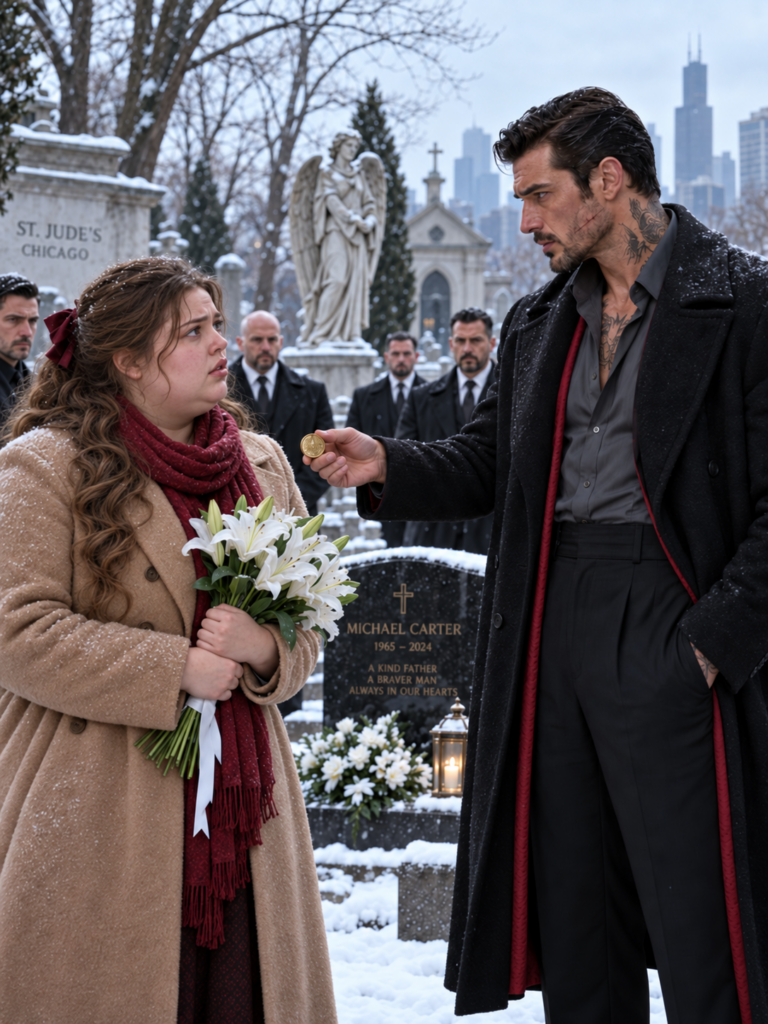
Ten men in tailored black suits stood around Thomas Reed’s grave as if guarding a king.
Norah stopped just inside the cemetery gate.
Rain battered the black umbrellas above their heads and turned the narrow gravel path into gray mud. In her hands, a cheap bundle of white lilies sagged beneath wet plastic. Three days earlier, she had watched cemetery workers lower her father into a plywood coffin because it was the only one she could afford.
Thomas Reed had repaired transmissions.
He had died with grease beneath his fingernails, overdue bills stacked on his kitchen table, and forty dollars in his checking account.
He had not been the kind of man who knew people like these.
Norah tightened her grip on the flowers and walked toward them.
St. Jude’s had buried her father near the back fence beneath an old oak with half its branches dead. The plot was cheap, the granite marker plain.
Yet ten broad-shouldered men now stood around it in complete silence.
“Excuse me.”
No one moved.
Norah’s grief sharpened into irritation.
“You have the wrong grave.”
Still nothing.
She stopped a few feet from the nearest man.
“I said move. That’s my father.”
This time, the circle opened.
The movement was almost unnervingly coordinated. Men stepped aside without speaking, revealing a single figure standing before Thomas Reed’s headstone.
He was tall, perhaps somewhere in his forties, in a charcoal overcoat that looked absurdly expensive against the wet cemetery grass. Rain darkened his hair, silver already showing at the temples. A pale scar cut along one side of his jaw before disappearing beneath his collar.
When he looked at Norah, she understood immediately that he was not there because he enjoyed funerals.
He looked like a man who caused them.
“Nora,” he said.
She hated that he knew her name.
“It’s Norah.”
His gaze flickered, accepting the correction.
“I’m sorry about Thomas.”
“Who are you?”
“Dominic.”
“That isn’t an answer.”
One corner of his mouth moved, but there was no humor in it.
“Your father was a good man.”
“My father fixed cars.”
“He fixed a great many things.”
Norah’s pulse changed.
She glanced at the men surrounding them.
“My father didn’t know people who bring armed security to cemeteries.”
Dominic reached into his coat.
Several terrible possibilities flashed through her mind before his hand emerged holding an old gold coin.
Its edges had been worn smooth.
He held it toward her.
Norah didn’t take it.
“I don’t want your money.”
“It isn’t money.”
“What is it?”
“A marker.”
“For what?”
Dominic looked toward Thomas’s name carved into granite.
“A closed ledger.”
He placed the coin on top of the headstone.
Then he stepped closer to Norah.
His voice dropped beneath the sound of the rain.
“Your father paid a very high price to make sure you would never need to know me.”
Norah’s throat tightened.
“What did he pay?”
Dominic’s expression gave her nothing.
“I intend to honor what he wanted. The debt is paid.”
He walked past her.
The other men followed him toward a line of dark SUVs waiting along the cemetery road.
Within a minute, Norah stood alone.
She stared at the grave.
Then at the gold coin.
“What did you do, Dad?”
Only the rain answered.
She took the coin home.
The apartment felt wrong without Thomas in it.
His cracked leather chair sat beside the window. His work boots remained beneath the coat rack. A half-used bottle of hot sauce still stood on the kitchen counter because he had believed there was no meal bad enough that hot sauce couldn’t save it.
For twenty-six years, it had been the two of them.
Thomas had been steady, practical, quiet.
He smelled of gasoline, Gojo soap, and wintergreen gum. He drank cheap beer. He cursed property taxes. He had taught Norah how to rebuild a carburetor before he taught her how to parallel park.
He had also apparently known a man named Dominic who traveled with ten armed guards.
Norah placed the gold coin beside a pile of overdue notices.
Her phone rang.
FIRST NATIONAL BANK.
Her stomach dropped.
The auto shop mortgage.
Thomas had been behind for months. With funeral expenses and hospital bills, Norah knew foreclosure was coming.
She answered.
“Ms. Reed?”
Mr. Gable, the branch manager.
“Yes.”
“I’m calling regarding the Fourth Street property.”
“I know. I need thirty days. The insurance claim is still processing, and I—”
“No.”
Her jaw set.
“Then why bother calling?”
“I mean no, Ms. Reed. You misunderstand. I’m calling to apologize.”
Norah sat upright.
“For what?”
“The notices. The calls. The entire matter has been resolved.”
She stared at the wall.
“What matter?”
“The mortgage.”
“What about it?”
“It was paid in full approximately one hour ago.”
For several seconds she could hear only the refrigerator humming.
“My father owed almost two hundred thousand dollars.”
“Yes.”
“And somebody paid it?”
“Yes.”
“Who?”
A pause.
The banker lowered his voice.
“The transfer originated with a private holding company. I was contacted by their representatives afterward.”
“What did they say?”
Another pause.
“That further collection activity involving your account would be considered… personally offensive to their employer.”
Norah looked at the gold coin.
The debt is paid.
“Who is their employer?”
“I don’t have that information.”
The speed of his answer told her he was lying.
“The deed will be mailed this week. Good evening, Ms. Reed.”
He disconnected.
Norah stayed still for perhaps five seconds.
Then she stood and went into her father’s bedroom.
She searched everything.
Drawers.
Closet.
Mattress.
Coat pockets.
Nothing.
Then she saw Thomas’s steel toolbox at the bottom of the hall closet.
She dragged it into the bedroom.
Inside were normal tools: sockets, ratchets, extensions, screwdrivers.
Her fingers moved across the bottom tray.
Something caught.
A seam.
Norah found a flathead screwdriver and forced it beneath the edge.
The metal panel popped free.
Under the false bottom sat three objects sealed inside plastic.
A thick stack of hundred-dollar bills.
A Glock 19.
And a black leather notebook.
Norah reached for the notebook first.
Inside, Thomas’s handwriting filled the pages.
Dates.
Initials.
Payments.
Short descriptions that sounded innocent until they didn’t.
Transported package.
Cleaned Rivera mess.
Fixed leak in South Side operation.
The same initials appeared over and over.
D.R.
Dominic.
Norah felt as though someone had replaced her father with a stranger while she had been watching.
Thomas had taught her to check tire pressure every month.
Thomas had burned pancakes every Sunday.
Thomas had apparently spent years working for organized crime.
She turned to the final page.
The handwriting was newer.
They know about the ledger.
D.R. promised to keep Norah out.
If you are reading this, I am dead.
Do not trust anyone.
Run.
Her breath stopped.
She looked toward the window.
Across the street, beneath a flickering lamp, a black SUV sat with its engine off.
A man was visible behind the windshield.
Watching.
Norah closed the notebook.
She did not run.
Not immediately.
Running without understanding the problem was how people made bad problems worse.
At six the next morning, she climbed down the fire escape carrying the ledger, cash, and Glock in an old canvas duffel.
She crossed alleys, doubled back through side streets, and took public transit until she was certain the watcher had lost her.
Then she spent three hours in a diner with bad coffee and a burner phone.
The company that had paid her mortgage led to another company.
Then another.
Eventually the paper trail ended at a commercial real-estate business that owned a restaurant in Chicago’s financial district.
Verona.
By ten, Norah stood outside its dark mahogany doors.
Two men in suits guarded the entrance.
“We’re closed.”
“I’m not hungry.”
One man stepped into her path.
Norah met his eyes.
“Tell Dominic Thomas Reed’s daughter is here.”
The man didn’t react.
“And tell him I have his ledger.”
That did it.
Minutes later, Norah entered a private dining room.
Dominic sat alone at a circular table.
His coat was gone. His white shirt sleeves were rolled to his forearms. Reading glasses rested low on his nose while he reviewed invoices beside a cup of espresso.
For a moment, he looked less like a crime boss than a tired businessman balancing accounts before opening.
He didn’t look up.
“You were supposed to leave Chicago.”
Norah took the ledger from her bag and slammed it onto his papers.
“You paid my mortgage.”
“Yes.”
“Reverse it.”
“No.”
“I don’t want your money.”
“It wasn’t a gift.”
“What was it?”
“A way out.”
He removed his glasses.
“Sell the shop. Take the money. Start somewhere else.”
“You don’t get to reorganize my life because you feel guilty about my father.”
Dominic studied her.
“Thomas was meticulous.”
“He was a mechanic.”
“He was much more than that.”
Norah’s hand curled against the table.
“Then explain.”
Dominic leaned back.
“Your mother was sick twenty years ago.”
Norah went still.
She remembered almost nothing about her mother except photographs and fragments of hospital rooms.
“Cancer,” Dominic continued. “Your father couldn’t pay for her treatment. The banks refused him.”
“And you didn’t.”
“No.”
“What did you want?”
“One job. Driving a car.”
Norah laughed once, without humor.
“There’s always one job.”
“Yes.”
He did not insult her by pretending otherwise.
“Thomas noticed things. He understood systems. He could see where a problem would develop before everyone else noticed it existed. One job became another. Eventually, I depended on him.”
“So he was a criminal.”
Dominic looked at the ledger.
“He was a desperate man who crossed a line and spent the next twenty years trying to keep that line from reaching you.”
Norah swallowed.
“The coroner said he died from a heart attack.”
“He did.”
“You expect me to believe that?”
“Yes.”
Dominic poured water into a glass and pushed it toward her.
She ignored it.
“Six months ago, a shipment disappeared. Thirty million dollars in weapons.”
Norah stared.
“A faction inside Sullivan’s organization stole it. Sullivan blamed half the city while his own men hid the trucks.”
“And my father?”
“He was hired to clean the warehouse where the theft had been staged.”
Dominic’s voice hardened.
“He discovered what had happened.”
Norah looked at the ledger.
“Then Sullivan found out.”
“Eventually.”
“What did he want from Dad?”
“The location. Records. Anything Thomas knew about me.”
Her stomach tightened.
“Did you threaten him too?”
Dominic did not answer immediately.
“He knew what would happen if he gave my enemies everything in that book.”
“That isn’t an answer.”
“No,” Dominic said. “It isn’t.”
Something in his willingness to leave the accusation standing disturbed her more than denial would have.
“He hid the ledger,” Dominic continued. “Sullivan’s people cornered him two days before he died. Thomas escaped. But he knew they would come again.”
“And his heart gave out.”
“Yes.”
Norah stared at him.
“You had someone watching my apartment.”
“Protecting it.”
“They were spying on me.”
“They were making certain Sullivan’s men didn’t reach you first.”
“I don’t know anything.”
“That doesn’t matter.”
Dominic stood.
He was considerably larger than she had realized at the cemetery.
“To Sullivan, you are leverage. To anyone who thinks Thomas left behind the location of thirty million dollars in stolen weapons, you are the only remaining path to it.”
Norah’s anger began turning into something colder.
“You stood at his grave so people would see me with you.”
“Yes.”
“You paid the mortgage so I could leave.”
“Yes.”
“And did your warning work?”
Dominic looked toward the front of the restaurant.
“No.”
The explosion struck a second later.
The windows came inward.
Norah experienced the blast first as pressure—a brutal invisible hand throwing her backward.
Dominic hit her before the floor did.
His body covered hers as glass, plaster, and burning wood ripped through the dining room.
Then darkness swallowed the restaurant.
“Get up!”
Norah’s ears screamed.
Smoke filled her mouth.
Dominic pulled her to her feet.
The elegant front room had become wreckage.
“Bag,” she coughed.
“Leave it.”
“The ledger’s inside.”
Dominic swore, found the duffel beneath debris, and shoved it against her chest.
Car doors slammed outside.
Dominic drew a handgun.
The weary accountant vanished.
“Kitchen. Now.”
Norah ran.
Gunshots cracked behind her.
In the kitchen, Dominic forced her behind the heavy freezer door.
“Stay down.”
Two shots.
A scream.
Another shot.
Silence.
When Dominic returned, blood darkened one shoulder.
He led her through the service exit into an alley.
A gray sedan waited between dumpsters.
“Keys beneath the rear tire.”
Norah found them.
She started the engine.
Dominic fell into the passenger seat.
“Drive.”
She hit the accelerator.
Three blocks later, she glanced toward him.
Blood soaked his coat.
“You’ve been hit.”
“Shrapnel.”
“You need a hospital.”
“No hospitals.”
“Of course not.”
“Keep driving.”
Norah gripped the wheel.
“Where?”
Dominic’s face had gone pale.
“A place where we can finish what your father started.”
Part 2
The safe house was a dead dental clinic above a suburban strip mall.
No marble.
No armed guards.
No underground bunker.
Just dusty windows, a keypad door, radio equipment, locked cases, and an old operating room converted into a makeshift medical station.
Dominic sat on the stainless-steel table and removed his coat.
Blood had soaked through his shirt.
“Bottom drawer,” he said. “Forceps. Iodine. Sutures.”
Norah opened the cabinet.
“You have a doctor?”
“Not one I can reach without telling people where I am.”
“So I’m your surgeon now?”
“You’re the person standing here.”
She brought the supplies over.
A jagged fragment of metal was buried in his shoulder.
Norah looked at it.
Then at him.
“This is going to hurt.”
“I assumed.”
“My father used to cut himself open on radiator fans. He refused to go to the emergency room because he said they charged six hundred dollars for what he could stitch in the garage.”
Something moved in Dominic’s expression.
“He said the same thing to me once.”
Norah paused.
For one strange second they shared the same memory of a man neither had fully known.
Then she gripped the shrapnel with the forceps.
“Ready?”
“No.”
She pulled anyway.
Dominic’s hand clamped against the table edge, but he did not make a sound.
Norah dropped the bloody fragment into a steel tray.
Then she cleaned and closed the wound.
“You’re good at this,” he said.
“I rebuild carburetors.”
“This is different.”
“Not enough.”
Dominic watched her hands.
“You didn’t freeze during the attack.”
“I panicked.”
“You kept functioning.”
“That doesn’t mean I wasn’t terrified.”
“No.” His voice softened slightly. “It means terror didn’t make the decision for you.”
Norah tied the final stitch.
She pulled off the gloves and retrieved Thomas’s ledger.
“Tell me about Sullivan.”
Dominic rested a clean towel against his shoulder.
“He runs an operation on the South Side. Weapons mostly. Narcotics. Violent men who mistake noise for strength.”
“And the thirty million?”
“Stolen from him by his own people.”
“You said Dad found the warehouse.”
“Yes.”
Dominic opened the ledger.
“The thieves hired Thomas to clean the scene of the hijacking. They didn’t realize he worked for me.”
“So he found out where they moved the weapons.”
“That is what Sullivan believes.”
Norah turned pages.
“No addresses.”
“I know.”
“No warehouse numbers.”
“I looked.”
She examined the entries again.
Each included a date, initials, payment, and numbers she had assumed belonged to some financial system.
Norah stopped.
Her pulse quickened.
Dominic noticed.
“What?”
“These aren’t account codes.”
He waited.
Norah tapped the first sequence.
“One-five-three-six-two-four.”
“Yes?”
“Inline-six firing order.”
She pointed to another.
“One-eight-four-three-six-five-seven-two. Chevy V8.”
Then another.
“One-three-four-two. Inline four-cylinder.”
Dominic leaned closer.
“Your father encoded the entries using engine sequences.”
“Not exactly.”
Norah turned to the final page.
A note appeared beside another sequence.
The shipment is parked.
Her brow furrowed.
“That’s wrong.”
“How?”
“No engine should fire like this. Not one Dad worked on.”
“Then perhaps it was never meant to represent an engine.”
Dominic crossed to a filing cabinet and removed a city map.
He unfolded it across a table.
Colored marks divided industrial zones along the South Side.
“Sullivan uses six primary depots.”
Norah stared at them.
Six.
She traced the sequence.
One.
Four.
Two.
Five.
Three.
Six.
Connecting the depots created intersecting lines.
Their center fell on a blank section of the map.
“What’s there?”
Dominic leaned over it.
“An abandoned municipal impound lot.”
“No cameras?”
“None that still work.”
“Security?”
“Minimal.”
Norah looked at the map.
Thirty million dollars hidden among acres of dead cars.
She almost laughed.
“That’s exactly where Dad would put them.”
Dominic studied her differently now.
Not as Thomas Reed’s daughter.
Not as someone to evacuate.
As someone useful.
“Your father raised you well.”
“My father lied to me for twenty years.”
“That too.”
A burner phone vibrated.
Dominic answered on speaker.
A man’s voice filled the clinic.
“Dominic.”
His accent was thick, his tone amused.
“Sullivan.”
“You destroyed two of my vehicles this morning.”
“You destroyed my restaurant.”
“Yes. Tragic.”
Dominic’s face became unreadable.
“What do you want?”
“The mechanic’s daughter.”
Norah felt the temperature of the room change.
“She’s gone.”
“Don’t insult me.”
Sullivan laughed softly.
“Thomas kept records. Thomas kept insurance. Thomas kept secrets. Now Thomas is dead, and blood inherits what dead men leave behind.”
Dominic’s good hand curled against the table.
“You come near her, and I end this.”
“You’re in no position to threaten me. Give me the girl, the book, and my shipment. We all go home.”
“Your own men robbed you.”
The humor disappeared from Sullivan’s voice.
“Careful.”
“You can barely control what remains of your organization. You attack my people again, and I will not send anyone after you.”
Dominic leaned toward the phone.
“I will come myself.”
He disconnected and crushed the burner beneath his palm.
Norah stared at him.
“That was dramatic.”
“He needed to believe I’m angrier than I am injured.”
“You’re both.”
“Yes.”
Dominic opened one of the black equipment cases.
Inside were weapons, body armor, radios, cash.
He pulled on a vest.
“What are you doing?”
“Going to the impound lot.”
“You can barely move your left arm.”
“I only need the right one.”
“That might be the stupidest thing you’ve said all day.”
He ignored her.
“There’s an old Honda two streets west. Fifty thousand dollars is inside. Clean plates.”
Norah understood.
“You’re sending me away.”
“I’m sending you west.”
“Where?”
“Denver. Then wherever you want.”
“And you?”
“I secure the shipment before Sullivan finds it.”
“Alone?”
“My people are moving.”
“You don’t even know whether the trucks are safe to touch.”
Dominic stopped.
Norah pointed toward the ledger.
“My father hid thirty million dollars in stolen weapons while two criminal organizations hunted him.”
“Yes.”
“You think he parked two trucks and left the keys in the ignition?”
Dominic said nothing.
“He rigged them.”
“You don’t know that.”
“I knew Thomas Reed.”
“So did I.”
The words came sharper than Dominic intended.
They stared at one another.
Norah felt something unexpected beneath her anger.
He really had known Thomas.
Not the father who made pancakes and complained about taxes.
Another Thomas.
A man who carried secrets home and washed blood, perhaps literal and perhaps not, from his hands before walking through the apartment door.
Dominic had known that man.
Norah had not.
“You knew a part of him,” she said.
Dominic’s gaze held hers.
“Yes.”
“So did I.”
She picked up the ledger.
“And the part I knew would never leave thirty million dollars undefended.”
Dominic looked toward the weapons cases, then back at her.
“You are a civilian.”
“I’m a mechanic.”
“You are not coming into a cartel conflict because you know wiring.”
“I know my father.”
“You think that makes you bulletproof?”
“No.”
For the first time, Norah stepped close enough to see exhaustion beneath Dominic’s discipline.
She lowered her voice.
“I think it means I may be the only person alive who understands how his traps work.”
That stopped him.
“He taught me his shortcuts. His habits. His mistakes. If there’s a kill switch, a bypass, a false wire, I can find it.”
Dominic looked at the dried blood beneath Norah’s nails from stitching him.
“Your father asked me to keep you out.”
“He also left me the ledger.”
A faint grimness crossed Dominic’s face.
“He left you a warning to run.”
“And then encoded the location in a language only I would understand.”
Neither spoke.
That fact changed everything.
Finally Dominic removed a spare magazine from the case and tossed it to her.
Norah caught it.
“We do this your way until it stops working,” he said.
“And then?”
“Then we do it mine.”
The impound lot stretched across thirty acres beside the industrial canal.
Dead cars formed narrow metallic corridors beneath a moonless sky.
Dominic left the Honda two blocks away.
Norah carried the Glock but trusted the heavy wire cutters in her other hand far more.
They entered through torn fencing.
“Sector G,” Norah whispered after orienting herself. “Near the crusher.”
“How certain?”
“Enough.”
They moved slowly.
Dominic checked every blind angle before letting her pass.
There was something unsettlingly efficient about him in darkness. His steps avoided glass almost instinctively. His weapon remained ready without unnecessary movement.
Norah understood now why ten armed men had stood around him in the cemetery.
Power was not the suits.
It was not the SUVs.
It was this: a man who entered dangerous spaces as though he had already accepted the worst possible outcome.
After ten minutes, the stacked cars opened into a clearing.
Two gray utility trucks waited on a cracked concrete pad.
No logos.
No markings.
Norah’s eyes immediately found the reinforced axles and heavy suspension.
“There.”
Dominic took one step.
“Stop.”
He froze.
Norah aimed her flashlight beneath the first truck.
A nearly invisible line ran into the chassis.
She dropped to the pavement.
“Dad.”
“What?”
“Nothing.”
She crawled beneath.
The wiring was elaborate.
Explosives connected to the door latch.
Another line ran toward the ignition.
A third reached the drive shaft.
“If you open the door, it blows.”
Dominic remained very still.
“If you start it?”
“It blows.”
“If we tow it?”
“If the shaft rotates, probably blows.”
“Can you disable it?”
Norah traced the wires.
Perfect factory-style red.
Perfect black.
Perfect yellow.
Then, behind a suspension component, she found faded blue electrical wire wrapped with cheap tape.
She smiled despite herself.
Thomas used to tell her factory work was beautiful and repairs were ugly.
Find the ugly wire.
She placed the cutter jaws around it.
“If I’m wrong—”
“I understand.”
“You might want to move farther away.”
“Would it help?”
“No.”
“Then continue.”
She cut.
A tiny indicator light died.
Norah slid from beneath the truck and opened the driver’s door.
Nothing happened.
Dominic breathed out.
“Well done.”
“We’re not finished.”
She swept the flashlight around the clearing.
Packages hid beneath the windshields and frames of abandoned vehicles surrounding them.
Explosives.
A perimeter.
“My father turned this place into a minefield.”
Dominic surveyed the cars.
“How do we shut it off?”
“There should be a receiver.”
“Where?”
“Second truck, probably.”
The distant growl of engines stopped them.
Headlights broke through the darkness.
Three SUVs crashed through the fence.
Men emerged carrying rifles.
Dominic counted them.
“Fifteen.”
Norah’s mouth went dry.
“Your people?”
“No.”
Sullivan’s men spread into the junkyard.
Dominic stepped in front of her.
“Get inside the truck.”
“You cannot fight fifteen people.”
“I don’t need fifteen victories.”
“What does that mean?”
“It means get inside.”
Norah looked toward the wired vehicles around the clearing.
Then at the tactical radio on Dominic’s vest.
“Give me that.”
He glanced down.
“The radio.”
“Why?”
“These triggers are old.”
Gunmen advanced through the metal corridors.
Norah’s thoughts accelerated.
“Dad would use cheap receivers because they’re disposable. If I can force a strong enough transmission across the right frequency range, I may be able to trigger individual charges.”
Dominic removed the radio.
“How long?”
“Ninety seconds.”
“You have sixty.”
“That isn’t how electronics work.”
“It is tonight.”
He handed her the radio.
Then he disappeared into the darkness.
The first suppressed shot dropped one of Sullivan’s men.
Automatic fire erupted in response.
Norah crouched behind the truck tire and tore open the radio housing.
Bullets struck metal around her.
She forced herself to focus.
Circuit.
Antenna.
Power limiter.
Signal amplifier.
Machines did not care whether you were afraid.
They obeyed inputs.
Another burst of gunfire hammered the clearing.
Sullivan’s amplified voice echoed through the junkyard.
“Dominic!”
Norah kept working.
“You’re bleeding for nothing!”
A shot answered him.
Then several rifles fired at once.
Norah looked beneath the truck.
Dominic was pinned behind the engine block of a gutted Chevrolet.
His wounded arm hung almost uselessly.
Four men were moving above him along the crushed roofline of another vehicle.
Flanking.
Norah stripped two wires.
Twisted them.
Forced the antenna directly into the battery contact.
The radio grew hot.
Signal.
She looked toward the nearest explosive charge.
Too far to wire manually.
Then she saw a lug wrench lying in the mud.
A conductor.
Norah ran.
Bullets tore sparks from the cars around her.
She reached the wired vehicle, grabbed the wrench, and hurled it across the exposed battery terminals.
Metal struck metal.
She jammed the radio transmission button.
“DOWN!”
The world turned orange.
Part 3
The explosion lifted Norah from the ground.
She struck the side of a tire and landed hard in the mud.
For several seconds there was no Chicago, no impound lot, no gunfire.
Only a high-pitched ringing inside her skull.
Ash drifted through the air.
She rolled onto one elbow.
The rigged car was gone.
So were the men who had been using the wreckage above Dominic as a firing position.
Fire spread through shattered metal.
Norah coughed and forced herself upright.
Dominic emerged from smoke thirty yards away.
His rifle was gone.
His shirt and vest were dark with blood.
He carried a handgun in his right hand.
Three of Sullivan’s surviving men dropped their weapons and backed away.
Dominic let them.
His attention was elsewhere.
Sullivan pulled himself from beneath the crushed side of a Ford Explorer.
His expensive suit was torn. One side of his face had been burned by the blast, and one leg dragged uselessly behind him.
He reached for a silver revolver at his ankle.
Dominic fired once.
Sullivan screamed.
The revolver fell away.
Dominic walked toward him.
Not fast.
Not angry.
That frightened Norah more.
Sullivan crawled backward until the armored truck stopped him.
“You kill me,” he gasped, “and my people hunt you forever.”
Dominic stopped several yards away.
“Your people robbed you.”
Sullivan clutched his ruined wrist.
“My people—”
“Are already deciding who takes what when you die.”
Dominic lifted the handgun.
“You lost your money. You lost your men. You attacked me in my city.”
His voice was almost conversational.
“You were dead before you came through that fence.”
“Wait.”
Dominic looked toward Norah.
She stepped through the smoke.
Her lip was bleeding.
Grease and ash covered her jacket.
Thomas’s ledger remained inside her bag.
Sullivan stared at her.
Recognition followed.
“The mechanic’s daughter.”
Norah said nothing.
Sullivan laughed despite the pain.
“That’s what all this is for?”
His gaze dropped to the Glock now in her hand.
“You don’t know what to do with that.”
Norah kept walking.
“You’re a girl holding a gun because a dangerous man told you it would make you dangerous too.”
Dominic watched her.
Sullivan spread his good hand.
“Go ahead.”
Norah stopped.
“Shoot.”
She thought of Thomas’s funeral.
The cheap coffin.
The hospital call.
His empty chair.
The false bottom of his toolbox.
She thought of all the years he had come home after whatever work Dominic required and smiled at her as though the world outside their apartment were ordinary.
She thought of his final warning.
Run.
Norah lowered the Glock.
Sullivan smiled.
“There.”
His smile widened.
“That’s what I thought.”
“You’re right about one thing.”
Norah put the gun away.
“I don’t kill people.”
Sullivan laughed.
Norah reached into her pocket.
The small bypass component she had removed while working beneath the truck rested in her palm.
“I fix things.”
She tossed it onto Sullivan’s lap.
He looked down.
“And what exactly is that?”
“A problem.”
Norah gestured toward the armored vehicle against his back.
“My father rigged these trucks with explosives.”
Sullivan’s face changed.
“The truck you’re leaning against has enough underneath it to turn this section of the lot into scrap.”
He went perfectly still.
“The bypass circuit has been interrupted.”
Sullivan stared at the device.
“You’re lying.”
“Maybe.”
Norah turned away from him.
“But if I were you, I’d be very careful about finding out.”
She walked toward the second truck.
“Dominic.”
He continued staring at Sullivan.
“Keys.”
Dominic looked at her.
For the first time since the cemetery, something in his expression broke completely through the restraint.
Not amusement.
Not surprise.
Respect.
Deep and unmistakable.
He reached into his pocket and tossed her the keys.
She caught them.
Behind them, Sullivan began frantically examining the bypass.
“The debt is paid, Norah,” Dominic said.
She opened the driver’s door.
“No.”
He raised an eyebrow.
Norah climbed into the seat.
“The debt is collected.”
Dominic’s mouth curved faintly.
Then he walked around the truck and climbed in beside her.
Norah turned the ignition.
The diesel engine started with a deep mechanical vibration she felt through the steering wheel.
No explosion.
She shifted into drive.
In the side mirror, Sullivan remained on the ground beside the other transport, staring between the wiring and the device in his hands.
Dominic leaned back against the passenger seat.
“You gave him five minutes?”
Norah glanced over.
“I never said five minutes.”
“You implied a timed trigger.”
“I implied several things.”
“Is the truck actually going to explode?”
Norah faced the road.
“My father taught me never to explain a repair before someone pays the invoice.”
Dominic almost laughed.
It was a small sound, barely there.
But it was the first sound Norah had heard from him that belonged to an ordinary human being.
She drove through the broken fence.
Neither spoke for the first mile.
The city glowed ahead of them beyond the canal.
Norah’s hands remained steady on the wheel until the adrenaline began draining away.
Then they started to tremble.
Dominic noticed.
“You can pull over.”
“No.”
“You may be concussed.”
“I’m fine.”
“You were thrown into a car.”
“So were several other people.”
“Most of them are not driving.”
Norah looked at him.
“You’ve been bleeding for an hour.”
“Fair.”
She faced the road again.
Another silence.
Then:
“Did you know?”
Dominic’s voice softened.
“Know what?”
“That he would leave the location for me to find.”
“No.”
“Did he ever talk about me?”
“Often.”
Norah tightened her hands on the wheel.
“What did he say?”
Dominic looked through the windshield.
“He said you were better with engines than he was by sixteen.”
“He was lying.”
“He said you would say that.”
Norah swallowed.
“What else?”
“That you were stubborn.”
“That’s rich.”
“He worried you trusted systems more than people.”
“He taught me that.”
“Yes.”
Dominic shifted slightly and winced as the movement pulled against his wounded shoulder.
“He said machines made sense to you because failures left evidence. People could hide theirs.”
Norah looked at the highway.
“That sounds like him.”
“He was proud of you.”
The words landed harder than the explosion.
Norah blinked rapidly.
For two days people had told her Thomas loved her.
Neighbors.
Customers.
The funeral director.
None of them had known the other life he had hidden.
Dominic had.
And somehow that made his words different.
“Then why leave me that ledger?”
Dominic remained quiet.
Norah answered herself.
“Because he knew he might not be there to finish it.”
“Yes.”
“He knew you would come.”
“Yes.”
“But he didn’t trust you enough to give you the location.”
“No.”
Norah glanced over.
That did not offend Dominic.
If anything, he seemed to understand.
“He trusted me to protect you,” he said. “Not with everything else.”
“Did that bother you?”
“Thomas survived twenty years in my world because he did not trust easily.”
Dominic looked at her.
“I would have thought less of him if he had trusted me completely.”
The road carried them toward the skyline.
Norah drove another mile before asking the question that had been pressing against her since Verona.
“What exactly was the debt?”
Dominic stared ahead.
“Your father saved my life.”
“When?”
“Years ago.”
“How?”
“He noticed someone had altered the brake assembly on my car.”
Norah gave him a sharp look.
“Seriously?”
“Yes.”
“That’s painfully appropriate.”
“I thought so.”
“What happened?”
“He fixed the brakes.”
“That’s it?”
“And identified the person who had sabotaged them.”
“What happened to that person?”
Dominic’s silence answered sufficiently.
Norah shook her head.
“You know, normal people send Christmas cards.”
“Thomas disliked Christmas cards.”
“That is true.”
A faint change came over Dominic’s face again.
Norah realized then that grief was not hers alone.
Dominic had stood in the rain because he had lost Thomas too.
Whatever their arrangement had begun as, twenty years changed things.
Debts became loyalty.
Loyalty became friendship, even when men like Dominic preferred other words.
“You said you failed him,” Norah said.
“At the clinic.”
“Yes.”
“I did.”
“You got me out of the restaurant.”
“I allowed the danger to reach you in the first place.”
“You didn’t put the ledger in Dad’s toolbox.”
“No.”
“You didn’t make Sullivan steal his own weapons.”
“No.”
“You didn’t give Dad a heart attack.”
Dominic looked at her.
“You’re trying very hard to absolve a criminal.”
“I’m trying to understand the machine.”
He was silent.
Norah continued.
“Dad made choices. You made choices. Sullivan made choices. I made choices.”
She nodded toward the cargo behind them.
“This happened because all those pieces collided.”
Dominic’s eyes rested on her profile.
“You really do see everything as machinery.”
“Machines are easier.”
“People rarely are.”
“I’m noticing.”
They reached an intersection.
Norah slowed.
“What happens to the weapons?”
“They disappear.”
“That sounds suspiciously vague.”
“It is deliberately vague.”
“Destroyed?”
“Most likely.”
She looked at him.
“Most likely?”
“You are asking for details Thomas spent twenty years preventing you from hearing.”
Norah considered that.
“Fine.”
She drove on.
Then Dominic said, “The shop remains yours.”
“I told you to reverse the payment.”
“No.”
“It was two hundred thousand dollars.”
“Thomas saved considerably more than that for me.”
“You’re impossible.”
“So I have been told.”
“By Dad?”
“Repeatedly.”
Norah could almost hear Thomas saying it.
The thought hurt.
But for the first time since the hospital had called, the pain did not feel entirely empty.
Something remained.
Stories she had never heard.
Parts of her father that had existed outside her childhood home.
Questions Dominic could answer.
That realization made the man beside her more dangerous in a different way.
He was a doorway.
And Norah did not know whether opening it would help her grieve or destroy the version of Thomas she still wanted to keep.
“After tonight,” she said, “I decide what happens to me.”
“Yes.”
“No watchers outside my apartment without telling me.”
Dominic considered.
“Yes.”
“No paying bills behind my back.”
“That depends.”
She turned toward him.
“Wrong answer.”
He sighed.
“Fine.”
“And I’m not joining your organization.”
“I have not asked.”
“You looked like you were considering it.”
“I was considering hiring you to repair one of my cars.”
“No.”
“Thomas charged less.”
“Thomas had terrible business instincts.”
“That is also true.”
Norah almost smiled.
Almost.
Then a brilliant flash bloomed behind them.
Orange light reflected across the mirrors.
A distant concussion rolled through the night.
Norah did not look back.
Neither did Dominic.
For several seconds they listened to the fading echo.
Finally Dominic said, “You told me the trigger wasn’t timed.”
“I said I never told Sullivan it was timed.”
Dominic turned slowly.
Norah kept her eyes forward.
“Was that explosion your doing?”
“Technically?”
“Yes.”
“No.”
“What does technically mean?”
“It means I left a damaged receiver beside several unstable explosive circuits in a burning junkyard.”
Dominic stared at her.
“And Sullivan?”
“He decided what to touch.”
Dominic looked forward again.
“I understand.”
Norah’s jaw tightened.
“Do you?”
“Yes.”
He rested his head against the seat.
“You don’t pull the trigger.”
“No.”
“You fix the system until the broken part removes itself.”
Norah thought of the gold coin.
The mortgage.
The ledger.
The coded firing orders.
The truck beneath her hands.
Thomas had spent twenty years moving between two worlds, solving problems quietly enough that his daughter could believe he was only a mechanic.
Perhaps he had succeeded.
Perhaps he had failed.
Norah no longer knew.
But she knew this:
She was still Thomas Reed’s daughter.
Not because she had inherited his secrets.
Because she had inherited the way he looked at impossible problems.
Find the system.
Understand the parts.
Look for the ugly wire.
Then decide what needs fixing.
The truck rumbled toward Chicago.
Dominic sat beside her, wounded, exhausted, and for once apparently willing to let someone else choose the direction.
Norah drove.
Tomorrow there would be police reports, destroyed property, criminal factions scrambling to replace dead leadership, and questions neither of them could answer in public.
There would be a funeral bill still sitting on her table.
A shop to reopen.
A father to mourn.
And somewhere in her apartment, a gold coin she had once believed represented a debt between two men.
Now she understood better.
Debts did not vanish when somebody declared a ledger closed.
They became choices.
Thomas had spent his life trying to buy his daughter freedom from Dominic’s world.
Dominic had tried to honor that by pushing her away from it.
Sullivan had tried to drag her into it.
And Norah had entered on her own terms.
That distinction mattered.
At the next light, Dominic looked at her.
“What will you do now?”
Norah considered the question.
Then she looked toward the city her father had hidden from her in plain sight.
“First?”
“Yes.”
“I’m going home.”
Dominic nodded.
“And after that?”
“I’m reopening the shop.”
He looked genuinely surprised.
“After tonight?”
“Especially after tonight.”
“Why?”
Norah rested one hand more lightly on the steering wheel.
“Because my father spent twenty years making sure I could have an ordinary life.”
The signal turned green.
She accelerated.
“I think I’ll decide for myself what ordinary means.”
Dominic watched her for another moment.
Then he gave a slow nod.
Not an order.
Not permission.
Recognition.
Outside, Chicago stretched ahead of them beneath a wet black sky.
Behind them, Thomas Reed’s final secret burned itself out among thirty acres of rusted machinery.
Ahead waited his daughter, his shop, his unfinished ledger, and a powerful man who had promised a dead friend he would keep her beyond the reach of his world.
That promise had already failed.
What replaced it was something neither Thomas nor Dominic had planned.
Norah was not under Dominic’s protection because she was helpless.
She had stood beside him because she was useful.
Because she had chosen to.
Because when armed men, buried explosives, and thirty million dollars in stolen weapons reduced the night to chaos, she had understood the one thing everyone else had forgotten.
Every machine had a logic.
Every trap had a circuit.
Every system had one part on which everything else depended.
And sometimes winning a war had nothing to do with being the person holding the biggest gun.
Sometimes you only had to know which wire to cut.


