
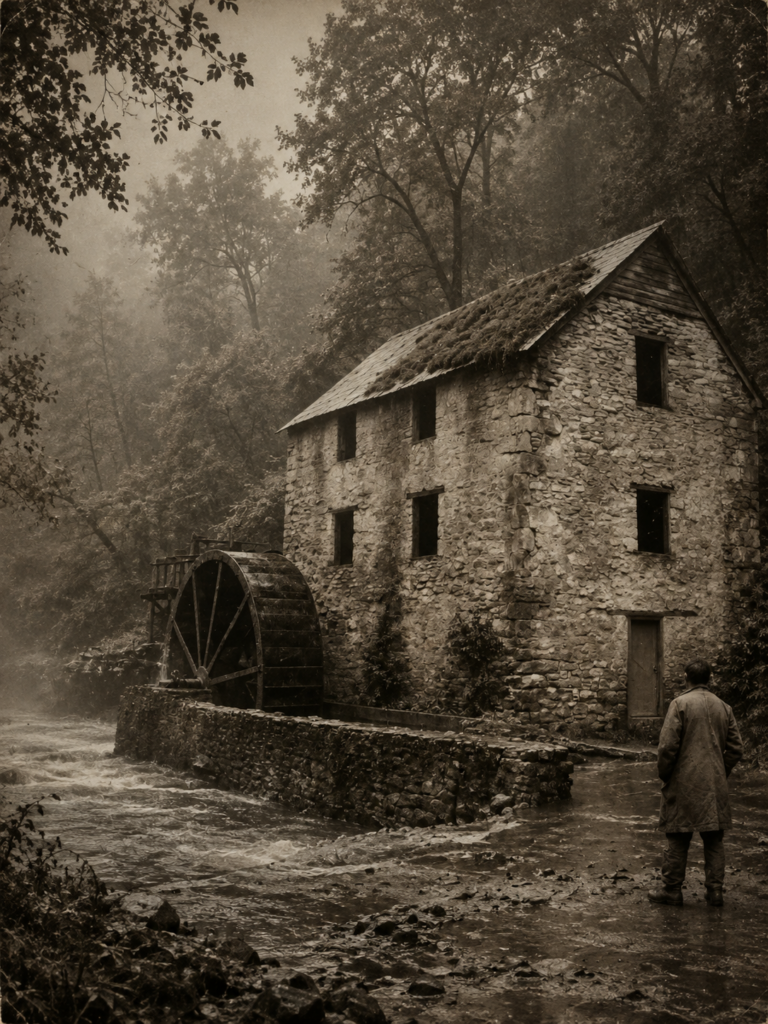
Part 1
In the spring of 1911, Isham Pettigrew was 38 years old and had spent most of his adult life listening to machines.
He was a millwright by trade, the kind of man summoned when a waterwheel refused to turn properly, when gears knocked in their housings, when a shaft ran hot for reasons nobody could locate, or when a mill that had worked faithfully for 30 years suddenly began behaving as if it had forgotten what it was built to do.
He was tall and narrow through the waist, strong without looking particularly strong. A pale burn scar ran along the inside of his left forearm from wrist to elbow, the result of a babbitt-metal pour that had gone wrong when he was 22. In cold weather the scar tightened and made him favor that arm.
His fingertips had been flattened by years of handling wood, iron, rope, bolts, wedges, and bearing surfaces. His hands looked less like the hands of a craftsman than tools slowly shaped by other tools.
He possessed one habit that other millwrights sometimes mocked.
When Isham entered a broken mill, he did not immediately touch anything.
He stood.
He listened.
A mill, he believed, announced its failures before a man ever laid a wrench against them.
A worn bearing spoke differently from a loose cog.
A twisted shaft did not complain like a warped wheel.
A bad stone had its own rhythm.
So did a dry journal, a leaking race, a cracked bucket, a swollen timber.
“All you have to do,” Isham once told an apprentice, “is give the building the courtesy of shutting up first.”
That habit would save him in Nettle Fork Hollow.
It would also ruin his sleep for the remaining 42 years of his life.
The job arrived by letter.
The writer was Corbin Yarnell of St. Louis, a timber investor who had recently purchased nearly 2,000 acres of white oak in Loyal County in the southern Missouri Ozarks.
Yarnell was 54, heavy through the shoulders and soft around the middle, with a gold watch chain that he touched habitually. He had made money in timber because he understood railroads, prices, labor, and distance.
He intended to cut the oak into ties and float or haul the finished timber toward a rail connection.
The problem was power.
According to Yarnell’s letter, however, there was already a mill on the property.
A substantial one.
Three stories.
Stone and timber construction.
A wheel nearly 20 feet across.
The building stood on Nettle Fork Creek at the bottom of a narrow hollow.
It had been erected in 1862 by a man named Hollis Varney.
Varney had been dead 17 years.
The mill had not operated since the week of his death.
Yet Yarnell claimed the structure remained sound.
So did the machinery.
He wanted Isham to inspect it, repair whatever needed repair, and calculate what would be necessary to use the old waterpower to drive a saw.
For perhaps 1 week of work, Yarnell offered $300.
Isham read the figure twice.
$300 was too much.
Not impossibly too much.
But enough that an experienced tradesman noticed.
Isham noticed nearly everything.
He simply had a way of keeping his observations to himself.
He accepted the job.
The journey into Loyal County became difficult 9 miles before he reached the mill.
The hired wagon could go no farther.
The road narrowed first into a wagon track, then into 2 wheel ruts among hickory and oak, then into something so badly overgrown it seemed less a road than the memory of one.
Isham continued on foot.
A mule followed behind him carrying his tool chest and supplies.
The country was green with spring.
Dogwood showed white between darker trees.
Water ran high but clear in the creeks.
The air smelled of wet bark and limestone.
The first abandoned house appeared before noon.
Isham might have walked past without noticing if the chimney had not been standing almost perfectly straight while the roof sagged behind it.
The front door hung from 1 hinge.
No smoke.
No fence worth naming.
No path maintained by feet.
He stopped.
The mule lowered its head to graze.
Isham went to the doorway.
Inside stood a table.
4 plates rested upon it.
Dust covered them.
Mouse droppings lay along the edges.
A cup had fallen on its side.
The room itself had survived unusually well.
One corner of the roof remained watertight.
What interested Isham was not the decay.
It was what had been left.
People in those hills did not own enough to abandon useful things.
If a family moved, they took iron cookware.
Blankets.
Tools.
Window glass.
Hinges.
Nails if they could pull them clean.
Boards if they had time.
A quilt might represent weeks of labor.
A good coat might last 10 winters.
A family who could not carry everything returned later.
The people from this house had left 4 plates on a table.
Half a mile farther, Isham found another cabin.
A quilt remained on the bed.
A man’s coat still hung from a nail.
Isham did not enter.
Before reaching the mill, he counted 11 houses.
Some nearly collapsed.
Others disturbingly intact.
All empty.
All abandoned with possessions still inside.
At approximately 4 that afternoon, he reached the bottom of Nettle Fork Hollow.
The mill stood there.
Years later, after enough whiskey loosened his judgment in a rooming house in Rolla, Isham described it to another tradesman.
“It looked like a church that had been told to do a job.”
The description remained one of the clearest things he ever said about it.
The lower 2 stories were built of limestone blocks.
Heavy timbers formed the upper floor.
The north pitch of the shingle roof had turned green with moss.
Several windows were broken.
The wheel rested along one wall, broad and dark with age.
The hollow was so narrow that sunlight reached the creek late in the morning and left early in the afternoon.
Isham walked upstream.
Approximately 200 feet above the mill, Nettle Fork looked like an ordinary Ozark creek.
Clear water.
Gravel and chert bottom.
Minnows moving in the shallows.
Then the creek entered a channel cut directly into stone.
Human hands had made the channel.
Chisel marks still showed in protected places.
The water followed it toward the mill.
Isham traced the course.
The stream passed beneath the building.
Then disappeared.
There was a tailrace.
He found it exactly where engineering said it should be.
Stone arch.
Proper grade.
Wide enough for a man to stand inside.
Dry.
Not recently dry.
Leaves had filled much of it.
Some had turned to black soil.
Water entered the mill.
No water emerged.
Isham crouched near the tailrace for several minutes.
The Ozarks are limestone country.
Water disappears underground there with no supernatural assistance.
Creeks sink into openings and reappear miles away.
Springs rise from hillsides carrying water from drainage systems nobody on the surface can fully trace.
To Isham, subterranean water itself was no mystery.
What troubled him was simpler.
No competent mill builder placed an entire mill over the point where the water disappeared.
You built above such places.
Beside them.
Never directly over the throat.
Yet Hollis Varney had built 3 floors of stone, gearing, shafts, millstones, and timber precisely there.
The front door was chained.
The chain was not 17 years old.
Isham examined it.
Perhaps 5 or 6 years.
Someone had returned long after the mill closed.
Locked it.
Left again.
Yarnell had provided a key.
It fit.
Isham entered with a lamp.
Dust lay everywhere, but the building had not collapsed into ruin.
Two runs of French burr stones remained mounted.
The wooden gears were intact.
The hopper remained above them.
The damsel.
The shoe.
Elevator housings.
Main shaft.
Furniture.
Everything waited in darkness as though the mill had been shut at the end of one working week and expected its crew back after Sunday.
Corn remained in the hopper.
Old kernels.
Dry.
Hard as stones.
Someone had loaded grain before the mill stopped.
Never dropped it.
Isham placed his tool chest on the floor.
Then did what he always did.
He listened.
Years later, he struggled to explain what happened next.
An abandoned mill is not silent.
Timber buildings breathe.
Boards tighten when air cools.
Mice move.
Birds nest in upper spaces.
Water murmurs in races.
A roof responds to wind.
Every joint, pin, peg, and beam has some minute complaint.
Isham knew dead mills.
He had spent 15 years inside them.
The Varney Mill was different.
No rats.
No birds.
No insects scratching behind boards.
No water sound, although a creek was entering beneath the building.
No breeze through broken windows.
Nothing.
He later wrote that the quiet had shape.
That standing inside it felt like entering a room immediately after someone had stopped speaking.
He remained perhaps 5 minutes.
Then he went outside.
Closed the door.
Pitched his tent 40 yards up the bank.
He slept badly.
In the morning, he blamed the long walk.
Then he went looking for neighbors.
The nearest crossroads store stood 6 miles away at the edge of what people still considered settled country.
Its owner was Dessie Lamphere.
She was 61, broad and immovable-looking, with gray hair pinned up tightly and forearms hardened by decades of lifting sacks, moving barrels, cranking mills, and handling stock.
Isham purchased coffee, salt pork, lamp oil, and rope.
While Dessie added the figures, he mentioned casually that he was working at the Varney Mill.
Her pencil stopped.
She did not look at him.
“You fixing the wheel?”
“That’s the idea.”
Then she asked, “You fixing the quiet?”
Isham laughed.
Dessie did not.
She finished his total.
Pushed the rope toward him.
When Isham offered payment, she returned the money for it.
“You take that.”
“I can pay.”
“I know.”
“Then why—”
“You’ll want more rope than you think.”
That changed his expression.
Dessie leaned both hands upon the counter.
“Do you know why Varney built that mill where he did?”
“I’ve wondered.”
“So did everybody.”
She looked at him for several seconds.
Then her gaze moved toward the window.
“My mother knew Hollis Varney.”
Isham waited.
“She wasn’t a woman who scared easy.”
“What did she say?”
Dessie hesitated.
When she spoke again, her voice was lower.
“She said the Varney Mill was never really a gristmill.”
Isham frowned.
“I saw the stones.”
“I know.”
“Corn in the hopper.”
“I know.”
“What was it, then?”
Dessie’s jaw tightened.
“It doesn’t like being said.”
“What doesn’t?”
She ignored the question.
“My mother said the corn was an excuse.”
“For what?”
“For keeping it turning.”
Dessie stepped away.
That was all she would say.
Isham returned to the hollow.
He worked.
Practical men often respond to things they cannot explain by finding something they can.
A bent coupling can be measured.
A gear can be inspected.
A wheel can be plumbed.
Wood can be sounded for rot.
Iron can be tested.
On his third day, Isham entered the office on the second floor.
A cupboard stood against the wall with its latch broken.
Inside were 6 ledgers.
Miller’s daybooks.
Every commercial mill kept records because the miller generally took payment as a fraction of the grain being ground.
Without books, disputes came quickly.
The first ledger began in 1862.
Its earliest entries were ordinary.
A farmer’s name.
Bushels of corn.
Toll retained.
Wheat.
More corn.
Routine bookkeeping.
Then, several pages into the year, Isham found an entry with no customer and no grain.
Turn dry, dusk to midnight.
Beside it appeared a name.
The next line:
Turn dry, midnight to 4.
Another name.
Then:
Turn dry, 4 to daylight.
A third.
Isham read further.
The entries continued.
Night after night.
Week after week.
Month after month.
People in the hollow had taken shifts.
Not grinding grain.
Turning the mill dry.
One person remained in the building with the wheel moving and no grain passing between the stones.
In exchange, Hollis Varney gave that person cornmeal.
One peck for a night.
The arrangement continued through the first ledger.
Then the second.
Third.
Fourth.
Isham sat at the office desk with a lamp burning while the afternoon faded outside.
The ledgers covered 32 years.
1862 to 1894.
For 32 years, the Varney Mill had operated every night.
Every night.
When no grain needed grinding, they turned it anyway.
The poor families of Nettle Fork Hollow, people who patched clothing until cloth became rags and counted candle stubs because light cost money, surrendered sleep according to a schedule.
Midnight to 4.
Dusk to midnight.
4 to sunrise.
A rotation.
Like maintaining a church.
Only no congregation was praying.
They were keeping a waterwheel turning.
Keeping gears meshing.
Keeping shafts groaning.
Keeping stones moving.
Isham looked at the dead machinery beneath him.
The idea came slowly.
They had not been making flour.
They had been making noise.
He closed the ledger.
For the first time since entering the hollow, he became conscious of the silence around him as something active.
Not an absence.
A condition.
He continued his inspection.
Technically, the mill made little sense.
It had been enormously overbuilt.
The main oak shaft measured 16 inches square where 12 would have carried the load easily.
Gearing was doubled in places.
Supports were heavier than necessary.
The wheel had 3 separate brake assemblies.
At first, that seemed excessive but understandable.
Then Isham examined them properly.
All 3 brakes were designed to control runaway speed.
None could stop the wheel quickly.
The arrangement was backward.
A normal mill required a reliable means of stopping.
A man had to inspect bearings.
Replace buckets.
Work in the pit.
Repair gearing.
Most important of all, every watermill had a headgate.
A gate upstream shut off the flow into the race.
The Varney Mill had the stone frame for one.
Lever mounts.
Iron pins.
A clean slot.
But no gate.
More disturbing, the slot showed no wear.
Not even old wear.
No gate had ever been installed.
Hollis Varney had built a watermill in 1862 that was deliberately difficult to stop.
On Isham’s 16th day, he found the hatch.
It had been hidden beneath sacks rotted into a gray mass in a rear corner of the ground floor.
Thick oak boards.
Iron ring.
He pulled.
The hatch opened onto stairs.
That was normal.
Most mills provided access to the wheel pit.
Isham descended with a lamp.
The stone stair followed the wall downward.
Past the wheel axle.
Past the base of the channel.
Past the depth where any wheel pit should have ended.
He counted nearly 40 steps.
At the bottom was a landing.
Beyond it, darkness.
Nettle Fork Creek poured past the wheel and into a circular opening in the limestone.
The swallow hole.
It was perhaps 30 feet across.
Maybe more.
Smooth stone curved downward.
The water vanished into it at an angle.
Isham extended the lamp.
He saw no opposite wall.
No bottom.
Only water pouring into blackness.
He lay flat on the landing.
Listened.
A creek entering a cavern eventually strikes something.
Rock.
Pool.
Lower channel.
Isham waited for the roar or echo of impact.
Nothing returned.
Only the nearby water.
Then he remembered Dessie Lamphere’s rope.
He climbed back outside.
Brought the coil down.
Tied a heavy stone to the end.
Then lowered it into the hole.
50 feet.
The rope went slack.
Isham frowned.
If the stone had reached a shelf or bottom, the line should have lost tension.
That had happened.
But differently.
The rope had not eased.
It had simply gone slack all at once.
He waited.
No pull.
No movement.
He began hauling it back.
The first lengths were wet and cold from spray.
Then his hands reached the final 30 feet.
He stopped.
The rope was dry.
And warm.
Not slightly warmer than the cave.
Warm like rope left beside a stove.
Isham held it.
The cavern air around him was cold enough to raise bumps along his arms.
The creek water was colder.
Yet 30 feet of rope from the lower end was warm.
He pulled the stone onto the landing.
It too was dry.
Isham climbed the stairs.
Closed the hatch.
Sat on the ground-floor boards in complete darkness for nearly an hour.
Then he lit his lamp.
And returned to work.
Because work remained the only response he trusted.
By then, he had decided one thing.
Whatever explanation existed for Varney Mill, the place had been considered safer when the wheel ran.
32 years of ledgers made that clear.
Men and women had sacrificed sleep to maintain it.
Hollis Varney had designed the machinery so that stopping it was difficult.
That was enough for Isham.
He did not need to believe in stories.
He needed only to respect accumulated behavior.
On May 22, 1911, he completed repairs.
4 buckets replaced.
Bearings packed.
Gudgeons greased.
Leaf debris cleared from the race.
He removed the blocks preventing movement.
Water struck the repaired wheel.
For a moment, nothing happened.
Then the great structure shifted.
Wood creaked.
Shafts moved.
Gear teeth entered one another.
The wheel turned.
Slowly first.
Then evenly.
It took the water as if it had stopped yesterday.
That evening Isham wrote:
She took up sweet. Not a shudder in her.
Later, in different ink, he added another sentence.
The birds came back because they had.
Within 2 hours of the wheel turning, the hollow changed.
Whippoorwills called.
Thrushes moved in the undergrowth.
Insects began.
Something cried from farther down the creek.
Wind returned to the trees.
Isham stood outside after dark listening to an ordinary Ozark night.
For the first time he understood that the animals had not necessarily left Nettle Fork Hollow.
They had been silent.
He slept 9 hours.
Deeply.
The best sleep he could remember.
He woke hungry.
Whistled while making breakfast.
It was the last completely good day he spent in Loyal County.
Part 2
News traveled through the Ozarks by methods no engineer could diagram.
There were few telephones.
Mail came slowly.
Roads were poor.
Yet a man might mention something to a cousin at a store, the cousin tell his wife, she tell her brother, and by the end of the week 3 valleys knew.
The Varney wheel had begun turning again.
People came to see.
Most remained at the rim of Nettle Fork Hollow.
They stood where the road emerged among hickories and looked down.
They did not wave.
They did not approach.
Then Zadok Fenno came.
He was 72.
Small.
Bent.
His face had the dried, compact look of a man who had spent most of his life outdoors.
He walked down the road alone.
17 years had passed since he last entered the hollow.
He came directly to the mill.
Placed one hand against the limestone wall.
Closed his eyes.
Stood there for a long while.
Isham made coffee.
They sat together on the step.
“You knew this mill,” Isham said.
Zadok nodded.
“I greased those gudgeons when I was a boy.”
“For Varney?”
“For whoever was on shift.”
“You worked nights?”
“Everybody did.”
Isham waited.
“Midnight to 4?”
Zadok looked at him.
“You found the books.”
“Yes.”
“Then you know.”
“I know what you did.”
Isham leaned forward.
“I don’t know why.”
Zadok held the cup in both hands.
For several seconds, he watched steam rise.
“We kept the racket up.”
“That’s all?”
“That was enough.”
“What was the corn for?”
“So a stranger came in, he’d see a mill.”
Isham frowned.
“A man sitting beside a hopper looks like a miller.”
“And otherwise?”
“He looks like a man keeping watch.”
Isham said nothing.
Zadok continued.
“Hollis built the place in ’62.”
“Why here?”
“Nobody understood.”
“There isn’t enough grain for a mill this size.”
“That’s what everybody told him.”
“You knew about the swallow hole?”
“Everybody knew.”
“How long?”
Zadok shrugged.
“Before my grandfather.”
“What did people think was down there?”
“Nothing.”
“That isn’t an answer.”
“It is.”
Zadok looked toward the creek.
“You leave a bad dog’s yard alone because you know the dog. You leave some places alone because nobody remembers why.”
“Varney didn’t.”
“No.”
“Where did he come from?”
“East.”
“Where east?”
“Wouldn’t say.”
Zadok set down the cup.
“He looked in that hole 2 days before he put a stake in the ground.”
“What happened?”
“Don’t know.”
“What did he say?”
Zadok’s expression became distant.
“He came up gray.”
“From the pit?”
“Yes.”
“And?”
“He said, ‘It’ll want feeding or it’ll want deafening, and I know which one we can afford.’”
Isham stared.
“What did he mean?”
“I never asked.”
“Never?”
“Not once.”
“You sat this mill for years and never asked?”
Zadok looked at him directly.
“That is how I got to be 72.”
Isham remembered the warm rope.
He said nothing about it.
Zadok told him that the wheel had stopped twice during the 32 years the hollow kept watch.
The first time was in January 1871.
An ice jam damaged part of the race around 3 in the morning.
The wheel stopped.
People rushed from houses with axes, bars, rope, and lanterns.
They worked in freezing water.
It took 19 hours to restore the flow.
During those 19 hours, according to Zadok, nothing visibly happened.
No creature emerged.
No person disappeared.
No ground opened.
Then people began noticing memories.
3 residents of the hollow remembered the lost day incorrectly.
Not vaguely.
Incorrectly.
A woman insisted it had been Sunday.
She remembered dressing for church.
Walking to meeting.
Listening to a sermon.
Other people swore no meeting had occurred.
A farmer described supper in detail.
Salt pork.
Beans.
Cornbread.
His wife had not cooked that meal.
The strangest case was Pearl Anspaugh.
44 years old.
Married.
2 children.
After the wheel restarted, Pearl became convinced his wife had died 6 years earlier.
She stood directly in front of him.
Alive.
He would not touch her.
Would not sleep in the same house.
Would not allow himself to be alone with her.
“She’s kind,” he reportedly said. “But she ain’t my wife.”
No argument changed him.
He moved into his brother’s house.
Stayed there for the rest of his life.
Zadok described it differently from madness.
“Like somebody took a piece out and put the rest back crooked.”
After the wheel resumed, nothing further happened.
Then came 1894.
The second stop.
Hollis Varney died that spring at 68.
After 32 years of maintaining the mill, something in his body failed.
The details of his death became exaggerated over time, and Zadok refused to repeat them.
What mattered was what followed.
The hollow mourned.
There was a funeral.
A widow required help.
People lost track of the mill.
One wheel bucket cracked.
Then another.
Unattended, the wheel began to strike badly.
Finally it seized.
16 hours passed before anyone discovered it.
They started repairs immediately.
Every able-bodied person in the hollow worked.
But a large wooden wheel with broken buckets could not be repaired quickly.
And because Hollis Varney had never installed a headgate, the men could not shut off the water.
They worked inside the flowing race.
Green oak had to be cut.
Hauled.
Shaped.
Fitted.
8 days passed.
On the fourth night, Nettle Fork Hollow ceased to be a place people were willing to inhabit.
Zadok would not tell Isham exactly what happened.
“I was there.”
His hands tightened around the coffee cup.
“I won’t say it.”
“You can’t?”
“I won’t.”
“What did you see?”
Zadok shook his head.
“If you had been there, you wouldn’t say it either.”
He did tell Isham how it began.
At approximately 1 in the morning, the dead mill began to sound as though it was operating.
Not the wheel.
The wheel remained motionless.
Not the gears.
They remained stopped.
The sound rose from beneath the floor.
Millstones turning.
Gears engaging.
The deep grinding resonance of French burr stones working under load.
Men entered carrying lanterns.
The noise was loud enough that they shouted.
They placed hands against the stone floor.
Felt vibration.
Outside, the wheel stood dead in the race.
Inside, nothing moved.
But under them, somewhere beneath the wheel pit and the swallow hole, something was grinding.
Zadok remembered one detail more clearly than any other.
The rhythm changed.
Real millstones maintain pace.
That steady repetition is fundamental to their operation.
The sound below Varney Mill did not.
When men entered the building, it accelerated.
Not wildly.
Only enough to notice.
Like something hearing them above.
By daylight, the sound stopped.
11 people were missing.
Their homes looked like the abandoned cabins Isham had passed on his way in.
Coats left hanging.
Food left.
Beds empty.
No tracks anyone could follow.
No bodies.
On the seventh day, Loyal County sent a constable named Ruell Tatum.
Whatever formal report Tatum produced disappeared when the courthouse burned in 1931.
One sentence survived because Tatum repeated it in a private letter to his sister.
I have put down flood on the paper because there is a word required and flood is the word that will let these people be buried.
There had been no significant rain in 3 weeks.
On the eighth day, workers finished the repairs.
The wheel turned again.
The sound beneath the mill ceased.
Every surviving family in Nettle Fork Hollow packed what they could carry.
That same week they left.
They took children.
Money.
Tools.
Food.
What fit on wagons.
The rest remained.
Quilts.
Plates.
Coats.
The 11 houses Isham had seen.
Zadok Fenno left with them.
One of the last men to leave was Hollis Varney’s brother.
He spent nearly a day begging someone to remain and watch the wheel.
“If everybody leaves, it’ll stop.”
The others continued packing.
“Let it stop.”
“We won’t be here.”
According to Zadok, Varney’s brother replied, “That’s not—”
Then stopped.
He never completed the sentence.
He left with everyone else.
For 17 years, the mill sat abandoned.
The wheel stopped.
No one watched.
No one maintained the nightly rota.
And apparently nothing came out of the hollow to trouble neighboring communities.
That contradiction kept Isham awake on May 28.
If noise was essential, why had silence been tolerated for 17 years?
Either the entire system had been superstition.
Or the people had misunderstood what their own behavior accomplished.
Or perhaps the wheel had never prevented something from leaving.
Perhaps it had prevented something else.
Isham sat with a lamp while the restored wheel groaned beneath him.
He remembered Hollis Varney’s words.
Feeding or deafening.
He did not yet understand.
On June 9, Corbin Yarnell arrived.
2 wagons.
A cook.
4 hired men.
A surveyor’s transit.
Supplies.
He was delighted.
The wheel turned perfectly.
Yarnell slapped the mill’s stone wall with an open hand.
“Pettigrew, you earned every dollar.”
Isham showed him the machinery.
The shaft.
The gearing.
The available power.
Then Yarnell announced his improvement.
The wheel would be removed.
All of it.
Wheel.
Shaft.
Much of the gearing.
He would install a turbine.
A turbine could extract several times more power from the same head of water.
The sawmill could run double shifts.
Isham said, “No.”
Yarnell thought he had misheard.
“What?”
“You shouldn’t remove the wheel.”
“Why?”
“It works.”
“That isn’t the question.”
“You don’t need a turbine.”
“I bought 2,000 acres of oak. I know exactly what I need.”
“To install one, you have to work dry.”
“Correct.”
“There’s no headgate.”
“We build a dam.”
Yarnell already had plans.
A crib dam upstream.
Oak.
Stone.
Divert Nettle Fork across a flat and down the hillside.
Drain the channel.
Dry the wheel pit.
Expose the lower works.
Isham felt his scar tighten although the weather was warm.
“You don’t want the race empty.”
Yarnell smiled.
“That’s generally how one works on machinery.”
Isham tried again.
Over the next 3 days, he argued 3 times.
Each attempt grew less coherent because the true reasons sounded worse aloud.
Finally he brought the ledgers.
He opened them across the office desk.
“Read.”
Yarnell read several pages.
Turn dry.
Midnight to 4.
Names.
More names.
32 years.
He closed the book.
Then looked at Isham with something resembling sympathy.
“You know what this is?”
Isham waited.
“A rich man afraid of the dark.”
“Hollis Varney wasn’t rich.”
“Rich enough to pay people in meal.”
“You haven’t seen the pit.”
“I’ve seen caves.”
“The wheel was built so it couldn’t stop.”
“Bad design.”
“There was never a headgate.”
“Worse design.”
“The whole hollow sat night watches.”
“Every hill in Missouri has a story.”
Yarnell tapped the ledger.
“Whiskey stills. Ghosts. Indians. Lost Spanish gold. Pick one.”
Isham’s jaw tightened.
“You hired me because I know mills.”
“Yes.”
“Then listen to me about this one.”
Yarnell stood.
“You are a millwright.”
He picked up the ledger.
“I am not paying you to be a preacher.”
He returned it to the table.
“If you won’t help build the dam, I’ll hire someone who will.”
Isham could have left.
He had earned his $300.
He had a wife in Springfield.
A home.
A trade useful anywhere.
He could have packed his tools, climbed the road, and never returned.
Instead, he stayed.
The reason appeared in his notebook on June 12.
If I go, he will do it anyhow and do it stupid. If I stay, I can hold the wheel.
Men have remained in dangerous places for greed.
Pride.
Duty.
Love.
Isham Pettigrew remained because he believed knowledge could control what ignorance would worsen.
The dam took 11 days.
The men worked well.
They slept on the ground floor of the mill when rain made camp uncomfortable.
On the 10th night, teamster Ordell Crance woke at approximately 2.
He was 44.
Large.
Quiet.
20 years hauling oak had given him the stooped posture of a man accustomed to heavy reins.
He hitched his team alone in darkness.
Drove away.
He left his coat hanging beside the mill door.
In the morning, Isham stared at it.
A coat on a nail.
Just like the houses.
Crance reached Dessie Lamphere’s crossroads store shortly after dawn.
She offered coffee.
He refused.
Would not enter.
He sat on the wagon seat gripping the reins.
“What happened?” Dessie asked.
“Nothing.”
“You don’t drive 6 miles before breakfast for nothing.”
Crance looked toward Loyal County behind him.
“I woke.”
“And?”
“Wheel was going.”
“What did you see?”
“Nothing.”
“What did you hear?”
That question changed him.
“The wheel.”
“That’s all?”
“No.”
He swallowed.
“Something under it.”
Dessie waited.
“Same rhythm.”
“What do you mean?”
“Wheel above.”
Crance tapped one hand slowly against his knee.
Then his other hand followed a fraction later.
“Second one under it.”
Dessie said nothing.
“Like it had been listening.”
His hands continued the rhythm.
Tap.
Tap.
A second beat slightly behind.
“Learning.”
Crance drove home to Douglas County.
He never worked in Loyal County again.
On June 24, 1911, the men closed Yarnell’s dam.
Nettle Fork changed course.
Water spread across the flat.
Then found the slope and ran away from the mill.
The race began draining.
The wheel slowed.
Its great timbers produced a descending groan.
Isham watched from the bank.
The sound reminded him of a hymn sung more slowly with every verse.
His heart began beating faster.
He later wrote that he had the irrational sensation his pulse was trying to turn the wheel in place of the creek.
At 6:11 in the evening, it stopped.
The Varney Mill stood completely still for the first time in 17 years.
For the third known time in 49.
The birds stopped first.
All at once.
Not gradually.
One moment calls filled the hollow.
The next, nothing.
The water noise was already gone.
Then the wind disappeared.
Isham watched leaves moving high in the hickories.
He could see them.
Could see branches sway.
Yet heard no rustle.
The men noticed.
No one spoke.
One worker laughed nervously.
The sound emerged small and wrong.
He immediately stopped.
Corbin Yarnell pulled out his gold watch.
“6:11.”
He looked at the dial.
“Mark it.”
He wrote the time in his book.
It was the last statement anyone present remembered hearing Corbin Yarnell make in the ordinary way of a man speaking to other men.
Before dark, the entire crew moved camp to the flat above the hollow.
No one suggested it.
They simply did.
Around midnight, Isham returned alone.
He later claimed he had left a rope inside the mill.
Near the end of his life, he admitted the truth.
Exact. I wanted to hear it. God help me. 40 year of a life and I have never in it wanted anything so bad as to hear what was under that floor.
He reached the mill at approximately 12:30.
No lamp burned inside.
The wheel remained motionless.
The race was empty.
The building made no sound.
Yet the mill was working.
Isham felt it first through the stone step.
A vibration.
Low.
Steady.
Patient.
The unmistakable pulse of millstones running under load.
But silent.
No audible grinding.
No gears.
No water.
Only vibration rising through limestone.
He stood frozen.
It felt like watching a man scream behind thick glass.
Isham placed one hand upon the door.
The vibration stopped.
Instantly.
Not fading.
Stopping.
Like a person freezing after hearing a floorboard creak in another room.
Isham did not move.
And finally he understood.
Feeding or deafening.
The wheel had never been a lock.
A lock is not watched by 11 households in rotating shifts.
A lock does not require 32 years of relentless noise.
Hollis Varney had not built the mill to hold something underground.
He had built it to keep something from hearing.
60 tons of oak, stone, iron, water, gearing, and grinding machinery created continuous sound.
Day.
Night.
Year after year.
The hollow’s people had hidden themselves behind noise.
At 6:11, Corbin Yarnell had removed the cover.
For the first time in 17 years, people were again living above the swallow hole.
And the thing below had begun listening.
Isham ran.
He did not carry a lamp.
He fell twice on the mountain road.
Cut both palms.
Reached camp around 1.
Dragged men from blankets.
“Open the dam.”
They thought him mad.
He had blood on his hands.
No coat.
No lamp.
No explanation anyone could follow.
Yarnell was sleeping somewhere, they assumed.
No one moved.
Then Hobart Sipes spoke.
The cook was past 60 and had once worked riverboats.
He had survived enough bad situations to develop a sharp sense for when a place should be abandoned.
“Where is Mr. Yarnell?”
The camp quieted.
Yarnell’s tent stood open.
His cot was empty.
His boots rested beside it.
Rain had fallen earlier.
The soil outside was soft.
Bare footprints led from the tent.
Toward Nettle Fork Hollow.
Evenly spaced.
Unhurried.
As though a barefoot man were walking to work.
Part 3
They reached the dam with lanterns.
At 3:20 in the morning, 8 men began tearing open a structure they had spent 11 days building.
Oak cribbing resisted.
Stone jammed the current.
Pry bars bent.
Isham entered waist-deep water with an axe.
The same man who had supervised the dam now destroyed it.
When part of the crib finally broke, the diverted creek surged toward its old course.
Nettle Fork returned to the race.
Water struck the channel.
Then the wheel.
For one suspended moment, nothing happened.
Then the Varney wheel moved.
A wooden groan rolled through the hollow.
The shaft engaged.
Gears turned.
The structure accelerated with astonishing speed.
Within less than 1 minute, it was running normally.
The noise was enormous.
After hours of unnatural quiet, Isham experienced it almost as physical force.
Water.
Wood.
Iron.
Gearing.
The deep repetitive labor of a mill.
He sank into the mud.
And cried.
They searched for Corbin Yarnell at dawn.
No sign.
The barefoot tracks had led down toward the hollow.
Somewhere near the stony road they became difficult to follow.
For 4 days, men searched creek banks, woods, caves, ravines, and abandoned houses.
On the fourth day, someone found him 11 miles east.
Walking along a county road.
Barefoot.
Alive.
He carried nothing.
His clothes were dirty.
His feet were torn badly enough that the doctor later said they looked exactly as expected after an 11-mile barefoot walk across Ozark ground.
Otherwise, Yarnell was unharmed.
Physically.
He did not recognize his name.
Did not recognize Isham.
Did not know St. Louis.
Could not identify his sisters.
Could not remember buying timber.
Could not say where he had been.
In fact, he could not say anything.
Corbin Yarnell never spoke another word.
His sisters placed him in a private institution near St. Louis.
He lived there for 9 years.
Staff recorded almost no change.
He ate when fed.
Slept.
Walked when guided.
Sometimes stared at walls.
He did make a sound.
A low vibration in his chest.
2 alternating tones.
Hour after hour.
Day after day.
One physician wrote in 1914 that it resembled heavy machinery operating at a distance.
Yarnell made the sound while awake.
While eating.
While sleeping.
He continued making it until his death in 1920.
The death certificate listed exhaustion.
A word was required.
So a word was supplied.
Isham returned to Nettle Fork after Yarnell was found.
The hired crew wanted no part of the mill.
Neither did the surveyor.
Within days, they had left.
Isham stayed.
Alone.
He sent for iron.
Tools.
A portable forge.
For 9 days he worked on the Varney Mill for the final time.
Not to modernize it.
To make Hollis Varney’s original intention permanent.
He drove and reinforced the shaft.
Banded the gudgeons.
Strengthened wheel joints.
Removed every brake mechanism that might be used to stop it.
The parts went into the creek.
He filled the unused headgate slot with mortared stone so thoroughly that no future owner could install a gate without tearing apart the race.
Above the mill, he cut an additional channel.
In dry weather, whatever water remained in Nettle Fork would reach the wheel before being diverted for any other purpose.
He inspected the machinery twice.
Then a third time.
When he finished, the wheel could not easily be stopped by human hands.
Flood might destroy it.
Lightning might burn the building.
The mountain itself might collapse.
Short of those, it would turn as long as water flowed.
Isham packed his tool chest.
He walked up the old road.
He did not look back.
In Springfield, he abandoned mill work entirely.
He took a position as a pattern maker in a foundry.
Quiet indoor work.
Or at least quieter.
He had spent 20 years learning to listen to machinery.
After Nettle Fork, he spent the remainder of his life ensuring he was never required to listen to its absence.
At home, something changed.
His wife noticed.
She never confronted him.
There was a clock in every room.
Not synchronized.
Isham preferred them slightly off from one another.
At any moment, one tick sounded before another.
In the sitting room, he built a small gravity-fed waterwheel approximately the size of a dinner plate.
A bucket fed it through a thin drip line.
It turned day and night.
When the bucket ran low, Isham refilled it.
Even at 2 in the morning.
He would wake from sleep.
Walk downstairs.
Add water.
Return to bed.
When electric service finally reached his street, one of the first appliances he purchased was a fan.
He ran it during summer.
He ran it during winter.
His wife never asked why.
According to a niece, Isham waited every night until his wife fell asleep before closing his own eyes.
He had survived Nettle Fork.
Part of him never left the hollow.
Years passed.
One question remained.
Had Isham’s work succeeded?
The Varney Mill continued operating.
At least for a long time.
In 1938, during the federal documentation programs of the Depression era, survey crews traveled through portions of the Ozarks photographing old buildings, bridges, farms, and mill sites.
One crew reached Nettle Fork.
A surviving image reportedly shows the abandoned Varney Mill.
Weathered.
Windows missing.
Roof damaged.
But standing.
The wheel turning.
44 years after the hollow had been abandoned.
27 years after Isham’s repair.
The official caption was plain.
Abandoned Grist Mill.
Nettle Fork Creek.
Loyal County.
Wheel operational.
No owner of record.
Wheel operational.
Someone added a note beneath it in pencil.
The writer is unknown.
Local guide would not go down.
Would not say why.
Turned back at rim.
By then, nearly everyone who remembered 1894 firsthand was dead or old.
The hollow acquired the kind of reputation abandoned places naturally attract.
Children told stories.
Hunters avoided sections.
Travelers claimed strange sounds.
Most of those later stories cannot be separated from folklore.
They may have grown from nothing more than a ruined mill turning without a miller.
A waterwheel continuing year after year beside empty houses is enough to create legends without anything beneath it.
Then, in the 1950s, the hollow disappeared.
A reservoir project flooded the valley.
Nettle Fork Creek vanished beneath a larger body of water.
The abandoned cabins disappeared.
The old road.
The mill.
The wheel.
Everything went under.
On summer weekends, fishermen crossed the water above it.
Children swam.
Boats passed.
People ate sandwiches beneath bright sun without knowing that somewhere below lay limestone walls, French burr stones, an oak shaft, and a stair descending into a swallow hole whose depth Isham Pettigrew never measured.
For most people, that should have ended the matter.
But Isham had never been convinced water itself was the issue.
There had always been water.
The creek had entered the hole for thousands of years.
The mill had merely added noise.
A reservoir placed more water above it.
Whether that mattered was another question.
Isham never returned to find out.
He died in Springfield in 1953.
Age 80.
He had been married 51 years.
Neighbors described him as patient.
Courteous.
Dependable.
He kept a good house.
A garden.
He repaired things for people.
Rarely raised his voice.
Never took another millwright contract.
Most acquaintances knew nothing about Loyal County.
Near the end of his life, he wrote one long account of what happened in 1911.
He also preserved the notebook he had kept during his weeks at Varney Mill.
Those papers later entered a historical collection.
Without them, the story would likely have dissolved completely into local folklore.
His final written statement about himself was brief.
Every house I have slept in since, I have asked 1 question of the man who owns it.
Is it quiet here at night?
They always say yes.
They are proud of it.
40 year, and not one understood why I did not stay.
That sentence was written by a man who had once believed silence was the absence of a problem.
Before Nettle Fork, quiet helped Isham diagnose machinery.
He would enter a mill and wait until other men stopped talking.
Only then could he hear what mattered.
After Nettle Fork, the logic reversed.
He no longer trusted silence.
That change is perhaps more revealing than anything he claimed to see or hear.
Isham never described a creature.
Never claimed something climbed from the swallow hole.
Never gave it eyes.
Hands.
Teeth.
A shape.
He never said anything followed him home.
He described only effects.
Warm rope.
Birds becoming silent.
A vibration beneath stone.
People losing pieces of memory.
11 households leaving possessions behind.
A barefoot man walking toward the hollow and returning without a name.
The sound in Yarnell’s chest.
And one sentence spoken by Hollis Varney nearly half a century earlier.
It’ll want feeding or it’ll want deafening.
Of those 2 possibilities, Varney had chosen sound.
That choice shaped an entire community.
For 32 years, poor families organized themselves around the Varney Mill.
They did not fight what they feared.
They did not investigate.
They did not call experts.
They did not abandon the hollow, at least not initially.
They created a schedule.
A peck of meal.
4-hour shifts.
One person awake while others slept.
Night after night.
Year after year.
No heroism.
No ritual robes.
No grand speeches.
Only work.
That may be why the story survived in such an unsettling form.
The people behaved as though maintaining the mill were no more mysterious than feeding livestock or keeping a roof patched.
Necessary things often become ordinary through repetition.
A child in Nettle Fork might grow up watching his father leave home before midnight.
At a certain age he would take a shift himself.
Perhaps someone explained why.
Perhaps nobody did.
The wheel turns.
That would have been enough.
The first failure in 1871 cost the hollow portions of memory.
The second, in 1894, cost 11 people and drove every remaining household away.
Then the wheel stood dead for 17 years.
That is the part Isham never solved.
If the noise protected people, why did nothing obvious happen while the hollow was empty?
He considered the question repeatedly.
His later notes suggest several possibilities.
Perhaps nothing beneath the mill cared about empty land.
Perhaps silence became dangerous only when there was someone present to hear it.
Perhaps Varney’s machine did not restrain an underground thing.
Perhaps it concealed human beings from its attention.
The distinction mattered.
A cage keeps a creature from reaching you.
Noise might keep it from noticing you.
If so, the hollow was safe while abandoned.
There was nobody to notice.
Then Isham returned.
He repaired the wheel.
Noise filled Nettle Fork again.
Birds returned to ordinary behavior.
Then Yarnell arrived with men.
More footsteps.
Voices.
Hammering.
Beds on the ground floor.
The thing below, if Isham understood correctly, had spent 11 nights beneath the turning wheel listening.
Ordell Crance heard it matching the rhythm.
A second beat.
Slightly delayed.
Practicing.
Then the wheel stopped.
Silence gave whatever lay below a clear field.
At 12:30, Isham stood upon the mill step.
The building vibrated without producing sound.
When he touched the door, the vibration ceased.
That moment convinced him more thoroughly than all the ledgers and stories.
Because the response suggested attention.
Not automatic motion.
Not water pressure.
Not geology.
Attention.
Something had been doing one thing.
Detected another presence.
Stopped.
Listened.
There are natural explanations for individual elements.
Caves can produce strange vibrations.
Moving water can carry heat in unexpected ways.
Isolation can intensify fear.
Machinery creates infrasound.
Memory is unreliable.
Workers tell stories.
Communities build superstitions around dangerous places.
Yarnell may have suffered a neurological collapse.
The 1894 disappearances may have had an ordinary cause obscured by lost records.
Even the abandoned houses might reflect a sudden economic migration.
Each explanation can carry some weight.
None explains why the Varney Mill had been intentionally designed without a headgate.
That detail troubled Isham most.
A millwright understands maintenance.
Hollis Varney had too.
He built the mill competently.
More than competently.
Then deliberately omitted the mechanism that would make shutting off water easy.
The gate frame existed.
Pins existed.
Slot existed.
He simply never installed the gate.
That was not ignorance.
It was a decision.
So were the 3 brake assemblies designed only to control speed.
So was the oversized shaft.
So was the nightly rota.
Those were physical things.
Wood.
Stone.
Iron.
Records.
Not stories.
A belief strong enough to change engineering becomes harder to dismiss than a belief spoken beside a fire.
Varney’s beliefs entered the building itself.
He built fear into the machinery.
Years later, Isham did the same.
After Yarnell disappeared, Isham did not merely restore the old design.
He strengthened it.
He made stopping the wheel even more difficult.
2 practical craftsmen, separated by 49 years, independently reached the same conclusion after descending toward the swallow hole.
The wheel must turn.
Whatever else happens, the wheel turns.
Whether the reservoir finally silenced Varney Mill cannot be established.
If the original structure survived inundation briefly, the wheel would eventually have stopped.
Debris.
Silt.
Rot.
Pressure.
Water does what decades of neglect cannot.
Perhaps the entire mill collapsed.
Perhaps stones settled across the swallow hole.
Perhaps the opening remains below the lake.
If it does, water still enters.
The old creek became part of the reservoir.
There would be no wooden wheel now.
No grinding stones.
No oak gearing.
No night watch.
But lakes are not silent.
Water moves.
Boat motors cross in daylight.
Rain strikes the surface.
Wind raises waves.
Fish finders pulse.
Docks knock.
Perhaps those sounds matter.
Probably they do not.
The difficulty with inherited precautions is that nobody knows which part of them was essential.
Was Varney’s wheel required?
Or merely continuous vibration?
Did the mill need to be directly over the hole?
Did human presence matter?
Did silence matter only at night?
Was the corn truly only a disguise?
Why did the underground grinding appear in 1894 after 4 days rather than immediately?
Why did it accelerate when people entered?
Why did the 1871 event alter memory while 1894 produced disappearances?
Why did Yarnell return alive but emptied?
Why did he imitate machinery until death?
Isham offered no theory that answered all of it.
In old age, he seems to have stopped trying.
He focused instead upon one lesson.
Systems that prevent disaster often look unnecessary precisely because they are working.
The Varney wheel ground no useful grain through the night.
To an outsider like Corbin Yarnell, that made it inefficient.
Wasteful.
A relic built by frightened hill people.
He saw unused mechanical power.
He saw a wheel where a turbine should be.
A dry rotation that produced nothing.
So he improved it.
From an engineering perspective, Yarnell was right.
From every perspective that mattered, he may have been catastrophically wrong.
For 32 years, the wheel’s uselessness may have been its purpose.
The people of Nettle Fork Hollow had learned that.
They paid in cornmeal.
Labor.
Sleep.
One night every month.
Perhaps more.
There were 11 households.
Enough to divide the burden.
That, rather than the supposed thing beneath the mill, remained the portion of the story Isham returned to repeatedly.
11 poor households discovered something beneath their homes.
They could have fled immediately.
Instead, they built a system.
Someone would always be awake.
Someone would always sit beside the lever.
Someone would always keep the mill noisy.
If a neighbor became sick, another took the shift.
If the weather turned cold, someone still went.
If Christmas fell on a scheduled night, the wheel still turned.
Children were born while it turned.
People married.
Old people died.
Harvests succeeded and failed.
War came.
Presidents changed.
Railroads spread.
For 32 years, Nettle Fork maintained its agreement.
Then Hollis Varney died.
The human part of the mechanism failed.
Not immediately.
But enough.
A bucket cracked.
A second followed.
The wheel stopped.
The hollow emptied.
17 years later, Isham Pettigrew arrived because a businessman saw unused property.
He repaired the machine.
For a few weeks, the old arrangement began again without anyone understanding it.
Then another businessman saw inefficiency.
That sequence remained with Isham for the rest of his life.
Something necessary can resemble waste.
Something protective can resemble superstition.
A system can function so well that future people conclude the danger never existed.
Then they remove the system.
That was the part Isham feared more than any shape a storyteller might invent beneath the mill.
A man did not need to believe in monsters to understand it.
He needed only to understand maintenance.
Maintenance is often invisible when done correctly.
A bearing greased on schedule gives no warning.
A bridge inspected every year appears never to need inspection.
A levee that holds through every flood seems unnecessarily expensive until the year nobody repairs it.
The Varney wheel may have been the same.
It looked pointless because it worked.
Isham’s final years were comfortable by the standards of his generation.
His house was warm.
His marriage endured.
His garden produced vegetables.
He grew old.
No thing emerged from his floor.
No family member vanished.
But silence never became ordinary to him again.
Every clock tick mattered.
The small waterwheel turned.
The fan ran.
He slept only after another person had already fallen asleep.
Perhaps he believed sound protected him.
Perhaps sound merely protected him from remembering.
There is a difference.
His wife never forced him to explain.
That fact may have been one of the quiet kindnesses of their marriage.
She lived beside clocks that disagreed.
A toy-sized wheel dripping through the night.
A fan turning during winter.
And a husband who sometimes woke at 2 in the morning to refill a bucket rather than allow the house to become still.
She did not ask.
Maybe she understood that some questions return a man to places he has spent his life escaping.
Isham’s own papers contain no claim that what happened at Varney Mill followed him to Springfield.
Nothing stood beside his bed.
No voice called.
No stone grew warm.
No bare footprints appeared.
He simply could not bear complete quiet.
That may have been trauma.
It may have been wisdom.
No surviving document can distinguish them.
What remains is the old mill.
Or the place where the old mill stood.
Beneath reservoir water.
Above a swallow hole.
A location most people now cross without knowing there was ever a hollow below them where 11 families once left coats hanging and plates sitting on tables because returning for them seemed worse than abandoning everything they owned.
There may be nothing beneath the lake except limestone.
Water.
Collapsed timber.
Rusting iron.
Silt.
A millstone lying on its side.
That is the reasonable expectation.
Yet if the story has any value beyond fear, it may be found in a simpler fact.
Hollis Varney looked into a hole in 1862 and built a mill.
The people laughed at its size.
Then they took turns keeping it running for 32 years.
When it stopped, they repaired it in freezing water.
When it stopped again, they abandoned the hollow.
In 1911, Isham Pettigrew entered the same pit.
He lowered a rope.
30 feet returned dry and warm.
He repaired the wheel.
Birds resumed singing.
When Corbin Yarnell stopped it, Yarnell disappeared before dawn and returned without his name.
Isham then spent 9 days making sure no man could stop the wheel easily again.
2 millwrights.
Same hole.
Same conclusion.
Perhaps that is coincidence.
Perhaps engineering.
Perhaps folklore shaping behavior.
Perhaps something else.
Isham himself ended with no grand answer.
Only a question.
Whenever he entered a house where he intended to sleep, he asked whether the place was quiet at night.
People generally smiled.
Of course it was quiet.
Quiet was desirable.
A mark of peace.
A good neighborhood.
A solid house.
Nothing nearby to disturb sleep.
They were proud to answer yes.
Isham would thank them.
And, whenever possible, he would sleep somewhere else.
He never explained.
After Nettle Fork, he knew there were at least 2 kinds of silence.
The first was ordinary.
The quiet of a sleeping house.
A winter field.
A workshop after men have gone home.
The second was the silence he had found inside Varney Mill before the wheel began turning.
A silence with structure.
A silence that felt less like the absence of sound than the presence of attention.
He had entered that kind of quiet once.
Once was enough.
For the remaining 42 years of his life, something in Isham Pettigrew always ticked, turned, dripped, hummed, or spun nearby.
And he slept only after listening long enough to make certain it had not stopped.


