
Part 1
Romano Valenti had survived men with guns, prosecutors with ambitions, business partners with secret accounts, and relatives who believed blood gave them permission to interfere with his life.
None of that prepared him for his great-aunt Lucia.
“There he is!” she shouted across the Marlow Community Cultural Center. “My nephew. Handsome, rich, impossible—and still unmarried because God has apparently been saving Elena for him.”
Nearly a hundred people heard her.
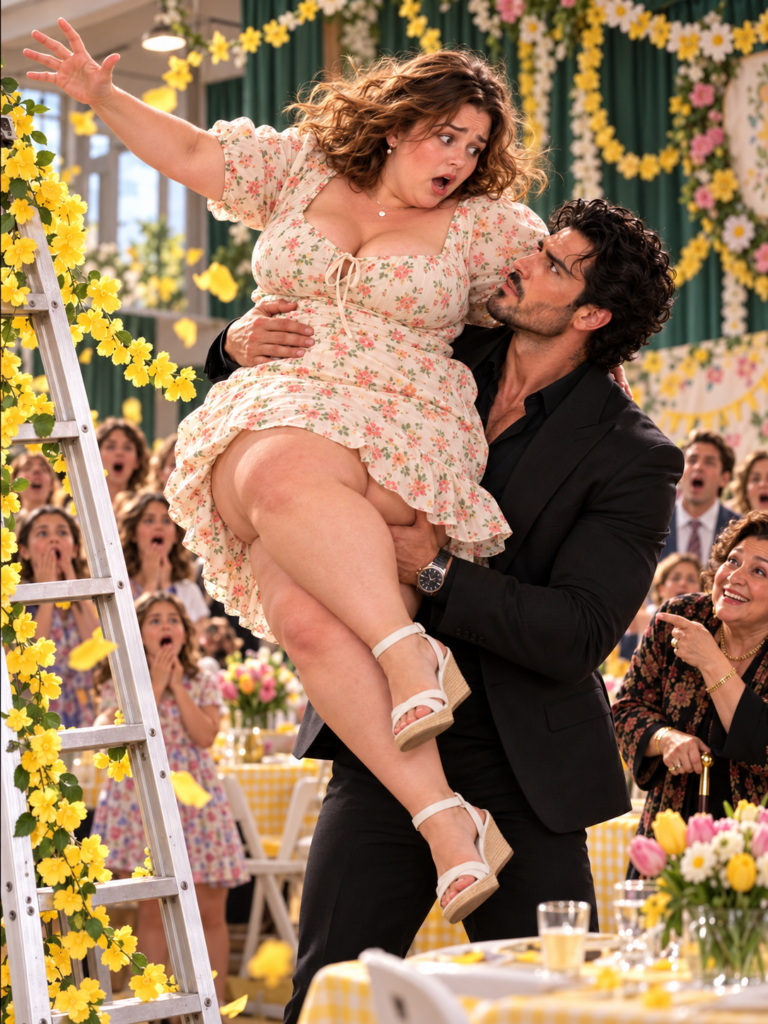
Elena Marlow heard her from six feet above the floor.
She was standing on a metal ladder beside the stage, one hand stretched toward a paper garland, the other holding a strip of yellow flowers above a crooked banner that read SPRING HERITAGE NIGHT.
Her fingers stopped moving.
So did almost everyone else in the room.
Children who had been spinning in circles near the craft tables went still. Parents turned toward the entrance. Volunteers lowered trays and clipboards. Even Mr. Alvarez, who considered silence a personal failure, suddenly found his lemonade fascinating.
Romano Valenti had entered at exactly 6:32.
Two men followed several steps behind him.
His black coat was open, his expression unreadable, and the atmosphere around him seemed to travel faster than he did. Conversations died before he reached them.
Elena had never met him.
She knew his name anyway.
Everyone on the Westside did.
The stories changed depending on who told them. According to some, Romano controlled half the neighborhood through legitimate companies whose books became considerably less legitimate after midnight. According to others, politicians returned his calls before they returned calls from their own families. Men who disliked him used words like criminal. Men who admired him used words like businessman.
Elena preferred another word.
Avoidable.
She had constructed a stable life by understanding which complications deserved her attention and which deserved a locked door.
Romano Valenti belonged firmly behind the locked-door category.
Unfortunately, Lucia Belandi had apparently decided otherwise.
Elena forced her professional smile into place.
“Mrs. Belandi,” she called from the ladder, “perhaps we should let Mr. Valenti attend the event before planning the rest of his life.”
Lucia waved one small hand dismissively.
“He has attended enough events. What he has not attended is his own wedding.”
Several people laughed.
Quietly.
Romano looked first at Lucia, then at Elena.
He said nothing.
That was somehow worse.
An offended man could be placated. An embarrassed man could be reassured. Romano simply watched, his face giving Elena nothing to work with.
She decided the safest solution was to come down from the ladder and restore the event before Lucia began discussing grandchildren.
Elena lowered one foot.
The ladder shifted.
Her heel slipped.
The garland tore loose beneath her fingers.
For one sickening second, her weight moved sideways and there was nothing beneath her except air.
A gasp swept through the room.
Then the ladder stopped.
Romano had crossed the distance between them faster than Elena would later remember. Both of his hands closed around the metal frame, steadying it before it could fold beneath her.
She stared down.
He stared up.
At this distance, the notorious Romano Valenti looked less like a rumor and more inconveniently human. There was tiredness beneath his eyes. A faint line cut beside his mouth. His face was controlled without being blank.
“Come down carefully,” he said.
“I was already doing that.”
His gaze flicked toward her foot.
“You were descending horizontally.”
Somebody near the raffle table choked on a laugh.
Elena felt heat climb into her cheeks.
She came down one rung at a time.
The instant both of her shoes touched the floor, Romano released the ladder and moved backward.
He gave her space.
He did not touch her arm, ask whether she was frightened, or use her near fall as an excuse to stand closer.
That tiny act of restraint unsettled her almost as much as catching the ladder had.
Lucia, naturally, noticed only the romantic possibilities.
“You see?” she announced. “He catches you. Already he is useful.”
“Lucia,” Romano said.
She lifted her eyebrows.
“No.”
“No what?”
“No to whatever you think you are doing.”
“I am helping.”
“You are publicly humiliating Miss Marlow.”
Lucia studied Elena.
“Good. She is too composed.”
Elena stared at her.
Lucia tapped her cane once against the floor.
“A woman who is always composed is usually hiding grief, stubbornness, or both.”
Now every face in the room turned toward Elena.
Eight years.
She had spent eight years building the cultural center into a place where children learned music, immigrants recorded family histories, retirees taught recipes, teenagers painted murals, and exhausted parents could drink coffee while somebody else entertained their children for an hour.
She could write grant proposals, repair microphones with tape, balance six competing schedules, calm furious donors, stretch a food budget, and explain to city officials why replacing a leaking roof qualified as infrastructure rather than “cosmetic improvement.”
Nothing in those eight years had prepared her for an elderly matchmaker publicly psychoanalyzing her beside a reputed mafia boss.
Romano glanced at her.
“I apologize.”
Lucia snorted.
“He apologizes because he has no courage where romance is concerned.”
“I have courage.”
“You have security systems. Not the same thing.”
This time the laughter came more easily.
Romano closed his eyes for perhaps half a second.
Elena saw it then.
Affection.
Not indulgence. Not obligation.
He loved Lucia.
The discovery damaged the simple picture Elena preferred to have of him.
She picked up her clipboard.
“The children’s choir begins in ten minutes. The historical exhibit is beside the library, and refreshments are in the side hall.”
“I came for the exhibit,” Romano said.
Elena looked at him.
“You did?”
“My aunt said you were trying to preserve the oral-history collection.”
That was not what Elena had expected.
“Yes. Some recordings are almost fifty years old. We’re losing them faster than we can digitize them.”
Most wealthy donors asked how large their names would appear on the wall.
Romano asked, “Do you have recordings from the Italian families who settled here?”
“Several hundred.”
“My grandfather recorded something here.”
Elena stopped.
“Antonio Valenti?”
Something changed in Romano’s face.
“You know his name?”
“We have his interview.”
The activity of the room seemed to recede.
Romano looked toward the library as though a man long dead might walk through the doorway.
Elena continued carefully.
“I cataloged part of it last month. He talked about arriving with one suitcase. He worked nights in a bakery. He said people tried to shorten Valenti because it was easier for them to pronounce.”
Romano’s eyes returned to her.
“What did he say?”
Elena hesitated.
“That people had already taken enough from him. They weren’t taking his name too.”
Lucia’s expression softened.
Romano did not move.
“I never heard that story.”
Elena wished immediately that she had been more cautious.
“I’m sorry. I shouldn’t have—”
“No.”
His voice remained even, but the word held weight.
“I’m glad you remembered it.”
Before Elena could answer, something crashed in the side hall.
A volunteer appeared in the doorway wearing an expression of absolute defeat and a streak of white frosting across one sleeve.
“Elena.”
“Oh, no.”
“The dessert table collapsed.”
Of course it had.
Because evenings like this never offered one disaster when four were available.
Elena hurried into the side hall.
Cannoli cream covered several tiles. Lemon cookies were scattered across the floor. A folding table had buckled through its middle, sending three trays down with it.
Mrs. Patel stood beside the wreckage whispering, “Oh no,” repeatedly, while three children stared at the fallen desserts with solemn horror.
Elena took one breath.
Then the part of her that handled emergencies clicked into place.
“Nobody step in the cream. Ben, mop closet. Maya, please take the kids back to crafts. We’ll move the fruit to the front table and cut the sheet cake early.”
Mrs. Patel looked close to tears.
“I ruined everything.”
“The table ruined everything. You merely had the misfortune of standing beside it.”
That earned a weak laugh.
Elena bent toward a tray.
A second hand reached it first.
Romano.
He had removed his coat.
Before Elena could object, he lifted the broken folding table and carried it toward the wall.
One of his men moved to help.
Romano glanced at him.
The man stopped.
Elena watched Romano roll his sleeves above his wrists.
His silver watch probably cost more than the center’s arts program for an entire season.
He picked up a tray covered in cannoli filling.
“You don’t need to do this,” she said.
“I’m aware.”
“You are Romano Valenti.”
He looked at her.
“I’m also currently the person closest to the broken table.”
“That is not what I meant.”
“I know.”
He crouched and began gathering ruined napkins.
Elena lowered her voice.
“People are watching.”
“They generally are.”
The answer stopped her.
No arrogance.
No complaint.
Simply fact.
For one moment Elena heard the loneliness beneath it.
She looked toward the doorway.
Half the room was pretending not to stare.
Lucia stood in the center of the spectators, visibly delighted.
Elena pointed at her.
“Did you arrange this?”
Lucia placed a hand over her chest.
“I am elderly, Elena. Not supernatural.”
Romano looked at the destroyed table.
“I would hesitate to testify to that.”
Elena turned toward him.
The humor was so dry she nearly missed it.
A reluctant smile pulled at her mouth.
And that was the second problem.
The first was that Romano Valenti was not behaving like the man she had expected.
The second was that she was beginning to want to know why.
The evening survived.
Barely.
The choir began eleven minutes late. The banner remained crooked. One city councilman walked away with frosting on the bottom of his shoe.
Yet the children sang, donors stayed, and Lucia did not announce an actual wedding date.
Romano remained near the back through the entire performance.
There was powdered sugar on his cuff.
Elena noticed.
She also noticed when a little girl spilled red juice near his shoes.
The child froze.
Her mother rushed toward him, apologizing before the cup stopped rolling.
Romano looked at the puddle.
Then at the frightened girl.
“You missed my shoe.”
She stared.
“Next time you’ll need better aim.”
Her mouth opened.
Then she laughed.
Her mother’s relief was almost visible.
Romano took a napkin and helped clean the floor.
He did not check whether anyone saw him.
Elena did.
That was becoming dangerous.
By nine fifteen, the building had emptied.
Elena counted the cash box twice, checked the art rooms, locked the side entrance, and listened to volunteers say good night.
Paper flowers shifted gently above the stage.
The center smelled faintly of sugar, paint, and old wood.
Somewhere outside, Lucia was arguing with Romano.
Elena caught herself smiling.
She stopped.
Romano was dangerous. That had not changed simply because he loved his aunt and cleaned floors.
But obvious danger had always been manageable.
What disturbed Elena was everything else.
He had steadied the ladder without taking advantage of her vulnerability.
He had listened when she spoke about the archive.
He had remembered his grandfather.
He had seen frightened people around him and seemed uncomfortable with their fear rather than pleased by it.
Complications, Elena knew from experience, rarely announced themselves as complications.
They arrived disguised as exceptions.
She had just closed the office when she found Romano near the lobby windows.
Alone.
Lucia was outside beneath the awning, apparently explaining something to his driver with the help of her cane.
Elena tightened her grip on her keys.
“Did you need something?”
“Yes.”
His answer came without hesitation.
“What?”
“To thank you.”
She blinked.
“For tonight?”
“For remembering my grandfather.”
“Oh.”
Elena looked at the keys in her hand.
“I didn’t remember him for you. I remember as much as I can about everyone in that archive. That’s my job.”
“That makes it more meaningful.”
Compliments were easy to resist.
Respect was harder.
Elena glanced toward the dark hallway.
“We’re trying to preserve those voices before the tapes deteriorate. A lot of people here didn’t leave written histories. What we have are conversations. Recipes. Songs. Arguments. Stories people never wrote down because they assumed somebody would always remember.”
“And you make sure somebody does.”
“I organize things.”
Romano studied her.
“That is one form of protection.”
The remark landed too close to something private.
Elena looked through the glass toward Lucia.
“You should take your aunt home.”
“She told me she arrived at five.”
“She’s been here since three.”
His eyes narrowed.
“She lied.”
“She knew you’d worry.”
“I don’t worry.”
Elena looked pointedly at the dark car, the driver, and the two security men outside.
“You brought protection to a children’s choir because an eighty-something-year-old woman invited you.”
“That is logistics.”
“That is worry wearing an expensive coat.”
Silence.
Elena realized what she had said.
She had spoken to Romano Valenti as though he were simply a difficult man standing in her lobby.
Old caution stirred immediately.
Then he said, “My aunt likes you.”
Elena laughed despite herself.
“Your aunt has already damaged my reputation in front of the entire neighborhood.”
“She often damages things she intends to improve.”
“That is horrifying.”
“Yes.”
Her laugh came out again, quieter this time.
He watched her.
Not possessively.
Almost curiously.
Outside, Lucia rapped her cane against the window.
They both turned.
She pointed first at Romano.
Then Elena.
Then pressed two fingers together in an unmistakable imitation of a wedding ceremony.
Elena closed her eyes.
“She is impossible.”
“She has been impossible for decades.”
“She told me she was born in 1948.”
“She changes the year whenever it benefits the story.”
Elena looked at him again.
He had moved slightly closer but had stopped well outside her personal space.
She noticed that, too.
“Romano.”
“Yes?”
“I think tonight should remain exactly what it was. A community event. A strange community event, but nothing more.”
His gaze stayed on hers.
“You believe I came because Lucia told me to meet you?”
“Didn’t you?”
“No.”
Something inside Elena loosened.
Then, unexpectedly, tightened.
“I came because she told me the archive might not survive without funding.”
Elena folded her arms.
“She told you that?”
“She said you were too proud to ask wealthy people for help and too stubborn to let the project die.”
“That sounds like her.”
“She also said if I gave you money anonymously, you would discover it and return it.”
“I would.”
“I believed her.”
“Then why are we having this conversation?”
“Because I dislike hidden debts.”
Elena studied him.
“People say men like you prefer them.”
The atmosphere changed.
Not threatening.
Simply more honest.
“People say many things about me.”
“Are they wrong?”
“Sometimes.”
“And when they aren’t?”
Romano’s eyes did not leave hers.
“Sometimes they do not say enough.”
That answer frightened her more than denial would have.
It also felt cleaner.
He did not ask her to confuse shadow with sunlight.
Outside, Lucia struck the window again.
Romano exhaled.
“She will break it.”
“She’ll make you pay for the replacement.”
“She’ll claim it was necessary for romance.”
“There is no romance.”
“No,” Romano said.
“There isn’t.”
The answer was perfectly reasonable.
It still irritated Elena.
Romano reached for the door.
Then stopped.
“May I return tomorrow?”
Her heartbeat changed.
He added, “To hear my grandfather.”
Of course.
That was all.
A family member had every right to hear his history.
“The archive is quiet around four.”
His gaze sharpened almost imperceptibly.
“Is four your safest hour?”
Elena looked at him.
“It is my least busy.”
“That wasn’t my question.”
“No.”
She waited for him to push.
He did not.
“Four o’clock,” he said.
Then he walked outside.
Lucia immediately took his arm and began talking before he reached the car.
At the curb, Romano glanced back.
Elena was still standing behind the glass.
Nothing extraordinary happened.
No declaration.
No certainty.
Only the smallest shift inside a woman who had spent years arranging her life so nothing unpredictable could enter it.
She locked the door after he left.
Then checked it twice more.
Tomorrow, at four o’clock, Romano Valenti was coming back.
And the most troubling part was not that Elena was afraid he would.
It was that some hidden part of her was already waiting to hear the door open.
Part 2
Elena unlocked the archive room early the following afternoon.
She told herself that was habit.
Habit also explained why she tested the tape player twice, adjusted both chairs, checked the headphones, and inspected Antonio Valenti’s recording before placing it carefully on the table.
The room occupied the quietest corner of the center, behind the small library. Dust and paper scented the air. Afternoon sunlight entered through narrow upper windows and fell across shelves filled with photographs, handwritten recipes, recorded interviews, and boxes marked with family names.
These were lives that might otherwise have disappeared.
Elena understood disappearing better than she liked to admit.
At four, the front door opened.
Romano arrived carrying a paper bakery bag.
“No security detail?” Elena asked when he reached the archive doorway.
“Not where you can see them.”
She gave him a look.
His mouth almost moved.
Then she noticed the bag.
“Did you bring pastries to listen to a fifty-year-old recording?”
“My aunt said coming empty-handed makes a man look cheap or emotionally unavailable.”
“Those were her exact words?”
“She used several more.”
“I believe that.”
Romano waited at the threshold.
He did not enter until Elena stepped aside.
That courtesy affected her far more than it should have.
“The recording isn’t clean,” she warned. “There’ll be static. Some words may disappear.”
“Memories do that.”
Elena set the tape in the machine.
She pressed play.
Static filled the room.
Then a dead man spoke.
Antonio Valenti’s voice was weathered by age and imperfect equipment, but his accent remained clear.
He described arriving in America with almost nothing. He worked in a bakery at night and slept above flour sacks because rent elsewhere cost money he did not have.
He spoke of hunger.
Humiliation.
Pride.
A woman he had loved before he could afford to give her a proper ring.
He remembered Lucia as a furious baby who seemed offended by the existence of sleep.
Romano did not smile.
But Elena saw warmth pass through his face.
She pretended to reorganize labels while he listened.
She wanted to give him privacy.
Then Antonio’s recorded voice became more reflective.
A young man, he said, believed strength meant forcing life to obey him.
Age had taught him differently.
Real strength sometimes meant allowing another person to love you without controlling the form that love took.
Romano lowered his head.
Elena stopped moving.
The sentence filled the room after Antonio’s voice had passed.
She thought about herself.
About schedules created months ahead.
Bills paid early.
Invitations politely declined.
Relationships ended before they grew dangerous.
Doors locked, checked, and checked again.
People called Elena reliable.
Disciplined.
Safe.
Nobody asked whether safety could become another name for loneliness.
When the tape ended, Romano remained seated.
For a long time he said nothing.
Finally, he touched the plastic case.
“He died when I was nine.”
Elena sat opposite him.
“Lucia told me.”
“People described him as hard.”
“He probably was.”
Romano looked up.
“That wasn’t all he was.”
“No.”
Elena folded her hands.
“No one is only one thing.”
He watched her.
“Do you believe that about me?”
There it was.
The easy response would have been kindness.
The safer response would have been distance.
Elena chose neither.
“I don’t know yet.”
Romano considered her answer.
Then he nodded.
“Fair.”
He did not punish her uncertainty.
He did not demand reassurance.
He did not try to convince her.
That single reaction followed Elena through the rest of the afternoon.
At six she caught herself replaying it.
At seven, Lucia arrived carrying a basket of oranges.
Elena saw her expression and immediately said, “No.”
Lucia stopped.
“I have not spoken.”
“You were about to ask about Romano.”
“I was going to ask whether the west radiator still sounds like a dying animal.”
“It doesn’t.”
“Then I was going to ask about Romano.”
“He listened to the tape. That is all.”
Lucia narrowed her eyes.
“With quiet men, there is never ‘that is all.’ Quiet men are soup pots.”
Elena stared.
“They appear calm while everything inside is boiling.”
Elena took the oranges from her.
“Why are you really here?”
Lucia’s usual smile faded.
“I am leaving.”
Elena stopped.
“Leaving where?”
“Italy.”
“When?”
“Next week.”
“For how long?”
“One month. Perhaps five weeks.”
Lucia brightened slightly.
“There is a pilgrimage. There may also be a cooking tour. Which one I tell people depends on whether I respect them.”
Elena did not laugh.
“Does your doctor know?”
“My doctor objects to everything enjoyable.”
“Lucia.”
“And Romano objects more beautifully but with less imagination.”
“Are you healthy enough to travel?”
Lucia looked toward the mural painted by the neighborhood children.
“I am old, Elena. Everyone has begun confusing old with finished.”
“That isn’t what I said.”
“No. But you thought about airports. Medicine. Stairs. Me falling in some Italian street.”
Elena had.
Lucia reached for her hand.
“People keep trying to protect me by reducing the size of my life.”
“They love you.”
“Yes.”
Lucia squeezed her fingers.
“And sometimes love builds a cage, then insists it is a comfortable chair.”
Romano arrived later that evening looking for her.
Lucia had already left.
He found Elena in the kitchen dividing the oranges into bags for the food pantry.
“She told you,” Elena said.
“She told everyone except, possibly, the airline.”
His calm face did not fool her.
He was afraid.
Not visibly enough for most people to notice.
Elena noticed.
“She shouldn’t go alone.”
“She won’t. A cousin will meet her in Rome.”
“How old is the cousin?”
“Eighty-three.”
“That does not improve things.”
“According to Lucia, the woman remains lethal with a wooden spoon.”
Elena placed another orange into a bag.
“You could stop her.”
Romano’s eyes moved to hers.
“Yes.”
Something cold passed through Elena.
Then he continued.
“But I won’t.”
“Why?”
He looked toward the dark kitchen window.
“Because yesterday my grandfather reminded me that control is not the same as strength.”
Elena’s hand went still.
Romano leaned against the counter.
“I could cancel her ticket. Speak to her doctor. Hire a nurse. Put security beside her every hour of the trip.”
“That sounds very much like you.”
“Yes.”
His expression tightened.
“That is precisely the problem.”
The admission disarmed her.
“I call it protection because control is an uglier word.”
Elena looked down at the oranges.
She understood.
She had never assigned guards to anyone.
But she had controlled her world in quieter ways.
She had rejected opportunities before they could become disappointments. Avoided intimacy before anyone could leave. Maintained routines so efficiently that unpredictability had almost no room to breathe.
“What happens if something goes wrong?” she asked.
Romano answered after a pause.
“Then I will be frightened.”
His gaze settled on her.
“And I will still have let her live.”
Something inside Elena moved.
“Maybe I’ve done the same thing.”
He waited.
“With myself.”
She touched one of the paper bags.
“I keep telling myself I built a peaceful life.”
Romano said nothing.
Elena appreciated that.
“Maybe I just built one I could control.”
Romano came around the counter.
For a moment she expected advice.
Instead, he picked up an orange.
He placed it in the next bag.
They worked side by side beneath humming fluorescent lights.
The feared Romano Valenti.
A basket of oranges.
No declarations.
No promises.
Somehow it felt more intimate than either would have.
Six days later, half the neighborhood came to the airport.
Lucia had invited everyone.
She arrived wearing a red coat, dark sunglasses, and a scarf covered with lemons. Romano carried her suitcase with the expression of a man escorting a loved one toward active combat.
Lucia hugged Elena tightly.
“Do not allow him to become dramatic while I am gone.”
“I heard you,” Romano said.
“You were intended to.”
Then Lucia turned to him.
For once, she made no joke.
She kissed his cheek.
Romano closed his eyes.
Only briefly.
Elena saw.
When Lucia walked toward security, Romano’s hand tightened around the suitcase handle before he remembered she had taken the suitcase with her.
He remained where he was.
“You’re doing well,” Elena murmured.
“I am mentally identifying several methods of taking control of this airport.”
“That does not sound like doing well.”
“I have reduced the number.”
“To?”
“Five.”
Elena laughed.
The tension around his mouth eased.
They stayed until Lucia vanished beyond security.
Then Romano turned toward Elena.
Uncertainty appeared in his face for perhaps the first time.
“Would you have coffee with me?”
Elena could say no.
The center needed her.
Payroll waited.
Emails waited.
Her normal life was sitting exactly where she had left it.
“Yes,” she said.
Romano’s expression changed.
“But somewhere I’ve never been.”
Now he looked at her as though she had said something far more personal.
“That,” he replied, “I can arrange.”
The weeks that followed did not transform Romano into a harmless man.
Elena would have distrusted the story if they had.
Phone calls still came that hardened his expression. Certain men still avoided his eyes. Restaurants still seemed to develop extra space when he entered.
Rumors did not disappear because Elena had begun to understand him better.
What changed was that she stopped pretending one truth erased another.
Romano could frighten people.
He could also repair a broken archive shelf with surprising patience.
One afternoon, three children asked if he was a spy.
He answered, “Not professionally.”
They followed him for twenty minutes.
He never donated money behind Elena’s back.
Instead, he introduced her to a preservation specialist who treated her like the director of a serious historical project rather than a woman seeking charity.
Elena noticed the difference.
She noticed everything.
She began accepting small invitations.
Coffee became dinner.
Dinner became a late walk after a fundraiser.
At a community dance Elena had organized for years without ever participating, Romano held out his hand.
“I don’t dance,” she said.
“Neither do I.”
“You attended anyway.”
“So did you.”
“I work here.”
“And apparently I repair furniture here.”
She laughed and let him lead her toward the edge of the floor.
They were terrible.
Lucia, calling from Italy, somehow learned about it within twelve hours.
The deeper change came on a rainy night after a poetry event.
Elena locked the center, stepped outside, and found rain falling so heavily that the street had disappeared behind silver sheets.
Romano stood beneath the awning with her.
His car waited at the curb.
Neither moved toward it.
Elena watched water pour from the roof.
“I don’t know how to do this.”
Romano turned.
“This?”
She looked at him.
“Whatever this is.”
For once he answered immediately.
“Neither do I.”
Elena gave him a skeptical look.
“You walk into every room as though you have already calculated every possible outcome.”
“I calculate them.”
His voice lowered.
“That is not the same as knowing.”
The rain filled the silence.
“What are you calculating now?” Elena asked.
He studied her face.
“How many ways I could destroy this by moving too quickly.”
Her heartbeat changed.
“And if you move too slowly?”
“Then I risk making you believe I don’t want to move at all.”
Elena stepped toward him.
Only one step.
Romano became motionless.
He did not close the remaining distance.
He let the choice remain hers.
That was when Elena understood what had been happening between them.
Her fear had never disappeared.
She had simply begun discovering that fear did not always mean stop.
Sometimes it meant something mattered.
“You can kiss me,” she said.
Romano lifted one hand.
Slowly.
His fingers touched her cheek only after she remained where she was.
The kiss that followed contained none of the power the neighborhood attributed to him.
No conquest.
No demand.
It was careful.
Warm.
Almost reverent.
Rain struck the pavement beyond them.
Elena rested one hand against his coat.
For years she had imagined vulnerability as a door left unlocked for the wrong person.
Standing beneath that awning, she understood something different.
Sometimes opening a door was not carelessness.
Sometimes it was a decision.
Part 3
Lucia returned three weeks later with swollen ankles, two suitcases, a wide sun hat, and enough stories to supply the neighborhood until Christmas.
She entered the community center during a board meeting.
Elena was standing near the archive display with Romano.
Lucia stopped.
She looked at Elena.
Then Romano.
Then their proximity.
She clapped once.
“I leave the country for a few weeks, and apparently God finally has time to finish his work.”
Elena covered her face.
Romano looked toward the ceiling as if searching for patience.
The board members failed spectacularly at pretending not to listen.
Lucia pointed at Romano.
“You look less miserable.”
“I was not miserable.”
“You were a beautifully dressed funeral.”
Then she looked at Elena.
“And you.”
Elena braced herself.
“You are smiling more.”
“I smiled before.”
“Yes, at grant approvals and correctly filed tax documents.”
Romano’s mouth twitched.
Elena pointed at him.
“Do not encourage her.”
“I haven’t said anything.”
“That has never stopped you from encouraging her.”
Lucia beamed.
For all her matchmaking theatrics, however, something had changed during her absence.
The archive project was going to survive.
Three legitimate grants had been approved.
Two family foundations had committed funds.
Small donations had arrived from across the neighborhood.
Lucia was responsible for some of those.
From Italy, she had mailed postcards reminding residents that preserving history cost money and accusing certain unnamed families of being cheap.
Several families had donated immediately.
Romano never tried to take credit for the project.
That mattered to Elena.
He helped in ways she could accept without surrendering ownership of the work.
Introductions.
Advice.
A repair contact.
Transportation for fragile recordings.
When money entered the center, it came through transparent channels, applications, foundations, and documented gifts.
No hidden debt.
No invisible obligation.
Months earlier, Elena might have assumed his restraint was strategic.
Now she understood that it cost him something.
Romano was accustomed to solving problems by applying force—financial force, personal force, influence, planning.
With Elena, he was learning not every problem wanted to be conquered.
And Elena was learning that independence did not require refusing every hand offered to her.
The first restored listening station opened near the end of summer.
The cultural center was crowded again.
Not with fear this time.
With families.
Children dragged grandparents toward headphones. Adults searched the digital catalog for surnames they recognized. People who had never thought of themselves as historical subjects suddenly heard the voices of mothers, fathers, shopkeepers, bakers, mechanics, seamstresses, teachers, and immigrants speaking from decades earlier.
Antonio Valenti’s interview was among the first restored recordings.
Romano stood toward the back during Elena’s speech.
Lucia sat in the first row and cried openly while aggressively denying that she was crying.
Elena stood at the microphone with several pages prepared.
She had rewritten the speech five times.
She knew every sentence.
She began with funding.
Then preservation.
Then the importance of oral history.
But midway through, her eyes found Romano.
He had first entered this room beneath a cloud of whispers.
People had moved away from him.
Elena had wanted to do the same.
Now he stood beside families listening to the words of people who had been gone for decades, and Elena suddenly understood that her prepared speech was missing the most important thing.
She lowered the pages.
“Archives sound like they are about the past,” she said. “But I think they are really about timing.”
The audience quieted.
“A story can exist for years before someone is ready to hear it.”
Romano’s attention sharpened.
“A voice can wait in a box. A memory can wait inside a family. Sometimes the person who needs it most doesn’t arrive until decades later.”
She thought of Antonio telling his grandson that strength was not obedience.
She thought of Lucia boarding an airplane while Romano remained behind.
She thought of herself beneath a rain-soaked awning.
“Some stories return when we’re finally ready to listen.”
Her gaze remained on Romano.
“And sometimes people do too.”
Something changed in his face.
Not enough for the room.
Enough for her.
When the applause came, Lucia was crying harder.
Mrs. Patel handed her a tissue.
“I have allergies,” Lucia announced.
“To history?” Mrs. Patel asked.
Lucia glared at her.
Later, while guests moved toward the food tables, Romano found Elena in the archive room.
Antonio’s restored recording rested beside the original machine.
Outside, the building hummed with conversation.
Somebody dragged chairs across the lobby.
A child laughed.
A man near the refreshment table had begun singing badly.
Romano closed the archive door halfway.
Not completely.
Elena noticed.
He came toward her.
“My aunt has begun telling people we are engaged.”
Elena folded her arms.
“Only engaged?”
“She told Mrs. Patel we are spiritually married.”
“That sounds advanced.”
“She also advised my driver to reserve Saturdays.”
“For what?”
“Grandchildren.”
Elena laughed so hard she had to look away.
Romano watched her with the quiet expression he wore when he seemed to be memorizing something.
Then he reached for her hand.
His fingers closed around hers.
No rush.
No ownership.
Simply connection.
Elena looked down.
“Everyone seems very determined to make decisions for us.”
“Yes.”
“And we both hate that.”
“More than most things.”
“So maybe we should decide.”
Romano became still.
“For ourselves?”
“That would be radical.”
A hint of amusement touched his mouth.
“What do we decide?”
Elena did not answer immediately.
She looked around the archive.
Only months ago, she had believed stability meant eliminating uncertainty.
She still loved calendars.
Still labeled spare keys.
Still checked budgets twice.
Still kept extra batteries in organized drawers because she considered being surprised by a dead microphone an unacceptable moral failure.
Romano still frightened people.
His life still contained areas Elena did not romanticize or pretend away.
Loving him, if that was where they were going, would not transform the world around them into something harmless.
But Elena no longer wanted harmlessness at any cost.
She wanted a life that moved.
A life that occasionally overturned the plan.
A life with music after closing time and coffee in unfamiliar places.
A life in which a difficult elderly woman could fly across an ocean even while the people who loved her were terrified.
A life where a powerful man might learn to release what he most wanted to control.
A life where Elena herself did not mistake solitude for safety simply because solitude was predictable.
“We decide to try,” she said.
Romano searched her face.
“That is all?”
“It is not a small thing.”
“No.”
“Trying means neither of us gets guarantees.”
“I have never trusted guarantees.”
“You seem like a man who buys them.”
“I buy insurance.”
She laughed.
Then Romano smiled.
Really smiled.
Elena had seen fragments before. Brief amusement. Dry humor. A reluctant reaction to Lucia.
This was different.
Open.
Rare.
For once, there seemed to be no locked room behind his eyes.
“That sounds dangerous,” he said.
“Probably.”
“Are you afraid?”
Elena considered lying.
Months earlier, she would have.
“Yes.”
Romano lifted her hand.
He kissed her fingers.
“So am I.”
That mattered more than if he had promised she had nothing to fear.
Elena stepped closer.
“Good.”
His eyebrows lifted.
“Good?”
“Yes. I was beginning to worry I was the only one.”
Romano’s arm came around her gently.
She rested against him.
Then Lucia’s voice exploded from the hallway.
“Do not imagine frosted glass makes you invisible!”
Elena laughed against Romano’s chest.
He closed his eyes.
“I could have that glass replaced.”
“With what?”
“Something opaque.”
“You heard your grandfather. Stop trying to control everything.”
“I believe there are reasonable exceptions.”
Lucia struck the door with her cane.
“I can still hear you!”
Romano looked at Elena.
For several seconds they both tried to remain serious.
They failed.
The future did not suddenly become easy because they had chosen each other.
Lucia continued meddling.
The neighborhood continued gossiping.
Romano’s reputation did not evaporate.
Elena did not stop needing order simply because she had learned to tolerate uncertainty.
They disagreed.
Sometimes sharply.
Romano occasionally offered solutions that sounded suspiciously like commands wearing polite clothing.
Elena pointed that out.
He hated when she was right.
She enjoyed pointing that out too.
Elena occasionally withdrew when something frightened her, retreating into work and routine instead of admitting what she felt.
Romano noticed.
He did not break through the wall.
He waited at the door.
Their relationship was not built from a magical absence of fear.
It grew because fear ceased to be the only voice either of them obeyed.
Romano learned that protecting someone sometimes meant standing still while they walked away from you.
Elena learned that accepting love did not require surrendering the keys to her own life.
Lucia claimed she had known all of this from the beginning.
No one believed her.
She remained offended by that.
One evening, long after the listening-station opening had ended, Elena turned off the lights in the archive room.
Antonio Valenti’s voice had played several times that day.
Families had gathered around the recording. Some knew him. Most did not.
Yet his words had traveled across decades and altered the choices of a grandson who had once believed control was the safest form of devotion.
Elena stood in the doorway.
Romano waited in the lobby.
Months earlier, the sight of him there would have tightened every instinct she possessed.
Now he simply asked, “Ready?”
Elena checked her bag.
“Yes.”
“Did you lock the archive?”
“Yes.”
“The office?”
“Yes.”
“The side entrance?”
“Yes.”
“The supply room?”
She narrowed her eyes.
He almost smiled.
“You’re mocking me.”
“I would never.”
“You absolutely would.”
He offered his hand.
Outside, evening had settled over the neighborhood.
The bakery sign glowed across the street. A bus groaned at the corner. Somewhere farther down the block, somebody was arguing in two languages from an apartment window.
The world remained untidy.
Uncontrolled.
Alive.
“Do you want me to drive you home?” Romano asked.
Elena usually checked the weather.
Usually checked the hour.
Usually calculated whether walking was practical.
She did none of those things.
“No.”
Romano looked at her.
“No?”
“Walk with me.”
The request surprised him.
Elena enjoyed that.
He took her hand.
They stepped outside together.
Behind them, the cultural center glowed with the warm light of a place that belonged to neither one of them alone, yet had somehow become part of both their lives.
It was where Elena had nearly fallen from a ladder.
Where Lucia had announced a marriage before there had even been a first date.
Where Romano had found the voice of a grandfather he had barely known.
Where a broken dessert table had revealed more about a feared man than any rumor.
Where Elena had discovered that a locked door could protect you—but if every door remained locked forever, nothing new could enter.
Romano squeezed her hand.
Elena looked at him.
“What?”
“Nothing.”
“That is never true.”
He glanced toward the street ahead.
“I was thinking my aunt will eventually claim credit for all of this.”
“She already does.”
“She will become unbearable.”
“She already is.”
Romano nodded.
“Fair.”
The word carried Elena back to the archive room months earlier.
I don’t know yet, she had told him.
Fair, he had answered.
He had given her room not to know.
Room to choose.
In the end, that had mattered more than fate.
More than Lucia’s certainty.
More than the stories people told about Romano Valenti.
Elena did not believe love had been waiting for her like a fixed appointment on a calendar.
She believed two frightened people had kept making small decisions.
Listen.
Wait.
Stay.
Release.
Try.
And somewhere between those choices, the locked shape of their lives had opened.
They walked beneath the neighborhood lights, hand in hand, toward an evening Elena had not scheduled.
For once, she did not need to know exactly where it would lead.
She only needed to know that she had chosen it.
So had he.


