
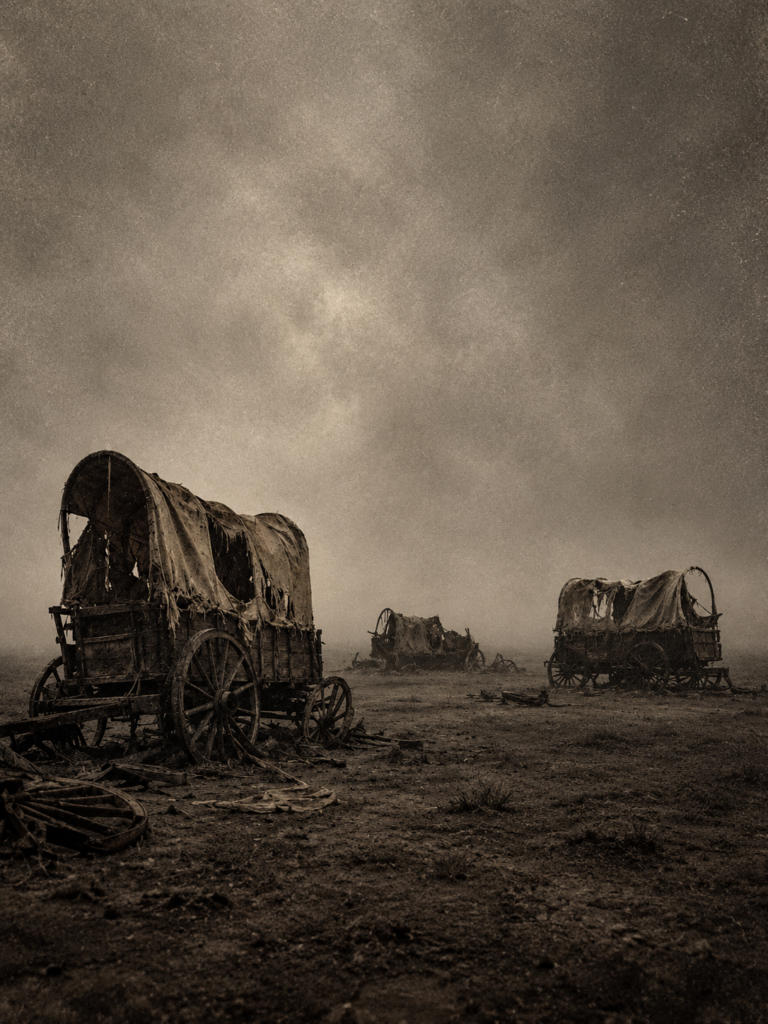
Part 1
The Oregon Trail was remembered as a road west.
For the people who traveled it, it was also a graveyard.
Across nearly 2,000 miles between the Missouri River and Oregon, thousands of emigrants were buried beside, beneath, or within sight of the wagon road. Estimates have ranged widely, from roughly 12,000 deaths to somewhere between 20,000 and 30,000 over the great migration years. In places, the arithmetic suggested grave after grave for mile after mile.
Yet very few of those graves marked the kind of death later paintings, novels, and films taught Americans to expect.
The emigrants feared attack. They bought rifles and pistols. They carried powder and lead. They stood armed watches after dark and sometimes arranged their wagons for defense.
What killed them most often was less dramatic.
Water.
Disease.
Rivers.
Accidents.
Their own firearms.
And the slow, crushing wheels of the wagons carrying everything they owned.
The first death associated with the earliest wagon attempt across much of the route came in 1841.
His name was George Shotwell.
Shotwell traveled with what became known as the Bartleson-Bidwell Company, a party of 61 people attempting to take wagons farther west than almost any American emigrant group before them.
They were entering a geography they barely understood.
Their captain, John Bartleson, had never crossed the country. Neither had John Bidwell, a 22-year-old member whose written record would help preserve the journey. Their company included 32 men, Nancy Kelsey, and Kelsey’s infant daughter.
They had no complete map.
They followed information wherever they could obtain it, eventually accompanying a Jesuit missionary party as far as Soda Springs because the missionaries had a guide who knew the country.
Shotwell never reached the difficult part.
He was reaching into a wagon box for his rifle when he took hold of the weapon by the muzzle and pulled it toward himself.
The gun discharged.
The ball struck him in the chest.
He lived only a few minutes.
The company stopped.
Men dug a grave.
They buried him beside a road that was barely yet a road.
Then they continued.
The party eventually turned south, abandoned its wagons in the desert, and completed much of the remaining journey on foot.
They reached California on November 4, 1841.
Everyone lived except George Shotwell.
If anyone noticed the irony, it did not alter what came next.
Over the following decades, hundreds of thousands of people entered the overland migration routes leading toward Oregon and California.
Almost all prepared for violence.
Almost all prepared badly for what actually killed them.
The journals that survive are filled with sickness, thirst, graves, frightened animals, broken equipment, drownings, accidental shootings, and children injured beneath wagon wheels.
They contain violence too.
But the balance is nothing like the later mythology.
The clearest evidence lies in the graves.
When someone died on the trail, a family did not always choose a peaceful hillside beneath a tree.
Often there was no tree.
There might not even be wood for a coffin.
A practical burial could be made directly in the wagon road.
Men dug into the existing wheel ruts.
The body was lowered.
The earth was replaced.
Then the wagons passed over it.
One after another.
Oxen, iron-rimmed wheels, loaded wagon beds.
By the time the final vehicle rolled across, the ground could look much like it had before.
This was deliberate.
Wolves followed the trail.
They learned quickly that the emigrants buried food and bodies.
A shallow grave marked by fresh soil could be opened within hours after the wagon train disappeared.
Human thieves could also disturb graves.
So families sometimes erased them.
That decision protected the dead by making them nearly impossible to find.
It also meant that much of the Oregon Trail became an enormous cemetery without markers.
The people who followed had little idea whose bodies were beneath their wheels.
The deeper question, then, is not whether the Oregon Trail was dangerous.
It was.
The question is what the emigrants misunderstood about that danger.
They crossed because Oregon represented land on a scale that could change the future of an entire family.
Under the Donation Land Claim system of the period, an eligible married couple could claim as much as 640 acres in Oregon by meeting residence and cultivation requirements.
A square mile.
To a farmer in Illinois or Missouri, that was difficult to ignore.
A prosperous man might own 160 acres.
A more ordinary family might work 80.
Oregon did not promise a modest improvement.
It promised transformation.
The difficulty was getting there.
A proper wagon outfit in the middle of the 19th century could cost between $800 and $1,200.
The wagon itself might cost around $85.
A cover could add another substantial expense.
Oxen might cost about $50 each, and a family could need 6 or 8.
Then came harness, tools, weapons, spare parts, cooking equipment, clothing, medicine, containers, bedding, and enough food to survive the journey and the first period after arrival.
The emigrant did not merely buy transportation.
He converted his old life into a moving survival system.
Guidebooks produced enormous supply lists.
Joseph Ware’s 1849 guide recommended that 3 travelers carry more than 1,000 lb of flour, hundreds of pounds of bacon, and large supplies of coffee, sugar, rice, dried fruit, and other provisions.
Everything had weight.
Every pound had to cross plains, rivers, deserts, and mountains.
Every pound depended on animals that survived by grazing.
And the grass beside the road was being eaten by tens of thousands of animals moving in the same direction.
The typical emigrant was therefore not necessarily a penniless wanderer.
He was often a farmer who had sold something permanent in order to purchase something temporary.
Land became wagon.
Household goods became flour.
Livestock became oxen.
Furniture became supplies.
The family placed much of its wealth inside a wooden box and pointed that box toward a country almost no one in it had seen.
Keturah Belknap understood the physical reality before she left Iowa.
During the winter of 1847, she sewed the cover for her family’s wagon.
She spun the thread herself.
Every seam mattered.
The canvas had to withstand months of sun and rain, wind and dust.
Her son Jesse watched the preparations and played at traveling to Oregon, using a work basket as his wagon.
For him, westward migration could still be a game.
On April 9, 1848, the family loaded for the real journey.
Keturah placed a chair against the wagon bed as her seat.
Beside it, she left a corner for Jesse.
Then they joined the road.
The departure itself created one of the trail’s greatest dangers.
There were only a few major starting points: Independence, Westport, St. Joseph, and later Council Bluffs.
And there was only a narrow period each spring when leaving made sense.
Depart too early and there might not be enough grass for the animals.
Depart too late and the wagon train risked meeting snow before crossing the mountain country.
The result was concentration.
Thousands of people entered the same corridor within weeks of one another.
They camped at the same places.
They drew water from the same rivers.
They used the same springs.
They dug into the same riverbanks.
Their animals drank there too.
At first the traffic was manageable.
The great migration of 1843 carried roughly 1,000 people.
By 1847, more than 4,000 traveled west.
Then came the discovery of gold in California.
In 1849, perhaps 25,000 went overland.
In 1850, around 50,000.
By 1852, estimates ranged from 50,000 to 70,000 in a single season.
The road became a moving city stretched across the continent.
Dust sometimes never settled.
Grass could be eaten down far beyond the visible track.
Every family seemed to buy 2 essential things before departure.
Oxen.
And guns.
Only one of those purchases would routinely justify its cost.
The Sager family left Missouri in 1844.
Henry Sager was a blacksmith from Platte County.
His wife, Naomi, had suffered poor health for years and believed the Oregon climate might help her.
They joined a company of roughly 300 people traveling in 72 wagons.
6 Sager children started the journey.
5 weeks onto the plains, Naomi gave birth to the seventh.
They named the baby Henrietta.
The family was now moving west with a newborn among thousands of pounds of supplies, animals, wheels, dust, insects, and strangers.
Early in July, near the South Fork of the Platte, 9-year-old Catherine Sager tried to jump down from the moving wagon.
Children did it constantly.
The wagons moved only a few miles an hour, slow enough that children walked beside them, climbed aboard, jumped off, ran ahead, rode on tongues, and moved between animals.
Catherine’s dress caught on an axe handle.
She swung beneath the wagon.
The wheel passed over her left leg.
It broke the limb in several places.
Her father set the fractures beside the road while the train waited.
For much of the remaining 1,500 miles, Catherine lay inside the wagon listening to the movement of the damaged leg.
What saved her was coincidence.
Traveling nearby was a German-born doctor, Theophilus Deyon.
He had no obligation to the Sagers.
He nevertheless remained close enough to watch Catherine’s recovery.
A serious fracture on the plains could kill without ever being directly fatal.
Infection, immobility, fever, and the impossibility of proper care could do what the wagon wheel had not.
Catherine survived.
Her family’s greater disaster had not yet begun.
By the time the company reached South Pass in late August, illness was spreading.
Henry Sager became sick with what the emigrants described as camp fever.
He died near the Green River.
A coffin was built from wagon boards.
He was buried.
The train moved the next morning.
That pattern repeated across the trail.
Grief had to occur on a schedule.
A company that remained too long behind its season could exhaust local grass, lose animals, reach mountain country too late, and transform 1 death into several.
Naomi Sager continued west with 7 children.
She survived Henry by about 26 days.
Near the country now associated with Twin Falls, Idaho, she died inside the wagon.
Her youngest child was approximately 3 months old.
There was no useful lumber for a coffin.
They wrapped Naomi in a sheet.
Her oldest son, John, was 14.
He cut a board and carved his mother’s name into it.
Naomi Carney Sager.
Age 37.
The marker disappeared long ago.
Today, no one can identify her grave with confidence.
7 children remained.
The oldest was 14.
The youngest was an infant.
Captain Shaw and Doctor Deyon helped carry the orphans the rest of the way to the Walla Walla Valley.
There they were placed at a Presbyterian mission operated by Marcus and Narcissa Whitman.
The adults at the mission considered dividing the children.
Shaw refused.
Eventually Marcus Whitman obtained legal custody of all 7.
For a time, the story appeared to have found mercy.
It had not.
The same movement that carried the Sager children to Oregon was carrying something else.
Disease.
The most destructive disease on the central overland trail was cholera.
Its mechanism was almost brutally simple.
The bacterium entered the body through contaminated food or water.
It settled in the small intestine.
Then the body began losing fluid.
Violently.
A healthy adult could wake in the morning feeling only mild discomfort and be dead before night.
The medicines available to emigrants offered little help.
Laudanum might dull suffering.
Camphor oil might be administered.
Neither corrected the underlying loss of water.
The disease moved through the trail because the emigrants moved in waves.
Tens of thousands of people and enormous numbers of animals crossed the same water sources within weeks.
Waste entered rivers.
Camps drew drinking water downstream.
The Platte was especially dangerous.
It was wide, shallow, and slow.
Exactly the kind of river in which contamination could become a shared problem for a moving population.
Every wagon train drank what those ahead had left behind.
The emigrants feared enemies hiding beyond the horizon.
Much of the time, the greater danger had already passed through their camp in the bowels of the people in front of them.
On April 16, 1849, 25 men left Boston for the California gold fields as members of the Boston-Newton Joint Stock Association.
They organized themselves carefully.
Shares.
Rules.
Officers.
A treasurer.
Among the founders was George Winslow, 25 years old.
He left behind a wife and 2 young sons in Massachusetts.
He expected to return within 2 years.
Near Topeka on May 29, Winslow became ill with cholera.
His companions stopped for 3 days.
That decision mattered.
Stopping cost grass.
Grass meant animal survival.
Animal survival meant movement.
But Winslow rallied, and the company continued.
Then a thunderstorm soaked and chilled him.
He weakened again.
On June 8, several miles from what is now Fairbury, Nebraska, George Winslow died.
His companions buried him carefully.
They chose a grassy rise.
They cut sandstone for a marker and inscribed it.
One of the men, Bracket Lord, wrote the letter home.
Leaving Winslow there, hundreds of miles from anyone they considered civilized, was among the hardest things the company had done.
His wife received news instead of a husband.
His sons grew up without him.
63 years later, in 1912, those sons helped place a granite monument over their father’s grave.
That made Winslow unusual.
His burial could still be found.
Most could not.
And he died during a season when cholera was not merely a frontier disease.
In 1849, the epidemic killed thousands in St. Louis.
New York City lost more than 6,000 people.
In Sandusky, Ohio, the disease tore through the population with astonishing force.
Cholera did not wait in the wilderness for the emigrants.
The emigrants carried it west from cities and river ports.
It traveled at the speed of an ox team.
The worst overland season came in 1852.
Somewhere between 50,000 and 70,000 people were on the road.
Modern estimates cited in the source place the dead at roughly 2,800.
Cecilia McMillan Adams counted fresh graves until she reached 41.
George Trible counted 71 graves at a single campground.
He later wrote that for hundreds of miles the road seemed almost like one continuous graveyard.
10 members of the Trible party had started west.
5 reached the destination.
That same spring, John Tucker Scott left Tazewell County, Illinois, with his wife Anne and 9 of their children.
He gave his 17-year-old daughter Abigail an unusual responsibility.
She would keep the diary.
Others drove animals, cooked meals, repaired equipment, collected fuel, and managed camp.
Abigail wrote.
She watched carefully.
On June 8 she recorded an observation that came remarkably close to identifying the central mechanism of the disease surrounding them.
The diarrhea, she believed, was being caused by water taken from holes dug along contaminated riverbanks.
She was a teenager in a wagon train.
She had no public health authority.
No laboratory.
No way to communicate with tens of thousands of strangers.
She had nevertheless recognized the danger.
12 days later, her mother died.
Anne Roloffson Scott died on June 20, 1852, from what the emigrants called plains cholera.
The family buried her beside another woman from a different train who had died the day before.
It was considered a kindness.
No one wanted to leave a mother alone.
Then the Scotts continued west.
They had to.
In August, near the Burnt River in eastern Oregon, they buried 3-year-old Willie, the youngest of Anne’s 12 children.
His grave has never been located.
Abigail continued writing.
Her handwriting did not dramatically change.
That plainness was one of the defining features of trail diaries.
Catastrophe could appear between notes about mileage and grass.
A mother died.
A child was buried.
Then came the weather.
Then the road.
The wagon moved.
Part 2
Death in mid-19th-century America normally belonged to ritual.
A family gathered.
The dying person might speak final words.
Relatives witnessed the death.
Someone preserved what was said.
The body was washed and prepared.
There was a coffin.
There was a funeral.
A family plot.
A stone.
A place to return.
The Oregon Trail dismantled that structure one piece at a time.
On the plains, there might be no lumber for a coffin.
For hundreds of miles, emigrants sometimes cooked with dried buffalo dung because even firewood was scarce.
Every board in a wagon served a purpose.
To build a coffin meant taking material from the vehicle carrying the living.
Some families did it anyway.
Willis and Mary Ann Boatman surrendered part of their wagon structure for coffins.
Small children were sometimes buried in boxes originally used to carry crackers or supplies.
One emigrant was placed inside bark shaped into a crude coffin.
The company considered it a decent burial because at least the body had wood around it.
Another was buried in a canoe.
When there was nothing rigid available, families used bedding.
A feather mattress.
A sheet.
A quilt.
Objects intended to protect the living through cold nights became burial cloth.
The survivors then continued without them.
The cost was psychological as much as material.
Louisa Frizzell crossed in 1852 with her husband and 4 sons.
Before reaching the Blue River she had counted around 100 fresh graves.
Passing them, she began looking at the boards forming her own wagon.
Those boards no longer seemed like parts of transportation.
They were possible coffin lumber.
That was what the trail did to ordinary objects.
A wagon wheel could become the thing that killed a child.
A wagon side could become the child’s coffin.
A blanket could become a shroud.
Then came the animals.
Amelia Hadley passed a burial made in a canoe and later saw that wolves had opened it.
She believed wolves disturbed almost every grave they could find once a wagon company moved on.
Mary Ringo saw human remains pulled into the open.
That was why the wheel-rut burial became practical.
That was why people piled stones when stone was available.
The work was not decorative.
It was defense.
A family had already failed to protect a loved one from death.
Now it tried to protect the body.
Graves also served as communication.
A board bearing a name could tell the wagon trains behind what had happened.
Families followed one another west across months of distance.
Someone might hear that a brother, cousin, neighbor, or friend had started earlier in the season.
A marker beside the trail could become the only message ever received.
Lucia Lorraine Williams lost her 10-year-old son John after he fell from a wagon in 1851.
She wrote home asking that any friends traveling behind them locate his grave and repair it if needed.
The request assumed an extraordinary thing: that a grave made in open country could become a shared community responsibility among travelers who might arrive weeks later.
Others improvised identification in different ways.
When Nancy Glenn’s company found an unknown dead man beside the road, they buried him.
They placed his boots and coat on the mound.
If someone behind recognized them, the nameless man might become a known one again.
But repetition changed the emigrants.
In 1857, Helen Carpenter’s party stopped and prepared a meal.
Only after building the fire did they realize the ground beneath them was a grave.
They did not move.
Carpenter noticed the change in herself and those around her.
Each day demanded so much endurance that sentiment was being worn away.
She was only 26.
There was one place where many emigrants attempted to defeat that erasure.
Independence Rock in what is now Wyoming rose from the landscape as a massive granite formation.
Emigrants painted or carved their names onto it.
Some used tar.
Some used grease.
Some cut directly into stone.
The Jesuit missionary Pierre-Jean De Smet saw the names and called the rock the Great Register of the Desert.
Reaching it by July 4 meant an emigrant company was generally maintaining a schedule that gave it a reasonable chance of reaching mountain country before severe weather.
The softer marks disappeared.
The carved names endured.
Those inscriptions are among the few moments on the trail where emigrants deliberately wrote themselves into something more durable than paper.
Beyond Independence Rock waited another form of water danger.
Disease came from water that moved too slowly.
Drowning came from water moving too quickly.
There were more than 20 significant river crossings between the Missouri and the Willamette Valley.
Many were encountered in May and June, when snowmelt filled the rivers.
The Kansas.
The Big Blue.
The Platte.
The North Platte.
The Green.
The Snake.
A family would arrive with everything it owned inside a wagon.
Then it had to get that wagon to the opposite bank.
The upper Platte became a place where fear could be converted into money.
In 1847, members of a Mormon party built a raft to cross near what is now Casper, Wyoming.
After crossing themselves, they saw the long line of Oregon-bound wagons waiting behind.
9 men remained and began operating a ferry.
Travelers paid in provisions or cash.
Others quickly recognized the business.
By 1850, David Hickman was running a ferry there and charging several dollars per wagon.
A diarist called it a smashing business.
In modern adjusted value, a successful operator could earn an extraordinary amount in a short season.
The emigrants complained.
Then they paid.
Because the alternative was the river.
Francis Hardy recorded the danger in June 1850.
2 men had drowned the previous day.
He heard that 19 had died at the crossing in only 11 days.
One river.
One location.
Less than 2 weeks.
The Green River could be worse.
By the time emigrants reached it, many were financially exhausted.
Animals had weakened.
Supplies were lower.
Patience had disappeared.
A ferry might demand as much as $16 per wagon, close to the price of valuable livestock.
Families who refused could attempt the crossing themselves.
Wagon beds might be removed from their running gear and floated.
Oxen swam beside them.
People held ropes.
Current pulled.
A small mistake became irreversible.
In 1850 alone, the source records 37 people drowning in Green River crossings.
Even paying did not eliminate the risk.
Charlotte Alice later wrote about a ferry accident from the previous season in which intoxicated operators encountered panicked cattle aboard a boat.
The ferry sank.
A man drowned.
His wife and children waited in California for someone who would never arrive.
The Snake River presented another decision.
Near Three Island Crossing, travelers came from a long dry stretch and found grass visible across the water.
The ford was long and diagonal.
Hidden holes could overturn wagons or break footing beneath animals.
In August 1851, Robert Renshaw’s company hired a Shoshone man to demonstrate the crossing.
He rode through first.
Those willing to accept the risk followed.
Those unwilling took the longer dry route.
The danger encouraged infrastructure.
Traders built ferries.
Then bridges.
Jean Baptiste Richard constructed a toll bridge over the North Platte in the early 1850s.
Later, Louis Guinard built a far more substantial structure, roughly 1,000 ft long on dozens of piers.
It cost a fortune by contemporary standards.
The investment made sense because wagon traffic could be counted.
Every family approaching a dangerous river represented a customer with no good alternative.
By then the margins of the trail were filling with abandoned property.
Beyond Fort Laramie, animals failed more frequently.
Wagons became too heavy.
The travelers had to choose what mattered.
Stoves went beside the road.
Trunks.
Tools.
Barrels.
Blacksmith equipment.
Books.
Furniture.
Food.
Elam Camp described seeing valuable bacon thrown away.
D. H. Moss recorded tools, law books, novels, powder, lead, and guns abandoned along the route.
The trail gradually stripped the emigrant household down to the minimum the animals could pull.
Among the most common objects discarded were weapons.
By the middle of the 1850s, the relationship between guns and actual danger had become difficult to ignore.
Guidebooks and popular fear encouraged families to arm themselves.
Some wagons carried several firearms.
Many emigrants were farmers who had little practical experience handling guns.
Some weapons were cheaply manufactured.
Some misfired.
Some burst.
Many traveled loaded.
Children lived within arm’s reach of them.
The wagons bounced over uneven ground hour after hour.
People climbed into and out of them while weapons shifted among boxes and bedding.
Accidents followed.
Men shot themselves pulling guns from wagons.
Others were wounded while climbing over tailgates with muzzles pointed inward.
Hunters accidentally shot companions in tall grass.
Armed night watches created another danger.
The watchers existed largely because emigrants feared attack.
Fear made tired people sit awake in darkness with loaded weapons.
One of the clearest examples came decades after George Shotwell’s death.
On July 29, 1864, a train of approximately 70 wagons camped near Deer Creek on the North Platte.
Earlier that day, Native riders had attempted to take horses.
The emigrants responded predictably.
They armed themselves.
They remained alert.
They watched through the night.
At first light the following morning, 45-year-old Martin Ringo of Missouri climbed onto his wagon.
His shotgun discharged.
He died almost immediately.
The people who had stayed armed all night to prevent an outside attack buried one of their own because of an accidental gunshot.
Ringo’s wife Mary had kept a plain diary through the journey.
Weather.
Distance.
Grass.
On that morning the tone changed.
She wrote that the saddest day of her life had come because her husband had accidentally shot himself and been buried beside the road.
Her grief was so complete that she wrote she would gladly have lain down beside him if she had not had children to care for.
She had 5.
The oldest was 14.
He helped bury his father in Wyoming.
His name was John Ringo.
Years later, remembered as Johnny Ringo, he became associated with one of the most famous violent environments in western history.
But the gunshot that most profoundly shaped his childhood was not fired in a gunfight.
It was an accident.
Martin Ringo’s grave still survives west of Glenrock.
The stone is simple.
M. Ringo.
Little else.
Then there were the wagon wheels.
They were among the most ordinary objects in every diary.
And among the most frightening.
A heavily loaded wagon traveled at approximately 2 mph.
Slow enough for families to walk beside it all day.
Slow enough for children to climb aboard and jump down.
Slow enough that the danger seemed manageable.
But a loaded wagon could weigh thousands of pounds.
Its iron tires concentrated that weight into narrow bands.
Once a child fell beneath a wheel, there was often no time to stop.
Lucia Lorraine Williams lost her 10-year-old son that way.
Edward Lennox remembered another small boy falling over the front of a moving wagon.
The accounts repeat with grim similarity.
There was rarely a dramatic sequence.
A family walked.
A child climbed.
Something caught.
A body fell.
The wagon stopped.
Then came the grave.
Catherine Sager survived such an accident because the correct doctor happened to be traveling near her family.
Most families had no such luck.
Keturah Belknap saw another death shortly after her own departure in 1848.
Her company had debated whether to travel on the Sabbath.
A man named Jackson argued that remaining would violate necessity more than continuing.
They resumed travel.
5 miles later a small boy went beneath a wagon and died.
They buried him there.
The trail contained thousands of such collisions between moral intention and physical circumstance.
People prayed.
Then axles broke.
They rested on Sundays.
Then weather trapped them.
They bought guns to protect children.
Then the guns or the wagons killed them.
Amelia Stewart Knight left Iowa in April 1853 with her husband, Dr. Joel Knight, and 7 children.
She kept one of the most direct trail diaries.
She recorded distance.
Dust.
Weather.
Graves.
Dead livestock.
One entry described dust several inches deep, fine as flour.
Another described desert country strewn with carcasses and filled with stench.
Amelia carried another burden she barely acknowledged in writing.
She was pregnant.
For the entire 2,000-mile journey.
She never directly recorded the pregnancy.
Respectable women of her era often did not write openly about such matters, even in private journals.
Instead, the diary recorded everything surrounding it.
Her young son Chatfield became ill with scarlet fever.
He fell from the wagon twice.
For month after month Amelia crossed the continent while managing children beside iron wheels, caring for sickness, sleeping in temporary camps, and moving through a country where medical help was uncertain despite her husband’s profession.
The family reached the Columbia in September.
They crossed over several days using borrowed boats.
Joel exchanged livestock for land and a small log cabin.
On September 17, 1853, the journey ended.
The next day Amelia gave birth to her eighth child.
A son.
They named him Adam.
That ending has the shape Americans later preferred for the Oregon Trail.
Endurance.
Arrival.
Land.
New child.
New beginning.
But even successful families had spent months inside a statistical reality rarely printed on celebratory posters.
At the trail’s estimated death rate, a group of 12 people faced something close to an even chance that at least 1 member would be left somewhere along the route.
The famous disasters distorted how Americans remembered that fact.
The Donner Party became the defining nightmare.
In 1845, Ohio lawyer Lansford Hastings published a guide recommending, among other things, a shorter route southwest of the Great Salt Lake.
He had not personally traveled the proposed route.
The following year, a group of roughly 87 people eventually followed what became known as the Hastings Cutoff.
48 emerged from the Sierra Nevada the next spring.
The catastrophe became legendary.
But even that story began with an ordinary death.
Sarah Keyes, approximately 70 years old and already suffering from consumption, died near the Big Blue River before the party reached the famous cutoff.
She had gone west because she did not want to be separated from her daughter.
She was buried beneath an oak.
The later horror in the Sierra can be stated simply.
The party became trapped by snow.
Food disappeared.
Some survivors ate the dead.
That episode eventually dominated the national memory of overland migration.
13-year-old Virginia Reed survived.
In a letter to her cousin, she warned against cutoffs and urged travelers to move as quickly as possible.
For her experience, the warning made perfect sense.
But the Oregon Trail contained other cutoffs that demonstrate how misleading a single disaster can become.
In 1845, mountain man Stephen Meek led roughly 200 wagons off the established route in eastern Oregon with promises of a shorter path.
There was no proper road.
The emigrants became lost.
Water and food grew scarce.
The journey became remembered as the Lost Wagon Train.
14 people died.
That was tragedy.
But given the size of the party, the death rate was far below what the Donner catastrophe taught Americans to associate with every cutoff.
4 of the deaths occurred when members of an extended family drowned after a raft overturned on the Columbia.
The remaining deaths were largely caused by illnesses that might have appeared anywhere.
Anna Maria King nevertheless remembered the experience as catastrophic because the losses clustered among people she knew.
That is how danger becomes memory.
Statistics belong to historians.
Grief belongs to whoever was standing close enough to dig the grave.
The Applegate Trail emerged from another family disaster.
In November 1843, members of the Applegate family were traveling by boat near The Dalles when one vessel entered a dangerous current.
Lindsay Applegate’s 9-year-old son Warren drowned.
Jesse Applegate’s 10-year-old son Edward drowned.
An older friend, Alexander McClellan, entered the water trying to save them and died as well.
The brothers spent years looking for a land route that would allow emigrants to avoid the Columbia River.
By 1846, they had helped establish one.
The new road did not eliminate suffering.
Nothing did.
Wagons following the route encountered weather, mud, snow, and difficult canyon country.
Among the travelers was 66-year-old widow Tabitha Brown.
She lost her wagon.
She crossed the Umpqua Canyon on horseback, covering only about 12 miles in 3 days.
By Christmas, she reached the house of a minister with almost nothing.
Then she discovered a tiny coin hidden inside the finger of an old glove.
She used it to buy needles.
With needles she worked deerskin.
She sold gloves.
Within a few years she helped create a school for children orphaned by the migration.
That institution eventually became Pacific University.
The trail was filled with such reversals.
A family could be destroyed by a river and another institution created because someone survived one.
A child could be orphaned in Wyoming and become a famous adult in Oregon.
A road could produce tragedy without being uniformly lethal.
To understand the difference between memory and probability required someone willing to count.
That person was historian John David Unruh Jr.
Born in South Dakota in 1937 and raised in Mennonite farming culture, Unruh became a historian at Bluffton College.
For his doctoral work, he undertook a task almost designed to defeat patience.
He read the emigrants.
Diaries.
Letters.
Company rosters.
Military records.
Fort registers.
Newspapers.
Surviving trail documents.
Line after line.
He counted.
The resulting work became one of the most important statistical reconsiderations of the overland migration.
Unruh finished the dissertation and sent the manuscript onward toward publication.
Then he was diagnosed with brain cancer.
He died in January 1976.
He was 38.
His book, The Plains Across, appeared several years later.
Its author never held the finished volume.
The numbers he assembled did something remarkable.
They overturned one of the most persistent images of the trail.
Between 1840 and 1860, Native people killed 362 emigrants according to the figures cited in the source.
During the same period, emigrants killed 426 Native people.
362 deaths in a migration numbering hundreds of thousands.
Cholera alone overwhelmed that figure.
Drowning did too.
In some seasons, accidental gunfire may have approached or exceeded it.
Even the geography of the violence did not match popular imagery.
The majority of fatal conflicts occurred west of South Pass, particularly in parts of present-day Idaho, Nevada, and eastern Oregon.
The iconic Great Plains scenery of buffalo, open horizons, and mounted warriors became the preferred setting of paintings and films partly because later Plains wars occurred there in the 1860s and 1870s.
By then, the great wagon migration was already declining.
The mythology collapsed 2 different periods into one image.
The emigrants themselves sometimes anticipated violence most intensely before they had meaningful contact with Native communities.
Actual day-to-day interaction was often commercial.
Native families sold fish.
Berries.
Moccasins.
Horses.
Guides helped emigrants find crossings.
Trackers recovered stray cattle.
Native boatmen moved travelers through river country for payment.
Martha Reed recorded purchasing food from Shoshone traders and described them as friendly.
The ordinary encounter was often trade.
The terrible reversal was that disease did not respect the direction of fear.
Part 3
The emigrants were frightened of the people whose lands they were crossing.
Yet the emigrant migration carried epidemics into those communities on a scale far beyond the attacks the emigrants feared.
Cholera moved outward from the wagon road.
It entered Native camps along the Platte, Arkansas, Kansas, and other corridors.
The people there had no understanding of the bacterial mechanism.
Many had little prior exposure to the disease.
Between 1849 and 1852, epidemics devastated Plains nations.
The transcript describes estimates suggesting that enormous proportions of some communities died.
Pawnee losses may have reached catastrophic levels.
Southern Cheyenne communities suffered heavily.
Among the Comanche, survivors described periods in which so many were sick and dead that the living lacked strength to bury everyone.
The precise numbers are difficult because no equivalent documentary archive recorded every death.
That is part of the historical imbalance.
An emigrant could die beside the road and leave a diary, a letter, a wagon-company roster, or a grave marker.
A Native family could lose half a village and leave little material record accessible to later American historians.
There was no wagon train behind them counting graves.
The emigrants feared arrows and were killed overwhelmingly by other things.
The Native people they feared were exposed to diseases carried through the same migration corridor.
That was the darker exchange beneath the Oregon Trail.
Invisible organisms traveled with flour, bedding, livestock, children, and wagon wheels.
Disease moved in every direction.
The people who believed themselves to be entering danger were themselves carrying danger.
Then violence grew from misunderstandings that had begun almost absurdly small.
One episode in 1854 illustrates the process.
A cow belonging to a Mormon emigrant wandered near Fort Laramie.
A Miniconjou Lakota man known as High Forehead killed it.
Lakota leader Conquering Bear attempted to resolve the dispute.
Compensation was offered.
A horse.
A cow.
The emigrant owner demanded \$25.
2 days later, a young army officer, Lieutenant John Grattan, entered a Lakota camp with 29 soldiers, an interpreter, and artillery.
He intended to make an arrest under circumstances in which the legal authority itself was disputed.
Tension escalated.
Someone fired.
Conquering Bear was shot.
Grattan and his entire command were killed.
Historians often identify the incident as an opening stage in the long cycle of warfare on the northern Plains.
The immediate dispute had begun with livestock.
A stray cow.
Compensation.
A demand for money.
Then military force.
By the time the later wars reached their greatest violence, the wagon traffic that had helped create the conditions was already fading.
The earlier story of the Sager children also returned through disease.
After Henry and Naomi Sager died on the road, their 7 children reached the Whitman mission in the Walla Walla Valley.
There Marcus and Narcissa Whitman became responsible for them.
In 1847, another heavy stream of immigration reached the region.
It carried measles.
Among white families, measles could be severe.
Among communities with little previous exposure, the consequences could be devastating.
The Cayuse villages surrounding the mission suffered enormous mortality.
Children died in large numbers.
Marcus Whitman treated both white and Cayuse patients.
The outcomes appeared radically different.
White children often recovered.
Cayuse children often did not.
The people involved did not possess a modern theory of immunity.
From inside a grieving Cayuse household, the pattern could look deliberate.
A white doctor administered medicine.
White patients survived.
Cayuse patients died.
Within Cayuse understandings of responsibility, a healer whose patients died could be held personally accountable.
On November 29, 1847, a group of Cayuse men attacked the mission.
Marcus and Narcissa Whitman were killed along with others.
Among the dead were 2 Sager boys.
John Sager, who only 3 years earlier had carved his mother’s name onto a board marking her grave beside the trail, died at the mission.
So did his brother Francis.
Their younger sister Louise died from measles during the captivity that followed.
She was 6.
Dozens of women and children were held for roughly a month.
Peter Skene Ogden of the Hudson’s Bay Company eventually negotiated their release.
The ransom was recorded in material terms.
Blankets.
Shirts.
Rifles.
Ammunition.
Tobacco.
Flints.
Catherine Sager survived.
So did sisters Elizabeth, Matilda, and Henrietta.
Of the 7 children who had begun the journey from Missouri in their father’s wagon, 4 reached adulthood.
Catherine later married Methodist minister Clark Pringle, raised children, and wrote an account of the family’s journey.
Her survival preserved the deaths.
The attack on the Whitman mission led to war.
Cayuse communities were broken by the consequences.
Executions followed.
The sequence was later remembered through the language of frontier conflict.
But underneath it stood disease.
The migration had brought measles into a population that suffered catastrophic mortality.
People acted without understanding why one group survived at greater rates than another.
Fear became blame.
Blame became killing.
The news traveled east along the same road the immigrants had followed west.
In 1848, Joe Meek rode from Oregon toward Washington seeking federal support.
Beyond Ash Hollow, he encountered Keturah Belknap’s party short of supplies.
Belknap fed Meek and his companions.
They told the emigrants what had happened at the Whitman mission.
Fear spread immediately.
Some travelers considered turning around.
Others discussed what they would do if attacked.
No attack came.
The information nevertheless changed how they saw every mile ahead.
The trail’s final obstacles were often more mundane.
Until the middle 1840s, the overland route effectively stalled near The Dalles because the Cascades and Mount Hood blocked easy wagon passage into the Willamette Valley.
Families could transfer wagons and possessions onto boats or rafts and descend the Columbia while livestock traveled by land.
It was dangerous.
It was expensive.
The river remained capable of taking people almost within sight of the end.
The 4 members of the King family who drowned during the Meek Cutoff disaster did not die deep in an unknown desert.
Their raft overturned late in the journey.
The end could be deadlier because tired people were willing to risk more to reach it.
Samuel Barlow arrived at The Dalles in 1845 and found families waiting for transportation they could barely afford.
He believed a wagon road around Mount Hood had to be possible.
He and partners eventually developed what became the Barlow Road.
It opened as a toll route.
Travelers paid per wagon and per head of livestock.
In its early period, hundreds of wagons and large numbers of emigrants used it.
Families disliked the toll.
They had already spent vast amounts reaching Oregon.
Now, with the destination nearly visible, they were asked to pay again.
Then came Laurel Hill.
The descent was so steep that wagons sometimes had to be lowered with ropes wrapped around trees.
Rear wheels were chained to prevent them from turning.
Logs could be dragged behind as additional brakes.
Imagine a family standing on a mountain slope, feeding rope through their hands while every possession they had carried for 2,000 miles hung below them inside a wagon.
That was one of the final obstacles of the Oregon Trail.
Not an ambush.
A hill.
And a toll gate.
Some emigrants never reached it because they chose to turn around.
The eastbound returners became known as go-backs.
The diaries mention them frequently.
In some seasons hundreds of wagons moved back toward Missouri.
Mary Ellen Todd once counted an extraordinary proportion of travelers abandoning the westward attempt.
Ezra and Eliza Jane Meeker encountered eastbound wagons near Fort Laramie in 1852 being driven largely by women because the men were dead or too sick to manage the teams.
Turning around did not necessarily mean cowardice.
It could mean arithmetic.
Remaining food.
Animal condition.
Distance.
Weather.
Children.
If the numbers no longer worked, survival might require reversing direction.
Even the overall death rate remains debated.
Some historians placed it near 6%.
Unruh’s more conservative count was closer to 4%.
Against hundreds of thousands of travelers, the difference means many thousands of people.
A 4% death rate is roughly 1 person in 25.
High enough that large family groups faced a serious probability of loss.
But another comparison complicates the picture.
In 1849, St. Louis suffered catastrophic cholera mortality while remaining exactly where it was.
Other American cities were devastated too.
The Oregon Trail was dangerous.
So was 19th-century life.
The trail did not necessarily introduce entirely new forms of death.
It stripped away the systems that normally contained death.
No familiar doctor.
No church.
No cemetery.
No extended family nearby.
No undertaker.
No reliable postal line.
A person died in the dirt.
The family buried them.
Then the wagon moved at 2 mph.
For hours, the grave remained visible behind.
Then it became smaller.
Then it disappeared.
That may have been the true psychological horror of the trail.
Not simply that death happened.
But that the survivors had to leave.
On May 10, 1869, workers drove the final spike connecting the transcontinental railroad at Promontory Summit.
The meaning of the Oregon Trail changed almost immediately.
A journey that had taken families 5 or 6 months could now be measured in days.
Rail tickets could cost far less than a full wagon outfit.
A family in 1852 might spend \$1,000, exhaust animals, endure disease, cross rivers, and bury someone along the road.
A family less than 20 years later could sit inside a railcar and cross much of the same country while reading a newspaper.
The Oregon Trail did not gradually become safe.
It became unnecessary.
That distinction matters.
The wagon road did not solve its dangers.
Technology bypassed them.
Within years, sections of the old trail began disappearing.
Fields were plowed across wagon ruts.
Fences cut old corridors.
Towns grew.
Grass returned.
Wooden grave markers rotted.
The children who had walked beside the wagons became adults in a country rapidly erasing the physical evidence of their childhoods.
Abigail Scott was one of them.
She had been 17 when her father assigned her to keep the family diary in 1852.
She had recorded the contaminated water.
She had recorded her mother’s death.
She had recorded the continuation west.
After reaching Oregon, Abigail married Benjamin Duniway.
She taught school.
Ran a millinery business.
And eventually entered journalism.
In 1871, she founded The New Northwest in Portland.
For 16 years she used the paper to advocate women’s suffrage.
The fight lasted decades.
Oregon rejected suffrage measures repeatedly.
One of Abigail’s most influential opponents was editor Harvey Scott of The Oregonian.
Harvey was her younger brother.
They had crossed the plains in the same wagon train.
He had been 14 when their mother died.
He had shared the same journey in which their 3-year-old brother Willie was later buried near the Burnt River.
The siblings emerged from the same trauma and became opponents in one of Oregon’s longest political arguments.
Harvey died in 1910.
2 years later, Oregon voters approved women’s suffrage.
Abigail Scott Duniway, then 78, was asked to write the state’s suffrage proclamation.
She wrote it by hand.
Governor Oswald West signed it.
Then he handed the pen to Abigail so that she could sign as well.
She became the first woman to register to vote in Multnomah County.
60 years earlier she had been the teenage girl in a moving wagon writing that contaminated water was making people sick.
No one had been able to act on that observation then either.
Her life connected the Oregon Trail to a country radically different from the one in which she had begun the journey.
Ezra Meeker made that connection physical.
He crossed the trail in 1852 when he was 22.
His wife Eliza Jane traveled with him.
They had an infant son.
His brother Oliver accompanied them.
Meeker later made money in hops near Puyallup, Washington.
He lost much of it.
He grew old.
Then, in his 70s, he realized the trail was disappearing.
The road of his youth was being plowed into farmland.
Fenced.
Developed.
Forgotten.
Grave markers vanished.
Ruts flattened.
People living beside historic locations often had no idea what had happened there.
Meeker decided to travel the trail again.
Backward.
On January 26, 1906, at the age of 76, he harnessed 2 oxen named Dave and Twist to a covered wagon.
He hired a driver.
A collie named Jim traveled with them.
Then Meeker headed east, retracing his life.
He stopped in towns.
Spoke publicly.
Raised money.
Argued for monuments.
He helped establish granite markers and inscribed boulders.
He placed temporary stakes where wagon ruts still survived.
He addressed tens of thousands of people.
Eventually he took his wagon all the way to Washington, D.C., and appeared before President Theodore Roosevelt.
He kept going.
That was the remarkable thing about Meeker.
He understood that memory could disappear even faster than wood.
So he repeated the journey.
In 1910, he crossed again with oxen.
In 1916, he used a touring automobile fitted with a canvas structure resembling a covered wagon.
Then, in 1924, when he was 93, Meeker climbed into an army biplane and flew above part of the route.
The old man who had once moved across the continent at the speed of an ox now passed over his own road at roughly 100 mph.
The transformation of America could scarcely have been expressed more clearly.
He died in Seattle on December 3, 1928, less than 1 month before his 98th birthday.
He was preparing another trip.
This time he intended to travel in a Ford automobile fitted with a covered-wagon body.
He never stopped trying to preserve the road.
He also never found most of the graves.
No one has.
Many markers disappeared within years.
Boards rotted.
Stones were scattered by livestock.
Agriculture disturbed burial sites.
Development crossed them.
And the most effective burial method of all defeated preservation completely.
Families had placed their dead directly beneath the road.
Then they drove wagon after wagon over the grave.
They did it so wolves could not find the body.
So scavengers would not disturb it.
So strangers would not rob it.
So the dead could remain where the family had been forced to leave them.
The method worked.
That is why the Oregon Trail is difficult to see clearly now.
Its most important evidence was intentionally hidden by the people who made it.
The familiar version of the trail is built around visible drama.
Warriors on ridges.
Snowbound wagons.
Gunfights.
Buffalo.
Mountain passes.
Those things existed.
Some were terrible.
But the greater horror was quieter.
A rifle fired while being pulled from a wagon.
A child slipped beneath an iron wheel.
A mother drank contaminated water.
A man drowned because the ferry cost too much.
An epidemic moved downstream.
A family cut boards from its own wagon to make a coffin.
Another family had no boards left.
A teenage girl understood why people were dying and could do nothing to stop them.
A Native village lost people to a disease it had never seen.
A dispute over a cow helped open decades of warfare.
A woman buried her husband in the morning and drove west with 5 children that afternoon.
The Oregon Trail did not kill people in the way later generations preferred to imagine.
That was what made it more frightening.
The danger was often ordinary.
The tools intended to save a family could kill it.
The water necessary for life could carry death.
The wagon carrying everything a family owned could roll across a child.
The people feared strangers while invisible disease moved between them all.
And after someone died, the survivors performed the final act the road demanded.
They dug.
They lowered the body.
They filled the hole.
Then they climbed back into the wagons.
The oxen leaned into their yokes.
The wheels began turning.
And somewhere behind them, the road erased the grave exactly as they had intended.


