
Part 1
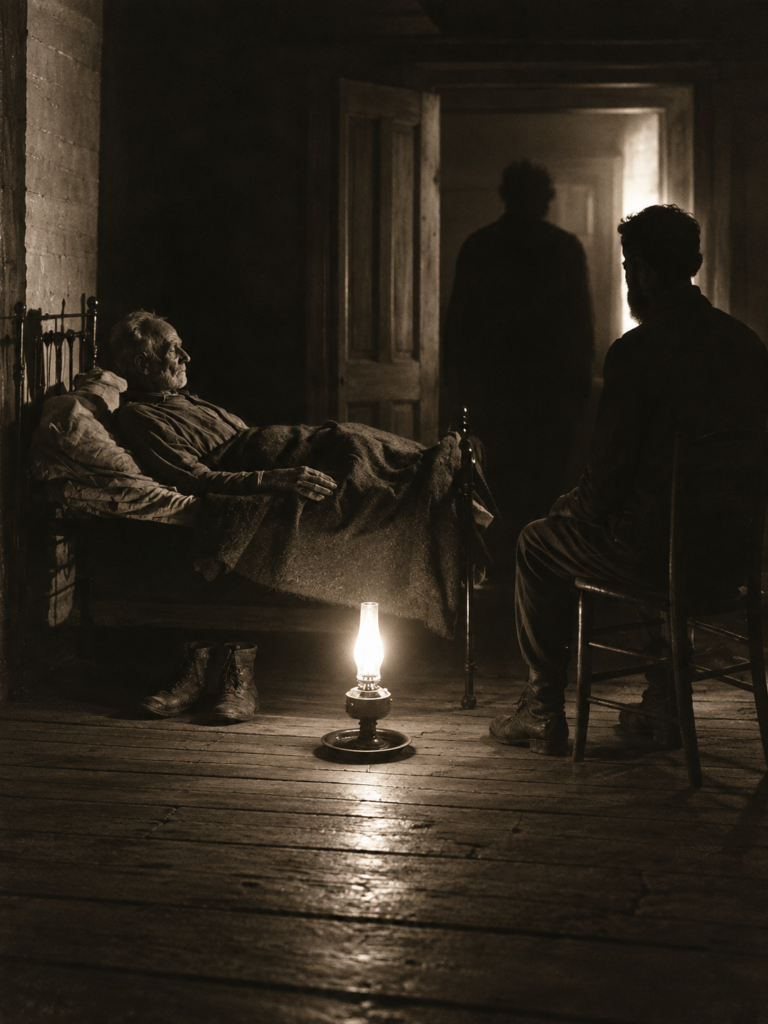
For as long as Winston Westwood could remember, his father had kept an oil lamp burning at the foot of his bed.
Not beside the headboard, where a man might use it to read.
Not upon the mantel, where its light might soften a cold room.
At the foot.
The lamp sat in a shallow tin dish set directly upon the floorboards, its wick trimmed low so that it threw only a small amber circle across the iron frame, Alaric Westwood’s boots, and the strip of floor between the bed and the door.
It was a poor place for a lamp.
That was precisely why Winston had noticed it as a child.
He had also learned not to ask.
There were questions in the Westwood house that seemed to close themselves before anyone could speak them.
Why did Alaric turn his boots every night so that their toes pointed toward the doorway?
Why would he not allow his bedroom door to close completely?
Why were there no photographs of him in the house?
Why had he once taken the only tintype from his wedding, held it over the kitchen stove until the edges curled black, and dropped it into the fire without explaining himself?
And why, some nights, could Winston hear his father talking quietly in the back room when no visitor had come to the house?
Winston had grown up among these habits until they ceased to appear strange.
A child can become accustomed to nearly anything if the adults around him behave as though it is ordinary.
By 1934, Winston was 34 years old and a wheelwright by trade. He had returned to his childhood home in Marrowbone Notch, Wolfe County, Kentucky, after his mother died in the winter of 1928.
His wife, Odessa, came with him.
They took the 2 front rooms of the cabin and left the back room to Alaric, who refused to sleep anywhere else.
The bed had been there since his marriage.
Its frame was black iron, darkened by more than 30 years of woodsmoke. The mattress had been replaced twice. The blanket belonged to Alaric’s mother. The northeast corner of the room belonged to the bed.
The foot faced the door.
The door never quite shut.
The lamp burned.
Every night.
By October of 1934, Alaric was dying.
The mountains had turned brown and rust-red beneath a sky that seemed lower every day. Wind came down through the gaps after sunset, crossed the creek, and pressed against the cabin walls with a low, lonely sound.
Marrowbone Notch was hardly more than a crease in the mountains: several houses, a road following the creek, a few barns, and ridges that appeared to fold over one another forever.
At night there were no distant lights.
The dogs generally stopped barking after dark.
There was little to bark at.
Alaric’s illness began slowly.
A weakness.
A cough.
Then long periods when he stared at nothing.
On the third day, Winston sent for Doctor Chesney Marable.
The doctor came by wagon because his automobile could not climb the final 3 miles of broken grade.
Marable was 61, broad-shouldered and gray-bearded, from a family that had practiced medicine in that country before roads properly existed. His father had assisted at Alaric’s birth.
He stayed in the back room for nearly 2 hours.
When he came out, he placed his medical bag on the kitchen table and looked at Winston.
“You should sit with him tonight.”
Winston already knew what that meant.
“How long?”
Marable removed his spectacles.
“Until the small hours. Maybe dawn if he is stronger than I think.”
“What is it?”
The doctor sighed.
“I could give you several answers. None would help him.”
He glanced toward the hallway.
“I left something for the pain. He won’t take it.”
“I’ll talk to him.”
“Don’t.”
Winston looked up.
Marable put on his coat.
“A man gets to make some decisions for himself at the end.”
Outside, the wind rattled dry leaves along the road.
“I’ll come back at first light,” the doctor said. “Either to sit with you or sign the paper.”
He put on his hat.
“I don’t know which one until I get here.”
Odessa made coffee after he left.
Winston sat in the kitchen with the cup between his hands and watched the stove flame breathe behind its iron door.
He knew his father had secrets.
Every father did.
That was what Winston told himself.
He did not yet understand the scale of the thing hidden in the back room.
The call came shortly after 9.
“Winston.”
Odessa heard it first.
Winston had drifted asleep in the chair.
She touched his shoulder.
“Your father wants you.”
He stood.
The hallway was dark except for the narrow glow coming from the back room.
The door was open the usual amount.
A hand’s breadth.
Winston pushed it farther.
Alaric lay propped upon 3 pillows.
The oil lamp burned at his feet.
“Sit down, son.”
Winston pulled a ladder-back chair beside the bed.
“Close the door.”
His father raised one finger.
“Not all the way.”
Winston left the familiar gap.
“Like that?”
“Yes.”
Alaric studied him.
His face had changed in the past week. The cheeks seemed hollowed, the skin nearly translucent. But his eyes remained clear.
“There’s something I owe you.”
Winston waited.
“I owed it to your mother too.”
Alaric looked toward the wall.
“I never told her.”
“You don’t have to—”
“I do.”
The old man turned back.
“When I am gone, there are things you will have to do.”
Winston said nothing.
“And if you don’t understand why, you won’t do them right.”
The lamp made a faint ticking sound as oil heated in its reservoir.
Alaric spoke very quietly.
“If you don’t do them right, what has stood at the foot of this bed for 48 years will stand at the foot of yours.”
Winston felt the muscles along his back tighten.
He had expected talk of money.
Land.
His mother.
A debt.
Not this.
“Pa.”
“Listen.”
There was no confusion in Alaric’s face.
No fever wandering behind the eyes.
“Do you remember asking me when you were 19 why there weren’t any photographs of me?”
“Yes.”
“I told you I didn’t like my own face.”
Winston almost smiled.
“I remember.”
“I lied.”
Alaric took a breath that rattled deep in his chest.
“The lamp. The boots. The door. The photographs.”
He looked toward the small flame at the end of the bed.
“They are all for the same reason.”
He closed his eyes.
For several seconds he seemed too tired to continue.
Then he began.
“In the spring of 1886, I was 26 years old.”
At that time, Alaric worked for the Halleran-Rush Lumber Company as a timber cruiser.
The work took him ahead of the cutting crews.
He walked unlogged forests, estimated timber by species and board feet, examined slopes and creek beds, marked where mules could haul and where they could not, and recorded everything the company needed before axes arrived.
“You had to know trees,” he told Winston. “And you had to know ground.”
Mostly, though, a timber cruiser had to be willing to walk.
In April of that year, Halleran-Rush acquired rights to a long ridge running near the Wolfe-Breathitt County line.
Black Post Ridge.
It extended roughly 11 miles north to south.
The western slopes had been hunted, crossed, and cut in places.
The eastern side held timber that appeared untouched.
White oak.
Yellow poplar.
Trees large enough to interest any lumber company.
The assignment offered double pay.
At 26, Alaric did not ask why.
He went with 2 men.
Their foreman was Elias Trench, 31, a seasoned mountain worker who had spent 12 years cruising timber and laying out cuts.
The third man was Foraker Wisp.
Foraker was 24.
Rowan County born.
Quick-footed, broad-shouldered, and cheerful in the irritating way some young men remain cheerful even when exhausted.
“He could walk from daylight to dark,” Alaric said. “Then complain that supper was taking too long.”
Alaric’s mouth moved slightly at the memory.
“He was hard to dislike.”
Then the faint expression disappeared.
“And impossible to keep alive.”
The company gave them chains, measuring tools, notebooks, a Jacob’s staff, 1 pack mule, and instructions to reach Marrowbone Notch on April 3.
They arrived late in the afternoon after 2 days of travel.
The final stretch of road was shale and mud.
Spring had not settled properly into the mountains.
Patches of old frost still pushed strange columns of frozen earth out of shaded ground.
Foraker broke one beneath his boot and laughed as it crumbled.
“That’s the kind of thing a man could get to liking,” he said.
Their lodging was a tavern run by Bramble Holloway.
Holloway was around 60, though mountain life had made his age difficult to judge.
He was a widower, lean almost to frailty, with large hands that trembled whenever he thought no one was watching.
More importantly, he knew Black Post Ridge.
Elias asked for a guide during supper.
Holloway stopped clearing plates.
He placed one on the table.
Then another.
Finally he pulled out a chair.
“I can take you to the north end.”
Elias waited.
“I can walk you along the west slope.”
“We’re working east.”
“I know.”
“Then take us east.”
Holloway shook his head.
“I won’t.”
Elias leaned back.
“What’s over there?”
“The timber you came for.”
Foraker laughed.
Holloway did not.
“It’s good timber,” he continued. “Been good timber longer than my grandfather was alive.”
“Then why hasn’t anybody cut it?”
Holloway looked toward the window.
Outside, the last light had faded behind the ridge.
“There’s a reason.”
“What reason?”
“One you won’t understand because somebody tells you.”
Elias frowned.
“Try us.”
“No.”
The tavern keeper folded his hands.
“If you mean to go anyway, I’ll take you to the trail mouth. I’ll take you as far as a marker.”
“What marker?”
“You’ll know it.”
Foraker exchanged a glance with Alaric.
Holloway continued.
“I’ll meet you there again at dawn on the 6th. I’ll wait until noon. After that, I go home.”
“What happens after the marker?” Alaric asked.
The older man’s eyes settled on him.
“Don’t move anything.”
“What do you mean?”
“Anything.”
Holloway’s voice remained calm.
“Don’t move the marker. Don’t sleep beyond it if you can help yourself.”
He paused.
“And don’t pick anything up off the ground once you cross.”
Foraker smiled.
“Stones?”
“Yes.”
“Sticks?”
“Yes.”
“Feathers?”
“Yes.”
“Holloway, we’re counting trees.”
“I know what you’re doing.”
Foraker laughed again.
Holloway watched him.
“Son, I hope you never understand me.”
He stood and returned to his work.
The 3 cruisers sat quietly afterward.
Elias smoked near the window.
Foraker brushed mud from his boots.
Alaric tried to read a trade paper.
The printed lines refused to hold his attention.
At one point Holloway passed through carrying firewood.
He stopped behind Alaric.
Without looking down, he said, “If the young one carries something out, you make him leave it at the marker.”
Alaric turned.
Holloway’s gaze remained fixed ahead.
“You,” he said. “Not Elias.”
“Why me?”
“The older one won’t have it in him if the time comes.”
“What time?”
Holloway walked away.
At dawn, they rode.
The route followed a creek the color of tea from repeated freezes and thaws.
The trail narrowed toward midday.
Eventually they reached a shallow saddle between 2 knobs of ridge.
The forest beyond appeared ordinary.
White oak.
Poplar.
Moss-dark rock.
Yet Alaric noticed a difference before anyone said it aloud.
The light.
“It seemed thinner,” he told Winston.
“Thinner how?”
“Like it had traveled farther to get there.”
In the center of the saddle stood the marker.
A flat-topped stone rose to approximately knee height.
It had been placed there deliberately.
Marks were carved into its upper surface.
Not letters.
Not numbers.
Shapes.
Alaric studied them for only a few seconds before experiencing a peculiar impulse to look away.
“I still remember them,” he told Winston. “Couldn’t draw them if you gave me paper. But I remember not wanting to keep my eyes on them.”
Bramble Holloway dismounted.
“This is it.”
Elias looked beyond the stone.
“The east slope?”
Holloway nodded.
“You’re not coming?”
“No.”
“We’re paying you.”
“You paid me to bring you here.”
He pointed to the marker.
“I’ll be here dawn of the 6th.”
Then he sat against a tree with his back to them.
Elias looked at Alaric.
Foraker shrugged.
They crossed.
Nothing happened.
No sudden darkness.
No sound.
No movement.
10 steps beyond the stone, Alaric noticed the quiet.
No birds.
No wind.
Their boots crushed leaves with uncomfortable clarity.
Foraker made a joke.
None of them laughed.
The work began.
The timber was extraordinary.
Trees 150 or 200 years old stood on easy slopes. Some poplars rose nearly straight enough for ship masts. White oak grew thick and clean.
There were no old axe scars.
No rope marks.
No evidence of prior cutting.
Nothing.
The company would make a fortune.
That should have encouraged them.
Instead, by afternoon, all 3 men were speaking less.
At one point Alaric realized he had not seen a single bird shadow beneath the canopy.
Not a jay.
Not a hawk.
Not even a crow.
He mentioned it quietly to Elias.
The foreman stared into the branches.
“Don’t tell Foraker.”
“Why?”
“Just don’t.”
They camped roughly 100 yards beyond the marker that night.
Sleep came badly.
Alaric dreamed of walking through trees that turned slowly as he passed, although in the dream they had no branches.
He woke before sunrise with mud beneath his fingernails and no memory of leaving his bedroll.
He told no one.
For the next day and a half, they worked.
On the second afternoon they began making their way back.
Elias moved slowly, unwilling to miss valuable timber.
The light already seemed to be fading when they entered a small clearing around a dead white oak.
At its base was a cairn.
Not a random stone pile.
A spiral.
Blackened rocks formed concentric turns, small stones on the outside, larger ones toward the center.
At the middle sat a single stone approximately the size of a man’s head.
The ground around the cairn was thick with fallen leaves.
The stones were clean.
No leaves rested upon them.
Foraker stopped.
“Well.”
Elias went pale.
“Foraker.”
The younger man walked closer.
“Don’t.”
Foraker crouched.
“It’s rocks.”
“Holloway told us.”
“He told us not to pick things up.”
“That includes rocks.”
Foraker put one hand on the central stone.
“He said sticks and feathers.”
“He said anything.”
Foraker looked over his shoulder.
“We’re surveying company land.”
Elias said nothing.
“If this marks a grave, we need to know.”
“Foraker.”
“If we bring a cutting crew up here next spring and somebody digs into a body, the sheriff shuts everything down.”
He pulled the central stone free.
Alaric remembered the sound it made.
Not a scrape.
Something softer.
As though the soil beneath had released air.
Foraker set it beside him.
Then began lifting smaller stones.
Elias never touched the cairn.
He stood several yards back.
Alaric watched.
He thought of Bramble Holloway.
He thought of the warning.
Then he thought of how foolish he would sound telling Foraker to stop because an old tavern keeper did not like people moving stones.
At 26, pride often disguises itself as reason.
Alaric knelt.
He helped.
They removed the spiral.
Beneath it lay leaf mold.
Nothing more.
No bones.
No box.
No metal.
No grave.
Only a dark round patch of earth roughly the size of a dinner plate.
Foraker laughed.
The sound was too loud.
“There.”
He looked at Elias.
“No corpse. No treasure. No mountain spirits.”
Elias did not answer.
Foraker replaced none of the stones.
Instead he picked up the large central rock.
“We’ll take this.”
Alaric stared at him.
“For what?”
“Marker.”
“Foraker.”
“We’ll need to find this exact clearing again.”
He shifted the stone under one arm.
“It’s different from the local rock. We put it beside camp, bring it back with the cutters.”
Elias looked at Alaric.
It was then that Alaric remembered Holloway’s words.
If the young one carries something out, you make him leave it at the marker.
Alaric opened his mouth.
Nothing came.
Foraker walked away with the stone.
They reached the saddle too late.
Daylight was almost gone.
Holloway had already left.
Elias refused to attempt the mountain trail in darkness.
They made camp on the east side, close enough to see the marker through the trees.
Foraker placed the head-sized stone beside his bedroll.
Then covered it with his coat.
Elias barely ate.
Foraker ate twice.
Alaric finished what Elias left.
The fire burned low.
Foraker fell asleep quickly.
Alaric did not know what woke him.
There was no sound.
That was what he remembered most clearly.
No wind.
No creek.
No popping from the banked fire.
Nothing.
His eyes opened.
Stars shone between the trees.
For a while he lay still, listening.
Then some old instinct made him look toward his feet.
Something stood there.
At the foot of his bedroll.
Alaric stopped breathing.
It was approximately the height of a small man.
Upright.
It possessed no face he could see.
No hands.
No clothing.
No defined edge.
“It was darkness,” he told Winston.
“Darkness?”
“Not shadow.”
Alaric’s eyes had shifted toward the foot of his bed in the present room.
“A place where the dark had gathered thicker than the rest.”
He swallowed.
“I could see stars beside it.”
His voice lowered.
“Not through it.”
The thing stood still.
Alaric remained still.
Minutes may have passed.
Or seconds.
Fear distorts time.
Finally, being young and not knowing what else to do, Alaric spoke.
“Get away from me.”
The shape did not move.
From somewhere to his left, Elias whispered, “Please.”
At the same moment, Foraker said, “No.”
All 3 men sat upright.
The shapes were gone.
Because there had been 3.
One at each bedroll.
No one spoke until dawn.
They packed without breakfast.
Foraker carried the stone.
When they stepped over the marker, Bramble Holloway was already there.
A small fire burned.
Coffee waited.
He looked at their faces.
Asked nothing.
He handed them cups.
Foraker placed the head-sized stone near the fire while drinking.
Holloway saw it.
For a moment, he closed his eyes.
Alaric expected anger.
There was none.
Only exhaustion.
Holloway opened his eyes again.
Said nothing.
Then led them home.
Halfway back, Foraker tried to laugh.
“That’s the last time I take double pay for mountain work.”
No one replied.
“I’m serious.”
He looked at Elias.
“Halleran had better pay every cent.”
Elias stopped on the trail.
“Foraker.”
“What?”
“We don’t talk about what happened.”
The younger man’s smile faded.
“Not to the company.”
“All right.”
“Not to wives.”
Foraker frowned.
“All right.”
“Not to each other.”
The forest was loud again.
Birds.
Wind.
Water.
Ordinary sounds.
Elias looked at both men.
“Understand?”
Foraker nodded.
Alaric did too.
That was the last conversation the 3 of them ever had about Black Post Ridge.
Foraker Wisp died that December.
Part 2
The news reached Alaric 3 days after Christmas.
He was in Marrowbone Notch on company business when a foreman named Cadwell stopped at Holloway’s tavern on his way home.
Cadwell knew Alaric had worked with Foraker.
He removed his cap before speaking.
“There was an accident.”
Alaric already understood.
Sawmills killed men.
Belts snapped.
Logs rolled.
Blades broke.
A worker who lost concentration for half a second sometimes paid with a hand, an arm, or his life.
Still, something in Cadwell’s face made Alaric ask, “What kind?”
“Belt line.”
The Halleran-Rush mill outside Prestonsburg had been running through the night to fill an order before Christmas.
Foraker worked a second stretch near the belt system.
According to the 2 men beside him, they turned away for only a few seconds.
When they looked back, the machinery had taken him.
Cadwell had witnessed many industrial accidents.
This one bothered him.
“The belt was checked that morning.”
Alaric said nothing.
“It was slack afterward.”
“How slack?”
“Too slack to do what they say it did.”
Cadwell rubbed the rim of his cap.
“His face wasn’t hurt.”
Alaric looked up.
“The rest…”
Cadwell stopped.
“No need.”
“But his face looked normal.”
“Normal?”
“No.”
The foreman stared into the tavern fire.
“That’s the trouble.”
“What did it look like?”
“Ready.”
Alaric felt cold.
“What?”
“Like he knew.”
Cadwell shook his head.
“Not surprised. Not scared. Like a man sitting for a doctor’s knife after he has already decided to bear it.”
Alaric asked only 1 more question.
“What time?”
Cadwell thought.
“Just after midnight.”
Something inside Alaric tightened.
The same hour.
Nearly exactly.
The hour when 6 months earlier he had awakened beyond the marker and seen the darkness standing at his feet.
He thanked Cadwell.
Then went outside.
Rain had begun.
Cold December rain, almost sleet.
Alaric stood in the road with his coat open.
He remained there until his hands went numb.
It was then he understood—or believed he understood—that the shape had never been interested in the stone alone.
The stone had opened something.
Or marked something.
Or represented something.
But what had stood at the foot of 3 bedrolls had been looking at the men.
Waiting.
Foraker had gone first.
Alaric did not attend the funeral.
For years afterward he regretted that.
At the time he could not explain why he stayed away.
Perhaps he feared seeing the body.
Perhaps he feared seeing nothing wrong with the face.
Perhaps he feared Foraker’s relatives asking about the last job the 2 men had worked together.
Elias Trench survived until the following April.
Almost exactly 1 year after Black Post Ridge.
After the timber cruise, Elias left Halleran-Rush.
He went home to his wife near Two Springs and joined a road crew.
People described him as quieter.
He no longer drank with other workers.
He avoided sleeping away from home.
And he began keeping an oil lamp beside his bed.
His wife asked why.
Elias said his eyes needed light when he woke.
She believed him briefly.
Later she asked again.
He gave another explanation.
She believed that even less.
One April evening, Elias returned from work.
He ate supper.
Then went onto the porch to smoke.
His wife went to bed.
When she woke, he was gone.
His pipe remained on the porch.
His coat hung inside.
His boots were missing.
Fresh snow covered the ground.
Tracks led from the house.
Elias’s tracks.
They went east.
Straight east.
Across 2 fields.
Over a fence.
Through a shallow creek.
For 3 miles.
Then stopped at the base of the ridge running toward Black Post.
They did not turn.
They did not double back.
They simply ended.
The sheriff organized a search.
On the third day, someone found Elias’s coat folded upon a stump roughly 100 yards beyond the final footprint.
It was dry.
No snow upon it.
No dampness.
His wife recognized the fold.
Elias had always folded work clothes the same way.
No body was found.
3 weeks later, she wrote to Alaric.
Her letter arrived with mud along one edge and Elias’s name on the envelope in a hand Alaric did not recognize.
She described everything.
At the end she asked a question.
Elias had spoken names in his sleep.
Foraker.
Alaric.
Sometimes he had begged someone not to stand so close.
Did Alaric know why?
Alaric read the letter twice.
Then a third time.
He owed the woman an answer.
He did not give her one.
He wrote that he was sorry.
That Elias had been a good man.
That he knew nothing useful.
48 years later, dying beneath the same roof where Winston had grown up, Alaric still did not know whether that sentence had been a lie.
“The night I got her letter,” he said, “I rode.”
“Where?”
“Back to Holloway.”
Alaric left after dark.
He rode through the night and most of the following day.
By supper he reached Marrowbone Notch.
Bramble Holloway remained at his tavern.
The year had aged him badly.
When Alaric entered, Holloway set down the pot he was carrying and stared.
He did not ask why Alaric had returned.
Instead he asked, “Is the third one here yet?”
Alaric knew what he meant.
“Gone.”
Holloway closed his eyes.
“Tell me the stone came back.”
“No.”
“Where is it?”
“Foraker took it home.”
“You didn’t stop him.”
“No.”
“Where is it now?”
“I don’t know.”
Holloway sat across from him.
Neither man spoke for a long time.
Finally the tavern keeper said, “Then we rebuild what we can.”
“What?”
“The cairn.”
“You knew?”
“I knew enough.”
“Enough for what?”
“Enough not to cross.”
Holloway stood.
“We go at dawn.”
This time he took a shorter route.
A narrow trail Alaric had not seen the previous year climbed directly toward the saddle.
By midmorning they reached the marker.
Holloway placed his palm on the carved top.
He would go no farther.
“You walk.”
Alaric looked beyond the stone.
The east slope appeared exactly as before.
Quiet.
Thin light.
Waiting forest.
“What do I do?”
“Find the stones.”
“All of them?”
“All you can.”
“And?”
“Put them back.”
“I don’t remember the spiral exactly.”
“You remember enough.”
“That won’t be right.”
“No.”
Holloway’s expression did not change.
“It won’t.”
Alaric waited.
“Bring the moss back too.”
“Moss?”
“Anything moved that shouldn’t have been moved.”
“What about the center stone?”
Holloway looked away.
“You don’t have it.”
“So what do I use?”
“Something.”
“That sounds useful.”
“It’s more useful than nothing.”
Holloway pointed toward the trees.
“Do not run.”
Alaric frowned.
“Whatever happens.”
“Why?”
“Because running tells a thing you believe it is chasing you.”
The old man’s eyes returned to Alaric.
“And don’t turn your back on the clearing.”
Alaric said nothing.
“When you come out,” Holloway continued, “walk backward from the marker 10 steps.”
“Then?”
“Then turn.”
Alaric crossed.
It took most of the day to find the clearing.
He recognized the dead oak first.
The cairn remained dismantled.
Some stones lay where they had been tossed.
Others had rolled beneath leaves.
Alaric gathered them.
He replaced moss.
He tried to remember the pattern.
Small stones outside.
Larger ones inward.
The original center remained absent.
He found a fist-sized rock and placed it there instead.
Immediately he knew it was wrong.
Not because anything happened.
Because nothing changed.
The clearing felt open.
Not physically open.
Incomplete.
As though a sentence had been spoken without its final word.
Alaric backed away.
He kept his eyes upon the cairn.
At the marker, he continued backward.
1 step.
All the way to 10.
Then he turned.
Holloway waited by a fire.
He looked at Alaric’s face.
“You did it?”
“Yes.”
“Correctly?”
“No.”
Holloway nodded.
There was no disappointment.
Only confirmation.
“Will it help?”
“Maybe.”
“How much?”
“A year.”
Alaric stared.
“What happens after a year?”
“Maybe another.”
“That isn’t an answer.”
“It’s the only one I have.”
Alaric went home.
On the first night, he placed an oil lamp at the foot of his bed.
Not because Holloway had instructed him.
Because he wanted to see.
Around 3 in the morning, Alaric woke.
Silence.
The same silence as Black Post Ridge.
He turned his head.
The shape stood at the foot of the bed.
Smaller.
Less distinct.
But there.
The lamp’s light behaved strangely around it.
The flame illuminated the floorboards.
The bedframe.
The wall.
But the light did not touch the shape.
It seemed to bend around it.
Alaric watched.
The thing did nothing.
He moved 1 hand.
No reaction.
He raised his head.
Nothing.
He spoke.
Nothing.
Then he understood something.
It was not there to attack.
It was there to wait.
“It had patience,” Alaric told Winston.
“What did it want?”
“I thought the stone.”
“You don’t think that now?”
“I think the stone was what we took.”
Alaric swallowed.
“But after we took it, the debt changed.”
He stared toward the lamp.
“Maybe a thing can wait long enough that what it wants changes too.”
The shape returned.
Not every night.
Enough.
Alaric began studying it the way he once studied forests.
He discovered patterns.
The lamp had to remain lit.
Not bright.
Just burning.
If the wick went low but held flame, the shape remained at the foot of the bed.
If the flame died, the shape appeared closer the next time.
He learned this only once.
That was enough.
The door mattered.
When shut completely, the thing moved nearer.
Not immediately.
Not visibly.
Alaric would fall asleep.
Then wake and find the darkness halfway between the bed’s foot and his knees.
After that he kept the door open a hand’s breadth.
Boots mattered too.
One winter night he had removed them carelessly, leaving the toes pointed toward the bed.
The shape appeared on the near side of them.
The next evening he turned them toward the door.
The darkness stood behind them.
Alaric did not understand why.
He did not need to.
He accepted useful rules.
The photographs came later.
A traveling photographer took a picture of a logging crew Alaric joined in 1889.
Someone gave him a copy.
He carried it home.
That night, the shape did not stand at the foot of his bed.
For the first time in years, Alaric woke and saw nothing.
He nearly cried with relief.
Then he noticed the photograph on a shelf across the room.
The figure was standing there.
Not physically.
In the image.
Behind the row of men.
A vertical darkness too narrow to be a tree.
Too upright to be shadow.
When Alaric looked from the photograph toward the foot of the bed, the shape was gone.
When he looked back at the picture, it seemed closer to the figure representing him.
He burned it.
After that he refused photographs.
Wedding tintypes.
Family portraits.
Anything containing his likeness.
His wife never understood.
For a long time Alaric lied to her.
He said he disliked his appearance.
Then he said photographs were vanity.
Eventually she stopped asking.
Years passed.
The thing remained.
Sometimes it disappeared for weeks.
Sometimes months.
Then a winter would come when it stood there 10 nights in succession.
The second summer after Black Post Ridge nearly broke him.
Alaric stopped sleeping.
2 hours one night.
1 the next.
Then none.
By the 11th day he was seeing the shape while awake.
At the barn door.
Behind a wagon.
Across a field.
In the mirror when he shaved.
Always distant enough that he could tell himself he was exhausted.
Near enough that exhaustion became difficult to believe.
One afternoon he lay beneath a tree at the edge of his north field.
His eyes closed.
He considered not opening them.
Let it come.
Let it do whatever it had waited to do.
He was tired of watching.
Tired of lamps.
Tired of turning boots.
Tired of measuring the gap in a door.
Then he thought of Foraker.
Of Elias.
He stood.
Went home.
Lit the lamp before dark.
Made coffee.
And sat facing the foot of the bed until dawn.
The shape remained there all night.
When morning came, it vanished.
It did not return for 4 days.
“That was the closest I ever came to believing I beat it,” Alaric said.
Winston shifted in the chair.
“Did you?”
“No.”
His father almost smiled.
“I learned better.”
For 48 years, Alaric maintained the rules.
Lamp.
Door.
Boots.
No photographs.
Sometimes fear weakened.
Sometimes he could go weeks scarcely thinking about the thing.
But the rituals never stopped.
Even when his wife became ill in 1928.
Especially then.
On one of her final nights, she took his hand.
“I never believed you about that lamp,” she said.
Alaric had looked away.
She continued.
“I never believed your feet hurt.”
He started to speak.
She stopped him.
“I didn’t ask because I decided a man who keeps a light against something he can’t name has his reasons.”
Her fingers tightened weakly.
“I’d rather sleep beside a man with a reason he won’t tell than a man who lies because there’s no reason at all.”
Alaric wept that night.
His wife died 3 days later.
The lamp remained burning in the back room.
He never told her.
That failure stayed with him longer than any fear.
Now, in October 1934, Winston sat beside the same bed.
His father looked smaller beneath the blanket.
Outside, wind pressed against the cabin.
“Why are you telling me now?”
Alaric took a long breath.
“Because I am almost out of your way.”
Winston frowned.
“What does that mean?”
“The thing doesn’t stand for me anymore.”
“You said—”
“I said it stands at my bed.”
“That’s different?”
“Yes.”
Alaric looked toward the footboard.
“For years it watched me.”
His eyes remained fixed there.
“The last 5, it changed.”
“How?”
“Not shape.”
He took another breath.
“Posture.”
Winston almost asked what that meant.
His father continued.
“At first it stood like something willing to wait.”
The room seemed colder.
“Then it stood like something thinking about coming closer.”
Alaric’s voice fell.
“Now it stands like a visitor who knows he will be invited inside eventually.”
Winston looked despite himself.
The lamp flame moved.
The floorboards were empty.
“I don’t think it wants me anymore,” Alaric said.
“Then what does it want?”
“The door.”
Part 3
Winston leaned forward.
“What door?”
“This one.”
Alaric’s eyes moved toward the narrow opening.
“Not wood.”
“Pa—”
“Listen.”
The old man’s voice sharpened unexpectedly.
“I’ve been standing in its way.”
He coughed.
Winston started to rise.
Alaric gripped his wrist.
“No.”
The strength in the hand surprised him.
“When I am gone, it is going to look for the next ground.”
“I don’t understand.”
“You will.”
“What next ground?”
“Nearest.”
Alaric released him.
“The nearest feet under this roof will be yours.”
Winston sat very still.
“And Odessa?”
“If you do it wrong, maybe hers.”
“What am I supposed to do?”
“Remember.”
The lamp must burn through the night.
From Alaric’s final breath until dawn, there could be no break in the flame.
The oil should be checked every hour.
If it went out, even briefly, Winston was not to relight it and assume the danger had passed.
“If the lamp dies before dawn,” Alaric said, “the thing leaves the bed.”
“Leaves for where?”
“It won’t be waiting after that.”
“What does that mean?”
“It will be moving.”
Winston did not ask again.
The boots came next.
After death, Alaric’s boots had to remain at the foot of the bed, toes facing the door.
At first light they were to be taken outside and placed upon the ground facing Black Post Ridge.
They must remain there 1 full day and 1 full night.
The following morning, Winston must carry them toward the ridge and bury them beneath a tree.
Toes still pointing toward Black Post.
The photographs had to go.
Every image of Alaric inside the cabin.
Tintypes.
Portraits.
Anything.
No likeness could remain for 1 year.
The front-room mirror had to be turned against the wall or covered.
“No drawing either.”
“Why a year?”
“I don’t know.”
“You’ve done this 48 years and don’t know?”
“I know what works.”
Alaric looked at him.
“That is different from knowing why.”
The door must remain a hand’s breadth open.
Not less.
Not closed.
Not wide open.
The same gap he had maintained every night.
Winston repeated the instructions.
“Lamp until dawn.”
“Yes.”
“Oil every hour.”
“Yes.”
“Boots toward the door.”
“Yes.”
“Outside at dawn. Ridge on the second morning.”
“Yes.”
“Pictures gone. Mirror covered for a year.”
“Yes.”
“The door stays open.”
“How far?”
“A hand’s breadth.”
Winston held up his palm.
“This?”
“That.”
Alaric relaxed slightly.
“One more thing.”
Winston waited.
“Don’t tell Odessa tonight.”
“Why?”
“Because she will want to help.”
“That’s bad?”
“She’ll ask questions.”
“So?”
“You don’t have answers.”
Neither did Alaric.
Not really.
He had rules.
That was all.
“Do everything first,” Alaric said. “Get through 1 clean night.”
“Then tell her?”
“Everything.”
“You want me to lie?”
“No.”
His father’s expression tightened.
“Never build a marriage on the kind of lie I used with your mother.”
He looked away.
“Just wait until morning.”
Winston nodded.
“All right.”
Alaric’s breathing had grown slower.
He closed his eyes.
Winston thought the story had ended.
Then his father spoke again.
“There is something else.”
Winston leaned closer.
“I’ve spent 48 years listening to the foot of this bed.”
The old man opened his eyes.
“The strangest part is tonight.”
“What?”
“I’m not afraid.”
Winston looked at him.
Alaric almost laughed, but lacked the breath.
“I was afraid in 1886.”
His eyes moved toward the lamp.
“I was afraid when Foraker died. I was afraid when Elias disappeared. Afraid when your mother slept beside me and never knew what I saw.”
He swallowed.
“I’ve been afraid more nights than I can count.”
His gaze returned to Winston.
“But not tonight.”
“Maybe that’s good.”
“No.”
The answer came softly.
“That is worse.”
“Why?”
“I don’t know.”
Alaric closed his eyes.
“Maybe because fear belongs to a man who still expects tomorrow.”
After that, his breathing changed.
Winston recognized the pattern Doctor Marable had described.
He held his father’s hand.
For the first time since entering the room, Winston deliberately refused to look toward the foot of the bed.
He watched Alaric’s face.
Listened to the wind.
Listened to the lamp.
Listened to the long pauses between breaths.
Shortly after 2 in the morning, Alaric inhaled.
Then did not exhale.
Winston waited.
“Pa?”
Nothing.
He remained beside him for approximately 1 minute.
Then memory took over.
The lamp.
Winston stood.
The reservoir was almost dry.
He filled it from the oil can.
Trimmed the wick.
The flame brightened.
He turned Alaric’s boots.
Toes toward the doorway.
The door had shifted slightly.
Winston adjusted it until the gap measured roughly the width of his hand.
Then he stepped into the hallway.
He did not wake Odessa.
He sat in the kitchen until dawn.
Every hour, he returned to the back room.
Checked the oil.
Checked the flame.
Checked the boots.
Checked the door.
He never looked directly at the floor beyond the footboard.
At first light, Doctor Marable arrived.
He examined Alaric.
Signed the death certificate.
“What happened in the night?”
“Not much.”
The doctor studied Winston.
Perhaps he knew that was not true.
He did not press.
The undertaker came that afternoon.
Neighbors followed.
Food arrived.
Coffee stayed hot on the stove.
People entered and left the house.
Winston guarded the back room without appearing to guard it.
The lamp stayed lit.
The door remained open.
He tolerated questions.
Why is the lamp still burning?
His father wanted it that way.
Why are the boots there?
His father wanted that too.
Odessa watched him.
She said nothing.
At dawn on the second morning, Winston carried the boots outside.
He set them upon bare ground.
Toes toward Black Post Ridge.
They remained there through the day.
That night dew silvered the leather.
The following morning, Winston took them up the first switchback toward the ridge.
He found a tulip tree.
Dug beneath it.
Buried the boots with their toes pointing eastward toward Black Post.
Then returned home.
He turned the front-room mirror against the wall.
There were 2 photographs of Alaric.
Odessa had kept them.
Winston waited until she went to the spring house.
He removed both.
Dropped them into the stove.
Watched the faces blacken.
Odessa noticed almost immediately.
“Where are the photographs?”
“My father asked me to burn them.”
She stared.
“What?”
“For 1 year, he said there shouldn’t be any picture of him here.”
“Why?”
“I promised.”
“Winston.”
He met her eyes.
“There are things I owe you.”
“What things?”
“I don’t know how to explain them yet.”
Odessa’s face changed.
“Does this have to do with what he told you that night?”
“Yes.”
“What did he tell you?”
Winston remembered the instruction.
One clean night.
“Give me a little time.”
“How much?”
“A night or 2.”
She studied him.
“You’re frightening me.”
“I know.”
“Are you in danger?”
He did not know how to answer.
“I don’t think so.”
“That isn’t the same as no.”
“No.”
Odessa remained silent.
Then nodded.
“All right.”
“Thank you.”
She did not ask again.
For 3 weeks, nothing happened.
Winston kept the lamp burning in the back room.
Every evening he filled it.
Every morning he trimmed the wick.
The door remained open.
He began turning his own boots toward his bedroom doorway.
He could not explain why.
Perhaps imitation.
Perhaps instinct.
Odessa noticed.
Still she did not ask.
Winston slept.
No shapes.
No voices.
No strange silence.
He began to wonder if grief had made him too willing to believe.
A dying man’s mind could change.
48 years of ritual could grow into certainty.
Perhaps Foraker’s death had been exactly what it looked like.
A mill accident.
Perhaps Elias had left his wife.
Perhaps the tracks had been misread.
Perhaps Alaric had spent most of his life afraid of an idea.
Every night Winston entered the back room and looked at the lamp.
Every night nothing stood there.
A week passed.
Then 2.
Then 3.
Winston started preparing what he would tell Odessa.
Not the whole story at once.
Black Post.
The cairn.
The stone.
The first night.
He rehearsed the words privately and found each version ridiculous.
Then, on a Tuesday in November, Odessa woke him.
Her hand rested on his shoulder.
“Winston.”
He opened his eyes.
The room was dark.
“What?”
“Don’t move.”
Her voice did not shake.
That frightened him more than if she had screamed.
“How long have you been awake?”
“A while.”
“What’s wrong?”
“Look at the foot of the bed.”
Winston stopped breathing.
Odessa’s hand tightened.
“Don’t sit up.”
He turned his head.
The lamp in the back room still burned 3 doors away.
Its light traveled beneath doorways and through the hallway, leaving only a faint yellow line across the boards of Winston’s bedroom.
It illuminated almost nothing.
Still, his eyes had adjusted to darkness.
He could see the wardrobe.
The chair.
Odessa’s dressing table.
And the shape.
Standing at the foot of the bed.
A place where darkness had gathered more densely than darkness should.
Approximately the height of a small man.
No face.
No hands.
No clear edge.
Winston could not see the wardrobe through it.
He did not move.
Odessa did not move.
The thing did not move.
Time passed.
Finally she whispered, “I have been looking at it for almost an hour.”
Winston’s mouth was dry.
“What is it?”
He said nothing.
“What did your father tell you?”
Her fingers pressed into his shoulder.
“I need to know now.”
So Winston told her.
Lying on his back.
Looking at the foot of the bed.
He told her about 1886.
About Black Post Ridge.
Bramble Holloway.
The marker.
The warning.
The cairn.
Foraker taking the stone.
The 3 shapes.
Foraker’s death.
Elias’s disappearance.
Alaric returning to rebuild the stones.
The lamp.
The door.
The boots.
The photographs.
Everything.
Odessa listened.
The shape remained.
When Winston finished, neither spoke.
Outside, the wind began changing.
A faint grayness appeared at the edge of the shutters.
First light.
The shape did not walk away.
It simply became more difficult to distinguish.
Darkness thinned.
Furniture took form.
The place at the foot of the bed was there.
Then perhaps it was not.
Neither Winston nor Odessa could identify the exact moment.
They rose.
Went to the kitchen.
Sat across from each other.
For a long time, they said nothing.
Finally Odessa asked, “Is the lamp in the back room still burning?”
“Yes.”
“Tonight we put one here too.”
Winston looked at her.
She poured coffee.
“At the foot of the bed.”
That night they lit a second lamp.
They never stopped.
Odessa Westwood remained in the cabin until 1968.
Winston lived 4 years longer.
For the remainder of their lives, lamps burned at night.
Boots faced doors.
Doors remained open by a hand’s breadth.
They did not keep photographs in the sleeping rooms.
The habits became part of the house.
Children visiting relatives were told not to move lamps.
Guests were asked not to close doors.
When someone asked why, the answer varied.
Ventilation.
Habit.
Old mountain superstition.
No one gave the whole story.
Not at first.
Years later, a niece named Perpetua became interested in the family history.
She noticed something curious.
There were photographs of Odessa.
Photographs of cousins.
Photographs of houses.
But almost none of Alaric.
And very few of Winston.
She began asking.
Most relatives shrugged.
Then she found something.
A photograph.
Alaric Westwood.
The image had traveled through several branches of the family until it ended up in a small house in Rowan County.
The woman who possessed it did not know Alaric’s name.
Someone had told her only that he was somebody’s grandfather.
She placed the photograph on a mantel among portraits of other dead relatives.
The room bothered her.
It was colder than the others.
She said so often.
Even in summer.
Even when windows were shut.
She kept a lamp burning there.
Sometimes during the day.
She could not say why.
Perpetua visited.
The lamp was lit in the middle of the afternoon.
The woman laughed about it.
“Silly thing.”
“Why do you keep it on?”
“I don’t know.”
Perpetua looked at the photograph.
Alaric stood among several people.
Older than he had been at Black Post.
Younger than at death.
Nothing obvious appeared behind him.
Still, Perpetua felt no desire to touch the frame.
She wrote to Winston.
By then he was near the end of his life.
She explained where she found the picture and asked whether she should bring it back.
His reply came slowly.
Do not take the picture down.
She read the sentence twice.
The picture is doing more good where it is than it would do in a stove now.
Then another line.
The door in that house is probably a little open in a way nobody living there can name.
Leave it be.
Near the end of the letter, Winston wrote something Perpetua preserved.
She would later read it aloud when family members asked why the Westwoods had spent generations keeping lamps in strange places.
He wrote:
A lamp is not for keeping the dark out.
A lamp is for showing the dark what it has agreed to.
Perpetua never fully understood what he meant.
Perhaps Winston did not either.
Rules outlive explanations.
That is one of the ways fear becomes tradition.
A child sees a lamp at the foot of a bed.
His father tells him not to move it.
The child grows.
He stops asking.
One day the father dies.
The lamp remains.
A pair of boots still points toward the doorway.
The door does not quite close.
The explanation disappears.
The behavior survives.
Years pass.
Someone calls it habit.
Someone else calls it superstition.
Eventually no one remembers the first warning.
Only the rule.
Do not move the lamp.
Do not shut the door.
Do not turn the boots.
Do not bring the picture into the room.
Perhaps nothing Alaric described was supernatural.
Perhaps 3 exhausted timber cruisers frightened themselves in an unfamiliar forest.
Perhaps Foraker died because mills were dangerous.
Perhaps Elias left his home voluntarily and perished on the ridge.
Perhaps 48 years of insomnia produced the shape Alaric saw.
Perhaps Winston inherited his father’s expectations so completely that he saw what he had been told to see.
That would not explain Odessa.
But families influence one another.
Fear can pass between people without words.
There are rational answers available for almost every fragment of the story.
What remains difficult is how many fragments require them.
The untouched forest.
The marker.
The cairn kept clear of leaves.
The central stone.
3 men waking simultaneously.
Foraker dying at the same hour months later.
Elias walking toward Black Post and disappearing where his footprints ended.
The dry folded coat.
Alaric spending the rest of his life maintaining rules no one had taught him.
The shape appearing to Odessa weeks after Alaric’s death.
The lamp in Rowan County kept burning beside a photograph whose owner did not know the man it depicted.
None proves the others.
Together they form the inheritance Winston spent the rest of his life refusing to name too confidently.
He never claimed the darkness was a ghost.
Neither had Alaric.
No one called it a demon.
Bramble Holloway, who seemed to know more than any of them, never gave it a name at all.
Perhaps naming was another kind of invitation.
The only certainty Alaric possessed was that some boundaries were older than the people who later crossed them.
The stone marker had been there before Halleran-Rush Lumber Company.
The spiral had been there.
The forest had been untouched despite the value of its timber.
The people nearest to it knew enough not to guide strangers inside.
Then 3 young men arrived carrying measuring chains and company contracts.
They crossed.
They picked something up.
One of them carried it away.
None returned to the lives they had expected.
Alaric lived longest.
Whether that meant he was the luckiest is another question.
48 years is a long time to keep watch.
A long time to trim a wick each morning.
A long time to measure a doorway with your hand.
A long time to wake at 3 and determine whether the darkness at the foot of your bed is ordinary.
He married.
Had a son.
Worked.
Aged.
Buried his wife.
Saw seasons turn.
Through all of it, the lamp burned.
Perhaps that was what Bramble Holloway meant when he said the rebuilt cairn might buy Alaric a year at a time.
Not safety.
Years.
Pieces of a life paid out slowly.
Alaric once believed the figure waited for the missing center stone.
Later he doubted it.
By old age, he thought the thing was interested in passage more than possession.
A door.
Not necessarily the wooden door in his room.
Something represented by the gap.
Something kept neither fully open nor fully closed.
The lamp marked one side.
The darkness stood on the other.
And Alaric stood between.
Until October 15, 1934.
Then he stopped.
Winston took his place.
Perhaps Odessa did too.
Perhaps every person who followed the rules took some part of that burden.
No known record states what eventually happened to the head-sized stone Foraker carried from Black Post Ridge.
His belongings were scattered after his death.
Some went to relatives.
Some may have been sold.
Some may have remained near Prestonsburg.
The stone could have been discarded.
Used in a foundation.
Thrown into a creek.
Placed beside a barn.
Someone may have carried it somewhere without ever knowing what it was.
That possibility troubled Winston more than anything else in old age.
Because if the stone still mattered, it might no longer be anywhere near Black Post.
It could sit beneath a porch.
Beside a road.
Inside a wall.
Or on a mantel as an interesting piece of dark rock collected long ago by someone whose name was forgotten.
And if the stone did not matter anymore, then the problem was worse.
It meant the thing had learned to remain without it.
Black Post Ridge itself changed.
Logging eventually reached nearby mountains.
Roads improved.
Properties changed hands.
People who knew the old warnings died.
Some sections were cut.
Others remained rough enough that few outsiders bothered with them.
Stories persisted.
Hunters occasionally mentioned areas where birds seemed absent.
A survey crew in the 1950s supposedly found a knee-high stone with markings that none recognized.
Whether it was the same marker cannot be confirmed.
One man claimed they moved it.
Another insisted they did not.
Both versions were told decades later.
No official survey notes mention the stone.
There are also stories of small cairns discovered beneath dead trees.
Most are surely ordinary.
Mountain people stack stone for countless reasons.
Property lines.
Graves.
Trail marks.
Children.
Hunters.
There is no reason every spiral of rock should mean anything.
Still, some old families in that part of Kentucky retained peculiar habits.
Do not take stones from certain hollows.
Do not carry objects across a ridge after sunset.
Do not sleep with a bedroom door fully shut.
Keep a small light where your feet point.
Turn your boots toward the way out.
Traditions without explanations.
Warnings reduced to behavior.
Maybe that is all the Westwood account ever was.
A collection of mountain customs woven around 3 dead or frightened men.
Yet Alaric’s final instruction to Winston did not concern Black Post.
It concerned the house.
The nearest ground.
The next bed.
That was what frightened Winston enough to obey.
He had watched his father die.
He had followed the rules.
Then he waited 3 weeks.
He had begun to doubt.
And Odessa woke him.
Look at the foot of the bed.
That moment ended doubt.
Not because Winston understood.
Because Odessa had seen it first.
For nearly an hour she watched the darkness before waking him.
No story had prepared her.
No father had described it.
No warning had told her what shape to expect.
Yet when Winston turned his head, he saw what Alaric had described.
A darkness shaped roughly like a small man.
No face.
No hands.
No edges.
The room visible around it.
Not through it.
And it remained until morning.
Afterward, Winston told Odessa everything.
Unlike Alaric, he did not spend a marriage hiding the truth.
That may have been the only part of the inheritance he improved.
Together they watched.
Together they kept lamps.
Together they grew old.
Whatever stood at the foot of their bed never took either of them young.
Perhaps the rules worked.
Perhaps nothing was there.
Perhaps their lives would have gone exactly the same way without a single lamp.
There is no way to know.
The account leaves no experiment.
No one was willing to extinguish the flame and see.
That restraint is worth remembering.
People often imagine that courage means testing a warning.
Opening the forbidden door.
Crossing the line.
Picking up the stone.
Foraker believed that.
At 24, he saw caution as ignorance.
Alaric learned something different.
Sometimes courage is leaving a thing alone.
Sometimes it is keeping a lamp burning without needing to prove what would happen in the dark.
And sometimes the oldest warning in a house survives because someone, long ago, tested it for you.
By the time Winston died, the Westwood cabin had become an old house filled with habits nobody fully understood.
The lamp still mattered.
The doors still stood slightly open.
A visitor might have assumed warped hinges.
Old wood.
Mountain custom.
Perhaps that was for the best.
There are stories that become weaker when everyone believes them.
Others may become stronger.
No one in the family wished to discover which kind this was.
Perpetua kept Winston’s letter.
Especially the sentence about the lamp.
She copied it once into a notebook.
A lamp is not for keeping the dark out.
A lamp is for showing the dark what it has agreed to.
What agreement?
With whom?
No surviving account answers.
Perhaps Bramble Holloway knew.
He died long before anyone thought to record his explanation.
Perhaps his parents knew more.
Perhaps the marker at the saddle belonged to a system of warnings that existed before his family ever settled the hollow.
All that remained was the behavior.
Boundary.
Cairn.
Stone.
Lamp.
Door.
Boots.
No photographs.
A series of actions that seem absurd until performed for 48 years by a man who otherwise lived an ordinary life.
Alaric never became famous.
He was not known as a mystic.
He did not preach.
He did not sell charms.
He did not tell ghost stories in taverns.
He did not even tell his wife.
He worked timber.
Raised a son.
Paid debts.
Mended tools.
A man could know him for decades and never hear of Black Post Ridge.
That restraint may be the most credible part of the story.
He did not want attention.
He wanted distance.
He failed to obtain it.
So he settled for rules.
When death came, he was less frightened by dying than by what might remain after him.
That was why he called Winston.
Not to confess guilt.
Not exactly.
To transfer responsibility.
The story was part of the transfer.
Without it, Winston would have blown out the lamp.
Closed the door.
Thrown away the boots.
Hung photographs.
Ordinary actions.
Possibly harmless.
Possibly not.
Alaric had no intention of letting ignorance test the question.
So he told the story.
Every part.
The young men.
The warning.
The stone.
The shapes.
The deaths.
The years.
And finally, the change in the way the darkness stood.
Patient at first.
Closer later.
Certain at the end.
A visitor already inside the room.
Waiting only for the man guarding the doorway to leave.
Alaric left.
Winston did not close the door.
The lamps burned for decades afterward.
Whether any are still burning now is impossible to say.
Perhaps the Westwood habits ended when the cabin passed from the family.
Perhaps someone renovated the back room.
Moved the iron bed.
Removed the tin dish.
Rehung the doors.
Opened the walls.
Perhaps the floorboards beneath the lamp were replaced.
Perhaps whoever did the work found nothing beneath them.
That would be expected.
There was never anything beneath the floor.
The thing Alaric feared had always stood above it.
And if somewhere in the Kentucky mountains there is still an old house where a door refuses to close completely at night, where boots are turned toward the hall before sleep, where no one keeps photographs in a certain room, and where a small lamp burns at the foot of the bed although nobody can remember who first placed it there, perhaps the explanation is simple.
Old houses collect habits.
Families repeat things.
People inherit caution without understanding its source.
That may be all.
But if you ever find such a house, it may still be wiser not to move the lamp.


