they laughed when they handed the grieving widow a three-dollar ruined estate—then she found what their family had buried beneath the barn
they laughed when they handed the grieving widow a three-dollar ruined estate—then she found what their family had buried beneath the barn
Part 1
Grief did not feel like sorrow to Nora Bennett.
Sorrow was what people brought in sympathy cards with watercolor flowers on the front. Sorrow was casseroles left on a porch and church women squeezing your hand and saying they were praying for you.
What Nora felt was more like waking after a car wreck and discovering she was still inside the vehicle.
Everything familiar remained around her, but nothing was where it belonged.
Twenty-three days after her husband died, she sat at the far end of a polished walnut conference table in Albany, New York, watching rain crawl down a window seventeen floors above the street.
Her black dress pinched beneath one arm. She had bought it twelve years earlier for Leo’s father’s funeral and had not worn it since. It smelled faintly of cedar from the garment bag.
Across from her sat the rest of Leo Hastings’s family.
His mother, Beatrice, seventy-eight and still straight-backed as a church pew, wore a gray wool suit and a strand of pearls Nora had once heard cost more than their house.
Graham, Leo’s older brother, kept checking a gold watch.
Cecilia, the youngest of the three Hastings children, stared at the rain and tapped one red fingernail against the table.
None of them had cried at Leo’s funeral.
Beatrice had cried once, privately, when Nora called her the night Leo collapsed in their kitchen. Nora remembered the silence at the other end of the phone, then one strangled sound before Beatrice regained herself.
By morning, she was cold again.
Maybe that was how rich families survived themselves, Nora thought.
They turned pain into paperwork.
The Hastings family attorney, Martin Gable, adjusted his glasses.
“We have one remaining matter involving the rural properties held by the older branch of the family trust.”
Nora lifted her eyes.
She had barely heard anything else.
Three weeks earlier, Leo had been making coffee before sunrise. He had complained about a strange pain behind one eye, then dropped the mug.
It shattered on the kitchen floor.
Nora had spent thirty-eight years as a registered nurse. She had worked emergency rooms, cardiac wards, nursing homes, county clinics. She knew what a catastrophic brain aneurysm looked like before his body finished hitting the linoleum.
She had done CPR anyway.
She had kept doing it long after the ambulance arrived.
Now she could not drink coffee without hearing ceramic breaking.
Martin Gable slid a folder toward her.
“Leo held a contingent interest in a property in Oakhaven Township. The Ironwood estate.”
Graham gave a humorless laugh.
“Calling it an estate is generous.”
Nora touched the folder but did not open it.
“What is it?”
“A former country manor,” Gable said. “Approximately one hundred eighteen acres. Main residence, carriage barn, greenhouse remains, two agricultural outbuildings and woodland.”
For half a second, Nora wondered if they had finally decided to show mercy.
Leo had walked away from his family’s business thirty-one years earlier to marry her. Not because Beatrice had forbidden the marriage exactly. Beatrice was too sophisticated for open threats.
She had merely told Leo that marrying “a woman without a background” would permanently alter his place in the family.
Leo had chosen Nora.
He never regretted it.
They lived in a two-bedroom house outside Poughkeepsie. Nora worked hospital shifts. Leo taught history at a community college and repaired antique radios on weekends. Their vacations involved state parks, thermoses and used paperbacks.
He could have had chauffeurs and trust funds.
Instead, he packed Nora’s lunch every morning until the week he died.
Gable continued.
“The property has substantial encumbrances.”
Nora looked up.
That word penetrated the fog.
“How substantial?”
Gable glanced at Beatrice.
Beatrice folded her hands.
“Tell her.”
Gable inhaled.
“There are delinquent county taxes, code-enforcement penalties, structural violations and environmental remediation obligations. Current estimates total approximately four hundred twenty-seven thousand dollars.”
Nora stared at him.
“I’m sorry?”
“The asbestos alone may represent—”
“You’re giving me four hundred thousand dollars in debt?”
Graham leaned back.
“No one is giving you debt. You’re receiving Leo’s remaining real-estate interest.”
“The property is worthless.”
“Technically,” Gable said, “the county’s adjusted taxable valuation, accounting for liens and known remediation, has been reduced to three dollars.”
Cecilia’s laugh escaped before she could stop it.
Nora turned toward her.
Cecilia looked down.
At least she had the decency to appear embarrassed.
Beatrice did not.
“Leo rejected his inheritance,” she said. “Repeatedly and publicly. He wanted independence. This is what remains attached to his share.”
“No,” Nora said quietly. “This is what you don’t want attached to yours.”
Graham’s jaw tightened.
“Careful.”
Nora looked at him.
She had known Graham for thirty-five years.
He had never once visited their house.
Not when she and Leo married.
Not when Leo had pneumonia.
Not when Nora underwent surgery twelve years ago.
Not when his brother died.
Yet here he sat telling her to be careful.
Something inside her, already cracked, broke a little farther.
Gable pushed the transfer documents closer.
“You are not required to accept.”
“Don’t pretend this is kindness,” Nora said.
His eyes fell.
It told her enough.
“If I refuse?”
“The property remains subject to trust administration pending litigation and possible county foreclosure.”
“And Leo’s share?”
Gable hesitated.
Graham answered.
“Consumed by the liabilities.”
There it was.
Nora understood.
If she accepted Ironwood, the Hastings family could place the entire contaminated liability outside their active trust. If she refused, their lawyers would bury the matter until nothing remained of Leo’s portion anyway.
Beatrice reached into her handbag.
She placed three one-dollar bills on the table.
“For the consideration required by the deed.”
Nora stared at them.
Three dollars.
Forty-one years with Leo.
Thirty-one years of marriage.
Christmas mornings. Mortgage payments. Burned dinners. His hand on her shoulder when her mother died. His habit of humming old Johnny Cash songs off-key. The small vegetable garden behind their house. The night he drove through a snowstorm because Nora was stranded at the hospital.
And his family had reduced the last thing attached to his name to three wrinkled bills on a conference table.
Graham smiled.
“Don’t spend it all in one place.”
Nora turned her head slowly.
For the first time that afternoon, Cecilia looked ashamed.
“Graham,” she murmured.
“What? We all know what this is.”
Nora picked up the deed.
She did not pick up the money.
“Did Leo ever go there?”
Beatrice’s expression changed slightly.
It was small, but Nora had spent a lifetime reading faces.
“I don’t know.”
“Did his father?”
“It’s been abandoned for decades.”
“That wasn’t my question.”
Beatrice stood.
“This meeting has gone on long enough.”
Nora looked at Gable.
“If I sign, everything on that property becomes mine?”
“Subject to the stated liens and legal obligations.”
“Buildings?”
“Yes.”
“Contents?”
Gable glanced at Graham.
“The deed language drafted by the trust conveys the parcel in its entirety, including improvements, fixtures, subsurface structures and contents remaining on site, known or unknown. That wording was requested to ensure a complete transfer of liability.”
Graham stopped looking at his watch.
Nora noticed.
Only for a second.
Then he relaxed.
Ironwood was a ruin. Everybody in the room believed that.
Nora took the pen.
She signed.
When it was done, Beatrice slid the three bills toward her.
Nora left them lying there.
“You forgot your money,” Graham called.
Nora put on her old black coat.
“No,” she said. “I didn’t.”
She walked out.
The elevator doors closed before her legs started shaking.
That night, she returned to the silent house she had shared with Leo.
His boots were still beside the back door.
His reading glasses still rested on the arm of his chair.
On the refrigerator, a yellow note in his handwriting said:
Nora—milk, furnace filters, birdseed. Love you.
She stood in the kitchen holding the Ironwood deed and finally began to cry.
Not because of the property.
Not because of the debt.
Because there would never be another note.
She sat on the floor where Leo had fallen.
For a long time, she pressed the paper against her chest and let the house remain dark.
The next morning, she packed a thermos, boots, two sweaters, Leo’s old canvas jacket and the deed.
Then she drove north.
Oakhaven was the kind of town people passed through after missing the interstate exit.
A rusted water tower rose above bare November trees. Half the storefronts on Main Street were vacant. An old feed mill stood beside the river with broken windows staring over the water.
Nora stopped at a diner called Mabel’s because her hands were stiff from driving.
A waitress with silver hair brought coffee.
“You traveling through?”
“Looking for Ironwood.”
The waitress stopped pouring.
At a nearby booth, two older men quit talking.
“Why?”
Nora stirred sugar into the coffee.
“I own it.”
The waitress studied her face.
“You’re one of the Hastings?”
“By marriage.”
That seemed to answer something.
The woman set the pot down.
“Take County Nine past the old paper mill. Road narrows after the church cemetery. There’s a stone wall about five miles out.”
“Thank you.”
The waitress didn’t leave.
“You planning on staying there?”
“I haven’t seen it yet.”
“Don’t.”
Nora looked up.
The waitress lowered her voice.
“Roof’s bad. Kids used to break in until the sheriff started chasing them out. County wanted it condemned years ago.”
“Anything else?”
The woman hesitated.
“People around here used to say Mr. Ironwood buried things.”
One of the men in the booth snorted.
“Every old rich hermit supposedly buried things.”
The waitress ignored him.
“What kind of things?” Nora asked.
“Nobody knows.”
Nora paid and left.
County Nine became gravel.
Gravel became mud.
Branches scratched the sides of her twelve-year-old Subaru until she reached a pair of rusted gates hanging crookedly between stone pillars.
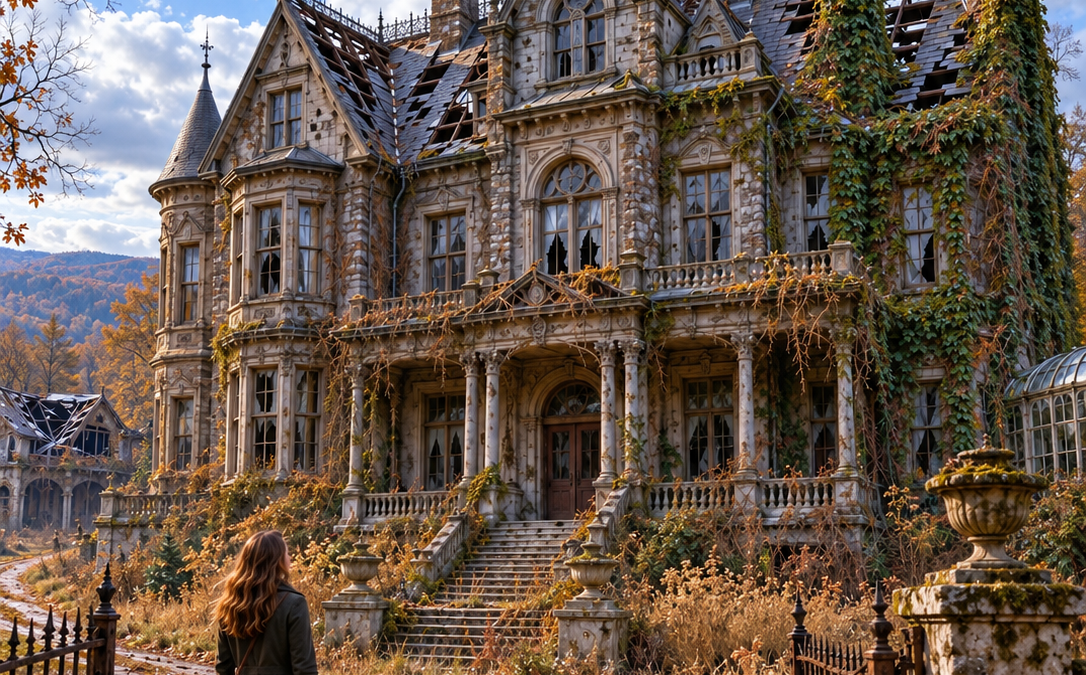
Beyond them stood Ironwood Manor.
Nora got out.
The November wind went straight through Leo’s jacket.
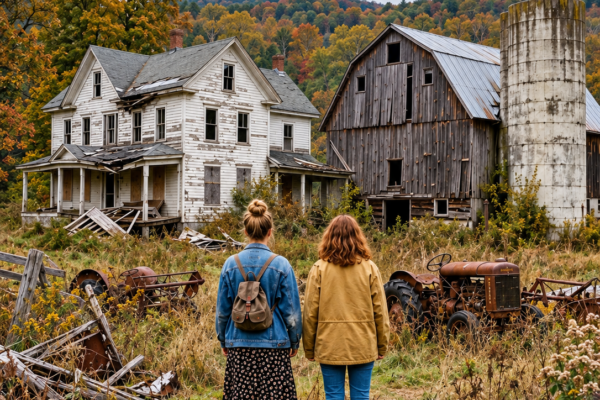
The house was enormous.
Three stories of dark stone rose from a hill above an overgrown valley. Chimneys leaned against a low gray sky. Ivy swallowed one side of the building. Several windows had been boarded. Others were black holes.
Behind it stood the remains of a carriage barn.
A section of roof had collapsed inward.
Beyond that were pasture fields disappearing beneath brush and young trees.
Nora walked slowly up the drive.
Dead leaves scraped across the stone.
The front door hung partly open.
Inside, rainwater had stained the walls brown. Plaster peeled in sheets. A chandelier dangled by one chain in the entrance hall.
The place smelled of wet wood and cold stone.
Nora moved carefully.
A dining room.
A ruined conservatory.
A pantry with rusted cans still sitting on shelves.
A library where mice had chewed books into gray nests.
She kept imagining the Hastings family arriving here generations earlier in automobiles driven by chauffeurs.
Servants lighting fires.
Children running the stairs.
Dinner bells.
Money everywhere.
Now all of it had become rot.
She found an upstairs bedroom with faded wallpaper printed with blue flowers.
On the floor lay a framed photograph covered in dust.
She wiped it with her sleeve.
A family stood in front of the manor sometime around 1948.
An older man. His wife. Three children.
Behind them, almost hidden near the edge of the picture, stood another young man beside a black automobile.
On the back someone had written:
Ironwood, September 1948.
Nora put the photograph in her coat pocket.
By late afternoon the cold had reached her bones.
She went downstairs and stood in the old library.
A section of ceiling had fallen in.
Wind blew through a broken window.
She looked around at the mold, rot and ruin.
Four hundred twenty-seven thousand dollars.
Her savings were nearly gone.
Leo’s life insurance would barely clear the remaining mortgage on their house.
She was sixty-two years old.
Her knees hurt after long shifts.
She had planned to reduce her hospital hours next spring.
Now she owned a condemned mansion and enough debt to destroy the rest of her life.
Nora gripped the edge of a mantel.
Then she screamed.
It came out of her without warning.
She screamed at Beatrice.
At Graham.
At every doctor who had told her there was nothing anyone could have done.
At God.
At Leo.
“You promised me!” she shouted into the empty house.
Her voice echoed upstairs.
“You said we’d grow old together!”
A piece of plaster dropped somewhere in the hallway.
Nora covered her face.
“I don’t know what to do, Leo.”
That was the first thing she had said in twenty-three days that felt completely true.
She sank onto the dusty floor.
Outside, darkness moved through the woods.
After a while she wiped her eyes.
Then she noticed something carved into the wooden edge of the fireplace.
Three initials.
E.I.H.
Under them, a date.
And beneath the date, a single word.
REMEMBER.
Nora ran her fingers over the carving.
She did not know what it meant.
Not yet.
But for the first time since entering Ironwood, she felt something other than despair.
Curiosity.
Part 2
Nora rented a room at the Oak Haven Motor Lodge for thirty-nine dollars a night.
The carpet was green. The heater rattled. A neon VACANCY sign blinked outside her window until midnight.
She slept anyway.
At six the next morning she called the hospital and requested another two weeks of bereavement leave.
Then she drove to the town hardware store.
A brass bell rang when she entered.
The man behind the register was somewhere near sixty-five, broad through the shoulders, with gray hair under a John Deere cap.
Nora bought leather gloves, contractor bags, masks, a pry bar, flashlights, rope and a small sledgehammer.
The man studied the pile.
“Building something or destroying it?”
“Probably both.”
He noticed mud on her boots.
“Ironwood?”
Nora looked at him.
“How does everybody know?”
“Small town.”
He held out his hand.
“Wyatt Mercer.”
“Nora Bennett.”
“Hastings?”
“Not anymore, if I can help it.”
That earned the beginning of a smile.
Wyatt rang up her supplies.
“My father worked there.”
Nora paused.
“At Ironwood?”
“Grounds crew. After the war.”
“What was the owner like?”
“Edwin Ironwood?”
Wyatt leaned against the counter.
“Depends who you ask. Some said brilliant. Some said crazy. Probably both.”
“People say he buried things.”
“People say plenty.”
“Did your father?”
Wyatt’s smile disappeared.
“He said old Edwin didn’t trust banks after 1929. Didn’t trust Washington after the war. Didn’t trust his own relatives by the end.”
“What did he trust?”
“Machines.”
Nora thought of the young man standing beside the automobile in the old photograph.
Wyatt continued.
“Cars. Engines. Farm equipment. Anything built by somebody who knew what they were doing.”
“Do you know what happened to it?”
“No.”
“Did your father ever mention anything under the carriage barn?”
Wyatt’s eyes sharpened.
“Why?”
“I haven’t found anything.”
That was true.
He studied her another moment.
“Watch the floors. One section collapsed ten years back.”
“I will.”
“You staying out there alone?”
“During the day.”
“If you find yourself under a beam, yelling won’t help much.”
“I’ve been under worse things.”
Wyatt raised an eyebrow.
Nora lifted the bag of respirators.
“I worked emergency medicine.”
He nodded as though that made sense of her.
“Store closes at five. My number’s on the receipt.”
For the next six days, Nora worked.
She approached the estate the way she had once approached an overcrowded emergency room during a winter flu outbreak.
Not as one impossible problem.
As a hundred smaller ones.
First she photographed everything.
Then she made a written inventory.
She taped dangerous stairways closed.
She separated salvageable metal from trash.
She cleared one downstairs room enough to use as a staging area.
She located the main electrical service and discovered the power had been disconnected in 1997.
The well pump no longer worked.
The septic system had not been inspected in decades.
Every answer created three more problems.
But the work steadied her.
At night she returned to the motel exhausted enough to sleep.
She began eating properly again.
On the third day, Mabel’s waitress introduced herself as June and stopped charging Nora for coffee.
On the fourth, one of the old men from the booth brought her a stack of historical society newsletters.
On the fifth, Wyatt arrived without being asked.
His truck carried two sheets of plywood, several braces and a thermos.
“You look terrible,” he said.
“So do you.”
“Fair.”
Together they stabilized a section of porch.
Wyatt did not ask why Nora cried once while holding a measuring tape.
He simply kept working.
Near sunset, they sat on the tailgate eating sandwiches.
“Leo would’ve liked you,” Nora said.
Wyatt chewed.
“That a compliment?”
“He didn’t like many people.”
“Then yes.”
She told Wyatt a little about him.
Not the polished version people told after funerals.
The real Leo.
How he hated olives.
How he bought too many used books.
How he once tried to fix their washing machine and flooded half the kitchen.
How he had grown up wealthy but never learned to care about expensive things.
“Why’d he leave them?” Wyatt asked.
Nora looked toward the darkening manor.
“Me, partly.”
“Only partly?”
“Leo couldn’t stand being owned.”
Wyatt nodded.
“Some families confuse love with ownership.”
Nora looked at him.
“Experience?”
“Everybody over sixty has experience.”
Then he stood and brushed crumbs from his coat.
“Cold’s coming.”
He was right.
Two mornings later frost covered the fields.
Nora decided to clear the carriage barn before snow made the work impossible.
Most of the roof had collapsed along the western side.
She began pulling loose boards from what remained of the tack-room floor.
Near noon, the pry bar struck something.
Not stone.
Metal.
Nora stopped.
She scraped away dirt.
A smooth steel surface lay beneath the rotten boards.
She uncovered another foot.
Then another.
The steel continued.
She fetched the sledgehammer and knocked apart the remaining flooring.
By three o’clock she had exposed a circular mechanism about eighteen inches across.
A wheel.
Attached to a steel plate.
Nora sat back.
Her breath came white in the cold.
She stared at it.
Then she pulled the hardware-store receipt from her pocket.
Wyatt answered on the fourth ring.
“This better not be about plywood.”
“I found something.”
“What?”
“A door.”
“In the house?”
“Under the barn.”
Silence.
“What kind of door?”
“Steel.”
Another pause.
“I’ll be there in twenty minutes.”
He arrived in fourteen.
Wyatt climbed down beside her, knelt and ran one gloved hand along the exposed steel.
His face changed.
“Well.”
“What?”
“This isn’t a cellar hatch.”
“What is it?”
He brushed dirt from the locking wheel.
“Military-style pressure door. Or something modeled after one.”
Nora stared.
“Why would somebody put that under a carriage barn?”
Wyatt sat back.
“Because he didn’t want anybody finding it.”
They uncovered the frame until sunset.
Concrete surrounded the steel on all sides.
Wyatt refused to cut it that night.
“Could be a sealed room with bad air. Could be fuel. Could be a collapsed chamber. We open it right.”
Nora barely slept.
The next morning Wyatt brought a generator, ventilation blower, steel cable, cutting equipment and an oxygen meter borrowed from the volunteer fire department.
June arrived carrying sandwiches.
Sheriff Tom Daley appeared because June had apparently told him half the town’s history was about to be uncovered.
Nora looked at the crowd.
“I thought this was a small town.”
“It is,” June said. “That’s why everybody’s here.”
Wyatt cut through the seized locking pins.
He attached a cable from his truck winch to the wheel.
“Back up.”
Metal groaned.
Nothing moved.
He tried again.
The truck suspension dipped.
Then, with a sound like an animal waking after a long sleep, the seal broke.
Dry air rushed from the darkness.
Everybody stepped away.
Wyatt tested the atmosphere repeatedly.
When the readings stabilized, he set a ladder into the opening.
“I’m first.”
“It’s my property.”
“And I’d rather not explain to the sheriff how the new property owner died twenty-four hours after meeting me.”
Daley nodded.
“He has a point.”
Wyatt descended.
Nora followed.
The ladder ended on a concrete landing.
A second steel door stood open below, apparently released by the upper mechanism.
Their flashlights moved across smooth concrete walls.
The room beyond was enormous.
Nora stopped breathing.
Rows of long shapes rested beneath canvas covers.
Shelving filled the far wall.
Wooden crates stood stacked from floor to ceiling.
Everything was dry.
Everything was still.
Wyatt walked toward the nearest covered object.
His hands were trembling.
“Don’t touch anything yet.”
Nora looked at him.
“You know what it is?”
“I know what shape it is.”
He lifted one corner of the canvas.
Chrome reflected the flashlight beam.
They pulled the cover back together.
A deep blue automobile emerged from the darkness.
It had sweeping fenders, enormous headlights and a hood longer than some modern cars.
Wyatt removed his cap.
“No.”
“What?”
He stepped closer.
“No, no, no.”
“What is it?”
“A Duesenberg.”
Nora knew enough about old cars to recognize the name.
“Is that good?”
Wyatt turned toward her as though she had asked whether gold was useful.
“Nora, there might be fewer than five hundred Model Js ever built.”
He moved his flashlight over the bodywork without touching it.
“This one looks original.”
Sheriff Daley whistled.
June said, “What’s it worth?”
Wyatt shook his head.
“I don’t know. Millions maybe. Depends on history, bodywork, provenance.”
Nora looked deeper into the chamber.
“There are more.”
There were seventeen vehicles.
Some were cars.
Several were motorcycles.
One appeared to be a prewar racing machine on wooden stands.
Crates contained engines wrapped in oil paper, carburetors, instruments, factory parts and sealed cases of documents.
In a smaller side room they found steel filing cabinets.
Nora opened one drawer.
Folders remained inside, labeled by year.
Her hands shook harder than they had when she signed Leo’s death certificate paperwork.
Wyatt pulled a folder carefully.
Inside were purchase receipts.
Factory correspondence.
Shipping manifests.
Numbers.
Serial codes.
Signatures.
“Provenance,” he whispered.
Nora sat down on a crate.
June stared at her.
“Honey, I think you just stopped being poor.”
Nora almost laughed.
Instead she started crying.
Not loudly.
She covered her mouth.
Wyatt crouched beside her.
“You okay?”
“No.”
She shook her head.
“I don’t even know what okay means anymore.”
She looked around the bunker.
Three dollars.
Beatrice’s hand pushing those bills across the table.
Graham laughing.
Four hundred twenty-seven thousand dollars in debt.
Leo dead.
Her future gone.
And beneath a barn nobody had bothered to visit sat a hidden collection that might be worth more than everyone in Oakhaven earned in a lifetime.
Nora wiped her face.
“Nobody says anything.”
Sheriff Daley nodded immediately.
“I’ll have a deputy watch the road tonight.”
“Why?”
“Because once somebody knows, everybody knows.”
Wyatt looked toward the entrance.
“And if that Hastings family dumped this land on you to avoid liability, they’re going to come back the moment they hear what’s under it.”
Nora stood.
The grief was still there.
But beside it now stood something else.
Purpose.
“Then they don’t hear.”
For the next forty-eight hours she moved carefully.
She hired an attorney in Albany with no connection to the Hastings family.
Then a classic-automobile appraiser in Boston.
Then a conservation specialist.
The appraiser arrived quietly, inspected three vehicles and stopped halfway through his notes.
“Mrs. Bennett, before I say anything else, secure the property.”
“How secure?”
“As though there are thirty million dollars sitting underground.”
Nora stared.
He removed his glasses.
“And I am being conservative.”
Using one documented engine as collateral, Nora obtained a short-term secured loan from a specialty lender.
She paid the delinquent taxes.
She satisfied the county’s immediate liens.
She posted insurance.
She hired fencing and overnight security.
For the first time in weeks, she felt herself breathing normally.
Then on Thursday morning, while she was standing beside the old greenhouse, her phone rang.
Graham.
She watched his name flash.
Once.
Twice.
Three times.
She answered.
“Hello.”
His voice was controlled.
“Nora.”
“Graham.”
“I understand you paid the Ironwood taxes.”
“Yes.”
“How?”
“Money.”
“Don’t be childish.”
Nora looked across the frost-covered pasture.
“You should try being clearer when you ask questions.”
Silence.
Then:
“What did you find?”
Nora’s hand tightened around the phone.
So they knew.
Not everything.
Enough.
She remembered Gable saying the deed included known and unknown contents.
She remembered Graham stopping his watch-checking for one fraction of a second.
Maybe he had not known what was beneath Ironwood.
But perhaps he had heard the same family stories everyone else dismissed.
“Nora.”
“Yes?”
“What did you find?”
She looked toward the broken barn.
Then she smiled.
“A lot of asbestos.”
And hung up.
Part 3
The first snow arrived the night before the Hastings family returned to Ironwood.
Only three inches fell, but it covered the ruined grounds in clean white and turned every broken fence rail into a dark line across the fields.
Nora was in the manor’s kitchen when Wyatt called from the gate.
“You expecting company?”
“No.”
“Black Mercedes SUV?”
Nora set down her coffee.
“I am now.”
By the time she reached the drive, Graham was already outside the gate.
Beatrice sat in the passenger seat.
Cecilia was not with them.
Graham wore a wool overcoat entirely unsuited to snow and mud.
The new fence stood between them.
Two security men remained nearby.
“Open it,” Graham said.
Nora stopped ten feet away.
“No.”
His face hardened.
“We need to talk.”
“We are talking.”
Beatrice stepped carefully out of the vehicle.
For the first time Nora could remember, Leo’s mother looked her age.
Not weak.
But tired.
The cold drew lines around her mouth.
“Nora,” she said. “Please.”
Nora almost opened the gate because of that one word.
Please.
Beatrice Hastings had never said please to her.
Then Nora remembered the three dollars.
“What do you want?”
Graham answered first.
“Access.”
“No.”
“You have possession of family assets.”
“I have possession of my assets.”
“The property transfer was intended to cover real-estate liabilities, not undisclosed personal property.”
Nora removed a folded photocopy from her coat pocket.
She had expected this.
“Paragraph fourteen.”
Graham did not move.
She read.
“‘Grantor conveys all land, structures, fixtures, subsurface improvements, abandoned chattels, stored contents and property of every kind situated thereon, whether presently known or unknown, with grantee assuming associated liability and benefit.'”
Graham’s nostrils flared.
“You know damn well that clause wasn’t intended to transfer a hidden collection.”
“It was intended to make sure you never had to pay for anything hidden here.”
“That’s not the same thing.”
“It became the same thing when I signed.”
Beatrice moved closer to the fence.
“What is down there?”
Nora studied her.
“You don’t know?”
“I know stories.”
“What stories?”
Graham cut in.
“Mother, don’t.”
Beatrice ignored him.
“My father-in-law collected automobiles before the war. Leo’s grandfather said Edwin Ironwood helped store equipment for businessmen who feared wartime seizure. There were rumors after Edwin died.”
“And you never came looking?”
“Your father said the collection was gone,” Graham said.
Nora looked at Beatrice.
“Did he know that?”
Beatrice’s eyes went toward the manor.
“I don’t know.”
The answer sounded genuine.
For one dangerous moment, Nora saw not the woman who despised her but an old mother standing in snow outside part of her own history.
Then Graham stepped forward.
“We’re obtaining an injunction.”
Nora’s sympathy disappeared.
“Do what you have to do.”
“I will.”
“I know.”
“We can make this easy.”
Nora almost smiled.
“Easy for whom?”
“We buy the property back. You walk away with the debts covered plus two hundred thousand dollars.”
Wyatt, listening several yards behind Nora, made a small sound that might have been a cough.
Nora stared at Graham.
“Two hundred thousand.”
“More than you had a month ago.”
“So is pneumonia.”
His face flushed.
Beatrice closed her eyes.
“Graham.”
“What?”
“Stop.”
But he was angry now.
“You don’t understand the position you’re in. Collectibles require authentication. Litigation can freeze sales. Taxes can consume fortunes. Storage costs. Security. Insurance. Experts. You’re a retired nurse with a second mortgage.”
“Not retired.”
“Fine. A nurse.”
Nora moved closer to the fence.
“I spent thirty-eight years watching people discover that money couldn’t bargain with death. I watched men worth millions beg for five more minutes. I watched women with nothing hold dying husbands more gently than your family ever held Leo.”
Graham’s mouth opened.
She continued.
“You keep assuming I want what you want.”
“And what exactly do you want?”
Nora thought about it.
“I want time to understand what I own. I want the truth about this place. And I want you off my land.”
She turned.
Behind her, Graham shouted.
“You’ll regret this!”
Nora stopped.
She looked back.
“Maybe.”
Then she walked toward the house.
The lawsuit arrived three days later.
Graham had not been bluffing.
The Hastings trust alleged mistake, unjust enrichment, lack of informed consent and improper transfer of trust-held personal assets.
Nora’s new attorney, Rebecca Sloan, read the filing at Mabel’s diner while Nora ate meatloaf.
“They’re throwing everything against the wall.”
“Can they win?”
“Anybody can win something with enough money and the right judge.”
Nora put down her fork.
Rebecca looked up.
“You want reassurance?”
“I want the truth.”
“The deed is strong. Their biggest problem is they wrote it. Their second problem is the transfer was designed specifically to cut off future liability. Courts don’t love sophisticated parties claiming they didn’t understand their own documents.”
“So we’re safe.”
“I didn’t say safe.”
Rebecca tapped the papers.
“They can make this expensive.”
Nora nodded.
That frightened her more than she let anyone see.
The bridge loan carried high interest.
Security cost money every day.
Engineers had discovered contamination around the old greenhouse.
The manor required stabilization before winter.
If litigation dragged on for years, even millions in theoretical value might not save her.
That night, Nora slept at Ironwood for the first time.
Wyatt had helped make two rooms in the west wing usable.
They installed a small woodstove, sealed broken windows with insulated panels and carried five-gallon water jugs from town.
Nora unfolded a camp cot in what had once been the estate manager’s office.
Wind moved across the roof.
The house creaked and knocked.
She kept Leo’s old jacket on a chair beside the bed.
At two in the morning she woke convinced someone had called her name.
She sat up.
Darkness.
“Nora.”
Nothing.
She laughed bitterly.
“Now I’m talking to ghosts.”
The woodstove had gone low.
She added two splits of maple and watched sparks rise.
On the desk lay boxes of documents removed from the bunker.
She had been reading them for days.
Most concerned vehicles.
But one file was different.
It contained correspondence between Edwin Ironwood and a man named Samuel Hastings.
Leo’s grandfather.
Nora opened it again.
A 1953 letter read:
Sam,
You are wrong about the valley. The railroad may leave, the mill may close, and our sons may decide the city is more respectable, but land remembers labor longer than men remember promises.
I will hold your portion with mine until you come to your senses.
E.I.
Nora read it twice.
Your portion.
She opened another letter.
Sam,
The machines remain below. Half were purchased through your account and half through mine, although the inventory should not be divided until preservation can be guaranteed.
If your heirs abandon Ironwood, they abandon what is stored with it. I will not allow the collection to be scattered by men who value price more than workmanship.
Your friend,
Edwin.
Nora’s heartbeat quickened.
Half belonged to the Hastings family once.
Not because they had inherited it automatically.
Because Samuel Hastings had helped purchase it.
There might be a claim after all.
She called Rebecca at seven the next morning.
Rebecca arrived before noon.
They read every letter.
When she finished, the lawyer leaned back.
“This complicates things.”
“How badly?”
“The Hastings can argue some vehicles were held in bailment or joint ownership.”
“But the deed.”
“Still helps us. The question becomes whether the trust owned the collection separately from the real estate at the time of transfer.”
Nora rubbed her forehead.
“So Graham might be right.”
“Partly.”
Nora hated that word.
“What do we do?”
“We keep reading.”
They found the answer two days later.
Not in the bunker.
In the manor library.
Nora had asked Wyatt to help remove a collapsed bookcase from the east wall. Behind it they discovered a narrow cupboard hidden between studs.
Inside sat one metal document box.
The lock broke with one twist of a screwdriver.
The papers smelled of dust.
At the bottom lay an envelope addressed to:
THE HASTINGS HEIRS, SHOULD THEY EVER RETURN.
Wyatt read the words over her shoulder.
“Well.”
Nora carried it to the kitchen.
Rebecca was there within the hour.
Inside was a notarized agreement dated October 4, 1961.
Samuel Hastings had transferred his entire interest in the preserved collection to Edwin Ironwood.
In exchange, Edwin forgave substantial debts Samuel owed after a failed commercial venture.
A final clause stated:
Should Samuel Hastings or his descendants acquire title to Ironwood estate in the future, all abandoned stored property then remaining upon or beneath the estate shall pass with the land unless expressly excluded in writing.
Rebecca read the paragraph three times.
Then she started laughing.
Nora did not.
“What?”
Rebecca looked at her.
“They excluded nothing.”
Nora thought of Graham.
All structures, substructures, contents, known and unknown.
“They did the opposite.”
“They practically engraved your name on it.”
Wyatt poured coffee into three chipped mugs.
“So it’s over?”
Rebecca’s laughter faded.
“No. Lawsuits don’t disappear because the facts become embarrassing.”
She turned toward Nora.
“But we just became much harder to bully.”
That afternoon Nora walked alone through the snow-covered field behind the house.
The pasture sloped toward a frozen creek.
Beyond it rose low wooded hills.
Ironwood was still ugly.
Still dangerous.
Still deeply in debt.
But she no longer saw only decay.
She saw stone walls that could be rebuilt.
Old apple trees buried in brush.
A barn foundation still square beneath the snow.
A road.
A creek.
A house that had endured abandonment without entirely falling.
Nora understood that.
At the far end of the field she found a section of fence down.
She went back for tools.
The temperature was twenty-six degrees.
Her fingers hurt inside her gloves.
She wrestled a cedar post upright and braced it with stones while Wyatt watched from his truck.
“You know we can fix that in spring.”
“I know.”
“Ground’s half frozen.”
“I know.”
“Then why are you doing it?”
Nora pulled the wire tight.
“Because it’s mine.”
Wyatt nodded.
He got out of the truck.
Without another word, he picked up a hammer.
Part 4
Winter settled over Oakhaven hard.
Snow followed snow.
The county plow stopped two miles from Ironwood, so Wyatt attached a blade to his truck and opened the road after every storm.
Nora spent Christmas in the manor.
She could have gone back to her house near Poughkeepsie.
She tried once.
She lasted forty-seven minutes.
Every room contained Leo.
His slippers beneath the bed.
His cereal in the pantry.
His fingerprints on the basement workbench.
She returned to Ironwood before dark.
On Christmas Eve, June brought turkey.
Wyatt brought pie.
Sheriff Daley brought a bottle of bourbon and claimed he was only staying ten minutes.
He stayed four hours.
They ate around an old kitchen table Nora found in the attic and repaired.
Snow pressed against the windows.
The woodstove glowed.
At one point June looked around the room.
“Not bad for a three-dollar house.”
Nora smiled.
“No.”
It was the first Christmas she had ever spent without Leo.
Halfway through dinner she excused herself.
She went outside.
Snowflakes caught in her hair.
She stood beneath the porch roof and cried quietly where nobody could see.
A minute later the door opened.
Wyatt stepped outside but stayed at the other end of the porch.
He did not ask what was wrong.
He knew.
After a while Nora said, “He always overcooked the turkey.”
“Tragic.”
“It was dry every year.”
“Some men shouldn’t be trusted with poultry.”
She laughed through tears.
Then she said, “I would eat the driest turkey on earth if he could ruin one more.”
Wyatt looked across the snow.
“Yeah.”
That was all.
And somehow it was enough.
In January, Graham Hastings changed tactics.
He stopped calling Nora.
Instead, he attacked the financing.
His attorneys challenged the collateral lender’s priority interest.
An insurance carrier threatened to suspend coverage until title litigation was resolved.
A collector who had privately offered seven figures for one automobile withdrew.
Nora sat in Rebecca’s office staring at bills.
“How long can we last?”
“At current burn rate?”
“Yes.”
“Maybe five months.”
Nora’s stomach tightened.
“And the court hearing?”
“Four months.”
“Convenient.”
“Very.”
Nora leaned back.
“I could sell my house.”
Rebecca’s expression sharpened.
“No.”
“It’s almost paid off.”
“That’s your home.”
Nora looked out the window.
“No. It was my home.”
Rebecca understood.
“You sell it and lose the case, you could lose both.”
“If I do nothing, Graham wins by waiting.”
Rebecca tapped a pencil against the desk.
“There is another option.”
“What?”
“Bring the truth into daylight.”
Nora frowned.
“The collection.”
“Not sell it. Document it publicly. Historical organizations. Preservation societies. Museums. Once respected institutions authenticate the Ironwood collection, the asset becomes harder to suppress or characterize as disputed junk.”
“Graham will hate that.”
“Exactly.”
Nora thought about Leo.
He hated public feuds.
But he hated secrecy used as power even more.
“Do it.”
Within weeks, experts began arriving in Oakhaven.
Automotive historians.
Archivists.
Museum conservators.
A documentary photographer.
The Ironwood collection was bigger than anyone first understood.
The seventeen vehicles included rare American luxury cars, European sports cars, motorcycles and experimental equipment.
Not every machine was worth millions.
Some needed extensive conservation.
But three vehicles were internationally significant.
The documentation made them even more valuable.
Then the archivists found something nobody expected.
The underground chamber contained records unrelated to automobiles.
Payroll ledgers.
Factory correspondence.
Photographs.
Engineering drawings from wartime manufacturing plants.
Letters from Oakhaven residents serving overseas.
Edwin Ironwood had preserved the history of an entire valley.
One afternoon an archivist named Dr. Helen Marsh carried a box upstairs and set it before Nora.
“You need to see this.”
Inside were photographs of women operating machinery in 1943.
A handwritten sign above them read:
OAKHAVEN AUXILIARY MACHINING GROUP.
Nora recognized the old feed mill.
“My grandmother worked there,” June whispered from behind her.
One photograph showed twenty-two women standing in coveralls.
June pointed to a tiny dark-haired girl near the end.
“That’s her.”
Her eyes filled.
“That’s my grandmother.”
For the first time, Nora understood Ironwood’s hidden value was not merely financial.
The bunker held lives.
Names.
Proof that ordinary people had mattered.
That night she sat alone in the library beneath the carved word REMEMBER.
It no longer felt mysterious.
Edwin Ironwood had not been hiding treasure merely because he was paranoid.
He had been preserving things.
Machines, yes.
But also memory.
She thought of Leo.
A history teacher who spent his life convincing bored nineteen-year-olds that the past was not dead.
“You would’ve loved this,” she whispered.
Her phone rang.
Cecilia Hastings.
Nora almost ignored it.
Then answered.
“What do you want?”
Cecilia sounded tired.
“To tell you something before Graham does something worse.”
Nora sat straighter.
“What?”
“My mother is sick.”
Nora’s anger faltered.
“How sick?”
“Heart failure. Manageable, supposedly. But stress isn’t helping.”
“I’m sorry.”
“I know you are.”
Silence.
Cecilia continued.
“Graham’s borrowing against trust assets to finance the lawsuit.”
“Why?”
“Because this stopped being about money.”
“It was always about money.”
“No. For him it’s about humiliation now.”
Nora looked toward the dark window.
“What do you want me to do?”
“Nothing.”
“Then why call?”
“Because Leo would’ve called me.”
The words hurt.
Nora closed her eyes.
Cecilia’s voice broke slightly.
“I wasn’t good to him.”
Nora said nothing.
“I kept thinking there would be time. Every Christmas I’d tell myself next year I’d visit. Next year I’d call without Mother knowing. Next year I’d tell him I understood why he left.”
Nora gripped the phone.
“There isn’t always a next year.”
“I know that now.”
For the first time, Nora heard grief in a Hastings voice.
Real grief.
Not polished.
Not strategic.
Cecilia sniffed.
“Graham found an old draft inventory in Father’s papers. He’s going to claim the collection remained separately titled trust property.”
“Rebecca already expects that.”
“There’s more. The inventory is incomplete. Graham intends to present it as final.”
“Meaning?”
“Meaning he knows there were later transfers that undermine it.”
Nora went still.
“Do you have proof?”
“I have Father’s correspondence.”
“Why are you telling me?”
Another long silence.
“Because Leo was my brother.”
Nora’s anger rose.
“He was your brother when he was alive.”
“I know.”
That answer stopped her.
Cecilia did not defend herself.
Did not excuse herself.
She simply accepted the wound.
Nora exhaled slowly.
“Send everything to Rebecca.”
“I already did.”
Before hanging up, Cecilia said, “Nora?”
“Yes?”
“I’m sorry about the three dollars.”
Nora looked at Leo’s old jacket hanging by the woodstove.
“So am I.”
The court hearing began in March.
Graham arrived with six attorneys.
Nora arrived with Rebecca.
Beatrice came in a wheelchair, furious at needing it.
Cecilia sat behind her mother but not beside Graham.
The Hastings team argued that the collection had always remained separate trust property.
Rebecca produced the 1961 agreement.
Then the later letters.
Then Cecilia’s documents.
Graham turned around slowly.
His sister met his stare.
The judge read in silence.
At one point he removed his glasses.
“Mr. Hastings, your own drafting counsel prepared the transfer instrument?”
“Yes, Your Honor.”
“And the trust insisted upon language conveying unknown contents to avoid future environmental and property liability?”
“That was not intended to—”
“I did not ask what you intended after the contents became valuable.”
Graham’s face flushed.
The judge continued.
“You cannot draft an absolute transfer when you believe the property worthless and then ask the court to rewrite it because your valuation was mistaken.”
Nora looked down.
Her hands were shaking beneath the table.
The judge did not issue the full ruling that day.
But the preliminary injunction was dissolved.
The collection belonged to Nora unless the Hastings could establish specific separately titled assets.
Outside the courthouse reporters waited.
Nora hated cameras.
Graham loved them when he controlled the story.
Today he did not.
“Nora!” someone shouted. “How does it feel to win?”
She stopped.
Beatrice was being helped toward a car behind her.
Graham stood several yards away, surrounded by attorneys.
Nora could have said something cruel.
She could have mentioned the three dollars.
She could have humiliated them.
Part of her wanted to.
Then she remembered Leo refusing to become like his family.
She faced the cameras.
“This isn’t about winning.”
A reporter called, “What is it about?”
Nora looked directly at Graham.
“Looking at something closely before you decide it has no value.”
Then she walked away.
Part 5
By late spring, Ironwood changed.
Not quickly.
Not magically.
Stone masons stabilized the manor.
Local crews repaired the carriage barn roof.
Environmental workers removed contaminated materials.
The old greenhouse came down completely.
Nora insisted that as many Oakhaven workers as possible receive the contracts.
“Money should stay where the mud is,” Wyatt said.
She liked that.
The final court ruling arrived in May.
The Hastings family’s remaining claims were dismissed.
Not because Nora had a better story.
Because the documents were clear.
Samuel Hastings had transferred his ownership decades earlier. The trust later reacquired Ironwood itself. When Graham arranged the three-dollar conveyance, his lawyers intentionally transferred everything attached to the property so no hidden environmental obligation could return to them.
They had protected themselves too thoroughly.
The language that was supposed to bury Nora saved her.
Two weeks after the ruling, Beatrice asked to see her.
Nora nearly refused.
Then she agreed.
They met at Ironwood.
Beatrice arrived without Graham.
Cecilia drove.
The old woman used a cane now.
Nora waited on the restored porch.
Beatrice looked up at the house.
“You saved it.”
“Part of it.”
“I hadn’t been here since I was eleven.”
That surprised Nora.
“You remembered it?”
“Of course.”
Beatrice looked toward the pasture.
“Leo fell out of that oak tree.”
Nora followed her gaze.
“He told me he broke his arm falling from a barn.”
“He lied. He wasn’t supposed to climb the tree.”
For one moment they almost smiled.
Then silence returned.
Cecilia walked toward the barn, leaving them alone.
Beatrice sat on a porch chair.
Nora remained standing.
“I came to apologize,” Beatrice said.
Nora waited.
Beatrice folded both hands over her cane.
“I disliked you before I knew you.”
“I know.”
“I told myself I was protecting Leo.”
“From what?”
“A smaller life.”
Nora looked around.
A breeze moved through new grass.
“Was it smaller?”
Beatrice’s eyes dropped.
“No.”
That single word carried more defeat than any courtroom ruling.
“He was happy with you,” Beatrice said.
“Yes.”
“I knew that.”
Nora felt anger tightening her throat.
“Then why punish him?”
Beatrice’s face shifted.
“Because every time he was happy without us, it proved he had been right to leave.”
There it was.
Not greed.
Not entirely.
Pride.
Fear.
The ordinary human ugliness of being unable to admit that someone loved you and still chose another way of living.
Beatrice looked toward the yard.
“When Leo’s father died, he asked me to call him. I didn’t.”
Nora said nothing.
“I told myself Leo should call me.”
“He did.”
Beatrice looked at her sharply.
“Twice.”
The old woman’s face collapsed by degrees.
Nora almost wished she had not said it.
Almost.
“I didn’t know.”
“You didn’t answer.”
“I changed numbers after—”
“Beatrice, stop.”
The old woman did.
Nora sat across from her.
“Leo spent thirty years making excuses for you. He said you were proud. He said Graham pressured you. He said losing his father changed you. He said you didn’t know how to apologize.”
Beatrice stared at the boards beneath her shoes.
“Maybe he was right.”
“No.”
Beatrice looked up.
Nora’s voice softened.
“He was kind.”
Tears appeared in Beatrice’s eyes.
She did not wipe them.
“I loved my son.”
“I know.”
That surprised them both.
Nora continued.
“But love doesn’t become useful just because you feel it privately.”
Beatrice closed her eyes.
They sat without speaking.
Finally, the old woman reached into her purse.
She placed three one-dollar bills on the small table between them.
The same bills.
Or perhaps merely three others.
Nora looked at them.
“I kept them after you left the conference room.”
“Why?”
“I don’t know.”
Beatrice swallowed.
“Perhaps because I knew even then that what we did was shameful.”
Nora touched one bill with her fingertip.
“I don’t want them.”
“I know.”
Beatrice stood slowly.
Before leaving, she turned.
“What will you do with the cars?”
“Some will be sold.”
“All of them?”
“No.”
“Which will you keep?”
Nora smiled faintly.
“The blue Duesenberg.”
Beatrice looked genuinely surprised.
“Why?”
“Because Leo would’ve hated it.”
For one second, Beatrice laughed.
It was the first sound Nora had ever heard from her that reminded her of Leo.
Then she cried.
Nora did not embrace her.
Not everything needed to be healed completely to be real.
But when Beatrice reached the steps, Nora offered her arm.
The older woman accepted.
The auction was held that August in California.
Nora flew west with Wyatt, June and Cecilia.
Wyatt wore a rented tuxedo and complained for three straight hours.
“You could hang drywall in this collar.”
“You look handsome,” June told him.
“I look embalmed.”
The main auction hall glittered with chandeliers.
Collectors from around the world filled the seats.
The Ironwood vehicles had become famous in preservation circles.
Their condition was extraordinary.
Their history even more so.
Nora stood near the back as the first major lot rolled onto the stage.
A silver 1936 automobile gleamed beneath white lights.
The auctioneer began.
One million.
Two.
Three.
The bidding rose.
Nora listened.
Not with triumph.
With disbelief.
At seven million, June grabbed her hand.
At nine, Wyatt whispered something inappropriate under his breath.
The hammer fell at eleven point four million dollars.
Applause filled the room.
More vehicles followed.
A European sports car brought nearly eighteen million.
The motorcycles and parts exceeded estimates.
A set of engineering documents was purchased by a museum consortium rather than a private collector after Nora insisted the archive remain accessible to researchers.
The final sale total, after premiums and fees, exceeded sixty-four million dollars.
Nora watched the number appear on the screen.
Sixty-four million.
She thought of the hospital cafeteria where she once counted coins because payday was two days away.
She thought of Leo driving a twenty-year-old truck.
She thought of the three dollars on the table.
Beside her, Cecilia cried openly.
“My family could’ve had all this.”
Nora looked at her.
Cecilia wiped her eyes.
“That sounded terrible.”
“It sounded human.”
“What are you going to do with it?”
Nora already knew.
She sold her old house.
Not because she needed money.
Because she was ready.
She donated most of Leo’s books to his former college, keeping the ones filled with his notes.
She moved permanently to Ironwood.
Not into the grand rooms.
She renovated the smaller west wing with a simple kitchen, wide windows and a bedroom overlooking the pasture.
The rest of the manor became the Ironwood Center for Rural History and Trades.
The underground vault was preserved.
Several vehicles remained on display.
The archive documented local factory workers, farmers, machinists and soldiers whose lives would otherwise have been forgotten.
Nora created the Leo Bennett Scholarship for older students returning to school after hardship.
She funded Oakhaven’s volunteer fire department.
She paid for repairs to the town clinic.
She established a small emergency fund for widows and widowers facing housing crises.
When Rebecca asked how large the fund should be, Nora thought for a moment.
“Enough that nobody gets destroyed because they were too grief-struck to read the fine print.”
Wyatt became facilities manager despite protesting that the title sounded “too clean for a man who unclogs toilets.”
June ran the center’s café three days a week.
Sheriff Daley donated his grandfather’s wartime letters.
Cecilia came often.
Graham did not.
His fight over Ironwood had damaged his standing inside the family business. Loans taken to finance litigation forced the trust to sell several investments. He remained wealthy, but something more important to him had been lost.
Certainty.
For the first time in his life, money had failed to make reality obey.
Nora heard that he blamed Cecilia.
She also heard Cecilia stopped caring.
Beatrice visited twice before her health declined.
On her final visit, she and Nora sat beneath the old oak tree where Leo had broken his arm as a boy.
They did not talk about lawsuits.
They talked about him.
What he was like at six.
At fourteen.
At thirty.
Nora learned he had once stolen Beatrice’s Cadillac at seventeen and driven it thirty miles to hear a blues band.
Beatrice learned he still made the same cinnamon toast she had made when he was a child.
Between the two women, a version of Leo existed neither had known alone.
That was more valuable than forgiveness.
It was truth.
Two years after Nora first climbed through the rusted gate, autumn returned to Ironwood.
The house stood solid beneath a bright October sky.
Children on a school trip crossed the lawn toward the museum.
The carriage barn had been rebuilt using much of its original stone.
A sign beside the road read:
IRONWOOD CENTER
WORK. MEMORY. LAND.
Nora sat on the porch drinking coffee from Leo’s old chipped mug.
She was sixty-four now.
Her knees still hurt.
Money had not fixed that.
It had not stopped her from waking some mornings reaching toward Leo’s side of the bed.
It had not turned grief into a beautiful lesson.
Some losses remained losses.
But grief no longer filled every room.
There was space around it now.
Space for work.
Neighbors.
Purpose.
Laughter.
A blue Duesenberg rolled slowly up the driveway.
Wyatt was driving.
Nora stood.
He stopped beside the porch and lowered the window.
“You’re late.”
“It’s eighty-five years old.”
“So are half the people who volunteer here.”
“Car has more sense.”
He got out.
The Duesenberg had never been restored.
Only conserved.
Its paint still carried tiny flaws from another century.
Nora liked them.
Perfection erased too much.
A busload of visitors gathered near the barn.
One elderly man walked toward the car.
He removed his cap.
“My father talked about this place,” he said.
Nora smiled.
“Did he work here?”
“During the war. Said there was machinery everywhere.”
“We may have his name in the archive.”
The man’s face changed.
“You do?”
“Come inside. We’ll look.”
He followed her toward the house.
At the front steps Nora paused.
The carved word above the old library fireplace was invisible from here.
But she knew it was there.
REMEMBER.
For years the Hastings family had believed inheritance meant possession.
Money.
Property.
Names engraved on buildings.
They had been wrong.
Inheritance was also what people carried.
Habits.
Stories.
Regrets.
Work done by hands no newspaper ever mentioned.
Love expressed too late.
Love expressed in time.
Nora had inherited debt, danger and humiliation.
She had also inherited the chance to decide what happened next.
That had been the real fortune.
That evening, after the visitors left, she walked alone to the hill behind the manor.
The sun was setting beyond the trees.
Fields glowed copper under the last light.
Nora carried something in her pocket.
Three one-dollar bills.
The ones Beatrice had left.
For two years they had remained inside a kitchen drawer.
Nora took them out.
She unfolded them.
Three dollars.
Once they had been an insult.
Now they were merely paper.
Nora laughed softly.
“Oh, Leo.”
Wind moved across the grass.
She imagined him beside her in his old denim shirt, hands in his pockets.
He would have made some joke about rich people being fools.
Then he would have asked whether she had eaten dinner.
Her eyes burned.
“I miss you.”
The valley gave no answer.
It didn’t need to.
She folded the bills again.
The next morning Nora framed them.
She hung them inside the museum near the entrance.
Beneath them was a small brass plaque.
It did not mention Graham.
It did not mention revenge.
It said:
IRONWOOD ESTATE WAS TRANSFERRED IN 2026 FOR THREE DOLLARS.
ITS GREATEST VALUE WAS NOT WHAT HAD BEEN HIDDEN BENEATH THE GROUND.
ITS GREATEST VALUE WAS WHAT PEOPLE ALMOST FORGOT.
Nora stood before the plaque for a while.
Then she opened the doors.
Outside, an October wind moved through the old trees.
A school bus turned up the road.
Wyatt shouted from the barn that a water line was leaking.
June was arguing with a delivery driver.
Somewhere inside the museum, a child laughed.
Nora rolled up her sleeves and went to work.
For the first time since the morning Leo’s coffee mug shattered on the kitchen floor, she did not feel as though her life had ended.
It had changed.
That was not the same thing.
Behind her, sunlight entered the old house through restored windows and spread across floors that had once been buried beneath rot and dust.
Ironwood had survived because someone eventually decided it was worth saving.
So had she.
You Might Also Enjoy

she prayed in a mountain cave because she had nowhere left to go—then a lonely rancher heard her through the storm