
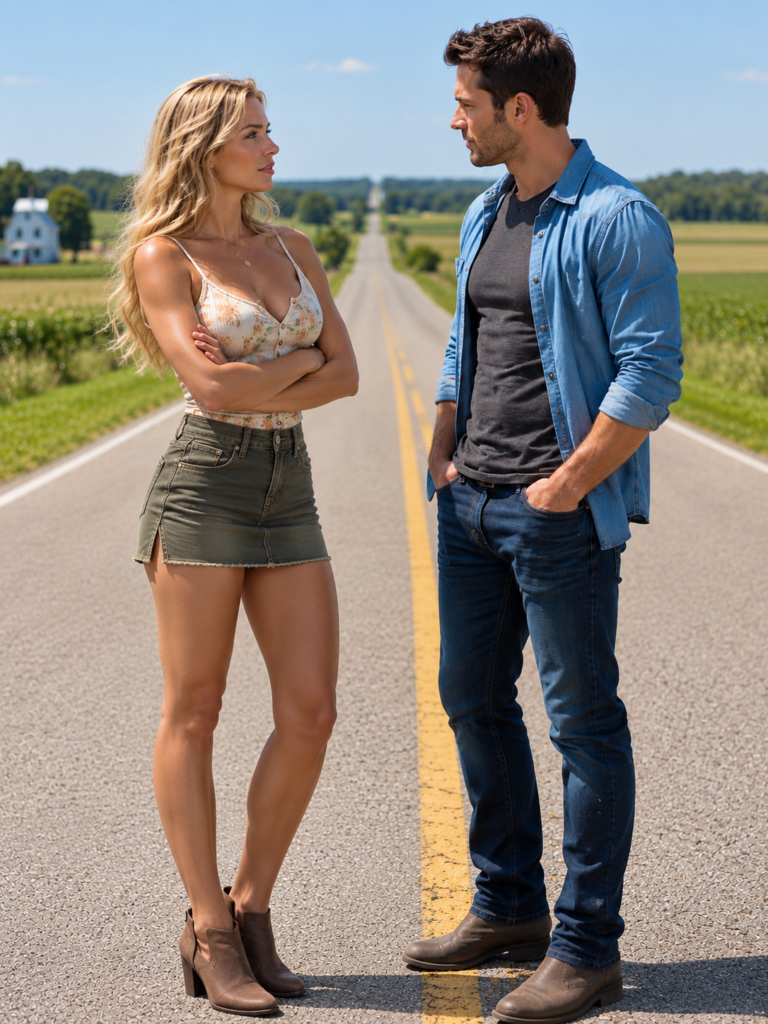
PART 3
I am standing in my driveway with a wrench in my hand when I realize I am about to say something that might ruin everything before it has even had the chance to become anything at all.
The sun is barely up. It sits low behind the trees like a coin pressed into cold blue paper, and the whole world looks washed clean in that fragile way Vermont mornings do at the end of summer. The grass is wet with dew. The gravel at my feet smells damp and mineral and familiar. There is engine oil on my hands and a streak of it on my left wrist where I wiped sweat away without thinking. My van sits open in front of me with the side door pulled back, exposing the inside like a secret I have been building for months and have only just now finished admitting I believe in.
I built the whole thing myself.
The bed frame is pine, sanded smooth and sealed three times because I knew I would run my hands over it when I was tired and needed to feel that I had made at least one solid thing in my life. The cabinet doors are crooked if you stare too hard at them, but they close right, and the latch holds even on bad roads. The curtains are sewn from dark canvas because I wanted privacy and because I do not trust factory stitches. There’s a narrow shelf over the driver’s seat with room for maps, a flashlight, a paperback, coffee filters, and whatever version of myself I thought I might become once I finally got on the road. I wired the battery system myself. I mounted the solar panel in August heat until the metal roof nearly burned my palms. I built the little table that folds out from the wall and locks back into place. I even made the cushions, badly at first, then less badly, until they stopped looking like something stolen from a church basement.
This van was supposed to be my answer.
My quiet, clean plan.
Leave before the winter contract starts. Head south by way of the coast. Sleep where the sky opens up. Keep driving until the inside of my head sounds different. Maybe North Carolina. Maybe further if the money stretches. No one to answer to. No one needing anything from me. No one close enough to disappoint.
My name is Marcus. I am twenty-eight years old. I have lived in this rental house in northern Vermont for three years, and in all that time I have barely spoken to the woman who lives next door.
Her name is Diane.
I know this because once, early in spring, I heard her laughing on the phone on her porch while I was fixing a loose board on my own steps. She said, “I am forty-three years old, not eighty-three. Reading glasses are not the beginning of the apocalypse.” I remember the number because it surprised me, and because the laugh that came after it sounded tired and warm at the same time, like it had been away for a while and had only just found the road back.
She has dark blonde hair she usually ties in a low ponytail that hangs over one shoulder when she’s carrying groceries. She wears jeans and hoodies and old boots and those thin silver hoops in her ears that catch light when she turns her head too quickly. She teaches ceramics at the community college twenty minutes away. I know this because on Monday mornings she loads boxes of clay into the back seat of her sedan and drives off with the grim concentration of someone already halfway into a room full of students. She divorced two years ago. I know this because one Tuesday a moving truck came and only half the furniture left, and because for the next week there were muffled arguments through open windows and then, suddenly, none at all.
I have noticed all of these things in the quiet, shamefully attentive way a person notices someone when they begin to matter before there is any permission for them to matter.
Not in a creepy way.
That distinction matters to me, maybe more than it should. I never looked through her windows. I never followed her anywhere. I never made up fantasies about her that replaced the fact that she was a whole person with a life I knew almost nothing about. It was more that she entered the edges of my awareness and never quite left. I would see her carrying groceries, or kneeling in her flower bed in old garden gloves, or standing on her porch after dark with a mug in both hands, looking out into nothing in particular. And every time I noticed her, something inside me shifted a little. Not enough to call it love. That would have been too dramatic, too adolescent, too convenient. Just enough to make the world feel fractionally more populated.
This morning she is standing on her porch in a gray sweatshirt, both hands wrapped around a ceramic mug, steam rising between her fingers. She is watching me and the van with that same direct, thoughtful look she has always had, like she sees more than people expect and has no interest in pretending otherwise.
I wipe my hands on my jeans and walk over before I can stop myself.
My heart is doing something humiliating in my chest.
“Big trip?” she asks.
Her voice is low, a little rough from sleep, and there is something in it I’ve always liked. Not husky in a flirtatious way. More like she does not waste tone on anyone who doesn’t deserve it.
“Yeah,” I say, nodding toward the van. “Finally finished. I’m heading to the coast. Maybe down to North Carolina. I’ve got a couple months before my next freelance job starts.”

She takes in the van slowly. The bike rack. The solar panel. The open side door. The little shelf where I have already stacked road maps and a tin coffee mug like props for a life I haven’t quite earned yet.
“That is really something,” she says.
I should stop there.
I should say thanks, maybe explain the battery system because that would be safe, and then go back to tightening bolts that don’t need tightening. I should not stand in front of a woman fifteen years older than me, on a bright quiet morning, with all my nerves showing.
Instead, because I am tired and keyed up and secretly desperate in ways I have not admitted even to myself, I hear myself say something that immediately makes me want to bite my own tongue off.
“If you were my age,” I say, “I’d take you on the road with me.”
The words land between us with a kind of soft violence.
I hear them fully only after they exist.
Not because it is obscene. Not because wanting her is obscene. Because hidden inside the joke is a line I never meant to draw. My age. Her age. Younger. Older. The reminder of difference dressed up like flirtation. The kind of thing men say when they want to seem brave and end up only sounding careless.
I want to take it back immediately.
I want to laugh and say that’s not what I meant and even I don’t know what I meant and we can both pretend my mouth didn’t betray me.
But Diane does not react right away.
She takes a sip of coffee, watching me over the rim of the mug.
Then she lowers it and looks straight at me.
“What are we waiting for?”
For one second my entire brain goes blank.
I still have the wrench in my hand. I can feel the cold metal of it against my palm, the roughness where the handle’s old rubber grip is peeling off.
“What?”
“You’re leaving this morning, right?” she asks.
“Yeah.”
“In about an hour?”
“Something like that.”
She nods once, a decision settling visibly through her body.
“I’ll be ready.”
Then she turns, walks back into her house, and closes the door softly behind her.
I stand there in the driveway staring at her porch like maybe I imagined the entire exchange.
This is not how this was supposed to go.
I was supposed to leave alone.
That wasn’t just the plan. It was the point.
The whole idea behind the van, behind the six months of measuring wood and budgeting and sanding and building, had been to get away from the shape my life had taken before I noticed I was living in it. I had told myself I needed solitude. Space. Motion. I never admitted that what I really wanted was escape from the dull, persistent feeling that I was always almost becoming something and then not quite getting there.
I go back to the van and pretend to be busy.
I tighten bolts that are already tight.
I check the oil again.
I reorganize the same drawer three times.
I wipe down the little counter.
I stand staring into the open cabinet like it contains an answer and not just oatmeal packets and coffee grounds.
Part of me hopes she doesn’t come back.
Part of me is terrified she won’t.
Twenty minutes later, her front door opens.
She comes down the steps carrying a canvas duffel and a faded backpack with one broken zipper pull. She’s wearing hiking boots, jeans, and a dark green jacket zipped almost to her throat. Her hair is still tied back. Her face is calm in a way that feels almost supernatural.
Too calm.
Are you sure? I ask when she reaches me.
She raises one eyebrow. “Are you?”
I hesitate.
This is the moment I could still stop it. Laugh it off. Tell her I was kidding. Say I am not good company. Say I didn’t think she would actually come. Say all the clever, self-protective things men say when reality suddenly offers them exactly what they claimed to want.
But the truth is I do not want to stop it.
“Yeah,” I say. “I’m sure.”
She hands me the duffel. Our fingers brush for less than a second. My chest tightens like something inside it has been waiting years for exactly that amount of contact.
I load her bag into the van.
She climbs into the passenger seat like she belongs there.
That is maybe the strangest part at first. Not that she came. Not even that she trusted me enough to come. It’s the way she sits down without performing awkwardness for either of us. Hands folded in her lap. Mug in the cup holder. Looking straight ahead while I circle around to the driver’s side feeling like I’m entering an alternate version of my own life.
The engine turns over rough, then settles into that steady familiar growl I spent months promising myself would eventually mean freedom.
I glance at her.
She glances back.
“I brought coffee,” she says.
The red thermos appears from her bag like a peace offering.
“If you want some.”
I laugh under my breath because, suddenly, of course she brought coffee. Of course she would arrive prepared, calm, with caffeine and a packed bag and none of the fussing I would have done in her place.
She pours carefully into the travel mug and hands it to me.
The coffee is hot and dark and strong enough to make me forgive every bad decision I’ve ever made.
We pull onto the road.
For the first hour, we barely talk.
Not because the silence is bad. The opposite. It is careful. Curated. Like both of us understand that one badly placed sentence could knock this new impossible thing sideways before it even develops a shape.
Northern Vermont gives way to the kind of morning New Hampshire was probably invented to hold—pine trees tall and still, white church steeples, fields with round hay bales sitting in them like punctuation. We stop for gas and Diane buys trail mix and bottled water and returns to the van like she has been doing this with me for years instead of thirty-seven minutes.
Back on the highway, she opens the trail mix and holds it out.
Our fingers almost touch.
“Why did you say that?” she asks quietly.
I grip the steering wheel.
“About your age?”
She nods.
I stare at the road for a while before answering because this is a place where lies would be easy and absolutely fatal.
“I think,” I say slowly, “I was trying to say something without saying it.”
She waits.
The van hums. A truck passes us in the left lane. The thermos shifts in the cup holder with a soft metal clink.
“Like what?” she asks.
I exhale.
“That I think about you more than I should.”
There.
Out.
Irretrievable.
The highway stretches ahead through trees and low hills and the sort of beautiful indifference nature specializes in. I wait for the sentence to make her laugh, or go quiet in the wrong way, or make her tell me I’m being flattering and reckless and a little ridiculous.
Instead she looks out the windshield and says, “I almost didn’t come.”
I glance at her.
She is still watching the road.
“I stood in my kitchen,” she says, “with my hand on that duffel bag for about ten minutes thinking I was being absurd.”
“What changed your mind?”
She smiles then, small and private.
“I decided I’d rather be absurd than safe.”
Something in me settles so suddenly it feels like a physical shift.
By midday we are deep into New Hampshire. The road narrows, curving around lakes that flash silver between trees. Diane hums softly when I put music on. She doesn’t ask what I’m playing. She just leans back and lets it happen. It feels so easy that it scares me a little. I have spent enough of my life around complicated people, around relationships where every quiet meant something unspoken and every request arrived with a hidden invoice behind it. This has none of that. Not yet.
We cross into Maine in the late afternoon and take a smaller road on impulse when a sign promises a scenic overlook by a lake. The parking area is nearly empty. Just one truck at the far end and a family with two kids skipping stones near the water.
The air is cooler here. Cleaner. The lake sits still as polished glass, reflecting the clouds in long white streaks. We stand side by side at the railing and do not touch.
“Are you okay with this?” she asks.
I turn to look at her.
There is no irony in her face now. No performance. She genuinely wants to know if this is too much, too strange, too fast.
“More than okay,” I say.
She smiles then. Small and real. The kind of smile that doesn’t ask to be seen but feels like being chosen when it is.
We camp that night under trees near a state park where the ranger barely glances at the van and waves us toward a patch of dirt and pine needles that feels private enough to matter. I build a fire with wood I bought from a roadside stand. Diane sits on a folded camp chair with the blanket over her knees, watching the flames catch.
When the air cools, I bring her another blanket without asking.
Our fingers linger this time.
“You can sit closer,” she says.
I do.
The stars come out over us, sudden and impossible in the clear dark. We drink the rest of the coffee, then switch to cheap wine from plastic cups because that feels somehow exactly right and exactly ridiculous. She tells me about one of her students who made an entire ceramic bowl lopsided and still insisted it was intentional. I tell her about the client from last winter who tried to pay me in handcrafted hot sauce instead of cash for a website redesign.
She laughs.
I watch her laugh.
And for the first time, I think this might not be a mistake at all.
When I wake to rain the next morning, everything already feels different.
The world outside the van has gone gray and blurred, every tree softened by water. Rain taps steadily on the roof in a pattern that somehow manages to be both soothing and impossible to ignore. The windows are fogged. The campsite beyond them looks abandoned, all cold picnic table and slick leaves and air that would cut right through a sweatshirt if I stepped out unprepared.
Inside the van it feels small, warm, and strangely safe.
Diane is curled toward the passenger-side window with the blanket around her shoulders, her hair loose now, darker at the ends from the damp. There is something so intimate about that sight that I have to look away for a second just to breathe normally again.
I make coffee on the tiny propane stove in silence.
When she wakes, she watches me pour and smiles like this, this exact absurd little setup in a self-built van in the rain, is the most natural thing in the world.
“Can I tell you something?” she asks once both cups are warm in our hands.
“Of course.”
She looks down at the coffee before she answers.
“I don’t usually do things like this.”
“No?”
“No.” Her smile turns thoughtful. “I make lists. I think things through. I plan. I usually know what I’m doing two weeks ahead. This…” She gestures vaguely to the rain, the van, me. “This was not on any list.”
“It wasn’t on mine either.”
She laughs softly, then goes serious again.
“I don’t know what happens after this trip,” she says. “I just knew that if I stayed home, I would keep wondering. And I am tired of wondering.”
I know exactly what she means.
Wondering is another word for fear when it gets dressed for respectable company.
When the rain slows enough for us to move, we pack the wet tent together, our hands brushing often enough that it stops startling me. By the time we’re back on the road, the silence between us has changed. It isn’t careful anymore. It’s inhabited.
Then I hear it.
A low rattle. Soft at first. Easy to ignore if I really wanted to.
My stomach drops.
“You hear that, right?” Diane asks.
“Yeah.”
The sound grows louder with every mile. Mechanical. Wrong. The kind of noise anyone who has spent six months building a van from a shell learns to hear immediately and hate on principle.
I take the next exit and pull into a gas station with a two-bay repair shop attached to it. The van sputters once as I park, then idles with that same ugly metallic complaint that tells me exactly how expensive this day is about to become.
The mechanic is maybe sixty and shaped like an old fire hydrant. He listens, pops the hood, listens again, and then gives me the look every driver dreads.
“Alternator’s going,” he says. “I can fix it, but I won’t have the part till tomorrow.”
Tomorrow.
The word lands with a stupid amount of weight.
When I turn to tell Diane, I expect disappointment. Maybe annoyance. Maybe the first little fracture in the careful magic of the trip.
Instead she just nods.
“Okay,” she says.
I blink. “You’re not upset?”
She steps closer and touches my arm lightly, just above the elbow.
“Marcus,” she says, “this is part of it. Things break. Plans change.”
I let out a breath I didn’t realize I was holding.
There is a town a few blocks away. One main street, white clapboard buildings, a diner, a bookstore, a bed-and-breakfast painted yellow with a porch swing that creaks in the wind. It feels like the sort of place where time slows down just enough to make people reveal themselves.
At the bed-and-breakfast, the woman at the front desk apologizes before she even checks.
“One room left,” she says. “One bed.”
I open my mouth to say we’ll find somewhere else.
Diane beats me to it.
“We’ll take it.”
The room is simple and clean. White quilt. Lace curtains. A braided rug at the foot of the bed. A little bathroom with rose-patterned wallpaper so old it’s become charming again.
It feels strangely intimate just standing there.
“I can sleep on the floor,” I say too quickly.
She turns and looks at me like I’ve just suggested we communicate by carrier pigeon.
“We’re adults,” she says. “We can share a bed if that’s okay with you.”
It is more than okay.
It is possibly the best sentence I have ever heard in my life.
It is also terrifying.
She showers first.
I sit on the edge of the bed staring at the carpet and trying not to become the kind of man who mistakes physical proximity for permission. I tell myself this over and over until the bathroom door opens and Diane comes out wearing sweatpants and an oversized gray sweater, her hair damp and loose around her shoulders, and all my self-control becomes abstract theory.
My shower does not help.
We go to the diner across the street because if I stay in that room too long without witnesses I might say something even stupider than the age joke.
The diner is warm and bright and smells like coffee and grilled onions and old pie crust. We slide into a booth by the window. She reaches across the table at one point and covers my hand with hers while I’m talking about nothing important at all.
“This is perfect,” she says quietly.
I want to believe her so badly it almost hurts.
Back in the room, the silence is heavy now but not uncomfortable. Full. Waiting.
She sits cross-legged near the headboard and looks at me with a calm I still don’t understand.
“What were you afraid of?” she asks.
“When?”
“When you invited me.”
I laugh once. “I didn’t exactly invite you.”
“You know what I mean.”
So I tell her the truth.
“That you’d realize I’m not enough.”
Her expression shifts.
Not pity.
Something gentler and harder to survive.
She moves closer until I can feel the heat of her body.
“I’m not going anywhere,” she says.
The kiss happens slowly.
Not because either of us is playing some careful game. Because speed would cheapen it somehow. Because both of us have lived enough life to know that urgency and honesty are not the same thing. Her lips are soft. She tastes like coffee and rain and the kind of relief I didn’t know had a physical form.
When we pull apart, my heart is hammering so hard I can feel it in my wrists.
We sleep side by side with our hands finding each other in the dark like they already know the route.
In the morning, I wake before her and walk across the street for coffee and blueberry muffins, and when I come back she smiles at me like I have done something impossibly tender instead of just buying breakfast.
We spend that day walking the town.
Bookstore.
Secondhand shop.
A place that sells old maps.
A diner lunch.
A bakery where she buys maple cookies and insists I try one before we leave.
We talk more now because the first wall is down.
She tells me about her marriage in pieces, not dramatically, not as a confession. Just the truth as it comes.
He wasn’t cruel, she says. That would have been easier. He was distracted. Distant. More in love with his own ambitions than with anything in the room. When they divorced, it felt less like a collapse than like the final acknowledgment of a silence that had been there for years.
“I forgot who I was in that marriage,” she says while we walk along the little river behind the library. “Not all at once. Just in tiny practical ways. I stopped making things I liked because he thought the kiln smell got into his clothes. I stopped taking weekend classes because we ‘needed more time together,’ which translated to sitting beside him while he answered emails. I got good at becoming convenient.”
That sentence stays with me.
Because I know that language, even if my version of it looks different.
I tell her about the years after college, the freelance work, the moving around, the terrible apartments and short contracts and the way I kept telling myself I liked not being tied down when really I was just afraid of wanting anything badly enough to be disappointed if it failed.
The van, I admit, was not only about travel. It was about control. A home I could build myself. An escape I could manage alone. A future that didn’t require another person’s agreement.
“Instead,” she says, smiling as we head back toward the inn, “you got me.”
“Yeah,” I say. “Turns out that’s better.”
When we pick up the van the next afternoon, it feels like freedom again. But now freedom has her in the passenger seat.
We drive south along the coast. The Atlantic stretches out beside us, gray-blue and endless. We stop wherever we feel like stopping. A beach with almost no one on it. A roadside stand selling apples and hot cider. A pull-off where black rocks split the surf into white explosions.
The world narrows beautifully.
Morning coffee wrapped in blankets.
Her hand on my knee while I drive.
Kissing in parking lots.
Silence with her head on my shoulder while the van cools after a long day on the road.
There is no pressure to define it.
That might be the strangest mercy of all.
On the third morning by the ocean, I wake up and find her already dressed, sitting in the passenger seat with the red thermos in her lap and the whole gray Atlantic spread out beyond the windshield.
Something in her face is different.
Not wrong.
Heavy.
“Hey,” I say, pushing myself up.
“Hey.”
“You okay?”
She nods, then looks down at the thermos and back up at me.
“I think we should go home.”
The words hit me harder than I expect.
“Why?”
“Not forever.” She reaches over and touches my hand. “I have classes next week. You have work coming up. We can’t make a real life decision inside a beautiful accident and pretend that’s the same thing as knowing.”
I know immediately that she is right.
I also hate it.
The road back north feels longer. We stop at another bed-and-breakfast on the way. There is no awkwardness now about sharing the bed, but there is a new tenderness in it, a kind of mutual recognition that we are carrying something fragile back into the ordinary and neither of us knows yet whether the ordinary will crush it or teach it how to last.
She falls asleep with her head on my chest.
I lie awake a long time memorizing the weight of her, the sound of her breathing, the way her hand curls lightly into my shirt even in sleep like some part of her has already chosen trust before the rest of her can argue.
When we finally pull into my driveway the next afternoon, the sky is heavy with clouds. My van engine clicks as it cools. Neither of us moves.
“So,” she says softly. “What now?”
I look at her. “What do you want?”
“I want to keep doing this.”
My answer comes before fear can offer edits.
“Yeah. Me too.”
She smiles then and kisses me slow and gentle and so full of promise it almost makes me stupid again.
Then she grabs her bags and walks across the small strip of lawn to her house.
At the door she turns and waves.
I wave back like a man seeing home from a distance.
That night the van feels weirdly empty. The blankets still smell like her shampoo. One of her hair ties is looped around the cup holder. The red thermos sits on the passenger seat.
She forgot it.
Or maybe she didn’t.
The next morning, I fill it with fresh coffee and walk across the grass to her door.
She opens it with damp hair and sleepy eyes and one sock on.
“You forgot this,” I say, holding it out.
She smiles.
“I did not forget it. I left it on purpose.”
“Why?”
“Because I knew you’d bring it back.”
Then she steps aside.
I follow her into her kitchen.
I have never been inside her house before. That realization hits me first. Then everything else.
Pottery everywhere.
Bowls on shelves.
Half-finished mugs drying on a tray by the sink.
A wheel in the corner of the dining room turned into a studio nook.
Plants.
Books.
A red chair by the window with a blanket draped over it.
Light in every possible place.
Her house feels like the opposite of mine, not in a bad way. Mine is neat because I don’t accumulate much. Hers is warm because she has. It looks like a person has lived here on purpose, even through the hard years.
We sit at the kitchen table with our knees touching.
“So,” she says, wrapping her hands around the thermos lid she’s using as a cup, “where do we go from here?”
I look at her and realize the answer has been there all along. Not in words. In the way we came back.
“Anywhere you want.”
She smiles, and for the first time, the future does not feel like a cliff.
It feels like weather.
Natural.
Changing.

Survivable.
We sit there longer than we need to. The coffee cools. Her hand rests over mine and stays there without ceremony. Outside, the neighborhood is almost offensively peaceful. No cars. No voices. Just wind in the trees and the occasional distant bark of a dog I’ve never seen.
“We’re really doing this,” she says.
“Yeah.”
She exhales like she’s been waiting to hear the sentence spoken in full.
“Good.”
“Good?”
“I don’t think I could pretend that trip didn’t happen.”
“Neither could I.”
She stands and rinses the cups in the sink. I watch her move around the kitchen like it’s already one of my favorite things to do.
“I should unpack,” she says. “I still haven’t opened my bags.”
“You disappeared for almost a week. I assumed decompression was necessary.”
She laughs and nudges my shoulder. “You’re not wrong.”
When I stand to leave, she walks me to the door. We hesitate there, absurdly, because even though our houses are maybe ten steps apart, goodbye suddenly feels heavier than geography should allow.
“Come over later,” she says. “For dinner.”
“Yeah,” I say. “I will.”
The rest of the day crawls.
I unpack the van. Put tools back. Wipe down the counters. Re-fold blankets. The practical work should settle me, but everything in the house feels slightly off, like it noticed I left one version of myself and came back with another.
That evening I walk over with a bottle of wine and a loaf of bread from the little market in town.
She opens the door in jeans and a soft cream sweater, hair down.
“Hi.”
“Hi.”
Dinner is soup and salad and bread and a kind of careful happiness neither of us wants to spook by naming too loudly. We talk about nothing pressing. Movies. Places we have not been. The ceramic residency in North Carolina she once almost applied for and didn’t. The tiny mountain town in Colorado I spent six months in after college because I thought I might become a different person there and only ended up becoming cold.
Later we move to the couch.
She curls into my side without asking.
Her head fits under my chin like I’ve been built around the idea of it without realizing.
“Marcus,” she says after a while, “can I be honest?”
“Always.”
“I’m scared.”
I look down at her.
“Not of you,” she says quickly. “Just… this. How fast it feels. How right it feels. That part scares me more, honestly.”
I nod because pretending otherwise would be cowardly.
“Me too.”
She turns enough to see my face.
“But,” I add, “I think sometimes slow is just another way people wait until something gets out of reach.”
She studies me for one long second.
Then she smiles.
“I’m glad you said that.”
We kiss.
Easy.
Familiar.
No uncertainty left in it.
After that, real life begins.
And that is where most stories cheat.
They end at the kiss.
At the road trip.
At the promise in the doorway.
They stop before bills and schedules and ex-spouses and the ordinary friction of two people trying to see whether an intense beginning can survive fluorescent kitchens and grocery lists and bad moods on Tuesdays.
We did not stop there.
We had to learn each other in daylight.
The first few weeks feel almost embarrassingly good.
Morning coffee at one house or the other.
Walks after dinner.
Text messages about nothing.
The slow migration of objects that announces affection before anyone says the word live.
Her mug at my sink.
My hoodie over her kitchen chair.
Her shampoo in my shower.
My tools fixing the cabinet hinge in her bathroom because I notice it before she asks.
The age difference shows up, but never the way I feared.
Not as a wall.
More like texture.
She remembers songs I only know because my mother played them while cleaning. I reference websites and jokes from high school that make her laugh and then call me impossible. She had a husband before me, a mortgage before me, years of adult life built in a different shape. I had roommates well into my twenties, a string of cities, and a habit of leaving before things got serious enough to disappoint me.
But none of that translates into imbalance the way outsiders like to imagine. It becomes conversation. Context. Different routes to the same porch.
One night, sitting outside while the sun goes down, she says, “You know if you hadn’t made that stupid joke, none of this would have happened.”
I laugh softly. “Worst joke of my life.”
“Best one,” she corrects.
I think about the van, the trip I planned to take alone, the whole narrative I had built around escape, and I realize something that embarrasses me with its simplicity.
I didn’t need distance.
I needed courage.
She sees it in my face before I say it.
“What are we waiting for?” she asks.
I look at her.
And this time, unlike in the driveway, I actually know.
“Nothing,” I say.
“Absolutely nothing.”
That should have been enough to carry us.
In many ways, it was.
In many other ways, it was only the beginning.
Because love, once it stops being hypothetical, begins asking practical questions.
Where do we sleep most nights?
Who keeps what at which house?
What do we do when one of us needs space?
How much alone time is healthy?
How much togetherness is enough?
What happens when someone gets sick?
What happens when winter comes?
What happens when one life, previously designed for one person, must start making room for two without feeling crowded?
The first real argument we have is over a casserole dish.
That sounds ridiculous until you understand that no argument is ever really about the thing in your hands. It is about what the thing touches.
Diane invites me to dinner one Wednesday after a long day at school and a longer one for me trying to finish a website redesign for a winery owner in Stowe who keeps changing the color palette every six hours. She is tired. I am tired. The casserole dish cracks in her hands as she takes it from the oven, not badly enough to shatter, but enough that she curses and drops it onto the stovetop too hard.
I reach for it.
“So help me,” she snaps, “if you tell me to relax, I’m throwing this at the wall.”
I freeze.
She freezes.
The silence that follows is not about the dish anymore.
It is about the fact that I have been helping with everything without asking whether she wants that kind of help all the time.
It is about the fact that she has started relying on my presence and now resents it slightly because dependence frightens her.
It is about the fact that I have quietly begun spending more nights there than in my own house and neither of us has named what that means.
“Sorry,” she says first, too quickly.
“No, you’re not,” I say, because tiredness makes me honest in dangerous ways.
Her face changes.
“You want me to be?”
“I want you to tell me what that was actually about.”
She stares at me, then turns off the burner and leans both hands on the counter.
“I don’t know how to do this part,” she says.
“What part?”
“The part where someone’s in my space all the time and I like it.”
It’s so vulnerable and sharp and unguarded that all my defensiveness drains right out through my shoes.
I step closer, but not too close.
“You can tell me when you need space.”
“I know that.”
“Then tell me.”
She closes her eyes.
“I’m scared,” she says. “Every time something gets good, I start waiting for the version of it that asks me to disappear.”
There it is.
Not the casserole.
The marriage.
The slow erasure she survived before me.
I put my hands on the counter beside hers and say the only true thing I have.
“I’m not him.”
She laughs weakly. “No. You’re younger and more annoying.”
“Cruel.”
That gets a real laugh.
Then she turns and leans into me and we stand there in front of the ruined casserole and let the argument become what it should have been from the start: an explanation, not a wound.
That is how we learn.
Not by never getting it wrong.
By recovering honestly when we do.
Winter comes early that year.
The first heavy snow lands in November and transforms the space between our two houses into something almost symbolic. What had been a casual strip of lawn becomes a small white road we keep crossing anyway.
I shovel her walk if I’m up first.
She leaves soup in my fridge if she knows I’m buried in a deadline.
We start joking that our houses are just rooms in the same badly planned building.
By December, most nights end in the same bed. Sometimes mine, more often hers, because her mattress is better and her bedroom window faces east and she likes the morning light.
Around Christmas, my sister Leah visits from Burlington and takes one look at Diane passing us mugs of coffee in fuzzy socks and says, after Diane steps into the kitchen, “You’re in love with her.”
I stare at her.
“That obvious?”
Leah snorts. “Marcus, you are standing differently.”
“What does that even mean?”
“It means you look like someone who knows where he’s going after dinner.”
Which, infuriatingly, is exactly what it means.
Diane’s complication arrives in January, wearing expensive boots and a cashmere scarf.
Her ex-husband, Peter, comes by without warning.
I am in her kitchen making coffee because apparently that has become a legitimate function in my life. She opens the door, sees him, and goes so still that I know instantly this is not a harmless visit.
He is handsome in a polished, slightly tired way. Corporate. Careful. The sort of man who probably has opinions about chair design and tax shelters. He looks past her and sees me with one hand on the coffee pot.
The silence crackles.
“Can I come in?” he asks.
“No.”
Then she seems to remember I exist.
“Marcus, could you—”
“Want me to stay?”
Her eyes flick to mine. A hundred things pass there. Pride. Old habits. Embarrassment. Relief.
“Yes,” she says finally. “Stay.”
That one word changes the whole dynamic.
Peter hears it too.
He steps inside with visible effort and we all sit in the living room like civilized people trying not to become their worst selves before noon.
He says he’s moving to Seattle.
He says his firm offered him a promotion.
He says he thought she should know in person.
Then, because some men are unable to leave things at the size they arrived, he adds, “And because I heard… things.”
“Things,” Diane repeats.
He glances at me. “About the neighbor.”
I do not like him on principle now.
Diane leans back in her chair. “The neighbor has a name.”
“I’m sure he does.”
I almost laugh at how efficiently he has made himself ridiculous.
Then he says the real thing.
“Diane, you don’t have to do this because you’re lonely.”
The room goes cold.
I start to stand.
She stops me with one look.
Then she turns to him and says, in the calmest voice I have ever heard her use, “You don’t get to diagnose me anymore.”
Peter blinks.
She goes on.
“Lonely is the marriage where I learned to ask permission before hanging a shelf in my own kitchen because you cared about visual symmetry more than my comfort. Lonely is spending ten years beside someone who notices when the market drops but not when I stop making art. Lonely is not this.”
She gestures toward me—not grandly, just enough.
“This,” she says, “is chosen.”
Peter’s face goes through three expressions in the space of five seconds. Surprise. Offense. Something more complicated and maybe more honest than either.
Then he stands.
“Goodbye, Diane.”
“Goodbye, Peter.”
He leaves.
The door shuts.
The house is silent.
I turn to her.
“You okay?”
She looks at me and suddenly starts laughing, full and startled and maybe a little wild.
“I think,” she says between breaths, “that might be the first time in my life I’ve won an argument ten years late.”
I laugh too.
Then she starts crying.
I hold her while she does, and when it’s over, she says into my shirt, “I’m so tired of surviving versions of myself.”
That sentence stays with me for weeks.
Because I know exactly what she means.
My version of it comes later, in March, when a freelance contract I’ve been counting on falls through three days before the deposit is due on my next big project. It shouldn’t be catastrophic. I have savings. Some. Not enough. I have work. Just not that work. But the old panic rises anyway. The old fear of instability, of having to keep moving because stillness is too expensive.
I get weird.
That’s the easiest way to say it.
I become quieter.
Shorter.
I stop sleeping well.
I spend too long staring at spreadsheets and pretend I’m just busy.
Diane notices, of course.
One night she comes over with takeout and finds me sitting on the floor of my van with a screwdriver in my hand, half dismantling a drawer latch that is not broken.
“Marcus.”
I don’t answer right away.
“Marcus.”
“What?”
She leans against the van door and looks at me the way she looked at that ocean the third morning of the trip. Like she is deciding how gentle honesty needs to be.
“Talk to me.”
I laugh once. Badly.
“There’s nothing to talk about.”
“Then why are you taking apart something that works?”
That gets me.
I set the screwdriver down.
“It’s not enough,” I say.
“What isn’t?”
I gesture vaguely at the whole useless air around me. “Any of it.”
She climbs into the van and sits across from me in the narrow space like she has every right.
“Explain.”
And because she has already earned the truth too many times for me to insult her with anything less, I do.
The contract.
The money.
The fear.
The old restless instinct telling me I should sell the van, break the lease, go somewhere cheaper, start over before I become a burden to the life I’ve built.
She listens without interrupting.
When I finish, she says, “Do you know what you sound like?”
“Financially prudent?”
“Like someone who learned a long time ago that leaving first feels safer than asking for help.”
I hate that she is right.
“I’m not asking you for help.”
“I know.”
We sit there a second.
Then she says, “That doesn’t mean you don’t need it.”
I look away because the alternative is letting her see how close to the surface all of it is.
She reaches across the van and touches my knee.
“You are not one bad contract away from vanishing, Marcus.”
“How do you know?”
“Because I won’t let you.”
It is such a fierce little sentence, said with no drama at all, that I have to blink hard.
I don’t cry.
But I get it.
I understand, all at once, how many people go their whole lives never being held in another person’s certainty like that.
The next morning she spreads my invoices and bank statements across her kitchen table and helps me build a plan. No panic. No pity. Just numbers, options, timeline, and the practical refusal to let fear narrate reality when facts can do it better.
This is when I realize that loving Diane does not feel only like softness.
It also feels like being sharpened into a truer version of myself.
Spring comes.
Then summer.
Our lives braid together in all the unglamorous ways that matter more than romance when it comes to staying power.
We fight about dishes.
We make up before bed.
She leaves glaze samples on my workbench and asks my opinion on colors for a piece she’s making.
I show up at the community college one Thursday with a sandwich because she texted that she’d forgotten lunch and find half a dozen students looking at me like they’re trying to solve a puzzle.
She introduces me without hesitation.
“This is Marcus.”
Not my neighbor.
Not a friend.
Just Marcus, in the tone people use when the rest is understood.
We go back to the coast in August.
Not to recreate the first trip. We know better than that by then. Recreated magic always disappoints.
We go because we want to.
Because the van is ours now in a way it never was when I built it alone.
Because Diane has a week off before fall semester and I can work from anywhere with signal if I need to and because some roads are worth revisiting once they’ve become part of your map.
This time we argue about where to stop for lunch.
This time we know each other’s coffee orders by heart.
This time she falls asleep with one bare foot in my lap while I drive and I think, with a kind of quiet awe, this is what safety can look like when it’s shared instead of defended.
On the second night, parked above the ocean under a sky so clear the stars look vindictive, she says, “Do you ever think about that first morning?”
“All the time.”
“You really thought saying if you were my age was the move?”
I groan. “Please never repeat that sentence.”
“Absolutely not,” she says. “I intend to weaponize it for decades.”
I laugh so hard I nearly spill the wine.
Then she turns serious in that sudden way of hers that always makes me feel like the world has shifted one inch and everything important is about to become visible.
“I’m glad you said it,” she says softly.
“That’s because you’re very forgiving.”
“No.” She looks out at the water, then back at me. “Because you said the wrong thing, but underneath it was the right truth. And I was tired of both of us pretending not to know.”
That is the thing about Diane. She never lets me get away with the smaller version of what’s real.
Two years after the trip, I ask her to marry me.
Not because marriage is the required endpoint of love.
Because one November morning we are making coffee in her kitchen—our kitchen by then, though we still call the houses mine and hers out of habit—and I realize I can no longer imagine a future that doesn’t organize itself around her presence.
So I ask.
No grand setup.
No restaurant.
No ring hidden in dessert.
Just her in socks and one of my old T-shirts, hair a mess, looking half awake and wholly beloved.
I put the coffee mug down and say, “I want to be seventy and still annoying you.”
She looks at me over the rim of hers.
“You think you’ll make it to seventy?”
“With good luck and your excellent soup, maybe.”
“That’s not a proposal.”
“No,” I say, “this is. Marry me.”
Her face changes slowly, the way dawn changes a room.
Not shock.
Not tears at first.
Something deeper.
Recognition, maybe, that some things have been coming toward you for so long that when they finally arrive, they feel less like surprise and more like truth catching up.
“Yes,” she says.
Then she laughs.
Then she cries.
Then she says yes again into my neck when I hold her because apparently one yes is insufficient for this level of emotional event.
We do get a ring.
Later that afternoon.
A simple one from the jeweler downtown who pretends not to know everyone’s business and absolutely knows all of it.
The wedding is small.
Backyard.
September.
Lanterns in the trees.
My sister Leah crying so hard she embarrasses herself.
Diane’s best friend from the ceramics department officiating with terrible jokes and perfect timing.
A long table set under lights.
The van parked just beyond the fence because by then it is part of the story and everyone knows it.
When the officiant asks if anyone objects, old Mr. Halpern from the corner house sneezes so loudly that the entire gathering dissolves into laughter and the tension breaks into joy before we even say our vows.
In mine, I tell the truth.
That I spent half my life mistaking motion for freedom.
That she taught me stillness can be brave too.
That I was supposed to take that van and disappear and instead found the one person who made staying feel larger than escape.
In hers, she says, “Thank you for making the worst joke I have ever heard.”
Everyone laughs.
I do too.
Then I cry because apparently I’m that kind of groom, which will be held over me forever.
Years pass in the ordinary miraculous way.
The houses change first.
Mine becomes a studio and guest place and eventually a rental we keep because Vermont is full of practical decisions disguised as sentiment. Hers—ours—fills up gradually with the evidence of a life not trying to stay light anymore.
More books.
Better pans.
Plants multiplying in every window.
Pottery in the cupboards and on the shelves and eventually in a little shed out back we convert into a proper studio because the dining room corner is no longer enough.
I take fewer freelance jobs and start a custom woodworking business partly because people keep asking where I bought the built-ins and partly because Diane says, more than once, “You know you are allowed to build the life you’re actually good at.”
She keeps teaching.
She keeps making.
Then she starts exhibiting work in small galleries up and down New England because once she stopped building herself around other people’s convenience, what came out of her hands got bolder.
We do not have children together.
That is not tragedy.
It is simply one shape a life can take.
Sometimes people ask if we regret it, always with that careful half-apologetic curiosity reserved for things adults imagine are universal and therefore must ache if absent.
The truth is more complicated and kinder than regret.
We have nieces and nephews.
Students who keep reappearing in our lives after graduation because Diane was the first adult who took their work seriously.
Friends’ kids who know where the cookie jar is in our kitchen.
A dog named June we adopt when she is already too old and too stubborn and therefore exactly our type.
We have a house full of making.
A porch.
A van that still runs.
A marriage that was not built on youth or timing or social approval, but on the much less glamorous miracle of choosing honesty before safety.
Every once in a while, usually on clear mornings in late summer, I stand in the driveway with a wrench in my hand.
Habit, I guess.
There is always something small to adjust on the van.
A cabinet hinge.
A bike rack bolt.
A light over the sink.
The air smells like dew and oil.
The world is quiet.
And sometimes Diane comes out onto the porch with a ceramic mug in both hands and watches me.
Her hair is streaked with silver now. Mine too at the temples. The years look good on her. They make her seem not older exactly, but more herself. Which maybe is what aging should be when life has been kind enough to let you arrive there honestly.
“Big trip?” she still asks sometimes, even when the bikes are already on the rack and the route is taped to the dash.
“Yeah,” I say.
And then we both smile because we know.
We know where this began.
We know how ridiculous it was.
We know how close I came to ruining it before it started and how lucky I am that Diane has always been just reckless enough, just brave enough, just tired enough of safe, to answer a bad joke with the one sentence that changed everything.
What are we waiting for?
Nothing, it turns out.
Absolutely nothing.
THE END


