
PART 3
“I’ll handle it.”
Then he said, “Stay there.”
That was exactly what I did.
Seven hours.
Terrible vinyl chair.
Bad coffee.
No task.
No fix.
Nothing I could measure improved Ashley’s odds.
That was torture for a man like me.
I had weather apps.
Engine logs.
Safety plans.
But there are situations where loving somebody—though I did not use that word yet—means accepting that staying is the only useful thing left.
The surgeon came out near dawn.
Successful repair.
Stable.
Recovery would take time.
I thanked him.
Then my legs nearly stopped working.
They let me into Ashley’s room.
I sat beside the bed.
And eventually I slept.
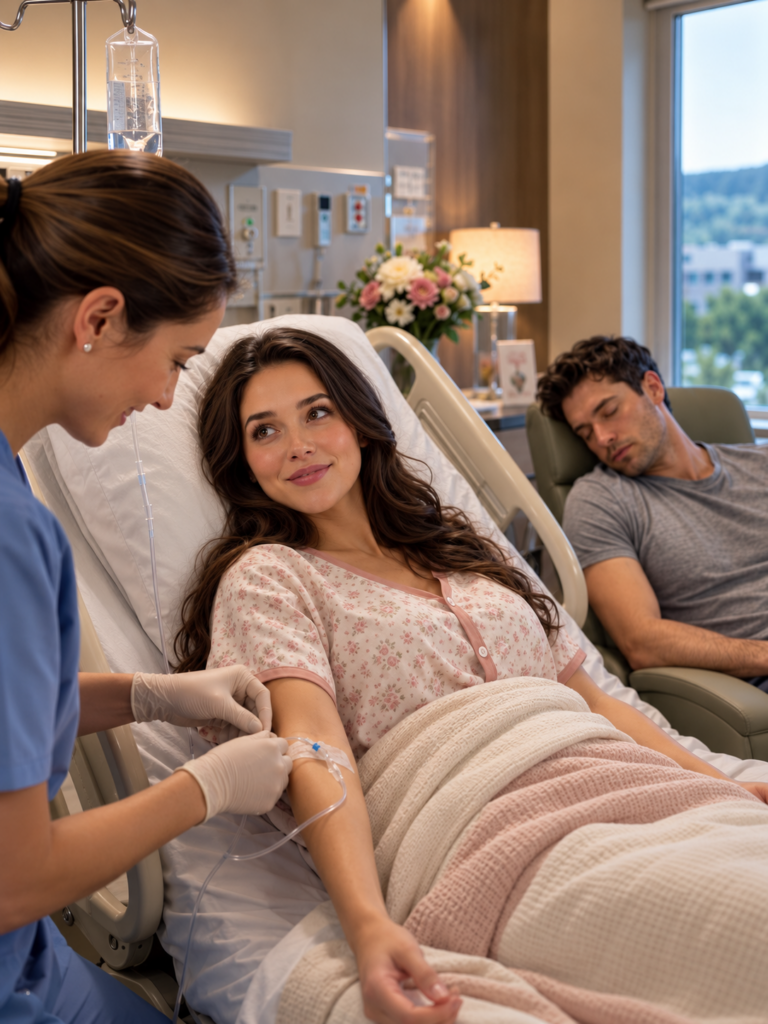
Which brought me back to Nurse Suzanne.
“Your husband’s a keeper.”
“I know.”
Once Suzanne left, I opened my eyes.
Ashley was watching me.
“You look awful.”
“The chair won.”
“You snore.”
“I do not.”
“A little.”
“I’m leaving.”
The joke came easily.
That was reassuring.
I stood and stretched.
“How do you feel?”
“Tired.”
“Pain?”
“Managed.”
“Good.”
Ashley looked toward the door.
Then at me.
“Jason.”
“Yeah?”
“The husband thing.”
I rubbed my face.
“Right.”
“You know you’re not one.”
“Good. I was worried the anesthesia had rewritten our history.”
The corner of her mouth lifted.
I explained exactly what I had said.
Why.
I told her I had not signed anything medically, answered for her, or made decisions about her body.
“I heard you,” she said.
“You did?”
“Most of it.”
She looked down at her blanket.
“I knew what you were doing.”
Then she looked at me.
“Thank you for staying.”
We did not discuss money that morning.
Over the next several days, the word husband disappeared.
Doctors spoke to Ashley.
She answered.
If she wanted me to remember a medication instruction, she asked me to listen.
If she wanted privacy, I left.
I called the museum because she asked.
Charged her phone.
Brought the cardigan from her house.
The lie had been a shortcut through one frightening hour.
Anything after that needed to be real without it.
On discharge morning, a social worker explained Ashley should not spend the first stretch of recovery alone overnight.
After she left, I gave Ashley options.
“I can sleep on your couch.”
She considered it.
“Or the downstairs guest room at my house. Bathroom next door. No stairs. Kitchen closer.”
Ashley looked at me.
“Your house.”
“You sure?”
“I want to be at your house.”
No argument about independence.
No performance.
Just a decision.
“Okay. Room locks from inside.”
She smiled.
“Jason.”
“If you want me out, say so. If you need help, ask. I won’t assume.”
“You rehearsed that.”
“Only the first half.”
Bringing Ashley home changed the shape of my house.
Medication bag on the kitchen counter.
Museum book beside the guest-room chair.
Soft shoes near the door.
I asked which reminders she wanted.
“Morning meds. Evening meds.”
“Everything else?”
“Mine.”
“Okay.”
For two days, she slept.
I went to the docks only after Shawn confirmed he had things handled.
Returned before noon.
I learned to stop asking “Are you okay?” every fifteen minutes.
That took effort.
On the third evening, I brought dinner.
Set it on the table near the open French doors.
“Water’s there. Medication at eight. I’ll be on the porch.”
I turned.
“Jason.”
“What?”
“Company?”
I stopped.
“Not help.”
She adjusted the blanket over her legs.
“Just company. Sit outside if you want. Leave the door open.”
That request felt different.
I had been inventing reasons to remain in the doorway.
Water.
Charger.
Temperature.
Now Ashley gave me permission to stay without pretending the reason was medical.
I moved a chair near the doors.
Ate dinner on the porch while she ate inside.
We talked about nothing important.
A school group putting fingerprints across an exhibit case.
Shawn setting coffee on the section of my dock map labeled DO NOT SET DRINKS HERE.
Halfway through, Ashley closed her eyes.
“Too much?”
“No.”
“Tired?”
“Yes.”
“Want quiet?”
“No.”
Her eyes remained closed.
“Keep talking.”
So I told her about the river.
Current patterns.
A bald eagle I had seen near the north bend.
The tourist who insisted catfish were “river sharks.”
Ashley fell asleep.
I left the door open.
Did not move her.
Did not transform the moment into more than she had asked for.
By the fifth day, friction arrived.
Shawn came by with dock mail while I was updating the whiteboard in my kitchen.
My entire business lived on that board.
Charters.
Weather.
Maintenance.
Fuel.
Now medication times and follow-up appointments sat between them in different-colored marker.
Ashley was drinking tea at the island.
Shawn nodded toward her.
“Looking better.”
“I feel better.”
Then he turned to me.
“Broker called. Still releasing the pontoon slot?”
“Yes.”
Ashley’s head came up.
“The second boat?”
Shawn realized what he had done.
Too late.
He looked between us.
“I’m going to leave.”
“You just got here,” Ashley said.
“I remembered an emergency.”
“What emergency?”
“Dock-related.”
He picked up nothing and disappeared.
Ashley put down her cup.
“What happened to the expansion money?”
I capped the marker.
“Medical costs.”
“How much?”
“Most.”
She stared at me.
“Jason.”
“The boat can wait.”
“Don’t make it sound small because you’re afraid I’ll react.”
I leaned against the counter.
Ashley’s eyes glistened.
“I have a hospital bag by my front door.”
I said nothing.
“Two shirts. Charger. Medication list. Copies of insurance cards.”
Her voice tightened.
“I started keeping it after my parents died because I never wanted some coworker or neighbor going through drawers trying to figure out what to bring if I ended up in an ambulance.”
She looked toward the window.
“I made a system for leaving cleanly.”
That sentence hurt.
“And you spent three years of your plan because I asked you to stay.”
“You didn’t ask me to spend the money.”
“Exactly.”
We stood there.
Then I looked at the whiteboard.
“You have your bag.”
“What?”
“I have that.”
I pointed.
“Everything I understand goes there.”
Weather.
Repairs.
Bookings.
Fuel.
Now Ashley.
“If a storm moves in, I change the route. Engine goes down, clients move. Need money next spring, I save this fall.”
I rubbed the marker between my fingers.
“A few years ago, I watched a life I thought was settled change without warning.”
Ashley waited.
I had never told her the whole story.
“My older brother and I were supposed to build this business together.”
Her expression softened.
“Daniel?”
I nodded.
She knew the name from a photograph.
“He died six months before we were supposed to launch.”
Boat accident.
Not ours.
A drunk driver hit his truck on the bridge leading into town.
No warning.
No plan.
Afterward, I started the charter company alone.
I became obsessed with contingencies.
“I learned the wrong lesson.”
“What lesson?”
“That things I could measure were safer than things I couldn’t.”
Ashley was quiet.
Then she asked, “What do you want five years from now?”
Easy question.
Except it wasn’t.
I could tell her boats.
Revenue.
Booked weekends.
Reserve accounts.
She was asking about life.
“I don’t know.”
Ashley did not rescue me.
So I continued.
“I know I wanted you to wake up.”
Her eyes lifted.
“I know I wanted you in that room after surgery. I know that money was never a claim on you.”
I stepped closer.
“If you want to repay some later, we talk when you’re healthy and working.”
“And if I can’t?”
“Then you can’t.”
“Jason—”
“I’m not owed your life because I moved money.”
Her shoulders loosened.
That sentence was enough.
I turned toward the board.
Erased a Friday maintenance block.
Wrote:
DINNER WITH ASHLEY — 6:00.
Ashley walked over.
Took the marker.
Changed 6:00 to 6:30.
I looked at her.
“The museum closes at five.”
“You’re not working yet.”
“I will be.”
She placed a small star beside her name.
“If this is a real dinner, I get time to shower.”
I laughed.
No guilt.
No hospital smell.
“Six-thirty.”
A few days later, I had to prove I meant everything I said about autonomy.
Ashley’s cardiologist cleared her for two hours of desk work.
No stairs all afternoon.
No tours.
No lifting.
The first shift happened Wednesday morning.
I had a lodge group booked at the same time.
My instinct was immediate.
Shawn could drive her.
Mary at the museum could text me.
I could call before entering the river’s dead zone.
Ashley watched me pacing in the kitchen.
“Stop.”
“I can have Shawn take you.”
“No.”
“He can wait.”
“No.”
“Ashley.”
“I am walking three blocks.”
She picked up her museum bag.
“Mary knows. If I get tired, I sit. If that isn’t enough, I go home.”
Then she said the thing I needed.
“I need to know I can do that without turning it into a test for you.”
I looked at the keys in my hand.
Put them into my pocket.
“Okay.”
She smiled.
“I’ll be on the water. No signal below Miller Bend.”
“I know.”
“Text when you’re done. I won’t see it until I dock.”
“I will.”
I ran the charter.
I did my job.
Kept the boat safe.
Put clients on fish.
And checked my phone the instant we cleared the dead zone.
Ashley:
Two hours done. Sat twice. Mary did not rescue me. I’m on your porch.
A walk-in group asked about an afternoon run.
Normally, I would have taken it.
Instead, I moved them to Thursday.
I already had dinner with Ashley.
For once, a personal promise was not the first thing I sacrificed when work appeared.
When I got home, she was on the porch swing.
Museum lanyard beside her.
Shoes off.
Tired.
Pleased.
“How was it?”
“I sorted donation records and remained conscious.”
“Impressive.”
“Very glamorous.”
“Did you sit?”
She gave me a look.
“Right. Not my lane.”
We ate lukewarm takeout.
Talked about work.
Not heart rates.
Not bills.
Two adults who had both had a day.
The following afternoon, Ashley came to the dock before a later museum shift.

A family charter was waiting to board.
One teenage boy pointed across the river.
“What’s that old building?”
I opened my mouth.
Ashley answered first.
“That’s the Osgood Mill foundation.”
The boy turned toward her.
She explained the old intake channel.
River trade.
Local Prohibition stories.
Within thirty seconds, both teenagers stopped looking bored.
The parents listened.
I watched Ashley doing what she did best.
Not recovering.
Not needing me.
Working.
The father asked, “Do we get stories like that on the charter?”
Normally I would have said we were there to fish.
Instead, I looked at Ashley.
“Maybe they should.”
Later, she apologized.
“I didn’t mean to step into your job.”
“You didn’t.”
“You looked surprised.”
“You do something I don’t.”
“What?”
“You make people care where they are.”
She smiled.
“History is easier when people can see where it happened.”
I immediately began building a plan.
“One stop upriver, three minutes before—”
I stopped.
Ashley noticed.
“You tell me,” I said. “If we use history, it’s your piece.”
Her expression changed.
“A short dock introduction. Only on routes that pass something worth explaining.”
“Good.”
“No trapped clients listening to lectures.”
“Agreed.”
“And if customers pay more because it’s included, I pay you.”
“We’ll figure that out.”
“Before it goes on the website.”
Ashley smiled.
“There he is.”
She walked to the scheduling podium.
Opened the following week.
Wrote:
DINNER — ASHLEY’S HOUSE.
Tuesday.
I looked.
“You didn’t ask whether I was free.”
“I checked.”
Of course she had.
Then I held out my hand.
Ashley looked at it.
Placed hers in mine.
First touch without a stretcher.
No hospital bed.
No medical reason.
Her fingers were warm.
Shawn stood ten feet away pretending a coil of rope was fascinating.
Ten days after surgery, Friday arrived.
Our dinner.
I finished the last charter, cleaned the deck, and drove home early enough to shower.
When I walked inside, something felt wrong.
The guest room was empty.
Bed made.
Museum books gone.
Shoes gone.
A note rested on the pillow.
Doctor cleared me to sleep at home and keep increasing work slowly. I moved my things back. Finish your day. Don’t turn this into an emergency. I’ll come over at 6:30.
I read it twice.
My first impulse was to cross the yard.
Her kitchen light was on.
Movement through the window.
Ten days earlier, I would have called checking on her care.
Five days earlier, caution.
Now?
Control.
Ashley had told me what she wanted.
So I stayed home.
Showered.
Changed.
Discovered how much uncertainty could fit into thirty minutes.
At 6:28, her screen door closed.
At 6:31, Ashley walked up my steps wearing a simple pale-blue dress.
No medication bag.
No overnight case.
Nothing in her hands.
Only herself.
Relief hit me so hard I opened the door before she knocked.
“One minute late.”
“I considered making it five.”
“I would have survived.”
Her smile softened.
“I put the hospital bag away.”
I waited.
“Closet. Not by the door.”
“That sounds good.”
“I still have a heart condition.”
“I know.”
“Follow-ups.”
“I know.”
“Some days I’ll be tired.”
“Okay.”
She stepped closer.
“But tonight I can sleep in my own house.”
Something tightened in my chest.
“I don’t need someone in the next room.”
“Okay.”
“And I still came over.”
I looked at her.
Ashley swallowed.
“I don’t want the hospital version of us to be the only version we get.”
Neither did I.
“I don’t want you because you called yourself my husband for one night.”
She smiled slightly.
“I don’t want you because you paid bills or gave me a guest room.”
Her voice became quieter.
“I want you when I’m working. When I’m tired for boring reasons. When I’m stubborn. When I don’t need saving.”
She moved closer.
“I want to find out what this is when necessity is gone.”
My entire adult life had been built around avoiding uncertainty.
Ashley was asking me to choose it.
I wanted to.
“I want you healthy.”
Her eyes softened.
“I want you next door.”
Closer.
“I want you at the museum telling people stories I would have reduced to one sentence.”
She laughed quietly.
“I want you writing on my calendar and changing the time when I get it wrong.”
I took her hand.
“And I want tomorrow.”
“Tomorrow?”
“Not because I know what it looks like.”
I breathed.
“Because I want you in it.”
Ashley released a breath.
“Then date me.”
“I thought this was dinner.”
“Dinner can be a date.”
“Good. I already bought food.”
She smiled.
I kissed her.
No frantic gratitude.
No emergency.
No monitor.
No confused line between care and love.
Ashley lifted her hand to my neck.
My hand settled at her waist.
When we separated, she glanced at the clock.
“Six-thirty-one.”
“I’m not changing the board.”
“Look at you.”
After dinner, Ashley erased one of the remaining RECOVERY CHECK blocks from my whiteboard.
In its place she wrote:
MUSEUM. CHARTER. DINNER.
Three separate things.
Two separate lives.
One evening chosen.
The months that followed were not dramatic.
That was their strength.
Ashley returned to work gradually.
Desk work.
Short gallery talks.
Full tours.
Some days she came home exhausted and said so without apologizing.
On those nights, I brought dinner if she wanted it.
Left if she wanted quiet.
Other nights, she crossed the yard with takeout and rearranged whatever I had planned because a school group kept her late.
I kept one boat another season.
Losing the expansion hurt.
It did not destroy me.
I rebuilt savings.
Ashley eventually asked to repay part of the medical costs.
I resisted.
She insisted.
We compromised.
A monthly amount she could manage without damaging her own security.
Written down once.
Then put in a drawer.
Money did not become a relationship.
That mattered.
The history-charter idea grew.
Selected weekends.
Ashley gave a ten-minute introduction at the dock.
Sometimes she rode one stretch before getting off near the museum.
She was paid every time her work became part of what customers bought.
She kept her museum career.
I kept the charter.
Neither became an accessory to the other.
Sometimes I sat in the back of her tours and watched her make a faded map feel alive.
Sometimes she came out after my final charter.
I taught her channel markers.
Throttle control.
How current pushes differently around bends.
By late summer, Ashley could handle the boat in calm water.
I sat beside her.
Hands off unless asked.
That lesson was larger than boating.
One evening after practice, we tied up near sunset.
Ashley stood beside me on the dock.
I had spent weeks thinking about rings.
Restaurants.
Plans.
I had lists.
Then I looked at her.
“I want to marry you.”
Ashley blinked.
“That’s the proposal?”
“Apparently.”
She laughed.
Then took my hand.
“I want to marry you too.”
That was enough.
Wedding planning nearly destroyed all the progress I had made.
I created three ceremony options.
Dock if weather held.
Covered marina if rain.
Courthouse if attendance became complicated.
Ashley found the notebook.
She was wearing one of my flannel shirts and carrying coffee.
She read the page.
Took my pen.
Circled DOCK.
“Morning. Small.”
She wrote names.
Shawn.
Suzanne.
Mary from the museum.
A few friends.
“If it rains, marina roof.”
“That’s backup option two.”
“It’s a roof.”
“Technically—”
“You do not need option three.”
She crossed out COURTHOUSE.
I stared.
Ashley leaned down.
“Jason.”
“What?”
“We can survive weather.”
I smiled.
“I know.”
Our wedding morning arrived with mist over the river.
No storm.
No disaster.
Shawn wore the only jacket I had ever seen him own.
Mary cried before Ashley reached the dock.
Nurse Suzanne stood near the back looking far too pleased with herself.
Ashley wore a simple white dress.
No giant wedding party.
No elaborate decorations.
River.
Morning light.
People who mattered.
When the officiant called me Ashley’s husband for the first time legally, I glanced toward Suzanne.
She grinned.
After the ceremony, Suzanne hugged Ashley.
Then she looked at me.
“See?”
Ashley laughed.
Suzanne raised her voice.
“I told you he was a keeper.”
I groaned.
She continued.
“Now I can call him your husband without guessing.”
Ashley looked at me.
Same soft smile she had given Suzanne from the hospital bed.
Except this time there was no IV.
No borrowed word.
No surgery waiting.
“I know.”
Breakfast happened at the dock.
Too much coffee.
Pastries.
Shawn reminded everyone that he had lost an entire week of charters because I fell in love during a medical emergency.
I corrected him.
“I did not fall in love at the hospital.”
Ashley looked at me.
“When?”
I considered.
“The museum brochure box.”
“Before I collapsed?”
“Possibly.”
“You were slow.”
“I was planning.”
“Of course.”
After everyone left, we walked to the boat.
I untied us.
Idled into the channel.
Once clear, I stood from the wheel.
“Your turn.”
Ashley took my place.
Checked the current.
Adjusted the throttle.
Held the boat exactly where she wanted.
I sat beside her.
Not behind.
Not reaching over.
Not correcting.
Years earlier, I had believed safety meant knowing what came next.
Weather.
Money.
Schedules.
Contingencies.
I still believed planning mattered.
Fuel matters.
Forecasts matter.
Emergency equipment matters.
Loving Ashley had not taught me to become careless.
It taught me the difference between a plan that protects people and one that replaces their choices.
Ashley’s heart condition did not disappear because we married.
There were cardiology appointments.
Medication changes.
Days when fatigue arrived before either of us expected it.
The first time she had a follow-up scan after our wedding, I almost rearranged an entire charter week.
Ashley found me staring at the calendar.
“Don’t.”
“I’m doing nothing.”
“You’re planning to do something.”
“That is different.”
“What time is my appointment?”
“Ten.”
“When is your charter?”
“Seven.”
“When will you dock?”
“Eleven-thirty.”
“Then I’ll call you when I’m done.”
I hated it.
She knew.
“You don’t have to like uncertainty.”
“That’s generous.”
“You just don’t get to eliminate mine so yours feels easier.”
I looked at her.
“That was harsh.”
“It was accurate.”
Also true.
I ran the charter.
Ashley attended the appointment.
Everything was fine.
When I cleared the dead zone, her message waited.
Valve looks good. Cardiologist says I’m annoying and healthy. Don’t cancel anything.
I smiled so hard Shawn noticed.
“What?”
“Nothing.”
“You’re doing the husband face.”
“I don’t have a husband face.”
“You absolutely do.”
The second boat finally came two years after the wedding.
Not because Ashley repaid everything.
Not because life returned to my original schedule.
The business grew differently.
The history tours attracted families who otherwise would never have booked a fishing charter.
Local hotels began referring guests.
Shawn became captain-certified.
I rebuilt the reserve.
The new boat arrived on an April morning.
Ashley stood beside me at the dock.
“You waited a long time.”
“Two years.”
“Five if you count the original plan.”
I touched the railing.
“For a while I thought giving it up meant losing something.”
“And now?”
“I think it waited until the business was ready.”
She smiled.
“That sounded almost emotionally flexible.”
“Don’t tell anyone.”
The new boat allowed us to run parallel charters.
Shawn captained one.
I took the other.
Ashley developed a seasonal River Stories tour with the museum, independent from my company but sometimes partnered with us.
She negotiated her own contract.
I tried once to waive the docking fee.
She rejected it.
“You charge other organizations.”
“You’re my wife.”
“I’m also representing the museum.”
I sighed.
“Fine.”
She smiled.
“Look at us. Ethical.”
Somewhere along the way, my whiteboard changed.
It still carried weather.
Bookings.
Maintenance.
But it also held things I once would never have treated as equally real.
Dinner with Ashley.
Suzanne birthday.
Museum fundraiser.
Sunday — nothing.
The nothing blocks were Ashley’s idea.
I hated them at first.
“What happens if a charter comes in?”
“We say no.”
“What if it’s a premium rate?”
“We still say no.”
“That is economically irrational.”
“That is marriage.”
We did not protect every empty block.
Sometimes work won.
Sometimes the museum had an emergency event.
Sometimes weather shifted.
The point was not rigid scheduling.
The point was that our life stopped becoming the thing automatically moved whenever business appeared.
Years passed.
Suzanne retired from the hospital.
Shawn eventually bought a small ownership share in the charter company.
Mary became museum director.
Ashley became education curator.
Her health remained stable.
Not magically perfect.
Stable.
There is a difference.
Every anniversary of the surgery, Ashley did something small.
Not a celebration of almost dying.
A recognition of being here.
One year, dinner.
Another, a morning walk.
On the fifth anniversary, she came down to the dock before sunrise.
I was checking fuel.
She carried two coffees.
“Cancel the first charter.”
I looked up.
“No.”
“I already did.”
“You cannot cancel my charter.”
“Shawn can run it.”
I stared toward the other boat.
Shawn waved.
Traitor.
Ashley handed me coffee.
“Come on.”
“Where?”
She stepped onto the boat.
“Anywhere.”
I almost asked for a route.
Instead, I followed.
Ashley took the wheel.
We moved upriver while sunrise turned the water gold.
Near the Osgood Mill ruins, she reduced speed.
“Remember the first time I talked about this place at the dock?”
“The teenager who thought history was boring.”
“He later emailed the museum.”
“What?”
“His family came back.”
I smiled.
“You never told me.”
“I forgot.”
“Impossible.”
She turned the boat toward the center of the channel.
“Jason.”
“Yeah?”
“Do you regret the boat money?”
I knew exactly what she meant.
“No.”
“Never?”
“I regretted losing the schedule.”
“That sounds like you.”
“But not the decision.”
Ashley looked forward.
“I used to feel guilty.”
“I know.”
“I don’t anymore.”
“Good.”
She smiled.
“I paid what we agreed.”
“You did.”
“And the new boat exists.”
“Yes.”
“And you didn’t buy me with the old one.”
I laughed.
“That would have been a terrible exchange rate.”
She elbowed me.
Then she became serious.
“I think that’s why I could love you.”
“Because I’m financially inefficient?”
“Because you helped without turning help into ownership.”
The river widened ahead.
I thought about the hospital.
The word husband.
How easily a dramatic story could make that lie seem romantic.
It wasn’t.
Not then.
Ashley was vulnerable.
Afraid.
She wanted one person beside her.
I used a label to keep that place.
But a label is not love.
Neither is paying a bill.
Neither is canceling work.
Neither is carrying medication.
Those things can be care.
They can also become control if you start believing they buy you a future.
The relationship began later.
When Ashley could sleep alone.
Work again.
Drive herself.
Tell me no.
When necessity ended and she crossed the yard anyway.
That was love.
Choice after dependence.
Choice without debt.
Choice when she could leave.
I looked at her hand on the wheel.
Wedding ring catching the early sun.
“Do you remember Suzanne calling me your husband?”
Ashley laughed.
“Of course.”
“You said, ‘I know.’”
“I did.”
“You could have corrected her.”
“I could have.”
“Why didn’t you?”
She considered.
“I was tired.”
“Terrible answer.”
“I had just had heart surgery.”
“Excuse accepted.”
She smiled.
Then said, “Also, I liked the sound of it.”
I stared.
“You never told me that.”
“You were already panicking.”
“I was not.”
“You slept bent in half because you refused to leave.”
“I was tired.”
“The legendary Jason Mercer defeated by a hospital chair.”
“That’s unfair.”
She laughed.
I thought about the day the ambulance arrived.
Ashley’s hand gripping the rail.
Stay.
At the time, it sounded like the simplest request in the world.
Years later, I understood how much care that word required.
Staying did not mean hovering.
It did not mean making Ashley’s body my responsibility.
It did not mean arranging her life until nothing dangerous could touch her.
Staying meant being there when asked.
Stepping back when asked.
Learning the difference.
Sometimes holding the rail.
Sometimes letting her take the wheel.
Ashley looked toward me.
“What?”
“You’re thinking.”
“I do that.”
“Dangerous.”
“I was thinking about planning.”
She groaned.
“Romantic.”
“For most of my life, I thought a good plan meant reducing uncertainty.”
“That sounds like you.”
“Then you collapsed next door and ruined the system.”
“Sorry.”
“No.”
I looked ahead.
The river divided around a wooded island.
Two navigable paths.
Ashley slowed.
“Which way?”
Years ago, I would have answered immediately.
Current.
Depth.
Wind.
Destination.
There would have been a correct route.
Today, both were safe.
I looked at my wife.
“Your choice.”
Ashley smiled.
Then turned the wheel.
I did not reach for it.
The boat entered the left channel.
Morning light spilled across the water.
Somewhere behind us were schedules, weather reports, medication reminders, museum exhibits, invoices, and the thousand small plans required to build a responsible life.
They still mattered.
But they no longer told us everything worth knowing.
I had once spent years believing safety meant knowing exactly where I was going.
Then the happiest life I had ever known began the day a woman lying on a stretcher looked through a crowd, found me, and asked me to stay.
And it became real when, later, she no longer needed me there at all—and came back anyway.
The river opened in front of us.
Ashley kept one hand steady on the wheel.
I sat beside her.
And let the woman I loved choose the direction.
The End.


