
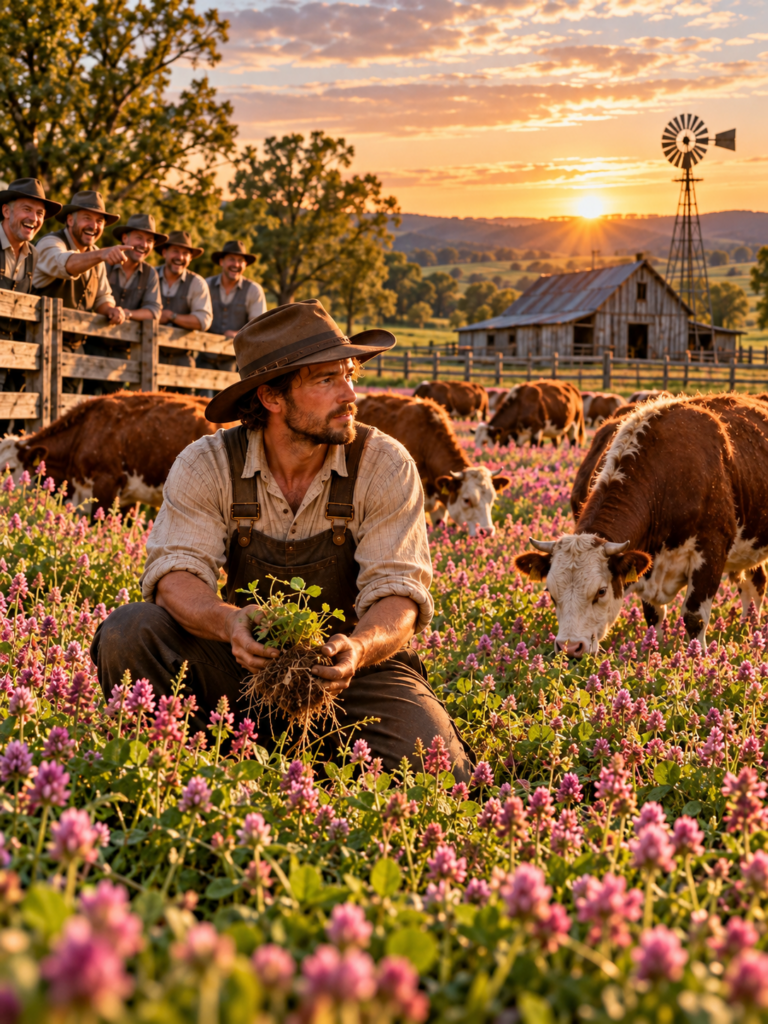
they laughed when the old rancher planted pink flowers across his dying montana pastures—then the drought came and his cattle were the ones still grazing
Part 1
By the middle of July, the hills outside Lewistown, Montana, had taken on the color of old rope.
The green of May was gone.
Wind moved across the open country with nothing to slow it, flattening what little grass remained and sending dust behind every pickup that passed along the county road. Stock ponds were shrinking. Creeks that usually lasted through August had become strings of muddy pools.
Most ranchers in Fergus County had already begun feeding hay.
Tom Mercer had not.
That fact alone was enough to make people slow down when they drove past his place.
But it was not the cattle that made them stop.
It was the flowers.
Thousands of them.
Pink.
Rolling across the pasture in long waves whenever the wind came over the ridge.
From the road, Tom Mercer’s cattle ranch looked less like a working Montana operation and more like someone had planted a wedding garden across several hundred acres.
People took pictures.
One woman from town parked on the shoulder and stood on the running board of her SUV so she could photograph the hillside.
Tom saw her from his four-wheeler.
He shook his head.
“Still famous,” his wife Ellen said that evening.
She had been watching from the kitchen window.
Tom hung his hat on the hook beside the door.
“For the wrong reason.”
“Three years ago you were angry when people laughed.”
“I wasn’t angry.”
Ellen looked at him.
Tom sighed.
“All right. I was a little angry.”
“A little?”
He opened the refrigerator and stared inside.
There was lemonade in a glass pitcher.
He poured a cup.
“I just didn’t like people thinking I’d lost my mind.”
Ellen sat at the kitchen table.
At sixty, she wore her gray hair in the same loose knot she had worn when they married thirty-five years earlier. There were soil samples drying in paper bags on the counter because Tom had started doing things like that now.
Three years earlier, Tom Mercer had never placed dirt in a paper bag unless he was cleaning his boots.
Things had changed.
Outside the window, several black Angus cows moved slowly between pink sainfoin blossoms.
The ground beneath them was still covered.
Not green everywhere.
Not lush.
Tom hated people describing it that way because it made the truth sound too easy.
The ranch was still dry.
Some plants had gone dormant.
Several fields looked weak.
He would still buy hay that winter.
But his cows were grazing in July while some neighbors were already hauling feed twice a day.
That mattered.
Three university trucks had arrived that morning.
Two soil scientists and a graduate student had spent hours digging small pits, measuring water infiltration, studying roots, counting plant species, and writing numbers on clipboards.
Tom had almost refused when the state university asked to visit.
He did not want to become a success story before he knew whether he had succeeded.
Land had a way of embarrassing men who announced victory too early.
Ellen convinced him.
“Maybe they’ll tell you what you’re doing wrong.”
That was how she sold it.
Tom agreed immediately.
Now, as the scientists finished near the north paddock, three neighboring ranchers had gathered along the fence.
Tom knew why.
One of the scientists had pushed a shovel into the ground using only one boot.
The soil opened.
Three years earlier, Tom sometimes needed a steel bar to break that same ground in August.
The scientist knelt.
He pulled apart a clod with his fingers.
Fine roots threaded through it.
An earthworm twisted in the darkness.
Bill Carter stared.
Bill owned the ranch west of Tom’s.
He had spent the previous three years referring to Tom’s sainfoin as “Mercer’s flower business.”
Now he crouched beside the soil pit.
“You put worms in there?”
Tom laughed.
“Yeah, Bill. Bought them by the truckload.”
Bill did not laugh.
He looked across the fence toward his own field.
Less than three hundred yards away, the ground between the grass plants was pale and exposed.
Dust moved across it.
Tom knew better than to feel superior.
Three years earlier, his land had looked the same.
Maybe worse.
He remembered because he had spent most of his adult life refusing to admit what was happening.
Tom was sixty-two.
His father had raised cattle.
His grandfather had raised cattle.
The Mercer ranch had been in the family since 1919.
For more than thirty years, Tom had managed it almost exactly as his father had.
Cattle went into large pastures in spring.
They stayed until the grass looked short.
Then Tom moved them.
Some fields were cut for hay.
Some were grazed.
When forage ran low, he bought feed.
It was simple.
Familiar.
Respectable.
For a long time, it worked.
Then the changes began so slowly that Tom could explain every one of them away.
A dry June.
A cold May.
Grasshoppers.
A bad snow year.
Too much spring rain followed by too little summer rain.
There was always a reason.
The grass on several hills stopped recovering as quickly after grazing.
Rain hit hard ground and ran downhill instead of disappearing into it.
Low areas became muddy while higher slopes dried within days.
Cattle spent more time around water.
Calves gained less weight.
The hay bill rose.
Tom noticed every symptom separately.
He refused to see them together.
Ellen noticed.
She usually did.
One January night, Tom sat at the same kitchen table with three feed invoices.
A calculator sat beneath his left hand.
Coffee sat cold beside his right.
He punched numbers.
Erased them.
Started again.
Ellen dried a plate at the sink.
“You keep doing that.”
“Doing what?”
“Trying to make the answer change.”
Tom leaned back.
“It should.”
“But it doesn’t.”
The number on the calculator was higher than the year before.
Much higher.
Hay prices had jumped.
Diesel had gone up.
A tractor needed repairs.
One well pump was failing.
Tom had enough cattle to maintain the income they depended on.
But keeping those cattle was becoming more expensive every season.
Sell cows, lose income.
Keep cows, buy more hay.
Borrow money, delay the problem.
None of those choices fixed the land.
Tom rubbed both hands over his face.
For the first time in his adult life, he asked himself a question that felt like betrayal.
What if his father had been wrong?
He hated the thought immediately.
Then he corrected it.
Maybe his father had not been wrong.
Maybe his father’s methods had belonged to his father’s conditions.
Different rainfall.
Different costs.
Different cattle numbers.
Different years.
Maybe doing exactly what his father had done was not the same as respecting what his father had taught him.
Ellen placed the plate in the cabinet.
“What are you thinking?”
Tom stared at the invoices.
“What if the problem isn’t the weather?”
She sat across from him.
“Then what is it?”
He looked toward the dark window.
“Our management.”
The word tasted worse than he expected.
Because weather was blameless.
Management was his.
A month later, Tom drove nearly three hours to a grazing workshop.
He almost turned around twice.
The first time was outside Great Falls when he stopped for fuel.
The second was in the parking lot after seeing trucks from ranches he did not know.
He sat behind the wheel for ten minutes.
Men Tom’s age were not supposed to admit they no longer understood the ground they had spent forty years walking.
At least that was what pride told him.
Tom eventually went inside.
He sat in the back row.
Speakers talked about plant recovery.
Root reserves.
Ground cover.
Infiltration.
Stock density.
Rotation.
Some terms irritated him.
Some sounded like academic names for things ranchers had always known.
Then a rancher from eastern Montana showed two photographs.
The first looked painfully familiar.
Short grass.
Bare spaces.
Hard soil.
The second, taken six years later, showed thicker cover.
The speaker pointed at the screen.
“Cattle aren’t automatically the problem.”
Tom leaned forward.
“The problem is keeping them in one place long enough to eat the same plants twice before those plants recover.”
That sentence followed him home.
The next morning, Tom walked into one of his weakest pastures.
Eighty acres.
Thirty-eight cows.
He had always considered that light pressure.
The cattle were scattered.
At first glance, everything looked normal.
Then Tom watched instead of assuming.
Some grasses had been bitten nearly to the ground.
Other plants stood untouched.
The cows walked selectively from one favorite patch to another.
Plants bitten early were growing small green leaves again.
Those new leaves were being eaten.
Again.
Tom knelt.
The soil was hard enough that he could barely push a pocketknife into it.
Old manure lay dry on the surface.
Bare ground showed between bunch grasses.
For years, Tom had believed giving cattle a large area meant giving the land rest.
Now he saw the opposite.
The cattle had access to everything.
Which meant their favorite plants never escaped them.
That winter, Tom read more than he had since high school.
Slowly.
Suspiciously.
He called ranchers.
He called the local conservation district.
He attended another workshop.
He annoyed people with questions.
“What happens in dry years?”
“How much fence?”
“What if the cattle break through?”
“What if I rest too long?”
“What if I get it wrong?”
One conservation specialist finally laughed.
“Tom, you will get parts wrong.”
“That’s encouraging.”
“You’ve been ranching thirty years.”
“Forty.”
“Then you already know land punishes arrogance. This is no different.”
That, Tom understood.
During his research, he found sainfoin.
The first photograph made him close the book.
Pink flowers.
Tall stems.
It looked ridiculous.
He opened the book again later.
Sainfoin was forage.
A legume.
Cattle could graze it.
It could be cut for hay.
Pollinators liked it.
It could root deeply in suitable soil.
It did not solve everything.
It was expensive to establish.
Young stands needed protection from heavy grazing.
It preferred certain soil conditions.
Tom liked that last part.
Anything advertised as working everywhere usually worked nowhere as well as promised.
He showed Ellen a picture on the computer.
“You want to plant flowers.”
“It’s forage.”
“They’re pink.”
“Cows don’t care.”
“How much?”
Tom closed the laptop.
Ellen raised an eyebrow.
“That much?”
“The seed’s expensive.”
“Tom.”
“I said it’s expensive.”
“How expensive?”
He told her.
She sat back.
For several seconds she said nothing.
Then she asked, “All of it?”
“No.”
That answer saved the idea.
Tom would not convert the entire ranch.
He would try one section.
Small enough that failure would hurt.
Not large enough to kill them.
That spring, he installed temporary electric fencing.
He divided a large pasture into smaller paddocks.
He extended water where possible.
He seeded sainfoin into selected fields where soil and drainage seemed appropriate.
Almost immediately, everything went wrong.
A water fitting cracked.
Cattle walked through a temporary wire.
One field germinated poorly.
Another filled with weeds.
A fence charger failed during a rainstorm.
Tom spent evenings moving posts instead of sitting on the porch.
Then the neighbors noticed.
Bill Carter leaned against the counter at the feed store.
“What are you planting?”
“Sainfoin.”
“What’s that?”
“Feed.”
Bill looked at another rancher.
“Looks like flowers.”
“Flowers can be feed.”
By June, the hills began turning pink.
The jokes got worse.
Bill asked if Tom planned to rent the pasture for weddings.
Another rancher suggested putting picnic tables along the county road.
Somebody called him Flower Tom.
Tom laughed.
Mostly.
At night, he checked seed invoices.
He checked fencing costs.
He checked fuel.
The experiment was more expensive than expected.
And there was no guarantee it would work.
One evening, he stood beside a thin patch where half the sainfoin had failed.
Ellen walked up behind him.
“You’re doing it again.”
“What?”
“Trying to make the answer change by staring.”
Tom looked across the field.
“I hate wasting money.”
“So don’t waste what you learned.”
“I don’t know if I learned anything.”
“You learned that part of this field doesn’t grow sainfoin very well.”
“That’s an expensive lesson.”
“Most useful ones are.”
He looked at her.
“Whose side are you on?”
“The side that wants you to stop expecting the first attempt to look like the picture in the book.”
Tom smiled despite himself.
Then the rain stopped.
Part 2
The drought arrived without ceremony.
No single day marked its beginning.
There was simply a week without rain.
Then two.
Clouds formed over the mountains and dissolved before reaching the valley.
By late June, the grass changed color.
By early July, ranchers began discussing herd reductions.
The price of hay climbed.
Tom’s sainfoin stopped growing as quickly.
Several thin sections looked worse than they had the year before.
Bill Carter caught him checking one of them.
Bill climbed out of his truck and rested both arms on the fence.
“Flower experiment’s struggling.”
“So is your grass.”
“That seed cost you more than grass.”
“It did.”
“You still think it was worth it?”
Tom looked across the field.
Pink flowers remained in pockets.
Other areas had gone short and dull.
“I don’t know.”
Bill seemed surprised.
Tom could have defended himself.
Three years earlier, he would have.
Now he had learned something uncomfortable.
Not knowing was different from failing.
Sometimes it was simply where a person stood before enough time had passed.
Tom had cattle ready to move.
The next paddock had forage.
Not enough.
Not yet.
If he put cows in immediately, he could avoid buying several tons of hay.
The plants would also be grazed earlier than Tom wanted.
He drove home.
Changed his mind.
Drove back.
Changed it again.
At dinner, Ellen watched him push potatoes around his plate.
“You’re not eating.”
“I’m thinking.”
“That has never stopped you before.”
He looked up.
“If I feed hay, I’m spending money to protect pasture I planted so I wouldn’t have to feed hay.”
“Yes.”
“When you say it like that, it sounds stupid.”
“I repeated what you said.”
“The plants need more time.”
“Then what does putting cattle on them do?”
“Helps us today.”
“And next month?”
Tom said nothing.
Ellen cut another piece of meat.
He knew the answer.
The next morning, he bought hay.
It felt like defeat.
Bill saw the truck delivering it.
Tom knew because Bill called.
“Buying hay to protect your hay field?”
“Something like that.”
“Interesting business plan.”
Tom hung up irritated.
Then moved the cattle into a smaller section than usual.
They stayed less than a day.
He moved them again.
And again.
The work was awkward at first.
Tom had spent decades judging pasture by how long cattle could remain in it.
Now he judged by what they left behind.
The first time he moved cows out while grass was still standing, his instincts screamed waste.
His father’s voice seemed to speak from memory.
You paid for the grass. Use it.
But Tom had begun thinking of leaves differently.
Leaves were not only feed.
They were solar panels.
They captured energy.
Energy grew roots.
Roots helped the plant recover.
Living roots fed the unseen world beneath the soil.
Some trampled plants became cover.
Manure was distributed more evenly.
Nothing was as simple as “eat everything.”
That idea had taken Tom almost sixty years to question.
By August, the drought was severe.
The Mercer ranch was not green.
Tom made sure nobody claimed it was.
But more soil remained covered.
Some deeper-rooted plants stayed active longer.
Where grass had been left taller, the ground beneath remained cooler.
A short storm finally crossed the valley one evening.
Rain came hard for twelve minutes.
Then stopped.
The next morning, Tom carried a shovel.
He dug first in an older pasture.
The top inch was damp.
Below that, soil was nearly dry.
He crossed into a mixed field.
The first hole showed deeper moisture.
The second did too.
The third less.
It was not proof.
Tom knew that.
One storm.
Three holes.
One ranch.
But it was enough to make him curious.
The following year, he expanded cautiously.
More paddocks.
Better water access.
Additional sainfoin only where he thought the soil could support it.
Most importantly, Tom stopped moving cattle according to dates written on a calendar.
He watched plants.
Some paddocks recovered quickly.
Others needed longer.
Spring recovery differed from midsummer recovery.
Wet years differed from dry.
South-facing slopes behaved differently from low ground.
The ranch became more complicated.
Then, strangely, simpler.
Instead of forcing every field into the same schedule, Tom asked each field what it was ready to do.
The cattle adapted faster than he did.
Soon they recognized the four-wheeler.
They gathered near temporary wire.
When Tom opened a new section, cows moved calmly into fresh forage.
There was less wandering.
Less selective grazing.
More concentrated use for short periods.
Then rest.
Tom liked watching the previous paddock after cattle left.
At first, it looked messy.
Standing grass.
Bent stems.
Hoofprints.
Manure.
Nothing like the clean, evenly clipped pasture he had once considered good management.
But two weeks later, new growth appeared.
A month later, some areas looked stronger.
He began carrying a pocketknife.
Then a small shovel.
Then a soil probe.
Ellen teased him.
“You used to make fun of people who carried soil probes.”
“I was younger.”
“You were sixty.”
“Sixty is younger than sixty-two.”
By the third summer, the flowers exploded.
Not everywhere.
Tom disliked that word too.
Nothing on a ranch happened everywhere.
But several hills turned vivid pink at the same time.
Bees moved through them.
Small birds appeared along edges.
Cars slowed on the county road.
Someone posted photographs online.
For two days, people Tom had never met sent messages asking whether the ranch was open to visitors.
Tom told Ellen they were putting up a NO PARKING sign.
Ellen told him not to be miserable.
“I’m not miserable.”
“You yelled at a minivan.”
“They stopped in the road.”
“They were taking a picture.”
“They can take pictures at forty-five miles an hour.”
“That seems safe.”
He ignored her.
Then the university called.
A soil scientist named Dr. Hannah Pierce had heard about the ranch through a conservation specialist.
Would Tom allow a small team to compare several managed and conventionally grazed areas?
Tom hesitated.
“I don’t want an article saying flowers saved my ranch.”
Hannah laughed.
“I don’t either.”
That earned her visit.
The team arrived in July.
They measured.
Sampled.
Asked about grazing history.
Tom answered carefully.
“How much recovery time?”
“Depends.”
“Stocking density?”
“Depends.”
“Rainfall?”
“Depends on the year.”
Hannah smiled.
“You like that answer.”
“It’s usually the right one.”
By late morning, Bill Carter and two other ranchers appeared.
Nobody had invited them.
Nobody asked them to leave.
Hannah dug near an area Tom remembered as nearly bare three years earlier.
She pushed the shovel down.
Bill watched.
“That used to be hardpan.”
Tom corrected him.
“Compacted topsoil.”
“Whatever you want to call concrete dirt.”
Hannah pulled apart the soil.
Fine roots showed.
An earthworm curled near one edge.
Bill picked it up.
“Don’t have many of these across the fence.”
Hannah looked toward his pasture.
“Management isn’t the only factor.”
Bill nodded.
“Meaning don’t blame Tom for everything good.”
“Or you for everything bad.”
“I appreciate that.”
She pointed at the soil.
“We’re seeing encouraging structure here. Better aggregation near the surface. Root activity. Ground cover.”
Tom crossed his arms.
“But?”
Hannah looked at him.
“You want a but?”
“There’s always one.”
“But this doesn’t mean sainfoin is magic. It doesn’t mean every pasture should look like this. It doesn’t mean all the changes are caused by one practice.”
Tom nodded.
“Good.”
Bill stared at him.
“You paid people to come here and tell you it might not work?”
Tom smiled.
“That’s called learning, Bill.”
At lunch, the university team sat beneath a cottonwood.
Bill stayed by the fence.
Finally, he asked, “You cut any of this for hay?”
“Some.”
“Cattle eat it?”
“You’ve watched them eat it.”
“Any seed?”
“Maybe next year.”
Bill kicked the ground.
“How much for enough to try ten acres?”
Tom looked at him.
“What happened to the wedding business?”
Bill finally laughed.
“Still think you should do weddings.”
Tom laughed too.
And something old between the two men loosened.
Not disappeared.
Loosened.
That fall, Tom reviewed the ranch finances.
He had not become rich.
No miracle had happened.
Seed costs remained high.
Fence required maintenance.
Water systems cost money.
He still bought feed.
But other numbers had changed.
Several pastures produced longer.
Certain hay purchases were lower than expected.
Some fields now served more than one purpose.
Forage.
Hay.
Ground cover.
Pollinator habitat.
Water capture.
Drought resilience.
Tom began noticing expenses that did not occur.
Loads of hay not bought.
Soil not washed into ditches.
Days of grazing not lost.
Rain that stayed where it landed.
Those things did not appear on a cattle sale check.
But they affected whether the ranch could survive the next bad year.
And Tom knew another bad year would come.
He just did not know how soon.
Part 3
The worst summer arrived two years later.
By then, Tom was sixty-four.
Ellen had started calling the pink fields “your famous flowers” without sarcasm.
Bill had planted twelve acres of sainfoin and complained constantly about establishment.
“You didn’t tell me weeds would come up.”
“I absolutely told you.”
“You should have told me louder.”
“You would have said I was trying to scare you.”
“I still might.”
Bill’s stand was uneven.
Tom refused to reassure him falsely.
“Give it time.”
“I hate that answer.”
“So did I.”
But the real test did not come from Bill’s field.
It came from the sky.
Winter snowpack had been poor.
Spring rain stopped in May.
June brought heat.
July brought wind.
By the second week of July, county extension bulletins warned of worsening drought.
Cattle markets filled with ranchers selling early.
Hay prices rose almost daily.
Tom walked his land each morning before breakfast.
Some plants curled.
Growth slowed.
Sainfoin flowers appeared smaller.
Several grass species went dormant.
The ranch was suffering.
But it was not suffering uniformly.
Fields with better cover held moisture longer.
Areas where roots had improved remained cooler.
Paddocks given longer recovery before the drought entered summer with more plant material.
Tom reduced grazing pressure.
He sold twelve cows.
It hurt.
Those bloodlines had been on the Mercer place for years.
But he had learned another lesson.
Keeping every animal because you were emotionally attached to herd size could destroy the resource supporting the entire herd.
Ellen stood beside him as the truck left.
“You all right?”
“No.”
“You made the right decision.”
“I know.”
“That doesn’t make it pleasant.”
“No.”
Tom watched dust settle behind the trailer.
His father had hated selling cows too.
Tom remembered being eleven when drought forced his father to ship nearly a third of their herd.
His father had come home and sat alone behind the barn.
Tom had never understood why.
Now he did.
A rancher could know livestock were business and still know each cow as a living history.
The drought continued.
One afternoon, Tom found Bill’s truck near the south boundary.
Bill stood outside staring toward Mercer pasture.
“What?”
Bill pointed.
“Your cows are grazing.”
“So are yours.”
“Mine are eating hay.”
Tom said nothing.
Bill looked at the ground.
“How long since cattle were on this paddock?”
“Forty-seven days.”
“That long?”
“It needed it.”
“I’d have put them back three weeks ago.”
“So would I, once.”
Bill studied the pasture.
Then he pointed toward the sainfoin.
“Still alive.”
“Some.”
“You always have to qualify everything?”
“Land qualifies everything for you eventually.”
Bill looked across the fence.
“I think I came back too soon.”
Tom knew what Bill meant.
The previous month, Bill had moved cattle through his new field earlier than planned because feed was short.
Then he returned before the plants fully recovered.
Now parts of the stand looked weak.
Tom could have said I told you so.
He had spent years imagining what it would feel like to say those words.
Now that the opportunity arrived, it seemed useless.
“Come by tomorrow,” he said.
“Why?”
“We’ll look at your field.”
Bill frowned.
“You think you can fix it?”
“No.”
“That’s encouraging.”
“I think we can figure out what still has a chance.”
The next morning, Tom brought a shovel.
Bill brought coffee.
They walked the field.
Some plants had healthy crowns.
Others were gone.
Tom dug roots.
Checked soil.
Asked when cattle had entered.
Asked how long they stayed.
Bill answered.
Finally, Tom said, “You didn’t ruin it.”
“Feels ruined.”
“You hurt part of it.”
“That sounds better.”
“It isn’t supposed to.”
Bill sighed.
“What do I do?”
“Rest this section.”
“For how long?”
“Until it’s ready.”
“There’s that answer again.”
Tom smiled.
“Now you understand why people hate listening to me.”
The drought worsened through August.
Then fire came.
Lightning struck dry grass twelve miles west.
Within hours, wind pushed flames across open range.
The county sheriff issued evacuation warnings.
Smoke turned the afternoon orange.
Tom and Ellen loaded documents, medicines, clothes, photographs, and the old Mercer family Bible into the pickup.
Tom opened gates so cattle could move into a grazed paddock with shorter vegetation near the home place.
His hands shook.
Not from fear for the house.
From helplessness.
Fire was different from drought.
You could plan grazing.
Store hay.
Improve soil.
But once flame moved under wind, a ranch could disappear between breakfast and dark.
Neighbors arrived with discs and water tanks.
Bill brought his tractor.
Volunteer firefighters cut lines.
The fire stopped three miles west after the wind shifted.
No one in Tom’s immediate valley lost a house.
Two barns burned.
Miles of fence were destroyed.
The next morning, smoke hung low.
Tom drove to the western boundary.
Bill followed.
Blackened land stretched in the distance.
Closer to Tom’s place, some pastures had burned in patches.
Others had not carried flame as intensely where grazing and plant moisture differed.
Tom did not claim his system had stopped fire.
That would have been foolish.
Weather and luck mattered.
Fuel arrangement mattered.
Wind mattered.
Everything mattered.
Still, the experience changed how Tom thought again.
A ranch was not only an animal operation.
It was a living system exposed to drought, flood, fire, cold, markets, disease, and human mistakes.
Diversity was not decoration.
It was options.
Options were survival.
That winter, Ellen found Tom writing at the kitchen table.
“What’s that?”
“Nothing.”
She picked up the page.
At the top, Tom had written:
Things I was wrong about.
Ellen sat.
“This could be a long evening.”
He gave her a look.
She read aloud.
“More pasture space always means less grazing pressure.”
Tom nodded.
“Wrong.”
“Grass left standing is wasted.”
“Wrong.”
“Buying hay is always cheaper than changing management.”
“Sometimes wrong.”
“Sainfoin is too strange for a cattle ranch.”
He smiled.
“Very wrong.”
Ellen looked farther down.
“My father’s way is the only right way.”
Tom took the page from her.
“That one’s complicated.”
“Why?”
“Because Dad wasn’t stupid.”
“I never said he was.”
“He taught me to work. Watch cattle. Fix what breaks. Don’t spend money you don’t have.”
“And?”
Tom looked toward the dark fields.
“I turned his habits into commandments.”
Ellen was quiet.
“That isn’t the same thing.”
“No.”
He folded the page.
“I think I used him as an excuse not to change.”
She reached across the table and covered his hand.
“Your father changed plenty.”
Tom looked at her.
“When?”
“When tractors replaced horses. When electric pumps replaced windmills. When you convinced him to use artificial insemination.”
Tom laughed.
“He hated that.”
“For five years.”
“He said no respectable bull would approve.”
“And then?”
“He used it.”
Ellen smiled.
“Maybe changing was the family tradition after all.”
Tom sat with that thought for a long time.
The following spring, he began hosting small pasture walks.
Not seminars.
Tom hated the word seminar.
People came.
Some were curious.
Some skeptical.
Some simply wanted to see the flowers.
Tom always started the same way.
“If you came here to copy what I did, don’t.”
That usually confused them.
He pointed toward the ground.
“This worked here in certain places. Your soil is different. Your water is different. Your cattle are different. Your debt is different. Your family is different.”
A younger rancher raised his hand once.
“So what are we supposed to copy?”
“The thinking.”
Tom led them through paddocks.
He showed failures first.
Thin sainfoin.
Weedy areas.
A badly designed water point.
A fence layout he regretted.
People expected him to show only success.
Tom thought that was dangerous.
“If somebody only shows you what worked, don’t trust the lesson.”
Bill stood near the back.
“Listen to him. He killed a lot of expensive seed learning this.”
Everyone laughed.
Tom pointed at Bill.
“So did he.”
More laughter.
The pasture walks grew.
Some years thirty people came.
Other years six.
Tom did not care.
He answered what he knew.
When he did not know, he said so.
That habit earned more trust than he expected.
Because rural people had heard enough experts pretend certainty.
Tom had become useful precisely because he remembered being wrong.
Part 4
At sixty-seven, Tom Mercer nearly lost the ranch for reasons that had nothing to do with soil.
Ellen found the letter first.
It came from the bank.
A loan connected to equipment and previous drought expenses was approaching renewal.
Interest rates had changed.
The terms would be worse.
Much worse.
Tom read the letter twice.
Then a third time.
The ranch was functioning better than it had several years earlier.
But land health did not erase debt.
Cattle prices helped.
Feed savings helped.
Hay sales helped.
Still, cash flow remained tight.
Tom sat at the kitchen table.
The same table.
Different problem.
Ellen placed coffee in front of him.
“You’re doing it.”
Tom stared at the paper.
“Doing what?”
“Trying to make the number change.”
He smiled faintly.
“Some traditions survive.”
They met with the banker.
The young man behind the desk was named Matthew Cole.
Tom remembered him as a child running around the county fair.
Now Matthew wore a tie.
He spoke carefully.
“I’m not saying the bank wants the land.”
“Banks never say that before they take it.”
Matthew looked uncomfortable.
Ellen touched Tom’s arm.
Matthew continued.
“We need stronger coverage.”
Tom understood.
Sell cattle.
Sell equipment.
Sell acreage.
Increase revenue.
Reduce debt.
All choices with consequences.
The ranch had begun improving just as financial pressure threatened to cut away parts of it.
For several days, Tom became unbearable.
He knew because Ellen told him.
“You are snapping at everybody.”
“I am not.”
“You told the dog his timing was poor.”
“He was standing behind me.”
“He is fourteen.”
“He should know better by now.”
Ellen folded her arms.
Tom apologized to the dog.
Then to Ellen.
That evening, Bill Carter came over.
Tom had not told him about the bank.
Bill already knew.
Small towns treated private information like water through cracked pipe.
It moved.
Bill sat on the porch.
“You selling?”
“Who told you?”
“Does it matter?”
“Yes.”
“No.”
Tom glared.
Bill opened two beers.
“What do you need?”
“I don’t need charity.”
“Good, because I wasn’t offering any.”
Tom took the beer.
Bill looked toward the pink pasture.
“You sell hay?”
“Some.”
“Seed?”
“Some.”
“Grazing workshops?”
Tom frowned.
“What?”
“People drive two hundred miles to walk around your place while you tell them everything you did wrong.”
“I don’t charge.”
“Maybe you should.”
“I’m not turning the ranch into a tourist attraction.”
“I didn’t say petting zoo.”
Tom shook his head.
Bill continued.
“You’ve got ranchers calling you from three counties. University brings people. Conservation district keeps sending folks. There’s value there.”
“I ranch cattle.”
“You also know something people want to learn.”
Tom stared ahead.
He disliked the idea.
Which, by then, was enough reason to examine it.
Ellen joined them.
Bill explained.
She immediately liked it.
Of course she did.
Within months, the Mercer ranch began offering a handful of paid educational field days each year.
Not expensive.
Not frequent.
Tom insisted working ranchers should be able to afford them.
The university partnered on several.
A conservation nonprofit sponsored scholarships for younger producers.
Ellen organized lunches.
Tom hated speaking into microphones.
He eventually tolerated them.
The extra income did not save the ranch alone.
Nothing did.
They sold one older tractor.
Refinanced part of the debt.
Reduced several expenses.
Hay sales improved.
Cattle prices helped.
Every piece mattered.
That was becoming the story of Tom’s life.
No single miracle.
Systems.
Relationships.
Pieces supporting other pieces.
Then came a spring unlike any Tom remembered.
Rain.
Too much.
For years, drought had dominated conversation.
Now storms arrived repeatedly.
Fields saturated.
Creeks rose.
One afternoon, more than two inches fell in less than an hour.
Tom stood in rain gear near the north slope.
Water moved downhill.
But not the way it once had.
In some sections, it disappeared into the soil.
Elsewhere, it slowed beneath standing residue.
There was runoff.
Of course there was.
But less muddy water reached the ditch than Tom remembered from similar storms years earlier.
Across the fence, Bill stood under his truck’s open door.
He yelled through rain.
“Your flowers finally learned to swim?”
Tom laughed.
Later, when the storm passed, they walked both ranches.
Bill had changed his grazing substantially by then.
His soil was improving too.
They found water infiltrating in places that once would have shed it.
Bill pushed a shovel into the ground.
“Remember when this thing bounced?”
“Yeah.”
Bill turned soil over.
“Think we fixed it?”
Tom shook his head.
“Land’s never fixed.”
“What does that mean?”
“It means we’re not done.”
Bill groaned.
“You have become exhausting.”
“Ellen says the same thing.”
That summer, Tom’s father’s old barn finally began to fail.
The building had survived nearly seventy years.
One corner sagged.
Roof tin lifted.
Posts rotted at ground level.
Tom stood inside one morning looking at the structure.
His father had taught him to saddle a horse there.
His mother had milked a cow in the south stall during the hard winter of 1962.
Tom had kissed Ellen behind the barn when they were teenagers.
His children had built forts in the hayloft.
Now engineers said repairing it would cost almost as much as replacing it.
Tom resisted for months.
Ellen understood.
“It’s not just a barn.”
“No.”
“But it is also a barn.”
He laughed.
“That sounds like something I would say about a pasture.”
“Living with you has consequences.”
Eventually, Tom agreed to dismantle it.
He saved the best beams.
Saved the old sliding door.
Saved one feeding trough.
Everything else came down.
The new structure went up fifty feet east.
More efficient.
Better drainage.
Solar panels on one roof.
Rainwater collection.
Tom’s father would have hated the appearance.
Tom knew that.
He also suspected his father would have admired the function.
When the building was finished, Tom mounted one old barn beam over the entrance.
He carved a sentence into it.
USE WHAT LASTS. CHANGE WHAT DOESN’T.
Ellen read it.
“You make that up?”
“No.”
“Your father say it?”
“No.”
“Who did?”
“I guess I did.”
She looked at him.
“Not bad.”
Tom nodded toward the beam.
“Don’t sound surprised.”
That fall, a young rancher named Caleb Morris came to a field day.
Caleb was thirty-two.
His family’s place lay ninety miles east.
He asked more questions than everyone else combined.
At lunch, he found Tom alone near the equipment shed.
“My dad thinks this stuff is nonsense.”
Tom smiled.
“I used to think that.”
“He says moving cattle every couple days is city people telling ranchers how to ranch.”
“Sometimes city people do say stupid things.”
Caleb laughed.
“So he’s right?”
“About that? Occasionally.”
Caleb grew serious.
“Our grass is going backward.”
Tom waited.
“Dad won’t admit it.”
“That’s harder.”
“What do I do?”
Tom remembered himself at the kitchen table.
The calculator.
Cold coffee.
Fear disguised as stubbornness.
“Don’t tell him he’s wrong.”
“But he is.”
“Doesn’t matter.”
Caleb frowned.
“Ask him what he’s seeing.”
“He’ll tell me everything’s fine.”
“Then ask what hay cost ten years ago.”
Caleb smiled.
“Ask calf weights.”
The smile disappeared.
“Ask which hills green up last.”
Caleb looked down.
“Ask when the creek stopped running through August.”
Tom pointed toward the pasture.
“People defend opinions. They have a harder time arguing with their own observations.”
Caleb nodded slowly.
“Did somebody do that with you?”
“My wife.”
“What did she say?”
Tom laughed.
“Mostly that I was stubborn.”
“That work?”
“Eventually.”
A year later, Caleb returned with his father.
The older man crossed his arms through most of the field walk.
Tom did not push.
At the end, the father asked one question.
“How much did all that fence cost?”
Tom answered.
The man winced.
Then asked another.
“How much hay did you save last winter?”
Tom answered that too.
The conversation lasted another hour.
Tom watched Caleb from across the yard.
The young man never said I told you so.
Tom respected him for that.
Change required room.
Humiliation closed doors.
Tom had learned that from being laughed at.
He had also learned it from laughing at others.
Part 5
Tom Mercer was seventy-three when he stopped managing the daily cattle moves.
His knees made the decision before he did.
Ellen had been telling him for two years.
“You limp every night.”
“I walk it off.”
“You limp while walking it off.”
One morning, his left knee buckled stepping off the four-wheeler.
He caught himself against a fence post.
No one saw.
That somehow made it worse.
Tom stood alone beside the wire.
Cattle waited on the opposite side.
Beyond them, pink sainfoin moved in the wind.
The scene looked almost exactly like the photographs strangers had taken years earlier.
Tom opened the gate.
The herd moved quietly into fresh forage.
He leaned against the post.
For most of his life, Tom believed strength meant continuing.
Now he wondered whether strength sometimes meant knowing when to let someone else continue.
His daughter, Rachel, had returned to the ranch five years earlier.
She had studied agricultural economics, worked in Bozeman, married, divorced, and come home with a twelve-year-old son named Noah.
Tom never asked whether she was staying permanently.
He knew better than to trap people with questions.
But Rachel gradually took over more decisions.
She changed some things immediately.
Tom hated several of them.
Digital grazing records.
Drone photographs.
Remote water sensors.
A mapping system on her tablet.
One afternoon, Tom stood beside her as she checked a sensor.
“You know I can look in the tank.”
“Yes.”
“With my eyes.”
“Yes.”
“Free.”
“The sensor tells me before we drive six miles.”
“What if it breaks?”
“Then we look with our eyes.”
Tom considered that.
“Fine.”
Months later, he bragged about the sensors to Bill.
Ellen heard.
At dinner she said, “Interesting.”
“What?”
“Nothing.”
Tom knew exactly what.
Rachel did not copy her father.
That pleased him eventually.
She reduced sainfoin on one piece of ground where repeated establishment failures showed it did not belong.
Tom objected at first.
“But the soil tests—”
“Dad.”
He stopped.
Rachel pointed at the hill.
“For twelve years, you’ve told everyone not to copy the flower.”
Tom frowned.
“That’s different.”
“How?”
He hated when children used a parent’s own wisdom against him.
The sainfoin came out.
A different forage mix went in.
It performed better.
Tom admitted this approximately eighteen months later.
Noah grew up moving cattle.
But his grandfather also made him dig holes.
Lots of holes.
“Why?” Noah asked when he was fifteen.
“You need to know what’s under the grass.”
“Can’t we use the soil test?”
“Yes.”
“Then why dig?”
“Because numbers without dirt under your fingernails make people overconfident.”
Noah rolled his eyes.
Then dug.
Tom showed him roots.
Worm channels.
Compaction layers.
Moisture.
Plant crowns.
The boy learned.
One evening, Noah asked, “Did everyone really laugh at you?”
Tom sat on the four-wheeler.
“Pretty much.”
“Grandma too?”
“No. Your grandmother waited until we were alone.”
Noah laughed.
“What did Great-grandpa think?”
Tom looked toward the old house.
“He died before I tried any of this.”
“Would he have liked it?”
Tom had spent years wondering.
“I think he would’ve hated the flowers.”
Noah grinned.
“But?”
“But he hated waste more.”
“What does that mean?”
“It means he’d have watched.”
Tom looked across the pasture.
“And once he saw cows eating it, he probably would’ve asked how much hay it made.”
That autumn, Bill Carter died.
Heart attack.
Seventy-four.
He collapsed near a water tank.
His son found him.
The funeral filled the small Lutheran church outside Lewistown.
Tom sat beside Ellen.
His knee hurt.
He barely noticed.
During the service, Bill’s son told stories.
Some Tom knew.
Others he did not.
Then he held up a photograph.
Bill stood in one of his sainfoin fields.
Pink flowers reached almost to his waist.
People laughed softly.
“Dad called this Mercer’s wedding pasture for years.”
Tom looked down.
“He eventually planted more of it than Tom.”
More laughter.
“That was Dad. He could be wrong. It just took him a while to become enthusiastic about it.”
After the funeral, Tom remained near Bill’s grave.
Everyone else slowly left.
Rachel waited by the truck.
Ellen stood several yards away.
Tom placed one hand on the fence.
He remembered Bill leaning against a feed-store counter.
Wedding business.
Tourists.
Flowers.
Then Bill crouching beside university soil pits.
Buying seed.
Making mistakes.
Learning.
Teaching others.
Tom realized something.
The jokes had never been the important part.
If Bill had died still laughing at the pink fields, the memory would have been small.
Instead, he had changed.
There was courage in that.
People often praised the courage required to defend a belief.
They rarely praised the courage required to abandon one.
Tom removed his hat.
“See you, Bill.”
Wind moved through cemetery grass.
That was all.
Several years later, the state university held a soil health conference in Lewistown.
They asked Tom to speak.
He refused.
Rachel accepted for him.
Tom complained for three months.
When the day arrived, nearly three hundred people filled the hall.
Tom stood backstage looking at the crowd.
“I’m leaving.”
Ellen blocked the door.
“I will divorce you after fifty-two years.”
“You wouldn’t.”
“Try me.”
Tom went onstage.
The first slide showed a photograph of his ranch during the bad years.
Bare ground.
Short grass.
A dry slope.
The second showed pink fields.
Tom faced the audience.
“I know which one you like looking at.”
People smiled.
“The second picture is the dangerous one.”
The room quieted.
“Because people see flowers and think the plant was the answer.”
He changed slides.
A photograph of cattle concentrated in a small paddock.
“The plant wasn’t the answer.”
Another slide.
Residual forage after grazing.
“The fence wasn’t the answer.”
Another.
Roots.
“The cattle weren’t the answer.”
Another.
Water infiltration tests.
“Rest wasn’t the answer.”
He paused.
“They were tools.”
Tom gripped the podium.
“I nearly lost years chasing the idea that one new thing would solve an old problem.”
He looked across the hall.
“What changed my ranch was changing the relationship between things.”
Cattle.
Plants.
Soil.
Water.
Time.
Money.
Labor.
Family.
“We stopped asking how much we could take from a pasture today and started asking what had to remain so the pasture could still work tomorrow.”
No applause came immediately.
Tom preferred that.
It meant people were listening.
He continued.
“I was sixty years old before I started understanding that leaving something behind is not the same as wasting it.”
The final slide showed his father standing beside the old barn in 1971.
Tom had not told Rachel he planned to use it.
“My father taught me to ranch.”
His voice changed slightly.
“He also taught me things he never said out loud.”
The audience waited.
“He changed when he had to. Then I got older and somehow convinced myself honoring him meant refusing to do the same.”
Tom looked at the photograph.
“So I’ll leave you with this.”
He smiled.
“Respect tradition enough to understand why it worked.”
Then:
“And respect your land enough to notice when it doesn’t anymore.”
People stood.
Tom hated standing ovations.
He endured it.
Ellen cried.
He pretended not to notice.
By the time Tom turned eighty, he no longer drove cattle alone.
He still walked the nearest paddocks with a cane.
Rachel managed most of the ranch.
Noah had returned from college and was experimenting with new forage mixes.
Some Tom approved of.
Some he did not.
He tried not to interfere too early.
One July evening, Tom sat on the porch beside Ellen.
The hills were pink again.
Not all of them.
Some sainfoin stands had disappeared over the years.
Others remained strong.
Native grasses filled areas Tom once planned to seed.
Rachel had planted trees along a drainage.
Noah had installed another water system.
The ranch looked different.
That was good.
A pickup slowed on the county road.
Then stopped.
A woman stepped out.
She lifted her phone and photographed the flowers.
Tom watched.
Ellen smiled.
“You going to yell at her?”
Tom shook his head.
“Not unless she blocks traffic.”
Cattle grazed quietly.
Behind them, the previous paddock looked untidy.
Standing stems.
Trampled grass.
Seed heads.
Ground cover.
Years earlier, that sight would have bothered Tom.
He would have wanted cattle to finish it.
Clean it.
Use everything.
Now he understood the danger in that phrase.
Use everything.
A ranch did not survive because a rancher took everything available.
It survived because enough remained.
Enough leaves to capture sunlight.
Enough roots to feed soil.
Enough residue to cover ground.
Enough moisture to survive dry weeks.
Enough money to endure a poor market.
Enough humility to change.
Enough memory to remember what had failed.
Enough generosity to teach someone else.
A young cow raised her head and looked toward the porch.
Tom knew the animal’s grandmother.
And her grandmother before that.
The Mercer family had spent more than a century raising cattle on that ground.
For decades, Tom believed that made the ranch theirs.
Age had changed his thinking.
The ranch had never belonged to any Mercer in the permanent sense.
They were simply the current people responsible for what happened while the deed carried their name.
His grandfather had held it.
His father.
Tom.
Now Rachel.
Eventually Noah.
After that, someone Tom would never meet.
“What are you thinking?” Ellen asked.
Tom looked at her.
“That the flowers were never the important part.”
“I could have told you that twenty years ago.”
“You probably did.”
“I definitely did.”
Tom smiled.
Below them, Noah stepped off a four-wheeler.
He opened a temporary fence.
The cattle gathered.
Then moved through.
Not hurried.
Not frightened.
Simply following fresh feed.
Noah closed the line behind them.
He stopped.
Looked back at the previous paddock.
Tom watched him study what remained.
The boy—no, not a boy anymore—knelt.
Touched the ground.
Pulled aside plant residue.
Then smiled at something Tom could not see.
Maybe moisture.
Maybe roots.
Maybe an earthworm.
Tom did not need to know.
That was the point.
The ranch no longer depended on Tom seeing everything.
He had spent years trying to restore soil.
What he had actually restored was something larger.
Curiosity.
Options.
A willingness to question.
The idea that land should be handed forward with more possibilities than it had when you received it.
Cars still stopped to photograph the pink hills.
People still called them Tom Mercer’s flower fields.
Tom eventually stopped correcting them.
A strange idea sometimes needed a simple name.
But whenever a rancher asked him what seed to buy, he answered the same way.
“Don’t copy my flowers.”
Then he pointed toward the ground.
“Learn your land.”
When they asked how long to rest a paddock, he said:
“Until it’s ready.”
When they demanded a number, he made them walk.
When they asked whether cattle damaged soil, Tom answered:
“They can.”
When they asked whether cattle could improve soil, he said:
“They can.”
That frustrated people.
They wanted rules.
Tom had once wanted rules too.
Eventually, he understood that ranching was less like following instructions and more like holding a conversation that lasted decades.
The land spoke through roots.
Through water.
Through weeds.
Through bare ground.
Through cattle behavior.
Through feed bills.
Through the way a shovel entered soil.
Through what recovered.
Through what did not.
The rancher’s job was not to command the conversation.
It was to notice when the answer changed.
Near sunset, Noah walked toward the house.
Tom lifted one hand.
Noah waved.
Ellen stood.
“Dinner.”
Tom pushed himself up slowly.
His knee protested.
He looked once more across the valley.
Pink flowers moved beneath the Montana sky.
Cattle grazed between them.
Below the surface, roots continued their quiet work in darkness, unnoticed by drivers on the road and invisible in every photograph.
Tom liked that most.
The most important work on the ranch had always happened where nobody was looking.
And after a lifetime of trying to make the land produce more, Tom Mercer had finally learned the lesson his dying pastures had been trying to teach him all along.
A healthy ranch was not measured only by what you could remove from it.
It was measured by what remained capable of growing after you were gone.


