
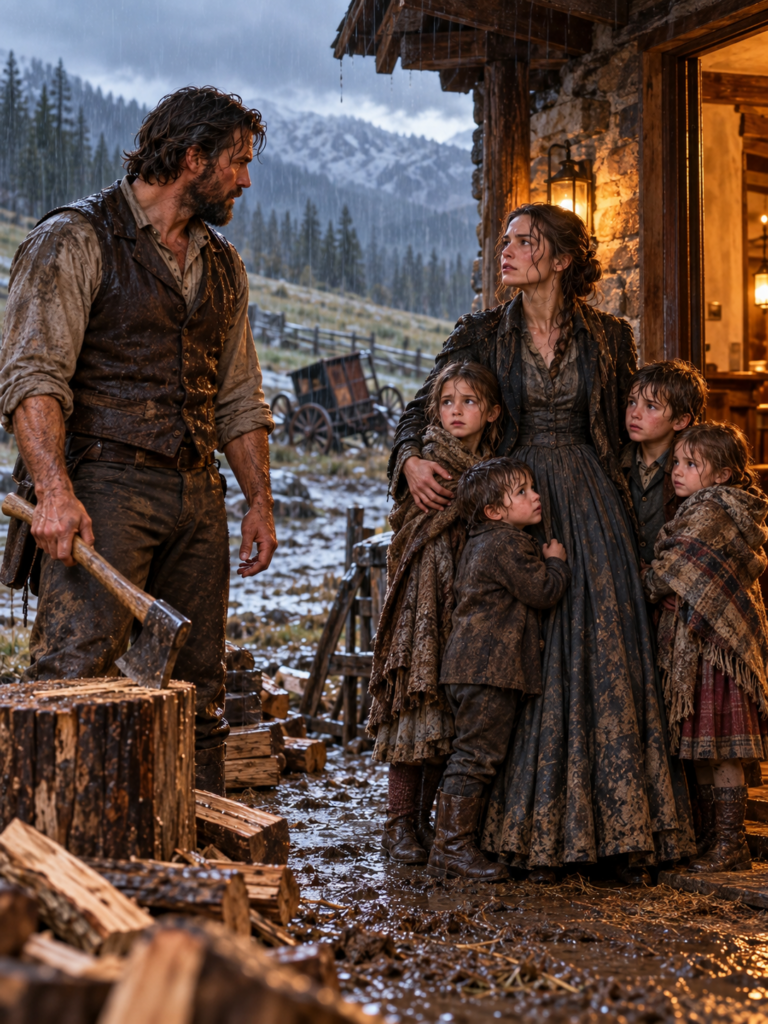
Together, without another word, they walked back into the storm.
The mud had worsened while Calla and the children stood in the yard. Water poured along the wagon ruts, and the narrow road descended sharply through black pines toward the bend where the damaged coach lay tilted against an embankment.
Elias shortened his stride without mentioning it.
Calla noticed.
She also noticed that he remained on the downhill side of the path, where a slip would send him into the ditch before it sent her there.
“You do this with every stranger who arrives at your door?” she asked.
“No.”
“Then why us?”
Elias looked ahead.
“Your youngest was turning blue.”
That answer was too practical to argue with.
They found the coach exactly where Calla had left it. One wheel leaned uselessly outward. Her trunk remained strapped to the rear.
Elias examined the broken axle.
“You walked the children from here?”
“Yes.”
“In that rain?”
“There was no shelter worth trusting.”
He gave her a brief look.
Not admiration.
Calculation.
As if revising something he had first assumed about her.
He cut the trunk loose and lifted one end.
Calla seized the other handle.
“You cannot carry that uphill.”
“I have carried heavier.”
“So have I.”
That earned the smallest shadow of a smile.
They began climbing.
Halfway up, Calla’s boot slid.
Her knee struck the road.
Elias dropped his end instantly and caught her elbow, but the moment she regained balance, he released her.
No lingering grip.
No unnecessary rescue.
“You hurt?”
“My pride.”
“That survives most falls.”
She looked up sharply.
He was joking.
Barely.
But joking.
By the time they returned, Thomas had built the fire higher and Beatrice had found towels. Henry sat wrapped in Elias’s coat while Clara slept against one of the hounds as if she had known the animal all her life.
Calla stopped in the doorway.
The great dog lifted one yellow eye.
Elias said, “That one’s Amos.”
“And he allows this?”
“He has apparently been conquered.”
Clara’s small fist was buried in the dog’s rough fur.
Something in Calla’s chest tightened.
She set the trunk down.
“Now,” she said. “Terms.”
Elias glanced at her wet hem.
“You are relentless.”
“I have four children.”
“That explains it.”
They settled at a scarred table beside the fire.
Calla named a weekly wage.
Elias offered half.
She countered immediately.
He leaned back.
“You bargain hard.”
“I have been poor long enough to know what everything costs.”
Silence.
Then Calla added, “Room and board for the children. Access to the supply books. Authority to purchase household necessities within an agreed budget. And I will not be dismissed without notice unless I steal, lie, or endanger this property.”
Elias’s expression lost every trace of amusement.
“You expect dismissal.”
“I expect the ground to disappear beneath me. Experience has trained me well.”
His eyes held hers.
Calla wished she had not said that.
At last Elias reached for paper from a desk near the wall.
He wrote slowly.
Then pushed the sheet toward her.
“Three dollars a week. Rooms. Food. Household budget. Thirty days’ notice from either side.”
Calla read it twice.
“And my children?”
“They live here as long as you do.”
“As dependents?”
“As your children.”
That distinction mattered more than he could know.
She took the pencil.
“One more condition.”
Elias waited.
“My eldest is twelve. He believes his father’s death made him responsible for all of us. It did not.”
Calla’s voice remained steady.
“If he offers to work, you may teach him. You may expect him to help. But you will not make a hired man of him to pay our keep.”
Elias’s gaze moved toward Thomas, who was pretending not to listen from the hearth.
Then back to Calla.
“Agreed.”
She signed.
Elias signed beneath her.
The instant the pencil left the page, a crash sounded upstairs.
Beatrice shrieked.
Thomas sprang toward the staircase.
Calla was faster.
She ran, Elias directly behind her, and reached the upper corridor just as Henry staggered from an open doorway, white-faced.
“The ceiling,” he gasped. “It fell.”
Calla looked past him.
Rainwater poured through cracked plaster onto the bed where Clara had been sleeping minutes before.
Elias’s jaw tightened.
“The west roof.”
“You said the east rooms were safe.”
“They should have been.”
Calla turned on him.
“Should have been is not enough.”
He absorbed the blow without defending himself.
Then he nodded.
“You’re right.”
That stopped her.
Men had apologized to Calla before, but usually only after explaining why the fault belonged to someone else.
Elias crossed to the damaged doorway.
“Everyone downstairs tonight. Tomorrow you choose which rooms are safe. Not me.”
Calla stared.
He had just surrendered authority over his own house because she had challenged his judgment.
Behind them, another piece of wet plaster struck the floor.
Calla stepped into the damaged room, lifted Clara’s little blanket from the soaked mattress, and looked at the spreading stain overhead.
“We begin with the roof,” she said.
Elias picked up a lantern.
“And if the weather breaks?”
“Then I inspect every room in this house.”
His mouth curved slightly.
“You really did come here for work.”
Calla faced him.
“No, Mr. Mercer.”
She folded the wet blanket over her arm.
“I came here because my children need somewhere the floor does not vanish beneath them.”
For the first time, Elias had no answer.
She walked past him toward the stairs.
After one motionless second, he followed.
After one motionless second, he followed.
By sunrise, Elias had moved the entire family into the great room, where the stone hearth held heat better than the upstairs bedrooms. He brought down mattresses himself, then disappeared onto the roof with two ranch hands Calla had not yet met.
Calla spent the morning inspecting Ironwood.
She quickly discovered that the house had not been ruined by poverty.
It had been abandoned by attention.
The pantry held enough flour, beans, salt pork, dried apples, coffee, and preserved vegetables to feed twice the number of people living there, yet no one had bothered to organize any of it. The account books were accurate but months behind. Several upstairs rooms were usable once aired. A pipe leaked in the scullery. The linen press was full but poorly kept.
The place had resources.
What it lacked was somebody who expected tomorrow to matter.
Calla understood that kind of neglect.
Within a week, she had established routines.
She hired an older woman from the settlement to help two days each week. She renegotiated the butcher’s deliveries. She discovered that Elias was paying nearly double for lamp oil because he disliked bargaining and approved invoices without reading them closely.
“You own cattle,” she told him one evening, placing three bills beside his supper. “How can you be cheated this badly on oil?”
Elias looked at the papers.
“I know cattle.”
“Apparently lamps remain your natural enemy.”
Thomas laughed into his cup.
Elias glanced at the boy.
Then, unexpectedly, he laughed too.
It was the first time Calla heard the sound.
Low.
Rusty.
Almost startled by itself.
The children changed faster than the house.
Henry discovered the hayloft.
Beatrice found an overgrown kitchen garden and declared herself its superintendent.
Clara attached herself shamelessly to Amos, who accepted the arrangement with the patience of an ancient saint.
Thomas remained different.
He watched Elias constantly.
One cold morning, Calla saw him standing by the chopping block.
Elias’s splitting axe had been left buried in a round of pine.
Thomas wrapped both hands around the handle and pulled.
Nothing happened.
He braced one boot against the stump.
Still nothing.
Calla moved toward the door.
Then Elias emerged from the barn.
Thomas straightened immediately.
“I wasn’t stealing it.”
“Hard thing to steal,” Elias said.
He walked over and freed the axe with one hand.
Thomas’s face reddened.
Elias did not mock him.
Instead he turned the handle sideways.
“You’re using your arms.”
Thomas frowned.
“What else would I use?”
“Your weight.”
For the next hour, Elias taught him.
Not like a father.
Not like a master.
Like one person passing useful knowledge to another.
When Thomas finally split a narrow log cleanly, he looked stunned.
Elias nodded once.
“Stack it.”
Thomas grinned.
That night Calla carried coffee into Elias’s office.
“You did not have to do that.”
“He wanted to learn.”
“He wants to become thirty years old before supper.”
Elias looked toward the door through which Thomas had disappeared.
“He thinks being useful will keep bad things from happening.”
Calla’s fingers tightened around the coffee pot.
“You noticed.”
“I used to know someone like that.”
“Your brother?”
Elias’s expression closed slightly.
Calla had finally learned the basic history of Ironwood from town gossip. Elias’s older brother had inherited the ranch first and died several years later after a sudden illness. Elias, who had preferred working cattle and timber operations in the high country, became owner almost overnight.
He had not wanted the position.
Yet he had remained.
“My brother liked cities,” Elias said. “Parties. Politics. Expensive coats. He could walk into a room and belong there before anybody knew his name.”
“And you?”
“I usually look for the nearest door.”
Calla smiled despite herself.
“Why stay here, then?”
“This is where I know what I’m doing.”
His answer carried more weight than the words suggested.
Calla understood it because she had done the same thing.
She had fled toward work because work was measurable.
People were not.
The next week she took Thomas to the mountain settlement for winter coats.
There, the wife of the county magistrate cornered her inside the mercantile.
“So you are the widow living with Mercer.”
Calla turned.
The woman’s silk-trimmed traveling coat cost more than Calla had earned in months.
“I am his housekeeper.”
“How respectable.”
The insult sat plainly between them.
Calla had endured worse in Denver after her husband’s debts became known.
She no longer possessed patience for it.
“I manage Ironwood,” she said evenly. “And I am currently buying coats for children who are waiting outside in weather too cold for idle conversation.”
The woman smiled thinly.
“People say Mercer collects broken things.”
Calla felt the old shame rise.
Penniless widow.
Four children.
No family willing to take them.
A man’s failed finances following her like dirt on a hem.
Then she remembered Elias signing a contract instead of offering charity.
She lifted her chin.
“Then perhaps the valley should be grateful he has better judgment than the people throwing them away.”
The merchant became intensely interested in his ledger.
Calla paid for the coats and left.
When she returned to Ironwood, Elias was shoeing a draft horse.
“I hear you met Mrs. Vale.”
“News moves quickly.”
“Her nephew delivered flour.”
Calla expected embarrassment.
Possibly annoyance.
Instead Elias said, “You were kinder than she deserved.”
“I was not kind.”
“I heard what you said.”
He set down the hoof and stood.
“What should I have said?”
Elias thought about it.
“Nothing. You handled your own fight.”
That answer mattered.
More than gallantry would have.
Winter arrived brutally.
Snow sealed the road.
Elias closed the upper rooms and moved everyone into the great room during the worst nights, where the walls were thick and the hearth broad.
He slept nearest the drafty outer door.
Calla noticed that too.
One night, after the children slept, Elias handed her hot coffee sweetened with honey.
“Will the roof hold?” she asked.
“Yes.”
“You sounded more certain than last time.”
“I inspected it myself after you did.”
Calla looked at him over the cup.
“Good.”
The corner of his mouth moved.
Across the room, Clara coughed.
Elias’s gaze shifted immediately.
It had been a mild cough for days.
By morning, it was worse.
Calla knew enough about sick children to fear the change.
She kept Clara warm, offered broth and water, and sent Thomas to fetch Elias from the barn.
Elias came immediately.
He touched Clara’s forehead, listened to her breathing, then stood.
“We need the doctor.”
“The road is buried.”
“I know.”
“You cannot ride through that.”
“I can reach the lower track.”
“No.”
He looked at her.
Calla surprised herself with the force of the word.
“No heroics. If you break your neck, I still have a sick child and now this ranch has no owner.”
For several seconds, neither moved.
Then Elias nodded.
“What do you suggest?”
“Two riders. Rope between the horses where the drift is worst. The strongest animals. Someone stays here who knows what to do if her breathing changes.”
“I stay.”
Calla had expected resistance.
None came.
Two ranch hands left for the settlement.
Elias remained beside the fire while Calla cared for Clara.
Hours passed.
At one point Calla’s hands began shaking so badly she spilled water.
Elias took the cup before it fell.
“She is breathing.”
“For now.”
“Then we work with now.”
Calla looked at him.
Her husband had always responded to fear with irritation.
Elias responded by becoming quieter.
Steadier.
“I once lost a baby,” she whispered.
It was the first time she had spoken of it since leaving Denver.
Elias did not say he understood.
He did not promise Clara would recover.
He simply pulled a chair closer.
“I’m here.”
The doctor arrived after dark.
Clara remained ill through the night, but by the following afternoon her fever had begun to ease.
Calla slept three hours without waking.
When she opened her eyes, she found Elias sitting near the mattress, Clara’s tiny hand wrapped around one of his fingers.
He looked almost embarrassed to be discovered.
Calla said nothing.
Neither did he.
Spring came slowly.
Snow receded from the south-facing slopes. Mud swallowed the yard. Ironwood began opening itself to daylight.
So did Calla.
One afternoon she worked in the neglected garden beside the house, cutting dead briars away from old rose roots.
Elias found her there.
“You’ll tear your hands apart.”
“They have survived worse.”
He crouched beside the bed.
“Why roses?”
“Because they are alive under all this.”
He studied the tangled stems.
“You’re certain?”
“No.”
Calla pulled another length of dead growth free.
“That is what makes it worth trying.”
Elias was quiet.
Then he began clearing the other side.
They worked without speaking for nearly an hour.
At last Calla said, “My husband did not leave us money.”
Elias kept cutting.
“He left debts. More than I understood. By the time I learned how bad it was, almost everything belonged to someone else.”
“You don’t have to explain.”
“Yes, I do.”
He looked at her.
Calla set down the shears.
“I need you to understand why I work like this. Why I count food. Why I keep money sewn into the hem of one dress. Why I cannot belong to a place simply because someone tells me I am safe.”
Elias’s face changed.
Not wounded.
Attentive.
“So what would make you believe it?”
Calla had no answer ready.
Finally she said, “Choice.”
He waited.
“A door I may walk through in either direction.”
Elias nodded slowly.
Then he reached into his coat and removed a key.
“The household account chest.”
He placed it on the stone wall between them.
“You manage it already. You should control access to it.”
Calla stared at the key.
“That is a great deal of trust.”
“Yes.”
“And if I leave?”
“You take whatever wages are owed and go.”
The simplicity of it struck deeper than any declaration could have.
Calla picked up the key.
A few weeks later, with the roses showing their first green shoots, Elias found her in the same garden.
He stood across from her, hat in his hands.
“I want to ask you something.”
Calla’s pulse changed.
He did not step closer.
“I want you and the children to stay after your employment ends.”
She held his gaze.
“In what capacity?”
Elias breathed once.
Then said, “That depends on what you are willing to choose.”
“That depends on what you are willing to choose.”
Calla did not answer immediately.
The garden lay between winter and spring, much as everything else at Ironwood seemed to. Dead briars had been piled beside the wall. Fresh shoots pushed through black soil. Water dripped from the eaves in a slow, steady rhythm.
Elias stood several feet away.
He had not reached for her.
That mattered.
Calla folded her hands around the pruning shears.
“You are asking me to remain at Ironwood.”
“Yes.”
“As housekeeper?”
“No.”
“As what, then?”
The question cost him something.
She saw it in the way his broad shoulders tightened.
“A partner,” he said. “If that is a thing you could want.”
Calla looked toward the house.
Through an open kitchen window came Henry’s laughter, followed by Beatrice telling him in a voice of fierce authority that he was ruining her seed rows.
Ironwood no longer sounded empty.
That frightened her almost as much as losing it.
“Elias, you own this ranch.”
“Yes.”
“The land. The cattle. The house. Everything.”
“Yes.”
“And I own almost nothing.”
“That is not your fault.”
“I did not say it was.”
She stepped closer.
“I am saying affection does not erase arithmetic.”
His brow furrowed.
Calla continued.
“If I stay because you want me, and one day you stop wanting me, I become the woman standing in the rain again.”
Understanding moved slowly through his face.
He looked down at the soil.
“That is what you meant by choice.”
“Yes.”
He was silent for so long that Calla feared she had broken whatever had begun between them.
Then Elias nodded.
“What would partnership require?”
The question stunned her.
Not what do you want from me?
Not why can’t you trust me?
What would partnership require?
Calla considered carefully.
“My wages remain mine while I work.”
“Agreed.”
“If we become something other than employer and housekeeper, the children remain secure here regardless of whether that relationship survives.”
Elias’s eyes sharpened.
“Agreed.”
“I continue managing the household accounts only if I have authority to question expenses, negotiate contracts, and say no when the numbers do not support what you want.”
“You already do that.”
“I want it understood.”
“Then it is.”
She hesitated.
“And Thomas is not your replacement son.”
Something flickered across his face.
“No.”
“If he grows close to you, that is his choice. He has spent too long believing every man who feeds us becomes someone he must satisfy.”
Elias glanced toward the barn, where Thomas had left a newly split stack of wood.
“I would never ask that of him.”
“I know.”
That was the first time Calla realized she truly did know.
Elias stepped nearer but stopped before touching her.
“Anything else?”
“Yes.”
Her voice softened.
“If you want me as a woman rather than an employee, say it plainly.”
For perhaps the first time since she arrived, Elias Mercer looked genuinely uncertain.
Calla almost smiled.
He had faced winter storms without visible fear.
A widow with muddy boots defeated him.
At last he said, “I think about you when you are in the next room.”
Calla’s heart began pounding.
“I notice when you have not eaten.”
He swallowed.
“I know which stair creaks under your left foot because you step lighter on the right when Clara is sleeping.”
Calla did not move.
Elias continued.
“I have spent years making this place quiet because quiet asks nothing of me.”
His gaze flicked toward the house.
“Then you arrived with four children, a broken wagon, no money worth mentioning, and the nerve to negotiate wages before your dress was dry.”
Calla’s mouth trembled.
“And now?”
“Now quiet feels wrong.”
He looked back at her.
“I want you here when there is no storm. When nobody is sick. When there is no problem to solve. I want you here when the day is ordinary.”
Calla’s eyes burned.
That was the dangerous promise.
Not rescue.
Ordinary days.
She set the shears down.
“Elias.”
“Yes.”
“Come here.”
He took one step.
Calla rose onto her toes, placed one hand against his rough cheek, and kissed him.
He remained perfectly still for half a heartbeat, giving her time to retreat.
She did not.
Then his hand settled carefully at her waist.
The kiss was not dramatic.
No thunder rolled.
No doors slammed.
It was warm and astonishingly gentle, tasting faintly of coffee and cold mountain air.
When they parted, Elias rested his forehead against hers.
Calla whispered, “Do not mistake this for an answer about forever.”
“I won’t.”
“Good.”
His mouth curved.
“Terrifying woman.”
“Poor negotiator.”
That spring changed Ironwood by inches.
The garden returned first.
Calla and Beatrice planted vegetables between the surviving flowers. Henry built crooked markers from scrap wood. Clara followed Amos through the rows, occasionally uprooting something important and offering it proudly to whoever stood nearest.
Thomas worked with the ranch hands after lessons, but Calla made certain his hours remained a boy’s hours.
Elias enforced that boundary more fiercely than she did.
When Thomas attempted to join a long cattle ride, Elias handed him a shorter list of work around the home corrals.
“I can do it,” Thomas protested.
“I know.”
“Then why can’t I go?”
“Because being capable does not mean you owe every ounce of strength you have.”
Thomas went silent.
Calla, standing nearby with an account ledger under her arm, felt the words land in both of them.
Later she found Elias repairing a gate.
“You knew who you were speaking to.”
“Yes.”
“Thomas?”
Elias looked at her.
“Both of you.”
Summer widened the world.
The road dried.
Neighbors came more often.
Some arrived because they were curious about the widow living at Ironwood.
Others came because Calla had restored the ranch kitchen’s trading accounts and begun purchasing produce, eggs, sewing work, and preserved goods from families throughout the valley.
She made no attempt to win everyone.
That surprised Elias.
“You could make them like you,” he said once after a particularly stiff visit from Mrs. Vale.
Calla closed the account book.
“I could also spend the afternoon teaching a mule to play cards. Both seem equally useful.”
He laughed so loudly Henry came running to see what had happened.
Then Denver came back.
Not as an army.
Not as a villain.
As a letter.
Thomas carried it in from the weekly post.
Calla recognized the handwriting on the envelope immediately.
Mr. Harland Pike.
Her late husband’s former attorney.
Her stomach tightened.
She opened it alone in the office.
Richard Sterling’s estate, he wrote, had finally been settled.
There was no hidden fortune.
No miraculous inheritance.
Only confirmation.
The debts had consumed everything in Denver.
A creditor had made a final inquiry regarding several personal objects still believed to be in Calla’s possession, but the matter could be closed if she signed a declaration stating that no estate property remained.
Calla sat very still.
For months she had feared someone would arrive at Ironwood and drag the past through the door.
Instead the past had reduced itself to one piece of paper.
Elias found her there.
“What happened?”
Calla handed him the letter.
He read it once.
Then placed it on the desk.
“That all?”
She stared.
“What do you mean, that all?”
“No one is coming?”
“No.”
“No claim against you?”
“No.”
“Then sign whatever is true and send it back.”
Calla laughed once.
It broke into tears before she could stop it.
Elias did not reach for her immediately.
He waited.
Calla held out her hand.
Only then did he come closer.
“I thought I would feel free,” she whispered.
“You don’t?”
“I feel angry.”
“At him?”
“At myself.”
“Why?”
“Because I spent years believing if I worked harder, watched more carefully, asked fewer questions, managed his moods better, perhaps everything would hold together.”
Elias crouched in front of her chair.
“Calla.”
She looked at him.
“His failures were not your lack of vigilance.”
She closed her eyes.
“I know that in my head.”
“Your head is usually terrifyingly reliable.”
A wet laugh escaped her.
He squeezed her fingers once.
“What do you want to do with the letter?”
Calla opened her eyes.
“Burn it.”
Elias looked toward the fireplace.
Then back to her.
“Your decision.”
Calla carried the letter to the hearth herself.
She held one corner over the flame.
The paper darkened.
Curled.
Caught.
She did not feel transformed.
She felt lighter by perhaps one ounce.
It was enough.
Weeks passed.
The roses flowered.
One evening, Elias asked Thomas to walk with him to the lower pasture.
They returned after sunset.
Thomas entered the kitchen first, strangely quiet.
Calla looked from him to Elias.
“What happened?”
“Nothing.”
Thomas took bread from the table.
“He asked me something.”
Calla’s pulse jumped.
“What?”
Thomas scowled at Elias.
“You ask her.”
Then he left.
Calla turned slowly.
Elias removed his hat.
“I told him I intended to ask whether you would marry me.”
She became perfectly still.
“And why,” she asked softly, “did you tell my son before telling me?”
“Because if the idea frightened him, I wanted to know before I put any weight on you.”
Calla studied his face.
“What did he say?”
Elias almost smiled.
“He asked whether you would still control the household accounts.”
Calla laughed so hard she had to grip the table.
“And?”
“I told him God himself could not take those books from you.”
Her laughter faded into something warmer.
Elias stepped nearer.
“I also told him he did not owe me permission. Neither do the others. But their lives would change if you said yes, and I thought they deserved warning.”
Calla looked toward the hallway.
Four children.
A ranch.
A man who had once believed silence was safety.
She felt fear.
Real fear.
Not because she doubted him.
Because the choice mattered.
Elias reached into his pocket.
Calla immediately raised one finger.
“If you kneel, I will leave the room.”
He froze.
Then slowly straightened.
“I was only getting this.”
He produced a small brass key.
Calla frowned.
“What is it?”
“The east office.”
“The room beside mine?”
“Yes.”
“You keep it locked.”
“I did.”
He placed the key on the table.
“My brother used it for estate business. After he died, I closed it because I did not want the ranch becoming what he tried to make it—something run for appearances instead of usefulness.”
Calla waited.
“I want it reopened.”
“For what?”
“For you.”
Her eyes narrowed.
“Explain carefully.”
Elias did.
He proposed that the room become Calla’s office.
Not a sitting room.
Not a sewing room.
An office.
The ranch household accounts, supply contracts, valley purchases, wage records, and correspondence would be managed there. She would be paid separately for that work whether they married or not.
If they married, the arrangement would continue.
“You are proposing employment before marriage.”
“I am trying not to be an idiot.”
“That is ambitious.”
“I’ve had instruction.”
Calla picked up the key.
“Anything else?”
“Yes.”
He took a breath.
“I love you.”
The room seemed to narrow around those three words.
Elias did not embellish them.
He did not tell her she belonged to him.
He did not promise she would never suffer again.
He simply stood there and allowed the truth to remain vulnerable between them.
Calla felt tears rise.
“Why?”
He frowned.
“What?”
“Why do you love me?”
Elias looked genuinely offended by the question.
“You argue with invoices.”
She stared.
“You challenge roof construction.”
“Elias.”
“You rescued my garden while insulting my pantry.”
She fought a smile.
“You raised four children through grief and poverty without teaching them the world owed them kindness.”
His voice softened.
“You know how to stay without surrendering yourself.”
Calla stopped smiling.
That was it.
The answer beneath every other answer.
Elias moved no closer.
“Marry me if you want a life with me. Not because I gave you shelter. Not because the children are comfortable. Not because leaving would be difficult.”
His eyes held hers.
“If you need to leave first to know you can, I’ll take you to town myself.”
Calla’s throat tightened painfully.
A door in either direction.
He had remembered.
She picked up the brass key.
Then she looked toward the front entrance.
“I want the wagon tomorrow.”
Elias’s face went still.
“All right.”
“I am taking the children to the settlement.”
“All right.”
“I will spend the day there.”
He swallowed.
“All right.”
“And you will not follow.”
Something like pain crossed his face.
Still he answered, “All right.”
The next morning, Calla drove down the mountain with all four children.
She rented two rooms at the inn.
She paid with her own wages.
Then she spent the day walking the settlement.
She visited the mercantile.
The school.
A small house advertised for rent.
She calculated what her wages and savings could support.
It would be difficult.
But possible.
That evening Thomas sat across from her at the inn supper table.
“Are we leaving Ironwood?”
“I don’t know.”
Henry looked alarmed.
Beatrice stopped eating.
Clara asked, “Where Amos?”
Calla’s heart broke a little.
Still she continued.
“I need all of you to understand something. We can leave. We are not trapped there.”
Thomas watched her carefully.
“Do you want to?”
Calla looked at her children.
This was not a question Elias could answer.
Nor society.
Nor fear.
“No,” she said.
The word came easily.
“I don’t.”
Thomas nodded.
“Neither do I.”
Beatrice said, “My carrots are there.”
Henry said, “The barn cat needs me.”
Clara repeated, “Amos.”
Calla laughed through sudden tears.
The following afternoon they drove home.
Elias stood in the yard splitting wood.
Exactly as he had the first day.
He saw the wagon.
The axe stopped.
Calla climbed down.
For several seconds neither spoke.
Then Elias set the axe aside.
“You came back.”
“Yes.”
He remained where he was.
Calla crossed the yard.
Mud no longer sucked at her broken boots.
Summer grass brushed the hem of her blue work dress.
She stopped in front of him.
“I went because I needed proof.”
“That you could leave.”
“Yes.”
“And?”
“I can.”
Something in Elias relaxed.
Calla took the old employment contract from her bag.
She had kept her copy.
She unfolded it.
Three dollars a week.
Room.
Food.
Thirty days’ notice.
The terms that had once saved her dignity.
She tore it once.
Elias’s eyebrows lifted.
Then Calla produced another folded paper.
“What is that?”
“A new agreement.”
He took it.
Her handwriting covered the page.
Management of household accounts.
Purchasing authority.
Separate wages.
Schooling for the children.
Thomas’s work limited to agreed hours.
Calla’s office under her control.
And beneath those terms, one final line.
Marriage, if both parties continue to choose it freely.
Elias read it twice.
Then looked at her.
“You put marriage in a contract.”
“I like clarity.”
“I love you.”
“That is fortunate.”
His laugh rolled across the yard.
Calla smiled.
“Do you agree to the terms?”
“Yes.”
“You have not negotiated.”
“I’ve learned when I’m beaten.”
She held out her hand.
Elias took it.
Weeks later, they married in the small valley church.
There was no grand society crowd.
No aristocratic spectacle.
The ranch hands came.
The older woman who helped in the kitchen cried openly.
The merchant supplied cake ingredients at cost and claimed afterward that he had always supported the match.
Mrs. Vale attended wearing an expression suggesting she considered happiness personally suspicious.
Thomas stood beside Elias.
Not as a replacement son.
Not because anyone required it.
Because he chose to.
After the ceremony, when the wagon climbed toward Ironwood, Clara fell asleep against Amos before Calla had removed her gloves.
Life afterward did not become effortless.
Winter returned.
Cattle got sick.
Accounts came due.
Henry broke a window.
Beatrice planted beans where Elias had specifically warned they would not grow.
Thomas became a teenager and discovered that silence could be used as a weapon.
Calla and Elias argued.
Once, furiously, about hiring another ranch hand.
Twice about money.
Frequently about Elias forgetting meals while repairing fences.
But no argument threatened the ground beneath Calla’s feet.
Her office key remained hers.
Her wages remained recorded.
The wagon remained available.
The door still opened both ways.
That was why she stayed.
Years later, the east garden grew roses high against the stone wall.
The old chopping block remained in the yard.
One autumn afternoon, Calla stood at the kitchen window and watched Elias teaching Henry to split wood.
Thomas, nearly grown, repaired harness nearby.
Beatrice carried a basket of late vegetables toward the house.
Clara sat in the grass with Amos’s aging head in her lap.
Ironwood was loud.
Gloriously, relentlessly loud.
Elias glanced toward the window.
He saw Calla watching.
Without saying anything, he lifted one hand.
She lifted hers in answer.
On her desk inside lay the brass key to her office.
Beside it rested the first contract, taped carefully back together after she had torn it—not because either of them needed its terms anymore, but because Calla had chosen to keep proof of the first thing Elias Mercer had given her.
Not charity.
Not rescue.
A bargain she could accept or refuse.
A place where her children were welcome before they were useful.
A door she could leave through.
And because that door had always remained open, Ironwood finally became the first home she had ever freely chosen to stay in.

