
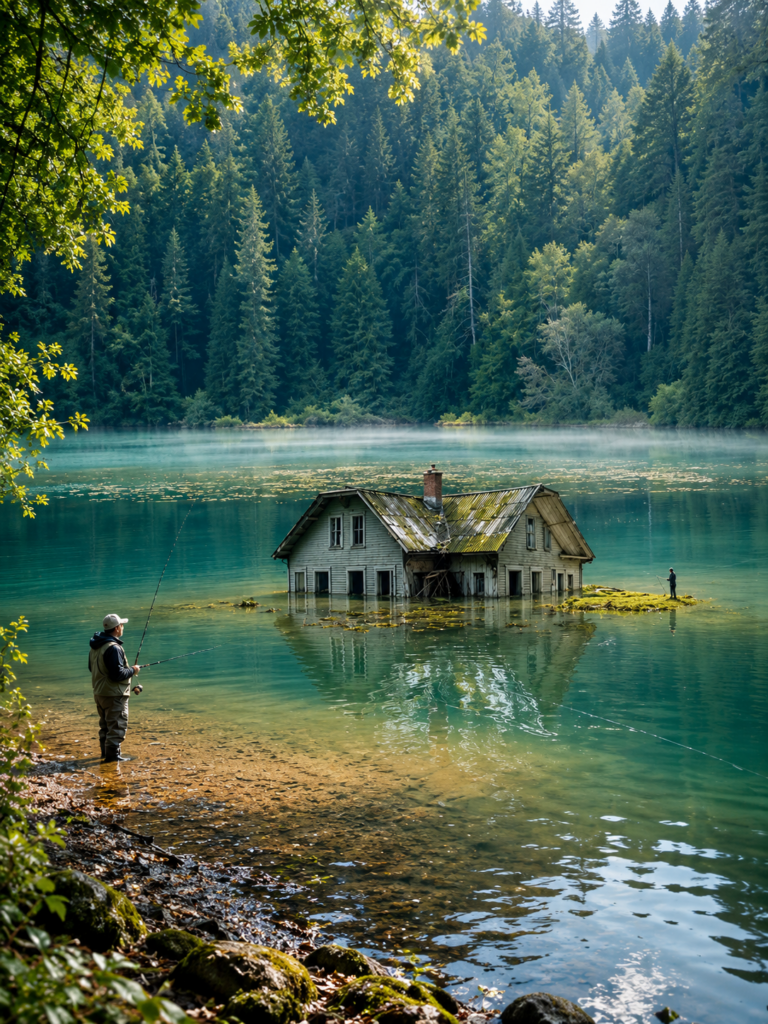
a widowed fisherman saw a farmhouse beneath the lake—what he found inside exposed the secret his town had buried for forty years
Part 1
For thirty-seven years, Walter Hayes had fished Bellweather Lake without ever wondering what lay beneath it.
He knew where the largemouth bass gathered in late April, where crappie hid beneath the drowned timber, and which shallow coves turned useless when a north wind came down through the Cumberland foothills.
He knew when rain upstream would muddy the water two days later.
He knew the smell of a storm before the clouds crossed the ridge.
And he knew that after sixty-eight years of living in the same Tennessee county, a man could survive perfectly well without knowing every secret his neighbors carried.
At least, that was what Walter had believed until the morning the lake gave him a roof.
His wife, Helen, had been dead three years.
Since then, Walter’s mornings had become almost painfully predictable.
He rose at 4:45, though no job required it. He fed the orange barn cat Helen had named Biscuit, filled the old green Stanley thermos with black coffee, and stood for a moment at the kitchen window looking toward the dark outline of the ridge.
Sometimes he still expected Helen to come down the hall in her robe and complain that no fish on earth was worth waking up before daylight.
The silence that followed those memories was why Walter went fishing.
The lake asked nothing of him.
That October morning, a long drought had lowered Bellweather Lake farther than anyone could remember.
Mud banks showed where water normally stood six feet deep. Old fence posts poked from the shallows. A cracked concrete foundation had appeared near the northern arm of the reservoir, attracting teenagers who posted photographs of it online.
Walter paid little attention.
Everybody knew there had been farms in the valley before Bellweather Dam was finished in 1978. Families had sold their land, houses had been torn down, and the river had been backed up until the valley became a lake.
That was history.
History belonged in courthouse files and black-and-white photographs.
Walter preferred fish.
He carried his tackle box down the path behind his small house and climbed into the fourteen-foot aluminum boat he had owned since 1996.
The outboard coughed twice before catching.
“You’re getting as stubborn as me,” Walter muttered.
He pushed away from the dock.
Fog lay low over Bellweather.
The world disappeared ten yards beyond the bow. Only the steady putter of the motor and the slap of water against aluminum told him he was moving.
He headed toward a rocky point Helen used to call Widow’s Elbow because the shoreline bent there sharply beneath a grove of sycamores.
Walter cut the engine fifty yards offshore.
Silence settled around him.
He cast once.
Twice.
On the third cast, something pulled hard enough to bend the rod.
Walter grinned.
“Come on.”
He reeled.
Whatever had his lure did not fight like a fish.
It dragged heavily for several feet, then stopped.
Walter pulled harder.
The line snapped.
“Well, that’s five dollars gone.”
He leaned over the side, trying to see whether his lure had caught a stump.
The water was unusually clear.
Sunlight had begun burning through the fog, reaching down through the green water.
Walter squinted.
Something angular sat below him.
At first he thought it was rock.
Then he saw two straight lines meeting at a peak.
Walter leaned farther.
A roof.
He sat back.
“No.”
He looked again.
There was no mistaking it.
Roughly twelve feet beneath the surface, coated in silt and moss, was the pitched roof of a house.
One end had collapsed, but the other remained astonishingly intact.
Walter could even make out what looked like a brick chimney.
He drifted over it slowly.
A darker rectangle appeared beneath the roofline.
A window.
The sight made Walter’s skin tighten.
He had heard stories about houses under reservoirs. Everybody had. But Bellweather Lake had been here most of his adult life, and he had never heard anyone mention a complete house beneath Widow’s Elbow.
He marked the location on his fish finder and stayed another twenty minutes.
The longer he stared, the more details appeared.
A section of porch.
A fence line.
Something that might once have been a shed.
Then a cloud crossed the sun and the house disappeared into green darkness.
Walter went home without catching a fish.
At McCord’s General Store that afternoon, four older men occupied their usual table near the coffee machine.
Walter bought bread, batteries, and cat food.
He almost left without saying anything.
Then seventy-nine-year-old Earl Pritchard looked up.
“Fish quit biting?”
“They’re smarter than I am.”
“They’ve had practice.”
The men laughed.
Walter set his purchases on the counter.
“You boys remember the farms that were down in the valley before Bellweather Dam?”
The laughter stopped sooner than Walter expected.
Earl stirred his coffee.
“Some.”
Walter noticed the hesitation.
“I saw a house.”
One man frowned.
“Where?”
“Under the lake. Off Widow’s Elbow.”
Nobody spoke.
Walter looked from one face to another.
Earl finally lowered his spoon.
“How low’s the water?”
“Low enough.”
Earl stared toward the store window.
“Was bound to happen someday.”
Walter felt a chill that had nothing to do with the air conditioner.
“You knew about it?”
Earl rubbed his jaw.
“Everybody who was grown back then knew about the Mercer place.”
“Mercer?”
“Samuel Mercer.”
Walter knew the name.
Not the man.
There was a Mercer Road on the west side of the county and an abandoned family cemetery near the state line.
“What happened to him?”
Earl looked uncomfortable.
“He wouldn’t sell.”
Walter waited.
“Most families took the government’s money when the dam project came through,” Earl continued. “Didn’t mean they liked it. But they took it. Sam Mercer didn’t.”
“Why?”
“Because his daddy built that house. His granddaddy cleared the bottomland. Sam raised cattle there. Buried his wife on the hill. Said no amount of money was going to make him walk away.”
One of the other men, Leonard Pike, snorted.
“Man was stubborn enough to argue with thunder.”
Earl shot him a look.
“Maybe he had reason.”
Walter pulled out a chair.
“What happened?”
Earl’s expression changed.
For a moment he was not an old man sitting beneath fluorescent lights.
He looked frightened.
“He disappeared.”
Walter waited for the punch line.
None came.
“When?”
“Summer of ’77. Right before they closed the gates.”
“They never found him?”
“No.”
Walter frowned.
“And they flooded his house anyway?”
Leonard stared into his coffee.
“Project was behind schedule.”
Walter looked at Earl.
“You saying they knew a man was missing and just filled the valley?”
“I’m saying those were different days.”
“That doesn’t answer me.”
Earl pushed back from the table.
“Some questions don’t improve with age, Walter.”
Walter drove home thinking about that sentence.
At dusk, he sat on his back porch with Biscuit curled beneath the chair.
Across the field, the lake reflected the fading sky.
Helen had always accused him of being unable to leave a loose board unfixed.
If a gate sagged, he rehung it.
If a tractor made a strange sound, he tore into it until he understood why.
If a neighbor’s cow got loose at midnight, Walter was the man who put on boots and helped.
He could not stop thinking about Samuel Mercer’s house.
More than that, he could not stop thinking about the way Earl Pritchard had looked when he heard where Walter found it.
The next morning Walter returned.
This time he brought a long fiberglass pole.
The lake had dropped another few inches overnight.
He anchored directly above the roof and lowered the pole.
Twelve feet.
Then ten.
Something hard.
He moved closer to shore.
Seven feet.
The old farm sat on a gradual slope.
Walter circled the location for nearly an hour.
Then he saw a flash of metal near what appeared to be the house’s back wall.
Not rusted roofing.
Something smooth.
Something manufactured.
His curiosity became determination.
That evening, he dug through an old address book until he found a number for Raymond Cole.
Raymond had served twenty-two years with the county rescue squad and still did occasional underwater recovery work despite being sixty-two.
They had not spoken in nearly five years.
Raymond answered on the fourth ring.
“Walter Hayes. Either somebody died or you need something heavy moved.”
“I found a house.”
“Most folks call a realtor.”
“Under Bellweather Lake.”
There was silence.
Then Raymond laughed.
Walter did not.
“You serious?”
“Come Saturday.”
“What am I bringing?”
“Dive gear.”
Another silence.
“Walter.”
“Yeah?”
“Where exactly?”
“Widow’s Elbow.”
Raymond stopped joking.
“Who told you about that place?”
Walter sat straighter.
“You know it?”
“I’ve heard things.”
“What things?”
“Things I’d rather explain in daylight.”
Saturday arrived gray and cold.
Raymond’s truck came down Walter’s gravel drive at 6:20 with tanks, fins, ropes, lights, and a dry suit piled in the bed.
He climbed out slower than Walter remembered.
His beard had gone white.
His knees appeared stiff.
But his eyes were sharp.
Over coffee, Walter told him everything.
Raymond listened without interruption.
When Walter mentioned Samuel Mercer, Raymond exhaled through his nose.
“My dad worked concrete on Bellweather Dam.”
Walter had forgotten.
“Did he know Mercer?”
“Everybody did.”
“What did your father say?”
“Not much. Dad drank hard for ten years after that project. Wouldn’t drive across the dam unless he had to.”
Walter looked toward the lake.
“Why?”
Raymond picked up his mug.
“Let’s find out whether you actually saw a house before we start digging graves.”
They launched at 8:10.
The water was fifty-four degrees.
At Widow’s Elbow, Raymond studied the fish finder, then leaned over the gunwale.
“You weren’t seeing things.”
Walter’s pulse quickened.
Raymond spent fifteen minutes preparing.
“You’re staying in the boat,” he said.
“I can still swim.”
“So can rocks. Doesn’t mean they belong underwater with scuba equipment.”
Walter tied Raymond’s safety line to the cleat.
“If I pull twice?”
“Feed slack. Three hard pulls, bring me up.”
Raymond rolled backward into the lake.
Walter watched the bubbles disappear.
Five minutes passed.
Then ten.
The rope shifted slowly through his hands.
At twelve minutes, it stopped.
Walter stared at the surface.
“Ray?”
Nothing.
Then the rope jerked.
Once.
Twice.
Three times.
Walter hauled.
His hands burned.
Bubbles erupted beside the boat, and Raymond surfaced hard, tearing off his mask.
Walter grabbed his shoulder.
“What happened?”
Raymond sucked air.
“There’s somebody’s whole damn life down there.”
Walter’s stomach tightened.
“The house?”
“Standing. Porch mostly gone. Kitchen table’s still inside. Cast-iron stove. Bed frame. Dishes.”
He looked back at the water.
“And a safe.”
Walter remembered the flash of metal.
“Inside?”
“Back room. Floor’s collapsed under it.”
“Can we lift it?”
“Not with what I brought.”
Walter studied his friend’s face.
“What else did you see?”
Raymond hesitated.
“Marks on one wall.”
“What kind?”
“Can’t tell. Maybe damage from debris.”
“Raymond.”
The diver met his eyes.
“The back door is chained shut from the outside.”
Neither man spoke for several seconds.
Walter looked toward the calm shoreline.
A house abandoned before a flood did not need its door chained from outside.
And somewhere beneath them, in a room that had been dark for nearly half a century, a safe waited on the floor.
Part 2
Walter barely slept that night.
Rain tapped against his bedroom window after midnight.
Each time he closed his eyes, he pictured an old farmhouse beneath black water and a chain pulled across a door.
Around three, he gave up and went to the kitchen.
Helen’s blue ceramic coffee mug still sat in the cupboard.
He had not used it since she died.
Walter took it down anyway.
The foolishness of that made his throat ache.
“Tell me to leave it alone,” he whispered.
He could imagine exactly what Helen would have said.
Walter Hayes, you haven’t left anything alone since the day I met you.
He almost smiled.
By seven, Raymond had returned with a portable winch, lifting bags, heavier rope, and a younger man named Travis Boone from the rescue squad.
They spent half the morning rigging equipment.
Walter remained in the boat while Raymond and Travis went down.
Forty minutes later, the first corner of the safe broke the surface.
It was larger than Walter expected—nearly three feet tall, square-shouldered, and orange with rust.
The three men fought it onto the boat.
Black water streamed from its seams.
On the front, beneath moss and sediment, Walter found faint stamped letters.
S. MERCER.
Raymond saw them too.
“Well.”
Walter ran his thumb over the name.
“Bring it to my barn.”
The safe weighed nearly four hundred pounds.
They lowered it onto a concrete slab beside Walter’s workbench.
For two days, he sprayed penetrating oil around the hinges and lock.
On Monday evening, Earl Pritchard appeared without calling.
Walter found him standing outside the barn, staring at the safe.
“Who told you?”
“Nothing stays quiet in a county this small.”
Walter crossed his arms.
“You know what was inside?”
“No.”
“You know why Mercer’s back door was chained?”
Earl looked away.
“No.”
“That’s twice you’ve answered like a man who’s afraid of the truth.”
Earl’s shoulders sagged.
“I’m afraid of what people did because they were told it was easier than doing what was right.”
Walter waited.
Earl stepped into the barn.
“In 1977 I was twenty-nine. Had two kids, a mortgage, and a job driving a dump truck for Carden Construction.”
Walter recognized the company. Carden had built part of the dam and disappeared in the early 1980s.
“Sam Mercer had been fighting them for almost a year,” Earl said. “He claimed the rock on the eastern foundation wasn’t stable. Said they were pouring too fast, using bad aggregate, hiding cracks.”
“How would a farmer know that?”
“Sam wasn’t always a farmer. Served with Army engineers. Worked bridge construction after Korea. Came home when his father got sick.”
Walter looked at the rusted safe.
Earl continued.
“Sam started taking photographs. Writing letters. State offices. Newspapers. Federal inspectors. Anybody who might listen.”
“Did anybody?”
“One engineer did.”
“What happened to him?”
“Fired.”
Walter felt anger growing.
“And Mercer?”
Earl rubbed his hands together.
“Last time I saw him, he stood in the road in front of that house while two Carden trucks waited behind me. He told us nobody was crossing his land.”
“What did you do?”
“I turned around.”
“And then?”
Earl’s eyes filled.
“Three days later we heard he’d left town.”
“You believed that?”
“I wanted to.”
Walter said nothing.
Earl looked around the barn as if expecting someone to overhear after forty-nine years.
“The reservoir started filling the following week.”
“Did anyone check the house?”
“I don’t know.”
“You never asked?”
Earl looked at him sharply.
“People had families, Walter. Jobs. Men from Carden came into town and made it plain that anyone causing delays would never work construction in Tennessee again.”
Walter stared at him.
“So everybody shut up.”
“Yes.”
The word seemed to hurt Earl more than any accusation could.
He turned toward the door.
“I’ve regretted it longer than you’ve known me.”
Walter watched him leave.
Tuesday morning, Raymond arrived with a grinder.
It took ninety minutes to open the safe.
When the rusted door finally groaned outward, neither man celebrated.
Inside were layers of ruined cloth, plastic sleeves, notebooks, photographs, survey maps, carbon copies of letters, and several sealed metal document cases.
Some papers had dissolved.
Others had survived surprisingly well.
Walter carried them carefully into his kitchen.
He spread towels across the table.
By noon he understood why someone might have wanted Samuel Mercer silent.
There were photographs of concrete honeycombing.
Cracks.
Corroded reinforcement.
Truck manifests showing one grade of material ordered and a cheaper grade delivered.
Copies of inspection forms with handwritten notes.
Walter found letters addressed to the Tennessee Department of Conservation, the Army Corps of Engineers, two Nashville newspapers, and the county prosecutor.
The last was dated July 18, 1977.
If anything happens to me, please understand that I have not voluntarily abandoned my home or property.
Walter read the sentence three times.
Raymond stood behind him.
“Keep going.”
Another paragraph named three men.
Gerald Carden, president of Carden Construction.
County Commissioner Howard Bell.
Project superintendent Virgil Stroud.
Walter’s breath caught at the third name.
Virgil Stroud.
Everyone in Ashford County knew the Stroud family.
Virgil had been dead for twenty years, but his son Daniel had served as county mayor. His grandson owned the biggest excavation company in the region.
There was more.
Sam claimed records had been falsified after a worker named Thomas Avery died in a nighttime foundation collapse.
Officially, Avery had been killed in a vehicle accident.
Samuel said otherwise.
Raymond pulled out a chair.
“My father knew Thomas Avery.”
Walter looked up.
“He ever tell you how he died?”
“No.”
Raymond’s face had lost color.
“He just said Tom didn’t make it home.”
Walter began sorting photographs.
One showed laborers standing beside a concrete form.
On the back, someone had written names.
R. Cole.
T. Avery.
Raymond picked it up.
“That’s Dad.”
For a long moment he said nothing.
Then he sat heavily.
“My father was there.”
Walter placed a hand on his shoulder.
That afternoon they found a smaller notebook.
Samuel had kept dates, truck numbers, names, quantities, and conversations.
Near the end, the entries became shorter.
July 21: Bell came again. Offered double. Refused.
July 22: Truck outside after midnight.
July 23: Telephone line cut.
July 24: Saw Stroud near south pasture.
July 25: Earl P. warned me men are angry.
Walter stopped.
Earl.
Raymond leaned closer.
“Keep reading.”
July 26: Sent copies with Ruth. Originals remain here.
July 27: If they come tonight, I will not run.
There were no more entries.
Walter stood and walked to the sink.
His hands trembled.
“We need the sheriff.”
Raymond shook his head.
“We need somebody outside this county.”
“Why?”
“Because Daniel Stroud’s nephew is chief deputy.”
Walter turned.
“You think people are still protecting something that happened in ’77?”
“I think families protect names long after the people who earned those names are dead.”
Walter looked at the documents.
He remembered Earl’s shame.
He remembered the chained door.
“What would Helen tell you?” Raymond asked.
Walter gave him a tired glance.
“She’d say I should stop pretending I’m not already involved.”
Raymond smiled faintly.
“Smart woman.”
Walter contacted a reporter instead.
Her name was Claire Donnelly.
She worked for a Knoxville newspaper and had recently written about a rural nursing-home fraud case.
Walter expected skepticism.
Instead, she drove two hours the following morning.
Claire was fifty-one, with short gray-streaked hair and a notebook so battered it looked older than her.
She sat at Walter’s kitchen table for four hours.
She photographed every document.
Asked questions.
Made phone calls.
At 3:20 she lowered her phone.
“Carden Construction dissolved in 1983.”
Walter nodded.
“But Bellweather Dam still has state inspection records. There were emergency repairs in 1981 that were never publicly explained.”
Raymond frowned.
“What kind?”
“I don’t know yet.”
She lifted Samuel’s notebook.
“This could be legitimate. It could also be one man’s accusations.”
Walter’s expression hardened.
“His house was underwater with the door chained.”
“I understand.”
“No, ma’am. I don’t think you do.”
Claire did not flinch.
“Then help me prove it.”
That answer earned Walter’s respect.
Over the next week, she checked names.
Dates.
Land records.
Employment files.
Old newspapers.
Walter returned to ordinary chores, or tried to.
He replaced a rotten fence post.
Changed oil in the truck.
Split firewood.
Every task felt unreal.
One afternoon, Earl returned.
“I need to tell you something.”
They sat on the porch.
Earl held his cap between his hands.
“I lied.”
Walter waited.
“I saw Sam after everybody claimed he’d left.”
“When?”
“The night before they started filling the reservoir.”
Walter went still.
“Where?”
“Near his house.”
“Alive?”
Earl nodded.
“I was driving back from the construction yard. Saw lights down in the valley. Two trucks. One belonged to Carden.”
“What did you do?”
“Drove home.”
Walter stared at him.
“You left him there?”
Earl’s face twisted.
“I was twenty-nine years old with two babies sleeping at home.”
“And Sam?”
“I told myself it wasn’t my fight.”
Walter stood.
Earl did not defend himself.
“Next morning, Sam was gone.”
Walter looked toward the lake.
“You’ve carried that forty-nine years.”
“Every day.”
“Why tell me now?”
Earl looked at him.
“Because you’re doing what the rest of us should’ve done before the water ever rose.”
That evening, Claire called.
“Walter, I found Thomas Avery’s death certificate.”
“And?”
“Cause of death was crushing trauma.”
Walter gripped the phone.
“Not a vehicle accident?”
“No.”
“Anything else?”
“Yes. The physician who signed it was Commissioner Bell’s brother-in-law.”
Walter closed his eyes.
Claire continued.
“I also found something about Samuel Mercer.”
“What?”
“His property condemnation wasn’t finalized when the reservoir began filling.”
Walter sat down.
“They flooded land they didn’t legally own?”
“According to the county records, yes.”
The next day Claire arrived with worse news.
Someone had broken into her office.
Nothing expensive was taken.
Only copies of the Mercer documents.
Walter’s fear finally overtook curiosity.
“Stop.”
Claire looked at him.
“What?”
“Stop investigating.”
“You don’t mean that.”
“They know.”
“Who?”
“I don’t care.”
Walter paced his kitchen.
“You’ve got children?”
“Two daughters.”
“Then stop.”
Claire closed her notebook.
“Walter, someone stealing copies proves these documents still matter.”
“That’s exactly why I’m telling you to stop.”
She studied him.
“Did Samuel Mercer stop?”
“No.”
“And where did that get him?”
Silence filled the kitchen.
Claire softened.
“I understand.”
“No, you don’t.”
“I understand enough.”
She gathered her things.
Before leaving, she turned.
“If Samuel’s allegations were right, Bellweather Dam may have been built using falsified safety records. This isn’t only about what happened forty-nine years ago.”
Walter frowned.
“What are you saying?”
“I’m saying if the defects were never properly corrected, people downstream may still be living beneath them.”
For the first time since seeing the roof, Walter wished he had never looked into the water.
Part 3
The first hard rain of autumn arrived two nights later.
It came out of Kentucky in a long wall of thunder and hammered Ashford County for fourteen straight hours.
Walter lay awake listening to water pour through the gutters.
Before dawn, his phone rang.
Raymond.
“You watching the lake level?”
Walter sat up.
“No.”
“It’s rising fast.”
Bellweather Dam controlled flooding for three communities downstream.
Nobody in Ashford County worried much about it anymore.
The concrete structure had been standing for nearly fifty years.
Children rode bicycles across its overlook.
Families took photographs there.
Fishermen cursed the release schedule.
A dam, Walter realized, became invisible when it did its job long enough.
At eight o’clock Claire called.
She had located a retired structural engineer named Calvin Ross, eighty-six, living outside Chattanooga.
Ross had worked as a junior inspector at Bellweather.
“He remembers Samuel,” Claire said.
Walter stood beside the kitchen window.
“What’s he remember?”
“Enough that he wants to meet.”
They drove south that afternoon.
Calvin Ross lived in a modest brick house with a wheelchair ramp and a flag snapping above the porch.
His daughter let them inside.
Ross was thin, white-haired, and attached to an oxygen concentrator.
But when Claire placed Samuel Mercer’s notebook on the table, his eyes sharpened.
“I wondered where those went.”
Walter sat forward.
“You saw them?”
“Some.”
Ross touched the cover.
“Sam kept records better than we did.”
“Was he right about the dam?”
Ross leaned back.
“That’s not a yes-or-no question.”
“Make it one.”
Claire glanced at Walter, but Ross smiled.
“You’re a farmer?”
“Was.”
“You talk like one.”
“I still need the answer.”
Ross looked toward the rain-streaked window.
“The original design was sound. The construction was not.”
Walter felt Raymond stiffen beside him.
Ross continued.
“Carden was losing money. Fuel went up. Material costs went up. They started cutting corners.”
“Bad concrete?”
“In places.”
“Unsafe?”
Ross hesitated.
“Potentially.”
Claire leaned forward.
“What did you do?”
“I wrote reports.”
“What happened?”
“They disappeared.”
“Who made them disappear?”
“I can’t prove that.”
“Who?”
Ross closed his eyes.
“Virgil Stroud told me I had a wife and newborn son and should think carefully about whether I wanted to keep feeding them.”
Walter’s jaw tightened.
“And Samuel?”
“Sam photographed everything.”
Ross opened his eyes again.
“He was impossible to frighten.”
“Until they killed him?”
Ross looked at Walter for several seconds.
“I never knew what happened.”
“But you suspected.”
“Yes.”
Raymond placed the photograph of workers on the table.
“That’s my father.”
Ross studied it.
“Robert Cole.”
Raymond swallowed.
“You remember him?”
“Good man. Quiet.”
“Did he know what happened to Thomas Avery?”
Ross’s face changed.
“He was there.”
Raymond’s breathing became shallow.
“Tell me.”
Ross looked toward his daughter in the next room, then back at Raymond.
“A temporary wall failed during a night pour. Thomas got trapped. Robert and three others tried to reach him.”
“Why was it covered up?”
“Because the collapse showed the concrete mix didn’t meet specification.”
Raymond stared at the floor.
“My father drank himself half to death after that job.”
Ross nodded sadly.
“A lot of men carried Bellweather home with them.”
Walter thought about Earl.
About silence passed from father to son.
“What did Sam plan to do?”
“He had an appointment with a federal inspector.”
“When?”
“July 28, 1977.”
The day after Samuel’s final notebook entry.
Claire wrote rapidly.
“Did the inspector come?”
“No.”
“Why?”
“Someone called his office and said Samuel had withdrawn the complaint.”
“Did he?”
Ross looked directly at her.
“Samuel Mercer would have withdrawn his complaint when the mountains withdrew from Tennessee.”
They left near sunset.
Halfway home, Claire’s phone rang.
She answered.
Her expression changed.
“When?”
She listened.
“How serious?”
Another pause.
“We’re coming.”
She hung up.
Walter glanced at her.
“What?”
“State emergency management has requested an inspection at Bellweather.”
“Because of the rain?”
“Because one monitoring instrument on the eastern foundation is showing movement.”
No one spoke for the next several miles.
By the time they reached the county, sheriff’s vehicles blocked the access road to the dam.
Nobody had been evacuated.
Officials described the measure as precautionary.
Walter stood outside his truck in cold rain, looking toward the concrete wall barely visible through the darkness.
For decades he had thought of Bellweather Dam as permanent.
Now Samuel Mercer’s words seemed to hang over the valley.
Unsafe.
Refused authorization.
At home, Walter found Biscuit hiding beneath the porch.
He carried the cat inside and sat alone at the kitchen table.
Helen’s photograph stood beside the salt shaker.
Their wedding day.
She had been nineteen.
Walter twenty-one.
They had borrowed her father’s Chevrolet because Walter’s truck would not start.
He touched the frame.
“I don’t want to be brave,” he whispered.
That was the truth.
He had no desire to become a hero.
He wanted his coffee in the morning.
His boat.
His cat.
His memories.
He wanted to repair the loose gutter and sharpen the mower blades before winter.
He had spent three years learning how to live after losing the person who made ordinary life meaningful.
He did not want danger.
But he thought of Samuel Mercer standing in his house while trucks approached through the darkness.
A man could be frightened and still refuse to look away.
Walter called Claire.
“What do you need from me?”
The investigation widened quickly.
State engineers began reviewing archived records.
Claire published her first article three days later.
She did not accuse anyone of murder.
She reported only what could be documented: the submerged Mercer property, Samuel’s disappearance, the recovered records, Thomas Avery’s misreported workplace death, and concerns raised during Bellweather’s construction.
The story spread.
Television trucks arrived.
County officials held a press conference.
Daniel Stroud, seventy-three, appeared before cameras and called the allegations “irresponsible attacks on dead men who cannot defend themselves.”
Walter watched from McCord’s store.
Earl sat beside him.
“Virgil’s son,” Earl said.
“I know.”
“He sounds just like his daddy.”
On television, Daniel continued.
“My father devoted his career to developing this county. To imply he participated in wrongdoing based on documents found in a lake is disgraceful.”
Earl laughed bitterly.
“Funny thing about respectable men. They always want respect before truth.”
Walter looked at him.
“You willing to tell Claire what you told me?”
Earl’s humor vanished.
“I don’t know.”
“Then nothing’s changed.”
Earl stared at the television.
Walter regretted saying it.
But he did not take it back.
Two days later, Earl gave Claire an interview.
So did Calvin Ross.
Then Raymond.
Then the widow of another Bellweather worker.
After Claire’s second story, more people called.
A retired secretary said she had typed reports that were later destroyed.
A former equipment operator remembered being ordered to bury cracked test cylinders.
The daughter of Thomas Avery produced letters her mother had kept.
The past was not emerging cleanly.
It came out in scraps.
Shame.
Half memories.
Old receipts.
Photographs.
Voices shaking over telephone lines.
Walter began to understand that truth rarely returned like lightning.
It returned like groundwater, finding every crack.
Then Raymond called one morning.
“They’re going back to the house.”
“Who?”
“State investigators. They want to document the structure before the lake rises any higher.”
Walter looked at the cloudy sky.
“I’m coming.”
The dive took place under official supervision.
Walter sat aboard a larger rescue boat with Claire, two investigators, and technicians watching a live underwater feed.
The camera descended through green water.
Sediment drifted in the light.
Then the roof appeared.
Walter’s chest tightened.
Seeing it on a screen was somehow worse.
The diver moved toward the back.
The chain remained on the door.
A forensic investigator asked him to document it before touching anything.
The camera moved through a broken window instead.
Inside, chairs lay on their sides.
A cabinet door floated open and shut.
The diver’s light crossed the kitchen.
A rusted coffee pot sat on the stove.
Walter suddenly imagined Samuel making breakfast there.
Outside, men wanted his land.
Inside, coffee boiled.
Ordinary life standing stubbornly against something larger.
The diver entered the hallway.
The image shook.
“Visibility dropping.”
“Proceed carefully.”
He moved toward the rear room where the safe had been.
Empty now.
The light crossed a fallen beam.
Then stopped.
Something pale protruded from beneath it.
Nobody on the boat moved.
The diver brushed sediment away.
A human hand emerged.
Claire covered her mouth.
Walter felt the world narrow.
More silt lifted.
An arm.
Ribs.
A skull.
The remains were pinned beneath the collapsed structure.
Raymond whispered beside Walter.
“Lord have mercy.”
The investigator spoke into the radio.
“Do not disturb anything further. Mark location and withdraw.”
Walter could not look away.
He remembered the sentence in Samuel’s letter.
I have not voluntarily abandoned my home or property.
For forty-nine years, people said Samuel Mercer had left.
He had never left at all.
He had been home the entire time.
That evening Walter returned alone to the lake.
Police tape fluttered near the shore.
He sat on an overturned bucket.
The sunset spread orange light across the reservoir.
He thought he would feel triumph.
Instead he felt grief.
Samuel had not been a symbol when he died.
He had been a man.
He had probably been frightened.
Probably angry.
Perhaps injured.
Perhaps calling for help that never came.
Walter thought of Earl driving past lights in the valley.
Of Calvin Ross protecting a newborn son.
Of Raymond’s father drinking away memories.
Of dozens of ordinary people making small choices that together became forty-nine years of silence.
Biscuit rubbed against Walter’s boot.
The cat had followed him down from the house.
Walter reached down and scratched behind its ears.
“I suppose we’re in this now.”
The lake did not answer.
But somewhere beneath the surface, investigators were preparing to bring Samuel Mercer home.
Part 4
The remains were recovered three days later.
Dental records no longer existed, but investigators obtained DNA through a surviving niece living in Missouri.
The match came back at 99.8 percent.
Samuel James Mercer.
Age fifty-two when he disappeared.
Walter was surprised by how much that number affected him.
Fifty-two.
Samuel had been sixteen years younger than Walter was now.
Not an old man.
Not finished.
He might have lived another thirty years.
He might have watched grandchildren run through those fields.
Instead, his entire future had ended in the house everyone else agreed to forget.
The medical examiner found fractures to the back of Samuel’s skull inconsistent with the beam that pinned him.
That changed everything.
The investigation was no longer about questionable construction.
It was a homicide inquiry.
Forty-nine years late.
Claire called Walter after the announcement.
“You okay?”
“I didn’t know him.”
“That wasn’t what I asked.”
Walter sat beside his woodstove.
“No. I don’t reckon I am.”
Neither spoke for a moment.
Then Claire said, “They found something else.”
Walter’s stomach tightened.
“What?”
“Samuel had a broken left wrist that started healing before he died.”
“So?”
“Calvin Ross remembered seeing him with his hand bandaged ten days before the disappearance.”
Walter understood.
“Somebody hurt him before.”
“Possibly.”
“Trying to scare him.”
“Possibly.”
Walter closed his eyes.
“Stop saying possibly.”
“I’m a reporter.”
“I’m a tired old fisherman.”
That made her laugh softly.
“Fair enough.”
The state ordered a comprehensive safety assessment of Bellweather Dam.
Engineers drilled cores.
Reviewed old repair reports.
Installed new monitors.
For two weeks rumors outran facts.
People downstream packed cars.
Hotels filled.
Facebook groups claimed the dam could collapse at any moment.
It could not.
At least not immediately.
But inspectors did confirm that several sections contained lower-strength concrete than the original specifications required.
More troubling was an inadequately documented seam near the eastern foundation.
Exactly where Samuel had placed a red circle on his map.
Emergency stabilization work began.
When Walter heard, he drove to the cemetery where Helen was buried.
Her grave sat beneath a maple tree near the church.
He brought yellow chrysanthemums.
“You remember how you said I wasted half my life fixing things nobody asked me to fix?”
Wind moved through dry leaves.
“This one needed fixing.”
He sat on the grass despite his knees.
“I wish you were here.”
That was the sentence beneath everything now.
Not the dam.
Not Samuel.
Not reporters.
Not danger.
He simply wished Helen were there.
He wanted to tell her over breakfast.
Wanted to hear her call him ridiculous.
Wanted her hand on his shoulder when the news became too much.
He had discovered that courage did not fill loneliness.
Sometimes it made loneliness sharper.
A truck stopped near the cemetery gate.
Earl climbed out.
He carried no flowers.
He came over slowly.
“Hope I’m not intruding.”
Walter shook his head.
Earl stood looking at Helen’s stone.
“Good woman.”
“Best.”
After a moment Earl said, “I gave my statement to investigators.”
Walter looked up.
“All of it?”
“All I remember.”
“How’d that feel?”
“Like vomiting after being sick forty-nine years.”
Walter gave a short laugh.
Earl sat beside him.
“I remembered something else.”
“What?”
“The truck I saw at Mercer’s house.”
Walter waited.
“Virgil Stroud drove a dark blue Ford company pickup. Everybody knew it.”
“And?”
“The truck at Sam’s wasn’t blue.”
Walter frowned.
“It was white. Had the county seal on the door.”
“Whose?”
“I couldn’t tell from the road.”
“Did you tell investigators?”
“Yes.”
Walter stared across the cemetery.
County government had participated somehow.
Claire began digging through vehicle records.
Most were gone.
But old county commission minutes survived.
One document authorized Commissioner Howard Bell to use a county truck during “reservoir relocation operations.”
Bell had driven a white Ford.
Howard Bell died in 1994.
Virgil Stroud in 2006.
Gerald Carden in 1989.
The men most likely to know what happened could no longer be questioned.
Daniel Stroud used that fact aggressively.
He gave interviews defending his father.
He accused Claire of sensationalism and Walter of trespassing on private property, though the lake was public water.
Then one afternoon Daniel Stroud himself arrived at Walter’s house.
He drove a polished black SUV that looked absurd beside Walter’s rust-spotted pickup.
Walter met him on the porch.
Daniel wore a wool coat and expensive boots too clean for October mud.
“Mr. Hayes.”
“Mr. Stroud.”
“I’d like to talk.”
“We are.”
Daniel’s jaw tightened.
“I’m asking for ten minutes.”
Walter opened the door.
“No.”
Daniel stared.
Walter had spent enough of his life being polite when he did not mean it.
Daniel tried again.
“You’ve caused considerable damage to my family.”
Walter almost laughed.
“I went fishing.”
“You know what I mean.”
“No. Explain it.”
“My father’s name is being dragged through the mud based on accusations from a dead man.”
“Your father’s name was in Samuel Mercer’s records.”
“Allegations.”
“Then you shouldn’t have anything to worry about.”
Daniel stepped closer.
“My grandchildren are being harassed.”
Walter’s anger cooled slightly.
Children did not deserve inherited punishment.
“That’s wrong.”
“I’m glad we agree.”
“We don’t.”
Daniel studied him.
“What do you want?”
Walter frowned.
“From this.”
“Nothing.”
“Money?”
Walter laughed.
That seemed to offend Daniel more than anger would have.
“Mr. Stroud, I live in a house worth less than that SUV. I fish with a boat held together by welds and bad language. What exactly do you think you’re going to buy from me?”
Daniel’s expression hardened.
“Peace.”
Walter’s smile disappeared.
“Peace for who?”
Daniel said nothing.
“For forty-nine years Samuel Mercer had plenty of peace,” Walter continued. “So did your father. So did Commissioner Bell. So did Carden.”
“You don’t know what happened.”
“Neither do you.”
“Exactly.”
“Which is why people are finally looking.”
Daniel took a breath.
“My father was strict. He was ambitious. He was not a murderer.”
Walter watched him.
For the first time he saw not a wealthy county family but an old son trying desperately to protect the memory of a father.
“You loved him.”
Daniel appeared startled.
“Of course.”
“So did I.”
“What?”
“My father. I loved him.”
Walter leaned against the porch post.
“He could also be mean when he drank. Those two facts can live in the same house.”
Daniel’s face changed.
“You don’t know my father.”
“No.”
Walter nodded toward the lake.
“But maybe neither did you.”
Daniel left without another word.
For several days, Walter wondered whether he had been cruel.
Then Claire called with an extraordinary discovery.
Samuel’s younger sister Ruth had died in 2011.
Her house had been sold, but boxes from her estate remained in a storage unit near St. Louis.
Inside was a package Samuel had mailed her in July 1977.
Copies of his evidence.
And a cassette tape.
The recording was damaged but playable.
Walter listened to it in Claire’s office.
Static filled the first seconds.
Then Samuel Mercer’s voice came through.
Low.
Controlled.
Tired.
“If Ruth is hearing this, then things have gone farther than I hoped.”
Walter closed his eyes.
The dead man had a voice.
That alone nearly broke him.
Samuel explained the construction defects.
Named Carden.
Bell.
Stroud.
Then his voice became quieter.
“Virgil came here Tuesday night. He said accidents happen to men who stand in front of progress.”
Raymond cursed under his breath.
The tape continued.
“I told him progress ought to be strong enough to survive an honest inspection.”
There was a faint sound that might have been Samuel laughing.
Then:
“I don’t believe every man working that project is crooked. Most are scared. That’s different, though fear can do almost as much damage as wickedness if enough people obey it.”
Earl, who had come to hear the recording, lowered his head.
Walter looked at him.
Samuel could not have known Earl would someday hear those words.
Perhaps that made them worse.
The final minute contained something unexpected.
“If anything happens, don’t blame the whole town. Folks have children to feed. Mortgages. Old parents. Fear makes small men out of decent people. Tell them I understood. I just couldn’t do the same.”
Earl began crying.
Not dramatically.
He simply covered his face with both hands.
Walter placed an arm around him.
For nearly half a century Earl had imagined Samuel condemning him.
Instead Samuel had understood him.
Forgiveness had been waiting in a box in Missouri while Earl punished himself.
That night Earl went home lighter than Walter had ever seen him.
The cassette changed public opinion.
Daniel Stroud stopped giving interviews.
Then, three days later, he called Walter.
“I found something.”
Walter said nothing.
“In my father’s things.”
“What?”
“A journal.”
Walter’s heartbeat quickened.
“Have you called investigators?”
“No.”
“Why are you calling me?”
Daniel’s voice cracked slightly.
“Because I don’t know if I can read the rest alone.”
Walter drove to the Stroud house.
Daniel lived on sixty acres above the river in a home with stone columns and a three-car garage.
Inside, he seemed smaller.
The journal lay on the dining table.
Virgil Stroud had written sporadically.
Most entries concerned work.
Weather.
Money.
Then Walter found July 27, 1977.
Bell says Mercer must be removed tonight. Carden panicking. I said no violence. Bell laughed.
The next entry was two days later.
God forgive us.
Walter’s mouth went dry.
Daniel sat across from him, staring at the floor.
“Keep reading.”
Walter turned the page.
Mercer would not sign. Howard struck him. He fell against stove. Still breathing. Howard said leave him. Carden chained rear door because Sam kept trying to get outside. Water scheduled tomorrow. I should have stopped it. I did not.
Walter stopped.
The room became utterly silent.
Daniel wept.
Not for Samuel at first.
For his father.
For the man he had spent weeks defending.
Walter understood.
Truth could restore dignity.
It could also destroy illusions people had built entire lives around.
“My father knew.”
“Yes.”
“He watched them leave him there.”
Walter did not answer.
Daniel covered his face.
“What am I supposed to do with this?”
Walter thought of Samuel’s tape.
Of Earl.
Of his own father.
“Tell the truth.”
“And then?”
“Live with it.”
Daniel looked up angrily.
“That’s easy for you to say.”
“No, sir.”
Walter’s voice stayed calm.
“Living with truth is rarely easy. But I’ve seen what happens when people choose the alternative.”
Daniel looked at the journal.
After several minutes, he reached for his phone.
He called the state investigator himself.
Part 5
The final report was released the following spring.
It ran more than six hundred pages.
Walter read only seventeen.
That was enough.
Investigators concluded that Samuel Mercer had most likely been struck during a confrontation at his home on July 27, 1977.
He survived the initial injury.
Evidence suggested he attempted to leave through the rear door.
The door had been chained from outside.
Howard Bell and representatives of Carden Construction then abandoned the property.
Virgil Stroud knew Mercer remained inside and failed to intervene.
When water began rising into the lower valley, no rescue attempt was made.
Within days, Samuel’s house disappeared beneath Bellweather Lake.
The report could not determine the exact moment he died.
No living person was charged.
Justice, Walter discovered, was imperfect when it arrived half a century late.
But other things happened.
Thomas Avery’s death certificate was officially amended to identify his death as an industrial accident.
The state recognized that safety records had been falsified.
Bellweather Dam underwent a $38 million reinforcement project.
Families downstream received new emergency planning and monitoring systems.
Samuel Mercer’s surviving relatives recovered compensation for land that had never been legally condemned.
But none of those things mattered to Walter as much as what happened on a clear Saturday in April.
Samuel Mercer was buried beside his wife.
The Mercer cemetery had been above the old flood line all along, hidden in woods on a hill overlooking the reservoir.
More than three hundred people attended.
Walter stood near the back with Raymond, Earl, Claire, Calvin Ross’s daughter, and families of former dam workers.
Daniel Stroud came too.
Some people stared.
Nobody asked him to leave.
He carried a small bundle of wildflowers.
When his turn came, he placed them beside Samuel’s grave and stood there longer than anyone else.
Walter watched without judgment.
A man did not choose what his father had done.
He only chose what to do after learning it.
The pastor spoke briefly.
Then Samuel’s niece, Margaret Ellis, approached the grave.
She was eighty-one and walked with two canes.
“My uncle Sam was called difficult,” she said.
A few people smiled.
“He was.”
More smiles.
“He argued about fences. He complained when coffee was weak. He once refused to speak to my father for six months over a borrowed chainsaw.”
Gentle laughter moved through the crowd.
Margaret looked at the coffin.
“But difficult is sometimes what the world calls a person who refuses to agree that wrong is right.”
The laughter faded.
“My uncle did not win his fight while he was alive.”
Her voice trembled.
“But he kept the evidence.”
She looked toward Walter.
“And somebody finally looked.”
Walter lowered his eyes.
After the burial, Margaret found him near the cemetery fence.
“Mr. Hayes?”
“Ma’am.”
She took his hands.
“I’ve wanted to meet you.”
“I didn’t do much.”
Her grip tightened.
“Don’t insult an old woman by lying to her.”
Walter smiled despite himself.
She looked toward the lake.
“My mother spent her whole life believing Sam ran away.”
“I’m sorry.”
“She never forgave him.”
Walter did not know what to say.
Margaret continued.
“Now I know he didn’t leave us.”
There it was.
The deeper wound.
Not money.
Not property.
Not even murder.
For forty-nine years, a family believed Samuel had abandoned them.
The truth gave them back the man they thought they had lost twice.
Margaret wiped her eyes.
“That’s what you gave us.”
Walter shook his head.
“The lake did most of the work.”
“Then I’m thanking the lake next.”
By summer, life became quieter.
The television trucks disappeared.
Claire won an investigative journalism award and sent Walter a photograph of the ceremony.
He framed it beside Helen’s picture.
Raymond returned to occasional rescue work but promised his knees he would retire soon.
Earl began volunteering at the county historical society.
He spent Tuesdays cataloging photographs from the Bellweather project.
“Figured I owe the past some honest paperwork,” he said.
Daniel Stroud resigned from the board of his family’s foundation and donated money to establish a worker-safety scholarship in Thomas Avery’s name.
Some people called it guilt.
Walter thought guilt could become useful if a man stopped using it merely to hurt himself.
The county debated renaming Bellweather Lake.
Walter opposed that.
“Water didn’t do anything wrong,” he told Claire.
Instead, they built a modest memorial on the northern shore.
No marble statue.
No grand monument.
Just fieldstone from the old Mercer property and a bronze plaque.
SAMUEL JAMES MERCER
1925–1977
FARMER, ENGINEER, HUSBAND, BROTHER
HE STOOD HIS GROUND WHEN SILENCE WAS EASIER.
Below that were the names of workers whose injuries and deaths had been concealed during construction.
Thomas Avery was among them.
The dedication took place in October, exactly one year after Walter first saw the roof.
He almost did not attend.
Crowds made him uncomfortable now.
People recognized him in grocery stores.
Strangers asked for photographs.
One television producer offered money for exclusive rights to his story.
Walter refused.
“I’m not an actor.”
“You wouldn’t have to act.”
“Good, because I’m terrible at pretending.”
On the morning of the dedication, he woke at 4:45.
He fed Biscuit.
Filled the green thermos.
Put on the same canvas jacket he had worn a year earlier.
Then he went fishing.
The reinforcement project had changed lake levels, but autumn remained dry.
At Widow’s Elbow, the water was clear enough that Walter could still see the faint roof below.
He shut off the motor.
The silence returned.
For months Bellweather Lake had been surrounded by machinery, reporters, investigators, boats, and voices.
Now it was simply water again.
Walter poured coffee.
He raised the cup slightly.
“Morning, Sam.”
A breeze moved across the surface.
Walter cast his line.
Nothing bit.
He did not care.
After a while another boat approached.
Earl sat at the controls.
“You hiding?”
“Fishing.”
“Same thing with you.”
Earl tied alongside.
For several minutes neither man spoke.
Then Earl looked down.
“Can still see it.”
“Yep.”
“You ever think about why you noticed the house when nobody else did?”
“Water was low.”
“That’s your explanation?”
“Seems adequate.”
Earl smiled.
“I think some things wait until somebody’s ready.”
Walter snorted.
“You been spending too much time at that historical society.”
“Probably.”
They sat quietly.
Earl finally said, “Samuel forgave us.”
Walter looked at him.
“Sounded that way.”
“Harder part’s forgiving myself.”
“Probably.”
Earl sighed.
“You’re not much comfort.”
“Helen said the same.”
They both laughed.
Walter thought about Helen then.
Not the hospital bed.
Not the oxygen machine.
Not the last terrible week.
He remembered her barefoot in their first kitchen, dancing with a dish towel over her shoulder.
He remembered her yelling directions while he tried to back a camper into a campsite.
He remembered forty-seven Christmas mornings.
The smell of her hand lotion.
The way she cleared her throat before saying something she knew he would disagree with.
Grief had changed over three years.
At first it was a storm.
Then weather.
Now it was landscape.
Always there, but no longer destroying everything it touched.
Maybe truth worked the same way.
At ten, Walter and Earl went to the dedication.
Hundreds gathered beside the new memorial.
Schoolchildren stood with teachers.
Families of dam workers filled folding chairs.
Margaret Mercer sat in the front row.
Daniel Stroud stood off to one side.
Claire found Walter near the back.
“You’re supposed to be up front.”
“No.”
“They’ve saved you a chair.”
“Give it to somebody with bad knees.”
“You have bad knees.”
“Exactly why I’m standing.”
Claire rolled her eyes.
“You know they’re going to ask you to say something.”
“No.”
“They already asked me to ask you.”
“Tell them I drowned.”
She laughed.
But near the end of the ceremony, Margaret Mercer walked to the microphone.
“I was told Walter Hayes doesn’t want to speak.”
People turned toward him.
Walter closed his eyes.
Margaret smiled.
“So I’m going to use the privilege of being eighty-one years old and ignore him.”
Laughter broke through the crowd.
“Walter, please.”
Raymond shoved him lightly.
“Go on, hero.”
Walter muttered something unprintable.
He walked to the front.
The microphone stood too high.
He lowered it.
Hundreds of faces waited.
Walter had no speech.
He looked at the memorial.
Then at the lake.
“I found a roof.”
The crowd became quiet.
“That’s all.”
He rubbed his jaw.
“I wish I could tell you I went looking for justice. I didn’t. I went fishing.”
A few people laughed.
“I saw something I didn’t understand, so I looked closer.”
He glanced at Earl.
“A lot of folks knew pieces of this story before I did.”
Earl lowered his head.
“Some were scared. Some had families. Some convinced themselves it wasn’t their responsibility.”
Walter paused.
“I understand that more than I want to.”
He looked toward Daniel Stroud.
“And some people inherited truths they never asked for.”
Daniel met his eyes.
“What I learned this year is that silence doesn’t make a wrong disappear. It just makes somebody else carry it.”
The wind moved through the trees.
“Samuel carried his truth into that house. Earl carried guilt. Raymond’s daddy carried memories he couldn’t talk about. Thomas Avery’s family carried a lie about how he died. Samuel’s sister carried the belief that her brother had abandoned her.”
Walter swallowed.
“Everybody carried something.”
He looked down at his rough hands.
“Truth didn’t fix all of it.”
His voice softened.
“It couldn’t give anybody forty-nine years back.”
Margaret wiped her eyes.
“But it gave Samuel his name back.”
Walter stepped away from the microphone.
Applause rose.
He hated applause.
Helen would have enjoyed watching him suffer through it.
That thought made him smile.
Afterward, families placed flowers around the fieldstone memorial.
Walter waited until the crowd thinned.
Then he walked down to the water alone.
The afternoon sun had begun turning gold.
Bellweather Lake stretched between wooded hills, calm and bright.
From shore, nobody could see the farmhouse.
But Walter knew exactly where it rested.
State archaeologists had decided not to remove it.
The Mercer family agreed.
The structure was too fragile, and raising it would destroy what remained.
So the house stayed where history had put it.
Not forgotten anymore.
Just quiet.
Walter sat on a flat rock.
Behind him, gravel crunched.
Daniel Stroud approached.
“Mind if I sit?”
Walter moved slightly.
Daniel sat.
For a while they watched the lake.
“My father wrote one more thing,” Daniel said.
Walter looked over.
“An entry from 1998.”
“What?”
“He drove here.”
Daniel took a folded photocopy from his pocket.
“He wrote that he’d stood on this shore for three hours.”
Walter read the entry.
Water calm. Mercer still below. I thought time would make this easier. It has only made me older.
Walter handed it back.
Daniel stared at the lake.
“I spent my whole life thinking my father was the strongest man I knew.”
“Maybe he was weak once.”
“Once was enough.”
“Sometimes.”
Daniel’s eyes filled.
“Do you hate him?”
Walter considered the question.
“No.”
“Why?”
“Didn’t know him well enough.”
Daniel almost laughed.
Walter continued.
“Hating dead men is expensive work.”
Daniel looked at him.
“So what do I do?”
“About your father?”
“About all of it.”
Walter leaned forward.
“Be better where you still have time.”
Daniel looked toward the memorial.
After a moment he nodded.
They sat together until the shadows lengthened.
That winter came early.
Snow covered the ridge before Thanksgiving.
Walter spent more evenings inside with the woodstove burning.
Biscuit slept on Helen’s old chair.
A package arrived from Margaret Mercer just before Christmas.
Inside was a black-and-white photograph.
Samuel stood in front of his farmhouse in 1964, one hand resting on a fence post.
He was broad-shouldered and unsmiling.
Beside him stood his wife, Evelyn.
On the back Margaret had written:
For Walter. So you can remember him above the water.
Walter placed the photograph beside Helen’s.
Two people he had never met.
Two lives connected by an accident of drought, light, and curiosity.
On Christmas Eve, Walter poured a small glass of bourbon.
He lifted it first toward Helen.
Then toward Samuel.
“To stubborn people.”
Biscuit opened one eye.
Walter smiled.
“You’re included.”
Spring returned.
Then summer.
The news moved on.
It always did.
But Ashford County did not entirely return to what it had been.
The historical society created an archive of the dam project.
Former workers recorded oral histories.
The high school added the Bellweather investigation to a local-history unit.
People who had once avoided discussing 1977 began bringing boxes down from attics.
Photographs.
Pay stubs.
Letters.
Helmets.
Maps.
Ordinary pieces of ordinary lives.
Walter visited the archive only once.
Earl showed him a wall covered in photographs.
Near the center was the image of Samuel beside his farmhouse.
Beside it hung a photograph Claire had taken of the same house underwater.
Above both images were Samuel’s words from the cassette:
Fear makes small men out of decent people.
Below them, someone had added another sentence from the recording:
I just couldn’t do the same.
Walter stood there a long time.
“You all right?” Earl asked.
“Yep.”
“Want coffee?”
“That stuff you make isn’t coffee.”
“You drank it for forty years.”
“Proof of loyalty, not quality.”
They walked away laughing.
By the following October, Walter was seventy.
His knees hurt more.
His boat motor hurt almost as much.
Raymond finally retired from diving after his doctor threatened to “personally remove his scuba tanks.”
Claire started work on a book.
Margaret Mercer called Walter every few weeks.
Daniel Stroud occasionally joined the county historical meetings and listened more than he spoke.
Life continued.
One dawn, Walter returned to Widow’s Elbow.
Mist covered the lake exactly as it had two years earlier.
He anchored.
The water was higher now.
The roof could no longer be seen.
For a moment Walter felt disappointed.
Then he realized it did not matter.
A thing did not have to remain visible to remain known.
He poured coffee and watched sunrise turn the fog pale gold.
He thought about all the years Samuel had spent under that water.
The cold winters.
The hot summers.
Boats passing overhead.
Children learning to fish.
Families growing old.
Politicians changing.
Factories closing.
Roads widening.
Helen living almost her entire life and then leaving it.
Time had moved everywhere except inside that house.
Until one morning when the water fell low enough and an old fisherman happened to look down.
Walter smiled.
He had spent most of his life believing important events announced themselves.
Sirens.
Phone calls in the night.
Doctors entering rooms with serious faces.
But sometimes a life changed because sunlight struck water at the right angle.
Sometimes history returned quietly.
Sometimes justice looked like an elderly man leaning over the side of a dented aluminum boat.
Walter cast toward the shore.
The lure landed with a soft splash.
He waited.
A minute later, the rod bent hard.
Walter sat upright.
“Well, finally.”
The fish pulled toward deep water.
Walter laughed as the drag whined.
“Come on, you old thief.”
He fought it patiently.
When the bass surfaced, it was the largest he had caught in years.
Walter brought it beside the boat.
Five pounds, maybe six.
He admired it.
Then he removed the hook and lowered the fish back into the lake.
For a second it rested in his hand.
Then it disappeared.
Walter watched the ripples widen.
He thought of Samuel.
Of Helen.
Of everything lost and everything returned.
The sunrise broke fully across Bellweather Lake.
Water turned gold.
Walter lifted his coffee.
“Rest easy, Sam.”
The lake remained silent.
This time, silence did not feel like concealment.
It felt like peace.
fix the timeline and age inconsistenciesstrengthen the opening’s mystery hook

