kicked out at eighteen, she bought an abandoned motel for ten dollars—then her dead mother’s key opened the one room nobody had entered in years
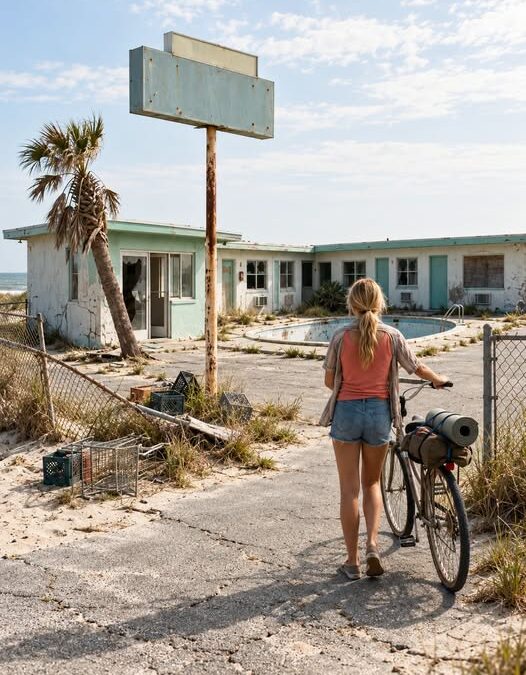
kicked out at eighteen, she bought an abandoned motel for ten dollars—then her dead mother’s key opened the one room nobody had entered in years
Part 1
Three days after Nella Cade crossed the high school graduation stage, her father changed the locks on the only home she remembered.
Her graduation gown was still folded across the back seat of her old Corolla.
She had planned to hang it up after work.
Instead, when she came home from the grocery store that afternoon, two black trash bags sat on the porch.
Her gray sweatshirt stuck from the top of one.
Her winter boots were shoved into the other.
Beside them, balanced carefully against the railing, sat her mother’s cedar box.
Nella stopped halfway up the walk.
For a few seconds she tried to create another explanation.
Maybe Renee had cleaned the closet.
Maybe the boys needed more storage.
Maybe—
The screen door opened.
Her father stood behind it.
He did not come onto the porch.
“Nella.”
She looked at the bags.
Then at him.
“What is this?”
He rubbed the back of his neck.
“Renee and I talked.”
That sentence had introduced nearly every decision Nella disliked since her father remarried.
“You’re eighteen now.”
“I know.”
“The boys are getting bigger.”
Nella stared.
Her two stepbrothers shared a bedroom.
She had heard Renee complain about it for months.
“The boys need the space.”
“So I don’t?”
“That isn’t what I said.”
“It’s what the bags say.”
His face tightened.
“You graduated. You’ve got a job. You’ve got the car.”
“A grocery-store job.”
“You’re practical.”
He said that word as though it solved everything.
Practical.
Nella had been practical when her mother died.
She had been six.
Adults praised her because she did not scream at the funeral.
She had been practical when her father started working longer shifts.
Practical when Renee moved in.
Practical when toys disappeared from her bedroom to make room for a crib.
Practical when family photographs changed.
Practical meant Nella did not complain.
Practical meant she understood.
Practical meant adults could take something from her and compliment her afterward for surviving it.
“Where am I supposed to sleep tonight?”
Her father looked toward the porch boards.
“You’ll figure it out.”
“Where?”
“Nella.”
“I’m asking.”
Behind him, Renee spoke from the kitchen.
“Her things are all there.”
Nella could not see her.
“I put her mama’s box out too so nobody says we kept anything.”
Nella looked at the cedar box.
That hurt more than the trash bags.
Renee had thought about it.
She had walked to the closet.
Taken the one object belonging only to Nella’s mother.
Set it outside.
Sorted the house into what belonged inside and what belonged with Nella.
Her father finally looked at her.
“Don’t make this harder than it needs to be.”
Nella almost laughed.
Harder for whom?
Instead, she picked up the cedar box.
“Dad?”
“Yes?”
“When did you change the locks?”
His face gave him away.
“This morning.”
Before she came home.
Before he told her.
Before she had any chance to argue.
Nella nodded once.
“Okay.”
“You understand?”
“No.”
The answer startled him.
Nella lifted one trash bag.
“But I understand enough.”
She carried everything to the Corolla.
Her father remained behind the screen.
He never came down the steps.
The deadbolt clicked after she walked away.
That sound followed her longer than his words did. The original story centers on Nella being forced out at eighteen with her mother’s cedar box and an old key marked “Sundowner — 7,” the clue that eventually leads her to the motel.
She sat inside the car for nearly twenty minutes.
Her hands rested on the steering wheel.
She did not cry.
Crying felt like something a person did after losing a home.
Nella had not yet decided whether that house deserved the word.
Finally she opened the cedar box.
She had seen its contents before.
A thin gold necklace with a broken clasp.
A photograph of her mother, Shay, young and laughing on concrete steps.
And an old brass key.
The key hung from a green plastic diamond.
Most of the white lettering had rubbed away.
But two things remained legible.
SUNDOWNER.
Nella had played with it as a child.
After her mother died, she sometimes lay on Shay’s side of the bed and pressed the cold key against her cheek.
“What does it open?” she once asked her father.
“No idea.”
“Mom never told you?”
“Your mom had plenty of old junk from before we met.”
He had said it casually.
Nella had accepted the answer.
Children accept what adults refuse to explain.
She put the key in her jacket pocket.
Then started the Corolla.
The next four nights taught her how quickly independence became survival when nobody had prepared you for it.
She slept behind a shuttered lumberyard because the nearest streetlight was broken.
She learned that June nights became surprisingly cold inside a parked car.
She learned to crack two windows so condensation did not give away that someone was sleeping inside.
She learned which gas station clerk would let her wash her face and brush her teeth if she purchased crackers.
She learned to keep her phone charged because a dead phone meant employers could not call.
She learned that a two-hundred-dollar emergency fund stopped feeling large the moment there was no next paycheck guaranteed.
Gas.
Food.
Phone bill.
Laundry.
A replacement charging cable when the old one broke.
By the fourth night she had eighty-seven dollars.
She counted twice.
Eighty-seven dollars.
Her father had told her she always figured things out.
For the first time Nella wondered whether perhaps nobody ever had.
Maybe they simply stopped watching before they saw what figuring it out cost her.
On the fifth morning she went to a diner outside town.
Two eggs.
Toast.
Coffee.
She ate slowly.
A large man worked the grill.
Burn scar along one forearm.
White towel over his shoulder.
When Nella approached the register, he waved her away.
“I can pay.”
“I know.”
“I have money.”
“I didn’t say you didn’t.”
“Then why—”
“You look like you’re between things.”
Nella stiffened.
The cook turned a pancake.
“Come back when you’re between better things and pay double.”
“I don’t take charity.”
“Good.”
He looked at her.
“Neither do I.”
“What do you call this?”
“An investment.”
“In what?”
“You coming back.”
She almost smiled.
Almost.
“Double?”
“Plus tip.”
Nella nodded.
“Deal.”
Near the diner entrance stood a rack of local notices.
Farm auctions.
Church supper.
Used tractor.
County tax sale.
She would have walked past except one name caught her eye.
THE SUNDOWNER MOTEL.
Nella stopped.
She pulled the brass key from her pocket.
SUNDOWNER.
She read the notice.
Twelve motel units.
Office.
Approximately one and a half acres.
Tax delinquent.
Public auction Saturday.
Sold as is.
Nella spent Friday at the library.
The Sundowner had once operated along Old Highway 16.
Then the interstate opened farther north.
Traffic disappeared.
Businesses died one after another.
The motel’s final owner had been a woman named Verna Pryor.
No husband listed.
No children.
No will on record.
Verna died two years earlier.
Since then the county had possessed the property.
Photographs showed boarded windows.
Weeds.
A rusted sign.
A long L-shaped building that looked exhausted even before abandonment finished with it.
Nella stared at the picture.
It was worthless.
Probably dangerous.
Almost certainly beyond repair.
She went to the auction anyway.
About fifteen people gathered outside the courthouse.
Farmers.
Investors.
A woman carrying a clipboard with a property company logo.
Nella remained near the back.
Parcels sold for thousands.
A repossessed truck brought six hundred.
Then the auctioneer reached the motel.
“The old Sundowner.”
People chuckled.
“Twelve units, office, acre and a half. Structures rated poor to failing. No utilities currently connected. Sold strictly as is.”
He looked around.
“One hundred dollars?”
Nobody moved.
“Fifty?”
Someone laughed.
The auctioneer sighed.
“Somebody give me ten dollars so I can tell my wife I accomplished something today.”
More laughter.
Nella raised her hand.
The laughter stopped.
“Ten.”
Everyone turned.
The auctioneer squinted at her.
“You understand what we’re selling?”
“Yes.”
“Do I hear twenty?”
Silence.
The woman with the clipboard never looked up.
“Ten going once.”
Nella’s heart hammered.
“Going twice.”
Nobody moved.
The gavel struck the folding table.
“Sold.”
The auctioneer looked directly at her.
“For ten dollars.”
A pause.
“God help you.”
Nella paid with ten one-dollar bills.
The county clerk handed her a manila folder and a ring containing twelve keys.
“You know it’s condemned?”
“Yes.”
“No water.”
“Okay.”
“No electricity.”
“Okay.”
“There’s been discussion of demolition.”
Nella stopped.
“Why would the county auction me a building it plans to demolish?”
The clerk’s expression tightened.
“That’s a question you should ask Planning.”
“That sounds like something somebody should have said before taking my ten dollars.”
The woman looked almost impressed.
Then she shrugged.
“You bought the property.”
Nella left the courthouse.
An elderly man followed.
“You the girl bought Verna’s place?”
She turned.
He was in his seventies.
White mustache.
Canvas work coat despite the heat.
Hands swollen from decades of labor.
“Yes.”
“Hollis Mercer.”
Nella waited for a sales pitch.
Instead he said, “I kept that motel running thirty years.”
“You worked there?”
“For Verna.”
“Why did it close?”
“Because Verna died.”
“The highway had nothing to do with it?”
“Oh, highway killed the business.”
Hollis looked toward the road.
“Verna wasn’t running a business by the end.”
“What was she running?”
His eyes returned to Nella.
“You’ll understand.”
People in this county enjoyed saying that.
He scratched his phone number onto an old receipt.
“If you go tonight, don’t drink from the office spigot.”
“Why?”
“Because unless you enjoy three days regretting your decisions, you’ll wait until I flush the line.”
Nella folded the paper.
“You helping me?”
“Maybe.”
“Why?”
Hollis looked toward the courthouse.
“Because everybody laughed.”
“What does that have to do with anything?”
“Usually means somebody ought not to.”
He walked away.
Twenty minutes later Nella drove west.
The old highway seemed to have been forgotten intentionally.
Boarded service station.
Closed feed dealer.
Weeds through parking lots.
Then she saw the sign.
A rusted orange sun.
SUNDOWNER.
Below it hung a smaller panel.
VACANCY.
It swung in the wind.
Nella turned in.
Grass pushed through cracked asphalt.
Plywood covered most windows.
A swing set stood beside the building, eaten with rust.
That caught her attention.
A swing set.
At a motel.
Someone had expected children here.
She shut off the engine.
Silence settled.
Then a dog appeared.
Blue-gray coat.
White muzzle.
Too thin.
Old.
He stopped twenty feet away and stared.
“Hi.”
His ears twitched.
Nella crouched.
“I don’t have much.”
The dog turned.
Walked toward the motel rooms.
Stopped.
Looked back.
Nella followed.
Room two.
Three.
Four.
Five.
Six.
At seven, the dog sat.
He scratched once against the door.
Then whined.
Nella’s hand went to her pocket.
The brass key suddenly felt heavy.
She drew it out.
SUNDOWNER.
Her hands began shaking.
She moved the key toward the lock.
Then stopped.
Darkness had nearly fallen.
Nobody except Hollis knew where she was.
No lights.
No working phone signal.
No idea what might be inside.
Practical Nella spoke.
Not tonight.
The room had waited eighteen years.
It could wait until morning.
She put the key away.
The dog followed her back to the car.
Nella gave him half her sandwich.
He ate in two bites.
Then lay beside the front tire.
Facing outward.
Guarding her.
Twice that night she woke.
Twice the dog was still there.
For the first time since her father locked her out, Nella slept somewhere that seemed to want her to stay.
Part 2
Hollis arrived at eight the next morning.
Exactly.
His truck carried two water jugs, a small generator, extension cords, tools, a work light, and enough canned dog food to feed an army.
“You look terrible,” he told Nella.
“Good morning.”
“Drink.”
He handed her water.
“I’m fine.”
“You’re the color of paste.”
She drank.
Then Hollis saw the dog.
His face changed.
“Deacon.”
The animal approached slowly.
Hollis knelt.
“Come here, you old fool.”
Deacon pressed into him.
Hollis buried both hands in the animal’s coat.
“He stayed?”
“All night.”
“He’s been living here since Verna died.”
“Two years?”
“Near enough.”
“Why?”
Hollis looked toward the motel.
“Some dogs don’t understand death.”
Nella thought that perhaps some people did not either.
They opened the office.
Dust coated the desk.
Old keys hung behind the counter.
A ceramic mug sat beside a ledger.
On the wall, painted in faded blue letters, were ten words.
NO ONE WHO STOPS HERE LEAVES WITH NOTHING.
Nella read them twice.
“Advertising?”
Hollis laughed.
“Verna never knew the first thing about advertising.”
“What does it mean?”
“She meant it literally.”
He spent the next hour telling her.
After the interstate opened, respectable travelers stopped coming.
But other people did.
A teenage girl walking the highway at two in the morning with a black eye.
A mechanic stranded without money.
A family living in a station wagon.
Men released from the county jail with no ride home.
Women escaping husbands.
Runaways.
Older people whose relatives had stopped answering telephone calls.
Verna gave them rooms.
Sometimes for one night.
Sometimes weeks.
Sometimes months.
“She charge them?”
“If they had money.”
“And if they didn’t?”
“She fed them.”
“How did she survive?”
“She barely did.”
Hollis opened a swollen desk drawer.
Inside sat a shoebox filled with envelopes.
“People sent money later.”
Nella picked one.
A man from Denver thanking Verna for a summer spent at the Sundowner thirty years earlier.
He now owned two trucks.
His daughter was named Verna.
“I hope the sign is still on,” he had written.
Nella looked through the office window toward the dead sign.
“He doesn’t know.”
“Most don’t.”
“About her dying?”
“No.”
Hollis touched the desk.
“She died right there.”
Nella looked at the old chair.
“Here?”
“Went to sleep waiting up for somebody.”
Nella thought about the sign.
No one who stops here leaves with nothing.
Her eyes drifted down the row.
“What about seven?”
Hollis froze.
“What about it?”
“It won’t open.”
“It wouldn’t.”
“Why?”
“That was Verna’s private room.”
“I thought she lived in the office.”
“Mostly. But seven was hers.”
“Where’s the key?”
“Gone.”
Nella kept her hand away from her pocket.
“County took everything when she passed. I figured the key got thrown away.”
“Did you ever go inside?”
“Never.”
“Thirty years?”
“She kept one key.”
“Why?”
Hollis shrugged.
“Verna had secrets.”
All day they worked.
They cleared brush.
Opened rooms.
Ran the old water line until brown water became clear.
Hollis showed Nella which roof sections were unsafe.
Room seven remained locked.
That afternoon Hollis told her about the county’s larger plan.
A utility company wanted the old-highway frontage.
New transmission infrastructure might come through.
Land once considered worthless was suddenly strategic.
“The county thought the Sundowner would end up with the developer.”
“And my ten-dollar bid messed that up.”
“Considerably.”
“You think they’ll try taking it?”
“I think money doesn’t like surprises.”
Two days later, a county truck arrived.
The inspector wore a pressed shirt and carried a clipboard.
“Miss Cade?”
“Yes.”
“You’re the purchaser?”
“Yes.”
He inspected the buildings.
Red tags.
Structural concerns.
Electrical violations.
No occupancy certificate.
Then he handed Nella a business card.
“There’s a pending demolition action.”
“You auctioned it.”
“I didn’t.”
“The county did.”
“The auction transferred interest in the parcel. It doesn’t certify the buildings.”
“So what am I supposed to do?”
“My advice?”
“That’s apparently why everybody comes here.”
“Call the company on that card.”
“What company?”
“Interested buyer.”
Nella read the name.
“Sell?”
“Walk away with something.”
“I paid ten dollars.”
“Exactly.”
He smiled faintly.
“You might make a nice return.”
Nella did not take the card.
“Did you know Verna?”
The man’s professional expression slipped.
“Everybody knew Verna.”
“Did she ever help you?”
He looked toward the office.
Nella continued.
“I found letters.”
No answer.
“People around here stayed here when they had nowhere else.”
The inspector placed the business card on her ladder.
“I’m just telling you how the county sees the property.”
“That wasn’t what I asked.”
His eyes met hers.
Then he walked to the truck.
That night Nella read Verna’s letters by generator light.
Dozens.
Thank you notes.
Christmas cards.
Photographs.
Updates from people who had become teachers, drivers, nurses, parents, mechanics.
Again and again, one memory repeated.
A light.
The sign glowing on a dark highway.
A woman behind a desk who did not ask humiliating questions before handing over a key.
Nella began cleaning rooms.
Room two became hers.
Room three became storage.
Four smelled better once the carpet came out.
Five had water damage.
Six required window glass.
Seven remained closed.
Every day Deacon led Nella there.
Sat.
Waited.
Every day Nella touched her mother’s key.
Every day she walked away.
She told herself she wanted Hollis present.
That she needed proper lighting.
That opening it at night was foolish.
All true.
None complete.
Nella understood instinctively that room seven contained something capable of changing her past.
And once the past changes shape, a person cannot easily fit inside the old version of themselves.
On the fifth night she stopped pretending.
At midnight she carried the work light down the walkway.
Deacon followed.
Room seven looked ordinary under harsh white light.
Peeling paint.
Tarnished number.
Old lock.
Nella took out Shay’s key.
Inserted it.
Perfect fit.
She turned.
For one second nothing happened.
Then the mechanism shifted.
The deadbolt withdrew.
The door opened.
Deacon made a sound almost like crying.
Nella pushed inside.
Unlike the other rooms, seven had been preserved.
An iron bed.
A quilt folded neatly.
Small writing table.
Bookshelf.
Cedar smell.
Hundreds of Polaroid photographs covered an entire wall.
Children.
Women.
Families.
Old men.
Teenagers.
Truckers.
Every kind of face.
Deacon walked directly to the bed and lay beside it.
Nella approached the table.
A thick clothbound ledger waited there.
She opened it.
The book recorded people.
Not payments.
A sixteen-year-old boy arriving barefoot in the rain.
A mother with two babies and a bruised face.
Two elderly brothers evicted by a bank.
A truck driver stranded after an engine failure.
Verna had written each person down.
Not case numbers.
People.
Sometimes one sentence.
Sometimes a page.
Nella read until the words blurred.
Then she stood before the photograph wall.
She moved slowly.
Face after face.
Then stopped.
Third row.
Near the center.
A young pregnant woman standing on the office steps.
One hand shielding her eyes.
Laughing.
Nella knew her.
She pulled the photograph from the cedar box out of her jacket.
Same woman.
Same steps.
Almost the same moment.
Shay.
Her mother.
Under Verna’s copy was written:
SHAY.
Pinned behind the photograph was a folded sheet.
Nella opened it.
The date was eighteen years earlier.
The week Nella was born.
Storm tonight.
Shay went into labor three weeks early.
Road washed badly enough there was no getting her to the hospital.
Baby came in seven.
Small.
Loud.
Healthy.
Mother terrified but strong.
Called the baby Nella.
Gave Shay my key.
Told her she always has a door here.
Nella sat on the bed.
Her legs stopped holding her.
She looked at the quilt beneath her.
This bed.
This room.
She had been born here.
Her mother had arrived frightened and pregnant.
Verna had taken her in.
During a storm, with the road impassable, Verna helped bring Nella into the world.
And afterward she gave Shay a key.
The key Nella had carried through childhood.
The key her father called junk.
The key Renee put outside with the trash bags.
For eighteen years, Nella had possessed the key to the place she entered the world.
She pressed both palms against the quilt.
Deacon put his head on her knee.
Nella cried.
Silent at first.
Then not.
Her mother had not come from nowhere.
Neither had Nella.
Behind the photograph she discovered letters from Shay.
Three.
The last written when Nella was four.
Dear Verna,
Nella is into every drawer we own.
She has your stubbornness.
Things are hard, but we are hard too.
I still keep your key with me.
I tell her about the woman who caught her when she came early.
If anything happens to me, I need her to know one door in this world will always open.
Nella pressed the letter to her mouth.
Shay died two years later.
The story disappeared.
The key did not.
Then Nella noticed a framed black-and-white photograph near the bed.
A young Verna held a newborn.
The inscription read:
My daughter.
Six days.
Nella stared.
Finally she understood the Sundowner.
Verna had lost a baby.
Six days.
Six days of motherhood.
And instead of allowing grief to close every door inside her, she spent the rest of her life opening doors for other people’s children.
The motel was not a business that slowly failed.
It was grief transformed into shelter.
Under the writing table sat a strongbox.
Inside were cash, property documents, and a handwritten will.
Verna had written:
I leave the Sundowner to whoever keeps it a home after I am gone.
My lawyer says this wording is foolish.
My lawyer never spent a night stranded on this highway.
Below was another note around the money.
For the next one who has run out of road.
You will know them.
Send them on better than they arrived.
Nella sat very still.
Then headlights swept across the boarded window.
Deacon rose.
A car entered the lot.
Nella stepped outside.
An old sedan stopped.
Steam escaped the hood.
A young woman climbed out.
Twenty, maybe.
Grocery bag of clothes.
No purse.
Eyes constantly checking the highway behind her.
“Sorry.”
Her voice trembled.
“I saw the light.”
Nella understood.
The first person had arrived before Nella had even finished reading Verna’s instructions.
“My car died.”
The woman hugged herself.
“I don’t have anywhere to go tonight.”
Nella looked at room four.
Clean.
Dry.
Lock working.
She heard Verna without ever having heard Verna’s voice.
“You hungry?”
The woman started crying.
Nella gave her room four.
Water.
Her last food.
A blanket.
She asked no questions.
Deacon lay outside the woman’s door.
Keeping watch.
Nella stood in the lot.
Above her, the Sundowner sign remained dark.
She looked up.
“That’s coming back on.”
She did not know how.
She only knew nobody was tearing this place down.
Part 3
Three days later, the demolition notice arrived.
Twenty-three days.
After that, county contractors could enter.
Clear the buildings.
Recover costs from the land sale.
Nella read the notice on the floor of room seven.
Twenty-three days until machines pushed through the room where she had been born.
Twenty-three days until Verna’s wall became rubble.
Twenty-three days until the highway company bought clean dirt where hundreds of desperate people had once found safety.
She drove to the courthouse.
The clerk examined the handwritten will.
“This may not stand.”
“It’s signed.”
“So are birthday cards.”
“Two witnesses.”
“Still needs legal review.”
“I have the deed.”
“You have a tax-auction deed subject to county restrictions.”
Nella’s hands tightened.
“So you sold it to me and now you can knock it down?”
“Honey.”
“Don’t call me honey.”
The clerk stopped.
Nella lowered her voice.
“I’m sorry.”
The older woman sighed.
“I’ve seen this sort of thing.”
“What sort?”
“One person against a county process.”
Nella looked at the will.
“You’re one girl.”
That sentence landed badly.
Her father had treated her as one girl too.
One practical girl who could be pushed out because nobody expected anyone to stand behind her.
“I’m not one girl.”
The clerk looked at her.
Nella was not entirely sure what she meant.
She left.
That evening, Hollis found her in the office.
The shoebox of letters sat open.
Nella held one envelope.
“These people loved her.”
“Yes.”
“They don’t know.”
“No.”
“Every letter has an address.”
Hollis sat.
“Most old.”
“Some will work.”
“What are you thinking?”
“I’m telling them.”
“All?”
“All.”
Hollis’s mustache twitched.
Nella opened the ledger.
“You know some?”
“Plenty.”
“Then help.”
For two days, they wrote.
Verna Pryor died two winters ago.
The Sundowner is scheduled for demolition.
My name is Nella Cade.
My mother, Shay, once stayed here.
I discovered I was born in room seven.
If Verna ever left a light on for you, there is a county meeting Tuesday at seven.
I could use you to stand up.
Sixty-one letters went into the mail.
Nella expected silence.
The first telephone call came four days later.
“Is she really gone?”
A woman’s voice.
“Yes.”
“How long?”
“Two years.”
Silence.
“My name is Marisol Vega.”
Nella found the name in the ledger.
Fifteen.
Runaway.
Room eight.
Stayed three months.
“I own three flower shops now,” Marisol said. “And a lawyer owes me favors.”
Nella swallowed.
“The hearing is Tuesday.”
“I’ll be there Monday.”
Marisol arrived in a white commercial van covered with painted flowers.
She was forty-six.
Small.
Fast-moving.
Silver earrings.
She walked into the motel office.
Saw Verna’s sentence painted on the wall.
Stopped.
“No one who stops here leaves with nothing.”
Her eyes filled.
“She said that my first night.”
Nella waited.
“I stole forty dollars from her.”
Nella blinked.
“Then ran.”
“What did she do?”
“Found me at the bus station.”
“And?”
Marisol laughed through tears.
“Bought me lunch.”
“That was it?”
“Told me room eight would be ready when I finished being scared.”
Marisol wiped her face.
“Do you understand what kind of person does that?”
“No.”
“Neither do I.”
Nella took her to room seven.
Marisol found her thank-you card on Verna’s wall.
She sat on the iron bed.
Cried.
Then stood.
Straightened her blouse.
“All right.”
“What?”
“You need to understand something.”
Marisol pointed toward the photographs.
“You think you’re asking these people for help.”
“Aren’t I?”
“No.”
“You’re giving them the chance they’ve wanted for years.”
“To do what?”
“Pay her back.”
The courthouse parking lot filled before six-thirty Tuesday.
Pickup trucks.
Sedans.
A church van.
Out-of-state plates.
People who had not seen one another for thirty years recognized each other by room numbers and old stories.
“You room five?”
“Winter of eighty-seven?”
“You’re Tommy?”
“No one calls me that anymore.”
“You still look like Tommy.”
At seven, the meeting room was full.
People stood in the hallway.
County officials stared.
The Sundowner appeared near the bottom of the agenda.
Condemned property.
Demolition order.
Potential redevelopment.
The inspector began speaking.
Marisol stood.
“Before you demolish it, could we tell you what it is?”
The chairman looked irritated.
Then saw the crowd.
“Briefly.”
Marisol smiled.
“That may be difficult.”
A trucker stood first.
“Room eleven.”
Everyone turned.
“1989.”
He removed his cap.
“My transmission went out. Verna let me stay eight days. Fed me. Loaned me money to get home.”
He sat.
A woman rose.
“Room four. 1994.”
Her daughter stood beside her.
“I arrived with this girl when she was nine months old.”
She touched her daughter’s hand.
“Her father broke my jaw.”
Silence.
“Verna never asked why I stayed. Just gave me a key.”
Another man.
“Room nine.”
His voice failed.
He tried again.
“1991.”
He swallowed.
“I’d just gotten out of prison. No one would take me.”
He lowered his head.
“I would’ve frozen.”
One by one.
Room numbers.
Years.
Stories.
People the county never knew were connected by one dead motel owner.
The inspector lowered his clipboard.
His expression changed.
He was not evil.
That mattered to Nella.
The county was not a villain.
It was something colder.
A process.
Processes erase things without hating them.
Sometimes that makes them more dangerous.
When the testimonies ended, Marisol spoke.
“Half these people would not be here if Verna Pryor had treated them the way you’re treating her motel.”
Nobody moved.
“The girl sitting behind me was born in room seven.”
Heads turned toward Nella.
“She owns the property. She has Verna’s handwritten will.”
Marisol placed a folder on the desk.
“And she now has legal representation.”
A middle-aged man in a suit stood.
Nella recognized him as room nine.
“I’ll handle the probate issue without charge.”
Marisol continued.
“You can spend money fighting a teenager and sixty taxpayers over land nobody wanted until a private company decided it had value.”
The county chairman looked toward the representative from the development company.
His chair was empty.
“He left,” somebody whispered.
Marisol spread her hands.
“Or you can pause demolition, let us repair the property ourselves, and see whether the only reason anybody has driven that old highway intentionally in ten years can become useful again.”
The chairman conferred quietly.
Then announced the demolition order would be suspended pending legal review and inspection.
The room released one collective breath.
Outside, people surrounded Nella.
Phone numbers.
Offers.
Money pushed into her hand.
A drywall contractor.
An electrician.
A plumber.
A roofer.
Former guests.
Children of former guests.
Grandchildren.
Hollis stood near the edge.
Nella found him.
“You knew?”
“About what?”
“That they’d come.”
He looked around.
“I hoped.”
“She really did all this.”
“Yes.”
“And nobody knew?”
“People she helped knew.”
“That isn’t the same thing.”
“No.”
Nella looked toward the courthouse.
“How does somebody do that much good and still end up with the county calling her life a condemned parcel?”
Hollis took his time.
“Paperwork doesn’t remember kindness.”
He looked toward her.
“People do.”
Saturday morning, the motel lot filled with trucks.
Ladders appeared.
Toolboxes.
Lumber.
Generators.
Coffee.
People repaired the Sundowner like it belonged to them.
In a way, it did.
Someone repainted the office message.
NO ONE WHO STOPS HERE LEAVES WITH NOTHING.
Hollis supervised the roof.
The insurance man from room nine ruined expensive jeans hauling debris.
Marisol turned the office into command headquarters.
The young woman staying in room four helped repair an old sedan.
Nella hammered trim beside her.
“Who are these people?” the woman asked.
Nella looked across the lot.
She almost said strangers.
Then family.
Neither felt completely accurate.
“People Verna didn’t give up on.”
A gray pickup turned into the lot.
Nella recognized it immediately.
Her father climbed out.
The hammering slowed.
He removed his cap.
“Hey, kiddo.”
Nella’s stomach tightened.
“What are you doing here?”
“Heard about this place.”
“So?”
“I wanted to see.”
He looked around.
“They said it was yours.”
“It is.”
“That’s real good.”
Nella waited.
“I always said you’d land on your feet.”
There it was.
The sentence designed to convert abandonment into confidence.
Nella put down the hammer.
“You didn’t say that because you believed in me.”
His face fell.
“Nella.”
“You said it because it made throwing me out easier.”
“That’s not fair.”
“No.”
Her voice remained calm.
“Changing the locks before telling me wasn’t fair.”
“Renee—”
“I don’t want to talk about Renee.”
“The boys needed—”
“I know.”
Her anger had changed.
Less fire.
More weight.
She realized suddenly she no longer needed him to agree.
“Come with me.”
She led him to room seven.
Unlocked it with Shay’s key.
Her father entered.
He saw the photograph wall.
Nella pointed.
Shay.
Pregnant.
Laughing.
His knees weakened.
“That’s your mother.”
“Yes.”
“Where did—”
“She lived here before she met you.”
“What?”
“She came here alone and pregnant.”
His face emptied.
“Pregnant with you?”
“Yes.”
“She never told me.”
“I know.”
Nella showed him Verna’s entry.
The storm.
The birth.
Room seven.
Shay’s key.
Her father sat on the iron bed.
“No.”
“Yes.”
“She told me you were born at County.”
“She was probably ashamed.”
“Of what?”
“Being homeless.”
He covered his face.
“I never asked.”
“No.”
“I thought she didn’t want to talk about before.”
“So you didn’t.”
He looked at Shay’s photograph.
“All those years.”
Nella stood beside the wall.
“Then she died.”
He nodded.
“And you stopped asking me too.”
He began crying.
Nella did not hug him.
She also did not leave.
Some grief belonged to the person who created it.
After a while he said, “Can I help?”
“With what?”
“This place.”
Nella considered.
“Not today.”
He nodded.
“I understand.”
“I’m not saying never.”
His eyes lifted.
“You can come one Saturday.”
“Okay.”
“Work like everybody else.”
“Okay.”
“And don’t call what happened to me a lesson you meant to teach.”
He swallowed.
“I won’t.”
“You didn’t push me so I’d fly.”
“No.”
“You pushed me.”
His face tightened.
“Yes.”
“That matters.”
“I know.”
Nella looked toward the door.
“That’s all I’ve got today.”
He stood.
“It’s more than I deserve.”
He left.
Two Saturdays later he returned.
No speech.
No excuses.
He hung three doors.
Repaired the porch sag.
Left before dinner.
It was not forgiveness.
It was effort.
Sometimes effort had to come first.
Part 4
Renee came once.
Alone.
She carried a cardboard box.
“Found these in the garage.”
Inside were Shay’s things.
Recipe cards.
A scarf.
Two letters.
A baby blanket.
Nella looked at Renee.
“You knew they were there?”
“No.”
Nella believed her.
Maybe because Renee looked uncomfortable rather than defensive.
“I thought you should have them.”
“Thank you.”
Renee glanced toward the rooms.
“You really live here?”
“Yes.”
“Your father says you’re fixing it.”
“A lot of people are.”
Renee nodded.
“I suppose you always were determined.”
Nella almost reacted.
Another compliment that turned neglect into character.
Then Renee said something unexpected.
“I think we depended on that too much.”
Nella waited.
Renee looked toward the highway.
“You being easy.”
“I wasn’t easy.”
“No.”
A faint, humorless smile.
“You were quiet.”
Nella folded her arms.
Renee swallowed.
“I’m not good at apologies.”
“I know.”
“That isn’t an excuse.”
“No.”
Silence.
Finally Renee said, “I shouldn’t have put your things outside.”
Nella’s throat tightened.
“No.”
“And your father shouldn’t have let me.”
“No.”
Renee nodded.
“That’s what I came to say.”
Nella looked at the box.
It did not repair eighteen years.
It did not make Renee warm.
It did not restore the bedroom.
But it was true.
“Thank you.”
Renee turned to leave.
“Nella?”
“Yes?”
“I’m glad that key opened something.”
Then she drove away.
The motel repairs lasted through summer.
Heat rose from the old highway in shimmering waves.
Roofing tar burned arms.
Paint dried too fast.
The old plumbing fought every improvement.
One afternoon the water main cracked under the parking lot.
Another week, an inspector discovered wiring so dangerous Hollis called it “an attempted murder.”
Money ran short twice.
Marisol organized donations.
Room-nine insurance man established a nonprofit.
Travelers who could afford to pay would eventually subsidize those who could not.
Eleven rooms would operate.
Room seven would remain untouched.
The county required new emergency lights.
Smoke detectors.
Fire exits.
Railings.
A septic inspection.
Nella learned more about permits by nineteen than most homeowners learned by fifty.
She worked at the grocery three evenings a week.
Slept in room two.
Ran the motel restoration by day.
The young woman in room four stayed.
Her name was Callie.
Nella learned it after twelve days.
Callie volunteered it herself.
That mattered.
She had been running from a boyfriend.
He had not found her.
She repaired engines well.
“Dad taught me.”
“You going back?”
“No.”
“Where will you go?”
Callie looked around the Sundowner.
“I don’t know.”
Nella understood the answer.
“You can stay while you figure it out.”
“How much?”
“For now?”
“Yeah.”
“Help.”
Callie frowned.
“That’s not rent.”
“It is here.”
“What if I leave?”
“Then leave.”
Callie stared.
“You’re weird.”
“So I’ve been told.”
Deacon gained weight.
His coat thickened.
He appointed himself security.
If a frightened guest arrived, Deacon slept outside that person’s door.
If Hollis came, the dog followed him around pretending he did not care.
If Nella worked in room seven, Deacon lay beside the bed.
By September, the Sundowner looked alive.
New paint.
Repaired roofs.
Clean windows.
Fresh numbers.
The swing set had been sanded and painted red.
Nella almost removed it.
Then a woman who had once lived at the motel with two children stopped her.
“My son learned to swing there.”
So the swing remained.
The final problem was the sign.
The old neon was gone.
Wiring corroded.
Transformer dead.
Replacement cost more than Nella could afford.
Hollis disappeared for three days.
When he returned, an electrician rode beside him.
“You?”
The electrician pointed toward the motel.
“Room three.”
“What year?”
“Nineteen seventy-nine.”
He looked at Hollis.
“This old fool called me.”
“You live three states away.”
“Verna gave me two months.”
He opened the truck bed.
“I can give her three days.”
They rebuilt the sign.
Opening night arrived with the first cold air of autumn.
People returned.
Former guests.
County employees.
The diner cook.
Raina from the grocery store who had quietly covered Nella’s shifts.
Her father.
Even Renee stood near the back.
Marisol brought flowers.
Nobody made speeches.
At dusk Hollis walked toward the sign.
Nella did not know what he was doing until he reached the switch.
“Ready?”
“For what?”
He smiled.
Then turned it on.
The setting sun flickered.
One letter ignited.
S.
Then U.
N.
D.
O.
W.
N.
E.
R.
The full word glowed against the dark highway.
Below it, the smaller green sign buzzed.
VACANCY.
No one cheered.
Silence was more appropriate.
People simply looked.
Some cried.
Nella felt the old key resting against her chest.
She had started wearing it on a cord.
Not because she needed it daily.
Because Verna had worn it.
Because Shay had carried it.
Now Nella did.
Three women.
One door.
The Sundowner reopened.
Eleven available rooms.
Room seven became a memory room.
Nella kept everything exactly where Verna had left it.
The photographs.
Ledger.
Iron bed.
Picture of Verna and her six-day-old daughter.
Shay’s letters.
She added a small card.
This is the room where the Sundowner’s second keeper was born.
Its first keeper is still being thanked.
People visited.
Sometimes elderly guests found their younger faces on Verna’s wall.
They sat on the bed.
Touched a photograph.
Remembered the person they had been when somebody gave them a room without first requiring proof that they deserved one.
Callie stayed.
She learned the desk.
The boiler.
Reservations.
Emergency contacts.
Most important, she learned when not to ask questions.
The first genuine nighttime arrival came six days after opening.
A man walked in from the highway.
Trash bag.
Shaking hands.
No coat despite cold weather.
Callie looked toward Nella.
Nella remained in the doorway.
Callie understood.
“You need a room?”
The man swallowed.
“No money.”
“Didn’t ask.”
He looked confused.
Callie handed him a key.
“Room six.”
“What do you need from me?”
“Tonight?”
He nodded.
“Sleep.”
The man stared.
Callie added, “We’ll figure tomorrow out tomorrow.”
He accepted the key.
Afterward Callie found Nella in the office.
Her eyes were wet.
“I did it right.”
“You did.”
“Like Verna?”
Nella looked toward room seven.
“Exactly.”
Later that night, she opened Verna’s ledger to the first blank page.
She wrote:
Daniel.
Came on foot.
Cold.
Hands shaking.
Room six.
Then beneath it:
He is safe.
Those were the first words Nella added to Verna’s book.
She sat quietly afterward.
Two trash bags on a porch.
Four nights sleeping in a car.
Ten dollars.
A dead motel.
A rusted key.
Everything had brought her here.
Not because suffering had been necessary.
Nella rejected that idea.
Pain did not become good merely because someone eventually built something from it.
Her father should not have thrown her out.
Shay should not have been alone and pregnant.
Verna should not have lost a child.
Callie should not have needed to run.
The people in the ledger should not have reached the Sundowner desperate.
But when terrible things happened, someone could still decide what happened next.
Verna had.
Shay had.
Now Nella would.
That winter Hollis took her to the cemetery.
Verna’s grave was plain.
Name.
Dates.
Nothing else.
“That’s it?”
“County buried her.”
“No family?”
“Not blood.”
Nella almost laughed.
If family were measured another way, Verna Pryor might have had the largest funeral in the state.
Nella brought the photograph of Verna holding her baby.
She leaned it against the headstone.
Then sat in the cold grass.
“We turned the sign back on.”
Hollis stood several feet away.
“The rooms are open.”
Wind moved through bare branches.
“Mom’s picture is still in seven.”
Nella touched Verna’s stone.
“And I know what you did.”
Her voice broke slightly.
“I know somebody wrote it down for everyone else.”
She smiled through tears.
“So I’m writing yours.”
They sat until the air became too cold.
Then Nella returned the framed photograph to room seven.
It belonged there.
Back at the motel, Deacon waited on the walkway.
He barked once.
Hollis frowned.
“He never barked for Verna.”
“He likes me better.”
“Don’t get proud.”
Nella rubbed the dog’s ears.
That evening she and Hollis drank coffee beneath the office awning.
The Sundowner sign had not yet lit.
Daylight remained.
Nella asked, “Do you think Verna would approve?”
“Of what?”
“How I’m doing this.”
Hollis studied the motel.
Curtains in windows.
Fresh paint.
Callie helping a mother carry luggage.
Deacon sleeping near room three.
The red swing moving in the wind.
“She used to say you’re not really homeless if there’s a light burning somewhere for you.”
Nella looked at him.
“Then she’d complain about the electric bill for an hour.”
He drank his coffee.
“You turned the light back on.”
Nella smiled.
“That enough?”
“For Verna?”
Hollis looked toward room seven.
“More than enough.”
Part 5
The first year almost broke them.
Not emotionally.
Financially.
Kindness still required electricity.
Hot water.
Insurance.
Food.
Roof repairs.
Licenses.
Taxes.
Nella discovered that doing good did not exempt anybody from receiving an invoice.
So the Sundowner developed rules.
Travelers who could afford normal rates paid.
Those who could pay less paid less.
Those with nothing received a room anyway if one was available.
People donated.
Former guests contributed.
A church stocked pantry shelves.
The diner cook sent pies.
The mechanic in town repaired the motel van for parts cost.
Nobody called it charity.
Not anymore.
One spring morning, Nella entered the diner where she had eaten during her first homeless week.
The cook looked up.
“Well.”
She sat.
“Two eggs.”
“Toast?”
“Yes.”
“Coffee?”
“Yes.”
He brought the plate.
Nella ate.
Then placed four times the original bill on the counter.
He counted.
“You said double.”
“Interest.”
He pushed half back.
“No.”
“We made a deal.”
“Double.”
“You gave me food when I was sleeping in my car.”
“Double.”
Nella stared.
He stared harder.
She took the money.
“You’re annoying.”
“I’ve been told.”
She smiled.
“You ever need a room?”
“Girl, I own a house.”
“That wasn’t what I asked.”
The cook laughed.
“Now you sound like Verna.”
“You knew her?”
“Everybody knew Verna.”
Nella shook her head.
“I’m learning that.”
Her father became a Saturday regular.
At first he worked silently.
Repaired doors.
Rehung gutters.
Fixed broken furniture.
Nella gave him jobs.
Nothing more.
One afternoon, months later, he was repairing the office porch when she brought lemonade.
“Thanks.”
She sat on the step.
He wiped sweat from his forehead.
“I should’ve come out the first Saturday.”
“Probably.”
“I was ashamed.”
“I know.”
“That’s not an excuse.”
“No.”
He stared toward the highway.
“You were right.”
“About?”
“I called you practical because it made things easier for me.”
Nella said nothing.
“When your mom died, you were six.”
His voice shook.
“You didn’t cry much.”
“I cried.”
“Not where I could see.”
“You were falling apart.”
“I was the father.”
“You were falling apart.”
He nodded.
“And I thought your quiet meant you were okay.”
“It meant I was six.”
His eyes filled.
“I know that now.”
Nella looked at him.
For years she had wanted her father to become another man.
Braver.
More attentive.
Someone who had seen her pain before it became impossible to ignore.
He could not become that man retroactively.
He could only decide who arrived next Saturday.
That would have to be enough.
“Room eleven needs trim,” she said.
He nodded.
“I’ll bring the miter saw.”
Their relationship rebuilt that way.
Not through dramatic forgiveness.
Through work.
Saturday after Saturday.
Renee never became part of the motel.
But at Christmas she mailed a card.
The following year she brought casserole once when Nella was sick.
Nobody announced reconciliation.
Nobody pretended the past was harmless.
The door simply stopped being locked.
Callie eventually became assistant manager.
Then manager.
She moved from room four into a little apartment behind the office.
She saved money.
Started taking automotive classes.
One night Nella asked whether she planned to leave after graduating.
Callie smiled.
“Maybe.”
“Good.”
“You want me gone?”
“I want you able to.”
Callie understood.
The Sundowner was not supposed to collect people.
It was supposed to return choice.
Hollis slowed.
His knees worsened.
He stopped climbing ladders.
He still arrived most mornings.
Coffee.
Complaint.
Inspection.
Deacon aged beside him.
One winter morning the dog could not stand.
Nella found him outside room seven.
Hollis came immediately.
They carried Deacon inside.
He lay beside Verna’s bed.
His breathing slowed.
Nella rested one hand against his ribs.
“You kept the door.”
Deacon looked at her.
His tail moved once.
“You did good.”
He died there.
In room seven.
Hollis cried harder than Nella had ever seen.
They buried Deacon beneath the old cottonwood behind the motel.
A small stone read:
DEACON
HE KEPT THE DOOR.
For three days, every guest entering the office looked for him.
Nella did too.
Then one rainy evening a skinny heeler mix appeared near the dumpsters.
Callie found him.
“No.”
Nella looked at the dog.
“No what?”
“We are not keeping another dog.”
“Agreed.”
“We already have enough expenses.”
“Absolutely.”
The dog slept outside the office.
The next morning Callie fed him.
Within a week his name was Deputy.
Hollis complained that it was ridiculous.
He was the one who bought the collar.
Years passed.
The old highway remained quiet.
That helped.
The Sundowner did not become fashionable.
No resort developer appeared.
No travel magazine transformed it into a destination.
That would have ruined something.
It remained what it had always needed to be.
Visible.
Clean.
Affordable.
Lit.
People sometimes arrived because they needed a bed.
Others because they had nowhere safe.
Some paid.
Some did not.
Nella learned to distinguish need from manipulation, though not perfectly.
A few people stole.
One smashed a television.
Another disappeared owing money.
Nella refused to let those cases become evidence against everyone else.
Verna had known something difficult.
Kindness does not guarantee gratitude.
It is still kindness.
Room seven remained closed except when Nella chose to show someone.
The wall filled slowly.
Nella added photographs.
Not all guests.
Only those who wanted to be remembered there.
Callie’s photograph joined the wall.
Marisol brought hers from the seventies.
Nella added one of Hollis laughing beside the restored sign.
Beside Shay’s photograph, Nella eventually placed a picture of herself.
Eighteen years old.
Standing beneath the Sundowner sign.
Hair messy.
Work gloves tucked into her belt.
The rusted key around her neck.
She wrote nothing beneath it.
The story was already in the ledger.
On the tenth anniversary of the motel’s reopening, the county historical society offered a plaque.
Nella accepted.
The wording described Verna Pryor and the Sundowner’s role as an informal refuge.
At the ceremony, the same county inspector who once handed Nella the developer’s card attended.
He was gray now.
He found her afterward.
“You asked me something once.”
“What?”
“If Verna ever helped somebody I knew.”
Nella remembered.
“You didn’t answer.”
“No.”
He looked toward the rooms.
“My brother.”
Nella went still.
“He drank.”
The man’s voice dropped.
“Our family stopped answering.”
He stared at the ground.
“Verna didn’t.”
“What room?”
“Three.”
“Did he make it?”
“Eight years sober before cancer got him.”
The inspector swallowed.
“I should’ve answered you.”
“You answered now.”
He nodded.
“County processes don’t make much room for stories.”
“I know.”
“You taught us to look harder.”
Nella glanced toward the plaque.
“I think Verna did.”
That evening, after everyone left, Nella opened the ledger.
She found the page describing the inspector’s brother.
Room three.
Cold February.
Hands trembling.
Says family is finished with him.
I am not family, so perhaps I am allowed another opinion.
Nella smiled.
Verna.
Always Verna.
Hollis died at eighty-seven.
Peacefully.
His funeral was held in the little church near Verna’s grave.
The Sundowner closed for one day.
Every room stood empty.
Every light except the office went dark.
Nella placed his photograph beside Verna’s.
Then reopened the next morning.
Because Hollis would have hated keeping rooms unavailable on his account.
By then Nella was thirty.
She had become a woman teenagers trusted because she remembered exactly what it felt like to be looked at as a problem somebody wanted relocated.
One night near midnight, headlights appeared.
A car pulled slowly into the parking lot.
Deputy lifted his head.
Callie—now running the desk three nights a week—began to stand.
Nella touched her shoulder.
“I’ll take this.”
She walked outside.
A girl climbed from the passenger seat.
Sixteen, perhaps.
Thin.
Backpack.
Jaw clenched.
A social worker exited the driver’s side.
“This is Tessa.”
The girl looked at the sign.
Then the rooms.
“Is this like a shelter?”
Nella thought about it.
“No.”
“A motel?”
“Yes.”
“So why am I here?”
“Because tonight you need a room.”
The girl crossed her arms.
“How long can I stay?”
“We’ll work that out.”
“What do I owe?”
Nella looked toward the office.
The blue words inside were visible through the glass.
NO ONE WHO STOPS HERE LEAVES WITH NOTHING.
“Tonight?”
“Yes.”
“Nothing.”
Tessa’s expression hardened.
“People always want something.”
Nella remembered herself standing outside her father’s door.
Callie behind her car door.
Shay eighteen years before that.
Marisol stealing forty dollars because trusting Verna frightened her more than running did.
“Sometimes.”
Nella nodded.
“Not tonight.”
The girl looked at Deputy.
“Does he bite?”
“Only cheeseburgers.”
The dog walked toward her.
Tessa cautiously touched his head.
Her shoulders lowered slightly.
Nella unlocked room five.
Clean bed.
Warm lamp.
Water.
Fresh towel.
The girl stood in the doorway.
“You’re really just leaving me here?”
“I’ll be in the office.”
“What if I need something?”
“Come get me.”
“What if I leave?”
“Door opens from both sides.”
Tessa stared.
Nella smiled.
“That’s important around here.”
She returned to the office.
Later, when the highway was empty, Nella opened Verna’s ledger.
The original book had run out of pages years earlier.
Another identical volume sat beside it.
Nella began writing.
Tessa.
Sixteen.
Came in with a backpack and enough suspicion to fill a truck.
Room five.
She paused.
Then added:
Door unlocked from the inside.
Light on outside.
Safe tonight.
Nella closed the book.
On the office wall hung the rusted brass key.
She no longer wore it.
For years she had kept it around her neck because it connected her to Shay and Verna.
One day she realized a key carried against your heart was still a key waiting for a lock.
Nella did not need to search anymore.
She knew what it opened.
Not merely room seven.
It opened her beginning.
Her mother’s fear.
Verna’s grief.
The life Nella had not known existed before her father shut his door.
She hung it beside the office entrance.
Under it was a small handwritten card.
THIS KEY OPENED ROOM 7.
THE LIGHT OPENS EVERYTHING ELSE.
Travelers sometimes asked what that meant.
Nella usually told them to stay long enough and decide for themselves.
Near dawn she stepped outside.
The highway stretched east and west through darkness.
Few cars passed.
The sign burned above her.
SUNDOWNER.
Below it:
VACANCY.
The same word had hung uselessly for years.
Now it meant exactly what Verna had intended.
There was space.
A door.
A bed.
A chance.
A place where somebody would notice if you arrived frightened.
Nella thought about the morning she had been eighteen and carrying two trash bags.
Her father had told her everybody had to start somewhere.
He had been right about that one thing.
Just not in the way he imagined.
She had started in room seven.
Years before she knew it.
Started in the arms of a frightened mother and an older woman who refused to let that frightened mother face a storm alone.
Then eighteen years later, when Nella believed every door had closed, the same room opened again.
Not by accident.
Not magic.
Because Shay saved a key.
Because Renee, whatever else she had done, put the cedar box outside instead of throwing it away.
Because an auctioneer asked for ten dollars.
Because Hollis did not laugh.
Because Deacon remembered a door.
Because Verna Pryor spent a lifetime turning six days of devastating love into thousands of nights of shelter.
Behind Nella, the office door opened.
Tessa stood there.
“You got coffee?”
Nella looked over.
“You drink coffee?”
“Sometimes.”
“You’re sixteen.”
“So?”
“Hot chocolate.”
Tessa rolled her eyes.
“Fine.”
Nella walked inside.
Before closing the door, she glanced one last time toward the highway.
Somewhere beyond the darkness, somebody else was still driving.
Someone with a bag on a passenger seat.
Someone counting the last dollars in a wallet.
Someone rehearsing what they would say if they found a place willing to let them stop.
They might come tonight.
Or next winter.
Or years from now.
That was all right.
The Sundowner would be there.
Nella switched on the coffee maker.
The girl sat at the counter.
Deputy lay across the office doorway.
Outside, the old sign burned steadily against the dark.
And because one grieving woman had decided long ago that losing her own child would not make her close her door to everyone else’s, there would always be one light on along the forgotten highway.
For anyone who had run out of road.
For anyone who had been called practical when what they really needed was help.
For anyone who had been pushed out and told to figure it out.
For the next frightened girl.
For the next exhausted mother.
For the next stranger who looked into the distance and wondered whether there was still somewhere in the world that would let them stop.
There was.
Nella kept the light on.