
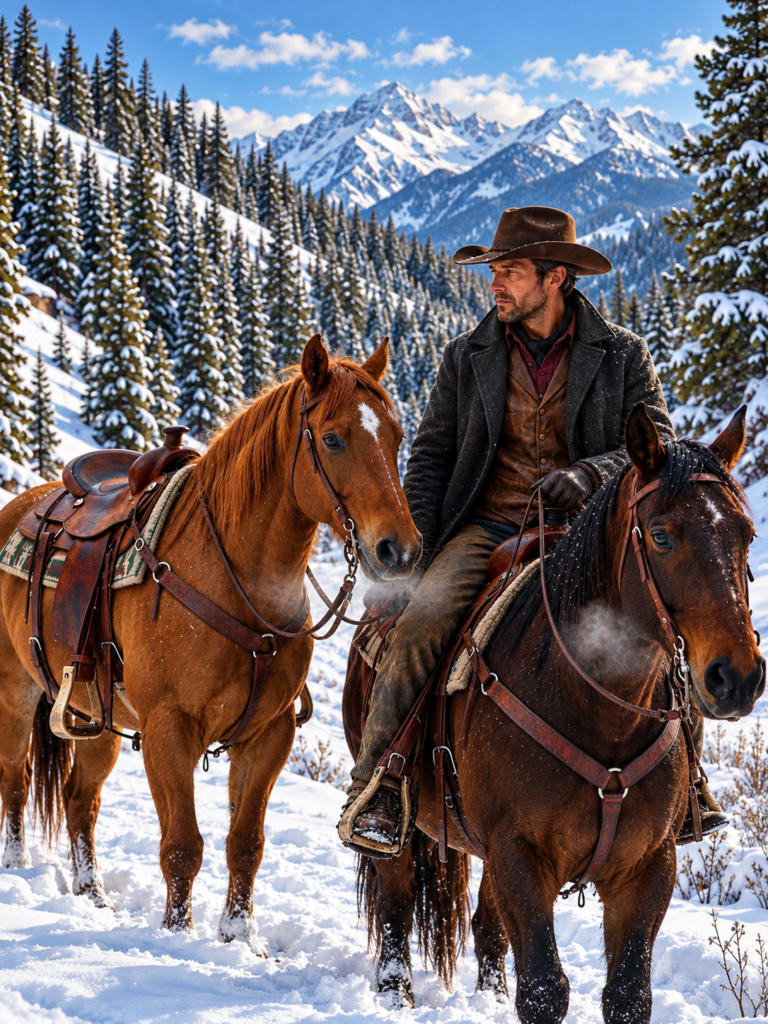
Part 1
Late one winter afternoon, Garrett Morrow found a saddled horse standing alone in the middle of a mountain trail.
There was no rider.
The mare stood forty yards ahead through curtains of blowing snow, her light bay coat darkened by dampness, white powder gathered in her mane and along the leather of her tack. One rein hung low enough to drag. Her sides rose and fell too quickly.
Garrett stopped Bracken beneath him and watched.
The dark bay gelding had noticed her first. Bracken had shortened his stride without being asked, lifted his head, and fixed both ears forward.
Garrett trusted that horse’s attention almost as much as his own.
“What is it?”
Bracken did not move.
The wind shifted between the pines, revealing the mare more clearly.
Saddle. Bridle. No rider.
Garrett looked beyond her toward the bend in the trail.
“Hello?”
His voice carried strangely in the snow.
No answer.
“Anybody there?”
Only the mare’s breathing came back to him.
Garrett dismounted.
At forty-one, he had spent enough years traveling mountain roads and winter passes to understand when something merely looked wrong and when it truly was wrong. This was the second kind.
He approached slowly, holding one hand where the mare could see it.
“Easy.”
She watched him with wide eyes but did not bolt. Whatever panic had seized her had already spent itself.
“Easy, girl.”
He reached the trailing rein and gathered it.
The left stirrup had been twisted backward. Snow was packed beneath one edge of the saddle. A fresh scrape marked the leather near the rear rigging. Garrett crouched, studying the tack, then straightened and looked again toward the empty trail.
Something had happened fast.
He put a gloved hand on the saddle.
Then stopped.
Garrett removed his glove and touched the leather again.
Warm.
Not warm from sunlight. There had been no sunlight all afternoon.
Warm from a rider.
Recently.
Very recently.
Garrett turned toward the mare.
“Well,” he murmured, “where did you lose them?”
One ear flicked toward him.
He led her several yards backward along the trail and began reading the snow.
The storm had been falling since noon, softly at first. But in the last hour the wind had risen, driving flakes sideways through the pass. Old hoofprints were already disappearing. Rock edges blurred beneath white accumulation. The road Garrett had traveled was slowly closing behind him.
Still, enough remained.
He found the mare’s tracks.
Four clean impressions at first.
Then confusion.
Her hind hooves had punched deeply into the snow. One print sank almost twice as far as the others. A little farther on, her tracks jumped sharply toward the outer edge of the trail.
Garrett crouched.
Above him, a heavy pine branch hung nearly bare of snow. Beneath it lay a fresh mound of powder.
He could picture what had happened.
A branch overloaded by the storm. Snow breaking loose without warning. Hundreds of pounds of it dropping beside the trail with a crack and a rush.
Enough to make a steady horse jump.
Enough to make a nervous one run.
He walked farther.
Then saw what he had hoped not to see.
A long depression marked the snow beside the trail.
Someone had gone over.
Garrett stepped carefully toward the edge.
There was no blood. That was something.
Several feet below the trail, he found a boot print.
Then another.
He exhaled.
The rider had gotten up.
Garrett descended far enough to examine the tracks.
At first, they pointed back uphill. The rider had tried to return to the trail. The prints were deep, close together, evidence of someone fighting the slope.
Then they turned sideways across the mountain.
Garrett followed for another dozen yards.
The stride shortened.
One heel dragged.
A right footprint sank unevenly, deeper on one side than the other.
Injured.
Behind him, the mare gave a low sound.
Garrett straightened.
The daylight had thinned to dull gray-blue beneath the pines.
He knew what the sensible decision was.
Beyond the pass stood an old line cabin. Four walls, a roof, and perhaps a stove if nobody had stolen the iron pipe since the previous winter. If Garrett mounted Bracken now and kept moving, he could reach it before full darkness.
The stranger had survived the fall.
She had walked away.
Perhaps she knew the mountain. Perhaps she was heading toward another shelter. Perhaps somebody was searching for her already.
Someone else.
Garrett remained still.
The words were ordinary.
They had also followed him for years.
Once, on another winter road, he had seen a wagon overturned beneath a shallow embankment.
He had been tired that day. Snow had been coming. A settlement was only a few miles behind him.
Garrett had slowed long enough to look down at the wagon.
Then he had reasoned his way onward.
Someone else would come.
Someone closer.
Someone with more reason to stop.
He had ridden away.
The following spring, Garrett learned there had been a man beside that wagon.
Alive when darkness came.
Dead before morning.
Garrett had never told himself that he had killed him. That would have been false. He had not caused the accident. He had not known the man was there.
But neither had he checked.
And every winter since, whenever the roads grew quiet and the snow made the world feel empty, the memory returned with a question Garrett had never managed to answer.
How many times could a man decide something was not his concern before it became true?
Before he became the kind of man who could see trouble, lower his eyes, and keep riding?
Garrett climbed back to the trail.
The mare waited.
He put his bare hand against the saddle again.
The warmth was fading.
Bracken stood nearby, snow collecting along the broad line of his back.
Garrett looked toward the trail leading to shelter.
Then down the slope, where the boot prints were already softening beneath fresh snow.
“Damn it.”
He gathered the mare’s reins.
Then mounted Bracken and turned away from the cabin.
The light bay mare followed.
Within minutes, the wind began filling the hoofprints behind them.
Ahead, the injured rider’s tracks were disappearing even faster.
Garrett descended slowly.
The accident became clearer from below.
The overloaded branch had dumped its weight beside the mare. She had jumped sideways. Deep gouges showed where she fought to regain balance. She had managed several steps before the trail narrowed.
Then one hoof slipped.
Broken snow showed where horse and rider had struggled.
The rider had fallen through loose powder, struck a young pine, and slid farther down the slope.
Garrett found where she had first stood.
Two boot prints.
Then another pair uphill.
She had tried to climb back toward the trail. Snow had swallowed her legs almost to the knee. Hand marks appeared beside branches she had grabbed for support.
After several attempts, she had changed plans.
Instead of wasting more strength, she turned across the mountain.
Garrett understood why.
An abandoned logging road lay somewhere below the eastern face. If she knew the country, she might have been trying to reach it.
Smart.
Except for the leg.
Her left boot left a clean impression.
The right did not.
Sometimes only the toe touched. Sometimes the entire print sank at an angle.
Whatever injury she had suffered, walking was making it worse.
Garrett continued until the horses began struggling in deeper drifts.
Lark—the name he would soon learn belonged to the mare—stumbled.
Bracken sank nearly to the knee.
Garrett stopped.
Dense trees crowded the slope ahead.
Taking the horses farther would turn one emergency into three.
He found a shallow hollow guarded by several large firs where the wind barely reached the ground. He secured both animals with enough room to shift and stamped out a place where they could stand.
Then he removed a blanket and several supplies.
Bracken watched him.
“I know.”
The gelding snorted.
Garrett looked toward the vanishing tracks.
“I don’t like it either.”
He went on alone.
Without the horses, the mountain became larger.
His boots punched through crust every few steps. Snow entered one and melted against his sock. Ice collected in his beard. The cold worked through his gloves.
Still he followed.
A partial footprint.
A broken crust.
A bent branch.
A trunk where someone had steadied herself with one hand.
Garrett had spent years becoming good at leaving.
A ranch job ended, he rode on.
Someone asked whether he would return for spring work, he said maybe.
A woman once asked which town he called home.
He had given the name of the place where his mail happened to arrive.
Eventually, people stopped asking him questions that required permanent answers.
That had suited him.
If nobody expected Garrett Morrow to arrive, he could never arrive too late.
If nobody depended on him, he could never fail them.
It was a simple arrangement.
And now he was walking into a winter storm for a stranger whose name he did not know.
The tracks vanished.
Garrett stopped.
Wind had filled every shallow depression.
He searched left.
Nothing.
Right.
Untouched snow.
“Come on.”
He returned to the last visible print and crouched.
The rider had been moving east. Unless she had changed direction, she should be somewhere ahead.
Somewhere.
A dangerous word after dark on a mountain.
Garrett lifted his head.
Only tree trunks. Blowing snow.
Then he noticed color.
Dark red.
Something hung from a low fir branch.
He pushed through the trees and pulled free a wool scarf caught on a twig.
Garrett stared downhill.
“Ma’am!”
Nothing.
He moved faster.
“Can you hear me?”
For a moment, only the storm answered.
Then, faintly:
“Here.”
Garrett froze.
The voice had come from below.
He descended until the trees opened around a low shelf of rock.
Beneath it, partly sheltered from the wind, sat a woman.
Her dark green coat was powdered white along one side. Strands of dark red hair had escaped a low braid and frozen against her cheek.
She opened her eyes when he approached.
They were light brown, almost amber.
“You alone?” Garrett asked.
She nodded.
He crouched.
“I’m Garrett.”
“Adeline.”
“Adeline what?”
“Cross.”
His attention dropped to her right leg. She had positioned it carefully in front of her.
“Can you move your foot?”
“A little.”
“Where does it hurt?”
“Above the ankle. And the knee.”
Garrett examined the leg gently, beginning at the boot and working upward without forcing anything.
Adeline’s expression barely changed, but her jaw tightened when he touched the swollen area.
That was enough.
He could not know exactly what was broken or badly sprained without a proper examination.
He did know she was not walking back through half a mile of deep snow.
“You did right staying here.”
“I was trying for the logging road.”
“I saw.”
“Didn’t get far.”
“No.”
A tired irritation passed across her face.
“You always this encouraging?”
“Usually worse.”
Something close to a smile appeared.
Then another shiver went through her.
Garrett took the blanket from his shoulder and wrapped it around her.
She watched him.
“You came from the trail?”
“Yes.”
“Then you were going over the pass.”
“Yes.”
Her eyes stayed on him.
“You left the road for me?”
Garrett glanced at the red scarf in his hand.
“Warm saddle.”
Adeline frowned.
“What?”
“Your mare’s saddle was still warm.”
Her expression changed instantly.
“Lark?”
“She’s fine.”
Adeline closed her eyes.
For the first time since he had found her, Garrett saw relief overwhelm everything else.
“She frightened?”
“Less than you ought to be.”
Another weak smile.
Garrett looked toward the darkening trees.
He had found her.
That was only the first problem.
The second was getting her out.
And the mountain had just removed most of his choices.
Part 2
By the time Garrett found Adeline Cross, darkness had nearly settled over the mountain.
Going back immediately would have been the obvious decision if she could walk.
She could not.
Carrying her across the steep slope where she had fallen would risk sending both of them down through rocks and trees. If her lower leg was fractured, forcing it over rough ground could do more damage.
Adeline followed Garrett’s gaze into the storm.
“How far are the horses?”
“Too far.”
“I can try.”
“No.”
“You don’t know that.”
“I watched your tracks for half a mile. I know exactly how well you can walk.”
She said nothing.
Garrett examined the shallow rock shelf.
Poor shelter.
But poor shelter was better than freezing on an exposed slope.
Once, Garrett had believed courage meant movement. Keep going. Push harder. Reach the next place.
The mountains had cured him of that.
They did not care whether a man felt brave.
Sometimes, the most dangerous decision was the one that looked courageous.
“We stay,” he said.
Adeline looked at him.
“Here?”
“Until light.”
Her gaze moved toward the blowing snow.
“We could freeze.”
“We could.”
“And going back?”
“Could be worse.”
She studied him for several seconds.
Then nodded.
No argument.
No dramatic insistence that she could make it.
Just acceptance.
Garrett began clearing snow from beneath the overhang.
“What are you doing?” Adeline asked.
“Making this place slightly less terrible.”
“Can you?”
“No.”
He pushed another load aside.
“But I’ve got all night to try.”
He left her wrapped in the blanket and made the trip back to the horses alone.
Darkness swallowed the slope before he reached them.
Garrett had marked trees during his search, but even so, he lost his direction twice.
Bracken heard him first.
The gelding gave a low call beneath the firs.
“Still here,” Garrett said.
Lark stood beside him, nervous but unharmed.
Garrett checked both animals carefully.
Then he collected another blanket, rope, food, a hatchet, cloth, and whatever else could help two people survive until morning.
When he returned to the rock shelf, Adeline had not moved.
She was shivering harder.
“Thought you might decide the cabin sounded better,” she said.
“It does.”
Garrett set down the supplies.
“Unfortunately, you’re in the wrong direction.”
He worked without wasting time.
With fallen branches and one blanket, he closed off part of the exposed side of the shelter.
It did not make the space warm.
It stopped the wind from cutting directly through them.
That was enough to matter.
He cleared a safer patch near the rock and built a small fire where smoke could escape along the stone.
The flame looked absurdly fragile.
Tiny against an entire mountain storm.
But it burned.
Garrett knelt beside Adeline’s leg.
“I’m going to brace this. I’ll straighten it as little as I can.”
“That sounds unpleasant.”
“It probably will be.”
“You’re terrible at comforting people.”
“I don’t practice.”
He cut two straight pieces of wood and tore strips from an old cloth in his saddlebag.
Garrett did not pretend to know what he could not know. Maybe the ankle was broken. Maybe the damage was higher. Maybe it was a severe sprain.
The swelling told him enough.
The leg needed support.
Adeline drew a sharp breath while he secured the brace but never complained.
Afterward, Garrett handed her dried beef.
She stared at it.
“Dinner?”
“Half.”
“And the other half?”
“Breakfast.”
That nearly earned him another smile.
They ate slowly.
Beyond the rock shelf, the mountain vanished into snow.
Branches hissed in the wind. Heavy loads fell from trees somewhere in the darkness with muffled crashes.
Garrett fed the fire carefully.
Wood close enough to gather was limited.
Nothing could be wasted.
For a long time they did not speak.
Then Adeline said, “My father would be furious.”
Garrett looked over the flames.
“Because you fell?”
“Because I crossed alone.”
She pulled the blanket tighter.
“He died three years ago.”
Garrett waited.
“After that,” she continued, “there wasn’t anybody left to tell me when an idea was foolish.”
“Most people manage that without assistance.”
“He was particularly talented.”
Her voice had softened.
“I’ve been running his place since.”
“Much land?”
“Not much. Enough to keep me busy.”
“You run it alone?”
“Mostly.”
“Why?”
Adeline considered the question.
“At first because I had to.”
The fire popped softly.
“Then I suppose I got used to it.”
Garrett understood more than he wanted to.
She looked at the flames.
“People offered help after he died. Neighbors. Friends. I hated it.”
“Why?”
“Because every offer reminded me he wasn’t there.”
There was no self-pity in the answer.
Only weariness.
“So I started saying no. After a while, people stopped asking.”
Garrett turned a small branch in the fire.
“People learn.”
“Yes.”
Adeline looked at him.
“You sound like you know something about that.”
Garrett kept his eyes on the flame.
“I know people stop knocking on doors that never open.”
The storm filled the silence.
Eventually, Adeline explained where she had been going.
The winter cabin beyond the pass.
The same cabin Garrett had been trying to reach.
She knew the route. She had crossed it before.
She had misjudged the weather.
“I thought I had enough time.”
“You didn’t.”
“I’ve noticed.”
Garrett glanced at her.
“Knowing a road doesn’t make weather respect you.”
“No.”
She looked toward the white darkness.
“I suppose I thought being able to do something alone meant I should.”
Garrett did not answer.
The sentence settled between them.
Adeline had spent years making certain she needed nobody.
Garrett had spent years making certain nobody needed him.
Different choices.
Same result.
An empty space where asking for help and being asked for help had both become uncomfortable.
After midnight, the temperature dropped.
The fire could no longer hold the cold at a distance.
Garrett moved closer and arranged the blankets around both of them.
Every time the flames weakened, he woke and added wood.
At some point Adeline’s violent shivering eased.
That frightened him more than the shaking had.
“Adeline.”
Her eyes opened.
“Stay awake.”
“I’m awake.”
“No. You’re answering.”
“Is there a difference?”
“Tonight there is.”
He gave her warmed water from his tin cup.
Then he made her talk.
About her father.
About Lark.
About the small place she had managed since his death.
Anything that kept her mind working.
Hours passed without behaving like hours.
They had no clock.
Only wood slowly disappearing into fire.
Only darkness refusing to end.
Near what Garrett guessed was dawn, Adeline spoke quietly.
“Tomorrow you should leave me here.”
Garrett did not answer.
“You could ride faster alone,” she continued. “Reach the cabin. Maybe farther. Bring help.”
“No.”
“Garrett.”
“No.”
“You could be back sooner than if you try moving me.”
“Could.”
“Then why not?”
Garrett watched the fire.
Because he had built too much of his life around that word.
Could.
Someone could have found the wagon.
Someone could have stopped.
Someone could have heard.
Someone could have helped.
“I left somebody once,” he said.
Adeline went quiet.
Garrett rubbed his hands near the flames.
“Saw an overturned wagon below the road. Didn’t know anybody was there. Told myself someone else would come.”
He stared into the fire.
“Nobody did until morning.”
Adeline watched him.
“You couldn’t have known.”
“No.”
Garrett raised his eyes.
“But I could have checked.”
The simplicity of the words was what made them hurt.
No excuse had ever changed them.
He had not known.
He could have checked.
“I’m not spending another night wondering whether somebody I left behind was still waiting for someone else.”
Adeline looked away.
After a moment she said, “All right.”
Nothing more was necessary.
By dawn, the storm weakened.
Garrett stepped beyond the rock shelf and looked over the mountain.
Everything had changed.
Snow had rebuilt the landscape.
Hollows disappeared beneath drifts. Rocks had vanished. Every footprint from the day before was gone.
Their trail back had been erased.
Garrett stood studying the slope.
Returning the way they came was shorter.
Much shorter.
But it required moving Adeline back across the steep ground where she had already fallen once.
Forward, over the pass, added hours.
Yet beyond the ridge lay a broad, gradual descent.
Adeline moved carefully to the edge of the shelter, supporting herself against the rock.
“Which way?”
Garrett pointed behind them.
“Back is faster.”
She looked.
“And forward?”
“Safer.”
“For me?”
“Yes.”
“What about you?”
Garrett looked toward the distant ridge.
The old answer would have been simple.
Take the shortest road.
Reach shelter.
Finish the problem.
He had lived much of his life that way.
“We go forward.”
Adeline studied him.
“That’s the longer way.”
“I know.”
Garrett put on his gloves and stepped into the untouched snow.
For once, the extra distance did not feel like wasted time.
Morning arrived fully after the wind died.
Garrett noticed the silence first.
The mountain that had spent the night battering them was suddenly still.
The sky cleared to pale blue.
Sunlight reflected from the white slope so strongly he had to narrow his eyes.
All evidence of yesterday had vanished.
Lark’s frightened hoofprints.
Adeline’s uneven trail.
Garrett’s search through the trees.
Gone.
He looked back toward the rock shelf.
“Morning.”
Adeline was awake.
“Better one?”
“Ask me tonight.”
Getting to the horses took time.
Garrett went first, breaking a path through the drifts.
Then he returned and helped Adeline through difficult sections.
Neither rushed.
When they finally reached the sheltered hollow, Lark lifted her head.
The mare stared at Adeline.
Then gave a low, trembling call.
Adeline stopped.
“Lark.”
The horse stepped toward her as far as the reins allowed.
Relief transformed Adeline’s face.
Then Garrett saw something else.
Fear.
Her eyes moved from Lark to the saddle.
Yesterday, she had mounted without thinking.
Now the saddle seemed to belong to the moment her life had gone over the edge of the trail.
Garrett untied Bracken.
He said nothing.
Several minutes passed.
“You aren’t going to tell me I have to get back on eventually?” Adeline asked.
“No.”
“Why not?”
“You already know.”
She looked at him.
Garrett adjusted Bracken’s blanket.
“Knowing isn’t the same as being ready.”
Adeline stood beside Lark.
Slowly, she reached out.
The mare stretched her neck toward her.
Adeline rested a hand beneath the animal’s mane.
Lark lowered her head.
“I’m sorry, girl.”
Garrett turned away, granting her the privacy of pretending he had not heard.
A minute later, she called to him.
“I’m ready.”
Garrett came over.
He checked the saddle twice.
Then he shortened one stirrup so her injured leg would not need to bear unnecessary weight.
He helped her mount.
Adeline winced as she settled into place.
But once seated, her breathing slowed.
She placed one hand against Lark’s neck.
“Easy,” she whispered.
Garrett mounted Bracken.
Together, they turned toward the pass.
The longer road waited ahead.
Part 3
Crossing the mountain took most of the day.
Garrett kept his promise.
He chose the safer route even when the shorter one remained behind them.
They climbed gradually toward the ridge and then turned south, where the mountain opened into a broad valley. The descent there was gentle enough for Lark to place each hoof carefully in the new snow.
Garrett rode slightly ahead, breaking trail where the drifts were deeper.
Every so often he looked back.
Adeline sat quietly in the saddle.
Her injured leg rested as carefully as possible. One hand remained close to Lark’s neck.
By afternoon, the pale sun had begun dropping toward the western hills.
Adeline spoke.
“The man with the wagon.”
Garrett kept his eyes ahead.
“What about him?”
“Do you still think about him?”
“Every winter.”
She was silent for a while.
“You think finding me changes what happened?”
“No.”
The answer came so quickly that she looked at him.
Garrett studied the white valley.
“For years I thought feeling bad long enough was the same as paying for it.”
“And now?”
“Now I think it was easier than changing.”
Adeline watched him.
Garrett tightened the reins slightly as Bracken chose his footing.
“Guilt doesn’t keep anybody warm.”
Neither spoke for several strides.
“You can’t ride backward far enough to fix an old road,” Garrett said. “You can only decide what you do at the next turn.”
Adeline looked down at Lark.
“Maybe that applies to more than one of us.”
Garrett glanced toward her.
“I suppose it might.”
They continued.
Near sunset, the winter cabin appeared between the trees.
Small.
Weathered.
Crooked.
To Garrett, it had never looked finer.
The roof still stood.
The stove pipe was still attached.
He dismounted.
“Luxury.”
Adeline looked at the uneven door.
“You have low standards.”
“They’ve kept me alive.”
Inside, Garrett lit the stove and checked Adeline’s leg again.
He melted snow for water and arranged blankets near the heat.
For the first time since touching Lark’s warm saddle on the trail, nothing needed to happen immediately.
No footprints were disappearing.
No storm was closing over them.
No decision had to be made in the next few minutes.
Garrett found the absence of urgency almost uncomfortable.
Adeline sat near the stove.
He stood beside the window, watching evening settle across the snow.
“Where will you go now?” she asked.
Garrett nearly gave the answer he had used for years.
Somewhere farther.
It had always been useful.
Those words required nothing from him.
No destination meant no expectation.
No expectation meant nobody could say he had failed to arrive.
He looked at his gloves on the rough wooden table.
“Don’t know yet.”
Adeline smiled slightly.
“That sounds inconvenient.”
“It is.”
Neither added anything.
There was no promise between them.
No need to invent one.
They had met because snow had fallen from a pine branch above a mountain trail and frightened a horse.
Garrett had found a warm saddle.
He had followed tracks.
For one winter night, their lives had crossed in a storm.
That was enough.
Two days later, Adeline could move somewhat more comfortably with the brace Garrett had made.
The weather remained clear.
Soon, travelers would begin using the lower roads again.
Garrett prepared Bracken outside the cabin.
He checked the gelding’s tack, tightened the cinch, and loaded his few possessions.
Adeline stood in the doorway.
“Garrett.”
He turned.
“Thank you.”
He nodded.
She hesitated.
Then added, “For stopping.”
Garrett looked at her.
The words reached farther than she probably intended.
He thought of the overturned wagon.
Of a winter road years earlier.
Of all the explanations he had made afterward.
He had spent years wishing he could return to that moment and become the man who stopped.
But roads did not work backward.
Neither did time.
He looked toward Lark.
“Take care of that mare.”
“I will.”
“And yourself.”
Adeline gave him a knowing look.
“I’m working on that.”
Garrett mounted.
He rode south until the cabin disappeared behind the pines.
The day was bright and still.
Bracken’s hooves pressed dark hollows into untouched snow.
Near midday, they reached a fork.
Garrett stopped.
He knew both roads.
The western route was familiar.
It crossed open country and avoided most settlements. A man could travel for days there without anyone asking where he had come from, where he was going, or when he might return.
Garrett knew the creeks along that route.
The grazing places.
The stretches where storms gathered first.
He knew where to disappear.
The eastern road was different.
It descended toward ranches.
Stage stops.
Towns.
People.
Garrett had avoided it whenever possible.
He took out his map.
Bracken waited beneath him.
Garrett looked west.
Then east.
For years, he had mistaken distance for freedom.
He had built his life so nobody could ask much of him.
At first, that had seemed easier.
Eventually, it became a habit.
A ranch job ended, and he left.
A friendship grew too close, and he moved on.
A woman asked where home was, and he named a post office.
People learned.
They stopped expecting him.
They stopped asking.
Nobody waited for Garrett Morrow.
That had been exactly what he wanted.
Until a winter afternoon when a riderless mare stood in the middle of a mountain trail.
He thought of the moment his hand touched the saddle.
Still warm.
The easiest thing in the world would have been to ride past.
He had nearly done it.
The cabin had been ahead.
Darkness had been coming.
Every sensible reason pointed forward.
But below the trail, a stranger had been limping through the snow while her tracks vanished behind her.
Years earlier, another man had been lying beside a wagon while Garrett reasoned himself onward.
The two events did not cancel each other.
Saving Adeline did not resurrect the man beside the wagon.
Choosing differently once did not erase choosing badly before.
Garrett understood that now.
For years he had treated guilt as a kind of punishment.
He had carried it.
Turned it over.
Returned to it every winter.
Perhaps part of him had believed that if the memory hurt long enough, he had paid what he owed.
But regret was private.
Change was not.
Change required another decision when the next road divided.
Garrett folded the map.
“Well,” he said quietly.
Bracken flicked an ear.
Garrett turned him east.
The gelding stepped forward.
Nothing dramatic happened.
Garrett did not suddenly become another man.
The sky did not change.
The past did not loosen its grip simply because he chose one road instead of another.
He did not forgive himself.
Perhaps he never entirely would.
But that was no longer the question.
The question was what he would do with the next person who needed him.
Whether he would stay when leaving was easier.
Whether he would answer when someone knocked.
Whether he could learn to belong somewhere long enough for somebody to notice his absence.
Bracken carried him down out of the mountains.
Behind them stretched a single line of hoofprints across untouched snow.
Garrett looked back once.
Yesterday, the wind would have erased tracks like those within minutes.
Today there was no wind.
For mile after mile, they remained.

