
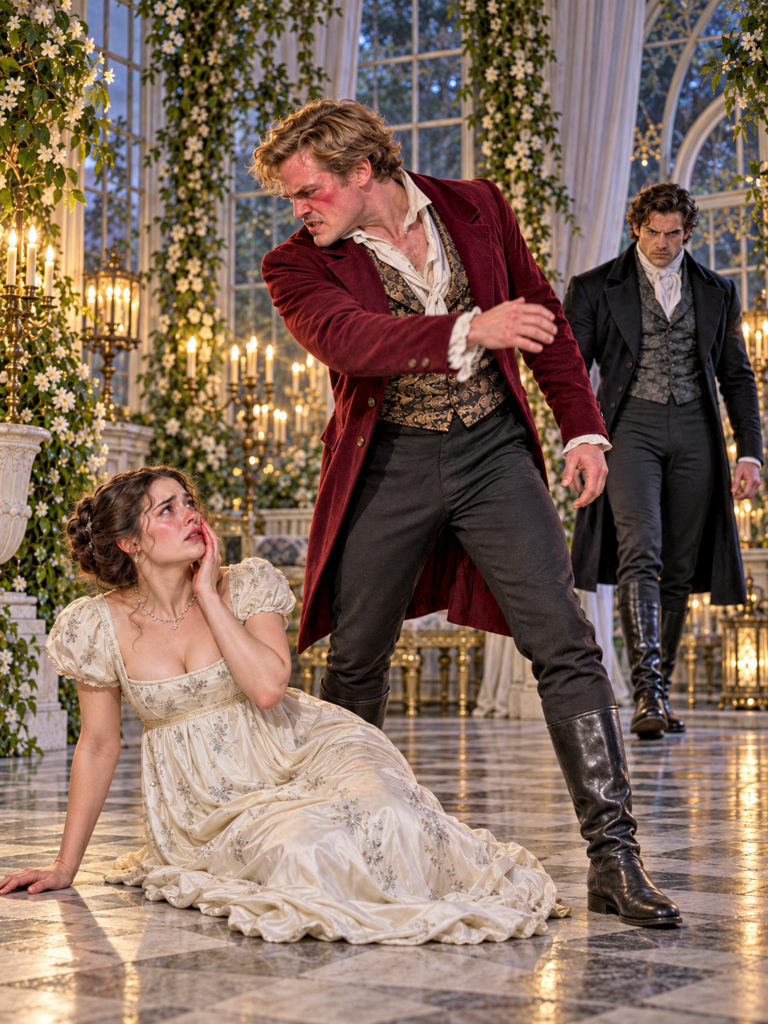
Her Ex Slapped Her at the Mafia Gala—He Had No Idea Her Husband, the Most Feared Boss in the City, Was Watching
Part 1
The slap landed beneath the music.
One sharp crack, nearly swallowed by the jazz band playing beyond the glass doors.
Beatrice Vale staggered sideways.
Her shoulder struck the marble edge of a planter. Pain flashed through her arm. The taste of blood spread across her tongue where her teeth had cut the inside of her cheek.
For one stunned second, she heard nothing.
Not the party.
Not the fountain.
Not Henry Rowley’s breathing.
Only the ringing inside her skull.
Henry stared at his own hand.
Then at her.
His shock lasted less than a heartbeat.
After that came the sneer.
“You always did bring out the worst in me.”
Beatrice slowly raised her face.
Her left cheek burned.
“You hit me.”
“You humiliated me.”
His voice was thick with bourbon.
“You married him.”
Beatrice wiped the corner of her mouth with the back of her hand.
Red stained her skin.
She looked at it.
Then at Henry.
“No.”
Her voice came out quieter than expected.
“You humiliated yourself.”
Henry stepped closer.
The private conservatory attached to the Cavendish Hotel ballroom had seemed like a safe place to escape the crowd.
Now it felt like a locked room.
Behind Henry, orchids climbed black iron trellises. Beyond the glass ceiling, Manhattan lights shimmered against a wet spring night.
The gala continued thirty feet away.
Politicians.
CEOs.
Judges.
Bankers.
Men with legitimate fortunes.
Men with fortunes nobody asked about.
And among them, somewhere, was Beatrice’s husband.
Arthur Roth.
The name alone made experienced men check whether doors were locked.
Henry laughed.
“You still talk like you’re above me.”
“I am above this.”
“You were bankrupt six months ago.”
Beatrice pushed herself upright.
Her knees shook.
She hated that.
Henry noticed.
His smile widened.
“There she is.”
He moved closer.
“The same frightened little girl I found standing in that dead mansion while creditors carried your father’s paintings out.”
Something old and poisonous crawled through Beatrice’s chest.
Her father’s debts.
His gambling.
The lies.
The foreclosure notices.
The men ringing the bell at all hours.
Henry arriving last.
Not because he wanted repayment.
Because he wanted her.
He had purchased several of her father’s worst debts for pennies on the dollar and presented Beatrice with what he called a generous arrangement.
Move into his penthouse.
Belong to him.
Let him decide everything.
He would make the debt disappear.
Beatrice had asked whether he meant marriage.
Henry had smiled.
“Why complicate something simple?”
Twenty-four hours later, Arthur Roth had walked into the crumbling Vale estate.
Arthur had been everything Henry was not.
Quiet.
Controlled.
Massive enough to make the antique doorway seem too narrow.
He had looked over the foreclosure documents and then at Beatrice.
“I can buy every note against your family by tomorrow afternoon.”
She had stared at him.
“Why?”
“I need a wife.”
It had been the least romantic proposal in human history.
Arthur controlled Roth Steel, Roth Shipping, several construction firms, and enough legitimate companies to satisfy financial magazines.
He also controlled the Roth family.
That part never appeared in magazines.
For thirty years, the Roth organization had dominated the northern industrial corridor, the river docks, and half the private freight contracts between New York and Pennsylvania.
Arthur needed political legitimacy.
A respectable wife with an old family name helped.
Beatrice needed financial survival.
So they made an agreement.
He would clear every debt her father left behind.
She would become Beatrice Roth and stand beside him at dinners, charity events, and political functions.
No romantic expectations.
No forced intimacy.
Her own rooms.
Her own accounts.
Her own staff if she wanted them.
“If you ever want out,” Arthur had told her before the wedding, “you tell me.”
She had almost laughed.
There was no out.
Not then.
Not with nowhere to go.
They married on a gray Tuesday morning at City Hall with twelve witnesses and no flowers.
Yet somewhere during the following six months, the transaction had become something neither of them had planned.
Arthur learned she hated lilies because they reminded her of funerals.
Beatrice learned he took his coffee black and forgot to drink it when working.
He learned she flinched when doors slammed.
After noticing it once, he began walking more heavily in the hallway outside her rooms so she always heard him coming.
He never mentioned why.
She learned that when he was angry, he rubbed the scar running across his right palm.
He learned she worried the side of her index finger with her thumb whenever anxious.
Arthur did not say tender things.
He remembered them instead.
Her tea appeared before she asked.
The guest bedroom she used as a library gained warmer lamps because she complained once about headaches.
When she mentioned in passing that her father had sold her mother’s piano years earlier, a restored Steinway appeared in the music room three weeks later.
Beatrice had confronted him.
“Did you buy me a piano?”
Arthur looked confused by the question.
“You said you missed playing.”
“That does not mean you purchase a concert grand.”
“It was available.”
“You are impossible.”
“So I’ve been told.”
He never asked her to play for him.
Three nights later, she did anyway.
Arthur sat in the doorway for forty minutes without saying a word.
And now Henry stood in front of her, drunk and furious because six months ago Arthur had taken away the one weapon Henry believed gave him ownership over her.
“You think that ring makes you untouchable?” Henry asked.
Beatrice straightened.
“No.”
She lifted her chin.
“It reminds me that I was never yours.”
His expression twisted.
“You would have been.”
“No.”
“You had nothing.”
“I had myself.”
“Your father owed me eleven million dollars.”
“My father owed you.”
Henry grabbed her arm.
Beatrice sucked in a sharp breath.
His fingers dug hard into flesh.
“You wore my money. Slept under a roof paid for with my money. Ate food bought with my money.”
“My father did.”
“You benefited.”
“And that gave you what right?”
Henry jerked her closer.
“The right to collect.”
Her fear disappeared.
Anger replaced it.
Pure and bright.
Beatrice looked directly into his bloodshot eyes.
“You never wanted money.”
Henry’s jaw tightened.
“You wanted a frightened woman with nowhere else to go because that was the only version of me you thought you could keep.”
“Careful.”
“You lost me before Arthur ever entered that house.”
“Don’t say his name.”
“Arthur.”
His grip tightened.
“Arthur.”
“Stop.”
“My husband.”
Henry slapped her.
And somewhere behind the curtains separating the conservatory from the private cigar lounge, a glass quietly touched a table.
Henry did not hear it.
Beatrice did.
Her blood went cold.
Not because she was afraid.
Because she knew that sound.
Arthur.
Henry stood over her, chest heaving.
“You provoked me.”
Beatrice stared.
Then came the slow scrape of a shoe against stone.
Henry turned.
Arthur Roth stepped out of the shadows.
Everything in Henry’s face vanished.
Color.
Arrogance.
Breath.
Arthur wore a black tuxedo without a tie now. He had removed it sometime during the evening, which meant he had already been irritated before walking into the conservatory.
His dark hair was swept back.
His shoulders filled the doorway.
His face showed nothing.
That was worse than rage.
Beatrice had seen Arthur angry.
Anger had heat.
This was cold.
He looked at Henry for less than one second.
Then walked straight past him.
“Beatrice.”
Arthur knelt in front of her.
The movement startled Henry more than any threat could have.
Men did not watch Arthur Roth kneel.
Arthur ignored him.
His gaze moved carefully over Beatrice’s face.
Her swelling cheek.
The blood at her mouth.
The mark already forming around her upper arm.
Arthur’s right hand closed once.
The scar in his palm disappeared beneath his fingers.
“Look at me.”
She did.
“Are you dizzy?”
“A little.”
“Nauseous?”
“No.”
“Can you see clearly?”
“Yes.”
Arthur reached into his pocket.
He removed a white handkerchief.
Held it toward her.
He did not touch her.
“May I?”
The question nearly broke her.
Not after Henry grabbing her.
Not after her father throwing glasses and calling fear obedience.
This enormous, feared man was asking permission to wipe blood from her mouth.
Beatrice nodded.
Arthur touched the linen carefully to her lip.
His fingers remained steady.
Only his eyes betrayed him.
Something murderous lived there.
“Can you stand?”
“Yes.”
Arthur rose first.
He offered his hand.
Beatrice took it.
He pulled her upright.
Then positioned himself slightly in front of her.
Not hiding her.
Shielding.
Only then did he turn.
Henry backed away.
“Arthur.”
Arthur said nothing.
“Listen to me.”
Silence.
“She slipped.”
Arthur’s eyes moved to him.
Henry swallowed.
“It was an accident.”
Beatrice almost laughed.
Arthur spoke.
“You’re going to say that again.”
Henry blinked.
“What?”
“You’re going to look at my wife and tell her she slipped.”
Henry looked toward Beatrice.
Arthur’s voice dropped.
“Go ahead.”
“I—”
“Say it.”
Henry’s mouth opened.
Nothing came.
Arthur crossed the distance.
Fast.
One hand closed around Henry’s collar.
He drove him backward until Henry struck a steel support beam hard enough to grunt.
Beatrice flinched.
Arthur immediately stopped.
Not because of Henry.
Because he heard her.
His head turned slightly.
Beatrice whispered, “Arthur.”
He looked at her.
That was all it took.
His hand remained around Henry’s collar, but the violence stopped advancing.
Arthur faced Henry again.
“A duel would be easier.”
Henry’s eyes widened.
“What?”
“If this were twenty years ago, men like you would expect me to kill you.”
Arthur’s voice was terrifyingly calm.
“That would make you important.”
Henry clawed at Arthur’s wrist.
“Please.”
“I don’t think you understand.”
Arthur leaned closer.
“I spent six months believing you were merely pathetic.”
Henry’s face turned red.
“I let you keep your businesses. Your clubs. Your reputation. I let you tell people whatever story helped you sleep.”
Arthur’s grip tightened by a fraction.
“But you touched my wife.”
“Arthur,” Beatrice said again.
He released Henry.
Henry collapsed forward, coughing.
Arthur did not strike him.
Instead he adjusted his own cuff.
“Tomorrow morning, Roth Capital purchases every outstanding loan connected to Rowley Development.”
Henry froze.
Arthur continued.
“Your building on Seventy-Third is leveraged at eighty-two percent. Your hotels are carrying variable debt you can no longer service.”
Henry’s face changed.
“How do you know that?”
Arthur almost smiled.
“Because six months ago you made yourself relevant to me.”
“Arthur, wait—”
“Your primary investors have exit clauses triggered by a credit downgrade.”
Henry went pale.
“My attorneys will make sure the downgrade happens.”
“You can’t do that.”
“I can.”
“That’s illegal.”
“No.”
Arthur tilted his head.
“It’s expensive.”
Henry stared.
“By noon tomorrow, your lenders begin calling notes.”
“Please.”
“By Friday, no serious bank in the city extends you a dollar.”
“You’ll lose money.”
“Yes.”
“Millions.”
“Probably.”
Henry looked toward Beatrice.
“You’re doing this over her?”
Arthur’s expression became something Beatrice had never seen before.
Not possession.
Offense.
As though the question itself disgusted him.
“Over what you did to her.”
Henry laughed desperately.
“She married you because she had no choice.”
Arthur went still.
“You think she loves you?”
Beatrice’s heart stopped.
Henry saw it.
There.
The opening.
He smiled.
“She was broke. You bought her father’s debt and put your ring on her finger.”
“Henry,” Beatrice warned.
“You’re no better than me.”
Arthur’s gaze shifted to her.
For the first time that night, something like uncertainty appeared in his face.
Henry saw that too.
“She chose the richer cage.”
Arthur released him completely.
Not because Henry had won.
Because the words had landed somewhere dangerous.
Henry straightened his jacket.
“You know I’m right.”
Arthur looked at Beatrice.
“Do you want him gone?”
The question silenced the room.
Beatrice looked from her husband to Henry.
Arthur could destroy Henry.
But he was giving the decision to her.
Henry realized it.
His confidence cracked.
Beatrice wiped blood from her lip.
“Yes.”
Arthur nodded.
He took out his phone.
“Enzo.”
A voice answered instantly.
“Boss.”
“Conservatory.”
Twenty seconds later, two Roth security men entered.
Arthur never raised his voice.
“Mr. Rowley is leaving.”
Henry stared.
“This isn’t over.”
Beatrice stepped from behind Arthur.
“Yes.”
Her cheek burned.
Her arm hurt.
Her voice shook.
But she looked directly at the man who had spent years believing fear made her his.
“It is.”
Henry was escorted out.
Arthur waited until the door closed.
Then turned toward her.
His rage disappeared.
“Hospital.”
“No.”
“Beatrice.”
“It’s a slap.”
“You fell.”
“My shoulder hurts.”
“Hospital.”
She almost smiled despite herself.
“You’re very commanding when terrified.”
Arthur stopped.
The word terrified hung between them.
Beatrice realized what she had said.
Arthur looked away.
“You’re bleeding.”
“That wasn’t a denial.”
He picked up her wrap.
“Car.”
“Arthur.”
He stopped.
Beatrice stepped closer.
“You saw it happen.”
His jaw clenched.
“Yes.”
“And you didn’t kill him.”
“No.”
“Thank you.”
Arthur stared at her.
“I didn’t do it for him.”
“I know.”
His hand lifted.
Stopped beside her bruised cheek.
Beatrice leaned into it before he could ask.
Arthur’s breath caught.
His rough palm settled carefully against the uninjured side of her face.
Then he lowered his forehead to hers.
“I was three seconds too late.”
The words came out broken.
Beatrice closed her eyes.
“No.”
“I watched him hit you.”
“And you came.”
“I should have been there sooner.”
“Arthur.”
She opened her eyes.
“I survived before you.”
Something flashed across his face.
“I know.”
“I’m not asking you to become the reason I survive.”
Her voice softened.
“I’m asking you to be the person who stays after.”
Arthur’s eyes closed.
Then he wrapped an arm around her waist.
Not hard.
Not possessively.
Carefully.
“Then I’m staying.”
They left the gala together.
By sunrise, Manhattan had learned that Henry Rowley had made the worst mistake of his life.
Part 2
Arthur did not take Beatrice directly to the hospital.
He took her first to a private medical clinic owned by a doctor he trusted enough to wake at one in the morning.
Beatrice had a mild concussion.
A bruised shoulder.
A split lip.
No fractures.
By two-thirty they were back at the Roth townhouse.
The staff slept.
Arthur ordered that no one be awakened.
Then he led Beatrice upstairs.
Her suite was to the left.
His was to the right.
Arthur stopped between them.
“Your room?”
Beatrice looked at him.
“No.”
He went very still.
“Yours.”
Arthur said nothing.
His private rooms were surprisingly plain.
Dark wood.
Books.
Leather chairs.
No gold.
No display of wealth.
The only photograph on the desk showed a younger Arthur beside an older woman in a factory yard.
His mother.
Beatrice had never slept there.
Had never been invited.
Arthur guided her toward the sofa near the windows.
“Sit.”
“That sounded like an order.”
“It was.”
She gave him a look.
Arthur exhaled.
“Please sit.”
“Better.”
He disappeared into the bathroom and returned with ice, towels, antiseptic, and a medical kit.
Beatrice almost laughed.
“You have a trauma kit in your bathroom.”
“I have several.”
“Of course you do.”
Arthur sat on the low table in front of her.
Their knees nearly touched.
“Let me see your arm.”
She lifted the sleeve.
Finger-shaped bruises were already darkening.
Arthur stared.
His face went blank again.
Beatrice touched his wrist.
“Stay here.”
He looked up.
“Where else would I go?”
“Into whatever place in your head is currently purchasing Henry’s destruction.”
Arthur said nothing.
“That’s a yes.”
“He deserves worse.”
“Probably.”
Arthur lifted the cold pack.
“May I?”
Beatrice nodded.
He pressed it gently against her shoulder.
She flinched.
Arthur immediately pulled away.
“Sorry.”
“No.”
She swallowed.
“It’s reflex.”
Arthur’s gaze sharpened.
“Your father?”
She looked toward the window.
“Yes.”
He had guessed months earlier.
He had never asked.
Beatrice let out a slow breath.
“He never hit me often enough for anyone to call him violent.”
Arthur’s expression became colder.
“He threw things. Grabbed. Shoved.”
She laughed bitterly.
“Mostly he liked making sure everyone understood he could.”
Arthur’s hand tightened around the ice pack.
“He taught me that anticipating anger was safer than surviving it.”
A long silence.
Then Arthur moved his hand slowly into her field of vision.
Not touching.
Showing her where it was.
“I will never hit you.”
Beatrice looked at him.
“Not angry.”
His voice dropped.
“Not drunk.”
He was never drunk.
“Not frightened.”
His eyes held hers.
“Never.”
Something inside Beatrice hurt worse than her face.
“I believe you.”
Arthur lowered his gaze.
“That should not be difficult.”
“It is.”
He looked back up.
Beatrice touched his cheek.
“You make it easier.”
His eyes closed for half a second.
Then her phone rang.
They both looked at it.
Unknown number.
Arthur took one glance.
“Don’t answer.”
Beatrice raised an eyebrow.
“You’re already failing at the choice thing.”
His jaw tightened.
She answered on speaker.
“Hello?”
Henry.
His voice trembled.
“Beatrice.”
Arthur became motionless.
“What do you want?”
“You need to stop him.”
Beatrice looked at Arthur.
He did not react.
“My lenders called.”
“It’s three in the morning.”
“They called anyway.”
“Arthur is efficient.”
“Beatrice, please.”
Her stomach twisted.
Once she would have felt guilty.
Henry knew that.
He heard silence and pressed.
“I made a mistake.”
“You hit me.”
“I was drunk.”
“You hit me.”
“I lost control.”
“You hit me.”
Henry’s breathing turned ragged.
“He’s going to destroy everything.”
“Yes.”
“You’re going to let him?”
Beatrice looked at Arthur.
He watched her.
Not intervening.
Not taking the phone.
Waiting.
She said, “No.”
Hope rushed into Henry’s voice.
“Thank God.”
“I’m not letting Arthur do anything.”
Silence.
“I’m choosing not to stop him.”
Henry cursed.
Arthur’s eyes changed.
Not triumph.
Something warmer.
Henry’s voice hardened.
“You little bitch.”
Arthur reached for the phone.
Beatrice put a finger against his wrist.
Wait.
Henry continued.
“You think you’re powerful because a gangster married you?”
Beatrice smiled slightly.
“No.”
“Then what do you think you are?”
“Free.”
She ended the call.
Arthur stared at her.
“What?”
“You told him no.”
“I do that often.”
“Not like that.”
Beatrice set down the phone.
“I spent half my life believing freedom was having enough money to prevent anyone from controlling me.”
Arthur looked around the room.
“And now?”
“Now I think it’s being able to hear someone threaten what you have and still choose yourself.”
Arthur sat very still.
Then he whispered, “You’re extraordinary.”
The words stunned both of them.
Arthur almost looked annoyed that they had escaped.
Beatrice’s mouth curved.
“That sounded dangerously close to affection.”
“Medication side effect.”
“I’m not taking medication.”
“Concussion.”
“That’s mine, not yours.”
Arthur stood.
“You should sleep.”
“Coward.”
His mouth twitched.
The next morning, Arthur went to war with a spreadsheet.
That was how Beatrice thought of it.
No guns.
No beatings.
No bodies.
Arthur summoned lawyers, bankers, accountants, and two men whose official titles were unclear.
By eleven, Roth Capital had acquired most of Henry’s distressed corporate debt.
By noon, three investors withdrew.
By two, a lender filed notice of default.
By four, Henry’s flagship hotel project lost financing.
Beatrice entered Arthur’s office shortly after five.
His chief attorney, Samuel Abernathy, was speaking.
“Rowley’s personal guarantee exposes his penthouse.”
“Take it,” Arthur said.
“A full foreclosure may attract attention.”
“I know.”
“We’re already spending nearly twelve million above market value to acquire these positions.”
“I know.”
“There is no financial upside.”
Arthur looked at him.
“I know.”
Abernathy stopped.
Beatrice stood in the doorway.
Arthur noticed her.
Everything about his posture changed.
“Abernathy.”
The attorney followed his gaze.
“Mrs. Roth.”
“Beatrice.”
“Ma’am.”
She entered.
“What’s happening?”
Abernathy collected papers.
“Your husband is making the concept of fiduciary responsibility personally offensive.”
Arthur gave him a cold look.
Abernathy left.
Beatrice closed the door.
“You’re spending twelve million dollars to punish Henry.”
“Possibly more.”
“That is insane.”
“Yes.”
“You agree?”
“Yes.”
Beatrice sat opposite him.
“Arthur.”
“He put his hands on you.”
“I know.”
“He has spent years using your father’s debt to justify harassing you.”
“I know.”
“He bribed one of the Vale estate trustees six months ago to delay the sale because he thought it would keep you desperate longer.”
Beatrice froze.
“What?”
Arthur slid a file across the desk.
She opened it.
Emails.
Payments.
Corporate records.
Henry had sabotaged restructuring offers that might have saved part of the Vale estate.
“He engineered it.”
“Not your father’s original debt.”
Arthur’s voice remained measured.
“But when your family started collapsing, Henry made sure it collapsed completely.”
Beatrice’s fingers trembled.
“So I would need him.”
“Yes.”
She stared at the documents.
Her humiliation transformed into something colder.
“Why didn’t you tell me?”
“I found proof yesterday.”
Arthur watched her.
“I was going to tell you this morning.”
Beatrice stood.
“We’re not ruining him.”
Arthur went completely still.
“No?”
“No.”
His jaw tightened.
She walked around the desk.
“We’re exposing him.”
Arthur’s eyes narrowed.
“He expects you to destroy him privately.”
“Yes.”
“He’ll tell everyone you’re a criminal who abused your power because of jealousy.”
“Yes.”
“Then we don’t let him.”
Arthur leaned back.
“What do you propose?”
Beatrice looked at the evidence.
“The Vale Foundation still has its annual board luncheon Friday.”
“Yes.”
“Henry sits on the donor committee.”
“For approximately thirty more hours.”
“Leave him there.”
Arthur studied her.
“Beatrice.”
“He wanted me ashamed.”
She straightened.
“Let him experience the opposite.”
Friday afternoon, two hundred people gathered inside the Vale Museum.
Henry attended.
He had to.
If he missed another major society event, rumors of his financial collapse would become confirmation.
He entered pale but perfectly dressed.
Then saw Beatrice.
She wore white.
Not to look innocent.
To make sure nobody missed the faint yellow-purple shadow still visible beneath makeup on her cheek.
Arthur stood beside her in black.
Henry stopped.
Conversation around the room thinned.
Beatrice walked toward the podium.
Her hands were cold.
Arthur touched the small of her back.
“You don’t have to.”
“I know.”
“I can do it.”
“I know.”
“Do you want me beside you?”
She looked at him.
“Yes.”
Arthur followed.
Beatrice stepped to the microphone.
“Before today’s luncheon begins, there is a governance matter that requires attention.”
Henry’s face changed.
The museum trustees looked toward one another.
Beatrice continued.
“Six months ago, my father’s estate entered insolvency proceedings.”
She hated speaking of it publicly.
That was precisely why she had to.
“My father was responsible for those debts.”
She paused.
“But recent documents show that one creditor deliberately interfered with refinancing offers, bribed a trustee, and acquired additional notes not to recover money, but to increase pressure on me personally.”
Whispers began.
Henry stood.
“This is ridiculous.”
Arthur’s eyes moved to him.
Henry sat again.
Beatrice held up copies.
“These records have been provided to the board’s counsel and financial regulators.”
Henry’s face drained.
“This is revenge.”
“No.”
Beatrice looked directly at him.
“This is accounting.”
Someone in the audience almost laughed.
She continued.
“You spent years telling me debt gave you ownership over my choices.”
Her voice grew steadier.
“You were wrong.”
Henry glanced around.
No allies met his eyes.
Then Beatrice did something Arthur had not expected.
She stepped away from the microphone.
Crossed the stage.
Stopped directly in front of Henry.
The room became silent.
“You hit me because you believed humiliation would make me small enough to control again.”
Henry stared.
Beatrice lifted her chin.
“It didn’t.”
She turned to the board.
“I move that Henry Rowley be removed from every position associated with the Vale Foundation pending the outcome of the investigation.”
The chairwoman spoke.
“Seconded.”
Hands rose.
Unanimous.
Henry looked at Arthur.
“You planned this.”
Arthur shook his head once.
“My wife did.”
The sentence moved through Beatrice like electricity.
Not my woman.
Not someone under my protection.
My wife did.
Henry left through the side door.
Nobody followed.
Arthur and Beatrice remained at the front of the room.
For the first time in her adult life, she watched the man who had terrorized her walk away while she stayed.
That evening Arthur took her to dinner.
Not one of his restaurants.
A small Italian place in Brooklyn where the owner called him Arturo and shouted at him for not visiting enough.
Beatrice stared.
“You have secret normal places.”
“Apparently.”
The owner, Rosa, pinched Arthur’s cheek.
The feared head of the Roth organization tolerated it with the patience of a saint.
Beatrice laughed.
Arthur looked at her.
Really looked.
“What?”
“Nothing.”
“You always say that before saying something.”
He poured wine.
“I like hearing you laugh.”
Her smile faded slightly.
Arthur’s gaze dropped to the table.
“I should say things more often.”
“You should.”
“I’m working on it.”
“Painfully.”
“Yes.”
After dinner they walked three blocks instead of taking the car.
Arthur’s security followed at a distance.
Rain had stopped.
The pavement shone.
Beatrice slipped her hand through Arthur’s arm.
He looked down.
She pretended not to notice.
They walked another block.
Then a black SUV turned the corner too quickly.
Arthur reacted before Beatrice understood.
He grabbed her.
Pulled her behind a parked vehicle.
Two Roth security cars moved instantly.
The SUV sped past.
No gunshots.
Nothing.
Arthur remained over her, shielding her with his body.
“Arthur.”
He didn’t move.
“Arthur.”
The SUV disappeared.
Enzo’s voice came through Arthur’s earpiece.
“Plate is false. We’re following.”
Arthur looked down at Beatrice.
His face had gone gray.
She touched his jaw.
“I’m okay.”
“Get in the car.”
“Arthur.”
“Now.”
She heard fear becoming control.
“Don’t.”
He froze.
“Don’t turn fear into orders.”
His eyes closed.
Then opened.
“Please get in the car.”
“Better.”
They returned home.
An hour later Enzo arrived.
The SUV belonged to a shell company connected not to Henry Rowley.
But to Vincent Marchesi.
Arthur’s oldest rival.
Beatrice knew the name.
Everyone did.
The Marchesi family had fought the Roth organization for control of freight routes, construction unions, and waterfront properties for nearly a decade.
“What does Marchesi have to do with Henry?” Beatrice asked.
Arthur stood by the study window.
“Maybe nothing.”
Enzo placed photographs on the desk.
Henry meeting a Marchesi lieutenant.
Two weeks before the gala.
Then another photograph.
Henry leaving a private club with Vincent Marchesi himself.
Beatrice stared.
Arthur’s expression hardened.
“Henry didn’t just want you back.”
“He was giving Marchesi information.”
“Yes.”
“About me?”
“About us.”
A slow chill moved through her.
Arthur looked at Enzo.
“How much?”
“We’re still checking.”
Another man entered.
He whispered something.
Enzo cursed.
Arthur turned.
“What?”
The man placed a tablet on the desk.
Security footage.
The Roth townhouse service entrance.
One of Arthur’s own guards letting an unknown man inside two nights earlier.
Insider.
Arthur’s jaw tightened.
Beatrice looked at him.
“Who?”
“Daniel Corda.”
She knew the name.
One of Arthur’s security supervisors.
He had driven her twice.
Opened doors.
Carried shopping bags.
Smiled.
Arthur said, “Find him.”
Too late.
Daniel had disappeared.
And three minutes later, Beatrice’s phone received a photograph.
The Vale family estate.
The house Arthur had saved from immediate sale when he cleared the debts.
Someone stood inside her childhood bedroom.
On the back wall, written across the faded wallpaper in black paint:
YOUR HUSBAND CAN’T BUY EVERYTHING BACK.
Arthur stared.
Beatrice’s fear returned.
Then another message arrived.
A video.
Henry.
Bruised.
Terrified.
Tied to a chair.
Vincent Marchesi stood behind him.
Smiling.
“Mrs. Roth.”
Arthur moved closer.
Marchesi continued.
“Your former admirer has been disappointing.”
Henry looked like he had been crying.
“He gave me your husband’s routines. Your charity calendar. Your travel plans.”
Arthur’s entire body went still.
“But apparently he overestimated his usefulness.”
Marchesi put one hand on Henry’s shoulder.
“So now I’m offering you a trade.”
Beatrice’s heartbeat hammered.
“The Vale estate.”
Arthur whispered, “No.”
Marchesi smiled at the camera.
“Come tomorrow night.”
He gave an address.
Her childhood home.
“Bring the original Vale property trust documents Arthur acquired when he bought your father’s debt.”
Beatrice looked at Arthur.
He understood instantly.
Those documents contained old waterfront easements.
Land her father had treated as worthless.
Land now positioned beside a proposed commercial port expansion.
Worth hundreds of millions.
Marchesi continued.
“And Arthur comes alone.”
The video ended.
Silence.
Arthur said, “You’re leaving the city tonight.”
Beatrice stared.
“No.”
“I’m not discussing it.”
“Then you’re about to be disappointed.”
“Beatrice.”
“My family property is the leverage.”
“I don’t care about the property.”
“I do.”
“You matter more.”
“That doesn’t make it your decision.”
His eyes flashed.
“This is not Henry at a party.”
“I know.”
“Marchesi kills people.”
“I know.”
“He killed my brother.”
Beatrice stopped.
Arthur had never told her.
His face closed.
“Eight years ago.”
She moved closer.
“Arthur.”
“He wants me emotional.”
His voice roughened.
“He knows the Vale estate matters to you. He knows you matter to me.”
That last sentence hung there.
Beatrice waited.
Arthur looked at her.
Fear.
Love.
Everything he still refused to name.
“He’s forcing both into the same room.”
Beatrice whispered, “Then we don’t give him the room he expects.”
Arthur shook his head.
“You are not going.”
“Yes, I am.”
“No.”
“Arthur.”
His hand hit the desk.
Not at her.
Never at her.
But hard enough to make the papers jump.
“I watched one man hit you because I was three seconds late.”
His composure broke.
“I am not walking you into a house with Marchesi.”
Beatrice stared at him.
“Then don’t walk me.”
He froze.
“Walk beside me.”
Part 3
The plan they built was Beatrice’s.
Arthur hated almost all of it.
That made her trust it more.
Marchesi wanted the original Vale trust documents because the waterfront easement could derail or control a billion-dollar port expansion.
Arthur possessed the originals.
Marchesi assumed Arthur would trade anything for Beatrice.
He was right.
That was the problem.
So Beatrice changed what the documents meant.
At nine the next morning, she met with federal investigators already examining financial links between Henry Rowley and the Marchesi organization.
Arthur did not like involving law enforcement.
Beatrice did not care.
“This is my family property.”
“Yes.”
“My former creditor.”
“Yes.”
“My evidence.”
Arthur’s jaw flexed.
“Yes.”
“Then I choose part of the response.”
He stared.
“Fine.”
It sounded painful.
Beatrice almost smiled.
The investigators copied everything.
The original trust documents were placed inside a sealed evidence package.
Beatrice carried a visually identical duplicate.
Meanwhile Arthur fed a controlled piece of misinformation through two compromised business channels.
He intended to arrive at the Vale estate alone.
He would bring the documents.
He would sign.
The lie reached Marchesi by afternoon.
At eight forty-five that night, Beatrice sat beside Arthur in a black sedan three blocks from her childhood home.
Rain streaked the windows.
Exactly the kind of night she hated.
Arthur wore no tie.
His right hand rested on his thigh.
The scar in his palm showed white.
Beatrice covered it with hers.
He turned.
“You stay in the car.”
“That was not the plan.”
“I’ve revised it.”
“No.”
“I’m the boss.”
“Not of me.”
Arthur exhaled through his nose.
“Do you enjoy saying that?”
“Deeply.”
His mouth almost curved.
Then fear returned.
“If anything happens—”
“We follow the plan.”
“If the plan fails?”
“Then we improvise.”
“I hate improvising.”
“I know.”
Arthur looked through the rain at the house.
Beatrice followed his gaze.
The Vale estate had once been beautiful.
White stone.
Tall windows.
A garden her mother loved.
Her father had turned it into collateral.
Then neglect.
Then shame.
Marchesi had chosen it because he understood symbolism.
He wanted Beatrice frightened in the place she had once felt powerless.
That was his mistake.
Beatrice was not that woman anymore.
She opened the car door.
Arthur caught her wrist.
Not hard.
Instantly he loosened his grip.
“Sorry.”
Beatrice looked down at his hand.
Then back up.
“Come with me.”
Arthur stared.
She held out her hand.
He took it.
They entered together.
Inside, the old foyer smelled of dust and damp wood.
The chandelier was dark.
Three armed men stood near the staircase.
Arthur’s shoulders changed.
Predator.
Beatrice squeezed his hand once.
Stay with me.
He did.
Vincent Marchesi appeared at the top of the stairs.
Silver-haired.
Perfect suit.
Polite smile.
“Arthur.”
“Vincent.”
Marchesi looked at Beatrice.
“Mrs. Roth.”
“Mr. Marchesi.”
“You’re braver than Henry described.”
“Henry has always confused fear with obedience.”
Marchesi smiled.
“I see why Arthur likes you.”
Arthur’s face hardened.
Beatrice spoke first.
“Where is Henry?”
A door opened.
Henry was pushed into the hall.
His face was bruised.
One eye swollen.
For one ugly second, Beatrice felt pity.
Then Henry saw her.
“Beatrice.”
He stumbled forward.
One guard stopped him.
“I’m sorry.”
She stared.
“I swear, I didn’t know what Marchesi planned.”
“You gave him my schedule.”
Henry cried.
“I was desperate.”
“You gave him Arthur’s security routes.”
“I owed them money.”
“You gave him information about my home.”
Henry’s face collapsed.
“I thought he would scare Roth. That’s all.”
Beatrice looked at him for a long time.
Then said, “You always think consequences belong to someone else.”
Henry lowered his head.
Marchesi descended the stairs.
“Touching reunion.”
Arthur’s hand tightened around Beatrice’s.
Marchesi noticed.
“Documents.”
Beatrice held up the folder.
“Henry first.”
Marchesi laughed.
“No.”
Beatrice shrugged.
“Then we leave.”
She turned.
Every gun in the room lifted.
Arthur moved instantly in front of her.
Marchesi sighed.
“Arthur. We both know you aren’t leaving.”
Arthur’s voice was low.
“If one weapon points at my wife for another second, the conversation ends.”
Marchesi smiled.
“How?”
Arthur looked at him.
“You know.”
The smile faded.
Beatrice stepped around Arthur.
He hated it.
She saw it.
But he let her.
“Henry comes to me.”
Marchesi considered.
Then nodded.
A guard shoved Henry across the hall.
He nearly fell.
Beatrice caught his arm.
Henry looked at her.
Shame filled his face.
She released him immediately.
“Outside.”
“They’ll shoot me.”
“No.”
“How do you know?”
“Because Marchesi thinks he still needs the documents.”
Henry hesitated.
Arthur said, “Go.”
Henry went.
The front door closed behind him.
Marchesi held out his hand.
“Now.”
Beatrice opened the folder.
“You know what I learned growing up in this house?”
Marchesi’s expression changed slightly.
“No.”
“Everything had a price.”
She removed the documents.
“My father believed that.”
Arthur looked at her.
“Henry believed it.”
She held up the pages.
“You believe it.”
Marchesi’s eyes narrowed.
“You want the easement.”
“I do.”
“Because without it, your port expansion is vulnerable to injunction.”
Silence.
“And if you control it?”
“I become very rich.”
“You’re already rich.”
“One is rarely enough.”
Beatrice almost smiled.
“That’s what my father said.”
She walked toward the fireplace.
Arthur understood before anyone else.
“Beatrice.”
Marchesi’s expression changed.
“Don’t.”
She held the pages over the flame.
“The original documents are protected under federal evidence seal.”
Marchesi went pale.
“These?”
She smiled.
“Copies.”
Then dropped them.
Paper caught fire.
Marchesi shouted.
Everything exploded.
One of his men lunged.
Arthur hit him.
Another drew a weapon.
Glass shattered from the rear doors.
Federal agents entered from the garden.
“Federal agents! Drop your weapons!”
Marchesi turned toward Beatrice.
Not Arthur.
Her.
Rage transformed his face.
“You stupid—”
He grabbed her.
His arm locked across her throat.
Arthur stopped moving.
The room went silent around them.
Marchesi dragged Beatrice backward.
A gun pressed against her ribs.
Arthur’s face became deathly calm.
“Let her go.”
“Drop yours.”
Arthur had taken a gun from the man he hit.
He lowered it.
“Arthur, no,” Beatrice said.
Marchesi tightened his grip.
Arthur dropped the weapon.
It struck the floor.
“Good.”
Marchesi breathed hard against Beatrice’s ear.
“Now tell your men to move.”
Arthur looked only at Beatrice.
Not the gun.
Not Marchesi.
Her.
Years of surviving angry men had taught Beatrice something.
Men like Marchesi watched the threat in front of them.
They rarely watched the woman they were using as leverage.
Her heel came down on his foot.
Hard.
Marchesi cursed.
Beatrice drove her elbow backward into his ribs.
His grip loosened.
She dropped instantly.
Arthur moved.
One second later Marchesi was on the ground.
Arthur’s knee pinned his chest.
His fist pulled back.
Marchesi looked up.
Terrified.
Arthur could kill him.
Everyone in the room knew it.
Beatrice rose.
Her throat hurt.
“Arthur.”
His fist remained raised.
“Look at me.”
He did.
Beatrice walked closer.
“Not for him.”
Arthur’s breathing slowed.
“Not for Henry.”
His hand trembled.
“For you.”
Arthur stared.
Then lowered his fist.
Federal agents took Marchesi.
The entire thing lasted less than three minutes.
For Beatrice, it divided her life into before and after.
Outside, ambulances flashed blue and red across the Vale estate.
Henry sat on the rear bumper of one.
A medic checked his face.
He looked at Beatrice approaching.
“I’m sorry.”
She stopped.
“I know.”
“Can you forgive me?”
Beatrice considered.
“No.”
Henry closed his eyes.
“Not now.”
He looked back up.
“Maybe never.”
She spoke without cruelty.
“But I don’t need to hate you anymore.”
Henry’s eyes filled.
“That’s all?”
“That’s more than you gave me.”
He lowered his head.
Beatrice turned away.
Arthur waited near the front steps.
His tuxedo shirt was torn at the shoulder.
Blood marked one knuckle.
His own.
Not Marchesi’s.
Beatrice walked to him.
Arthur said, “Hospital.”
She laughed.
His eyes narrowed.
“You had a gun against you.”
“I know.”
“Hospital.”
“I’m fine.”
“Beatrice.”
She touched his chest.
“Ask.”
Arthur looked deeply offended.
Then understood.
His face softened.
“Will you please let a doctor examine you?”
“Yes.”
“Thank you.”
“You’re learning.”
“Slowly.”
At the hospital, nothing serious was found.
By four in the morning they returned home.
Beatrice showered.
Changed.
Found Arthur sitting in the dark library.
He held a glass of whiskey he had not touched.
She entered.
Arthur stood immediately.
“Why are you awake?”
“So are you.”
He looked at her neck.
A faint red mark remained.
His jaw tightened.
Beatrice crossed the room.
“Sit.”
He stared.
“Please.”
Arthur sat.
Beatrice stood in front of him.
“What happened tonight was not your fault.”
His eyes dropped.
“He grabbed you because of me.”
“He grabbed me because he is a violent man.”
“He knew you because of me.”
“And I walked into that house because I chose to.”
“You should not have had to.”
“No.”
She touched his hair.
“But listen carefully.”
Arthur looked up.
“You do not get to love me only when love feels safe.”
He went still.
Beatrice swallowed.
“There. I said it.”
His eyes darkened.
“Say what?”
She almost smiled.
“You know.”
“No.”
Arthur rose slowly.
He towered over her.
“Say it again.”
Beatrice’s heart pounded.
“Love.”
His breathing changed.
Arthur Roth could order a room cleared with one glance.
Now one word had terrified him.
Beatrice whispered, “You love me.”
Arthur said nothing.
She continued.
“And I love you.”
The silence became enormous.
Arthur looked away first.
Beatrice frowned.
“That is not the reaction I expected.”
He laughed once.
Brokenly.
Then dragged both hands over his face.
“You don’t know what that does to me.”
“Tell me.”
He looked at her.
“I bought your father’s debt because I wanted to free you from Henry.”
“I know.”
“I asked you to marry me because I told myself it was practical.”
“Yes.”
“It wasn’t.”
Her breath caught.
Arthur stepped closer.
“I saw you in that ruined house while six men inventoried your family’s possessions.”
His voice roughened.
“You were twenty-eight years old. Your father was dead. Everyone around you was calculating what remained to take.”
His hand lifted.
Touched her cheek carefully.
“And you stood there with your shoulders straight and asked each creditor for documentation before you agreed they were owed anything.”
Beatrice almost laughed through tears.
“You thought that was romantic?”
“I thought it was magnificent.”
Her eyes burned.
“I wanted you that day.”
Arthur’s thumb moved lightly beneath her eye.
“But you were desperate.”
His voice broke.
“And I hated myself for wanting anything from a woman who could not freely refuse.”
Beatrice stared.
“That’s why the contract gave me an exit.”
“Yes.”
“That’s why separate rooms.”
“Yes.”
“That’s why you never…”
“Yes.”
She swallowed.
“You thought I might believe I owed you.”
“I knew you might.”
Arthur’s eyes closed.
“I have spent six months waiting for the day you were safe enough to realize you didn’t need me.”
Beatrice felt something inside her shatter.
“Arthur.”
“I love you.”
He opened his eyes.
There was no control left.
“I love you enough that I have been terrified of saying it because it might sound like another debt.”
Tears slipped down Beatrice’s cheeks.
Arthur’s hands remained at his sides.
Not touching.
Waiting.
She stepped into him.
His arms closed around her.
Not with ownership.
Relief.
Beatrice pressed her face against his chest.
“You idiot.”
“Yes.”
“You enormous, terrifying idiot.”
“Yes.”
“You could have told me.”
“I’m bad at this.”
“You’re spectacularly bad at this.”
Arthur laughed into her hair.
They stayed that way until dawn.
Three weeks later, Arthur took Beatrice north.
Not because they were fleeing New York.
Because he wanted to show her where he came from.
Roth Steel’s primary mills stood outside Pittsburgh along a river valley filled with smoke stacks, freight yards, and red brick.
Arthur changed there.
In Manhattan he seemed like a weapon disguised in a suit.
At the mills, he became part of the ground.
Workers nodded to him.
Called him Arthur.
Argued with him.
One foreman shouted across a loading floor that Arthur’s redesigned shipping schedule was idiotic.
Arthur shouted back that the foreman was welcome to replace him.
Beatrice stared.
“You allow that?”
Arthur looked confused.
“He’s right half the time.”
They toured the steelworks.
Arthur gave her a hard hat.
“Stay behind the marked lines.”
“Is that an order?”
“Yes.”
She looked at the glowing furnace thirty feet away.
“This one I’ll accept.”
“Thank God.”
The heat struck like a wall.
Arthur explained blast pressures, casting schedules, rail costs.
Beatrice asked questions.
A lot of questions.
At one furnace she frowned at a diagram.
“What happens if that pressure valve fails?”
Arthur pointed.
“Secondary release.”
“And if that fails?”
A pause.
Beatrice looked at him.
“There should be a third.”
Arthur blinked.
“It would cost six hundred thousand.”
“How much does a fatal accident cost?”
Arthur stared.
Then called the plant engineer.
“Price a third release system.”
The engineer looked surprised.
Arthur pointed at Beatrice.
“Her idea.”
That night they ate in Arthur’s childhood home.
Not a mansion.
A brick house overlooking the mill.
Arthur’s mother had refused to leave it even after the Roth family became wealthy.
Her photograph sat above the fireplace.
Beatrice looked around.
“You could buy any house in the country.”
“Yes.”
“And this is your favorite.”
“Yes.”
“Why?”
Arthur sat beside her.
“Nothing in it was purchased to impress anyone.”
She leaned against him.
“I understand.”
Over the next month, Beatrice spent more time in Pennsylvania.
She reviewed community grants connected to Roth companies.
Found an accounting discrepancy that had cost the shipping business almost three million dollars.
Arthur’s CFO stared at her.
“How did you see that?”
Beatrice shrugged.
“My father taught me everything about losing money.”
Arthur did not laugh.
He kissed her temple.
The Roth house changed too.
Beatrice added rugs.
Books.
Plants.
Arthur complained about decorative pillows.
She bought more.
Then one rainy night, she found him sitting on the floor in front of the fire.
A legal folder lay beside him.
“What’s that?”
Arthur looked up.
“You should sit.”
“That is never a comforting sentence.”
She sat.
Arthur handed her the folder.
Inside was a property deed.
Beatrice read the address.
Then again.
Her childhood estate.
Vale House.
Her chest tightened.
“Arthur.”
“I purchased the remaining title interests.”
She looked at him.
“Why?”
“It’s yours.”
The deed listed her name.
Not Arthur Roth.
Not Roth Holdings.
Beatrice Vale Roth, sole beneficiary through an independent trust.
She stared.
“What did you do?”
“I hired six lawyers.”
“That sentence is never reassuring.”
“The trust is outside my marital estate.”
Her hands began to shake.
“If anything happens to me, nobody in the Roth family can touch it.”
“Arthur.”
“If we divorce, it remains yours.”
She froze.
He continued.
“If Roth Steel fails, it remains yours.”
His voice became quieter.
“If tomorrow you decide marrying me was the greatest mistake of your life, you can leave with a home, income, and enough independent property that nobody can ever corner you again.”
Beatrice looked at the man kneeling before her.
“Why would you do this?”
Arthur’s eyes held hers.
“Because six months ago you didn’t choose me freely.”
Pain crossed his face.
“You chose survival.”
Beatrice’s throat tightened.
“I need to know that isn’t still why you stay.”
He pushed the deed toward her.
“You have a real exit now.”
Silence filled the room.
“You could leave tonight.”
Arthur swallowed.
“And I would not stop you.”
Beatrice stared at the deed.
Everything she had once wanted.
Vale House.
Her mother’s gardens.
Her childhood room.
The family name restored.
Financial independence.
Freedom.
Arthur mistook her silence.
His face changed.
He looked devastated.
But he nodded.
“I understand.”
Beatrice looked up.
“You understand what?”
“If you want to go.”
“You think I’m leaving?”
Arthur said nothing.
She almost laughed.
Then almost cried.
She stood.
Walked to the fireplace.
Arthur’s eyes widened.
“Beatrice.”
She held the deed over the flames.
“Don’t.”
“Why?”
“That is a legally executed original.”
“You have copies.”
“That is not the point.”
She smiled.
Then pulled the deed back.
Arthur exhaled.
“I nearly died.”
“You deserve it.”
She placed the document safely on the mantel.
“I’m not burning my own property to make a romantic point.”
Arthur stared.
“Practicality first.”
“You’re cruel.”
“You married me for it.”
His expression softened.
Beatrice walked toward him.
“The deed stays.”
Arthur’s face fell almost imperceptibly.
She took his hands.
“Because you’re right.”
He looked at her.
“I should have something that is mine.”
“Yes.”
“I should know I can leave.”
“Yes.”
“And now I do.”
Arthur’s jaw tightened.
Beatrice smiled.
“I’m still here.”
He stopped breathing.
“I am not staying because you paid my father’s debt.”
She squeezed his hands.
“I’m not staying because Henry frightened me.”
She moved closer.
“I’m not staying because Marchesi made your world dangerous.”
Arthur’s eyes shone.
“I’m staying because when you had the power to own every part of my life, you kept finding ways to give pieces of it back to me.”
His composure broke.
Beatrice touched his face.
“You are not my cage.”
Arthur closed his eyes.
“You are my choice.”
He made a sound that was almost painful.
Then opened his eyes.
“Say it again.”
“You are my choice.”
Arthur kissed her.
Not carefully this time.
Not like a contract husband afraid of taking what had not been offered.
Beatrice wrapped both arms around his neck.
He lifted her against him.
The kiss deepened, months of restraint finally collapsing into warmth, hunger, relief.
When they separated, Arthur pressed his forehead to hers.
“I love you.”
Beatrice smiled.
“That was easier the second time.”
“No.”
“No?”
“Terrifying.”
She laughed.
Arthur’s arms tightened.
“Stay anyway.”
“I already told you.”
“Tell me again.”
Beatrice kissed him.
“I’m staying.”
Months later, New York society gathered for another gala.
This one belonged to the Vale Foundation.
Beatrice stood beneath chandeliers wearing deep green.
No bruise.
No fear.
Arthur stood across the ballroom talking to a senator and watching her every few minutes with the same quiet precision he always had.
Only now, when their eyes met, Beatrice smiled.
Arthur did too.
Barely.
But enough.
A younger woman beside Beatrice whispered, “Does he always watch you like that?”
“Yes.”
“I would find it intimidating.”
Beatrice considered.
“Years ago, I might have.”
Arthur excused himself from the senator.
Crossed the room.
He reached Beatrice.
“Everything all right?”
“Yes.”
His hand settled on her lower back.
Warm.
Familiar.
The young woman disappeared tactfully.
Beatrice looked up.
“You’re hovering.”
“I’m standing.”
“Very close.”
“I’m your husband.”
“You use that excuse often.”
“It’s useful.”
A server approached with champagne.
Arthur took two glasses.
Handed one to her.
Beatrice looked around the ballroom.
Six months earlier, whispers had followed her.
Bankrupt daughter.
Bought wife.
Arthur Roth’s charity case.
Now those same people watched her chair foundation meetings.
Manage investments.
Challenge senators.
Appear at Roth Steel shareholder conferences with three pages of questions executives hated.
More importantly, Beatrice no longer cared what they called her.
Arthur looked toward the balcony.
“Air?”
She nodded.
Outside, Manhattan glittered.
Beatrice leaned against the stone railing.
Arthur stood behind her.
After a moment she said, “Do you remember the Cavendish gala?”
His body tightened.
“Yes.”
“You still hate thinking about it.”
“Yes.”
“I don’t.”
Arthur frowned.
She turned.
“I hate what Henry did.”
Her fingers touched his lapel.
“But that night was the first time I understood something.”
“What?”
“That you would destroy the world for me.”
Arthur’s expression darkened.
“That is not reassuring.”
“No.”
She smiled.
“The important part came later.”
He waited.
“You would also stop when I asked.”
Arthur stared.
Beatrice’s hand slid into his.
“That mattered more.”
His thumb moved over her wedding ring.
“Henry thought power was making someone too frightened to leave.”
Arthur’s voice was quiet.
“So did my father.”
Beatrice looked up.
“And you?”
Arthur lifted her hand to his mouth.
“Kneeling in front of a woman and giving her the door.”
Her eyes burned.
“That sounds almost poetic.”
“Don’t tell anyone.”
“Your reputation?”
“Ruined.”
She laughed.
Inside, music swelled.
Arthur looked toward the ballroom.
“We should go back.”
“In a minute.”
He waited.
Of course he did.
Beatrice watched the city.
Somewhere Henry Rowley was awaiting trial on financial fraud charges connected to Marchesi.
Vincent Marchesi faced federal racketeering charges.
Daniel Corda had taken a plea deal.
The Vale estate belonged to Beatrice again.
But she did not move back.
She restored it slowly and converted part of the property into a foundation residence for women rebuilding their lives after financial abuse and coercive relationships.
Arthur funded nothing without board approval.
Beatrice made sure of that.
Once he tried to anonymously donate five million dollars.
She discovered it within forty-eight hours.
“You audited my charity donation?”
“You married an accountant’s daughter.”
“My mistake.”
“Your best one.”
Arthur had smiled.
“Yes.”
Now he wrapped his coat around Beatrice’s shoulders.
She leaned back against him.
“Arthur.”
“Yes?”
“If I had left when you gave me the deed…”
His arms went still.
“What would you have done?”
The answer took time.
“I would have made sure the house was secure.”
She smiled faintly.
“And?”
“Transferred your staff if you wanted them.”
“And?”
“Stayed away.”
Her chest tightened.
“Really?”
“No.”
She turned.
Arthur looked mildly ashamed.
“I would have driven past occasionally.”
“Occasionally?”
“Daily.”
Beatrice laughed.
“You’re hopeless.”
“Yes.”
“And if I told you to stop?”
“I would stop.”
She looked into his eyes.
There was the answer.
Not power.
Choice.
Beatrice rose onto her toes.
Kissed him.
Inside the ballroom, people could see them through the glass.
Arthur did not care.
Neither did she.
Months earlier, Henry had struck her because he believed the woman he once cornered with debt still existed beneath the silk and diamonds.
He had been wrong.
Arthur had not created her strength.
He had not purchased it.
He had simply been the first powerful man in her life who looked at her strength and never asked her to surrender it.
The first man who could have locked every door and instead handed her keys.
The first man who could have demanded love and waited to be chosen.
Beatrice drew back from the kiss.
Arthur’s forehead rested against hers.
“The lights are on at home,” he murmured.
She smiled.
“Then take me there.”
Arthur offered his hand.
Beatrice took it freely.
And together they walked back through the ballroom, past the whispers, past the staring faces, past every person who had once mistaken desperation for weakness and marriage for ownership.
Arthur Roth could frighten half the city into silence.
Beatrice Roth was the one person who could stop him with his name.
And for both of them, that was exactly what love was supposed to be.

