
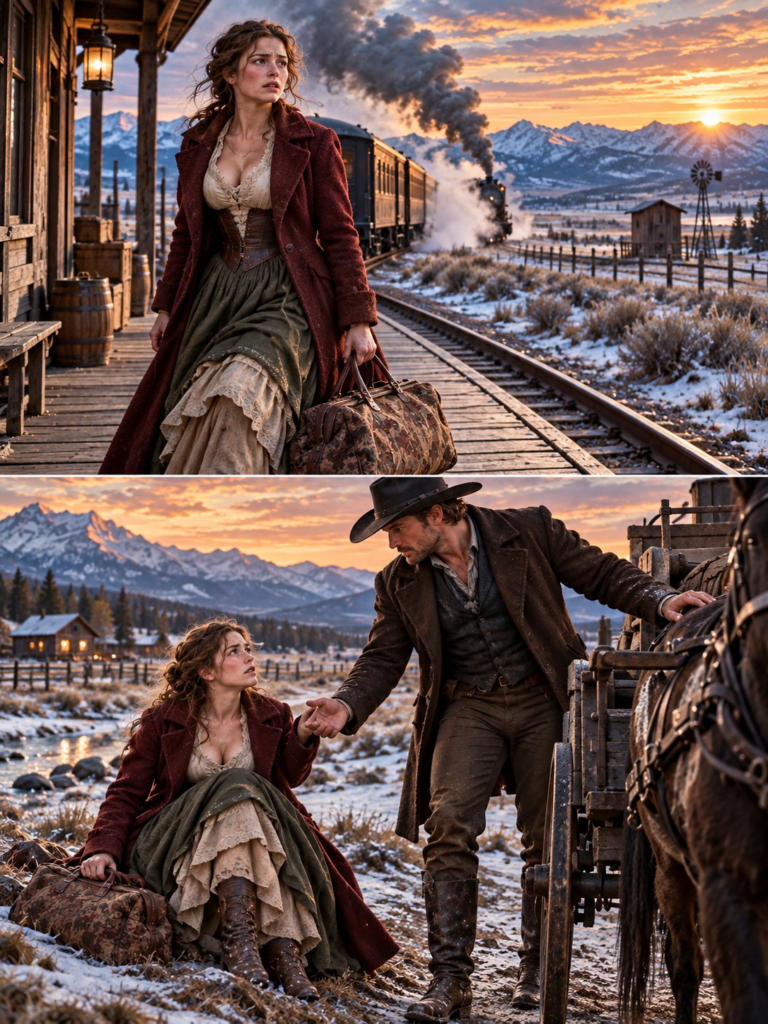
“It isn’t much.”
Pearl put down her carpetbag.
“It has a door.”
Thomas seemed confused.
“Yes.”
“And a window.”
“Yes.”
“Then it will do.”
“The wages are four dollars monthly. Sundays are yours. Meals included.”
“Agreed.”
“You don’t want to see anything else?”
Pearl looked at him.
“I have seen the door.”
Again that slight confusion.
Again, no question.
“I suppose you have.”
That first night, after Thomas carried Rosie back to bed, Pearl went directly into the kitchen.
“You don’t have to work tonight,” he said.
“I know.”
She opened the pantry.
“You also don’t have to reorganize everything.”
“I know.”
“Then why are you doing it?”
Pearl lifted a jar.
“Because you have dried beans behind lamp oil.”
Thomas looked at the shelf.
“So?”
“So I am choosing to believe you are good with cattle.”
He stared at her for a second.
Then he laughed.
It was a quiet laugh, rusty from disuse.
Pearl smiled despite herself.
They drank coffee at the table while the wind moved through the cottonwoods.
Thomas did not ask about Missouri.
Pearl did not ask about the absence of Rosie’s mother.
Their silence became an agreement before either recognized it.
You may tell me when you are ready.
Until then, I will not pry open what you have chosen to keep closed.
Before sleeping, Pearl sat on her cot and removed thirty-one cents from her pocket.
She placed the coins carefully inside the small drawer of the washstand.
Then she touched the door.
It latched.
She touched the window.
Morning would come through it from the east.
“This will do,” she whispered.
For the first time in months, Pearl slept without keeping one shoe on.
Within a week, the Holt household began changing.
Not dramatically.
Pearl did not believe in dramatic household miracles. She believed in shelves, schedules, repaired hems, clean water, hot meals served before people became too tired to eat them, and knowing where the matches were when darkness came.
She put flour and cornmeal into labeled tins.
She moved lamp oil away from food.
She washed the curtains.
She patched a draft beneath the front door.
She found six of Rosie’s dresses waiting for repairs and mended all of them.
Rosie watched every task as if Pearl were performing stage magic.
“Why do you fold towels like that?”
“They fit better.”
“Papa stuffs them in the drawer.”
“I noticed.”
“Is Papa doing it wrong?”
Pearl glanced toward the barn.
“Your father has many fine qualities.”
Rosie thought carefully.
“That means yes.”
Pearl laughed.
By the second week, Rosie had attached herself to Pearl with the steady determination of ivy climbing a wall.
She followed Pearl into the pantry.
Into the garden shed.
Into the chicken yard.
Once, Pearl turned around while hanging laundry and found Rosie standing behind her holding three clothespins in her mouth.
“Rosie.”
The child removed them.
“Yes?”
“You cannot hold those in your mouth.”
“Why?”
“Because someday you may swallow one, and then your father will blame me forever.”
Rosie looked toward the barn.
“Papa doesn’t blame people forever.”
Pearl paused.
“No?”
“He mostly blames himself.”
The statement was so simple that Pearl could not answer.
That evening she noticed Thomas sitting by the fire after Rosie slept, elbows on his knees, hands loosely joined.
He looked exhausted.
Not merely tired.
There was a difference.
“You should sleep,” Pearl said.
“So should you.”
“I am mending.”
“You mended all day.”
“Things continue tearing after sunset.”
Thomas glanced at her.
“You always have an answer?”
“Usually.”
He looked toward Rosie’s closed bedroom door.
“She likes you.”
“I like her.”
“She hasn’t liked anyone I hired before.”
Pearl threaded the needle.
“How many?”
“Three.”
“What happened?”
“One married. One decided the territory was too lonely. One lasted five days.”
“What happened after five days?”
“Rosie put a frog in her washbasin.”
Pearl stared at him.
Thomas’s expression remained serious.
Then Pearl saw the smallest glint in his eye.
“You’re lying.”
“I am.”
“Mr. Holt.”
“Thomas.”
She held his gaze.
“All right. Thomas. What really happened?”
“She said Rosie cried too much.”
Pearl’s smile disappeared.
Thomas looked back into the fire.
“She was three. Her mother had been dead less than a year.”
There it was.
The truth both of them had been walking around.
“I’m sorry,” Pearl said.
“Her name was Anna.”
Pearl waited.
Thomas rarely volunteered more than one sentence at a time.
“She got sick after Rosie turned two. Fever. Doctor came twice. Nothing helped.”
His voice remained even.
Pearl understood that the evenness cost him something.
“She was gone in nine days.”
“I’m sorry,” Pearl repeated.
Thomas nodded once.
“Rosie remembers pieces. Her voice. Her hair. A song.”
Pearl lowered the shirt she was mending.
“My mother died this spring.”
Thomas looked at her.
“She raised me alone,” Pearl continued. “My father disappeared before I was old enough to remember him properly. She sewed dresses for women who complained the sleeves were half an inch too long while she worked until midnight to keep food on our table.”
“You were with her?”
“At the end?”
“Yes.”
Pearl swallowed.
“I was.”
Thomas waited.
“She was afraid I would stop living because she had.”
The fire cracked.
Pearl looked down at the shirt in her lap.
“She made me promise that whenever one road closed, I would find another before I had time to sit beside the closed one and become bitter.”
Thomas was silent.
Then he said, “That sounds like a hard promise.”
“It has been.”
“Still keeping it?”
Pearl thought of thirty-one cents in the drawer beside her bed.
“I’m trying.”
The first snow came four days later.
Rosie woke feverish.
It was only a cold, Pearl knew, but grief does not care about medical reason.
When Thomas came inside at noon and saw Rosie sleeping under two quilts, his face changed.
“She’s all right,” Pearl said.
He stood in the doorway.
“She gets hot when she sleeps.”
“Children do.”
“She did too.”
Pearl knew immediately he meant Anna.
Thomas sat beside Rosie’s bed and touched the child’s forehead with hands built for reins and fence posts.
Rosie opened her eyes.
“Papa?”
“I’m here.”
“Pearl’s here too.”
“I see that.”
Rosie reached toward Pearl.
Pearl took her hand.
Thomas looked at their joined fingers.
“She wanted her mother this morning,” Pearl said softly.
His jaw tightened.
“I’m not her mother. I told her that.”
Rosie’s eyes opened again.
“You said Mama wouldn’t be mad.”
Thomas looked sharply at Pearl.
Pearl met his gaze.
“I told her loving someone new does not mean loving someone gone any less.”
Rosie nodded sleepily.
“Mama would like Pearl.”
Thomas turned his head.
For several seconds, he seemed unable to speak.
Then he rose.
“I have to check the north field.”
“Go.”
“I can stay.”
“Thomas.”
He looked at her.
“She has a cold. The cattle have no understanding of respiratory illnesses. Go.”
His mouth almost smiled.
“Bossy woman.”
“Efficient woman.”
He left.
Pearl stayed beside Rosie all night.
Near dawn, Rosie’s fever broke.
Pearl fell asleep sitting in a chair with her cheek resting against the wall.
She woke to the smell of coffee.
Thomas stood in the doorway holding a mug.
“For you.”
Pearl blinked.
“You made coffee?”
“I’ve been making coffee longer than you’ve been here.”
“Yes, but until now I assumed you boiled mud and prayed.”
He laughed.
Then his expression softened.
“Thank you.”
Pearl accepted the cup.
“You don’t have to thank me every time I do what I came here to do.”
“This wasn’t what you came here to do.”
She looked down at Rosie.
“No,” Pearl admitted.
“It wasn’t.”
Something changed between them after that.
Nothing was said.
But Thomas started coming inside earlier when he could.
Pearl started leaving a plate warm for him instead of assuming he would eat whenever he remembered.
He built a shelf in her room after noticing her sewing tins stacked on the floor.
“For your things,” he said.
“You didn’t have to.”
“I know.”
She looked at him.
Thomas held her gaze.
“It needed doing.”
Pearl recognized her own words.
She smiled.
Then trouble arrived.
His name was Edward Farrow.
He wore a town suit that had never seen ranch work and boots polished enough to show Pearl’s reflection.
He came while Thomas was gone.
“Mrs. Holt?”
“Miss Callaway.”
Farrow’s eyebrows lifted.
“Ah. Household help.”
Pearl disliked him immediately.
“What do you want?”
“I represent Mr. Silas Creighton.”
Everyone in Harland County knew the name.
Creighton owned more cattle, land, and influence than any rancher within a hundred miles.
He also wanted Holt Creek.
According to Gus Mercer, Thomas’s sixty-year-old hired hand, Creighton had spent years buying smaller ranches along the southern valley so he could control access to water during dry summers.
Thomas’s property stood directly in his way.
Farrow smiled.
“Mr. Creighton remains prepared to make Mr. Holt a generous offer.”
“Thomas isn’t home.”
“Perhaps you might help him understand reality.”
Pearl’s expression cooled.
“What reality?”
“That a man raising a young daughter alone may find a smaller property closer to town more appropriate.”
Pearl felt something hard settle behind her ribs.
She thought of Thomas carrying coffee carefully in both hands.
She thought of Rosie’s little fingers learning to fold towels.
She thought of the lamp in the window.
“This is his home.”
“Everything has a price, Miss Callaway.”
Pearl looked directly at him.
“No. Everything has a cost. That is not the same thing.”
Farrow’s smile faded slightly.
“Tell Mr. Holt that Mr. Creighton’s patience is limited.”
“I’ll tell him you stopped by.”
“You’ll give him the message?”
“I just told you what I’ll tell him.”
Farrow studied her.
“You are very protective for hired help.”
Pearl opened the door wider.
It was not an invitation inside.
It was an invitation to leave.
“You are very comfortable insulting people on property that doesn’t belong to you.”
Farrow’s eyes hardened.
Then he put on his hat.
“Good afternoon.”
“Was until you arrived.”
That evening Pearl repeated every word to Thomas.
His hands went flat on the kitchen table.
“Farrow came here?”
“Yes.”
“While Rosie was here?”
“She was napping.”
Thomas’s jaw tightened.
Pearl had never seen him truly angry.
Now she did.
He did not raise his voice.
That made it worse.
“He comes again, you lock the door.”
“I can handle Mr. Farrow.”
“That isn’t the point.”
“What is?”
Thomas looked at her.
For the first time, the quiet between them became sharp.
“The point is I hired you to keep house, not stand between me and a man like Creighton.”
Pearl stood.
“I did not stand between you and anyone. I answered my own front door.”
“Your front door?”
The words stopped both of them.
Pearl felt heat rise into her face.
“I meant the door.”
Thomas stared at her.
Then something in his anger changed.
Softened.
“You were right the first time,” he said quietly.
Pearl’s breath caught.
Thomas looked down.
“This has become your home too.”
Neither moved.
Then Rosie appeared in the doorway dragging Mr. Buttons.
“Why are you both standing funny?”
Pearl turned away to hide her face.
Thomas cleared his throat.
“No reason.”
Rosie looked unconvinced.
Children, Pearl thought, were merciless witnesses.
Two days later, Thomas rode to the county seat to review his deed and water rights.
He returned after dark.
Pearl met him on the porch.
“Well?”
“The land is mine. The water right is mine. Filed seventeen years ago when my father bought the place.”
“So Creighton cannot take it?”
Thomas dismounted slowly.
“Not legally.”
Pearl heard the word he had emphasized.
Legally.
“What does that mean?”
“It means men who cannot win one way sometimes discover another.”
Pearl looked toward the dark southern ridge.
“Then we make sure he doesn’t.”
Thomas studied her.
“You keep saying we.”
Pearl crossed her arms.
“Does that trouble you?”
“No.”
His voice dropped.
“It scares me how much it doesn’t.”
The barn caught fire three weeks before Christmas.
Pearl woke to horses screaming.
For one disoriented second, she saw orange light through her east-facing window and thought sunrise had come early.
Then someone shouted outside.
“Fire!”
Pearl was out of bed before she was fully awake.
She pulled on boots, wrapped a coat over her nightdress, and ran into the main room.
Thomas was already there.
“Get Rosie.”
“Where are you going?”
“The barn.”
“Thomas—”
“Get Rosie out of the house.”
He disappeared through the door.
Pearl ran to the child’s room.
Rosie sat upright, terrified.
“Pearl?”
“It’s all right. Come here.”
“What’s happening?”
“We’re going outside.”
“Mr. Buttons—”
Pearl snatched the rabbit.
“Got him.”
Smoke blew across the yard.
The barn roof was burning along one end.
Gus, who slept in a bunkhouse during winter work, was dragging a horse through the side gate. Thomas came from inside leading another.
Pearl carried Rosie to the well house.
“Stay here.”
“No!”
“Rosie, listen to me.”
The child was crying.
“Papa!”
“Your papa needs me to help him. You help us by staying here.”
Rosie clutched Mr. Buttons.
Pearl grabbed buckets.
For the next twenty minutes, there was no room for fear.
Only work.
Water.
Bucket.
Run.
Throw.
Again.
Thomas and Gus freed every animal except one injured calf trapped behind a fallen beam.
Thomas went back for it.
Pearl saw him disappear into smoke.
“Thomas!”
No answer.
The roof groaned.
Pearl’s entire body went cold.
Then Thomas emerged, coughing, half-dragging the calf.
Pearl ran to him.
“You fool!”
He dropped to one knee.
“I’m fine.”
“You are on the ground.”
“I tripped.”
“While being fine?”
Gus shouted that the fire was contained.
The eastern stall was ruined.
Part of the roof was gone.
But the house was safe.
The animals were alive.
Rosie came running.
Thomas caught her and held her against his chest.
Pearl stood several feet away, shaking.
Now that the danger had passed, her body had remembered fear.
Thomas saw her.
Their eyes met over Rosie’s head.
Something unspoken passed between them.
Later, after Rosie was asleep in Pearl’s bed because she refused to stay alone, Thomas and Gus examined the barn.
Gus found the oil rag.
Stuffed beneath dry straw.
Thomas held it under the lantern.
“It didn’t fall there,” Gus said.
Pearl’s stomach tightened.
“Creighton?”
Thomas did not answer.
He did not need to.
At noon the following day, Edward Farrow returned.
Thomas was home this time.
Pearl watched through the kitchen window as the two men stood in the yard.
Farrow removed his hat.
Thomas did not invite him inside.
Pearl could not hear every word, but she heard enough.
“Unfortunate.”
“Very.”
“Winter is expensive when a barn needs rebuilding.”
“We’ll manage.”
“My employer has increased his offer.”
Thomas’s voice hardened.
“Leave.”
“Thomas—”
“Mr. Holt to you.”
Farrow’s expression changed.
He reached inside his coat and produced a folded paper.
“Mr. Creighton will pay nearly twice market value. You could buy a comfortable place near Boise. Your daughter could attend school. You could start over.”
Thomas took the paper.
For one terrible second, Pearl thought he might consider it.
Then he tore it in half.
Then again.
The pieces fell into the snow.
Farrow’s mouth hardened.
“You’re letting pride endanger your child.”
Thomas stepped closer.
Pearl had never seen him look so dangerous.
“My child was sleeping fifty yards from a fire someone set deliberately last night. If you say her name again, choose your next words carefully.”
Farrow went pale.
“I don’t know what you’re implying.”
“I’m not implying anything.”
Thomas pointed toward the road.
“Go.”
Farrow left.
Pearl waited until the wagon disappeared.
Then she stepped onto the porch.
“Thomas.”
He remained facing the road.
“What?”
“Your hand.”
He looked down.
His right hand was shaking.
Pearl walked to him.
“Come inside.”
“I have work.”
“Thomas.”
He turned.
The fury vanished.
What remained was fear.
“I almost lost everything last night.”
Pearl’s throat tightened.
“You didn’t.”
“I could have.”
“But you didn’t.”
“Pearl, if that fire had reached the house—”
“It didn’t.”
“What happens next time?”
She had no easy answer.
So she gave him the true one.
“We prepare.”
He laughed once without humor.
“You think shelves and water buckets fix men like Creighton?”
“No.”
Pearl stepped closer.
“But fear does not fix them either.”
Thomas stared at her.
“You should leave.”
She went still.
He looked away.
“Until this is settled.”
“No.”
“I’ll pay you through January.”
“No.”
“You could stay with Mrs. Baker in town.”
“No.”
His voice rose.
“Pearl.”
“Stop trying to turn fear into authority.”
His head snapped toward her.
“You think I’m ordering you around for pleasure?”
“I think you are terrified, and because you cannot control Creighton, you are trying to control where I stand.”
“I’m trying to keep you safe.”
“By sending me away from the first safe place I have had since my mother died?”
Thomas froze.
Pearl felt tears sting her eyes, which only made her angrier.
“You told me this had become my home.”
“It has.”
“Then don’t ask me to abandon it the moment it becomes difficult.”
He stared at her.
Snow settled on his shoulders.
Pearl wiped her cheek impatiently.
Thomas’s face changed.
“You were walking eleven miles alone when I found you.”
“I remember.”
“I should’ve realized then.”
“Realized what?”
“That there is probably no force on earth capable of making you go somewhere you’ve decided not to go.”
A wet laugh escaped her.
“Now you’re learning.”
Thomas stepped closer.
“Pearl.”
“Yes?”
His gloved hand lifted, hesitated, then touched her cheek.
“I don’t know what I would do if something happened to you.”
Pearl stopped breathing.
The whole frozen yard seemed to go quiet.
“You would keep going,” she whispered. “Because Rosie would need you.”
“That isn’t what I meant.”
“I know.”
Thomas looked frightened in a way the fire had not made him look.
Pearl understood.
Fire was simple.
Love was not.
His thumb moved once beneath her eye.
“I buried one woman I loved.”
There it was.
The word.
Pearl’s heartbeat stumbled.
Thomas closed his eyes briefly.
“When Anna died, I promised myself Rosie would be enough. I thought wanting anything more was selfish.”
“Thomas.”
“I was wrong.”
Pearl put her hand over his.
He opened his eyes.
“You are not replacing her,” Pearl said.
“I know.”
“I would never ask you to.”
“I know.”
“And I am not staying because I need rescuing.”
A faint smile touched his mouth.
“That part I definitely know.”
Pearl smiled through tears.
Thomas leaned his forehead against hers.
He did not kiss her.
Not yet.
It was somehow more intimate that he did not.
Two people standing in falling snow, admitting the thing they had already built before either had been brave enough to name it.
The next morning, Pearl found something in the kitchen that changed everything.
It was an old account book.
She had pulled it from beneath a stack of receipts while looking for spare paper.
Inside were records from Thomas’s father.
Land purchases.
Livestock.
Water access.
Then a page from eighteen years earlier.
Pearl read it twice.
“Thomas!”
He came in from the porch.
“What happened?”
She pushed the ledger toward him.
“Read.”
Thomas bent over the page.
His eyes narrowed.
The entry described an easement agreed upon by four ranchers along Holt Creek. Maintenance of the southern channel was shared. No owner could block or redirect the creek without written approval from the others.
Two of those neighboring properties now belonged to Silas Creighton.
One belonged to the elderly widow, Martha Bell.
And the fourth was Thomas’s.
“If Creighton wants to change the creek,” Pearl said, “he needs your signature and Mrs. Bell’s.”
“He’ll never get mine.”
“Maybe he already thinks he has hers.”
Thomas looked at Pearl.
They rode to Martha Bell’s farm that afternoon.
The sixty-eight-year-old widow greeted them holding a shotgun.
“Thomas Holt, if you’re selling religion or cattle feed, I need neither.”
“Martha, put that thing down.”
“I know how to hold a shotgun.”
“That isn’t reassuring.”
Pearl liked her immediately.
Inside, Martha served terrible coffee and listened while Pearl explained.
Her face darkened.
“Creighton’s man came twice.”
“Farrow?” Thomas asked.
“Yes. Wanted my signature on some drainage papers. Said it was county maintenance.”
“Did you sign?”
Martha snorted.
“I’m old, Thomas. I’m not stupid.”
Pearl smiled.
Martha glanced at her.
“You’re the housekeeper?”
“For now.”
Thomas looked at Pearl.
She pretended not to notice.
Martha opened a drawer and produced the papers Farrow had left.
Pearl read them.
They were not drainage permits.
They transferred permanent control of Martha’s water easement.
Thomas swore.
Martha’s eyes flashed.
“That son of a snake.”
“With this,” Pearl said, “we can prove what Creighton is trying to do.”
Thomas looked at her.
“Trying is not the same as proving he set the fire.”
“No.”
Pearl folded the document.
“But it gives him motive.”
Three days later, they rode to the county seat.
Not to a powerful agency.
Not to some grand institution.
Just to the county magistrate, a tired local judge named Samuel Pritchard who had known the Holt family since Thomas was a boy.
Martha came with them.
So did Gus.
And, unexpectedly, two smaller ranchers who had received similar offers from Creighton.
By noon, five men and women were standing in a cramped office telling the same story.
Pressure.
Threats.
Fraudulent papers.
Fences mysteriously cut.
A shed burned.
Livestock driven off.
Creighton had counted on everyone believing they were alone.
That had been his mistake.
An inquiry began.
Farrow disappeared from Harland Creek before Christmas.
Silas Creighton denied everything, but the forged documents were enough to stop his attempt to seize the water route. By January, his own investors began abandoning the expansion.
He sold two parcels before spring.
Not justice in the dramatic way dime novels promised.
No gunfight at noon.
No villain dragged through the street.
Just ordinary people standing together long enough that a powerful man discovered they were no longer easy to frighten.
Pearl preferred that kind of victory.
It lasted longer.
On Christmas Eve, snow covered the ranch.
The barn had a temporary roof.
Rosie had made paper stars and attached them to every surface she could reach.
Gus brought a pie of questionable origin.
Martha Bell brought preserves and insulted Thomas’s chimney.
After supper, Rosie fell asleep curled against Pearl with Mr. Buttons beneath her chin.
Thomas carried her to bed.
When he returned, Pearl was standing by the fireplace.
“You look worried,” he said.
“I’m thinking.”
“Dangerous.”
“Very.”
Thomas sat.
Pearl remained standing.
“Thomas, my employment agreement was for an indefinite term.”
His eyebrows rose.
“Yes.”
“I think we should clarify it.”
His face became carefully blank.
“If you want higher wages—”
Pearl laughed.
“No.”
“If you want Sundays and Saturdays—”
“Thomas.”
He stopped.
Pearl’s courage nearly failed.
She thought of her mother.
When one road closes, find another before you become bitter beside the old one.
She had found one.
Dusty.
Eleven miles long.
Leading here.
“I don’t want to work for you forever.”
Thomas stood slowly.
Pearl’s pulse hammered.
“I see.”
“No. You don’t.”
She crossed the room.
“I want to stay. But not as someone you pay four dollars a month.”
Thomas stared at her.
Pearl forced herself to continue.
“I want to wake up here because this is my home. I want to argue with you about where you leave your boots. I want Rosie to interrupt me every six minutes for the rest of my natural life. I want to worry when you are late and be angry when you are foolish and make coffee because I love you, not because it is written in an employment letter.”
Thomas’s eyes shone.
Pearl took a shaky breath.
“That is what I want.”
He stepped toward her.
“Pearl.”
“Yes?”
“I had an entire speech prepared.”
“You did?”
“For almost two weeks.”
“What happened to it?”
“You ruined it.”
She smiled.
“Good.”
Thomas reached into his pocket.
He took out a small ring.
Not gold.
Silver.
Plain.
Pearl covered her mouth.
“I bought this in town six days ago.”
“Six days?”
“I was working up to asking.”
“It took you six days?”
“I’m a rancher. We move cautiously around unpredictable animals.”
Pearl slapped his arm.
He laughed and caught her hand.
Then he became serious.
“I cannot promise you an easy life.”
“I don’t want a dishonest promise.”
“I can promise that this ranch will be yours as much as mine.”
She looked at him.
“I can promise Rosie will never be told to forget her mother.”
Pearl’s eyes filled.
“And I can promise that if you ever decide you need something more than this place can give you, I will listen before I become afraid.”
Pearl squeezed his hand.
“That may be the most romantic thing you’ve ever said.”
“I had better lines in the speech.”
“I’m sure you did.”
Thomas looked toward Rosie’s room.
Then back at Pearl.
“Will you marry me?”
Pearl thought about thirty-one cents.
About bleeding boots.
About a wagon appearing behind her at dusk.
About a little girl holding out a cloth rabbit.
About a man who understood that not asking a question could sometimes be kinder than demanding an answer.
“Yes.”
Thomas exhaled.
“Just yes?”
Pearl smiled.
“You ruined my speech.”
He kissed her then.
Not like a man claiming something.
Like a man grateful he had been trusted with it.
They married on a clear January morning in the small Harland Creek chapel.
Rosie wore blue wool.
Mr. Buttons attended.
Gus cried and denied it.
Martha Bell announced loudly that she had expected the marriage by Thanksgiving and considered them “both painfully slow.”
Pearl kept the thirty-one cents.
She never spent it.
Thomas built a little wooden box for the coins and placed it on the shelf in their bedroom.
Years later, when Rosie was old enough to understand, she asked why her mother kept three dimes and a penny in a box as though they were jewels.
Pearl took the coins out and placed them in Rosie’s palm.
“Because once,” she said, “this was everything I had.”
Rosie stared at them.
“That’s hardly anything.”
Pearl smiled.
“That depends on what you buy with it.”
“What did you buy?”
“Nothing.”
“Then why does it matter?”
Pearl looked through the window.
Thomas was outside repairing a gate while their two younger children chased each other around the cottonwoods.
The creek moved bright under the spring sun.
The rebuilt barn stood red against the field.
A lamp waited on the windowsill for evening.
“I kept enough money in my pocket,” Pearl said, “to believe I still had choices.”
Rosie considered that.
“And then Papa found you.”
“No.”
Pearl smiled.
“Your father found me walking.”
Rosie frowned.
“What’s the difference?”
Pearl looked toward Thomas.
As if sensing it, he lifted his head.
Even across the yard, after all those years, his face changed when he saw her.
The same quiet change.
The same warmth.
“The difference,” Pearl said, “is that being found is not the same as being saved.”
Rosie waited.
Pearl closed her fingers gently around the thirty-one cents.
“I saved myself long enough to reach the road.”
Outside, Thomas called that the gate was finished.
One of the children cheered.
Rosie ran toward the door.
Pearl followed more slowly.
At the porch, Thomas looked at her.
“What are you smiling about?”
“Thirty-one cents.”
He nodded as though that explained everything.
Perhaps to him, it did.
He held out his hand.
Pearl took it.
The sun was lowering over the western ridge, spilling gold across the ranch.
Years earlier, she had walked toward that same sunset with torn boots, an aching back, and no certainty beyond the next mile.
She had believed then that courage meant continuing alone.
She knew better now.
Sometimes courage was continuing alone.
Sometimes it was accepting a place beside someone.
Sometimes it was refusing to leave when fear told you to run.
Sometimes it was opening the door after grief had convinced you to lock it.
And sometimes an entire life turned because a woman stepped off a train two stops early rather than spend her last thirty-one cents, and a lonely rancher happened to be driving home before dark.
Thomas squeezed her hand.
“You coming inside?”
Pearl looked once more at the creek, the cottonwoods, the barn, the children, and the window that still faced east.
Then she looked at the man who had once moved a sack of flour and made room for her on a wagon bench.
“Yes,” she said.
“I’m home.”
THE END

