
Part 1
“Four mechanics already quit.”
Clayton Reeves said it with the easy amusement of a man who believed the conversation was over before it had begun.
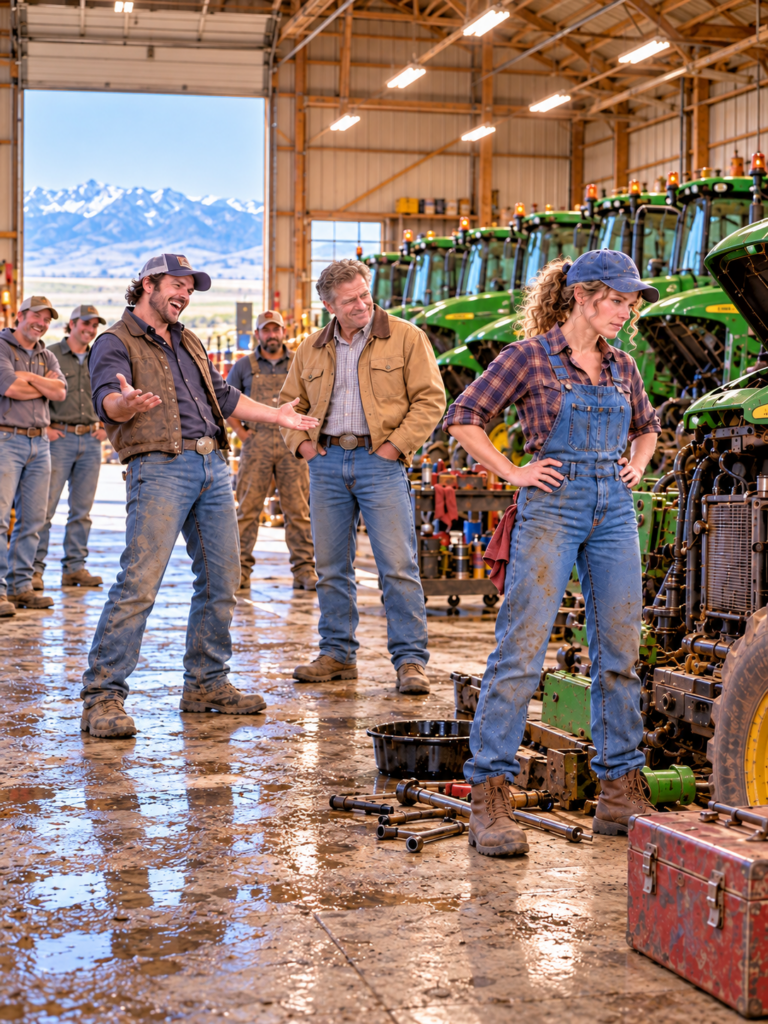
Maya Carter stood inside the machinery shed at Reeves Ranch with one hand resting on the handle of her father’s old metal toolbox. The box had once been red. Thirty years of being dragged across concrete floors, gravel lots, pickup beds, and muddy fields had worn the paint down to silver along the corners.
Clayton glanced at it, then at her.
“What makes you think you’re any different?”
Maya looked past him at the machines lined inside the shed.
“Show me.”
That answer seemed to amuse him even more.
Behind Clayton, two ranch hands leaned against a workbench. One of them lowered his head as if trying to hide a smile.
Clayton spread an arm toward the row.
Nine John Deere machines.
Tractors. A sprayer. A forage harvester. Equipment that had once represented the strength of one of the largest cattle operations in Harland County and now sat beneath a film of dust like expensive green monuments to something nobody wanted to discuss.
Clayton had already told the story around town.
Four certified mechanics had come.
Four had failed.
The machines were cursed, useless, too far gone, or built badly depending on which version Clayton happened to be telling that day.
Maya walked toward the first tractor.
She did not answer his question.
Not yet.
At twenty-six, she had learned that explanations rarely changed the minds of men who had decided what she was before she arrived.
Her father, Daniel Carter, had spent thirty years repairing agricultural equipment across the county. Farmers called him when tractors died in planting season, when irrigation pumps seized in July, when balers quit with weather moving in, or when a diesel engine produced a sound that made an experienced operator turn the key off immediately.
Daniel never owned a dealership.
There was no polished lobby at his shop, no receptionist, no line of new equipment sitting outside beneath banners.
There was only a weathered building off the county road, a gravel yard full of machinery in various stages of repair, shelves packed with parts, and several scarred toolboxes that seemed to contain exactly what he needed no matter what had broken.
He also kept notebooks.
Not organized service manuals.
Not clean diagnostic journals.
Notebooks.
Cheap ones.
Spiral-bound ones.
Old accounting ledgers someone had thrown away.
Pads advertising seed companies.
Daniel wrote observations wherever there was room.
Pressure readings. Wiring diagrams. Part numbers. Strange failures. Things customers had said. Things machines had done that made no sense until he discovered why.
When he died, those notebooks went to Maya along with the shop, the tools, a modest amount of equipment, almost no money, and a customer list that had trusted Daniel Carter far more than it trusted his daughter.
She had been twenty-two.
The first months taught her something no manual ever had.
A room changed when she walked into it alone.
Men who had watched her carry wrenches for her father since childhood suddenly asked whether there was somebody else they could talk to.
One farmer asked if her husband handled the diesel work.
Maya did not have a husband.
Another asked whether she had a man who could “look at the heavy stuff.”
At first, Maya explained.
She told them where she had learned.
She told them how long she had worked beside Daniel.
She listed repairs she had already done.
Eventually she stopped.
She learned that a running machine was a better argument.
So she fixed what came through the door.
Then she sent the invoice.
That method kept the lights on.
It did not make her successful.
The profitable jobs went to larger shops and better-known mechanics. Maya got the difficult work, the old machines, the customers with small budgets, the equipment nobody else wanted to touch, and emergencies that began with some version of, “You’re the only person who answered.”
She drove hours for individual parts.
She worked beneath machines in freezing wind.
She repaired a combine until two in the morning because rain was expected before sunrise.
Every finished job added one more quiet piece to a reputation she was building without permission from anybody.
That was why she had driven to Reeves Ranch before daylight on a Tuesday in early spring.
A parts supplier had mentioned the nine dead John Deeres two days earlier.
Four mechanics had already been involved.
The equipment had remained idle for months.
Maya heard failure.
She also heard opportunity.
One successful contract at Reeves Ranch could change the kind of work people trusted her with.
But after ten minutes inside the machinery shed, she understood that the situation was not what she had expected.
The machines had real problems.
One tractor showed fuel-pressure loss.
Another had a control-module communication error.
The sprayer had an intermittent hydraulic failure.
The forage harvester entered emergency shutdown cycles.
The largest utility tractor cranked strongly but would not remain running.
None of that was unusual on its own.
What bothered Maya were the small details.
She crouched beside one machine and studied a sensor connector.
It did not look corroded.
It looked loosened.
On another machine, a relay was installed in the wrong position.
She found a hydraulic restriction that appeared too deliberate to be normal buildup.
Then she noticed an internal service tag.
She read the signature.
Not an outside technician.
A Reeves Ranch employee.
Eight months earlier.
She checked another machine.
Another internal tag.
Same period.
By the third one, Maya stopped thinking of the breakdowns as nine unrelated mechanical failures.
Someone with access to the shed had been inside the equipment.
Recently enough to matter.
Clayton watched her from several yards away.
“What do you think?”
Maya straightened.
“I think I need more time.”
Clayton laughed softly.
“Four certified mechanics needed more time.”
She wiped her hands on a rag.
He looked toward the ranch hands.
Then he made the offer.
Maybe he wanted to embarrass her.
Maybe he wanted to turn a failing machinery shed into entertainment.
Maybe he was simply too certain to imagine consequences.
“Tell you what, Maya. You get all nine running in seven days, and the herd is yours.”
She looked at him.
“What herd?”
“The north pasture.”
“How many?”
“A hundred cows.”
One of the ranch hands laughed.
Clayton smiled.
Maya studied him carefully.
A hundred cows were not a casual wager.
Even neglected cattle had value.
But there was something peculiar in the way he said it.
Too quickly.
Too easily.
As though the animals mattered less to him than proving she could not do the work.
Maya took out her phone.
“Put it in writing.”
The laughter stopped.
Clayton’s eyebrows lifted.
“What?”
“Seven days. All nine machines operating. In return, ownership of one hundred cows from the north pasture. Put it in writing.”
For the first time, he seemed to realize she was not participating in a joke.
Then his confidence returned.
“You scared I’ll forget?”
“No.”
She met his eyes.
“I’m wondering if you’re scared you won’t.”
One of the ranch hands looked away.
Clayton’s expression tightened.
“Write it down, girl.”
“My pleasure.”
Paper appeared.
The terms were written.
Maya photographed the agreement before Clayton even finished handing back the pen.
He signed it with the casual flourish of a man documenting somebody else’s humiliation.
He never once looked toward the north pasture.
That night, Denise Carter sat at her kitchen table and read the agreement twice.
Maya’s mother had spent enough years around farmers, lenders, ranchers, equipment dealers, and county gossip to understand the difference between confidence and recklessness.
She placed the paper flat on the table.
“Men like Clayton Reeves don’t bet things they think they can lose.”
“I know.”
“So why would he put up a hundred cows?”
“I don’t know.”
“That should bother you.”
“It does.”
Denise watched her daughter.
Maya had Daniel’s habit of becoming quieter the more seriously she was thinking.
Finally Maya said, “I don’t think he’s worried about losing the cattle.”
“Then what is he worried about?”
“That’s what I want to find out.”
Before daylight the next morning, Maya was back at Reeves Ranch.
She did not begin with a wrench.
She began with her phone.
Photographs.
Serial numbers.
Wiring positions.
Relays.
Connectors.
Fluid condition.
Fuel samples.
Hydraulic lines.
Control modules.
Diagnostic screens.
Every machine was documented before she disturbed anything.
She photographed the internal service tags and matched their dates against stored fault information.
She still could not prove exactly what had happened.
But she could prove something important.
The failures did not have a single cause.
Some were ordinary mechanical neglect.
Some were poor maintenance.
And some showed evidence of human interference.
Whether Clayton had ordered it or merely allowed it, Maya did not yet know.
For the next seven days, the distinction would not matter.
She rolled her father’s tools into position beside the first tractor and started working.
By midmorning, ranch employees had begun drifting toward the machinery shed.
They pretended to be passing through.
Maya ignored them.
She worked through fuel delivery, wiring, and pressure.
She replaced what needed replacing.
She corrected what had been disturbed.
Shortly before the end of the first day, the first tractor started.
The diesel engine settled into a steady rhythm.
Maya climbed into the cab.
She drove the machine out of the shed and parked it in the sunlight.
No speech.
No celebration.
No look at Clayton.
She shut it down, walked back inside, and began on the next one.
By the afternoon of the second day, another John Deere came out.
The jokes from the ranch hands grew quieter.
Clayton began appearing more often.
He stood in the doorway.
He watched.
He offered no assistance.
Maya overheard him speaking through the thin wall of a storage bay.
“Nobody helps her.”
A ranch hand said something she could not hear.
Clayton answered more loudly.
“She made the bet. She does the work.”
That meant parts too.
Moving equipment.
Driving.
Everything.
On the third day Maya drove thirty miles for a fuel-injection component, returned to the ranch, installed it, found another problem, and then drove back to Daniel’s workshop after dark.
A required bracket was backordered.
She fabricated one herself.
At eleven that night, sparks from the grinder scattered across the old concrete floor.
Daniel’s notebooks sat only a few yards away.
Maya finished the bracket, loaded it into her pickup, returned to Reeves Ranch, and slept for roughly three hours in the cab.
Before sunrise she was working again.
The sprayer came online.
The forage harvester cleared its emergency shutdown fault.
By the end of day three, four machines were operating.
By the end of day four, five.
Her hands had swollen around the knuckles.
Her shoulders ached even while she stood still.
Grease remained beneath her fingernails no matter how often she washed.
Clayton stopped smiling when he passed the shed.
On day five, the sixth machine joined the line outside.
On day six, the seventh started.
Then the eighth.
Eight green machines now stood outside the machinery shed in a row.
Only one remained.
The largest utility tractor.
The one that had defeated everyone.
Maya connected the diagnostic equipment again.
The engine cranked perfectly.
Fuel delivery was normal.
Compression held.
Sensors responded.
The control system reported what it should.
But every time the engine approached full ignition, it shut itself down.
Maya tested one possibility after another.
Nothing.
Afternoon became evening.
The sun went down beyond the pasture.
For the first time all week, she left Reeves Ranch without solving the machine in front of her.
Clayton was standing near the barn when her pickup passed.
She did not look at him.
But she could feel his confidence returning.
Part 2
By sunrise on the seventh day, half of Harland County seemed to know what was happening at Reeves Ranch.
Pickup trucks began appearing along the fence line.
Neighboring farmers arrived without invitations.
Some stayed inside their vehicles.
Others leaned against tailgates with coffee cups in their hands, watching the machinery shed with the peculiar patience rural people reserved for storms, auctions, and public mistakes.
The ranch employees gathered too.
Clayton checked his watch.
Maya went inside.
She started from the beginning.
Fuel.
Air.
Compression.
Electrical controls.
Shutdown logic.
Sensors.
Connections.
For two hours she tested every reasonable explanation.
Nothing changed.
The tractor would nearly start.
Then something killed it.
Again.
Again.
Again.
At last Maya turned the key off and sat motionless in the cab.
She could hear muffled voices outside.
Seven days of work had come down to one machine that insisted on giving her information she could not reconcile.
She climbed down.
For a moment she simply stood beside the tractor.
Then she remembered Daniel.
Not a conversation.
A sentence.
One of those strange lines he had written in a notebook years earlier.
She had been a teenager when she first read it.
When the machine keeps giving you the wrong answer, ask who benefits from you believing it.
Daniel had not meant machinery was dishonest.
He meant people often trusted the explanation presented to them more than they trusted what the evidence actually showed.
Maya looked at the utility tractor again.
What if the failure was not where the diagnostic system said it was?
What if the shutdown was not evidence of a failing component?
What if it was being made to look like one?
She returned to the secondary electrical compartment.
She had inspected it before.
This time she went farther.
Instead of working around the rear mounting plate, she removed it completely.
Behind the plate, tucked carefully beside the factory harness, was a wire that did not belong there.
Maya stared at it.
The installation was clean.
Too clean to attract attention.
The wire had been routed into the engine-shutdown circuit in a way that could produce exactly what she had been seeing.
A false failure.
Something that would send a mechanic toward expensive internal problems while the real cause sat hidden behind a plate most people had no reason to remove.
She did not touch it.
First she photographed it.
One angle.
Then another.
Then a third.
She already had the service tags.
She already had timestamps from the fault logs.
Now she had the wire.
Only after documenting it did she remove the bypass and restore the factory connection.
Outside, Clayton checked his watch again.
Maya replaced the panel.
Climbed into the cab.
Less than five minutes remained.
She turned the key.
The engine cranked.
Caught.
And stayed running.
The sound filled the shed, deep and even.
Nobody outside needed an explanation.
Maya drove the tractor through the open doors.
Eight John Deeres were already lined up beneath the morning sun.
She parked the ninth at the end.
For several seconds there was no cheering.
The moment seemed too complete for noise.
Then conversations broke out along the fence line.
Ranch hands stared at the row of machines.
Clayton did not move.
His smile was gone.
Maya climbed down from the cab and walked toward him.
“When can I move my cattle?”
Clayton answered quickly.
“Today.”
Too quickly.
“Immediately, if you want.”
Maya studied him.
That same feeling returned.
He was angry about losing.
But not worried enough about the cattle.
“Fine.”
She took out her phone.
“I’ll start today.”
Maya called Samuel Brooks before she ever reached the north pasture.
Samuel was seventy and had known Daniel Carter since before Maya was born. He had spent much of his life around cattle and had the kind of memory that made old ear-tag numbers mean something to him years after everyone else had forgotten them.
He brought a trailer and two men.
Maya also called Dr. Rachel Hayes.
No cattle would leave Reeves Ranch until a veterinarian looked at them.
Maya expected trouble.
A neglected herd could carry every kind of expense disguised as an animal.
Parasites.
Respiratory illness.
Foot problems.
Poor nutrition.
Reproductive issues.
She was prepared for bad news.
Dr. Hayes examined the first group.
Then she paused.
“Did Reeves tell you these cows had been exposed to a bull?”
“No.”
Rachel looked back at the animal in front of her.
Then she continued.
A second cow.
A fifth.
A tenth.
The count kept rising.
By the time she finished, Rachel lowered the clipboard.
“Seventy-three.”
Maya thought she had misheard.
“Seventy-three what?”
“Seventy-three of the hundred are pregnant.”
Maya looked toward the pasture.
“Are you sure?”
Rachel gave her a tired look.
“Yes, Maya. I’m sure.”
Several pregnancies were far enough along to have begun well before Clayton made the wager.
Maya turned slowly toward the herd.
Clayton had not known.
That was her first thought.
Not because he could not have concealed it.
Because his behavior made no sense if he had understood what was standing in the field.
Nearby, Samuel was studying ear tags.
He called Maya over.
“I know some of these numbers.”
“From where?”
“Old Reeves records.”
Years earlier, Reeves Ranch had maintained a breeding program built around a strong maternal line—cows selected for calving ease, feed efficiency, and consistency.
But the ranch had changed.
Experienced employees left.
Recordkeeping deteriorated.
Cattle were shifted among groups without proper documentation.
The north pasture gradually became a place where animals ended up when nobody knew exactly where else they belonged.
Samuel looked through the herd.
“I’d want to check records before I say too much.”
“What are you thinking?”
“I’m thinking Reeves stopped keeping track of more than machinery.”
That changed the situation.
It did not simplify it.
Maya had won a hundred cows.
Seventy-three were pregnant.
Many were nutritionally behind where Maya wanted them.
Some might come from valuable bloodlines.
But cattle were not money sitting in a field.
They needed pasture.
Water.
Feed.
Veterinary care.
Fencing.
Labor.
Maya could have sold them.
That would have been the easy decision.
She could have taken the cash, paid bills, improved the repair shop, and turned Clayton’s arrogance into immediate profit.
Instead she looked at Samuel.
“You still have that rough pasture north of your place?”
“Haven’t grazed it in two seasons.”
“You willing to lease it?”
Samuel considered her.
“The well needs work.”
“I’ll fix the well.”
He smiled.
“That’s more than fair.”
They shook hands beside the fence while the first trailer was being loaded.
From the main barn, Clayton watched the cattle leave.
He did not come down.
He did not ask about the veterinary inspection.
He did not study the ear tags.
He did not seem curious about what he had lost.
Maya noticed.
So did Samuel.
The first calves began arriving in late spring.
Reality arrived with them.
One calf died during a cold April night.
The next evening Maya spent hours in the pasture with Rachel Hayes working a difficult delivery that should not have been difficult if the cow had entered calving season in better condition.
There were no miracle profits.
No clean transformation.
By November, Maya sat at Daniel’s old workbench with a ledger that refused to balance.
The herd had eaten more money than she planned.
Hay costs were higher than expected.
Infrastructure was poor.
She traded repair work for forage.
She rebuilt Samuel’s well pump instead of paying more rent.
An old livestock trailer became a mobile feeding setup after Maya cut, welded, reinforced, and modified it until it no longer looked like anything a manufacturer would sell.
It was ugly.
It worked.
That first season, survival counted as progress.
Months after the wager, Samuel began helping Maya compare the cattle’s ear tags with old records he had kept.
The pieces slowly aligned.
DNA testing on a portion of the cows strengthened what Samuel had suspected.
A meaningful share of Maya’s herd descended from the high-performing maternal line Reeves Ranch had once developed and then stopped managing.
Clayton had not hidden valuable cows in the north pasture.
He had forgotten them.
That distinction mattered to Maya.
The story around town was already changing.
Some people wanted to make Clayton more calculating than he was.
They said he had tried to trick her.
They said the broken machines had been a trap.
The evidence told a more complicated story.
Clayton’s financial problems had become serious years earlier.
Operating costs had risen.
Pastures suffered.
Good employees left.
Rather than let people see how weak the operation had become, Clayton protected the image of strength.
Publicly repairing or replacing nine major pieces of equipment required money he did not have.
More importantly, it required admitting that he did not have it.
So he directed a trusted employee to park machinery and keep it out of service while financing was negotiated privately.
Then the deception grew.
Components were disconnected.
Relays were misplaced.
Failures became more difficult to diagnose.
Eventually the bypass wire was installed on the utility tractor, creating a false internal failure expensive enough to justify leaving the machine idle.
Clayton had not built the system specifically to defeat Maya.
He had built it to protect appearances.
Then he stopped controlling it.
The same habit had damaged his cattle records.
The same habit had damaged his pastures.
The same habit had made him look at a woman carrying an old toolbox and decide he knew her value without examining the evidence.
For a while, it seemed Maya might escape the same kind of mistake.
Then the drought came.
Her second full season with the cattle turned brutally dry.
Grass browned early.
Water costs climbed.
Hay prices nearly doubled.
By then Maya owned considerably more livestock than the original one hundred cows.
Growth, which had felt like success, became a liability.
At almost the same time, three major repair customers delayed payments.
The shop had money coming.
That was not the same as having money.
Maya went to the bank.
The bank declined additional operating credit.
She went home with numbers running through her head.
Calves could be sold.
Then breeding females.
If things became bad enough, perhaps some of the original Reeves cows.
If things became worse than that, part of Daniel’s repair property.
She hated even thinking it.
Then Clayton Reeves sent an offer through an intermediary.
He had heard she was struggling.
He would buy back a substantial portion of the herd.
The amount would cover Maya’s immediate debts.
For one evening, she nearly accepted.
Denise found her in Daniel’s workshop.
The lights were on.
The ledger lay open.
Maya sat on a stool beside the workbench, staring at numbers she had already checked three times.
Denise pulled up another stool.
Neither spoke for a while.
Finally Maya said, “Maybe everybody was right.”
Her mother turned toward her.
“About what?”
“Maybe I can fix machines.”
She looked around the workshop.
“That doesn’t mean I know how to build anything.”
Denise considered that.
Then she said, “Your father fixed things his whole life.”
“I know.”
“You think that meant they never broke again?”
Maya looked at her.
Denise continued.
“Fixing something was never about making sure nothing bad happened again. It meant knowing what to do when it did.”
Maya’s eyes moved across Daniel’s shop.
The old shelves.
The tools.
Boxes of salvaged components.
His notebooks stacked near the end of the bench.
For years she had treated the repair shop and the cattle operation as two different lives.
One made money.
The other consumed it.
One came from her father.
The other came from the wager.
But sitting there that night, Maya began to see the problem differently.
Her advantage was not that she owned cattle.
Her advantage was what she knew how to do when equipment failed.
The next morning she rejected Clayton’s offer.
Then she began rebuilding her operation around the one skill nobody could easily copy.
Part 3
Maya stopped trying to operate like ranchers with more capital.
If she could not afford a new feeding system, she would not finance one simply because that was what established operators did.
She went to regional equipment auctions.
Damaged machinery sold cheaply because buyers saw repair bills.
Maya saw parts.
She bought hay-handling equipment that other people considered too rough.
She rebuilt it.
She bought portable feeders with structural damage.
She repaired them.
She assembled low-cost water-distribution equipment from components she could service herself.
She rebuilt pasture-renovation tools for a fraction of replacement cost.
The machines did not need to be beautiful.
They needed to work.
Something unexpected happened along the way.
Customers visiting the repair shop saw the equipment Maya was rebuilding for herself.
They asked who had done the work.
She had.
That brought more repair jobs.
Repair income helped carry the cattle operation.
The cattle operation became a demonstration of what the repair business could do.
For the first time, the two halves of Maya’s working life strengthened each other.
Samuel taught her pasture management.
He did it much the way Daniel had taught her diesel engines.
Not through lectures.
Through observation.
He showed her when grass was being grazed too hard.
He taught her that moving cattle at the right time mattered more than squeezing another week out of a field.
He let her make mistakes small enough to learn from.
Rachel Hayes redesigned Maya’s herd-health program around prevention instead of crisis.
Maya tracked more data.
Pregnancy rates.
Calf weights.
Feed efficiency.
Maternal consistency.
She stopped asking how many cows she could accumulate.
Instead she asked which animals deserved to remain.
Poor performers were sold.
The strongest females were retained.
The old Reeves maternal line became a foundation, not because Maya romanticized it, but because the numbers repeatedly justified keeping it.
Three years passed.
Not three lucky months.
Not one unusually good calf crop.
Three years.
The original one hundred cows became the base of an operation that grew beyond four hundred head.
The number impressed people.
The consistency mattered more.
Buyers began noticing that Carter calves were not occasionally good.
They were predictably good.
Weights stayed competitive.
Females performed.
Maternal traits carried forward.
Customers returned.
Then they began asking for Carter females by name.
That changed things in a way Maya could feel.
For years, people in Harland County had introduced her through Daniel.
Daniel Carter’s daughter.
The girl running Daniel’s shop.
Daniel’s kid who knew engines.
Now ranchers who had never met her father called because they had heard about Maya’s cattle.
Her reputation finally existed independently of the man who had taught her everything.
She named the cattle operation Carter Heritage.
The repair business continued beside it.
In Maya’s office, above the desk, she hung the original wager.
No elaborate frame.
No dramatic display.
Just the sheet of paper Clayton Reeves had signed years earlier.
Nine machines.
Seven days.
One hundred cows.
Visitors often thought she displayed it as a trophy.
They were wrong.
Five years after Clayton signed that paper, Maya arrived at one of the largest regional cattle sales of her career.
She did not bring all four hundred head.
She brought a selected offering from Carter Heritage—animals chosen because they represented the consistency she had spent years creating.
Buyers began inspecting them early.
Commercial ranchers asked questions.
Some had purchased Carter cattle before.
Others had heard about them through neighbors.
Then several representatives from a multi-state beef breeding company began spending more time around Maya’s offering than she expected.
Their questions were different.
Not whether one calf looked impressive.
Not whether a single cow had a strong production history.
They wanted records.
Maternal performance.
Consistency across seasons.
Data from previous customers.
Calving history.
Feed efficiency.
Repeatability.
Maya answered carefully.
She had learned years earlier not to oversell evidence.
The company had already been watching Carter performance through cattle owned by other producers.
What interested them was not a spectacular individual animal.
It was the pattern.
Weeks of discussion followed the sale.
Then negotiations.
The resulting proposal was larger than anything Maya had imagined when she first drove through the gates at Reeves Ranch.
A multi-year supply and genetics partnership.
If performance targets were met, the agreement had the potential to be worth several million dollars over time.
More important to Maya, it was structured so Carter Heritage could expand without surrendering control.
She read every page.
Then she read them again.
On the day the discussions became public enough to attract attention around the sale operation, Clayton Reeves was there.
His ranch no longer looked the way it once had.
The financial weakness he had hidden behind appearances had eventually become impossible to conceal.
Acreage had been sold.
Cattle numbers were down.
Several barns stood emptier than Maya remembered.
The Reeves name still meant something in the county.
But not what it had five years earlier.
Clayton watched from across the sale floor while buyers gathered near Maya.
He was older.
So was she.
The difference was not simply the passing of five years.
Maya no longer entered rooms wondering whether people believed she belonged there.
She had too much work to do to spend energy on that question.
After the bidding and conversations began to thin out, Clayton walked over.
For a moment neither of them spoke.
His eyes moved toward the Carter cattle.
Then back to Maya.
“I suppose those cows weren’t worthless after all.”
There was no laughter in his voice this time.
Maya looked at him.
“They never were.”
Clayton’s mouth tightened slightly.
She could have stopped there.
Instead she said, “You just stopped looking closely enough to see it.”
He understood.
They both did.
She was talking about the herd.
But also the machinery.
The ranch.
His employees.
His finances.
And the twenty-six-year-old woman he had looked at once and dismissed before she had opened a toolbox.
Clayton gave a small nod.
No apology came.
Maya did not need one.
Before he walked away, his attention shifted toward a young woman standing near a table a short distance behind Maya.
She was working through diagnostic information on a tablet, her expression focused, one hand blackened slightly at the fingertips from work she had done earlier that day.
Her name was Kayla Bennett.
She was twenty-one.
Three years earlier, Kayla had applied to half a dozen agricultural equipment shops around the county.
Nobody offered her a job.
Maya had hired her the week she applied.
At first Kayla handled basic work.
Then electrical diagnostics.
Then engines.
She made mistakes.
Maya corrected them.
She asked questions.
Maya answered the useful ones and sometimes made her find the answers to the others.
Now Kayla led a small group of apprentices at Carter Agricultural Repair.
Most had entered without formal credentials.
What they had was willingness, patience, and enough humility to keep learning.
Maya trained them the way Daniel had trained her.
Not by telling them constantly what they were capable of.
By giving them real work and expecting them to become capable of doing it.
Clayton watched Kayla for another second.
Then he walked away.
Years earlier, his judgment would have mattered to Maya.
Now it barely registered.
That evening she returned to her office.
Daniel’s notebooks still sat at the corner of the desk.
Some were falling apart along the bindings.
She had copied important pages, but she could never bring herself to put the originals away.
Above them hung Clayton’s wager.
Nine John Deeres.
Seven days.
One hundred cows.
His signature at the bottom.
There were days when Maya could still remember every detail of that week.
The ache in her shoulders.
Sleeping in the pickup.
Driving thirty miles for a part.
The sound of ranch hands laughing on the first morning.
The way the eighth machine looked parked outside while the ninth one refused to run.
The five minutes remaining on the final day.
The hidden wire behind the mounting plate.
The engine catching.
Clayton’s face when she drove the tractor into the sunlight.
For a long time, people assumed that was the moment the story changed.
Maya knew better.
Fixing nine machines had been difficult.
Keeping one hundred cows alive had been harder.
Keeping them through drought had been harder still.
Learning to build an operation from them had required years after the applause was gone and nobody was standing along a fence waiting to see whether she succeeded.
The wager had not made her successful.
It had simply created a door.
She still had to walk through it.
The cattle themselves had not been a miracle either.
Seventy-three pregnant cows sounded like a fortune only to someone who had never paid for hay, water, veterinary care, fencing, pasture, equipment, and losses.
Their genetics had value because Maya, Samuel, and Rachel learned what was there and managed it properly.
Clayton could have done the same.
That was the point.
The opportunity had been in front of him long before Maya arrived.
So had the problems.
He had chosen appearances over attention.
Maya had learned the opposite lesson.
Look closer.
At the machine.
At the numbers.
At the pasture.
At the animal.
At the person standing in front of you.
Daniel had understood that long before she did.
A machine telling the wrong story did not require louder guesses.
It required better questions.
Maya leaned back in her chair.
Outside the office window, lights glowed from the repair shop.
Kayla and two apprentices were finishing work on a tractor.
Farther out, beyond the buildings, Carter cattle stood in fields that had once seemed impossible for Maya to afford.
The repair business was larger now.
So was the herd.
There were more employees.
More responsibility.
More things that could break.
Maya no longer expected success to mean reaching some point where nothing failed.
She had stopped believing in that version of life.
Success meant seeing the failure clearly enough to respond before it defined you.
That was what Denise had tried to tell her during the drought.
That was what Daniel’s notebooks had been teaching her all along.
The framed wager above the desk was not proof that Maya Carter had once beaten Clayton Reeves.
It was a reminder of something more useful.
Clayton had looked at nine machines and seen worthless equipment.
He had looked at one hundred cows and seen cattle he could afford to throw into a joke.
He had looked at Maya and seen a young woman carrying her dead father’s tools, someone small enough to underestimate publicly.
Every judgment had come from the same mistake.
He had stopped looking before he actually saw what was in front of him.
Maya had nearly made her own version of that mistake during the drought.
She had looked at debt and seen failure.
She had looked at the herd and seen a burden.
She had looked at herself and wondered whether knowing how to repair things was the same as knowing how to build.
Then she looked again.
That second look changed everything.
Not overnight.
Not easily.
But permanently.
The machines had never been the most important thing she repaired.
The cattle had never been the most important thing she won.
What mattered was the boundary she stopped accepting—the one drawn by other people’s certainty about what she was qualified to become.
Daniel’s tools had given her a trade.
The hundred cows had given her an opportunity.
But the life outside that office window was something Maya had built herself, one repair, one season, one decision, and one hard-earned lesson at a time.

