
Part 1
The gavel came down, and the laughter started almost immediately.
Norah had expected whispers. Maybe a few pitying looks. She had not expected forty people in the Oak Haven municipal building to laugh at her as though she had just volunteered to crawl into a dumpster and call it home.
Which, judging by the property she had just purchased, was not far from the truth.
Mayor Higgins still had one hand resting on the wooden gavel. Under the municipal building’s buzzing fluorescent lights, his face had the waxy, tired look of a man who had been trying all morning to sell things nobody wanted.
“Sold,” he repeated, as though he needed to hear the absurdity aloud. “One dollar.”
Two rows ahead, Norah’s older brother Arthur covered his face with both hands.
That hurt more than the laughter.
Norah remained seated for a moment, her damp coat cold against her shoulders. October rain had followed everyone inside, leaving muddy footprints across the scuffed linoleum. Around her, people exchanged grins and shook their heads.
They knew her story.
Everybody in Oak Haven did.
Five years earlier, Norah had left town determined to build something of her own. She had started a logistics company in the city and poured nearly everything she possessed into it—money, time, sleep, eventually even her marriage.
For a while, the sacrifice had seemed worth it.
Then her business partner disappeared with the operating capital.
By the time the lawyers, lenders, and creditors finished with what remained, Norah owned little more than the clothes in her rusted sedan and roughly three hundred dollars.
Returning to Oak Haven had been humiliating enough.
Sleeping in her car had been worse.
But what made it unbearable was knowing Arthur was watching.
Arthur had always treated failure as a moral defect. He wore expensive wool coats, drove immaculate cars, and spoke about money with the calm authority of someone who believed success had confirmed every opinion he had ever held about himself.
Norah had once gone to him for help.
She had learned better.
At the front of the auction room, Mayor Higgins had reached Lot 42 almost apologetically.
“The old Harrelson property,” he had said, flipping through a manila folder. “Black Creek Road. Approximately 1.2 acres with original residential structure.”
People had started murmuring before he finished.
Everyone knew the place.
Elias Harrelson had been an eccentric recluse who died nearly a decade earlier with no known heirs. Afterward, the county seized his property for unpaid taxes and discovered that nobody wanted it.
The acreage was mostly marsh.
The cottage leaned.
The roof sagged.
The walls carried black mold, and several windows had been broken long enough for rain, leaves, insects, and small animals to claim the interior.
The town council had even discussed letting the fire department burn it for training rather than paying to demolish it.
“Bidding opens at one thousand dollars,” Higgins had announced.
Silence.
“Five hundred?”
Still nothing.
Arthur leaned toward the man sitting beside him and whispered something.
They laughed.
Norah stared at the floor.
She was exhausted. Cold. Nearly broke.
And so tired of being ashamed that something inside her simply stopped caring.
“One hundred?” Higgins tried.
Norah raised her hand.
“One dollar.”
The room had gone still.
Higgins peered toward the back. “I’m sorry?”
“One dollar.”
Arthur twisted around so quickly his coat scraped against the metal chair.
“Nora.”
He said her name like a warning.
Higgins looked down at his paperwork. The county had removed the reserve because of the property’s structural condition.
Technically, there was nothing preventing the bid.
“That’s legal tender,” Norah said. “I’ll give you one dollar.”
Someone barked out a laugh.
Then another.
Soon the entire room joined in.
The contractor near the aisle, Greg, laughed hardest of all.
Norah looked straight ahead.
She had spent years trying to prove she belonged among people who measured worth in square footage and bank balances. She no longer had the energy.
If a ruined house could keep her from freezing in her car, she would take it.
Ten minutes later, she handed the county clerk a crumpled dollar bill.
In return she received tax documents, transfer paperwork, and a corroded brass key.
Arthur intercepted her in the parking lot.
Rain speckled his expensive coat.
“What is wrong with you?”
Norah kept walking.
He grabbed her elbow.
“Are you trying to humiliate me?”
She pulled free.
“I bought a house.”
“You bought a condemned structure in a swamp.”
“It’s mine.”
“The foundation is sinking. There’s mold everywhere. You can’t live there.”
Norah looked at him.
His shoes were polished despite the rain.
His hair was perfect.
He seemed offended not because she might be in danger, but because other people had watched her fall.
“You don’t understand,” she said.
“Understand what?”
“It’s the only thing left in the world that belongs to me.”
She got into her sedan and drove away.
Black Creek Road lay twenty minutes beyond town, where neat neighborhoods gave way to dense coastal woods. Pavement became cracked asphalt, then gravel, then mud.
The cottage appeared through the trees like something being reclaimed by the earth.
Even knowing what to expect did not prepare her.
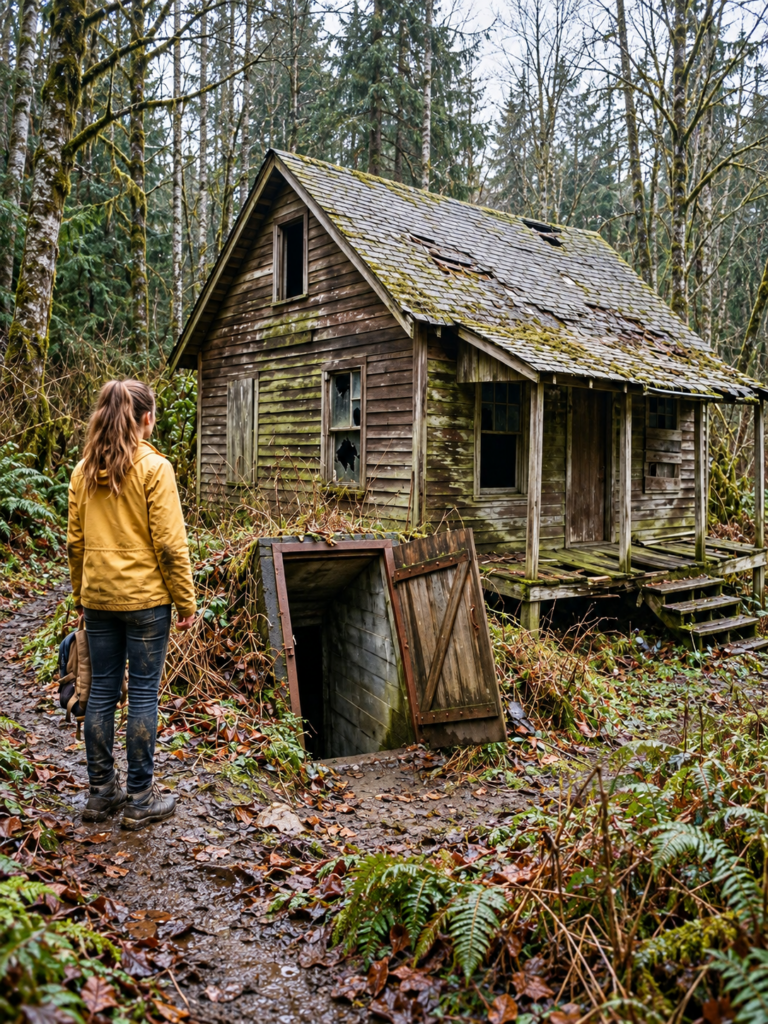
The porch listed badly to one side. Shingles peeled from the roof. Several windows were shattered. The gray exterior had darkened with moisture and decay.
Norah sat behind the wheel for nearly a minute.
Then she stepped into the rain.
Her boots sank into soft earth as she crossed the yard.
The brass key barely entered the lock.
She twisted.
Nothing.
She tried again, then planted one shoulder against the door and shoved.
The hinges shrieked.
A wave of stale air and dust rolled over her.
Inside, water dripped from the ceiling into a brown puddle. Old newspapers, cans, broken furniture, and boxes crowded the rooms.
The place smelled of wet cardboard, mildew, and abandoned things.
Norah stood in the middle of it.
She had bought a nightmare.
And yet, beneath the exhaustion and humiliation, something unexpected stirred.
Possibility.
Nobody could fire her from this place.
No creditor could repossess it tomorrow.
No landlord could demand rent she didn’t possess.
It was ruined.
But it was hers.
During the next week, the cottage tried to defeat her inch by inch.
She spent most of her remaining cash on industrial bleach, gloves, heavy trash bags, a crowbar, and a cheap sleeping bag.
By the third day, the skin across her knuckles had split.
She wrapped her hands with medical tape and kept working.
Elias Harrelson had apparently collected everything.
Waterlogged boxes.
Car parts.
Encyclopedias swollen with moisture.
Broken appliances.
Newspapers fused into solid masses.
Norah dragged load after load outside.
Cold arrived each evening before she was ready. Without functioning heat, it settled into the cottage walls and seeped through her sleeping bag.
Passing cars slowed to stare.
Teenagers tossed beer cans near the mailbox.
Oak Haven enjoyed a spectacle, and Norah had become one.
On Thursday morning, a heavy pickup turned into the driveway.
Greg.
He lowered his window as Norah wrestled a moldy mattress across the porch.
“Morning, Nora.”
She let the mattress fall.
“What do you want?”
“Arthur asked me to check on you.”
“How thoughtful.”
Greg studied the house.
“Look, I’m going to save you some time. This place is done. Joists are rotten. Foundation’s cracked. Roof’s a liability.”
Norah wiped sweat from her forehead.
“I’ll bring an excavator out,” he continued. “Clear everything. Do it close to cost. Once you’ve got bare land, maybe you can sell the lot for a couple thousand.”
“I’m not tearing it down.”
Greg laughed.
“Nora, this isn’t one of your business projects.”
Her grip tightened around the edge of the mattress.
“And I couldn’t afford you anyway.”
“Suit yourself.”
He put the truck in reverse.
“Just don’t come crying to the council when you’re freezing in December.”
His tires sprayed mud as he left.
Norah stood alone in the driveway.
For several seconds, she simply watched the truck disappear.
Then she went inside, grabbed her crowbar, and attacked the kitchen floor.
Three layers of old linoleum covered the original boards.
The bottom layer was a mustard-yellow floral pattern glued down with an adhesive so hard she had to pry away each section a few inches at a time.
She worked until her shoulders burned.
She wanted the house stripped to its bones.
Maybe Greg was right.
Maybe the place really was unsalvageable.
But she needed to know for herself.
By late afternoon, she had exposed several wide oak planks.
They were stained, but surprisingly solid.
Norah sat back on her heels.
Wind rattled somewhere above her.
Then she noticed something else.
Cold air brushed her ankle.
She looked toward the wall.
No obvious gap.
She moved her palm over the floor.
The draft was coming from below.
Norah leaned closer.
At first she thought she was looking at an ordinary seam between boards.
Then she saw a corner.
She brushed away grime.
Another straight line appeared.
Three feet.
A turn.
Another three feet.
A perfect square had been cut into the kitchen floor.
Norah’s fatigue vanished.
She scraped harder.
The outline sharpened.
Layers of linoleum had concealed it for decades.
Near the center, her crowbar struck metal.
Norah cleared away the remaining dirt with her fingers.
An iron ring lay recessed into the wood.
She stared at it.
The county documents mentioned a crawl space.
They did not mention a trap door.
Norah wrapped both hands around the ring and pulled.
Nothing.
She planted her feet and tried again.
Still nothing.
Finally she threaded the hooked end of the crowbar through the ring and leaned onto the bar with all her weight.
For a moment the floor refused to move.
Then something cracked.
Dry air escaped through the opening.
Not the smell of swamp water.
Not soil.
Not rot.
Something colder.
Metallic.
Old paper.
Norah hauled the door upward.
Beneath it, concrete stairs descended into darkness.
She stayed kneeling beside the opening.
The practical part of her mind supplied sensible explanations.
Root cellar.
Old storm shelter.
Utility access.
But the stairs were too deliberate.
She took out her phone.
Fourteen percent battery.
The flashlight illuminated poured concrete steps and cinder-block walls.
No moisture stains.
No roots.
No decay.
Whatever Elias Harrelson had neglected above ground, he had built this carefully.
Norah descended.
Fifteen steps.
At the bottom was a concrete corridor roughly thirty feet long. Rubber-coated electrical wiring ran overhead to industrial fixtures.
Metal shelving lined the walls.
Airtight drums held sealed rice, beans, and old military rations.
Elias had been preparing for disaster.
Farther along stood stacked ammunition boxes.
Norah left them untouched.
At the end of the corridor, the space opened into a larger room.
Her flashlight swept across an antique iron safe.
Then something beside it reflected the light.
Canvas bank bags were piled against the wall.
Several had split.
Rectangular metal blocks had spilled across the concrete.
Norah crouched and picked one up.
It was shockingly heavy.
Dust and tarnish covered the surface. She rubbed it with her thumb until bright metal appeared.
Stamped lettering emerged.
ENGELHARD.
100 TROY OUNCES.
.999 FINE SILVER.
Norah stopped breathing.
She checked another.
Identical.
And another.
The pile behind them was enormous.
She turned toward smaller wooden crates near the safe.
One lid had already come loose.
Inside were plastic tubes.
Norah removed one and opened it.
A gold coin slid into her palm.
American Gold Eagle.
One ounce.
The beam from her dying phone struck the coin, throwing warm light across her filthy fingers.
“Oh my God.”
Her own voice echoed through the bunker.
She stared around the room again.
The cottage above her was almost worthless.
The room beneath it held a fortune.
Norah sank onto the concrete floor and laughed.
Not because anything was funny.
Because a week earlier she had been sleeping inside a rusted sedan.
Because Arthur had buried his face in his hands when she bid one dollar.
Because Greg had offered to bulldoze the house.
Because an entire town had watched her reach what they believed was the final stage of failure.
And directly beneath their punchline, Elias Harrelson had hidden enough precious metal to rewrite her life.
Her phone dimmed.
Five percent.
The laughter stopped.
Norah’s old business instincts returned.
Nobody knew.
Which meant nobody could know.
Not yet.
She chose one silver bar, carried it upstairs, shut the trap door, and dragged the discarded mattress across the kitchen floor.
That night she sat in darkness with a crowbar beside her.
She did not sleep.
By dawn, she had made one decision.
Before she celebrated anything, she needed to know whether what she had found was real.
Part 2
Norah drove south before Oak Haven was fully awake.
She had washed her face with bottled water, changed into a clean black turtleneck and dark jeans, and wrapped the silver bar inside a wool sweater at the bottom of a canvas tote.
She bypassed the neighboring county.
Two and a half hours later, the woods opened into city traffic and commercial districts.
Norah chose a bullion dealer called Apex Numismatics and Bullion because the storefront looked serious enough to discourage amateurs.
Security glass.
Barred windows.
A buzzer at the entrance.
Inside, a man in his late sixties stood behind a reinforced counter examining coins.
He looked Norah over when she entered.
She recognized the expression.
Caution.
She probably looked like someone desperate to pawn stolen jewelry.
“I need an appraisal,” she said.
She lifted the silver bar onto the counter.
It landed with a dense thud.
The man’s expression changed.
He put on cotton gloves.
“Engelhard,” he murmured.
He inspected the stamp through a jeweler’s loupe.
“One hundred ounce extruded bar. Vintage.”
“Is it real?”
“Probably. I’ll test it.”
He glanced at Norah.
“Where did you get it?”
“An inheritance.”
The lie came easily.
“My grandfather didn’t trust banks.”
That earned a small laugh.
“Your grandfather wasn’t alone.”
He explained that the bar carried some premium because collectors liked older Engelhard pieces.
After checking the market, he looked back at her.
“Silver spot’s around thirty-two. With the premium, if the bar tests properly, I can give you thirty-four hundred dollars.”
Norah kept her expression still.
Thirty-four hundred.
For one bar.
She pictured the bunker.
The canvas bags.
The stacks.
“Cash,” she said.
The dealer drilled a tiny test hole in the back to check the metal beneath the surface.
Ten minutes later, he counted thirty-four hundred-dollar bills onto the counter.
“If you’ve inherited more of these,” he said, “I’m buying.”
Norah tucked away the money.
“I’ll remember that.”
She made it to her car before exhaling.
For the first time since her company collapsed, the cash in her pocket did not represent borrowed time.
It represented options.
Her phone rang.
Arthur.
She considered ignoring him.
Then answered.
“Where are you?” he demanded.
“Out.”
“Greg told me what happened.”
“Did he?”
“He said you refused the demolition.”
Norah looked through the windshield at pedestrians moving along the city sidewalk.
“I’m not demolishing my house.”
“It’s not a house. Higgins is sending the county building inspector Monday. They’re going to condemn it.”
Norah straightened.
Arthur continued.
“If somebody gets hurt on that property, you’ll be liable. Greg is willing to give you a thousand dollars for the deed and take care of the demolition himself. You bought it for a dollar. That’s nine hundred ninety-nine dollars profit.”
There it was again.
The certainty that her desperation gave him authority over her choices.
“Arthur.”
“What?”
“Tell Greg to go to hell.”
Silence.
“And tell Mayor Higgins that nobody enters my property without authorization.”
“Nora, you don’t have the money to fight the county.”
She almost smiled.
“I have renovations to do.”
She ended the call.
Instead of buying herself a proper meal, Norah went to an industrial hardware supplier.
Deadbolts.
Heavy hinges.
Battery-powered drill.
Motion-activated trail cameras.
Galvanized chain.
Padlocks.
By evening, the cottage looked as ruined as ever, but getting close to it had become more difficult.
Norah installed locks on both doors.
She positioned cameras among the trees.
Then she stretched chain across the driveway.
The decaying exterior no longer embarrassed her.
It protected her.
Nobody looking at the building would imagine what lay below it.
After dark, Norah opened the trap door again.
This time she carried a powerful flashlight.
She descended with a notebook.
Emotion would not help her anymore.
Numbers would.
She counted the silver first.
Sixty canvas bags.
Five one-hundred-ounce Engelhard bars in each.
Three hundred bars.
Using the price she had just received, the silver represented more than one million dollars.
Norah sat quietly for several seconds.
Then she looked toward the wooden crates.
Ten.
She opened one and counted.
Fifty tubes.
Twenty one-ounce American Gold Eagles per tube.
One thousand ounces in the crate.
Ten crates.
Ten thousand ounces.
Even valuing gold at only two thousand dollars per ounce, the total was around twenty million dollars.
Norah slowly lowered herself onto the concrete.
Twenty million.
The number felt unreal because everything above her still smelled of damp wood and mold.
A woman could not be broke upstairs and worth twenty million dollars downstairs.
Yet somehow she was.
After the shock faded, risk took its place.
The county planned to inspect the building Monday.
If they condemned it, demolition could follow.
Nobody knew the bunker existed.
One careless excavator bucket could expose everything.
Norah packed gold coins into three canvas bags.
Carrying them upstairs was miserable. The weight dragged at her shoulders and strained her back.
She placed them in the trunk beneath the spare tire.
It was only a fraction of the cache.
But it gave her enough portable wealth to act.
At seven the next morning, her phone chimed.
Motion detected.
Norah opened the trail-camera feed.
Greg’s truck stood at the driveway chain.
Greg was outside, testing the padlock.
Norah dressed, walked onto the porch, and watched him.
Eventually he noticed her.
“What is this?”
“A chain.”
“Very funny.”
“It means private property.”
Greg climbed over it.
Norah stepped down from the porch.
“Stop.”
He kept coming.
“Higgins signed the inspection order,” he said. “I’m here because somebody has to figure out how we’re getting equipment in.”
“You’re not.”
“I’m the contractor working with the council.”
“You are trespassing.”
Greg shook his head as though dealing with an unreasonable child.
Norah held up her phone.
“Three cameras are recording you.”
That stopped him.
“If you come closer to my house, I’m calling the state police. Not the local sheriff. State police. Then I’m filing a criminal trespassing complaint.”
Greg glanced toward the trees.
He spotted one camera.
For the first time since the auction, his confidence weakened.
“Arthur is trying to save you from bankruptcy.”
“Arthur doesn’t care about my bankruptcy.”
Greg’s face tightened.
“Get off my property.”
He stared at her.
Then spat into the mud, turned around, climbed over the chain, and left.
Norah watched until his truck disappeared.
On Friday she returned to the city carrying enough gold to change the nature of every conversation that followed.
She rented five safe-deposit boxes across three banks.
Then she went looking for an attorney.
Not a local lawyer.
Not someone who played golf with Higgins or had gone to high school with Arthur.
She wanted someone Oak Haven could not intimidate.
Richard Cole’s firm occupied several floors of a financial-district building where polished stone, quiet elevators, and discreet receptionists announced the price of entry before anyone presented a bill.
Cole specialized in hostile corporate disputes and aggressive land cases.
Norah sat across from his mahogany desk.
He listened without interrupting as she explained the county auction, the planned condemnation, the attempted entry, and the contractor’s pressure.
She did not tell him everything about the bunker.
Not yet.
She placed a fifty-thousand-dollar retainer on his desk.
Cole looked at the money.
Then at her.
“What outcome do you want?”
“I want the county off my land.”
“Anything else?”
“I want the ownership locked down so tightly that nobody can manufacture a reason to take it from me.”
That produced the faintest smile.
“That,” Cole said, “I can do.”
Monday arrived under freezing rain.
At nine exactly, Mayor Higgins’s black SUV stopped at the chain.
A county vehicle pulled in behind him.
The building inspector stepped out carrying a clipboard.
Norah remained inside her idling sedan, heater running, and watched.
Then a black Mercedes appeared.
Richard Cole emerged in a charcoal suit beneath a trench coat, briefcase in hand.
He walked directly toward Higgins.
The conversation could not be heard through the rain.
Norah did not need to hear it.
Cole opened his briefcase and produced documents inside a waterproof sleeve.
Temporary restraining order.
Injunctions preventing municipal entry.
A private structural engineer’s report stating that the foundation remained intact and was undergoing permitted retrofitting.
Cease-and-desist notices naming Higgins and Greg personally in connection with targeted harassment.
The inspector read several pages.
His posture changed.
Higgins argued.
Cole checked his watch.
Five minutes later, both municipal vehicles reversed away from the property.
Cole unlocked the chain and drove his Mercedes up the driveway.
Norah met him outside.
“They won’t be entering today,” he said.
He handed her a folder.
“The property has been transferred into the LLC structure we discussed. The blind trust is finalized. Taxes and outstanding obligations have been handled.”
Norah opened the folder.
For days she had been living with the irrational fear that somebody would simply announce the auction did not count.
Seeing the legal structure on paper steadied her.
“What else did you find?”
Cole looked toward the road.
“Something interesting.”
Norah waited.
“I reviewed county zoning records. Higgins recently approved a rezoning plan along Black Creek Road.”
“For what?”
“A commercial logistics center.”
The words struck differently than anything else he could have said.
Norah had spent five years in logistics.
She understood exactly what such a development could be worth.
“Who’s behind it?”
“Apex Holdings is involved.”
Cole paused.
“The primary investor in the land-acquisition phase is Arthur.”
Norah stared at him.
Rain rattled against the Mercedes.
The auction.
Greg’s offer.
Arthur insisting the building be demolished.
The sudden urgency from the county.
It rearranged itself into a single picture.
Arthur had not been embarrassed merely because his sister bought a ruin.
He needed the property.
Her property.
“How important is my parcel?” she asked.
“Potentially very.”
Cole’s expression sharpened.
“Your brother will receive notice of the injunction. Based on the development documents, failure to assemble the necessary parcels could cost him a substantial amount.”
Norah looked toward the cottage.
One dollar.
Arthur had tried to turn her desperation into his opportunity for one thousand.
“Let him receive the notice.”
Cole nodded.
“I imagine he’ll call.”
He did.
At three that afternoon.
Norah let the phone ring five times.
“What did you do?”
Arthur was almost shouting.
“Hello, Arthur.”
“Who is Richard Cole?”
“A lawyer.”
“I know he’s a lawyer. How are you paying him?”
Norah smiled faintly.
“Found some spare change.”
“Stop playing games. Do you have any idea what you’re interfering with? I have investors. Contracts. Deadlines.”
“So that’s why you wanted my land.”
Silence.
Norah continued.
“You didn’t care about the house. You wanted the parcel for your logistics center.”
“Nora, listen to me.”
“You sent Greg.”
“I was trying to make a deal.”
“You offered your bankrupt sister a thousand dollars for land you needed to make millions.”
Arthur’s voice changed.
The anger became negotiation.
“Fine. You know more now. We can be reasonable. I’ll offer one hundred thousand.”
“The property isn’t for sale.”
“Don’t be ridiculous.”
“I’m going to build a house there.”
“What?”
“A new house.”
“Nora—”
“Right where the old one stands.”
“You’ll destroy the entire development.”
“Then you should have thought about that before you tried to steal my land.”
She ended the call.
For the first time since returning to Oak Haven, Norah understood that the fight had never been about whether she could survive in a condemned cottage.
It was about who believed they had the right to decide what happened to her once she became vulnerable.
Arthur had mistaken poverty for surrender.
The town had mistaken humiliation for weakness.
Neither understood that beneath Norah’s ruined kitchen sat enough gold to ensure she would never again have to ask permission to stand her ground.
Part 3
Spring came to Black Creek Road with diesel engines.
Norah did not hire Greg.
She did not hire anyone recommended by Mayor Higgins.
Richard Cole arranged contracts with an architectural firm from the city and construction crews that arrived in clean white trucks.
The old Harrelson cottage came down slowly.
Carefully.
No excavator simply smashed through the structure.
Workers dismantled the rotting roof, walls, and framing piece by piece so nothing heavy struck the concealed bunker.
From the road, townspeople watched.
Rumors multiplied.
Some claimed Norah had found an investor.
Others decided she must have secretly married someone wealthy.
A few believed she had somehow blackmailed the mayor.
Nobody guessed the truth.
The worst house in Oak Haven had been camouflage for a private fortune.
Once the structure was gone, specialists reinforced the area above the bunker. Concrete and steel turned Elias Harrelson’s hidden shelter into part of a climate-controlled basement vault.
Norah moved carefully with the treasure.
Some of the precious metals remained secure below.
Others were transferred through legal and financial structures managed with professional help.
Money flowed into the LLC in controlled amounts sufficient to pay architects, contractors, engineers, and suppliers.
Above ground, the transformation became impossible to ignore.
Black steel framing rose where sagging timber had stood.
Walls of glass faced the marsh.
Dark cedar siding replaced mold-blackened boards.
The property that people once wanted burned for fire-department practice became the most talked-about construction project in Oak Haven.
Norah rarely reacted to the attention.
She had spent too much of her life allowing other people’s opinions to determine the temperature of her day.
Praise was no more useful than laughter if either could control her.
Arthur’s development was another matter.
The project required his land assembly to work.
Norah’s 1.2 acres sat over the stable bedrock needed for the planned highway access.
Without that route, the logistics center faced surrounding tidal ground that could not support the design as planned.
Arthur’s investors had expected him to deliver.
He could not.
At first he tried pressure.
Then negotiation.
Then lawyers.
None changed the fundamental fact.
Norah owned the land.
The injunctions held.
The property was protected.
And she had no interest in selling.
Months passed.
Investors became nervous.
Deadlines slipped.
Funding disappeared.
By September, Arthur’s lenders began calling his commercial loans.
Norah heard most of this through Cole.
She listened without celebration.
Once, she might have imagined revenge as something exhilarating.
Arthur ruined.
Arthur embarrassed.
Arthur begging.
But watching his business collapse did not restore the years Norah had lost.
It did not return her marriage.
It did not erase the night she had sat in her car wondering how much colder October would become.
Money could repair structures.
It could hire attorneys.
It could purchase security.
It could not rewrite memory.
The house was nearly finished when Arthur finally came.
Norah saw the car first.
A cheap rental.
It rattled along the new driveway and stopped below the broad concrete stairs.
Arthur stepped out.
For several seconds she almost did not recognize him.
His tailored coats were gone.
He wore a wrinkled jacket that fit poorly across his shoulders. Stubble darkened his face.
The man who had once occupied every room as though he owned part of the air now seemed reduced inside his clothes.
Norah stood on the wraparound deck holding black coffee.
The autumn breeze carried the scent of cedar and wet leaves.
Arthur climbed the steps.
His eyes moved across the enormous windows, the steel, the finished stonework.
“Nora.”
“Arthur.”
She did not invite him inside.
He looked toward the marsh.
Then at his shoes.
“The bank seized my house this morning.”
Norah said nothing.
“My company is in receivership.”
Still she waited.
“They took the cars. The accounts.”
Arthur swallowed.
“I have nothing.”
The sentence landed between them.
Norah had said almost the same thing once.
Not those exact words.
But she remembered sitting in Arthur’s immaculate living room five years earlier when the theft from her company became impossible to contain.
She had asked him for a bridge loan.
Temporary money.
Enough to keep operations alive while lawyers pursued her vanished partner.
Arthur had poured himself a drink.
Then explained that the market punished weakness.
Failure, he told her, was how inefficient businesses disappeared.
He had not offered the loan.
Now he stood on the deck of a house built over the treasure he had unknowingly tried to take from her.
“I’m sorry to hear that,” Norah said.
Arthur looked up.
“I know you have money.”
Norah took a sip of coffee.
“I don’t know where it came from. I don’t know who’s backing you. But you have it.”
His voice cracked slightly.
“I need fifty thousand dollars.”
Norah lowered the mug.
“Just enough for a bankruptcy attorney. Enough to keep this from getting worse.”
He stepped closer.
“I’m your brother.”
The words should have stirred something.
Maybe once they would have.
Instead, Norah remembered the municipal building.
Arthur covering his face while the room laughed.
She remembered him grabbing her arm in the rain.
Pathetic.
She remembered Greg arriving with an offer to tear down the house.
The county inspector appearing days later.
One thousand dollars for the deed.
Arthur had not merely refused to rescue her.
He had seen her desperation as leverage.
“You weren’t my brother at the auction,” she said.
Arthur flinched.
“You were ashamed of me.”
“I was frustrated.”
“You laughed.”
“So did everybody else.”
“Then you tried to take the land.”
Arthur rubbed both hands over his face.
“I was under pressure.”
“So was I.”
“Nora—”
“When my partner stole from me, I lost everything. I came back here with three hundred dollars. I was sleeping in my car.”
“I know.”
“No. You knew the facts. That’s different.”
Arthur looked away.
Norah continued more quietly.
“You knew I didn’t have a home. You knew winter was coming. And when you discovered I owned something you needed, you tried to buy it from me for one thousand dollars before I understood what it was worth.”
“I wasn’t thinking clearly.”
“You were thinking perfectly clearly.”
The words hung in the cold air.
Arthur’s shoulders sagged.
He looked older than Norah remembered.
“I made mistakes.”
“Yes.”
“Does that mean you let your own brother go under?”
Norah studied him.
There it was.
Not apology.
Not yet.
A request wrapped in blood relation.
He wanted family to become sacred at the exact moment it became useful to him.
Five years earlier, when Norah needed him, he had believed the market should decide whether she survived.
Now the market had reached him.
“I was desperate,” Arthur said.
Norah looked past him toward the trees lining Black Creek Road.
“So was I.”
He followed her gaze.
For a while neither spoke.
Then Norah said, “The difference is that when I hit bottom, I bought the only thing I could afford and started working on it.”
Arthur’s jaw tightened.
“You got lucky.”
Norah almost laughed.
Of course she had been lucky.
Absurdly lucky.
No amount of hard work caused twenty million dollars in gold to appear under a kitchen.
She knew that.
But luck had come after the auction.
After the business collapse.
After sleeping in the car.
After walking into a condemned house because it was the only roof she could purchase.
And even after finding the treasure, luck had not installed the locks, secured the injunctions, hired the engineer, protected the property, or stopped Greg from walking up the driveway.
She had done those things.
“Elias’s treasure was luck,” she said.
Arthur’s head snapped toward her.
Norah realized immediately what she had said.
But there was no reason to hide forever.
“What treasure?”
She looked at him.
His expression changed.
Confusion first.
Then calculation.
Then something very close to horror.
Norah reached into the pocket of her sweater.
Her fingers closed around the coin she sometimes carried there.
A tarnished American Gold Eagle.
She held it between two fingers.
Arthur stared.
“What is that?”
“You wanted to know who was backing me.”
He looked from the coin to the house.
Understanding spread slowly across his face.
“The cottage?”
Norah said nothing.
“The old man left money?”
“More than money.”
Arthur’s lips parted.
“How much?”
Norah rolled the coin across her knuckles.
His eyes followed it.
“Enough.”
Arthur turned toward the house again.
For the first time, he seemed to see not the finished walls and expensive glass, but the rotting structure that had stood there before.
The auction room.
The one-dollar bid.
Greg’s demolition offer.
The property he had nearly convinced her to surrender.
“Nora.”
She saw it instantly.
The request changing inside him.
Fifty thousand no longer seemed like much.
He now understood that his sister was not simply comfortable.
She was wealthy.
Very wealthy.
Norah closed her fingers around the coin.
“Don’t.”
His mouth shut.
Whatever argument he had been preparing died there.
She did not need to hear it.
Arthur stood on her deck while the consequences of a dozen earlier choices settled around him.
If he had helped her when her company collapsed, the story between them might have been different.
If he had shown compassion at the auction, different.
If he had offered a fair price for the land, different.
If he had simply left her alone, different.
Instead, every time Norah became more vulnerable, Arthur had treated that vulnerability as permission to press harder.
Now there was nothing left to negotiate.
“Get off my property,” Norah said.
Arthur stared at her.
She spoke without anger.
“Please leave before I call the police.”
His eyes shone, though whether from humiliation, exhaustion, or fury, Norah could not tell.
He nodded once.
Then turned.
He walked down the concrete stairs toward the rental car.
Norah watched from the deck.
Arthur did not look back.
The engine started.
The car rolled down the driveway, passed between the trees, and disappeared onto Black Creek Road.
Silence returned.
Norah remained outside.
Autumn had begun coloring the edges of the woods. The marsh grasses moved beneath the wind.
Behind her, the new house reflected the afternoon sky in enormous dark windows.
A year earlier, Norah had believed losing her company meant losing herself.
She had confused the business with proof that she mattered.
When it vanished, she had thought the people laughing in the municipal building were confirming something she already feared.
That she had failed so completely there was nothing left worth respecting.
Now she understood the danger in that belief.
Arthur had believed it too.
So had Greg.
So had Higgins.
They had assumed a woman with no money had no leverage.
A woman sleeping in her car had no choices.
A woman willing to buy a condemned cottage for one dollar must be desperate enough to accept whatever somebody offered next.
They had been wrong before Norah ever found the gold.
The treasure changed the scale of her life.
It did not create the part of her that had raised her hand at the auction.
It did not drag the first moldy mattress outside.
It did not scrape three layers of linoleum from the kitchen floor.
The woman who discovered the bunker was already the woman who had refused to disappear.
Norah looked down at the gold coin in her hand.
Elias Harrelson had hidden his fortune beneath decay because he trusted nobody.
He had allowed the house above it to rot while protecting the metals below with concrete, steel, and secrecy.
In an odd way, Norah understood him.
After betrayal, security could become an obsession.
She had spent months protecting what she found.
Locks.
Cameras.
Lawyers.
Trusts.
Vaults.
For a while, every decision had been about preventing someone from taking something else from her.
But standing outside her finished home, Norah realized she did not want the rest of her life to be organized around fear.
The money was hers.
The property was hers.
More importantly, her choices were hers.
She slipped the coin back into her pocket.
Then she picked up her coffee.
Inside the house, cedar and new plaster had replaced the smell of mold. The old kitchen was gone, but the hidden structure beneath it remained incorporated into the foundation.
Norah crossed the living room.
Late sunlight poured through the floor-to-ceiling glass.
For months people in Oak Haven had speculated about how she could afford the house.
She no longer cared whether they ever learned.
Once, she had wanted Arthur and everyone in that auction room to see her succeed.
She had imagined their expressions.
Their embarrassment.
Their regret.
But revenge had a surprisingly short half-life.
After survival came something quieter.
Freedom.
She no longer needed the town’s laughter to stop.
She simply no longer belonged to it.
A year earlier, the county had considered the Harrelson cottage worthless.
Arthur had considered Norah nearly worthless too.
Both judgments had been made from the surface.
A sagging roof.
Broken windows.
An empty bank account.
A failed company.
Things people could see.
Nobody had known what remained underneath.
Norah paused beside the dark glass and saw her reflection.
Clean jeans.
Cashmere sweater.
A house behind her that no one could take.
She remembered the woman who had walked through the rain with a corroded brass key and three hundred dollars to her name.
That woman had pushed open a rotten front door because she needed somewhere to sleep.
She had not known about Elias’s bunker.
She had not known about the silver.
She had not known that ten wooden crates of American Gold Eagles sat beneath her kitchen floor.
She had known only one thing.
The house was hers.
At the time, that had been enough.
Norah touched the coin through the fabric of her pocket.
Outside, Black Creek Road grew quiet as evening settled over the woods.
The cottage that cost one dollar was gone.
In its place stood a house nobody in Oak Haven would ever laugh at.
But Norah knew the truth.
The treasure had never been visible from the road.
Neither had she.

